
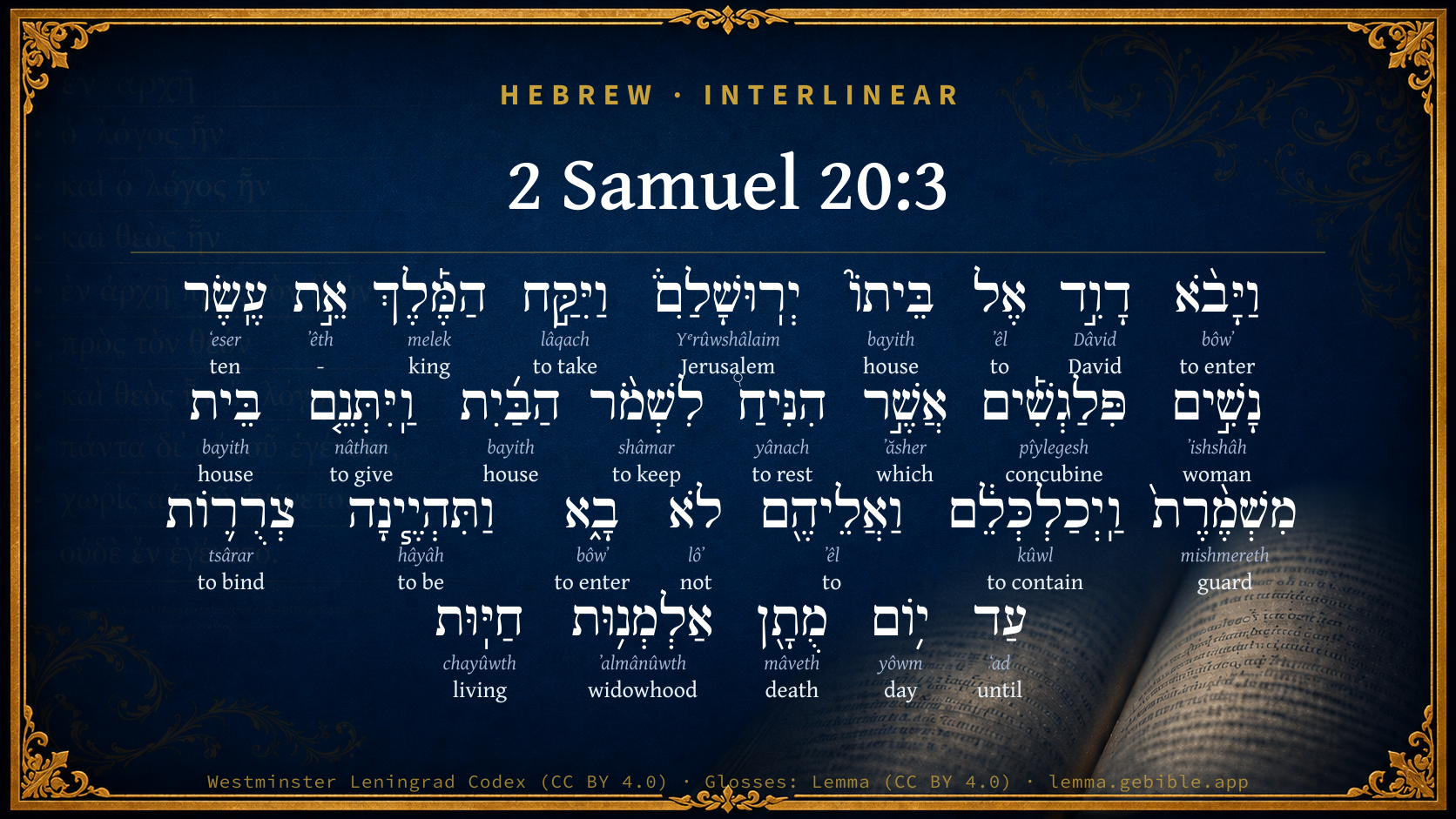
2 Samuel 20:3

Hebrew (Westminster Leningrad Codex) 2 Samuel 20:3 appears in the Hebrew Old Testament. The text above is from the Westminster Leningrad Codex. Each word links to its Strong’s number, a concise gloss, and parsing drawn from the Open Scriptures Hebrew Bible morphology. Click any word for its full Brown-Driver-Briggs (BDB) entry.
Download image
Cite this verse

2 Samuel 20:3 (World English Bible). Public Domain. Lemma interlinear Bible study tool, https://lemma.gebible.app/v/2-samuel/20/3.

Show BibTeX & RIS
BibTeX
RIS
English Translation
David came to his house at Jerusalem; and the king took the ten women his concubines, whom he had left to keep the house, and put them in custody, and provided them with sustenance, but didn't go in to them. So they were shut up to the day of their death, living in widowhood.
World English Bible · Public Domain
Highlights
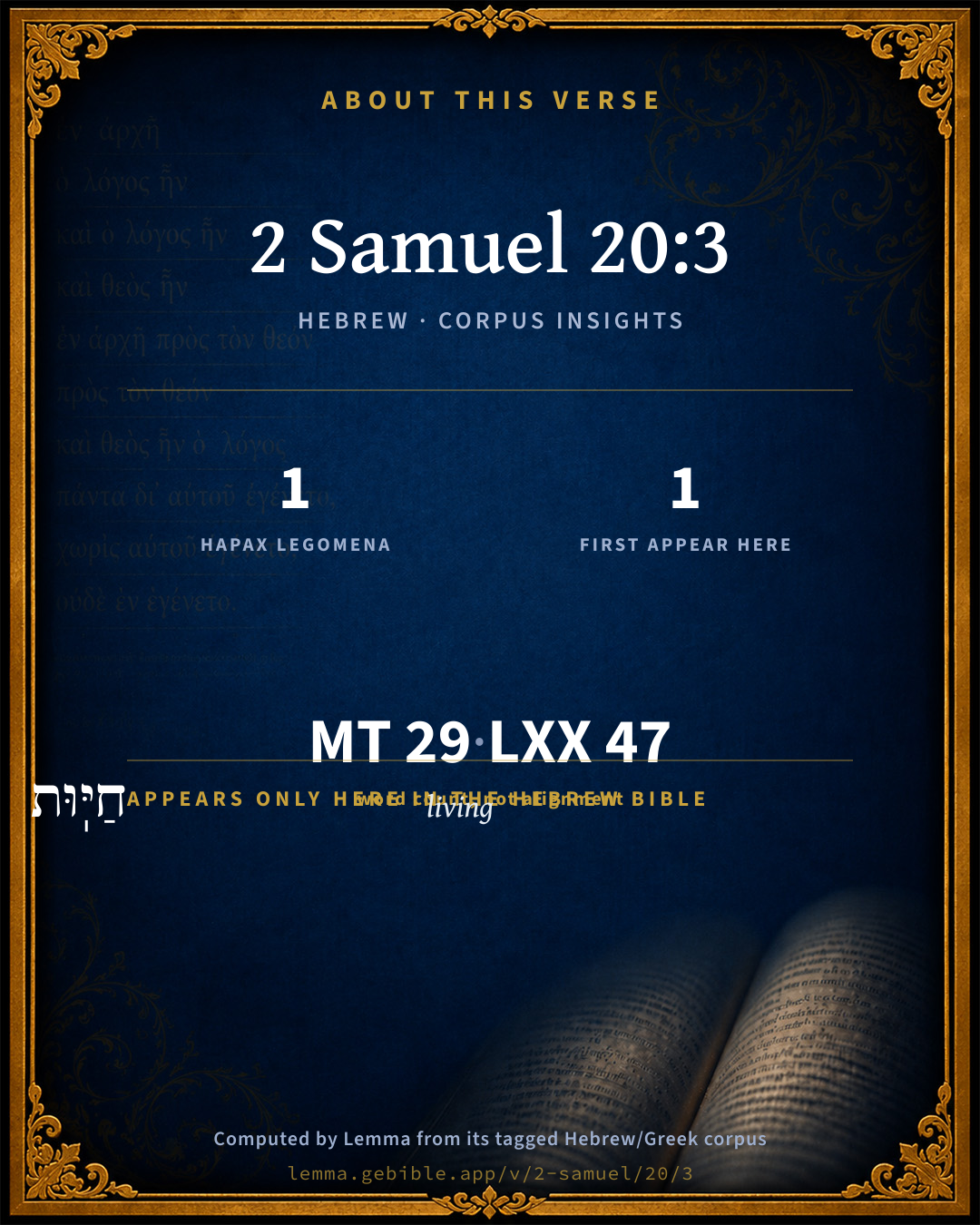
  • 1 hapax legomenon — only here in the Hebrew Bible
  • 1 first appearance in the Hebrew Bible
Full analysis ↓
Download a study sheet

One document with this verse’s original text, its word-by-word gloss line, the meaning frame, cross-references with their text, attributed commentary, and full source and license credits — printable, and it pastes into notes with its structure intact.

This verse Autodidact and up

Study sheet (.html) Plain text (.txt)

A passage Seminary Student

Up to 50 verses in one chapter. A passage sheet keeps up to 6 commentary sources and 12 cross-references per verse, in the order this page ranks them, and says so on the sheet whenever that leaves anything out. Ask for a single verse and you get the Autodidact verse sheet above.

Everything on this page stays free to read, with no account — the sheet is a download of what is already on screen, not access to it.

Want to remove ads? Support Godless Engineer
Compare translations 3

The same verse in 3 English versions, stacked beneath the original-language interlinear above. Click any original word for its lexicon entry.

Each is an independent rendering of the whole verse — the interlinear is not word-aligned to these translations.

Highlighted words mark where these versions differ — a whole-verse word diff, not a word-by-word alignment.

  • World English Bible Public Domain
    David came to his house at Jerusalem; and the king took the ten women his concubines, whom he had left to keep the house, and put them in custody, and provided them with sustenance, but didn't go in to them. So they were shut up to the day of their death, living in widowhood.
  • King James Version Public Domain
    And David came to his house at Jerusalem; and the king took the ten women his concubines, whom he had left to keep the house, and put them in ward, and fed them, but went not in unto them. So they were shut up unto the day of their death, living in widowhood.
  • unfoldingWord Literal Text CC BY-SA 4.0
    And David came to his house Jerusalem, and the king took the ten concubine wives whom he had left to keep the house, and he put them a house of keeping, and he sustained them, but he did not go in to them. And they were confined until the day of their death, a widowhood of life.

unfoldingWord Literal Text — © unfoldingWord, licensed CC BY-SA 4.0. Word-aligned USFM3 via Door43 (git.door43.org/unfoldingWord/en_ult).

Versions to compare (up to 4)

3 of 4 selected

Show all 18 translations

Every available English version of this verse, each an independent rendering of the whole verse.

  • World English Bible Public Domain
    David came to his house at Jerusalem; and the king took the ten women his concubines, whom he had left to keep the house, and put them in custody, and provided them with sustenance, but didn't go in to them. So they were shut up to the day of their death, living in widowhood.
  • Berean Standard Bible Public Domain
    When David returned to his palace in Jerusalem, he took the ten concubines he had left to care for the palace, and he placed them in a house under guard. He provided for them, but he no longer slept with them. They were confined until the day of their death, living as widows.
  • Majority Standard Bible Public Domain
    When David returned to his palace in Jerusalem, he took the ten concubines he had left to take care of the palace, and he placed them in a house under guard. He provided for them, but he no longer slept with them. They were confined until the day of their death, living as widows.
  • King James Version Public Domain
    And David came to his house at Jerusalem; and the king took the ten women his concubines, whom he had left to keep the house, and put them in ward, and fed them, but went not in unto them. So they were shut up unto the day of their death, living in widowhood.
  • American Standard Version (1901) Public Domain
    And David came to his house at Jerusalem; and the king took the ten women his concubines, whom he had left to keep the house, and put them in ward, and provided them with sustenance, but went not in unto them. So they were shut up unto the day of their death, living in widowhood.
  • Revised Version (1885) Public Domain
    And David came to his house at Jerusalem; and the king took the ten women his concubines, whom he had left to keep the house, and put them in ward, and provided them with sustenance, but went not in unto them. So they were shut up unto the day of their death, living in widowhood.
  • Geneva Bible (1599) Public Domain
    When Dauid then came to his house to Ierusalem, the King tooke the ten women his concubines, that hee had left behinde him to keepe the house, and put them in warde, and fed them, but lay no more with them: but they were enclosed vnto the day of their death, liuing in widowhode.
  • Douay-Rheims (1899) Public Domain
    And when the king was come into his house at Jerusalem, he took the ten women his concubines, whom he had left to keep the house, and put them in ward, allowing them provisions: and he went not in unto them, but they were shut up unto the day of their death living in widowhood.
  • Young's Literal Translation Public Domain
    And David cometh in unto his house at Jerusalem, and the king taketh the ten women-concubines -- whom he had left to keep the house, and putteth them in a house of ward, and sustaineth them, and unto them he hath not gone in, and they are shut up unto the day of their death, in widowhood living.
  • Literal Standard Version CC BY-SA 4.0
    And David comes to his house at Jerusalem. And the king takes the ten women-concubines whom he had left to keep the house, and puts them in a house of ward and sustains them, and he has not gone in to them, and they are shut up to the day of their death, living in widowhood.
  • Unlocked Literal Bible CC BY-SA 4.0
    When David came to his palace at Jerusalem, he took the ten slave wives whom he had left to keep the palace, and he put them in a house under guard. He provided for their needs, but he did not sleep with them any longer. So they were shut up to the day of their death, living as if they were widows.
  • unfoldingWord Literal Text CC BY-SA 4.0
    And David came to his house Jerusalem, and the king took the ten concubine wives whom he had left to keep the house, and he put them a house of keeping, and he sustained them, but he did not go in to them. And they were confined until the day of their death, a widowhood of life.
  • Darby Bible Public Domain
    And David came to his house at Jerusalem; and the king took the ten women, concubines, whom he had left to keep the house, and put them in a house of confinement and maintained them, but did not go in to them. So they were shut up unto the day of their death, living in widowhood.
  • World Messianic Bible Public Domain
    David came to his house at Jerusalem; and the king took the ten women his concubines, whom he had left to keep the house, and put them in custody and provided them with sustenance, but didn’t go in to them. So they were shut up to the day of their death, living in widowhood.
  • Webster's Bible Public Domain
    And David came to his house at Jerusalem; and the king took the ten women his concubines, whom he had left to keep the house, and put them in custody, and fed them, but went not in to them. So they were shut up to the day of their death, living in widowhood.
  • Free Bible Version CC BY-SA 4.0
    When David returned to his palace in Jerusalem, he took the ten concubines he had left to look after the palace and put them in a house under guard. He took care of their needs but he didn't sleep with them. They were imprisoned until they died, living like widows.
  • Bible in Basic English Public Domain
    And David came to his house at Jerusalem: and the king took the ten women to whom he had given the care of the house, and had them shut up, and gave them the necessaries of life, but did not go near them. So they were shut up till the day of their death, living as widows.
  • JPS Tanakh (1917) Public Domain
    And David came to his house at Jerusalem; and the king took the ten women his concubines, whom he had left to keep the house, and put them in ward, and provided them with sustenance, but went not in unto them. So they were shut up unto the day of their death, in widowhood, with their husband alive.

Literal Standard Version (2020), Covenant Press — licensed CC BY-SA 4.0. Text via the HelloAO Bible API (eBible.org). Unlocked Literal Bible (unfoldingWord) — licensed CC BY-SA 4.0. Text via the HelloAO Bible API (eBible.org). unfoldingWord Literal Text — © unfoldingWord, licensed CC BY-SA 4.0. Word-aligned USFM3 via Door43 (git.door43.org/unfoldingWord/en_ult). Free Bible Version, Dr. Jonathan Gallagher — licensed CC BY-SA 4.0. Text via the HelloAO Bible API (eBible.org).

Word by word

More ways to search: Search by grammar → Find every occurrence → Compare this word →

Practice this passage: Drill this verse → Learn its vocabulary →

חַיּֽוּת
chayûwth
H2424
“living”
Noun, Common, Feminine, Singular, Absolute
Part of Speech
Noun
Type
Common
Gender
Feminine
Number
Singular
State
Absolute
Full BDB Definition

Origin: from H2421

TWOT: 644g

living
  1. וַיָּבֹ֨א bôwʼ H935 “and · to enter” Conjunction + Verb, Qal, Sequential Imperfect, 3rd Person, Masculine, Singular
  2. דָוִ֣ד Dâvid H1732 “David” Noun, Proper
  3. אֶל ʼêl H413 “to” Preposition
  4. בֵּיתוֹ֮ bayith H1004 “house · his” Noun, Common, Masculine, Singular, Construct + Suffix, Personal, 3rd Person, Masculine, Singular
  5. יְרֽוּשָׁלִַם֒ Yᵉrûwshâlaim H3389 “Jerusalem” Noun, Proper
  6. וַיִּקַּ֣ח lâqach H3947 “and · to take” Conjunction + Verb, Qal, Sequential Imperfect, 3rd Person, Masculine, Singular
  7. הַמֶּ֡לֶךְ melek H4428 “the · king” Particle, Definite Article + Noun, Common, Masculine, Singular, Absolute
  8. אֵ֣ת ʼêth H853 “-” Particle, Direct Object
  9. עֶֽשֶׂר ʻeser H6235 “ten” Adjective, Cardinal number, Feminine, Singular, Absolute
  10. נָשִׁ֣ים ʼishshâh H802 “women” Noun, Common, Feminine, Plural, Absolute
  11. פִּלַגְשִׁ֡ים pîylegesh H6370 “concubines” Noun, Common, Feminine, Plural, Absolute
  12. אֲשֶׁ֣ר ʼăsher H834 “which” Particle, Relative
  13. הִנִּיחַ֩ yânach H3240 “to rest” Verb, Hiphil, Perfect, 3rd Person, Masculine, Singular
  14. לִשְׁמֹ֨ר shâmar H8104 “to keep” Preposition + Verb, Qal, Infinitive Construct
  15. הַבַּ֜יִת bayith H1004 “the · house” Particle, Definite Article + Noun, Common, Masculine, Singular, Absolute
  16. וַֽיִּתְּנֵ֤ם nâthan H5414 “and · to give · them” Conjunction + Verb, Qal, Sequential Imperfect, 3rd Person, Masculine, Singular + Suffix, Personal, 3rd Person, Masculine, Plural
  17. בֵּית bayith H1004 “house of” Noun, Common, Masculine, Singular, Construct
  18. מִשְׁמֶ֨רֶת֙ mishmereth H4931 “guard” Noun, Common, Feminine, Singular, Absolute
  19. וַֽיְכַלְכְּלֵ֔ם kûwl H3557 “and · to contain · them” Conjunction + Verb, Pilpel, Sequential Imperfect, 3rd Person, Masculine, Singular + Suffix, Personal, 3rd Person, Masculine, Plural
  20. וַאֲלֵיהֶ֖ם ʼêl H413 “and · to · them” Conjunction + Preposition + Suffix, Personal, 3rd Person, Masculine, Plural
  21. לֹא lôʼ H3808 “not” Particle, Negative
  22. בָ֑א bôwʼ H935 “to enter” Verb, Qal, Perfect, 3rd Person, Masculine, Singular
  23. וַתִּהְיֶ֧ינָה hâyâh H1961 “and · to be” Conjunction + Verb, Qal, Sequential Imperfect, 3rd Person, Feminine, Plural
  24. צְרֻר֛וֹת tsârar H6887 “bound” Verb, Qal, Participle Passive, Feminine, Plural, Absolute
  25. עַד ʻad H5704 “until” Preposition
  26. י֥וֹם yôwm H3117 “day of” Noun, Common, Masculine, Singular, Construct
  27. מֻתָ֖ן mâveth H4194 “death · them” Verb, Qal, Infinitive Construct + Suffix, Personal, 3rd Person, Feminine, Plural
  28. אַלְמְנ֥וּת ʼalmânûwth H491 “widowhood of” Noun, Common, Feminine, Singular, Construct

About this verse

These counts appear in no published source. They are computed here, from the morphology-tagged text and Lemma’s own curated glosses. What Lemma adds →

29
words
25
distinct lemmas
Historical
section

Notable vocabulary

1 hapax legomenon — a word that appears only here in the entire Hebrew Bible:

  • חַיּֽוּת living H2424

First appearance in Scripture

This word makes its first canonical appearance in the Hebrew Bible here:

  • חַיּֽוּת living H2424

Shared distinctive vocabulary

אַלְמְנ֥וּת widowhood H491 occurs in 4 verses of the Hebrew Bible. Also found in:

Grammatical profile

  • 10 verbs
  • 12 nouns
  • 1 adjective
  • 3 prepositions
  • 3 particles

Verb forms

  • וַיָּבֹ֨א Qal · Sequential Imperfect
  • וַיִּקַּ֣ח Qal · Sequential Imperfect
  • הִנִּיחַ֩ Hiphil · Perfect
  • לִשְׁמֹ֨ר Qal · Infinitive Construct
  • וַֽיִּתְּנֵ֤ם Qal · Sequential Imperfect
  • וַֽיְכַלְכְּלֵ֔ם Pilpel · Sequential Imperfect
  • בָ֑א Qal · Perfect
  • וַתִּהְיֶ֧ינָה Qal · Sequential Imperfect
  • צְרֻר֛וֹת Qal · Participle Passive
  • מֻתָ֖ן Qal · Infinitive Construct

Repetition

Words recur within this verse — often emphatic in Hebrew:

  • בֵּיתוֹ֮ house H1004 ×3
  • וַיָּבֹ֨א to enter H935 ×2
  • אֶל to H413 ×2

Hebrew & Septuagint length

In English translation the verse runs 54 words from the Hebrew and 56 from the Septuagint (LXX English) — closely comparable.

A rough comparison of the two English renderings, which tokenize alike — not a word-level alignment.

Word counts can differ between the Hebrew and the Greek without any difference in meaning — e.g. the Hebrew direct-object marker אֵת has no separate Greek word, and Greek often adds the article ὁ.

In the original languages it is 29 Hebrew tokens and 47 Greek tokens — but the two are counted differently (Hebrew bundles its prefixes and suffixes into one token; the Greek is in lemma form), so that isn’t a like-for-like length.

Cross-references

3

Topical passages linked to 2 Samuel 20:3 in the Treasury of Scripture Knowledge — connected by theme and wording, ordered by reader-vote popularity; previews shown in the World English Bible.

  • 2 Samuel 16:21–22 Ahithophel said to Absalom, Go in to your father's concubines, that he has left to keep the house; and all Israel will hear that you are abhorred of your father: then will the hands of all who are with you be strong.
  • 2 Samuel 15:16 The king went forth, and all his household after him. The king left ten women, who were concubines, to keep the house.
  • Genesis 40:3 He put them in custody in the house of the captain of the guard, into the prison, the place where Joseph was bound.

Cross-references courtesy of OpenBible.info (CC BY 4.0).

Hebrew and Greek witnesses Masoretic Hebrew ↔ Greek Septuagint

The same verse in the two great witnesses to the Old Testament, shown verse-for-verse.

These are two independent witnesses, not word-aligned to each other, and the Septuagint is shown in lemma (dictionary) form.

Hebrew 2 Samuel 20:3 Masoretic · Westminster Leningrad Codex

וַיָּבֹ֨א דָוִ֣ד אֶל בֵּיתוֹ֮ יְרֽוּשָׁלִַם֒ וַיִּקַּ֣ח הַמֶּ֡לֶךְ אֵ֣ת עֶֽשֶׂר נָשִׁ֣ים פִּלַגְשִׁ֡ים אֲשֶׁ֣ר הִנִּיחַ֩ לִשְׁמֹ֨ר הַבַּ֜יִת וַֽיִּתְּנֵ֤ם בֵּית מִשְׁמֶ֨רֶת֙ וַֽיְכַלְכְּלֵ֔ם וַאֲלֵיהֶ֖ם לֹא בָ֑א וַתִּהְיֶ֧ינָה צְרֻר֛וֹת עַד י֥וֹם מֻתָ֖ן אַלְמְנ֥וּת חַיּֽוּת

David came to his house at Jerusalem; and the king took the ten women his concubines, whom he had left to keep the house, and put them in custody, and provided them with sustenance, but didn't go in to them. So they were shut up to the day of their death, living in widowhood.

World English Bible · Public Domain

Greek LXX 2 Samuel 20:3 Septuagint · lemma form

καί εἰςἔρχομαι δαυίδ εἰς ὁ οἶκος αὐτός εἰς ἰερουσαλήμ καί λαμβάνω ὁ βασιλεύς ὁ δέκα γυνή ὁ παλλακή αὐτός ὅς ἀποἵημι φυλάσσω ὁ οἶκος καί δίδωμι αὐτός ἐν οἶκος φυλακή καί διατρέφω αὐτός καί πρός αὐτός οὐ εἰςἔρχομαι καί εἰμί συνἔχω ἕως ἡμέρα θάνατος αὐτός χήρα ζάω

And David went into his house at Jerusalem: and the king took the ten women his concubines, whom he had left to keep the house, and he put them in a place of custody, and maintained them, and went not in to them; and they were kept living as widows, till the day of their death.

LXX2012 (modern English Septuagint) · Public Domain

Hebrew: Westminster Leningrad Codex (CC BY 4.0). Greek: Septuagint (public domain); English from LXX2012 (modern English Septuagint) (Public Domain). How the Septuagint differs from the Hebrew →

Targum (Aramaic paraphrase)

1

The Targum is the ancient Jewish Aramaic paraphrase of the Hebrew Scriptures — an interpretive translation, not the Hebrew text itself. Onkelos (literal) and Pseudo-Jonathan (expansive) render the Torah, and Jonathan the Prophets. Coverage is partial: where no permissively-licensed English translation exists for a verse, only the Aramaic is shown. This is verse-level text, not a word-by-word alignment to the Hebrew.

  1. Targum Jonathan Prophets (Joshua–Malachi)
    וַאֲתָא דָוִד לְבֵיתֵיהּ לִירוּשְׁלֵם וּדְבַר מַלְכָּא יַת עֲסַר נְשִׁין לְחֵינָן דִי שְׁבַק לְמִטַר בֵּיתָא וּמַנִינָן בְּבֵית מַטָרָא וּמְסוֹבַר לְהֵן וּלְוַתְהֶן לָא עַל וַהֲוָאָה נְטִירָן וּמִתְקַרְיָן עַד יוֹם מוּתְהֵן אַרְמְלָן דְבַעְלֵיהֶן קַיָם:

    (no public-domain English translation for this verse)

    Targum Jonathan — Aramaic: “Mikraot Gedolot” (public domain). English: “Sefaria Community Translation” (CC0 1.0 (public-domain dedication)); “London "Chaldee Paraphrase," 1871” (public domain). Text via Sefaria.

Commentary

Notes on 2 Samuel 20:3 from classic Christian and Jewish commentators (each source and its license shown beneath its notes). The classic Christian expositions comment on the surrounding passage and are grouped to its opening verse, so a note may address several verses; the Jewish commentaries on the Tanakh (Rashi and others) are per-verse, so they appear only where the commentator wrote on this verse.

Lemma curates 59 commentaries, every one of them public domain or Creative Commons licensed, each selected and text-cleaned for this edition rather than reprinted as found. About our sources →

Trapp's Complete Commentary

John Trapp

2Sa 20:3 And David came to his house at Jerusalem; and the king took the ten women [his] concubines, whom he had left to keep the house, and put them in ward, and fed them, but went not in unto them. So they were shut up unto the day of their death, living in widowhood.

Ver. 3. And David came to his house at Jerusalem.] Which had been in his absence basely defiled, and was therefore by him newly dedicated. {Psa 30:1, title}

And put them in ward.] He committed them to perpetual, yet liberal imprisonment: because they had not rather died, as they ought to have done, than yielded to Absalom’s lust, in so public a manner especially. Pellican here observeth that David was to blame for not punishing such others, now in his power, as were either causers or consenters to that disgrace; such as was Amasa, a chief man, then about Absalom. Of one Ode Severus, Archbishop of Canterbury, A.D. 934, we read that he excommunicated King Edwin’s concubines; and caused one of them, whom the king doted unreasonably upon, to be fetched out of the court by violence, burnt her in the forehead with a hot iron, and banished her into Ireland. {a} Absalom had no such zealots about him; but what should David have done?

{a} Godw., Catal., 62.

John Trapp, A Commentary or Exposition upon All the Books of the Old and New Testament (1647–1656) — public domain. Text from a community e-Sword module.

Joseph Benson's Commentary

2Sa 20:3. But went not in unto them — He looked upon them as become impure to him, having been defiled by his son. They were shut up to the day of their death, living in widowhood — Being royal wives, it was not proper they should be married to any one else, and therefore David did not give them a bill of divorce, but shut them up close, that no man might have converse with them. And indeed it would not have been prudent to have let them be so much as seen abroad, as that would have renewed the remembrance of Absalom’s crime.

Joseph Benson's Commentary on the Old and New Testaments (1811–1818) — public domain. Text from a community e-Sword module.

The Preacher's Complete Homiletical Commentary

Joseph S. Exell (gen. ed.)

CRITICAL AND EXPOSITORY NOTES.—

2Sa_20:3. “Living in widowhood.” Lit. In widowhood of life. Probably meaning so long as their lifetime, or it may mean during the lifetime of David. “They were not divorced, for they were guiltless; but they were no longer publicly recognised as David’s wives; nor was their confinement to a sequestered life a very heavy doom in a region where women have never been accustomed to go much abroad.” (Jamieson).

2Sa_20:4. “Said to Amasa.” Thus appointing him to the position which he has promised him in 2Sa_19:13.

2Sa_20:5. “He tarried.” “Either because he met with distrust and opposition among the people, and could not so soon execute his commission; or, because he did not wish to make haste, and nourished in his breast traitorous designs.” (Erdmann).

2Sa_20:6. “Abishai.” “Joab’s was still David’s official commander-in-chief, but David speaks to Abishai rather than to him, because he wished to have nothing to do with the latter on account of his crabbedness, and further knew that be would take Amasa’s appointment ill.’ (Erdmann). “Servants, soldiers.” “The standing army in distinction from the levy of the people for which Amasa was sent.” (Erdmann). “Escape us.” The verb means “to take away,” and the phrase has been variously rendered, escape, turn away, and tear out, our eye. This latter rendering (adopted by Keil, Thenius and others) is taken to be equivalent to “severely injure us.” But it seems more probable that one of the other readings is more correct, and that the expression means to elude the sight—to escape.

2Sa_20:7. “Joab’s men.” Some have thought it strange that those who went out with Abishai should be so designated, and have, therefore, without sufficient reason, substituted Joab’s name for that of his brother in 2Sa_20:6. But from what follows, Joab appears to have marched with his brother to the field. “Cherethites.” etc. (see on 2Sa_8:18). “The mighty men.” Gibborim. “The six hundred heroes mentioned in 2Sa_15:18.” (Erdmann.)

2Sa_20:8. “The great stone,” etc. Doubtless an isolated rock of considerable size. Gibeon lay north-west of Jerusalem, in the mountains of Ephraim, whither Sheba (2Sa_20:2), had gone.” (Erdmann). “Went before,” rather came towards. “Joab’s garment.” “The minute description of Joab’s military dress and arms is intended to make it clear how he could suddenly kill Amasa without anyone’s noticing his purpose.” (Erdmann). “His loins.” “This statement receives ample illustration from the Assyrian sculptures on which warriors are depicted, their swords not upon the thigh, but on the loin or side.” (Jamieson.) “Fell out.” Josephus explains that Joab purposely allowed it to drop out so that stooping to raise it at the moment when he saluted Amasa, he might hold it naked in his hand ready for action, without exciting suspicion.

2Sa_20:9. “By the beard.” A mode of salutation in the East. Kissing the beard is also a token of great respect and goodwill. “My brother.” “He was his first cousin.” (Biblical Commentary).

2Sa_20:10. “Fifth rib.” “Rather the abdomen.” (Keil). “Joab and Abishai.” “The connection of the two favour the view that Joab had gone out at the head of the body of troops under Abishai.” (Erdmann).

2Sa_20:11. “By him,” i.e., Amasa, no doubt by Joab’s command. “He that favoureth.” etc. This was said to the men whom Amasa had gathered, and who came on ignorant at first of their leader’s fall, and then of the cause of his death. This plan of Joab identifies his cause with that of David.

MAIN HOMILETICS OF THE PARAGRAPH.—2Sa_20:3-13

DAVID’S RETURN TO JERUSALEM AND THE MURDER OF AMASA

I. The consequences of violating God’s laws are not in this life confined to him who violate them. David had no sooner returned to his city and his palace than he found himself confronted with a difficulty arising out of a double transgression. As we have before had occasion to remark (see on 1Sa_1:2, etc.), polygamy was a violation of God’s intention with regard to marriage, which brought great sorrow upon David and upon others. The practice of concubinage seems a much farther remove from the Divine ideal, and a nearer approach to the customs of the heathen nations, and must in any case have often been felt to be a hardship by the woman. But David’s great transgression entailed upon the women of his harem a heavier penalty than was common to such a position. It it true they were Eastern women, and therefore less alive to their humiliation by Absalom than women of this age and nation would be in similar circumstances, but they were women, and we have no reason to suppose they were entirely destitute of the instincts and desires proper to their sex. Upon them the consequences of David’s transgression fell very heavily, and endured to the end of life. The certainty that in this sense, as in many others, no man liveth to himself, ought to be a strong motive to keep us from forbidden paths.

II. The consciousness of even pardoned guilt makes one in power weak and cowardly towards similar offenders. One of the most bitter elements in David’s cup of affliction after his fall must have been to see his own evil deeds so faithfully imitated by those around him, and to feel unable to deal out the punishment they deserved. Amnon closely copied his adultery and Absalom his act of murder, without his being able to deal with either as he could have done if he had himself been innocent. And now when he probably hoped he had reaped the last of the harvest from that fatal sowing of sin, he sees his deed reproduced by Joab with startling similarity. The master had not scrupled to remove by violent means one who stood in his way, and it could not be expected that his less scrupulous servant would falter on the same line of action. Truly Joab had known the way before (2Sa_3:27), but he could be bolder now that David had gone the same road. David had been able to declare himself guiltless before the Lord from the blood of Abner, but he is silent concerning the death of Amasa, remembering without doubt how he had once commanded Joab to commit as cowardly a crime. It must have surely been this sense of blood-guiltiness which sealed his lips at this time, and almost compelled him henceforth to accept in silence whatever measures Joab thought fit to adopt, and to leave to his son the odious task of reckoning with him.

The Preacher's Complete Homiletical Commentary (gen. ed. Joseph S. Exell; Funk & Wagnalls, c. 1892) — public domain (pre-1929). A full-Bible homiletical/sermon-outline anthology covering 65 of 66 books (2 John is absent from the source module). Text from a community e-Sword module.

Tyndale Open Study Notes

Tyndale Open Resources

20:3 The fate of the ten concubines (15:16) whom Absalom had publicly violated (16:21-22) was like Michal’s (see 6:23 and corresponding note).

Tyndale Open Study Notes — © Tyndale Open Resources, licensed CC BY-SA 4.0. Text via the HelloAO Bible API.

Jamieson, Fausset & Brown

Robert Jamieson, A. R. Fausset & David Brown

the king took the ten women his concubines--Jewish writers say that the widowed queens of Hebrew monarchs were not allowed to marry again but were obliged to pass the rest of their lives in strict seclusion. David treated his concubines in the same manner after the outrage committed on them by Absalom. They were not divorced, for they were guiltless; but they were no longer publicly recognized as his wives; nor was their confinement to a sequestered life a very heavy doom, in a region where women have never been accustomed to go much abroad.

Jamieson, Fausset & Brown — Commentary Critical and Explanatory on the Whole Bible (1871) — public domain (CC PDM 1.0). Text via the HelloAO Bible API.

Adam Clarke's Commentary

Verse 3. The ten women] He could not well divorce them; he could not punish them, as they were not in the transgression; he could no more be familiar with them, because they had been defiled by his son; and to have married them to other men might have been dangerous to the state: therefore he shut them up and fed them - made them quite comfortable, and they continued as widows to their death.

Adam Clarke's Commentary on the Bible (1810–1826) — public domain. Text from a community e-Sword/MySword module.

Ellicott's Commentary for English Readers

(3) Living in widowhood.—This was the necessary result, under the system of polygamy, of what had happened. The clause may be understood as “in widowhood of life,” as in our version, or “in widowhood of the living,” i.e., while their husband was living, as in the Chaldee.

A Bible Commentary for English Readers, edited by Charles John Ellicott (1878–1897) — public domain. Text from a community e-Sword module.

The Cambridge Bible for Schools and Colleges

gen. ed. J. J. S. Perowne

3. David’s return to Jerusalem

3. living in widowhood] Either in widowhood for life, or as the Targum explains it, in widowhood while their husband was still alive. Since they had been appropriated by Absalom, they could no longer be regarded as members of the royal harem, nor could they be set at liberty.

The Cambridge Bible for Schools and Colleges (gen. ed. J. J. S. Perowne; Cambridge University Press, 1878–1918) — public domain. Text from a community e-Sword module.

John Gill's Exposition

And David came to his house at Jerusalem,.... His palace there, which was in that part of the city called the fort of Zion, and city of David:

and the king took the ten women his concubines, whom he had left to keep the house; when he fled from Jerusalem because of Absalom, Sa2 15:16,

and put them in ward; partly as a punishment for easily yielding to the lust of Absalom, and partly that they might not be seen, which would bring to remembrance his sin:

and fed them; he did not put them to death, nor put them away, but kept them thus confined, and made a proper provision for them, not suffering them to marry any other, and be maintained by them:

but went not in unto them: into their apartments to lie with them, having been defiled by his son, Sa2 16:22,

so they were shut up unto the day of their death; kept in the ward till they died:

living in widowhood; neither used by the king as his concubines, as they had been before, nor suffered to many any other; or "in the widowhood of life" (o), which is so expressed, to distinguish it from widowhood made by death; this was such sort of widowhood as obtained while their husband was living; so the Targum,"widows of their husband alive,''

or remaining.

(o) "in viduitate vitae", Pagninus, Montanus.

John Gill's Exposition of the Whole Bible (1746–1763) — public domain (CC PDM 1.0). Text via the HelloAO Bible API.

Haydock's Catholic Bible Commentary

Widowhood, or celibacy, (Menochius) like nuns. (Grotius; Salien) --- David could not with propriety approach to them, (Estius) as they resembled his daughters-in-law; (Leviticus xviii. 15.; Menochius) and no other person could marry them, while he was still their husband. (Haydock) --- The punishment of seclusion was very small in the East, where women seldom go out. The Jews assert, that the widows of the Hebrew kings could not marry again. (Selden, Uxor. i. 10.) --- The like custom formerly prevailed in Spain. (Council of Toledo, xiii. 3., A.D. 683.; [Council] of Saragossa, canon 5., A.D. 691.) So great was the respect for the king or the apprehension, lest those who married their widows, should aspire to the throne. (Calmet)

George Leo Haydock (1774–1849), Haydock's Catholic Family Bible and Commentary, 1859 edition — public domain. Excludes Psalms (Douay-Rheims chapter numbering differs from Protestant) and Deuterocanonical books (Catholic canon only).

Matthew Poole's English Annotations

Put them in ward; partly, because they had not vigorously opposed Absalom’s lustful desire, as they should have done, even with the hazard of their lives; and partly, lest the sight of them should renew the memory of Absalom’s filthiness, and of their own and David’s reproach, which it was fit to bury in-perpetual oblivion; and partly, because it might appear incestuous to have to do with those who had been defiled by his own son; and partly, because as David would not, so it was not now convenient that any other man should have any conjugal conversation with them.

Matthew Poole's English Annotations on the Holy Bible (1683–1685) — public domain. Text from a community e-Sword/MySword module.

Whedon's Commentary on the Bible

Daniel D. Whedon

3. Put them in ward — Shut them up in a place of security, where no one could come at them.

Fed them — Provided them with temporal comforts. “He could not well divorce them; he could not punish them, as they were not in the transgression; he could no more be familiar with them, because they had been defiled by his son; and to have married them to other men might have been dangerous to the state.” — Clarke.

Daniel D. Whedon (gen. ed.), Commentary on the Old and New Testaments (1874–1909) — public domain. Text from a community e-Sword module.

The Pulpit Commentary

They were shut up. We are not to conclude that all widows had to live in seclusion, but only that those women who belonged to the royal harem, but had been taken by another, were not allowed to return to it, but condemned to a sort of imprisonment. Living in widowhood. This is explained by the Chaldee as lasting only during David"s life, its rendering being, "in widowhood while their husband was alive."

The Pulpit Commentary (1880–1919), ed. H.D.M. Spence-Jones & Joseph S. Exell — public domain. Text from a community e-Sword module.

unfoldingWord translationNotes

Door43 World Missions Community

to keep the palace

Here the phrase "to keep" means to take care of. AT: "to take care of the palace" (See: Idiom)

in a house under guard

If a house is "under guard" it means that a guard is posted at the house. AT: "in a house and put a guard there" (See: Idiom)

they were shut up

This means that they were not allowed to leave the house. AT: "they were shut inside the house" (See: Idiom)

widows

These are women whose husbands have died.

translationWords

palace

Jerusalem

servant

had relations with

die

life

unfoldingWord translationNotes — © Distant Shores Media and the Door43 World Missions Community, licensed CC BY-SA 4.0. Source: git.door43.org/Door43/en_tn.

Lesson kit

Teaching starters — assembled from the data on this page, not authored interpretation. Every prompt links to the verse data it draws on. Edit before teaching.

2 Samuel, in the Historical, opens this verse with 29 words (25 distinct Hebrew lemmas). Its most distinctive word is chayûwth (“living”). A historical commentator’s framing appears above. Read the whole chapter for the surrounding context.

Discussion questions

  1. The word chayûwth carries the sense “living.” How does it shape the verse?
  2. This verse holds 1 word here found nowhere else in the Hebrew Bible. What might the rare word draw attention to?
  3. The word “living” first appears here in Scripture. What is being introduced at this debut?
  4. Genesis 38:14 shares the word «widowhood» with this verse. How do the two illuminate each other?
  5. “house” occurs 3× in this one verse. What is the effect of the repetition?
  6. These translations render this verse differently; the difference is in the English rendering, not the original. What questions does that raise?
  7. The verb «וַיָּבֹ֨א» is Qal Sequential Imperfect. How does its form color the action?
  8. Reading how Trapp's Complete Commentary and Joseph Benson's Commentary read this verse, where do the two commentators agree and where do they part?

Things to notice

  • 1 word in this verse appears nowhere else in the Hebrew Bible.
  • 1 word makes its first canonical appearance in Scripture here.
  • This verse counts 29 Hebrew ↔ 47 Greek words.
  • These translations choose different wording for 21 words in this verse.
  • “house” occurs 3× in this single verse.

Reading settings

Reading text

Shown beneath each verse's original-language words.

Old Testament
Old Testament edition

Read the OT as the Masoretic Hebrew (MT) or the Greek Septuagint (LXX).

English shown for the Greek Septuagint (in the Hebrew ↔ Greek comparison).

Comparing translations? Open the Compare panel on any verse page to stack up to four side by side.