Psalms 78:50

Hebrew (Westminster Leningrad Codex) Psalms 78:50 appears in the Hebrew Old Testament. The text above is from the Westminster Leningrad Codex. Each word links to its Strong’s number, a concise gloss, and parsing drawn from the Open Scriptures Hebrew Bible morphology. Click any word for its full Brown-Driver-Briggs (BDB) entry.
Download image
Cite this verse

Psalms 78:50 (World English Bible). Public Domain. Lemma interlinear Bible study tool, https://lemma.gebible.app/v/psalms/78/50.

Show BibTeX & RIS
BibTeX
RIS
English Translation
He made a path for his anger. He didn't spare their soul from death, But gave their life over to the pestilence,
World English Bible · Public Domain
Download a study sheet

One document with this verse’s original text, its word-by-word gloss line, the meaning frame, cross-references with their text, attributed commentary, and full source and license credits — printable, and it pastes into notes with its structure intact.

This verse Autodidact and up

Study sheet (.html) Plain text (.txt)

A passage Seminary Student

Up to 50 verses in one chapter. A passage sheet keeps up to 6 commentary sources and 12 cross-references per verse, in the order this page ranks them, and says so on the sheet whenever that leaves anything out. Ask for a single verse and you get the Autodidact verse sheet above.

Everything on this page stays free to read, with no account — the sheet is a download of what is already on screen, not access to it.

Want to remove ads? Support Godless Engineer
Compare translations 3

The same verse in 3 English versions, stacked beneath the original-language interlinear above. Click any original word for its lexicon entry.

Each is an independent rendering of the whole verse — the interlinear is not word-aligned to these translations.

Highlighted words mark where these versions differ — a whole-verse word diff, not a word-by-word alignment.

  • World English Bible Public Domain
    He made a path for his anger. He didn't spare their soul from death, But gave their life over to the pestilence,
  • King James Version Public Domain
    He made a way to his anger; he spared not their soul from death, but gave their life over to the pestilence;
  • unfoldingWord Literal Text CC BY-SA 4.0
    He made level a path for his anger; he did not spare their soul from death, and their life he gave over to the plague.

unfoldingWord Literal Text — © unfoldingWord, licensed CC BY-SA 4.0. Word-aligned USFM3 via Door43 (git.door43.org/unfoldingWord/en_ult).

Versions to compare (up to 4)

3 of 4 selected

Show all 18 translations

Every available English version of this verse, each an independent rendering of the whole verse.

  • World English Bible Public Domain
    He made a path for his anger. He didn't spare their soul from death, But gave their life over to the pestilence,
  • Berean Standard Bible Public Domain
    He cleared a path for His anger; He did not spare them from death but delivered their lives to the plague.
  • Majority Standard Bible Public Domain
    He cleared a path for His anger; He did not spare them from death but delivered their lives to the plague.
  • King James Version Public Domain
    He made a way to his anger; he spared not their soul from death, but gave their life over to the pestilence;
  • American Standard Version (1901) Public Domain
    He made a path for his anger; He spared not their soul from death, But gave their life over to the pestilence,
  • Revised Version (1885) Public Domain
    He made a path for his anger; he spared not their soul from death, but gave their life over to the pestilence;
  • Geneva Bible (1599) Public Domain
    He made a way to his anger: he spared not their soule from death, but gaue their life to the pestilence,
  • Douay-Rheims (1899) Public Domain
    He made a way for a path to his anger: he spared not their souls from death, and their cattle he shut up in death.
  • Young's Literal Translation Public Domain
    He pondereth a path for His anger, He kept not back their soul from death, Yea, their life to the pestilence He delivered up.
  • Literal Standard Version CC BY-SA 4.0
    He ponders a path for His anger, || He did not keep back their soul from death, || Indeed, He delivered up their life to the pestilence.
  • Unlocked Literal Bible CC BY-SA 4.0
    He leveled a path for his anger; he did not spare them from death but gave them over to the plague.
  • unfoldingWord Literal Text CC BY-SA 4.0
    He made level a path for his anger; he did not spare their soul from death, and their life he gave over to the plague.
  • Darby Bible Public Domain
    He made a way for his anger; he spared not their soul from death, but gave their life over to the pestilence;
  • World Messianic Bible Public Domain
    He made a path for his anger. He didn’t spare their soul from death, but gave their life over to the pestilence,
  • Webster's Bible Public Domain
    He made a way to his anger; he spared not their soul from death, but gave their life over to the pestilence;
  • Free Bible Version CC BY-SA 4.0
    He sent his unrestrained anger against them; he did not spare them from death, handing them over to the plague.
  • Bible in Basic English Public Domain
    He let his wrath have its way; he did not keep back their soul from death, but gave their life to disease.
  • JPS Tanakh (1917) Public Domain
    He levelled a path for His anger; He spared not their soul from death, but gave their life over to the pestilence;

Literal Standard Version (2020), Covenant Press — licensed CC BY-SA 4.0. Text via the HelloAO Bible API (eBible.org). Unlocked Literal Bible (unfoldingWord) — licensed CC BY-SA 4.0. Text via the HelloAO Bible API (eBible.org). unfoldingWord Literal Text — © unfoldingWord, licensed CC BY-SA 4.0. Word-aligned USFM3 via Door43 (git.door43.org/unfoldingWord/en_ult). Free Bible Version, Dr. Jonathan Gallagher — licensed CC BY-SA 4.0. Text via the HelloAO Bible API (eBible.org).

Word by word

More ways to search: Search by grammar → Find every occurrence → Compare this word →

Practice this passage: Drill this verse → Learn its vocabulary →

יְפַלֵּ֥ס
pâlaç
H6424
“to weigh”
Verb, Piel, Imperfect, 3rd Person, Masculine, Singular
Part of Speech
Verb
Stem
Piel
Form
Imperfect
Person
3rd Person
Gender
Masculine
Number
Singular
Full BDB Definition

Origin: a primitive root

TWOT: 1777

(Piel) to weigh, make level, balance - to weigh out - to make level or smooth
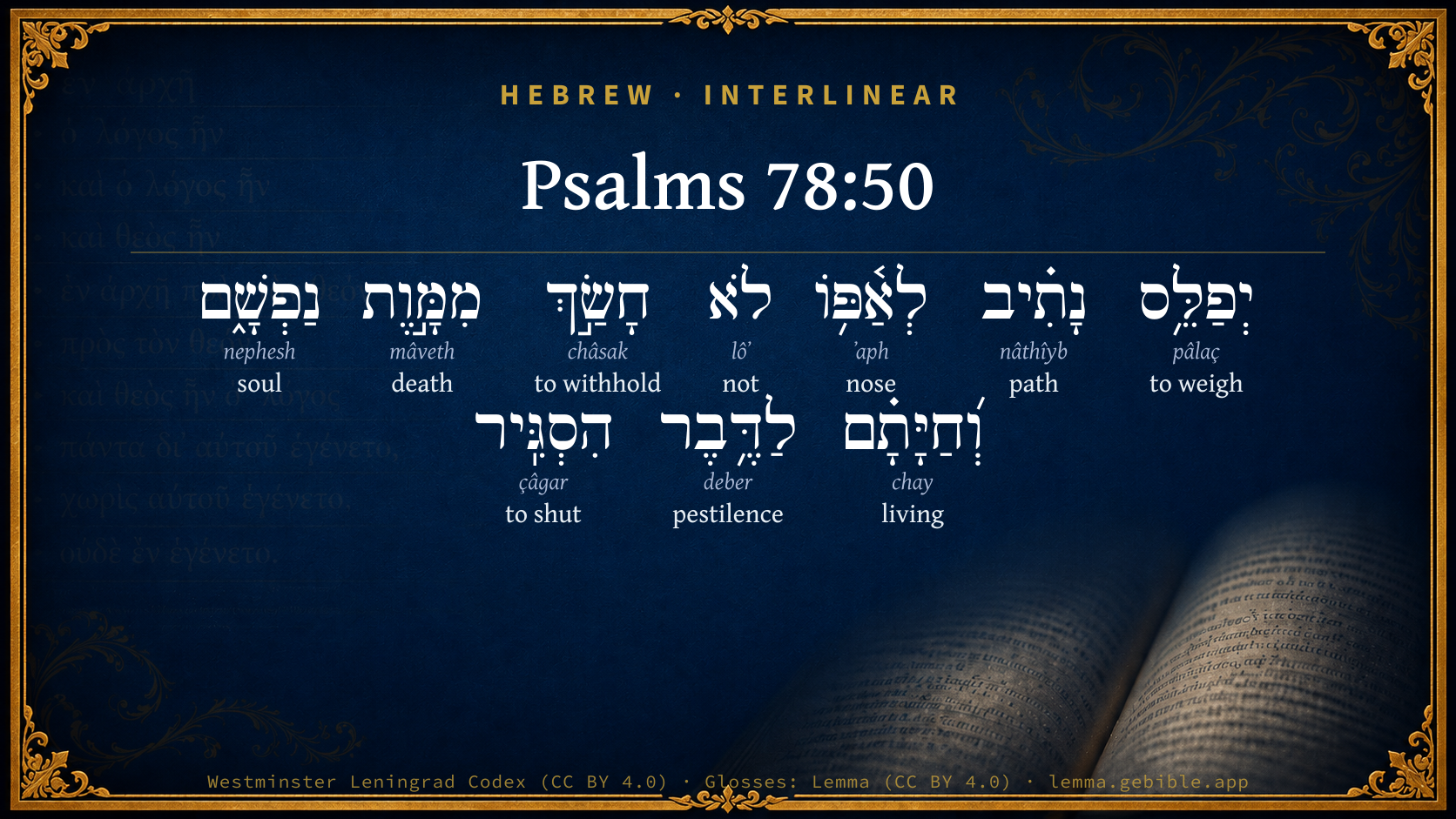
  1. נָתִ֗יב nâthîyb H5410 “path” Noun, Common, Both, Singular, Absolute
  2. לְאַ֫פּ֥וֹ ʼaph H639 “to/for · nose · his” Preposition + Noun, Common, Masculine, Singular, Construct + Suffix, Personal, 3rd Person, Masculine, Singular
  3. לֹא lôʼ H3808 “not” Particle, Negative
  4. חָשַׂ֣ךְ châsak H2820 “to withhold” Verb, Qal, Perfect, 3rd Person, Masculine, Singular
  5. מִמָּ֣וֶת mâveth H4194 “from · death” Preposition + Noun, Common, Masculine, Singular, Absolute
  6. נַפְשָׁ֑ם nephesh H5315 “soul · their” Noun, Common, Both, Singular, Construct + Suffix, Personal, 3rd Person, Masculine, Plural
  7. וְ֝חַיָּתָ֗ם chay H2416 “and · living · their” Conjunction + Noun, Common, Feminine, Singular, Construct + Suffix, Personal, 3rd Person, Masculine, Plural
  8. לַדֶּ֥בֶר deber H1698 “to/for the · pestilence” Preposition, Determined + Noun, Common, Masculine, Singular, Absolute
  9. הִסְגִּֽיר çâgar H5462 “to shut” Verb, Hiphil, Perfect, 3rd Person, Masculine, Singular

About this verse

These counts appear in no published source. They are computed here, from the morphology-tagged text and Lemma’s own curated glosses. What Lemma adds →

10
words
10
distinct lemmas
Wisdom
section

Notable vocabulary

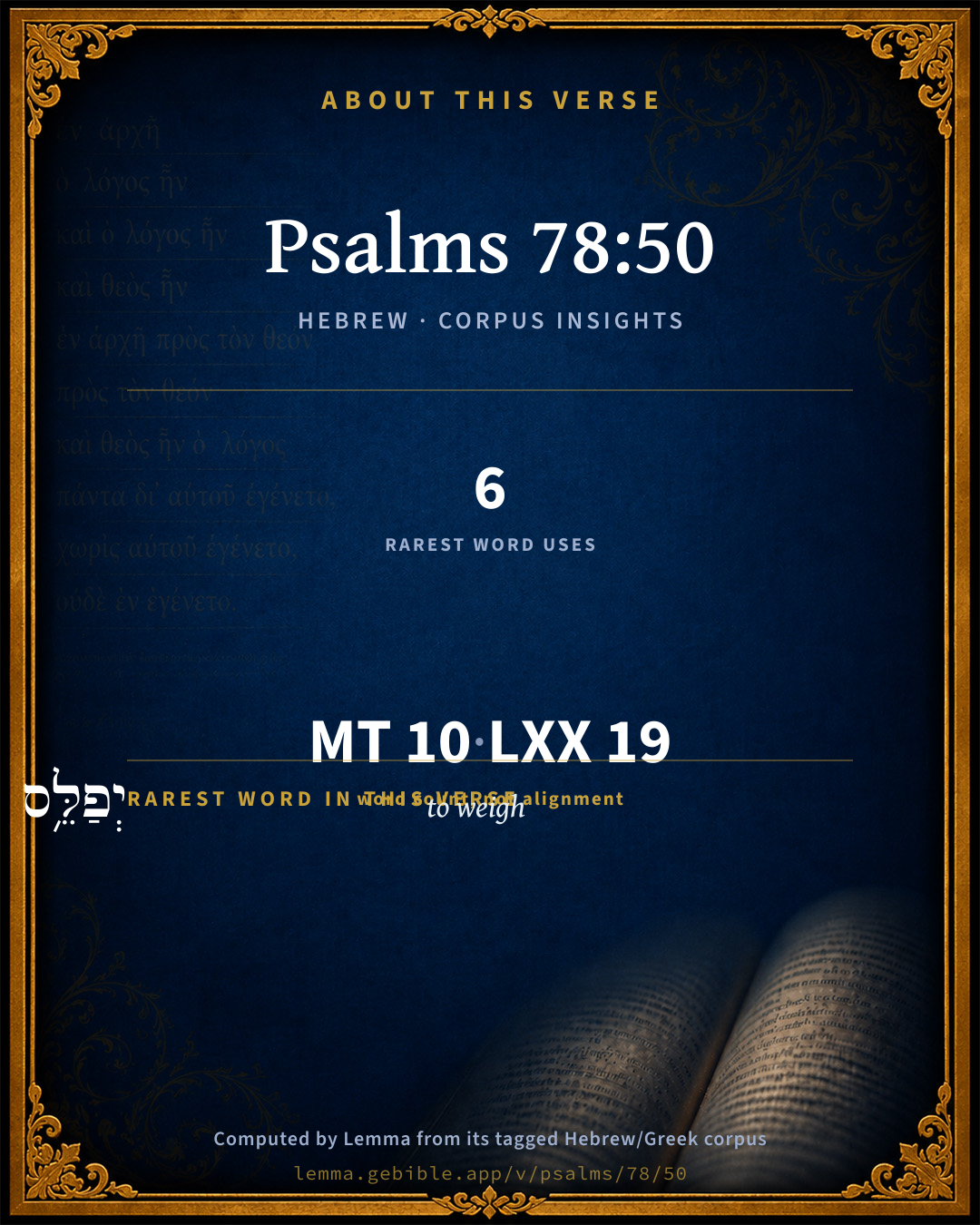
The rarest word here is יְפַלֵּ֥ס to weigh H6424 — appearing just 6 times in the whole Hebrew Bible.

Shared distinctive vocabulary

יְפַלֵּ֥ס to weigh H6424 occurs in 6 verses of the Hebrew Bible. Also found in:

Grammatical profile

  • 3 verbs
  • 6 nouns
  • 1 particle

Verb forms

  • יְפַלֵּ֥ס Piel · Imperfect
  • חָשַׂ֣ךְ Qal · Perfect
  • הִסְגִּֽיר Hiphil · Perfect

Hebrew & Septuagint length

In English translation the verse runs 22 words from the Hebrew and 20 from the Septuagint (LXX English) — closely comparable.

A rough comparison of the two English renderings, which tokenize alike — not a word-level alignment.

Word counts can differ between the Hebrew and the Greek without any difference in meaning — e.g. the Hebrew direct-object marker אֵת has no separate Greek word, and Greek often adds the article ὁ.

In the original languages it is 10 Hebrew tokens and 19 Greek tokens — but the two are counted differently (Hebrew bundles its prefixes and suffixes into one token; the Greek is in lemma form), so that isn’t a like-for-like length.

Cross-references

9

Topical passages linked to Psalms 78:50 in the Treasury of Scripture Knowledge — connected by theme and wording, ordered by reader-vote popularity; previews shown in the World English Bible.

  • Ezekiel 7:4 My eye shall not spare you, neither will I have pity; but I will bring your ways on you, and your abominations shall be in the midst of you: and you shall know that I am Yahweh.
  • 2 Peter 2:4–5 For if God didn't spare angels when they sinned, but cast them down to Tartarus, and committed them to pits of darkness, to be reserved to judgment;
  • Ezekiel 8:18 Therefore will I also deal in wrath; my eye shall not spare, neither will I have pity; and though they cry in my ears with a loud voice, yet will I not hear them.
  • Ezekiel 9:10 As for me also, my eye shall not spare, neither will I have pity, but I will bring their way on their head.
  • Romans 8:32 He who didn't spare his own Son, but delivered him up for us all, how would he not also with him freely give us all things?
  • Exodus 9:3–6 behold, the hand of Yahweh is on your cattle which are in the field, on the horses, on the donkeys, on the camels, on the herds, and on the flocks with a very grievous pestilence.
  • Job 27:22 For it hurls at him, and does not spare, As he flees away from his hand.
  • Ezekiel 5:11 Therefore, as I live, says the Lord Yahweh, surely, because you have defiled my sanctuary with all your detestable things, and with all your abominations, therefore will I also diminish [you]; neither shall my eye spare, and I also will have no pity.
  • Ezekiel 7:9 My eye shall not spare, neither will I have pity: I will bring on you according to your ways; and your abominations shall be in the midst of you; and you shall know that I, Yahweh, do strike.

Cross-references courtesy of OpenBible.info (CC BY 4.0).

Hebrew and Greek witnesses Masoretic Hebrew ↔ Greek Septuagint

The same verse in the two great witnesses to the Old Testament, shown verse-for-verse.

You’re reading Greek Psalm 77 (Hebrew Psalm 78). The Septuagint counts the superscription, so verse numbers can differ from the Hebrew — chapter-level alignment, not verse-by-verse. Numbering follows Rahlfs.

These are two independent witnesses, not word-aligned to each other, and the Septuagint is shown in lemma (dictionary) form.

Hebrew Psalms 78:50 Masoretic · Westminster Leningrad Codex

יְפַלֵּ֥ס נָתִ֗יב לְאַ֫פּ֥וֹ לֹא חָשַׂ֣ךְ מִמָּ֣וֶת נַפְשָׁ֑ם וְ֝חַיָּתָ֗ם לַדֶּ֥בֶר הִסְגִּֽיר

He made a path for his anger. He didn't spare their soul from death, But gave their life over to the pestilence,

World English Bible · Public Domain

Greek LXX Greek Psalm 77:50 Septuagint · lemma form

ὁδοποιέω τρίβων ὁ ὀργή αὐτός οὐ φείδομαι ἀπό θάνατος ὁ ψυχή αὐτός καί ὁ κτῆνος αὐτός εἰς θάνατος συνκλείω

He made a way for his wrath; he spared not their souls from death, but consigned their cattle to death;

LXX2012 (modern English Septuagint) · Public Domain

Hebrew: Westminster Leningrad Codex (CC BY 4.0). Greek: Septuagint (public domain); English from LXX2012 (modern English Septuagint) (Public Domain). How the Septuagint differs from the Hebrew →

Commentary

Notes on Psalms 78:50 from classic Christian and Jewish commentators (each source and its license shown beneath its notes). The classic Christian expositions comment on the surrounding passage and are grouped to its opening verse, so a note may address several verses; the Jewish commentaries on the Tanakh (Rashi and others) are per-verse, so they appear only where the commentator wrote on this verse.

Lemma curates 59 commentaries, every one of them public domain or Creative Commons licensed, each selected and text-cleaned for this edition rather than reprinted as found. About our sources →

Trapp's Complete Commentary

John Trapp

Psa 78:50 He made a way to his anger; he spared not their soul from death, but gave their life over to the pestilence;

Ver. 50. He made a way to his anger] Heb. He weighed a path, recompensing their unjust stiffness with his just judgments, and proceeding in his anger from lighter plagues to that heaviest of all the rest, the slaying of all the flower of Egypt in one night, Psa 78:51.

John Trapp, A Commentary or Exposition upon All the Books of the Old and New Testament (1647–1656) — public domain. Text from a community e-Sword module.

Joseph Benson's Commentary

Psa 78:50-51. He made a way to his anger — By removing every obstacle that mercy had thrown in the path of justice, he made a way for his indignation, which then rushed forth like a fiery stream. Hebrew, יפלס נתיב לאפו, He weighed a path to his anger, that is, he made a most smooth, even, and exact path, as if he had done it by weight and measure, that so his anger might pass swiftly and freely, without interruption. The phrase also may be intended to signify the wisdom and justice of God in weighing out their plagues proportionably to their sins; that is, he did not cast his anger upon them rashly, but by weight: it was weighed with the greatest exactness, in the balances of justice: and though he exercised great severity toward them, it was only such as was answerable to their great and barbarous cruelty toward his people. For in his greatest displeasure he never did, nor ever will do, any wrong to any of his creatures. The path of his anger is always weighed. He spared not their soul from death — But suffered death to ride in triumph among them; and gave their life over to the pestilence — Which cut off the thread of life immediately. And smote all the firstborn in Egypt — “An unlimited commission was given to the destroyer, who, at midnight, passed through the land, and gave the final stroke in every house.” “While all things,” says the author of the book of Wisdom, chap. Psa 18:14, “were in quiet silence, and that night was in the midst of her swift course, thine almighty word leaped down from heaven out of thy royal throne, as a fierce man of war into the midst of a land of destruction, and brought thine unfeigned commandment as a sharp sword, and, standing up, filled all things with death: and it touched the heaven, but it stood upon the earth.” Pharaoh rose up in the night, he and all his servants, and all the Egyptians, and there was a great cry throughout all the land of Egypt; “and universal consternation reigned, inferior only to that which is to extend its empire over the world, when the trumpet shall sound, and the dead shall be raised.” — Horne.

Joseph Benson's Commentary on the Old and New Testaments (1811–1818) — public domain. Text from a community e-Sword module.

J. A. Alexander on Psalms

Joseph Addison Alexander

50. (Psa 78:50) He levels a path for his anger; and he did not withhold from death their soul, and their life to the plague gave up. For the meaning of the first verb, see above, on Psa 58:2. The meaning of the figure seems to be, that he removes all hindrance to his anger and allows it free scope. Not content with having smitten their possessions and their persons, he now extends his stroke to their lives. The word translated life more usually means an animal or animals collectively. See above, on Psa 68:10; Psa 68:30; Psa 74:19. If we retain this meaning here, the verse may be referred to the death of the Egyptian cattle by the murrain (Exo 9:1-7). But the parallelism and the context rather favour the translation life, and the reference of the passage to the death of the first-born, which was probably occasioned by a pestilence (Exo 9:15) and is expressly mentioned in the next verse.

Joseph Addison Alexander, The Psalms Translated and Explained (1850) — public domain. Text from a community e-Sword module.

John Calvin's Commentaries

50. He made a way to his anger. To take away all excuse from this ungrateful people, whom the most evident and striking proofs of the goodness of God which were presented before their eyes could not keep in their obedience to him, it is here again repeated that the wrath of God overflowed Egypt like an impetuous torrent. The miracle adverted to is the last which was there wrought, when God, by the powerful hand of his angel, slew, in one night, all the first-born of Egypt. According to a common and familiar mode of speaking in the Hebrew language, the first-born are called the beginning, or the first-fruits of strength. Although the old advance to death as they decline in years, yet as they are in a manner renewed in their offspring, and thus may be said to recover their decayed strength, the term strength is applied to their children. And the first-born are called the beginning or the first-fruits of this strength, as I have explained more at large on Genesis 49:3. The houses of Egypt are called the tents of Ham, because Misraim, who gave the name to the country, was the son of Ham, Genesis 10:6. Farther, there is here celebrated the free love of God towards the posterity of Shem, as manifested in his preferring them to all the children of Ham, although they were possessed of no intrinsic excellence which might render them worthy of such a distinction.

John Calvin's Commentaries (1540-1563) — public domain. Text from the Calvin Translation Society English edition (1840s-50s) via the Christian Classics Ethereal Library (ccel.org). Calvin's coverage is partial (roughly two-thirds of the Bible); uncommented books and verses are honest gaps, never fabricated. The 19th-century editor's footnotes and remarks are omitted so the notes are faithfully Calvin's own voice.

Ellicott's Commentary for English Readers

(50) Made a way.—Literally, levelled a path. So Symmachus.

A Bible Commentary for English Readers, edited by Charles John Ellicott (1878–1897) — public domain. Text from a community e-Sword module.

The Cambridge Bible for Schools and Colleges

gen. ed. J. J. S. Perowne

50. He made a way to his anger] Lit., he levelled a path for his anger, i.e. gave it free course.

but gave their life over to the pestilence] This is the natural rendering of the words in this context. The rendering of R.V. marg., gave their beasts over to the murrain, is that of the Ancient Versions. But a reference to the murrain is out of place here, where the Psalmist is clearly describing the culmination of the plagues in the destruction of the firstborn. He emphasises the fact that after minor plagues had failed to touch Pharaoh’s conscience, God finally attacked the very lives of the Egyptians.

The Cambridge Bible for Schools and Colleges (gen. ed. J. J. S. Perowne; Cambridge University Press, 1878–1918) — public domain. Text from a community e-Sword module.

John Gill's Exposition

And smote all the firstborn in Egypt,.... From the prince to the peasant; and not only the firstborn of men, but of beasts also, Exo 12:29,

the chief of their strength; or first of it, as the firstborn is called, Gen 49:3,

in the tabernacles of Ham; in the several cities, towns, villages, and houses of the Egyptians, the descendants of cursed Ham; for Mizraim, from whom the Egyptians have their name, and from whence they sprung, was a son of Ham's, Gen 10:6. Perhaps No Ammon may be particularly meant, Nah 3:8, the same with Memphis, and which signifies the mansion or palace of Ammon, that is, Ham; and so Chemmis, another city in Egypt, signifies the same (n); of which see Psa 105:23 this was the tenth and last plague: according to Suidas (o), the plagues of Egypt continued forty days.

(n) Dickinson Delph. Phoeniciz. cap. 4. (o) In voce

John Gill's Exposition of the Whole Bible (1746–1763) — public domain (CC PDM 1.0). Text via the HelloAO Bible API.

Albert Barnes' Notes on the Bible

He made a way to his anger - Margin, he weighed a path. He leveled a path for it; he took away all hindrance to it; he allowed it to have free scope. The idea of weighing is not in the original. The allusion is to a preparation made by which one can march along freely, and without any obstruction. See the notes at Isa 40:3-4.

He spared not their soul from death - He spared not their lives. That is, he gave them over to death.

But gave their life over to the pestilence - Margin, their beasts to the murrain. The original will admit of either interpretation, but the connection seems rather to demand the interpretation which is in the text. Both these things, however, occurred.

Albert Barnes' Notes on the Bible (1834–1885) — public domain. Text from a community e-Sword/MySword module.

Matthew Poole's English Annotations

He made a way, Heb. He weighed a path or causeway, i.e. he made a most smooth, and even, and exact path, as if he had done it by weight and measure, that so his anger might pass swiftly and freely without interruption. The phrase also seems to note the wisdom and justice of God in weighing out their plagues proportionably to their sins, and exercising great severity towards them answerably to their great and barbarous cruelty towards his people.

He spared not their soul from death, i.e. he punished them with death or killing plagues, as the next words explain it.

Their life; or, their beasts. So he speaks of the murrain among their cattle. But our translation seems better to agree with the next foregoing and following passages, which plainly speak of the death of persons.

Matthew Poole's English Annotations on the Holy Bible (1683–1685) — public domain. Text from a community e-Sword/MySword module.

The Treasury of David

Charles H. Spurgeon

Ver. 50. He made a way to his anger, coming to the point with them by slow degrees; assailing their outworks first by destroying their property, and then coming in upon their persons as through an open breach in the walls. He broke down all the comforts of their life, and then advanced against their life itself. Nothing could stand in his way; he cleared a space in which to do execution upon his adversaries.

He spared not their soul from death, but gave their life over to the pestilence. In their soul was the origin of the sin, and he followed it to its source and smote it there. A fierce disease filled the land with countless funerals; Jehovah dealt out myriads of blows, and multitudes of spirits failed before him.

Ver. 50. He made a way to his anger. Literally"weighed a way:" implying that God, in punishing the Egyptians so severely, did nothing but what was just and equitable, when weighed in the balance of right. Pr 4:26. A. R. Fausset.

Ver. 50. He made a way to his anger. As if the psalmist had said, If there were not a way for his anger, that is, for the execution of his anger, he forced his way; though he did not find a way, yet he made one, and fought himself through all difficulties which seemed to oppose the destruction of his enemies. We put in the margin, he weighed a path, he made the path as exact as if he had put it into a balance; the way was fitted to the largeness of his own anger, and it was fitted to the dimensions of their wickedness. Thus he made a way to his anger, both by suiting the way to his anger and by removing all impediments out of the way of his anger. If God will work to save, who shall let it? and if God will work to destroy, who will or what shall let it? Joseph Caryl.

None.

Charles H. Spurgeon's The Treasury of David (1869–1885) — public domain. Psalms only. Text from a community e-Sword/MySword module.

The Pulpit Commentary

He made a way to his anger; literally, he levelled a way for his anger; i.e. made a smooth path for it (Cheyne). He spared not their soul from death; rather, held not back their soul. But gave their life over to the pestilence. This is, undoubtedly, the true meaning, and not "he gave their beasts over to the murrain." Though no "pestilence" is expressly mentioned in Ex 12 as having caused the death of the firstborn, yet pestilence may assuredly have been the means employed.

The Pulpit Commentary (1880–1919), ed. H.D.M. Spence-Jones & Joseph S. Exell — public domain. Text from a community e-Sword module.

unfoldingWord translationNotes

Door43 World Missions Community

General Information:

The writer continues to describe what God did to the Egyptians.

He leveled a path for his anger

The psalmist speaks of anger as if it were a person who could walk Yahweh getting ready to punish the people as if he were making a smooth road for a person to walk on. AT: "He was so angry that he did everything he could to harm them" or "It was as if his anger was an army and he made a smooth road for it to march on" (See: Metaphor and Personification)

he did not spare them from death

"he did not keep the Egyptians from dying" or "he did not permit the Egyptians to live"

gave them over to the plague

Asaph speaks of the plague as if it were a person who was going to harm the Egyptians. AT: "he made them all very ill with the plague" (See: Metaphor and Personification)

the firstborn of their strength

This phrase refers to the firstborn males of each family. AT: "the firstborn males" (See: Idiom)

in the tents of Ham

Here the word "tents" is a metonym for families. The word "Ham" refers to Egypt by the name of their ancestor. AT: "among the families of Egypt" (See: Metonymy)

translationWords

die

plague

firstborn

strength

tent

Ham

unfoldingWord translationNotes — © Distant Shores Media and the Door43 World Missions Community, licensed CC BY-SA 4.0. Source: git.door43.org/Door43/en_tn.

Rashi

Rabbi Shlomo Yitzchaki (Rashi)

He leveled a path for His anger Although the plagues were dispatched in anger, they performed only their orders; what they were commanded to kill, they killed, but nothing else. They went in their paths. In other commentaries I found as follows: He leveled a path for His anger When He smote every firstborn in Egypt, He showed the way for [the angel] who was destroying with anger to enter the houses of the Egyptians, but not the houses of the children of Israel.

...and...their body Heb. וחיתם, their body.

Rashi on the Tanakh — English translations: “The Judaica Press complete Tanach with Rashi, translated by A. J. Rosenberg” (CC BY 4.0); “Pentateuch with Rashi's commentary by M. Rosenbaum and A.M. Silbermann, 1929-1934” (public domain); “The Metsudah Tanach series, Lakewood, N.J” (CC BY 4.0); and “The Book of Joshua, Metsudah Publications, 1997” (CC BY 4.0). Text via Sefaria.

Lesson kit

Teaching starters — assembled from the data on this page, not authored interpretation. Every prompt links to the verse data it draws on. Edit before teaching.

Psalms, in the Wisdom, opens this verse with 10 words (10 distinct Hebrew lemmas). Its most distinctive word is pâlaç (“to weigh”). A historical commentator’s framing appears above. Read the whole chapter for the surrounding context.

Discussion questions

  1. What does “to weigh” (pâlaç) contribute to the verse as a whole?
  2. Psalms 58:2 shares the word «to weigh» with this verse. How do the two illuminate each other?
  3. The translations on this page render this verse differently — a whole-verse word diff, not a word-by-word alignment. What might account for the different wordings?
  4. The verb «יְפַלֵּ֥ס» is Piel Imperfect. How does its form color the action?
  5. Reading how Trapp's Complete Commentary and Joseph Benson's Commentary read this verse, where do the two commentators agree and where do they part?

Things to notice

Reading settings

Reading text

Shown beneath each verse's original-language words.

Old Testament
Old Testament edition

Read the OT as the Masoretic Hebrew (MT) or the Greek Septuagint (LXX).

English shown for the Greek Septuagint (in the Hebrew ↔ Greek comparison).

Comparing translations? Open the Compare panel on any verse page to stack up to four side by side.