
Jeremiah 15:2

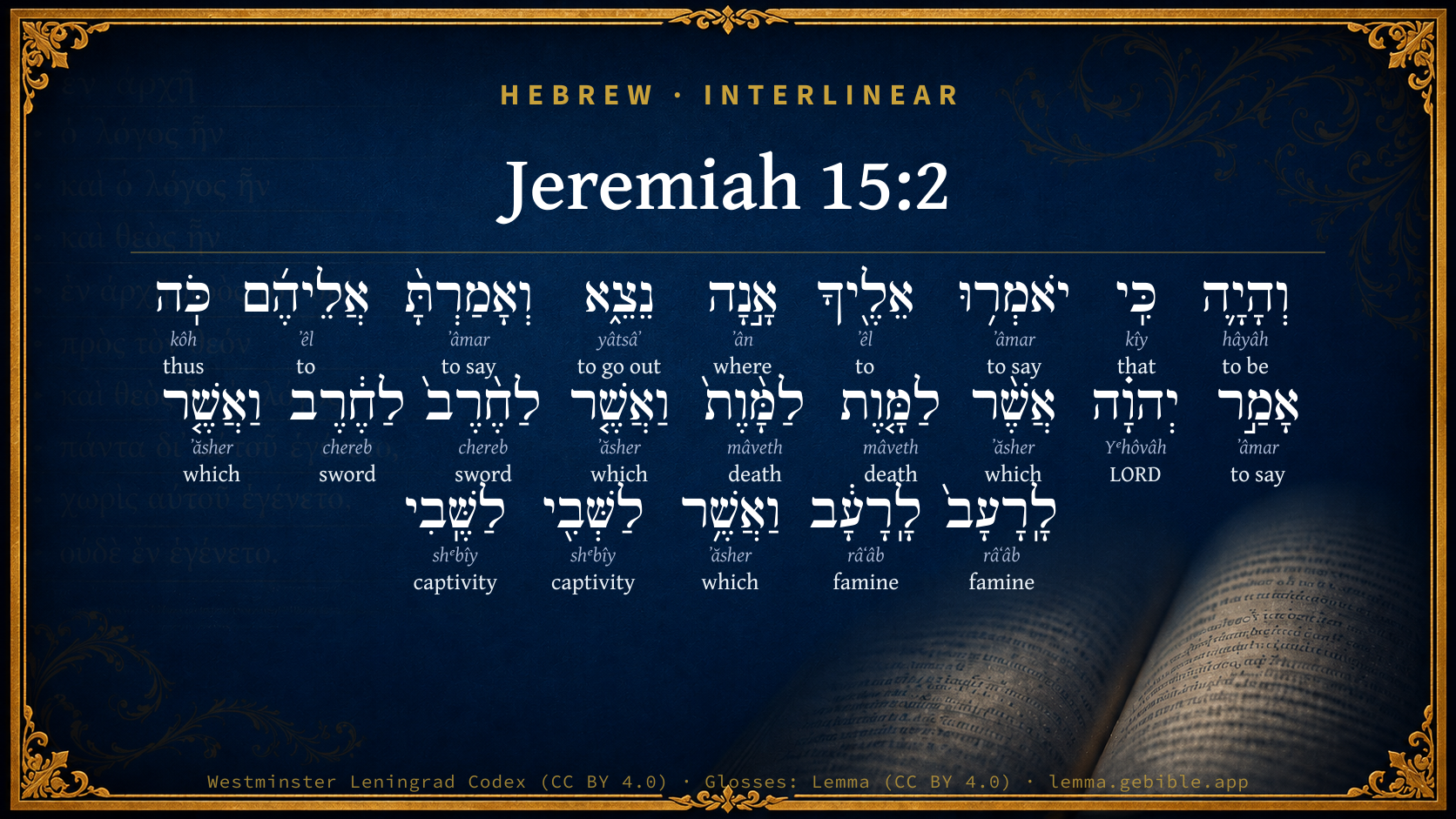
Hebrew (Westminster Leningrad Codex) Jeremiah 15:2 appears in the Hebrew Old Testament. The text above is from the Westminster Leningrad Codex. Each word links to its Strong’s number, a concise gloss, and parsing drawn from the Open Scriptures Hebrew Bible morphology. Click any word for its full Brown-Driver-Briggs (BDB) entry.
Download image
Cite this verse

Jeremiah 15:2 (World English Bible). Public Domain. Lemma interlinear Bible study tool, https://lemma.gebible.app/v/jeremiah/15/2.

Show BibTeX & RIS
BibTeX
RIS
English Translation
It shall happen, when they tell you, Where shall we go forth? then you shall tell them, Thus says Yahweh: Such as are for death, to death; and such as are for the sword, to the sword; and such as are for the famine, to the famine; and such as are for captivity, to captivity.
World English Bible · Public Domain
Download a study sheet

One document with this verse’s original text, its word-by-word gloss line, the meaning frame, cross-references with their text, attributed commentary, and full source and license credits — printable, and it pastes into notes with its structure intact.

This verse Autodidact and up

Study sheet (.html) Plain text (.txt)

A passage Seminary Student

Up to 50 verses in one chapter. A passage sheet keeps up to 6 commentary sources and 12 cross-references per verse, in the order this page ranks them, and says so on the sheet whenever that leaves anything out. Ask for a single verse and you get the Autodidact verse sheet above.

Everything on this page stays free to read, with no account — the sheet is a download of what is already on screen, not access to it.

Want to remove ads? Support Godless Engineer
Compare translations 3

The same verse in 3 English versions, stacked beneath the original-language interlinear above. Click any original word for its lexicon entry.

Each is an independent rendering of the whole verse — the interlinear is not word-aligned to these translations.

Highlighted words mark where these versions differ — a whole-verse word diff, not a word-by-word alignment.

  • World English Bible Public Domain
    It shall happen, when they tell you, Where shall we go forth? then you shall tell them, Thus says Yahweh: Such as are for death, to death; and such as are for the sword, to the sword; and such as are for the famine, to the famine; and such as are for captivity, to captivity.
  • King James Version Public Domain
    And it shall come to pass, if they say unto thee, Whither shall we go forth? then thou shalt tell them, Thus saith the LORD; Such as are for death, to death; and such as are for the sword, to the sword; and such as are for the famine, to the famine; and such as are for the captivity, to the captivity.
  • unfoldingWord Literal Text CC BY-SA 4.0
    And it shall be, if they say to you, ‘Where should we go?’ Then you shall tell them, ‘Thus says Yahweh: “ who for death to death and who for the sword to the sword and who for the famine to the famine and who for the captivity to the captivity.”’

unfoldingWord Literal Text — © unfoldingWord, licensed CC BY-SA 4.0. Word-aligned USFM3 via Door43 (git.door43.org/unfoldingWord/en_ult).

Versions to compare (up to 4)

3 of 4 selected

Show all 18 translations

Every available English version of this verse, each an independent rendering of the whole verse.

  • World English Bible Public Domain
    It shall happen, when they tell you, Where shall we go forth? then you shall tell them, Thus says Yahweh: Such as are for death, to death; and such as are for the sword, to the sword; and such as are for the famine, to the famine; and such as are for captivity, to captivity.
  • Berean Standard Bible Public Domain
    If they ask you, ‘Where shall we go?’ you are to tell them that this is what the LORD says: ‘Those destined for death, to death; those destined for the sword, to the sword; those destined for famine, to famine; and those destined for captivity, to captivity.’
  • Majority Standard Bible Public Domain
    If they ask you, ‘Where shall we go?’ you are to tell them that this is what the LORD says: ‘Those destined for death, to death; those destined for the sword, to the sword; those destined for famine, to famine; and those destined for captivity, to captivity.’
  • King James Version Public Domain
    And it shall come to pass, if they say unto thee, Whither shall we go forth? then thou shalt tell them, Thus saith the LORD; Such as are for death, to death; and such as are for the sword, to the sword; and such as are for the famine, to the famine; and such as are for the captivity, to the captivity.
  • American Standard Version (1901) Public Domain
    And it shall come to pass, when they say unto thee, Whither shall we go forth? then thou shalt tell them, Thus saith Jehovah: Such as are for death, to death; and such as are for the sword, to the sword; and such as are for the famine, to the famine; and such as are for captivity, to captivity.
  • Revised Version (1885) Public Domain
    And it shall come to pass, when they say unto thee, Whither shall we go forth? then thou shalt tell them, Thus saith the LORD: Such as are for death, to death; and such as are for the sword, to the sword; and such as are for the famine, to the famine; and such as are for captivity, to captivity.
  • Geneva Bible (1599) Public Domain
    And if they say vnto thee, Whither shall we depart? then tell them, Thus saith the Lord, Such as are appointed to death, vnto death: and such as are for the sworde, to the sworde: and such as are for the famine, to the famine: and such as are for the captiuitie, to the captiuitie.
  • Douay-Rheims (1899) Public Domain
    And if they shall say unto thee: Whither shall we go forth? thou shalt say to them: Thus saith the Lord: Such as are for death, to death: and such as are to the sword, to the sword: and such as are for famine, to famine: and such as are to captivity, to captivity.
  • Young's Literal Translation Public Domain
    And it hath come to pass, when they say to thee, Whither do we go out? that thou hast said unto them, Thus said Jehovah: Those who `are' for death -- to death, And those who are for the sword, to the sword, And those who are for famine, to famine, And those who are for captivity, to captivity.
  • Literal Standard Version CC BY-SA 4.0
    And it has come to pass, when they say to you, || To where do we go out? That you have said to them, || Thus said YHWH: Those who [are] for death—to death, || And those who are for the sword—to the sword, || And those who are for famine—to famine, || And those who are for captivity—to captivity.
  • Unlocked Literal Bible CC BY-SA 4.0
    It will happen that they will say to you, 'Where should we go?' Then you must say to them, 'Yahweh says this: Those who are for death should go to death; those who are for the sword should go to the sword. Those who are for famine should go to famine; and those who are for captivity should go to captivity.'
  • unfoldingWord Literal Text CC BY-SA 4.0
    And it shall be, if they say to you, ‘Where should we go?’ Then you shall tell them, ‘Thus says Yahweh: “ who for death to death and who for the sword to the sword and who for the famine to the famine and who for the captivity to the captivity.”’
  • Darby Bible Public Domain
    And it shall come to pass, if they say unto thee, Whither shall we go forth? then thou shalt tell them, Thus saith Jehovah: Such as are for death, to death; and such as are for the sword, to the sword; and such as are for the famine, to the famine; and such as are for captivity, to captivity.
  • World Messianic Bible Public Domain
    It will happen when they ask you, ‘Where shall we go out?’ then you shall tell them, ‘The LORD says: “Such as are for death, to death; such as are for the sword, to the sword; such as are for the famine, to the famine; and such as are for captivity, to captivity.”’
  • Webster's Bible Public Domain
    And it shall come to pass, if they say to thee, Whither shall we go forth? then thou shalt tell them, Thus saith the LORD; Such as are for death, to death; and such as are for the sword, to the sword; and such as are for the famine, to the famine; and such as are for the captivity, to the captivity.
  • Free Bible Version CC BY-SA 4.0
    If they ask you, “Where shall we go?” tell them that this is what the Lord says: Those to be killed by the plague, to the plague; those to be killed by the sword, to the sword; those to be killed by famine, to famine; and those to be killed in captivity, to captivity.
  • Bible in Basic English Public Domain
    And it will be, when they say to you, Where are we to go? then you are to say to them, The Lord has said, Such as are for death, to death; and such as are for the sword, to the sword; and such as are to be in need of food, to need of food; and such as are to be taken away prisoners, to be taken away.
  • JPS Tanakh (1917) Public Domain
    And it shall come to pass, when they say unto thee: Whither shall we go forth? then thou shall tell them: Thus saith the LORD: Such as are for death, to death; and such as are for the sword, to the sword; and such as are for the famine, to the famine; and such as are for captivity, to captivity.

Literal Standard Version (2020), Covenant Press — licensed CC BY-SA 4.0. Text via the HelloAO Bible API (eBible.org). Unlocked Literal Bible (unfoldingWord) — licensed CC BY-SA 4.0. Text via the HelloAO Bible API (eBible.org). unfoldingWord Literal Text — © unfoldingWord, licensed CC BY-SA 4.0. Word-aligned USFM3 via Door43 (git.door43.org/unfoldingWord/en_ult). Free Bible Version, Dr. Jonathan Gallagher — licensed CC BY-SA 4.0. Text via the HelloAO Bible API (eBible.org).

Word by word

More ways to search: Search by grammar → Find every occurrence → Compare this word →

Practice this passage: Drill this verse → Learn its vocabulary →

אָ֣נָה
ʼân
H575
“where”
Adverb
Part of Speech
Adverb
Full BDB Definition

Origin: contracted from H370

TWOT: 75g

where?, whither? (of place) - when?, until when?, how long? (of time)
  1. וְהָיָ֛ה hâyâh H1961 “and · to be” Conjunction + Verb, Qal, Sequential Perfect, 3rd Person, Masculine, Singular
  2. כִּֽי kîy H3588 “that” Conjunction
  3. יֹאמְר֥וּ ʼâmar H559 “to say” Verb, Qal, Imperfect, 3rd Person, Masculine, Plural
  4. אֵלֶ֖יךָ ʼêl H413 “to · you” Preposition + Suffix, Personal, 2nd Person, Masculine, Singular
  5. נֵצֵ֑א yâtsâʼ H3318 “to go out” Verb, Qal, Imperfect, 1st Person, Common, Plural
  6. וְאָמַרְתָּ֨ ʼâmar H559 “and · to say” Conjunction + Verb, Qal, Sequential Perfect, 2nd Person, Masculine, Singular
  7. אֲלֵיהֶ֜ם ʼêl H413 “to · them” Preposition + Suffix, Personal, 3rd Person, Masculine, Plural
  8. כֹּֽה kôh H3541 “thus” Adverb
  9. אָמַ֣ר ʼâmar H559 “to say” Verb, Qal, Perfect, 3rd Person, Masculine, Singular
  10. יְהוָ֗ה Yᵉhôvâh H3068 “LORD” Noun, Proper
  11. אֲשֶׁ֨ר ʼăsher H834 “which” Particle, Relative
  12. לַמָּ֤וֶת mâveth H4194 “to/for the · death” Preposition, Determined + Noun, Common, Masculine, Singular, Absolute
  13. לַמָּ֨וֶת֙ mâveth H4194 “to/for the · death” Preposition, Determined + Noun, Common, Masculine, Singular, Absolute
  14. וַאֲשֶׁ֤ר ʼăsher H834 “and · which” Conjunction + Particle, Relative
  15. לַחֶ֨רֶב֙ chereb H2719 “to/for the · sword” Preposition, Determined + Noun, Common, Feminine, Singular, Absolute
  16. לַחֶ֔רֶב chereb H2719 “to/for the · sword” Preposition, Determined + Noun, Common, Feminine, Singular, Absolute
  17. וַאֲשֶׁ֤ר ʼăsher H834 “and · which” Conjunction + Particle, Relative
  18. לָֽרָעָב֙ râʻâb H7458 “to/for the · famine” Preposition, Determined + Noun, Common, Masculine, Singular, Absolute
  19. לָֽרָעָ֔ב râʻâb H7458 “to/for the · famine” Preposition, Determined + Noun, Common, Masculine, Singular, Absolute
  20. וַאֲשֶׁ֥ר ʼăsher H834 “and · which” Conjunction + Particle, Relative
  21. לַשְּׁבִ֖י shᵉbîy H7628 “to/for the · captivity” Preposition, Determined + Noun, Common, Both, Singular, Absolute
  22. לַשֶּֽׁבִי shᵉbîy H7628 “to/for the · captivity” Preposition, Determined + Noun, Common, Both, Singular, Absolute

About this verse

These counts appear in no published source. They are computed here, from the morphology-tagged text and Lemma’s own curated glosses. What Lemma adds →

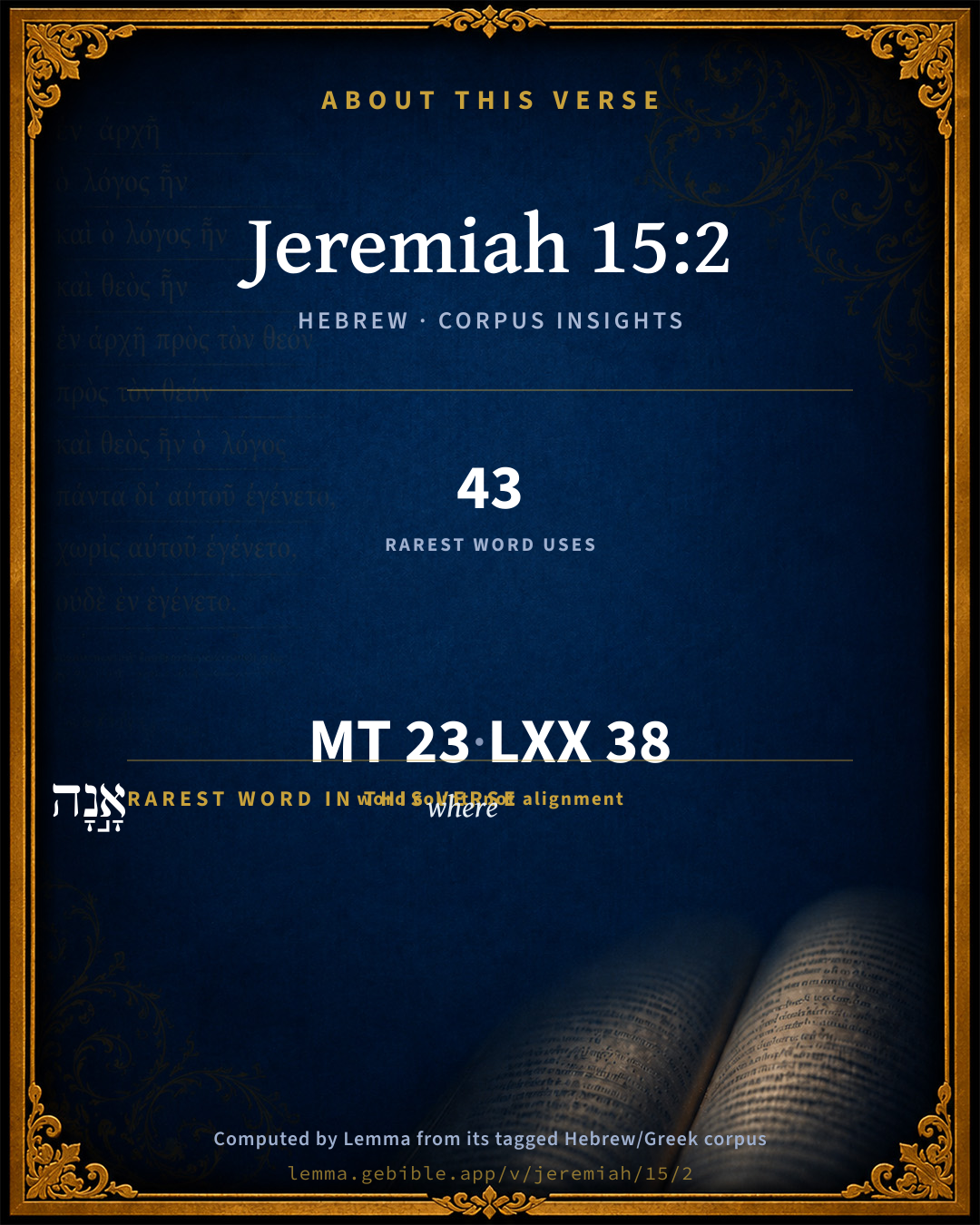
23
words
13
distinct lemmas
Prophets
section

Shared distinctive vocabulary

אָ֣נָה where H575 occurs in 33 verses of the Hebrew Bible. Also found in:

Grammatical profile

  • 5 verbs
  • 9 nouns
  • 2 prepositions
  • 1 conjunction
  • 2 adverbs
  • 4 particles

Verb forms

  • וְהָיָ֛ה Qal · Sequential Perfect
  • יֹאמְר֥וּ Qal · Imperfect
  • נֵצֵ֑א Qal · Imperfect
  • וְאָמַרְתָּ֨ Qal · Sequential Perfect
  • אָמַ֣ר Qal · Perfect

Repetition

Words recur within this verse — often emphatic in Hebrew:

  • יֹאמְר֥וּ to say H559 ×3
  • לַמָּ֤וֶת death H4194 ×2
  • לַחֶ֨רֶב֙ sword H2719 ×2
  • לָֽרָעָב֙ famine H7458 ×2
  • לַשְּׁבִ֖י captivity H7628 ×2
  • אֲשֶׁ֨ר which H834 ×4
  • אֵלֶ֖יךָ to H413 ×2

Hebrew & Septuagint length

In the original languages it is 23 Hebrew tokens and 38 Greek tokens — but the two are counted differently (Hebrew bundles its prefixes and suffixes into one token; the Greek is in lemma form), so that isn’t a like-for-like length.

Cross-references

12

Topical passages linked to Jeremiah 15:2 in the Treasury of Scripture Knowledge — connected by theme and wording, ordered by reader-vote popularity; previews shown in the World English Bible.

  • Jeremiah 43:11 He shall come, and shall strike the land of Egypt; such as are for death [shall be given] to death, and such as are for captivity to captivity, and such as are for the sword to the sword.
  • Zechariah 11:9 Then I said, "I will not feed you. That which dies, let it die; and that which is to be cut off, let it be cut off; and let those who are left eat each other's flesh."
  • Ezekiel 5:2 A third part shall you burn in the fire in the midst of the city, when the days of the siege are fulfilled; and you shall take a third part, and strike with the sword round about it; and a third part you shall scatter to the wind, and I will draw out a sword after them.
  • Revelation 6:3–8 When he opened the second seal, I heard the second living creature saying, "Come!"
  • Revelation 13:10 If anyone has captivity, he will go. If anyone is with the sword, he must be killed. Here is the endurance and the faith of the saints.
  • Isaiah 24:18 It shall happen, that he who flees from the noise of the fear shall fall into the pit; and he who comes up out of the midst of the pit shall be taken in the snare: for the windows on high are opened, and the foundations of the earth tremble.
  • Jeremiah 14:12 When they fast, I will not hear their cry; and when they offer burnt offering and meal-offering, I will not accept them; but I will consume them by the sword, and by the famine, and by the pestilence.
  • Ezekiel 5:12 A third part of you shall die with the pestilence, and with famine shall they be consumed in the midst of you; and a third part shall fall by the sword round about you; and a third part I will scatter to all the winds, and will draw out a sword after them.
  • Jeremiah 24:9–10 I will even give them up to be tossed back and forth among all the kingdoms of the earth for evil; to be a reproach and a proverb, a taunt and a curse, in all places where I shall drive them.
  • Daniel 9:12 He has confirmed his words, which he spoke against us, and against our judges who judged us, by bringing on us a great evil; for under the whole sky has not been done as has been done on Jerusalem.
  • Amos 5:19 As if a man fled from a lion, And a bear met him; Or he went into the house and leaned his hand on the wall, And a snake bit him.
  • Ezekiel 14:21 For thus says the Lord Yahweh: How much more when I send my four sore judgments on Jerusalem, the sword, and the famine, and the evil animals, and the pestilence, to cut off from it man and animal!

Cross-references courtesy of OpenBible.info (CC BY 4.0).

Hebrew and Greek witnesses Masoretic Hebrew ↔ Greek Septuagint

The same verse in the two great witnesses to the Old Testament, shown verse-for-verse.

These are two independent witnesses, not word-aligned to each other, and the Septuagint is shown in lemma (dictionary) form.

Hebrew Jeremiah 15:2 Masoretic · Westminster Leningrad Codex

וְהָיָ֛ה כִּֽי יֹאמְר֥וּ אֵלֶ֖יךָ אָ֣נָה נֵצֵ֑א וְאָמַרְתָּ֨ אֲלֵיהֶ֜ם כֹּֽה אָמַ֣ר יְהוָ֗ה אֲשֶׁ֨ר לַמָּ֤וֶת לַמָּ֨וֶת֙ וַאֲשֶׁ֤ר לַחֶ֨רֶב֙ לַחֶ֔רֶב וַאֲשֶׁ֤ר לָֽרָעָב֙ לָֽרָעָ֔ב וַאֲשֶׁ֥ר לַשְּׁבִ֖י לַשֶּֽׁבִי

It shall happen, when they tell you, Where shall we go forth? then you shall tell them, Thus says Yahweh: Such as are for death, to death; and such as are for the sword, to the sword; and such as are for the famine, to the famine; and such as are for captivity, to captivity.

World English Bible · Public Domain

Greek LXX Structure differs

In the Septuagint, Jeremiah is about an eighth shorter than the Hebrew and arranges its material differently — the Oracles Against the Nations (Hebrew chapters 46–51) appear in the middle of the Greek book, after 25:13. Because the chapter and verse boundaries do not line up, a verse-for-verse comparison with the Hebrew is not shown.

A verse-for-verse comparison isn’t shown here because the chapters and verses don’t line up. Switch to the LXX edition with the MT / LXX toggle above to read the Greek directly.

Hebrew: Westminster Leningrad Codex (CC BY 4.0). Greek: Septuagint (public domain); English from a public-domain English Septuagint. How the Septuagint differs from the Hebrew →

Targum (Aramaic paraphrase)

1

The Targum is the ancient Jewish Aramaic paraphrase of the Hebrew Scriptures — an interpretive translation, not the Hebrew text itself. Onkelos (literal) and Pseudo-Jonathan (expansive) render the Torah, and Jonathan the Prophets. Coverage is partial: where no permissively-licensed English translation exists for a verse, only the Aramaic is shown. This is verse-level text, not a word-by-word alignment to the Hebrew.

  1. Targum Jonathan Prophets (Joshua–Malachi)
    וִיהֵי אֲרֵי יֵימְרוּן לָךְ לְאָן נִגְלֵי וְתֵימַר לְהוֹן כִּדְנַן אֲמַר יְיָ לִדְמוֹתָא לְמוֹתָא וְדִלְחַרְבָּא לְחַרְבָּא וְדִלְכַפְנָא לְכַפְנָא וְדִי לִשִׁבְיָא לְשִׁבְיָא:

    (no public-domain English translation for this verse)

    Targum Jonathan — Aramaic: “Mikraot Gedolot” (public domain). English: “Sefaria Community Translation” (CC0 1.0 (public-domain dedication)); “London "Chaldee Paraphrase," 1871” (public domain). Text via Sefaria.

Commentary

Notes on Jeremiah 15:2 from classic Christian and Jewish commentators (each source and its license shown beneath its notes). The classic Christian expositions comment on the surrounding passage and are grouped to its opening verse, so a note may address several verses; the Jewish commentaries on the Tanakh (Rashi and others) are per-verse, so they appear only where the commentator wrote on this verse.

Lemma curates 59 commentaries, every one of them public domain or Creative Commons licensed, each selected and text-cleaned for this edition rather than reprinted as found. About our sources →

Trapp's Complete Commentary

John Trapp

Jer 15:2 And it shall come to pass, if they say unto thee, Whither shall we go forth? then thou shalt tell them, Thus saith the LORD; Such as [are] for death, to death; and such as [are] for the sword, to the sword; and such as [are] for the famine, to the famine; and such as [are] for the captivity, to the captivity.

Ver. 2. If they say unto thee.] As they will be apt enough to do in a jeer.

Such as are for death,] i.e., For the pestilence commonly called mortality, because it is so deadly a disease. Those at Genoa have lately found it so. And yet it is here reckoned first, as the least and tightest of all the four threatened judgments, which must needs be bad enough when the pest is the best of them all. The Turks shun not the company of those that have the plague, but pointing upon their foreheads, say it was written there at their birth when they should die, and of what disease. These in the text could as little avoid the deaths they were assigned to, as Aeschylus the tragedian could his being knocked on the head. For whenas he was foretold that he should die with a stroke coming from above, he shunned houses, and was wont to remain in the open air, but he was killed by a tortoise falling from the mouth of an eagle upon his bald head, mistaken for a stone. {a}

{a} Aelian, l. 1. c. 5. s. 19. 1:225,227; Valerius Maximus, l. 9. ext. c. 12. 1:375

John Trapp, A Commentary or Exposition upon All the Books of the Old and New Testament (1647–1656) — public domain. Text from a community e-Sword module.

Joseph Benson's Commentary

Jer 15:2-5. If they say unto thee, Whither shall we go forth? — If they ask thee what thou meanest by going forth, and whither they shall go: thou shalt tell them, Such as are for death to death, &c. — In general, You shall go forth, saith God, to ruin and destruction; but shall not be all destroyed in one and the same way, but every one shall perish in that way which God hath appointed: some shall be destroyed by the pestilence, (for that is here to be understood by death, Rev 6:8, it being death without visible means,) others shall be destroyed by famine, others by the sword of the enemy, others shall go into captivity; but one way or other the greatest part of you shall be consumed. And I will appoint over them four kinds — Namely, of destroyers. The sword to slay — And those that are slain by it shall not enjoy the common rites of burial, but their carcasses shall be left a prey to the dogs, the birds, and the wild beasts, which last shall both tear their living bodies and their dead carcasses. And I will cause them to be removed into all kingdoms, &c. — Though the body of the people were removed into Babylon, yet it is more than probable that many of them became voluntary exiles to avoid the miseries which they saw coming upon their country. And, without doubt, the king of Babylon removed them into several kingdoms belonging to his large empire. These, it must be observed, are the very words of Moses, (Deu 28:25,) where he threatens the Israelites with a general dispersion over the world, which threatening received its completion, in part, by the Babylonish captivity, but more perfectly after the destruction of Jerusalem by the Romans. Because of Manasseh — In idolatry and other abominations he exceeded all the kings that preceded him: see 2Ki 21:7-11. In his time the public worship of God was wholly suppressed, and idolatry introduced into the very temple; the law of God was likewise quite laid aside, and, in a manner, forgotten, as appears by the surprise Hilkiah was in when he found the original copy of the law in the house of the Lord. So that his sins filled up the measure of the Jews’ iniquities; and therefore, notwithstanding the reformation wrought afterward by Josiah, the Lord turned not from the fierceness of his wrath kindled against Judah: see 2Ki 23:26 and 2Ki 24:3-4. It must be observed, however, that it was not merely for his sins, or the sins of his times, that God so dreadfully punished the Jews in the days of Jehoiakim and Zedekiah; but it was also, and especially because they imitated the wicked example which Manasseh had set them, the reformation effected by Josiah being only partial, and of not long continuance. For who shall, or, who will, have pity upon thee, O Jerusalem — Thy sins render thee unworthy of pity, and all that see the calamities brought upon thee will acknowledge them to be just. Who will go aside, &c. — Who will be so much concerned for thee as to step a little out of his way to inquire after thee; a common instance of respect between persons in any degree acquainted. Rather they that pass by will insult over thy calamities.

Joseph Benson's Commentary on the Old and New Testaments (1811–1818) — public domain. Text from a community e-Sword module.

Tyndale Open Study Notes

Tyndale Open Resources

15:2 The people had no place to go to escape death . . . war . . . famine, and captivity.

Tyndale Open Study Notes — © Tyndale Open Resources, licensed CC BY-SA 4.0. Text via the HelloAO Bible API.

Jamieson, Fausset & Brown

Robert Jamieson, A. R. Fausset & David Brown

death--deadly plague (Jer 18:21; Jer 43:11; Eze 5:2, Eze 5:12; Zac 11:9).

Jamieson, Fausset & Brown — Commentary Critical and Explanatory on the Whole Bible (1871) — public domain (CC PDM 1.0). Text via the HelloAO Bible API.

Adam Clarke's Commentary

Verse 2. Whither shall we go forth? - Such as are for death, to death] Some shall be destroyed by the pestilence, here termed death. See Jer 18:21. Others shall be slain by the sword in battle, and in the sackage of cities. Others shall perish by famine, shall be starved to death through the mere want of the necessaries of life; and the rest shall go into captivity. There shall be different sorts of punishments inflicted on them according to the nature of their transgressions. Some shall be punished in one way, and some in another.

Adam Clarke's Commentary on the Bible (1810–1826) — public domain. Text from a community e-Sword/MySword module.

John Calvin's Commentaries

He now confirms the previous sentence, If they shall say, Whither shall we go forth? then shalt thou say to them, Those for death, to death; those for the sword, to the sword; those for the famine, to the famine; those for exile, to exile; as though he had said, “In vain do they complain of their own miseries.” For God, no doubt, had in view the clamorous complaints which prevailed everywhere among the people on account of their very heavy calamities. Thus indeed were hypocrites wont to do; for whenever God spared them, they haughtily insulted the prophets, and boastingly alleged their subsidies and fortresses; but when God’s hand pressed hard on them, they became very eloquent in their complaints: “Alas! how far will God go at length? is there to be never an end? and what does all this mean? why does he so severely afflict us? and why does he not at least relieve us in some measure from our ntiseries?” As then the hypocrites were so querulous in their calamities, God anticipates all these expostulations, and says, “If they say to thee, ‘Where shall we flee?’ say to them, ‘Either to death, or to famine, or to the sword, or to exile;’ it is all one with God, and it matters not; for there is no hope of mercy for you any longer, since God has rejected you: know then that it is all over with you, for there is no deliverance for you from God: either the sword, or famine, or some other kind of death will overtake you; ye are in every way past hope.”

John Calvin's Commentaries (1540-1563) — public domain. Text from the Calvin Translation Society English edition (1840s-50s) via the Christian Classics Ethereal Library (ccel.org). Calvin's coverage is partial (roughly two-thirds of the Bible); uncommented books and verses are honest gaps, never fabricated. The 19th-century editor's footnotes and remarks are omitted so the notes are faithfully Calvin's own voice.

Ellicott's Commentary for English Readers

(2) Such as are for death . . .—The difference between the first two forms of punishment is that the first points possibly to being led out to execution as criminals, as in Deu_19:6, but more probably to death from pestilence, as in Job_27:15; the second, to falling in a vain and hopeless conflict.

A Bible Commentary for English Readers, edited by Charles John Ellicott (1878–1897) — public domain. Text from a community e-Sword module.

The Cambridge Bible for Schools and Colleges

gen. ed. J. J. S. Perowne

2. Whither shall we go forth?] If we are driven unpardoned from the presence of the Lord, to what shall we betake ourselves? The reply is a stern and even ironical one.

death] by pestilence. Cp. Jer_43:11; Eze_14:21; Eze_33:27, and in English “the Black Death.”

2–9. See introd. summary to section.

The Cambridge Bible for Schools and Colleges (gen. ed. J. J. S. Perowne; Cambridge University Press, 1878–1918) — public domain. Text from a community e-Sword module.

John Gill's Exposition

And it shall come to pass, if they say unto thee,.... As doubtless they will, when this message is brought to them:

whither shall we go forth? in a jeering scornful manner, not believing that this would be their case:

then thou shall tell them, thus saith the Lord, such as are for death, to death; such as were appointed to death, or to die by the pestilence, which is often signified by death; they shall go forth unto it; or it shall meet them, and seize upon them, and take them away:

and such as are for the sword, to the sword; who are appointed to die by the sword of the enemy, into whose hands they should fall by attempting to escape out of the city, shall perish by it:

and such as are for the famine, to the famine; such as are appointed to die by that, shall die of it in the city, where they shall be besieged, and not be able to get out to fetch in any provisions, and where none can be brought, because of the enemy:

and such as are for the captivity, to the captivity; such as are spared from the pestilence, sword, and famine, and are designed to be carried captive into a strange land, shall be taken and carried thither; nor will it be in their power, or in any other's, to hinder any of the above things, to which they are appointed of God. According to the Jews, the latter of these is more grievous than the former; as the sword than death, and famine than the sword, so captivity than them all (w).

(w) T. Bab Bava Bathra, fol. 8. 2.

John Gill's Exposition of the Whole Bible (1746–1763) — public domain (CC PDM 1.0). Text via the HelloAO Bible API.

Haydock's Catholic Bible Commentary

Death. This Hebrew phrase intimates that some should die by sickness, &c. (Worthington)

George Leo Haydock (1774–1849), Haydock's Catholic Family Bible and Commentary, 1859 edition — public domain. Excludes Psalms (Douay-Rheims chapter numbering differs from Protestant) and Deuterocanonical books (Catholic canon only).

Matthew Poole's English Annotations

If they say unto thee, Whither shall we go forth? if they ask thee what thou meanest by going forth; which being a term of motion, implieth a term to which the motion should be. Saith God, In the general, it is to ruin and destruction, but they shall not all be destroyed one and the same way; some shall be destroyed by the pestilence, (for that is here to be understood by

death, ) others shall be destroyed by the

famine, others by the sword of enemies, others shall go into

captivity, but one way or other the land shall be quitted of the most of you.

Matthew Poole's English Annotations on the Holy Bible (1683–1685) — public domain. Text from a community e-Sword/MySword module.

Whedon's Commentary on the Bible

Daniel D. Whedon

2. If they ask where they are to go, Jeremiah is to say: To their fate. And the choice will be, indeed, among grim alternatives — death, sword, famine, and captivity.

Daniel D. Whedon (gen. ed.), Commentary on the Old and New Testaments (1874–1909) — public domain. Text from a community e-Sword module.

The Pulpit Commentary

Such as are for death, etc.; a sternly ironical answer. Death, sword, famine, captivity, lie in wait for them in every possible road. "Death" here means "pestilence" (comp. "the black death" in the Middle Ages), as in Jer_18:21Jo Jer_27:15. Similar combinations of evils occur in Jer_43:11 Eze_14:21 Eze_33:27.

Ver. 2. Various destinies of punishment.

I PUNISHMENT WILL BE ASSIGNED AS A DEFINITE DESTINY. It is not casual. It cannot be evaded. It is decidedly appointed and inflexibly executed. The destiny it involves, though not original but a consequence of voluntary actions, is as certain as if it were in accordance with a primary law of nature. (Gal_6:7, Gal_6:8)

II PUNISHMENT WILL BE ASSIGNED IN A VARIETY OF DESTINIES. All the wicked will not suffer alike. There will be various forms of penalty and various degrees of suffering. Some are appointed to the painful death of the plague, some to the sudden death of the sword, some not to death at all but to exile. Punishment will be various,

(1) because men"s constitutions, capacities, and susceptibilities are various, so that the form of suffering which is suitable for one may not be suitable for another; and

(2) because guilt varies in degree. (Luk_12:47, Luk_12:48)

III PUNISHMENT WILL BE ASSIGNED TO ALL THE GUILTY WITHOUT EXCEPTION. They may be numerous, yet some penalty will be found for all. The variety of destinies might suggest that among them some would find a way of escape, but, alas! they are all penal. This variety will ever secure the punishment of all. They who escape one form of punishment will only fall into another. Some hope to elude justice because their case is very exceptional. But exceptional punishment is found for exceptional crime.

IV PUNISHMENT WILL BE SEVERE IN ALL CASES. There is a choice of destinies, but the list is given with somewhat of irony. How terrible is the mildest fate! All future punishment must be inexpressibly. (Heb_10:31) Therefore let us not delude ourselves with hoping that ours will be of the milder kind, but seek deliverance from the certain fearful doom of sin in the forgiving mercy of God in Christ.

The Pulpit Commentary (1880–1919), ed. H.D.M. Spence-Jones & Joseph S. Exell — public domain. Text from a community e-Sword module.

Rashi

Rabbi Shlomo Yitzchaki (Rashi)

Such as are for death, to death Each calamity mentioned later in this verse is harsher than the one preceding it. The sword is harsher than death. Death by the sword is defacing, whereas death in bed is not defacing. And so he says (Psalms 116:15): “Precious in the eyes of the Lord is the death of His Saints.” Famine is harsher than the sword, for this one is agonizing whereas the other is not agonizing. And so Scripture states (Lam. 4:9): “Better are those who die from the sword than those who die from famine.” Captivity - all sorts of death are in it.

Rashi on the Tanakh — English translations: “The Judaica Press complete Tanach with Rashi, translated by A. J. Rosenberg” (CC BY 4.0); “Pentateuch with Rashi's commentary by M. Rosenbaum and A.M. Silbermann, 1929-1934” (public domain); “The Metsudah Tanach series, Lakewood, N.J” (CC BY 4.0); and “The Book of Joshua, Metsudah Publications, 1997” (CC BY 4.0). Text via Sefaria.

Lesson kit

Teaching starters — assembled from the data on this page, not authored interpretation. Every prompt links to the verse data it draws on. Edit before teaching.

Jeremiah, in the Prophets, opens this verse with 23 words (13 distinct Hebrew lemmas). Its most distinctive word is ʼân (“where”). A historical commentator’s framing appears above. Read the whole chapter for the surrounding context.

Discussion questions

  1. How does “where” (ʼân) shape what this verse is saying?
  2. How does Genesis 16:8, which shares the word «where», read alongside this verse?
  3. What does the repetition of “to say” (3× in this one verse) do in this verse?
  4. The translations on this page render this verse differently — a whole-verse word diff, not a word-by-word alignment. What might account for the different wordings?
  5. «וְהָיָ֛ה» is a Qal Sequential Perfect verb. How does that grammatical form shape the action described?
  6. Compare how Trapp's Complete Commentary and Joseph Benson's Commentary read this verse. Where do they agree or differ?

Things to notice

Reading settings

Reading text

Shown beneath each verse's original-language words.

Old Testament
Old Testament edition

Read the OT as the Masoretic Hebrew (MT) or the Greek Septuagint (LXX).

English shown for the Greek Septuagint (in the Hebrew ↔ Greek comparison).

Comparing translations? Open the Compare panel on any verse page to stack up to four side by side.