Jonah 4:9

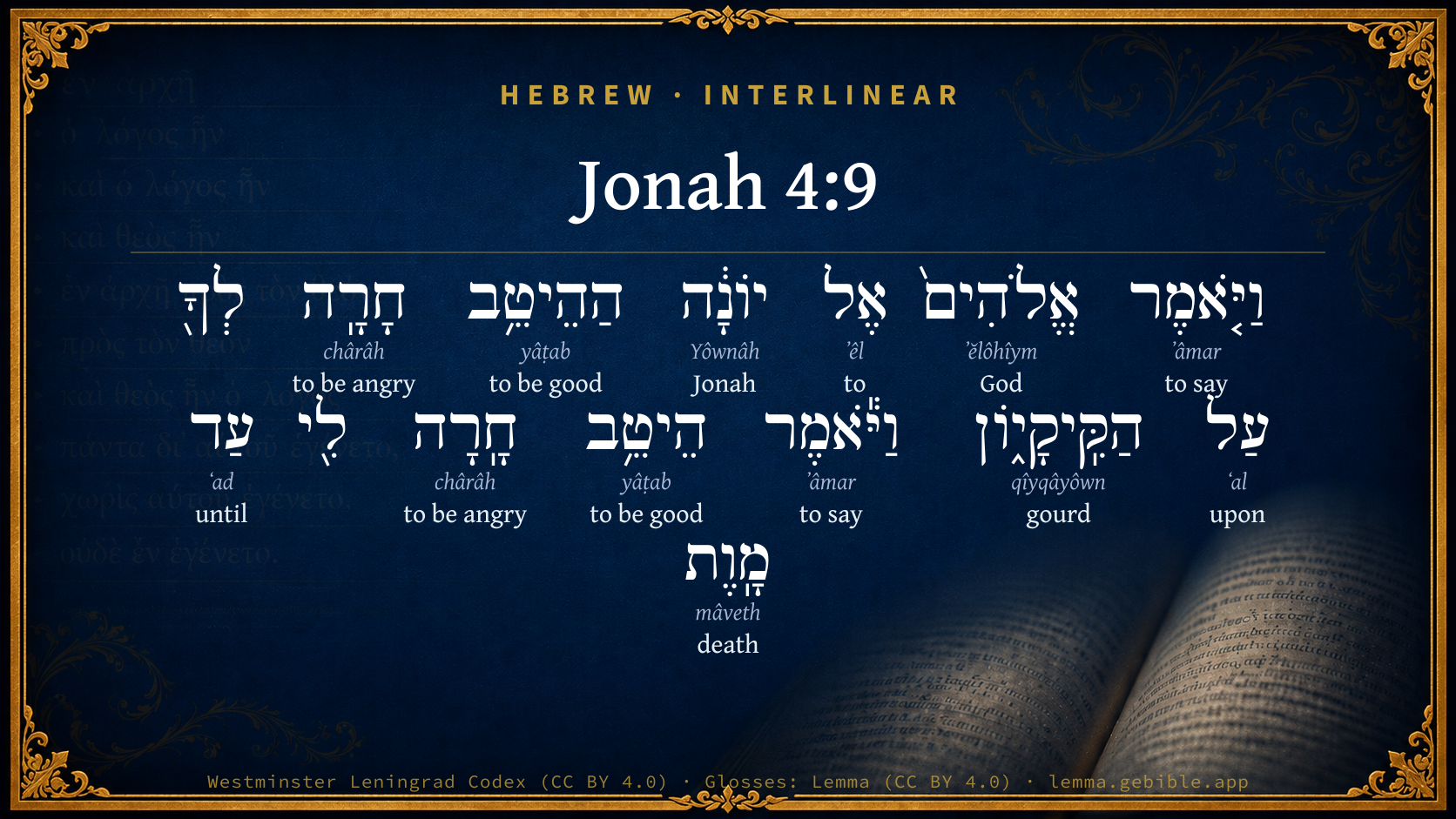
Hebrew (Westminster Leningrad Codex) Jonah 4:9 appears in the Hebrew Old Testament. The text above is from the Westminster Leningrad Codex. Each word links to its Strong’s number, a concise gloss, and parsing drawn from the Open Scriptures Hebrew Bible morphology. Click any word for its full Brown-Driver-Briggs (BDB) entry.
Download image
Cite this verse

Jonah 4:9 (World English Bible). Public Domain. Lemma interlinear Bible study tool, https://lemma.gebible.app/v/jonah/4/9.

Show BibTeX & RIS
BibTeX
RIS
English Translation
God said to Jonah, "Is it right for you to be angry about the vine?" He said, "I am right to be angry, even to death."
World English Bible · Public Domain
Download a study sheet

One document with this verse’s original text, its word-by-word gloss line, the meaning frame, cross-references with their text, attributed commentary, and full source and license credits — printable, and it pastes into notes with its structure intact.

This verse Autodidact and up

Study sheet (.html) Plain text (.txt)

A passage Seminary Student

Up to 50 verses in one chapter. A passage sheet keeps up to 6 commentary sources and 12 cross-references per verse, in the order this page ranks them, and says so on the sheet whenever that leaves anything out. Ask for a single verse and you get the Autodidact verse sheet above.

Everything on this page stays free to read, with no account — the sheet is a download of what is already on screen, not access to it.

Want to remove ads? Support Godless Engineer
Compare translations 3

The same verse in 3 English versions, stacked beneath the original-language interlinear above. Click any original word for its lexicon entry.

Each is an independent rendering of the whole verse — the interlinear is not word-aligned to these translations.

Highlighted words mark where these versions differ — a whole-verse word diff, not a word-by-word alignment.

  • World English Bible Public Domain
    God said to Jonah, "Is it right for you to be angry about the vine?" He said, "I am right to be angry, even to death."
  • King James Version Public Domain
    And God said to Jonah, Doest thou well to be angry for the gourd? And he said, I do well to be angry, even unto death.
  • unfoldingWord Literal Text CC BY-SA 4.0
    Then God said to Jonah, “Is it right that it burns to you about the plant?” And he said, “It is right that it burns to me, even as far as death.”

unfoldingWord Literal Text — © unfoldingWord, licensed CC BY-SA 4.0. Word-aligned USFM3 via Door43 (git.door43.org/unfoldingWord/en_ult).

Versions to compare (up to 4)

3 of 4 selected

Show all 18 translations

Every available English version of this verse, each an independent rendering of the whole verse.

  • World English Bible Public Domain
    God said to Jonah, "Is it right for you to be angry about the vine?" He said, "I am right to be angry, even to death."
  • Berean Standard Bible Public Domain
    Then God asked Jonah, “Have you any right to be angry about the plant?” “I do,” he replied. “I am angry enough to die!”
  • Majority Standard Bible Public Domain
    Then God asked Jonah, “Have you any right to be angry about the plant?” “I do,” he replied. “I am angry enough to die!”
  • King James Version Public Domain
    And God said to Jonah, Doest thou well to be angry for the gourd? And he said, I do well to be angry, even unto death.
  • American Standard Version (1901) Public Domain
    And God said to Jonah, Doest thou well to be angry for the gourd? And he said, I do well to be angry, even unto death.
  • Revised Version (1885) Public Domain
    And God said to Jonah, Doest thou well to be angry for the gourd? And he said, I do well to be angry even unto death.
  • Geneva Bible (1599) Public Domain
    And God said vnto Ionah, Doest thou well to be angrie for the gourde? And he said, I doe well to be angrie vnto the death.
  • Douay-Rheims (1899) Public Domain
    And the Lord said to Jonas: Dost thou think thou hast reason to be angry, for the ivy? And he said: I am angry with reason even unto death.
  • Young's Literal Translation Public Domain
    And God saith unto Jonah: `Is doing good displeasing to thee, because of the gourd?' and he saith, `To do good is displeasing to me -- unto death.'
  • Literal Standard Version CC BY-SA 4.0
    And God says to Jonah: “Is doing good displeasing to you, because of the gourd?” And he says, “To do good is displeasing to me—to death.”
  • Unlocked Literal Bible CC BY-SA 4.0
    Then God said to Jonah, “Is it good that you are so angry about the plant?” Then Jonah said, “It is good that I am angry, even to death.”
  • unfoldingWord Literal Text CC BY-SA 4.0
    Then God said to Jonah, “Is it right that it burns to you about the plant?” And he said, “It is right that it burns to me, even as far as death.”
  • Darby Bible Public Domain
    And God said to Jonah, Doest thou well to be angry for the gourd? And he said, I do well to be angry, unto death.
  • World Messianic Bible Public Domain
    God said to Jonah, “Is it right for you to be angry about the vine?” He said, “I am right to be angry, even to death.”
  • Webster's Bible Public Domain
    And God said to Jonah, Doest thou well to be angry for the gourd? And he said, I do well to be angry, even to death.
  • Free Bible Version CC BY-SA 4.0
    But the Lord asked Jonah, “Do you have a good reason to be so angry about the plant?” “Yes I do!” Jonah replied. “I'm angry enough to die!”
  • Bible in Basic English Public Domain
    And the Lord said to Jonah, Have you any right to be angry about the vine? And he said, I have a right to be truly angry.
  • JPS Tanakh (1917) Public Domain
    And God said to Jonah: 'Art thou greatly angry for the gourd?' And he said: 'I am greatly angry, even unto death.'

Literal Standard Version (2020), Covenant Press — licensed CC BY-SA 4.0. Text via the HelloAO Bible API (eBible.org). Unlocked Literal Bible (unfoldingWord) — licensed CC BY-SA 4.0. Text via the HelloAO Bible API (eBible.org). unfoldingWord Literal Text — © unfoldingWord, licensed CC BY-SA 4.0. Word-aligned USFM3 via Door43 (git.door43.org/unfoldingWord/en_ult). Free Bible Version, Dr. Jonathan Gallagher — licensed CC BY-SA 4.0. Text via the HelloAO Bible API (eBible.org).

Word by word

More ways to search: Search by grammar → Find every occurrence → Compare this word →

Practice this passage: Drill this verse → Learn its vocabulary →

הַקִּֽיקָי֑וֹן
qîyqâyôwn
H7021
“the · gourd”
Particle, Definite Article + Noun, Common, Masculine, Singular, Absolute
Part of Speech
Particle + Noun
Type
Common
Gender
Masculine
Number
Singular
State
Absolute
Full BDB Definition

Origin: perhaps from H7006

TWOT: 2021

a plant - perhaps a gourd, castor-oil plant, bottle-gourd
  1. וַיֹּ֤אמֶר ʼâmar H559 “and · to say” Conjunction + Verb, Qal, Sequential Imperfect, 3rd Person, Masculine, Singular
  2. אֱלֹהִים֙ ʼĕlôhîym H430 “God(s)” Noun, Common, Masculine, Plural, Absolute
  3. אֶל ʼêl H413 “to” Preposition
  4. יוֹנָ֔ה Yôwnâh H3124 “Jonah” Noun, Proper
  5. הַהֵיטֵ֥ב yâṭab H3190 “to be good” Particle, Interrogative + Verb, Hiphil, Infinitive Absolute
  6. חָרָֽה chârâh H2734 “to be angry” Verb, Qal, Perfect, 3rd Person, Masculine, Singular
  7. עַל ʻal H5921 “upon” Preposition
  8. וַיֹּ֕אמֶר ʼâmar H559 “and · to say” Conjunction + Verb, Qal, Sequential Imperfect, 3rd Person, Masculine, Singular
  9. הֵיטֵ֥ב yâṭab H3190 “to be good” Verb, Hiphil, Infinitive Absolute
  10. חָֽרָה chârâh H2734 “to be angry” Verb, Qal, Perfect, 3rd Person, Masculine, Singular
  11. עַד ʻad H5704 “until” Preposition
  12. מָֽוֶת mâveth H4194 “death” Noun, Common, Masculine, Singular, Absolute

About this verse

These counts appear in no published source. They are computed here, from the morphology-tagged text and Lemma’s own curated glosses. What Lemma adds →

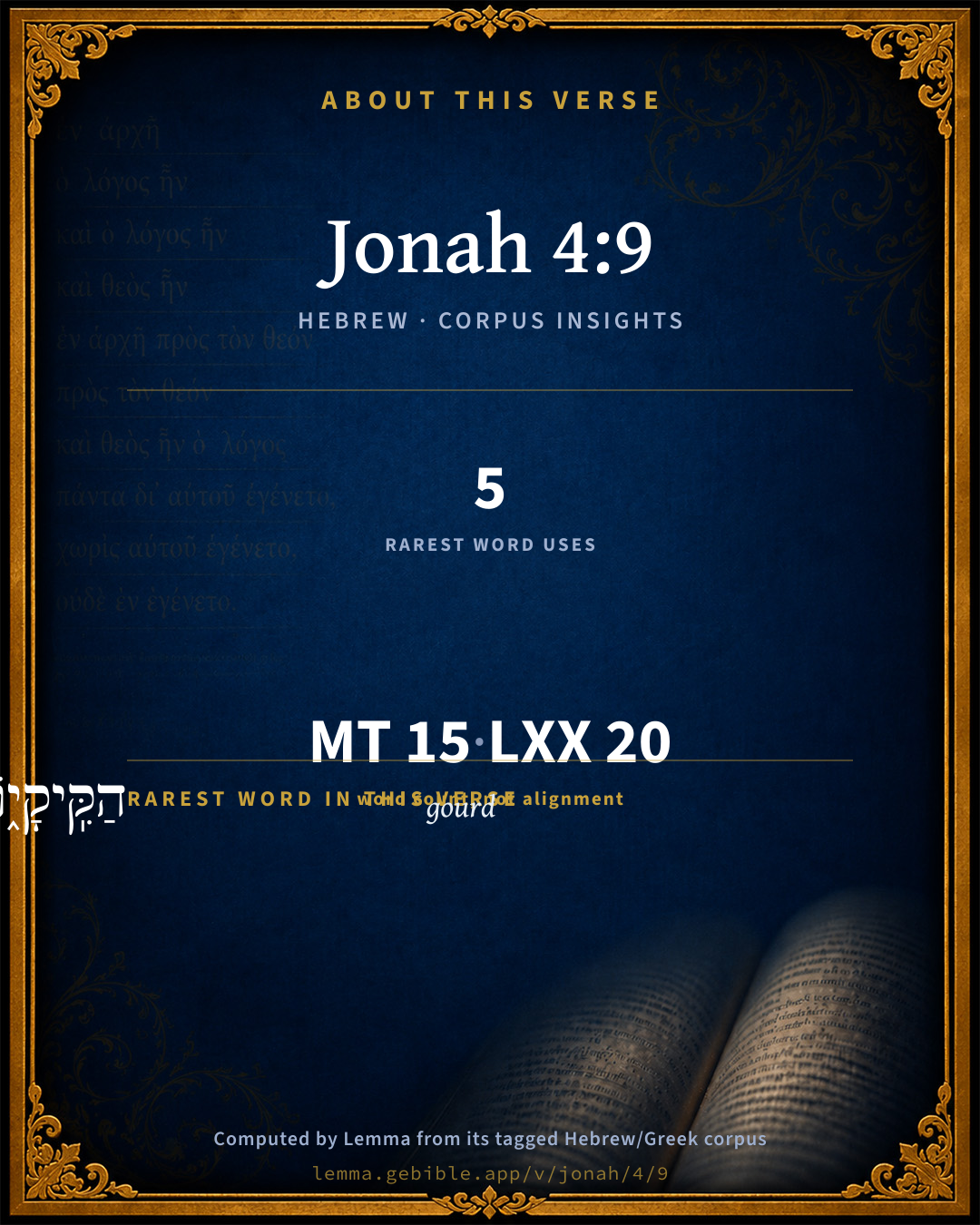
15
words
10
distinct lemmas
Prophets
section

Notable vocabulary

The rarest word here is הַקִּֽיקָי֑וֹן gourd H7021 — appearing just 5 times in the whole Hebrew Bible.

Shared distinctive vocabulary

הַקִּֽיקָי֑וֹן gourd H7021 occurs in 4 verses of the Hebrew Bible. Also found in:

Grammatical profile

  • 6 verbs
  • 4 nouns
  • 5 prepositions

Verb forms

  • וַיֹּ֤אמֶר Qal · Sequential Imperfect
  • הַהֵיטֵ֥ב Hiphil · Infinitive Absolute
  • חָרָֽה Qal · Perfect
  • וַיֹּ֕אמֶר Qal · Sequential Imperfect
  • הֵיטֵ֥ב Hiphil · Infinitive Absolute
  • חָֽרָה Qal · Perfect

Repetition

Words recur within this verse — often emphatic in Hebrew:

  • וַיֹּ֤אמֶר to say H559 ×2
  • הַהֵיטֵ֥ב to be good H3190 ×2
  • חָרָֽה to be angry H2734 ×2

Hebrew & Septuagint length

In English translation the verse runs 26 words from the Hebrew and 24 from the Septuagint (LXX English) — closely comparable.

A rough comparison of the two English renderings, which tokenize alike — not a word-level alignment.

Word counts can differ between the Hebrew and the Greek without any difference in meaning — e.g. the Hebrew direct-object marker אֵת has no separate Greek word, and Greek often adds the article ὁ.

In the original languages it is 15 Hebrew tokens and 20 Greek tokens — but the two are counted differently (Hebrew bundles its prefixes and suffixes into one token; the Greek is in lemma form), so that isn’t a like-for-like length.

Cross-references

8

Topical passages linked to Jonah 4:9 in the Treasury of Scripture Knowledge — connected by theme and wording, ordered by reader-vote popularity; previews shown in the World English Bible.

  • Genesis 4:5–14 but he didn't respect Cain and his offering. Cain was very angry, and the expression on his face fell.
  • Judges 16:16 It happened, when she pressed him daily with her words, and urged him, that his soul was vexed to death.
  • Job 5:2 For resentment kills the foolish man, And jealousy kills the simple.
  • Job 18:4 You who tear yourself in your anger, Shall the earth be forsaken for you? Or shall the rock be removed out of its place?
  • Job 40:4–5 "Behold, I am of small account. What shall I answer you? I lay my hand on my mouth.
  • Matthew 26:38 Then he said to them, "My soul is exceedingly sorrowful, even to death. Stay here, and watch with me."
  • 2 Corinthians 7:10 For godly sorrow works repentance to salvation, which brings no regret. But the sorrow of the world works death.
  • Revelation 9:6 In those days people will seek death, and will in no way find it. They will desire to die, and death will flee from them.

Cross-references courtesy of OpenBible.info (CC BY 4.0).

Hebrew and Greek witnesses Masoretic Hebrew ↔ Greek Septuagint

The same verse in the two great witnesses to the Old Testament, shown verse-for-verse.

These are two independent witnesses, not word-aligned to each other, and the Septuagint is shown in lemma (dictionary) form.

Hebrew Jonah 4:9 Masoretic · Westminster Leningrad Codex

וַיֹּ֤אמֶר אֱלֹהִים֙ אֶל יוֹנָ֔ה הַהֵיטֵ֥ב חָרָֽה לְךָ֖ עַל הַקִּֽיקָי֑וֹן וַיֹּ֕אמֶר הֵיטֵ֥ב חָֽרָה לִ֖י עַד מָֽוֶת

God said to Jonah, "Is it right for you to be angry about the vine?" He said, "I am right to be angry, even to death."

World English Bible · Public Domain

Greek LXX Jonah 4:9 Septuagint · lemma form

καί εἶπον ὁ θεός πρός ιωνας εἰ σφόδρα λυπέω σύ ἐπί ὁ κολόκυνθα καί εἶπον σφόδρα λυπέω ἐγώ ἕως θάνατος

And God said to Jonas, Are you very much grieved for the gourd? And he said, I am very much grieved, even to death.

LXX2012 (modern English Septuagint) · Public Domain

On this verse, The Pulpit Commentary discusses the Septuagint’s reading. Read the note in Commentary ↓

Hebrew: Westminster Leningrad Codex (CC BY 4.0). Greek: Septuagint (public domain); English from LXX2012 (modern English Septuagint) (Public Domain). How the Septuagint differs from the Hebrew →

Targum (Aramaic paraphrase)

1

The Targum is the ancient Jewish Aramaic paraphrase of the Hebrew Scriptures — an interpretive translation, not the Hebrew text itself. Onkelos (literal) and Pseudo-Jonathan (expansive) render the Torah, and Jonathan the Prophets. Coverage is partial: where no permissively-licensed English translation exists for a verse, only the Aramaic is shown. This is verse-level text, not a word-by-word alignment to the Hebrew.

  1. Targum Jonathan Prophets (Joshua–Malachi)
    וַאֲמַר יְיָ לְיוֹנָה הֲלַחֲדָא תְקֵיף לָךְ עַל קִיקָיוֹן וַאֲמַר לַחֲדָא תְקוֹף לִי עַד מוֹתָא:

    And the LORD said to Jonah, “You mad about that gourd?” And he said, “Yes, I’m so mad I want to die!”

    Targum Jonathan — Aramaic: “Mikraot Gedolot” (public domain). English: “Sefaria Community Translation” (CC0 1.0 (public-domain dedication)); “London "Chaldee Paraphrase," 1871” (public domain). Text via Sefaria.

Commentary

Notes on Jonah 4:9 from classic Christian and Jewish commentators (each source and its license shown beneath its notes). The classic Christian expositions comment on the surrounding passage and are grouped to its opening verse, so a note may address several verses; the Jewish commentaries on the Tanakh (Rashi and others) are per-verse, so they appear only where the commentator wrote on this verse.

Lemma curates 59 commentaries, every one of them public domain or Creative Commons licensed, each selected and text-cleaned for this edition rather than reprinted as found. About our sources →

Trapp's Complete Commentary

John Trapp

Jon 4:9 And God said to Jonah, Doest thou well to be angry for the gourd? And he said, I do well to be angry, [even] unto death.

Ver. 9. Doest thou well to be angry for the gourd?] What? so soon blown up for a thing of nothing.? Tantaene animis coelestibus irae? (Eneid. lib. i.).

“ Diine hunc ardorem mentibus indunt

Euryale? an sua cuique deus fit dira libido? ”

Knew not Jonah that to be angry without a cause was to be in danger of the judgment? Mat 5:22, that it was a mortal sin, and not venial, as Papists falsely conclude from the text; which sets not forth a different punishment of rash anger, but a diverse degree of punishment? that it is the murder of the heart, as our Saviour there shows, and the fountain of the murder both of the tongue and of the hand? will he be like the foolish bee, who loseth her life to get revenge? {See Trapp on "Jon 4:4"}

And he said] Before he said nothing when reproved for his rash anger, Jon 4:4, and that was best. Now he chats against God, laying the reins on the neck of his unruly passions and running riot. Who can understand his errors? and who can tell how often a servant of God may fall into a foul sin, if strongly inclined thereto by nature, or violently tempted by Satan and his instruments? Of Judah indeed it is expressly noted, that he knew his daughter-in-law Tamar again no more, Gen 38:26. But what shall we say to Lot’s double incest? to Samson’s going down again to Gaza, Jdg 16:1? to Abraham’s twice denying his wife? to John’s twice adoring the angel, Rev 19:10; Rev 22:8? "Let him that standeth take heed lest he fall": and let God’s people see that there be no way of wickedness found in them, that they allow not, wallow not in this guzzle: since hereby they lose not their ius haereditarium, but yet their ius aptitudinale, not their title, but yet their fitness to God’s kingdom; and, perhaps, their fulness of reward there, 2Jn 1:8.

And he said, I do well to be angry, even unto death] A fearful outburst! Resist passion at the first rising up; else who knows whither it may transport us? Passions, saith one, like heavy bodies down steep hills, once in motion move themselves; and know no ground but the bottom. Jonah (saith another upon this text) slights admonition, riseth up in an animosity against it to a desperate degree of anger; such wild beasts are furious passions when we give them the reins. Thus he, Surely as the lion beateth himself with his own tail, and as sullen birds in a cage beat themselves to death, so could Jonah in this rage find in his heart to do and he shames not to tell God as much. It was therefore no ill wish of him that desired God to deliver him from that naughty man himself ( Domino libera me a malo homine meipso), from headlong and headstrong passions, which may not only dissweeten a man’s life, but shorten it. The Emperor Nerva died of a fever contracted by anger. Valentinian by an irruption of blood. Wenceslaus, King of Bohemia, in a rage against his cupbearer, fell presently into a palsy, whereof he died. What disease Jonah died of I know not: but this I know, that in his heat he did and said enough here in this text to have made Almighty God resolve, as he did once against those muttering rebels in the wilderness, "As truly as I live, saith the Lord, as ye have spoken in mine ears, so will I do to you," Num 14:28. Thou shalt surely die, Jonah; out of thine own mouth will I judge thee, &c. But God chose rather to glorify himself in Jonah’s salvation than in his deserved destruction. Dat igitur poenitentiam, et postea indulgentiam (as that father prayed), he therefore first giveth him repentance, and then pardon, as appeareth partly by his recording these passages, and so shaming himself, as it were, before all the world; and partly also by his closing up his prophecy with silence; not striving with God for the last word, as Peter did with Christ, and would needs carry it, till the events of things confuted him, and he was glad to seek a corner to cry in, Mat 26:35; Mat 26:75.

John Trapp, A Commentary or Exposition upon All the Books of the Old and New Testament (1647–1656) — public domain. Text from a community e-Sword module.

The Biblical Illustrator

Joseph S. Exell

Jon_4:9

Doest thou well to be angry for the gourd?

Jehovahs appeal to Jonah

I. Jonahs then mood. God said to Jonah, Doest thou well to be angry?

1. Observe the point of this appeal. To be grieved for the gourd was to be grieved for himself.

2. The compliment involved in this Divine appeal. God made Jonah judge in his own case.

3. Note the response of the prophet to this appeal. I do well to be grieved, even unto death. Candid, if somewhat passionate.

II. The propriety of the divine procedure. Note the correspondence between the words pity and spare. God did not contradict the prophet. There is a double contrast presented in this branch of the appeal. The contrast between Jonah and Jehovah; and between the gourd and the city.

1. The labour expended on the city was one reason why God should spare it.

2. The growth of Nineveh was another reason.

3. The antiquity of Nineveh was another.

4. The commodiousness and magnitude of Nineveh was another.

5. The presence of the children and cattle was another. (Samuel Clift Burn.)

God reasoning with man

The amazing interest God takes in mankind is shown--

I. In his reasoning with a man who is in a bad temper. Jonah was angry, and the intensity of his anger became so intolerable that he wished to die. Why was he angry?

1. Because of the Divine compassion shown to the Ninevites.

2. Because of the loss of a temporal blessing.

II. In his reasoning in order to impress this man with the reality of his compassion. The comparison between the plant and Nineveh may be expressed in three questions.

1. What is this plant to the men that inhabit Nineveh?

2. What is this one plant even to the unconscious infants at Nineveh!

3. What is one plant to even the irrational creatures in Nineveh! (Homilist.)

The sinfulness and cure of absorbing passion

The Book of Jonah is a standing rebuke of intolerance among the sacred writings of a most intolerant people. It is because it exposes and rebukes the sin of intolerance that this book has been preserved. The reason of Jonahs disobedience to the heavenly voice is boldly and frankly told in the history. No tenderness for the prophets reputation is allowed to veil his sin; exclusiveness is laid bare in all its baseness and malignity. There is no need for us to offer other explanations of the prophets conduct. National antipathy and religious exclusiveness will account for it all. Equally marked in this history is Gods determination to expose the workings and rebuke the sin of exclusiveness. Why was the hard and obstinate Jonah called and forced to a work that was so uncongenial to him, a work that goaded him to wildest turbulence, and called out his bitterest passion? It was for Jonahs sake, that his bad heart might be searched and corrected. We have here Gods solemn rebuke of a common sin, and many a man may find here searching and humbling lessons. Jonah rebelled against the mission appointed him, but he had to fulfil it. To do Gods work is our sole discharge. It is only by obeying Gods bidding that we can be purged from the sinfulness that makes obedience unwelcome. Gods chosen servants have to yield to Him, though often in the yielding they are searched and convicted of startling wickedness. In the working of Jonahs anger we see the characteristics of all absorbing passion; and Gods mode of curing him is an example of the myriad influences by which He restores the self-absorbed to true and healthy life.

I. The sinfulness of absorbing passion.

1. The sinfulness is seen in Jonahs contempt of life. A mans worth may be measured by the reverence he has for his life. The Gospel, which delivers us from a coward fear of dying, was never intended to foster an equally coward fear of living.

2. The sinfulness is seen in that it works insincerity. Even after Jonah has recognised that God is sparing the city, he still affects to believe that it will be overthrown. He hastens out of it lest he should be partaker of its plagues. Under his booth he pretends that he is awaiting its destruction. What hateful affectation and insincerity! But is it very uncommon? How much of life is wasted because of our refusal to acknowledge that we have outgrown the expectations of the past, or that time and change have swept us far beyond them!

3. The selfishness of an absorbing passion is illustrated in Jonahs contempt for the men of Nineveh. He will not share in their repentance, nor encourage them to hope in Gods mercy; he shuts himself up alone to brood over his anger. All passion tends to arrogance. Self-absorption means scorn of our fellows. A single passion may arrogate to itself the whole sphere of life, and constitute itself the be-all and end-all of existence. It is well for us to be aware of this. Our holiest emotions may become overweening.

II. Gods cure for absorbing passion. Notice the exceeding gentleness with which God reproves and seeks to restore the angry prophet. The disobedient are constrained by a force too strong for them; but even the ungracious doing of duty brings the spirit into fitness for gentler discipline. The Lord cares for Jonah in his self-will. When God smites the gourd, and sends the vehement cast wind and burning sun to beat on Jonahs head, it is that tie may speak his words gentler than the gourd-shade, and reveal Himself to the stricken spirit as the shadow of a great rock in a weary land. How different is this from man! We should have been glad that the self-absorbed man should be his own tormentor. God seeks to restore the prophet by awakening love in his heart: awakening his interest, and making him tender over the gourd. Over the wretched, gloomy Jonah, sprung up the wondrous plant, and its leaves and tendrils drew off his thoughts from himself, and as he watched it grow, a new interest was awakened in him. His heart softened to the plant, and he becomes strangely tender and reverential over a gourd. There is something wonderful in life, even though it be the life of a common weed. Jonah loves his gourd, and has pity on it when it is smitten. The first result of Jonahs tenderness would seem to be a deeper gloom. Another wrong is added to his suffering; and again he cries for death. But it has not all been in vain; for he is prepared to listen to the voice that once more sounds in his ears. His reply, I do well to be angry, was bad and bitter; but perverse and sullen silence before God is far worse than perverse and sullen speech. How wonderful is Gods answer. The tenderness that was in Jonah, poor as it was, mingled with selfishness as it was, was yet, in its dim and partial way, an emblem of the tenderness of God for every creature He has made! Thou canst not bear that what has lived, and lived for thee, should die. And shall I be careless of the great city? There is this sacred energy in love, however poor it may be, however mixed with selfishness, that it admits us into the secret of Gods counsel, helps us to bear Divine mysteries, and understand Gods ways. Since on every hand God has put the tokens and witnesses of His Divine care and tenderness, do we not hear on every hand the voice that calls us from our absorbing passions, from our griefs, our angers, and our woes? Life is worth living when every human creature is felt worthy of our love: the voice of duty will sweetly beckon us to human sympathy and human helpfulness. And so the dark mystery of your life will be read. In Gods care for all men you will find yourself surrounded by Gods care for you. The wise and blessed purpose of the individual destiny is seen in the one eternal purpose of love to men. (A. Mackennal, D. D.)

The character of Jonah

The immediate occasion of Jonahs anger was the withering of the gourd. There had been, however, a prior occasion of his wrath. He had been offended with the patience and lenity which God had exercised towards the inhabitants of Nineveh, contrary (as he unreasonably thought) to the commission that had been given him, to threaten their destruction. If Jonah was grieved at the destruction of the agreeable and useful gourd, the destruction of a populous, flourishing, and powerful city ought to be a much more mournful and distressing sight; and if this could be prevented, though it had been threatened, it ought to give him joy. His behaviour exhibits to our view the hurtful effects of that pride and wrath, which, in certain circumstances, more or less arises in the breast of every man. Learn these lessons--

1. That the mind of man, being prone to gratify every passion which it feels to the utmost possible extent, therefore gives the object for which it is conceived that figure and importance in its own imagination whereby it is fitted to afford the most extensive and complete gratification.

2. That the mind of man, being thus disposed to magnify the object of every passion beyond its real nature and extent, it is hereby equally disposed to justify the passion it conceives, however excessive and unreasonable. What use ought we to make of Jonahs example? It ought to put us on our guard against that fatal self-deceit which leads men to give themselves a false description of the objects of their several passions, and as false a description of the innocence and justice of the passions which they have conceived. Being of a passionate and peevish nature, his pride and anger being raised, by what Jonah apprehended might hurt his interest and reputation as a prophet, every pious, every tender and humane consideration was entirely overlooked. We should learn to put ourselves upon our guard against the influence of this pernicious self-deceit, and to make it, as far as possible we can, the invariable measure of our conduct.

1. To proportion the degree of our affections to the real merit and importance of the cause by which they are produced; and

2. To exclude the false, artificial apologies by which the most unjust and criminal attachments in the heart of man are ready to conceal, or justify their own excess. This conduct will, indeed, require a careful attention to ourselves and much self-correction and command. To enforce this instruction the following reflection ought to be attended to, namely, that the artifice by which the mind of man imposes on itself, in the indulgence of its sinful and irregular desires, whatever present ease or pleasure it may give, must become, ere long, the source of anguish and remorse. We have reason to believe that the consciences of men will hereafter punish them in the same manner for those iniquities which they now commit calmly and without remorse. Without great vigilance and much inspection of ourselves we are in the utmost danger of misapprehending our own character and of justifying ourselves. This dangerous self-deceit proceeds from two causes.

1. From the self-love and vanity which is natural to every man.

2. From the artifice of sinful passions.

By the first, men are laid under a general partiality in favour of themselves, and are disposed to form a more favourable opinion of their own character than it is entitled to. By the second, they are hindered in a more particular manner from perceiving the iniquity and guilt of those parts of their character and conduct which are directed by the influence of their sinful passions. When these two causes of self-deceit meet, they must betray a man into a total ignorance and misapprehension of himself. (W. Craig, D. D.)

The Biblical Illustrator, edited by Joseph S. Exell (c. 1880s–1900s) — public domain. Text from a community e-Sword module.

Geneva Bible (1599)

Geneva Bible translators

This declareth the great inconveniences whereinto God’s servants do fall when they give place to their own affections, and do not in all things willingly submit themselves to God.

Geneva Bible (1599) marginal notes — public domain. Text via Bolls.life.

Jamieson, Fausset & Brown

Robert Jamieson, A. R. Fausset & David Brown

(See on ).

I do well to be angry, even unto death--"I am very much grieved, even to death" [FAIRBAIRN]. So the Antitype ().

Jamieson, Fausset & Brown — Commentary Critical and Explanatory on the Whole Bible (1871) — public domain (CC PDM 1.0). Text via the HelloAO Bible API.

Adam Clarke's Commentary

Verse 9. I do well to be angry, even unto death.] Many persons suppose that the gifts of prophecy and working miracles are the highest that can be conferred on man; but they are widely mistaken, for the gifts change not the heart. Jonah had the gift of prophecy, but had not received that grace which destroys the old man and creates the soul anew in Christ Jesus. This is the love of which St. Paul speaks, which if a man have not, though he had the gift of prophecy, and could miraculously remove mountains, yet in the sight of God, and for any good himself might reap from it, it would be as sounding brass and a tinkling cymbal. Jonah was a prophet, and yet had all his old bad tempers about him, in a shameful predominancy. Balaam was of the same kind. So we find that God gave the gift of prophecy even to graceless men. But many of the prophets were sanctified in their nature before their call to the prophetic office, and were the most excellent of men.

Adam Clarke's Commentary on the Bible (1810–1826) — public domain. Text from a community e-Sword/MySword module.

John Calvin's Commentaries

We see here that God had concealed himself for a time, but did not yet forsake his servant. He often looks on us from behind; that is, though we think that he has forgotten us, he yet observes how we go on, that he may in due time afford help: and hence it is that he recovers and raises up the falling, before we perceive that he is near. This was his manner with Jonah, when he began to address him: for, as we have said, grief had so oppressed the mind of the holy Prophets that it could no longer be raised up to God. Hence he desired to die; and still God did not forsake him. This was no common example of the invaluable mercy of God, with which he favors his own people, even when they precipitate themselves into ruin: such was the case with Jonah, who rushed headlong into a state of despair, and cared not for any remedy. God then did not wait until he was sought, but anticipated miserable Jonah, who was now seeking destruction to himself.

He says, Doest thou well that thou art thus angry for the gourd? As though he had said, that he was too violently disturbed for a matter so trifling. And we must ever bear that in mind, of which we spoke more fully yesterday, — that God did not merely reprove his servant, because he did not patiently bear the withering of the gourd — what then? but because he became angry; for in anger there is ever an excess. Since then Jonah was thus grieved beyond measure, and without any restraint, it was justly condemned by God as a fault. I will now not repeat what I said yesterday respecting the enhancing of the crime, inasmuch as Jonah not only murmured on account of the withering of the shrub, but also disregarded himself, and boiled over with displeasure beyond all due limits.

And the answer of Jonah confirms this, I do well, he says, in being angry even to death. We here see how obstinately the holy Prophet repelled the admonition of God, by which he ought to have been restored to a right mind. He was not ignorant that God spoke. Why then was he not smitten with shame? Why was he not moved by the authority of the speaker, so as immediately to repress the fierceness of his mind? But thus it commonly happens, when the minds of men are once blinded by some wrong feeling; though the Lord may thunder and fulminate from heaven, they will not hear, at least they will not cease violently to resist, as Jonah does here. Since then we find such an example of perverseness in this holy man, how much more ought every one of us to fear? Let us hence learn to repress in time our feelings, and instantly at the beginning to bridle them, lest if they should burst forth to a greater extent, we become at last altogether obstinate. I do well, he says, in being angry even to death. God charged his servant Jonah with the vice of anger; Jonah now indulges himself in his own madness, so that he says that desperation is not a vice: I do not sin, he says, though I am despairing; though I abandon myself to death as with mad fury, I do not yet sin.

Who could have thought that the holy Prophet could have been brought into this state of mind? But let us be reminded, as I have already said, by this remarkable example, how furious and unreasonable are the passions of our flesh. There is, therefore, nothing better than to restrain them, before they gather more strength than they ought; for when any one feeds his vices, this obstinacy and hardness always follow. But to be angry, or to be in a fume even to death, is to feel such a weariness of life, as to give ourselves up of our own accord to death. It was not indeed the design of Jonah to lay violent hands on himself; but though he abstained from violence, he yet, as to the purpose of his mind, procured death to himself; for he submitted not to God, but was carried away by a blind impulse, so that he wished to throw away his life. It now follows —

John Calvin's Commentaries (1540-1563) — public domain. Text from the Calvin Translation Society English edition (1840s-50s) via the Christian Classics Ethereal Library (ccel.org). Calvin's coverage is partial (roughly two-thirds of the Bible); uncommented books and verses are honest gaps, never fabricated. The 19th-century editor's footnotes and remarks are omitted so the notes are faithfully Calvin's own voice.

Ellicott's Commentary for English Readers

(9) Doest thou well . . .?—See Note to Jon_4:4. Jonah was really hurt at the loss of his shade, not sorry for the destruction of the gourd. But it is very true to nature that the moment a worthier excuse is suggested, he accepts it, without perceiving that by so doing he prepared the way for his own condemnation. The lesson is to all who would sacrifice the cause of humanity to some professional or theological difficulty.

A Bible Commentary for English Readers, edited by Charles John Ellicott (1878–1897) — public domain. Text from a community e-Sword module.

The Cambridge Bible for Schools and Colleges

gen. ed. J. J. S. Perowne

9. even unto death] “Art thou rightly angry for the palmchrist? I am rightly angry, (and that) unto death:” i. e. “my anger is so great that it well-nigh kills me, and even in that excess it is justified by the circumstances.” In like manner it is said of Samson that “his soul was vexed unto death” by the urgency of Delilah (Jdg_16:16), and our Lord exclaims in the garden, “My soul is exceeding sorrowful, even unto death” (Mat_26:38), where Alford observes, “Our Lord’s soul was crushed down even to death by the weight of that anguish which lay upon Him—and that literally—so that He (as regards His humanity) would have died, had not strength (bodily strength upholding His human frame) been ministered from on high by an angel, Luk_22:43.” The question in its more general form, “Doest thou well to be angry?” (Jon_4:4) is here narrowed to a single issue, “Doest thou well to be angry for the palmchrist?” And Jonah, in his unreasoning irritation, accepts and answers it on that single issue, and thus unwrittingly prepares the way for the unanswerable argument which follows.

The Cambridge Bible for Schools and Colleges (gen. ed. J. J. S. Perowne; Cambridge University Press, 1878–1918) — public domain. Text from a community e-Sword module.

John Gill's Exposition

And God said to Jonah, dost thou well to be angry for the gourd?.... Or, "art thou very angry for it?" as the Targum: no mention is made of the blustering wind and scorching sun, because the gourd or plant raised up over him would have protected him from the injuries of both, had it continued; and it was for the loss of that that Jonah was so displeased, and in such a passion. This question is put in order to draw out the following answer, and so give an opportunity of improving this affair to the end for which it was designed:

and he said, I do well to be angry, even unto death; or, "I am very angry unto death", as the Targum; I am so very angry that I cannot live under it for fretting and vexing; and it is right for me to be so, though I die with the passion of it: how ungovernable are the passions of men, and to what insolence do they rise when under the power of them!

John Gill's Exposition of the Whole Bible (1746–1763) — public domain (CC PDM 1.0). Text via the HelloAO Bible API.

Albert Barnes' Notes on the Bible

Doest thou well to be angry? - o “See again how Almighty God, out of His boundless lovingkindness, with the yearning tenderness of a father, almost disporteth with the guileless souls of the saints! The palm-christ shades him: the prophet rejoices in it exceedingly. Then, in God’s Providence, the caterpillar attacks it, the burning East wind smites it, showing at the same time how very necessary the relief of its shade, that the prophet might be the more grieved, when deprived of such a good. He asketh him skillfully, was he very grieved? and that for a shrub? He confesseth, and this becometh the defense for God, the Lover of mankind.”

I do well to be angry, unto death - o “Vehement anger leadeth men to long and love to die, especially if thwarted and unable to remove the hindrance which angers them. For then vehement anger begetteth vehement sorrow, grief, despondency.” We have each, his own palm-christ; and our palm-christ has its own worm . “In Jonah, who mourned when he had discharged his office, we see those who, in what they seem to do for God, either do not seek the glory of God, but some end of their own, or at least, think that glory to lie where it does not. For he who seeketh the glory of God, and not his own Phi 2:21. things, but those of Jesus Christ, ought to will what God hath willed and done. If he wills aught else, he declares plainly that he sought himself, not God, or himself more than God. Jonah sought the glory of God wherein it was not, in the fulfillment of a prophecy of woe. And choosing to be led by his own judgment, not by God’s, whereas he ought to have joyed exceedingly, that so many thousands, being “dead, were alive again,” being “lost, were found,” he, when “there was joy in heaven among the angels of God over” so many repenting sinners, was “afflicted with a great affliction” and was angry.

This ever befalls those who wish “that” to take place, not what is best and most pleasing to God, but what they think most useful to themselves. Whence we see our very great and common error, who think our peace and tranquility to lie in the fulfillment of our own will, whereas this will and judgment of our own is the cause of all our trouble. So then Jonah prays and tacitly blames God, and would not so much excuse as approve that, his former flight, to “Him Whose eyes are too pure to behold iniquity.” And since all inordinate affection is a punishment to itself, and he who departeth from the order of God hath no stability, he is in such anguish, because what he wills, will not be, that he longs to die. For it cannot but be that “his” life, who measures everything by his own will and mind, and who followeth not God as his Guide but rather willeth to be the guide of the Divine Will, should be from time to time troubled with great sorrow.

But since “the merciful and gracious Lord” hath pity on our infirmity and gently admonisheth us within, when He sees us at variance with Him, He forsakes not Jonah in that hot grief, but lovingly blames him. How restless such men are, we see from Jonah. The “palm-christ” grows over his head, and “he was exceeding glad of the palm-christ.” Any labor or discomfort they bear very ill, and being accustomed to endure nothing and follow their own will, they are tormented and cannot bear it, as Jonah did not the sun. If anything, however slight, happen to lighten their grief, they are immoderately glad. Soon gladdened, soon grieved, like children. They have not learned to bear anything moderately. What marvel then that their joy is soon turned into sorrow? They are joyed over a palm-christ, which soon greeneth, soon drieth, quickly falls to the ground and is trampled upon. Such are the things of this world, which, while possessed, seem great and lasting; when suddenly lost, men see how vain and passing they are, and that hope is to be placed, not in them but in their Creator, who is Unchangeable. It is then a great dispensation of God toward us, when those things in which we took special pleasure are taken away. Nothing can man have so pleasing, green, and, in appearance, so lasting, which has not its own worm prepared by God, whereby, in the dawn, it may be smitten and die. The change of human will or envy disturbs court favor; manifold accidents, wealth; the varying opinion of the people or of the great, honors; disease, danger, poverty, infamy, pleasure. Jonah’s palm-christ had one worm; our’s have many; if others were lacking, there is the restlessness of man’s own thoughts, whose food is restlessness.”

Albert Barnes' Notes on the Bible (1834–1885) — public domain. Text from a community e-Sword/MySword module.

Haydock's Catholic Bible Commentary

Death. The spirit of prophecy changes not the temper. (Calmet) --- Jonas had reason to be grieved, and so had God to shew mercy. In this history and prediction, who would have thought that Jonas had been a figure of our Saviour’s death and resurrection, if he himself had not declared it? (Matthew xii.) (Worthington) --- The prophet comes out of the fish alive, as Christ does from the tomb. He was cast into the sea to save those on board; Christ dies for the redemption of mankind. Jonas had been ordered to preach, but did not comply till after his escape; thus the gospel was designed to be preached to the Gentiles, yet Christ would not have it done till he had risen, Matthew xv. 26. The prophet’s grief intimates the jealousy of the Jews; as his shade destroyed, points out the law, which leaves them in the greatest distress. The very name fish, Greek: ichthus, is a monogram of "Jesus Christ, the Son of God, a Saviour, (Calmet) or crucified." (Haydock) (St. Paulinus, ep. 33.) --- Hence Jonas most strikingly foreshowed Christ. (St. Augustine, City of God xviii. 30.)

George Leo Haydock (1774–1849), Haydock's Catholic Family Bible and Commentary, 1859 edition — public domain. Excludes Psalms (Douay-Rheims chapter numbering differs from Protestant) and Deuterocanonical books (Catholic canon only).

Matthew Poole's English Annotations

Doest thou well to be angry? see Jon 4:4.

For the gourd: God adds this to the same question before proposed, that Jonah might be his own judge, and at once condemn his own passions, justify God’s patience and mercy, and submit himself with satisfaction in that God had spared Nineveh.

And he, Jonah, said; passionately answers for himself: whereas he was silent, Jon 4:4, now he is out of all patience, and quarrels highly against God, who had spared Nineveh, which Jonah thought should have been consumed as Sodom, or as the old world; but he feels in himself a heat almost as devouring as he wished to the Ninevites; thus unexpectedly crossed he flies out against God himself.

I do well to be angry, even unto death; if in the violence of this passion I should die, (as we know some have,) yet I were not to blame: thus he tacitly chargeth God with hardly using Jonah, and breaking his heart, though he had come a long journey to deliver a message he would fain have been excused from. So exorbitant and unreasonable is Jonah’s anger.

Matthew Poole's English Annotations on the Holy Bible (1683–1685) — public domain. Text from a community e-Sword/MySword module.

Whedon's Commentary on the Bible

Daniel D. Whedon

9. God again deals very patiently with Jonah. He addresses him as in Jon_4:4 : “Doest thou well to be angry?” To which the prophet replies that he has every reason to be exceedingly angry, even so far as to desire death (Jdg_16:16; Mat_26:38). “The reply betrays a strange degree of willfulness; it shows the prophet in the attitude of a sullen child toward a loving father who is remonstrating with it.”

Daniel D. Whedon (gen. ed.), Commentary on the Old and New Testaments (1874–1909) — public domain. Text from a community e-Sword module.

The Pulpit Commentary

God said. Keil and others have noted the variety in the use of the names of God in this passage (vers. 6-9). The production of the gourd is attributed to Jehovah-Elohim (ver. 6), a composite name, which serves to mark the transition from Jehovah in ver. 4 to Elohim in vers. 7 and 8. Jehovah, who replies to the prophet"s complaint (ver. 4), prepares the plant as Elohim the Creator, and the worm as ha-Elohim the personal God. Elohim, the Ruler of nature, sends the east wind to correct the prophet"s impatience; and in ver. 10 Jehovah sums up the history and teaches the lesson to be learned from it. Doest thou well to be angry? The same tender expostulation as in ver. 4. I do well to be angry, even unto death. I am right to be angry, so that my anger almost kills me. Deprived of the shelter of the gourd, Jonah is immediately depressed, and in his unreasoning anger defends himself against the reproaches of God"s voice within him. Septuagint, Sfodra leluphmai egw ewv yanatou "I am greatly grieved even unto death," which reminds one of our Lord"s words in the garden. (Mar_14:34)

Vers. 9-11. God reasoning with man.

"And God said to Jonah, Doest thou well to be angry for the gourd?" etc. The whole Book of Jonah develops at least the following truths:

1. That the regard of Heaven, even under the old dispensation, was not confined to the Jews. Jonah was sent to Nineveh, a city far away from Judea, whose population had neither kinship nor sympathy with the Jewish people. It is represented as a bloody city, full of lies and robbery, its ferocious violence to captives is portrayed in its own monuments. The opinion that once prevailed very extensively in the Christian world, and which still prevails to a certain extent, that the Eternal Father confined his interest and communications entirely to the descendants of Abraham, is without foundation; Nineveh, Egypt, and Babylon were as dear to him as Jerusalem. He revealed himself to Pharaoh as well as to Moses, and to Nebuchadnezzar as well as to Daniel.

2. That wickedness, if persisted in, must end in ruin. "Arise," says Jehovah to Jonah, "go... to Nineveh, and cry against it; for their wickedness is come up before me." And because of its wickedness it was on the verge of destruction. So it ever is, sin leads to ruin. "The wages of sin is death.

3. That true repentance will rescue a people from their threatened doom. Though the ruin of Nineveh seemed all but settled to take place in about forty days, yet because it repented the terrible doom was averted. "When God saw their works, that they had repented of their evil ways, he repented of the evil he said he would do unto them; and he did it not". (Jon_3:10) It is ever so. "Let the wicked forsake his way, and the unrighteous man his thoughts: and let him return unto the Lord, and he will have mercy upon him; and to our God, for he will abundantly pardon." Amongst the many remarkable and suggestive passages in this book, not the least striking and significant is that which I have now selected for meditation. I shall employ it to illustrate the amazing interest God takes in mankind. This is seen

I IN HIS REASONING WITH A MAN WHO IS IN A BAD TEMPER. That the "High and Holy One that inhabiteth eternity" should notice individual man at all is a condescension transcending our conceptions, but that he should now enter into an argument with one who is under the influence of a bad temper is still more marvellous. Jonah was "angry," and the intensity of his anger became so intolerable that he wished to die. "Therefore now, O Lord, take my life, I beseech thee; for it is better to die than to live." Why was he angry?

1. Because of the Divine compassion shown to the Ninevites. Jonah had proclaimed their destruction in forty days, and fully perhaps did he expect that the truthfulness of his word would be attested by the fact. But the forty days passed away, and no thunderbolt of destruction came; it was preserved, and preserved by God because it repented. It seems that he would sooner have seen Nineveh in ruins than have had his word falsified before the people. His vanity was wounded. He thought more of his own reputation than of the lives of a teeming population. "Doest thou well to be angry?" The question implies a negative. "No; thou doest ill; thine anger is a sinful anger." There is a righteous anger; hence we are commanded to "be angry and sin not." Indignation against falsehood and meanness and selfishness and impiety is a holy passion a passion that must often flame out in all pure hearts in passing through a world of corruption like this. This, however, was not the anger of Jonah; his anger implied vanity, heartlessness, and irreverence.

2. Because of the loss of a temporal blessing. The gourd that grew up in a night and mantled his tent with its luxurious leafage, thus sheltering him from the rays of the burning sun, was felt by him one of his greatest temporal blessings. "He was exceeding glad of the gourd." That was now taken from him, the worm gnawed it to death, and as the hot simoom rushed at him, and the rays of the burning sun beat upon his head, he deeply felt its loss, and he was angry; he was angry with God for depriving him of this blessing. He was thus angry with the Almighty for showing compassion to the Ninevites, and also for depriving him of this temporal blessing. His anger seems to have been not a passing emotion, not a momentary flame, but a fire that rendered his life unbearable. "Let me die," he says. The passions of the soul have often extinguished the natural love of life and snapped the mystic cord that unites the body to the soul. Now, is it not wonderful that the great God should condescend to reason with a man in such a state of mind? Man is wont either to shun the individual who is indignant with him, or to hurl anathemas at his head. Not so the Infinite Father. Calmly and lovingly he reasons with his indignant enemy. "Come now, and let us reason together, saith the Lord: though your sins be as scarlet, they shall be as white as snow.

II IN HIS REASONING WITH A MAN WHO IS IN A BAD TEMPER IN ORDER TO IMPRESS HIM WITH THE REALITY OF HIS COMPASSION. "Then said the Lord, Thou hast had pity on the gourd, for the which thou hast not laboured, neither madest it grow; which came up in a night, and perished in a night: and should not I spare Nineveh, that great city, wherein are more than six score thousand persons that cannot discern between their right hand and their left hand; and also much cattle?" The Almighty here argues from Jonah"s pity for the gourd the plant to his compassion for Nineveh. The argument is from the less to the greater. If you, Jonah, feel pity for that mere vegetable production which you had for a few hours only, and which you yourself did not produce, conceive of my compassion for the inhabitants of Nineveh. The comparison here implied between the plant and Nineveh may be expressed in three questions.

1. What if this one plant to the men that inhabit Ninevah? What is the grandest production in the vegetable world, the most stately and symmetrical tree towering as the king of the forest, to one human being? The tree is the production of the earth, cannot think of its Creator, cannot itself alter its own position, is the mere creature of external influences, and must exhaust itself by its own growth; but man is the offspring of the Infinite, capable of tracing his existence to its Source, having the power to move as he pleases, and endowed with powers inexhaustible, and ever-increasing development! But if a plant is nothing to one man, what is it to the thousands of men that are found in Nineveh? You, Jonah, would have spared the one plant: shall not I spare the million of men?

2. What is this one plant even to the unconscious infants in Nineveh?"wherein are more than six score thousand persons that cannot discern between their right band and their left hand." What is one plant to a hundred and twenty thousand unconscious infants? Out of those infants will grow sages, poets, saints, kings and priests unto God. What men, in visiting cities, concern themselves with the babes that breathe therein? And yet the purest, divinest, most influential portion of the population are the babes. The great Father regards the infant population. His blessed Son, when here, took babes in his arms, and said, "Of such is the kingdom of heaven." Even one babe is of more worth in the universe than the whole vegetable kingdom.

3. What is one plant to even the irrational creatures in Nineveh? "Also much cattle." Though the cattle are below children in the scale of being, they are greater than plants. They are endowed with sensibilities; they have locomotive powers; and for their use the vegetable kingdom exists. God has an interest in the brute creation. "He openeth his liberal hand, and supplies the need of every living thing." He feeds the cattle on the hills, makes provision for the finny tribes of ocean, feeds the fowls of heaven, and prepares nourishment even for the world of microscopic existences. If God thus regards those creatures, with what kindness should we treat them, taking care that they suffer not, either from want of food or the cruelty of man! Such is a brief and imperfect sketch of the argument here employed to impress Jonah with God"s compassion for Nineveh. To use the language of another, "It is very beautiful; if you linger over it, planting your feet in the steps of it, touching the several links of it as you pass along, you will say it is beautiful. The skillfulness with which it is introduced, the forbearance with which it is conducted, the condescending regard to the prophets infirmities, the recognition of human excellence, the delicate allusions, the precious truths hidden in them, the accumulation of force as the argument goes on, the comprehensive linking of the different worlds of life to each other plants, animals, infants, men the easy transition from one to another, the abruptness of the close, too, indicating in its own way the completeness of the triumph, all these proclaim the argument Divine.

CONCLUSION. What subject is more suited to cheer and sustain our hearts amid the somewhat saddening associations connected, for instance, with the closing of the year, than the truth that the great God is lovingly interested in mankind? Every year as it passes bears away objects once most dear, the companions of our youth, and the dear friends of our riper years. And how dark, dreary, and depressed we might feel without the assurance that amidst all these changes and bereavements the great Father lives on, and feels the deepest and most vital interest in our weal I Though years, as they roll on, take away from us, and from our world, those whom we have known and loved, the great Father continues here. He has not withdrawn from the world and left it in an orphan state, dreary and desolate. He is here here with every human being, here reasoning with the thoughtless, enlightening the ignorant, consoling the sad, strengthening the weak, guiding the perplexed, restoring the lost. "God liveth ever! Wherefore, soul, despair thou never! What though thou tread with bleeding feet A thorny path of grief and gloom, Thy God will choose the way most meet To lead thee heavenward, to lead thee home; For this life"s long night of sadness He will give thee peace and gladness. Soul, forget not in thy pains, God o"er all forever reigns. D.T.

The Pulpit Commentary (1880–1919), ed. H.D.M. Spence-Jones & Joseph S. Exell — public domain. Text from a community e-Sword module.

John Wesley's Explanatory Notes

I do well to be angry - If in the violence of this passion I should die (as some have) yet were I not to blame. What a speech! Verily the law made nothing perfect!

John Wesley, Explanatory Notes Upon the Whole Bible (1754–1765) — public domain. Text via the GEBible commentary corpus.

Lesson kit

Teaching starters — assembled from the data on this page, not authored interpretation. Every prompt links to the verse data it draws on. Edit before teaching.

Jonah, in the Prophets, opens this verse with 15 words (10 distinct Hebrew lemmas). Its most distinctive word is qîyqâyôwn (“gourd”). A historical commentator’s framing appears above. Read the whole chapter for the surrounding context.

Discussion questions

  1. How does “gourd” (qîyqâyôwn) shape what this verse is saying?
  2. How does Jonah 4:6, which shares the word «gourd», read alongside this verse?
  3. What does the repetition of “to say” (2× in this one verse) do in this verse?
  4. These translations render this verse differently; the difference is in the English rendering, not the original. What questions does that raise?
  5. «וַיֹּ֤אמֶר» is a Qal Sequential Imperfect verb. How does that grammatical form shape the action described?
  6. Compare how Trapp's Complete Commentary and The Biblical Illustrator read this verse. Where do they agree or differ?

Things to notice

Reading settings

Reading text

Shown beneath each verse's original-language words.

Old Testament
Old Testament edition

Read the OT as the Masoretic Hebrew (MT) or the Greek Septuagint (LXX).

English shown for the Greek Septuagint (in the Hebrew ↔ Greek comparison).

Comparing translations? Open the Compare panel on any verse page to stack up to four side by side.