
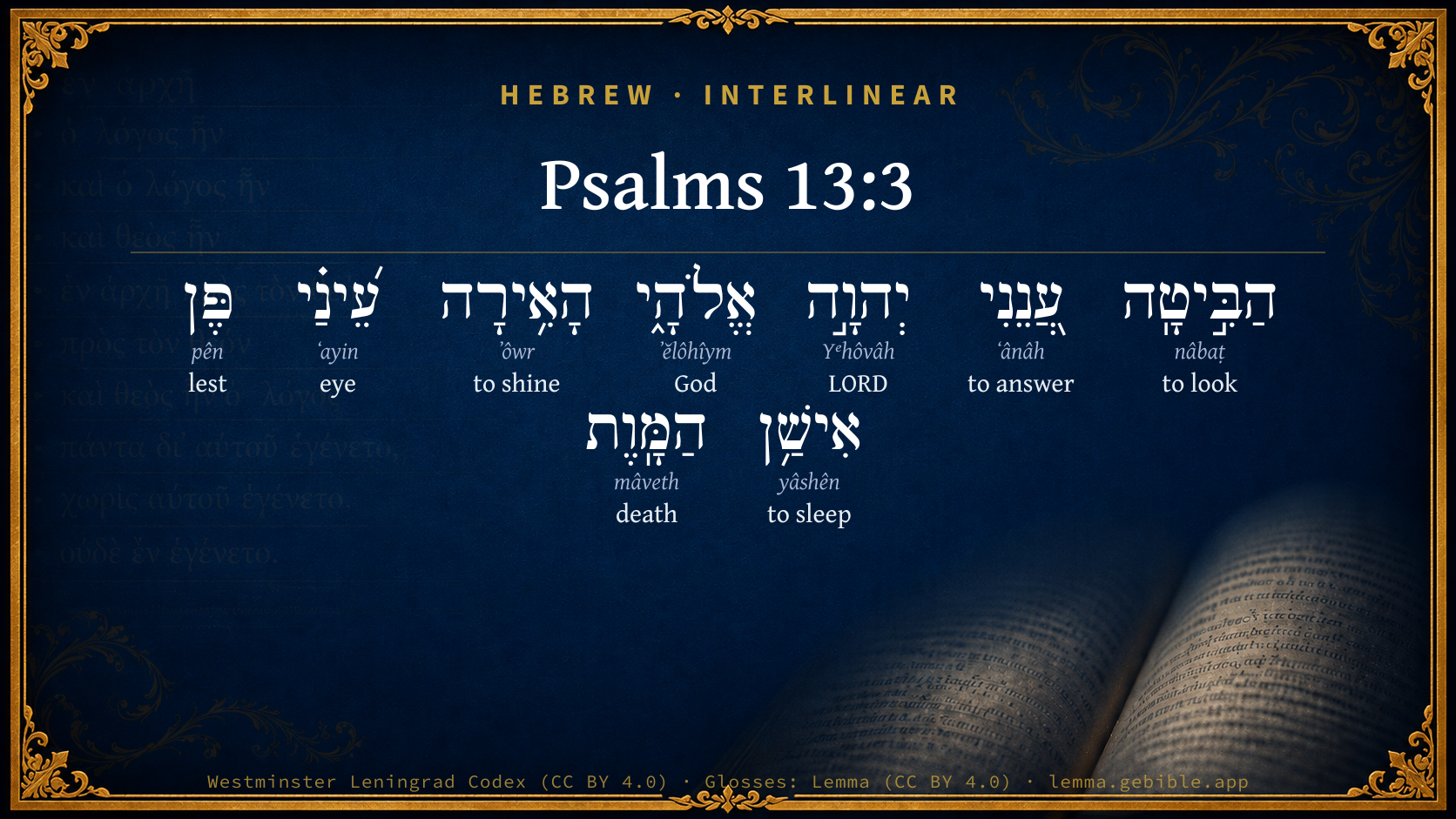
Psalms 13:3

Hebrew (Westminster Leningrad Codex) Psalms 13:3 appears in the Hebrew Old Testament. The text above is from the Westminster Leningrad Codex. Each word links to its Strong’s number, a concise gloss, and parsing drawn from the Open Scriptures Hebrew Bible morphology. Click any word for its full Brown-Driver-Briggs (BDB) entry.
Download image
Cite this verse

Psalms 13:3 (World English Bible). Public Domain. Lemma interlinear Bible study tool, https://lemma.gebible.app/v/psalms/13/3.

Show BibTeX & RIS
BibTeX
RIS
English Translation
Behold, and answer me, Yahweh, my God. Give light to my eyes, lest I sleep in death;
World English Bible · Public Domain
Download a study sheet

One document with this verse’s original text, its word-by-word gloss line, the meaning frame, cross-references with their text, attributed commentary, and full source and license credits — printable, and it pastes into notes with its structure intact.

This verse Autodidact and up

Study sheet (.html) Plain text (.txt)

A passage Seminary Student

Up to 50 verses in one chapter. A passage sheet keeps up to 6 commentary sources and 12 cross-references per verse, in the order this page ranks them, and says so on the sheet whenever that leaves anything out. Ask for a single verse and you get the Autodidact verse sheet above.

Everything on this page stays free to read, with no account — the sheet is a download of what is already on screen, not access to it.

Want to remove ads? Support Godless Engineer
Compare translations 3

The same verse in 3 English versions, stacked beneath the original-language interlinear above. Click any original word for its lexicon entry.

Each is an independent rendering of the whole verse — the interlinear is not word-aligned to these translations.

Highlighted words mark where these versions differ — a whole-verse word diff, not a word-by-word alignment.

  • World English Bible Public Domain
    Behold, and answer me, Yahweh, my God. Give light to my eyes, lest I sleep in death;
  • King James Version Public Domain
    Consider and hear me, O LORD my God: lighten mine eyes, lest I sleep the sleep of death;
  • unfoldingWord Literal Text CC BY-SA 4.0
    Consider answer me, Yahweh my God; give light to my eyes, lest I sleep the death,

unfoldingWord Literal Text — © unfoldingWord, licensed CC BY-SA 4.0. Word-aligned USFM3 via Door43 (git.door43.org/unfoldingWord/en_ult).

Versions to compare (up to 4)

3 of 4 selected

Show all 18 translations

Every available English version of this verse, each an independent rendering of the whole verse.

  • World English Bible Public Domain
    Behold, and answer me, Yahweh, my God. Give light to my eyes, lest I sleep in death;
  • Berean Standard Bible Public Domain
    Consider me and respond, O LORD my God. Give light to my eyes, lest I sleep in death,
  • Majority Standard Bible Public Domain
    Consider me and respond, O LORD my God. Give light to my eyes, lest I sleep in death,
  • King James Version Public Domain
    Consider and hear me, O LORD my God: lighten mine eyes, lest I sleep the sleep of death;
  • American Standard Version (1901) Public Domain
    Consider `and' answer me, O Jehovah my God: Lighten mine eyes, lest I sleep the `sleep of' death;
  • Revised Version (1885) Public Domain
    Consider and answer me, O LORD my God: lighten mine eyes, lest I sleep the sleep of death;
  • Geneva Bible (1599) Public Domain
    Beholde, and heare mee, O Lord my God: lighten mine eyes, that I sleepe not in death:
  • Douay-Rheims (1899) Public Domain
    How long shall my enemy be exalted over me?
  • Young's Literal Translation Public Domain
    Look attentively; Answer me, O Jehovah, my God, Enlighten mine eyes, lest I sleep in death,
  • Literal Standard Version CC BY-SA 4.0
    Look attentively; Answer me, O YHWH, my God, || Enlighten my eyes, lest I sleep in death,
  • Unlocked Literal Bible CC BY-SA 4.0
    Look at me and answer me, Yahweh my God! Give light to my eyes, or I will sleep in death.
  • unfoldingWord Literal Text CC BY-SA 4.0
    Consider answer me, Yahweh my God; give light to my eyes, lest I sleep the death,
  • Darby Bible Public Domain
    Consider, answer me, O Jehovah my God! lighten mine eyes, lest I sleep the [sleep of] death;
  • World Messianic Bible Public Domain
    Behold, and answer me, LORD, my God. Give light to my eyes, lest I sleep in death;
  • Webster's Bible Public Domain
    Consider and hear me, O LORD my God: lighten my eyes, lest I sleep the sleep of death;
  • Free Bible Version CC BY-SA 4.0
    Think about this, and answer me, Lord my God. Give me back my strength, otherwise I'm going to die,
  • Bible in Basic English Public Domain
    Let my voice come before you, and give me an answer, O Lord my God; let your light be shining on me, so that the sleep of death may not overtake me;
  • JPS Tanakh (1917) Public Domain
    (13-4) Behold Thou, and answer me, O LORD my God; lighten mine eyes, lest I sleep the sleep of death;

Literal Standard Version (2020), Covenant Press — licensed CC BY-SA 4.0. Text via the HelloAO Bible API (eBible.org). Unlocked Literal Bible (unfoldingWord) — licensed CC BY-SA 4.0. Text via the HelloAO Bible API (eBible.org). unfoldingWord Literal Text — © unfoldingWord, licensed CC BY-SA 4.0. Word-aligned USFM3 via Door43 (git.door43.org/unfoldingWord/en_ult). Free Bible Version, Dr. Jonathan Gallagher — licensed CC BY-SA 4.0. Text via the HelloAO Bible API (eBible.org).

Word by word

More ways to search: Search by grammar → Find every occurrence → Compare this word →

Practice this passage: Drill this verse → Learn its vocabulary →

אִישַׁ֥ן
yâshên
H3462
“to sleep”
Verb, Qal, Imperfect, 1st Person, Common, Singular
Part of Speech
Verb
Stem
Qal
Form
Imperfect
Person
1st Person
Gender
Common
Number
Singular
Full BDB Definition

Origin: a primitive root

TWOT: 928

to sleep, be asleep - (Qal) to sleep, go to sleep, be asleep - (Niphal) - to remain a long time, be stored up - to be festering (of leprosy) - (Piel) to cause to sleep, entice to sleep
  1. הַבִּ֣יטָֽה nâbaṭ H5027 “look” Verb, Hiphil, Imperative, 2nd Person, Masculine, Singular + Suffix, h
  2. עֲ֭נֵנִי ʻânâh H6030 “answer · me” Verb, Qal, Imperative, 2nd Person, Masculine, Singular + Suffix, Personal, 1st Person, Common, Singular
  3. יְהוָ֣ה Yᵉhôvâh H3068 “LORD” Noun, Proper
  4. אֱלֹהָ֑י ʼĕlôhîym H430 “God(s) · my” Noun, Common, Masculine, Plural, Construct + Suffix, Personal, 1st Person, Common, Singular
  5. הָאִ֥ירָה ʼôwr H215 “shine” Verb, Hiphil, Imperative, 2nd Person, Masculine, Singular + Suffix, h
  6. עֵ֝ינַ֗י ʻayin H5869 “eyes · my” Noun, Common, Both, Dual, Construct + Suffix, Personal, 1st Person, Common, Singular
  7. פֶּן pên H6435 “lest” Conjunction
  8. הַמָּֽוֶת mâveth H4194 “the · death” Particle, Definite Article + Noun, Common, Masculine, Singular, Absolute

About this verse

These counts appear in no published source. They are computed here, from the morphology-tagged text and Lemma’s own curated glosses. What Lemma adds →

9
words
9
distinct lemmas
Wisdom
section

Notable vocabulary

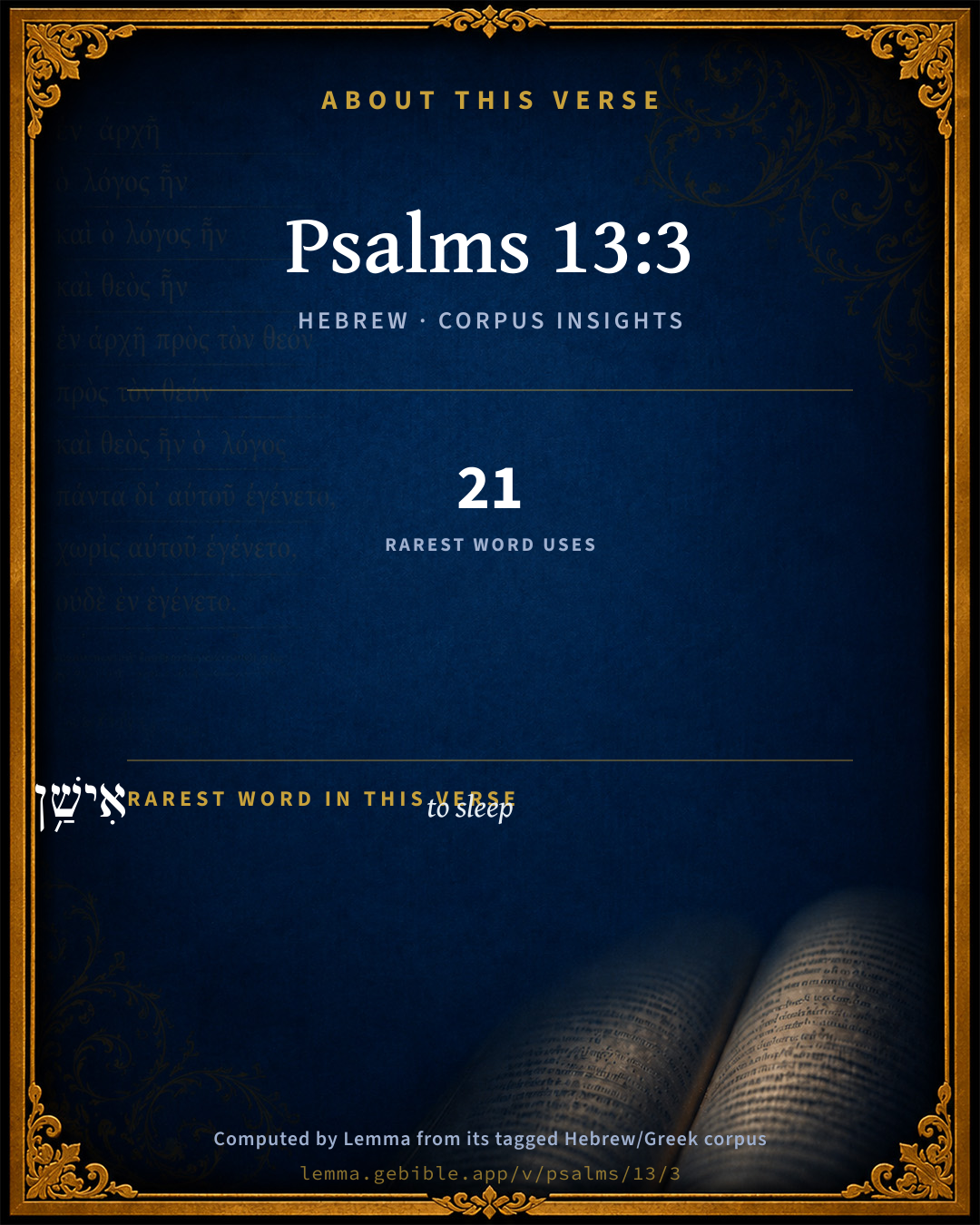
The rarest word here is אִישַׁ֥ן to sleep H3462 — appearing just 21 times in the whole Hebrew Bible.

Shared distinctive vocabulary

אִישַׁ֥ן to sleep H3462 occurs in 21 verses of the Hebrew Bible. Also found in:

Grammatical profile

  • 4 verbs
  • 4 nouns
  • 1 conjunction

Verb forms

  • הַבִּ֣יטָֽה Hiphil · Imperative
  • עֲ֭נֵנִי Qal · Imperative
  • הָאִ֥ירָה Hiphil · Imperative
  • אִישַׁ֥ן Qal · Imperfect

Hebrew & Septuagint length

In English translation the verse runs 17 words from the Hebrew and 18 from the Septuagint (LXX English) — closely comparable.

A rough comparison of the two English renderings, which tokenize alike — not a word-level alignment.

Word counts can differ between the Hebrew and the Greek without any difference in meaning — e.g. the Hebrew direct-object marker אֵת has no separate Greek word, and Greek often adds the article ὁ.

Cross-references

15

Topical passages linked to Psalms 13:3 in the Treasury of Scripture Knowledge — connected by theme and wording, ordered by reader-vote popularity; previews shown in the World English Bible.

  • Ezra 9:8 Now for a little moment grace has been shown from Yahweh our God, to leave us a remnant to escape, and to give us a nail in his holy place, that our God may lighten our eyes, and give us a little reviving in our bondage.
  • Psalms 18:28 For you will light my lamp, Yahweh. My God will light up my darkness.
  • Jeremiah 51:39 When they are heated, I will make their feast, and I will make them drunken, that they may rejoice, and sleep a perpetual sleep, and not wake, says Yahweh.
  • 1 Samuel 14:29 Then said Jonathan, My father has troubled the land. Please look how my eyes have been enlightened, because I tasted a little of this honey.
  • Psalms 5:1 Give ear to my words, Yahweh. Consider my meditation.
  • 1 Samuel 14:27 But Jonathan didn't hear when his father charged the people with the oath: therefore he put forth the end of the rod who was in his hand, and dipped it in the honeycomb, and put his hand to his mouth; and his eyes were enlightened.
  • Psalms 9:13 Have mercy on me, Yahweh. See my affliction by those who hate me, And lift me up from the gates of death;
  • Psalms 25:19 Consider my enemies, for they are many. They hate me with cruel hatred.
  • Psalms 31:7 I will be glad and rejoice in your loving kindness, For you have seen my affliction. You have known my soul in adversities.
  • Psalms 119:153 Consider my affliction, and deliver me, For I don't forget your law.
  • Jeremiah 51:57 I will make drunk her princes and her wise men, her governors and her deputies, and her mighty men; and they shall sleep a perpetual sleep, and not wake up, says the King, whose name is Yahweh of Hosts.
  • Lamentations 5:1 Remember, Yahweh, what has come on us: Look, and see our reproach.
  • Luke 2:32 A light for revelation to the Gentiles, And the glory of your people Israel."
  • Ephesians 5:14 Therefore he says, "Awake, you who sleep, and arise from the dead, and Christ will shine on you."
  • Revelation 21:23 The city has no need for the sun, neither of the moon, to shine, for the very glory of God illuminated it, and its lamp is the Lamb.

Cross-references courtesy of OpenBible.info (CC BY 4.0).

Hebrew and Greek witnesses Masoretic Hebrew ↔ Greek Septuagint

The same verse in the two great witnesses to the Old Testament, shown verse-for-verse.

You’re reading Greek Psalm 12 (Hebrew Psalm 13). The Septuagint counts the superscription, so verse numbers can differ from the Hebrew — chapter-level alignment, not verse-by-verse. Numbering follows Rahlfs.

These are two independent witnesses, not word-aligned to each other, and the Septuagint is shown in lemma (dictionary) form.

Hebrew Psalms 13:3 Masoretic · Westminster Leningrad Codex

הַבִּ֣יטָֽה עֲ֭נֵנִי יְהוָ֣ה אֱלֹהָ֑י הָאִ֥ירָה עֵ֝ינַ֗י פֶּן אִישַׁ֥ן הַמָּֽוֶת

Behold, and answer me, Yahweh, my God. Give light to my eyes, lest I sleep in death;

World English Bible · Public Domain

Greek LXX Greek Psalm 12:3 Septuagint · lemma form

ἕως τίς τίθημι βουλή ἐν ψυχή ἐγώ ὀδύνη ἐν καρδία ἐγώ ἡμέρα ἕως πότε ὑψόω ὁ ἐχθρός ἐγώ ἐπί ἐγώ

Look on me, listen to me, O Lord my God: lighten my eyes, lest I sleep in death;

LXX2012 (modern English Septuagint) · Public Domain

On this verse, Ellicott's Commentary for English Readers discusses the Septuagint’s reading. Read the note in Commentary ↓

Hebrew: Westminster Leningrad Codex (CC BY 4.0). Greek: Septuagint (public domain); English from LXX2012 (modern English Septuagint) (Public Domain). How the Septuagint differs from the Hebrew →

Commentary

Notes on Psalms 13:3 from classic Christian and Jewish commentators (each source and its license shown beneath its notes). The classic Christian expositions comment on the surrounding passage and are grouped to its opening verse, so a note may address several verses; the Jewish commentaries on the Tanakh (Rashi and others) are per-verse, so they appear only where the commentator wrote on this verse.

Lemma curates 59 commentaries, every one of them public domain or Creative Commons licensed, each selected and text-cleaned for this edition rather than reprinted as found. About our sources →

Trapp's Complete Commentary

John Trapp

Psa 13:3 Consider [and] hear me, O LORD my God: lighten mine eyes, lest I sleep the [sleep of] death;

Ver. 3. Consider and hear me, O Lord my God] He turns him to God in this peck of trouble (for they seldom come single), and pleads the covenant, "My God," beseeching him to see and hear both at once how it fared with him, and to send him seasonable and suitable help. It were wide with the faithful if they had not their God to repair unto in distress, pouring out their souls into his blessed bosom. This they must do most earnestly, when under a cloud of desertion; as our Saviour, being in an agony, prayed more fervently, Luk 22:44; and as Micah, having lost his gods, set up his note, Jdg 18:24.

Lighten mine eyes, lest I sleep death] i.e. Comfort my conscience, clear up my condition, and cheer up my drooping spirit, lest I faint away as a dying man, whose eyes through weakness wax dim, lest I fall into that somnus ferreus, as the poets call death, that longest sleep;

Surge, ne longus tibi somnus unde

Non times, detur (Hor. lib. 3, Od. 11).

John Trapp, A Commentary or Exposition upon All the Books of the Old and New Testament (1647–1656) — public domain. Text from a community e-Sword module.

The Biblical Illustrator

Joseph S. Exell

Psa_13:3

Lighten mine eyes, lest I sleep the sleep of death.

Moral and spiritual death

The Psalmists cry was for a physical deliverance from mortal danger--probably from a violent death at the hands of his enemies. With little or no straining of the words they may be turned into a prayer against the peril of moral and spiritual death. Under the emblem of death, virtuous and pious souls in all ages have been wont to depict a torpor, coldness, and inactivity of the moral and spiritual faculties. We dare not affirm that spiritual death is, like physical death, a final condition.

1. Moral death. The main point in bringing up children is to give moral life, so that at maturity conscience may be in them a living power. You must not only give your child rules of conduct, you must teach him likewise to hate evil and to love goodness. For moral death in the young man or woman there is but one remedy--the opening, lightening of the eyes. Another form of moral death is discoverable in those of maturer years, whose whole morality consists in simple imitation of others by habit, and in ruling the life by the ordinary customs and opinions of ones own little circle. Hundreds and thousands of quite respectable people are destitute of moral life. The essential conditions of moral life are absent. Such temptations as may come to then, are resisted from motives of self-indulgence rather than of self-denial and self-conquest. The worship of ease and respectability has gradually brought them into a state of moral torpor, indifference, and inactivity--has brought upon them, in fact, the sleep of death. Close akin to this is another form of moral death, into which some sink who once knew the nobility and the blessedness of the moral life. They began their worldly career not only innocent, but good, longing and striving to be good; but through adverse circumstances, through the pressure of the struggle for existence, they have been led to follow the evil example of the multitude, to copy their small dishonesties and their petty deceits in the matter of business, and to cease to have scruples in doing things and conniving at things which in their early days they shrank from as wicked. They become morally weaker from day to day, and at last the sleep of death comes over their hearts and consciences, and moral activity or heroic virtue is for them no longer possible. It is forgetfulness of God that most of all brings on this dreadful torpor. For the great mass of people, as they are, I can affirm, without fear of contradiction, that a religious life, a life of earnest prayer to God, is absolutely indispensable to a life of true and lofty morality.

2. Spiritual death. Moral death is widespread, even among respectable citizens. Spiritual death is equally prevalent among professedly religious people. Torpor, indifference, and inactivity of soul towards God is, I fear, the rule rather than the exception. And this is due to ignorance rather than to baseness, to a darkness which only the light of God can dispel. Spiritual death may be brought on by such means as these: by falseness in the creed detected, but not rejected; by superstition; by an unfounded fear of God; by undue regard for the mere externals of religious observances; by ignorance of what is really essential to true religion. These may be called the intellectual agents of spiritual disease and death. But there are other agents which are practical, such as being over-engrossed in worldly pursuits, giving up regular habits of prayer, seeking too eagerly the pleasures and indulgences of the flesh. We need a knowledge of the truth, which only God can give us, and which is much more than intellectual accuracy and consistency in our creed. The sleep of death may creel, over us when exhausted by the eternal problems which we make for ourselves, or find already made in our search after God. (Charles Voysey, M. A.)

Death in the midst of life

David was under no ordinary distress of mind, arising from some adversity into which he had fallen through the instrumentality of a fellow mortal. David knew that adversity is uniformly attended with one of two results: either a serious consideration of the causes which have brought down these inflictions and a consequent turning to God, or a reckless inattention to and a hardened disregard of the dealings of Gods providence, which eventually lead to an utter disregard of Him here, and an eternal separation from His favour and presence hereafter. In the text we have three petitions--

1. That the Lord would condescend to make him the object of His most gracious consideration. He grounds his plea upon a sense of utter helplessness in the sight of God. How blessed are days of adversity, when they bring with them such distrust in ourselves, and such unshaken confidence in the protection of God!

2. That the eyes of his spiritual understanding might be lightened.

3. That he might not be permitted to sleep the sleep of death. By death the Psalmist does not exclusively mean the separation of soul and body. We are inclined to think he is praying for deliverance from that spiritual death in which all, though naturally alive, are involved, on whose heart the spirit of the living God has not wrought a saving work. (James Robertson, A. M.)

Letting in the light

A passer-by one day asked of an Irishman, whom he observed breaking a large hole in the wall of an old cellar, what he was doing. The answer of Barney was prompt, Shure, an Im lettin out the dark. We spend much time and energy in the same foolish idea; we attack the dark, instead of putting all our powers into the glorious work of letting in the light. Whether the darkness be that of uncivilised ignorance, or infidel prejudice, let us shine in the light of the glorious Gospel, and the darkness will fly. (W. Luff.)

The Biblical Illustrator, edited by Joseph S. Exell (c. 1880s–1900s) — public domain. Text from a community e-Sword module.

Joseph Benson's Commentary

Psa 13:3-5. Lighten mine eyes — Because I find my own counsels insufficient, do thou enlighten my mind, and guide me by thy counsel into the right way of obtaining thy merciful help. Or, he means, Do thou revive, and comfort, and deliver me from the darkness of death, which is ready to come upon me, and to close mine eyes. Lest mine enemy say, I have prevailed against him — Namely, by my art or strength; which will reflect dishonour on thee, as if thou wert either unfaithful and unmindful of thy promises, or unable to fulfil them. Therefore prevent, or repress this their arrogance and blasphemy, and maintain thine own honour. I have trusted in thy mercy — Neither their threats and boastings, nor my own dangers, shall shake my confidence in thy mercy promised to me.

Joseph Benson's Commentary on the Old and New Testaments (1811–1818) — public domain. Text from a community e-Sword module.

Tyndale Open Study Notes

Tyndale Open Resources

13:3-4 Only the Lord can bring enlightenment and relief. The psalmist longs for the Lord’s vindication so that his foes will not rejoice.

13:3 The psalmist’s affliction feels like death (22:15; 55:4; 88:15; 94:17; 116:3).

Tyndale Open Study Notes — © Tyndale Open Resources, licensed CC BY-SA 4.0. Text via the HelloAO Bible API.

Jamieson, Fausset & Brown

Robert Jamieson, A. R. Fausset & David Brown

lighten mine eyes--dim with weakness, denoting approaching death (compare Sa1 14:27-29; Psa 6:7; Psa 38:10).

Jamieson, Fausset & Brown — Commentary Critical and Explanatory on the Whole Bible (1871) — public domain (CC PDM 1.0). Text via the HelloAO Bible API.

Adam Clarke's Commentary

Verse 3. Consider and hear me] Rather, answer me. I have prayed; I am seeking thy face I am lost without thee; I am in darkness; my life draws nigh to destruction; if I die unforgiven, I die eternally. O Lord my God, consider this; hear and answer, for thy name's sake.

Adam Clarke's Commentary on the Bible (1810–1826) — public domain. Text from a community e-Sword/MySword module.

John Calvin's Commentaries

3. Look upon me, answer me. As when God does not promptly afford assistance to his servants, it seems to the eye of sense that he does not behold their necessities, David, for this reason, asks God, in the first place, to look upon him, and, in the second place, to succor him. Neither of these things, it is true, is prior or posterior in respect of God; but it has been already stated in a preceding psalm, and we will have occasion afterwards frequently to repeat the statement, that the Holy Spirit purposely accommodates to our understanding the models of prayer recorded in Scripture. If David had not been persuaded that God had his eyes upon him, it would have availed him nothing to cry to God; but this persuasion was the effect of faith. In the meantime, until God actually puts forth his hand to give relief, carnal reason suggests to us that he shuts his eyes, and does not behold us. The manner of expression here employed amounts to the same thing as if he had put the mercy of God in the first place, and then added to it his assistance, because God then hears us, when, having compassion upon us, he is moved and induced to succor us. To enlighten the eyes signifies the same thing in the Hebrew language as to give the breath of life, for the rigour of life appears chiefly in the eyes. In this sense Solomon says,

“The poor and the deceitful man meet together; the Lord lighteneth both their eyes.” (Proverbs 29:13)

And when Jonathan fainted for hunger, the sacred history relates that his eyes were overcast with dimness; and again, that when he had tasted of the honeycomb, his eyes were enlightened, (1 Samuel 14:27.) The word sleep, as it is used in this passage, is a metaphor of a similar kind, being put for death. In short, David confesses, that unless God cause the light of life to shine upon him, he will be immediately overwhelmed with the darkness of death, and that he is already as a man without life, unless God breathe into him new vigor. And certainly our confidence of life depends on this, that although the world may threaten us with a thousand deaths, yet God is possessed of numberless means of restoring us to life. “Toutesfois Dieu ha en main des moyens infohis de nous restablir ca vie.” — Fr.

John Calvin's Commentaries (1540-1563) — public domain. Text from the Calvin Translation Society English edition (1840s-50s) via the Christian Classics Ethereal Library (ccel.org). Calvin's coverage is partial (roughly two-thirds of the Bible); uncommented books and verses are honest gaps, never fabricated. The 19th-century editor's footnotes and remarks are omitted so the notes are faithfully Calvin's own voice.

Ellicott's Commentary for English Readers

(3) Lighten.—Literally, give light to my eyes that I may not go to sleep in death, i.e., go to sleep and never wake; “sleep unto death,” as the LXX. (Comp. for the nature of the fear, Psa_6:5; and for the form of expression, 1Sa_14:27; 1Sa_14:29.)

A Bible Commentary for English Readers, edited by Charles John Ellicott (1878–1897) — public domain. Text from a community e-Sword module.

The Cambridge Bible for Schools and Colleges

gen. ed. J. J. S. Perowne

3. Behold (Psa_10:14), instead of hiding Thy face, answer me (Psa_3:4) instead of forgetting my need.

Lighten mine eyes] Revive and quicken me. The eyes are the index of vital energy. They ‘waste away,’ they lose their light, they ‘are darkened,’ by sickness or sorrow (Psa_6:7, Psa_38:10; Lam_5:17). They are ‘enlightened’ when strength and spirits are restored (1Sa_14:27; 1Sa_14:29; Ezr_9:8). It is the light of God’s face, the illumination of His love and favour, which is the source of life (Psa_4:6; Psa_31:16; Psa_36:9).

3, 4. A prayer, in calmer tone.

The Cambridge Bible for Schools and Colleges (gen. ed. J. J. S. Perowne; Cambridge University Press, 1878–1918) — public domain. Text from a community e-Sword module.

John Gill's Exposition

Consider and hear me, O Lord my God,.... The psalmist amidst all his distresses rightly applies to God by prayer, claims his interest in him as his covenant God, which still continued notwithstanding all his darkness, desertions, and afflictions; and entreats him to "consider" his affliction and trouble, and deliver him out of it; to consider his enemies, how many and mighty they were; and his own weakness his frame, that he was but dust, and unable to stand against them: or to "look" (u) upon his affliction, and upon him under it, with an eye of pity and compassion; to have respect to him and to his prayers, and to turn unto him, and lift up the light of his countenance upon him: and so this petition is opposed to the complaint in Psa 13:1; and he further requests that he would "hear" him; that is, so as to answer him, and that immediately, and thereby show that he had not forgotten him, but was mindful of him, of his love to him, and covenant with him;

lighten mine eyes: meaning either the eyes of his body, which might be dim and dull through a failure of the animal spirits, by reason of inward grief, outward afflictions, or for want of bodily food; which when obtained refreshes nature, cheers the animal spirits, enlightens or gives a briskness to the eyes; see Sa1 14:27; or else the eyes of his understanding, Eph 1:18; that he might behold wondrous things in the law of God, know the things which were freely given to him of God, see more clearly his interest in him, and in the covenant of his grace, and have his soul refreshed and comforted with the light of God's countenance; and he be better able to discern his enemies, and guard against them; and be directed to take the best method to be delivered and secured from them. The people of God are sometimes in the dark, and see no light; especially when benighted, and in sleepy frames; and it is God's work to enlighten and quicken them;

lest I sleep the sleep of death; a natural death (w), which is comparable to sleep, and often expressed by it; and which sense agrees with lightening the eyes of his body, as before explained; or rather the sense is, lift up the light of thy countenance, revive thy work in the midst of the years; let me see thy goodness in the land of the living, that I may not faint and sink and die away. Or it may be an eternal death is designed; for though true believers shall never die this death, yet they may be in such circumstances, as through unbelief to fear they shall. The Targum paraphrases the word thus;

"enlighten mine eyes in thy law, lest I sin, and sleep with those who are guilty of death.''

(u) "intuere", Junius & Tremellius, Piscator; "aspice", Pagninus, Montanus, Cocceius. (w) , Homer. Iliad. 11. v. 241. "ferreus somnus", Virgil. Aeneid. 10. v. 745, & 12. v. 309.

John Gill's Exposition of the Whole Bible (1746–1763) — public domain (CC PDM 1.0). Text via the HelloAO Bible API.

Albert Barnes' Notes on the Bible

Consider and hear me - literally, “Look, hear me.” God had seemed to avert his face as if he would not even look upon him Psa 13:1; and the psalmist now prays that he “would” look upon him - that he would regard his wants - that he would attend to his cry. So we pray to one who turns away from us as if he were not disposed to hear, and as if he cared nothing about us.

Lighten mine eyes - The allusion here is, probably, to his exhaustion, arising from trouble and despair, as if he were about to die. The sight grows dim as death approaches; and he seemed to feel that death was near. He says that unless God should interpose, the darkness would deepen, and he must die. The prayer, therefore, that God would “enlighten his eyes,” was a prayer that he would interpose and save him from that death which he felt was rapidly approaching.

Lest I sleep the sleep of death - literally, “Lest I sleep the death;” that is, “in” death, or, as in the common version, the sleep of death. The idea is, that death, whose approach was indicated by the dimness of vision, was fast stealing over him as a sleep, and that unless his clearness of vision were restored, it would soon end in the total darkness - the deep and profound sleep - of death. Death is often compared to sleep. See the note at 1Co 11:30; the note at Joh 11:11, Joh 11:13; 1Th 4:14; Dan 12:2. The resemblance between the two is so obvious as to have been remarked in all ages, and the comparison is found in the writings of all nations. It is only, however, in connection with Christianity that the idea has been fully carried out by the doctrine of the resurrection, for as we lie down at night with the hope of awaking to the pursuits and enjoyments of a new day, so the Christian lies down in death with the hope of awaking in the morning of the resurrection to the pursuits and enjoyments of a new and eternal day. Everywhere else death is, to the mind, a long and unbroken sleep. Compare Jer 51:39, Jer 51:57.

Albert Barnes' Notes on the Bible (1834–1885) — public domain. Text from a community e-Sword/MySword module.

Matthew Poole's English Annotations

Lighten mine eyes; either,

1. Because I find my counsel insufficient, Psa 13:2, do thou enlighten my mind, and guide me by thy counsel and Spirit into the right way of obtaining thy mercy and help. So this phrase is used Psa 19:8; Eph 1:18. Or,

2. Do thou revive, and comfort, and deliver me from the darkness of death, which is ready to come upon me and to close mine eyes. Nothing is more common than to express great dangers and calamities by darkness, and great comforts and deliverances by light, as Job 15:22; 17:13; 30:26, and by an enlightening of the eyes, as Ezr 9:8. Compare Pro 15:30; 29:13.

Lest I sleep the sleep of death, i.e. lest I sink under my burden and die; for death is oft called a sleep in Scripture, as Job 3:13; 14:12; Psa 76:5; Joh 11:11.

Matthew Poole's English Annotations on the Holy Bible (1683–1685) — public domain. Text from a community e-Sword/MySword module.

The Treasury of David

Charles H. Spurgeon

Ver. 3. But now prayer lifteth up her voice, like the watchman who proclaims the daybreak. Now will the tide turn, and the weeper shall dry his eyes. The mercyseat is the life of hope and the death of despair. The gloomy thought of God's having forsaken him is still upon the psalmist's soul, and he therefore cries,

Consider and hear me. He remembers at once the root of his woe, and cries aloud that it may be removed. The final absence of God is Tophet's fire, and his temporary absence brings his people into the very suburbs of hell. God is here entreated to see and hear, that so he may be doubly moved to pity. What should we do if we had no God to turn to in the hour of wretchedness?

Note the cry of faith,

O Lord MY God! Is it not a very glorious fact that our interest in our God is not destroyed by all our trials and sorrows? We may lose our gourds, but not our God. The title deed of heaven is not written in the sand, but in eternal brass.

Lighten mine eyes: that is, let the eye of my faith be clear, that I may see my God in the dark; let my eye of watchfulness be wide open, lest I be entrapped, and let the eye of my understanding be illuminated to see the right way. Perhaps, too, here is an allusion to that cheering of the spirits so frequently called the enlightening of the eyes because it causes the face to brighten, and the eyes to sparkle. Well may we use the prayer, "Lighten our darkness, we beseech thee, O Lord!" for in many respects we need the Holy Spirit's illuminating rays.

Lest I sleep the sleep of death. Darkness engenders sleep, and despondency is not slow in making the eyes heavy. From this faintness and dimness of vision, caused by despair, there is but a step to the iron sleep of death. David feared that his trials would end his life, and he rightly uses his fear as an argument with God in prayer; for deep distress has in it a kind of claim upon compassion, not a claim of right, but a plea which has power with grace. Under the pressure of heart sorrow, the psalmist does not look forward to the sleep of death with hope and joy, as assured believers do, but he shrinks from it with dread, from which we gather that bondage from fear of death is no new thing.

Ver. 3. Lighten mine eyes, lest I sleep the sleep of death. In time of sickness and grief, the "eyes" are dull and heavy; and they grow more and more so as death approaches, which closes them in darkness. On the other hand, health and joy render the organs of vision bright and sparkling, seeming, as it were, to impart "light" to them from within. The words, therefore, may be fitly applied to a recovery of the body natural, and thence, of the body politic, from their respective maladies. Nor do they less significantly describe the restoration of the soul to a state of spiritual health and holy joy, which will manifest themselves in like manner, by "the eyes of the understanding being enlightened; "and in this case, the soul is saved from the sleep of sin, as the body is in the other, from the sleep of death. George Horne.

Ver. 3. Why dost thou hide thy face? happily thou wilt say, None can see thy face and live. Ah, Lord, let me die, that I may see thee; let me see thee, that I may die: I would not live, but die; that I may see Christ, I desire death; that I may live with Christ, I despise life. Augustine.

Ver. 3. How long wilt thou hide thy face from me? Oh, excellent hiding, which is become my perfection! My God, thou hidest thy treasure, to kindle my desire! Thou hidest thy pearl, to inflame the seeker; thou delayest to give, that thou mayest teach me to importune; seemest not to hear, to make me persevere. John Anselm, 1034-1109.

Ver. 3. By accommodating the text to the believer.

1. True character of Satan, "enemy."

2. Remarkable fact that this enemy is exalted over us.

3. Pressing enquiry, "How long?"

B. Davies.

Ver. 3. Lighten mine eyes. A prayer fit for (1) Every benighted sinner. (2) Every seeker of salvation. (3) Every learner in Christ's school. (4) Every tried believer. (5) Every dying saint. B. Davies.

Psalms 13:4*

Charles H. Spurgeon's The Treasury of David (1869–1885) — public domain. Psalms only. Text from a community e-Sword/MySword module.

Whedon's Commentary on the Bible

Daniel D. Whedon

3. Consider… me—From dejection of mind David turns to prayer with a more softened and hopeful tone. “Consider;” that is, behold, look; give direct, immediate, attention.

Lighten… eyes—His sorrow had dimmed the lustre of his eyes, which the divine joy and salvation alone could restore.

On the figure, see 1Sa_14:27; 1Sa_14:29.

Sleep of death—Literally, lest I shall sleep the death. This language is the strongest that the Hebrew supplies to denote that without help from God death must soon end the dreadful conflict. See Jer_51:39

Daniel D. Whedon (gen. ed.), Commentary on the Old and New Testaments (1874–1909) — public domain. Text from a community e-Sword module.

The Pulpit Commentary

Consider and hear me, O Lord my God. (comp. Psa_5:1 Psa_9:13 Psa_141:1, etc.) David will not allow himself to be "forgotten;" he will recall himself to God"s remembrance. "Consider hear me," he says, "O Lord my God;" still "my God," although thou hast forgotten me, and therefore bound to "hear me." Lighten mine eyes. Not so much "enlighten me spiritually," as "cheer me up; put brightness into my eyes; revive me". (comp. Ezr_9:8, "Grace hath been showed from the Lord our God, to leave us a remnant to escape... that our God may lighten out eyes, and give us a little reviving Lest I sleep the sleep of death; literally, lest I sleep death. Death is compared to a sleep by Job, (Job_11:12) Jeremiah, (Jer_51:39, Jer_51:57) Daniel, (Dan_12:2) and here by David, in the Old Testament; and by our Lord (Joh_11:11-13) and St. Paul in the New. (1Co_11:30 1Co_15:51 1Th_4:14, 1Th_4:15) The external resemblance of a corpse to a sleeping person was the root of the metaphor, and we shall do wrong to conclude from its employment anything with respect to the psalmist"s views concerning the real nature of death.

The Pulpit Commentary (1880–1919), ed. H.D.M. Spence-Jones & Joseph S. Exell — public domain. Text from a community e-Sword module.

John Wesley's Explanatory Notes

Lighten - Revive and comfort, and deliver me from the darkness of death, which is ready to come upon me.

John Wesley, Explanatory Notes Upon the Whole Bible (1754–1765) — public domain. Text via the GEBible commentary corpus.

Keil & Delitzsch

C. F. Keil & F. Delitzsch

(Heb.: 13:4-5) In contrast to God's seeming to have forgotten him and to wish neither to see nor know anything of his need, he prays: הבּיטה (cf. Isa 63:15). In contrast to his being in perplexity what course to take and unable to help himself, he prays: ענני, answer me, who cry for help, viz., by the fulfilment of my prayer as a real, actual answer. In contrast to the triumphing of his foe: האירה עיני, in order that the triumph of his enemy may not be made complete by his dying. To lighten the eyes that are dimmed with sorrow and ready to break, is equivalent to, to impart new life (Ezr 9:8), which is reflected in the fresh clear brightness of the eye (Sa1 14:27, Sa1 14:29). The lightening light, to which האיר points, is the light of love beaming from the divine countenance, Psa 31:17. Light, love, and life are closely allied notions in the Scriptures. He, upon whom God looks down in love, continues in life, new powers of life are imparted to him, it is not his lot to sleep the death, i.e., the sleep of death, Jer 51:39, Jer 51:57, cf. Psa 76:6. המּות is the accusative of effect or sequence: to sleep so that the sleep becomes death (lxx εἰς θάνατον), Ew. 281, e. Such is the light of life for which he prays, in order that his foe may not be able at last to say יכלתּיו (with accusative object, as in Jer 38:5) = יכלתּי לו, Psa 129:2, Gen 32:26, I am able for him, a match for him, I am superior to him, have gained the mastery over him. כּי, on account of the future which follows, had better be taken as temporal (quum) than as expressing the reason (quod), cf. בּמוט רגלי, Psa 38:17.

Keil & Delitzsch — Biblical Commentary on the Old Testament (1861–1891) — public domain (CC PDM 1.0). Text via the HelloAO Bible API. (Old Testament only.)

J. A. Alexander on Psalms

Joseph Addison Alexander

3. (2). Till when, how long, shall I place (or lay up) counsels, plans, in my soul, grief in my heart by day? Till when shall my enemy be high above me? The idea in the first clause seems to be that of accumulating methods or expedients of escape, as in a storehouse, without finding any that will answer the purpose. The same figure maybe continued in the second clause: (how long shall I lay up) sorrow in my heart? The sense is then that the multiplication of devices only multiplies his sorrows. Or the figure of laying up may be confined to the first clause, and the noun grief governed by a verb understood: (how long shall I feel) sorrow in my heart? The common version, having sorrow, conveys the same idea, but supplies a verb unknown to the Hebrew and its cognate languages.—By day is elsewhere put in opposition to by night, as for instance in Ps. 1:2 above. Here it may possibly mean all day, but more probably means every day, daily, as in Ezek. 30:16.—Be high: the original expression is a verb alone. How long shall my enemy soar or tower above me, i.e. be superior, prevail? This clause determines the precise form of suffering complained of, namely, that occasioned by the malice of a powerful persecutor or oppressor. In all such cases, Saul was no doubt present to the mind of David, but only as a specimen or type of the whole class to which the psalm relates.

4. (Psa 15:3). Look, hear me, Jehovah, my God, lighten my eyes, lest I sleep the death. The complaint is now followed by a corresponding prayer. In allusion to the hiding of the face in Psa 15:2 (1), he now beseeches God to look towards him, or upon him, to show by his acts that he has not lost sight of him. As he before complained of God's forgetting him, so here he prays that he will hear and answer him. See above, on Psa 3:5 (4). The idea of Jehovah as a God in covenant with his people, is brought out still more fully by the phrase my God, i.e. one on whom I have a right to call, with a well-founded hope of being heard. See above on Psa 3:8 (7).— Enlighten my eyes, or make them shine, is by some understood to mean, Dispel my doubts, and extricate me out of my perplexities, with reference to the plans or counsels mentioned in the preceding verse. Others, with more probability, suppose an allusion to the dimness of the eyes produced by extreme weakness or approaching death, and understand the prayer as one for restoration and deliverance from imminent destruction. Compare 1Sa 14:27; 1Sa 14:29, where the relief of Jonathan's debility, occasioned by long fasting, is described by saying that his eyes were enlightened.—Lest the sleep (in) death, or lest I sleep the (sleep of) death, as in the common version. Compare the beautiful description of death as a sleep of perpetuity, a perpetual or everlasting sleep, in Jer 51:39; Jer 51:57.

Joseph Addison Alexander, The Psalms Translated and Explained (1850) — public domain. Text from a community e-Sword module.

unfoldingWord translationNotes

Door43 World Missions Community

Look at me and answer me

"Give me your attention and listen to me"

Give light to my eyes

This is a way of asking for strength. AT: "Make me strong again" (See: Idiom)

or I will sleep in death

To "sleep in death" means to die. (See: Euphemism)

Do not let my enemy say ... so that my enemy may not say

"Do not let my enemy say about me ... so that my enemy may not say about me"

when I am brought down

"when I fall" or "when they defeat me"

translationWords

God

die

adversary

joy

unfoldingWord translationNotes — © Distant Shores Media and the Door43 World Missions Community, licensed CC BY-SA 4.0. Source: git.door43.org/Door43/en_tn.

Lesson kit

Teaching starters — assembled from the data on this page, not authored interpretation. Every prompt links to the verse data it draws on. Edit before teaching.

Psalms, in the Wisdom, opens this verse with 9 words (9 distinct Hebrew lemmas). Its most distinctive word is yâshên (“to sleep”). A historical commentator’s framing appears above. Read the whole chapter for the surrounding context.

Discussion questions

  1. How does “to sleep” (yâshên) shape what this verse is saying?
  2. How does Genesis 2:21, which shares the word «to sleep», read alongside this verse?
  3. These translations render this verse differently. What is at stake in choosing one wording over another?
  4. «הַבִּ֣יטָֽה» is a Hiphil Imperative verb. How does that grammatical form shape the action described?
  5. Compare how Trapp's Complete Commentary and The Biblical Illustrator read this verse. Where do they agree or differ?

Things to notice

Reading settings

Reading text

Shown beneath each verse's original-language words.

Old Testament
Old Testament edition

Read the OT as the Masoretic Hebrew (MT) or the Greek Septuagint (LXX).

English shown for the Greek Septuagint (in the Hebrew ↔ Greek comparison).

Comparing translations? Open the Compare panel on any verse page to stack up to four side by side.