
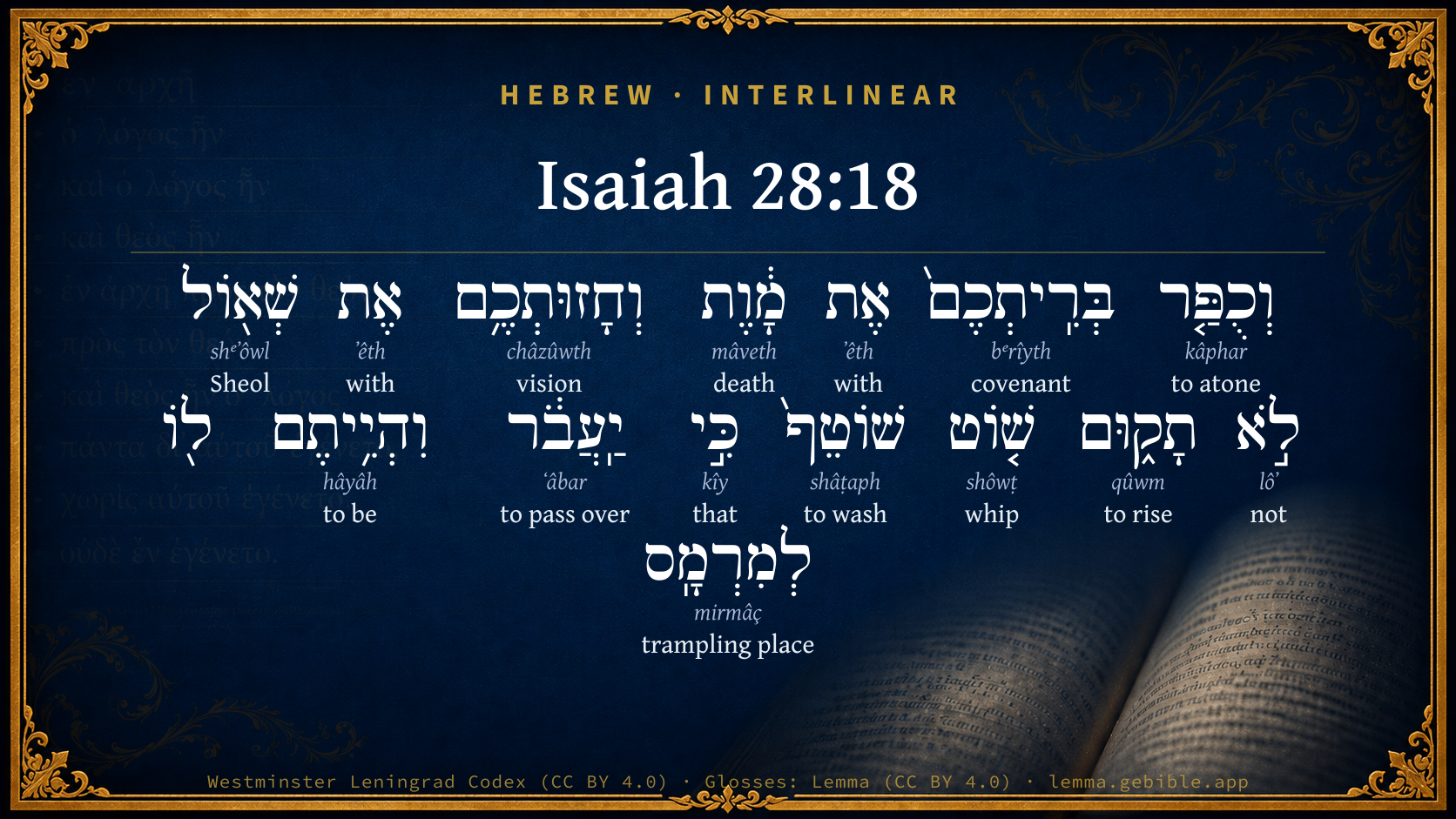
Isaiah 28:18

Hebrew (Westminster Leningrad Codex) Isaiah 28:18 appears in the Hebrew Old Testament. The text above is from the Westminster Leningrad Codex. Each word links to its Strong’s number, a concise gloss, and parsing drawn from the Open Scriptures Hebrew Bible morphology. Click any word for its full Brown-Driver-Briggs (BDB) entry.
Download image
Cite this verse

Isaiah 28:18 (World English Bible). Public Domain. Lemma interlinear Bible study tool, https://lemma.gebible.app/v/isaiah/28/18.

Show BibTeX & RIS
BibTeX
RIS
English Translation
Your covenant with death shall be annulled, and your agreement with Sheol shall not stand; when the overflowing scourge shall pass through, then you shall be trodden down by it.
World English Bible · Public Domain
Download a study sheet

One document with this verse’s original text, its word-by-word gloss line, the meaning frame, cross-references with their text, attributed commentary, and full source and license credits — printable, and it pastes into notes with its structure intact.

This verse Autodidact and up

Study sheet (.html) Plain text (.txt)

A passage Seminary Student

Up to 50 verses in one chapter. A passage sheet keeps up to 6 commentary sources and 12 cross-references per verse, in the order this page ranks them, and says so on the sheet whenever that leaves anything out. Ask for a single verse and you get the Autodidact verse sheet above.

Everything on this page stays free to read, with no account — the sheet is a download of what is already on screen, not access to it.

Want to remove ads? Support Godless Engineer
Compare translations 3

The same verse in 3 English versions, stacked beneath the original-language interlinear above. Click any original word for its lexicon entry.

Each is an independent rendering of the whole verse — the interlinear is not word-aligned to these translations.

Highlighted words mark where these versions differ — a whole-verse word diff, not a word-by-word alignment.

  • World English Bible Public Domain
    Your covenant with death shall be annulled, and your agreement with Sheol shall not stand; when the overflowing scourge shall pass through, then you shall be trodden down by it.
  • King James Version Public Domain
    And your covenant with death shall be disannulled, and your agreement with hell shall not stand; when the overflowing scourge shall pass through, then ye shall be trodden down by it.
  • unfoldingWord Literal Text CC BY-SA 4.0
    And your covenant with death will be covered over, and your agreement with Sheol will not stand. The overflowing scourge, when it passes through, then you will be to it for trampling.

unfoldingWord Literal Text — © unfoldingWord, licensed CC BY-SA 4.0. Word-aligned USFM3 via Door43 (git.door43.org/unfoldingWord/en_ult).

Versions to compare (up to 4)

3 of 4 selected

Show all 18 translations

Every available English version of this verse, each an independent rendering of the whole verse.

  • World English Bible Public Domain
    Your covenant with death shall be annulled, and your agreement with Sheol shall not stand; when the overflowing scourge shall pass through, then you shall be trodden down by it.
  • Berean Standard Bible Public Domain
    Your covenant with death will be dissolved, and your agreement with Sheol will not stand. When the overwhelming scourge passes through, you will be trampled by it.
  • Majority Standard Bible Public Domain
    Your covenant with death will be dissolved, and your agreement with Sheol will not stand. When the overwhelming scourge passes through, you will be trampled by it.
  • King James Version Public Domain
    And your covenant with death shall be disannulled, and your agreement with hell shall not stand; when the overflowing scourge shall pass through, then ye shall be trodden down by it.
  • American Standard Version (1901) Public Domain
    And your covenant with death shall be annulled, and your agreement with Sheol shall not stand; when the overflowing scourge shall pass through, then ye shall be trodden down by it.
  • Revised Version (1885) Public Domain
    And your covenant with death shall be disannulled, and your agreement with hell shall not stand; when the overflowing scourge shall pass through, then ye shall be trodden down by it.
  • Geneva Bible (1599) Public Domain
    And your couenant with death shalbe disanulled, and your agreement with hell shall not stand: when a scourge shall runne ouer and passe through, then shall ye be trode downe by it.
  • Douay-Rheims (1899) Public Domain
    And Sour league with death shall be abolished, and your covenant with hell shall not stand: when the overflowing scourge shall pass, you shall be trodden down by it.
  • Young's Literal Translation Public Domain
    And disannulled hath been your covenant with death, And your provision with Sheol doth not stand, An overflowing scourge, when it passeth over, Then ye have been to it for a treading-place.
  • Literal Standard Version CC BY-SA 4.0
    And your covenant with death has been annulled, || And your provision with Sheol does not stand, || An overflowing scourge, when it passes over, || Then you have been to it for a treading-place.
  • Unlocked Literal Bible CC BY-SA 4.0
    Your covenant with death will be dissolved, and your agreement with Sheol will not stand. When the raging flood passes through, you will be overwhelmed by it.
  • unfoldingWord Literal Text CC BY-SA 4.0
    And your covenant with death will be covered over, and your agreement with Sheol will not stand. The overflowing scourge, when it passes through, then you will be to it for trampling.
  • Darby Bible Public Domain
    And your covenant with death shall be annulled, and your agreement with Sheol shall not stand; when the overflowing scourge shall pass through, ye shall be trodden down by it.
  • World Messianic Bible Public Domain
    Your covenant with death shall be annulled, and your agreement with Sheol shall not stand. When the overflowing scourge passes through, then you will be trampled down by it.
  • Webster's Bible Public Domain
    And your covenant with death shall be disannulled, and your agreement with hell shall not stand; when the overflowing scourge shall pass through, then ye shall be trodden down by it.
  • Free Bible Version CC BY-SA 4.0
    Your agreement with death will be canceled; your contract with the grave will be revoked. When the terrible disaster rushes by, it will trample you underfoot.
  • Bible in Basic English Public Domain
    And the help you were looking for from death will come to nothing, and your agreement with the underworld will be broken; when the overflowing waters come through, then you will be overcome by them.
  • JPS Tanakh (1917) Public Domain
    And your covenant with death shall be disannulled and your agreement with the nether-world shall not stand; when the scouring scourge shall pass through, then ye shall be trodden down by it,

Literal Standard Version (2020), Covenant Press — licensed CC BY-SA 4.0. Text via the HelloAO Bible API (eBible.org). Unlocked Literal Bible (unfoldingWord) — licensed CC BY-SA 4.0. Text via the HelloAO Bible API (eBible.org). unfoldingWord Literal Text — © unfoldingWord, licensed CC BY-SA 4.0. Word-aligned USFM3 via Door43 (git.door43.org/unfoldingWord/en_ult). Free Bible Version, Dr. Jonathan Gallagher — licensed CC BY-SA 4.0. Text via the HelloAO Bible API (eBible.org).

Word by word

More ways to search: Search by grammar → Find every occurrence → Compare this word →

Practice this passage: Drill this verse → Learn its vocabulary →

וְחָזוּתְכֶ֥ם
châzûwth
H2380
“and · vision · your”
Conjunction + Noun, Common, Feminine, Singular, Construct + Suffix, Personal, 2nd Person, Masculine, Plural
Part of Speech
Conjunction + Noun
Type
Common
Gender
Feminine
Number
Singular
State
Construct
Full BDB Definition

Origin: from H2372

TWOT: 633d

vision, conspicuousness - vision, oracle of a prophet - agreement - conspicuousness in appearance
  1. וְכֻפַּ֤ר kâphar H3722 “and · to atone” Conjunction + Verb, Pual, Sequential Perfect, 3rd Person, Masculine, Singular
  2. בְּרִֽיתְכֶם֙ bᵉrîyth H1285 “covenant · your” Noun, Common, Feminine, Singular, Construct + Suffix, Personal, 2nd Person, Masculine, Plural
  3. אֶת ʼêth H854 “with” Preposition
  4. מָ֔וֶת mâveth H4194 “death” Noun, Common, Masculine, Singular, Absolute
  5. אֶת ʼêth H854 “with” Preposition
  6. שְׁא֖וֹל shᵉʼôwl H7585 “Sheol” Noun, Proper
  7. לֹ֣א lôʼ H3808 “not” Particle, Negative
  8. תָק֑וּם qûwm H6965 “to rise” Verb, Qal, Imperfect, 3rd Person, Feminine, Singular
  9. שׁ֤וֹט shôwṭ H7752 “whip” Noun, Common, Masculine, Singular, Absolute
  10. שׁוֹטֵף֙ shâṭaph H7857 “washing” Verb, Qal, Participle Active, Masculine, Singular, Absolute
  11. כִּ֣י kîy H3588 “that” Conjunction
  12. יַֽעֲבֹ֔ר ʻâbar H5674 “to pass over” Verb, Qal, Imperfect, 3rd Person, Masculine, Singular
  13. וִהְיִ֥יתֶם hâyâh H1961 “and · to be” Conjunction + Verb, Qal, Sequential Perfect, 2nd Person, Masculine, Plural
  14. לְמִרְמָֽס mirmâç H4823 “to/for · trampling place” Preposition + Noun, Common, Masculine, Singular, Absolute

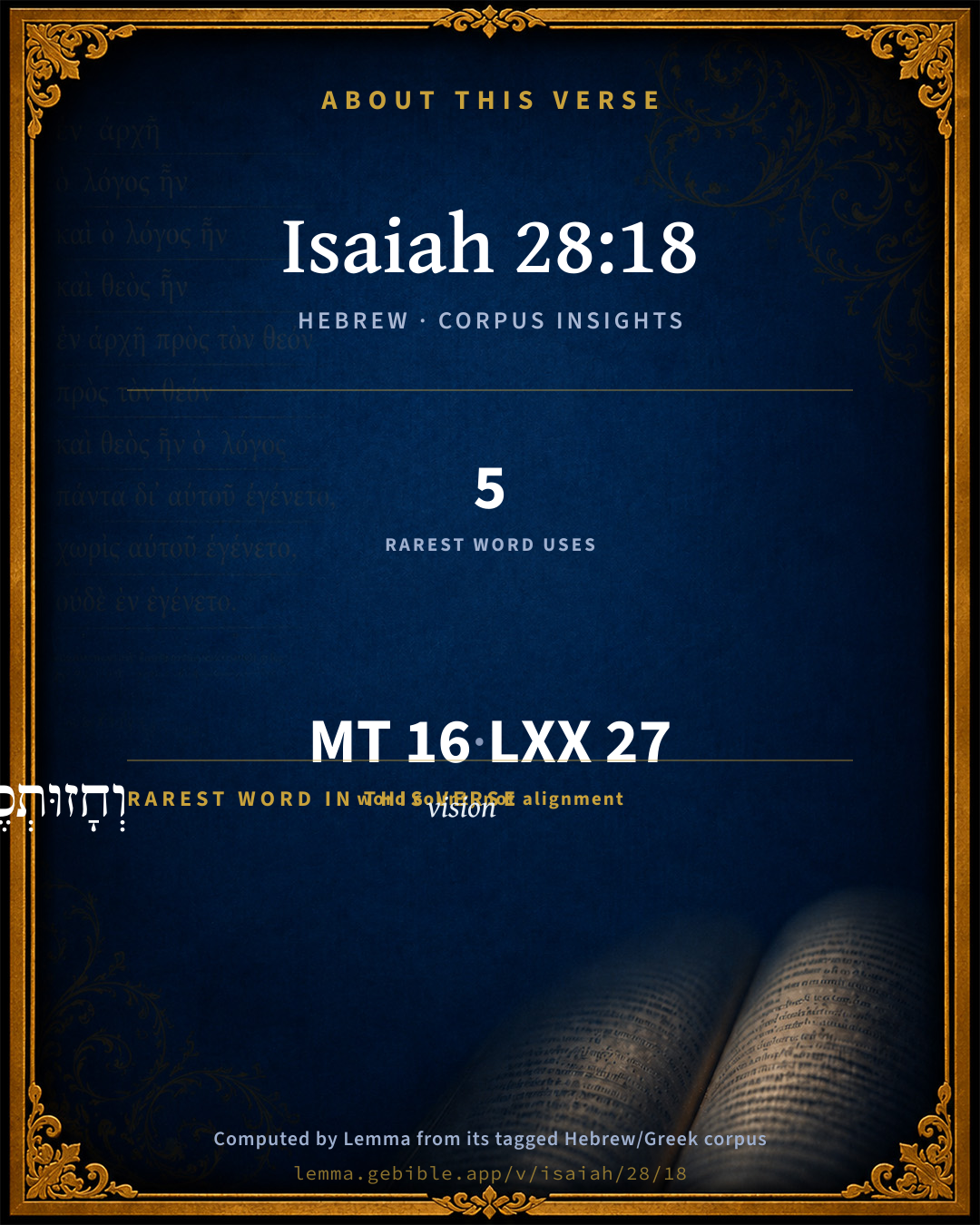
About this verse

These counts appear in no published source. They are computed here, from the morphology-tagged text and Lemma’s own curated glosses. What Lemma adds →

16
words
14
distinct lemmas
Prophets
section

Notable vocabulary

The rarest word here is וְחָזוּתְכֶ֥ם vision H2380 — appearing just 5 times in the whole Hebrew Bible.

Shared distinctive vocabulary

וְחָזוּתְכֶ֥ם vision H2380 occurs in 5 verses of the Hebrew Bible. Also found in:

Grammatical profile

  • 5 verbs
  • 6 nouns
  • 3 prepositions
  • 1 conjunction
  • 1 particle

Verb forms

  • וְכֻפַּ֤ר Pual · Sequential Perfect
  • תָק֑וּם Qal · Imperfect
  • שׁוֹטֵף֙ Qal · Participle Active
  • יַֽעֲבֹ֔ר Qal · Imperfect
  • וִהְיִ֥יתֶם Qal · Sequential Perfect

Repetition

A word recurs within this verse — often emphatic in Hebrew:

  • אֶת with H854 ×2

Hebrew & Septuagint length

In English translation the verse runs 30 words from the Hebrew and 34 from the Septuagint (LXX English) — closely comparable.

A rough comparison of the two English renderings, which tokenize alike — not a word-level alignment.

Word counts can differ between the Hebrew and the Greek without any difference in meaning — e.g. the Hebrew direct-object marker אֵת has no separate Greek word, and Greek often adds the article ὁ.

In the original languages it is 16 Hebrew tokens and 27 Greek tokens — but the two are counted differently (Hebrew bundles its prefixes and suffixes into one token; the Greek is in lemma form), so that isn’t a like-for-like length.

Cross-references

16

Topical passages linked to Isaiah 28:18 in the Treasury of Scripture Knowledge — connected by theme and wording, ordered by reader-vote popularity; previews shown in the World English Bible.

  • Isaiah 7:7 This is what the Lord Yahweh says: "It shall not stand, neither shall it happen."
  • Isaiah 8:10 Take counsel together, and it shall be brought to nothing; speak the word, and it shall not stand: for God is with us.
  • Isaiah 28:15 Because you have said, We have made a covenant with death, and with Sheol are we at agreement; when the overflowing scourge shall pass through, it shall not come to us; for we have made lies our refuge, and under falsehood have we hid ourselves:
  • Isaiah 28:3 The crown of pride of the drunkards of Ephraim shall be trodden under foot:
  • Daniel 11:40 At the time of the end shall the king of the south contend with him; and the king of the north shall come against him like a whirlwind, with chariots, and with horsemen, and with many ships; and he shall enter into the countries, and shall overflow and pass through.
  • Malachi 4:1–3 "For, behold, the day comes, it burns as a furnace; and all the proud, and all who work wickedness, will be stubble; and the day that comes will burn them up," says Yahweh of Hosts, "that it shall leave them neither root nor branch.
  • Isaiah 2:15 For every lofty tower, For every fortified wall,
  • Isaiah 8:8 and it shall sweep onward into Judah; it shall overflow and pass through; it shall reach even to the neck; and the stretching out of its wings shall fill the breadth of your land, Immanuel.
  • Jeremiah 44:28 Those who escape the sword shall return out of the land of Egypt into the land of Judah, few in number; and all the remnant of Judah, who have gone into the land of Egypt to sojourn there, shall know whose word shall stand, mine, or theirs.
  • Jeremiah 47:2 Thus says Yahweh: Behold, waters rise up out of the north, and shall become an overflowing stream, and shall overflow the land and all that is therein, the city and those who dwell therein; and the men shall cry, and all the inhabitants of the land shall wail.
  • Ezekiel 17:15 But he rebelled against him in sending his ambassadors into Egypt, that they might give him horses and much people. Shall he prosper? shall he escape who does such things? shall he break the covenant, and yet escape?
  • Daniel 8:9–13 Out of one of them came forth a little horn, which grew exceeding great, toward the south, and toward the east, and toward the glorious [land].
  • Daniel 9:26–27 After the sixty-two weeks the Anointed One shall be cut off, and shall have nothing: and the people of the prince who shall come shall destroy the city and the sanctuary; and the end of it shall be with a flood, and even to the end shall be war; desolations are determined.
  • Zechariah 1:6 But my words and my decrees, which I commanded my servants the prophets, didn't they overtake your fathers? "Then they repented and said, 'Just as Yahweh of Hosts determined to do to us, according to our ways, and according to our practices, so he has dealt with us.'"
  • Revelation 12:15 The serpent spewed water out of his mouth after the woman like a river, that he might cause her to be carried away by the stream.
  • Revelation 17:15 He said to me, "The waters which you saw, where the prostitute sits, are peoples, multitudes, nations, and languages.

Cross-references courtesy of OpenBible.info (CC BY 4.0).

Hebrew and Greek witnesses Masoretic Hebrew ↔ Greek Septuagint

The same verse in the two great witnesses to the Old Testament, shown verse-for-verse.

These are two independent witnesses, not word-aligned to each other, and the Septuagint is shown in lemma (dictionary) form.

Hebrew Isaiah 28:18 Masoretic · Westminster Leningrad Codex

וְכֻפַּ֤ר בְּרִֽיתְכֶם֙ אֶת מָ֔וֶת וְחָזוּתְכֶ֥ם אֶת שְׁא֖וֹל לֹ֣א תָק֑וּם שׁ֤וֹט שׁוֹטֵף֙ כִּ֣י יַֽעֲבֹ֔ר וִהְיִ֥יתֶם ל֖וֹ לְמִרְמָֽס

Your covenant with death shall be annulled, and your agreement with Sheol shall not stand; when the overflowing scourge shall pass through, then you shall be trodden down by it.

World English Bible · Public Domain

Greek LXX Isaiah 28:18 Septuagint · lemma form

μή καί ἀποαἱρέω σύ ὁ διαθήκη ὁ θάνατος καί ὁ ἐλπίς σύ ὁ πρός ὁ ᾅδης οὐ μή ἐνμένω καταιγίς φέρω ἐάν ἐπιἔρχομαι εἰμί αὐτός εἰς καταπάτημα

except it also take away your covenant of death, and your trust in Hades shall by no means stand: if the rushing storm should come upon you, you⌃ shall be beaten down by it.

LXX2012 (modern English Septuagint) · Public Domain

Hebrew: Westminster Leningrad Codex (CC BY 4.0). Greek: Septuagint (public domain); English from LXX2012 (modern English Septuagint) (Public Domain). How the Septuagint differs from the Hebrew →

Targum (Aramaic paraphrase)

1

The Targum is the ancient Jewish Aramaic paraphrase of the Hebrew Scriptures — an interpretive translation, not the Hebrew text itself. Onkelos (literal) and Pseudo-Jonathan (expansive) render the Torah, and Jonathan the Prophets. Coverage is partial: where no permissively-licensed English translation exists for a verse, only the Aramaic is shown. This is verse-level text, not a word-by-word alignment to the Hebrew.

  1. Targum Jonathan Prophets (Joshua–Malachi)
    וִיבַטֵל קִיָמְכוֹן דְעִם קָטוֹלָא וּשְׁלָמְכוֹן דְעִם מְחַבְּלָא לָא יִתְקַיָם מְחַת סָנְאָה אֲרֵי תֵיתֵי עֲלֵיכוֹן כְּנַחַל מַגְבַּר וּתְחוֹן לְהוֹן לְדָיִשׁ:

    And your covenant with death shall be destroyed, and your peace with the destroyer shall not stand. When the stroke of the enemy shall come upon you, it shall be like an overwhelming river, and ye shall be unto them for a treading under foot.

    Targum Jonathan — Aramaic: “Mikraot Gedolot” (public domain). English: “Sefaria Community Translation” (CC0 1.0 (public-domain dedication)); “London "Chaldee Paraphrase," 1871” (public domain). Text via Sefaria.

Commentary

Notes on Isaiah 28:18 from classic Christian and Jewish commentators (each source and its license shown beneath its notes). The classic Christian expositions comment on the surrounding passage and are grouped to its opening verse, so a note may address several verses; the Jewish commentaries on the Tanakh (Rashi and others) are per-verse, so they appear only where the commentator wrote on this verse.

Lemma curates 59 commentaries, every one of them public domain or Creative Commons licensed, each selected and text-cleaned for this edition rather than reprinted as found. About our sources →

Trapp's Complete Commentary

John Trapp

Isa 28:18 And your covenant with death shall be disannulled, and your agreement with hell shall not stand; when the overflowing scourge shall pass through, then ye shall be trodden down by it.

Ver. 18. And your covenant with death shall be disannulled.] See Isa 28:15. God shall shoot at such with an arrow suddenly; {Psa 64:7} and when they shall say, Peace and safety, then shall sudden destruction come upon them, as travail upon a woman with child, and they shall not escape. {1Th 5:3} They made a covenant with death and hell, but death and hell make no covenant with them. Thus it befell the rich fool; {Luk 12:20} Alexander the Great, whom his parasites flattered into a fond conceit of an immortality; and Pope Sylvester the second, who dealt with the devil for the popedom, and was persuaded by him that he should never die till he sang mass in Jerusalem; but when he saw how he was cheated, and that he must die, he cried out,

“ Ah miser! aeternos vado damnatus ad ignes. ”

John Trapp, A Commentary or Exposition upon All the Books of the Old and New Testament (1647–1656) — public domain. Text from a community e-Sword module.

Joseph Benson's Commentary

Isa 28:18-19. And your covenant with death shall be disannulled — Made void, or of none effect. Ye shall be trodden down — Namely, by the overflowing scourge, which you flattered yourselves should not come unto you. From the time that it goeth forth — Namely, from me into the land, it shall assuredly, and with the first, seize upon and carry away you scoffers. Morning by morning it shall pass over, &c. — It shall not only come to you, but it shall abide upon you; and when it hath passed over you, it shall return again to you, morning after morning, and shall follow you day and night, without giving you the least respite. It shall be a vexation to understand the report — So dreadful shall the judgment be, that it shall strike you with horror when you only hear the rumour of its approach.

Joseph Benson's Commentary on the Old and New Testaments (1811–1818) — public domain. Text from a community e-Sword module.

The Preacher's Complete Homiletical Commentary

Joseph S. Exell (gen. ed.)

FALSE REFUGES

Isa_28:18. Your covenant with death shall be disannulled.

Like the sinners spoken of in this chapter, most sinful men say in effect, “We have made a covenant with death,” &c. (Isa_28:15).

I. That he may escape the dreaded consequences of sin, the troubled sinner seeks a refuge. He flees—

1. From the voice of reason. The presence of a reasoning power in man is incompatible with the practice of sin. This is seen in the fact that when sinners can be brought to think, they at once admit themselves to be wrong. The moment a man commences to think about sin, that moment he becomes aware that it will not bear thinking about. It is because a sinful life is an unthinking life that God’s invitations to sinners are invitations to reason (chap. Isa_1:18; Psa_50:22).

2. From an accusing conscience. The authority of conscience is supreme, and no man can sin without feeling its sting. To escape remorse, which is conscience at work, men seek a refuge.

3. From an offended God. Sin is offensive to God’s holiness; for being pure, He must hate impurity. Because sinners are conscious that they have rendered themselves obnoxious to God, they seek a refuge.

4. From a broken law. In obedience to law there is safety, right, and happiness; while in disregarding law there is nothing but disaster. And from the consequences of the broken law—the broken law of God written on the heart, proclaimed in Nature, revealed in the Bible—the sinner tries to hide.

5. From an endless future. This more than anything else terrifies sinners and drives them to seek shelter.

II. Sinners, blindly infatuated, seek a refuge in wrong objects. They make a covenant with death and an agreement with hell. The terms “death” and “hell” stand for the whole class of false securities in which men seek shelter by making a covenant and agreement with them.

1. Unbelief is one of the more modern refuges of sin. When men can blot out of the universe the idea of God, quench the sense of moral responsibility, remove the belief in immortality, persuade themselves that there is no other world, that death is an eternal sleep, that heaven is only an air-castle, and hell a mere chimera, they may then indulge in evil to their hearts’ content.

2. Superstition is another. Not in open unbelief, but under the cover of a false religion others seek to shelter. Unable to shake off belief in God and in a spiritual world, they search for some system which will at once allow a profession of religion and a practice of wickedness. Nor are such systems wanting, nor are they without disciples. Romanism offers indulgences for gold and pardons for pence, and thus provides a refuge for the stronger in pocket than in brain.

3. Annihilation is another. According to some, such is the awfulness of the thought of extinction of being, that men revolt from it. Establish it that when sinners die they cease to live, and what better refuge for sin is possible, and what other is needed? Sinful men will soon say, “Let us eat and drink, for to-morrow we die.”

4. Excess is another. When the previous ones have failed to give comfort, the sinner rushes madly into excess. The drunkard seeks in increased intemperance to drown the sorrow his indulgence has occasioned.

5. Indifference is the last. This is the only comfort some men can find in their career of evil. But indifference is impossible without a denial of human responsibility. Sad indeed must the condition of human nature be when brought to this.

III. The refuges so confidently trusted in are utterly insecure.

1. Because they are incompatible with the real need of man. Only that can be conducive to man’s safety which meets man’s need. No human need is met by infidelity, or by superstition, or by annihilation, or by indulgence, or by indifference. Any one of these, tested by this argument drawn from human necessities, will be found a refuge of lies.

2. Because they are at variance with human instincts. Instinctively men believe in a Divine existence, in moral accountability, and in immortality.

3. Because they contradict human experience. They have all been tried, and as often as they have been tried they have been found false.

4. Because they are opposed to the teaching of revelation, both natural and Biblical. Nature proclaims loudly against all sin-sought refuges. The teaching of Nature and the Bible is that man is incompetent to provide for his own security, and that God only, in the exercise of His Divine prerogative, can provide for sinners the security they need.

IV. By Divine appointment the refuges so madly sought shall be totally destroyed. “Your covenant with death shall be disannulled.”

1. By consequence of their inherent character. They are “refuges of lies,” and necessarily all refuges built on lies must perish.

2. By necessity of strict justice. “Judgment will I lay to the line, and righteousness to the plummet” (Isa_28:17).

3. By the exertion of Almighty power. “And the hail shall sweep away the refuge of lies, and the waters shall overflow the hiding-place.”

CONCLUSION.—God has mercifully provided a true refuge. He only cuts off the false that He may exhibit the true. “Behold, I lay in Sion for a foundation a stone,” &c. (Isa_28:16).—William Brooks: Study and the Pulpit, New Series, vol. 1 pp. 413–416.

The Preacher's Complete Homiletical Commentary (gen. ed. Joseph S. Exell; Funk & Wagnalls, c. 1892) — public domain (pre-1929). A full-Bible homiletical/sermon-outline anthology covering 65 of 66 books (2 John is absent from the source module). Text from a community e-Sword module.

Jamieson, Fausset & Brown

Robert Jamieson, A. R. Fausset & David Brown

disannulled--obliterated, as letters traced on a waxen tablet are obliterated by passing the stylus over it.

trodden down--passing from the metaphor in "scourge" to the thing meant, the army which treads down its enemies.

Jamieson, Fausset & Brown — Commentary Critical and Explanatory on the Whole Bible (1871) — public domain (CC PDM 1.0). Text via the HelloAO Bible API.

Adam Clarke's Commentary

Verse 18. Your covenant with death shall be disannulled - "Your covenant with death shall be broken"] For כפר caphar, which seems not to belong to this place, the Chaldee reads תפר taphar, which is approved by Houbigant and Secker. See Jer 33:21, where the very same phrase is used. See Prelim. Dissert. p. l.

Adam Clarke's Commentary on the Bible (1810–1826) — public domain. Text from a community e-Sword/MySword module.

The Cambridge Bible for Schools and Colleges

gen. ed. J. J. S. Perowne

18. See on Isa_28:15. shall be disannulled] lit. “smeared over” (cf. Gen_6:14) i.e. “cancelled,” “obliterated.” The verb is the technical word for expiate (as e.g. Isa_22:14), and although it is nowhere else in the O.T. used exactly as here, the sense is supported by Syriac usage, and an alteration of the text is not necessary.

The Cambridge Bible for Schools and Colleges (gen. ed. J. J. S. Perowne; Cambridge University Press, 1878–1918) — public domain. Text from a community e-Sword module.

John Gill's Exposition

From the time that it goeth forth, it shall take you,.... Or, "as soon as it passeth through" (z), "it shall take you away"; as soon as it begins to overflow, and as it goes along, it shall make clear work, and carry you away with it; you will not be able to resist it, to withstand its motion, and stop its progress; but will be borne down by it, and carried away with it, either destroyed by it at once, or carried into captivity; so the Targum,

"in the time of its passing over, it shall carry you captive:''

for morning by morning shall it pass over, by day and by night; signifying that it should come very early, before they were aware of it and prepared for it, and should be constant and incessant, day after day, day and night, continually, until it had done its work thoroughly, in the utter destruction of them; which was true of the Assyrian, but especially of the Roman army:

and it shall be a vexation only to understand the report; the fame, the rumour of the enemy's coming, of his invasion of the land, of the devastation he makes everywhere, and of his progress and near approach to Jerusalem; the bare report of this only being made and confirmed, so that there was reason to believe it, would produce anguish and distress of mind, cause a commotion, a fear and trembling, and shaking of the joints, as the word (a) signifies; and therefore, how dreadful must the calamity itself be! or else this may be meant of the report of the prophecy of the Lord, which before they would not believe; but now the judgments threatened coming upon them, they would be made to understand it; so the Vulgate Latin version renders it, "and only vexation alone shall give understanding to the report"; and to this sense the Targum,

"and it shall be, before the time of the curse comes, that ye shall understand the words of the prophets;''

and, when it was come, should know to their sorrow, and by sad experience, the truth of what they had said.

(z) "mox ut pertransierit", Tigurine version. (a) "commotio", Montanus, Piscator; "terror", Calvin; "pavor", Pagninus.

John Gill's Exposition of the Whole Bible (1746–1763) — public domain (CC PDM 1.0). Text via the HelloAO Bible API.

Albert Barnes' Notes on the Bible

And your covenant with death - (see the note at Isa 28:15).

Shall be disannulled - The word rendered ‘shall be disannulled,’ (וכפר vekupar from כפר kâphar), properly means “to cover, overlay;” then to pardon, forgive; then to make atonement, to expiate. It has the idea of blotting out, forgiving, and obliterating - because a writing in wax was obliterated or “covered” by passing the “stylus” over it. Hence, also, the idea of abolishing, or rendering nought, which is the idea here. “When the overflowing scourge” (see the note at Isa 28:15).

Then ye shall be trodden down by it - There is in this verse a great intermingling of metaphor, not less than three figures being employed to denote the calamity. There is first the scourge, an instrument of punishment; there is then the idea of inundating waters or floods; then there is also the idea of a warrior or an invading army that treads down an enemy. All the images are designed to denote essentially the same thing, that the judgments of God would come upon the land, and that nothing in which they had trusted would constitute a refuge.

Albert Barnes' Notes on the Bible (1834–1885) — public domain. Text from a community e-Sword/MySword module.

Matthew Poole's English Annotations

Disannulled; made void, or of none effect; it shall stand you in no stead.

Ye shall be trodden down by it; which you flattered yourselves that it should not come unto you, Isa 28:15.

Matthew Poole's English Annotations on the Holy Bible (1683–1685) — public domain. Text from a community e-Sword/MySword module.

Whedon's Commentary on the Bible

Daniel D. Whedon

18. Covenant — Covenants secured by outside sorcery, black art, and oracle, shall be obliterated. So the literal word, in allusion to erasures of waxen tablets. Death and hell (original, sheol) are ghastly impersonations; very proper parties of the second part for such covenants and arguments.

Scourge — See on Isa_28:15; a mixed metaphor; — an invading army using blows heavily laid on, and trampling under feet as it advances.

Daniel D. Whedon (gen. ed.), Commentary on the Old and New Testaments (1874–1909) — public domain. Text from a community e-Sword module.

The Pulpit Commentary

And your covenant with death shall be disannulled; or, wiped out. The entire clever arrangement, by which they thought to avert the danger from themselves and from Judaea, shall come to naught. When the overflowing scourge shall pass through, then ye shall be trodden down by it. As the prophet continues, his metaphor becomes still more mixed. "Treading down" was so familiar an expression for destroying, that, perhaps, its literal sense was overlooked. (comp. Isa_5:5 Isa_7:25 Isa_10:6 Dan_8:13 Mic_7:10 Zec_10:5, etc.)

The Pulpit Commentary (1880–1919), ed. H.D.M. Spence-Jones & Joseph S. Exell — public domain. Text from a community e-Sword module.

Keil & Delitzsch

C. F. Keil & F. Delitzsch

And the whip which Jehovah swings will not be satisfied with one stroke, but will rain strokes. "And your covenant with death is struck out, and your agreement with Hades will not stand; the swelling scourge, when it comes, ye will become a thing trodden down to it. As often as it passes it takes you: for every morning it passes, by day and by night; and it is nothing but shuddering to hear such preaching. For the bed is too short to stretch in, and the covering too tight when a man wraps himself in it." Although berı̄th is feminine, the predicate to it is placed before it in the masculine form (Ges. 144). The covenant is thought of as a document; for khuppar (for obliterari (just as the kal is used in Gen 6:14 in the sense of oblinere; or in Pro 30:20, the Targum, and the Syriac, in the sense of abstergere; and in the Talmud frequently in the sense of wiping off = qinnēăch, or wiping out = mâchaq - which meanings all go back, along with the meaning negare, to the primary meaning, tegere, obducere). The covenant will be "struck out," as you strike out a wrong word, by crossing it over with ink and rendering it illegible. They fancy that they have fortified themselves against death and Hades; but Jehovah gives to both of these unlimited power over them. When the swelling scourge shall come, they will become to it as mirmâs, i.e., they will be overwhelmed by it, and their corpses become like dirt of the streets (Isa 10:6; Isa 5:5); והייתם has the mercha upon the penult., according to the older editions and the smaller Masora on Lev 8:26, the tone being drawn back on account of the following לו. The strokes of the scourge come incessantly, and every stroke sweeps them, i.e., many of them, away. מדּי (from דּי, construct דּי, sufficiency, abundance) followed by the infinitive, quotiescunque irruet; lâqach, auferre, as in Jer 15:15, and in the idiom lâqach nephesh. These scourgings without end - what a painful lecture Jehovah is reading them! This is the thought expressed in the concluding words: for the meaning cannot be, that "even (raq as in Psa 32:6) the report (of such a fate) is alarming," as Grotius and others explain it; or the report is nothing but alarming, as Gussetius and others interpret it, since in that case שׁמועה שׁמע (cf., Isa 23:5) would have been quite sufficient, instead of שׁמוּעה הבין. There is no doubt that the expression points back to the scornful question addressed by the debauchees to the prophet in Isa 28:9, "To whom will he make preaching intelligible?" i.e., to whom will he preach the word of God in an intelligible manner? (as if they did not possess bı̄nâh without this; שׁמוּעה, ἀκοή, as in Isa 53:1). As Isa 28:11 affirmed that Jehovah would take up the word against them, the drunken stammerers, through a stammering people; so here the scourging without end is called the shemū‛âh, or sermon, which Jehovah preaches to them. At the same time, the word hâbhı̄n is not causative here, as in Isa 28:9, viz., "to give to understand," but signifies simply "to understand," or have an inward perception. To receive into one's comprehension such a sermon as that which was now being delivered to them, was raq-zevâ‛âh, nothing but shaking or shuddering (raq as in Gen 6:5); זוּע (from which comes זועה, or by transposition זעוה) is applied to inward shaking as well as to outward tossing to and fro. Jerome renders it "tantummodo sola vexatio intellectum dabit auditui," and Luther follows him thus: "but the vexation teaches to take heed to the word," as if the reading were תּבין. The alarming character of the lecture is depicted in Isa 28:20, in a figure which was probably proverbial. The situation into which they are brought is like a bed too short for a man to stretch himself in (min as in Kg2 6:1), and like a covering which, according to the measure of the man who covers himself up in it (or perhaps still better in a temporal sense, "when a man covers or wraps himself up in it," cf., Isa 18:4), is too narrow or too tight. So would it be in their case with the Egyptian treaty, in which they fancied that there were rest and safety for them. They would have to acknowledge its insufficiency. They had made themselves a bed, and procured bed-clothes; but how mistaken they had been in the measure, how miserably and ridiculously they had miscalculated!

Keil & Delitzsch — Biblical Commentary on the Old Testament (1861–1891) — public domain (CC PDM 1.0). Text via the HelloAO Bible API. (Old Testament only.)

J. A. Alexander on Isaiah

Joseph Addison Alexander

“And your covenant with death shall be annulled, and your league with hell shall not stand, and the overflowing scourge — for it shall pass through, and ye shall be for it to trample on.” In the last clause, the construction seems to be interrupted. Supposing it to be complete, it may be explained as in the English Version, which makes both the words in question particles of time meaning when and then. There can be no doubt that the idea of a human invader was before the Prophet’s mind; but the mere rhetorical incongruity is not at all at variance with the Prophet’s manner. The attempt to reconcile the language with the artificial rules of composition is in this case rendered hopeless by the combination of expressions which cannot be strictly applied to the same subject. An army might trample, but it could not literally overflow; a stream might overflow, but it could not literally trample down. The time perhaps is coming when, even as a matter of taste, the strength and vividness of such mixed metaphors will be considered as outweighing their inaccuracy in relation to an arbitrary standard of correctness or propriety.

Joseph Addison Alexander, The Prophecies of Isaiah (1846–1847; New York: Scribner, 1870–1878) — public domain. Text from a community e-Sword module.

Scofield Reference Notes

C. I. Scofield

hell

Heb. "Sheol," (See Scofield "Hab 2:5").

The Scofield Reference Bible (1917 edition), notes by C. I. Scofield — public domain. Text from a community e-Sword module.

unfoldingWord translationNotes

Door43 World Missions Community

General Information:

Yahweh continues to speak to the people of Jerusalem.

Your covenant with death will be dissolved, and your agreement with Sheol will not stand

This can be stated in active form. AT: "I will cancel the covenant you have with death, and I will cancel the agreement you have with Sheol" (See: Active or Passive)

covenant with death ... agreement with Sheol

Possible meanings are 1) the leaders of Jerusalem had used magic or sorcery to try to make an agreement with the gods of the place of the dead so that these gods would protect them from dying or 2) this is a metaphor that speaks of the leaders having made an agreement with the leaders of Egypt. The leaders of Jerusalem were so confident that the Egyptians would protect that it was like they had made an agreement with the gods of the place of the dead. See how you translated this in Isaiah 28:15. (See: Metaphor)

will not stand

"will not last"

When the raging flood passes through

Possible meanings are 1) "flood" is a synecdoche that represents anything in general that will cause destruction or 2) "flood" is a metaphor referring to the enemy army that Yahweh will send to destroy the people of Jerusalem. (See: Synecdoche and Metaphor)

you will be overwhelmed by it

This can be stated in active form. AT: "it will overwhelm you" or "it will destroy you" (See: Active or Passive)

morning by morning

This is an idiom. AT: "every day" (See: Idiom)

by day and night

This means "throughout the entire day" (See: Merism)

translationWords

covenant

die

Hades

flood

terror

unfoldingWord translationNotes — © Distant Shores Media and the Door43 World Missions Community, licensed CC BY-SA 4.0. Source: git.door43.org/Door43/en_tn.

Rashi

Rabbi Shlomo Yitzchaki (Rashi)

And your treaty with death shall be nullified The treaty about which you said, “We have made a treaty with death,” shall be nullified. Every expression of כַּפָּרָה, atonement, is really an expression of wiping or removing something. Compare (Gen. 32:21): “I shall appease (אֲכַפְּרָה) his anger,” (lit., I will wipe away his anger.)

and your limit which you said, “With the grave we set a limit.”

an overflowing scourge which you said, “will not come upon us,” you shall be trampled by it.

Rashi on the Tanakh — English translations: “The Judaica Press complete Tanach with Rashi, translated by A. J. Rosenberg” (CC BY 4.0); “Pentateuch with Rashi's commentary by M. Rosenbaum and A.M. Silbermann, 1929-1934” (public domain); “The Metsudah Tanach series, Lakewood, N.J” (CC BY 4.0); and “The Book of Joshua, Metsudah Publications, 1997” (CC BY 4.0). Text via Sefaria.

Ibn Ezra

Rabbi Abraham ibn Ezra

וכפר And shall be disannulled. Comp. יכפרנה he will pacify it, that is, will annul or remove it. וברית חזותכם═וחזותכם And your prophetical agreement.

והייתם Then you shall be.

The ו has the same force as فَ in Arabic; comp. וישא ביום השלישי on the third day, then Abraham lifted up (Gen. 22:4)

Ibn Ezra on the Tanakh — English translations: “Sefaria Community Translation” (CC0 1.0 (public-domain dedication)); “Yalkut, Sifsei Chachomim Chumash, Metsudah Publications, 2009” (CC BY 4.0); and “Commentary of Ibn Ezra on Isaiah - trans. by M. Friedlander, 1873” (public domain). Text via Sefaria.

Lesson kit

Teaching starters — assembled from the data on this page, not authored interpretation. Every prompt links to the verse data it draws on. Edit before teaching.

Isaiah, in the Prophets, opens this verse with 16 words (14 distinct Hebrew lemmas). Its most distinctive word is châzûwth (“vision”). A historical commentator’s framing appears above. Read the whole chapter for the surrounding context.

Discussion questions

  1. The word châzûwth carries the sense “vision.” How does it shape the verse?
  2. Isaiah 21:2 shares the word «vision» with this verse. How do the two illuminate each other?
  3. “with” occurs 2× in this one verse. What is the effect of the repetition?
  4. These translations render this verse differently. What is at stake in choosing one wording over another?
  5. The verb «וְכֻפַּ֤ר» is Pual Sequential Perfect. How does its form color the action?
  6. Reading how Trapp's Complete Commentary and Joseph Benson's Commentary read this verse, where do the two commentators agree and where do they part?

Things to notice

Reading settings

Reading text

Shown beneath each verse's original-language words.

Old Testament
Old Testament edition

Read the OT as the Masoretic Hebrew (MT) or the Greek Septuagint (LXX).

English shown for the Greek Septuagint (in the Hebrew ↔ Greek comparison).

Comparing translations? Open the Compare panel on any verse page to stack up to four side by side.