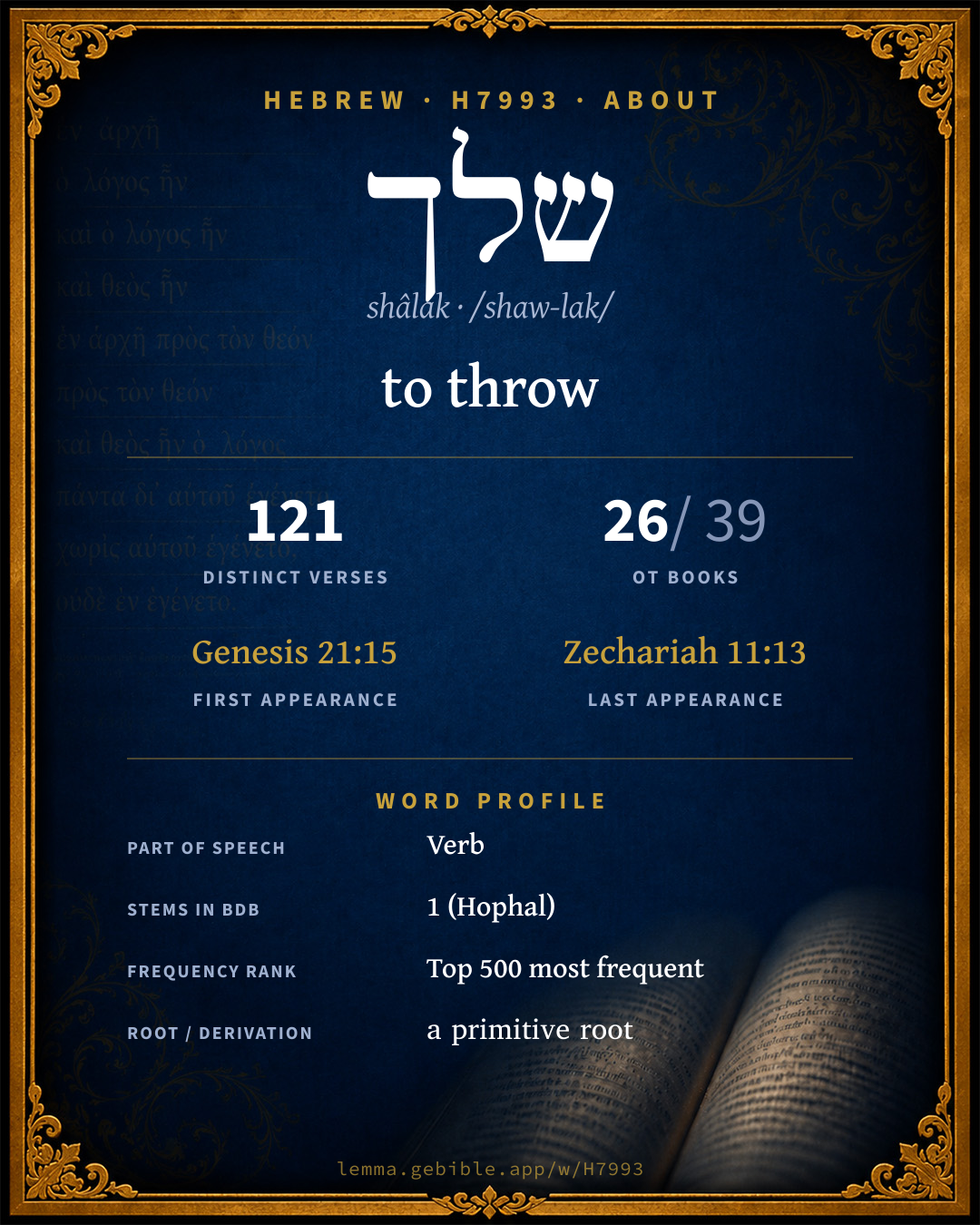
שָׁלַךְ
to throw
also: cast, hurl, fling fuller range ↓
Full lexicon entry — Brown-Driver-Briggs (BDB)
From Brown-Driver-Briggs (BDB)
Where this word appears
See every Hiphil verb in the Hebrew Bible →
Grammar key — what these labels mean
Part of speech
- Verb
- An action or state-of-being word.
Stem
- Hiphil
- The causative active stem (“he caused / brought about”).
- Hophal
- The passive counterpart of the Hiphil (“he was caused to…”). Here: ‘be thrown’
Form
- Sequential Imperfect
- An imperfect with prefixed waw — the standard past-narrative form (waw-consecutive imperfect).
- Perfect
- A completed action or state — Hebrew marks aspect (completeness) more than strict tense (“he wrote”).
- Imperfect
- An incomplete, ongoing, or future action (“he will / would write”).
- Participle Passive
- A verbal adjective expressing action received (“written”).
- Imperative
- A direct command (“write!”).
- Infinitive Absolute
- An unbound verbal noun, often intensifying or standing in for a finite verb.
- Sequential Perfect
- A perfect with prefixed waw continuing a preceding imperfect or command (waw-consecutive perfect).
- Infinitive Construct
- A bound verbal noun, frequently with prepositions (“to write / in writing”).
- Jussive
- A third- or second-person volitional form expressing wish or command (“let him write”).
- Participle Active
- A verbal adjective expressing ongoing or characteristic action (“writing / one who writes”).
- Cohortative
- A first-person volitional form expressing wish or resolve (“let me / let us write”).
State
- Absolute
- The independent form of a noun, not bound to a following word.
- Construct
- A noun bound to a following noun in a possessive / “of” relationship (the construct chain).
Person
- 3rd Person
- The one spoken about (“he / she / it / they”).
- 1st Person
- The speaker (“I / we”).
- 2nd Person
- The one addressed (“you”).
Gender
- Masculine
- Grammatically masculine.
- Common
- Either gender — not distinguished for this form.
- Feminine
- Grammatically feminine.
Number
- Singular
- One.
- Plural
- More than one (in Hebrew, generally three or more).
Grammatical forms 41 distinct
- Verb, Hiphil, Sequential Imperfect, 3rd Person, Masculine, Singular 20 times (16%)
- Verb, Hiphil, Sequential Imperfect, 3rd Person, Masculine, Plural 14 times (11%)
- Verb, Hiphil, Perfect, 3rd Person, Masculine, Singular 10 times (8%)
- Verb, Hiphil, Imperative, 2nd Person, Masculine, Singular 6 times (5%)
- Verb, Hiphil, Imperfect, 1st Person, Common, Singular 5 times (4%)
- Verb, Hiphil, Sequential Imperfect, 1st Person, Common, Singular 5 times (4%)
- Verb, Hophal, Participle Passive, Feminine, Singular, Absolute 4 times (3%)
- Verb, Hiphil, Perfect, 3rd Person, Common, Plural 4 times (3%)
+33 more forms (57 occurrences)
Parsed forms decoded from the imported morphology (morphhb / Westminster Leningrad Codex — WLC text public domain, morphhb tagging CC BY 4.0), counted across 125 parsed occurrences — not distinct verses.
Every verse where H7993 appears — 121 distinct verses across 26 books. Click any verse to open its interlinear word-by-word view. Verse text shown in the World English Bible for context — . Each verse’s Hebrew form is shown with its reference; the English is not keyword-highlighted, since the data carries no word-level English alignment. Use “Compare translations” on any verse to read it across multiple English versions. This concordance covers the Hebrew Bible; Septuagint (Greek Old Testament) occurrences are not indexed here.
Genesis 4 verses
- Genesis 21:15 וַ/תַּשְׁלֵ֣ךְ conj + Hiphil wimpf 3fs The water in the bottle was spent, and she cast the child under one of the shrubs.
- Genesis 37:20 וְ/נַשְׁלִכֵ֨/הוּ֙ conj + Hiphil coh 1cp + sfx pers 3ms Come now therefore, and let's kill him, and cast him into one of the pits, and we will say, 'An evil animal has devoured him.' We will see what will become of his dreams."
- Genesis 37:22 הַשְׁלִ֣יכוּ Hiphil impv 2mp Reuben said to them, "Shed no blood. Throw him into this pit that is in the wilderness, but lay no hand on him"-- that he might deliver him out of their hand, to restore him to his father.
- Genesis 37:24 וַ/יַּשְׁלִ֥כוּ conj + Hiphil wimpf 3mp and they took him, and threw him into the pit. The pit was empty. There was no water in it.
Exodus 9 verses
- Exodus 1:22 תַּשְׁלִיכֻ֔/הוּ Hiphil impf 2mp + sfx pers 3ms Pharaoh charged all his people, saying, "You shall cast every son who is born into the river, and every daughter you shall save alive."
- Exodus 4:3 הַשְׁלִיכֵ֣/הוּ וַ/יַּשְׁלִיכֵ֥/הוּ Hiphil impv 2ms + sfx pers 3ms conj + Hiphil wimpf 3ms + sfx pers 3ms He said, "Throw it on the ground." He threw it on the ground, and it became a snake; and Moses ran away from it.
- Exodus 7:9 וְ/הַשְׁלֵ֥ךְ conj + Hiphil impv 2ms "When Pharaoh speaks to you, saying, 'Perform a miracle!' then you shall tell Aaron, 'Take your rod, and cast it down before Pharaoh, that it become a serpent.'"
- Exodus 7:10 וַ/יַּשְׁלֵ֨ךְ conj + Hiphil wimpf 3ms Moses and Aaron went in to Pharaoh, and they did so, as Yahweh had commanded: and Aaron cast down his rod before Pharaoh and before his servants, and it became a serpent.
- Exodus 7:12 וַ/יַּשְׁלִ֨יכוּ֙ conj + Hiphil wimpf 3mp For they cast down every man his rod, and they became serpents: but Aaron's rod swallowed up their rods.
- Exodus 15:25 וַ/יַּשְׁלֵךְ֙ conj + Hiphil wimpf 3ms Then he cried to Yahweh. Yahweh shown him a tree, and he threw it into the waters, and the waters were made sweet. There he made a statute and an ordinance for them, and there he tested them;
- Exodus 22:31 תַּשְׁלִכ֥וּ/ן Hiphil impf 2mp + sfx n "You shall be holy men to me, therefore you shall not eat any flesh that is torn by animals in the field. You shall cast it to the dogs.
- Exodus 32:19 וַ/יַּשְׁלֵ֤ךְ conj + Hiphil wimpf 3ms It happened, as soon as he came near to the camp, that he saw the calf and the dancing: and Moses' anger grew hot, and he threw the tablets out of his hands, and broke them beneath the mountain.
- Exodus 32:24 וָ/אַשְׁלִכֵ֣/הוּ conj + Hiphil wimpf 1cs + sfx pers 3mp I said to them, 'Whoever has any gold, let them take it off:' so they gave it me; and I threw it into the fire, and out came this calf."
Leviticus 2 verses
- Leviticus 1:16 וְ/הִשְׁלִ֨יךְ conj + Hiphil wpf 3ms and he shall take away its crop with its filth, and cast it beside the altar on the east part, in the place of the ashes.
- Leviticus 14:40 וְ/הִשְׁלִ֤יכוּ conj + Hiphil wpf 3cp then the priest shall command that they take out the stones in which is the plague, and cast them into an unclean place outside of the city:
Numbers 3 verses
- Numbers 19:6 וְ/הִשְׁלִ֕יךְ conj + Hiphil wpf 3ms and the priest shall take cedar-wood, and hyssop, and scarlet, and cast it into the midst of the burning of the heifer.
- Numbers 35:20 הִשְׁלִ֥יךְ Hiphil pf 3ms If he thrust him of hatred, or hurled at him, lying in wait, so that he died,
- Numbers 35:22 הִשְׁלִ֥יךְ Hiphil pf 3ms But if he thrust him suddenly without enmity, or hurled on him anything without lying in wait,
Deuteronomy 3 verses
- Deuteronomy 9:17 וָֽ/אַשְׁלִכֵ֔/ם conj + Hiphil wimpf 1cs + sfx pers 3mp I took hold of the two tables, and cast them out of my two hands, and broke them before your eyes.
- Deuteronomy 9:21 וָֽ/אַשְׁלִךְ֙ conj + Hiphil wimpf 1cs I took your sin, the calf which you had made, and burnt it with fire, and stamped it, grinding it very small, until it was as fine as dust: and I cast the dust of it into the brook that descended out of the mountain.
- Deuteronomy 29:28 וַ/יַּשְׁלִכֵ֛/ם conj + Hiphil wimpf 3ms + sfx pers 3mp and Yahweh rooted them out of their land in anger, and in wrath, and in great indignation, and cast them into another land, as at this day.
Joshua 5 verses
- Joshua 8:29 וַ/יַּשְׁלִ֤יכוּ conj + Hiphil wimpf 3mp The king of Ai he hanged on a tree until the evening: and at the going down of the sun Joshua commanded, and they took his body down from the tree, and cast it at the entrance of the gate of the city, and raised thereon a great heap of stones, to this day.
- Joshua 10:11 הִשְׁלִ֣יךְ Hiphil pf 3ms It happened, as they fled from before Israel, while they were at the descent of Beth Horon, that Yahweh cast down great stones from the sky on them to Azekah, and they died: they were more who died with the hailstones than they whom the children of Israel killed with the sword.
- Joshua 10:27 וַ/יַּ֨שְׁלִכֻ֔/ם conj + Hiphil wimpf 3mp + sfx pers 3mp It happened at the time of the going down of the sun, that Joshua commanded, and they took them down off the trees, and cast them into the cave in which they had hidden themselves, and laid great stones on the mouth of the cave, to this very day.
- Joshua 18:8 אַשְׁלִ֨יךְ Hiphil impf 1cs The men arose, and went: and Joshua charged those who went to describe the land, saying, Go and walk through the land, and describe it, and come again to me; and I will cast lots for you here before Yahweh in Shiloh.
- Joshua 18:10 וַ/יַּשְׁלֵךְ֩ conj + Hiphil wimpf 3ms Joshua cast lots for them in Shiloh before Yahweh: and there Joshua divided the land to the children of Israel according to their divisions.
Judges 4 verses
- Judges 8:25 וַ/יַּשְׁלִ֣יכוּ conj + Hiphil wimpf 3mp They answered, We will willingly give them. They spread a garment, and did cast therein every man the ear-rings of his spoil.
- Judges 9:17 וַ/יַּשְׁלֵ֤ךְ conj + Hiphil wimpf 3ms (for my father fought for you, and adventured his life, and delivered you out of the hand of Midian:
- Judges 9:53 וַ/תַּשְׁלֵ֞ךְ conj + Hiphil wimpf 3fs A certain woman cast an upper millstone on Abimelech's head, and broke his skull.
- Judges 15:17 וַ/יַּשְׁלֵ֥ךְ conj + Hiphil wimpf 3ms It happened, when he had made an end of speaking, that he cast away the jawbone out of his hand; and that place was called Ramath Lehi.
2 Samuel 5 verses
- 2 Samuel 11:21 הִשְׁלִ֣יכָה Hiphil pf 3fs who struck Abimelech the son of Jerubbesheth? Didn't a woman cast an upper millstone on him from the wall, so that he died at Thebez? Why did you go so near the wall?' then shall you say, 'Your servant Uriah the Hittite is dead also.'"
- 2 Samuel 18:17 וַ/יַּשְׁלִ֨יכוּ conj + Hiphil wimpf 3mp They took Absalom, and cast him into the great pit in the forest, and raised over him a very great heap of stones: and all Israel fled everyone to his tent.
- 2 Samuel 20:12 וַ/יַּשְׁלֵ֤ךְ conj + Hiphil wimpf 3ms Amasa lay wallowing in his blood in the midst of the highway. When the man saw that all the people stood still, he carried Amasa out of the highway into the field, and cast a garment over him, when he saw that everyone who came by him stood still.
- 2 Samuel 20:21 מֻשְׁלָ֥ךְ Hophal ptcp.pass ms The matter is not so: but a man of the hill-country of Ephraim, Sheba the son of Bichri by name, has lifted up his hand against the king, even against David; deliver him only, and I will depart from the city. The woman said to Joab, Behold, his head shall be thrown to you over the wall.
- 2 Samuel 20:22 וַ/יַּשְׁלִ֣כוּ conj + Hiphil wimpf 3mp Then the woman went to all the people in her wisdom. They cut off the head of Sheba the son of Bichri, and threw it out to Joab. He blew the trumpet, and they were dispersed from the city, every man to his tent. Joab returned to Jerusalem to the king.
1 Kings 5 verses
- 1 Kings 13:24 מֻשְׁלֶ֣כֶת Hophal ptcp.pass fs When he was gone, a lion met him by the way, and killed him: and his body was cast in the way, and the donkey stood by it; the lion also stood by the body.
- 1 Kings 13:25 מֻשְׁלֶ֣כֶת Hophal ptcp.pass fs Behold, men passed by, and saw the body cast in the way, and the lion standing by the body; and they came and told it in the city where the old prophet lived.
- 1 Kings 13:28 מֻשְׁלֶ֣כֶת Hophal ptcp.pass fs He went and found his body cast in the way, and the donkey and the lion standing by the body: the lion had not eaten the body, nor torn the donkey.
- 1 Kings 14:9 הִשְׁלַ֖כְתָּ Hiphil pf 2ms but have done evil above all who were before you, and have gone and made you other gods, and molten images, to provoke me to anger, and have cast me behind your back:
- 1 Kings 19:19 וַ/יַּשְׁלֵ֥ךְ conj + Hiphil wimpf 3ms So he departed there, and found Elisha the son of Shaphat, who was plowing, with twelve yoke [of oxen] before him, and he with the twelfth: and Elijah passed over to him, and cast his mantle on him.
2 Kings 15 verses
- 2 Kings 2:16 וַ/יַּשְׁלִכֵ֨/הוּ֙ conj + Hiphil wimpf 3ms + sfx pers 3ms They said to him, See now, there are with your servants fifty strong men; let them go, we pray you, and seek your master, lest the Spirit of Yahweh has taken him up, and cast him on some mountain, or into some valley. He said, You shall not send.
- 2 Kings 2:21 וַ/יַּשְׁלֶךְ conj + Hiphil wimpf 3ms He went forth to the spring of the waters, and cast salt therein, and said, Thus says Yahweh, I have healed these waters; there shall not be from there any more death or miscarrying.
- 2 Kings 3:25 יַשְׁלִ֨יכוּ Hiphil impf 3mp They beat down the cities; and on every good piece of land they cast every man his stone, and filled it; and they stopped all the springs of water, and felled all the good trees, until in Kir Hareseth [only] they left the stones of it; however the men armed with slings went about it, and struck it.
- 2 Kings 4:41 וַ/יַּשְׁלֵ֖ךְ conj + Hiphil wimpf 3ms But he said, Then bring meal. He cast it into the pot; and he said, Pour out for the people, that they may eat. There was no harm in the pot.
- 2 Kings 6:6 וַ/יַּשְׁלֶךְ conj + Hiphil wimpf 3ms The man of God said, Where fell it? He shown him the place. He cut down a stick, and cast it in there, and made the iron to swim.
- 2 Kings 7:15 הִשְׁלִ֥יכוּ Hiphil pf 3cp They went after them to the Jordan: and, behold, all the way was full of garments and vessels, which the Syrians had cast away in their haste. The messengers returned, and told the king.
- 2 Kings 9:25 הַשְׁלִכֵ֔/הוּ Hiphil impv 2ms + sfx pers 3ms Then said [Jehu] to Bidkar his captain, Take up, and cast him in the portion of the field of Naboth the Jezreelite; for remember how that, when I and you rode together after Ahab his father, Yahweh laid this burden on him:
- 2 Kings 9:26 הַשְׁלִכֵ֛/הוּ Hiphil impv 2ms + sfx pers 3ms Surely I have seen yesterday the blood of Naboth, and the blood of his sons, says Yahweh; and I will requite you in this plat, says Yahweh. Now therefore take and cast him into the plat [of ground], according to the word of Yahweh.
- 2 Kings 10:25 וַ/יַּשְׁלִ֗כוּ conj + Hiphil wimpf 3mp It happened, as soon as he had made an end of offering the burnt offering, that Jehu said to the guard and to the captains, Go in, and kill them; let none come forth. They struck them with the edge of the sword; and the guard and the captains cast them out, and went to the city of the house of Baal.
- 2 Kings 13:21 וַ/יַּשְׁלִ֥יכוּ conj + Hiphil wimpf 3mp It happened, as they were burying a man, that behold, they spied a band; and they cast the man into the tomb of Elisha: and as soon as the man touched the bones of Elisha, he revived, and stood up on his feet.
- 2 Kings 13:23 הִשְׁלִיכָ֥/ם Hiphil pf 3ms + sfx pers 3mp But Yahweh was gracious to them, and had compassion on them, and had respect to them, because of his covenant with Abraham, Isaac, and Jacob, and would not destroy them, neither cast he them from his presence as yet.
- 2 Kings 17:20 הִשְׁלִיכָ֖/ם Hiphil pf 3ms + sfx pers 3mp Yahweh rejected all the seed of Israel, and afflicted them, and delivered them into the hand of spoilers, until he had cast them out of his sight.
- 2 Kings 23:6 וַ/יַּשְׁלֵךְ֙ conj + Hiphil wimpf 3ms He brought out the Asherah from the house of Yahweh, outside of Jerusalem, to the brook Kidron, and burned it at the brook Kidron, and beat it to dust, and cast the dust of it on the graves of the common people.
- 2 Kings 23:12 וְ/הִשְׁלִ֥יךְ conj + Hiphil pf 3ms The altars that were on the roof of the upper chamber of Ahaz, which the kings of Judah had made, and the altars which Manasseh had made in the two courts of the house of Yahweh, did the king break down, and beat [them] down from there, and cast the dust of them into the brook Kidron.
- 2 Kings 24:20 הִשְׁלִכ֥/וֹ Hiphil inf.cs + sfx pers 3ms For through the anger of Yahweh did it happen in Jerusalem and Judah, until he had cast them out from his presence. Zedekiah rebelled against the king of Babylon.
2 Chronicles 5 verses
- 2 Chronicles 7:20 אַשְׁלִ֖יךְ Hiphil impf 1cs then will I pluck them up by the roots out of my land which I have given them; and this house, which I have made holy for my name, will I cast out of my sight, and I will make it a proverb and a byword among all peoples.
- 2 Chronicles 24:10 וַ/יַּשְׁלִ֥יכוּ conj + Hiphil wimpf 3mp All the princes and all the people rejoiced, and brought in, and cast into the chest, until they had made an end.
- 2 Chronicles 25:12 וַ/יַּשְׁלִיכ֛וּ/ם conj + Hiphil wimpf 3mp + sfx pers 3mp [other] ten thousand did the children of Judah carry away alive, and brought them to the top of the rock, and cast them down from the top of the rock, so that they all were broken in pieces.
- 2 Chronicles 30:14 וַ/יַּשְׁלִ֖יכוּ conj + Hiphil wimpf 3mp They arose and took away the altars that were in Jerusalem, and all the altars for incense took they away, and cast them into the brook Kidron.
- 2 Chronicles 33:15 וַ/יַּשְׁלֵ֖ךְ conj + Hiphil wimpf 3ms He took away the foreign gods, and the idol out of the house of Yahweh, and all the altars that he had built in the mountain of the house of Yahweh, and in Jerusalem, and cast them out of the city.
Nehemiah 3 verses
- Nehemiah 9:11 הִשְׁלַ֧כְתָּ Hiphil pf 2ms You divided the sea before them, so that they went through the midst of the sea on the dry land; and their pursuers you did cast into the depths, as a stone into the mighty waters.
- Nehemiah 9:26 וַ/יַּשְׁלִ֤כוּ conj + Hiphil wimpf 3mp Nevertheless they were disobedient, and rebelled against you, and cast your law behind their back, and killed your prophets that testified against them to turn them again to you, and they committed awful blasphemies.
- Nehemiah 13:8 וָֽ/אַשְׁלִ֜יכָ/ה conj + Hiphil wimpf 1cs + sfx h It grieved me sore: therefore I cast forth all the household stuff of Tobiah out of the chamber.
Job 4 verses
- Job 15:33 וְ/יַשְׁלֵ֥ךְ conj + Hiphil impf 3ms He shall shake off his unripe grape as the vine, And shall cast off his flower as the olive tree.
- Job 18:7 וְֽ/תַשְׁלִיכֵ֥/הוּ conj + Hiphil impf 3fs + sfx pers 3ms The steps of his strength shall be shortened, His own counsel shall cast him down.
- Job 27:22 וְ/יַשְׁלֵ֣ךְ conj + Hiphil impf 3ms For it hurls at him, and does not spare, As he flees away from his hand.
- Job 29:17 אַשְׁלִ֥יךְ Hiphil impf 1cs I broke the jaws of the unrighteous, And plucked the prey out of his teeth.
Psalms 10 verses
- Psalms 2:3 וְ/נַשְׁלִ֖יכָה conj + Hiphil coh 1cp "Let's break their bonds apart, And cast away their cords from us."
- Psalms 22:10 הָשְׁלַ֣כְתִּי Hophal pf 1cs I was thrown on you from my mother's womb. You are my God since my mother bore me.
- Psalms 50:17 וַ/תַּשְׁלֵ֖ךְ conj + Hiphil wimpf 2ms Seeing you hate instruction, And throw my words behind you?
- Psalms 51:11 תַּשְׁלִיכֵ֥/נִי Hiphil juss 2ms + sfx pers 1cs Don't throw me from your presence, And don't take your holy Spirit from me.
- Psalms 55:22 הַשְׁלֵ֤ךְ Hiphil impv 2ms Cast your burden on Yahweh, and he will sustain you. He will never allow the righteous to be moved.
- Psalms 60:8 אַשְׁלִ֣יךְ Hiphil impf 1cs Moab is my wash basin. I will throw my shoe on Edom. I shout in triumph over Philistia."
- Psalms 71:9 תַּ֭שְׁלִיכֵ/נִי Hiphil juss 2ms + sfx pers 1cs Don't reject me in my old age. Don't forsake me when my strength fails.
- Psalms 102:10 וַ/תַּשְׁלִיכֵֽ/נִי conj + Hiphil wimpf 2ms + sfx pers 1cs Because of your indignation and your wrath, For you have taken me up, and thrown me away.
- Psalms 108:9 אַשְׁלִ֣יךְ Hiphil impf 1cs Moab is my wash pot. I will toss my sandal on Edom. I will shout over Philistia."
- Psalms 147:17 מַשְׁלִ֣יךְ Hiphil ptcp.act ms He hurls down his hail like pebbles. Who can stand before his cold?
Ecclesiastes 2 verses
- Ecclesiastes 3:5 לְ/הַשְׁלִ֣יךְ prep + Hiphil inf.cs A time to cast away stones, And a time to gather stones together; A time to embrace, And a time to refrain from embracing;
- Ecclesiastes 3:6 לְ/הַשְׁלִֽיךְ prep + Hiphil inf.cs A time to seek, And a time to lose; A time to keep, And a time to cast away;
Isaiah 5 verses
- Isaiah 2:20 יַשְׁלִ֣יךְ Hiphil impf 3ms In that day, men shall cast away their idols of silver, And their idols of gold, Which have been made for themselves to worship, To the moles and to the bats;
- Isaiah 14:19 הָשְׁלַ֤כְתָּ Hophal pf 2ms But you are cast forth away from your tomb like an abominable branch, clothed with the slain, who are thrust through with the sword, who go down to the stones of the pit; as a dead body trodden under foot.
- Isaiah 19:8 מַשְׁלִיכֵ֥י Hiphil ptcp.act mp cs The fishermen shall lament, and all those who cast angle into the Nile shall mourn, and those who spread nets on the waters shall languish.
- Isaiah 34:3 יֻשְׁלָ֔כוּ Hophal impf 3mp Their slain also shall be cast out, and the stench of their dead bodies shall come up; and the mountains shall be melted with their blood.
- Isaiah 38:17 הִשְׁלַ֛כְתָּ Hiphil pf 2ms Behold, [it was] for [my] peace [that] I had great bitterness: But you have in love to my soul delivered it from the pit of corruption; For you have cast all my sins behind your back.
Jeremiah 14 verses
- Jeremiah 7:15 וְ/הִשְׁלַכְתִּ֥י הִשְׁלַ֨כְתִּי֙ conj + Hiphil wpf 1cs Hiphil pf 1cs I will cast you out of my sight, as I have cast out all your brothers, even the whole seed of Ephraim.
- Jeremiah 7:29 וְֽ/הַשְׁלִ֔יכִי conj + Hiphil impv 2fs Cut off your hair, [Jerusalem], and cast it away, and take up a lamentation on the bare heights; for Yahweh has rejected and forsaken the generation of his wrath.
- Jeremiah 9:19 הִשְׁלִ֖יכוּ Hiphil pf 3cp For a voice of wailing is heard out of Zion, How are we ruined! we are greatly confounded, because we have forsaken the land, because they have cast down our dwellings.
- Jeremiah 14:16 מֻשְׁלָכִים֩ Hophal ptcp.pass mp The people to whom they prophesy shall be cast out in the streets of Jerusalem because of the famine and the sword; and they shall have none to bury them-them, their wives, nor their sons, nor their daughters: for I will pour their wickedness on them.
- Jeremiah 22:19 וְ/הַשְׁלֵ֔ךְ conj + Hiphil inf.abs He shall be buried with the burial of a donkey, drawn and cast forth beyond the gates of Jerusalem.
- Jeremiah 22:28 וְ/הֻ֨שְׁלְכ֔וּ conj + Hophal wpf 3cp Is this man Coniah a despised broken vessel? is he a vessel in which none delights? why are they cast out, he and his seed, and are cast into the land which they don't know?
- Jeremiah 26:23 וַ/יַּשְׁלֵךְ֙ conj + Hiphil wimpf 3ms and they fetched forth Uriah out of Egypt, and brought him to Jehoiakim the king, who killed him with the sword, and cast his dead body into the graves of the common people.
- Jeremiah 36:23 וְ/הַשְׁלֵ֕ךְ conj + Hiphil inf.abs It happened, when Jehudi had read three or four leaves, that [the king] cut it with the penknife, and cast it into the fire that was in the brazier, until all the scroll was consumed in the fire that was in the brazier.
- Jeremiah 36:30 מֻשְׁלֶ֔כֶת Hophal ptcp.pass fs Therefore thus says Yahweh concerning Jehoiakim king of Judah: He shall have none to sit on the throne of David; and his dead body shall be cast out in the day to the heat, and in the night to the frost.
- Jeremiah 38:6 וַ/יַּשְׁלִ֨כוּ conj + Hiphil wimpf 3mp Then took they Jeremiah, and cast him into the dungeon of Malchijah the king's son, that was in the court of the guard: and they let down Jeremiah with cords. In the dungeon there was no water, but mire; and Jeremiah sank in the mire.
- Jeremiah 38:9 הִשְׁלִ֖יכוּ Hiphil pf 3cp My lord the king, these men have done evil in all that they have done to Jeremiah the prophet, whom they have cast into the dungeon; and he is likely to die in the place where he is, because of the famine; for there is no more bread in the city.
- Jeremiah 41:9 הִשְׁלִ֨יךְ Hiphil pf 3ms Now the pit in which Ishmael cast all the dead bodies of the men whom he had killed, by the side of Gedaliah (the same was who which Asa the king had made for fear of Baasha king of Israel), Ishmael the son of Nethaniah filled it with those who were killed.
- Jeremiah 51:63 וְ/הִשְׁלַכְתּ֖/וֹ conj + Hiphil wpf 2ms + sfx pers 3ms It shall be, when you have made an end of reading this book, that you shall bind a stone to it, and cast it into the midst of the Euphrates:
- Jeremiah 52:3 הִשְׁלִיכ֥/וֹ Hiphil inf.cs + sfx pers 3ms For through the anger of Yahweh did it happen in Jerusalem and Judah, until he had cast them out from his presence. Zedekiah rebelled against the king of Babylon.
Lamentations 1 verse
Ezekiel 10 verses
- Ezekiel 5:4 וְ/הִשְׁלַכְתָּ֤ conj + Hiphil wpf 2ms Of these again shall you take, and cast them into the midst of the fire, and burn them in the fire; from it shall a fire come forth into all the house of Israel.
- Ezekiel 7:19 יַשְׁלִ֗יכוּ Hiphil impf 3mp They shall cast their silver in the streets, and their gold shall be as an unclean thing; their silver and their gold shall not be able to deliver them in the day of the wrath of Yahweh: they shall not satisfy their souls, neither fill their bowels; because it has been the stumbling block of their iniquity.
- Ezekiel 16:5 וַֽ/תֻּשְׁלְכִ֞י conj + Hophal wimpf 2fs No eye pitied you, to do any of these things to you, to have compassion on you; but you were cast out in the open field, for that your person was abhorred, in the day that you were born.
- Ezekiel 18:31 הַשְׁלִ֣יכוּ Hiphil impv 2mp Cast away from you all your transgressions, in which you have transgressed; and make you a new heart and a new spirit: for why will you die, house of Israel?
- Ezekiel 19:12 הֻשְׁלָ֔כָה Hophal pf 3fs But it was plucked up in fury, it was cast down to the ground, and the east wind dried up its fruit: its strong rods were broken off and withered; the fire consumed them.
- Ezekiel 20:7 הַשְׁלִ֔יכוּ Hiphil impv 2mp I said to them, Cast you away every man the abominations of his eyes, and don't defile yourselves with the idols of Egypt; I am Yahweh your God.
- Ezekiel 20:8 הִשְׁלִ֔יכוּ Hiphil pf 3cp But they rebelled against me, and would not listen to me; they did not every man cast away the abominations of their eyes, neither did they forsake the idols of Egypt. Then I said I would pour out my wrath on them, to accomplish my anger against them in the midst of the land of Egypt.
- Ezekiel 23:35 וַ/תַּשְׁלִ֥יכִי conj + Hiphil wimpf 2fs Therefore thus says the Lord Yahweh: Because you have forgotten me, and cast me behind your back, therefore bear you also your lewdness and your prostitution.
- Ezekiel 28:17 הִשְׁלַכְתִּ֗י/ךָ Hiphil pf 1cs + sfx pers 2ms Your heart was lifted up because of your beauty; you have corrupted your wisdom by reason of your brightness: I have cast you to the ground; I have laid you before kings, that they may see you.
- Ezekiel 43:24 וְ/הִשְׁלִ֨יכוּ conj + Hiphil wpf 3cp You shall bring them near before Yahweh, and the priests shall cast salt on them, and they shall offer them up for a burnt offering to Yahweh.
Daniel 3 verses
- Daniel 8:7 וַ/יַּשְׁלִיכֵ֤/הוּ conj + Hiphil wimpf 3ms + sfx pers 3ms I saw him come close to the ram, and he was moved with anger against him, and struck the ram, and broke his two horns; and there was no power in the ram to stand before him; but he cast him down to the ground, and trampled on him; and there was none who could deliver the ram out of his hand.
- Daniel 8:11 וְ/הֻשְׁלַ֖ךְ conj + Hophal pf 3ms Yes, it magnified itself, even to the prince of the host; and it took away from him the continual [burnt offering], and the place of his sanctuary was cast down.
- Daniel 8:12 וְ/תַשְׁלֵ֤ךְ conj + Hiphil impf 3fs The host was given over [to it] together with the continual [burnt offering] through disobedience; and it cast down truth to the ground, and it did [its pleasure] and prospered.
Joel 1 verse
Amos 2 verses
- Amos 4:3 וְ/הִשְׁלַכְתֶּ֥נָה conj + Hiphil wpf 2fp You will go out at the breaks in the wall, Everyone straight before her; And you will cast yourselves into Harmon," says Yahweh.
- Amos 8:3 הִשְׁלִ֥יךְ Hiphil pf 3ms The songs of the temple will be wailings in that day," says the Lord Yahweh. "The dead bodies will be many. In every place they will throw them out with silence.
Jonah 1 verse
Micah 2 verses
- Micah 2:5 מַשְׁלִ֥יךְ Hiphil ptcp.act ms Therefore you will have no one who divides the land by lot in the assembly of Yahweh.
- Micah 7:19 וְ/תַשְׁלִ֛יךְ conj + Hiphil impf 2ms He will again have compassion on us. He will tread our iniquities under foot; And you will cast all their sins into the depths of the sea.
Nahum 1 verse
Zechariah 2 verses
- Zechariah 5:8 וַ/יַּשְׁלֵ֥ךְ וַ/יַּשְׁלֵ֛ךְ conj + Hiphil wimpf 3ms conj + Hiphil wimpf 3ms He said, "This is Wickedness;" and he threw her down into the midst of the ephah basket; and he threw the weight of lead on its mouth.
- Zechariah 11:13 הַשְׁלִיכֵ֨/הוּ֙ וָ/אַשְׁלִ֥יךְ Hiphil impv 2ms + sfx pers 3ms conj + Hiphil wimpf 1cs Yahweh said to me, "Throw it to the potter, the handsome price that I was valued at by them!" I took the thirty pieces of silver, and threw them to the potter, in the house of Yahweh.
About this entry
At a glance — auto-summarized from this page’s data, not written by a person. Every figure links to its source below. This summary describes the numbers; it doesn’t interpret them.
שלך (shâlak) is a Hebrew verb most often rendered “to throw.” The King James Version usually renders it “cast,” while modern versions prefer “threw” (Berean Standard Bible) and “he threw” (unfoldingWord Literal Text) — see the renderings breakdown. With 121 verses in 26 books, it is a common word in the Hebrew Bible. Debuting at Genesis 21:15, it then recurs through the corpus. It also covers “cast”, “hurl”, and “fling”, alongside “to throw” — see its full sense range. For the data behind this summary, explore the sense tree and the renderings breakdown below.
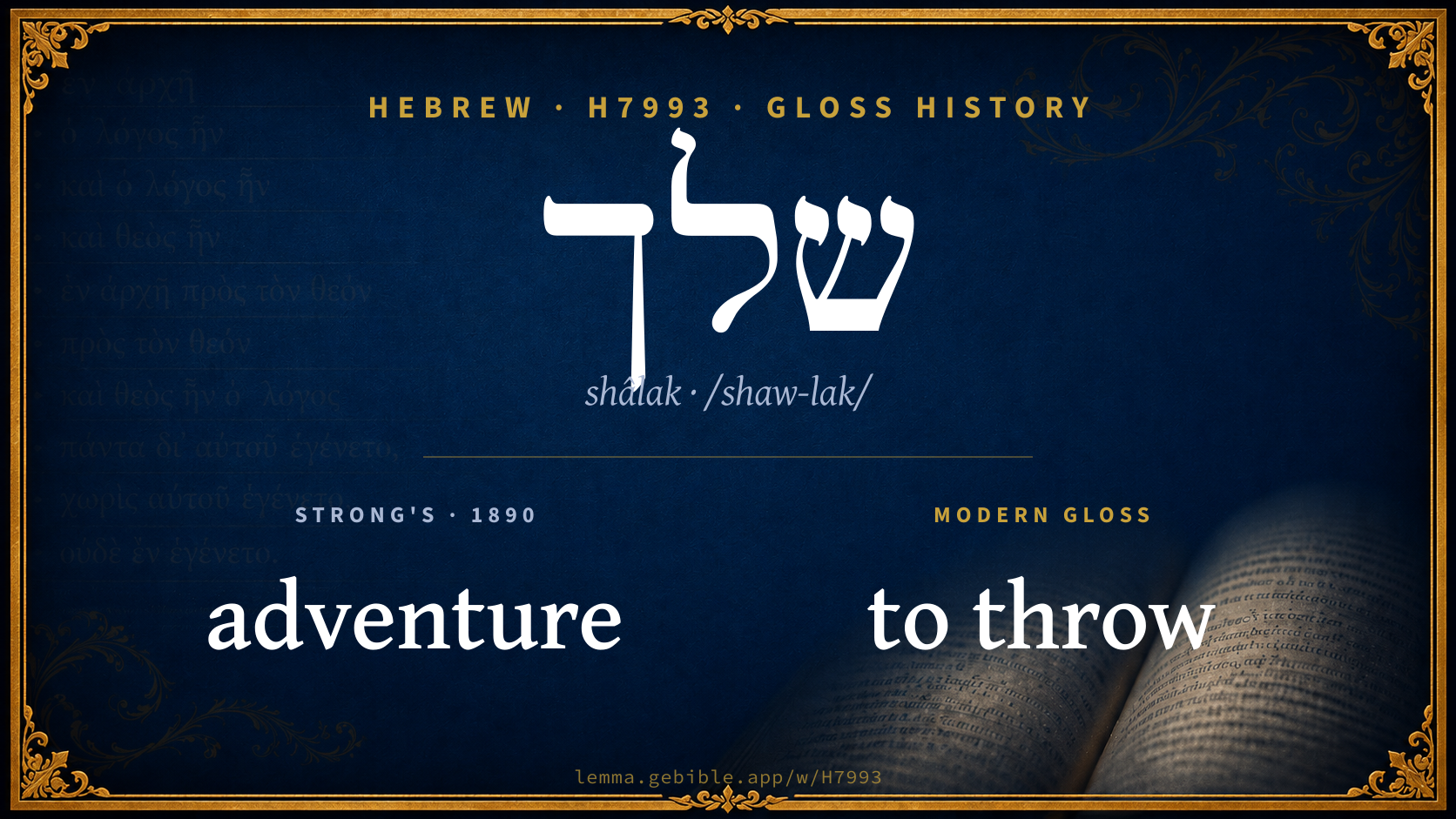
Gloss history
Strong's 1890 vs modern scholarship
About this word
Strong's H7993 catalogs a Hebrew word from the Hebrew Old Testament.
These counts are not copied from any lexicon or concordance. They are computed here, from the morphology-tagged Hebrew Old Testament. What Lemma adds →
- 121
- distinct verses
- The word appears in 121 distinct verses.
- 26 / 39
- OT books
- The word appears in 26 of 39 Old Testament books.
- #352
- by frequency
- Top 500 most frequent Hebrew words (rank 352 of 8,640 Hebrew words by occurrence).
View all 121 occurrences in the concordance →
By section of the Old Testament
By traditional corpus
Conventional, traditional groupings — biblical authorship is debated, so this is a traditional corpus grouping, not an authorship claim. Each share is this word’s portion of its verses in that division of the Hebrew canon. Each figure is a share of the word’s 121 distinct verses.
- Prophets (Nevi'im) 72 verses · 60%
- Writings (Ketuvim) 28 verses · 23%
- Torah (Pentateuch) 21 verses · 17%
How translations render this word
Counts come from each version’s own published word-to-Strong’s tagging or interlinear alignment — an approximate guide to how each version renders this word, not a word-level alignment the data otherwise carries. Because each total is that version’s own tagged count, the per-version totals vary from one another and need not match the appearance or distinct-verse counts above. These counts may also differ from a printed concordance because Lemma counts each distinctly tagged rendering and does not collapse phrase taggings into a single head-word total. This is a fixed set of word-tagged versions (KJV, ASV, BSB, ULT) and does not change with the reading translation you choose elsewhere. Each version’s license is shown beside its name below (and on Sources).
- King James Version: Cast 39×, Cast away 5×, He cast 5×
- American Standard Version: Cast 30×, He cast 6×, Cast away 4×
- Berean Standard Bible: Threw 14×, Cast 7×, Throw 7×
- unfoldingWord Literal Text: He threw 10×, Threw 9×, They threw 7×
King James Version Public Domain
Renders H7993 across 125 tagged occurrences — most commonly:
Plus 58 renderings that appear only once — usually multi-word phrases or single function words the recovered tagging swept in, not distinct renderings.
American Standard Version Public Domain
Renders H7993 across 124 tagged occurrences — most commonly:
Plus other, less common renderings. Plus 63 renderings that appear only once — usually multi-word phrases or single function words the recovered tagging swept in, not distinct renderings.
Berean Standard Bible Public Domain
Renders H7993 across 125 tagged occurrences — most commonly:
Plus other, less common renderings. Plus 70 renderings that appear only once — usually multi-word phrases or single function words the recovered tagging swept in, not distinct renderings.
unfoldingWord Literal Text CC BY-SA 4.0
Renders H7993 across 138 tagged occurrences — most commonly:
Plus other, less common renderings. Plus 58 renderings that appear only once — usually multi-word phrases or single function words the recovered tagging swept in, not distinct renderings.
Senses in the full BDB
What do BDB’s symbols mean?
BDB uses these scholarly abbreviations:
| Symbol | Meaning |
|---|---|
| 𝔊 | the Septuagint (the ancient Greek translation, LXX) |
| 𝔙 | the Vulgate (the Latin translation) |
| 𝔖 | the Syriac version (the Peshitta) |
| 𝔗 | the Targum (the Aramaic translation) |
| ψ | the Psalms |
| √ | root (the underlying root or stem) |
| ‖ | parallel passage (a synonymous or contrasted parallel) |
| † | the dagger: every passage where the word occurs is cited |
The 4 senses and sub-senses the full Brown-Driver-Briggs lexicon distinguishes for this word, in lexicon order (not ranked by frequency), with BDB’s own verbatim wording and sub-sense lettering. Shown in Hebrew script with BDB’s own scholarly abbreviations. The condensed entry is in the Lexicon Entry tab. See also the Forms in the corpus table below.
Hophal
- 1. be thrown, cast
- 2. be cast forth, out
- 3. be cast down
- 4. metaph., be cast
Senses from the full Brown-Driver-Briggs lexicon (Brown, Driver, Briggs; Oxford 1906 — public domain), digitized via Sefaria, supplemented by the OpenScriptures HebrewLexicon (CC BY 4.0). Full attribution on Sources.
Word origin
[ שָׁלַךְ ] 125 vb. Hiph. 112 throw, fling, cast
— Brown-Driver-Briggs (Oxford 1906, public domain), digitized via Sefaria, supplemented by the OpenScriptures HebrewLexicon (CC BY 4.0). See Sources.
Origin: a primitive root
Jastrow Dictionary
A second Hebrew/Aramaic lexicon for comparison, covering Aramaic and post-biblical (Talmudic, Targumic, Midrashic) usage that the biblical-Hebrew BDB does not. Matched by lemma rather than by Strong’s number, so a lemma may carry more than one Jastrow headword (shown separately below), and the entries cover usage well beyond the Bible.
שָׁלַךְ
- , Hif. הִשְׁלִיךְ (b. h.) to cast off, throw down. Erub. 22ᵃ; Yalk. Deut. 846 להַשְׁלִיכוֹ, v. מַשּׂוֹא. Tanḥ. Sh’mini 11 הבחורים … ומַשְׁלִיכִין חומר וכ׳ young men and boys struck him (the drunken man) and cast mud in his face. Midr. Prov. ch. I נַשְׁלִיךְ אותו לבור let us cast him into a pit. Ib. נטל חכה והִשְׁלִיכָהּ לים he took a hook and threw it into the sea. Lam. R. to II, 1 הִשְׁלִיכוֹ לארץ he cast him off (his shoulder and) to the ground; a. fr.
- to be thrown. Tanḥ. Vayesh. 2 כיון שה׳ לבור וכ׳ when he was thrown into the pit, his face changed &c. Tanḥ. Noah 10 ברשותו הוּשְׁלַכְנוּ וכ׳ by his order we have been thrown (into the furnace) &c.; a. e.—Part. מוּשְׁלָךְ; f. מוּשְׁלֶכֶת &c. Gen. R. s. 8; Yalk. ib. 13, v. בלורין. Sifré Deut. 43 נבלת … שהיתה מוש׳ וכ׳ the corpse of J.… which lay exposed to heat in day-time and to cold &c. Midr. Prov. l. c. טורח … מוש׳ עליו the care for the household was thrown upon him (Reuben).
- same. Ex. R. s. 20 ולמה … נִשְׁלַכְתִּי לתוכה וכ׳ why did not Moses strike it (the Nile)? He said, I have been thrown into it, and it did not harm me &c.; a. e.
שָׁלָךְ
- (b. h.) name of a bird of prey, cormorant. Ḥull. 63ᵃ, v. שָׁלָה I.
A Dictionary of the Targumim, the Talmud Babli and Yerushalmi, and the Midrashic Literature (Marcus Jastrow; London, Luzac, 1903) — Public Domain. Digitized via Sefaria. Digitized via Sefaria. Full attribution on Sources.
Forms in the corpus
The 108 distinct written forms H7993 takes in the Hebrew Bible, most frequent first — each parse links to that stem’s occurrences in the concordance. Hebrew forms include their vowel points and cantillation, so a single lemma takes many written forms.
The 60 most common forms are shown; 48 rarer forms follow in the full concordance.
Same root — word family
Other BDB entries built from the same root as H7993, grouped by Strong’s listed origin. These share a root / origin per the lexicon — not necessarily a shared meaning. Each links to that word’s own entry.
Derived from this word
Compare all same-root words → They share a root, not necessarily a meaning.
Septuagint verse parallels
This word appears in 111 verses that also exist in the Greek Old Testament (Septuagint), out of the 121 Hebrew verses it occurs in. You can read those verses in Greek by switching the Old Testament edition to the Septuagint.
Read these verses in the Septuagint
- Genesis 21:15
- Exodus 1:22
- Leviticus 1:16
- Numbers 19:6
- Deuteronomy 9:17
- Joshua 8:29
- Judges 8:25
- 2 Samuel 11:21
- 1 Kings 13:24
- 2 Kings 2:16
- 2 Chronicles 7:20
- Job 15:33
This is a verse-level parallel only — the same verses exist in both the Hebrew and Greek Old Testaments. No word-level Hebrew↔Greek correspondence is claimed: the data carries no such alignment, so no Greek word is shown as this Hebrew word’s translation. Coverage is not total — the Septuagint omits the deuterocanon and renumbers the Psalms, so some Hebrew verses have no direct Greek parallel.