
Job 27:22

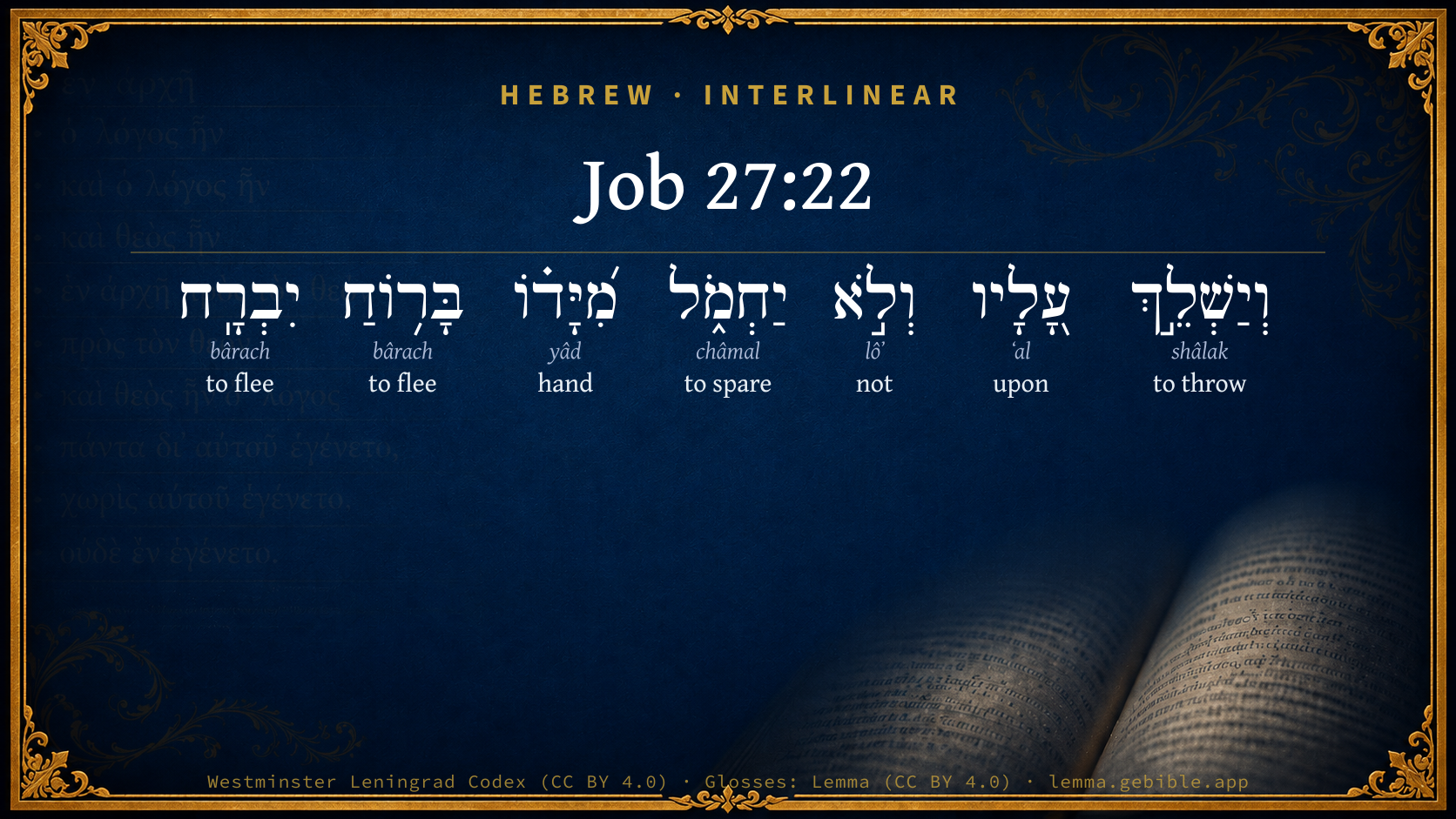
Hebrew (Westminster Leningrad Codex) Job 27:22 appears in the Hebrew Old Testament. The text above is from the Westminster Leningrad Codex. Each word links to its Strong’s number, a concise gloss, and parsing drawn from the Open Scriptures Hebrew Bible morphology. Click any word for its full Brown-Driver-Briggs (BDB) entry.
Download image
Cite this verse

Job 27:22 (World English Bible). Public Domain. Lemma interlinear Bible study tool, https://lemma.gebible.app/v/job/27/22.

Show BibTeX & RIS
BibTeX
RIS
English Translation
For it hurls at him, and does not spare, As he flees away from his hand.
World English Bible · Public Domain
Download a study sheet

One document with this verse’s original text, its word-by-word gloss line, the meaning frame, cross-references with their text, attributed commentary, and full source and license credits — printable, and it pastes into notes with its structure intact.

This verse Autodidact and up

Study sheet (.html) Plain text (.txt)

A passage Seminary Student

Up to 50 verses in one chapter. A passage sheet keeps up to 6 commentary sources and 12 cross-references per verse, in the order this page ranks them, and says so on the sheet whenever that leaves anything out. Ask for a single verse and you get the Autodidact verse sheet above.

Everything on this page stays free to read, with no account — the sheet is a download of what is already on screen, not access to it.

Want to remove ads? Support Godless Engineer
Compare translations 3

The same verse in 3 English versions, stacked beneath the original-language interlinear above. Click any original word for its lexicon entry.

Each is an independent rendering of the whole verse — the interlinear is not word-aligned to these translations.

Highlighted words mark where these versions differ — a whole-verse word diff, not a word-by-word alignment.

  • World English Bible Public Domain
    For it hurls at him, and does not spare, As he flees away from his hand.
  • King James Version Public Domain
    For God shall cast upon him, and not spare: he would fain flee out of his hand.
  • unfoldingWord Literal Text CC BY-SA 4.0
    And it hurls upon him and does not pity; fleeing, he flees from its hand.

unfoldingWord Literal Text — © unfoldingWord, licensed CC BY-SA 4.0. Word-aligned USFM3 via Door43 (git.door43.org/unfoldingWord/en_ult).

Versions to compare (up to 4)

3 of 4 selected

Show all 18 translations

Every available English version of this verse, each an independent rendering of the whole verse.

  • World English Bible Public Domain
    For it hurls at him, and does not spare, As he flees away from his hand.
  • Berean Standard Bible Public Domain
    It hurls itself against him without mercy as he flees headlong from its power.
  • Majority Standard Bible Public Domain
    It hurls itself against him without mercy as he flees headlong from its power.
  • King James Version Public Domain
    For God shall cast upon him, and not spare: he would fain flee out of his hand.
  • American Standard Version (1901) Public Domain
    For `God' shall hurl at him, and not spare: He would fain flee out of his hand.
  • Revised Version (1885) Public Domain
    For God shall hurl at him, and not spare: he would fain flee out of his hand.
  • Geneva Bible (1599) Public Domain
    And God shall cast vpon him and not spare, though he would faine flee out of his hand.
  • Douay-Rheims (1899) Public Domain
    And he shall cast upon him, and shall not spare: out of his hand he would willingly flee.
  • Young's Literal Translation Public Domain
    And it casteth at him, and doth not spare, From its hand he diligently fleeth.
  • Literal Standard Version CC BY-SA 4.0
    And it casts at him, and does not spare, || He diligently flees from its hand.
  • Unlocked Literal Bible CC BY-SA 4.0
    It throws itself at him and does not stop; he tries to flee out of its hand.
  • unfoldingWord Literal Text CC BY-SA 4.0
    And it hurls upon him and does not pity; fleeing, he flees from its hand.
  • Darby Bible Public Domain
    And [God] shall cast upon him and not spare: he would fain flee out of his hand.
  • World Messianic Bible Public Domain
    For it hurls at him, and does not spare, as he flees away from his hand.
  • Webster's Bible Public Domain
    For God shall cast upon him, and not spare: he would fain flee out of his hand.
  • Free Bible Version CC BY-SA 4.0
    The wind blows at them with full force; they try desperately to escape.
  • Bible in Basic English Public Domain
    God sends his arrows against him without mercy; he goes in flight before his hand.
  • JPS Tanakh (1917) Public Domain
    Yea, it hurleth at him, and spareth not; he would fain flee from its power.

Literal Standard Version (2020), Covenant Press — licensed CC BY-SA 4.0. Text via the HelloAO Bible API (eBible.org). Unlocked Literal Bible (unfoldingWord) — licensed CC BY-SA 4.0. Text via the HelloAO Bible API (eBible.org). unfoldingWord Literal Text — © unfoldingWord, licensed CC BY-SA 4.0. Word-aligned USFM3 via Door43 (git.door43.org/unfoldingWord/en_ult). Free Bible Version, Dr. Jonathan Gallagher — licensed CC BY-SA 4.0. Text via the HelloAO Bible API (eBible.org).

Word by word

More ways to search: Search by grammar → Find every occurrence → Compare this word →

Practice this passage: Drill this verse → Learn its vocabulary →

About this verse

These counts appear in no published source. They are computed here, from the morphology-tagged text and Lemma’s own curated glosses. What Lemma adds →

7
words
6
distinct lemmas
Wisdom
section

Shared distinctive vocabulary

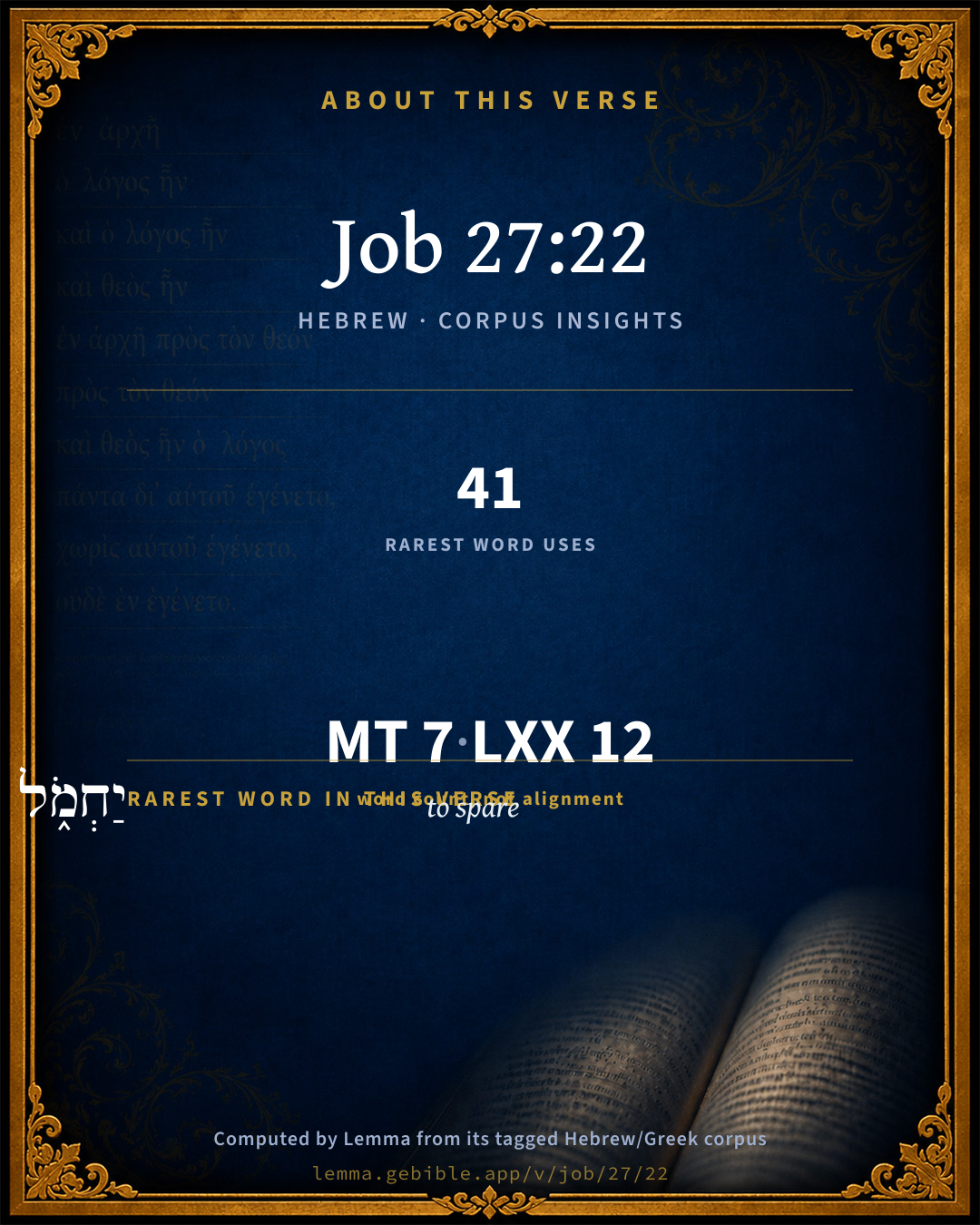
יַחְמֹ֑ל to spare H2550 occurs in 40 verses of the Hebrew Bible. Also found in:

Grammatical profile

  • 4 verbs
  • 1 noun
  • 1 preposition
  • 1 particle

Verb forms

  • וְיַשְׁלֵ֣ךְ Hiphil · Imperfect
  • יַחְמֹ֑ל Qal · Imperfect
  • בָּר֥וֹחַ Qal · Infinitive Absolute
  • יִבְרָֽח Qal · Imperfect

Repetition

A word recurs within this verse — often emphatic in Hebrew:

  • בָּר֥וֹחַ to flee H1272 ×2

Hebrew & Septuagint length

In English translation the verse runs 16 words from the Hebrew and 18 from the Septuagint (LXX English) — closely comparable.

A rough comparison of the two English renderings, which tokenize alike — not a word-level alignment.

Word counts can differ between the Hebrew and the Greek without any difference in meaning — e.g. the Hebrew direct-object marker אֵת has no separate Greek word, and Greek often adds the article ὁ.

In the original languages it is 7 Hebrew tokens and 12 Greek tokens — but the two are counted differently (Hebrew bundles its prefixes and suffixes into one token; the Greek is in lemma form), so that isn’t a like-for-like length.

Cross-references

17

Topical passages linked to Job 27:22 in the Treasury of Scripture Knowledge — connected by theme and wording, ordered by reader-vote popularity; previews shown in the World English Bible.

  • 2 Peter 2:4–5 For if God didn't spare angels when they sinned, but cast them down to Tartarus, and committed them to pits of darkness, to be reserved to judgment;
  • Job 11:20 But the eyes of the wicked shall fail, They shall have no way to flee; Their hope shall be the giving up of the spirit."
  • Ezekiel 5:11 Therefore, as I live, says the Lord Yahweh, surely, because you have defiled my sanctuary with all your detestable things, and with all your abominations, therefore will I also diminish [you]; neither shall my eye spare, and I also will have no pity.
  • Ezekiel 24:14 I, Yahweh, have spoken it: it shall happen, and I will do it: I will not go back, neither will I spare, neither will I repent; according to your ways, and according to your doings, shall they judge you, says the Lord Yahweh.
  • Exodus 9:14 For this time I will send all my plagues against your heart, against your officials, and against your people; that you may know that there is none like me in all the earth.
  • Exodus 14:25–28 He took off their chariot wheels, and they drove them heavily; so that the Egyptians said, "Let's flee from the face of Israel, for Yahweh fights for them against the Egyptians!"
  • Deuteronomy 32:23 I will heap evils on them; I will spend my arrows on them:
  • Joshua 10:11 It happened, as they fled from before Israel, while they were at the descent of Beth Horon, that Yahweh cast down great stones from the sky on them to Azekah, and they died: they were more who died with the hailstones than they whom the children of Israel killed with the sword.
  • Judges 4:17–21 However Sisera fled away on his feet to the tent of Jael the wife of Heber the Kenite; for there was peace between Jabin the king of Hazor and the house of Heber the Kenite.
  • Job 20:24 He shall flee from the iron weapon. The bronze arrow shall strike him through.
  • Isaiah 10:3 What will you do in the day of visitation, and in the desolation which shall come from far? to whom will you flee for help? and where will you leave your glory?
  • Jeremiah 13:14 I will dash them one against another, even the fathers and the sons together, says Yahweh: I will not pity, nor spare, nor have compassion, that I should not destroy them.
  • Ezekiel 9:5–6 To the others he said in my hearing, Go you through the city after him, and strike: don't let your eye spare, neither have you pity;
  • Amos 2:14 Flight will perish from the swift; And the strong won't strengthen his force; Neither shall the mighty deliver himself;
  • Amos 9:1–3 I saw the Lord standing beside the altar, and he said, "Strike the tops of the pillars, that the thresholds may shake; and break them in pieces on the head of all of them; and I will kill the last of them with the sword: there shall not one of them flee away, and there shall not one of them escape.
  • Romans 8:32 He who didn't spare his own Son, but delivered him up for us all, how would he not also with him freely give us all things?
  • Deuteronomy 29:20 Yahweh will not pardon him, but then the anger of Yahweh and his jealousy will smoke against that man, and all the curse that is written in this book shall lie on him, and Yahweh will blot out his name from under the sky.

Cross-references courtesy of OpenBible.info (CC BY 4.0).

Hebrew and Greek witnesses Masoretic Hebrew ↔ Greek Septuagint

The same verse in the two great witnesses to the Old Testament, shown verse-for-verse.

These are two independent witnesses, not word-aligned to each other, and the Septuagint is shown in lemma (dictionary) form.

Hebrew Job 27:22 Masoretic · Westminster Leningrad Codex

וְיַשְׁלֵ֣ךְ עָ֭לָיו וְלֹ֣א יַחְמֹ֑ל מִ֝יָּד֗וֹ בָּר֥וֹחַ יִבְרָֽח

For it hurls at him, and does not spare, As he flees away from his hand.

World English Bible · Public Domain

Greek LXX Job 27:22 Septuagint · lemma form

καί ἐπιῥίπτω ἐπί αὐτός καί οὐ φείδομαι ἐκ χείρ αὐτός φυγή φεύγω

And God shall cast trouble upon him, and not spare: he would fain flee out of his hand.

LXX2012 (modern English Septuagint) · Public Domain

On this verse, Haydock's Catholic Bible Commentary discusses the Septuagint’s reading. Read the note in Commentary ↓

Hebrew: Westminster Leningrad Codex (CC BY 4.0). Greek: Septuagint (public domain); English from LXX2012 (modern English Septuagint) (Public Domain). How the Septuagint differs from the Hebrew →

Commentary

Notes on Job 27:22 from classic Christian and Jewish commentators (each source and its license shown beneath its notes). The classic Christian expositions comment on the surrounding passage and are grouped to its opening verse, so a note may address several verses; the Jewish commentaries on the Tanakh (Rashi and others) are per-verse, so they appear only where the commentator wrote on this verse.

Lemma curates 59 commentaries, every one of them public domain or Creative Commons licensed, each selected and text-cleaned for this edition rather than reprinted as found. About our sources →

Trapp's Complete Commentary

John Trapp

Job 27:22 For [God] shall cast upon him, and not spare: he would fain flee out of his hand.

Ver. 22. For God shall cast upon him, and not spare] But set himself to inflict upon this cursed caitiff all the plagues written and unwritten in his book, full vials of vengeance; an evil, an only evil, even punishment without pity, misery without mercy, sorrow without succour, crying without comfort, mischief without measure, torments without end, and past imagination.

He would fain flee out of his hand] But that will not be; like a wretched caitiff, he runs without resting, but God’s hand pursueth him till he perisheth. He may shuffle from side to side, as Balaam’s ass did; he may skip up and down, as the wounded deer; Sed haeret lateri lethalis arundo, the deadly dart sticks in his side, &c.

John Trapp, A Commentary or Exposition upon All the Books of the Old and New Testament (1647–1656) — public domain. Text from a community e-Sword module.

Jamieson, Fausset & Brown

Robert Jamieson, A. R. Fausset & David Brown

cast--namely, thunderbolts (Job 6:4; Job 7:20; Job 16:13; Psa 7:12-13).

Jamieson, Fausset & Brown — Commentary Critical and Explanatory on the Whole Bible (1871) — public domain (CC PDM 1.0). Text via the HelloAO Bible API.

Adam Clarke's Commentary

Verse 22. God shall cast upon him] Or, rather, the storm mentioned above shall incessantly pelt him, and give him no respite; nor can he by any means escape from its fury.

Adam Clarke's Commentary on the Bible (1810–1826) — public domain. Text from a community e-Sword/MySword module.

Ellicott's Commentary for English Readers

(22) For God shall cast upon him.—The Authorised Version supplies God as the subject; but we obtain very good sense by understanding it of the man who constantly fled from his power now being only too glad of the opportunity of avenging himself on him, while he or others clap their hands at him, and hiss him from his place.

A Bible Commentary for English Readers, edited by Charles John Ellicott (1878–1897) — public domain. Text from a community e-Sword module.

The Cambridge Bible for Schools and Colleges

gen. ed. J. J. S. Perowne

22. shall cast upon him] i. e. shall shoot down upon him His destroying arrows, Num_35:20. Comp. again what Job says of himself, ch. Job_6:4, Job_16:13, “His arrows compass me round about, he cleaveth my reins and doth not spare.”

The Cambridge Bible for Schools and Colleges (gen. ed. J. J. S. Perowne; Cambridge University Press, 1878–1918) — public domain. Text from a community e-Sword module.

John Gill's Exposition

Men shall clap their hands at him,.... In a way of joy and triumph, scorn and derision, see Lam 2:15; either at the time of his death, being glad they are rid of him, Psa 52:5; or rather hereafter, to all eternity, while the wrath and vengeance of God is pouring on him; and this will be done by all righteous men evermore; not pleasing themselves with the shocking scene, nor indulging any evil passion in them, from which they will be entirely free; but rejoicing in the glory of divine justice, which will be displayed in the everlasting destruction of wicked men, see Rev 18:20; and this need not be restrained to good men only, but ascribed to angels also; for it may be rendered impersonally, "hands shall be clapped at him"; or joy be expressed on this occasion by all in heaven, angels and saints, who will all approve and applaud the divine procedure against wicked men as right and just; yea, this may express the glorying of divine justice, and its triumph in the condemnation and destruction of sinners;

and shall hiss him out of his place; from the bar and tribunal of God, where he stood and was condemned; and, as he goes to everlasting punishment, expressing abhorrence and detestation of him and his crimes, and as pleased with the righteous judgment of God upon him. Now this is the wicked man's portion, and the heritage he shall have of God at and after death, though he has been in flourishing circumstances in life; all which Job observes, to show that he was no friend nor favourer of wicked men, nor thought well of them and their ways, though he observed the prosperity they are attended with in their present state; and as for himself, he was not, and would not, be such a wicked man, and an hypocrite, on any account whatever, since he was sure he must then be miserable hereafter, to all intents and purposes.

Next: Job Chapter 28

John Gill's Exposition of the Whole Bible (1746–1763) — public domain (CC PDM 1.0). Text via the HelloAO Bible API.

Albert Barnes' Notes on the Bible

For God shall cast upon him - That is, God shall bring calamities upon him, or cast his thunderbolts upon him, and shall not pity him.

He would fain flee - He would gladly escape from the wrath of God, but he is unable to do it.

Albert Barnes' Notes on the Bible (1834–1885) — public domain. Text from a community e-Sword/MySword module.

Haydock's Catholic Bible Commentary

And he (God) shall, or Septuagint the wind, (Calmet) "shall fall upon him." (Haydock) --- Flee. Yet he will not escape, (Menochius) though he flee with all expedition. (Haydock)

George Leo Haydock (1774–1849), Haydock's Catholic Family Bible and Commentary, 1859 edition — public domain. Excludes Psalms (Douay-Rheims chapter numbering differs from Protestant) and Deuterocanonical books (Catholic canon only).

Matthew Poole's English Annotations

God shall cast upon him his darts or plagues, one after another.

And not spare, i.e. shall show no pity nor mercy to him, when he crieth to God for it.

He would fain flee out of his hand; he earnestly desires and endeavours by all ways possible to escape the judgments of God, but all in vain.

Matthew Poole's English Annotations on the Holy Bible (1683–1685) — public domain. Text from a community e-Sword/MySword module.

Whedon's Commentary on the Bible

Daniel D. Whedon

22. He would fain flee — Literally, Fleeing he flees. Hither and thither he flees before God’s hand, but in vain.

Daniel D. Whedon (gen. ed.), Commentary on the Old and New Testaments (1874–1909) — public domain. Text from a community e-Sword module.

The Pulpit Commentary

For God shall out upon him, and not spare. Some commentators regard the storm as still the subject, and translate, "For it shall east itself upon him or, "rush upon him and not spore" (Sohultens, Merx). The difference is not great, since the storm represents God"s judgment. He would fain flee out of his hand; or, if the storm is meant, out of its hand.

The Pulpit Commentary (1880–1919), ed. H.D.M. Spence-Jones & Joseph S. Exell — public domain. Text from a community e-Sword module.

John Wesley's Explanatory Notes

Cast - His darts or plagues one after another. Would flee - He earnestly desires to escape the judgments of God, but in vain. Those that will not be persuaded to fly to the arms of Divine grace, which are now stretched out to receive them, will not be able to flee from the arms of Divine wrath, which will shortly be stretched out to destroy them.

John Wesley, Explanatory Notes Upon the Whole Bible (1754–1765) — public domain. Text via the GEBible commentary corpus.

unfoldingWord translationNotes

Door43 World Missions Community

General Information:

In verses 22-23 Job speaks of the wind as if it were a person attacking the wicked person. (See: Personification)

It throws itself at him

Here the phrase "throws itself at him" represents the wind blowing strong against him like an attacker. AT: "It blows strong against him like someone attacking him" (See: Personification)

he tries to flee out of its hand

Here "hand" represents the power or control that the wind has over the wicked man. AT: "he tries to flee out of its control" (See: Personification and Metonymy)

It claps its hands at him in mockery

Clapping the hands is a way of mocking someone. Here it represents the wind making loud noises. AT: "It makes loud noises like someone clapping his hands to mock him" (See: Symbolic Action and Personification)

it hisses him out of his place

The wind makes a noise as it blows him out of his place. It sounds like the hissing sound that people make to mock someone. AT: "it makes a hissing noise as it causes him to leave his home" or "it blows him out of his place and makes a hissing noise like someone who hisses at him to mock him" (See: Symbolic Action and Personification)

translationWords

hand

mock

unfoldingWord translationNotes — © Distant Shores Media and the Door43 World Missions Community, licensed CC BY-SA 4.0. Source: git.door43.org/Door43/en_tn.

Rashi

Rabbi Shlomo Yitzchaki (Rashi)

And he will cast upon him i.e., the one who casts evil upon him will show no compassion.

from his hand of the wicked man, and from his strength. from his place.

he will flee His counselor, who assisted him from the start, will flee from assisting him at the time of his downfall, as Charbonah did to Haman (Esther 7:9).

Rashi on the Tanakh — English translations: “The Judaica Press complete Tanach with Rashi, translated by A. J. Rosenberg” (CC BY 4.0); “Pentateuch with Rashi's commentary by M. Rosenbaum and A.M. Silbermann, 1929-1934” (public domain); “The Metsudah Tanach series, Lakewood, N.J” (CC BY 4.0); and “The Book of Joshua, Metsudah Publications, 1997” (CC BY 4.0). Text via Sefaria.

Lesson kit

Teaching starters — assembled from the data on this page, not authored interpretation. Every prompt links to the verse data it draws on. Edit before teaching.

Job, in the Wisdom, opens this verse with 7 words (6 distinct Hebrew lemmas). Its most distinctive word is châmal (“to spare”). A historical commentator’s framing appears above. Read the whole chapter for the surrounding context.

Discussion questions

  1. What does “to spare” (châmal) contribute to the verse as a whole?
  2. Exodus 2:6 shares the word «to spare» with this verse. How do the two illuminate each other?
  3. “to flee” occurs 2× in this one verse. What is the effect of the repetition?
  4. The translations on this page render this verse differently — a whole-verse word diff, not a word-by-word alignment. What might account for the different wordings?
  5. The verb «וְיַשְׁלֵ֣ךְ» is Hiphil Imperfect. How does its form color the action?
  6. Reading how Trapp's Complete Commentary and Jamieson, Fausset & Brown read this verse, where do the two commentators agree and where do they part?

Things to notice

Reading settings

Reading text

Shown beneath each verse's original-language words.

Old Testament
Old Testament edition

Read the OT as the Masoretic Hebrew (MT) or the Greek Septuagint (LXX).

English shown for the Greek Septuagint (in the Hebrew ↔ Greek comparison).

Comparing translations? Open the Compare panel on any verse page to stack up to four side by side.