Jeremiah 7:29

Hebrew (Westminster Leningrad Codex) Jeremiah 7:29 appears in the Hebrew Old Testament. The text above is from the Westminster Leningrad Codex. Each word links to its Strong’s number, a concise gloss, and parsing drawn from the Open Scriptures Hebrew Bible morphology. Click any word for its full Brown-Driver-Briggs (BDB) entry.
Download image
Cite this verse

Jeremiah 7:29 (World English Bible). Public Domain. Lemma interlinear Bible study tool, https://lemma.gebible.app/v/jeremiah/7/29.

Show BibTeX & RIS
BibTeX
RIS
English Translation
Cut off your hair, [Jerusalem], and cast it away, and take up a lamentation on the bare heights; for Yahweh has rejected and forsaken the generation of his wrath.
World English Bible · Public Domain
Download a study sheet

One document with this verse’s original text, its word-by-word gloss line, the meaning frame, cross-references with their text, attributed commentary, and full source and license credits — printable, and it pastes into notes with its structure intact.

This verse Autodidact and up

Study sheet (.html) Plain text (.txt)

A passage Seminary Student

Up to 50 verses in one chapter. A passage sheet keeps up to 6 commentary sources and 12 cross-references per verse, in the order this page ranks them, and says so on the sheet whenever that leaves anything out. Ask for a single verse and you get the Autodidact verse sheet above.

Everything on this page stays free to read, with no account — the sheet is a download of what is already on screen, not access to it.

Want to remove ads? Support Godless Engineer
Compare translations 3

The same verse in 3 English versions, stacked beneath the original-language interlinear above. Click any original word for its lexicon entry.

Each is an independent rendering of the whole verse — the interlinear is not word-aligned to these translations.

Highlighted words mark where these versions differ — a whole-verse word diff, not a word-by-word alignment.

  • World English Bible Public Domain
    Cut off your hair, [Jerusalem], and cast it away, and take up a lamentation on the bare heights; for Yahweh has rejected and forsaken the generation of his wrath.
  • King James Version Public Domain
    Cut off thine hair, O Jerusalem, and cast it away, and take up a lamentation on high places; for the LORD hath rejected and forsaken the generation of his wrath.
  • unfoldingWord Literal Text CC BY-SA 4.0
    Shear your consecration and throw away. And lift up on the bare heights a lamentation. For Yahweh has rejected and abandoned the generation of his fury.

unfoldingWord Literal Text — © unfoldingWord, licensed CC BY-SA 4.0. Word-aligned USFM3 via Door43 (git.door43.org/unfoldingWord/en_ult).

Versions to compare (up to 4)

3 of 4 selected

Show all 18 translations

Every available English version of this verse, each an independent rendering of the whole verse.

  • World English Bible Public Domain
    Cut off your hair, [Jerusalem], and cast it away, and take up a lamentation on the bare heights; for Yahweh has rejected and forsaken the generation of his wrath.
  • Berean Standard Bible Public Domain
    Cut off your hair and throw it away. Raise up a lamentation on the barren heights, for the LORD has rejected and forsaken the generation of His wrath.’
  • Majority Standard Bible Public Domain
    Cut off your hair and throw it away. Raise up a lamentation on the barren heights, for the LORD has rejected and forsaken the generation of His wrath.’
  • King James Version Public Domain
    Cut off thine hair, O Jerusalem, and cast it away, and take up a lamentation on high places; for the LORD hath rejected and forsaken the generation of his wrath.
  • American Standard Version (1901) Public Domain
    Cut off thy hair, `O Jerusalem', and cast it away, and take up a lamentation on the bare heights; for Jehovah hath rejected and forsaken the generation of his wrath.
  • Revised Version (1885) Public Domain
    Cut off thine hair, O Jerusalem, and cast it away, and take up a lamentation on the bare heights; for the LORD hath rejected and forsaken the generation of his wrath.
  • Geneva Bible (1599) Public Domain
    Cut off thine heare, O Ierusalem, and cast it away, and take vp a complaint on the hie places: for the Lord hath reiected and forsaken the generation of his wrath.
  • Douay-Rheims (1899) Public Domain
    Cut off thy hair, and cast it away: and take up a lamentation on high: for the Lord hath rejected and forsaken the generation of his wrath,
  • Young's Literal Translation Public Domain
    Cut off thy crown, and cast `it' away, And lift up on high places lamentation, For Jehovah hath rejected, And He leaveth the generation of His wrath.
  • Literal Standard Version CC BY-SA 4.0
    Cut off your crown, and cast [it] away, || And lift up lamentation on high places, || For YHWH has rejected, || And He leaves the generation of His wrath.
  • Unlocked Literal Bible CC BY-SA 4.0
    Cut off your hair and shave yourself, and throw away your hair. Sing a funeral song over the open places. For Yahweh has rejected and abandoned this generation in his rage.
  • unfoldingWord Literal Text CC BY-SA 4.0
    Shear your consecration and throw away. And lift up on the bare heights a lamentation. For Yahweh has rejected and abandoned the generation of his fury.
  • Darby Bible Public Domain
    Cut off thy hair, and cast it away, and take up a lamentation on the heights; for Jehovah hath rejected and forsaken the generation of his wrath.
  • World Messianic Bible Public Domain
    Cut off your hair, and throw it away, and take up a lamentation on the bare heights; for the LORD has rejected and forsaken the generation of his wrath.
  • Webster's Bible Public Domain
    Cut off thy hair, O Jerusalem, and cast it away, and take up a lamentation on high places; for the LORD hath rejected and forsaken the generation of his wrath.
  • Free Bible Version CC BY-SA 4.0
    Cut off your hair and throw it away. Sing a song of mourning on the bare hills, for the Lord has rejected and abandoned the generation who made him angry.”
  • Bible in Basic English Public Domain
    Let your hair be cut off, O Jerusalem, and let it go, and let a song of grief go up on the open hilltops; for the Lord is turned away from the generation of his wrath and has given them up.
  • JPS Tanakh (1917) Public Domain
    Cut off thy hair, and cast it away, and take up a lamentation on the high hills; for the LORD hath rejected and forsaken the generation of His wrath.

Literal Standard Version (2020), Covenant Press — licensed CC BY-SA 4.0. Text via the HelloAO Bible API (eBible.org). Unlocked Literal Bible (unfoldingWord) — licensed CC BY-SA 4.0. Text via the HelloAO Bible API (eBible.org). unfoldingWord Literal Text — © unfoldingWord, licensed CC BY-SA 4.0. Word-aligned USFM3 via Door43 (git.door43.org/unfoldingWord/en_ult). Free Bible Version, Dr. Jonathan Gallagher — licensed CC BY-SA 4.0. Text via the HelloAO Bible API (eBible.org).

Word by word

More ways to search: Search by grammar → Find every occurrence → Compare this word →

Practice this passage: Drill this verse → Learn its vocabulary →

שְׁפָיִ֖ם
shᵉphîy
H8205
“bare heights”
Noun, Common, Masculine, Plural, Absolute
Part of Speech
Noun
Type
Common
Gender
Masculine
Number
Plural
State
Absolute
Full BDB Definition

Origin: from H8192

TWOT: 2440b

bareness, smooth or bare height, bare place, high places, barren height - bareness - bare place, bare height
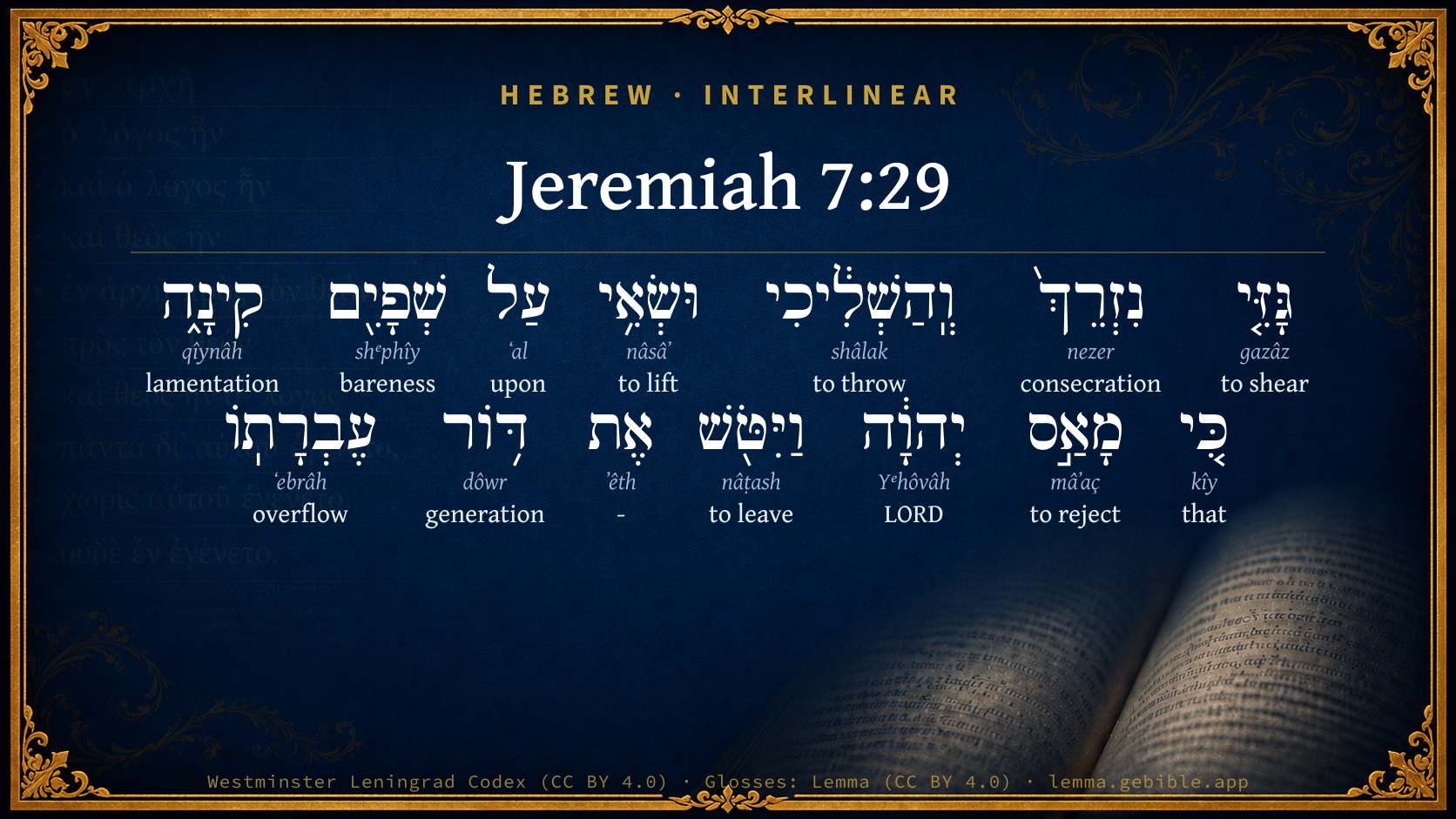
  1. גָּזִּ֤י gazâz H1494 “shear” Verb, Qal, Imperative, 2nd Person, Feminine, Singular
  2. נִזְרֵךְ֙ nezer H5145 “consecration · your” Noun, Common, Masculine, Singular, Construct + Suffix, Personal, 2nd Person, Feminine, Singular
  3. וְֽהַשְׁלִ֔יכִי shâlak H7993 “and · throw” Conjunction + Verb, Hiphil, Imperative, 2nd Person, Feminine, Singular
  4. וּשְׂאִ֥י nâsâʼ H5375 “and · lift” Conjunction + Verb, Qal, Imperative, 2nd Person, Feminine, Singular
  5. עַל ʻal H5921 “upon” Preposition
  6. קִינָ֑ה qîynâh H7015 “lamentation” Noun, Common, Feminine, Singular, Absolute
  7. כִּ֚י kîy H3588 “that” Conjunction
  8. מָאַ֣ס mâʼaç H3988 “to reject” Verb, Qal, Perfect, 3rd Person, Masculine, Singular
  9. יְהוָ֔ה Yᵉhôvâh H3068 “LORD” Noun, Proper
  10. וַיִּטֹּ֖שׁ nâṭash H5203 “and · to leave” Conjunction + Verb, Qal, Sequential Imperfect, 3rd Person, Masculine, Singular
  11. אֶת ʼêth H853 “-” Particle, Direct Object
  12. דּ֥וֹר dôwr H1755 “generation of” Noun, Common, Masculine, Singular, Construct
  13. עֶבְרָתֽוֹ ʻebrâh H5678 “overflow · his” Noun, Common, Feminine, Singular, Construct + Suffix, Personal, 3rd Person, Masculine, Singular

About this verse

These counts appear in no published source. They are computed here, from the morphology-tagged text and Lemma’s own curated glosses. What Lemma adds →

14
words
14
distinct lemmas
Prophets
section

Notable vocabulary

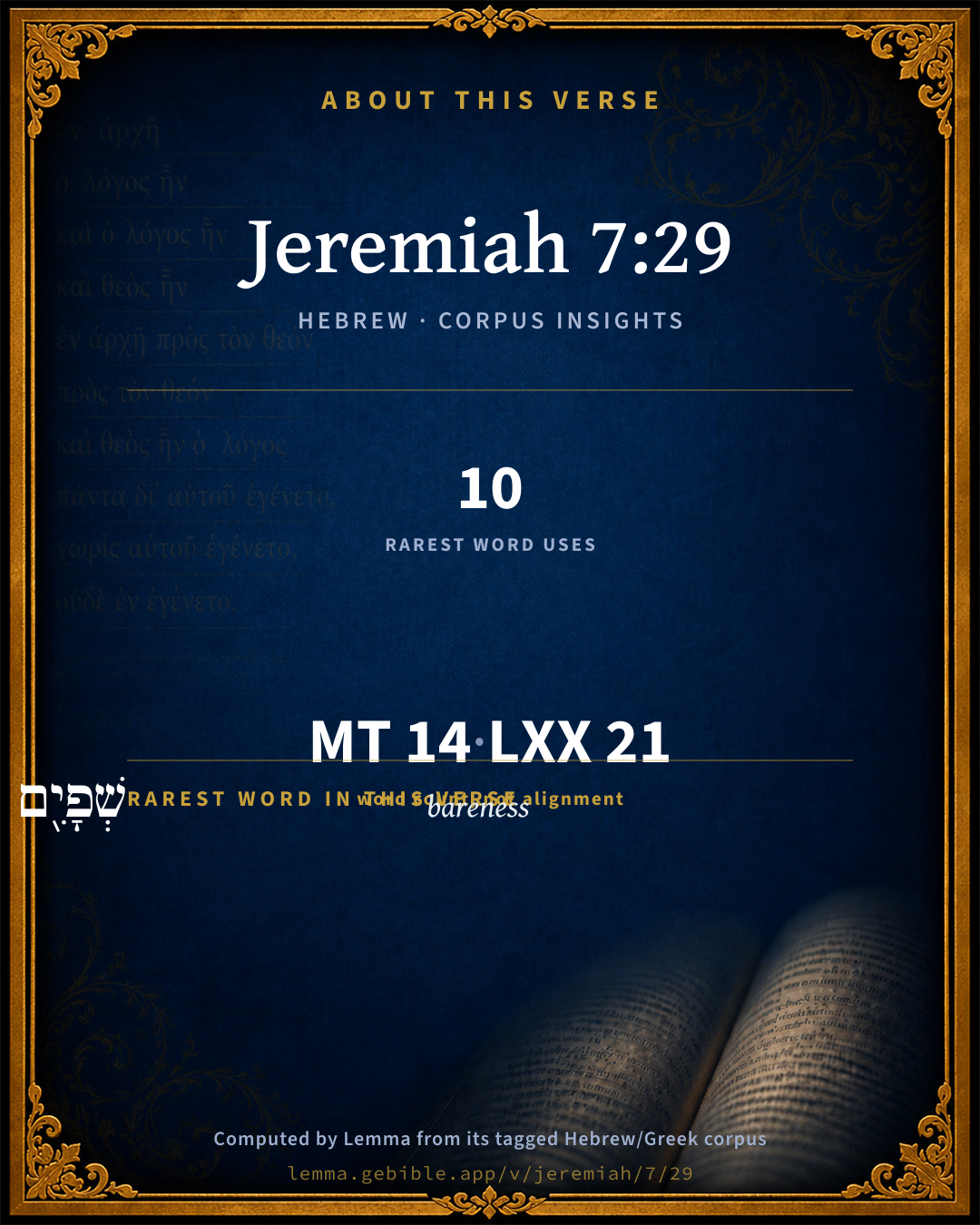
The rarest word here is שְׁפָיִ֖ם bareness H8205 — appearing just 10 times in the whole Hebrew Bible.

Shared distinctive vocabulary

שְׁפָיִ֖ם bareness H8205 occurs in 10 verses of the Hebrew Bible. Also found in:

Grammatical profile

  • 5 verbs
  • 6 nouns
  • 1 preposition
  • 1 conjunction
  • 1 particle

Verb forms

  • גָּזִּ֤י Qal · Imperative
  • וְֽהַשְׁלִ֔יכִי Hiphil · Imperative
  • וּשְׂאִ֥י Qal · Imperative
  • מָאַ֣ס Qal · Perfect
  • וַיִּטֹּ֖שׁ Qal · Sequential Imperfect

Hebrew & Septuagint length

In the original languages it is 14 Hebrew tokens and 21 Greek tokens — but the two are counted differently (Hebrew bundles its prefixes and suffixes into one token; the Greek is in lemma form), so that isn’t a like-for-like length.

Cross-references

18

Topical passages linked to Jeremiah 7:29 in the Treasury of Scripture Knowledge — connected by theme and wording, ordered by reader-vote popularity; previews shown in the World English Bible.

  • Job 1:20 Then Job arose, and tore his robe, and shaved his head, and fell down on the ground, and worshiped.
  • Jeremiah 6:30 Refuse silver shall men them, because Yahweh has rejected them.
  • Micah 1:16 Shave your heads, And cut off your hair for the children of your delight. Enlarge your baldness like the vulture; For they have gone into captivity from you!
  • Jeremiah 16:6 Both great and small shall die in this land; they shall not be buried, neither shall men lament for them, nor cut themselves, nor make themselves bald for them;
  • Deuteronomy 32:5 They have dealt corruptly with him, [they are] not his children, [it is] their blemish; [They are] a perverse and crooked generation.
  • 2 Kings 17:20 Yahweh rejected all the seed of Israel, and afflicted them, and delivered them into the hand of spoilers, until he had cast them out of his sight.
  • Isaiah 15:2–3 They are gone up to Bayith, and to Dibon, to the high places, to weep: Moab wails over Nebo, and over Medeba; on all their heads is baldness, every beard is cut off.
  • Jeremiah 9:17–21 Thus says Yahweh of Hosts, Consider you, and call for the mourning women, that they may come; and send for the skillful women, that they may come:
  • Jeremiah 47:5 Baldness is come on Gaza; Ashkelon is brought to nothing, the remnant of their valley: how long will you cut yourself?
  • Jeremiah 48:37 For every head is bald, and every beard clipped: on all the hands are cuttings, and on the loins sackcloth.
  • Ezekiel 19:1 Moreover, take up a lamentation for the princes of Israel,
  • Ezekiel 28:12 Son of man, take up a lamentation over the king of Tyre, and tell him, Thus says the Lord Yahweh: You seal up the sum, full of wisdom, and perfect in beauty.
  • Zechariah 11:8–9 I cut off the three shepherds in one month; for my soul was weary of them, and their soul also loathed me.
  • Matthew 3:7 But when he saw many of the Pharisees and Sadducees coming for his baptism, he said to them, "You offspring of vipers, who warned you to flee from the wrath to come?
  • Matthew 12:39 But he answered them, "An evil and adulterous generation seeks after a sign, but no sign will be given it but the sign of Jonah the prophet.
  • Matthew 16:4 An evil and adulterous generation seeks after a sign, and there will be no sign given to it, except the sign of the prophet Jonah." He left them, and departed.
  • Matthew 23:36 Most assuredly I tell you, all these things will come upon this generation.
  • Acts 2:40 With many other words he testified, and exhorted them, saying, "Save yourselves from this crooked generation!"

Cross-references courtesy of OpenBible.info (CC BY 4.0).

Hebrew and Greek witnesses Masoretic Hebrew ↔ Greek Septuagint

The same verse in the two great witnesses to the Old Testament, shown verse-for-verse.

These are two independent witnesses, not word-aligned to each other, and the Septuagint is shown in lemma (dictionary) form.

Hebrew Jeremiah 7:29 Masoretic · Westminster Leningrad Codex

גָּזִּ֤י נִזְרֵךְ֙ וְֽהַשְׁלִ֔יכִי וּשְׂאִ֥י עַל שְׁפָיִ֖ם קִינָ֑ה כִּ֚י מָאַ֣ס יְהוָ֔ה וַיִּטֹּ֖שׁ אֶת דּ֥וֹר עֶבְרָתֽוֹ

Cut off your hair, [Jerusalem], and cast it away, and take up a lamentation on the bare heights; for Yahweh has rejected and forsaken the generation of his wrath.

World English Bible · Public Domain

Greek LXX Structure differs

In the Septuagint, Jeremiah is about an eighth shorter than the Hebrew and arranges its material differently — the Oracles Against the Nations (Hebrew chapters 46–51) appear in the middle of the Greek book, after 25:13. Because the chapter and verse boundaries do not line up, a verse-for-verse comparison with the Hebrew is not shown.

A verse-for-verse comparison isn’t shown here because the chapters and verses don’t line up. Switch to the LXX edition with the MT / LXX toggle above to read the Greek directly.

Hebrew: Westminster Leningrad Codex (CC BY 4.0). Greek: Septuagint (public domain); English from a public-domain English Septuagint. How the Septuagint differs from the Hebrew →

Targum (Aramaic paraphrase)

1

The Targum is the ancient Jewish Aramaic paraphrase of the Hebrew Scriptures — an interpretive translation, not the Hebrew text itself. Onkelos (literal) and Pseudo-Jonathan (expansive) render the Torah, and Jonathan the Prophets. Coverage is partial: where no permissively-licensed English translation exists for a verse, only the Aramaic is shown. This is verse-level text, not a word-by-word alignment to the Hebrew.

  1. Targum Jonathan Prophets (Joshua–Malachi)
    תְּלִישִׁי עַל רַבְרְבַיִךְ דְיִגְלוּן וְטוּלִי עַל נַגְרִין אִלְיָא אֲרֵי רָחֵיק יְיָ וְרַטֵישׁ יַת דָרָא דַעֲבָרוּ עַל מֵימְרֵיהּ:

    (no public-domain English translation for this verse)

    Targum Jonathan — Aramaic: “Mikraot Gedolot” (public domain). English: “Sefaria Community Translation” (CC0 1.0 (public-domain dedication)); “London "Chaldee Paraphrase," 1871” (public domain). Text via Sefaria.

Commentary

Notes on Jeremiah 7:29 from classic Christian and Jewish commentators (each source and its license shown beneath its notes). The classic Christian expositions comment on the surrounding passage and are grouped to its opening verse, so a note may address several verses; the Jewish commentaries on the Tanakh (Rashi and others) are per-verse, so they appear only where the commentator wrote on this verse.

Lemma curates 59 commentaries, every one of them public domain or Creative Commons licensed, each selected and text-cleaned for this edition rather than reprinted as found. About our sources →

Matthew Henry's Commentary

Here is, I. A loud call to weeping and mourning. Jerusalem, that had been a joyous city, the joy of the whole earth, must now take up a lamentation on high places (Jer 7:29), the high places where they had served their idols; there must they now bemoan their misery. In token both of sorrow and slavery, Jerusalem must now cut off her hair and cast it away; the word is peculiar to the hair of the Nazarites, which was the badge and token of their dedication to God, and it is called their crown. Jerusalem had been a city which was a Nazarite to God, but now must cut off her hair, must be profaned, degraded, and separated from God, as she had been separated to him. It is time for those that have lost their holiness to lay aside their joy.

II. Just cause given for this great lamentation.

1. The sin of Jerusalem appears here very heinous, nowhere worse, or more exceedingly sinful (Jer 7:30): "The children of Judah" (God's profession people, that came forth out of the waters of Judah, Isa 48:1) "have done evil in my sight, under my eye, in my presence; they have affronted me to my face, which very much aggravates the affront:" or, "They have done that which they know to be evil in my sight, and in the highest degree offensive to me." Idolatry was the sin which was above all other sins evil in God's sight. Now here are two things charged upon them in their idolatry, which were very provoking: (1.) That they were very impudent in it towards God and set him at defiance: They have set their abominations (their abominable idols and the altars erected to them) in the house that is called by my name, in the very courts of the temple, to pollute it (Manasseh did so, Kg2 21:7, Kg2 23:12), as if they thought God would connive at it, or cared not though he was ever so much displeased with it, or as if they would reconcile heaven and hell, God and Baal. The heart is the place which God has chosen to put his name there; if sin have the innermost and uppermost place there, we pollute the temple of the Lord, and therefore he resents nothing more than setting up idols in the heart, Eze 14:4. (2.) That they were very barbarous in it towards their own children, Jer 7:31. They have particularly built the high places of Tophet, where the image of Moloch was set up, in the valley of the son of Hinnom, adjoining to Jerusalem; and there they burnt their sons and their daughters in the fire, burnt them alive, killed them, and killed them in the most cruel manner imaginable, to honour or appease those idols that were devils and not gods. This was surely the greatest instance that ever was of the power of Satan in the children of disobedience, and of the degeneracy and corruption of the human nature. One would willingly hope that there were not many instances of such a barbarous idolatry; but it is amazing that there should be any, that men could be so perfectly void of natural affection as to do a thing so inhuman as to burn little innocent children, and their own too, that they should be so perfectly void of natural religion as to think it lawful to do this, nay, to think it acceptable. Surely it was in a way of righteous judgment, because they had changed the glory of God into the similitude of a beast, that God gave them up to such vile affections that changed them into worse than beasts. God says of this that it was what he commanded them not, neither cam it into his heart, which is not meant of his not commanding them thus to worship Moloch (this he had expressly forbidden them), but he had never commanded that his worshippers should be at such an expense, nor put such a force upon their natural affection, in honouring him; it never came into his heart to have children offered to him, yet they had forsaken his service for the service of such gods as, by commanding this, showed themselves to be indeed enemies to mankind.

2. The destruction of Jerusalem appears here very terrible. That speaks misery enough in general (Jer 7:29), The Lord hath rejected and forsaken the generation of his wrath. Sin makes those the generation of God's wrath that had ben the generation of his love. And God will reject and quite forsake those who have thus made themselves vessels of wrath fitted to destruction. He will disown them for his. "Verily, I say unto you, I know you not." And he will give them up to the terrors of their own guilt, and leave them in those hands. (1.) Death shall triumph over them, Jer 7:32. 33. Sin reigns unto death; for that is the wages of it, the end of those things. Tophet, the valley adjoining to Jerusalem, shall be called the valley of slaughter, for there multitudes shall be slain, when, in their sallies out of the city and their attempts to escape, they fall into the hands of the besiegers. Or it shall be called the valley of slaughtered ones, because thither the corpses of those that are slain shall be brought to be buried, all other burying places being full; and there they shall bury until there be no more place to make a grave. This intimates the multitude of those that shall die by the sword, pestilence, and famine. Death shall ride on prosperously, with dreadful pomp and power, conquering and to conquer. The slain of the Lord shall be many. This valley of Tophet was a place where the citizens of Jerusalem walked to take the air; but it shall now be spoiled for that use, for it shall be so full of graves that there shall be no walking there, because of the danger of contracting a ceremonial pollution by the touch of a grave. There it was that they sacrificed some of their children, and dedicated others to Moloch, and there they should fall as victims to divine justice. Tophet had formerly been the burying place, or burning place, of the dead bodies of the besiegers, when the Assyrian army was routed by an angel; and for this it was ordained of old, Isa 30:33. But they having forgotten this mercy, and made it the place of their sin, God will now turn it into a burying place for the besieged. In allusion to this valley, hell is in the New Testament called Gehenna - the valley of Hinnom, for there were buried both the invading Assyrians and the revolting Jews; so hell is a receptacle after death both for infidels and hypocrites, the open enemies of God's church and its treacherous friends; it is the congregation of the dead; it is prepared for the generation of God's wrath. But so great shall that slaughter be that even the spacious valley of Tophet shall not be able to contain the slain; and at length there shall not be enough left alive to bury the dead, so that the carcases of the people shall be meat for the birds and beasts of prey, that shall feed upon them like carrion, and none shall have the concern or courage to frighten them away, as Rizpah did from the dead bodies of Saul's sons, 2 Sa. 28:26, Thy carcase shall be meat to the fowls and beasts, and no man shall drive them away. Thus do the law and the prophets agree, and the execution with both. The decent burying of the dead is a piece of humanity, in remembrance of what the dead body has been - the tabernacle of a reasonable soul. Nay, it is a piece of divinity, in expectation of what the dead body shall be at the resurrection. The want of it has sometimes been an instance of the rage of men against God's witnesses, Rev 11:9. Here it is threatened as an instance of the wrath of God against his enemies, and is an intimation that evil pursues sinners even after death. (2.) Joy shall depart from them (Jer 7:34): Then will I cause to cease the voice of mirth. God had called by his prophets, and by less judgments, to weeping and mourning; but they walked contrary to him, and would hear of nothing but joy and gladness, Isa 22:12, Isa 22:13. And what came of it? Now God called to lamentation (Jer 7:29), and he made his call effectual, leaving them neither cause nor heart for joy and gladness. Those that will not weep shall weep; those that will not by the grace of God be cured of their vain mirth shall by the justice of God be deprived of all mirth; for when God judges he will overcome. It is threatened here that there shall be nothing to rejoice in. There shall be none of the joy of weddings; no mirth, for there shall be no marriages. The comforts of life shall be abandoned, and all care to keep up mankind upon earth cast off; there shall be none of the voice of the bridegroom and the bride, no music, no nuptial songs. Nor shall there be any more of the joy of the harvest, for the land shall be desolate, uncultivated and unimproved. Both the cities of Judah and the streets of Jerusalem shall look thus melancholy; and when they thus look about them, and see no cause to rejoice, no marvel if they retire into themselves and find no heart to rejoice. Note, God can soon mar the mirth of the most jovial, and make it to cease, which is a reason why we should always rejoice with trembling, be merry and wise.

Matthew Henry's Commentary on the Whole Bible (1708–1710) — public domain (CC PDM 1.0). Text via the HelloAO Bible API.

Trapp's Complete Commentary

John Trapp

Jer 7:29 Cut off thine hair, [O Jerusalem], and cast [it] away, and take up a lamentation on high places; for the LORD hath rejected and forsaken the generation of his wrath.

Ver. 29. Cut off thine hair, O Jerusalem.] In token of greatest sorrow and servitude. {Job 1:20 Isa 15:2 Eze 27:31} Tu, dum servus es, comam nutris? said he in Aristophanes. The word here rendered "hair" is nezir, which signifieth a crown, and there hence the Nazarites had their name, {Num 6:2; Num 6:5} intimating thereby haply that their votaries should be as little accepted as were their sacrifices. {Jer 7:21}

And forsaken the generation of his wrath.] Who are elsewhere called "the people of his curse," and "vessels of wrath, fitted for destruction."

John Trapp, A Commentary or Exposition upon All the Books of the Old and New Testament (1647–1656) — public domain. Text from a community e-Sword module.

Albert Barnes' Notes on the Bible

Jeremiah summons the people to lament over the miserable consequences of their rejection of God. In the valley of Hinnom, where lately they offered their innocents, they shall themselves fall before the enemy in such multitudes that burial shall be impossible, and the beasts of the field unmolested shall prey upon their remains.

Jer 7:29

The daughter of Zion, defiled by the presence of enemies in her sanctuary, and rejected of God, must shear off the diadem of her hair, the symbol of her consecration to God, just as the Nazarite, when defiled by contact with a corpse, was to shave his crowned head.

Take up a lamentation ... - Or, lift up a “lamentation on the bare hill-sides” Jer 3:2.

Jer 7:30

They have set their abominations ... - Probably a reference to the reign of the fanatic Manasseh, in whose time the worship of Astarte and of the heavenly bodies was the established religion of the land 2Ki 21:3-5, and even the temple was used for idolatrous services. The people had never heartily accepted Josiah’s reformation.

Jer 7:31

The high places - Here, probably, not natural hills, but artificial mounts, on which the altars were erected.

Tophet (marginal reference note) is not here a proper name; as applied to Baal-worship the term is not an ordinary one, but almost unique to Jeremiah. Comparing this verse with Jer 19:5; Jer 32:35, it will be found that Baal is in those passages substituted for Tophet. Just as it is the practice of the prophets to substitute “Bosheth, shame,” for Baal (see Jer 3:24), so here Jeremiah uses “Tophet, an object of abhorrence” (compare Job 17:6 note), in just the same way.

Valley of the son of Hinnom - See Jos 15:8 note.

To burn ... - The children were not burned alive, but slain first Eze 16:21.

Jer 7:32

The valley of slaughter - Where they killed their helpless children, there shall they be slaughtered helplessly by their enemies.

Till there be no place - Rather, for want of room elsewhere.

Albert Barnes' Notes on the Bible (1834–1885) — public domain. Text from a community e-Sword/MySword module.

Joseph Benson's Commentary

Jer 7:29. Cut off thy hair, O Jerusalem — This was commonly practised in the time of great sorrow and mourning. And Jerusalem is here addressed as a woman in extreme misery, and exhorted to take upon her the habit and disposition of a mourner, and to bewail the calamities which were fallen upon her. But some have observed that the Hebrew word נזר, which we translate barely the hair, signifies something more, namely, votive, or Nazarite hair; and they think the prophet alludes to the law concerning Nazarites, (Num 6:9,) whereby it was ordered that, if any one should die near them, they should immediately shave off their hair. They suppose, therefore, the sense here is, that so many would be killed in Jerusalem by the Chaldeans, that if there were any Nazarites in the city, they would be all obliged on that account to shave off their hair: by which is signified that a great number of the inhabitants would be slain. And take up a lamentation on high places — Or, for the high places, as some read it; namely, where they had worshipped their idols, and offered their sacrifices, there they must now bemoan their misery. Or the words may, as some suppose, be intended to signify the cries and lamentations of the watchmen, who were placed on high towers and on hills, to observe the country around; and who are represented as seeing, on this occasion, scenes of calamity and slaughter on every side, and continually fresh subjects of alarm. For the Lord hath rejected the generation of his wrath — This sinful generation, who have so highly provoked him. As God is said to reject or cast off his people when he gives them up into the hands of their enemies, so he is said to choose them again at their restoration from captivity, Isa 14:1.

Joseph Benson's Commentary on the Old and New Testaments (1811–1818) — public domain. Text from a community e-Sword module.

Whedon's Commentary on the Bible

Daniel D. Whedon

JEHOVAH’S REJECTION OF THE NATION, Jer_7:29-34.

29. Hair — Here spoken of as a crown, the literal meaning of the original being diadem. See Num_6:7. English Version, “consecration.” The word was originally applied to the diadem of the high priest, (Exo_29:6,) and, as Keil thinks, was transferred to the hair because the uncut hair of the Nazarite was the mark of his consecration to the Lord, expressing what the diadem of the high priest expressed. As the defiled Nazarite should cut off the hair of his head because it had ceased to be a symbol of his peculiar and intimate relation to God, so Jerusalem is called upon to shear off her hair for the same reason. No longer is she the consecrated of the Lord. She has become defiled; hence cast off and abandoned.

Daniel D. Whedon (gen. ed.), Commentary on the Old and New Testaments (1874–1909) — public domain. Text from a community e-Sword module.

Keil & Delitzsch

C. F. Keil & F. Delitzsch

Therefore the Lord has rejected the backsliding people, so that it shall perish shamefully. - Jer 7:29. "Cut off thy diadem (daughter of Zion), and cast it away, and lift up a lamentation on the bald peaked mountains; for the Lord hath rejected and cast out the generation of His wrath. Jer 7:30. For the sons of Judah have done the evil in mine eyes, saith Jahveh, have put their abominations in the house on which my name is named, to pollute it; Jer 7:31. And have built the high places of Tophet, which is in the valley of Benhinnom, to burn their sons and daughters in the fire; which I have not commanded, neither came it into my heart. Jer 7:32. Therefore, behold, the days come, saith Jahveh, that they shall no longer say, Tophet and Valley of Benhinnom, but, The valley of slaughter; and they shall bury in Tophet for want of room. Jer 7:33. And the carcases of this people shall be meat for the fowls of heaven and the beasts of the earth, with no one to fray them away. Jer 7:34. And I make to cease out of the cities of Judah and from the streets of Jerusalem, the voice of mirth and the voice of gladness, the voice of the bridegroom and the voice of the bride; for a waste shall the land become. Jer 8:1. At that time, saith Jahveh, they shall bring out the bones of the kings of Judah and the bones of his princes, the bones of the priests and the bones of the prophets, and the bones of the inhabitants of Jerusalem, out of their graves. Jer 8:2. And they shall spread them before the sun, and the moon, and all the host of heaven, which they have loved, and which they have served, after which they have walked, and which they have sought and worshipped: they shall not be gathered nor buried; for dung upon the face of the earth shall they be. Jer 8:3. And death shall be chosen rather than life by all the residue which is left of this evil race, in all the places whither I have driven them that are left, saith Jahveh of hosts."

In these verses the judgment of Jer 7:20 is depicted in all its horror, and the description is introduced by a call upon Zion to mourn and lament for the evil awaiting Jerusalem and the whole land. It is not any particular woman that is addressed in Jer 7:29, but the daughter of Zion (cf. Jer 6:23), i.e., the capital city personified as a woman, as the mother of the whole people. Cut off נזרך, thy diadem. There can be no doubt that we are by this to understand the hair of the woman; but the current opinion, that the words simply and directly means the hair, is without foundation. It means crown, originally the diadem of the high priest, Exo 29:6; and the transference of the same word to the hair of the head is explained by the practice of the Nazarites, to wear the hair uncut as a mark of consecration to the Lord, Num 6:5. The hair of the Nazarite is called in Num 6:7 the consecration (נזר) of his God upon his head, as was the anointing oil on the head of the high priest, Lev 21:12. In this sense the long hair of the daughter of Zion is called her diadem, to mark her out as a virgin consecrated to the Lord. Cutting off this hair is not only in token of mourning, as in Job 1:20; Mic 1:16, but in token of the loss of the consecrated character. The Nazarite, defiled by the sudden occurrence of death near to his person, was bound to cut off his long hair, because by this defilement his consecrated hair had been defiled; and just so must the daughter of Zion cut off her hair and cast it from her, because by her sins she had defiled herself, and must be held as unconsecrate. Venema and Ros. object to this reference of the idea to the consecrated hair of the Nazarite: quod huc non quadrat, nec in faeminis adeo suetum erat; but this objection is grounded on defective apprehension of the meaning of the Nazarite's vow, and on misunderstanding of the figurative style here employed. The allusion to the Nazarite order, for the purpose of representing the daughter of Zion as a virgin consecrated to the Lord, does not imply that the Nazarite vow was very common amongst women. Deprived of her holy ornament, Zion is to set up a lament upon bare hill-tops (cf. Jer 3:21), since the Lord has rejected or cast out (Jer 7:30) the generation that has drawn His wrath down on it, because they have set idols in the temple in which He has revealed His glory, to profane it. The abominations are the image of Asherah which Manasseh set up in the temple, and the altars he had built to the host of heaven in both the courts (Kg2 21:5, Kg2 21:7). Besides the desecration of the temple of the Lord by idolatry, Jeremiah mentions in Jer 7:31, as an especially offensive abomination, the worship of Moloch practised in the valley of Benhinnom. Here children were burnt to this deity, to whom Manasseh had sacrificed his son, Kg2 21:6. The expression "high altars of Tophet" is singular. In the parallel passages, where Jeremiah repeats the same subject, Jer 19:5 and Jer 32:35, we find mentioned instead high altars of Baal; and on this ground, Hitz. and Graf hold התפת in our verse to be a contemptuous name for Baal Moloch. תּפת is not derived from the Persian; nor is it true that, as Hitz. asserts, it does not occur till after the beginning of the Assyrian period, since we have it in Job 17:6. It is formed from תּוּף, to spit out, like נפת from נוּף; and means properly a spitting out, then that before or on which one spits (as in Job 17:6), object of deepest abhorrence. It is transferred to the worship of Moloch here and Jer 19:6, Jer 19:13., and in Kg2 23:10. In the latter passage the word is unquestionably used for the place in the valley of Benhinnom where children were offered to Moloch. So in Jer 19:6, Jer 19:13 (the place of Tophet), and Jer 19:14; and so also, without a doubt, in Jer 7:32 of the present chapter. There is no valid reason for departing from this well-ascertained local signification; "high altars of the Tophet" may perfectly well be the high altars of the place of abominable sacrifices. With the article the word means the ill-famed seat of the Moloch-worship, situated in the valley of Ben or Bne Hinnom, to the south of Jerusalem. Hinnom is nomen propr. of a man of whom we know nothing else, and בּן( בּני הנּום) is not an appellative: son of sobbing, as Hitz., Graf, Bttcher explain (after Rashi), rendering the phrase by "Valley of the weepers," or "of groaning, sobbing," with reference to the cries of the children slain there for sacrifices. For the name Ben-hinnom is much older than the Moloch-worship, introduced first by Ahaz and Manasseh. We find it in Jos 15:8; Jos 18:16, in the topographical account of the boundaries of the tribes of Judah and Benjamin. As to Moloch-worship, see on Lev 18:21 and Eze 16:20. At the restoration of the public worship of Jahveh, Josiah had extirpated Moloch-worship, and had caused the place of the sacrifice of abominations in the valley of Ben-hinnom to be defiled (Kg2 23:20); so that it is hardly probable that it had been again restored immediately after Josiah's death, at the beginning of Jehoiakim's reign. Nor does the present passage imply this; for Jer. is not speaking of the forms of idolatry at that time in favour with the Jews, but of the abominations they had done. That he had Manasseh's doings especially in view, we may gather from Jer 15:4, where the coming calamities are expressly declared to be the punishment for Manasseh's sins. Neither is it come into my heart, i.e., into my mind, goes to strengthen: which I have not commanded.

Jer 7:32

Therefore God will make the place of their sins the scene of judgment on the sinners. There shall come days when men will call the valley of these abominations the valley of slaughter, i.e., shall make it into such a valley. Where they have sacrificed their children to Moloch, they shall themselves be slaughtered, massacred by their enemies. And in this valley, as an unclean place (Jer 19:13), shall they be buried "for want of room;" since, because of the vast numbers of the slain, there will be nowhere else to put them.

Jer 7:33

Even the number of the dead will be so great that the corpses shall remain unburied, shall become food for beasts of prey, which no one will scare away. This is taken almost literally from Deu 28:26.

Jer 7:34

Thus the Lord will put an end to all joyfulness in life throughout the land: cf. Hos 2:13; Eze 26:13. The voice of the bridegroom and the bride is a circumlocution for the mirth of marriage festivities; cf. 1 Macc. 9:39. All joy will be dumb, for the land shall become a waste; as the people had been warned, in Lev 26:31, Lev 26:33, would be the case if they forsook the Lord.

Keil & Delitzsch — Biblical Commentary on the Old Testament (1861–1891) — public domain (CC PDM 1.0). Text via the HelloAO Bible API. (Old Testament only.)

Geneva Bible (1599)

Geneva Bible translators

In sign of mourning, as Job 1:20.

Against whom he had just occasion to pour out his wrath, Mic. 1:6.

Geneva Bible (1599) marginal notes — public domain. Text via Bolls.life.

Jamieson, Fausset & Brown

Robert Jamieson, A. R. Fausset & David Brown

Jeremiah addresses Jerusalem under the figure of a woman, who, in grief for her lost children, deprives her head of its chief ornament and goes up to the hills to weep (Jdg 11:37-38; Isa 15:2).

hair--flowing locks, like those of a Nazarite.

high places--The scene of her idolatries is to be the scene of her mourning (Jer 3:21).

generation of his wrath--the generation with which He is wroth. So Isa 10:6; "the people of My wrath."

Jamieson, Fausset & Brown — Commentary Critical and Explanatory on the Whole Bible (1871) — public domain (CC PDM 1.0). Text via the HelloAO Bible API.

Adam Clarke's Commentary

Verse 29. Cut off thine hair] גזי נזרך gozzi nizrech, shear thy nazarite. The Nazarite was one who took upon him a particular vow, and separated himself from all worldly connexions for a certain time, that he might devote himself without interruption to the service of God; and during all this time no razor was to pass on his head, for none of his hair was to be taken off. After the vow was over, he shaved his head and beard, and returned to society. See Nu 6:2, c., and the notes there. Jerusalem is here considered under the notion of a Nazarite, by profession devoted to the service of God: but that profession was empty it was not accompanied with any suitable practice. God tells them here to cut off their hair; to make no vain pretensions to holiness or religion; to throw off the mask, and attempt no longer to impose upon themselves and others by their hypocritical pretensions. On the same ground he orders them, Jer 7:21, to devote to common use the animals destined for sacrifice; and to make no more vain shows of religion while their hearts were not right with him. Dr. Blayney thinks the address is to the prophet, who was a Nazarite by virtue of his office, and who was called to cut off his hair as a token of mourning for the desolations which were coming upon his people. That cutting off the hair was a sign of distress and mourning may be seen, Ezr 9:3; Isa 15:2; Jer 41:5, &c. But I think the other the more natural construction.

On high places] That the lamentation may be heard to the greater distance.

The generation of his wrath.] Persons exposed to punishment: used here as children of wrath, Eph 2:3.

Adam Clarke's Commentary on the Bible (1810–1826) — public domain. Text from a community e-Sword/MySword module.

John Calvin's Commentaries

Here again Jeremiah exhorts his own people to lament; and he uses the feminine gender, as though he called the people, the daughter of Sion, or the daughter of Jerusalem. He then, according to a common mode of speaking, calls the whole people a woman.

He first bids her to shave off the hair The word נזר, nesar, means the hair, derived from the Nazarites, who allowed their hair to grow: and there may be here a striking allusion to the Nazarites who were sacred to God; as though he had said, “This people are profane, and therefore ought to have nothing in common with the Nazarites.” Hence also is derived נזר, nesar, a crown. Though then the word means the hair, yet the allusion is not to be overlooked, — that this people, rejected by God, are bidden to cut off and to throw away the hair. After the throwing away of the hair there was to be great lamentation; Raise, he says, on high places a lamentation This may seem to be an exhortation to repentance: but as we have seen elsewhere, though the prophets often gave the people the hope of pardon and reconciliation, yet in this place the Prophet no doubt denounces a final judgment, and is a herald of lamentation, because the prevailing impiety was irreclaimable. He does not then perform here the duty of a teacher, but in a hostile manner denounces ruin: for it immediately follows —

For rejected hath Jehovah and forsaken the generation of his wrath The word דור, dur, means an age, not time, but men of the same age: as we call that our generation which now lives in the world, and that which is dead the generation of our fathers, and what succeeds us the next generation. It is indeed true, that the Israelites in every age were worthy of a similar vengeance; but God no doubt shews here, that his vengeance was at hand, for he had long borne with the perverse conduct of the people, and suspended his judgment. As then vengeance was now to be executed, the Prophet calls that age the age of God’s wrath; for we know that the genitive case in Hebrew has often such a meaning as this. Then the age of his wrath means the age or generation devoted to extreme vengeance; for their wickedness against God was extreme, as long as he treated them with forbearance. The longer then he had deferred his judgment, the heavier punishment was at hand. It afterwards follows —

John Calvin's Commentaries (1540-1563) — public domain. Text from the Calvin Translation Society English edition (1840s-50s) via the Christian Classics Ethereal Library (ccel.org). Calvin's coverage is partial (roughly two-thirds of the Bible); uncommented books and verses are honest gaps, never fabricated. The 19th-century editor's footnotes and remarks are omitted so the notes are faithfully Calvin's own voice.

Ellicott's Commentary for English Readers

(29) Cut off thine hair.—Literally, as in 2Sa_1:10; 2Ki_11:12, thy crown or diadem; but the verb determines the meaning. The word Netzer (“consecration” in the Authorised version) is applied to the unshorn locks of the Nazarite (Num_6:7), and from it he took his name. As the Nazarite was to shave his head if he came in contact with a corpse, as cutting the hair close was generally among Semitic races the sign of extremest sorrow (Job_1:20; Mic_1:16), so Jerusalem was to sit as a woman rejected by her husband, bereaved of her children. (Comp. the picture in Lam_1:1-3.) The word is applied also to the “crown” of the high priest in Exo_29:6, the “crown” of the anointing oil in Lev_21:12.

O Jerusalem.—The italics show that the words are not in the Hebrew, but the insertion of some such words was rendered necessary by the fact that the verb “cut off” is in the feminine. Those who heard or read the words of the prophet, who so often spoke of “the daughter of Zion” (Jer_6:2), of “the daughter of his people” (Jer_6:14; Jer_8:11), of “the betrothed of Jehovah” (Jeremiah 2, 3), would be at no loss to understand his meaning.

A Bible Commentary for English Readers, edited by Charles John Ellicott (1878–1897) — public domain. Text from a community e-Sword module.

The Cambridge Bible for Schools and Colleges

gen. ed. J. J. S. Perowne

29. hair] lit. (as mg.) crown, Heb. nezer, and used of the long hair worn in fulfilment of the Nazirite’s vow (Num_6:7). Jerusalem must now shew by outward sign her faithlessness to her vows of loyalty to her God.

bare heights] See on ch. Jer_3:2.

The Cambridge Bible for Schools and Colleges (gen. ed. J. J. S. Perowne; Cambridge University Press, 1878–1918) — public domain. Text from a community e-Sword module.

John Gill's Exposition

Cut off thine hair, O Jerusalem, and cast it away,.... This supplement is made, because the word is feminine; and therefore cannot be directed to the prophet, but to Jerusalem, and its inhabitants; shaving the head is a sign of mourning, Job 1:20 and this is enjoined, to show that there would soon be a reason for it; wherefore it follows:

and take up a lamentation on high places: that it might be heard afar off; or because of the idolatry frequently committed in high places. The Targum is,

"pluck off the hair for thy great ones that are carried captive, and take up a lamentation for the princes:''

for the Lord hath rejected and forsaken the generation of his wrath; a generation of men, deserving of the wrath of God, and appointed to it, on whom he determined to pour it out; of which his rejection and forsaking of them was a token: this was remarkably true of that generation in which Christ and his apostles lived, who disbelieved the Messiah, and had no faith in him, and spoke lying and blasphemous words concerning him; and therefore were rejected and forsaken by the Lord; and wrath came upon them to the uttermost.

John Gill's Exposition of the Whole Bible (1746–1763) — public domain (CC PDM 1.0). Text via the HelloAO Bible API.

Haydock's Catholic Bible Commentary

CHAPTER VII.

High. People lamented in such places, chap. ix. 13., and Judges xi. 35. (Calmet) --- Wrath, which he treats with the utmost severity. (Haydock)

George Leo Haydock (1774–1849), Haydock's Catholic Family Bible and Commentary, 1859 edition — public domain. Excludes Psalms (Douay-Rheims chapter numbering differs from Protestant) and Deuterocanonical books (Catholic canon only).

Matthew Poole's English Annotations

Cut off thine hair; it was a usual token of sorrow among the Jews to cut off the hair, Job 1:20; Isa 15:2; Mic 1:16. But here he speaketh either,

1. To Jeremiah; for

O Jerusalem is not in the text; or,

2. To the inhabitants of Jerusalem; and so speaks to them as a woman, whose hair is for an ornament, 1Co 11:15. Therefore this must needs signify a higher degree of sorrow. Cutting the hair among the ancients did signify,

1. Mourning.

2. Bondage. For the cutting off the hair in servants was a token of subjection; so that this speaks Jerusalem’s mournful condition in her captivity.

Cast it away; it is not to be reserved, as sometimes men and women both do for some use; but to be cast away, and as a thing good for nought. And thus it may agree with the church’s lamentation, Lam 5:16; for it is not here exhorted to as a token of repentance, but as a threatening of judgments.

Take up a lamentation on high places: see Jer 3:21. Lift up thy voice on high in lamentation, when thou hast thine eye or thoughts upon the high places where thou wentest a whoring from me, for which thou now goest into captivity.

The generation of his wrath; or, of his overrunning anger, as some render it, i.e. with whom he is extremely vexed, this present generation, that by their provocations have brought themselves under his wrath, Jer 7:18,20, a generation destined to the wrath of God, called elsewhere the people of his curse, Isa 34:5, and such as the apostle calls vessels of wrath, Rom 9:22, so far as it concerns the phrase.

Matthew Poole's English Annotations on the Holy Bible (1683–1685) — public domain. Text from a community e-Sword/MySword module.

The Pulpit Commentary

Vers. 29-34. Tophet, the greatest of all abominations; the beginning of the Divine retribution.

Cut off thine hair. The "daughter of Zion," i.e. the community of Jerusalem, is addressed; this appears from the verb being in the feminine. It is a choice expression which the prophet employs literally, shear off thy crown (i.e. thy chief ornament). The act was to be a sign of mourning. (see Job_1:20 Mic_1:16) Some think there is also a reference to the vow of the Nazarite (the word for "crown" being here nezer , which is also the word rendered in Authorized Version, "separation," i.e. "consecration," in the law of the Nazarite (Numbers 6). But neither in this context nor anywhere else have we any support for the application of the term "Nazarite" to the people of Israel. On high places; rather, on (the) bare hills. (see on Jer_3:21) The generation of his wrath; i.e. on which his wrath is to be poured out. (comp. Isa_10:6)

Ver. 29Jer_8:1, Jer_8:2)

d. in utter despair. (Jer_8:3)

III AND THOUGH DIFFERING IN OUTWARD CIRCUMSTANCE, YET IN SUBSTANCE AND REALITY THE SAME HARVEST WILL EVER SPRING FROM THE SAME SEED.

1. All evil-doing is such seed. And sheltering this under the cloak of religion, this is the same seed.

2. And its growth will be in like manner. Progressive daring in sin; the debasement of our nature.

3. And its harvest will be seen,

a. in widespread spiritual death, and often in terrible death-beds;

b. in the loss of all joy and gladness;

c. in degradation before men;

d. in awful despair.

CONCLUSION. Remember, "God is not mocked: whatsoever a man soweth," etc. C.

The Pulpit Commentary (1880–1919), ed. H.D.M. Spence-Jones & Joseph S. Exell — public domain. Text from a community e-Sword module.

John Wesley's Explanatory Notes

Cut off thine hair - This was an usual token of sorrow among the Jews. On high places - Upon the high places where thou wentest a whoring from me. The generation - A generation destined to the wrath of God.

John Wesley, Explanatory Notes Upon the Whole Bible (1754–1765) — public domain. Text via the GEBible commentary corpus.

unfoldingWord translationNotes

Door43 World Missions Community

Connecting Statement:

Yahweh continues giving Jeremiah his message to the people of Judah.

General Information:

The word "your" in these verses refers to the people of Judah.

Cut off your hair and shave yourself, and throw away your hair

This would be done as a sign of mourning. (See: Symbolic Action and Reflexive Pronouns)

rejected and abandoned

These two words have similar meanings and are repeated for emphasis. (See: Doublet)

sons of Judah

This refers to the people of Judah. AT: "people of Judah" (See: Metonymy)

have done evil in my eye

The word "eye" represents seeing, and seeing represents thoughts or judgment. AT: "have done what I judge to be evil" or "have done what I consider to be evil" (See: Metonymy)

this is Yahweh's declaration

Yahweh speaks of himself by name to express the certainty of what he is declaring. See how you translated this in Jeremiah 1:8. AT: "this is what Yahweh has declared" or "this is what I, Yahweh, have declared" (See: First, Second, or Third Person)

their detestable things

Here "detestable things" refers to idols, which God hates. AT: "their disgusting idols" (See: Metonymy)

house that is called by my name

This is a metonym for Yahweh's temple. It can be expressed in active form. See how you translated this in Jeremiah 7:10. AT: "house that belongs to me" or "temple where they worship me" (See: Metonymy and Active or Passive)

translationWords

reject

generation

rage

son

detest

house of God

defile

unfoldingWord translationNotes — © Distant Shores Media and the Door43 World Missions Community, licensed CC BY-SA 4.0. Source: git.door43.org/Door43/en_tn.

Rashi

Rabbi Shlomo Yitzchaki (Rashi)

So tear off your diadem Heb. גזי נזרך, tear out your hair. Comp. (Num. 11:31) “And He caused quails to fly (ויגז)”; also (Job 1:20), “And he shaved (ויגז) his head.” Another explanation is that נזרך means ‘your diadem,’ an expression of greatness, and so did Jonathan render: רברביך your great ones, and so did Menahem classify it (p. 83).

and abandoned Heb. ויטש.

Rashi on the Tanakh — English translations: “The Judaica Press complete Tanach with Rashi, translated by A. J. Rosenberg” (CC BY 4.0); “Pentateuch with Rashi's commentary by M. Rosenbaum and A.M. Silbermann, 1929-1934” (public domain); “The Metsudah Tanach series, Lakewood, N.J” (CC BY 4.0); and “The Book of Joshua, Metsudah Publications, 1997” (CC BY 4.0). Text via Sefaria.

Lesson kit

Teaching starters — assembled from the data on this page, not authored interpretation. Every prompt links to the verse data it draws on. Edit before teaching.

Jeremiah, in the Prophets, opens this verse with 14 words (14 distinct Hebrew lemmas). Its most distinctive word is shᵉphîy (“bareness”). A historical commentator’s framing appears above. Read the whole chapter for the surrounding context.

Discussion questions

  1. The word shᵉphîy carries the sense “bareness.” How does it shape the verse?
  2. How does Numbers 23:3, which shares the word «bareness», read alongside this verse?
  3. The translations on this page render this verse differently — a whole-verse word diff, not a word-by-word alignment. What might account for the different wordings?
  4. «גָּזִּ֤י» is a Qal Imperative verb. How does that grammatical form shape the action described?
  5. Compare how Matthew Henry's Commentary and Trapp's Complete Commentary read this verse. Where do they agree or differ?

Things to notice

Reading settings

Reading text

Shown beneath each verse's original-language words.

Old Testament
Old Testament edition

Read the OT as the Masoretic Hebrew (MT) or the Greek Septuagint (LXX).

English shown for the Greek Septuagint (in the Hebrew ↔ Greek comparison).

Comparing translations? Open the Compare panel on any verse page to stack up to four side by side.