
Zechariah 11:13

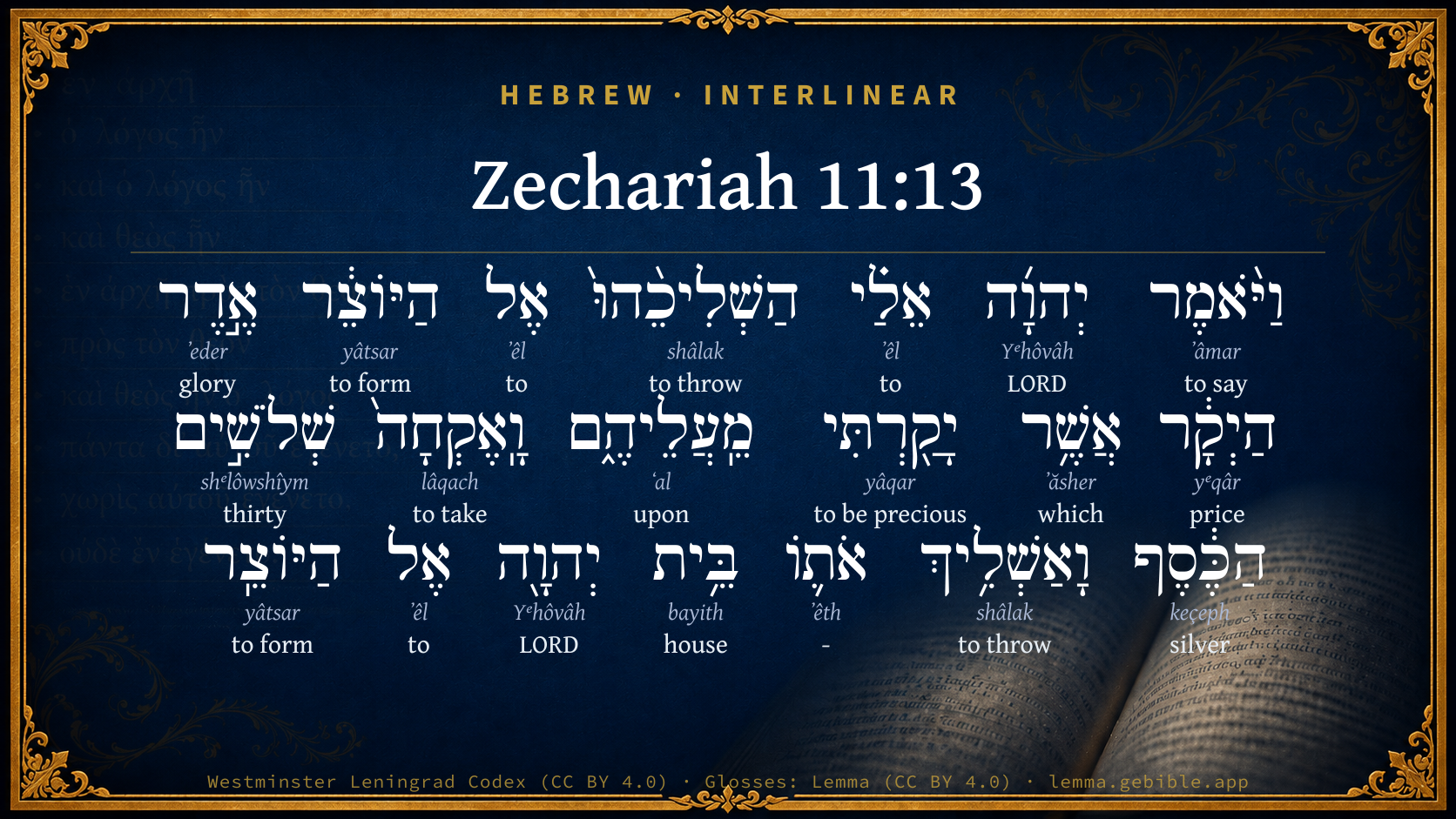
Hebrew (Westminster Leningrad Codex) Zechariah 11:13 appears in the Hebrew Old Testament. The text above is from the Westminster Leningrad Codex. Each word links to its Strong’s number, a concise gloss, and parsing drawn from the Open Scriptures Hebrew Bible morphology. Click any word for its full Brown-Driver-Briggs (BDB) entry.
Download image
Cite this verse

Zechariah 11:13 (World English Bible). Public Domain. Lemma interlinear Bible study tool, https://lemma.gebible.app/v/zechariah/11/13.

Show BibTeX & RIS
BibTeX
RIS
English Translation
Yahweh said to me, "Throw it to the potter, the handsome price that I was valued at by them!" I took the thirty pieces of silver, and threw them to the potter, in the house of Yahweh.
World English Bible · Public Domain
Download a study sheet

One document with this verse’s original text, its word-by-word gloss line, the meaning frame, cross-references with their text, attributed commentary, and full source and license credits — printable, and it pastes into notes with its structure intact.

This verse Autodidact and up

Study sheet (.html) Plain text (.txt)

A passage Seminary Student

Up to 50 verses in one chapter. A passage sheet keeps up to 6 commentary sources and 12 cross-references per verse, in the order this page ranks them, and says so on the sheet whenever that leaves anything out. Ask for a single verse and you get the Autodidact verse sheet above.

Everything on this page stays free to read, with no account — the sheet is a download of what is already on screen, not access to it.

Want to remove ads? Support Godless Engineer
Compare translations 3

The same verse in 3 English versions, stacked beneath the original-language interlinear above. Click any original word for its lexicon entry.

Each is an independent rendering of the whole verse — the interlinear is not word-aligned to these translations.

Highlighted words mark where these versions differ — a whole-verse word diff, not a word-by-word alignment.

  • World English Bible Public Domain
    Yahweh said to me, "Throw it to the potter, the handsome price that I was valued at by them!" I took the thirty pieces of silver, and threw them to the potter, in the house of Yahweh.
  • King James Version Public Domain
    And the LORD said unto me, Cast it unto the potter: a goodly price that I was prised at of them. And I took the thirty pieces of silver, and cast them to the potter in the house of the LORD.
  • unfoldingWord Literal Text CC BY-SA 4.0
    Then Yahweh said to me, “Deposit the silver in the treasury, the excellent price at which they valued you!” So I took the thirty of silver and deposited them in the treasury in the house of Yahweh.

unfoldingWord Literal Text — © unfoldingWord, licensed CC BY-SA 4.0. Word-aligned USFM3 via Door43 (git.door43.org/unfoldingWord/en_ult).

Versions to compare (up to 4)

3 of 4 selected

Show all 18 translations

Every available English version of this verse, each an independent rendering of the whole verse.

  • World English Bible Public Domain
    Yahweh said to me, "Throw it to the potter, the handsome price that I was valued at by them!" I took the thirty pieces of silver, and threw them to the potter, in the house of Yahweh.
  • Berean Standard Bible Public Domain
    And the LORD said to me, “Throw it to the potter”—this magnificent price at which they valued me. So I took the thirty pieces of silver and threw them to the potter in the house of the LORD.
  • Majority Standard Bible Public Domain
    And the LORD said to me, “Throw it to the potter”—this magnificent price at which they valued me. So I took the thirty pieces of silver and threw them to the potter in the house of the LORD.
  • King James Version Public Domain
    And the LORD said unto me, Cast it unto the potter: a goodly price that I was prised at of them. And I took the thirty pieces of silver, and cast them to the potter in the house of the LORD.
  • American Standard Version (1901) Public Domain
    And Jehovah said unto me, Cast it unto the potter, the goodly price that I was prized at by them. And I took the thirty `pieces' of silver, and cast them unto the potter, in the house of Jehovah.
  • Revised Version (1885) Public Domain
    And the LORD said unto me, Cast it unto the potter, the goodly price that I was prised at of them. And I took the thirty pieces of silver, and cast them unto the potter, in the house of the LORD.
  • Geneva Bible (1599) Public Domain
    And the Lord said vnto me, Cast it vnto the potter: a goodly price, that I was valued at of them. And I tooke the thirtie pieces of siluer, and cast them to the potter in the house of the Lord.
  • Douay-Rheims (1899) Public Domain
    And the Lord said to me: Cast it to the statuary, a handsome price, that I was prized at by them. And I took the thirty pieces of silver, and I cast them into the house of the Lord to the statuary.
  • Young's Literal Translation Public Domain
    And Jehovah saith unto me, `Cast it unto the potter;' the goodly price that I have been prized at by them, and I take the thirty silverlings, and cast them `to' the house of Jehovah, unto the potter.
  • Literal Standard Version CC BY-SA 4.0
    And YHWH says to me, “Cast it to the potter”; the good price that I have been prized at by them, and I take the thirty pieces of silver, and cast them [into] the house of YHWH, to the potter.
  • Unlocked Literal Bible CC BY-SA 4.0
    Then Yahweh said to me, “Deposit the silver in the treasury, the excellent price at which they valued you!” So I took the thirty pieces of silver and deposited them in the treasury in the house of Yahweh.
  • unfoldingWord Literal Text CC BY-SA 4.0
    Then Yahweh said to me, “Deposit the silver in the treasury, the excellent price at which they valued you!” So I took the thirty of silver and deposited them in the treasury in the house of Yahweh.
  • Darby Bible Public Domain
    And Jehovah said unto me, Cast it unto the potter: a goodly price that I was prized at by them. And I took the thirty silver-pieces, and cast them to the potter in the house of Jehovah.
  • World Messianic Bible Public Domain
    The LORD said to me, “Throw it to the potter—the handsome price that I was valued at by them!” I took the thirty pieces of silver and threw them to the potter in the LORD’s house.
  • Webster's Bible Public Domain
    And the LORD said to me, Cast it to the potter: a goodly price that I was prized at by them. And I took the thirty pieces of silver, and cast them to the potter in the house of the LORD.
  • Free Bible Version CC BY-SA 4.0
    And the Lord said to me, “Throw the money to the treasury,” this measly sum they thought I was worth! So I took the thirty pieces of silver and threw it into the treasury of the Lord's Temple.
  • Bible in Basic English Public Domain
    And the Lord said to me, Put it into the store-house, the price at which I was valued by them. And I took the thirty shekels of silver and put them into the store-house in the house of the Lord.
  • JPS Tanakh (1917) Public Domain
    And the LORD said unto me: 'Cast it into the treasury, the goodly price that I was prized at of them.' And I took the thirty pieces of silver, and cast them into the treasury, in the house of the LORD.

Literal Standard Version (2020), Covenant Press — licensed CC BY-SA 4.0. Text via the HelloAO Bible API (eBible.org). Unlocked Literal Bible (unfoldingWord) — licensed CC BY-SA 4.0. Text via the HelloAO Bible API (eBible.org). unfoldingWord Literal Text — © unfoldingWord, licensed CC BY-SA 4.0. Word-aligned USFM3 via Door43 (git.door43.org/unfoldingWord/en_ult). Free Bible Version, Dr. Jonathan Gallagher — licensed CC BY-SA 4.0. Text via the HelloAO Bible API (eBible.org).

Word by word

More ways to search: Search by grammar → Find every occurrence → Compare this word →

Practice this passage: Drill this verse → Learn its vocabulary →

אֶ֣דֶר
ʼeder
H145
“glory of”
Noun, Common, Masculine, Singular, Construct
Part of Speech
Noun
Type
Common
Gender
Masculine
Number
Singular
State
Construct
Full BDB Definition

Origin: from H142

TWOT: 28a

glory, magnificence - mantle, cloak (as wide)
  1. וַיֹּ֨אמֶר ʼâmar H559 “and · to say” Conjunction + Verb, Qal, Sequential Imperfect, 3rd Person, Masculine, Singular
  2. יְהוָ֜ה Yᵉhôvâh H3068 “LORD” Noun, Proper
  3. אֵלַ֗י ʼêl H413 “to · me” Preposition + Suffix, Personal, 1st Person, Common, Singular
  4. הַשְׁלִיכֵ֨הוּ֙ shâlak H7993 “throw · him” Verb, Hiphil, Imperative, 2nd Person, Masculine, Singular + Suffix, Personal, 3rd Person, Masculine, Singular
  5. אֶל ʼêl H413 “to” Preposition
  6. הַיּוֹצֵ֔ר yâtsar H3335 “the · forming” Particle, Definite Article + Verb, Qal, Participle Active, Masculine, Singular, Absolute
  7. הַיְקָ֔ר yᵉqâr H3366 “the · price” Particle, Definite Article + Noun, Common, Masculine, Singular, Absolute
  8. אֲשֶׁ֥ר ʼăsher H834 “which” Particle, Relative
  9. יָקַ֖רְתִּי yâqar H3365 “to be precious” Verb, Qal, Perfect, 1st Person, Common, Singular
  10. מֵֽעֲלֵיהֶ֑ם ʻal H5921 “from · upon · them” Preposition + Preposition + Suffix, Personal, 3rd Person, Masculine, Plural
  11. וָֽאֶקְחָה֙ lâqach H3947 “and · to take” Conjunction + Verb, Qal, Sequential Imperfect, 1st Person, Common, Singular + Suffix, h
  12. שְׁלֹשִׁ֣ים shᵉlôwshîym H7970 “thirty” Adjective, Cardinal number, Both, Plural, Absolute
  13. הַכֶּ֔סֶף keçeph H3701 “the · silver” Particle, Definite Article + Noun, Common, Masculine, Singular, Absolute
  14. וָאַשְׁלִ֥יךְ shâlak H7993 “and · to throw” Conjunction + Verb, Hiphil, Sequential Imperfect, 1st Person, Common, Singular
  15. אֹת֛וֹ ʼêth H853 “- · him” Particle, Direct Object + Suffix, Personal, 3rd Person, Masculine, Singular
  16. בֵּ֥ית bayith H1004 “house of” Noun, Common, Masculine, Singular, Construct
  17. יְהוָ֖ה Yᵉhôvâh H3068 “LORD” Noun, Proper
  18. אֶל ʼêl H413 “to” Preposition
  19. הַיּוֹצֵֽר yâtsar H3335 “the · forming” Particle, Definite Article + Verb, Qal, Participle Active, Masculine, Singular, Absolute

About this verse

These counts appear in no published source. They are computed here, from the morphology-tagged text and Lemma’s own curated glosses. What Lemma adds →

20
words
15
distinct lemmas
Prophets
section

Notable vocabulary

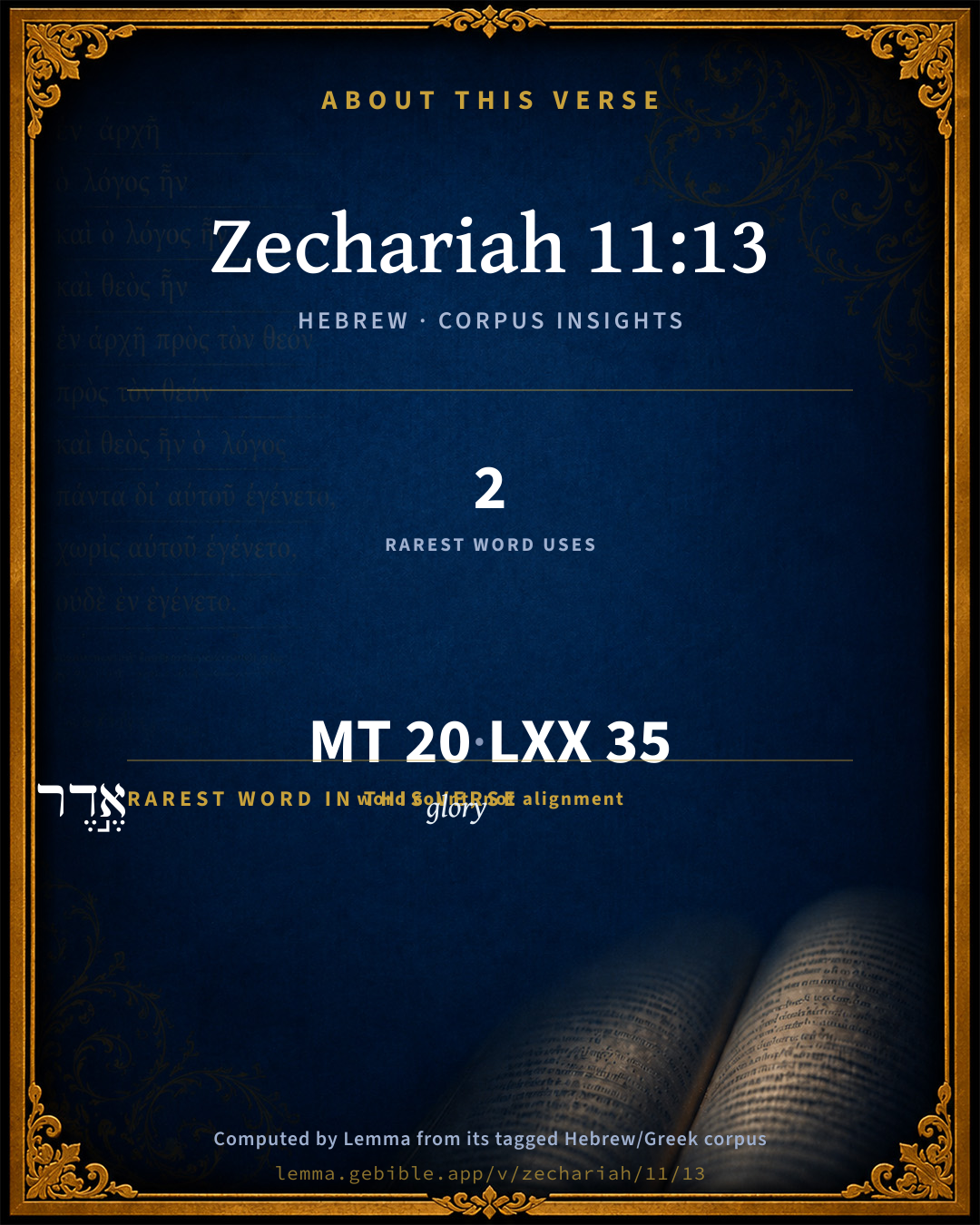
The rarest word here is אֶ֣דֶר glory H145 — appearing just 2 times in the whole Hebrew Bible.

Shared distinctive vocabulary

אֶ֣דֶר glory H145 occurs in 2 verses of the Hebrew Bible. Also found in:

Grammatical profile

  • 7 verbs
  • 6 nouns
  • 1 adjective
  • 4 prepositions
  • 2 particles

Verb forms

  • וַיֹּ֨אמֶר Qal · Sequential Imperfect
  • הַשְׁלִיכֵ֨הוּ֙ Hiphil · Imperative
  • הַיּוֹצֵ֔ר Qal · Participle Active
  • יָקַ֖רְתִּי Qal · Perfect
  • וָֽאֶקְחָה֙ Qal · Sequential Imperfect
  • וָאַשְׁלִ֥יךְ Hiphil · Sequential Imperfect
  • הַיּוֹצֵֽר Qal · Participle Active

Repetition

Words recur within this verse — often emphatic in Hebrew:

  • יְהוָ֜ה LORD H3068 ×2
  • הַשְׁלִיכֵ֨הוּ֙ to throw H7993 ×2
  • הַיּוֹצֵ֔ר to form H3335 ×2
  • אֵלַ֗י to H413 ×3

Hebrew & Septuagint length

In English translation the verse runs 37 words from the Hebrew and 47 from the Septuagint (LXX English) — closely comparable.

A rough comparison of the two English renderings, which tokenize alike — not a word-level alignment.

Word counts can differ between the Hebrew and the Greek without any difference in meaning — e.g. the Hebrew direct-object marker אֵת has no separate Greek word, and Greek often adds the article ὁ.

In the original languages it is 20 Hebrew tokens and 35 Greek tokens — but the two are counted differently (Hebrew bundles its prefixes and suffixes into one token; the Greek is in lemma form), so that isn’t a like-for-like length.

Cross-references

6

Topical passages linked to Zechariah 11:13 in the Treasury of Scripture Knowledge — connected by theme and wording, ordered by reader-vote popularity; previews shown in the World English Bible.

  • Matthew 27:3–10 Then Judas, who betrayed him, when he saw that Jesus was condemned, felt remorse, and brought back the thirty pieces of silver to the chief priests and elders,
  • Acts 1:18–19 Now this man obtained a field with the reward for his wickedness, and falling headlong, his body burst open, and all his intestines gushed out.
  • Isaiah 53:2–3 For he grew up before him as a tender plant, and as a root out of a dry ground: he has no form nor comeliness; and when we see him, there is no beauty that we should desire him.
  • Isaiah 54:7–10 For a small moment have I forsaken you; but with great mercies will I gather you.
  • Matthew 27:12 When he was accused by the chief priests and elders, he answered nothing.
  • Acts 4:11 He is 'the stone which was regarded as worthless by you, the builders, which has become the head of the corner.'

Cross-references courtesy of OpenBible.info (CC BY 4.0).

Hebrew and Greek witnesses Masoretic Hebrew ↔ Greek Septuagint

The same verse in the two great witnesses to the Old Testament, shown verse-for-verse.

These are two independent witnesses, not word-aligned to each other, and the Septuagint is shown in lemma (dictionary) form.

Hebrew Zechariah 11:13 Masoretic · Westminster Leningrad Codex

וַיֹּ֨אמֶר יְהוָ֜ה אֵלַ֗י הַשְׁלִיכֵ֨הוּ֙ אֶל הַיּוֹצֵ֔ר אֶ֣דֶר הַיְקָ֔ר אֲשֶׁ֥ר יָקַ֖רְתִּי מֵֽעֲלֵיהֶ֑ם וָֽאֶקְחָה֙ שְׁלֹשִׁ֣ים הַכֶּ֔סֶף וָאַשְׁלִ֥יךְ אֹת֛וֹ בֵּ֥ית יְהוָ֖ה אֶל הַיּוֹצֵֽר

Yahweh said to me, "Throw it to the potter, the handsome price that I was valued at by them!" I took the thirty pieces of silver, and threw them to the potter, in the house of Yahweh.

World English Bible · Public Domain

Greek LXX Zechariah 11:13 Septuagint · lemma form

καί εἶπον κύριος πρός ἐγώ καταἵημι αὐτός εἰς ὁ χωνευτήριον καί σκέπτομαι εἰ δόκιμος εἰμί ὅς τρόπος δοκιμάζω ὑπέρ αὐτός καί λαμβάνω ὁ τριάκοντα ἀργυροῦς καί ἐνβάλλω αὐτός εἰς ὁ οἶκος κύριος εἰς ὁ χωνευτήριον

And the Lord said to me, Drop them into the furnace, and I will see if it is good metal, as I was proved for their sakes. And I took the thirty pieces of silver, and cast them into the furnace in the house of the Lord.

LXX2012 (modern English Septuagint) · Public Domain

On this verse, Ellicott's Commentary for English Readers discusses the Septuagint’s reading. Read the note in Commentary ↓

Hebrew: Westminster Leningrad Codex (CC BY 4.0). Greek: Septuagint (public domain); English from LXX2012 (modern English Septuagint) (Public Domain). How the Septuagint differs from the Hebrew →

Targum (Aramaic paraphrase)

1

The Targum is the ancient Jewish Aramaic paraphrase of the Hebrew Scriptures — an interpretive translation, not the Hebrew text itself. Onkelos (literal) and Pseudo-Jonathan (expansive) render the Torah, and Jonathan the Prophets. Coverage is partial: where no permissively-licensed English translation exists for a verse, only the Aramaic is shown. This is verse-level text, not a word-by-word alignment to the Hebrew.

  1. Targum Jonathan Prophets (Joshua–Malachi)
    וַאֲמַר יְיָ לִי כְּתוֹב דִכְרַן עוֹבָדֵיהוֹן בְּחֵילַשׁ כְּתָבָא וּרְמֵי יָתֵיהּ לְבֵית מַקְדְשָׁא וּרְמֵי לִתְחוֹת יַד אֲמַרְכְּלָא חֲלַף דְיַקְרֵית דְחַלְתִּי בְּעֵינֵיהוֹן וּכְתָבִית דָכְרָן עוֹבְדֵיהוֹן בְּחֵילַשׁ כְּתָבָא וּרְמִיתִי יָתֵיהּ לְבֵית מַקְדְשָׁא דַייָ לִתְחוֹת יַד אֲמַרְכְּלָא רַבָּא:

    (no public-domain English translation for this verse)

    Targum Jonathan — Aramaic: “Mikraot Gedolot” (public domain). English: “Sefaria Community Translation” (CC0 1.0 (public-domain dedication)); “London "Chaldee Paraphrase," 1871” (public domain). Text via Sefaria.

Commentary

Notes on Zechariah 11:13 from classic Christian and Jewish commentators (each source and its license shown beneath its notes). The classic Christian expositions comment on the surrounding passage and are grouped to its opening verse, so a note may address several verses; the Jewish commentaries on the Tanakh (Rashi and others) are per-verse, so they appear only where the commentator wrote on this verse.

Lemma curates 59 commentaries, every one of them public domain or Creative Commons licensed, each selected and text-cleaned for this edition rather than reprinted as found. About our sources →

Trapp's Complete Commentary

John Trapp

Zec 11:13 And the LORD said unto me, Cast it unto the potter: a goodly price that I was prised at of them. And I took the thirty [pieces] of silver, and cast them to the potter in the house of the LORD.

Ver. 13. Cast it unto the potter] q.d. Do they deal with me as with some sordid swineherd? Do they award me less than carters’ wages? Throw it away, let the potter take it; and let us see how many tiles he can afford us for it, to repair the roof of the temple. Their undervaluing and despising of me in this sort is not only injurious, but contumelious; it is to turn my glory into shame; to spit in my face; or to use me as homely as Rachel did her father’s gods, which she laid among the litter, and sat upon.

A goodly price that I was valued at of them] So he calleth it by an irony, or a holy jeer. Poor Joseph was sold for less; for twenty pieces of silver, Gen 37:28 "They sold the just one for silver, and the poor for a pair of shoes," Amo 2:6. The Hebrews tell us, that of those twenty shekels every one of the ten brethren had two to buy shoes for his feet. The Jews that bought Christ for thirty pieces of silver (this goodly price) of the traitor that sold him, were themselves afterwards (by a just hand of God upon them) bought and sold thirty of them for a penny by the Romans, ad illudendum, saith mine author, for a scorn to their nation. God loves to retaliate, and to set the scales even; men’s cruelty in the one, and their reward in the other. If we be at any time underrated by the world (as we are sure to be; for the world knows us not, 1Jn 3:2), what so great matter is it, since Christ himself was no more set by? We must be content to pass to heaven (as he did) as concealed men. It must suffice us that our precious faith shall be found to praise, honour, and glory, at that great fair day, 1Pe 1:7, when all fardles {litle bundles} shall be opened, and our best wares exposed to public view.

And cast them to the potter] "I gave them for the potter’s field, as the Lord appointed me," saith the evangelist, Mat 27:10, expounding the prophet, and applying the words to Christ, who is hereby also proved to be God. So true is that observation of divines, that the Old Testament is both explained and fulfilled in the New, by a happy harmony.

In the house of the Lord] That thereby he might the more sharply prick the priests; whose care it ought to have been that God should be better prized by the people, and his service better observed.

John Trapp, A Commentary or Exposition upon All the Books of the Old and New Testament (1647–1656) — public domain. Text from a community e-Sword module.

Tyndale Open Study Notes

Tyndale Open Resources

11:13 to the potter: Some scholars speculate that a guild of potters might have been minor Temple officials due to the continual need for sacred vessels (see Lev 6:28). Others, noting the similarity between potter (Hebrew yotser) and treasury (’otsar), follow the Syriac version, which reads into the treasury (see Matt 27:6, 10; cp. Jer 32:6-9). The Greek Old Testament translates this sentence as “throw it into the furnace,” suggesting that the silver was melted down and recast into a silver vessel for use in Temple rituals. • Thirty coins (or pieces of silver) was a magnificent sum of money (nearly two years’ wages for the average laborer).

Tyndale Open Study Notes — © Tyndale Open Resources, licensed CC BY-SA 4.0. Text via the HelloAO Bible API.

Geneva Bible (1599)

Geneva Bible translators

Showing that it was too little to pay his wages, which could scarce suffice to make a few tiles to cover the Temple.

Geneva Bible (1599) marginal notes — public domain. Text via Bolls.life.

Jamieson, Fausset & Brown

Robert Jamieson, A. R. Fausset & David Brown

Cast it unto the potter--proverbial: Throw it to the temple potter, the most suitable person to whom to cast the despicable sum, plying his trade as he did in the polluted valley (Kg2 23:10) of Hinnom, because it furnished him with the most suitable clay. This same valley, and the potter's shop, were made the scene of symbolic actions by Jeremiah (Jer. 18:1-19:15) when prophesying of this very period of Jewish history. Zechariah connects his prophecy here with the older one of Jeremiah: showing the further application of the same divine threat against his unfaithful people in their destruction under Rome, as before in that under Nebuchadnezzar. Hence Mat 27:9, in English Version, and in the oldest authorities, quotes Zechariah's words as Jeremiah's, the latter being the original author from whom Zechariah derived the groundwork of the prophecy. Compare the parallel case of Mar 1:2-3 in the oldest manuscripts (though not in English Version), quoting Malachi's words as those of "Isaiah," the original source of the prophecy. Compare my Introduction to Zechariah. The "potter" is significant of God's absolute power over the clay framed by His own hands (Isa 45:9; Jer 18:6; Rom 9:20-21).

in the house of the Lord--The thirty pieces are thrown down in the temple, as the house of Jehovah, the fit place for the money of Jehovah-Messiah being deposited, in the treasury, and the very place accordingly where Judas "cast them down." The thirty pieces were cast "to the potter," because it was to him they were "appointed by the Lord" ultimately to go, as a worthless price (compare Mat 27:6-7, Mat 27:10). For "I took," "I threw," here Matthew has "they took," "they gave them"; because their (the Jews' and Judas') act was all His "appointment" (which Matthew also expresses), and therefore is here attributed to Him (compare Act 2:23; Act 4:28). It is curious that some old translators translate, for "to the potter," "to the treasury" (so MAURER), agreeing with Mat 27:6. But English Version agrees better with Hebrew and Mat 27:10.

Jamieson, Fausset & Brown — Commentary Critical and Explanatory on the Whole Bible (1871) — public domain (CC PDM 1.0). Text via the HelloAO Bible API.

Adam Clarke's Commentary

Verse 13. And the Lord said unto me, Cast it unto the potter] Jehovah calls the price of his prophet his own price; and commands that it should not be accepted, but given to a potter, to foreshadow the transaction related Mt 27:7.

"Earthen vessels were used in the temple; and we may suppose that some Levites were employed within the sacred precincts to furnish them. To these, the humblest of his ministers in the temple, God commands that the degrading price should be cast." This is the substance of the notes on these two verses, given by Abp. Newcome.

We may look at it in another light, Give me my price! הבו שכרי habu sichri, bring my price, or give him my price; that is, Give the money to Judas which you have agreed to give him; for he can neither betray me nor you crucify me, but my own permission. But if not, forbear; take time to consider this bloody business, and in time forbear. For though I permit you to do it, yet remember that the permission does not necessitate you to do it; and the salvation of the world may be effected without this treachery and murder.

See my notes on this place, See Clarke on Mt 27:9, where I have examined the evidence for the reading of "Zechariah the prophet," instead of "Jeremiah."

Adam Clarke's Commentary on the Bible (1810–1826) — public domain. Text from a community e-Sword/MySword module.

John Calvin's Commentaries

Hence he adds, Jehovah said to me, throw it to the potter. “This truly is my reward! Cast it to the potter, that he may get some bricks or coverings to repair the temple; if there are any parts of the temple dilapidated, let the potter get thereby some bricks, or let any humble artisan have such a price for himself.” But he afterwards speaks ironically when he says, the magnificence and the glory of the price at which he had been estimated! “This is, forsooth! the magnificence of my price, though I had endured many toils! they now deal with me as with some mean swineherd, though I was their Lord and Shepherd: since then they seek thus craftily to satisfy me, and reproachfully offer me a paltry reward, and as it were degrade my glory and spit in my face, Cast, cast it, he says, to the potter;” that is, let them repair the temple, in which they delight so much as if they were in heaven: for the temple is their idol; but God will be never nigh them while they act thus hypocritically with him. “Let them then repair the breaches of the temple and pay the price to the potter, for I will not suffer a price so unworthy of my majesty to be obtruded so disgracefully on me.”

We now then apprehend the meaning of the Prophet: and first we must bear in mind what I have stated, that here is described how irreclaimable had been the wickedness of the people: though rejected by God, when he had broken his rod, they yet esteemed as nothing the favors which they had experienced. How so? because they thought that they performed an abundant service to God, when they worshipped him by external frivolities; for ceremonies without a real sense of religion are frivolous puerilities in God’s presence. What then the Prophet now urges is, that the Jews wilfully buried God’s benefits, by which he had nevertheless so bound them to himself that they could not be released. And to the same purpose is what follows, Cast it to the potter: for he testifies that the price was of no value, nay, that he abominated such a reward as men paid hint when they dealt with him in such a reproachful manner; for as he says in Isaiah, it was a weariness to him —

“I am disgusted with your festal days; why do you daily tread the pavement of my temple?” (Isaiah 1:12,13;)

and again he says,

“He who slays an ox is the same as he who kills a man.” (Isaiah 66:3.)

God in these places shows, as here by Zechariah, that these sacrifices which ungodly men and hypocrites offer to him, without a right feeling of religion, are the greatest abominations to him, — why? Because it is the highest indignity which the wicked call offer, which is as it were to spit in his face, when they compare him to a potter or a swineherd, and think nothing of the reward which he deserves, and that is, to consecrate and really to devote themselves wholly to him without any dissimulation. When therefore men trifle with God and think that he is delighted with frivolous puerilities, they compare him, as I have said, to a swineherd, or to some low or common workman; and this is an indignity which he cannot bear, and for which he manifests hero by his Prophet his high displeasure.

John Calvin's Commentaries (1540-1563) — public domain. Text from the Calvin Translation Society English edition (1840s-50s) via the Christian Classics Ethereal Library (ccel.org). Calvin's coverage is partial (roughly two-thirds of the Bible); uncommented books and verses are honest gaps, never fabricated. The 19th-century editor's footnotes and remarks are omitted so the notes are faithfully Calvin's own voice.

Ellicott's Commentary for English Readers

(13) This verse proves, if proof be needed, that the prophet, in his action, represents the Lord.

Potter.—The price was so contemptible that it is flung to the meanest of craftsmen. It seems probable that “to the potter with it!” was a proverbial expression, used of throwing away anything that was utterly worthless. The LXX., by the change of one letter, read for “potter,” the “treasury.”

A goodly price . . . of them.—Better, O, the magnificence of the price that I was apprised at of them! That is to say, “What a price!” ironically. The prophet—in imagination, no doubt—goes into the Temple, and there before God and Israel, in the place where the covenant had been so often ratified by sacrifice, he meets “a potter” (the article is indefinite), and there flings to him the “goodly price,” and so pronounces the divorce between God and the congregation of Israel. The prophet, in his symbolical act, represented God (Eze_34:5), but at the same time he might well (or must) have represented God’s vice-gerent, “my servant David,” or, in other words, the Messiah. (See Notes on Zec_3:8; Zec_6:12-13.) Thus, though this prophecy received, no doubt, numerous fulfilments in the oft-recurring ingratitude of Israel, yet we can well, with St. Matthew, see its most remarkable and complete fulfilment in Him who was in every sense “the Good Shepherd,” and in whose rejection the ingratitude of the chosen nation culminated. The citation in the New Testament is a free paraphrase of the original, made, probably, from memory, and agrees in all the main points with the original. The introduction of the word “field” (Mat_27:10) was made, probably inadvertently, by an unconscious act of a mind which wished to find an excellent parallel between the prophecy and its fulfilment; but the price, thirty pieces of silver, does not seem to have been a mere coincidence. May not the “chief priests” have viciously proposed to Judas this price of a slave (the same that Hosea paid for the adulterous woman, half in money, and half in kind, Zec_2:1-2)? and may not the wretched Judas have maliciously accepted this very sum from the same motives which the prophet supposes to have actuated the people to whom he prophesies? Such a fulfilment would be a fulfilment indeed; while a mere chance coincidence between the sum mentioned in one case and that mentioned in another, apart from any agreement in the latter with the spirit of the former, would, in our estimation, amount to no fulfilment at all.

A Bible Commentary for English Readers, edited by Charles John Ellicott (1878–1897) — public domain. Text from a community e-Sword module.

The Cambridge Bible for Schools and Colleges

gen. ed. J. J. S. Perowne

13. Cast it] “as a thing vile and rejected, as torn flesh was to be cast to dogs (Exo_22:31), or a corpse was cast unburied (Isa_14:19), or the dead body of Absalom was cast into the pit (2Sa_18:17), or the dust of the idol-altars into the brook Kidron by Josiah (2Ki_23:12), or the idols to the moles and the bats (Isa_2:20), or Judah and Israel from the face of God into a strange land (2Ki_13:23); Coniah and his seed, a vessel in which is no pleasure, into a land which they knew not (Jer_22:28), or the rebels against God said, let us cast away their cords from us (Psa_2:3), or wickedness was cast into the Ephah (Zec_5:8); once it is added, for loathing (Eze_16:5).” Pusey.

a goodly price] or, the goodly price, R. V. This is, of course, ironical.

to the potter in the house of the Lord] to the potter; because his business was to make the most worthless of vessels, the last and least “to honour” of those found “in a great house” (2Ti_2:20), and thus the unworthiness of the “price” was shewn, as being only deserving of such a destiny. In the house of the Lord: both because He it was who, whether in the person of His servants or of His Son, was the real subject of the insulting valuation, and also because a formal and national character was given to the transaction, by its thus taking place before Jehovah and in His House. This explanation, which seems to be the simplest and most satisfactory, of this confessedly difficult passage, does not necessarily involve the supposition that the potter was in the house of the Lord, when the pieces of silver were cast contemptuously down there. It is enough if, in the vision or symbolical action of Zechariah, they were in some way clearly declared to be for him.

Like the earlier prophecy of the King (Zec_9:9), this prophecy of the Shepherd is remarkable for its literal fulfilment. The “thirty pieces of silver” were literally the “goodly price” paid for Him, “whom they of the children of Israel did value. “The potter” was literally the recipient of it, as the purchase-money of his exhausted field for an unclean purpose (Mat_27:5-10).

The Cambridge Bible for Schools and Colleges (gen. ed. J. J. S. Perowne; Cambridge University Press, 1878–1918) — public domain. Text from a community e-Sword module.

John Gill's Exposition

And the Lord said unto me,.... The Prophet Zechariah, in a visionary way representing the sanhedrim of the Jews, the chief priests, scribes, and elders:

Cast it unto the potter; for the purchase of his field, in order to make a burying ground of it for strangers:

a goodly price that I was prised at of them; this is sarcastically said; meaning that it was a very poor price; and showed that they had no notion of the worth and value of Christ, the Pearl of great price:

and I took the thirty pieces of silver, and cast them to the potter in the house of the Lord; it is a question with some what these pieces of silver were; they are commonly understood of silver shekels. So the Targum, in Gen 20:16 renders pieces of silver by shekels of silver; and Eusebius (m) calls these here thirty staters, the same with shekels; which, if common shekels, reckoned at one shilling and three pence, made but thirty seven shillings and sixpence; and if shekels of the sanctuary, which at most were but two shillings and sixpence, thirty of these would make but three pounds fifteen shillings; and therefore may be truly called, ironically speaking, "a goodly price"; being no more than the price of a servant, as before observed: but Drusius objects to this, seeing a potter's field was bought with this money; and asks, who can believe that a field near so populous a city as Jerusalem could be bought for thirty shekels? and observes, from R. Elias Levita (n), that it is a rule with their doctors, that all silver mentioned in the law signifies shekels; in the prophets, pounds; and in the Hagiographa, talents: this is said, but not proved: to understand these of pounds, indeed, would make the price considerable, and sufficient for the purchase of a large field; for a silver maneh or pound with the Jews was of the value of sixty shekels, Eze 45:12 and thirty of these make two hundred and seventy pounds; but then this would not in an ironical way be called "a goodly price": and as to the objection about the purchase of a field with such a sum of money as thirty shekels amount to, it may be observed, what Grotius seems rightly to conjecture, that this was a field the potter had dug up, and had made the most of it, and so was good for nothing but for such an use, for which it was bought, to bury strangers in. It is also a difficulty to fix it certainly to whom this money was ordered to be given, and was given. It is here said "to the potter"; but Jarchi and Kimchi observe, that some of their interpreters render it the "treasurer"; and being sometimes changed for one another; thus, the Targum paraphrases it,

"under the hand of the treasurer;''

and so others (o); and indeed the money was given to the chief priests and elders, some of whom might be in that office, Mat 27:3 though there is no need of such an alteration of the word, since the money Judas took for betraying Christ, and cast into the temple to the priests, they took up, and gave it to the potter for the field they bought of him with it; and, in the evangelist, the phrase by way of explanation is rendered, "for the potter's field", and may be here properly enough translated, "for the potter"; as the particle is sometimes used (p); that is, to be given to him for purchase money (q): and whereas the money is said to be cast, or given to him, "in the house of the Lord", i.e. in the temple, it appears a fact, in the accomplishment of this prophecy, that it was cast into the temple, Mat 27:5 and was took up by the priests; who, in all probability, sent for the potter thither, and agreed with him for his field, and paid him his money there; for there is no reason to believe that he had a workhouse for his business in the temple; though it may be he had one near it; see Jer 18:1 and worked for the service of it, since earthen vessels were used in temple service (r). The accomplishment of all this is in Mat 27:7.

(m) Demonstr. Evangel. l. 10. p. 479. (n) In Tishbi, p. 130. (o) "Ad thesaurarium", Pagninus, Vatablus. (p) Vid. Nold. Ebr. Part. Concord. p. 63. (q) "pro figulo", Cocceius; "conferendos in figulum", Junius & Tremellius, Piscator; "ut detur ad figulum", Burkius. (r) Vid. Misn. Parah, c. 5. sect. 1.

John Gill's Exposition of the Whole Bible (1746–1763) — public domain (CC PDM 1.0). Text via the HelloAO Bible API.

Albert Barnes' Notes on the Bible

And the Lord said unto me, Cast it - As a thing vile and rejected, as torn flesh was to be cast to dogs Exo 22:31, or a corpse was cast unburied Isa 14:19; Isa 34:3; Jer 14:16; Jer 22:19; Jer 26:23; Jer 36:30, or the dead body of Absalom was cast into the pit 2Sa 18:17, or the dust of the idolaltars into the brook Kedron by Josiah 2Ki 23:12, or the idols to the moles and the bats (Isa 2:20, add Eze 20:8); or Judah and Israel from the face of God 2Ki 13:23; 2Ki 17:20; 24:21; Jer 52:3 into a strange land (Deu 29:27, (28 English); Coniah and his seed, a vessel in which is no pleasure, Jer 22:28, into a land which they knew not; or the rebels against God, said, “let us cast away their cards from us” Psa 2:3; or wickedness was cast into the Ephah Zec 5:1-11 :18; once it is added, “for loathing” Eze 16:5.

Unto the potter - The words exactly correspond with the event, that the “thirty pieces of silver” were “cast” or flung away o; that their ultimate destination was the potter, whose field was bought with them; but that they were not cast directly to him, (which were a contemptuous act, such as would not be used whether for a gift or a purchase), but were cast to him “in the house of the Lord.” They were “flung away” by the remorse of Judas, and, in God’s Providence, came to the potter. Whether any portion of this was a direct symbolic action of the prophet, or whether it was a prophetic vision, in which Zechariah himself was an actor, and saw himself in the character which he described, doing what he relates, cannot now be said certainly, since God has not told us. It seems to me more probable, that these actions belonged to the vision, because in other symbolic actions of the prophets, no other actors take part; and it is to the last degree unlikely, that Zechariah, at whose preaching. Zerubbabel and Joshua and all the people set themselves earnestly to rebuild the temple, should have had so worthless a price offered to him; and the casting a price, which God condemned, into the house of God, at the command of God, and so implying His acceptance of it, were inconsistent. It was fulfilled, in act consistently, in Judas’ remorse; in that he “flung away the pieces of silver,” which had stained his soul with innocent blood, “in the temple,” perhaps remembering the words of Zechariah; perhaps wishing to give to pious uses, too late, money which was the price of his soul; whereas God, even through the chief priests, rejected it, and so it came to the potter, its ultimate destination in the Providence of God. Osorius: “He saith, “cast it unto the potter,” that they might understand that they would be broken as a potter’s vessel.”

A goodly price, that I was prized at of them - Literally, “the magnificence of the value, at which I was valued of them!” The strong irony is carried on by the, “at which I was valued of them,” as in the idiom, “thou wert precious in my sight” 1Sa 26:21; Psa 72:14; 2Ki 1:13-14; Isa 43:4. Precious the thought of God to David Psa 139:17; precious the redemption of the soul of man Psa 49:9; and precious was the Shepherd who came to them; precious was the value, whereat He was valued by them o. And yet He, who was so valued, was Almighty God. For so it stands: “Thus saith the Lord God, Cast it unto the potter, the goodly price that I was prized at of them.” The name, “the potter,” connects the prophecy with that former prophecy of Jeremiah Jer 19:1-15, denouncing the judgment of God for the shedding of innocent blood, whereby they had defiled “the valley of the son of Hinnom, which was at the entry of the gate of the pottery, o, and which, through the vengeance of God there, should be called “the valley of slaughter” Jer 19:6.

The price of this innocent Blood, by the shedding of which the iniquities of their fathers were filled up, should rest on that same place, for whose sake God said, “I will break this people and this city, as one breaketh a potter’s vessel, that cannot be made whole again” Jer 19:11. So then Matthew may have quoted this prophecy as Jeremiah’s, to signify how the woes, denounced on the sins committed in this same place, should be brought upon it through this last crowning sin, and “all the righteous blood which had been shed, should come upon that generation” o

None of the other cases of mixed quotation come up to this. Mark quotes two prophecies, of Malachi and of Isaiah as Isaiah’s Mar 1:2-3. Matthew blends in one, words of Isaiah Isa 62:1 and Zechariah Zec 9:9 as “the prophet” Mat 21:4-5. Our Lord unites Isa 56:7, and Jer 7:11, with the words,” It is written.”

Of earlier fathers “Tertullian” simply quotes the prophecy as Jeremiah’s (adv. Marc. iv. 40). “Origen” says, “Jeremiah is not said to have prophesied this anywhere in his books, either what are read in the Churches, or reported (referuntur) among the Jews. I suspect that it is an error of writing, or that it is some secret writing of Jeremiah wherein it is written.” (in Matt. p. 916.) “Euscbius” says, “Consider since this, is not in the prophet Jeremiah, whether we must think that it was removed from it by some wickedness, or whether it was a clericai error of those who made the copies of the Gospels carelessly.” Dem. Ev. x. p. 481).

Albert Barnes' Notes on the Bible (1834–1885) — public domain. Text from a community e-Sword/MySword module.

Haydock's Catholic Bible Commentary

The statuary. The Hebrew word signifies also a potter, (Challoner) and this seems to be the true meaning, Matthew xxvii. 3. The prophet is ordered to bring, thus to indicate what should be done by the traitor. (Calmet) --- Septuagint, "cast them into the crucible to see if it (the metal) be good, as I have been tried by them." (Haydock)

George Leo Haydock (1774–1849), Haydock's Catholic Family Bible and Commentary, 1859 edition — public domain. Excludes Psalms (Douay-Rheims chapter numbering differs from Protestant) and Deuterocanonical books (Catholic canon only).

Matthew Poole's English Annotations

The Lord, God the Father, with detestation of so vile an affront and undervalue of his Son, said unto me; to Zechariah, in this theatre personating Christ sometimes.

Cast it unto the potter; as being so little it would hardly purchase any thing but what was cheapest among them, a little earthenware.

A goodly price that I was prized at of them: in an irony God upbraids the shepherds of his people, who prized the great Shepherd no higher.

I took; Zechariah, who in this part now emblematically doth what Judas will with horror do when he hath sold innocent blood and betrayed it.

Cast them to the potter in the house of the Lord; or rather, east them into the house of the Lord for the potter, all which the Jewish rulers act over in their prosecuting Christ unto death.

Matthew Poole's English Annotations on the Holy Bible (1683–1685) — public domain. Text from a community e-Sword/MySword module.

The Pulpit Commentary

The Lord said unto me. The Lord takes the insult as offered to himself in the person of his representative. Cast it unto the potter; Kayev autou cwneu thrion , "Lay them in the foundry, and I will see if it is approved;" Vulgate; Projice illud ad statuarium; the Syriac and Targum have, "Put it into the treasury". (Mal_3:10) This involves an alteration of the text, and is in itself an improbable reading, as God could not be made to tell the prophet to throw this despicable wage into his treasury, unless, perchance, it is said ironically. There may be an undesigned coincidence here. In Mat_27:5 the council discuss the propriety of putting the thirty pieces of silver into the treasury. But taking our present text as genuine, commentators usually consider the phrase as a proverbial expression for contemptuous treatment; as the Greeks said, ev korakav , as the Germans say, "zum Schinder," "to the knacker," and we, "to the dogs." There is, however, no trace elsewhere of any such proverb, nor do we know how it could have arisen; it likewise does not very well suit the last clause of the verse, "I cast them to the potter in the house of the Lord." If we substitute the supposed analogous expression, "I threw them to the dogs," we see how unseemly would be the proverb in this connection. The rendering of the Jews in old time, adopted recently by Knabenbauer, "Cast them to the Creator," is considered by Dr. Pusey to be unidiomatic, and involves great difficulties. It seems simpler to consider that the command, "cast it to the potter," implies contemptuous rejection of the sum, and at the same time intimates the ultimate destination to which, in the sight of Omniscience, it was directed. The potter is named as the workman who makes the meanest utensils out of the vilest material. That this was ordered and executed in vision is plain; how much the prophet understood we cannot tell. The ambiguous and highly typical order was explained and fulfilled to the letter by the action of Judas Iscariot, as the evangelist testifies. (Mat_27:5-10) A (the) goodly price, etc. This is ironical, of course. Such was the price at which they estimated the good Shepherd"s services. Cast them to the potter in the house of the Lord. This rejection of the paltry wage took place in the house of the Lord (in the vision), because the insult had been really offered to him, and this was the natural place where oblations would be made; thus the transaction was represented as formal and national. Whether the potter was seen in the temple we know not. The prophet was made to connect him in some way with the business; and we learn from the fulfilment that the potter did in the end receive the money, which was paid for his field applied to an unclean purpose. In Mat_27:9 the two verses, 12, 13, with some variations, are quoted as "spoken by Jeremy the prophet." Hence some attribute this part of Zechariah to Jeremiah; and others think that in St. Matthew the present name is a mistake. The probability is that the evangelist did not name any prophet, but that some early transcriber, remembering the purchase of the field in Jer_32:6-12, attributed the quotation to that prophet. Or we may suppose that inspiration did not extend to all minor details, nor save the writers from unimportant errors.

The Pulpit Commentary (1880–1919), ed. H.D.M. Spence-Jones & Joseph S. Exell — public domain. Text from a community e-Sword module.

John Wesley's Explanatory Notes

The Lord - God the Father. Cast it - As being so little, it would hardly purchase any thing but what was the cheapest among them. A goodly price - God upbraids the shepherds of his people, who prized the great Shepherd no higher. Cast them to the potter - Or rather, cast them into the house of the Lord for the potter; all which the Jewish rulers acted over. 14. Then - So soon as I saw what value they put upon me. I cut asunder - Christ did it really, the prophet did it in the type. Break - Declare it broken. The brother-hood - That friendship which had been among them. Judah - The two tribes, and the remnant of the ten tribes.

John Wesley, Explanatory Notes Upon the Whole Bible (1754–1765) — public domain. Text via the GEBible commentary corpus.

unfoldingWord translationNotes

Door43 World Missions Community

General Information:

The parable about shepherds and sheep continues.

treasury

This is the place in the temple of Yahweh where the priests kept the money. Many versions of the Bible translate this as "potter." This is the person who would melt metal to make vessels out of it. Here Yahweh would mean that the payment is so small that the shepherd should have the silver melted to show how insulted he was.

the excellent price

Yahweh uses irony to say that this price was very small for a shepherd doing Yahweh's work. AT: "the ridiculously small amount of money" (See: Irony)

between Judah and Israel

Here "Judah" represents the people of the southern kingdom and "Israel" represents the people of the northern kingdom. AT: "between the people of Judah and the people of Israel" (See: Metonymy)

translationWords

Yahweh

house

staff

brother

Judah

Israel

unfoldingWord translationNotes — © Distant Shores Media and the Door43 World Missions Community, licensed CC BY-SA 4.0. Source: git.door43.org/Door43/en_tn.

Rashi

Rabbi Shlomo Yitzchaki (Rashi)

And the Lord said to me: Cast it to the keeper of the treasury like הָאוֹצֵר, the keeper of the treasury. Said the Holy One, blessed be He, to the prophet: Write, and leave over these and their righteousness to be preserved for the end of the seventy years of the Babylonian exile. The Temple shall be built by them. Now what is the treasury? [Cf. below] the stronghold of glory My Temple, the stronghold of My glory.

of which I stripped them of which I stripped them so that they should no longer have glory. The expression יָקַרְתִּי means the removal of glory; the “mem” in מֵעֲלֵיהֶם proves it. It is like (Ps. 52:7), “and He shall uproot you from the land of the living”; and like (Isa. 10:33), “lops off the branches.” My explanation is similar to Jonathan’s translation. I have seen many variant versions of the explanation of this prophecy, but I cannot reconcile those with the text.

Rashi on the Tanakh — English translations: “The Judaica Press complete Tanach with Rashi, translated by A. J. Rosenberg” (CC BY 4.0); “Pentateuch with Rashi's commentary by M. Rosenbaum and A.M. Silbermann, 1929-1934” (public domain); “The Metsudah Tanach series, Lakewood, N.J” (CC BY 4.0); and “The Book of Joshua, Metsudah Publications, 1997” (CC BY 4.0). Text via Sefaria.

Lesson kit

Teaching starters — assembled from the data on this page, not authored interpretation. Every prompt links to the verse data it draws on. Edit before teaching.

Zechariah, in the Prophets, opens this verse with 20 words (15 distinct Hebrew lemmas). Its most distinctive word is ʼeder (“glory”). A historical commentator’s framing appears above. Read the whole chapter for the surrounding context.

Discussion questions

  1. What does “glory” (ʼeder) contribute to the verse as a whole?
  2. How does Micah 2:8, which shares the word «glory», read alongside this verse?
  3. What does the repetition of “LORD” (2× in this one verse) do in this verse?
  4. These translations render this verse differently. What is at stake in choosing one wording over another?
  5. «וַיֹּ֨אמֶר» is a Qal Sequential Imperfect verb. How does that grammatical form shape the action described?
  6. Compare how Trapp's Complete Commentary and Tyndale Open Study Notes read this verse. Where do they agree or differ?

Things to notice

Reading settings

Reading text

Shown beneath each verse's original-language words.

Old Testament
Old Testament edition

Read the OT as the Masoretic Hebrew (MT) or the Greek Septuagint (LXX).

English shown for the Greek Septuagint (in the Hebrew ↔ Greek comparison).

Comparing translations? Open the Compare panel on any verse page to stack up to four side by side.