
Exodus 15:25

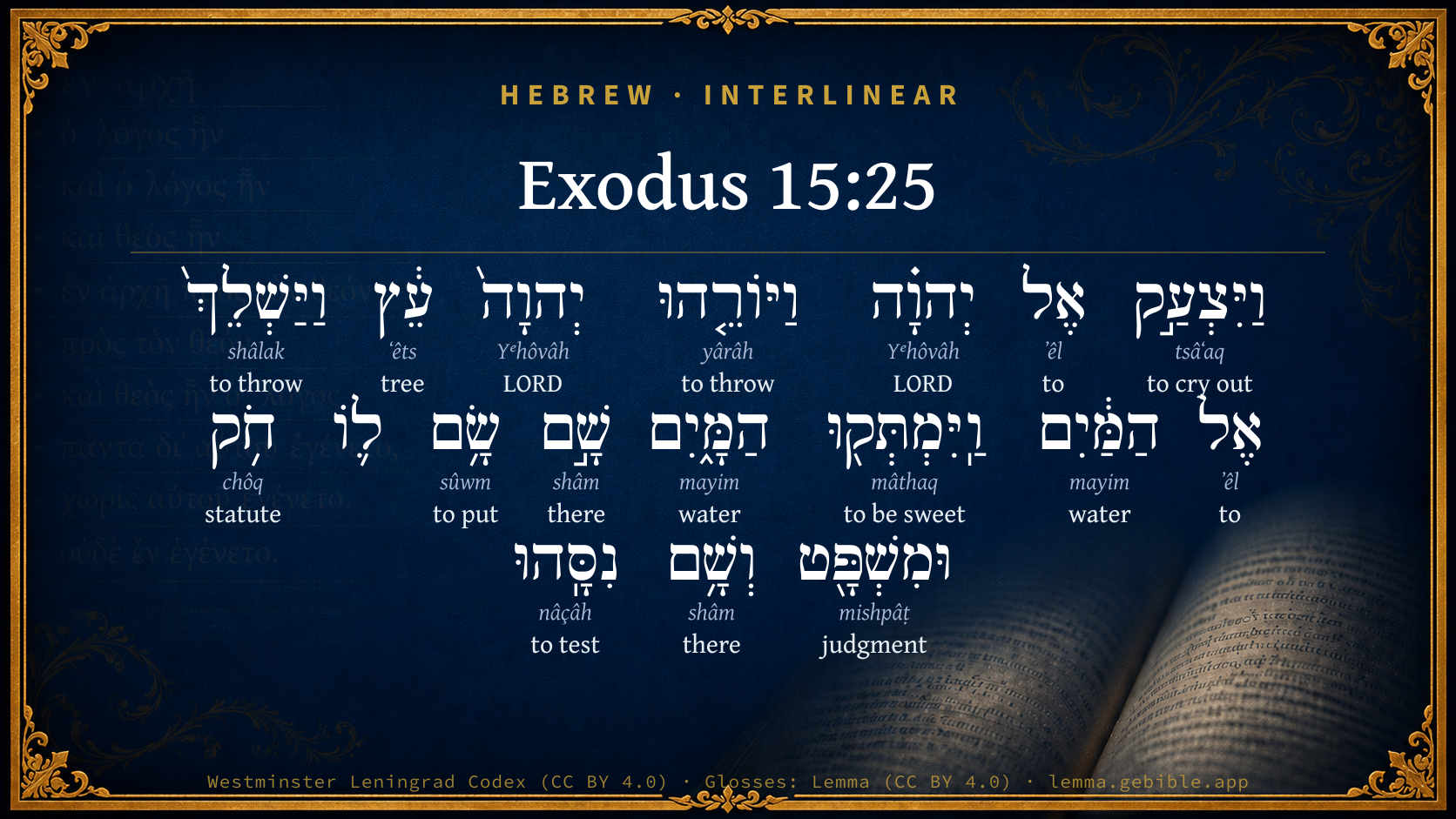
Hebrew (Westminster Leningrad Codex) Exodus 15:25 appears in the Hebrew Old Testament. The text above is from the Westminster Leningrad Codex. Each word links to its Strong’s number, a concise gloss, and parsing drawn from the Open Scriptures Hebrew Bible morphology. Click any word for its full Brown-Driver-Briggs (BDB) entry.
Download image
Cite this verse

Exodus 15:25 (World English Bible). Public Domain. Lemma interlinear Bible study tool, https://lemma.gebible.app/v/exodus/15/25.

Show BibTeX & RIS
BibTeX
RIS
English Translation
Then he cried to Yahweh. Yahweh shown him a tree, and he threw it into the waters, and the waters were made sweet. There he made a statute and an ordinance for them, and there he tested them;
World English Bible · Public Domain
Highlights
  • 1 first appearance in the Hebrew Bible
Full analysis ↓
Download a study sheet

One document with this verse’s original text, its word-by-word gloss line, the meaning frame, cross-references with their text, attributed commentary, and full source and license credits — printable, and it pastes into notes with its structure intact.

This verse Autodidact and up

Study sheet (.html) Plain text (.txt)

A passage Seminary Student

Up to 50 verses in one chapter. A passage sheet keeps up to 6 commentary sources and 12 cross-references per verse, in the order this page ranks them, and says so on the sheet whenever that leaves anything out. Ask for a single verse and you get the Autodidact verse sheet above.

Everything on this page stays free to read, with no account — the sheet is a download of what is already on screen, not access to it.

Want to remove ads? Support Godless Engineer
Compare translations 3

The same verse in 3 English versions, stacked beneath the original-language interlinear above. Click any original word for its lexicon entry.

Each is an independent rendering of the whole verse — the interlinear is not word-aligned to these translations.

Highlighted words mark where these versions differ — a whole-verse word diff, not a word-by-word alignment.

  • World English Bible Public Domain
    Then he cried to Yahweh. Yahweh shown him a tree, and he threw it into the waters, and the waters were made sweet. There he made a statute and an ordinance for them, and there he tested them;
  • King James Version Public Domain
    And he cried unto the LORD; and the LORD showed him a tree, which when he had cast into the waters, the waters were made sweet: there he made for them a statute and an ordinance, and there he proved them,
  • unfoldingWord Literal Text CC BY-SA 4.0
    And he cried out to Yahweh, and Yahweh showed him a tree. And he threw it into the water, and the water became sweet. There he gave him a statute and an ordinance, and there he tested him.

unfoldingWord Literal Text — © unfoldingWord, licensed CC BY-SA 4.0. Word-aligned USFM3 via Door43 (git.door43.org/unfoldingWord/en_ult).

Versions to compare (up to 4)

3 of 4 selected

Show all 18 translations

Every available English version of this verse, each an independent rendering of the whole verse.

  • World English Bible Public Domain
    Then he cried to Yahweh. Yahweh shown him a tree, and he threw it into the waters, and the waters were made sweet. There he made a statute and an ordinance for them, and there he tested them;
  • Berean Standard Bible Public Domain
    And Moses cried out to the LORD, and the LORD showed him a log. And when he cast it into the waters, they were sweetened. There the LORD made for them a statute and an ordinance, and there He tested them,
  • Majority Standard Bible Public Domain
    And Moses cried out to the LORD, and the LORD showed him a log. And when he cast it into the waters, they were sweetened. There the LORD made for them a statute and an ordinance, and there He tested them,
  • King James Version Public Domain
    And he cried unto the LORD; and the LORD showed him a tree, which when he had cast into the waters, the waters were made sweet: there he made for them a statute and an ordinance, and there he proved them,
  • American Standard Version (1901) Public Domain
    An he cried unto Jehovah; And Jehovah showed him a tree, and he cast it into the waters, and the waters were made sweet. There he made for them a statute and an ordinance, and there he proved them;
  • Revised Version (1885) Public Domain
    And he cried unto the LORD; and the LORD shewed him a tree, and he cast it into the waters, and the waters were made sweet. There he made for them a statute and an ordinance, and there he proved them;
  • Geneva Bible (1599) Public Domain
    And he cried vnto the Lord, and the Lord shewed him a tree, which when he had cast into the waters, the waters were sweete: there he made them an ordinance and a law, and there he proued them,
  • Douay-Rheims (1899) Public Domain
    But he cried to the Lord, and he shewed him a tree, which when he had cast into the waters, they were turned into sweetness. There he appointed him ordinances, and judgments, and there he proved him,
  • Young's Literal Translation Public Domain
    and he crieth unto Jehovah, and Jehovah sheweth him a tree, and he casteth unto the waters, and the waters become sweet. There He hath made for them a statute, and an ordinance, and there He hath tried them,
  • Literal Standard Version CC BY-SA 4.0
    And he cries to YHWH, and YHWH shows him a tree, and he casts [it] into the waters, and the waters become sweet. He has made a statute for them there, and an ordinance, and He has tried them there,
  • Unlocked Literal Bible CC BY-SA 4.0
    Moses cried out to Yahweh, and Yahweh showed him a tree. Moses threw it into the water, and the water became sweet to drink. It was there that Yahweh gave them a strict law, and it was there that he tested them.
  • unfoldingWord Literal Text CC BY-SA 4.0
    And he cried out to Yahweh, and Yahweh showed him a tree. And he threw it into the water, and the water became sweet. There he gave him a statute and an ordinance, and there he tested him.
  • Darby Bible Public Domain
    And he cried to Jehovah; and Jehovah shewed him wood, and he cast it into the waters, and the waters became sweet. There he made for them a statute and an ordinance; and there he tested them.
  • World Messianic Bible Public Domain
    Then he cried to the LORD. The LORD showed him a tree, and he threw it into the waters, and the waters were made sweet. There he made a statute and an ordinance for them, and there he tested them.
  • Webster's Bible Public Domain
    And he cried to the LORD; and the LORD showed him a tree, which he cast into the waters, and the waters were made sweet: there he made for them a statute and an ordinance, and there he proved them,
  • Free Bible Version CC BY-SA 4.0
    Moses called out to the Lord for help, and the Lord showed him a piece of wood. When he threw it into the water, it became sweet. There the Lord gave them rules and instructions and also tested their loyalty to him.
  • Bible in Basic English Public Domain
    And in answer to his prayer, the Lord made him see a tree, and when he put it into the water, the water was made sweet. There he gave them a law and an order, testing them;
  • JPS Tanakh (1917) Public Domain
    And he cried unto the LORD; and the LORD showed him a tree, and he cast it into the waters, and the waters were made sweet. There He made for them a statute and an ordinance, and there He proved them;

Literal Standard Version (2020), Covenant Press — licensed CC BY-SA 4.0. Text via the HelloAO Bible API (eBible.org). Unlocked Literal Bible (unfoldingWord) — licensed CC BY-SA 4.0. Text via the HelloAO Bible API (eBible.org). unfoldingWord Literal Text — © unfoldingWord, licensed CC BY-SA 4.0. Word-aligned USFM3 via Door43 (git.door43.org/unfoldingWord/en_ult). Free Bible Version, Dr. Jonathan Gallagher — licensed CC BY-SA 4.0. Text via the HelloAO Bible API (eBible.org).

Word by word

More ways to search: Search by grammar → Find every occurrence → Compare this word →

Practice this passage: Drill this verse → Learn its vocabulary →

וַֽיִּמְתְּק֖וּ
mâthaq
H4985
“and · to be sweet”
Conjunction + Verb, Qal, Sequential Imperfect, 3rd Person, Masculine, Plural
Part of Speech
Conjunction + Verb
Stem
Qal
Form
Sequential Imperfect
Person
3rd Person
Gender
Masculine
Number
Plural
Full BDB Definition

Origin: a primitive root

TWOT: 1268

to be or become sweet or pleasing - (Qal) - to be or become sweet - to be or become pleasant - to suck - (Hiphil) to give sweet taste
  1. וַיִּצְעַ֣ק tsâʻaq H6817 “and · to cry out” Conjunction + Verb, Qal, Sequential Imperfect, 3rd Person, Masculine, Singular
  2. אֶל ʼêl H413 “to” Preposition
  3. יְהוָ֗ה Yᵉhôvâh H3068 “LORD” Noun, Proper
  4. וַיּוֹרֵ֤הוּ yârâh H3384 “and · to throw · him” Conjunction + Verb, Hiphil, Sequential Imperfect, 3rd Person, Masculine, Singular + Suffix, Personal, 3rd Person, Masculine, Singular
  5. יְהוָה֙ Yᵉhôvâh H3068 “LORD” Noun, Proper
  6. עֵ֔ץ ʻêts H6086 “tree” Noun, Common, Masculine, Singular, Absolute
  7. וַיַּשְׁלֵךְ֙ shâlak H7993 “and · to throw” Conjunction + Verb, Hiphil, Sequential Imperfect, 3rd Person, Masculine, Singular
  8. אֶל ʼêl H413 “to” Preposition
  9. הַמַּ֔יִם mayim H4325 “the · water(s)” Particle, Definite Article + Noun, Common, Masculine, Plural, Absolute
  10. הַמָּ֑יִם mayim H4325 “the · water(s)” Particle, Definite Article + Noun, Common, Masculine, Plural, Absolute
  11. שָׁ֣ם shâm H8033 “there” Adverb
  12. שָׂ֥ם sûwm H7760 “to put” Verb, Qal, Perfect, 3rd Person, Masculine, Singular
  13. חֹ֥ק chôq H2706 “statute” Noun, Common, Masculine, Singular, Absolute
  14. וּמִשְׁפָּ֖ט mishpâṭ H4941 “and · judgment” Conjunction + Noun, Common, Masculine, Singular, Absolute
  15. וְשָׁ֥ם shâm H8033 “and · there” Conjunction + Adverb
  16. נִסָּֽהוּ nâçâh H5254 “to test · him” Verb, Piel, Perfect, 3rd Person, Masculine, Singular + Suffix, Personal, 3rd Person, Masculine, Singular

About this verse

These counts appear in no published source. They are computed here, from the morphology-tagged text and Lemma’s own curated glosses. What Lemma adds →

18
words
13
distinct lemmas
Pentateuch
section

Notable vocabulary

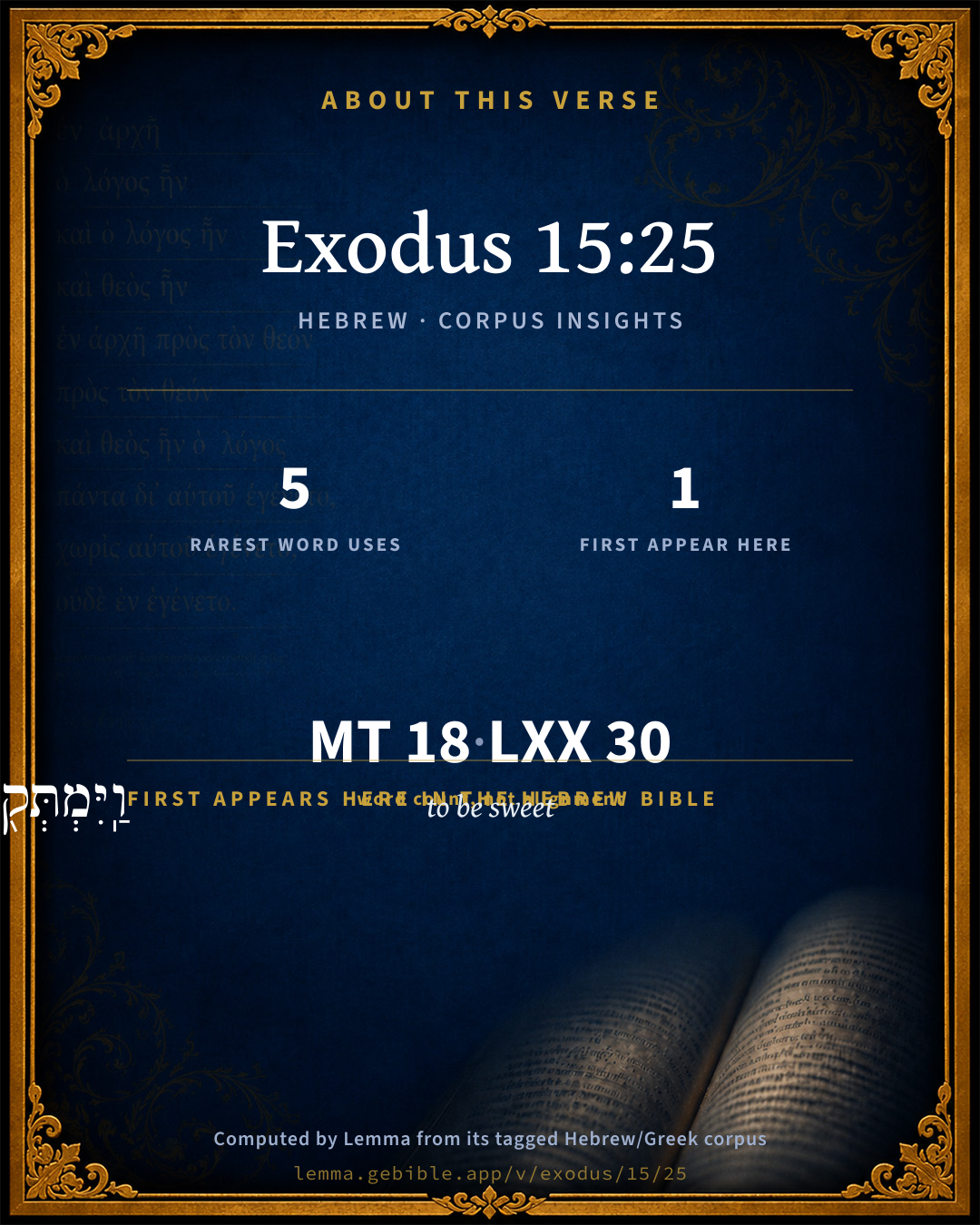
The rarest word here is וַֽיִּמְתְּק֖וּ to be sweet H4985 — appearing just 5 times in the whole Hebrew Bible.

First appearance in Scripture

This word makes its first canonical appearance in the Hebrew Bible here:

  • וַֽיִּמְתְּק֖וּ to be sweet H4985

Shared distinctive vocabulary

וַֽיִּמְתְּק֖וּ to be sweet H4985 occurs in 5 verses of the Hebrew Bible. Also found in:

Grammatical profile

  • 6 verbs
  • 7 nouns
  • 3 prepositions
  • 2 adverbs

Verb forms

  • וַיִּצְעַ֣ק Qal · Sequential Imperfect
  • וַיּוֹרֵ֤הוּ Hiphil · Sequential Imperfect
  • וַיַּשְׁלֵךְ֙ Hiphil · Sequential Imperfect
  • וַֽיִּמְתְּק֖וּ Qal · Sequential Imperfect
  • שָׂ֥ם Qal · Perfect
  • נִסָּֽהוּ Piel · Perfect

Repetition

Words recur within this verse — often emphatic in Hebrew:

  • יְהוָ֗ה LORD H3068 ×2
  • הַמַּ֔יִם water H4325 ×2
  • שָׁ֣ם there H8033 ×2
  • אֶל to H413 ×2

Hebrew & Septuagint length

In English translation the verse runs 38 words from the Hebrew and 38 from the Septuagint (LXX English) — the same length.

A rough comparison of the two English renderings, which tokenize alike — not a word-level alignment.

Word counts can differ between the Hebrew and the Greek without any difference in meaning — e.g. the Hebrew direct-object marker אֵת has no separate Greek word, and Greek often adds the article ὁ.

In the original languages it is 18 Hebrew tokens and 30 Greek tokens — but the two are counted differently (Hebrew bundles its prefixes and suffixes into one token; the Greek is in lemma form), so that isn’t a like-for-like length.

Cross-references

22

Topical passages linked to Exodus 15:25 in the Treasury of Scripture Knowledge — connected by theme and wording, ordered by reader-vote popularity; previews shown in the World English Bible.

  • Deuteronomy 8:2 You shall remember all the way which Yahweh your God has led you these forty years in the wilderness, that he might humble you, to prove you, to know what was in your heart, whether you would keep his commandments, or not.
  • Psalms 66:10 For you, God, have tested us. You have refined us, as silver is refined.
  • Judges 3:1 Now these are the nations which Yahweh left, to prove Israel by them, even as many [of Israel] as had not known all the wars of Canaan;
  • Judges 2:22 that by them I may prove Israel, whether they will keep the way of Yahweh to walk therein, as their fathers did keep it, or not.
  • Judges 3:4 They were [left], to prove Israel by them, to know whether they would listen to the commandments of Yahweh, which he commanded their fathers by Moses.
  • Exodus 16:4 Then said Yahweh to Moses, "Behold, I will rain bread from the sky for you, and the people shall go out and gather a day's portion every day, that I may test them, whether they will walk in my law, or not.
  • Deuteronomy 8:16 who fed you in the wilderness with manna, which your fathers didn't know; that he might humble you, and that he might prove you, to do you good at your latter end:
  • 2 Kings 2:21 He went forth to the spring of the waters, and cast salt therein, and said, Thus says Yahweh, I have healed these waters; there shall not be from there any more death or miscarrying.
  • 1 Peter 1:6–7 Wherein you greatly rejoice, though now for a little while, if need be, you have been put to grief in various trials,
  • Psalms 50:15 Call on me in the day of trouble. I will deliver you, and you will honor me."
  • Psalms 91:15 He will call on me, and I will answer him. I will be with him in trouble. I will deliver him, and honor him.
  • 1 Corinthians 1:18 For the word of the cross is foolishness to those who are dying, but to us who are saved it is the power of God.
  • Exodus 14:10 When Pharaoh drew near, the children of Israel lifted up their eyes, and behold, the Egyptians were marching after them; and they were very afraid. The children of Israel cried out to Yahweh.
  • Joshua 24:21–25 The people said to Joshua, No; but we will serve Yahweh.
  • 2 Kings 4:41 But he said, Then bring meal. He cast it into the pot; and he said, Pour out for the people, that they may eat. There was no harm in the pot.
  • Proverbs 17:3 The refining pot is for silver, and the furnace for gold, But Yahweh tests the hearts.
  • Jeremiah 9:7 Therefore thus says Yahweh of Hosts, Behold, I will melt them, and try them; for how [else] should I do, because of the daughter of my people?
  • Exodus 17:4 Moses cried to Yahweh, saying, "What shall I do with these people? They are almost ready to stone me."
  • Deuteronomy 13:3 you shall not listen to the words of that prophet, or to that dreamer of dreams: for Yahweh your God proves you, to know whether you love Yahweh your God with all your heart and with all your soul.
  • Psalms 81:7 You called in trouble, and I delivered you. I answered you in the secret place of thunder. I tested you at the waters of Meribah." Selah.
  • Psalms 99:6 Moses and Aaron were among his priests, Samuel among those who call on his name; They called on Yahweh, and he answered them.
  • Jeremiah 15:1 Then said Yahweh to me, Though Moses and Samuel stood before me, yet my mind would not be toward this people: cast them out of my sight, and let them go forth.

Cross-references courtesy of OpenBible.info (CC BY 4.0).

Hebrew and Greek witnesses Masoretic Hebrew ↔ Greek Septuagint

The same verse in the two great witnesses to the Old Testament, shown verse-for-verse.

These are two independent witnesses, not word-aligned to each other, and the Septuagint is shown in lemma (dictionary) form.

Hebrew Exodus 15:25 Masoretic · Westminster Leningrad Codex

וַיִּצְעַ֣ק אֶל יְהוָ֗ה וַיּוֹרֵ֤הוּ יְהוָה֙ עֵ֔ץ וַיַּשְׁלֵךְ֙ אֶל הַמַּ֔יִם וַֽיִּמְתְּק֖וּ הַמָּ֑יִם שָׁ֣ם שָׂ֥ם ל֛וֹ חֹ֥ק וּמִשְׁפָּ֖ט וְשָׁ֥ם נִסָּֽהוּ

Then he cried to Yahweh. Yahweh shown him a tree, and he threw it into the waters, and the waters were made sweet. There he made a statute and an ordinance for them, and there he tested them;

World English Bible · Public Domain

Greek LXX Exodus 15:25 Septuagint · lemma form

βοάω δέ μωυσῆς πρός κύριος καί δεικνύω αὐτός κύριος ξύλον καί ἐνβάλλω αὐτός εἰς ὁ ὕδωρ καί γλυκαίνω ὁ ὕδωρ ἐκεῖ τίθημι αὐτός δικαίωμα καί κρίσις καί ἐκεῖ πειράζω αὐτός

And Moses cried to the Lord, and the Lord showed him a tree, and he cast it into the water, and the water was sweetened: there he established to him ordinances and judgments, and there he proved him,

LXX2012 (modern English Septuagint) · Public Domain

Hebrew: Westminster Leningrad Codex (CC BY 4.0). Greek: Septuagint (public domain); English from LXX2012 (modern English Septuagint) (Public Domain). How the Septuagint differs from the Hebrew →

Targum (Aramaic paraphrase)

2

The Targum is the ancient Jewish Aramaic paraphrase of the Hebrew Scriptures — an interpretive translation, not the Hebrew text itself. Onkelos (literal) and Pseudo-Jonathan (expansive) render the Torah, and Jonathan the Prophets. Coverage is partial: where no permissively-licensed English translation exists for a verse, only the Aramaic is shown. This is verse-level text, not a word-by-word alignment to the Hebrew.

  1. Targum Onkelos Torah (Genesis–Deuteronomy)
    וְצַלִי קֳדָם יְיָ וְאַלְפֵהּ יְיָ אָעָא וּרְמָא לְמַיָא וּבַסִימוּ מַיָא תַּמָן גְזַר לֵהּ קְיָם וְדִין וְתַמָן נַסְיֵהּ:

    (no public-domain English translation for this verse)

    Targum Onkelos — Aramaic: “Onkelos Genesis” (public domain); “Onkelos Exodus” (public domain); “Onkelos Leviticus” (public domain); “Onkelos Numbers” (public domain); “Onkelos Deuteronomy” (public domain). English: “Sefaria Community Translation” (CC0 1.0 (public-domain dedication)); “J.W. Etheridge. The Targums of Onkelos and Jonathan Ben Uzziel on the Pentateuch. London: Longmans, Green, 1862” (public domain). Text via Sefaria.

  2. Targum Pseudo-Jonathan Torah (Genesis–Deuteronomy)
    וְצַלֵּי קֳדָם יְיָ וְאַחְוַיֵהּ לֵיהּ יְיָ אִילַן מְרִיר דְּאַרְדִפְנֵי וְכָתַב עֲלוֹי שְׁמָא רַבָּא וְיַקִּירָא וְטָלַק לְגוֹי מַיָא וְאִתְחַלּוּן מַיָא תַּמָּן שַׁוִי לֵיהּ מֵימְרָא דַיְיָ גְּזֵרַת שַׁבְּתָא וְקַיֵּים אִיקַר אַבָּא וְאִמָּא דִינֵי פִּדְעָא וּמַשְׁקוֹפֵי וּקְנָסִין דְמִקְנְסֵי לְחַיָּיבַיָא וְתַמָּן נַסְיָא בְּנִסְיוֹנָא עֲשִירְיָתָא

    And he prayed before the Lord, and the Lord showed him the bitter tree of Ardiphne; and he wrote upon it the great and glorious Name, and cast it into the midst of the waters, and the waters were rendered sweet. And there did the Word of the Lord appoint to him the ordinance of the Sabbath, and the statute of honouring father and mother, the judgments concerning wounds and bruises., and the punishments wherewith offenders are punished; and there he tried (them) with the tenth trial,

    Targum Pseudo-Jonathan — Aramaic: “Targum Jonathan on Genesis” (public domain); “Targum Jonathan on Exodus” (public domain); “Targum Jonathan on Leviticus” (public domain); “Targum Jonathan on Numbers” (public domain); “Targum Jonathan on Deuteronomy” (public domain). English: “The Targum of Jonathan ben Uzziel, trans. J. W. Etheridge, London, 1862” (public domain). Text via Sefaria.

Commentary

Notes on Exodus 15:25 from classic Christian and Jewish commentators (each source and its license shown beneath its notes). The classic Christian expositions comment on the surrounding passage and are grouped to its opening verse, so a note may address several verses; the Jewish commentaries on the Tanakh (Rashi and others) are per-verse, so they appear only where the commentator wrote on this verse.

Lemma curates 59 commentaries, every one of them public domain or Creative Commons licensed, each selected and text-cleaned for this edition rather than reprinted as found. About our sources →

Trapp's Complete Commentary

John Trapp

Exo 15:25 And he cried unto the LORD; and the LORD shewed him a tree, [which] when he had cast into the waters, the waters were made sweet: there he made for them a statute and an ordinance, and there he proved them,

Ver. 25. Showed him a tree.] A type of Christ’s sweet cross, and easy yoke, that sweeteneth and facilitateth all our light afflictions. The Jewish doctors tell us that this tree was bitter, and give us this note; It is the manner of the blessed God to sweeten that which is bitter by that which is bitter. {a}

{a} In Tanct. sive Ilmedenu.

John Trapp, A Commentary or Exposition upon All the Books of the Old and New Testament (1647–1656) — public domain. Text from a community e-Sword module.

Joseph Benson's Commentary

Exo 15:25. He cried unto the Lord — Moses did what they ought to have done. He made request unto the Lord for help in this distress. It is the greatest relief of the cares of magistrates and ministers, when those under their charge make them uneasy, that they may have recourse to God by prayer. He is the guide of the church’s guides; and to the chief Shepherd the under shepherds must, on all occasions, apply themselves. The Lord showed him a tree — What tree this was is quite uncertain. And although some have been of opinion that it had a peculiar virtue in it to render the bitter waters sweet, because it is said, God showed him the tree, yet since they were made sweet immediately upon casting the tree into them, and that to such a degree as to correct the taste of them for many hundreds of thousands of people, not to mention the numerous flocks and herds, it seems perfectly evident that this effect must have been miraculous, and that the tree was only a sign, and not the means of the cure, any more than the brazen serpent in another case. May not this tree be considered as an emblem of the cross of Christ, and of the blessings purchased thereby, which, when we receive them in faith, sweeten our bitterest trials with the peace and love of God, peace of conscience, and lively, joyful hopes of everlasting blessedness? There he made them a statute and an ordinance — God, having now eased them of the hard and iron yoke of the Egyptians, puts his sweet and easy yoke upon them, and having undertaken to be their king, protector, and leader, he claims their subjection to himself, and to his laws and statutes. It seems, however, that all he now did was to give them some general intimations of his will, previous to the promulgation of his law. According to the tradition of the Jews, the statute and ordinance now given was, that they should observe the sabbath, and do justice. There he proved or tried them — That is, he both tried their faith by the difficulty now mentioned, namely, their want of water, and their future obedience by this general command, afterward branched out into divers particulars.

Joseph Benson's Commentary on the Old and New Testaments (1811–1818) — public domain. Text from a community e-Sword module.

Tyndale Open Study Notes

Tyndale Open Resources

15:25 See 2 Kgs 2:19-22 for a similar incident.

Tyndale Open Study Notes — © Tyndale Open Resources, licensed CC BY-SA 4.0. Text via the HelloAO Bible API.

Geneva Bible (1599)

Geneva Bible translators

That is, God, or Moses in God’s name.

Geneva Bible (1599) marginal notes — public domain. Text via Bolls.life.

Jamieson, Fausset & Brown

Robert Jamieson, A. R. Fausset & David Brown

the Lord showed him a tree, which when he had cast into the waters, the waters were made sweet--Some travellers have pronounced this to be the Elvah of the Arabs--a shrub in form and flower resembling our hawthorn; others, the berries of the Ghurkhud--a bush found growing around all brackish fountains. But neither of these shrubs are known by the natives to possess such natural virtues. It is far more likely that God miraculously endowed some tree with the property of purifying the bitter water--a tree employed as the medium, but the sweetening was not dependent upon the nature or quality of the tree, but the power of God (compare Joh 9:6). And hence the "statute and ordinance" that followed, which would have been singularly inopportune if no miracle had been wrought.

and there he proved them--God now brought the Israelites into circumstances which would put their faith and obedience to the test (compare Gen 22:1).

Jamieson, Fausset & Brown — Commentary Critical and Explanatory on the Whole Bible (1871) — public domain (CC PDM 1.0). Text via the HelloAO Bible API.

Adam Clarke's Commentary

Verse 25. He cried unto the Lord] Moses was not only their leader, but also their mediator. Of prayer and dependence on the Almighty, the great mass of the Israelites appear to have had little knowledge at this time. Moses, therefore, had much to bear from their weakness, and the merciful Lord was long-suffering.

The Lord showed him a tree] What this tree was we know not: some think that the tree was extremely bitter itself, such as the quassia; and that God acted in this as he generally does, correcting contraries by contraries, which, among the ancient physicians, was a favourite maxim, Clavus clavo expellitur. The Targums of Jonathan and Jerusalem say that, when Moses prayed, "the WORD of the Lord showed him the tree ארדפני ardiphney, on which he wrote the great and precious name of (JEHOVAH), and then threw it into the waters, and the waters thereby became sweet" But what the tree ardiphney was we are not informed.

Many suppose that this tree which healed the bitter waters was symbolical of the cross of our blessed Redeemer, that has been the means of healing infected nature, and through the virtue of which the evils and bitters of life are sweetened, and rendered subservient to the best interests of God's followers. Whatever may be in the metaphor, this is true in fact; and hence the greatest of apostles gloried in the cross of our Lord Jesus Christ, by which the world was crucified to him and he unto the world.

It appears that these waters were sweetened only for that occasion, as Dr. Shaw reports them to be still brackish, which appears to be occasioned by the abundance of natron which prevails in the surrounding soil. Thus we may infer that the natural cause of their bitterness or brackishness was permitted to resume its operations, when the occasion that rendered the change necessary had ceased to exist. Thus Christ simply changed that water into wine which was to be drawn out to be carried to the master of the feast; the rest of the water in the pots remaining as before. As the water of the Nile was so peculiarly excellent, to which they had been long accustomed, they could not easily put up with what was indifferent. See Clarke on Ex 7:18.

There he made for them] Though it is probable that the Israelites are here intended, yet the word לו lo should not be translated for them, but to him, for these statutes were given to Moses that he might deliver them to the people.

There he proved them.] נסהו nissahu, he proved HIM. By this murmuring of the people he proved Moses, to see, speaking after the manner of men, whether he would be faithful, and, in the midst of the trials to which he was likely to be exposed, whether he would continue to trust in the Lord, and seek all his help from him.

Adam Clarke's Commentary on the Bible (1810–1826) — public domain. Text from a community e-Sword/MySword module.

Ellicott's Commentary for English Readers

(25) The Lord shewed him a tree.—There are trees which have the power of sweetening bitter water; but none of them is at present found in the Sinaitic peninsula, and the Arabs are not now acquainted with any means of rendering the bitter waters of Howarah and the neighbouring springs palatable. Perhaps in ancient times there were forms of vegetable life in the peninsula which do not now exist there. Moses would scarcely have been “shown a tree” unless the tree had some virtue of its own; but, on the other hand, the tree alone is scarcely to be credited with the entire effect. As in so many other instances, God seems to have made use of nature, as far as nature could go, and then to have superadded His own omnipotent energy in order to produce the required effect. (Compare our blessed Lord’s method in working His miracles.)

He made for them a statute and an ordinance.- God took advantage of the occasion to draw a lesson from it. He promised that, as He had healed the waters, so, if the Israelites would henceforth faithfully keep His commandments, He would “heal” them (Exo_15:26), keeping them free from all the diseases of Egypt, and from the far greater evil involved in their own corrupted nature and infirmity.

A Bible Commentary for English Readers, edited by Charles John Ellicott (1878–1897) — public domain. Text from a community e-Sword module.

The Cambridge Bible for Schools and Colleges

gen. ed. J. J. S. Perowne

25. cried unto Jehovah] Cf. Exo_14:15, Exo_17:4.

a tree] ‘That there might be a bush or tree, whose leaves, fruit, bark or wood were able to sweeten bitter water is not impossible (see on such means adopted by the Tamils and Peruvians, Rosenm. Alt. u. neues Morgenland, ii. 28 f.); from the Bedawin of the present time travellers have not been able to hear of such a tree (Rob. i. 67 f., Ebers, Gosen, 116 f.): according to de Lesseps (as quoted by Ebers, pp. 117, 531), however, a kind of barberry growing in the wilderness is so used’ (Di.). Comp. Sir_38:5. Josephus’ account of the incident (Ant. iii. 1, 2) is curious: see on this and other traditions, or interpretations, E. A. Abbott, Indices to Diatessarica (1907), pp. xi–lxiii.

There set he them, &c.] Cf. Jos_24:25 (the same words). ‘Statute and ordinance,’ as often (in the plur.) in Dt. (Deu_4:1; Deu_4:5; Deu_4:8; Deu_4:14, &c. [in these passages rendered ‘judgement’; see on Exo_21:1]). What ‘statute and ordinance’ is meant, is not stated: apparently some duty, by the observance or non-observance of which, Israel’s loyalty could be ‘proved’ (cf. on Exo_17:2). The notice seems imperfectly connected with what precedes; and the second clause reads as if it were originally intended as an explanation of the name Massah (‘Proving’), differing from the one given in Exo_17:7.

The Cambridge Bible for Schools and Colleges (gen. ed. J. J. S. Perowne; Cambridge University Press, 1878–1918) — public domain. Text from a community e-Sword module.

John Gill's Exposition

And said, if thou wilt diligently hearken to the voice of the Lord thy God,.... By this and the following words, they are prepared to expect a body of laws to be given unto them, as the rule of their future conduct; and though they were delivered from the rigorous laws, bondage, and oppression of the Egyptians, yet they were not to be without law to God, their King, Lord, and Governor, whose voice they were to hearken to in all things he should direct them in:

and wilt do that which is right in his sight; which he shall see and order as fit to be done, and which was not to be disputed and contradicted by them:

and wilt give ear to his commandments, and keep all his statutes; whether moral, ceremonial, or judicial, even all that either had been made known to them, or should be hereafter enjoined them; and this at Mount Sinai, where they received a body of laws, they promised to do; namely, both to hear and to obey, Exo 24:3.

I will put none of these diseases upon thee, which I have brought upon the Egyptians; in any of the plagues inflicted on them, which they were witnesses of; from these they should be preserved, if obedient, but if not they must expect them, or what was similar to them, see Deu 28:27,

for I am the Lord that healeth thee; both in body and soul; in body, by preserving from diseases, and by curing them when afflicted with them; and in soul, by pardoning their iniquities, which, in Scripture, is sometimes signified by healing, see Psa 103:3.

John Gill's Exposition of the Whole Bible (1746–1763) — public domain (CC PDM 1.0). Text via the HelloAO Bible API.

Albert Barnes' Notes on the Bible

A tree ... - The statement points to a natural agency, but the result was manifestly supernatural.

He made ... - The Lord then set before them the fundamental principle of implicit trust, to be shown by obedience. The healing of the water was a symbol of deliverance from physical and spiritual evils.

Albert Barnes' Notes on the Bible (1834–1885) — public domain. Text from a community e-Sword/MySword module.

Haydock's Catholic Bible Commentary

A tree, (lignum,) or piece of wood, which had the natural property here ascribed to it, Ecclesiasticus xxxviii. 4. (Calmet) --- Though we can hardly suppose, that all the collection of waters would be thus rendered sweet, unless God had given it a miraculous efficacy. (Haydock) --- It foreshewed the virtue of the cross. (Theodoret, ix. 26.) --- Him, Moses, and the people of Israel, of which he was now the sole head or king. (Haydock) --- God proved on this occasion the disposition of the Hebrews to enter into the alliance, of which he proposes to them the heads, ver. seq. [ver. 26.?] Josue xxiv. 25, makes use of nearly the same words. God begins to take upon himself the administration of the republic, appointing the forms of judicature, Jeremias vii. 22. What regarded sacrifices, was given upon occasion of their idolatry. (Du Hamel)

George Leo Haydock (1774–1849), Haydock's Catholic Family Bible and Commentary, 1859 edition — public domain. Excludes Psalms (Douay-Rheims chapter numbering differs from Protestant) and Deuterocanonical books (Catholic canon only).

Matthew Poole's English Annotations

The waters were made sweet, not so much by any virtue in that tree, as by the power of God, who used this rather as a sign to the Israelites, than as an instrument to himself in this work.

There he made for them a statute: God, or Moses in God’s name, and by his order, constituted and published to them a statute. Which seems to be understood not of any, particular statute or law, as that concerning the sabbath, or their duty to their parents, or the like; for the specifying of their duties is reserved to another time and place; but of a general law or rule formerly given, and now solemnly renewed by Moses at God’s command, like that given to Abraham their father, Gen 17:1, Walk before me, and be perfect. God having thus far performed his part of that covenant made with Abraham and his seed, to bring them out of Egypt towards Canaan, tells them that he expects and requires of them their observance of the condition of that covenant, and gives them this indefinite and universal law or precept, that they should obey and fulfil all the commands which God had already laid upon them or their parents, and which he should hereafter reveal to them. This sense may be gathered out of the following verse, wherein he explains what he meant by this

statute, even all God’s statutes or commandments, which if they would keep, he engageth himself to preserve and deliver them. So it is only a change of the number, the singular, statute, being put for the plural, statutes, which is a figure very frequently used both in Scripture and in other authors. God having now eased them of the hard and iron yoke of the Egyptians, puts his sweet and easy yoke upon them; and having undertaken to be their King, and Protector, and Captain, he claims their subjection to himself, and to his laws or statutes.

He proved them, or, tried them, i.e. the Israelites. There he tried both their faith by the difficulty now mentioned, viz. their want of water, and their future obedience by this general command, which he is about to branch forth into divers particulars.

Matthew Poole's English Annotations on the Holy Bible (1683–1685) — public domain. Text from a community e-Sword/MySword module.

Whedon's Commentary on the Bible

Daniel D. Whedon

25. The Lord showed him a tree — Many have supposed that this tree had sweetening properties, possibly neutralizing the salts which made the water undrinkable. Some have suggested that Moses used the ghurkud berries, above mentioned, for this purpose. But it was not yet time for this berry, which ripens in June, while the Israelites were at Marah in April; and if there were any shrub or tree in the desert possessing natural properties which would make these bitter, brackish springs drinkable, it is not at all probable that so valuable a fact would be unknown to the natives of the region; yet diligent inquiries made by the most intelligent travellers have failed to find any such knowledge among the Bedouins.

It is most probable that the wood had no more healing virtue than the clay which Jesus applied to the eyes of the blind man, or the Jordan waters which cleansed the leprosy of Naaman. The tree was but the appropriate means to call forth faith. Casting it into the waters was an exercise and manifestation of faith. And this was an instructive “sign” as well as a miracle. The first judgment-stroke upon Egypt made the sweet, wholesome Nile waters loathsome, and the first saving miracle in the desert made sweet the bitter Marah. Luther’s typical application is excellent. “Moses causes man to murmur by the terrors of the law, and thus pains him with bitterness, so that he longs for help; and then, when the Holy Spirit comes, at once it [the law] is made sweet. Now this tree of life is the Gospel, the word of the grace, the mercy, and goodness of God. When the Gospel is plunged into the law, and into the knowledge of sin which the law produces, and when it touches a heart in which the law has caused sadness, anxiety, terror, and confusion, it is at once delightful to the taste.”

For them (or, him, Israel being personified as one man) a statute and an ordinance, and there he proved them (or, him; the pronoun is grammatically singular) — The statute or law, and the ordinance or judgment, follows in the next verse.

Daniel D. Whedon (gen. ed.), Commentary on the Old and New Testaments (1874–1909) — public domain. Text from a community e-Sword module.

The Pulpit Commentary

Vers. 25, 26. The Lord shewed him a tree. Several trees or plants belonging to different parts of the world, are said to possess the quality of rendering bitter water sweet and agreeable; as the nellimaram of Coromandel, the sassafras of Florida, the yerva Caniani of Peru, and the perru nelli (Phylanthus emblica) of India. But none of them is found in the Sinaitic. peninsula. Burckhardt suggested (Travels in Syria. p. 474) that the berries of the ghurkud (Peganum retusum), a low thorny shrub which grows abundantly round the Ain Howarah, may have been used by Moses to sweeten the drink; but there are three objections to this.

1. Moses is not said to have used the berries, but the entire plant;

2. The berries would not have been procurable in April, since they do notripen till June; and

3. They would not have produced any such effect on the water asBurckhardt imagined. In fact there is no tree or shrub now growing in the Sinaitic peninsula, which would have any sensible effect on such water as that of Ain Howarah; and the Bedouins of the neighbourhood know of no means by which it can be made drinkable. Many of the Fathers believed that the "tree" had no natural effect, and was commanded to be thrown in merely to symbolise the purifying power of the Cross of Christ. But to moderns such a view appears to savour of mysticism. It is perhaps most probable that there was some tree or shrub in the vicinity of the bitter fountain in Moses" time which had a natural purifying and sweetening power, but that it has now become extinct. If this be the case, the miracle consisted in God"s pointing out the tree to Moses, who had no previous knowledge of it. The waters were made sweet. Compare the miracle of Elisha. (2Ki_2:19-22) There he made for them a statute and an ordinance. See the next verse. God, it appears, after healing the water, and satisfying the physical thirst of his people, gave them an ordinance, which he connected by a promise with the miracle. If they would henceforth render strict obedience to all his commandments, then he would "heal" them as he had healed the water, would keep them free at once from physical and from moral evil, from the diseases of Egypt, and the diseases of their own hearts. And there he proved them. From the moment of their quitting Egypt to that of their entering Canaan, God was ever "proving" his people trying them, that is exercising their faith, and patience and obedience and power of self-denial, in order to fit them for the position which they were to occupy in Canaan. He had proved them at the Red Sea, when he let them be shut in between the water and the host of the Egyptians he proved them now at Marah by a bitter disappointment he proved them again at Meribah; (Exo_17:1-7) at Sinai; (Exo_20:20) at Taberah; (Num_11:1-3) at Kibrothhattaavah (ib, verse 34); at Kadesh, (ib, Num_13:26-33) and elsewhere. For forty years he led them through the wilderness" to prove them, to know what was in their heart", (De 8) to fit them for their glorious and conquering career in the land of promise All these diseases. See Deu_7:15 Deu_28:27. Kalisch correctly observes that, though the Egyptians had the character in antiquity of being among the healthiest and most robust of nations (Heb 2:77), yet a certain small number of diseases have always raged among them with extreme severity He understands the present passage of the plagues, which, however, are certainly nowhere else called "diseases." There is no reason why the word should not be taken literally, as all take it in the passages of Deuteronomy above cited.

The Pulpit Commentary (1880–1919), ed. H.D.M. Spence-Jones & Joseph S. Exell — public domain. Text from a community e-Sword module.

John Wesley's Explanatory Notes

And he cried unto the Lord - It is the greatest relief of the cares of magistrates and ministers, when those under their charge make them uneasy, that they may have recourse to God by prayer; he is the guide of the church's guides, and to the chief shepherd, the under shepherds must on all occasions apply themselves: And the Lord directed Moses to a tree, which he cast into the waters, and they were made sweet - Some think this wood had a peculiar virtue in it for this purpose, because it is said, God shewed him the tree. God is to be acknowledged, not only in the creating things useful for man, but in discovering their usefulness. But perhaps this was only a sign, and not a means of the cure, no more than the brazen serpent. There he made a statute and an ordinance, and there he proved them - That is, there he put them upon trial, admitted them as probationers for his favour. In short he tells them, ver. 26, what he expected from them, and that was, in one word, obedience. They must diligently hearken to his voice, and give ear to his commandments, and must take care, in every thing, to do that which was right in God's sight, and to keep all his statutes. Then I will put none of these diseases upon thee - That is, I will not bring upon thee any of the plagues of Egypt. This intimates, that if they were disobedient, the plagues which they had seen inflicted on their enemies should be brought on them. But if thou wilt be obedient, thou shalt be safe, the threatening is implied, but the promise is expressed, I am the Lord that healeth thee - And will take care of thee wherever thou goest.

John Wesley, Explanatory Notes Upon the Whole Bible (1754–1765) — public domain. Text via the GEBible commentary corpus.

Scofield Reference Notes

C. I. Scofield

when he had cast into the waters

These bitter waters were in the very path of the Lord’s leading, and stand for the trials of God’s people, which are educatory and not punitive. The "tree" is the cross Gal 3:13 which became sweet to Christ as the expression of the Father’s will Joh 18:11. When our Marahs are so taken we cast the "tree" into the waters. Rom 5:3; Rom 5:4.

The Scofield Reference Bible (1917 edition), notes by C. I. Scofield — public domain. Text from a community e-Sword module.

Rashi

Rabbi Shlomo Yitzchaki (Rashi)

שם שם לו HERE HE MADE FOR THEM [A STATUTE AND AN ORDINANCE) — At Marah He gave them a few sections of the Torah in order that they might engage in the study thereof; viz., the sections containing the command regarding the sabbath, the red heifer and the administration of justice (Mekhilta; Sanhedrin 56b).

ושם נסהו AND THERE HE TRIED THEM (lit., He tried him) — “him” (singular) means the people; and He saw their stubbornness: that they did not consult with Moses in a respectful fashion: “Entreat mercy for us that we may have water to drink” — but that they murmured.

Rashi on the Tanakh — English translations: “The Judaica Press complete Tanach with Rashi, translated by A. J. Rosenberg” (CC BY 4.0); “Pentateuch with Rashi's commentary by M. Rosenbaum and A.M. Silbermann, 1929-1934” (public domain); “The Metsudah Tanach series, Lakewood, N.J” (CC BY 4.0); and “The Book of Joshua, Metsudah Publications, 1997” (CC BY 4.0). Text via Sefaria.

Ramban (Nachmanides)

Rabbi Moshe ben Nachman (Ramban / Nachmanides)

THERE HE MADE FOR THEM A STATUTE AND AN ORDINANCE, AND THERE HE TRIED THEM. “At Marah He gave them some of the sections of the Torah so that they might engage in the study thereof, [such as]: the Sabbath, the Red Heifer, (a statute), the type of a commandment the reason for which we do not know. The laws of justice are the typical examples of mishpat (ordinance), which is a precept dictated by reason. Accordingly Rashi interpreted the verse before us — a statute etc. — as referring to these three subjects. and the laws of justice. And there He tried them, that is, the people.”. It should have said, “There He made for them a statute and an ordinance and tried them,” in which case it would have meant that He tried them with the statute and ordinance, i.e., to see if they would observe them. But since it says, and there He tried them, it must refer to something additional, namely, the preceding event when the people murmured against Moses instead of approaching him to pray that the bitterness of the waters be removed. It is to this event, according to Rashi, that the expression refers: “And there He tried them, that is, the people” (Sifthei Chachamim). Ramban, however, will explain that “the trial” was of another nature, as will be explained in the text. Thus the language of Rashi, and it is the opinion of our Rabbis. But I wonder! Why does Scripture not explain these statutes and ordinances here, saying, “And the Eternal spoke to Moses: ‘Command the children of Israel,’” as it says in the chapters mentioned above, Speak ye unto all the congregation of Israel? Indeed, it does so with regard to all commandments given in the Tent of Meeting, on the plains of Moab, and the Passover in the wilderness!, 9:1-5. Now Rashi’s expression, “He gave them… sections of the Torah so that they might engage in the study thereof,” indicates that Moses did inform them of these statutes and that he taught these statutes to them, [saying], “In the future, the Holy One, blessed be He, will command you so,” in the same way as Abraham our father learned the Torah. The purpose of it was to make them familiar with the commandments and to know if they would accept them with joyfulness and with gladness of heart. This was “the trial” of which Scripture says, and there He tried them, and he [Moses] informed them that G-d would further command them the precepts of the Torah. This is the intent of the verse, “If thou wilt diligently hearken to the voice of the Eternal thy G-d… and wilt give ear to His commandments, (and he said) as a reference to Moses, and not, as rendered in some translations, “and He said.” which He will command you [in the future].”In line with the plain meaning of Scripture, when the Israelites began coming into the great and dreadful wilderness… thirsty ground where there was no water, Moses established customs for them concerning how to regulate their lives and affairs until they come to a land inhabited. established customs.” It should be noted that Ramban uses the expression sam lahem which could possibly be a reference to G-d, that “He established customs for them.” But in Rabbeinu Bachya’s commentary quoting Ramban he writes clearly: “In line with the plain meaning of Scripture, statute and ordinance are the customs how to regulate their lives in the desert, for Moses was king in Jeshurun, a leader who chastised his people and commanded them how to regulate their lives in the desert” (Bachya, Vol. II, p. 137 in my edition). On the basis of Bachya’s interpretation I have translated here: “Moses established customs.” A custom is called chok, this being associated with the expressions: Feed me with ‘chuki’ (my customary) bread; ‘chukoth’ (the customary ways or laws) of heaven and earth. Custom is also called mishpat (judgment or ordinance) because it is something measured out accurately. A similar usage [of the word mishpat] is found in these verses: So did David, and so hath been ‘mishpato’ (his manner) all the while; After the former ‘mishpat’ (manner) when thou wast his butler; And the palace shall be inhabited upon ‘mishpato’ i.e., upon its ascertained dimension.It may mean that Moses instructed them in the ways of the wilderness, namely to be ready to suffer hunger and thirst and to pray to G-d, and not to murmur. He taught them ordinances whereby they should live, to love one another, to follow the counsel of the elders, to be discreet in their tents with respect to women and children, to deal in a peaceful manner with the strangers that come into the camp to sell them various objects. He also imparted moral instructions, i.e., that they should not become like bands of marauders who do all abominable things and have no sense of shame, similar to that which the Torah commanded, When thou goest forth in camp against thine enemies, then thou shalt keep thee from every evil thing. In the case of Joshua it is also said, So Joshua made a covenant with the people that day, and set them a statute and an ordinance in Shechem. Here too the expression, [a statute and an ordinance], does not refer to the statutes and ordinances of the Torah, but rather to the customs and ways of civilized society, such as “the conditions which Joshua made [upon entering the Land],” which the Rabbis have mentioned, and other such similar regulations. And Scripture says, and there he tried them, in order to inform us that he [Moses] led them by such a road on which there was no water, and he brought them to a place where the waters were bitter in order to test them, even as Scripture says, And He afflicted thee, and suffered thee to hunger; And that He might prove thee, to do thee good at thy latter end., Verse 16.

VAYOREIHU HASHEM EITZ’ (AND THE ETERNAL SHOWED HIM A TREE). The meaning thereof is that G-d showed Moses a tree and He told him, “Throw this tree into the waters, and they shall become sweet.” Now due to the fact that I have not found the expression of moreh, [from which the word vayoreihu here is derived], except in the sense of instruction — [e.g., the verse], ‘vayoreini’ and said to me, which means “and he [my father] taught me,” and so all other such expressions — it appears by way of the plain meaning of Scripture that this tree had a natural property to sweeten water, this being its uniqueness, and He taught it to Moses. Our Rabbis have said that the tree was [naturally] bitter, but that this was a miracle within a miracle, [i.e., that He healed the bitter waters with something which was bitter], just as the salt which Elisha cast into the waters. Now if so, which indicates instruction? Ramban proceeds to remove this difficulty. the word ‘vayoreihu’ (and He instructed him) indicates that the tree was not found in that place, and the Holy One, blessed be He, taught him where it was to be found, or perhaps He made it available to him by a miracle. I found further in the Yelamdeinu: 24. For the name Yelamdeinu, see above in Seder Bo, Note 196. “See what is written there: Vayoreihu hashem eitz. It does not say vayar’eihu (and He showed him) but vayoreihu, which means that He taught him His way.” That is to say, He instructed him and taught him the way of the Holy One, blessed be He, i.e., that He sweetens the bitter with the bitter.

Ramban (Nachmanides) on the Tanakh — English translation: “Commentary on the Torah by Ramban (Nachmanides). Translated and annotated by Charles B. Chavel. New York, Shilo Pub. House, 1971-1976” (CC BY 4.0). Text via Sefaria.

Lesson kit

Teaching starters — assembled from the data on this page, not authored interpretation. Every prompt links to the verse data it draws on. Edit before teaching.

Exodus, in the Pentateuch, opens this verse with 18 words (13 distinct Hebrew lemmas). Its most distinctive word is mâthaq (“to be sweet”). A historical commentator’s framing appears above. Read the whole chapter for the surrounding context.

Discussion questions

  1. The word mâthaq carries the sense “to be sweet.” How does it shape the verse?
  2. This is the first place “to be sweet” appears in Scripture (first appears here). What does its debut here establish?
  3. How does Job 20:12, which shares the word «to be sweet», read alongside this verse?
  4. What does the repetition of “LORD” (2× in this one verse) do in this verse?
  5. The translations on this page render this verse differently — a whole-verse word diff, not a word-by-word alignment. What might account for the different wordings?
  6. «וַיִּצְעַ֣ק» is a Qal Sequential Imperfect verb. How does that grammatical form shape the action described?
  7. Compare how Trapp's Complete Commentary and Joseph Benson's Commentary read this verse. Where do they agree or differ?

Things to notice

Reading settings

Reading text

Shown beneath each verse's original-language words.

Old Testament
Old Testament edition

Read the OT as the Masoretic Hebrew (MT) or the Greek Septuagint (LXX).

English shown for the Greek Septuagint (in the Hebrew ↔ Greek comparison).

Comparing translations? Open the Compare panel on any verse page to stack up to four side by side.