
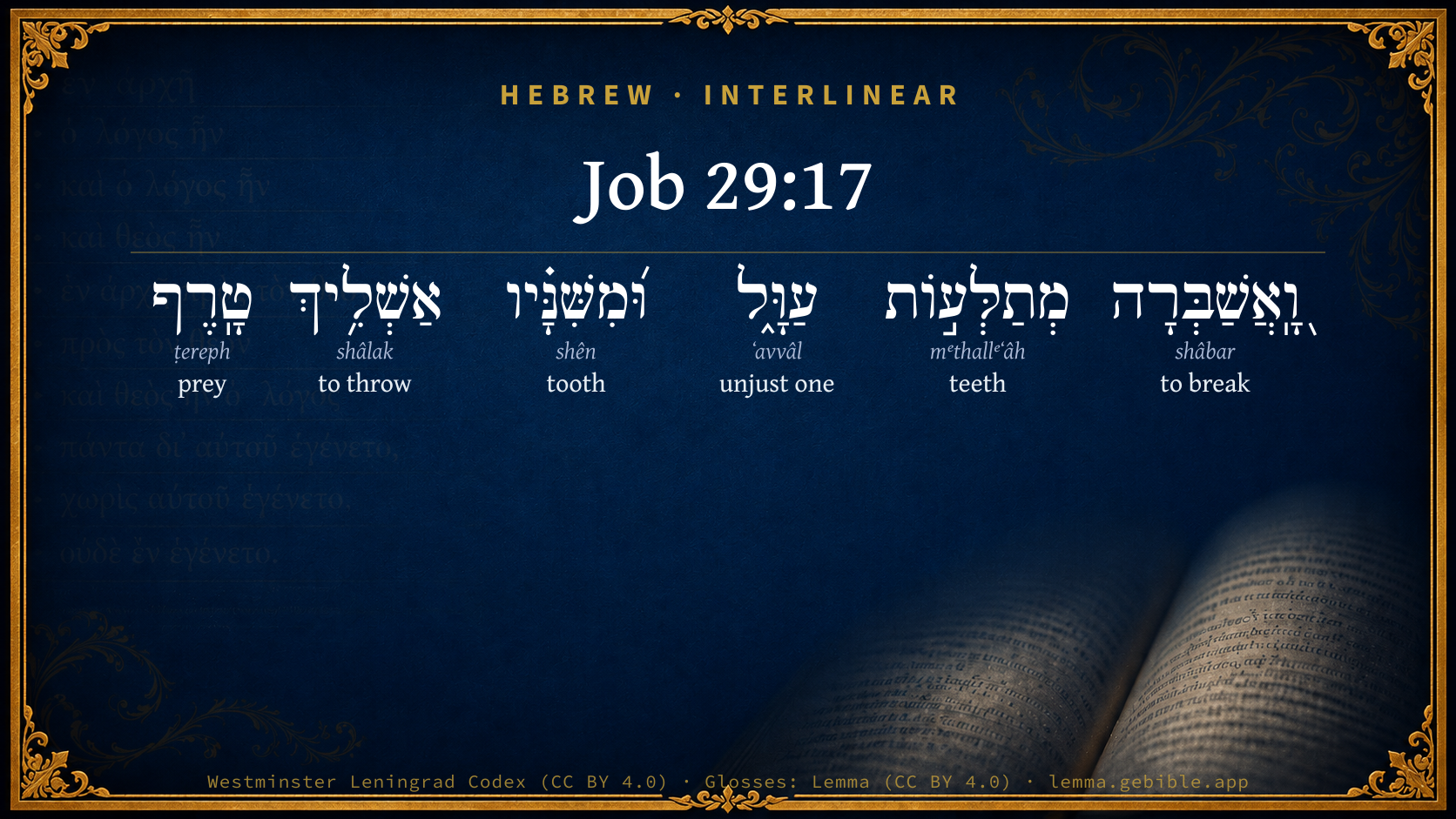
Job 29:17

Hebrew (Westminster Leningrad Codex) Job 29:17 appears in the Hebrew Old Testament. The text above is from the Westminster Leningrad Codex. Each word links to its Strong’s number, a concise gloss, and parsing drawn from the Open Scriptures Hebrew Bible morphology. Click any word for its full Brown-Driver-Briggs (BDB) entry.
Download image
Cite this verse

Job 29:17 (World English Bible). Public Domain. Lemma interlinear Bible study tool, https://lemma.gebible.app/v/job/29/17.

Show BibTeX & RIS
BibTeX
RIS
English Translation
I broke the jaws of the unrighteous, And plucked the prey out of his teeth.
World English Bible · Public Domain
Highlights
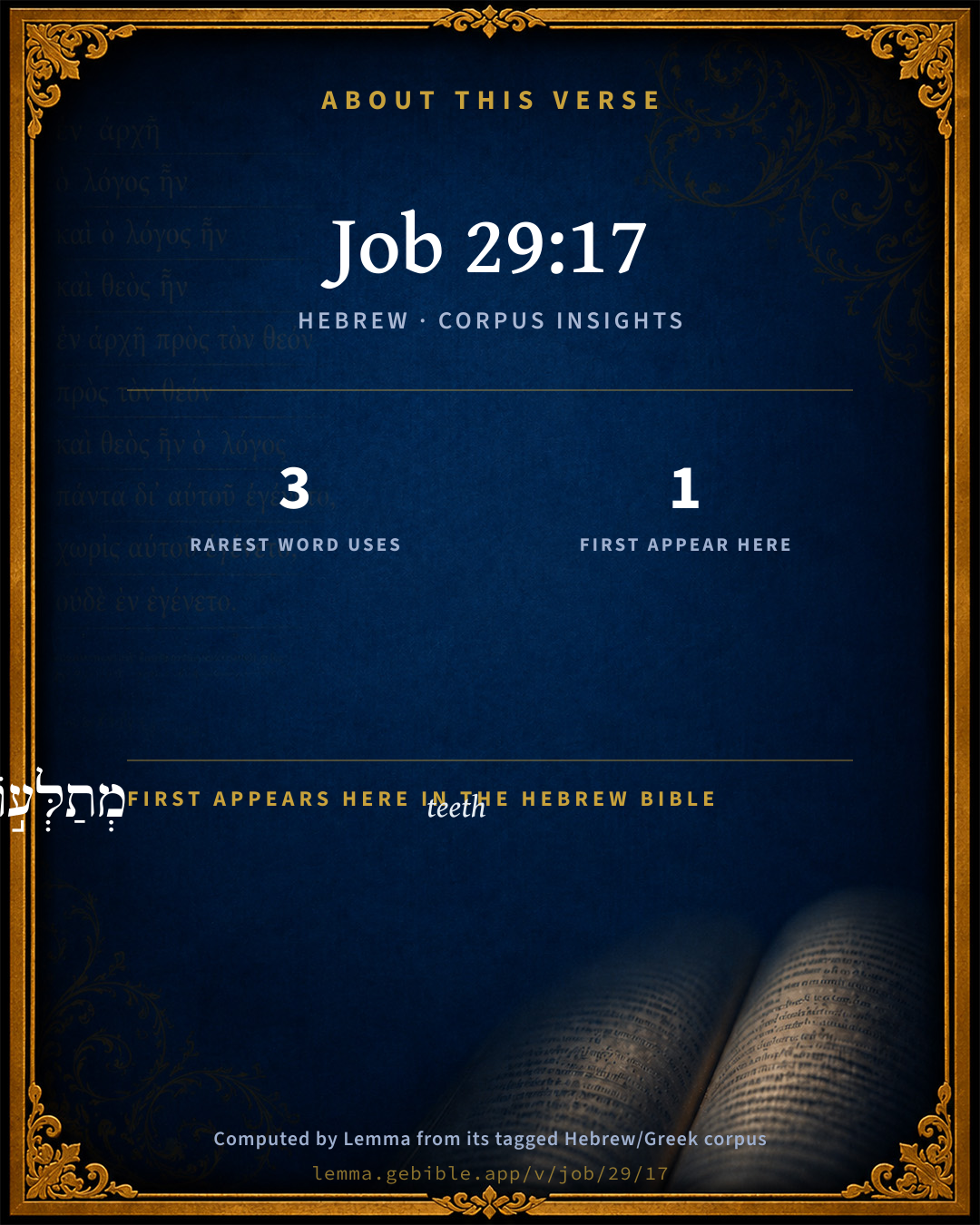
  • 1 first appearance in the Hebrew Bible
Full analysis ↓
Download a study sheet

One document with this verse’s original text, its word-by-word gloss line, the meaning frame, cross-references with their text, attributed commentary, and full source and license credits — printable, and it pastes into notes with its structure intact.

This verse Autodidact and up

Study sheet (.html) Plain text (.txt)

A passage Seminary Student

Up to 50 verses in one chapter. A passage sheet keeps up to 6 commentary sources and 12 cross-references per verse, in the order this page ranks them, and says so on the sheet whenever that leaves anything out. Ask for a single verse and you get the Autodidact verse sheet above.

Everything on this page stays free to read, with no account — the sheet is a download of what is already on screen, not access to it.

Want to remove ads? Support Godless Engineer
Compare translations 3

The same verse in 3 English versions, stacked beneath the original-language interlinear above. Click any original word for its lexicon entry.

Each is an independent rendering of the whole verse — the interlinear is not word-aligned to these translations.

Highlighted words mark where these versions differ — a whole-verse word diff, not a word-by-word alignment.

  • World English Bible Public Domain
    I broke the jaws of the unrighteous, And plucked the prey out of his teeth.
  • King James Version Public Domain
    And I brake the jaws of the wicked, and plucked the spoil out of his teeth.
  • unfoldingWord Literal Text CC BY-SA 4.0
    And I broke the jaws of the unrighteous, and I made the prey drop from his teeth.

unfoldingWord Literal Text — © unfoldingWord, licensed CC BY-SA 4.0. Word-aligned USFM3 via Door43 (git.door43.org/unfoldingWord/en_ult).

Versions to compare (up to 4)

3 of 4 selected

Show all 18 translations

Every available English version of this verse, each an independent rendering of the whole verse.

  • World English Bible Public Domain
    I broke the jaws of the unrighteous, And plucked the prey out of his teeth.
  • Berean Standard Bible Public Domain
    I shattered the fangs of the unjust and snatched the prey from his teeth.
  • Majority Standard Bible Public Domain
    I shattered the fangs of the unjust and snatched the prey from his teeth.
  • King James Version Public Domain
    And I brake the jaws of the wicked, and plucked the spoil out of his teeth.
  • American Standard Version (1901) Public Domain
    And I brake the jaws of the unrighteous, And plucked the prey out of his teeth.
  • Revised Version (1885) Public Domain
    And I brake the jaws of the unrighteous, and plucked the prey out of his teeth.
  • Geneva Bible (1599) Public Domain
    I brake also the chawes of the vnrighteous man, and pluckt the praye out of his teeth.
  • Douay-Rheims (1899) Public Domain
    I broke the jaws of the wicked man, and out of his teeth I took away the prey.
  • Young's Literal Translation Public Domain
    And I break the jaw-teeth of the perverse, And from his teeth I cast away prey.
  • Literal Standard Version CC BY-SA 4.0
    And I break the jaw-teeth of the perverse, || And from his teeth I cast away prey.
  • Unlocked Literal Bible CC BY-SA 4.0
    I broke the jaws of the unrighteous man; I plucked the victim out from between his teeth.
  • unfoldingWord Literal Text CC BY-SA 4.0
    And I broke the jaws of the unrighteous, and I made the prey drop from his teeth.
  • Darby Bible Public Domain
    And I broke the jaws of the unrighteous, and plucked the spoil out of his teeth.
  • World Messianic Bible Public Domain
    I broke the jaws of the unrighteous and plucked the prey out of his teeth.
  • Webster's Bible Public Domain
    And I broke the jaws of the wicked, and plucked the spoil out of his teeth.
  • Free Bible Version CC BY-SA 4.0
    I broke the jaw of the wicked and made them drop their prey from their teeth.
  • Bible in Basic English Public Domain
    By me the great teeth of the evil-doer were broken, and I made him give up what he had violently taken away.
  • JPS Tanakh (1917) Public Domain
    And I broke the jaws of the unrighteous, and plucked the prey out of his teeth.

Literal Standard Version (2020), Covenant Press — licensed CC BY-SA 4.0. Text via the HelloAO Bible API (eBible.org). Unlocked Literal Bible (unfoldingWord) — licensed CC BY-SA 4.0. Text via the HelloAO Bible API (eBible.org). unfoldingWord Literal Text — © unfoldingWord, licensed CC BY-SA 4.0. Word-aligned USFM3 via Door43 (git.door43.org/unfoldingWord/en_ult). Free Bible Version, Dr. Jonathan Gallagher — licensed CC BY-SA 4.0. Text via the HelloAO Bible API (eBible.org).

Word by word

More ways to search: Search by grammar → Find every occurrence → Compare this word →

Practice this passage: Drill this verse → Learn its vocabulary →

About this verse

These counts appear in no published source. They are computed here, from the morphology-tagged text and Lemma’s own curated glosses. What Lemma adds →

6
words
6
distinct lemmas
Wisdom
section

Notable vocabulary

The rarest word here is מְתַלְּע֣וֹת teeth H4973 — appearing just 3 times in the whole Hebrew Bible.

First appearance in Scripture

This word makes its first canonical appearance in the Hebrew Bible here:

  • מְתַלְּע֣וֹת teeth H4973

Shared distinctive vocabulary

מְתַלְּע֣וֹת teeth H4973 occurs in 3 verses of the Hebrew Bible. Also found in:

Grammatical profile

  • 2 verbs
  • 4 nouns

Verb forms

  • וָֽ֭אֲשַׁבְּרָה Piel · Sequential Imperfect
  • אַשְׁלִ֥יךְ Hiphil · Imperfect

Hebrew & Septuagint length

In English translation the verse runs 15 words from the Hebrew and 20 from the Septuagint (LXX English) — closely comparable.

A rough comparison of the two English renderings, which tokenize alike — not a word-level alignment.

Word counts can differ between the Hebrew and the Greek without any difference in meaning — e.g. the Hebrew direct-object marker אֵת has no separate Greek word, and Greek often adds the article ὁ.

Cross-references

6

Topical passages linked to Job 29:17 in the Treasury of Scripture Knowledge — connected by theme and wording, ordered by reader-vote popularity; previews shown in the World English Bible.

  • Psalms 3:7 Arise, Yahweh! Save me, my God! For you have struck all of my enemies on the cheek bone. You have broken the teeth of the wicked.
  • Proverbs 30:14 There is a generation whose teeth are like swords, And their jaws like knives, To devour the poor from the earth, and the needy from among men.
  • 1 Samuel 17:35 I went out after him, and struck him, and delivered it out of his mouth; and when he arose against me, I caught him by his beard, and struck him, and killed him.
  • Psalms 58:8 Let them be like a snail which melts and passes away, Like the stillborn child, who has not seen the sun.
  • Psalms 124:6 Blessed be Yahweh, Who has not given us as a prey to their teeth.
  • Psalms 124:3 Then they would have swallowed us up alive, When their wrath was kindled against us;

Cross-references courtesy of OpenBible.info (CC BY 4.0).

Hebrew and Greek witnesses Masoretic Hebrew ↔ Greek Septuagint

The same verse in the two great witnesses to the Old Testament, shown verse-for-verse.

These are two independent witnesses, not word-aligned to each other, and the Septuagint is shown in lemma (dictionary) form.

Hebrew Job 29:17 Masoretic · Westminster Leningrad Codex

וָֽ֭אֲשַׁבְּרָה מְתַלְּע֣וֹת עַוָּ֑ל וּ֝מִשִּׁנָּ֗יו אַשְׁלִ֥יךְ טָֽרֶף

I broke the jaws of the unrighteous, And plucked the prey out of his teeth.

World English Bible · Public Domain

Greek LXX Job 29:17 Septuagint · lemma form

συντρίβω δέ μύλη ἄδικος ἐκ δέ μέσος ὁ ὀδούς αὐτός ἅρπαγμα ἐκσπάω

And I broke the jaw teeth of the unrighteous; I plucked the spoil out of the midst of their teeth.

LXX2012 (modern English Septuagint) · Public Domain

Hebrew: Westminster Leningrad Codex (CC BY 4.0). Greek: Septuagint (public domain); English from LXX2012 (modern English Septuagint) (Public Domain). How the Septuagint differs from the Hebrew →

Commentary

Notes on Job 29:17 from classic Christian and Jewish commentators (each source and its license shown beneath its notes). The classic Christian expositions comment on the surrounding passage and are grouped to its opening verse, so a note may address several verses; the Jewish commentaries on the Tanakh (Rashi and others) are per-verse, so they appear only where the commentator wrote on this verse.

Lemma curates 59 commentaries, every one of them public domain or Creative Commons licensed, each selected and text-cleaned for this edition rather than reprinted as found. About our sources →

Trapp's Complete Commentary

John Trapp

Job 29:17 And I brake the jaws of the wicked, and plucked the spoil out of his teeth.

Ver. 17. And I brake the laws of the wicked] It is a mercy to have judges, saith one, modo audeant quae sentiunt, as the orator hath it ( Cic. pro Milone); so they dare do as their consciences tell them they should do. Job was such a judge, he feared not to encounter and keep under those unruly beasts and Belialists, who oppressed the poor, and then doubted not to oppose with crest and breast whatsoever stood in the way of their humours and lusts. Hic forti magnoque animo opus fuit, saith one. Here Job’s courage was put to the proof, if ever. Is it nothing to break the jaw bones of the wicked, to take the prey out of the lion’s mouth, and to rescue the oppressed from the man that is too mighty for him? Is it nothing to encounter the Hydra of sin, to oppose the current of times and torrent of vice, to turn the wheel over the wicked, and to leave them as powerless as old Entellus in Virgil did Dares; whom his fellows led away well beaten, and well nigh broken,

Iactantemque utroque caput, crassumque cruorem

Ore reiectantem, mistosque in sanguine dentes? - (Virg. Aeneid.)

And plucked the spoil out of his teeth] i.e. I made him make restitution of his ill gotten goods, whether by fraud or force. So that Job’s court, we see, was not vitiorum sentina, sed virtutum officina; his course was, Parcere subiectis, et debellare superbos, to help the afflicted and to punish the proud. Augustus, the emperor, was wont to say, That such a one only was fit to be a magistrate that was free from foul offence himself, and could withstand the corruptions of the times, keep a constant countermotion to the evil manners of the multitude; "Oς μητε τι αυτος αμαρτανειν και ταις του δημου σπουδαις ανθιστοσθαι δυνηται (Dio); as Cato was ever inveighing against covetousness and riot in the Roman State. Here also we have in Job the lively picture of a good magistrate, much better than that of Caesar Borgia, that villain, whom Machiavel proposeth as the only pattern for princes to imitate (De Principe, p. 185).

John Trapp, A Commentary or Exposition upon All the Books of the Old and New Testament (1647–1656) — public domain. Text from a community e-Sword module.

Joseph Benson's Commentary

Job 29:17. I brake the jaws of the wicked — Hebrew, מתלעות, methallegnoth, dentes molares vel maxillas cum dentibus, the grinders, or the jawbones with the teeth, the sharpest and strongest teeth in the jaw; that is, the power and violence wherewith they used to oppress others. It is a metaphor taken from wild beasts, which tear and crush their prey with their teeth. And plucked the spoil out of his teeth — Forced him to restore what he had violently taken away.

Joseph Benson's Commentary on the Old and New Testaments (1811–1818) — public domain. Text from a community e-Sword module.

Jamieson, Fausset & Brown

Robert Jamieson, A. R. Fausset & David Brown

Image from combating with wild beasts (Job 4:11; Psa 3:7). So compassionate was Job to the oppressed, so terrible to the oppressor!

jaws--Job broke his power, so that he could do no more hurt, and tore from him the spoil, which he had torn from others.

Jamieson, Fausset & Brown — Commentary Critical and Explanatory on the Whole Bible (1871) — public domain (CC PDM 1.0). Text via the HelloAO Bible API.

Adam Clarke's Commentary

Verse 17. I brake the jaws of the wicked] A metaphor taken from hunting. A beast of prey had entered into the fold, and carried off a sheep. "The huntsman comes, assails the wicked beast, breaks his jaws, and delivers the spoil out of his teeth. See the case 1Sa 17:34-37.

Adam Clarke's Commentary on the Bible (1810–1826) — public domain. Text from a community e-Sword/MySword module.

The Cambridge Bible for Schools and Colleges

gen. ed. J. J. S. Perowne

17. The figure is that of a beast of prey, who has its booty already in its teeth. The verse carries on Job_29:16; even when the unjust oppressor seemed already to have triumphed and carried off his prey, it was torn from his jaws.

The Cambridge Bible for Schools and Colleges (gen. ed. J. J. S. Perowne; Cambridge University Press, 1878–1918) — public domain. Text from a community e-Sword module.

John Gill's Exposition

And I brake the jaws of the wicked,.... Their jaw teeth, or grinders, alluding to beasts of prey, who have such teeth, very large; the meaning may be, that Job confuted the arguments which wicked men made use of in their own defence, and against the poor, exposed the weakness of them, and made them ineffectual to answer their purposes; disabled tyrants and cruel oppressors from doing any further hurt and damage to the fatherless and helpless; was an instrument in the hand of God of breaking the power, and weakening the hands of such persons, and hindering them from doing the mischief they otherwise would; see Pro 30:14;

and plucked the spoil out of his teeth; as David took the lamb out of the mouth of the bear and lion that came into his father's flock, and carried it off: thus Job delivered the poor out of the hands of such monsters in nature, comparable to beasts of prey, and saved them from being utterly ruined by them, and obliged them to restore unto them what they had in an unrighteous manner taken from them.

John Gill's Exposition of the Whole Bible (1746–1763) — public domain (CC PDM 1.0). Text via the HelloAO Bible API.

Albert Barnes' Notes on the Bible

And I brake the jaws of the wicked - Margin, “jaw-teeth, or, grinders.” The Hebrew word מתלעה methalle‛âh, the same, with the letters transposed, as מתלעות, is from לתע, to “bite” - and means “the biters,” the grinders, the teeth. It is not used to denote the jaw. The image here is taken from wild beasts, with whom Job compares the wicked, and says that he rescued the helpless from their grasp, as he would a lamb from a lion or wolf.

And plucked - Margin, “cast.” The margin is a literal translation, but the idea is, that he violently seized the spoil or prey which the wicked had taken, and by force tore it from him.

Albert Barnes' Notes on the Bible (1834–1885) — public domain. Text from a community e-Sword/MySword module.

Haydock's Catholic Bible Commentary

Prey, which he had extorted from the poor. (Menochius)

George Leo Haydock (1774–1849), Haydock's Catholic Family Bible and Commentary, 1859 edition — public domain. Excludes Psalms (Douay-Rheims chapter numbering differs from Protestant) and Deuterocanonical books (Catholic canon only).

Matthew Poole's English Annotations

The jaws; or, the jaw-bones; or, the grinders, the sharpest and strongest teeth in the jaw, i.e. their power and violence wherewith they used to oppress others. It is a metaphor from wild beasts, which break their prey with their teeth. Compare Psa 3:7; 57:4; 58:6.

Plucked the spoil out of his teeth, i.e. forced them to restore what they had violently and unjustly taken away.

Matthew Poole's English Annotations on the Holy Bible (1683–1685) — public domain. Text from a community e-Sword/MySword module.

Whedon's Commentary on the Bible

Daniel D. Whedon

17. I brake the jaws of the wicked — Gentle and compassionate to the oppressed, he was a thunderbolt to the oppressor. He broke the jaws of these ravenous beasts, and thus crushed their power to do injury; from their very teeth he tore their prey. The word for jaw may also be rendered eye teeth, protruding, says Schultens, like those of a wild boar.

Daniel D. Whedon (gen. ed.), Commentary on the Old and New Testaments (1874–1909) — public domain. Text from a community e-Sword module.

The Pulpit Commentary

And I brake the jaws of the wicked. (comp. Psa_58:6) It is scarcely meant, as Canon Cook supposes, that Job was himself the executioner. Quod facit per allure facit per so." Job would regard as Age doing what he ordered to be done. And plucked the spoil out of his teeth. Either by disappointing him of a prey which he was on the verge of making ms own, or by compelling him to make restitution of a prey that he had actually laid hold of.

The Pulpit Commentary (1880–1919), ed. H.D.M. Spence-Jones & Joseph S. Exell — public domain. Text from a community e-Sword module.

unfoldingWord translationNotes

Door43 World Missions Community

General Information:

In verses 18-20 Job tells about the things he used to say before bad things happened to him.

I broke the jaws of ... I plucked the victim

Job speaks of unrighteous people who persecute others as if they were wild animals that attack their victims by picking them up between their teeth. AT: "I made unrighteous people stop persecuting people, like someone who breaks the jaw of a wild animal and rescues its victim from between its teeth" (See: Metaphor)

I will die in my nest

Here "nest" represents Job's home and family. Job used to speak as if he were a bird that lived in a nest with his baby birds. AT: "I will die at home with my family" or "I will die in the safety of my home" (See: Metaphor)

I will multiply my days like the grains of sand

There are more grains of sand on the shore than anyone can count. To say that he would live more days than anyone could count is an exaggeration to express that he would live a very long time. AT: "I will live a very long time" or "I will live many years" (See: Hyperbole and Generalization and Simile)

My roots ... my branches

Job used to speak of his strength as if he were strong like a well-watered tree. (See: Metaphor)

translationWords

righteous

die

water

unfoldingWord translationNotes — © Distant Shores Media and the Door43 World Missions Community, licensed CC BY-SA 4.0. Source: git.door43.org/Door43/en_tn.

Lesson kit

Teaching starters — assembled from the data on this page, not authored interpretation. Every prompt links to the verse data it draws on. Edit before teaching.

Job, in the Wisdom, opens this verse with 6 words (6 distinct Hebrew lemmas). Its most distinctive word is mᵉthallᵉʻâh (“teeth”). A historical commentator’s framing appears above. Read the whole chapter for the surrounding context.

Discussion questions

  1. How does “teeth” (mᵉthallᵉʻâh) shape what this verse is saying?
  2. The word “teeth” first appears here in Scripture. What is being introduced at this debut?
  3. Proverbs 30:14 shares the word «teeth» with this verse. How do the two illuminate each other?
  4. These translations render this verse differently. What is at stake in choosing one wording over another?
  5. The verb «וָֽ֭אֲשַׁבְּרָה» is Piel Sequential Imperfect. How does its form color the action?
  6. Reading how Trapp's Complete Commentary and Joseph Benson's Commentary read this verse, where do the two commentators agree and where do they part?

Things to notice

Reading settings

Reading text

Shown beneath each verse's original-language words.

Old Testament
Old Testament edition

Read the OT as the Masoretic Hebrew (MT) or the Greek Septuagint (LXX).

English shown for the Greek Septuagint (in the Hebrew ↔ Greek comparison).

Comparing translations? Open the Compare panel on any verse page to stack up to four side by side.