
Jeremiah 36:30

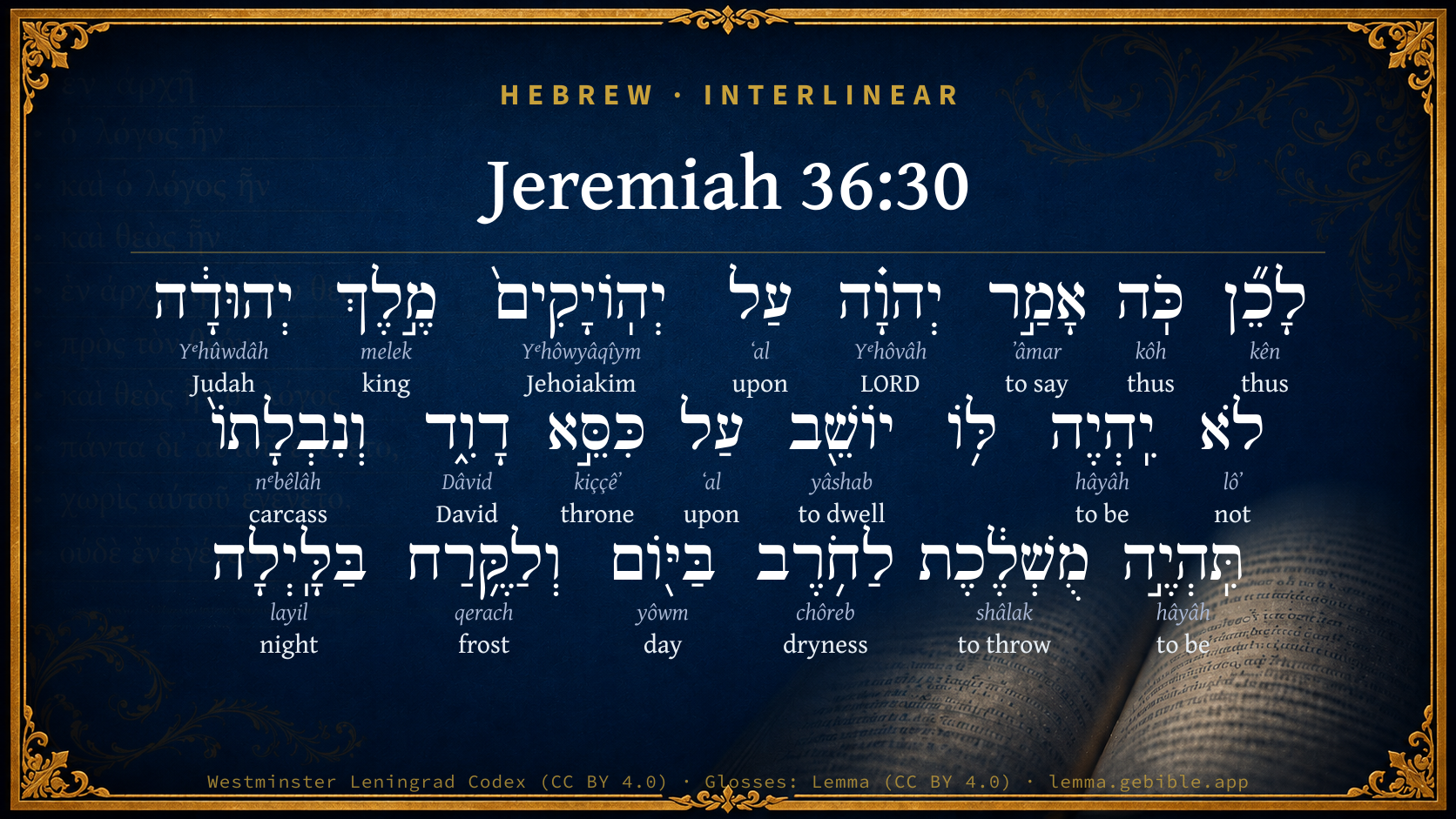
Hebrew (Westminster Leningrad Codex) Jeremiah 36:30 appears in the Hebrew Old Testament. The text above is from the Westminster Leningrad Codex. Each word links to its Strong’s number, a concise gloss, and parsing drawn from the Open Scriptures Hebrew Bible morphology. Click any word for its full Brown-Driver-Briggs (BDB) entry.
Download image
Cite this verse

Jeremiah 36:30 (World English Bible). Public Domain. Lemma interlinear Bible study tool, https://lemma.gebible.app/v/jeremiah/36/30.

Show BibTeX & RIS
BibTeX
RIS
English Translation
Therefore thus says Yahweh concerning Jehoiakim king of Judah: He shall have none to sit on the throne of David; and his dead body shall be cast out in the day to the heat, and in the night to the frost.
World English Bible · Public Domain
Download a study sheet

One document with this verse’s original text, its word-by-word gloss line, the meaning frame, cross-references with their text, attributed commentary, and full source and license credits — printable, and it pastes into notes with its structure intact.

This verse Autodidact and up

Study sheet (.html) Plain text (.txt)

A passage Seminary Student

Up to 50 verses in one chapter. A passage sheet keeps up to 6 commentary sources and 12 cross-references per verse, in the order this page ranks them, and says so on the sheet whenever that leaves anything out. Ask for a single verse and you get the Autodidact verse sheet above.

Everything on this page stays free to read, with no account — the sheet is a download of what is already on screen, not access to it.

Want to remove ads? Support Godless Engineer
Compare translations 3

The same verse in 3 English versions, stacked beneath the original-language interlinear above. Click any original word for its lexicon entry.

Each is an independent rendering of the whole verse — the interlinear is not word-aligned to these translations.

Highlighted words mark where these versions differ — a whole-verse word diff, not a word-by-word alignment.

  • World English Bible Public Domain
    Therefore thus says Yahweh concerning Jehoiakim king of Judah: He shall have none to sit on the throne of David; and his dead body shall be cast out in the day to the heat, and in the night to the frost.
  • King James Version Public Domain
    Therefore thus saith the LORD of Jehoiakim king of Judah; He shall have none to sit upon the throne of David: and his dead body shall be cast out in the day to the heat, and in the night to the frost.
  • unfoldingWord Literal Text CC BY-SA 4.0
    Therefore Yahweh says this concerning you, Jehoiakim king of Judah: “No descendant of yours will ever sit on the throne of David. As for you, your corpse will be thrown out into the heat of day and the frost of night.

unfoldingWord Literal Text — © unfoldingWord, licensed CC BY-SA 4.0. Word-aligned USFM3 via Door43 (git.door43.org/unfoldingWord/en_ult).

Versions to compare (up to 4)

3 of 4 selected

Show all 18 translations

Every available English version of this verse, each an independent rendering of the whole verse.

  • World English Bible Public Domain
    Therefore thus says Yahweh concerning Jehoiakim king of Judah: He shall have none to sit on the throne of David; and his dead body shall be cast out in the day to the heat, and in the night to the frost.
  • Berean Standard Bible Public Domain
    Therefore this is what the LORD says about Jehoiakim king of Judah: He will have no one to sit on David’s throne, and his body will be thrown out and exposed to heat by day and frost by night.
  • Majority Standard Bible Public Domain
    Therefore this is what the LORD says about Jehoiakim king of Judah: He will have no one to sit on David’s throne, and his body will be thrown out and exposed to heat by day and frost by night.
  • King James Version Public Domain
    Therefore thus saith the LORD of Jehoiakim king of Judah; He shall have none to sit upon the throne of David: and his dead body shall be cast out in the day to the heat, and in the night to the frost.
  • American Standard Version (1901) Public Domain
    Therefore thus saith Jehovah concerning Jehoiakim king of Judah: He shall have none to sit upon the throne of David; and his dead body shall be cast out in the day to the heat, and in the night to the frost.
  • Revised Version (1885) Public Domain
    Therefore thus saith the LORD concerning Jehoiakim king of Judah: He shall have none to sit upon the throne of David: and his dead body shall be cast out in the day to the heat, and in the night to the frost.
  • Geneva Bible (1599) Public Domain
    Therefore thus saith the Lord of Iehoiakim King of Iudah, Hee shall haue none to sit vpon the throne of Dauid, and his dead body shall be cast out in the day to the heate, and in the night to the frost.
  • Douay-Rheims (1899) Public Domain
    Therefore thus saith the Lord against Joakim the king of Juda: He shall have none to sit upon the throne of David: and his dead body shall be cast out to the heat by day, and to the frost by night.
  • Young's Literal Translation Public Domain
    `Therefore, thus said Jehovah, concerning Jehoiakim king of Judah: He hath none sitting on the throne of David, and his carcase is cast out to heat by day, and to cold by night;
  • Literal Standard Version CC BY-SA 4.0
    Therefore, thus said YHWH concerning Jehoiakim king of Judah: He has none sitting on the throne of David, and his carcass is cast out to heat by day, and to cold by night;
  • Unlocked Literal Bible CC BY-SA 4.0
    Therefore Yahweh says this concerning you, Jehoiakim king of Judah: “No descendant of yours will ever sit on the throne of David. As for you, your corpse will be thrown out into the heat of day and the frost of night.
  • unfoldingWord Literal Text CC BY-SA 4.0
    Therefore Yahweh says this concerning you, Jehoiakim king of Judah: “No descendant of yours will ever sit on the throne of David. As for you, your corpse will be thrown out into the heat of day and the frost of night.
  • Darby Bible Public Domain
    Therefore thus saith Jehovah concerning Jehoiakim king of Judah: He shall have none to sit upon the throne of David; and his dead body shall be cast out in the day to the heat, and in the night to the frost.
  • World Messianic Bible Public Domain
    Therefore the LORD says concerning Jehoiakim king of Judah: “He will have no one to sit on David’s throne. His dead body will be cast out in the day to the heat, and in the night to the frost.
  • Webster's Bible Public Domain
    Therefore thus saith the LORD concerning Jehoiakim king of Judah; He shall have none to sit upon the throne of David: and his dead body shall be cast out in the day to the heat, and in the night to the frost.
  • Free Bible Version CC BY-SA 4.0
    So this is what the Lord says about Jehoiakim king of Judah: He won't have anyone to succeed him as king, sitting on David's throne. His body will be thrown out to lie in the heat of the day and the cold of the night.
  • Bible in Basic English Public Domain
    For this reason the Lord has said of Jehoiakim, king of Judah, He will have no son to take his place on the seat of David: his dead body will be put out to undergo the heat of the day and the cold of the night.
  • JPS Tanakh (1917) Public Domain
    Therefore thus saith the LORD concerning Jehoiakim king of Judah: He shall have none to sit upon the throne of David; and his dead body shall be cast out in the day to the heat, and in the night to the frost.

Literal Standard Version (2020), Covenant Press — licensed CC BY-SA 4.0. Text via the HelloAO Bible API (eBible.org). Unlocked Literal Bible (unfoldingWord) — licensed CC BY-SA 4.0. Text via the HelloAO Bible API (eBible.org). unfoldingWord Literal Text — © unfoldingWord, licensed CC BY-SA 4.0. Word-aligned USFM3 via Door43 (git.door43.org/unfoldingWord/en_ult). Free Bible Version, Dr. Jonathan Gallagher — licensed CC BY-SA 4.0. Text via the HelloAO Bible API (eBible.org).

Word by word

More ways to search: Search by grammar → Find every occurrence → Compare this word →

Practice this passage: Drill this verse → Learn its vocabulary →

וְלַקֶּ֥רַח
qerach
H7140
“and · to/for the · frost”
Conjunction + Preposition, Determined + Noun, Common, Masculine, Singular, Absolute
Part of Speech
Conjunction + Preposition + Noun
Type
Common
Gender
Masculine
Number
Singular
State
Absolute
Full BDB Definition

Origin: from H7139

TWOT: 2070a

frost, ice, ice crystal - frost (of night) - ice
  1. לָכֵ֞ן kên H3651 “to/for · thus” Preposition + Adverb
  2. כֹּֽה kôh H3541 “thus” Adverb
  3. אָמַ֣ר ʼâmar H559 “to say” Verb, Qal, Perfect, 3rd Person, Masculine, Singular
  4. יְהוָ֗ה Yᵉhôvâh H3068 “LORD” Noun, Proper
  5. עַל ʻal H5921 “upon” Preposition
  6. יְהֽוֹיָקִים֙ Yᵉhôwyâqîym H3079 “Jehoiakim” Noun, Proper
  7. מֶ֣לֶךְ melek H4428 “king of” Noun, Common, Masculine, Singular, Construct
  8. יְהוּדָ֔ה Yᵉhûwdâh H3063 “Judah” Noun, Proper
  9. לֹא lôʼ H3808 “not” Particle, Negative
  10. יִֽהְיֶה hâyâh H1961 “to be” Verb, Qal, Imperfect, 3rd Person, Masculine, Singular
  11. יוֹשֵׁ֖ב yâshab H3427 “dwelling” Verb, Qal, Participle Active, Masculine, Singular, Absolute
  12. עַל ʻal H5921 “upon” Preposition
  13. כִּסֵּ֣א kiççêʼ H3678 “throne of” Noun, Common, Masculine, Singular, Construct
  14. דָוִ֑ד Dâvid H1732 “David” Noun, Proper
  15. וְנִבְלָתוֹ֙ nᵉbêlâh H5038 “and · carcass · his” Conjunction + Noun, Common, Feminine, Singular, Construct + Suffix, Personal, 3rd Person, Masculine, Singular
  16. תִּֽהְיֶ֣ה hâyâh H1961 “to be” Verb, Qal, Imperfect, 3rd Person, Feminine, Singular
  17. מֻשְׁלֶ֔כֶת shâlak H7993 “thrown” Verb, Hophal, Participle Passive, Feminine, Singular, Absolute
  18. לַחֹ֥רֶב chôreb H2721 “to/for the · dryness” Preposition, Determined + Noun, Common, Masculine, Singular, Absolute
  19. בַּיּ֖וֹם yôwm H3117 “in/at the · day” Preposition, Determined + Noun, Common, Masculine, Singular, Absolute
  20. בַּלָּֽיְלָה layil H3915 “in/at the · night” Preposition, Determined + Noun, Common, Masculine, Singular, Absolute

About this verse

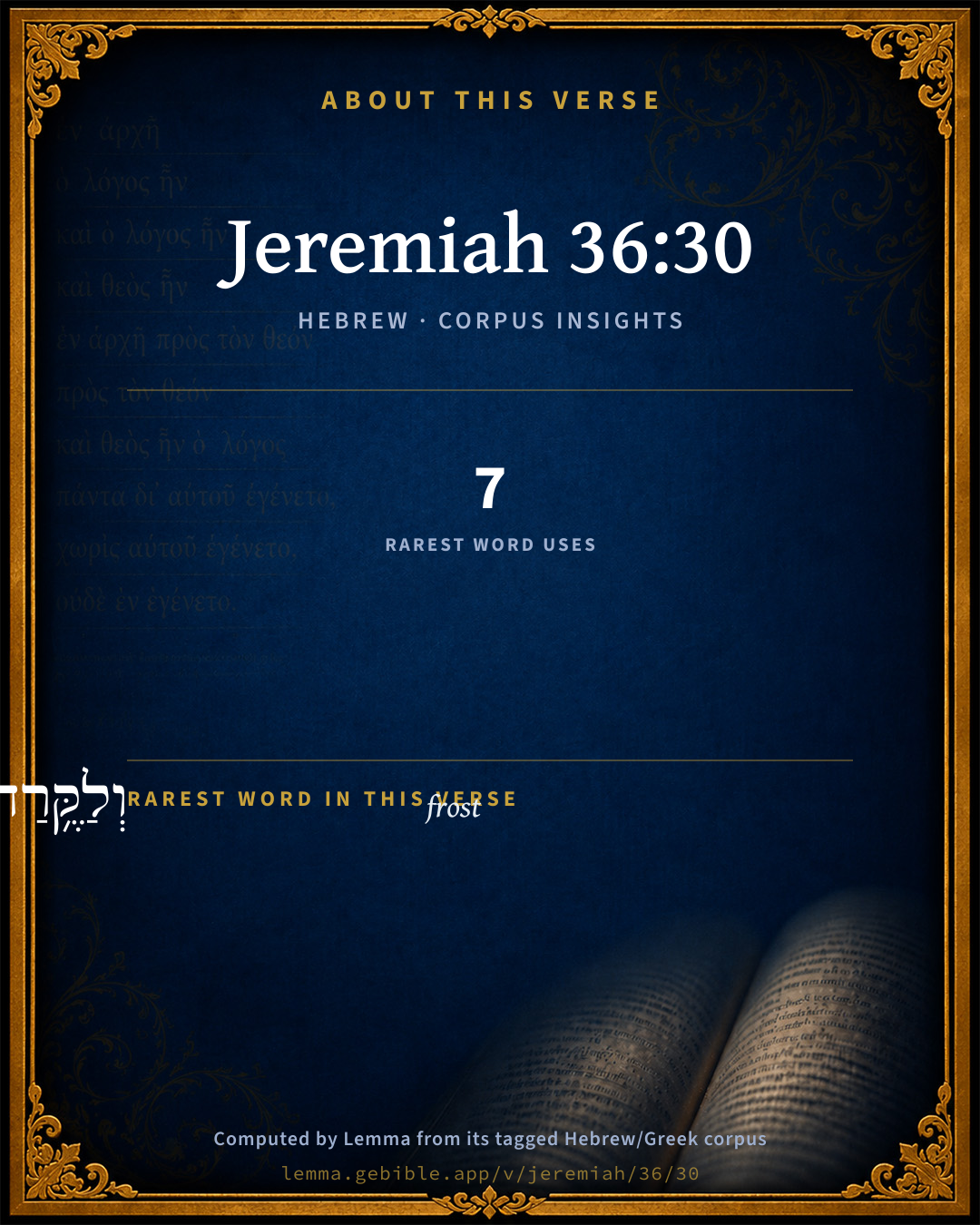
These counts appear in no published source. They are computed here, from the morphology-tagged text and Lemma’s own curated glosses. What Lemma adds →

22
words
19
distinct lemmas
Prophets
section

Notable vocabulary

The rarest word here is וְלַקֶּ֥רַח frost H7140 — appearing just 7 times in the whole Hebrew Bible.

Shared distinctive vocabulary

וְלַקֶּ֥רַח frost H7140 occurs in 7 verses of the Hebrew Bible. Also found in:

Grammatical profile

  • 5 verbs
  • 11 nouns
  • 3 prepositions
  • 2 adverbs
  • 1 particle

Verb forms

  • אָמַ֣ר Qal · Perfect
  • יִֽהְיֶה Qal · Imperfect
  • יוֹשֵׁ֖ב Qal · Participle Active
  • תִּֽהְיֶ֣ה Qal · Imperfect
  • מֻשְׁלֶ֔כֶת Hophal · Participle Passive

Repetition

Words recur within this verse — often emphatic in Hebrew:

  • עַל upon H5921 ×2
  • יִֽהְיֶה to be H1961 ×2

Cross-references

4

Topical passages linked to Jeremiah 36:30 in the Treasury of Scripture Knowledge — connected by theme and wording, ordered by reader-vote popularity; previews shown in the World English Bible.

  • Jeremiah 22:30 Thus says Yahweh, Write you this man childless, a man who shall not prosper in his days; for no more shall a man of his seed prosper, sitting on the throne of David, and ruling in Judah.
  • 2 Kings 24:12–15 and Jehoiachin the king of Judah went out to the king of Babylon, he, and his mother, and his servants, and his princes, and his officers: and the king of Babylon took him in the eighth year of his reign.
  • Genesis 31:40 Thus I was; in the day the drought consumed me, and the frost by night; and my sleep fled from my eyes.
  • Jeremiah 22:18–19 Therefore thus says Yahweh concerning Jehoiakim the son of Josiah, king of Judah: they shall not lament for him, [saying], Ah my brother! or, Ah sister! They shall not lament for him, [saying] Ah lord! or, Ah his glory!

Cross-references courtesy of OpenBible.info (CC BY 4.0).

Hebrew and Greek witnesses Masoretic Hebrew ↔ Greek Septuagint

The same verse in the two great witnesses to the Old Testament, shown verse-for-verse.

These are two independent witnesses, not word-aligned to each other, and the Septuagint is shown in lemma (dictionary) form.

Hebrew Jeremiah 36:30 Masoretic · Westminster Leningrad Codex

לָכֵ֞ן כֹּֽה אָמַ֣ר יְהוָ֗ה עַל יְהֽוֹיָקִים֙ מֶ֣לֶךְ יְהוּדָ֔ה לֹא יִֽהְיֶה לּ֥וֹ יוֹשֵׁ֖ב עַל כִּסֵּ֣א דָוִ֑ד וְנִבְלָתוֹ֙ תִּֽהְיֶ֣ה מֻשְׁלֶ֔כֶת לַחֹ֥רֶב בַּיּ֖וֹם וְלַקֶּ֥רַח בַּלָּֽיְלָה

Therefore thus says Yahweh concerning Jehoiakim king of Judah: He shall have none to sit on the throne of David; and his dead body shall be cast out in the day to the heat, and in the night to the frost.

World English Bible · Public Domain

Greek LXX Structure differs

In the Septuagint, Jeremiah is about an eighth shorter than the Hebrew and arranges its material differently — the Oracles Against the Nations (Hebrew chapters 46–51) appear in the middle of the Greek book, after 25:13. Because the chapter and verse boundaries do not line up, a verse-for-verse comparison with the Hebrew is not shown.

A verse-for-verse comparison isn’t shown here because the chapters and verses don’t line up. Switch to the LXX edition with the MT / LXX toggle above to read the Greek directly.

Hebrew: Westminster Leningrad Codex (CC BY 4.0). Greek: Septuagint (public domain); English from a public-domain English Septuagint. How the Septuagint differs from the Hebrew →

Targum (Aramaic paraphrase)

1

The Targum is the ancient Jewish Aramaic paraphrase of the Hebrew Scriptures — an interpretive translation, not the Hebrew text itself. Onkelos (literal) and Pseudo-Jonathan (expansive) render the Torah, and Jonathan the Prophets. Coverage is partial: where no permissively-licensed English translation exists for a verse, only the Aramaic is shown. This is verse-level text, not a word-by-word alignment to the Hebrew.

  1. Targum Jonathan Prophets (Joshua–Malachi)
    בְּכֵן כִּדְנַן אֲמַר יְיָ עַל יְהוֹיָקִים מְלַךְ שִׁבְטָא דְבֵית יְהוּדָה לָא יְהֵי לֵיהּ יָתֵיב עַל כּוּרְסֵי דָוִד וּנְבֶלְתֵּיהּ תְּהֵא מְשַׁגְרָא לִשְׁרָבָא בִימָמָא וְלִגְלִידָא בְלֵילְיָא:

    (no public-domain English translation for this verse)

    Targum Jonathan — Aramaic: “Mikraot Gedolot” (public domain). English: “Sefaria Community Translation” (CC0 1.0 (public-domain dedication)); “London "Chaldee Paraphrase," 1871” (public domain). Text via Sefaria.

Commentary

Notes on Jeremiah 36:30 from classic Christian and Jewish commentators (each source and its license shown beneath its notes). The classic Christian expositions comment on the surrounding passage and are grouped to its opening verse, so a note may address several verses; the Jewish commentaries on the Tanakh (Rashi and others) are per-verse, so they appear only where the commentator wrote on this verse.

Lemma curates 59 commentaries, every one of them public domain or Creative Commons licensed, each selected and text-cleaned for this edition rather than reprinted as found. About our sources →

Trapp's Complete Commentary

John Trapp

Jer 36:30 Therefore thus saith the LORD of Jehoiakim king of Judah; He shall have none to sit upon the throne of David: and his dead body shall be cast out in the day to the heat, and in the night to the frost.

Ver. 30. He shall have none to sit upon the throne of David,] i.e., None to make any reckoning of, for his son Jeconiah reigned but three months and ten days. And Zedekiah is not looked upon as his lawful successor, because he was his uncle, and set up likely by Nebuchadnezzar for a reproach to Jehoiakim aud Jeconiah; and in as great spite as once Attilus, King of Suesia, made a dog king of the Danes, in revenge of a great many injuries received by them, appointing counsellors to do all things under his title.

And his dead body shall be cast out in the day to the heat.] This was that infamous burial of an ass wherewith he had formerly been threatened. {Jer 22:19} His father Josiah was one of those few that lived and died with glory; but he did nothing less. Of Jehoiakim it may be said, as was afterwards of Ethelred, King of England, Eius vitae cursus saevus in principio, miser in medio, turpis in exitu asseritur. {a} It was said of his life that is was savage at the start, wretched in the middle and replusive at the end.

{a} Malms., lib. ii. cap. 10.

John Trapp, A Commentary or Exposition upon All the Books of the Old and New Testament (1647–1656) — public domain. Text from a community e-Sword module.

Joseph Benson's Commentary

Jer 36:30-31. He shall have none to sit on the throne of David — That is, none that shall be king any considerable time; Jeconiah, his son, was set up, but kept his throne only three months, and left none to succeed him in a direct line. And his dead body shall be cast out — See note on Jer 22:19. And I will punish him and his seed, &c. — Even his seed and his servants shall fare the worse for their relation to him: for they shall be punished, not indeed for his iniquity, but the sooner for their own. And as to the people, God threatens that they should feel what they were not willing to hear, even all the evil which God by his prophet had pronounced against them. Though the roll, the copy of the divine decree, was burned, the original remained, which should again be copied out after another manner in bloody characters. There is no escaping God’s judgments by striving against them. Who ever hardened his heart against God and prospered?

Joseph Benson's Commentary on the Old and New Testaments (1811–1818) — public domain. Text from a community e-Sword module.

Geneva Bible (1599)

Geneva Bible translators

Though Jehoiachin his son succeeded him, yet because he reigned but three months, it was esteemed as no reign.

Read Jer. 22:19.

Geneva Bible (1599) marginal notes — public domain. Text via Bolls.life.

Jamieson, Fausset & Brown

Robert Jamieson, A. R. Fausset & David Brown

He shall have none to sit upon the throne--fulfilled (Kg2 24:8, &c.; 2Ki. 25:1-30). He had successors, but not directly of his posterity, except his son Jeconiah, whose three months' reign is counted as nothing. Zedekiah was not the son, but the uncle of Jeconiah, and was raised to the throne in contempt of him and his father Jehoiakim (Jer 22:30).

dead body . . . cast out-- (Jer 22:18-19).

day . . . heat . . . night . . . frost--There are often these variations of temperature in the East between night and day (Gen 31:40).

Jamieson, Fausset & Brown — Commentary Critical and Explanatory on the Whole Bible (1871) — public domain (CC PDM 1.0). Text via the HelloAO Bible API.

Adam Clarke's Commentary

Verse 30. He shall have none to sit upon the throne of David] He shall have no successor, and himself shall have an untimely end, and shall not even be buried, but his body be exposed to the open air, both night and day. He who wishes to hide his crimes, or take away the evidence which is against him, adds thereby to his iniquities, and is sure in consequence to double his punishment. See the threatening against Jehoiakim, Jer 22:19, and See Clarke on Jer 22:19.

Adam Clarke's Commentary on the Bible (1810–1826) — public domain. Text from a community e-Sword/MySword module.

John Calvin's Commentaries

But the Prophet immediately shows that the ungodly in vain resist God, when they kick against the goad; they must necessarily be torn in pieces by the stone with which they contend, because their hardness cannot hinder God from executing his judgments. It is therefore added, Thus saith Jehovah of the king Jehoiakim, Be shall have no one to succeed him on the throne of David By saying, that he should have no successor, he means that he should have none of his own posterity; for though his son Jeconiah was made king in his stead, yet as he reigned only for three months, this short time was not counted. Then Jeremiah declares, by God’s cmnmand, that King Jehoiakim should not have a legitimate successor, for his son Jeconiah was led into exile at the end of three months; and Zedekiah was not counted as a legitimate successor, because he was the uncle. And there is also no doubt but that Nebuchadnezzar, from ill-will and hatred, set him on the throne, for he thus raised him in order to degrade Jehoiakim and Jeconiah.

We now then perceive in what sense God threatened that there would be none to succeed King Jehoiakim; for it is not simply said, “There shall be none to sit on the throne of David;” but, “There shall be none to him,” לא יהיה לו la ieie lu, that is, “There shall be none of his children, or of his offspring, to succeed him on the throne of David.” For the last king was Zedekiah, and he, as I have said, was the uncle; so that the whole royal seed were cast off, for no one after this time ever succeeded to the throne.

But it may be asked, How can this prophecy agree with the promise, that the posterity of David should continue as long as the sun and moon shone as faithful witnesses in the heavens? (Psalm 89:37, 38) God had promised that the kingdom of David should be perpetual, and that there would be some of his posterity to rule as long as the sun and moon shone in the heavens; but what does our Prophet mean now, when he says, that there shall not be a successor? This is, indeed, to be confined to the posterity of Jehoiakim; but yet we must bear in mind what we have seen elsewhere, and that is, that he speaks here of an interruption, which is not inconsistent with perpetuity; for the perpetuity of the kingdom, promised to David, was such, that it was to fall and to be trodden under foot for a time, but that at length a stem from Jesse’s root would rise, and that Christ, the only true and eternal David, would so reign, that his kingdom should have no end. When, therefore, the Prophets say, that there would be none to sit on David’s throne, they do not mean this strictly, but they thus refer only to that temporary punishment by which the throne was so overturned, that God at length would, in his own time, restore it, according to what Amos says,

“For come shall the time when God shall raise up the fallen tabernacle of David.” (Amos 9:11)

We now perceive in what sense hath stood firm the promise respecting the perpetuity of the kingdom, and that the kingdom had yet ceased for a time, that is, until Christ came, on whose head was placed the diadem, or the royal crown, as Ezekiel says. (Ezekiel 21:26) There is yet no doubt but this great inconsistency was made an objection to Jeremiah:

“What! can it be that the throne of David should be without a legitimate heir? Canst thou draw down the sun and moon from the heavens?”

In like manner, when the Prophets spoke of the destruction of Jerusalem, they said:

“What! Is it not said, ‘This is my rest for ever, here will I dwell?’ (Psalm 83:14)

Can it be that God will be without his habitation on earth, especially when he calls it his rest?” But the answer to all this was not difficult, even that God remained faithful to his promises, though his favor was, for a time, as it were, under a cloud, so that the dreadful desolation both of the city and of the kingdom might be an example to all.

There is no doubt, then, but that they shewed to the Prophet that the kingdom would be hid, as though it were a treasure concealed in the earth, and that still the time would come when God would again choose both the city and the kingdom, and restore them to their pristine dignity, as the Papists say, who boast in high terms of everything said in Scripture respecting the perpetual preservation of the Church:

“Christ promises to be with his people to the end of the world, that he will be where two or three meet together in his name, that the Church is the pillar and ground of the truth.” (Matthew 28:20; 1 Timothy 3:15)

They heap together all these things, in order to shew that God is in a manner tied and bound to them. But we can easily dissipate these frivolous objections; for God does wonderfully and invisibly preserve his Church in the world; and then the outward face of the Church does not always appear, but it is sometimes hid, and afterwards it emerges and recovers its own dignity, which, for a time, might seem to have been extinguished. Hence we give now the same answer to the Papists as the Prophets formerly did to the ancient people, — that God is a faithful preserver of his Church, but not according to the perception of the flesh, for the Church is in a wonderful manner sustained by God, and not in a common way, or as they say, according to the usual order of things.

He says that the dead body of Jehoiakim would be cast out, to be exposed to the cold in the night, and to the heat in the day This might seem unimportant, like what we threaten children with, when we mention some phantoms to them; for what harm could it have been to Jehoiakim to have his dead body exposed to the cold in the night? for no injury or feeling of sorrow can happen to a dead body, as a dead man as to his body can have no feeling. It seems then that it is to little purpose that the Prophet says, that his dead body would be exposed to the heat in the day, and to the cold at night. But this is to be referred to the common law of nature, of which we have spoken elsewhere; for it is a sad and disgraceful thing, nay, a horrid spectacle, when we see men unburied; and the duty of burying the dead has from the beginning been acknowledged, and burial is an evidence of a future resurrection, as it has been before stated. When, therefore, the body of man lies unburied, all men shun and dread the sight; and then when the body gets rigid through cold, and becomes putrid through the heat of the day, the indignity becomes still greater. God then intended to set forth the degradation that awaited Jehoiakim, not that any hurt could be done to him when his body was cast out, and not honored with a burial, but that it would be an evidence of God’s vengeance, when a king was thus cast out as an ass or a dog, according to what we have seen elsewhere, “With the burial of an ass shall he be buried,” that is, he will be deemed unworthy of common honor; for as it falls to the lot of the lowest of men to find a pit where their bodies lie buried, it was a rare and unusual proof of God’s vengeance, that a king should he exposed as a prey to birds and wild beasts. We know what Jehu said of Jezebel,

“Let her be buried, for she is a king’s daughter.” (2 Kings 9:34)

She was worthy to be torn to pieces a hundred times. She had been cast out from a chamber, and the dogs licked her blood; yet an enemy ordered her to be buried — and why? because she was a king’s daughter, or descended from a royal family, (1 Kings 21:23:) then, he said, let her be buried.

We now then understand the meaning of the Prophet, or rather of the Holy Spirit, that it would be a remarkable proof of God’s vengeance, when the body of King Jehoialdm should be exposed at night to the cold, and in the day to the heat. This has also happened sometimes to the saints, as we have before said; but it was a temporal punishment common to the good and to the bad. We ought yet always to consider it as God’s judgment. When a godly man is left without burial, we must know that all things happen for good to God’s children, according to what Paul says, whether it be life or death, it is for their salvation. (Romans 8:28) But when God gives a remarkable proof of his wrath against an ungodly man, our eyes ought to be opened; for it is not right to be blind to the manifest judgments of God; for it is not in vain that Paul reminds us that God’s judgment will come on the ungodly; but he would have us carefully to consider how God punishes the reprobate in life and in death and even after death. It follows —

John Calvin's Commentaries (1540-1563) — public domain. Text from the Calvin Translation Society English edition (1840s-50s) via the Christian Classics Ethereal Library (ccel.org). Calvin's coverage is partial (roughly two-thirds of the Bible); uncommented books and verses are honest gaps, never fabricated. The 19th-century editor's footnotes and remarks are omitted so the notes are faithfully Calvin's own voice.

The Cambridge Bible for Schools and Colleges

gen. ed. J. J. S. Perowne

30. He shall] See on Jer_22:18 f.

The Cambridge Bible for Schools and Colleges (gen. ed. J. J. S. Perowne; Cambridge University Press, 1878–1918) — public domain. Text from a community e-Sword module.

John Gill's Exposition

Therefore thus saith the Lord, of Jehoiakim king of Judah,.... Or, "concerning" (x) him; for Jehovah is not here said to be "the Lord of Jehoiakim", though he was, being King of kings, and Lord of lords; bat as speaking concerning him, and threatening him, as follows:

he shall have none to sit upon the throne of David; that is, none of his issue that should reign after him, or succeed him in the throne of David and kingdom of Judah; for his son Jeconiah reigned but three months, which is reckoned as nothing, and could not be called sitting upon the throne; and, besides, was never confirmed by the king of Babylon, in whose power he was, and by whom he was carried captive; and Zedekiah, who followed, was not his lawful successor, was brother to Jehoiakim, and uncle to Jeconiah, and was set up by the king of Babylon in contempt of the latter; and as for Zerubbabel, he was no king, nor was there any of this family till the Messiah came:

and his dead body shall be cast out in the day to the heat, and in the night to the frost. The sense is, he should have no burial but that of an ass, Jer 22:18; should be cast into a ditch, and be exposed to the heat of the sun in the daytime, and to nipping frosts at night, and so putrefy and become nauseous; and though the body would be insensible of it, yet would it be very reproachful to the character of a prince, and shocking to any to behold; and very disagreeable and dreadful for himself to hear and think of.

(x) "de", Schmidt, &c.

John Gill's Exposition of the Whole Bible (1746–1763) — public domain (CC PDM 1.0). Text via the HelloAO Bible API.

Albert Barnes' Notes on the Bible

He shall have none to sit ... - The 3 months’ reign of Jehoiakim was too destitute of real power to be a contradiction to this prediction.

Albert Barnes' Notes on the Bible (1834–1885) — public domain. Text from a community e-Sword/MySword module.

Haydock's Catholic Bible Commentary

None, &c. Because his son, Joachin or Jechonias, within three months after the death of his father, was carried away to Babylon, so that his reign is not worthy to be taken notice of. (Challoner) (Theodoret) (Worthington) --- He was subject to the Chaldeans; his uncle took his place. Joakim had the burial of an ass, chap. xii. 18. (Calmet) --- None of the following princes enjoyed the glory or power of the ancient king. (St. Thomas Aquinas, [Summa Theologiae] p. 3. qu. 31. a. 2.) (Worthington)

George Leo Haydock (1774–1849), Haydock's Catholic Family Bible and Commentary, 1859 edition — public domain. Excludes Psalms (Douay-Rheims chapter numbering differs from Protestant) and Deuterocanonical books (Catholic canon only).

Matthew Poole's English Annotations

That is, none that shall be king any considerable time; Jeconiah or Jehoiachin his son was set up, but kept his throne but three months, 2Ki 24:8-10. We no where read of the time or manner of this king’s death, but that he had an ignominious burial, Jer 22:19, like the burial of an ass, none accompanying his corpse, none mourning for him; and it appears from this text, that wherever he died, his body lay for a time unburied.

Matthew Poole's English Annotations on the Holy Bible (1683–1685) — public domain. Text from a community e-Sword/MySword module.

Whedon's Commentary on the Bible

Daniel D. Whedon

30. None to sit — The three months’ reign of Jeconiah was too trivial and insignificant to be counted.

His dead body shall be cast… day to the heat,… night to the frost — These are individualizing expressions, and add solemnity and graphic force.

Daniel D. Whedon (gen. ed.), Commentary on the Old and New Testaments (1874–1909) — public domain. Text from a community e-Sword module.

The Pulpit Commentary

He shall have none to sit, etc. Substantially a repetition of the prophecy in Jer_22:18, 19 (comp. 30).

The Pulpit Commentary (1880–1919), ed. H.D.M. Spence-Jones & Joseph S. Exell — public domain. Text from a community e-Sword module.

John Wesley's Explanatory Notes

None to sit - That is, none that shall be king any considerable time. Jeconiah his son was set up, but kept his throne but three months.

John Wesley, Explanatory Notes Upon the Whole Bible (1754–1765) — public domain. Text via the GEBible commentary corpus.

unfoldingWord translationNotes

Door43 World Missions Community

will ever sit on the throne of David

Sitting on the throne is a metonym for ruling as king. See how you translated "sits on the throne of David" in Jeremiah 29:16. AT: "will ever rule the Israelites as David did" (See: Metonymy)

your corpse will be thrown out

This can be translated in active form. AT: "people will throw your dead body outside" (See: Active or Passive)

your corpse

"your dead body"

into the heat of day

"so that it is exposed to the dry heat of the daytime"

frost

ice that forms on grass during cold nights

of you all

"of all of you"

translationWords

Yahweh

Jehoiakim

king

kingdom of Judah

descend

throne

David

punish

iniquity

Jerusalem

unfoldingWord translationNotes — © Distant Shores Media and the Door43 World Missions Community, licensed CC BY-SA 4.0. Source: git.door43.org/Door43/en_tn.

Lesson kit

Teaching starters — assembled from the data on this page, not authored interpretation. Every prompt links to the verse data it draws on. Edit before teaching.

Jeremiah, in the Prophets, opens this verse with 22 words (19 distinct Hebrew lemmas). Its most distinctive word is qerach (“frost”). A historical commentator’s framing appears above. Read the whole chapter for the surrounding context.

Discussion questions

  1. What does “frost” (qerach) contribute to the verse as a whole?
  2. How does Genesis 31:40, which shares the word «frost», read alongside this verse?
  3. What does the repetition of “upon” (2× in this one verse) do in this verse?
  4. These translations render this verse differently; the difference is in the English rendering, not the original. What questions does that raise?
  5. «אָמַ֣ר» is a Qal Perfect verb. How does that grammatical form shape the action described?
  6. Compare how Trapp's Complete Commentary and Joseph Benson's Commentary read this verse. Where do they agree or differ?

Things to notice

Reading settings

Reading text

Shown beneath each verse's original-language words.

Old Testament
Old Testament edition

Read the OT as the Masoretic Hebrew (MT) or the Greek Septuagint (LXX).

English shown for the Greek Septuagint (in the Hebrew ↔ Greek comparison).

Comparing translations? Open the Compare panel on any verse page to stack up to four side by side.