
1 Kings 14:9

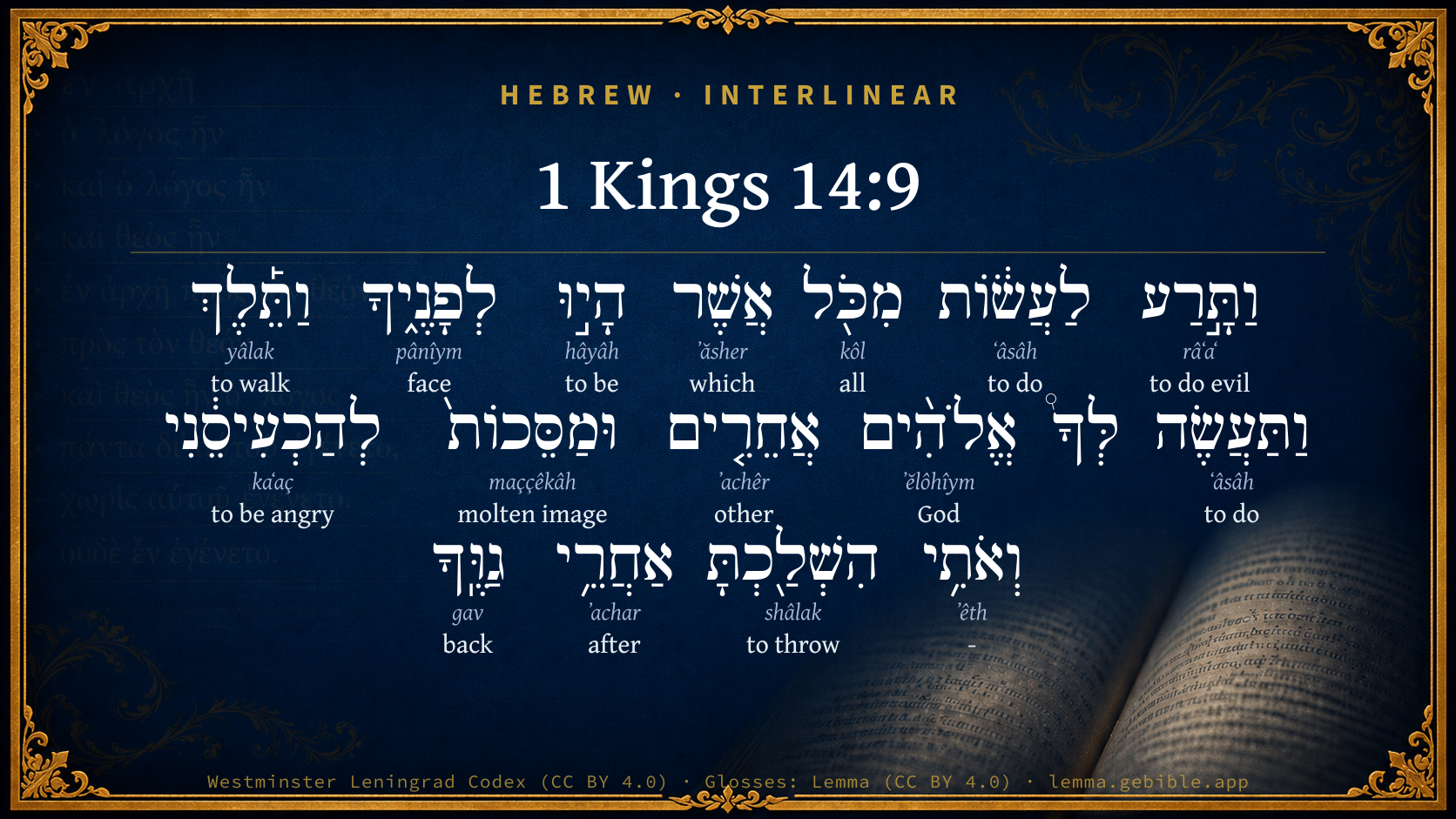
Hebrew (Westminster Leningrad Codex) 1 Kings 14:9 appears in the Hebrew Old Testament. The text above is from the Westminster Leningrad Codex. Each word links to its Strong’s number, a concise gloss, and parsing drawn from the Open Scriptures Hebrew Bible morphology. Click any word for its full Brown-Driver-Briggs (BDB) entry.
Download image
Cite this verse

1 Kings 14:9 (World English Bible). Public Domain. Lemma interlinear Bible study tool, https://lemma.gebible.app/v/1-kings/14/9.

Show BibTeX & RIS
BibTeX
RIS
English Translation
but have done evil above all who were before you, and have gone and made you other gods, and molten images, to provoke me to anger, and have cast me behind your back:
World English Bible · Public Domain
Highlights
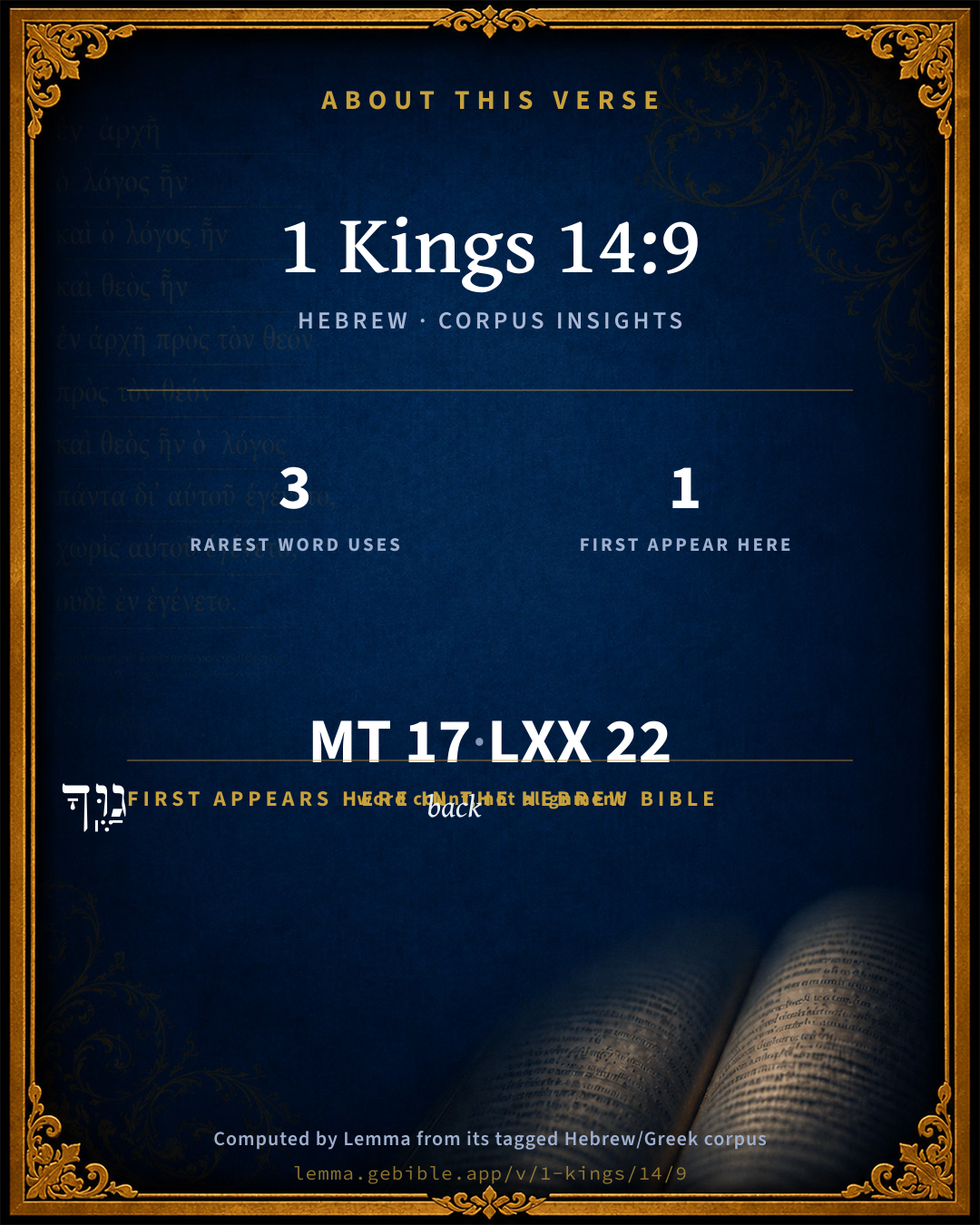
  • 1 first appearance in the Hebrew Bible
Full analysis ↓
Download a study sheet

One document with this verse’s original text, its word-by-word gloss line, the meaning frame, cross-references with their text, attributed commentary, and full source and license credits — printable, and it pastes into notes with its structure intact.

This verse Autodidact and up

Study sheet (.html) Plain text (.txt)

A passage Seminary Student

Up to 50 verses in one chapter. A passage sheet keeps up to 6 commentary sources and 12 cross-references per verse, in the order this page ranks them, and says so on the sheet whenever that leaves anything out. Ask for a single verse and you get the Autodidact verse sheet above.

Everything on this page stays free to read, with no account — the sheet is a download of what is already on screen, not access to it.

Want to remove ads? Support Godless Engineer
Compare translations 3

The same verse in 3 English versions, stacked beneath the original-language interlinear above. Click any original word for its lexicon entry.

Each is an independent rendering of the whole verse — the interlinear is not word-aligned to these translations.

Highlighted words mark where these versions differ — a whole-verse word diff, not a word-by-word alignment.

  • World English Bible Public Domain
    but have done evil above all who were before you, and have gone and made you other gods, and molten images, to provoke me to anger, and have cast me behind your back:
  • King James Version Public Domain
    But hast done evil above all that were before thee: for thou hast gone and made thee other gods, and molten images, to provoke me to anger, and hast cast me behind thy back:
  • unfoldingWord Literal Text CC BY-SA 4.0
    and you have been evil to do more than all who were to your face, and you have gone and made for yourself other gods and molded images to anger me, and you have thrown me behind your back,

unfoldingWord Literal Text — © unfoldingWord, licensed CC BY-SA 4.0. Word-aligned USFM3 via Door43 (git.door43.org/unfoldingWord/en_ult).

Versions to compare (up to 4)

3 of 4 selected

Show all 18 translations

Every available English version of this verse, each an independent rendering of the whole verse.

  • World English Bible Public Domain
    but have done evil above all who were before you, and have gone and made you other gods, and molten images, to provoke me to anger, and have cast me behind your back:
  • Berean Standard Bible Public Domain
    You have done more evil than all who came before you. You have proceeded to make for yourself other gods and molten images to provoke Me, and you have flung Me behind your back.
  • Majority Standard Bible Public Domain
    You have done more evil than all who came before you. You have proceeded to make for yourself other gods and molten images to provoke Me, and you have flung Me behind your back.
  • King James Version Public Domain
    But hast done evil above all that were before thee: for thou hast gone and made thee other gods, and molten images, to provoke me to anger, and hast cast me behind thy back:
  • American Standard Version (1901) Public Domain
    but hast done evil above all that were before thee, and hast gone and made thee other gods, and molten images, to provoke me to anger, and hast cast me behind thy back:
  • Revised Version (1885) Public Domain
    but hast done evil above all that were before thee, and hast gone and made thee other gods, and molten images, to provoke me to anger, and hast cast me behind thy back:
  • Geneva Bible (1599) Public Domain
    But hast done euil aboue al that were before thee (for thou hast gone and made thee other gods, and molten images, to prouoke me, and hast cast me behinde thy backe)
  • Douay-Rheims (1899) Public Domain
    But hast done evil above all that were before thee, and hast made thee strange gods and molten gods, to provoke me to anger, and hast cast me behind thy back:
  • Young's Literal Translation Public Domain
    and thou dost evil above all who have been before thee, and goest, and makest to thee other gods and molten images to provoke Me to anger, and Me thou hast cast behind thy back:
  • Literal Standard Version CC BY-SA 4.0
    and you do evil above all who have been before you, and go, and make other gods and molten images for yourself to provoke Me to anger, and you have cast Me behind your back—
  • Unlocked Literal Bible CC BY-SA 4.0
    Instead, you have done evil, more than all who were before you. You have made other gods, and you have cast metal images to provoke me to anger, and have thrust me behind your back.
  • unfoldingWord Literal Text CC BY-SA 4.0
    and you have been evil to do more than all who were to your face, and you have gone and made for yourself other gods and molded images to anger me, and you have thrown me behind your back,
  • Darby Bible Public Domain
    but thou hast done evil above all that were before thee, and hast gone and made thee other gods, and molten images, to provoke me to anger, and hast cast me behind thy back:
  • World Messianic Bible Public Domain
    but have done evil above all who were before you, and have gone and made for yourself other gods, molten images, to provoke me to anger, and have cast me behind your back,
  • Webster's Bible Public Domain
    But hast done evil above all that were before thee: for thou hast gone and made thee other gods, and molten images, to provoke me to anger, and hast cast me behind thy back:
  • Free Bible Version CC BY-SA 4.0
    You have done more evil than all those who lived before you. You have gone and made other gods for yourself, idols made of molten metal that made me angry. You have tossed me aside.
  • Bible in Basic English Public Domain
    But you have done evil more than any before you, and have made for yourself other gods, and images of metal, moving me to wrath, and turning your back on me.
  • JPS Tanakh (1917) Public Domain
    but hast done evil above all that were before thee, and hast gone and made thee other gods, and molten images, to provoke Me, and hast cast Me behind thy back;

Literal Standard Version (2020), Covenant Press — licensed CC BY-SA 4.0. Text via the HelloAO Bible API (eBible.org). Unlocked Literal Bible (unfoldingWord) — licensed CC BY-SA 4.0. Text via the HelloAO Bible API (eBible.org). unfoldingWord Literal Text — © unfoldingWord, licensed CC BY-SA 4.0. Word-aligned USFM3 via Door43 (git.door43.org/unfoldingWord/en_ult). Free Bible Version, Dr. Jonathan Gallagher — licensed CC BY-SA 4.0. Text via the HelloAO Bible API (eBible.org).

Word by word

More ways to search: Search by grammar → Find every occurrence → Compare this word →

Practice this passage: Drill this verse → Learn its vocabulary →

גַוֶּֽךָ
gav
H1458
“back · your”
Noun, Common, Masculine, Singular, Construct + Suffix, Personal, 2nd Person, Masculine, Singular
Part of Speech
Noun
Type
Common
Gender
Masculine
Number
Singular
State
Construct
Full BDB Definition

Origin: another form for H1460

TWOT: 326a

the back
  1. וַתָּ֣רַע râʻaʻ H7489 “and · to do evil” Conjunction + Verb, Hiphil, Sequential Imperfect, 2nd Person, Masculine, Singular
  2. לַעֲשׂ֔וֹת ʻâsâh H6213 “to do” Preposition + Verb, Qal, Infinitive Construct
  3. מִכֹּ֖ל kôl H3605 “from · all” Preposition + Noun, Common, Masculine, Singular, Absolute
  4. אֲשֶׁר ʼăsher H834 “which” Particle, Relative
  5. הָי֣וּ hâyâh H1961 “to be” Verb, Qal, Perfect, 3rd Person, Common, Plural
  6. לְפָנֶ֑יךָ pânîym H6440 “to/for · face(s) · your” Preposition + Noun, Common, Both, Plural, Construct + Suffix, Personal, 2nd Person, Masculine, Singular
  7. וַתֵּ֡לֶךְ yâlak H3212 “and · to walk” Conjunction + Verb, Qal, Sequential Imperfect, 2nd Person, Masculine, Singular
  8. וַתַּעֲשֶׂה ʻâsâh H6213 “and · to do” Conjunction + Verb, Qal, Sequential Imperfect, 2nd Person, Masculine, Singular
  9. אֱלֹהִ֨ים ʼĕlôhîym H430 “God(s)” Noun, Common, Masculine, Plural, Absolute
  10. אֲחֵרִ֤ים ʼachêr H312 “other” Adjective, Adjective, Masculine, Plural, Absolute
  11. וּמַסֵּכוֹת֙ maççêkâh H4541 “and · molten images” Conjunction + Noun, Common, Feminine, Plural, Absolute
  12. לְהַכְעִיסֵ֔נִי kaʻaç H3707 “to be angry · me” Preposition + Verb, Hiphil, Infinitive Construct + Suffix, Personal, 1st Person, Common, Singular
  13. וְאֹתִ֥י ʼêth H853 “and · - · me” Conjunction + Particle, Direct Object + Suffix, Personal, 1st Person, Common, Singular
  14. הִשְׁלַ֖כְתָּ shâlak H7993 “to throw” Verb, Hiphil, Perfect, 2nd Person, Masculine, Singular
  15. אַחֲרֵ֥י ʼachar H310 “after” Preposition

About this verse

These counts appear in no published source. They are computed here, from the morphology-tagged text and Lemma’s own curated glosses. What Lemma adds →

17
words
15
distinct lemmas
Historical
section

Notable vocabulary

The rarest word here is גַוֶּֽךָ back H1458 — appearing just 3 times in the whole Hebrew Bible.

First appearance in Scripture

This word makes its first canonical appearance in the Hebrew Bible here:

  • גַוֶּֽךָ back H1458

Shared distinctive vocabulary

גַוֶּֽךָ back H1458 occurs in 3 verses of the Hebrew Bible. Also found in:

Grammatical profile

  • 7 verbs
  • 5 nouns
  • 1 adjective
  • 2 prepositions
  • 2 particles

Verb forms

  • וַתָּ֣רַע Hiphil · Sequential Imperfect
  • לַעֲשׂ֔וֹת Qal · Infinitive Construct
  • הָי֣וּ Qal · Perfect
  • וַתֵּ֡לֶךְ Qal · Sequential Imperfect
  • וַתַּעֲשֶׂה Qal · Sequential Imperfect
  • לְהַכְעִיסֵ֔נִי Hiphil · Infinitive Construct
  • הִשְׁלַ֖כְתָּ Hiphil · Perfect

Repetition

A word recurs within this verse — often emphatic in Hebrew:

  • לַעֲשׂ֔וֹת to do H6213 ×2

Hebrew & Septuagint length

In the original languages it is 17 Hebrew tokens and 22 Greek tokens — but the two are counted differently (Hebrew bundles its prefixes and suffixes into one token; the Greek is in lemma form), so that isn’t a like-for-like length.

Cross-references

30

Topical passages linked to 1 Kings 14:9 in the Treasury of Scripture Knowledge — connected by theme and wording, ordered by reader-vote popularity; previews shown in the World English Bible.

  • Nehemiah 9:26 Nevertheless they were disobedient, and rebelled against you, and cast your law behind their back, and killed your prophets that testified against them to turn them again to you, and they committed awful blasphemies.
  • Psalms 50:17 Seeing you hate instruction, And throw my words behind you?
  • Ezekiel 23:35 Therefore thus says the Lord Yahweh: Because you have forgotten me, and cast me behind your back, therefore bear you also your lewdness and your prostitution.
  • 1 Kings 12:28 Whereupon the king took counsel, and made two calves of gold; and he said to them, It is too much for you to go up to Jerusalem: see your gods, Israel, which brought you up out of the land of Egypt.
  • 2 Chronicles 11:15 and he appointed him priests for the high places, and for the male goats, and for the calves which he had made.
  • Exodus 34:17 You shall make no cast idols for yourselves.
  • 1 Corinthians 10:22 Or do we provoke the Lord to jealousy? Are we stronger than he?
  • Psalms 78:40 How often they rebelled against him in the wilderness, And grieved him in the desert!
  • Psalms 106:29 Thus they provoked him to anger with their deeds. The plague broke in on them.
  • Psalms 115:4–8 Their idols are silver and gold, The work of men's hands.
  • Isaiah 44:9–20 Those who fashion an engraved image are all of them vanity; and the things that they delight in shall not profit; and their own witnesses don't see, nor know: that they may be disappointed.
  • Jeremiah 7:9–10 Will you steal, murder, and commit adultery, and swear falsely, and burn incense to Baal, and walk after other gods that you have not known,
  • Jeremiah 10:14–16 Every man is become brutish [and is] without knowledge; every goldsmith is disappointed by his engraved image; for his molten image is falsehood, and there is no breath in them.
  • Ezekiel 8:3 He put forth the form of a hand, and took me by a lock of my head; and the Spirit lifted me up between earth and the sky, and brought me in the visions of God to Jerusalem, to the door of the gate of the inner [court] that looks toward the north; where was the seat of the image of jealousy, which provokes to jealousy.
  • Ezekiel 8:17 Then he said to me, Have you seen [this], son of man? Is it a light thing to the house of Judah that they commit the abominations which they commit here? for they have filled the land with violence, and have turned again to provoke me to anger: and, behold, they put the branch to their nose.
  • Deuteronomy 9:8–16 Also in Horeb you provoked Yahweh to wrath, and Yahweh was angry with you to destroy you.
  • Deuteronomy 9:24 You have been rebellious against Yahweh from the day that I knew you.
  • Deuteronomy 32:16–17 They moved him to jealousy with strange [gods]; With abominations provoked they him to anger.
  • Deuteronomy 32:21 They have moved me to jealousy with that which is not God; They have provoked me to anger with their vanities: I will move them to jealousy with those who are not a people; I will provoke them to anger with a foolish nation.
  • Judges 5:8 They chose new gods; Then was war in the gates: Was there a shield or spear seen Among forty thousand in Israel?
  • 1 Kings 13:33–34 After this thing Jeroboam didn't return from his evil way, but made again from among all the people priests of the high places: whoever would, he consecrated him, that there might be priests of the high places.
  • 1 Kings 14:16 He will give Israel up because of the sins of Jeroboam, which he has sinned, and with which he has made Israel to sin.
  • 1 Kings 14:22 Judah did that which was evil in the sight of Yahweh, and they provoked him to jealousy with their sins which they committed, above all that their fathers had done.
  • 1 Kings 15:34 He did that which was evil in the sight of Yahweh, and walked in the way of Jeroboam, and in his sin with which he made Israel to sin.
  • 1 Kings 16:31 It happened, as if it had been a light thing for him to walk in the sins of Jeroboam the son of Nebat, that he took as wife Jezebel the daughter of Ethbaal king of the Sidonians, and went and served Baal, and worshiped him.
  • 2 Kings 21:3 For he built again the high places which Hezekiah his father had destroyed; and he reared up altars for Baal, and made an Asherah, as did Ahab king of Israel, and worshiped all the host of the sky, and served them.
  • 2 Kings 23:26 Notwithstanding, Yahweh didn't turn from the fierceness of his great wrath, with which his anger was kindled against Judah, because of all the provocation with which Manasseh had provoked him.
  • 2 Chronicles 33:6 He also made his children to pass through the fire in the valley of the son of Hinnom; and he practiced sorcery, and used enchantments, and practiced sorcery, and dealt with those who had familiar spirits, and with wizards: he worked much evil in the sight of Yahweh, to provoke him to anger.
  • Psalms 78:56 Yet they tempted and rebelled against the Most High God, And didn't keep his testimonies;
  • Psalms 106:19–20 They made a calf in Horeb, And worshiped a molten image.

Cross-references courtesy of OpenBible.info (CC BY 4.0).

Hebrew and Greek witnesses Masoretic Hebrew ↔ Greek Septuagint

The same verse in the two great witnesses to the Old Testament, shown verse-for-verse.

These are two independent witnesses, not word-aligned to each other, and the Septuagint is shown in lemma (dictionary) form.

Hebrew 1 Kings 14:9 Masoretic · Westminster Leningrad Codex

וַתָּ֣רַע לַעֲשׂ֔וֹת מִכֹּ֖ל אֲשֶׁר הָי֣וּ לְפָנֶ֑יךָ וַתֵּ֡לֶךְ וַתַּעֲשֶׂה לְּךָ֩ אֱלֹהִ֨ים אֲחֵרִ֤ים וּמַסֵּכוֹת֙ לְהַכְעִיסֵ֔נִי וְאֹתִ֥י הִשְׁלַ֖כְתָּ אַחֲרֵ֥י גַוֶּֽךָ

but have done evil above all who were before you, and have gone and made you other gods, and molten images, to provoke me to anger, and have cast me behind your back:

World English Bible · Public Domain

Greek LXX 1 Kings 14:9 Septuagint · lemma form

καί ὁ λοιπός ὁ λόγος ροβοαμ καί πᾶς ὅς ποιέω οὐ ἰδού οὗτος γράφω ἐν βιβλίον λόγος ὁ ἡμέρα ὁ βασιλεύς ιουδα

No English rendering of this Greek verse — the small residue in the structurally divergent books.

Hebrew: Westminster Leningrad Codex (CC BY 4.0). Greek: Septuagint (public domain); English from a public-domain English Septuagint. How the Septuagint differs from the Hebrew →

Targum (Aramaic paraphrase)

1

The Targum is the ancient Jewish Aramaic paraphrase of the Hebrew Scriptures — an interpretive translation, not the Hebrew text itself. Onkelos (literal) and Pseudo-Jonathan (expansive) render the Torah, and Jonathan the Prophets. Coverage is partial: where no permissively-licensed English translation exists for a verse, only the Aramaic is shown. This is verse-level text, not a word-by-word alignment to the Hebrew.

  1. Targum Jonathan Prophets (Joshua–Malachi)
    וְאַבְאֵישְׁתָּא לְמֶעְבַּד מִכֹּל דַהֲווֹ קָדָמָךְ וַאֲזַלְתָּא וַעֲבַדְתָּא לָךְ טַעֲוַת עַמְמַיָא וּמַתְּכָן לְאַרְגָזָא קָדָמַי וּפוּלְחָנִי אַרְחֵיקְתָּא מִקָבֵיל עֵינָךְ:

    (no public-domain English translation for this verse)

    Targum Jonathan — Aramaic: “Mikraot Gedolot” (public domain). English: “Sefaria Community Translation” (CC0 1.0 (public-domain dedication)); “London "Chaldee Paraphrase," 1871” (public domain). Text via Sefaria.

Commentary

Notes on 1 Kings 14:9 from classic Christian and Jewish commentators (each source and its license shown beneath its notes). The classic Christian expositions comment on the surrounding passage and are grouped to its opening verse, so a note may address several verses; the Jewish commentaries on the Tanakh (Rashi and others) are per-verse, so they appear only where the commentator wrote on this verse.

Lemma curates 59 commentaries, every one of them public domain or Creative Commons licensed, each selected and text-cleaned for this edition rather than reprinted as found. About our sources →

Trapp's Complete Commentary

John Trapp

1Ki 14:9 But hast done evil above all that were before thee: for thou hast gone and made thee other gods, and molten images, to provoke me to anger, and hast cast me behind thy back:

Ver. 9. But hast done evil above all that were before thee.] Not Saul and Solomon only, but the kings of the heathens also, - as Tostatus maketh the sense, - because they knew no better: but he fell with eyes open.

And hast cast me behind thy back.] Hast laid me aside and set light by me, quasi non satis essem ad ulciscendas iniurias, as if I were nobody with thee, nor had power to punish thee. Thou hast both despised and despited me. See on Psa 50:17 Neh 9:26.

John Trapp, A Commentary or Exposition upon All the Books of the Old and New Testament (1647–1656) — public domain. Text from a community e-Sword module.

Joseph Benson's Commentary

1Ki 14:9. But hast done evil above all that were before thee — Above all the judges and former kings of my people, none of whom set up images, and persuaded the people to worship them. For thou hast made thee other gods, and molten images — Namely, the golden calves: not as if they thought them to be other gods in a proper sense, but only representations of the true God; for it is apparent they still pretended to worship the God of their fathers; but because God rejected their whole worship, and, howsoever they accounted it, he reckoned it a manifest defection from him, and a betaking themselves to other gods, or devils, as they are called 2Ch 11:15, whom alone they served and worshipped therein, whatsoever pretences they had to the contrary. To provoke — Whereby thou didst provoke me. For otherwise this was not Jeroboam’s design in it, but only to establish himself in the throne. And hast cast me behind thy back — Despised and forsaken me, and my commands, and my worship, as we do things which we cast behind our backs.

Joseph Benson's Commentary on the Old and New Testaments (1811–1818) — public domain. Text from a community e-Sword module.

Geneva Bible (1599)

Geneva Bible translators

To wit, two calves.

Geneva Bible (1599) marginal notes — public domain. Text via Bolls.life.

Ellicott's Commentary for English Readers

(9) But hast done evil above all that were before thee.—The language is strong, in the face of the many instances of the worship of false gods in the days of the Judges, and the recent apostasy of Solomon—to say nothing of the idolatry of the golden calf in the wilderness, and the setting up of the idolatrous sanctuaries in olden times at Ophrah and at Dan (Jdg_8:27; Jdg_18:30-31). The guilt, indeed, of Jeroboam’s act was enhanced by the presumptuous contempt of the special promise of God, given on the sole condition of obedience. In respect of this, perhaps, he is said below—in an expression seldom used elsewhere—to have “cast God Himself behind his back.” But probably the reference is mainly to the unprecedented effect of the sin, coming at a critical point in the history of Israel, and from that time onward poisoning the springs of national faith and worship. Other idolatries came and passed away: this continued, and at all times “made Israel to sin.”

Other gods and molten images.—See in 1Ki_11:28 the repetition of the older declaration in the wilderness, “These be thy gods, O Israel.” Jeroboam would have justified the use of the calves as simply emblems of the true God; Ahijah rejects the plea, holding these molten images, expressly forbidden in the Law, to be really objects of worship—“other gods,”—as, indeed, all experience shows that such forbidden emblems eventually tend to become. Moreover, from 1Ki_14:15 it appears that the foul worship of the Asherah (“groves”) associated itself with the idolatry of Jeroboam.

A Bible Commentary for English Readers, edited by Charles John Ellicott (1878–1897) — public domain. Text from a community e-Sword module.

The Cambridge Bible for Schools and Colleges

gen. ed. J. J. S. Perowne

9. but hast done evil above all that were before thee] This must refer not only to the kings who had preceded Jeroboam, but to the cases of idolatry in the earlier days, e.g. of the Judges. There had been no such instance of sin in the lives of David or of Saul, and Solomon’s transgression had been the building of temples and the setting up of images for his strange wives, who were already idolaters.

for thou hast gone] R.V. ‘and thou hast gone’. The conjunction is the simple copulative.

other gods] So certain was the making of an image, even if it was to represent Jehovah, to lead to the introduction of false worship, that God speaks of it as already effected.

and hast cast me behind thy back] An expression indicative of the extremest contempt. It is used Neh_9:26 of the whole national sin which led to the captivity, and in Eze_23:35, where the prophet is describing the apostasy of Aholibah.

The Cambridge Bible for Schools and Colleges (gen. ed. J. J. S. Perowne; Cambridge University Press, 1878–1918) — public domain. Text from a community e-Sword module.

John Gill's Exposition

Therefore, behold, I will bring evil upon the house of Jeroboam,.... Calamities, destruction, and ruin:

and will cut off from Jeroboam him that pisseth against the wall; not leave a dog of his, or rather a male, see Sa1 25:22.

and him that is shut up and left in Israel; in garrisons or in prisons, in cities or in fields, or in whatsoever situation or circumstances they may be. Some interpret it of wealth and substance; it signifies an entire destruction it may be of men and goods, see Deu 32:36.

and will take away the remnant of the house of Jeroboam, as a man taketh away dung, till it be all gone; signifying that Jeroboam's family was as loathsome and abominable to the Lord as dung is to men; and that he would make as clean a riddance of them as men do of dung when they sweep it out, and will not leave the least scrap behind.

John Gill's Exposition of the Whole Bible (1746–1763) — public domain (CC PDM 1.0). Text via the HelloAO Bible API.

Albert Barnes' Notes on the Bible

Above all that were before thee - i. e., above all previous rulers of the people, whether Judges or kings. Hereto none of the rulers of Israel had set up the idolatrous worship of ephod, teraphim, and the like Jdg 18:17, as a substitute for the true religion, or sought to impose an idolatrous system on the nation. Gideon’s ephod “became a snare” contrary to his intention Jdg 8:27. Solomon’s high places were private - built for the use of his wives, and not designed to attract the people. Jeroboam was the first ruler who set himself to turn the Israelites away from the true worship, and established a poor counterfeit of it, which he strove to make, and succeeded in making, the religion of the great mass of his subjects.

And hast cast me behind thy back - A very strong and very rare expression, occurring again only in Eze 23:35; where it is said of the Jews generally, shortly before the captivity. The expressions in the marginal references are similar but less fearful.

Albert Barnes' Notes on the Bible (1834–1885) — public domain. Text from a community e-Sword/MySword module.

Haydock's Catholic Bible Commentary

Strange gods; that is, foreign gods: which expression destroys the opinion of those who imagine that Jeroboam designed by his calves to worship the Lord God of Israel. (Challoner) --- Back. Literally, "body."

George Leo Haydock (1774–1849), Haydock's Catholic Family Bible and Commentary, 1859 edition — public domain. Excludes Psalms (Douay-Rheims chapter numbering differs from Protestant) and Deuterocanonical books (Catholic canon only).

Matthew Poole's English Annotations

Above all that were before thee; above all the former kings of my people, as Saul, and Solomon, and Rehoboam.

Other gods, and molten images, or other gods, to wit, (for so and oft signifies among the Hebrews, as hath been formerly noted,)

molten images, namely, the golden calves; which he calls others gods, not as if the Israelites esteemed the calves made of their own gold to be gods indeed, which it is incredible should find belief with any man in his wits, especially with the whole body of the Israelites, who knew that the ark and cherubims, though made by God’s special direction, were not gods, but only pledges of God’s presence, &c.; nor as if they thought them to be

other gods in a strict and proper sense; for it is apparent that they still pretended to worship the God of their fathers, as the Jews at Jerusalem did, though in a differing manner: but only because God rejected their whole worship; and howsoever they called or accounted it, he reckoned it a manifest defection from him, and a betaking of themselves to other gods, or devils, as they are called, 2Ch 11:15, by whose instigation they were led to such idolatrous practices, and whom alone they served and worshipped therein, whatsoever pretences they had to the contrary.

To provoke me to anger, i.e. whereby thou didst provoke me; for otherwise this was not Jeroboam’s design in it, but only to establish himself in the throne.

Cast me behind thy back; despised, and disregarded, and forsaken me, and my commands, and my worship, as we do things which we cast behind our backs.

Matthew Poole's English Annotations on the Holy Bible (1683–1685) — public domain. Text from a community e-Sword/MySword module.

Whedon's Commentary on the Bible

Daniel D. Whedon

9. Cast me behind thy back — An expression the exact opposite of having God before one’s eyes, and denoting in the strongest manner the utter rejection of the counsels of Jehovah. Compare Ezekiel xxiii, 35.

Daniel D. Whedon (gen. ed.), Commentary on the Old and New Testaments (1874–1909) — public domain. Text from a community e-Sword module.

The Pulpit Commentary

But hast done evil above all that were before thee perhaps preceding kings are not meant, so much as judgesjudices et duces Israelis (Le Clerc). Kings, however, are not excluded. Both Saul and Solomon had sinned (1 Samuel passim; 1Ki_11:5, 1Ki_11:6) though neither had set up an organized idolism and "made Israel to sin": for thou hast gone and made thee other gods in defiance of the decalogue. (Exo_20:4) Jeroboam, no doubt, insisted that his calves were not idols, but cherubic symbols. But God does not recognize this distinction. Practically they were "other gods," and so they are here called derisively, and molten images the word is used of the golden calf, Exo_32:4, Exo_32:8. See also Exo_34:17; Deu_9:12; Jud_1:17:3, 4. The "other gods" and the "molten images" are but two names for the same thing, viz., the calves of Bethel and Dan to provoke me to anger This was the result, not, of course, the object of Jeroboam"s idolatrous worship, and hast cast me The order of the Hebrew stamps the "me" as emphatic, and ME hast thou cast, etc. behind thy back This strong expression only occurs here and in Eze_23:35. It forcibly expresses Jeroboam"s, contemptuous disregard of God"s revealed will. In Psalm: Neh_9:26, we have somewhat similar phrases

The Pulpit Commentary (1880–1919), ed. H.D.M. Spence-Jones & Joseph S. Exell — public domain. Text from a community e-Sword module.

John Wesley's Explanatory Notes

Above all - Above all the former kings of my people, as Saul, and Solomon, and Rehoboam. Images - Namely the golden calves: not as if they thought them to be other gods in a proper sense; for it is apparent they still pretended to worship the God of their fathers, but because God rejected their whole worship, and, howsoever they accounted it, he reckoned it a manifest defection from him, and a betaking themselves to other gods, or devils, as they are called, 2 Chron. xi, 15, whom alone they served and worshipped therein, whatsoever pretenses they had to the contrary. To provoke - Whereby thou didst provoke me. For otherwise this was not Jeroboam's design in it, but only to establish himself in the throne. Hast cast - Despised and forsaken me, and my commands, and my worship, as we do things which we cast behind our backs.

John Wesley, Explanatory Notes Upon the Whole Bible (1754–1765) — public domain. Text via the GEBible commentary corpus.

unfoldingWord translationNotes

Door43 World Missions Community

thrust me behind your back

Jeroboam has disrespected Yahweh like a person throws away something that is not wanted. AT: "completely rejected me" (See: Metaphor)

look

"pay attention." This word is added to indicate that what follows is important.

I will cut off ... and will completely remove

These two phrases are very similar in meaning and are repeated for emphasis. (See: Parallelism)

cut off from you every male child in Israel

Yahweh speaks of destroying Jeroboam's family and preventing him from having any descendants as if he were cutting them off as one would cut a branch from a tree. AT: "destroy every one of your male children in Israel" (See: Metaphor)

will completely remove your family, like someone who burns up dung until it is gone

This simile compares the removal of every descendant of Jeroboam with the complete burning up of dung that was mixed with straw, dried, and burned for fuel. (See: Simile)

translationWords

evil

false god

image

anger

cut off

kingdom of Israel

free

dung

unfoldingWord translationNotes — © Distant Shores Media and the Door43 World Missions Community, licensed CC BY-SA 4.0. Source: git.door43.org/Door43/en_tn.

Lesson kit

Teaching starters — assembled from the data on this page, not authored interpretation. Every prompt links to the verse data it draws on. Edit before teaching.

1 Kings, in the Historical, opens this verse with 17 words (15 distinct Hebrew lemmas). Its most distinctive word is gav (“back”). A historical commentator’s framing appears above. Read the whole chapter for the surrounding context.

Discussion questions

  1. What does “back” (gav) contribute to the verse as a whole?
  2. This is the first place “back” appears in Scripture (first appears here). What does its debut here establish?
  3. How does Nehemiah 9:26, which shares the word «back», read alongside this verse?
  4. What does the repetition of “to do” (2× in this one verse) do in this verse?
  5. These translations render this verse differently. What is at stake in choosing one wording over another?
  6. «וַתָּ֣רַע» is a Hiphil Sequential Imperfect verb. How does that grammatical form shape the action described?
  7. Compare how Trapp's Complete Commentary and Joseph Benson's Commentary read this verse. Where do they agree or differ?

Things to notice

Reading settings

Reading text

Shown beneath each verse's original-language words.

Old Testament
Old Testament edition

Read the OT as the Masoretic Hebrew (MT) or the Greek Septuagint (LXX).

English shown for the Greek Septuagint (in the Hebrew ↔ Greek comparison).

Comparing translations? Open the Compare panel on any verse page to stack up to four side by side.