
Psalms 147:17

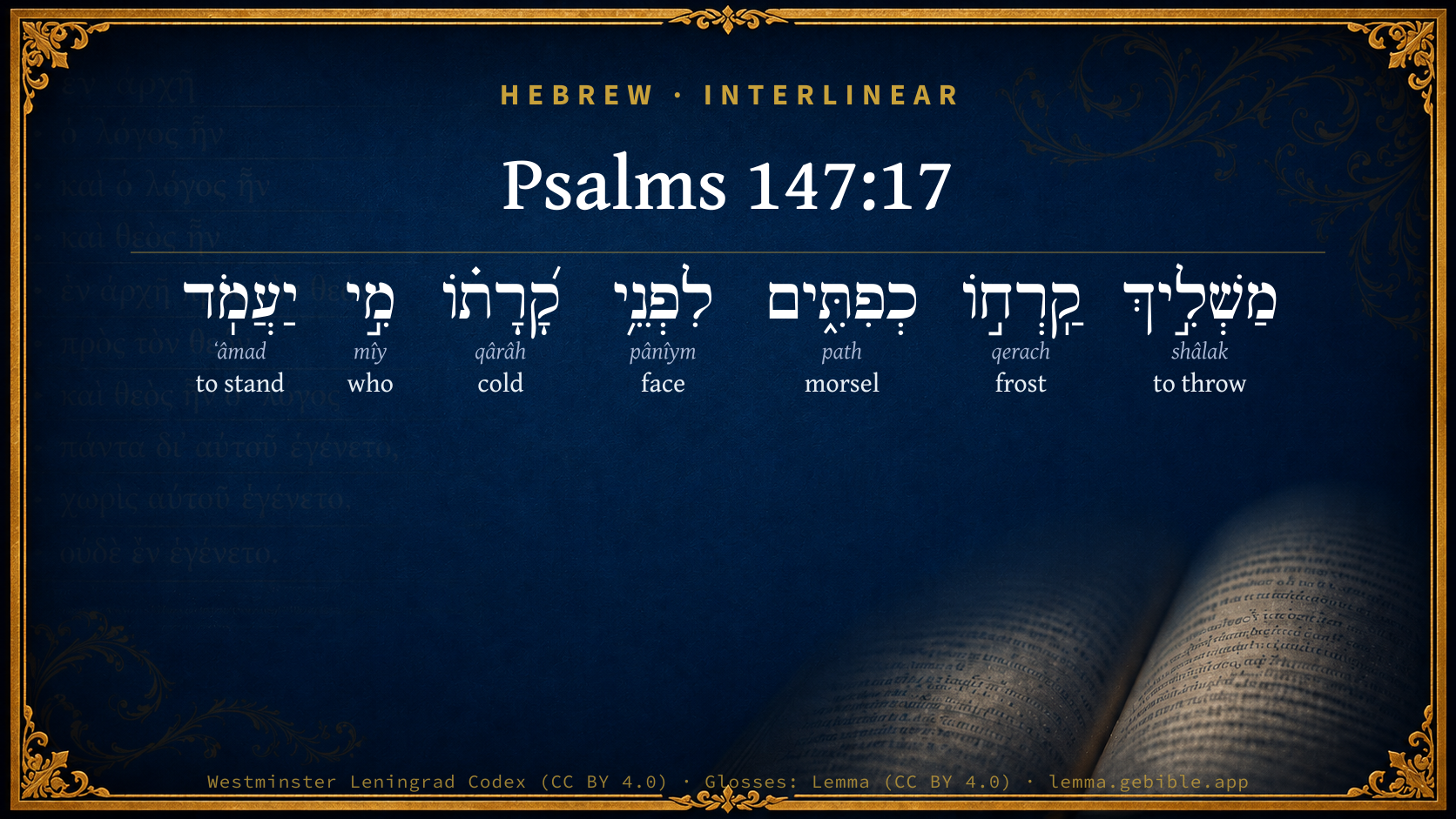
Hebrew (Westminster Leningrad Codex) Psalms 147:17 appears in the Hebrew Old Testament. The text above is from the Westminster Leningrad Codex. Each word links to its Strong’s number, a concise gloss, and parsing drawn from the Open Scriptures Hebrew Bible morphology. Click any word for its full Brown-Driver-Briggs (BDB) entry.
Download image
Cite this verse

Psalms 147:17 (World English Bible). Public Domain. Lemma interlinear Bible study tool, https://lemma.gebible.app/v/psalms/147/17.

Show BibTeX & RIS
BibTeX
RIS
English Translation
He hurls down his hail like pebbles. Who can stand before his cold?
World English Bible · Public Domain
Download a study sheet

One document with this verse’s original text, its word-by-word gloss line, the meaning frame, cross-references with their text, attributed commentary, and full source and license credits — printable, and it pastes into notes with its structure intact.

This verse Autodidact and up

Study sheet (.html) Plain text (.txt)

A passage Seminary Student

Up to 50 verses in one chapter. A passage sheet keeps up to 6 commentary sources and 12 cross-references per verse, in the order this page ranks them, and says so on the sheet whenever that leaves anything out. Ask for a single verse and you get the Autodidact verse sheet above.

Everything on this page stays free to read, with no account — the sheet is a download of what is already on screen, not access to it.

Want to remove ads? Support Godless Engineer
Compare translations 3

The same verse in 3 English versions, stacked beneath the original-language interlinear above. Click any original word for its lexicon entry.

Each is an independent rendering of the whole verse — the interlinear is not word-aligned to these translations.

Highlighted words mark where these versions differ — a whole-verse word diff, not a word-by-word alignment.

  • World English Bible Public Domain
    He hurls down his hail like pebbles. Who can stand before his cold?
  • King James Version Public Domain
    He casteth forth his ice like morsels: who can stand before his cold?
  • unfoldingWord Literal Text CC BY-SA 4.0
    The one sending his hail like crumbs, who can stand to the face of his cold?

unfoldingWord Literal Text — © unfoldingWord, licensed CC BY-SA 4.0. Word-aligned USFM3 via Door43 (git.door43.org/unfoldingWord/en_ult).

Versions to compare (up to 4)

3 of 4 selected

Show all 17 translations

Every available English version of this verse, each an independent rendering of the whole verse.

  • World English Bible Public Domain
    He hurls down his hail like pebbles. Who can stand before his cold?
  • Berean Standard Bible Public Domain
    He casts forth His hail like pebbles. Who can withstand His icy blast?
  • Majority Standard Bible Public Domain
    He casts forth His hail like pebbles. Who can withstand His icy blast?
  • King James Version Public Domain
    He casteth forth his ice like morsels: who can stand before his cold?
  • American Standard Version (1901) Public Domain
    He casteth forth his ice like morsels: Who can stand before his cold?
  • Revised Version (1885) Public Domain
    He casteth forth his ice like morsels: who can stand before his cold?
  • Geneva Bible (1599) Public Domain
    He casteth foorth his yce like morsels: who can abide the colde thereof?
  • Young's Literal Translation Public Domain
    Casting forth His ice like morsels, Before His cold who doth stand?
  • Literal Standard Version CC BY-SA 4.0
    Casting forth His ice like morsels, || Who stands before His cold?
  • Unlocked Literal Bible CC BY-SA 4.0
    He dispenses the hail like crumbs, who can withstand the cold he sends?
  • unfoldingWord Literal Text CC BY-SA 4.0
    The one sending his hail like crumbs, who can stand to the face of his cold?
  • Darby Bible Public Domain
    He casteth forth his ice like morsels: who can stand before his cold?
  • World Messianic Bible Public Domain
    He hurls down his hail like pebbles. Who can stand before his cold?
  • Webster's Bible Public Domain
    He casteth forth his ice like morsels: who can stand before his cold?
  • Free Bible Version CC BY-SA 4.0
    He throws hail like stones. Who can stand the cold he sends?
  • Bible in Basic English Public Domain
    He sends down ice like raindrops: water is made hard by his cold.
  • JPS Tanakh (1917) Public Domain
    He casteth forth His ice like crumbs; who can stand before His cold?

Literal Standard Version (2020), Covenant Press — licensed CC BY-SA 4.0. Text via the HelloAO Bible API (eBible.org). Unlocked Literal Bible (unfoldingWord) — licensed CC BY-SA 4.0. Text via the HelloAO Bible API (eBible.org). unfoldingWord Literal Text — © unfoldingWord, licensed CC BY-SA 4.0. Word-aligned USFM3 via Door43 (git.door43.org/unfoldingWord/en_ult). Free Bible Version, Dr. Jonathan Gallagher — licensed CC BY-SA 4.0. Text via the HelloAO Bible API (eBible.org).

Word by word

More ways to search: Search by grammar → Find every occurrence → Compare this word →

Practice this passage: Drill this verse → Learn its vocabulary →

About this verse

These counts appear in no published source. They are computed here, from the morphology-tagged text and Lemma’s own curated glosses. What Lemma adds →

7
words
7
distinct lemmas
Wisdom
section

Notable vocabulary

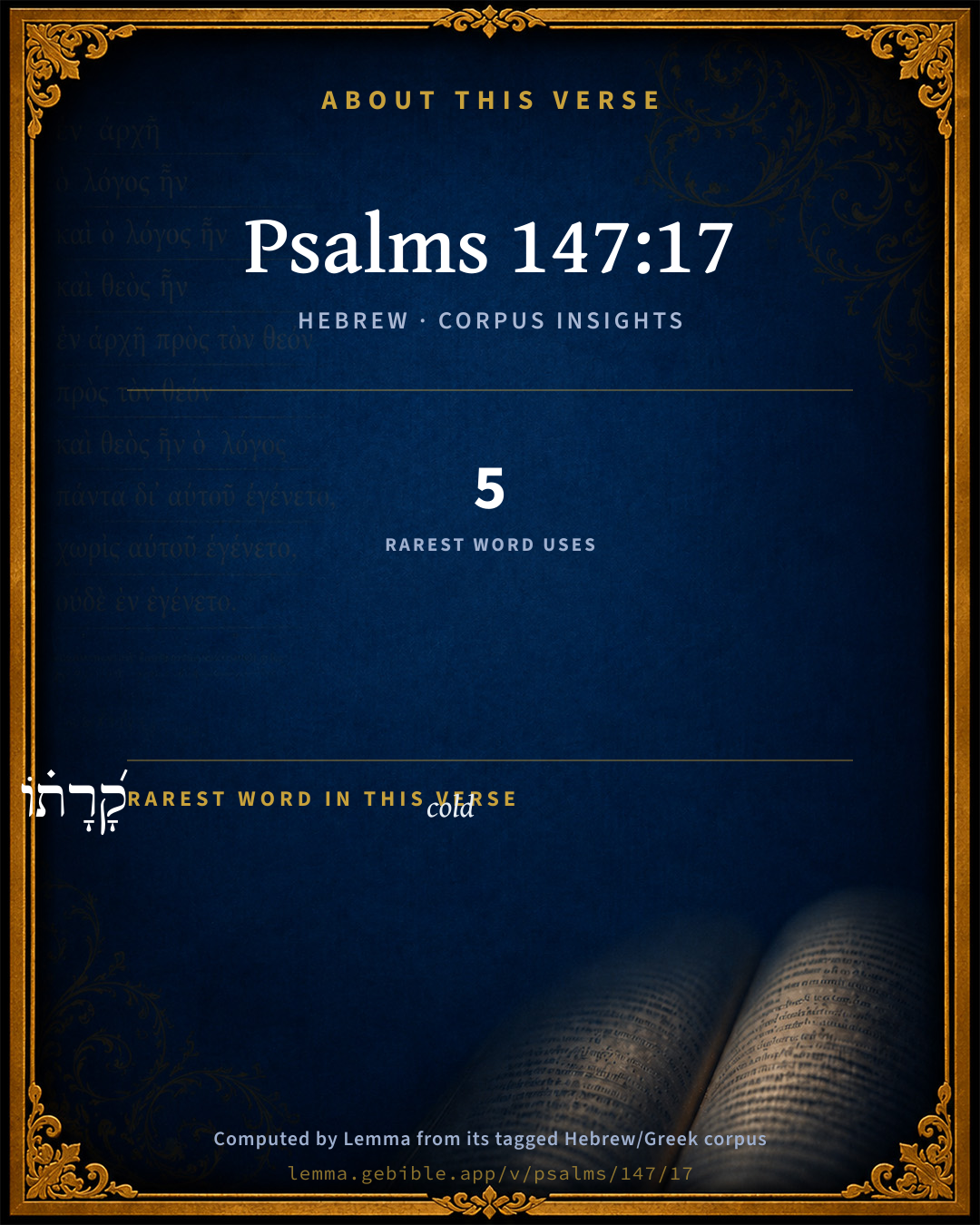
The rarest word here is קָ֝רָת֗וֹ cold H7135 — appearing just 5 times in the whole Hebrew Bible.

Shared distinctive vocabulary

קָ֝רָת֗וֹ cold H7135 occurs in 5 verses of the Hebrew Bible. Also found in:

Grammatical profile

  • 2 verbs
  • 4 nouns
  • 1 particle

Verb forms

  • מַשְׁלִ֣יךְ Hiphil · Participle Active
  • יַעֲמֹֽד Qal · Imperfect

Cross-references

6

Topical passages linked to Psalms 147:17 in the Treasury of Scripture Knowledge — connected by theme and wording, ordered by reader-vote popularity; previews shown in the World English Bible.

  • Job 38:29–30 Out of whose womb came the ice? The gray frost of the sky, who has given birth to it?
  • Job 38:22–23 Have you entered the treasuries of the snow, Or have you seen the treasures of the hail,
  • Job 37:9–10 Out of its chamber comes the storm, And cold out of the north.
  • Psalms 78:47–48 He destroyed their vines with hail, Their sycamore-fig trees with frost.
  • Exodus 9:23–25 Moses stretched forth his rod toward the heavens, and Yahweh sent thunder, hail, and lightning flashed down to the earth. Yahweh rained hail on the land of Egypt.
  • Joshua 10:11 It happened, as they fled from before Israel, while they were at the descent of Beth Horon, that Yahweh cast down great stones from the sky on them to Azekah, and they died: they were more who died with the hailstones than they whom the children of Israel killed with the sword.

Cross-references courtesy of OpenBible.info (CC BY 4.0).

Hebrew and Greek witnesses Masoretic Hebrew ↔ Greek Septuagint

The same verse in the two great witnesses to the Old Testament, shown verse-for-verse.

You’re reading Greek Psalm 146 (Hebrew Psalm 147). The Septuagint counts the superscription, so verse numbers can differ from the Hebrew — chapter-level alignment, not verse-by-verse. Numbering follows Rahlfs.

These are two independent witnesses, not word-aligned to each other, and the Septuagint is shown in lemma (dictionary) form.

Hebrew Psalms 147:17 Masoretic · Westminster Leningrad Codex

מַשְׁלִ֣יךְ קַֽרְח֣וֹ כְפִתִּ֑ים לִפְנֵ֥י קָ֝רָת֗וֹ מִ֣י יַעֲמֹֽד

He hurls down his hail like pebbles. Who can stand before his cold?

World English Bible · Public Domain

On this verse, The Treasury of David discusses the Septuagint’s reading. Read the note in Commentary ↓

Hebrew: Westminster Leningrad Codex (CC BY 4.0). Greek: Septuagint (public domain); English from a public-domain English Septuagint. How the Septuagint differs from the Hebrew →

Commentary

Notes on Psalms 147:17 from classic Christian and Jewish commentators (each source and its license shown beneath its notes). The classic Christian expositions comment on the surrounding passage and are grouped to its opening verse, so a note may address several verses; the Jewish commentaries on the Tanakh (Rashi and others) are per-verse, so they appear only where the commentator wrote on this verse.

Lemma curates 59 commentaries, every one of them public domain or Creative Commons licensed, each selected and text-cleaned for this edition rather than reprinted as found. About our sources →

Trapp's Complete Commentary

John Trapp

Psa 147:17 He casteth forth his ice like morsels: who can stand before his cold?

Ver. 17. He casteth forth his ice like morsels] Or, shivers of bread. It is a witty saying of one from this text: The ice is bread, the rain is drink, the snow is wool, the frost a fire to the earth, causing it inwardly to glow with heat; teaching us what to do for God’s poor.

Who can stand before his cold] Who can endure it, when and where it is extreme especially; as in Russia, Friezeland, &c.

John Trapp, A Commentary or Exposition upon All the Books of the Old and New Testament (1647–1656) — public domain. Text from a community e-Sword module.

The Biblical Illustrator

Joseph S. Exell

Psa_147:17

Who can stand before His cold?

His cold

In former days religious people were too much given to introducing the Deity directly into the workings of nature and the movements of history. The consequence was, that our forefathers made the Creator responsible for details, rather than for great leading principles and modes of action. In these last days there has been a marked recoil among thoughtful people from the old ideal. In certain intellectual quarters some have even gone to the other extreme; and, as usually happens in extremes, these cultured people of to-day have dropped into as great errors as their less cultured predecessors. As they represent Deity oftentimes, it would seem as if they had divorced Him from both nature and history; so that it is impossible to discover where His operation comes in, if it comes in at all. In the rich religious light of to-day it ought to be possible surely to bow before a God walking in the dignity of infinitely wise laws, and working in the silent majesty of infinite power; but also thinking, feeling, loving, in the interest of creatures on whom He has conferred a dignity first among living things.

I. His cold as a symbol of power. The power that can, in a few hours, bridge over the mightiest rivers with a pavement secure and stable, in strength and smoothness surpassing far the grandest of engineering feats; the power that can split up the rocks of the mountains, like cordwood under the axe of the feller; the power that can laugh at all known human powers, or forces arrayed against it; that must surely be a fit emblem of Him who sitteth upon the circle of the earth, and before whom the inhabitants thereof are as grasshoppers--Him who weigheth the mountains in scales, and the hills in a balance. May we have the true religious vision to see Him, and the ear to hear His voice.

II. The wisdom displayed in His cold. Water alone among bodies expands under cold. That anomaly explains how a small quantity of water getting deep down into the crevices of a mountain will, on freezing, split up its adamantine rocks as easily as a child sunders the petals of a buttercup. It explains why ice floats and does not sink; why the clayey soils so retentive of moisture are pulverized in winter, and made ready for the harrow in spring; why myriads of insects secreted in the soil are killed off in the torpid state where their parents thought they had found a secure nest for them against the rigours of the cold; and why cold is the best disinfectant if it be intense enough--destroying instantly the germs of disease as they appear in decaying vegetation, or foul garbage, or in impure drainage. What foul and hurtful thing can stand before His cold? The greatest blessing of all, however, is to be seen in the freezing of the flowing river. Because water expands under cold its specific gravity diminishes in the process of freezing, and so frozen water floats upon the unfrozen and heavier water below. By that means the ice-pavement is formed, which, on the one hand, is of immense value both to animals and man, and, on the other, preserves for the finny tribes their natural habitat intact.

III. The goodness of His cold. That standing exception of water alone expanding under cold, while other bodies contract, is not the least of many clear tokens of our almighty, all-wise Fathers care and goodness in the operation of His cold. Indeed, we might call it the greatest material blessing we can enjoy in that connection, for it is essential to our very existence. Still, after all, it is in the spiritual blessings which the material blessings suggest that the best blessing lies for devout souls. What stimulus to our spiritual nature in the contemplation of the Deity putting forth His mighty power and exercising His mighty mind to protect and provide for His creatures, as well as to expand and elevate their thoughts by the grandeur of His power in the works of His providence.

III. The method of His cold. Silently in the stilly night, under the jewelled canopy of heaven, a giants hand is laid upon rippling stream and solid land. Then, without the slightest sound of contending forces, or cry of pain, the vastest display of power under the mighty heaven is presented to thoughtful mortals, when the morning breaks, and eager life, awaking to its daily toil, finds the throne of the ice-king set up once again. What need we more impressive to inform us of a present divinity than such a feat of Divine workmanship? What a sublime consistency in work proclaiming abroad the sublime worker! All silent might; resistless power revelling in silence. What a lesson here also of the Divine majesty! No noisy demonstration in His grandest works; no straining after effect; no giant-like effort to secure success. In all His wide dominion self-confident, self-possessed, and modest, the great God marches silently through all the seasons working wonders as He goes. (J. E. Hill, B. D.)

Who can stand before His cold?

Not we, say the frozen lips of Sir John Franklin and his men, dying in Arctic exploration. Not we, answer Schwatka and his crew, falling back from the fortresses of ice which they had tried in vain to capture. Not we, say the abandoned and crushed decks of the Intrepid, the Resistance, and the Jeannette. The highest pillars of the earth are pillars of ice--Mont Blanc, Jungfrau, the Matterhorn. The largest galleries of the world are galleries of ice. Some of the mighty rivers are at this moment lying in captivity of ice. The greatest sculptors of the ages are the glaciers, with their arm and hand and chisel and hammer of ice. The cold is imperial, and has a crown of glittering crystal and is seated on a throne of ice, with a footstool of ice and sceptre of ice. One-half of the industries of our day are employed in battling the inclemency of the weather. The furs of the North, the cotton of the South, the flax of our own fields, the wool of our own flocks, the coal from our own mines, the wood from our own forests, all employed in battling these inclemencies, and still every January, with blue lips and chattering teeth, answers, None of us can stand before His cold. I am glad that the God of the frosts is the God of the heat; that the God of the snow is the God of the white blossoms; that the God of January is the God of June. The question as to how shall we warm this world up is a question of immense and all-encompassing practicality. In this zone and weather there are so many fireless hearths, so many broken window panes, so many defective roofs that sift the snow. Coal and wood and flannels and thick coats are better for warming up such a place than tracts and Bibles and creeds. Kindle that fire where it has gone out. Wrap something around those shivering limbs. Shoe those bare feet. Hat that bare head. Coat that bare back. Sleeve that bare arm. It is useless to preach to bare feet, and to empty stomachs, and to gaunt visages. Christ gave the world a lesson in common sense when, before preaching the Gospel to the multitude in the wilderness, He gave them a good dinner. It is the powerful heater--is the glorious furnace of Christian sympathy. The question ought to be, instead of how much heat can we absorb? how much beat can we throw out? Warm greeting, warm prayers, warm smiles, warm Christian influence. There are such persons. We bless God for them. We rejoice in their companionship. I have been for twenty-seven years studying how to make the Church warmer. Warmer architecture, warmer hymnology, warmer Christian salutation. All outside Siberian winter, we must have it a princes hothouse. The only institution on earth to-day that proposes to make the world warmer. Universities and observatories, they all have their work. They propose to make the world light, but they do not propose to make the world warm. Geology informs us, but it is as cold as the rock it hammers. The telescope shows where the other worlds are, but an astronomer is chilled while looking through it. Chemistry tells us of strange combinations, and how inferior affinity may be overcome by superior affinity; but it cannot tell how all things work together for good. Worldly philosophy has a great splendour, but it is the splendour of moonlight on an iceberg. The Church of God proposes warmth and hope--warmth for the expectations, warmth for the sympathies. Oh, I am so glad these great altar fires have been kindled I Come in out of the cold. Come in, and have your sins pardoned. Come in by the great Gospel fire-place. That is the way the cold world is going to be warmed up by the great Gospel fire-place. All nations will come and sit down at that banquet. While I was musing the fire burned. Come in out of the cold, come in out of the cold! (T. De Witt Talmage.)

The Biblical Illustrator, edited by Joseph S. Exell (c. 1880s–1900s) — public domain. Text from a community e-Sword module.

J. A. Alexander on Psalms

Joseph Addison Alexander

17. (Psa 147:17) He that sendeth his ice like crumbs. Before his cold who can stand? The second noun means scraps or morsels, but in usage is specially applied to food. See Gen 18:5, Jdg 19:5. This seems to be descriptive of hail, which God sends upon the earth as easily and freely as man scatters crumbs or throws away the refuse of his food. The allusion to the feeding of domesticated animals, which some assume, is needless, though admissible.

Joseph Addison Alexander, The Psalms Translated and Explained (1850) — public domain. Text from a community e-Sword module.

Jamieson, Fausset & Brown

Robert Jamieson, A. R. Fausset & David Brown

morsels--used as to food (Gen 18:5), perhaps here denotes hail.

Jamieson, Fausset & Brown — Commentary Critical and Explanatory on the Whole Bible (1871) — public domain (CC PDM 1.0). Text via the HelloAO Bible API.

Adam Clarke's Commentary

Verse 17. He casteth forth his ice] קרחו korcho, (probably hailstones,) like crumbs.

Who can stand before his cold?] At particular times the cold in the east is so very intense as to kill man and beast. Jacobus de Vitriaco, one of the writers in the Gesta Dei per Francos, says, that in an expedition in which he was engaged against Mount Tabor, on the 24th of December, the cold was so intense that many of the poor people, and the beasts of burden, died by it. And Albertus Aquensis, another of these writers, speaking of the cold in Judea, says, that thirty of the people who attended Baldwin I. in the mountainous districts near the Dead Sea, were killed by it; and that in that expedition they had to contend with horrible hail and ice, with unheard-of snow and rain. From this we find that the winters are often very severe in Judea; and in such cases as the above, we may well call out, "Who can stand against his cold!"

Adam Clarke's Commentary on the Bible (1810–1826) — public domain. Text from a community e-Sword/MySword module.

Ellicott's Commentary for English Readers

(17) Morsels.—Or, crumbs. (Gen_18:5; Jdg_19:5.) Doubtless the allusion is to hail.

A Bible Commentary for English Readers, edited by Charles John Ellicott (1878–1897) — public domain. Text from a community e-Sword module.

The Cambridge Bible for Schools and Colleges

gen. ed. J. J. S. Perowne

17. his ice like morsels] Hail, like fragments or crumbs of bread.

The Cambridge Bible for Schools and Colleges (gen. ed. J. J. S. Perowne; Cambridge University Press, 1878–1918) — public domain. Text from a community e-Sword module.

John Gill's Exposition

He casteth forth his ice like morsels,.... Divided like morsels, as the Targum; cut into pieces, like morsels of bread. This seems to have respect to hail stones, which sometimes fall like pieces of ice, and are very prejudicial to the fruits of the earth: this was one of the ten plagues of Egypt; and whereby also many of the Canaanites were destroyed in the times of Joshua, Exo 9:23; and there is an exceeding great storm of hail yet to come, very dreadful; see Rev 16:21. This is expressive of the wrath, vengeance, and judgments of God upon men, by which he is known in various perfections of his nature; as his power, justice, and holiness, for which he is celebrated, Isa 30:30;

who can stand before his cold? which he has purposed and promised shall be; for he has said, that "cold and heat shall not cease, as long as the earth remains"; and which he appoints and orders to be, for "by the breath of God frost is given", Gen 8:22; and this is sometimes and in some places so very vehement, that it is intolerable; men are obliged to keep within doors, to make them fires, and put on more clothes; and the "hands" of every man are sealed up from business; even "the beasts go into their dens, and remain in their places", or get what shelter they can; see Job 37:7. And if there is no standing before his cold, who can stand before the heat of his anger, or his furious wrath and indignation, when it is poured out like fire? see Psa 76:7.

John Gill's Exposition of the Whole Bible (1746–1763) — public domain (CC PDM 1.0). Text via the HelloAO Bible API.

Albert Barnes' Notes on the Bible

He casteth forth his ice like morsels - The word rendered morsels means properly a bit, a crumb, as of bread, Gen 18:5; Jdg 19:5. The allusion here would seem to be to hail, which God sends upon the earth as easily as one scatters crumbs of bread from the hand.

Who can stand before his cold? - Or, hail. The word is the same, except in pointing, as the preceding word rendered ice. The idea is that no one can stand before the peltings of the hail, when God sends it forth, or scatters it upon the earth.

Albert Barnes' Notes on the Bible (1834–1885) — public domain. Text from a community e-Sword/MySword module.

Matthew Poole's English Annotations

His ice; either,

1. Pieces of ice, which God may be said to

cast forth, or to cast down, because he sendeth it, and ofttimes suddenly; or,

2. Great hailstones, which are of an icy nature and substance, and which are very properly

cast forth or cast down out of the clouds, and that like morsels or fragments, the particles being congealed in them.

His cold; the cold which he sometimes sends into the air is so sharp, that it would be intolerable, if men did not defend themselves from it by houses, clothes, fire, &c.

Matthew Poole's English Annotations on the Holy Bible (1683–1685) — public domain. Text from a community e-Sword/MySword module.

The Treasury of David

Charles H. Spurgeon

Ver. 17. He casteth forth his ice like morsels. Such are the crumbs of hail which he casts forth, or the crusts of ice which he creates upon the waters. These morsels are his ice, and he casts them abroad. The two expressions indicate a very real presence of God in the phenomena of nature. Who can stand before his cold? None can resist the utmost rigours of cold any more than they can bear the vehemence of heat. God's withdrawals of light are a darkness that may be felt, and his withdrawals of heat are a cold which is absolutely omnipotent. If the Lord, instead of revealing himself as a fire, should adopt the opposite manifestation of cold, he would, in either case, consume us should he put forth all his power. It is ours to submit to deprivations with patience, seeing the cold is his cold. That which God sends, whether it be heat or cold, no man can defy with impunity, but he is happy who bows before it with childlike submission. When we cannot stand before God we will gladly lie at his feet, or nestle under his wings.

Ver. 17. He casteth forth his ice like morsels. Or, shivers of bread. It is a worthy saying of one from this text, The ice is bread, the rain is drink, the snow is wool, the frost a fire to the earth, causing it inwardly to glow with heat; teaching us what to do for God's poor. John Trapp.

Ver. 17. He casteth forth his ice like morsels. The word here translated "morsels", means, in most of the places where it occurs in the Bible, pieces of bread, exactly the LXX qwmouv; for this very ice, this wintry cold, is profitable to the earth, to fit it for bearing future harvests, and thus it matures the morsels of bread which man will yet win from the soil in due season. Genebrardus, in Neale and Littledale.

Ver. 17. Morsels. Or, crumbs. Ge 18:5 Jud 19:5. Doubtless the allusion is to hail. A.S. Aglen.

Ver. 17. "It is extremely severe", said his sister to Archbishop Leighton one day, speaking of the season. The good man only said in reply, "But thou, O God, hast made summer and winter." From J.J. Pearson's Life of Archbishop Leighton, 1830.

Psalms 147:18*

Charles H. Spurgeon's The Treasury of David (1869–1885) — public domain. Psalms only. Text from a community e-Sword/MySword module.

The Pulpit Commentary

He casteth forth his ice like morsels; or, "like crumbs;" i.e. in profusion, as men feed birds. The "ice" intended would seem to be that of hailstones. Who can stand before his cold? Though the thermometer rarely shows more than six or seven degrees of frost in Palestine, yet the Oriental is as much chilled by such a temperature as the Englishman by one twenty degrees lower. He shivers in his light attire, and is very reluctant to leave the shelter of his house or tent.

The Pulpit Commentary (1880–1919), ed. H.D.M. Spence-Jones & Joseph S. Exell — public domain. Text from a community e-Sword module.

John Wesley's Explanatory Notes

Ice - Great hail-stones, which are of an icy nature, and are cast forth out of the clouds, like morsels or fragments.

John Wesley, Explanatory Notes Upon the Whole Bible (1754–1765) — public domain. Text via the GEBible commentary corpus.

unfoldingWord translationNotes

Door43 World Missions Community

He dispenses the hail like crumbs

Yahweh scatters hail as easily as a person would scatter bread crumbs. AT: "He dispenses the hail easily, as if it were crumbs" (See: Simile)

He dispenses

"He sends"

hail

small pieces of ice that fall from the sky like rain

who can withstand the cold he sends?

The writer uses this question to emphasize that it is difficult to endure the cold weather that Yahweh causes. AT: "no one can live in the cold he sends." (See: Rhetorical Question)

He sends out his command and melts them

The writer speaks of Yahweh's command as if it were his messenger. The word "command" can be translated with a verb. AT: "He commands the ice to melt" (See: Metaphor and Abstract Nouns)

translationWords

send

command

unfoldingWord translationNotes — © Distant Shores Media and the Door43 World Missions Community, licensed CC BY-SA 4.0. Source: git.door43.org/Door43/en_tn.

Rashi

Rabbi Shlomo Yitzchaki (Rashi)

He hurls His ice like crumbs The water congeals and becomes crumbs. [According to] Midrash Aggadah: like crumbs Everything [is] according to the burden of the people: the poor man—according to his lack of clothing, He is lenient with him.

who can stand that he should not become chilled from His cold?

Rashi on the Tanakh — English translations: “The Judaica Press complete Tanach with Rashi, translated by A. J. Rosenberg” (CC BY 4.0); “Pentateuch with Rashi's commentary by M. Rosenbaum and A.M. Silbermann, 1929-1934” (public domain); “The Metsudah Tanach series, Lakewood, N.J” (CC BY 4.0); and “The Book of Joshua, Metsudah Publications, 1997” (CC BY 4.0). Text via Sefaria.

Lesson kit

Teaching starters — assembled from the data on this page, not authored interpretation. Every prompt links to the verse data it draws on. Edit before teaching.

Psalms, in the Wisdom, opens this verse with 7 words (7 distinct Hebrew lemmas). Its most distinctive word is qârâh (“cold”). A historical commentator’s framing appears above. Read the whole chapter for the surrounding context.

Discussion questions

  1. The word qârâh carries the sense “cold.” How does it shape the verse?
  2. Job 24:7 shares the word «cold» with this verse. How do the two illuminate each other?
  3. The translations on this page render this verse differently — a whole-verse word diff, not a word-by-word alignment. What might account for the different wordings?
  4. The verb «מַשְׁלִ֣יךְ» is Hiphil Participle Active. How does its form color the action?
  5. Reading how Trapp's Complete Commentary and The Biblical Illustrator read this verse, where do the two commentators agree and where do they part?

Things to notice

Reading settings

Reading text

Shown beneath each verse's original-language words.

Old Testament
Old Testament edition

Read the OT as the Masoretic Hebrew (MT) or the Greek Septuagint (LXX).

English shown for the Greek Septuagint (in the Hebrew ↔ Greek comparison).

Comparing translations? Open the Compare panel on any verse page to stack up to four side by side.