
Ezekiel 19:12

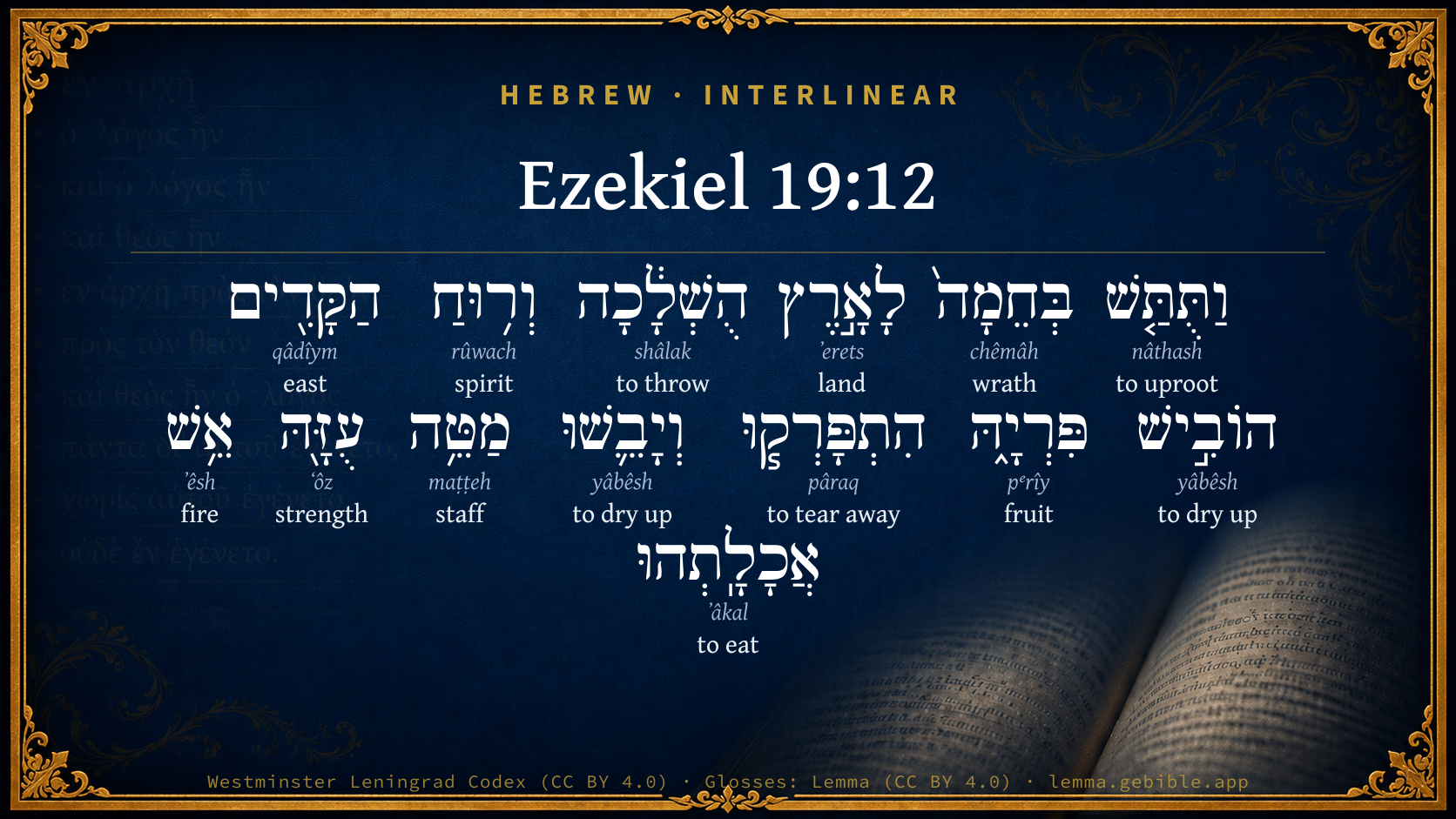
Hebrew (Westminster Leningrad Codex) Ezekiel 19:12 appears in the Hebrew Old Testament. The text above is from the Westminster Leningrad Codex. Each word links to its Strong’s number, a concise gloss, and parsing drawn from the Open Scriptures Hebrew Bible morphology. Click any word for its full Brown-Driver-Briggs (BDB) entry.
Download image
Cite this verse

Ezekiel 19:12 (World English Bible). Public Domain. Lemma interlinear Bible study tool, https://lemma.gebible.app/v/ezekiel/19/12.

Show BibTeX & RIS
BibTeX
RIS
English Translation
But it was plucked up in fury, it was cast down to the ground, and the east wind dried up its fruit: its strong rods were broken off and withered; the fire consumed them.
World English Bible · Public Domain
Download a study sheet

One document with this verse’s original text, its word-by-word gloss line, the meaning frame, cross-references with their text, attributed commentary, and full source and license credits — printable, and it pastes into notes with its structure intact.

This verse Autodidact and up

Study sheet (.html) Plain text (.txt)

A passage Seminary Student

Up to 50 verses in one chapter. A passage sheet keeps up to 6 commentary sources and 12 cross-references per verse, in the order this page ranks them, and says so on the sheet whenever that leaves anything out. Ask for a single verse and you get the Autodidact verse sheet above.

Everything on this page stays free to read, with no account — the sheet is a download of what is already on screen, not access to it.

Want to remove ads? Support Godless Engineer
Compare translations 3

The same verse in 3 English versions, stacked beneath the original-language interlinear above. Click any original word for its lexicon entry.

Each is an independent rendering of the whole verse — the interlinear is not word-aligned to these translations.

Highlighted words mark where these versions differ — a whole-verse word diff, not a word-by-word alignment.

  • World English Bible Public Domain
    But it was plucked up in fury, it was cast down to the ground, and the east wind dried up its fruit: its strong rods were broken off and withered; the fire consumed them.
  • King James Version Public Domain
    But she was plucked up in fury, she was cast down to the ground, and the east wind dried up her fruit: her strong rods were broken and withered; the fire consumed them.
  • unfoldingWord Literal Text CC BY-SA 4.0
    But the vine was uprooted in fury and thrown down to the earth, and an eastern wind dried out its fruit. Its strong branches were broken off and withered and fire consumed them.

unfoldingWord Literal Text — © unfoldingWord, licensed CC BY-SA 4.0. Word-aligned USFM3 via Door43 (git.door43.org/unfoldingWord/en_ult).

Versions to compare (up to 4)

3 of 4 selected

Show all 18 translations

Every available English version of this verse, each an independent rendering of the whole verse.

  • World English Bible Public Domain
    But it was plucked up in fury, it was cast down to the ground, and the east wind dried up its fruit: its strong rods were broken off and withered; the fire consumed them.
  • Berean Standard Bible Public Domain
    But it was uprooted in fury, cast down to the ground, and the east wind dried up its fruit. Its strong branches were stripped off and they withered; the fire consumed them.
  • Majority Standard Bible Public Domain
    But it was uprooted in fury, cast down to the ground, and the east wind dried up its fruit. Its strong branches were stripped off and they withered; the fire consumed them.
  • King James Version Public Domain
    But she was plucked up in fury, she was cast down to the ground, and the east wind dried up her fruit: her strong rods were broken and withered; the fire consumed them.
  • American Standard Version (1901) Public Domain
    But it was plucked up in fury, it was cast down to the ground, and the east wind dried up its fruit: its strong rods were broken off and withered; the fire consumed them.
  • Revised Version (1885) Public Domain
    But she was plucked up in fury, she was cast down to the ground, and the east wind dried up her fruit: her strong rods were broken off and withered; the fire consumed them.
  • Geneva Bible (1599) Public Domain
    But she was plucked vp in wrath: she was cast downe to the ground, and the East winde dried vp her fruite: her branches were broken, and withered: as for the rod of her strength, the fire consumed it.
  • Douay-Rheims (1899) Public Domain
    But she was plucked up in wrath, and cast on the ground, and the burning wind dried up her fruit: her strong rods are withered, and dried up: the fire hath devoured her.
  • Young's Literal Translation Public Domain
    And it is plucked up in fury, To the earth it hath been cast, And the east wind hath dried up its fruit, Broken and withered hath been the rod of its strength, Fire hath consumed it.
  • Literal Standard Version CC BY-SA 4.0
    And she is plucked up in fury, || She has been cast to the earth, || And the east wind has dried up her fruit, || [The] rod of her strength has been broken and withered, || Fire has consumed it.
  • Unlocked Literal Bible CC BY-SA 4.0
    But the vine was uprooted in fury and thrown down to the earth, and an eastern wind dried out its fruit. Its strong branches were broken off and withered and fire consumed them.
  • unfoldingWord Literal Text CC BY-SA 4.0
    But the vine was uprooted in fury and thrown down to the earth, and an eastern wind dried out its fruit. Its strong branches were broken off and withered and fire consumed them.
  • Darby Bible Public Domain
    But it was plucked up in fury, it was cast down to the ground, and the east wind dried up its fruit; its strong rods were broken and withered; the fire consumed them.
  • World Messianic Bible Public Domain
    But it was plucked up in fury. It was cast down to the ground, and the east wind dried up its fruit. Its strong branches were broken off and withered. The fire consumed them.
  • Webster's Bible Public Domain
    But she was plucked up in fury, she was cast down to the ground, and the east wind dried up her fruit: her strong rods were broken and withered; the fire consumed them.
  • Free Bible Version CC BY-SA 4.0
    But it was uprooted in anger and thrown down on the ground. The east wind blew and dried up its fruit. Its strong branches were stripped of leaves and they withered. Then they were burned up in the fire.
  • Bible in Basic English Public Domain
    But she was uprooted in burning wrath, and made low on the earth; the east wind came, drying her up, and her branches were broken off; her strong rod became dry, the fire made a meal of it.
  • JPS Tanakh (1917) Public Domain
    But she was plucked up in fury, she was cast down to the ground, and the east wind dried up her fruit; her strong rods were broken off and withered, the fire consumed her.

Literal Standard Version (2020), Covenant Press — licensed CC BY-SA 4.0. Text via the HelloAO Bible API (eBible.org). Unlocked Literal Bible (unfoldingWord) — licensed CC BY-SA 4.0. Text via the HelloAO Bible API (eBible.org). unfoldingWord Literal Text — © unfoldingWord, licensed CC BY-SA 4.0. Word-aligned USFM3 via Door43 (git.door43.org/unfoldingWord/en_ult). Free Bible Version, Dr. Jonathan Gallagher — licensed CC BY-SA 4.0. Text via the HelloAO Bible API (eBible.org).

Word by word

More ways to search: Search by grammar → Find every occurrence → Compare this word →

Practice this passage: Drill this verse → Learn its vocabulary →

הִתְפָּרְק֧וּ
pâraq
H6561
“to tear away”
Verb, Hithpael, Perfect, 3rd Person, Common, Plural
Part of Speech
Verb
Stem
Hithpael
Form
Perfect
Person
3rd Person
Gender
Common
Number
Plural
Full BDB Definition

Origin: a primitive root

TWOT: 1828

to tear apart or away, tear off, break away - (Qal) to tear away, snatch, rescue - (Piel) to tear off - (Hithpael) to tear off from oneself, be broken off, be broken in pieces
  1. וַתֻּתַּ֤שׁ nâthash H5428 “and · to uproot” Conjunction + Verb, Hophal, Sequential Imperfect, 3rd Person, Feminine, Singular
  2. בְּחֵמָה֙ chêmâh H2534 “in/at · wrath” Preposition + Noun, Common, Feminine, Singular, Absolute
  3. לָאָ֣רֶץ ʼerets H776 “to/for the · land” Preposition, Determined + Noun, Common, Both, Singular, Absolute
  4. הֻשְׁלָ֔כָה shâlak H7993 “to throw” Verb, Hophal, Perfect, 3rd Person, Feminine, Singular
  5. וְר֥וּחַ rûwach H7307 “and · spirit of” Conjunction + Noun, Common, Both, Singular, Construct
  6. הַקָּדִ֖ים qâdîym H6921 “the · east” Particle, Definite Article + Noun, Common, Masculine, Singular, Absolute
  7. הוֹבִ֣ישׁ yâbêsh H3001 “to dry up” Verb, Hiphil, Perfect, 3rd Person, Masculine, Singular
  8. פִּרְיָ֑הּ pᵉrîy H6529 “fruit · her” Noun, Common, Masculine, Singular, Construct + Suffix, Personal, 3rd Person, Feminine, Singular
  9. וְיָבֵ֛שׁוּ yâbêsh H3001 “and · to dry up” Conjunction + Verb, Qal, Perfect, 3rd Person, Common, Plural
  10. מַטֵּ֥ה maṭṭeh H4294 “staff of” Noun, Common, Masculine, Singular, Construct
  11. עֻזָּ֖הּ ʻôz H5797 “strength · her” Noun, Common, Masculine, Singular, Construct + Suffix, Personal, 3rd Person, Feminine, Singular
  12. אֵ֥שׁ ʼêsh H784 “fire” Noun, Common, Both, Singular, Absolute
  13. אֲכָלָֽתְהוּ ʼâkal H398 “to eat · him” Verb, Qal, Perfect, 3rd Person, Feminine, Singular + Suffix, Personal, 3rd Person, Masculine, Singular

About this verse

These counts appear in no published source. They are computed here, from the morphology-tagged text and Lemma’s own curated glosses. What Lemma adds →

14
words
13
distinct lemmas
Prophets
section

Notable vocabulary

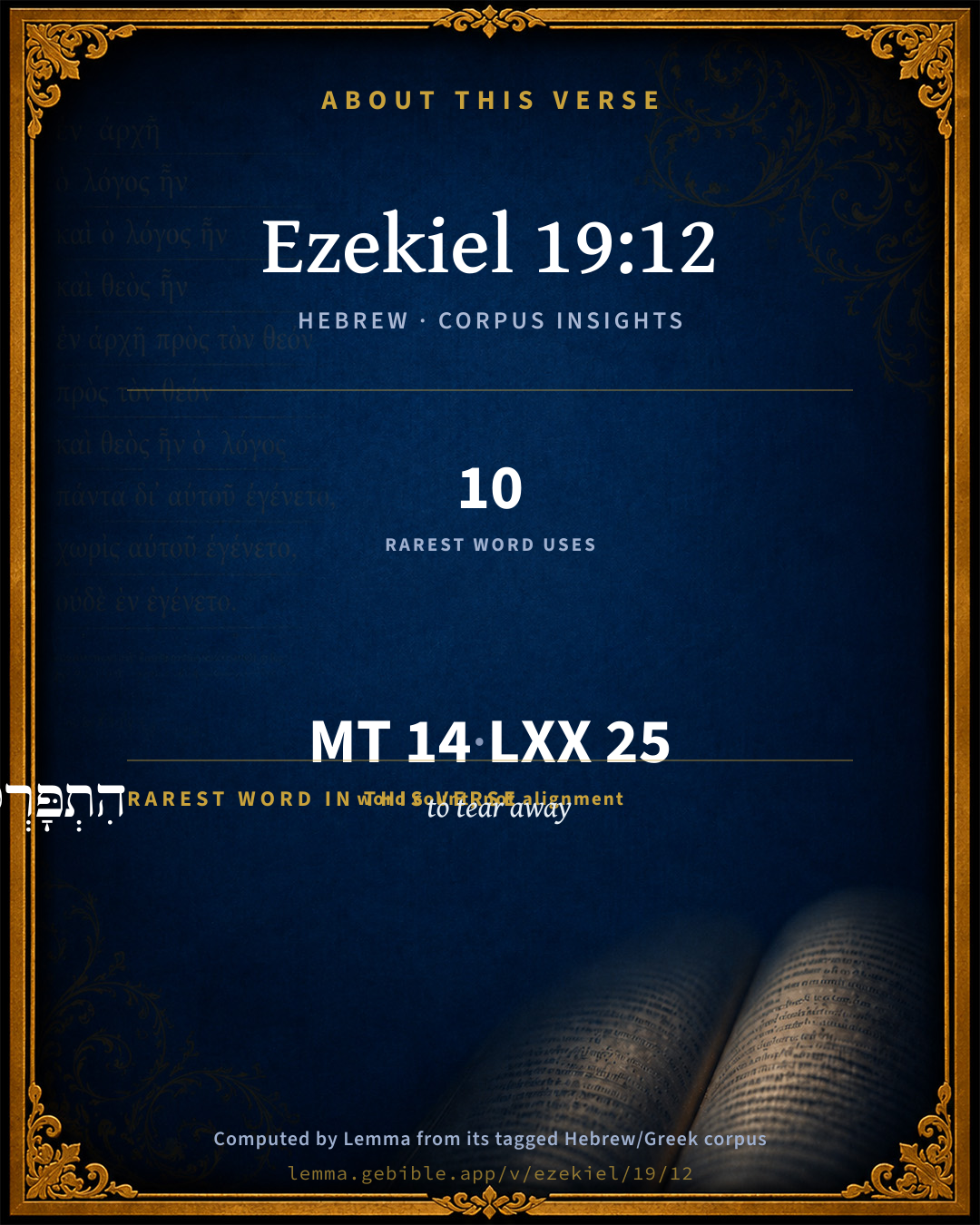
The rarest word here is הִתְפָּרְק֧וּ to tear away H6561 — appearing just 10 times in the whole Hebrew Bible.

Shared distinctive vocabulary

הִתְפָּרְק֧וּ to tear away H6561 occurs in 10 verses of the Hebrew Bible. Also found in:

Grammatical profile

  • 6 verbs
  • 8 nouns

Verb forms

  • וַתֻּתַּ֤שׁ Hophal · Sequential Imperfect
  • הֻשְׁלָ֔כָה Hophal · Perfect
  • הוֹבִ֣ישׁ Hiphil · Perfect
  • הִתְפָּרְק֧וּ Hithpael · Perfect
  • וְיָבֵ֛שׁוּ Qal · Perfect
  • אֲכָלָֽתְהוּ Qal · Perfect

Repetition

A word recurs within this verse — often emphatic in Hebrew:

  • הוֹבִ֣ישׁ to dry up H3001 ×2

Hebrew & Septuagint length

In English translation the verse runs 34 words from the Hebrew and 37 from the Septuagint (LXX English) — closely comparable.

A rough comparison of the two English renderings, which tokenize alike — not a word-level alignment.

Word counts can differ between the Hebrew and the Greek without any difference in meaning — e.g. the Hebrew direct-object marker אֵת has no separate Greek word, and Greek often adds the article ὁ.

In the original languages it is 14 Hebrew tokens and 25 Greek tokens — but the two are counted differently (Hebrew bundles its prefixes and suffixes into one token; the Greek is in lemma form), so that isn’t a like-for-like length.

Cross-references

27

Topical passages linked to Ezekiel 19:12 in the Treasury of Scripture Knowledge — connected by theme and wording, ordered by reader-vote popularity; previews shown in the World English Bible.

  • Ezekiel 17:10 Yes, behold, being planted, shall it prosper? shall it not utterly wither, when the east wind touches it? it shall wither in the beds where it grew.
  • Hosea 13:15 Though he is fruitful among his brothers, an east wind will come, The breath of Yahweh coming up from the wilderness; And his spring will become dry, And his fountain will be dried up. He will plunder the storehouse of treasure.
  • Isaiah 27:11 When the boughs of it are withered, they shall be broken off; the women shall come, and set them on fire; for it is a people of no understanding: therefore he who made them will not have compassion on them, and he who formed them will show them no favor.
  • Jeremiah 31:28 It shall happen that, like as I have watched over them to pluck up and to break down and to overthrow and to destroy and to afflict, so will I watch over them to build and to plant, says Yahweh.
  • Ezekiel 15:4 Behold, it is cast into the fire for fuel; the fire has devoured both the ends of it, and the midst of it is burned: is it profitable for any work?
  • Ezekiel 19:11 It had strong rods for the scepters of those who bore rule, and their stature was exalted among the thick boughs, and they were seen in their height with the multitude of their branches.
  • Deuteronomy 32:22 For a fire is kindled in my anger, Burns to the lowest Sheol, Devours the earth with its increase, Sets on fire the foundations of the mountains.
  • 2 Kings 23:29 In his days Pharaoh Necoh king of Egypt went up against the king of Assyria to the river Euphrates: and king Josiah went against him; and [Pharaoh Necoh] killed him at Megiddo, when he had seen him.
  • 2 Kings 23:34 Pharaoh Necoh made Eliakim the son of Josiah king in the room of Josiah his father, and changed his name to Jehoiakim: but he took Jehoahaz away; and he came to Egypt, and died there.
  • 2 Kings 24:6 So Jehoiakim slept with his fathers; and Jehoiachin his son reigned in his place.
  • 2 Kings 24:14–16 He carried away all Jerusalem, and all the princes, and all the mighty men of valor, even ten thousand captives, and all the craftsmen and the smiths; none remained, save the poorest sort of the people of the land.
  • 2 Kings 25:6–7 Then they took the king, and carried him up to the king of Babylon to Riblah; and they gave judgment on him.
  • Psalms 52:5 God will likewise destroy you forever. He will take you up, and pluck you out of your tent, And root you out of the land of the living. Selah.
  • Psalms 80:12–13 Why have you broken down its walls, So that all those who pass by the way pluck it?
  • Psalms 80:16 It's burned with fire. It's cut down. They perish at your rebuke.
  • Psalms 89:40–45 You have broken down all his hedges. You have brought his strongholds to ruin.
  • Isaiah 5:5–6 Now I will tell you what I will do to my vineyard. I will take away its hedge, and it will be eaten up. I will break down its wall of it, and it will be trampled down.
  • Jeremiah 4:11–12 At that time shall it be said to this people and to Jerusalem, A hot wind from the bare heights in the wilderness toward the daughter of my people, not to winnow, nor to cleanse;
  • Jeremiah 22:10–11 Don't you weep for the dead, neither bemoan him; but weep sore for him who goes away; for he shall return no more, nor see his native country.
  • Jeremiah 22:18–19 Therefore thus says Yahweh concerning Jehoiakim the son of Josiah, king of Judah: they shall not lament for him, [saying], Ah my brother! or, Ah sister! They shall not lament for him, [saying] Ah lord! or, Ah his glory!
  • Jeremiah 22:25–27 and I will give you into the hand of those who seek your life, and into the hand of them of whom you are afraid, even into the hand of Nebuchadrezzar king of Babylon, and into the hand of the Chaldeans.
  • Jeremiah 22:30 Thus says Yahweh, Write you this man childless, a man who shall not prosper in his days; for no more shall a man of his seed prosper, sitting on the throne of David, and ruling in Judah.
  • Ezekiel 15:6–8 Therefore thus says the Lord Yahweh: As the vine tree among the trees of the forest, which I have given to the fire for fuel, so will I give the inhabitants of Jerusalem.
  • Ezekiel 20:47–48 and tell the forest of the South, Hear the word of Yahweh: Thus says the Lord Yahweh, Behold, I will kindle a fire in you, and it shall devour every green tree in you, and every dry tree: the flaming flame shall not be quenched, and all faces from the south to the north shall be burnt thereby.
  • Ezekiel 28:17 Your heart was lifted up because of your beauty; you have corrupted your wisdom by reason of your brightness: I have cast you to the ground; I have laid you before kings, that they may see you.
  • Matthew 3:10 "Even now the axe lies at the root of the trees. Therefore, every tree that doesn't bring forth good fruit is cut down, and cast into the fire.
  • John 15:6 If a man doesn't remain in me, he is thrown out as a branch, and is withered; and they gather them, throw them into the fire, and they are burned.

Cross-references courtesy of OpenBible.info (CC BY 4.0).

Hebrew and Greek witnesses Masoretic Hebrew ↔ Greek Septuagint

The same verse in the two great witnesses to the Old Testament, shown verse-for-verse.

These are two independent witnesses, not word-aligned to each other, and the Septuagint is shown in lemma (dictionary) form.

Hebrew Ezekiel 19:12 Masoretic · Westminster Leningrad Codex

וַתֻּתַּ֤שׁ בְּחֵמָה֙ לָאָ֣רֶץ הֻשְׁלָ֔כָה וְר֥וּחַ הַקָּדִ֖ים הוֹבִ֣ישׁ פִּרְיָ֑הּ הִתְפָּרְק֧וּ וְיָבֵ֛שׁוּ מַטֵּ֥ה עֻזָּ֖הּ אֵ֥שׁ אֲכָלָֽתְהוּ

But it was plucked up in fury, it was cast down to the ground, and the east wind dried up its fruit: its strong rods were broken off and withered; the fire consumed them.

World English Bible · Public Domain

Greek LXX Ezekiel 19:12 Septuagint · lemma form

καί κατακλάω ἐν θυμός ἐπί γῆ ῥίπτω καί ἄνεμος ὁ καύσων ξηραίνω ὁ ἐκλεκτός αὐτός ἐκδικέω καί ξηραίνω ὁ ῥάβδος ἰσχύς αὐτός πῦρ ἀναἁλίσκω αὐτός

But she was broken down in wrath, she was cast upon the ground, and the east wind dried up her choice branches: vengeance came upon them, and the rod of her strength was withered; fire consumed it.

LXX2012 (modern English Septuagint) · Public Domain

Hebrew: Westminster Leningrad Codex (CC BY 4.0). Greek: Septuagint (public domain); English from LXX2012 (modern English Septuagint) (Public Domain). How the Septuagint differs from the Hebrew →

Targum (Aramaic paraphrase)

1

The Targum is the ancient Jewish Aramaic paraphrase of the Hebrew Scriptures — an interpretive translation, not the Hebrew text itself. Onkelos (literal) and Pseudo-Jonathan (expansive) render the Torah, and Jonathan the Prophets. Coverage is partial: where no permissively-licensed English translation exists for a verse, only the Aramaic is shown. This is verse-level text, not a word-by-word alignment to the Hebrew.

  1. Targum Jonathan Prophets (Joshua–Malachi)
    וְאִתְעַקְרַת בִּתְקוֹף מֵאַרְעָא בֵּית שְׁכִנְתָּא לְאַרְעָא אוֹחֲרֵי אִתְגְלִיאַת וּמְלַךְ דְתַקִיף כְּרוּחַ קִידוּמָא קְטֵיל עַמָהּ אִטַלְטָלוּ וּגְלוֹ שִׁלְטוֹנֵי תוּקְפָא וְעַמְמַיָא דְתַקִיפִין כְּאֶשְׁתָּא שֵׁיצִיאִינוּן:

    (no public-domain English translation for this verse)

    Targum Jonathan — Aramaic: “Mikraot Gedolot” (public domain). English: “Sefaria Community Translation” (CC0 1.0 (public-domain dedication)); “London "Chaldee Paraphrase," 1871” (public domain). Text via Sefaria.

Commentary

Notes on Ezekiel 19:12 from classic Christian and Jewish commentators (each source and its license shown beneath its notes). The classic Christian expositions comment on the surrounding passage and are grouped to its opening verse, so a note may address several verses; the Jewish commentaries on the Tanakh (Rashi and others) are per-verse, so they appear only where the commentator wrote on this verse.

Lemma curates 59 commentaries, every one of them public domain or Creative Commons licensed, each selected and text-cleaned for this edition rather than reprinted as found. About our sources →

Trapp's Complete Commentary

John Trapp

Eze 19:12 But she was plucked up in fury, she was cast down to the ground, and the east wind dried up her fruit: her strong rods were broken and withered; the fire consumed them.

Ver. 12. But she was plucked up in fury.] And so thrown with a force to the ground, as a man doth a dry or barren plant.

The east wind dried up her fruit.] See Eze 17:10. It is ventus urens et exsiccans; burning and drying wind this was Nebuchadnezzar and his army.

John Trapp, A Commentary or Exposition upon All the Books of the Old and New Testament (1647–1656) — public domain. Text from a community e-Sword module.

The Biblical Illustrator

Joseph S. Exell

Eze_19:12

Her strong rods were broken and withered.

Gods judgment in breaking the strong rods of a community

I. What qualifications of those who are in public authority may properly give them the denomination of strong rods.

1. Great ability for the management of public affairs. This is the case when they are men of largeness of understanding, especially when they have a natural genius for government.

2. Largeness of heart and a greatness and nobleness of disposition. It is peculiarly unbecoming them to be capable of little intrigues.

3. The spirit of government. They must have a peculiar aptitude for using their knowledge, and a spirit of resolution and activity.

4. Stability. A strong rod must be immovable in the execution of justice and judgment.

5. It contributes to the strength of a rod when he is in such circumstances as give him advantage for the exercise of his strength.

II. When such strong rods are broken and withered by death, it is a judgment of God upon the people who are deprived of them.

1. By reason of the many positive benefits and blessings to a people that such men are the instruments of (Psa_82:5; Psa_11:3). Their influence has a tendency to promote wealth and virtue (Ecc_10:17). Solomon was a remarkable illustration of this truth. (See 1Ki_4:25; 1Ki_10:27).

2. On account of the great calamities they are a defence from. Government is necessary to defend communities from miseries from within themselves; they are the heads of union without which nothing is to be expected but remediless and endless broils. We see the need of government in societies, by what is visible in families,--those lesser societies of which all public societies are constituted,--and as government is absolutely necessary, so there is a necessity of strong rods in order to it: the business being such as requires persons so qualified.

3. They are no less necessary to defend the community from foreign enemies. As they are like the pillars of a building, so they are like the bulwarks of a city; they are under God a peoples main strength in time of war (Lam_4:20; Neh_9:27). On these accounts, when a nation is strong, rods are broken; it is a judgment worthy of such lamentation as that which followed the death of King Josiah, who is one of those doubtless referred to in the text (2Ch_35:24-25). (Jonathan Edwards.)

.

The Biblical Illustrator, edited by Joseph S. Exell (c. 1880s–1900s) — public domain. Text from a community e-Sword module.

Geneva Bible (1599)

Geneva Bible translators

Meaning, that the Chaldeans should destroy them as the East wind doth the fruit of the vine.

Geneva Bible (1599) marginal notes — public domain. Text via Bolls.life.

Jamieson, Fausset & Brown

Robert Jamieson, A. R. Fausset & David Brown

plucked up--not gradually withered. The sudden upturning of the state was designed to awaken the Jews out of their torpor to see the hand of God in the national judgment.

east wind--(See on Eze 17:10).

Jamieson, Fausset & Brown — Commentary Critical and Explanatory on the Whole Bible (1871) — public domain (CC PDM 1.0). Text via the HelloAO Bible API.

Adam Clarke's Commentary

Verse 12. But she was plucked up in fury] Jerusalem; taken after a violent and most destructive siege; Nebuchadnezzar being violently enraged against Zedekiah for breaking his oath to him.

She was cast down to the ground] Jerusalem was totally ruined, by being burned to the ground.

Her strong rods were broken] The children of Zedekiah were slain before his eyes, and after that his own eyes pulled out; and he was laden with chains, and carried into Babylon.

Adam Clarke's Commentary on the Bible (1810–1826) — public domain. Text from a community e-Sword/MySword module.

John Calvin's Commentaries

Let us come now to the second clause. He says that the vine was torn away in wrath, thrown on the ground, and dried by the east wind, and that its boughs were broken off and withered, and consumed by fire. I have now briefly explained the Prophet’s meaning. As the Jews had grown stupid in their calamity, and were not humbled so as suppliantly to fly to God’s mercy, the Prophet corrects their torpor when he shows them their origin. He now says that they were reduced to extreme wretchedness by a sudden assault; for a change which took place in a short space of time ought to affect them to the quick; but if they had been slowly diminished, the change had not been so remarkable: but when the vine was struck by lightning, torn up, withered, and burnt, that instantaneous slaughter, as I have said, showed that it was not by chance, but by the evident wrath of God. For this reason he says that the vine was violently torn up, and cast upon the ground. If the vine had been dried up by degrees, it, would not have been so wonderful; but its sudden tearing up ought to have made them sensible of the wrath of God, towards which they had grown callous. This is the reason why the Prophet adds one simile to another. The plucking up would have been sufficient; but he adds, it was cast upon the ground, that it should wither away completely. He adds, the east wind, which destroys both fruits and trees, as is sufficiently evident from many passages; and not only so, but he says that the boughs were broken, or plucked off, and withered: lastly, they were consumed with fire In fine, the hand of God appeared visibly in that horrible slaughter of the people, when they were torn up, cut off, withered, and burnt. It follows —

John Calvin's Commentaries (1540-1563) — public domain. Text from the Calvin Translation Society English edition (1840s-50s) via the Christian Classics Ethereal Library (ccel.org). Calvin's coverage is partial (roughly two-thirds of the Bible); uncommented books and verses are honest gaps, never fabricated. The 19th-century editor's footnotes and remarks are omitted so the notes are faithfully Calvin's own voice.

Ellicott's Commentary for English Readers

(12) She was plucked up.—With the captivity of Jehoiachin and a part of the people the desolation had begun. Much still remained to be accomplished, but it was now close at hand; and the prophet speaks of it in the past tense, as if he saw it already fulfilled.

A Bible Commentary for English Readers, edited by Charles John Ellicott (1878–1897) — public domain. Text from a community e-Sword module.

The Cambridge Bible for Schools and Colleges

gen. ed. J. J. S. Perowne

12. Destruction of the vine, the nationality of Israel. The figures employed are usual, ch. Eze_17:9-10, Eze_31:12; Amo_9:15.

The Cambridge Bible for Schools and Colleges (gen. ed. J. J. S. Perowne; Cambridge University Press, 1878–1918) — public domain. Text from a community e-Sword module.

John Gill's Exposition

But she was plucked up in fury,.... This vine being turned into a degenerate plant of a strange vine; or the people of the Jews becoming wicked, disobedient to God, and disregarding his laws and ordinances, the wrath of God came upon them, and let in the Assyrians among them, who carried off ten tribes at once; and the tribes of Judah and Benjamin not taking warning hereby, but continuing and increasing in sinful courses, great part of them were carried captive into Babylon, with their king Jeconiah, who succeeded Jehoiakim before mentioned; when the kingdom seemed to be utterly ruined and destroyed, and is what is here referred to:

she was cast down to the ground; a phrase expressive of, he entire overthrow of the nation; for a vine, though plucked up, yet, if immediately planted again, might grow; but being plucked up, and left on the ground, and there lie, there is no hope of it; so that this denotes the desperate case of this people at this time, being in captivity. So the Targum paraphrases both clauses,

"and it was rooted up with strength out of the land of the house of the Shechinah, and translated into another land;''

and the east wind dried up her fruit; Nebuchadnezzar king of Babylon, and the Chaldean army, compared to an east wind, because hurtful and pernicious, as that is to trees and fruit, and because Babylon lay northeast of Judea; the people of, he land are meant by the fruit of the vine, with their wealth and riches, which were seized upon and wasted, or carried into Babylon. So the Targum,

"and a king strong as the east wind slew her people;''

her strong rods were broken and withered; or, "strong rod"; the singular for the plural; which may design King Jeconiah particularly, who with his mother, wives, princes, and officers, and the mighty of the land, even all the mighty men of valour, with the craftsmen and smiths, were taken and carried captive, Kg2 24:14;

the fire consumed them; the wrath of God, which is often compared to fire, the same with fury in the beginning of the verse; which shows that it was for sin, which had provoked the Lord to wrath and anger, that all this ruin came upon the Jewish nation. The Targum is,

"her strong governors removed, and were carried captive; and the people which are strong, as fire consumed them.''

John Gill's Exposition of the Whole Bible (1746–1763) — public domain (CC PDM 1.0). Text via the HelloAO Bible API.

Albert Barnes' Notes on the Bible

This is a dirge; and therefore that which is foreseen by the prophet, the capture and burning of Jerusalem, is described as already accomplished.

Albert Barnes' Notes on the Bible (1834–1885) — public domain. Text from a community e-Sword/MySword module.

Matthew Poole's English Annotations

This flourishing vine first degenerated, brought forth fruit to itself, not to God, and grew proud, abused God’s mercies to all manner of sin.

She was plucked up in fury; was violently, suddenly, and totally rooted out, tore up by the roots; so was the once flourishing kingdom of the Jews overthrown.

She was cast down to the ground; had she been again set, there might have been some hope, but plucked up root and branch together it is perished for ever. To hasten the utter destruction hereof, an east wind, that blasting, piercing wind, blows upon her; the king of Babylon with all his power, raised of God to pull up this sinful kingdom.

Dried up her fruit; blasted all her fruit; deposed her king, captivated him, his family, and the whole kingdom.

Her strong rods, all the choice men, the counsellors, warriors, artificers, all that were like to be the strength of the kingdom, were broken; by Nebuchadnezzar’s hand plucked away, and removed into Babylon, where they lay as withered branches.

The fire consumed them; called fury in the former part of the verse. God’s displeasure for their sins, their adversaries’ rage, and their own animosities, burnt them up; their houses and palaces, their city and temple, all burnt, yea, and some persons with this fire were consumed also, beside some that the conqueror roasted.

Matthew Poole's English Annotations on the Holy Bible (1683–1685) — public domain. Text from a community e-Sword/MySword module.

The Pulpit Commentary

The parable, like that of Eze_17:10, describes the sudden downfall of Jerusalem and the kingly house. The "dry ground" is Babylon, and the new "planting" indicates the deportation of Jehoiachin and the chief men of Judah.

The Pulpit Commentary (1880–1919), ed. H.D.M. Spence-Jones & Joseph S. Exell — public domain. Text from a community e-Sword module.

John Wesley's Explanatory Notes

The east wind - God raised up the king of Babylon to pull up this sinful kingdom. Dried up - Blasted all her fruit, deposed her king, captivated him, his family, and the whole kingdom. Strong rods - All the choice men.

John Wesley, Explanatory Notes Upon the Whole Bible (1754–1765) — public domain. Text via the GEBible commentary corpus.

unfoldingWord translationNotes

Door43 World Missions Community

General Information:

Yahweh continues to tell a story in which the nation of Israel is a vine. (See: Metaphor)

the vine was uprooted in fury and thrown down

This can be stated in active form. AT: "Yahweh uprooted the vine in fury and threw it down" or "people uprooted the vine in fury and threw it down" (See: Active or Passive)

Its strong branches were broken off and withered

This can be stated in active form. AT: "Yahweh broke off its strong branches and they withered" or "People broke off its strong branches and they withered" (See: Active or Passive)

in a land of drought and thirst

The very dry land is spoken of as if it were thirsty. AT: "in a very dry land of drought" (See: Metaphor)

translationWords

fruit

fire

consume

desert

unfoldingWord translationNotes — © Distant Shores Media and the Door43 World Missions Community, licensed CC BY-SA 4.0. Source: git.door43.org/Door43/en_tn.

Rashi

Rabbi Shlomo Yitzchaki (Rashi)

And it was scattered Heb. וַתֻּתֳּשּׁ. Every [expression of] נְתִישָּׁה or נְטִישָּׁה means something that lies scattered upon the face of the whole earth.

and the east wind Nebuchadnezzar.

dried up its fruit He slaughtered the sons of Zedekiah.

Rashi on the Tanakh — English translations: “The Judaica Press complete Tanach with Rashi, translated by A. J. Rosenberg” (CC BY 4.0); “Pentateuch with Rashi's commentary by M. Rosenbaum and A.M. Silbermann, 1929-1934” (public domain); “The Metsudah Tanach series, Lakewood, N.J” (CC BY 4.0); and “The Book of Joshua, Metsudah Publications, 1997” (CC BY 4.0). Text via Sefaria.

Lesson kit

Teaching starters — assembled from the data on this page, not authored interpretation. Every prompt links to the verse data it draws on. Edit before teaching.

Ezekiel, in the Prophets, opens this verse with 14 words (13 distinct Hebrew lemmas). Its most distinctive word is pâraq (“to tear away”). A historical commentator’s framing appears above. Read the whole chapter for the surrounding context.

Discussion questions

  1. The word pâraq carries the sense “to tear away.” How does it shape the verse?
  2. Genesis 27:40 shares the word «to tear away» with this verse. How do the two illuminate each other?
  3. “to dry up” occurs 2× in this one verse. What is the effect of the repetition?
  4. These translations render this verse differently. What is at stake in choosing one wording over another?
  5. The verb «וַתֻּתַּ֤שׁ» is Hophal Sequential Imperfect. How does its form color the action?
  6. Reading how Trapp's Complete Commentary and The Biblical Illustrator read this verse, where do the two commentators agree and where do they part?

Things to notice

Reading settings

Reading text

Shown beneath each verse's original-language words.

Old Testament
Old Testament edition

Read the OT as the Masoretic Hebrew (MT) or the Greek Septuagint (LXX).

English shown for the Greek Septuagint (in the Hebrew ↔ Greek comparison).

Comparing translations? Open the Compare panel on any verse page to stack up to four side by side.