Zechariah 5:8

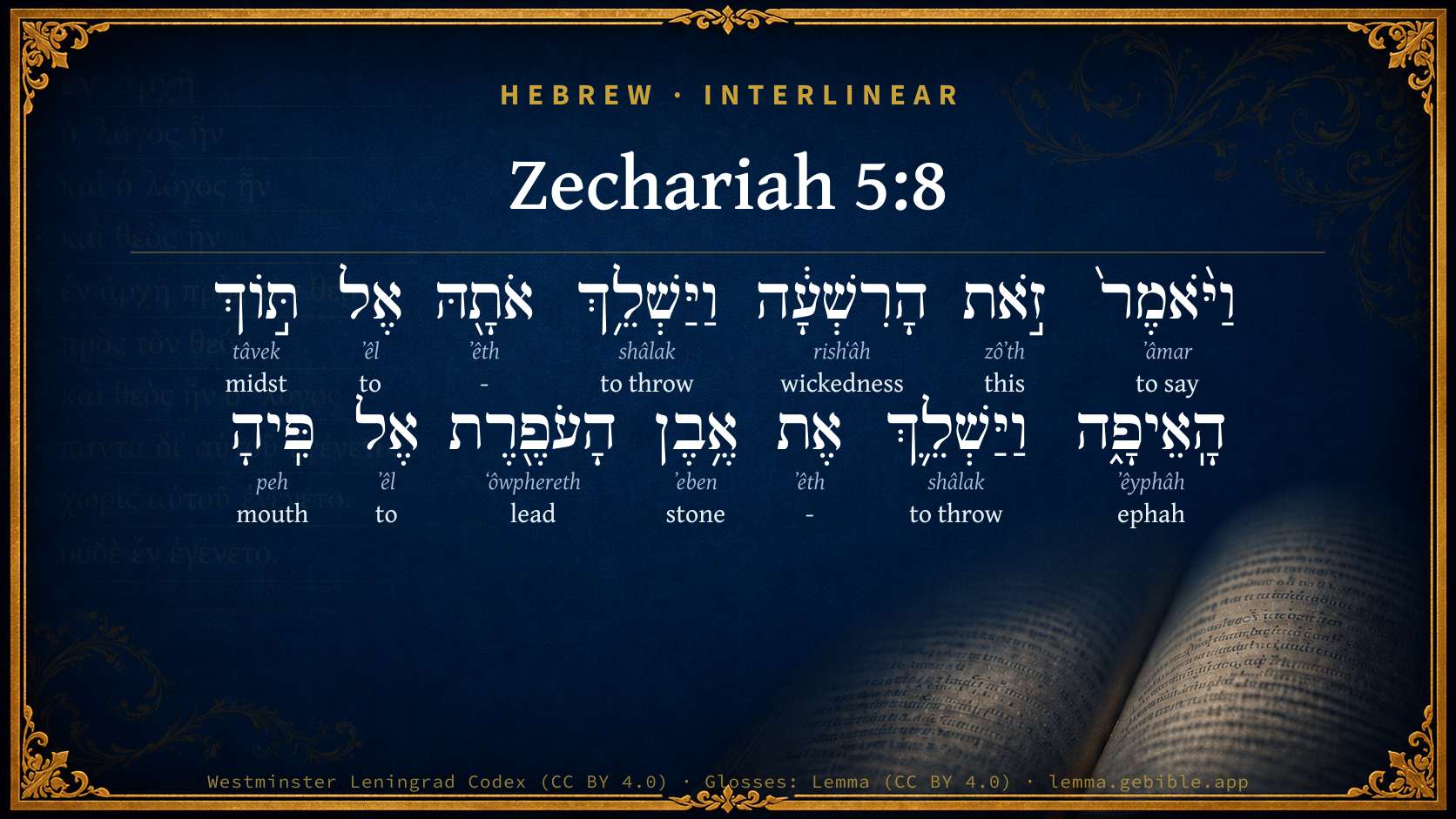
Hebrew (Westminster Leningrad Codex) Zechariah 5:8 appears in the Hebrew Old Testament. The text above is from the Westminster Leningrad Codex. Each word links to its Strong’s number, a concise gloss, and parsing drawn from the Open Scriptures Hebrew Bible morphology. Click any word for its full Brown-Driver-Briggs (BDB) entry.
Download image
Cite this verse

Zechariah 5:8 (World English Bible). Public Domain. Lemma interlinear Bible study tool, https://lemma.gebible.app/v/zechariah/5/8.

Show BibTeX & RIS
BibTeX
RIS
English Translation
He said, "This is Wickedness;" and he threw her down into the midst of the ephah basket; and he threw the weight of lead on its mouth.
World English Bible · Public Domain
Download a study sheet

One document with this verse’s original text, its word-by-word gloss line, the meaning frame, cross-references with their text, attributed commentary, and full source and license credits — printable, and it pastes into notes with its structure intact.

This verse Autodidact and up

Study sheet (.html) Plain text (.txt)

A passage Seminary Student

Up to 50 verses in one chapter. A passage sheet keeps up to 6 commentary sources and 12 cross-references per verse, in the order this page ranks them, and says so on the sheet whenever that leaves anything out. Ask for a single verse and you get the Autodidact verse sheet above.

Everything on this page stays free to read, with no account — the sheet is a download of what is already on screen, not access to it.

Want to remove ads? Support Godless Engineer
Compare translations 3

The same verse in 3 English versions, stacked beneath the original-language interlinear above. Click any original word for its lexicon entry.

Each is an independent rendering of the whole verse — the interlinear is not word-aligned to these translations.

Highlighted words mark where these versions differ — a whole-verse word diff, not a word-by-word alignment.

  • World English Bible Public Domain
    He said, "This is Wickedness;" and he threw her down into the midst of the ephah basket; and he threw the weight of lead on its mouth.
  • King James Version Public Domain
    And he said, This is wickedness. And he cast it into the midst of the ephah; and he cast the weight of lead upon the mouth thereof.
  • unfoldingWord Literal Text CC BY-SA 4.0
    And he said, “This the wickedness.” And he threw her into the midst of the ephah, and he threw the stone of lead to its mouth.

unfoldingWord Literal Text — © unfoldingWord, licensed CC BY-SA 4.0. Word-aligned USFM3 via Door43 (git.door43.org/unfoldingWord/en_ult).

Versions to compare (up to 4)

3 of 4 selected

Show all 18 translations

Every available English version of this verse, each an independent rendering of the whole verse.

  • World English Bible Public Domain
    He said, "This is Wickedness;" and he threw her down into the midst of the ephah basket; and he threw the weight of lead on its mouth.
  • Berean Standard Bible Public Domain
    “This is Wickedness,” he said. And he shoved her down into the basket, pushing down the lead cover over its opening.
  • Majority Standard Bible Public Domain
    “This is Wickedness,” he said. And he shoved her down into the basket, pushing down the lead cover over its opening.
  • King James Version Public Domain
    And he said, This is wickedness. And he cast it into the midst of the ephah; and he cast the weight of lead upon the mouth thereof.
  • American Standard Version (1901) Public Domain
    And he said, This is Wickedness: and he cast her down into the midst of the ephah; and he cast the weight of lead upon the mouth thereof.
  • Revised Version (1885) Public Domain
    And he said, This is Wickedness; and he cast her down into the midst of the ephah: and he cast the weight of lead upon the mouth thereof.
  • Geneva Bible (1599) Public Domain
    And he said, This is wickednes, and he cast it into the middes of the Ephah, and hee cast the weight of lead vpon the mouth thereof.
  • Douay-Rheims (1899) Public Domain
    And he said: This is wickedness. And he cast her into the midst of the vessel, and cast the weight of lead upon the mouth thereof.
  • Young's Literal Translation Public Domain
    And he saith, `This `is' the wicked woman.' And he casteth her unto the midst of the ephah, and casteth the weight of lead on its mouth.
  • Literal Standard Version CC BY-SA 4.0
    And he says, “This [is] the wicked woman.” And he casts her into the midst of the ephah, and casts the weight of lead on its mouth.
  • Unlocked Literal Bible CC BY-SA 4.0
    The angel said, “This is Wickedness!” He threw her back inside the basket, and he threw the lead cover over its opening.
  • unfoldingWord Literal Text CC BY-SA 4.0
    And he said, “This the wickedness.” And he threw her into the midst of the ephah, and he threw the stone of lead to its mouth.
  • Darby Bible Public Domain
    And he said, This is Wickedness: and he cast her into the midst of the ephah; and he cast the weight of lead upon the mouth thereof.
  • World Messianic Bible Public Domain
    He said, “This is Wickedness;” and he threw her down into the middle of the efah basket; and he threw the lead weight on its mouth.
  • Webster's Bible Public Domain
    And he said, This is wickedness. And he cast it into the midst of the ephah; and he cast the weight of lead upon its mouth.
  • Free Bible Version CC BY-SA 4.0
    “She represents wickedness,” he said, and pushed her back inside, forcing the lead lid shut.
  • Bible in Basic English Public Domain
    And he said, This is Sin; and pushing her down into the ephah, he put the weight of lead on the mouth of it.
  • JPS Tanakh (1917) Public Domain
    And he said: 'This is Wickedness.' And he cast her down into the midst of the measure, and he cast the weight of lead upon the mouth thereof.

Literal Standard Version (2020), Covenant Press — licensed CC BY-SA 4.0. Text via the HelloAO Bible API (eBible.org). Unlocked Literal Bible (unfoldingWord) — licensed CC BY-SA 4.0. Text via the HelloAO Bible API (eBible.org). unfoldingWord Literal Text — © unfoldingWord, licensed CC BY-SA 4.0. Word-aligned USFM3 via Door43 (git.door43.org/unfoldingWord/en_ult). Free Bible Version, Dr. Jonathan Gallagher — licensed CC BY-SA 4.0. Text via the HelloAO Bible API (eBible.org).

Word by word

More ways to search: Search by grammar → Find every occurrence → Compare this word →

Practice this passage: Drill this verse → Learn its vocabulary →

הָעֹפֶ֖רֶת
ʻôwphereth
H5777
“the · lead”
Particle, Definite Article + Noun, Common, Feminine, Singular, Absolute
Part of Speech
Particle + Noun
Type
Common
Gender
Feminine
Number
Singular
State
Absolute
Full BDB Definition

Origin: fem part act of H6080

TWOT: 1665b

lead
  1. וַיֹּ֨אמֶר֙ ʼâmar H559 “and · to say” Conjunction + Verb, Qal, Sequential Imperfect, 3rd Person, Masculine, Singular
  2. זֹ֣את zôʼth H2063 “this” Pronoun, Demonstrative, Feminine, Singular
  3. הָרִשְׁעָ֔ה rishʻâh H7564 “the · wickedness” Particle, Definite Article + Noun, Common, Feminine, Singular, Absolute
  4. וַיַּשְׁלֵ֥ךְ shâlak H7993 “and · to throw” Conjunction + Verb, Hiphil, Sequential Imperfect, 3rd Person, Masculine, Singular
  5. אֹתָ֖הּ ʼêth H853 “- · her” Particle, Direct Object + Suffix, Personal, 3rd Person, Feminine, Singular
  6. אֶל ʼêl H413 “to” Preposition
  7. תּ֣וֹךְ tâvek H8432 “midst of” Noun, Common, Masculine, Singular, Construct
  8. הָֽאֵיפָ֑ה ʼêyphâh H374 “the · ephah” Particle, Definite Article + Noun, Common, Feminine, Singular, Absolute
  9. וַיַּשְׁלֵ֛ךְ shâlak H7993 “and · to throw” Conjunction + Verb, Hiphil, Sequential Imperfect, 3rd Person, Masculine, Singular
  10. אֶת ʼêth H853 “-” Particle, Direct Object
  11. אֶ֥בֶן ʼeben H68 “stone of” Noun, Common, Feminine, Singular, Construct
  12. אֶל ʼêl H413 “to” Preposition
  13. פִּֽיהָ peh H6310 “mouth · her” Noun, Common, Masculine, Singular, Construct + Suffix, Personal, 3rd Person, Feminine, Singular

About this verse

These counts appear in no published source. They are computed here, from the morphology-tagged text and Lemma’s own curated glosses. What Lemma adds →

14
words
11
distinct lemmas
Prophets
section

Notable vocabulary

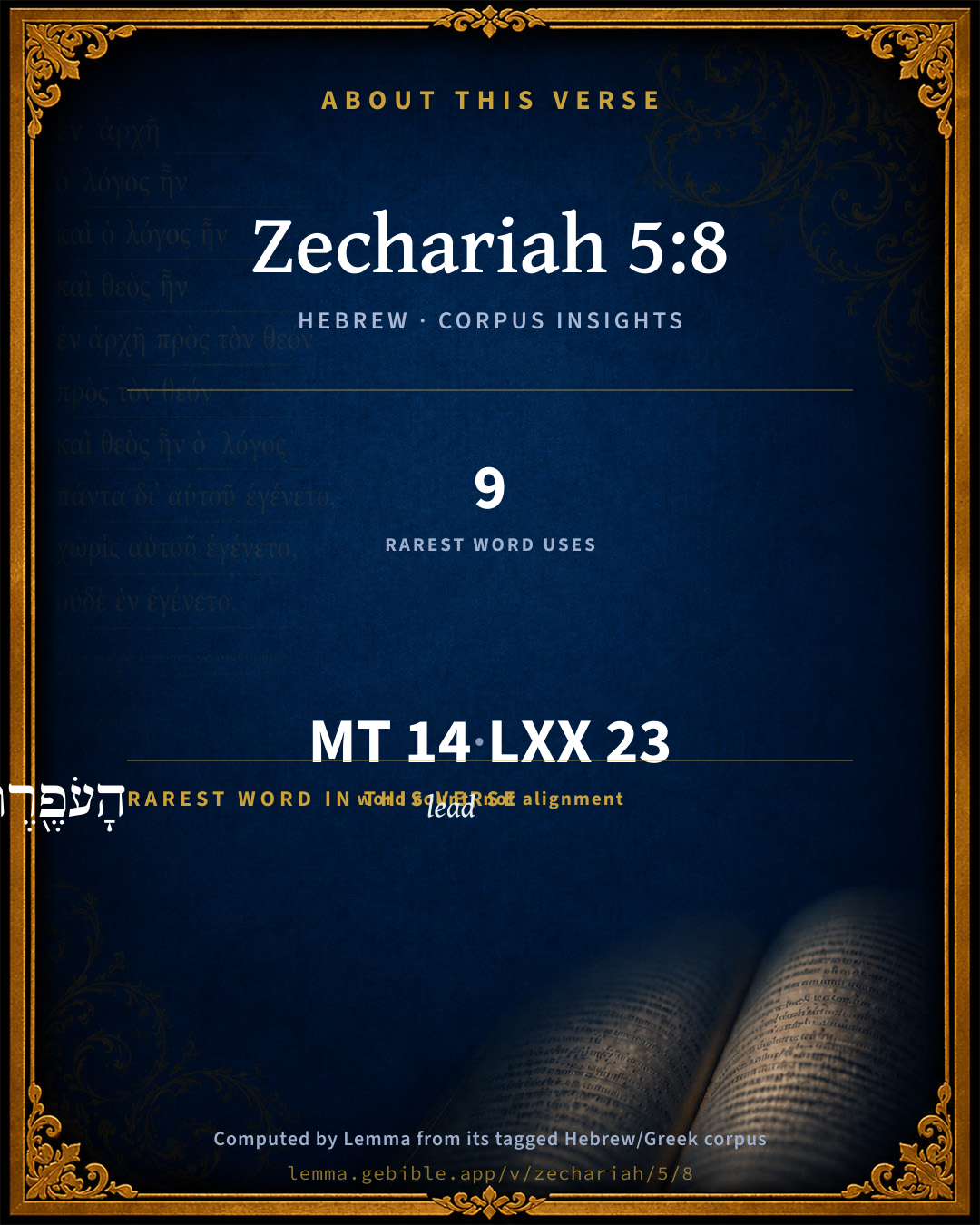
The rarest word here is הָעֹפֶ֖רֶת lead H5777 — appearing just 9 times in the whole Hebrew Bible.

Shared distinctive vocabulary

הָעֹפֶ֖רֶת lead H5777 occurs in 9 verses of the Hebrew Bible. Also found in:

Grammatical profile

  • 3 verbs
  • 6 nouns
  • 1 pronoun
  • 2 prepositions
  • 2 particles

Verb forms

  • וַיֹּ֨אמֶר֙ Qal · Sequential Imperfect
  • וַיַּשְׁלֵ֥ךְ Hiphil · Sequential Imperfect
  • וַיַּשְׁלֵ֛ךְ Hiphil · Sequential Imperfect

Repetition

Words recur within this verse — often emphatic in Hebrew:

  • וַיַּשְׁלֵ֥ךְ to throw H7993 ×2
  • אֶל to H413 ×2

Hebrew & Septuagint length

In English translation the verse runs 27 words from the Hebrew and 27 from the Septuagint (LXX English) — the same length.

A rough comparison of the two English renderings, which tokenize alike — not a word-level alignment.

Word counts can differ between the Hebrew and the Greek without any difference in meaning — e.g. the Hebrew direct-object marker אֵת has no separate Greek word, and Greek often adds the article ὁ.

In the original languages it is 14 Hebrew tokens and 23 Greek tokens — but the two are counted differently (Hebrew bundles its prefixes and suffixes into one token; the Greek is in lemma form), so that isn’t a like-for-like length.

Cross-references

9

Topical passages linked to Zechariah 5:8 in the Treasury of Scripture Knowledge — connected by theme and wording, ordered by reader-vote popularity; previews shown in the World English Bible.

  • Micah 6:11 Shall I be pure with dishonest scales, And with a bag of deceitful weights?
  • Genesis 15:16 In the fourth generation they will come here again, for the iniquity of the Amorite is not yet full."
  • Psalms 38:4 For my iniquities have gone over my head. As a heavy burden, they are too heavy for me.
  • Proverbs 5:22 The evil deeds of the wicked ensnare him. The cords of his sin hold him firmly.
  • Lamentations 1:14 The yoke of my transgressions is bound by his hand; They are knit together, they are come up on my neck; he has made my strength to fail: The Lord has delivered me into their hands, against whom I am not able to stand.
  • Amos 9:1–4 I saw the Lord standing beside the altar, and he said, "Strike the tops of the pillars, that the thresholds may shake; and break them in pieces on the head of all of them; and I will kill the last of them with the sword: there shall not one of them flee away, and there shall not one of them escape.
  • Zechariah 5:7 (and, behold, a talent of lead was lifted up); and this is a woman sitting in the midst of the ephah basket."
  • Matthew 23:32 Fill up, then, the measure of your fathers.
  • 1 Thessalonians 2:16 forbidding us to speak to the Gentiles that they may be saved; to fill up their sins always. But wrath has come on them to the uttermost.

Cross-references courtesy of OpenBible.info (CC BY 4.0).

Hebrew and Greek witnesses Masoretic Hebrew ↔ Greek Septuagint

The same verse in the two great witnesses to the Old Testament, shown verse-for-verse.

These are two independent witnesses, not word-aligned to each other, and the Septuagint is shown in lemma (dictionary) form.

Hebrew Zechariah 5:8 Masoretic · Westminster Leningrad Codex

וַיֹּ֨אמֶר֙ זֹ֣את הָרִשְׁעָ֔ה וַיַּשְׁלֵ֥ךְ אֹתָ֖הּ אֶל תּ֣וֹךְ הָֽאֵיפָ֑ה וַיַּשְׁלֵ֛ךְ אֶת אֶ֥בֶן הָעֹפֶ֖רֶת אֶל פִּֽיהָ

He said, "This is Wickedness;" and he threw her down into the midst of the ephah basket; and he threw the weight of lead on its mouth.

World English Bible · Public Domain

Greek LXX Zechariah 5:8 Septuagint · lemma form

καί εἶπον οὗτος εἰμί ὁ ἀνομία καί ῥίπτω αὐτός ἐν μέσος ὁ μέτρον καί ῥίπτω ὁ λίθος ὁ μολιβός εἰς ὁ στόμα αὐτός

And he said, This is iniquity. And he cast it into the midst of the measure, and cast the weight of lead on the mouth of it.

LXX2012 (modern English Septuagint) · Public Domain

On this verse, The Pulpit Commentary discusses the Septuagint’s reading. Read the note in Commentary ↓

Hebrew: Westminster Leningrad Codex (CC BY 4.0). Greek: Septuagint (public domain); English from LXX2012 (modern English Septuagint) (Public Domain). How the Septuagint differs from the Hebrew →

Targum (Aramaic paraphrase)

1

The Targum is the ancient Jewish Aramaic paraphrase of the Hebrew Scriptures — an interpretive translation, not the Hebrew text itself. Onkelos (literal) and Pseudo-Jonathan (expansive) render the Torah, and Jonathan the Prophets. Coverage is partial: where no permissively-licensed English translation exists for a verse, only the Aramaic is shown. This is verse-level text, not a word-by-word alignment to the Hebrew.

  1. Targum Jonathan Prophets (Joshua–Malachi)
    וַאֲמַר עַל דָא אִתְחַיְבוּ וּגְלוֹ עַל דַהֲווֹ נַסְבִין וְיָהֲבִין בִּמְכִילְתָּא דְשִׁקְרָא וַאֲתוֹ עַמְמִין אוֹחֲרָנִין וִיתִיבוּ בְּאַתְרֵיהוֹן:

    (no public-domain English translation for this verse)

    Targum Jonathan — Aramaic: “Mikraot Gedolot” (public domain). English: “Sefaria Community Translation” (CC0 1.0 (public-domain dedication)); “London "Chaldee Paraphrase," 1871” (public domain). Text via Sefaria.

Commentary

Notes on Zechariah 5:8 from classic Christian and Jewish commentators (each source and its license shown beneath its notes). The classic Christian expositions comment on the surrounding passage and are grouped to its opening verse, so a note may address several verses; the Jewish commentaries on the Tanakh (Rashi and others) are per-verse, so they appear only where the commentator wrote on this verse.

Lemma curates 59 commentaries, every one of them public domain or Creative Commons licensed, each selected and text-cleaned for this edition rather than reprinted as found. About our sources →

Trapp's Complete Commentary

John Trapp

Zec 5:8 And he said, This [is] wickedness. And he cast it into the midst of the ephah; and he cast the weight of lead upon the mouth thereof.

Ver. 8. And he said, This is wickedness] viz. This woman, a figure of the whole sinful nation of the Jews; as were Aholah and Aholibah, Eze 23:36; Eze 23:44, and Babylon the Great, the mother of fornications and abominations, Rev 17:5, to whom I may add that grand-daughter of hers, Katherine de Medicis, Queen mother; who by her wickedness wonderfully troubled all France for thirty years together.

And he cast it into the midst of the ephah] The angel, as an executioner of Divine justice, throws her down who before sat perking and priding herself; and claps her up close prisoner as it were in the ephah.

Casting the weight of lead into the mouth thereof] That is, of the ephah, or of the woman, according to that, Psa 107:42 "The righteous shall see it, and rejoice: and all iniquity shall stop her mouth." Montanus, one of the Talmud, addeth, that this woman is compelled to take this lead into her mouth; that molten lead was poured down her throat, for a punishment of her frauds and thefts, Zec 5:3. But the wicked shall not be so excused; for upon them God shall rain snares, fire, brimstone, and a burning tempest: this shall be the portion of their cup, Psa 11:6, and this is far worse than molten lead, or burning bell metal. Compare with this text Jer 51:64 Rev 18:21; cf. Rev 20:1. An angel, a strong angel, for better assurance of Rome’s irreparable ruin, taketh a stone, a great stone, which he throweth, and with force thrusteth into the bottom of the sea, whence it cannot be buoyed up, whence nothing ordinarily is recovered, much less a millstone thrust from such a hand with such a force. "What do ye imagine against the Lord?" saith Nahum; "he will make an utter end: affliction shall not rise up the second time," Nah 1:9; that is, the wicked shall be totally and finally consumed at once; neither will God make another doing of it. "I have overthrown some of you, as God overthrew Sodom and Gomorrah," Amo 4:11 : wickedness is here crushed together, as it were, in a narrow vessel, covered with lead, and carried into a strange country.

John Trapp, A Commentary or Exposition upon All the Books of the Old and New Testament (1647–1656) — public domain. Text from a community e-Sword module.

The Biblical Illustrator

Joseph S. Exell

Zec_5:8

And he said, This is wickedness

Worldliness

This is the ruin of thousands and tens of thousands.

It is not at all necessary to insure a mans perdition that he either steal or swear falsely. A man may be a thorough worldling, without the practice of these or any gross iniquities. Whatever shuts God out from His place in the heart as the object of fear and love, and from His place in the conscience as the authoritative regulator of the life, that, be it what it may, is the ruin of the man. In the parable of the marriage feast, the men who declined the invitation, and went away to their farms and to their merchandise, are not charged with any selfish and fraudulent dealings in the management of their farms or the prosecution of their merchandise. What was their sin? Worldliness. They preferred the world to God. They declined the blessings of the Gospel for something more to their taste. They chose the world and the things of the world--no matter in how innocent a form--even the sweets of domestic life itself--to God and the things of God. And in the enjoyment of these, as their chosen portion, they had their reward. Thus it was of old; thus it is still. Let no man deceive himself by fancying it necessary to his forfeiture of the blessings of Gods salvation, that he give himself up to the practice of dishonesty and of open vice. If his heart is in the world, with the world he must have his portion. Let Christians be on their guard against the love of this present world. It is as insinuating and perilous principle. In proportion as it gains upon the heart, it tends to enfeeble the energies, and deaden the sensibilities, of the Divine life in the soul. God will not have a divided heart. Ye cannot serve God and Mammon. (Ralph Wardlaw, D. D.)

.

The Biblical Illustrator, edited by Joseph S. Exell (c. 1880s–1900s) — public domain. Text from a community e-Sword module.

Tyndale Open Study Notes

Tyndale Open Resources

5:8 Wickedness refers to evil generally; whether moral or ceremonial, it is opposed to righteousness (see Prov 13:6; Ezek 33:12). The word wickedness (Hebrew rish‘ah) is similar in Hebrew to the name Asherah, the fertility goddess of the ancient Near East (see Deut 7:5; 16:21).

Tyndale Open Study Notes — © Tyndale Open Resources, licensed CC BY-SA 4.0. Text via the HelloAO Bible API.

Geneva Bible (1599)

Geneva Bible translators

Signifying, that Satan should not have such power against the Jews to tempt them, as he had in time past, but that God would shut up iniquity in a measure as in a prison.

Geneva Bible (1599) marginal notes — public domain. Text via Bolls.life.

Jamieson, Fausset & Brown

Robert Jamieson, A. R. Fausset & David Brown

wickedness--literally, "the wickedness": implying wickedness in its peculiar development. Compare "the man of sin," Th2 2:3.

cast it--that is, her, Wickedness, who had moved more freely while the heavy lid was partially lifted off.

weight--literally, "stone," that is, round mass.

Jamieson, Fausset & Brown — Commentary Critical and Explanatory on the Whole Bible (1871) — public domain (CC PDM 1.0). Text via the HelloAO Bible API.

John Calvin's Commentaries

Now the angel adds, that a thin piece of lead was cast over the mouth of the measure, and that wickedness was cast into the measure. The expression, that wickedness was thrown into the measure, may be explained in two ways — either that God would not permit so much liberty to the devil to lead the Jews to sin as before; for how comes it that men abandon themselves to every evil, except that God forsakes them, and at the same time delivers them up to Satan, that he may exercise his tyranny over them? or, that a bridle would be used to restrain foreign enemies, that they might not in their wantonness oppress the miserable people, and exercise extreme violence. God, then, intending to deliver them from their sins, or to check wrongs, shuts up wickedness, as it were, in a measure; and then he adds a cover; and it is said to have been a thin piece, or a weight of lead, because it was heavy; as though the Prophet had said, that whenever it pleased God iniquity would be taken captive, so that it could not go forth from its confinement or its prison. It afterwards follows —

John Calvin's Commentaries (1540-1563) — public domain. Text from the Calvin Translation Society English edition (1840s-50s) via the Christian Classics Ethereal Library (ccel.org). Calvin's coverage is partial (roughly two-thirds of the Bible); uncommented books and verses are honest gaps, never fabricated. The 19th-century editor's footnotes and remarks are omitted so the notes are faithfully Calvin's own voice.

The Cambridge Bible for Schools and Colleges

gen. ed. J. J. S. Perowne

8. This is wickedness] This woman that thou seest sitting in the ephah represents the wickedness of the whole land, gathered up, as it were, into one and personified.

the weight of lead] Lit. the stone of lead; so called, either because stones were used as weights (comp. our English word “stone”), or because the leaden lid on the mouth of the ephah suggested by its size and weight the stone cover of a well. Gen_29:2.

upon the mouth thereof] Lit. upon her mouth; but rightly rendered thereof, as the reference seems plainly to be to the ephah, on which the angel firmly fixed the lid, when he had cast down the woman into it.

A different, but less satisfactory, view of the vision has been taken. According to this the woman is seen “having in her hand the leaden weight with which she was wont to traffic, and sitting crouched down in an empty bushel or ephah, as if that were her true seat and throne.… It was a special form of wickedness that was here pourtrayed, namely, unrighteousness as it manifests itself in matters of weight and measure, or, to designate it in our Lord’s own words, ‘unfaithfulness as regards the unrighteous mammon’ … But ‘with the same measure that ye mete withal, shall it be measured to you again.’ The very instrument which the woman used for her unholy work was to be the means of her confusion. The ephah in which she sat was made the chariot in which she was removed from the land; and the angel, with righteous indignation, seized the woman herself, dashed her down into the ephah as she was about to rise from her sitting posture, and taking hold of the leaden weight, flung the heavy ‘stone of lead’ upon her mouth. Thus did the angel indicate that ‘wickedness’ would be a subject of Divine wrath. He smote her in the mouth wherewith she had so often uttered words of lying and fraud; and did so with the very instrument with which she was wont to measure her ungodly gain. Thus was her mouth stopped (Psa_107:42; Job_5:16), and the instrument of sin was made the instrument of her punishment.” (Rev. C. H. H. Wright.) The moral of the vision, however, is not the destruction, nor even the punishment of wickedness, but its expulsion from the holy land, that it may go to its own place.

The Cambridge Bible for Schools and Colleges (gen. ed. J. J. S. Perowne; Cambridge University Press, 1878–1918) — public domain. Text from a community e-Sword module.

John Gill's Exposition

And he said, This is wickedness,.... A representation of wicked men, who are wickedness itself, as their inward part is, Psa 5:9 and particularly of the wicked one, the man of sin and son of perdition, the Roman antichrist and apocalyptic beast; who, though he is called by this title, "his Holiness", his true and proper name is "wickedness"; , that wicked lawless one, Th2 2:8 yea, wickedness itself, being extremely wicked, a sink of sin and of all abominations, Rev 17:5.

And he cast it into the midst of the ephah; that is, wickedness; that it might be kept within bounds, and not exceed its measure to be filled up: this seems to denote some restraint on sinners, that they may not be able to go all the lengths they would; and some rebuke upon them, that they might not lift up their heads with impunity; and some check upon them, and their furious rage towards the people of God; and also the putting of an utter end to sin and sinners, and particularly the followers of antichrist; see Psa 104:35.

And he cast the weight of lead upon the mouth thereof; either upon the mouth of the woman, or of the ephah; and, be it which it will, it was done to keep the woman within the ephah, and press her down there; and intends the judgments of God upon sinners; and shows that there is no escaping divine vengeance; that it falls heavy where it lights, and sinks to the lowest hell; and that it will continue, being laid on by the firm, unchangeable, and irrevocable decree of God. Cocceius understands this of the Saracens and Turks, and the barbarous nations, being cast into the Roman empire, to restrain the antichristian tyranny; but it seems better to apply it to the utter destruction of antichrist, signified by a millstone cast into the sea and sunk there, never to rise more; see Rev 18:21 and with it compare Exo 15:10.

John Gill's Exposition of the Whole Bible (1746–1763) — public domain (CC PDM 1.0). Text via the HelloAO Bible API.

Albert Barnes' Notes on the Bible

And cast her into the midst of the Ephah - As yet then the measure was not full. Ribera: “She had the lower part within the Ephah, but the upper, especially the head, without. Though the Jews had slain the prophets and done many grievous things, the greatest sin of all remained to be done. But when they had crucified Christ and persecuted the Apostles and the Gospel, the measure was full; she was wholly within the Ephah, no part remained without, so that the measure was filled.”

And he cast the weight of lead upon the mouth thereof - that is, doubtless of the Ephah; as in Genesis, “a great stone was on the mouth of the well” Gen 29:2, so that there should be no access to it.

Albert Barnes' Notes on the Bible (1834–1885) — public domain. Text from a community e-Sword/MySword module.

Haydock's Catholic Bible Commentary

He cast. Hebrew (Calmet) according to Theodotion, (St. Jerome) "She cast herself into the epha," &c. (Haydock)

George Leo Haydock (1774–1849), Haydock's Catholic Family Bible and Commentary, 1859 edition — public domain. Excludes Psalms (Douay-Rheims chapter numbering differs from Protestant) and Deuterocanonical books (Catholic canon only).

Matthew Poole's English Annotations

And he said; the angel unfolds the riddle.

This, this woman that sits in the ephah, represents the sinful nation of the Jews, is emblem of their wickedness.

Is wickedness, in the abstract, to express the greatness of the Jews’ wickedness, they will grow up to be most wicked.

He cast it; the angel cast down this woman, wickedness, from the seat she sat on, Zec 5:7.

And he east the weight of lead upon the mouth thereof; and now she is down the weight of lead, which she can never lift up, or remove, is laid upon the mouth of the ephah, she is shut up, as in a prison, to suffer the punishment of all her sins. This is their resemblance.

Matthew Poole's English Annotations on the Holy Bible (1683–1685) — public domain. Text from a community e-Sword/MySword module.

Whedon's Commentary on the Bible

Daniel D. Whedon

8. The interpreter proceeds to explain the significance of the woman.

This is wickedness — The wickedness of the whole land (Zec_5:6) is personified in the one woman. As the cover is lifted up she begins to rise, but the angel throws her back and makes escape impossible by replacing the lid upon the mouth, that is, the opening of the ephah.

Weight of lead — Literally, the stone of lead; synonymous with “round piece of lead” in Zec_5:7.

Zec_5:9-10 describe the removal of the ephah from the land.

Then lifted I up mine eyes — This phrase introduces not a new vision, but a new phase of the same vision. Looking up from the ephah, he beholds two new figures appearing upon the scene.

Two women — These women have no special symbolical significance; they appear only as the agents appointed to remove the ephah. Women are selected rather than men because a woman is in the ephah, two women because one alone could not have carried the burden.

Wings — To enable the women to move more quickly, they were supplied with wings. The air would offer fewer obstacles than the land; besides, the wind of heaven might assist creatures flying through the air in their movements.

Like the wings of a stork — The stork is introduced not because he is an unclean bird (Lev_11:19), but on account of the great size of his wings.

The wind was in their wings — That they might proceed with greater swiftness.

Between the earth and the heaven — That is, in the air. Thus the women began their journey.

As they move away the prophet inquires where they are going, to which the angel makes answer. 11.

To build it [“her”] a house — The pronoun refers primarily to the ephah, but includes the contents, the woman, for houses are built ordinarily for human beings. The building of a house implies that the stay is to be permanent.

In the land of Shinar — Babylonia (Gen_10:10; Gen_11:2); the home of the long-time enemy of the people of God, the land of exile. Sin, which had brought serious disaster upon Judah, is to be removed to the land of the enemy, there to cause distress and destruction. That the stay is to be permanent is further indicated in the second half of the verse. R.V. is to be preferred: “and when it is prepared, she shall be set there in her own place.”

When it is prepared (R.V.) — That is, the house.

She shall be set there (R.V.) — The woman (and the ephah).

In her own place (R.V.) — In the house erected for her use.

Daniel D. Whedon (gen. ed.), Commentary on the Old and New Testaments (1874–1909) — public domain. Text from a community e-Sword module.

The Pulpit Commentary

This is wickedness. This woman is the personification of wickedness. It is very common to find backsliding Israel represented as a faithless and adulterous woman. (comp. Isa_1:21 Jer_2:20 Hos_2:5; and the parable of the two women in Eze 23) He cast it; her the woman. As the woman rose, or tried to rise, from the ephah, the angel flung her down into it. It is possible, as some commentators suppose, that the ephah into which wickedness is thrust represents the measure of iniquity which, being reached, constrains God to punish. (see Gen_15:16, where the dispossession of the Amorites is postponed till their iniquity is full) The weight of lead; literally, as the LXX, the stone of lead; Vulgate, massam plumbeam. This is the cover of the ephah, that which is called the "talent of lead" in the preceding verse. This heavy cover the angel cast upon the mouth of the ephah, in order to confine the woman therein. (comp. Gen_29:2, which passage may explain why the cover is called "a stone Dr. Wright and some other commentators, referring the passage to theft and perjury alone, consider that the woman held in her hand the leaden weight with which she weighed her gains, and was sitting in the ephah which she used in her traffic; so that she represents dishonesty in the matter of weight and measure. She is punished by the means of the instruments she had used unrighteously; the weight is dashed upon her lying mouth, and the ephah, her throne, is made the vehicle that carries her out of the land. But it seems a mistake to confine the iniquity mentioned to the two special sins of theft and perjury; nor would the talent and the ephah be natural instruments of stealing and false swearing; and the point of the vision is not the punishment of wickedness, but its expulsion from the land. It is true that the pronominal suffix in the mouth thereof is feminine, and that the LXX makes it refer to the woman, to stoma authv . But it may equally refer to ephah, which is also feminine.

The Pulpit Commentary (1880–1919), ed. H.D.M. Spence-Jones & Joseph S. Exell — public domain. Text from a community e-Sword module.

John Wesley's Explanatory Notes

This - This woman represents the wickedness of the Jews. He cast it - The angel cast down this woman. On the mouth - And so shut her up, to suffer the punishment of all her sins.

John Wesley, Explanatory Notes Upon the Whole Bible (1754–1765) — public domain. Text via the GEBible commentary corpus.

unfoldingWord translationNotes

Door43 World Missions Community

This is Wickedness

The woman represents wickedness. AT: "This woman represents wickedness" (See: Symbolic Language)

He threw her ... he threw the lead cover

"He thrust her ... he forced the lead cover." The word "threw" indicates the force with which the angel did these things. He did not literally throw the woman or the cover.

I lifted my eyes

Here the word "eyes" represents the person who sees. AT: "I looked up" (See: Synecdoche)

wind was in their wings

This idiom means that they were flying. AT: "they were flying" (See: Idiom)

they had wings like a stork's wings

A stork is a type of large bird that has a wingspan of two to four meters. Zechariah compares the size of the women's wings with the size of the stork's wings.

They lifted up the basket between earth and heaven

The words "earth" and "heaven" form a merism that refer to the sky. It is implicit that the two women flew away with the basket. AT: "They lifted the basket up into the sky and flew away" (See: Merism and Assumed Knowledge and Implicit Information)

translationWords

evil

earth

heaven

unfoldingWord translationNotes — © Distant Shores Media and the Door43 World Missions Community, licensed CC BY-SA 4.0. Source: git.door43.org/Door43/en_tn.

Rashi

Rabbi Shlomo Yitzchaki (Rashi)

And he said, “This is Wickedness.” This woman that you see in the midst of the ephah is the character of the way of wickedness, [the way] in which the wicked deport themselves. And behold, now they are placed in its midst to be punished in the midst of that very measure that they meted out, a measure for a measure.

And he cast her Heretofore she had been sitting, but he cast her and knocked her into its midst, symbolizing torments and punishments.

and he cast the lead weight into her mouth to weigh her down so that they achieve no more greatness and their voice is no longer heard robbing the poor and needy.

Rashi on the Tanakh — English translations: “The Judaica Press complete Tanach with Rashi, translated by A. J. Rosenberg” (CC BY 4.0); “Pentateuch with Rashi's commentary by M. Rosenbaum and A.M. Silbermann, 1929-1934” (public domain); “The Metsudah Tanach series, Lakewood, N.J” (CC BY 4.0); and “The Book of Joshua, Metsudah Publications, 1997” (CC BY 4.0). Text via Sefaria.

Lesson kit

Teaching starters — assembled from the data on this page, not authored interpretation. Every prompt links to the verse data it draws on. Edit before teaching.

Zechariah, in the Prophets, opens this verse with 14 words (11 distinct Hebrew lemmas). Its most distinctive word is ʻôwphereth (“lead”). A historical commentator’s framing appears above. Read the whole chapter for the surrounding context.

Discussion questions

  1. What does “lead” (ʻôwphereth) contribute to the verse as a whole?
  2. Exodus 15:10 shares the word «lead» with this verse. How do the two illuminate each other?
  3. “to throw” occurs 2× in this one verse. What is the effect of the repetition?
  4. These translations render this verse differently; the difference is in the English rendering, not the original. What questions does that raise?
  5. The verb «וַיֹּ֨אמֶר֙» is Qal Sequential Imperfect. How does its form color the action?
  6. Reading how Trapp's Complete Commentary and The Biblical Illustrator read this verse, where do the two commentators agree and where do they part?

Things to notice

Reading settings

Reading text

Shown beneath each verse's original-language words.

Old Testament
Old Testament edition

Read the OT as the Masoretic Hebrew (MT) or the Greek Septuagint (LXX).

English shown for the Greek Septuagint (in the Hebrew ↔ Greek comparison).

Comparing translations? Open the Compare panel on any verse page to stack up to four side by side.