
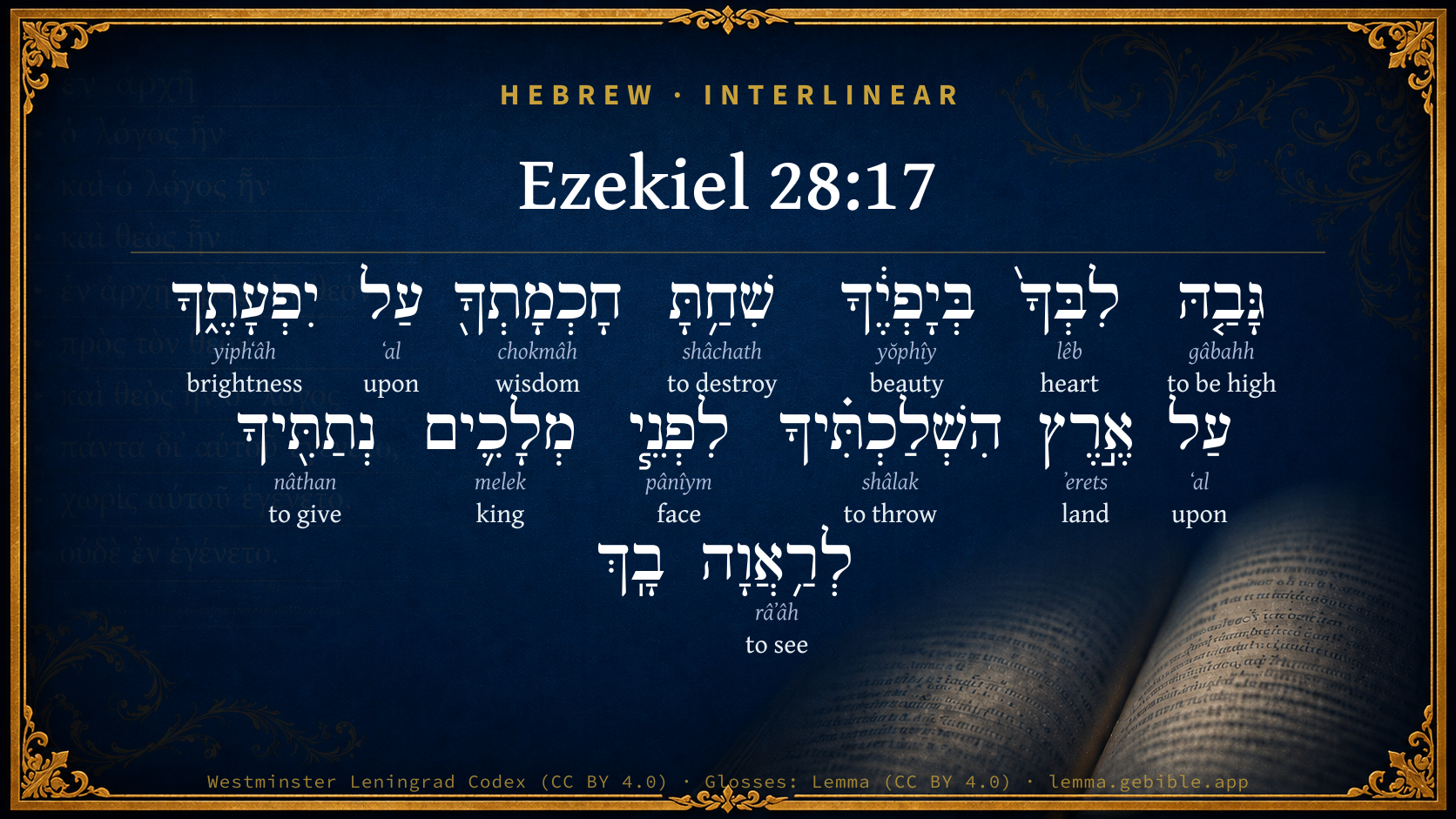
Ezekiel 28:17

Hebrew (Westminster Leningrad Codex) Ezekiel 28:17 appears in the Hebrew Old Testament. The text above is from the Westminster Leningrad Codex. Each word links to its Strong’s number, a concise gloss, and parsing drawn from the Open Scriptures Hebrew Bible morphology. Click any word for its full Brown-Driver-Briggs (BDB) entry.
Download image
Cite this verse

Ezekiel 28:17 (World English Bible). Public Domain. Lemma interlinear Bible study tool, https://lemma.gebible.app/v/ezekiel/28/17.

Show BibTeX & RIS
BibTeX
RIS
English Translation
Your heart was lifted up because of your beauty; you have corrupted your wisdom by reason of your brightness: I have cast you to the ground; I have laid you before kings, that they may see you.
World English Bible · Public Domain
Download a study sheet

One document with this verse’s original text, its word-by-word gloss line, the meaning frame, cross-references with their text, attributed commentary, and full source and license credits — printable, and it pastes into notes with its structure intact.

This verse Autodidact and up

Study sheet (.html) Plain text (.txt)

A passage Seminary Student

Up to 50 verses in one chapter. A passage sheet keeps up to 6 commentary sources and 12 cross-references per verse, in the order this page ranks them, and says so on the sheet whenever that leaves anything out. Ask for a single verse and you get the Autodidact verse sheet above.

Everything on this page stays free to read, with no account — the sheet is a download of what is already on screen, not access to it.

Want to remove ads? Support Godless Engineer
Compare translations 3

The same verse in 3 English versions, stacked beneath the original-language interlinear above. Click any original word for its lexicon entry.

Each is an independent rendering of the whole verse — the interlinear is not word-aligned to these translations.

Highlighted words mark where these versions differ — a whole-verse word diff, not a word-by-word alignment.

  • World English Bible Public Domain
    Your heart was lifted up because of your beauty; you have corrupted your wisdom by reason of your brightness: I have cast you to the ground; I have laid you before kings, that they may see you.
  • King James Version Public Domain
    Thine heart was lifted up because of thy beauty, thou hast corrupted thy wisdom by reason of thy brightness: I will cast thee to the ground, I will lay thee before kings, that they may behold thee.
  • unfoldingWord Literal Text CC BY-SA 4.0
    Your heart was arrogant with your beauty; you ruined your wisdom because of your splendor. I have sent you down to the earth. I have placed you before kings so they may see you.

unfoldingWord Literal Text — © unfoldingWord, licensed CC BY-SA 4.0. Word-aligned USFM3 via Door43 (git.door43.org/unfoldingWord/en_ult).

Versions to compare (up to 4)

3 of 4 selected

Show all 18 translations

Every available English version of this verse, each an independent rendering of the whole verse.

  • World English Bible Public Domain
    Your heart was lifted up because of your beauty; you have corrupted your wisdom by reason of your brightness: I have cast you to the ground; I have laid you before kings, that they may see you.
  • Berean Standard Bible Public Domain
    Your heart grew proud of your beauty; you corrupted your wisdom because of your splendor; so I cast you to the earth; I made you a spectacle before kings.
  • Majority Standard Bible Public Domain
    Your heart grew proud of your beauty; you corrupted your wisdom because of your splendor; so I cast you to the earth; I made you a spectacle before kings.
  • King James Version Public Domain
    Thine heart was lifted up because of thy beauty, thou hast corrupted thy wisdom by reason of thy brightness: I will cast thee to the ground, I will lay thee before kings, that they may behold thee.
  • American Standard Version (1901) Public Domain
    Thy heart was lifted up because of thy beauty; thou hast corrupted thy wisdom by reason of thy brightness: I have cast thee to the ground; I have laid thee before kings, that they may behold thee.
  • Revised Version (1885) Public Domain
    Thine heart was lifted up because of thy beauty, thou hast corrupted thy wisdom by reason of thy brightness: I have cast thee to the ground, I have laid thee before kings, that they may behold thee.
  • Geneva Bible (1599) Public Domain
    Thine heart was lifted vp because of thy beautie, and thou hast corrupted thy wisedome by reason of thy brightnes: I wil cast thee to ye grounde: I will lay thee before Kinges that they may beholde thee.
  • Douay-Rheims (1899) Public Domain
    And thy heart was lifted up with thy beauty: thou best lost thy wisdom in thy beauty, I have cast thee to the ground: I have set thee before the face of kings, that they might behold thee.
  • Young's Literal Translation Public Domain
    High hath been thy heart, because of thy beauty, Thou hast corrupted thy wisdom because of thy brightness, On the earth I have cast thee, Before kings I have set thee, to look on thee,
  • Literal Standard Version CC BY-SA 4.0
    Your heart has been high because of your beauty, || You have corrupted your wisdom because of your brightness, || I have cast you to earth, || I have set you before kings, to look on you,
  • Unlocked Literal Bible CC BY-SA 4.0
    Your heart was arrogant with your beauty; you ruined your wisdom because of your splendor. I have sent you down to the earth. I have placed you before kings so they may see you.
  • unfoldingWord Literal Text CC BY-SA 4.0
    Your heart was arrogant with your beauty; you ruined your wisdom because of your splendor. I have sent you down to the earth. I have placed you before kings so they may see you.
  • Darby Bible Public Domain
    Thy heart was lifted up because of thy beauty; thou hast corrupted thy wisdom by reason of thy brightness: I have cast thee to the ground, I have laid thee before kings, that they may behold thee.
  • World Messianic Bible Public Domain
    Your heart was lifted up because of your beauty. You have corrupted your wisdom by reason of your splendor. I have cast you to the ground. I have laid you before kings, that they may see you.
  • Webster's Bible Public Domain
    Thy heart was lifted up because of thy beauty, thou hast corrupted thy wisdom by reason of thy brightness: I will cast thee to the ground, I will lay thee before kings, that they may behold thee.
  • Free Bible Version CC BY-SA 4.0
    You became proud because of your beauty, you ruined your wisdom because you thought you were so wonderful. So I threw you down to the ground and I made sure kings saw what happened to you.
  • Bible in Basic English Public Domain
    Your heart was lifted up because you were beautiful, you made your wisdom evil through your sin: I have sent you down, even to the earth; I have made you low before kings, so that they may see you.
  • JPS Tanakh (1917) Public Domain
    Thy heart was lifted up because of thy beauty, thou hast corrupted thy wisdom by reason of thy brightness; I have cast thee to the ground, I have laid thee before kings, that they may gaze upon thee.

Literal Standard Version (2020), Covenant Press — licensed CC BY-SA 4.0. Text via the HelloAO Bible API (eBible.org). Unlocked Literal Bible (unfoldingWord) — licensed CC BY-SA 4.0. Text via the HelloAO Bible API (eBible.org). unfoldingWord Literal Text — © unfoldingWord, licensed CC BY-SA 4.0. Word-aligned USFM3 via Door43 (git.door43.org/unfoldingWord/en_ult). Free Bible Version, Dr. Jonathan Gallagher — licensed CC BY-SA 4.0. Text via the HelloAO Bible API (eBible.org).

Word by word

More ways to search: Search by grammar → Find every occurrence → Compare this word →

Practice this passage: Drill this verse → Learn its vocabulary →

יִפְעָתֶ֑ךָ
yiphʻâh
H3314
“brightness · your”
Noun, Common, Feminine, Singular, Construct + Suffix, Personal, 2nd Person, Masculine, Singular
Part of Speech
Noun
Type
Common
Gender
Feminine
Number
Singular
State
Construct
Full BDB Definition

Origin: from H3313

TWOT: 892a

splendour, brightness, shining
  1. גָּבַ֤הּ gâbahh H1361 “to be high” Verb, Qal, Perfect, 3rd Person, Masculine, Singular
  2. לִבְּךָ֙ lêb H3820 “heart · your” Noun, Common, Masculine, Singular, Construct + Suffix, Personal, 2nd Person, Masculine, Singular
  3. בְּיָפְיֶ֔ךָ yŏphîy H3308 “in/at · beauty · your” Preposition + Noun, Common, Masculine, Singular, Construct + Suffix, Personal, 2nd Person, Masculine, Singular
  4. שִׁחַ֥תָּ shâchath H7843 “to destroy” Verb, Piel, Perfect, 2nd Person, Masculine, Singular
  5. חָכְמָתְךָ֖ chokmâh H2451 “wisdom · your” Noun, Common, Feminine, Singular, Construct + Suffix, Personal, 2nd Person, Masculine, Singular
  6. עַל ʻal H5921 “upon” Preposition
  7. עַל ʻal H5921 “upon” Preposition
  8. אֶ֣רֶץ ʼerets H776 “land” Noun, Common, Both, Singular, Absolute
  9. הִשְׁלַכְתִּ֗יךָ shâlak H7993 “to throw · you” Verb, Hiphil, Perfect, 1st Person, Common, Singular + Suffix, Personal, 2nd Person, Masculine, Singular
  10. לִפְנֵ֧י pânîym H6440 “to/for · face(s) of” Preposition + Noun, Common, Both, Plural, Construct
  11. מְלָכִ֛ים melek H4428 “kings” Noun, Common, Masculine, Plural, Absolute
  12. נְתַתִּ֖יךָ nâthan H5414 “to give · you” Verb, Qal, Perfect, 1st Person, Common, Singular + Suffix, Personal, 2nd Person, Masculine, Singular
  13. לְרַ֥אֲוָה râʼâh H7200 “to see” Preposition + Verb, Qal, Infinitive Construct

About this verse

These counts appear in no published source. They are computed here, from the morphology-tagged text and Lemma’s own curated glosses. What Lemma adds →

15
words
13
distinct lemmas
Prophets
section

Notable vocabulary

The rarest word here is יִפְעָתֶ֑ךָ brightness H3314 — appearing just 2 times in the whole Hebrew Bible.

Shared distinctive vocabulary

יִפְעָתֶ֑ךָ brightness H3314 occurs in 2 verses of the Hebrew Bible. Also found in:

Grammatical profile

  • 5 verbs
  • 7 nouns
  • 3 prepositions

Verb forms

  • גָּבַ֤הּ Qal · Perfect
  • שִׁחַ֥תָּ Piel · Perfect
  • הִשְׁלַכְתִּ֗יךָ Hiphil · Perfect
  • נְתַתִּ֖יךָ Qal · Perfect
  • לְרַ֥אֲוָה Qal · Infinitive Construct

Repetition

A word recurs within this verse — often emphatic in Hebrew:

Hebrew & Septuagint length

In English translation the verse runs 37 words from the Hebrew and 44 from the Septuagint (LXX English) — closely comparable.

A rough comparison of the two English renderings, which tokenize alike — not a word-level alignment.

Word counts can differ between the Hebrew and the Greek without any difference in meaning — e.g. the Hebrew direct-object marker אֵת has no separate Greek word, and Greek often adds the article ὁ.

Cross-references

20

Topical passages linked to Ezekiel 28:17 in the Treasury of Scripture Knowledge — connected by theme and wording, ordered by reader-vote popularity; previews shown in the World English Bible.

  • Ezekiel 28:5 by your great wisdom [and] by your traffic have you increased your riches, and your heart is lifted up because of your riches;-
  • Proverbs 16:18 Pride goes before destruction, And a haughty spirit before a fall.
  • Ezekiel 31:10 Therefore thus said the Lord Yahweh: Because you are exalted in stature, and he has set his top among the thick boughs, and his heart is lifted up in his height;
  • James 4:6 But he gives more grace. Therefore it says, "God resists the proud, but gives grace to the humble."
  • Ezekiel 28:2 Son of man, tell the prince of Tyre, Thus says the Lord Yahweh: Because your heart is lifted up, and you have said, I am a god, I sit in the seat of God, in the midst of the seas; yet you are man, and not God, though you did set your heart as the heart of God;-
  • Luke 14:11 For everyone who exalts himself will be humbled, and whoever humbles himself will be exalted."
  • Psalms 147:6 Yahweh upholds the humble. He brings the wicked down to the ground.
  • Proverbs 11:2 When pride comes, then comes shame, But with humility comes wisdom.
  • Ezekiel 32:10 Yes, I will make many peoples amazed at you, and their kings shall be horribly afraid for you, when I shall brandish my sword before them; and they shall tremble at every moment, every man for his own life, in the day of your fall.
  • Job 40:11–12 Pour forth the fury of your anger. Look on everyone who is proud, and bring him low.
  • Psalms 73:18 Surely you set them in slippery places. You throw them down to destruction.
  • Isaiah 14:9–11 Sheol from beneath is moved for you to meet you at your coming; it stirs up the dead for you, even all the chief ones of the earth; it has raised up from their thrones all the kings of the nations.
  • Isaiah 19:11–13 The princes of Zoan are utterly foolish; the counsel of the wisest counselors of Pharaoh is become brutish: how do you say to Pharaoh, I am the son of the wise, the son of ancient kings?
  • Jeremiah 8:9 The wise men are disappointed, they are dismayed and taken: behold, they have rejected the word of Yahweh; and what manner of wisdom is in them?
  • Ezekiel 16:14–15 Your renown went forth among the nations for your beauty; for it was perfect, through my majesty which I had put on you, says the Lord Yahweh.
  • Ezekiel 16:41 They shall burn your houses with fire, and execute judgments on you in the sight of many women; and I will cause you to cease from playing the prostitute, and you shall also give no hire any more.
  • Ezekiel 23:48 Thus will I cause lewdness to cease out of the land, that all women may be taught not to do after your lewdness.
  • Ezekiel 28:7 therefore, behold, I will bring strangers on you, the terrible of the nations; and they shall draw their swords against the beauty of your wisdom, and they shall defile your brightness.
  • Romans 1:22–25 Professing themselves to be wise, they became fools,
  • 1 Corinthians 1:19–21 For it is written, "I will destroy the wisdom of the wise, I will bring the discernment of the discerning to nothing."

Cross-references courtesy of OpenBible.info (CC BY 4.0).

Hebrew and Greek witnesses Masoretic Hebrew ↔ Greek Septuagint

The same verse in the two great witnesses to the Old Testament, shown verse-for-verse.

These are two independent witnesses, not word-aligned to each other, and the Septuagint is shown in lemma (dictionary) form.

Hebrew Ezekiel 28:17 Masoretic · Westminster Leningrad Codex

גָּבַ֤הּ לִבְּךָ֙ בְּיָפְיֶ֔ךָ שִׁחַ֥תָּ חָכְמָתְךָ֖ עַל יִפְעָתֶ֑ךָ עַל אֶ֣רֶץ הִשְׁלַכְתִּ֗יךָ לִפְנֵ֧י מְלָכִ֛ים נְתַתִּ֖יךָ לְרַ֥אֲוָה בָֽךְ

Your heart was lifted up because of your beauty; you have corrupted your wisdom by reason of your brightness: I have cast you to the ground; I have laid you before kings, that they may see you.

World English Bible · Public Domain

Greek LXX Ezekiel 28:17 Septuagint · lemma form

ὑψόω ὁ καρδία σύ ἐπί ὁ κάλλος σύ διαφθείρω ὁ ἐπιστήμη σύ μετά ὁ κάλλος σύ διά πλῆθος ἁμαρτία σύ ἐπί ὁ γῆ ῥίπτω σύ ἐναντίον βασιλεύς δίδωμι σύ παραδειγματίζω

Your heart has been lifted up because of your beauty; your knowledge has been corrupted with your beauty: because of the multitude of your sins I have cast you to the ground, I have caused you to be put to open shame before kings.

LXX2012 (modern English Septuagint) · Public Domain

Hebrew: Westminster Leningrad Codex (CC BY 4.0). Greek: Septuagint (public domain); English from LXX2012 (modern English Septuagint) (Public Domain). How the Septuagint differs from the Hebrew →

Targum (Aramaic paraphrase)

1

The Targum is the ancient Jewish Aramaic paraphrase of the Hebrew Scriptures — an interpretive translation, not the Hebrew text itself. Onkelos (literal) and Pseudo-Jonathan (expansive) render the Torah, and Jonathan the Prophets. Coverage is partial: where no permissively-licensed English translation exists for a verse, only the Aramaic is shown. This is verse-level text, not a word-by-word alignment to the Hebrew.

  1. Targum Jonathan Prophets (Joshua–Malachi)
    רָאֵים לִבָּךְ בְּתוּקְפָךְ אִתְחַבַּלְתָּ בְּחוּכְמְתָךְ עַל זִיו אֵימְתָךְ עַל אַרְעָא רְטַשְׁתָּךְ אַזְהָרָא לְמַלְכַיָא יְהַבְתִּיךְ לְאִסְתַכְּלָא בָךְ:

    (no public-domain English translation for this verse)

    Targum Jonathan — Aramaic: “Mikraot Gedolot” (public domain). English: “Sefaria Community Translation” (CC0 1.0 (public-domain dedication)); “London "Chaldee Paraphrase," 1871” (public domain). Text via Sefaria.

Commentary

Notes on Ezekiel 28:17 from classic Christian and Jewish commentators (each source and its license shown beneath its notes). The classic Christian expositions comment on the surrounding passage and are grouped to its opening verse, so a note may address several verses; the Jewish commentaries on the Tanakh (Rashi and others) are per-verse, so they appear only where the commentator wrote on this verse.

Lemma curates 59 commentaries, every one of them public domain or Creative Commons licensed, each selected and text-cleaned for this edition rather than reprinted as found. About our sources →

Trapp's Complete Commentary

John Trapp

Eze 28:17 Thine heart was lifted up because of thy beauty, thou hast corrupted thy wisdom by reason of thy brightness: I will cast thee to the ground, I will lay thee before kings, that they may behold thee.

Ver. 17. Thine heart, &c.] Fastus inest pulchris.

By reason of thy brightness.] Thine own splendour hath dazzled thee. Magna cognatio est, ut rei sic et nominis, divitiis et vitiis.

That they may behold thee.] And beware by thee.

John Trapp, A Commentary or Exposition upon All the Books of the Old and New Testament (1647–1656) — public domain. Text from a community e-Sword module.

Jamieson, Fausset & Brown

Robert Jamieson, A. R. Fausset & David Brown

brightness--thy splendor.

lay thee before kings--as an example of God's wrath against presumptuous pride.

Jamieson, Fausset & Brown — Commentary Critical and Explanatory on the Whole Bible (1871) — public domain (CC PDM 1.0). Text via the HelloAO Bible API.

The Cambridge Bible for Schools and Colleges

gen. ed. J. J. S. Perowne

17. The prince’s sin was self-exaltation because of his beauty and wisdom. The prince is but the representative of the city and its inhabitants; the beauty of the one (Eze_27:3) and the wisdom of the other (Eze_27:8-9) are attributed to him. The prophet’s own deep humility before Jehovah makes him recoil from the self-exaltation of men elsewhere.

corrupted thy wisdom] i.e. lost thy wisdom over, or amidst, thy splendour. The tenses “I will cast” &c. are all perfects, the threat taking the form of an accomplished judgment.

that they may behold thee] i.e. as a spectacle to feast their eyes upon.

The Cambridge Bible for Schools and Colleges (gen. ed. J. J. S. Perowne; Cambridge University Press, 1878–1918) — public domain. Text from a community e-Sword module.

John Gill's Exposition

Thine heart was lifted up because of thy beauty,.... Riches, wealth, power, and authority; see Eze 28:5, as the pope of Rome is, because of his dignity, the pomp and splendour of the Roman church, and the gaudy appearance it makes:

thou hast corrupted thy wisdom by reason of thy brightness; outward lustre and glory, which dazzled his eyes so that he could not see things in a true light; but neglecting the word of God, and setting up his own infallibility, corrupted his doctrine and worship, and became foolish, stupid, and sottish:

I will cast thee to the ground; from the throne and pinnacle of honour, to the lowest state and condition:

and I will lay thee before kings: prostrate at the feet of them, who heretofore has set his feet on the necks of them; or he shall fall before them, and be destroyed by them, when they shall hate the whore, and make her desolate, and burn her flesh with fire, Rev 17:16, that they may behold thee; with contempt and disdain, and as an instance and example of divine vengeance.

John Gill's Exposition of the Whole Bible (1746–1763) — public domain (CC PDM 1.0). Text via the HelloAO Bible API.

Haydock's Catholic Bible Commentary

Beauty. Riches have corrupted thy heart.

George Leo Haydock (1774–1849), Haydock's Catholic Family Bible and Commentary, 1859 edition — public domain. Excludes Psalms (Douay-Rheims chapter numbering differs from Protestant) and Deuterocanonical books (Catholic canon only).

Matthew Poole's English Annotations

Thine heart was lifted up: see Eze 28:2,5.

Thy beauty: see Eze 28:12.

Converted thy wisdom; depraved or lost thy wisdom, by reflecting and gazing on thy own glory, state, wealth, and magnificence, and hast forgotten thou art a man; thou exaltest thyself above man, above thy neighbour kings.

I will cast thee to the ground; I will bring down thy pride, dethrone thee, and make thee sit in the dust; sully and darken all thy brightness.

Lay thee before kings; or, set thee before men of thy quality, who are, as thou, apt to forget men, themselves, and God, as he who, though he said not, I am God, yet, atheist-like, asked,

Who is God, that I should obey him? That they may behold thee; or, that thou mayst be a spectacle, an example and warning to them; or, that they see thee in chains, or an abused captive, and despise thee.

Matthew Poole's English Annotations on the Holy Bible (1683–1685) — public domain. Text from a community e-Sword/MySword module.

Whedon's Commentary on the Bible

Daniel D. Whedon

17. Corrupted — Rather, put to naught (Kautzsch), or stifled (Mitchel) (Amo_1:11). That is, his wisdom has been lost or lessened because of the glory which made him vain. Ezekiel only inveighed against the intellectual conceit, the aesthetic culture, and the commercial greatness of the Tyrian prince, because of his irreligious spirit and sacrilegious assumption (vs. Bertholet). Yet ancient Judaism was opposed to the mercantile spirit. On the influence of successful commerce on the religious life see Expositor’s Bible.

Daniel D. Whedon (gen. ed.), Commentary on the Old and New Testaments (1874–1909) — public domain. Text from a community e-Sword module.

The Pulpit Commentary

Thine heart was lifted up, etc. In yet another point Ezekiel sees the fall of Adam reproduced in that of the Tyrian king. He had forfeited his beauty and his wisdom through the pride which sought for a yet greater glory by a false and counterfeit wisdom. (Gen_3:6) I will cast thee, etc. The words are better taken, as in the Revised Version, in the past tense, I have cast thee I have laid thee before kings . Pride was to have its fall, as in Isa_23:9. The very sanctuaries, the temples whichmade Tyre the "holy island," were defiled by the iniquities through which the wealth that adorned them had been gained. The "fire," instead of being a rampart of protection, should burst forth as from the center of the sanctuary to destroy him. Is there an implied allusion to the fiery judgment that fell on Nadab and Abihu (Lev_10:2) and on Korah and his company? (Num_16:35) The doom of Sic transit gloria mundi was already passed on her.

The Pulpit Commentary (1880–1919), ed. H.D.M. Spence-Jones & Joseph S. Exell — public domain. Text from a community e-Sword module.

John Wesley's Explanatory Notes

Corrupted - Depraved, or lost thy wisdom. Behold thee - That thou mayst be a spectacle, and warning to them.

John Wesley, Explanatory Notes Upon the Whole Bible (1754–1765) — public domain. Text via the GEBible commentary corpus.

Rashi

Rabbi Shlomo Yitzchaki (Rashi)

you destroyed your wisdom with your brightness for you were proud of your brightness.

to gaze upon you [Heb. לְרַאֲוָה בָּך] to gaze upon your shame; לְרַאֲוָה is like לִרְאִיָה, to see.

Rashi on the Tanakh — English translations: “The Judaica Press complete Tanach with Rashi, translated by A. J. Rosenberg” (CC BY 4.0); “Pentateuch with Rashi's commentary by M. Rosenbaum and A.M. Silbermann, 1929-1934” (public domain); “The Metsudah Tanach series, Lakewood, N.J” (CC BY 4.0); and “The Book of Joshua, Metsudah Publications, 1997” (CC BY 4.0). Text via Sefaria.

Lesson kit

Teaching starters — assembled from the data on this page, not authored interpretation. Every prompt links to the verse data it draws on. Edit before teaching.

Ezekiel, in the Prophets, opens this verse with 15 words (13 distinct Hebrew lemmas). Its most distinctive word is yiphʻâh (“brightness”). A historical commentator’s framing appears above. Read the whole chapter for the surrounding context.

Discussion questions

  1. The word yiphʻâh carries the sense “brightness.” How does it shape the verse?
  2. How does Ezekiel 28:7, which shares the word «brightness», read alongside this verse?
  3. What does the repetition of “upon” (2× in this one verse) do in this verse?
  4. The translations on this page render this verse differently — a whole-verse word diff, not a word-by-word alignment. What might account for the different wordings?
  5. «גָּבַ֤הּ» is a Qal Perfect verb. How does that grammatical form shape the action described?
  6. Compare how Trapp's Complete Commentary and Jamieson, Fausset & Brown read this verse. Where do they agree or differ?

Things to notice

Reading settings

Reading text

Shown beneath each verse's original-language words.

Old Testament
Old Testament edition

Read the OT as the Masoretic Hebrew (MT) or the Greek Septuagint (LXX).

English shown for the Greek Septuagint (in the Hebrew ↔ Greek comparison).

Comparing translations? Open the Compare panel on any verse page to stack up to four side by side.