
Ezekiel 5:4

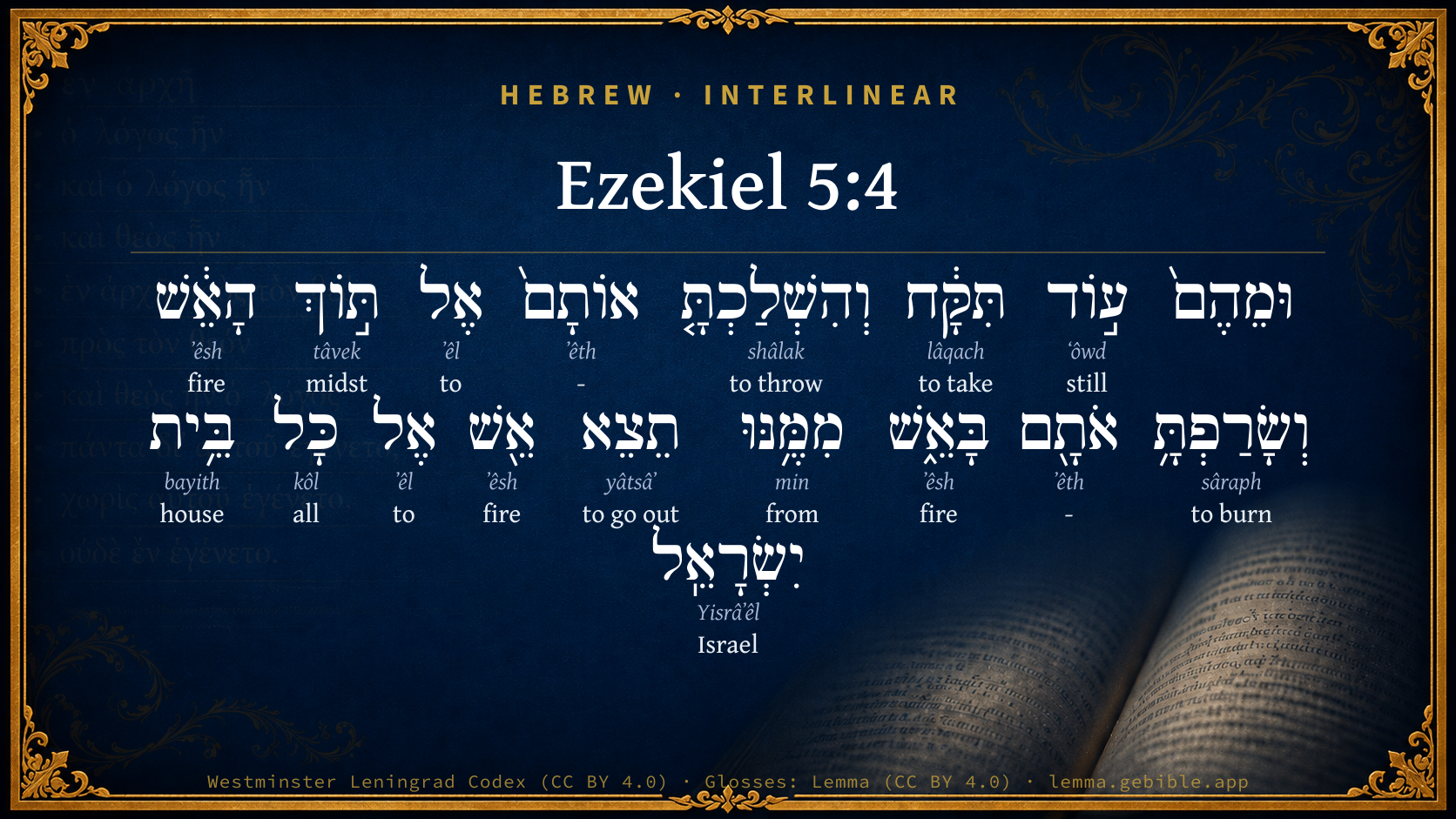
Hebrew (Westminster Leningrad Codex) Ezekiel 5:4 appears in the Hebrew Old Testament. The text above is from the Westminster Leningrad Codex. Each word links to its Strong’s number, a concise gloss, and parsing drawn from the Open Scriptures Hebrew Bible morphology. Click any word for its full Brown-Driver-Briggs (BDB) entry.
Download image
Cite this verse

Ezekiel 5:4 (World English Bible). Public Domain. Lemma interlinear Bible study tool, https://lemma.gebible.app/v/ezekiel/5/4.

Show BibTeX & RIS
BibTeX
RIS
English Translation
Of these again shall you take, and cast them into the midst of the fire, and burn them in the fire; from it shall a fire come forth into all the house of Israel.
World English Bible · Public Domain
Download a study sheet

One document with this verse’s original text, its word-by-word gloss line, the meaning frame, cross-references with their text, attributed commentary, and full source and license credits — printable, and it pastes into notes with its structure intact.

This verse Autodidact and up

Study sheet (.html) Plain text (.txt)

A passage Seminary Student

Up to 50 verses in one chapter. A passage sheet keeps up to 6 commentary sources and 12 cross-references per verse, in the order this page ranks them, and says so on the sheet whenever that leaves anything out. Ask for a single verse and you get the Autodidact verse sheet above.

Everything on this page stays free to read, with no account — the sheet is a download of what is already on screen, not access to it.

Want to remove ads? Support Godless Engineer
Compare translations 3

The same verse in 3 English versions, stacked beneath the original-language interlinear above. Click any original word for its lexicon entry.

Each is an independent rendering of the whole verse — the interlinear is not word-aligned to these translations.

Highlighted words mark where these versions differ — a whole-verse word diff, not a word-by-word alignment.

  • World English Bible Public Domain
    Of these again shall you take, and cast them into the midst of the fire, and burn them in the fire; from it shall a fire come forth into all the house of Israel.
  • King James Version Public Domain
    Then take of them again, and cast them into the midst of the fire, and burn them in the fire; for thereof shall a fire come forth into all the house of Israel.
  • unfoldingWord Literal Text CC BY-SA 4.0
    Then take more of the hair and throw it into the midst of the fire; and burn it in the fire; from there a fire will go out to all the house of Israel.”

unfoldingWord Literal Text — © unfoldingWord, licensed CC BY-SA 4.0. Word-aligned USFM3 via Door43 (git.door43.org/unfoldingWord/en_ult).

Versions to compare (up to 4)

3 of 4 selected

Show all 18 translations

Every available English version of this verse, each an independent rendering of the whole verse.

  • World English Bible Public Domain
    Of these again shall you take, and cast them into the midst of the fire, and burn them in the fire; from it shall a fire come forth into all the house of Israel.
  • Berean Standard Bible Public Domain
    Again, take a few of these, throw them into the fire, and burn them. From there a fire will spread to the whole house of Israel.
  • Majority Standard Bible Public Domain
    Again, take a few of these, throw them into the fire, and burn them. From there a fire will spread to the whole house of Israel.
  • King James Version Public Domain
    Then take of them again, and cast them into the midst of the fire, and burn them in the fire; for thereof shall a fire come forth into all the house of Israel.
  • American Standard Version (1901) Public Domain
    And of these again shalt thou take, and cast them into the midst of the fire, and burn them in the fire; therefrom shall a fire come forth into all the house of Israel.
  • Revised Version (1885) Public Domain
    And of these again shalt thou take, and cast them into the midst of the fire, and burn them in the fire; therefrom shall a fire come forth into all the house of Israel.
  • Geneva Bible (1599) Public Domain
    Then take of them againe and cast them into the middes of the fire, and burne them in the fire: for thereof shall a fire come foorth into all the house of Israel.
  • Douay-Rheims (1899) Public Domain
    And thou shalt take of them again, and shalt cast them in the midst of the fire, and shalt burn them with fire: and out of it shall come forth a fire into all the house of Israel.
  • Young's Literal Translation Public Domain
    and of them thou dost take again, and hast cast them unto the midst of the fire, and hast burned them in the fire -- out of it cometh forth a fire unto all the house of Israel.
  • Literal Standard Version CC BY-SA 4.0
    and you take of them again, and have cast them into the midst of the fire, and have burned them in the fire—out of it comes forth a fire to all the house of Israel.”
  • Unlocked Literal Bible CC BY-SA 4.0
    Then take more of the hair and throw it into the midst of the fire; and burn it in the fire; from there a fire will go out to all the house of Israel.”
  • unfoldingWord Literal Text CC BY-SA 4.0
    Then take more of the hair and throw it into the midst of the fire; and burn it in the fire; from there a fire will go out to all the house of Israel.”
  • Darby Bible Public Domain
    and thou shalt take of these again, and cast them into the midst of the fire, and burn them in the fire: from it shall a fire come forth against all the house of Israel.
  • World Messianic Bible Public Domain
    Of these again you shall take, and cast them into the middle of the fire, and burn them in the fire. From it a fire will come out into all the house of Israel.
  • Webster's Bible Public Domain
    Then take of them again, and cast them into the midst of the fire, and burn them in the fire: from which a fire shall come forth into all the house of Israel.
  • Free Bible Version CC BY-SA 4.0
    Take some of these and toss them into the fire to burn them. A fire will spread from there to burn everyone in Israel.
  • Bible in Basic English Public Domain
    And again take some of these and put them in the fire, burning them up in the fire; and say to all the children of Israel,
  • JPS Tanakh (1917) Public Domain
    And of them again shalt thou take, and cast them into the midst of the fire, and burn them in the fire; therefrom shall a fire come forth into all the house of Israel.

Literal Standard Version (2020), Covenant Press — licensed CC BY-SA 4.0. Text via the HelloAO Bible API (eBible.org). Unlocked Literal Bible (unfoldingWord) — licensed CC BY-SA 4.0. Text via the HelloAO Bible API (eBible.org). unfoldingWord Literal Text — © unfoldingWord, licensed CC BY-SA 4.0. Word-aligned USFM3 via Door43 (git.door43.org/unfoldingWord/en_ult). Free Bible Version, Dr. Jonathan Gallagher — licensed CC BY-SA 4.0. Text via the HelloAO Bible API (eBible.org).

Word by word

More ways to search: Search by grammar → Find every occurrence → Compare this word →

Practice this passage: Drill this verse → Learn its vocabulary →

וְשָׂרַפְתָּ֥
sâraph
H8313
“and · to burn”
Conjunction + Verb, Qal, Sequential Perfect, 2nd Person, Masculine, Singular
Part of Speech
Conjunction + Verb
Stem
Qal
Form
Sequential Perfect
Person
2nd Person
Gender
Masculine
Number
Singular
Full BDB Definition

Origin: a primitive root

TWOT: 2292

to burn - (Qal) to burn - (Niphal) to be burned - (Piel) burner, burning (participle) - (Pual) to be burnt up, be burned
  1. ע֣וֹד ʻôwd H5750 “still” Adverb
  2. תִּקָּ֔ח lâqach H3947 “to take” Verb, Qal, Imperfect, 2nd Person, Masculine, Singular
  3. וְהִשְׁלַכְתָּ֤ shâlak H7993 “and · to throw” Conjunction + Verb, Hiphil, Sequential Perfect, 2nd Person, Masculine, Singular
  4. אוֹתָם֙ ʼêth H853 “- · them” Particle, Direct Object + Suffix, Personal, 3rd Person, Masculine, Plural
  5. אֶל ʼêl H413 “to” Preposition
  6. תּ֣וֹךְ tâvek H8432 “midst of” Noun, Common, Masculine, Singular, Construct
  7. הָאֵ֔שׁ ʼêsh H784 “the · fire” Particle, Definite Article + Noun, Common, Both, Singular, Absolute
  8. אֹתָ֖ם ʼêth H853 “- · them” Particle, Direct Object + Suffix, Personal, 3rd Person, Masculine, Plural
  9. בָּאֵ֑שׁ ʼêsh H784 “in/at the · fire” Preposition, Determined + Noun, Common, Both, Singular, Absolute
  10. מִמֶּ֥נּוּ min H4480 “from · us” Preposition + Suffix, Personal, 1st Person, Common, Plural
  11. תֵצֵא yâtsâʼ H3318 “to go out” Verb, Qal, Imperfect, 3rd Person, Feminine, Singular
  12. אֵ֖שׁ ʼêsh H784 “fire” Noun, Common, Both, Singular, Absolute
  13. אֶל ʼêl H413 “to” Preposition
  14. כָּל kôl H3605 “all of” Noun, Common, Masculine, Singular, Construct
  15. בֵּ֥ית bayith H1004 “house of” Noun, Common, Masculine, Singular, Construct
  16. יִשְׂרָאֵֽל Yisrâʼêl H3478 “Israel” Noun, Proper

About this verse

These counts appear in no published source. They are computed here, from the morphology-tagged text and Lemma’s own curated glosses. What Lemma adds →

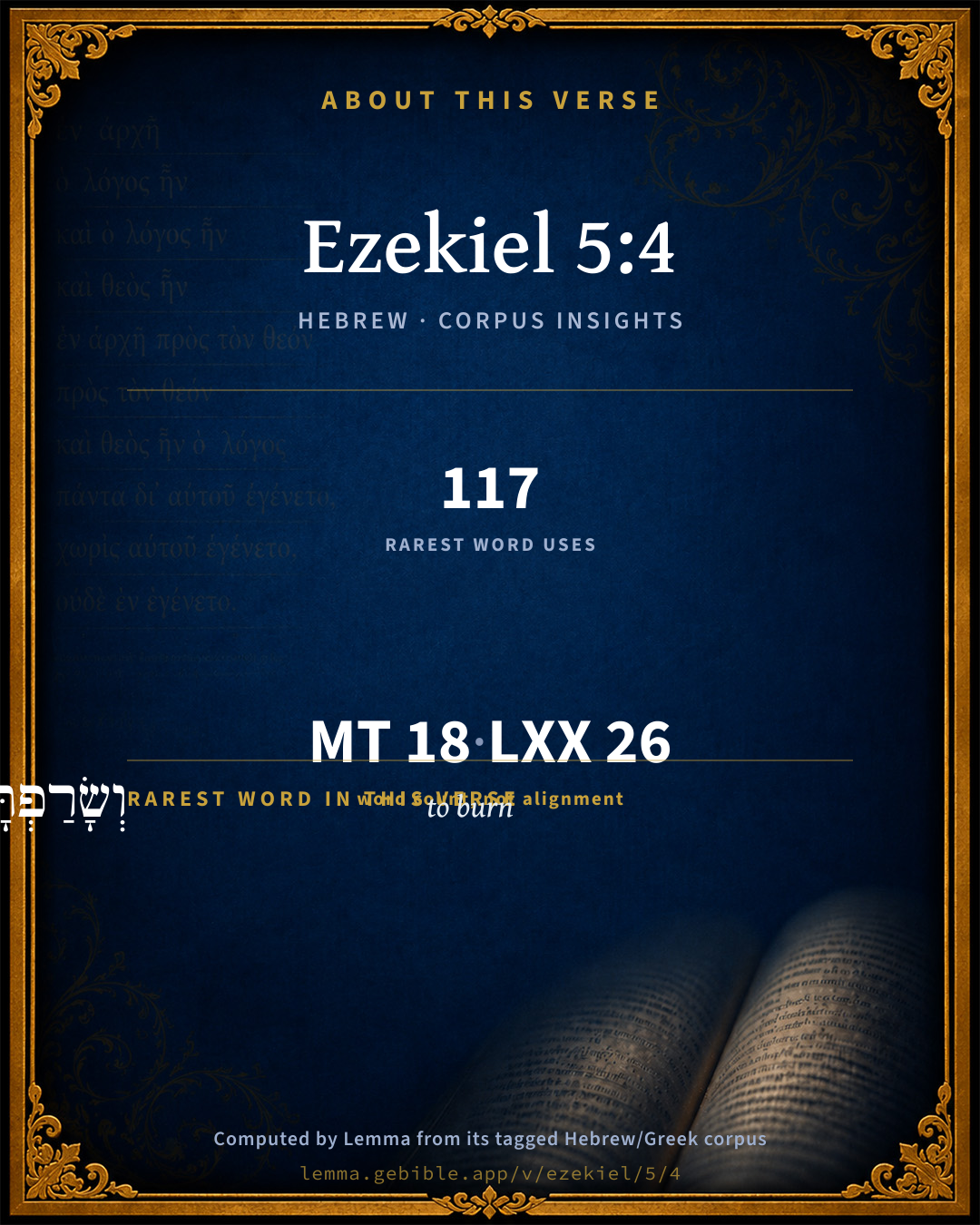
18
words
13
distinct lemmas
Prophets
section

Grammatical profile

  • 4 verbs
  • 7 nouns
  • 4 prepositions
  • 1 adverb
  • 2 particles

Verb forms

  • תִּקָּ֔ח Qal · Imperfect
  • וְהִשְׁלַכְתָּ֤ Hiphil · Sequential Perfect
  • וְשָׂרַפְתָּ֥ Qal · Sequential Perfect
  • תֵצֵא Qal · Imperfect

Repetition

Words recur within this verse — often emphatic in Hebrew:

  • הָאֵ֔שׁ fire H784 ×3
  • אֶל to H413 ×2

Hebrew & Septuagint length

In English translation the verse runs 34 words from the Hebrew and 38 from the Septuagint (LXX English) — closely comparable.

A rough comparison of the two English renderings, which tokenize alike — not a word-level alignment.

Word counts can differ between the Hebrew and the Greek without any difference in meaning — e.g. the Hebrew direct-object marker אֵת has no separate Greek word, and Greek often adds the article ὁ.

In the original languages it is 18 Hebrew tokens and 26 Greek tokens — but the two are counted differently (Hebrew bundles its prefixes and suffixes into one token; the Greek is in lemma form), so that isn’t a like-for-like length.

Cross-references

5

Topical passages linked to Ezekiel 5:4 in the Treasury of Scripture Knowledge — connected by theme and wording, ordered by reader-vote popularity; previews shown in the World English Bible.

  • 2 Kings 25:25 But it happened in the seventh month, that Ishmael the son of Nethaniah, the son of Elishama, of the royal seed came, and ten men with him, and struck Gedaliah, so that he died, and the Jews and the Chaldeans that were with him at Mizpah.
  • Jeremiah 4:4 Circumcise yourselves to Yahweh, and take away the foreskins of your heart, you men of Judah and inhabitants of Jerusalem; lest my wrath go forth like fire, and burn so that none can quench it, because of the evil of your doings.
  • Jeremiah 41:1–18 Now it happened in the seventh month, that Ishmael the son of Nethaniah, the son of Elishama, of the seed royal and [one of] the chief officers of the king, and ten men with him, came to Gedaliah the son of Ahikam to Mizpah; and there they ate bread together in Mizpah.
  • Jeremiah 48:45 Those who fled stand without strength under the shadow of Heshbon; for a fire is gone forth out of Heshbon, and a flame from the midst of Sihon, and has devoured the corner of Moab, and the crown of the head of the tumultuous ones.
  • Jeremiah 52:30 in the three and twentieth year of Nebuchadrezzar Nebuzaradan the captain of the guard carried away captive of the Jews seven hundred forty-five persons: all the persons were four thousand and six hundred.

Cross-references courtesy of OpenBible.info (CC BY 4.0).

Hebrew and Greek witnesses Masoretic Hebrew ↔ Greek Septuagint

The same verse in the two great witnesses to the Old Testament, shown verse-for-verse.

These are two independent witnesses, not word-aligned to each other, and the Septuagint is shown in lemma (dictionary) form.

Hebrew Ezekiel 5:4 Masoretic · Westminster Leningrad Codex

וּמֵהֶם֙ ע֣וֹד תִּקָּ֔ח וְהִשְׁלַכְתָּ֤ אוֹתָם֙ אֶל תּ֣וֹךְ הָאֵ֔שׁ וְשָׂרַפְתָּ֥ אֹתָ֖ם בָּאֵ֑שׁ מִמֶּ֥נּוּ תֵצֵא אֵ֖שׁ אֶל כָּל בֵּ֥ית יִשְׂרָאֵֽל

Of these again shall you take, and cast them into the midst of the fire, and burn them in the fire; from it shall a fire come forth into all the house of Israel.

World English Bible · Public Domain

Greek LXX Ezekiel 5:4 Septuagint · lemma form

καί ἐκ οὗτος λαμβάνω ἔτι καί ῥίπτω αὐτός εἰς μέσος ὁ πῦρ καί κατακαίω αὐτός ἐν πῦρ ἐκ αὐτός ἐκἔρχομαι πῦρ καί εἶπον πᾶς οἶκος ἰσραήλ

And you shall take of these again, and cast them into the midst of the fire, and burn them up with fire: from thence shall come forth fire; and you shall say to the whole house of Israel,

LXX2012 (modern English Septuagint) · Public Domain

Hebrew: Westminster Leningrad Codex (CC BY 4.0). Greek: Septuagint (public domain); English from LXX2012 (modern English Septuagint) (Public Domain). How the Septuagint differs from the Hebrew →

Targum (Aramaic paraphrase)

1

The Targum is the ancient Jewish Aramaic paraphrase of the Hebrew Scriptures — an interpretive translation, not the Hebrew text itself. Onkelos (literal) and Pseudo-Jonathan (expansive) render the Torah, and Jonathan the Prophets. Coverage is partial: where no permissively-licensed English translation exists for a verse, only the Aramaic is shown. This is verse-level text, not a word-by-word alignment to the Hebrew.

  1. Targum Jonathan Prophets (Joshua–Malachi)
    וּמִנְהוֹן עוֹד תִּסַב וְתַרְמֵי יַתְהוֹן לְגוֹ נוּרָא וְתוֹקִיד יַתְהוֹן בְּנוּרָא בְּכֵן תִּפּוֹק אֶשְׁתָּא עַל כָּל בֵּית יִשְׂרָאֵל:

    (no public-domain English translation for this verse)

    Targum Jonathan — Aramaic: “Mikraot Gedolot” (public domain). English: “Sefaria Community Translation” (CC0 1.0 (public-domain dedication)); “London "Chaldee Paraphrase," 1871” (public domain). Text via Sefaria.

Commentary

Notes on Ezekiel 5:4 from classic Christian and Jewish commentators (each source and its license shown beneath its notes). The classic Christian expositions comment on the surrounding passage and are grouped to its opening verse, so a note may address several verses; the Jewish commentaries on the Tanakh (Rashi and others) are per-verse, so they appear only where the commentator wrote on this verse.

Lemma curates 59 commentaries, every one of them public domain or Creative Commons licensed, each selected and text-cleaned for this edition rather than reprinted as found. About our sources →

Trapp's Complete Commentary

John Trapp

Eze 5:4 Then take of them again, and cast them into the midst of the fire, and burn them in the fire; [for] thereof shall a fire come forth into all the house of Israel.

Ver. 4. Then take of them again, and cast them into the midst of the fire.] Thus "evil shall hunt a wicked man to overthrow him"; {Psa 140:11} {See Trapp on "Psa 140:11"} he shall not escape, though he hath escaped; his preservation is but a reservation to further mischief, except he repent.

And burn them in the fire.] Such he meaneth as were combustible matter; for there were a sort of precious ones among them, who being brought by God through the fire, were thereby "refined as silver is refined, and tried as gold is tried." {Zec 13:9} {See Trapp on "Zec 13:9"}

John Trapp, A Commentary or Exposition upon All the Books of the Old and New Testament (1647–1656) — public domain. Text from a community e-Sword module.

Geneva Bible (1599)

Geneva Bible translators

Out of that fire which thou kindlest shall a fire come, which shall signify the destruction of Israel.

Geneva Bible (1599) marginal notes — public domain. Text via Bolls.life.

Adam Clarke's Commentary

Verse 4. See Clarke on Eze 5:1.

Adam Clarke's Commentary on the Bible (1810–1826) — public domain. Text from a community e-Sword/MySword module.

John Calvin's Commentaries

We just saw that there were many reprobate in that small number. Hence, therefore, it is easily gathered how desperate was the impiety of the whole people. After this, he says, take: this adverb is used that those who survived after the slaughter of the city should not think that all their punishments were over: after this, says he, that is, when they shall fancy all their difficulties over, thou shalt take from that part which thou hast preserved, and shalt cast it into the fire. Thence, he says, a fire shall go forth through the whole house of Israel He signifies by these words, as we have seen before, that the vision was not illusory, just as many fictitious things are represented in a theater. Hence God says, what he shows by vision to his servant would happen, as the event itself at length proved. But he goes further that the whole house of Israel shall burn in this burning, because indeed the last destruction of the city brought despair to the miserable, exiles, who, while the city was standing, promised themselves a return. But when they saw such utter destruction of the city, they were consumed just as if fire from Judea had crept even to themselves. In the meantime the remnant are always excepted whom the Lord wonderfully preserved, although he was in a vision destroying the whole people. We now see the tendency of this vision. I will not proceed further, because I should be compelled to desist, and so the doctrine would be abrupt. It is sufficient therefore to hold, although the people was divided into many parts so that the condition of each was distinct, yet that all should perish, since God so determined. Hence the confidence of those who thought they would be safe at Jerusalem was broken: then the ten tribes, which were captives, ought also to acknowledge that the last vengeance of God was not complete, until the city itself, the seat of government and the priesthood was destroyed.

John Calvin's Commentaries (1540-1563) — public domain. Text from the Calvin Translation Society English edition (1840s-50s) via the Christian Classics Ethereal Library (ccel.org). Calvin's coverage is partial (roughly two-thirds of the Bible); uncommented books and verses are honest gaps, never fabricated. The 19th-century editor's footnotes and remarks are omitted so the notes are faithfully Calvin's own voice.

The Cambridge Bible for Schools and Colleges

gen. ed. J. J. S. Perowne

4. Yet of those preserved some shall be cast into the fire and consumed.

thereof shall a fire] therefrom, i.e. from that remnant which is subjected to new consumption in the fire. The “fire” that goes out from this remnant must be destructive, not purifying, as in Eze_19:4 (cf. Jdg_9:15; Eze_15:5; Eze_30:9; Eze_39:6), but the meaning is not quite clear. It is the prophet’s belief that those left in the city after the captivity of Jehoiachin were more debased and wicked than those already carried away (ch. Eze_9:9, Eze_11:15). When the city is destroyed and its inhabitants come as captives among the former exiles, these when they see their wickedness will be comforted over the fall of Jerusalem, acknowledging that it was inevitable (ch. Eze_14:22). Further Jehovah expresses his determination that he shall yet subdue Israel unto him and rule over them, though this implies purging out from among them the rebels, as of old in the wilderness of the Exodus (ch. Eze_20:33-38). And the prophet feels himself a watchman (ch. Eze_3:17); an approaching judgment looms before him, which all the people, each one for himself, will have to pass through. And the idea may be that the judgment, beginning with the inhabitants of Jerusalem, shall spread from them over the whole house of Israel.

The Cambridge Bible for Schools and Colleges (gen. ed. J. J. S. Perowne; Cambridge University Press, 1878–1918) — public domain. Text from a community e-Sword module.

John Gill's Exposition

Then take of them again,.... Of that small number preserved:

and cast them into the midst of the fire, and burn them in the fire: this was fulfilled in Gedaliah and the Jews that were with him, over whom the king of Babylon had made him governor, who were slain by Ishmael, Jer 41:1;

for thereof shall a fire come forth into all the house of Israel; from this barbarous murder of Gedaliah and his men, judgment came upon all the house of Israel; a war commenced between Ishmael and Johanan the son of Kareah; and afterwards Nebuzaradan carried captive great numbers of them that were left in the land. The Syriac and Arabic versions render it, "from these shall a fire come forth", &c. which Jarchi interprets of these intimations given the prophet, from whence judgments should come upon all the house of Israel. It may be understood of those that were left in the land, and of such who returned from the captivity; for whose sins, and those of their posterity, the wrath of God came forth upon all the house of Israel, to the utter destruction of their nation, city, and temple, by Titus Vespasian.

Next: Ezekiel Chapter 6

John Gill's Exposition of the Whole Bible (1746–1763) — public domain (CC PDM 1.0). Text via the HelloAO Bible API.

Haydock's Catholic Bible Commentary

Out of it. Some rose up against Godolias, Jeremias xl., &c. (Calmet) --- The divisions of the Jews brought on the persecution of Epiphanes, (Sanctius) and introduced Pompey. (St. Jerome) (Haydock)

George Leo Haydock (1774–1849), Haydock's Catholic Family Bible and Commentary, 1859 edition — public domain. Excludes Psalms (Douay-Rheims chapter numbering differs from Protestant) and Deuterocanonical books (Catholic canon only).

Matthew Poole's English Annotations

Then take of them again; another division make of that little number, the preserved remnant. Throw some of them into the fire; they are not all to be saved who are delivered at the end of the siege.

Burn them; literally burn the hair, but signify the burning them that are meant by it.

In the fire of God’s displeasure, and of civil war, or private conspiracy, as in Ishmael against Gedaliah, Jer 41.

Thereof, from their sin against God, their discontents at their state, and conspiracies against their governor, appointed by Nebuchadnezzar, evil like another fire shall break out, which shall devour the most, and be near consuming all the house of Israel, as happened to them after Gedaliah’s death, and their going down to Egypt, as Jer 40:1-Jer 44:30; Jer 46, under Johanan’s revolt, which the Chaldean did revenge at last.

Matthew Poole's English Annotations on the Holy Bible (1683–1685) — public domain. Text from a community e-Sword/MySword module.

John Wesley's Explanatory Notes

Of them - Out of that little remnant. In the fire - For their sin against God, their discontents at their state, and conspiracies against their governor, another fire shall break out which shall devour the most, and be near consuming all the houses of Israel.

John Wesley, Explanatory Notes Upon the Whole Bible (1754–1765) — public domain. Text via the GEBible commentary corpus.

Rashi

Rabbi Shlomo Yitzchaki (Rashi)

And you shall take more of them From those few people.

and burn them with fire This represents Ahab son of Kolaiah and Zedekiah son of Maaseiah, whom the king of Babylon burnt with fire (Jer.29: 21f.).

therefrom a fire will emerge From these allusions that I give you, retribution will emerge to all the house of Israel.

Rashi on the Tanakh — English translations: “The Judaica Press complete Tanach with Rashi, translated by A. J. Rosenberg” (CC BY 4.0); “Pentateuch with Rashi's commentary by M. Rosenbaum and A.M. Silbermann, 1929-1934” (public domain); “The Metsudah Tanach series, Lakewood, N.J” (CC BY 4.0); and “The Book of Joshua, Metsudah Publications, 1997” (CC BY 4.0). Text via Sefaria.

Lesson kit

Teaching starters — assembled from the data on this page, not authored interpretation. Every prompt links to the verse data it draws on. Edit before teaching.

Ezekiel, in the Prophets, opens this verse with 18 words (13 distinct Hebrew lemmas). Its most distinctive word is sâraph (“to burn”). A historical commentator’s framing appears above. Read the whole chapter for the surrounding context.

Discussion questions

  1. The word sâraph carries the sense “to burn.” How does it shape the verse?
  2. 2 Kings 25:25 shares this passage’s theme. How do the two illuminate each other?
  3. “fire” occurs 3× in this one verse. What is the effect of the repetition?
  4. These translations render this verse differently. What is at stake in choosing one wording over another?
  5. The verb «תִּקָּ֔ח» is Qal Imperfect. How does its form color the action?
  6. Reading how Trapp's Complete Commentary and Geneva Bible (1599) read this verse, where do the two commentators agree and where do they part?

Things to notice

Reading settings

Reading text

Shown beneath each verse's original-language words.

Old Testament
Old Testament edition

Read the OT as the Masoretic Hebrew (MT) or the Greek Septuagint (LXX).

English shown for the Greek Septuagint (in the Hebrew ↔ Greek comparison).

Comparing translations? Open the Compare panel on any verse page to stack up to four side by side.