
Jeremiah 41:9

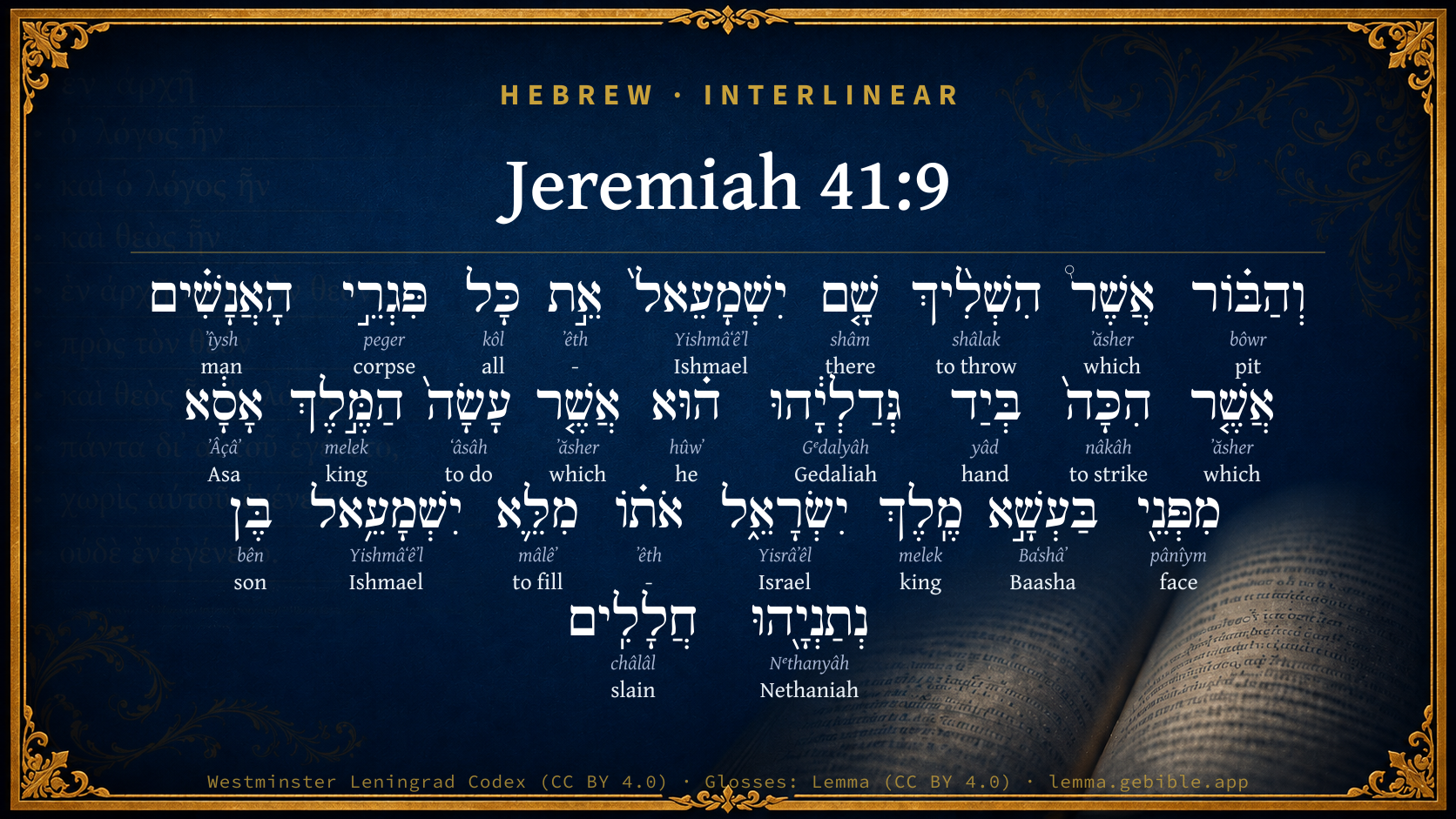
Hebrew (Westminster Leningrad Codex) Jeremiah 41:9 appears in the Hebrew Old Testament. The text above is from the Westminster Leningrad Codex. Each word links to its Strong’s number, a concise gloss, and parsing drawn from the Open Scriptures Hebrew Bible morphology. Click any word for its full Brown-Driver-Briggs (BDB) entry.
Download image
Cite this verse

Jeremiah 41:9 (World English Bible). Public Domain. Lemma interlinear Bible study tool, https://lemma.gebible.app/v/jeremiah/41/9.

Show BibTeX & RIS
BibTeX
RIS
English Translation
Now the pit in which Ishmael cast all the dead bodies of the men whom he had killed, by the side of Gedaliah (the same was who which Asa the king had made for fear of Baasha king of Israel), Ishmael the son of Nethaniah filled it with those who were killed.
World English Bible · Public Domain
Download a study sheet

One document with this verse’s original text, its word-by-word gloss line, the meaning frame, cross-references with their text, attributed commentary, and full source and license credits — printable, and it pastes into notes with its structure intact.

This verse Autodidact and up

Study sheet (.html) Plain text (.txt)

A passage Seminary Student

Up to 50 verses in one chapter. A passage sheet keeps up to 6 commentary sources and 12 cross-references per verse, in the order this page ranks them, and says so on the sheet whenever that leaves anything out. Ask for a single verse and you get the Autodidact verse sheet above.

Everything on this page stays free to read, with no account — the sheet is a download of what is already on screen, not access to it.

Want to remove ads? Support Godless Engineer
Compare translations 3

The same verse in 3 English versions, stacked beneath the original-language interlinear above. Click any original word for its lexicon entry.

Each is an independent rendering of the whole verse — the interlinear is not word-aligned to these translations.

Highlighted words mark where these versions differ — a whole-verse word diff, not a word-by-word alignment.

  • World English Bible Public Domain
    Now the pit in which Ishmael cast all the dead bodies of the men whom he had killed, by the side of Gedaliah (the same was who which Asa the king had made for fear of Baasha king of Israel), Ishmael the son of Nethaniah filled it with those who were killed.
  • King James Version Public Domain
    Now the pit wherein Ishmael had cast all the dead bodies of the men, whom he had slain because of Gedaliah, was it which Asa the king had made for fear of Baasha king of Israel: and Ishmael the son of Nethaniah filled it with them that were slain.
  • unfoldingWord Literal Text CC BY-SA 4.0
    The cistern where Ishmael threw all the dead bodies that he had killed, was a large cistern that King Asa dug to make a defense against King Baasha of Israel. Ishmael son of Nethaniah filled it in with the dead.

unfoldingWord Literal Text — © unfoldingWord, licensed CC BY-SA 4.0. Word-aligned USFM3 via Door43 (git.door43.org/unfoldingWord/en_ult).

Versions to compare (up to 4)

3 of 4 selected

Show all 18 translations

Every available English version of this verse, each an independent rendering of the whole verse.

  • World English Bible Public Domain
    Now the pit in which Ishmael cast all the dead bodies of the men whom he had killed, by the side of Gedaliah (the same was who which Asa the king had made for fear of Baasha king of Israel), Ishmael the son of Nethaniah filled it with those who were killed.
  • Berean Standard Bible Public Domain
    Now the cistern into which Ishmael had thrown all the bodies of the men he had struck down along with Gedaliah was a large one that King Asa had made for fear of Baasha king of Israel. Ishmael son of Nethaniah filled it with the slain.
  • Majority Standard Bible Public Domain
    Now the cistern into which Ishmael had thrown all the bodies of the men he had struck down along with Gedaliah was a large one that King Asa had made for fear of Baasha king of Israel. Ishmael son of Nethaniah filled it with the slain.
  • King James Version Public Domain
    Now the pit wherein Ishmael had cast all the dead bodies of the men, whom he had slain because of Gedaliah, was it which Asa the king had made for fear of Baasha king of Israel: and Ishmael the son of Nethaniah filled it with them that were slain.
  • American Standard Version (1901) Public Domain
    Now the pit wherein Ishmael cast all the dead bodies of the men whom he had slain, by the side of Gedaliah (the same was that which Asa the king had made for fear of Baasha king of Israel,) Ishmael the son of Nethaniah filled it with them that were slain.
  • Revised Version (1885) Public Domain
    Now the pit wherein Ishmael cast all the dead bodies of the men whom he had slain, by the side of Gedaliah, (the same was that which Asa the king had made for fear of Baasha king of Israel,) Ishmael the son of Nethaniah filled it with them that were slain.
  • Geneva Bible (1599) Public Domain
    Now the pit wherein Ishmael had cast the dead bodies of the men (whom he had slayne because of Gedaliah) is it, which Asa the King had made because of Basha King of Israel, and Ishmael the sonne of Nethaniah filled it with them that were slaine.
  • Douay-Rheims (1899) Public Domain
    And the pit into which Ismahel cast all the dead bodies of the men whom he slew because of Godolias, is the same that king Asa made, for fear of Baasa the king of Israel: the same did Ismahel the son of Nathanias fill with them that were slain.
  • Young's Literal Translation Public Domain
    And the pit whither Ishmael hath cast all the carcases of the men whom he hath smitten along with Gedaliah, is that which the king Asa made because of Baasha king of Israel -- it hath Ishmael son of Nethaniah filled with the pierced.
  • Literal Standard Version CC BY-SA 4.0
    And the pit to where Ishmael has cast all the carcasses of the men whom he has struck along with Gedaliah, is that which King Asa made because of Baasha king of Israel—Ishmael son of Nethaniah has filled it with the pierced.
  • Unlocked Literal Bible CC BY-SA 4.0
    The cistern where Ishmael threw all the dead bodies that he had killed, was a large cistern that King Asa dug to make a defense against King Baasha of Israel. Ishmael son of Nethaniah filled it in with the dead.
  • unfoldingWord Literal Text CC BY-SA 4.0
    The cistern where Ishmael threw all the dead bodies that he had killed, was a large cistern that King Asa dug to make a defense against King Baasha of Israel. Ishmael son of Nethaniah filled it in with the dead.
  • Darby Bible Public Domain
    And the pit into which Ishmael had cast all the dead bodies of the men whom he had slain by the side of Gedaliah was the one which Asa the king had made for fear of Baasha king of Israel: Ishmael the son of Nethaniah filled it with the slain.
  • World Messianic Bible Public Domain
    Now the pit in which Ishmael cast all the dead bodies of the men whom he had killed, by the side of Gedaliah (this was that which Asa the king had made for fear of Baasha king of Israel), Ishmael the son of Nethaniah filled it with those who were killed.
  • Webster's Bible Public Domain
    Now the pit into which Ishmael had cast all the dead bodies of the men, whom he had slain because of Gedaliah, was that which Asa the king had made for fear of Baasha king of Israel: and Ishmael the son of Nethaniah filled it with them that were slain.
  • Free Bible Version CC BY-SA 4.0
    (The cistern where Ishmael had thrown all the bodies of the men he'd killed, including Gedaliah, was a large one that King Asa had dug because of the threat of attack by Baasha king of Israel. Ishmael filled it with bodies.)
  • Bible in Basic English Public Domain
    Now the hole into which Ishmael had put the dead bodies of the men whom he had put to death, was the great hole which Asa the king had made for fear of Baasha, king of Israel: and Ishmael, the son of Nethaniah, made it full of the bodies of those who had been put to death.
  • JPS Tanakh (1917) Public Domain
    Now the pit wherein Ishmael cast all the dead bodies of the men whom he had slain by the side of Gedaliah was that which Asa the king had made for fear of Baasa king of Israel; the same Ishmael the son of Nethaniah filled with them that were slain.

Literal Standard Version (2020), Covenant Press — licensed CC BY-SA 4.0. Text via the HelloAO Bible API (eBible.org). Unlocked Literal Bible (unfoldingWord) — licensed CC BY-SA 4.0. Text via the HelloAO Bible API (eBible.org). unfoldingWord Literal Text — © unfoldingWord, licensed CC BY-SA 4.0. Word-aligned USFM3 via Door43 (git.door43.org/unfoldingWord/en_ult). Free Bible Version, Dr. Jonathan Gallagher — licensed CC BY-SA 4.0. Text via the HelloAO Bible API (eBible.org).

Word by word

More ways to search: Search by grammar → Find every occurrence → Compare this word →

Practice this passage: Drill this verse → Learn its vocabulary →

נְתַנְיָ֖הוּ
Nᵉthanyâh
H5418
“Nethaniah”
Noun, Proper
Part of Speech
Noun
Type
Proper
Full BDB Definition

Origin: from H5414 and H3050

TWOT: None

Nethaniah = "given of Jehovah" - son of Elishama of the royal family of Judah and father of Ishmael who murdered Gedaliah - father of Jehudi - a Levite, one of the 4 sons of Asaph the minstrel - a Levite in the reign of king Jehoshaphat of Judah
  1. וְהַבּ֗וֹר bôwr H953 “and · the · pit” Conjunction + Particle, Definite Article + Noun, Common, Masculine, Singular, Absolute
  2. אֲשֶׁר֩ ʼăsher H834 “which” Particle, Relative
  3. הִשְׁלִ֨יךְ shâlak H7993 “to throw” Verb, Hiphil, Perfect, 3rd Person, Masculine, Singular
  4. שָׁ֤ם shâm H8033 “there” Adverb
  5. יִשְׁמָעֵאל֙ Yishmâʻêʼl H3458 “Ishmael” Noun, Proper
  6. אֵ֣ת ʼêth H853 “-” Particle, Direct Object
  7. כָּל kôl H3605 “all of” Noun, Common, Masculine, Singular, Construct
  8. פִּגְרֵ֣י peger H6297 “corpses of” Noun, Common, Masculine, Plural, Construct
  9. הָאֲנָשִׁ֗ים ʼîysh H376 “the · men” Particle, Definite Article + Noun, Common, Masculine, Plural, Absolute
  10. אֲשֶׁ֤ר ʼăsher H834 “which” Particle, Relative
  11. הִכָּה֙ nâkâh H5221 “to strike” Verb, Hiphil, Perfect, 3rd Person, Masculine, Singular
  12. בְּיַד yâd H3027 “in/at · hand of” Preposition + Noun, Common, Both, Singular, Construct
  13. גְּדַלְיָ֔הוּ Gᵉdalyâh H1436 “Gedaliah” Noun, Proper
  14. ה֗וּא hûwʼ H1931 “he” Pronoun, Personal, 3rd Person, Masculine, Singular
  15. אֲשֶׁ֤ר ʼăsher H834 “which” Particle, Relative
  16. עָשָׂה֙ ʻâsâh H6213 “to do” Verb, Qal, Perfect, 3rd Person, Masculine, Singular
  17. הַמֶּ֣לֶךְ melek H4428 “the · king” Particle, Definite Article + Noun, Common, Masculine, Singular, Absolute
  18. אָסָ֔א ʼÂçâʼ H609 “Asa” Noun, Proper
  19. מִפְּנֵ֖י pânîym H6440 “from · face(s) of” Preposition + Noun, Common, Both, Plural, Construct
  20. בַּעְשָׁ֣א Baʻshâʼ H1201 “Baasha” Noun, Proper
  21. מֶֽלֶךְ melek H4428 “king of” Noun, Common, Masculine, Singular, Construct
  22. יִשְׂרָאֵ֑ל Yisrâʼêl H3478 “Israel” Noun, Proper
  23. אֹת֗וֹ ʼêth H853 “- · him” Particle, Direct Object + Suffix, Personal, 3rd Person, Masculine, Singular
  24. מִלֵּ֛א mâlêʼ H4390 “to fill” Verb, Piel, Perfect, 3rd Person, Masculine, Singular
  25. יִשְׁמָעֵ֥אל Yishmâʻêʼl H3458 “Ishmael” Noun, Proper
  26. בֶּן bên H1121 “son of” Noun, Common, Masculine, Singular, Construct
  27. חֲלָלִֽים châlâl H2491 “slain” Adjective, Adjective, Masculine, Plural, Absolute

About this verse

These counts appear in no published source. They are computed here, from the morphology-tagged text and Lemma’s own curated glosses. What Lemma adds →

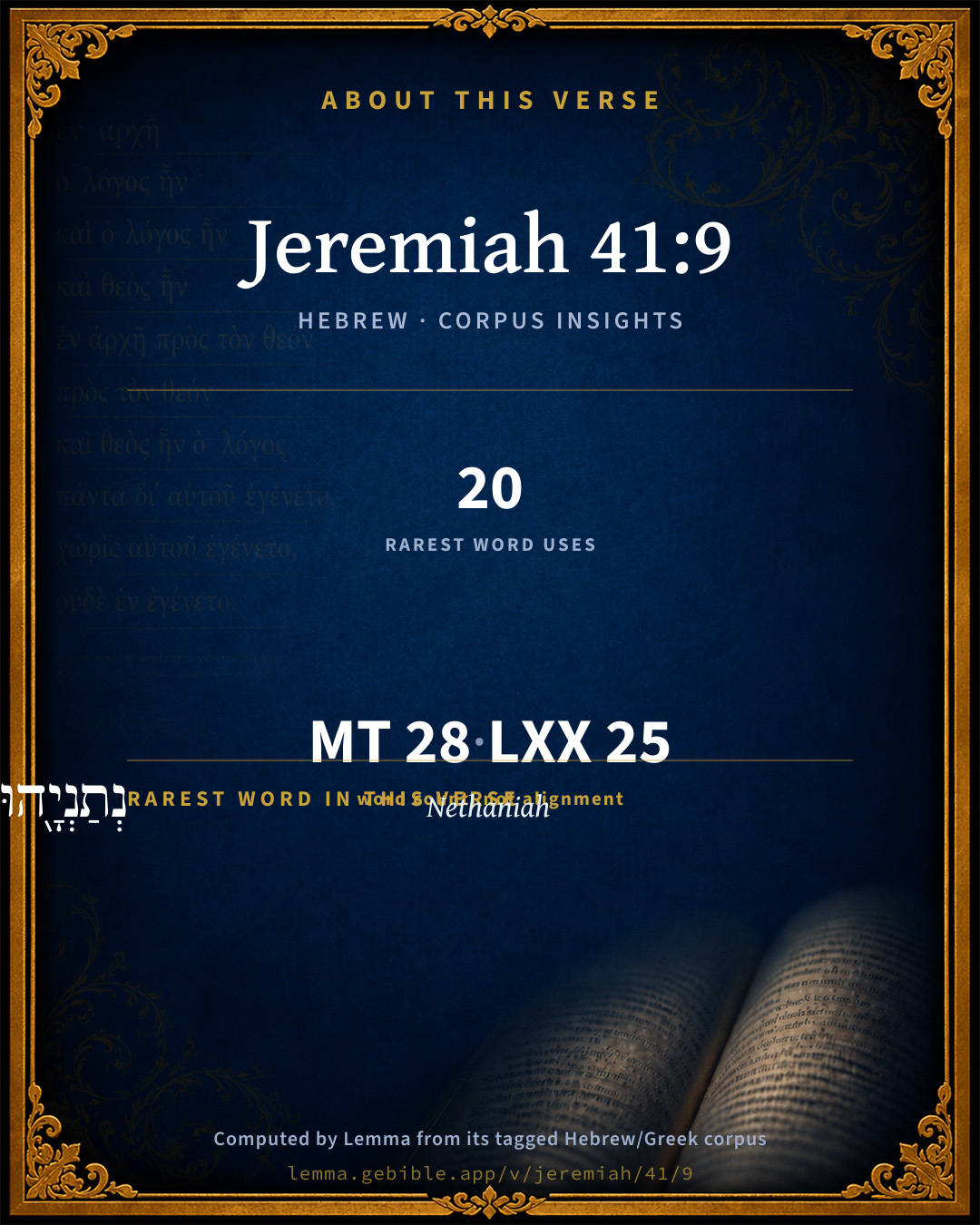
28
words
23
distinct lemmas
Prophets
section

Notable vocabulary

The rarest word here is נְתַנְיָ֖הוּ Nethaniah H5418 — appearing just 20 times in the whole Hebrew Bible.

Shared distinctive vocabulary

נְתַנְיָ֖הוּ Nethaniah H5418 occurs in 20 verses of the Hebrew Bible. Also found in:

Grammatical profile

  • 4 verbs
  • 16 nouns
  • 1 adjective
  • 1 pronoun
  • 1 adverb
  • 5 particles

Verb forms

  • הִשְׁלִ֨יךְ Hiphil · Perfect
  • הִכָּה֙ Hiphil · Perfect
  • עָשָׂה֙ Qal · Perfect
  • מִלֵּ֛א Piel · Perfect

Repetition

Words recur within this verse — often emphatic in Hebrew:

  • יִשְׁמָעֵאל֙ Ishmael H3458 ×2
  • הַמֶּ֣לֶךְ king H4428 ×2
  • אֲשֶׁר֩ which H834 ×3

Hebrew & Septuagint length

In the original languages it is 28 Hebrew tokens and 25 Greek tokens — but the two are counted differently (Hebrew bundles its prefixes and suffixes into one token; the Greek is in lemma form), so that isn’t a like-for-like length.

Cross-references

10

Topical passages linked to Jeremiah 41:9 in the Treasury of Scripture Knowledge — connected by theme and wording, ordered by reader-vote popularity; previews shown in the World English Bible.

  • Judges 6:2 The hand of Midian prevailed against Israel; and because of Midian the children of Israel made them the dens which are in the mountains, and the caves, and the strongholds.
  • 1 Samuel 13:6 When the men of Israel saw that they were in a strait (for the people were distressed), then the people did hide themselves in caves, and in thickets, and in rocks, and in coverts, and in pits.
  • 2 Samuel 17:9 Behold, he is hid now in some pit, or in some [other] place: and it will happen, when some of them are fallen at the first, that whoever hears it will say, There is a slaughter among the people who follow Absalom.
  • 1 Kings 15:17–22 Baasha king of Israel went up against Judah, and built Ramah, that he might not allow anyone to go out or come in to Asa king of Judah.
  • 2 Chronicles 16:1–10 In the six and thirtieth year of the reign of Asa, Baasha king of Israel went up against Judah, and built Ramah, that he might not allow anyone to go out or come in to Asa king of Judah.
  • Joshua 10:16–18 These five kings fled, and hid themselves in the cave at Makkedah.
  • 1 Samuel 14:11 Both of them disclosed themselves to the garrison of the Philistines: and the Philistines said, Behold, the Hebrews come forth out of the holes where they had hid themselves.
  • 1 Samuel 14:22 Likewise all the men of Israel who had hid themselves in the hill-country of Ephraim, when they heard that the Philistines fled, even they also followed hard after them in the battle.
  • 1 Samuel 24:3 He came to the sheep pens by the way, where was a cave; and Saul went in to cover his feet. Now David and his men were abiding in the innermost parts of the cave.
  • Hebrews 11:38 (of whom the world was not worthy), wandering in deserts, mountains, caves, and the holes of the earth.

Cross-references courtesy of OpenBible.info (CC BY 4.0).

Hebrew and Greek witnesses Masoretic Hebrew ↔ Greek Septuagint

The same verse in the two great witnesses to the Old Testament, shown verse-for-verse.

These are two independent witnesses, not word-aligned to each other, and the Septuagint is shown in lemma (dictionary) form.

Hebrew Jeremiah 41:9 Masoretic · Westminster Leningrad Codex

וְהַבּ֗וֹר אֲשֶׁר֩ הִשְׁלִ֨יךְ שָׁ֤ם יִשְׁמָעֵאל֙ אֵ֣ת כָּל פִּגְרֵ֣י הָאֲנָשִׁ֗ים אֲשֶׁ֤ר הִכָּה֙ בְּיַד גְּדַלְיָ֔הוּ ה֗וּא אֲשֶׁ֤ר עָשָׂה֙ הַמֶּ֣לֶךְ אָסָ֔א מִפְּנֵ֖י בַּעְשָׁ֣א מֶֽלֶךְ יִשְׂרָאֵ֑ל אֹת֗וֹ מִלֵּ֛א יִשְׁמָעֵ֥אל בֶּן נְתַנְיָ֖הוּ חֲלָלִֽים

Now the pit in which Ishmael cast all the dead bodies of the men whom he had killed, by the side of Gedaliah (the same was who which Asa the king had made for fear of Baasha king of Israel), Ishmael the son of Nethaniah filled it with those who were killed.

World English Bible · Public Domain

Greek LXX Structure differs

In the Septuagint, Jeremiah is about an eighth shorter than the Hebrew and arranges its material differently — the Oracles Against the Nations (Hebrew chapters 46–51) appear in the middle of the Greek book, after 25:13. Because the chapter and verse boundaries do not line up, a verse-for-verse comparison with the Hebrew is not shown.

A verse-for-verse comparison isn’t shown here because the chapters and verses don’t line up. Switch to the LXX edition with the MT / LXX toggle above to read the Greek directly.

On this verse, The Cambridge Bible for Schools and Colleges discusses the Septuagint’s reading. Read the note in Commentary ↓

Hebrew: Westminster Leningrad Codex (CC BY 4.0). Greek: Septuagint (public domain); English from a public-domain English Septuagint. How the Septuagint differs from the Hebrew →

Targum (Aramaic paraphrase)

1

The Targum is the ancient Jewish Aramaic paraphrase of the Hebrew Scriptures — an interpretive translation, not the Hebrew text itself. Onkelos (literal) and Pseudo-Jonathan (expansive) render the Torah, and Jonathan the Prophets. Coverage is partial: where no permissively-licensed English translation exists for a verse, only the Aramaic is shown. This is verse-level text, not a word-by-word alignment to the Hebrew.

  1. Targum Jonathan Prophets (Joshua–Malachi)
    וְגוּבָא דִי רְמָא תֵמָן יִשְׁמָעֵאל יַת כָּל פִּגְרֵי גַבְרַיָא דִי קְטַל בְּיַד גְדַלְיָהוּ הוּא דַעֲבַד מַלְכָּא אָסָא כַּד צַר עֲלוֹהִי בַּעֲשָׁא מַלְכָּא דְיִשְׂרָאֵל יָתֵיהּ מַלֵי יִשְׁמָעֵאל בַּר נְתַנְיָה קְטִילִין:

    (no public-domain English translation for this verse)

    Targum Jonathan — Aramaic: “Mikraot Gedolot” (public domain). English: “Sefaria Community Translation” (CC0 1.0 (public-domain dedication)); “London "Chaldee Paraphrase," 1871” (public domain). Text via Sefaria.

Commentary

Notes on Jeremiah 41:9 from classic Christian and Jewish commentators (each source and its license shown beneath its notes). The classic Christian expositions comment on the surrounding passage and are grouped to its opening verse, so a note may address several verses; the Jewish commentaries on the Tanakh (Rashi and others) are per-verse, so they appear only where the commentator wrote on this verse.

Lemma curates 59 commentaries, every one of them public domain or Creative Commons licensed, each selected and text-cleaned for this edition rather than reprinted as found. About our sources →

Trapp's Complete Commentary

John Trapp

Jer 41:9 Now the pit wherein Ishmael had cast all the dead bodies of the men, whom he had slain because of Gedaliah, [was] it which Asa the king had made for fear of Baasha king of Israel: [and] Ishmael the son of Nethaniah filled it with [them that were] slain.

Ver. 9. Now the pit … was it which Asa the king had made for fear of Baasha.] He had made it for some unknown use in the wars, and now it was filled with the dead bodies of men; for a punishment, say some, of his confederating with Benhadad King of Syria. Ut semper impiorum foedera et consilia nobis sint suspecta.

John Trapp, A Commentary or Exposition upon All the Books of the Old and New Testament (1647–1656) — public domain. Text from a community e-Sword module.

Joseph Benson's Commentary

Jer 41:9. Now the pit was it which Asa had made, &c. — The word בור, here and elsewhere rendered pit, frequently signifies, a cistern, basin, or, reservoir; a large place made for receiving rain-water; which seems to be the meaning of the word here. This pit, or reservoir, Asa, who built and fortified Mizpah, at the time he was at war with Baasha king of Israel, caused to be made in the midst of the city, in order that the people might not be in want of so necessary an article as water in case of a siege. Reservoirs of this kind were much in use in Palestine, as Jerome tells us, in his commentary upon Amo 4:7-8. And Josephus testifies the advantage of them to the besieged when he tells us that, when Masada was reduced to the greatest distress for want of water, it was relieved by a fall of rain in the night, which filled all the reservoirs, Antiq. lib. 14. cap. 14. Each private family seems also to have had one of these reservoirs for its own use. Drink ye every one the waters of his own cistern, בורו, his pit, or, reservoir, says Rabshakeh to the people of Jerusalem, Isa 36:16.

Joseph Benson's Commentary on the Old and New Testaments (1811–1818) — public domain. Text from a community e-Sword module.

Tyndale Open Study Notes

Tyndale Open Resources

41:9 dug by King Asa when he fortified Mizpah: See 2 Chr 16:1-6. That passage does not refer to cisterns, but the need for water and grain storage would have required such structures, and several cisterns have been found in the ruins of the city.

Tyndale Open Study Notes — © Tyndale Open Resources, licensed CC BY-SA 4.0. Text via the HelloAO Bible API.

Geneva Bible (1599)

Geneva Bible translators

Asa fortified Mizpah for fear of the enemy, and cast ditches and trenches, 1 Kings 15:22.

Geneva Bible (1599) marginal notes — public domain. Text via Bolls.life.

Jamieson, Fausset & Brown

Robert Jamieson, A. R. Fausset & David Brown

because of Gedaliah--rather, "near Gedaliah," namely, those intercepted by Ishmael on their way from Samaria to Jerusalem and killed at Mizpah, where Gedaliah had lived. So Ch2 17:15, "next"; Neh 3:2, Margin, literally, as here, "at his hand." "In the reign of Gedaliah" [CALVIN]. However, English Version gives a good sense: Ishmael's reason for killing them was because of his supposing them to be connected with Gedaliah.

Jamieson, Fausset & Brown — Commentary Critical and Explanatory on the Whole Bible (1871) — public domain (CC PDM 1.0). Text via the HelloAO Bible API.

Adam Clarke's Commentary

Verse 9. Now the pit - was it which Asa the king had made for fear of Baasha] See 1Kg 15:22. Asa made this cistern as a reservoir for water for the supply of the place; for he built and fortified Mizpah at the time that he was at war with Baasha, king of Israel.

Adam Clarke's Commentary on the Bible (1810–1826) — public domain. Text from a community e-Sword/MySword module.

John Calvin's Commentaries

The Prophet tells us by the way that the trench was made by King Asa, when he fortified the city against the attack of Baasha, as it is related in the sixteenth chapter of Second Chronicles. For Baasha, having collected an army, made an attack on the land of Judah and began to build the city, that he might thus keep the Jews as it were besieged, and make thence daily incursions, and where he might safely take his forces together with the spoils. Asa then hired the king of Syria, and induced him to break the treaty which the two kings of Syria and Israel had made with one another. Thus Baasha was forced to leave the work unfinished, and thence Asa is said to have carried away the gathered stones, that thereby the trench might be formed. There is indeed no mention of the trench; but we may conclude that it was then formed, in order that it might interpose between the enemy and the city. But it may seem strange that the trench was in the midst of the city, except perhaps that Asa built a fortress within the town, that if he was overcome by his enemy, he might take refuge there with his men of war, as we know that citadels are often built in the middle of cities as fortresses, as places of refuge. Asa then built this trench, that should the king of Israel take the city, he might not penetrate farther, but be kept back by the interposing trench. But only in things uncertain are conjectures to be allowed.

But the Prophet increases the indignity of the deed, when he says, that the trench was filled with the slain It was formed for a very different end and purpose, even that the king of Judah, when reduced to the greatest straits, might have the trench as a defense against the violence of his enemies, so that he might protect his kingdom and his subjects. But now the slain were cast into the trench, not the Syrians nor the Israelites, but Jews themselves and God’s pious worshipers. What then had been made for the public benefit of the people, was made by Ishmael a place for the slaughter of good men. And hence, as it has been said, the atrocity of the deed was more enhanced. It afterwards follows, —

John Calvin's Commentaries (1540-1563) — public domain. Text from the Calvin Translation Society English edition (1840s-50s) via the Christian Classics Ethereal Library (ccel.org). Calvin's coverage is partial (roughly two-thirds of the Bible); uncommented books and verses are honest gaps, never fabricated. The 19th-century editor's footnotes and remarks are omitted so the notes are faithfully Calvin's own voice.

Ellicott's Commentary for English Readers

(9) Because of Gedaliah.—Literally, by the hand of Gedaliah; i.e., by using his name to entrap the unsuspecting pilgrims.

Which Asa the king had made for fear of Baasha . . .—See 1Ki_15:22; 2Ch_16:6. Baasha had tried to fortify Ramah as an outpost of his kingdom. Asa called in the help of Benhadad, king of Syria, and compelled him to desist, and then carried off the stones and timber to strengthen Mizpah as a position of defence. The “pit” was probably a trench with a drawbridge over it, so constructed as to stop all approach from the neighbouring kingdom; or else one of the tanks or reservoirs constructed to supply the fortress with water. A various reading gives “the pit of Gedaliah,” instead of “because of Gedaliah.”

A Bible Commentary for English Readers, edited by Charles John Ellicott (1878–1897) — public domain. Text from a community e-Sword module.

The Cambridge Bible for Schools and Colleges

gen. ed. J. J. S. Perowne

9. See 1Ki_15:22; 2Ch_16:6.

by the side of Gedaliah] With the slightest possible change in the consonants of the MT. we may accept an almost certain correction, and read (with LXX) “was a great cistern” (tank for the storage of water). Cp. the tragic story of the “well” at Cawnpore in the Indian mutiny.

The Cambridge Bible for Schools and Colleges (gen. ed. J. J. S. Perowne; Cambridge University Press, 1878–1918) — public domain. Text from a community e-Sword module.

John Gill's Exposition

Now the pit wherein Ishmael had cast all the dead bodies,.... Not only of those seventy men of Samaria, &c. but

of the men whom he had slain because of Gedaliah; because of their attachment to him: or, "by the hand of Gedaliah" (k); not by him, as an instrument; unless, as Jarchi observes, because he rejected the advice of Johanan, and provided not for his safety, and his people, it was as if they were slain by him (l); rather the sense is, that they were slain by the side of him, or in the, place where he was, or along with him (m); see a like phrase in Jer 38:10; now both the one and the other were cast into one pit: and this

was that which Asa the king had made for fear of Baasha king of Israel; which was either a ditch that was cast up against the wall that went round the city; or a large pit or well in the midst of it, to hold water in it; and this was made by King Asa, either when he built and fortified Mizpah, Kg1 15:22; or, as the Targum here, when Baasha king of Israel besieged it; which he made that he might be provided for with water during the siege; or to hide himself in it; or stop the enemy from proceeding any further, should he enter:

and Ishmael the son of Nethaniah filled it with them that were slain; which shows it rather to be a pit or well within the city than a ditch about it; since it was filled with the slain, with those that were slain with Gedaliah, and those seventy other persons; and by which he made the well useless to the inhabitants hereafter.

(k) "in manu Gedaliae", Montanus, Vatablus. (l) So T. Bab. Nidda, fol. 61. 1. (m) "Ad latus", Junius & Tremellius, Piscator; "in loco", some in Munster; "cum Gedalia", De Dieu, Gataker.

John Gill's Exposition of the Whole Bible (1746–1763) — public domain (CC PDM 1.0). Text via the HelloAO Bible API.

Albert Barnes' Notes on the Bible

Because of Gedaliah - By the side “of Gedaliah.” Ishmael now cast beside Gedaliah’s body those of the pilgrims.

Albert Barnes' Notes on the Bible (1834–1885) — public domain. Text from a community e-Sword/MySword module.

Matthew Poole's English Annotations

The word which we translate

because of ביד signifieth in the hand of Gedaliah, which hath given critics a scope to vary in their notion of it, and to translate it, in the power of, by occasion of, &c. But the learned author of our English Annotations saith the sense of the place is plain enough; Jer 38:10, we have the same term twice, where we have translated it with thee, so here it doubtless signifies those who were with Gedaliah under his power or charge. What pit this was is not so well agreed, that is, upon what occasion made; the text telleth us it was digged by Asa king of Judah, and that it was made for fear of Baasha the king of Israel; but whether it was to receive water, or to hinder Baasha’s coming near some weak part of the city, we are not told, and it is but in vain to guess. We read, 1Ki 15:22, of Asa’s fortifying Mizpah with the stones of Ramah, but of this pit we read nothing.

Matthew Poole's English Annotations on the Holy Bible (1683–1685) — public domain. Text from a community e-Sword/MySword module.

Whedon's Commentary on the Bible

Daniel D. Whedon

9. Now the pit — From Jer_41:7 it would appear probable that this pit was within the city, though this is not quite certain. Probably, then, the meaning here is, that this was simply a cistern of extraordinary size intended to supply water in time of siege. A store of water is as necessary as a fortification.

Because of Gedaliah — The words have been variously interpreted. The most satisfactory sense is, by the side of, as in the margin. The reason of this extraordinary double assassination is not very clear. It could hardly be for booty merely, though it would seem that Ishmael was not indifferent to this. His real design was hostile to the Jews, and his object seems to be their ruin and dispersion. The whole affair expresses and illustrates the enmity of the Ammonite king, though the secret of his enmity we may not fully know.

Daniel D. Whedon (gen. ed.), Commentary on the Old and New Testaments (1874–1909) — public domain. Text from a community e-Sword module.

The Pulpit Commentary

Now the pit... which Arm the king had made, etc. Nothing is said of this "pit" in the historical books, but only (1Ki_15:22= 2Ch_16:6) that Asa used the material with which Baasha had fortified Ramah to build Geba and Mizpah. It would seem that this "pit" formed part of Asa"s defensive works; probably it was a cistern to supply the town with water during the siege. Because of Gedaliah; was it. The rendering "because of" must be abandoned. The Septuagint has, in this part of the verse, the very natural words, "was a great pit," and this reading is adopted by Movers, Hitzig, and Graft.

The Pulpit Commentary (1880–1919), ed. H.D.M. Spence-Jones & Joseph S. Exell — public domain. Text from a community e-Sword module.

Rashi

Rabbi Shlomo Yitzchaki (Rashi)

through Gedaliah Heb. ביד, [lit. by the hand of Gedaliah]. Since he should have heeded the counsel of Johanan the son of Kareah, and he did not heed, Scripture accounts it for him as though they had been slain by him.

Rashi on the Tanakh — English translations: “The Judaica Press complete Tanach with Rashi, translated by A. J. Rosenberg” (CC BY 4.0); “Pentateuch with Rashi's commentary by M. Rosenbaum and A.M. Silbermann, 1929-1934” (public domain); “The Metsudah Tanach series, Lakewood, N.J” (CC BY 4.0); and “The Book of Joshua, Metsudah Publications, 1997” (CC BY 4.0). Text via Sefaria.

Lesson kit

Teaching starters — assembled from the data on this page, not authored interpretation. Every prompt links to the verse data it draws on. Edit before teaching.

Jeremiah, in the Prophets, opens this verse with 28 words (23 distinct Hebrew lemmas). Its most distinctive word is Nᵉthanyâh (“Nethaniah”). A historical commentator’s framing appears above. Read the whole chapter for the surrounding context.

Discussion questions

  1. How does “Nethaniah” (Nᵉthanyâh) shape what this verse is saying?
  2. How does 2 Kings 25:23, which shares the word «Nethaniah», read alongside this verse?
  3. What does the repetition of “Ishmael” (2× in this one verse) do in this verse?
  4. These translations render this verse differently; the difference is in the English rendering, not the original. What questions does that raise?
  5. «הִשְׁלִ֨יךְ» is a Hiphil Perfect verb. How does that grammatical form shape the action described?
  6. Compare how Trapp's Complete Commentary and Joseph Benson's Commentary read this verse. Where do they agree or differ?

Things to notice

Reading settings

Reading text

Shown beneath each verse's original-language words.

Old Testament
Old Testament edition

Read the OT as the Masoretic Hebrew (MT) or the Greek Septuagint (LXX).

English shown for the Greek Septuagint (in the Hebrew ↔ Greek comparison).

Comparing translations? Open the Compare panel on any verse page to stack up to four side by side.