
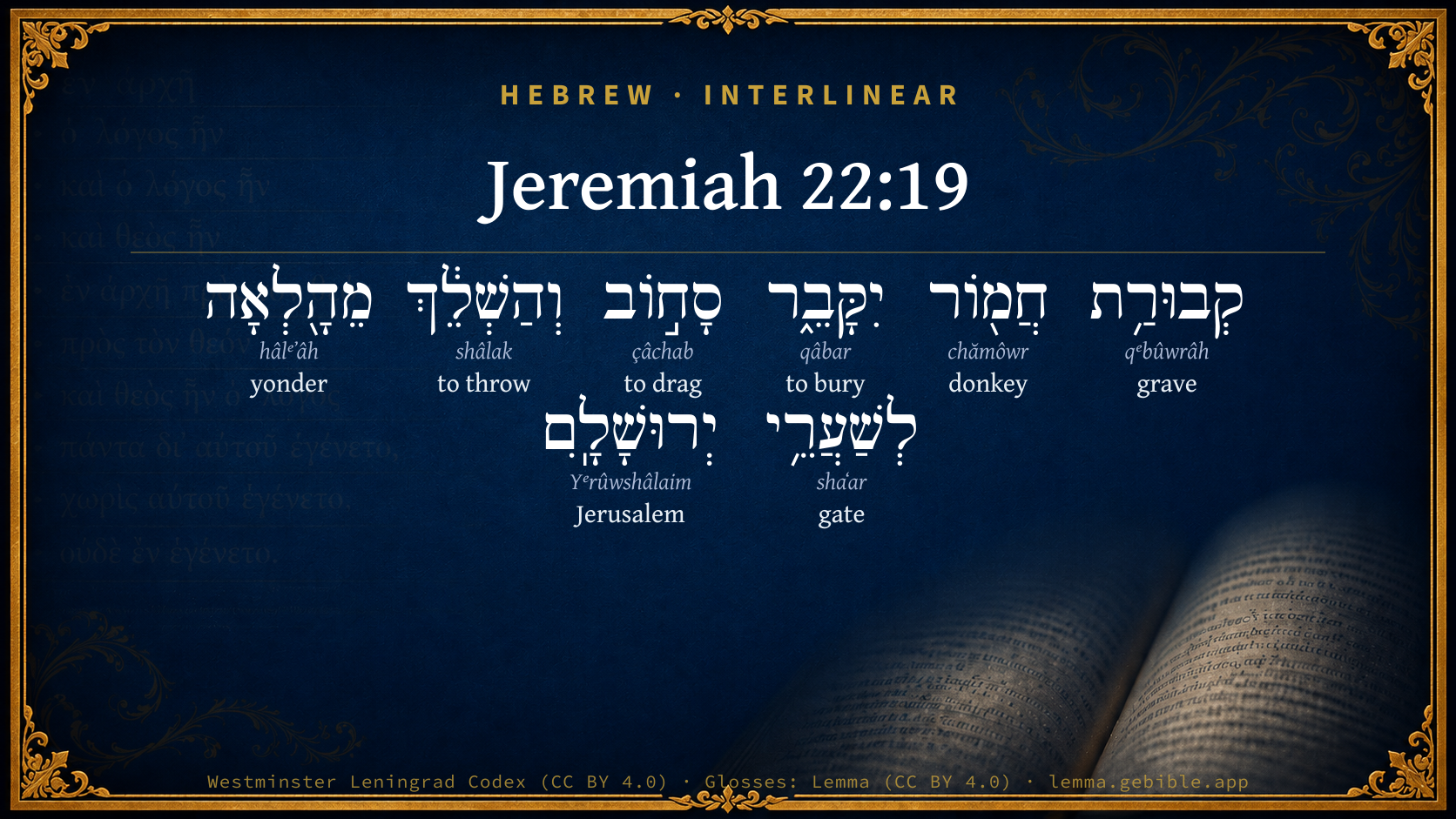
Jeremiah 22:19

Hebrew (Westminster Leningrad Codex) Jeremiah 22:19 appears in the Hebrew Old Testament. The text above is from the Westminster Leningrad Codex. Each word links to its Strong’s number, a concise gloss, and parsing drawn from the Open Scriptures Hebrew Bible morphology. Click any word for its full Brown-Driver-Briggs (BDB) entry.
Download image
Cite this verse

Jeremiah 22:19 (World English Bible). Public Domain. Lemma interlinear Bible study tool, https://lemma.gebible.app/v/jeremiah/22/19.

Show BibTeX & RIS
BibTeX
RIS
English Translation
He shall be buried with the burial of a donkey, drawn and cast forth beyond the gates of Jerusalem.
World English Bible · Public Domain
Download a study sheet

One document with this verse’s original text, its word-by-word gloss line, the meaning frame, cross-references with their text, attributed commentary, and full source and license credits — printable, and it pastes into notes with its structure intact.

This verse Autodidact and up

Study sheet (.html) Plain text (.txt)

A passage Seminary Student

Up to 50 verses in one chapter. A passage sheet keeps up to 6 commentary sources and 12 cross-references per verse, in the order this page ranks them, and says so on the sheet whenever that leaves anything out. Ask for a single verse and you get the Autodidact verse sheet above.

Everything on this page stays free to read, with no account — the sheet is a download of what is already on screen, not access to it.

Want to remove ads? Support Godless Engineer
Compare translations 3

The same verse in 3 English versions, stacked beneath the original-language interlinear above. Click any original word for its lexicon entry.

Each is an independent rendering of the whole verse — the interlinear is not word-aligned to these translations.

Highlighted words mark where these versions differ — a whole-verse word diff, not a word-by-word alignment.

  • World English Bible Public Domain
    He shall be buried with the burial of a donkey, drawn and cast forth beyond the gates of Jerusalem.
  • King James Version Public Domain
    He shall be buried with the burial of an ass, drawn and cast forth beyond the gates of Jerusalem.
  • unfoldingWord Literal Text CC BY-SA 4.0
    He will be buried with the burial of a donkey, dragged and thrown out beyond the gates of Jerusalem.”

unfoldingWord Literal Text — © unfoldingWord, licensed CC BY-SA 4.0. Word-aligned USFM3 via Door43 (git.door43.org/unfoldingWord/en_ult).

Versions to compare (up to 4)

3 of 4 selected

Show all 18 translations

Every available English version of this verse, each an independent rendering of the whole verse.

  • World English Bible Public Domain
    He shall be buried with the burial of a donkey, drawn and cast forth beyond the gates of Jerusalem.
  • Berean Standard Bible Public Domain
    He will be buried like a donkey, dragged away and thrown outside the gates of Jerusalem.
  • Majority Standard Bible Public Domain
    He will be buried like a donkey, dragged away and thrown outside the gates of Jerusalem.
  • King James Version Public Domain
    He shall be buried with the burial of an ass, drawn and cast forth beyond the gates of Jerusalem.
  • American Standard Version (1901) Public Domain
    He shall be buried with the burial of an ass, drawn and cast forth beyond the gates of Jerusalem.
  • Revised Version (1885) Public Domain
    He shall be buried with the burial of an ass, drawn and cast forth beyond the gates of Jerusalem.
  • Geneva Bible (1599) Public Domain
    He shalbe buryed, as an asse is buryed, euen drawen and cast foorth without the gates of Ierusalem.
  • Douay-Rheims (1899) Public Domain
    He shall be buried with the burial of an ass, rotten and cast forth without the gates of Jerusalem.
  • Young's Literal Translation Public Domain
    The burial of an ass -- he is buried, Dragged and cast out thence to the gates of Jerusalem.
  • Literal Standard Version CC BY-SA 4.0
    He is buried [with] the burial of a donkey, || Dragged and cast out there to the gates of Jerusalem.
  • Unlocked Literal Bible CC BY-SA 4.0
    He will be buried with a donkey's burial, dragged away and thrown out beyond the gates of Jerusalem.
  • unfoldingWord Literal Text CC BY-SA 4.0
    He will be buried with the burial of a donkey, dragged and thrown out beyond the gates of Jerusalem.”
  • Darby Bible Public Domain
    He shall be buried with the burial of an ass, dragged along and cast forth beyond the gates of Jerusalem.
  • World Messianic Bible Public Domain
    He will be buried with the burial of a donkey, drawn and cast out beyond the gates of Jerusalem.”
  • Webster's Bible Public Domain
    He shall be buried with the burial of an ass, drawn and cast forth beyond the gates of Jerusalem.
  • Free Bible Version CC BY-SA 4.0
    His burial will be that of a donkey. He'll be dragged off and thrown away outside the gates of Jerusalem.
  • Bible in Basic English Public Domain
    They will do to him what they do to the dead body of an ass; his body will be pulled out and placed on the earth outside the doors of Jerusalem.
  • JPS Tanakh (1917) Public Domain
    He shall be buried with the burial of an ass, drawn and cast forth beyond the gates of Jerusalem.

Literal Standard Version (2020), Covenant Press — licensed CC BY-SA 4.0. Text via the HelloAO Bible API (eBible.org). Unlocked Literal Bible (unfoldingWord) — licensed CC BY-SA 4.0. Text via the HelloAO Bible API (eBible.org). unfoldingWord Literal Text — © unfoldingWord, licensed CC BY-SA 4.0. Word-aligned USFM3 via Door43 (git.door43.org/unfoldingWord/en_ult). Free Bible Version, Dr. Jonathan Gallagher — licensed CC BY-SA 4.0. Text via the HelloAO Bible API (eBible.org).

Word by word

More ways to search: Search by grammar → Find every occurrence → Compare this word →

Practice this passage: Drill this verse → Learn its vocabulary →

About this verse

These counts appear in no published source. They are computed here, from the morphology-tagged text and Lemma’s own curated glosses. What Lemma adds →

8
words
8
distinct lemmas
Prophets
section

Notable vocabulary

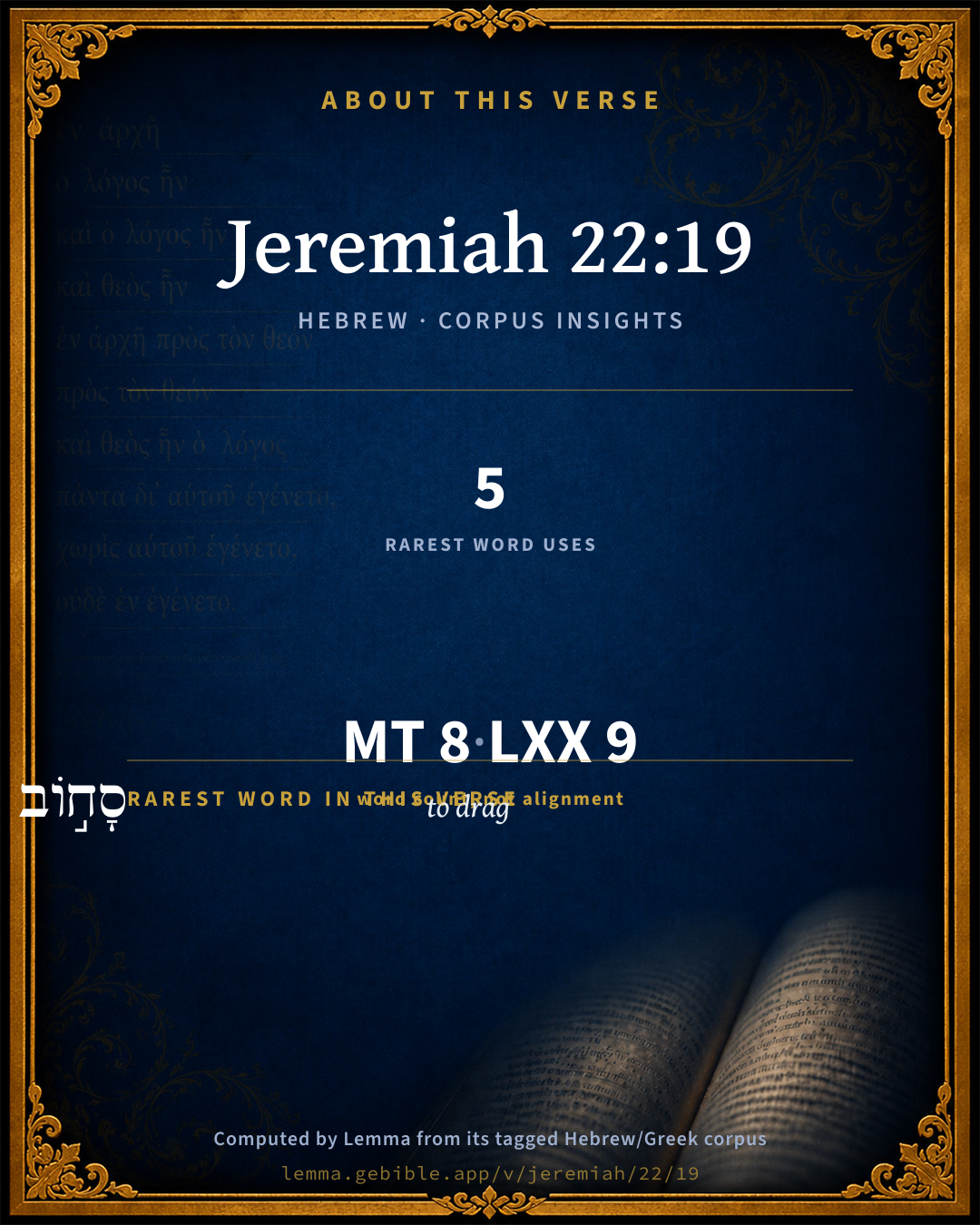
The rarest word here is סָח֣וֹב to drag H5498 — appearing just 5 times in the whole Hebrew Bible.

Shared distinctive vocabulary

סָח֣וֹב to drag H5498 occurs in 5 verses of the Hebrew Bible. Also found in:

Grammatical profile

  • 3 verbs
  • 4 nouns
  • 1 adverb

Verb forms

  • יִקָּבֵ֑ר Niphal · Imperfect
  • סָח֣וֹב Qal · Infinitive Absolute
  • וְהַשְׁלֵ֔ךְ Hiphil · Infinitive Absolute

Hebrew & Septuagint length

In the original languages it is 8 Hebrew tokens and 9 Greek tokens — but the two are counted differently (Hebrew bundles its prefixes and suffixes into one token; the Greek is in lemma form), so that isn’t a like-for-like length.

Cross-references

7

Topical passages linked to Jeremiah 22:19 in the Treasury of Scripture Knowledge — connected by theme and wording, ordered by reader-vote popularity; previews shown in the World English Bible.

  • Jeremiah 36:30 Therefore thus says Yahweh concerning Jehoiakim king of Judah: He shall have none to sit on the throne of David; and his dead body shall be cast out in the day to the heat, and in the night to the frost.
  • 1 Kings 21:23–24 Of Jezebel also spoke Yahweh, saying, The dogs shall eat Jezebel by the rampart of Jezreel.
  • 1 Kings 14:10 therefore, behold, I will bring evil on the house of Jeroboam, and will cut off from Jeroboam every man-child, him who is shut up and him who is left at large in Israel, and will utterly sweep away the house of Jeroboam, as a man sweeps away dung, until it be all gone.
  • 2 Kings 9:35 They went to bury her; but they found no more of her than the skull, and the feet, and the palms of her hands.
  • 2 Chronicles 36:6 Against him came up Nebuchadnezzar king of Babylon, and bound him in fetters, to carry him to Babylon.
  • Jeremiah 15:3 I will appoint over them four kinds, says Yahweh: the sword to kill, and the dogs to tear, and the birds of the sky, and the animals of the earth, to devour and to destroy.
  • Jeremiah 36:6 therefore go you, and read in the scroll, which you have written from my mouth, the words of Yahweh in the ears of the people in Yahweh's house on the fast-day; and also you shall read them in the ears of all Judah who come out of their cities.

Cross-references courtesy of OpenBible.info (CC BY 4.0).

Hebrew and Greek witnesses Masoretic Hebrew ↔ Greek Septuagint

The same verse in the two great witnesses to the Old Testament, shown verse-for-verse.

These are two independent witnesses, not word-aligned to each other, and the Septuagint is shown in lemma (dictionary) form.

Hebrew Jeremiah 22:19 Masoretic · Westminster Leningrad Codex

קְבוּרַ֥ת חֲמ֖וֹר יִקָּבֵ֑ר סָח֣וֹב וְהַשְׁלֵ֔ךְ מֵהָ֖לְאָה לְשַׁעֲרֵ֥י יְרוּשָׁלִָֽם

He shall be buried with the burial of a donkey, drawn and cast forth beyond the gates of Jerusalem.

World English Bible · Public Domain

Greek LXX Structure differs

In the Septuagint, Jeremiah is about an eighth shorter than the Hebrew and arranges its material differently — the Oracles Against the Nations (Hebrew chapters 46–51) appear in the middle of the Greek book, after 25:13. Because the chapter and verse boundaries do not line up, a verse-for-verse comparison with the Hebrew is not shown.

A verse-for-verse comparison isn’t shown here because the chapters and verses don’t line up. Switch to the LXX edition with the MT / LXX toggle above to read the Greek directly.

Hebrew: Westminster Leningrad Codex (CC BY 4.0). Greek: Septuagint (public domain); English from a public-domain English Septuagint. How the Septuagint differs from the Hebrew →

Targum (Aramaic paraphrase)

1

The Targum is the ancient Jewish Aramaic paraphrase of the Hebrew Scriptures — an interpretive translation, not the Hebrew text itself. Onkelos (literal) and Pseudo-Jonathan (expansive) render the Torah, and Jonathan the Prophets. Coverage is partial: where no permissively-licensed English translation exists for a verse, only the Aramaic is shown. This is verse-level text, not a word-by-word alignment to the Hebrew.

  1. Targum Jonathan Prophets (Joshua–Malachi)
    כְּמָה דִמְשַׁגְרָן יַת נִבְלַת חֲמָרָא כֵּן יְשַׁגְרוּן יַת נְבֵילְתֵּיהּ יִתְגְרַר וְיִשְׁתְּדֵי לְהַלְאָה לְתַרְעֵי יְרוּשְׁלֵם:

    (no public-domain English translation for this verse)

    Targum Jonathan — Aramaic: “Mikraot Gedolot” (public domain). English: “Sefaria Community Translation” (CC0 1.0 (public-domain dedication)); “London "Chaldee Paraphrase," 1871” (public domain). Text via Sefaria.

Commentary

Notes on Jeremiah 22:19 from classic Christian and Jewish commentators (each source and its license shown beneath its notes). The classic Christian expositions comment on the surrounding passage and are grouped to its opening verse, so a note may address several verses; the Jewish commentaries on the Tanakh (Rashi and others) are per-verse, so they appear only where the commentator wrote on this verse.

Lemma curates 59 commentaries, every one of them public domain or Creative Commons licensed, each selected and text-cleaned for this edition rather than reprinted as found. About our sources →

Trapp's Complete Commentary

John Trapp

Jer 22:19 He shall be buried with the burial of an ass, drawn and cast forth beyond the gates of Jerusalem.

Ver. 19. He shall be buried with the burial of an ass.] His corpse shall be cast out, like carrion, into some bycorner. A just hand of God upon this wicked one, that he who had made so many to weep, should have none to weep over him; he who had such a stately house in Jerusalem, should not have a grave to house his carcase in: sed insepulta sepultura elatus, {a} as Cicero phraseth it; but without the ordinary honour of burial, should be cast out, or thrown into a ditch or a dunghill, to be devoured by the beasts of the earth and fowls of heaven. Our Richard II, for his exactions to maintain a great court and favourites, lost his kingdom, was starved to death at Pomfret Castle, and scarcely afforded common burial. King Stephen was interred in Faversham monastery; but since, his body, for the value of the lead wherein it was coffined, was cast into river. Let great ones so live, as that they meet not in the end with the death of a dog, the burial of an ass, and the epitaph of an ox; such as Aristotle calleth that of Sardanapalus -

“ταυτ εχω, Eφαγον και εφυβρισα, ”& c.

Or that of Pope Alexander VI and his Lucrece -

“ Hospes abi: iacet hic et scelus et vitium. ”

{a} Philippic i.

John Trapp, A Commentary or Exposition upon All the Books of the Old and New Testament (1647–1656) — public domain. Text from a community e-Sword module.

Tyndale Open Study Notes

Tyndale Open Resources

22:19 Jehoiakim died in disgrace (see study note on 2 Kgs 24:6).

Tyndale Open Study Notes — © Tyndale Open Resources, licensed CC BY-SA 4.0. Text via the HelloAO Bible API.

Geneva Bible (1599)

Geneva Bible translators

Not honorably among his fathers, but as carrions are cast in a hole, because their stink should not infect, read 2 Kings 24:9. Josephus Antiquities 10:8, writeth that the enemy slew him in the city and commanded him to be cast before the walls unburied, see Jer. 36:30.

Geneva Bible (1599) marginal notes — public domain. Text via Bolls.life.

Jamieson, Fausset & Brown

Robert Jamieson, A. R. Fausset & David Brown

burial of an ass--that is, he shall have the same burial as an ass would get, namely, he shall be left a prey for beasts and birds [JEROME]. This is not formally narrated. But Ch2 36:6 states that "Nebuchadnezzar bound him in fetters to carry him to Babylon"; his treatment there is nowhere mentioned. The prophecy here, and in Jer 36:30, harmonizes these two facts. He was slain by Nebuchadnezzar, who changed his purpose of taking him to Babylon, on the way thither, and left him unburied outside Jerusalem. Kg2 24:6, "Jehoiakim slept with his fathers," does not contradict this; it simply expresses his being gathered to his fathers by death, not his being buried with his fathers (Psa 49:19). The two phrases are found together, as expressing two distinct ideas (Kg2 15:38; Kg2 16:20).

Jamieson, Fausset & Brown — Commentary Critical and Explanatory on the Whole Bible (1871) — public domain (CC PDM 1.0). Text via the HelloAO Bible API.

Adam Clarke's Commentary

Verse 19. With the burial of an ass] Cast out, and left unburied, or buried without any funeral solemnities, and without such lamentations as the above.

Adam Clarke's Commentary on the Bible (1810–1826) — public domain. Text from a community e-Sword/MySword module.

John Calvin's Commentaries

Hence, the Prophet says now, He shall be buried with the burial of an ass He mentions the ass because it is a mean animal; he might have named a horse or an ox, but as the ass is a meaner and more contemptible animal, it is the same thing as though he had said, “Jehoiakim shall be cast away with the dogs.” This prophecy no doubt grievously wounded not only the mind of the king himself, but also that of the whole people; for as yet his throne stood, and all highly regarded the family of David, and thought the kingdom sacred, as it was under the guardianship and protection of God. But the Prophet hesitated not to denounce what was afterwards confirmed by the event; for Jehoiakim was buried with the burial of an ass, as he was cast forth far beyond the gates of Jerusalem. Here the Prophet amplifies the disgrace by which the King Jehoiakim would be branded, for he might have been left dead in a journey; but he expresses what is more grievous than the casting forth; Drawn out, he says, and cast forth, etc.; that is, Jehoiakim shall not only be cast forth, but also drawn as an ass or a dog, lest his foetor should infect the city; as though he was unworthy not only of a grave, but also of being seen by men.

And this is to be especially noticed, for we hence conclude how great his perverseness was in despising the threatenings of God, since the Prophet could not otherwise storm the mind of the king, and terrify the people, than by exaggerating the indignity that was to happen to him. For if there had been any teachable spirit in the king and the people, the Prophet would have been content with making a simple statement, “Jehoiakim shall not be buried;” that is, God will punish him even when dead; the curse of God will not only be upon him while living, but he will also take vengeance on him after his death. He was not content with this kind of statement; but he shall be buried, he says, as an ass, and shall be cast far off; and further still, his carcass shall be drawn or dragged; so that it was to be an eternal mark of infamy and disgrace.

John Calvin's Commentaries (1540-1563) — public domain. Text from the Calvin Translation Society English edition (1840s-50s) via the Christian Classics Ethereal Library (ccel.org). Calvin's coverage is partial (roughly two-thirds of the Bible); uncommented books and verses are honest gaps, never fabricated. The 19th-century editor's footnotes and remarks are omitted so the notes are faithfully Calvin's own voice.

Ellicott's Commentary for English Readers

(19) He shall be buried with the burial of an ass.—The same prediction appears in another form in Jer_36:30. The body of the king was “to be cast out in the day to the heat, and in the night to the frost.” We have no direct record of its fulfilment, but its reproduction shows that the prophet’s word had not failed. The king was dragged in chains with the other captives, who were being carried off to Babylon (2Ch_36:6), and probably died on the journey, his corpse left behind unburied as the army marched. The phrase “he slept with his fathers” in 2Ki_24:6 cannot be pressed as meaning more than the mere fact of death. So Ahab, who died in battle, “slept with his fathers” (1Ki_22:40).

A Bible Commentary for English Readers, edited by Charles John Ellicott (1878–1897) — public domain. Text from a community e-Sword module.

The Cambridge Bible for Schools and Colleges

gen. ed. J. J. S. Perowne

19. buried with the burial of an ass] i.e. as the succeeding words explain, cast forth dishonoured.

The Cambridge Bible for Schools and Colleges (gen. ed. J. J. S. Perowne; Cambridge University Press, 1878–1918) — public domain. Text from a community e-Sword module.

John Gill's Exposition

He shall be buried with the burial of an ass,.... Have no burial at all, or no other than what any brute creature has; which, when it dies, is cast into a ditch, and becomes the food of dogs, and the fowls of the air. The "ass" is mentioned, as being a sordid stupid creature; and such an one was this king;

drawn and cast forth beyond the gates of Jerusalem; as the carcass of a beast is dragged about by dogs; or as a malefactor, when executed, is dragged and cast into a ditch: this perhaps was done by the Chaldeans, who, when he was slain, dragged him along, and cast him beyond the gates of Jerusalem. So Josephus (w) says, that when Nebuchadnezzar entered Jerusalem, he slew the most robust and beautiful with Jehoiakim their king, and ordered him to be cast without the walls unburied; and so, though he is said to "sleep with his fathers", yet not to be buried with them, Kg2 24:6. Kimchi says that he died without Jerusalem, as they were carrying him into captivity a second time; and the Chaldeans would not suffer him to be buried. Jerom reports, from the Hebrew history, that he was killed by the robbers and thieves of the Chaldeans, Syrians, Ammonites, and Moabites. Some think, that as he was bound in chains, in order to be carried to Babylon, that he was had there, and there died, and after his death used in this ignominious manner: and the words will bear to be rendered, "cast forth far beyond the gates of Jerusalem" (x); even as far as Babylon; see Ch2 36:6.

(w) Antiqu. l. 10. c. 6. sect. 3. (x) "et projiciendo procul ultra portas Hierosolymae", Schmidt. So Grotius and Gataker.

John Gill's Exposition of the Whole Bible (1746–1763) — public domain (CC PDM 1.0). Text via the HelloAO Bible API.

Albert Barnes' Notes on the Bible

The burial of an ass - i. e., he shall merely be dragged out of the way, and left to decay unheeded. Nothing is known of the fulfillment of this prophecy.

Albert Barnes' Notes on the Bible (1834–1885) — public domain. Text from a community e-Sword/MySword module.

Haydock's Catholic Bible Commentary

Jerusalem. Chap. xxxvi. 30. He died indeed with or like his fathers, 4 Kings xxiv. 6. But it is not said that he was buried. (St. Jerome) --- The Chaldeans designed to send him to Babylon, (2 Paralipomenon xxxvi. 6.) but slew him on the road, (Usher, the year of the world 3405) or treated his corpse ignominiously after his arrival. (Grotius)

George Leo Haydock (1774–1849), Haydock's Catholic Family Bible and Commentary, 1859 edition — public domain. Excludes Psalms (Douay-Rheims chapter numbering differs from Protestant) and Deuterocanonical books (Catholic canon only).

Matthew Poole's English Annotations

He shall be buried with the burial of an ass; that is, he shall not be buried at all, or he shall be buried in an indecent and contemptible manner, none attending him to his grave, none mourning for him. The last words of this verse incline some to think that Jehoiakim was buried near to Jerusalem; but the Scripture, which mentioneth his being carried into Babylon, saith nothing of his being brought back; nor is that very probable which some say, that the king of Babylon thought to have carried him to Babylon, but upon second thoughts altered his purposes, and caused him to be slain at Jerusalem, and his body to be ignominiously dragged out of the gates. The Scripture saith expressly he was carried to Babylon, 2Ki 24:15; and if he died there, yet this text remaineth true, the scope of which seemeth to be to show the vanity of this prince in his great and stately buildings, which he was not like long to enjoy, nor to be buried nigh to them, nor in any degree of honour proportionate to the splendour of them.

Matthew Poole's English Annotations on the Holy Bible (1683–1685) — public domain. Text from a community e-Sword/MySword module.

The Pulpit Commentary

Jehoiakim"s miserable death, without even the honor of burial. The prediction is repeated in Jer_36:30, where the statement is made in plain language. At first sight it appears to conflict with 2Ki_24:6, "So Jehoiakim slept with his fathers: and Jehoiachin his son reigned in his stead;" but it is only appearance, and when we remember that the complete formula for describing the natural death of a king of Judah is, "slept with his fathers, and was buried with his fathers in the city of David", (1Ki_14:31 1Ki_15:24 1Ki_22:50 2Ki_8:24 2Ki_15:7, 38 16:20) and that the phrase, "slept with his fathers," is used of Ahab, who fell on the field of battle, (1Ki_22:40) we are naturally led to the conjecture that Jehoiakim did not die a natural death, but fell in battle in some sally made by the besieged. Buried with the burial of an ass; i.e. cast out unburied. Beyond the gates; rather, far from the gates.

The Pulpit Commentary (1880–1919), ed. H.D.M. Spence-Jones & Joseph S. Exell — public domain. Text from a community e-Sword module.

John Wesley's Explanatory Notes

Of an ass - None attending him to his grave, none mourning for him.

John Wesley, Explanatory Notes Upon the Whole Bible (1754–1765) — public domain. Text via the GEBible commentary corpus.

Rashi

Rabbi Shlomo Yitzchaki (Rashi)

A donkey’s burial As they drag the carcass of a donkey, so will they drag his carcass. The word יְֹשַגְּרוּן used by Targum Jonathan means, they will drag.

Rashi on the Tanakh — English translations: “The Judaica Press complete Tanach with Rashi, translated by A. J. Rosenberg” (CC BY 4.0); “Pentateuch with Rashi's commentary by M. Rosenbaum and A.M. Silbermann, 1929-1934” (public domain); “The Metsudah Tanach series, Lakewood, N.J” (CC BY 4.0); and “The Book of Joshua, Metsudah Publications, 1997” (CC BY 4.0). Text via Sefaria.

Lesson kit

Teaching starters — assembled from the data on this page, not authored interpretation. Every prompt links to the verse data it draws on. Edit before teaching.

Jeremiah, in the Prophets, opens this verse with 8 words (8 distinct Hebrew lemmas). Its most distinctive word is çâchab (“to drag”). A historical commentator’s framing appears above. Read the whole chapter for the surrounding context.

Discussion questions

  1. How does “to drag” (çâchab) shape what this verse is saying?
  2. How does 2 Samuel 17:13, which shares the word «to drag», read alongside this verse?
  3. These translations render this verse differently. What is at stake in choosing one wording over another?
  4. «יִקָּבֵ֑ר» is a Niphal Imperfect verb. How does that grammatical form shape the action described?
  5. Compare how Trapp's Complete Commentary and Tyndale Open Study Notes read this verse. Where do they agree or differ?

Things to notice

Reading settings

Reading text

Shown beneath each verse's original-language words.

Old Testament
Old Testament edition

Read the OT as the Masoretic Hebrew (MT) or the Greek Septuagint (LXX).

English shown for the Greek Septuagint (in the Hebrew ↔ Greek comparison).

Comparing translations? Open the Compare panel on any verse page to stack up to four side by side.