
Judges 9:53

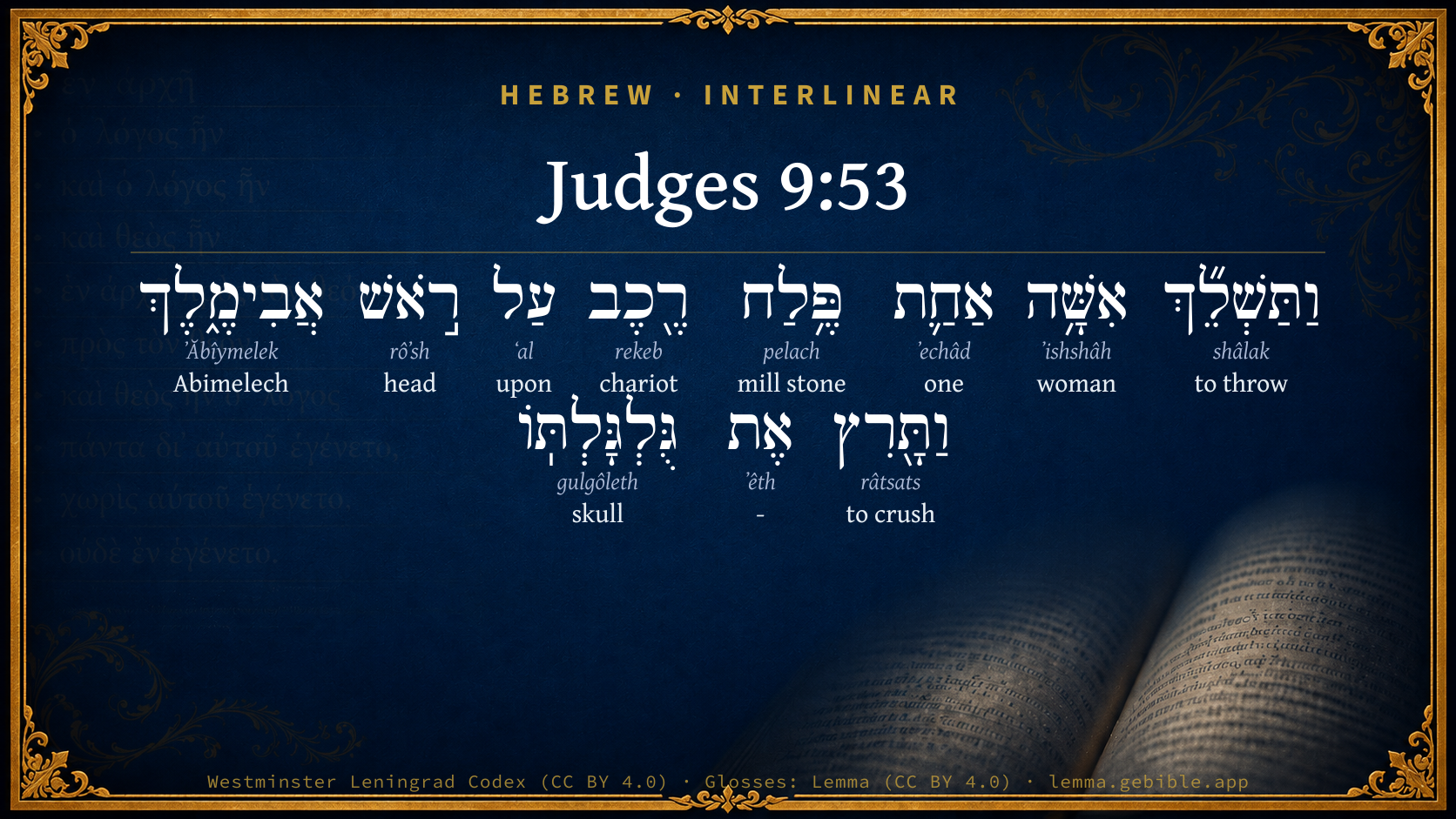
Hebrew (Westminster Leningrad Codex) Judges 9:53 appears in the Hebrew Old Testament. The text above is from the Westminster Leningrad Codex. Each word links to its Strong’s number, a concise gloss, and parsing drawn from the Open Scriptures Hebrew Bible morphology. Click any word for its full Brown-Driver-Briggs (BDB) entry.
Download image
Cite this verse

Judges 9:53 (World English Bible). Public Domain. Lemma interlinear Bible study tool, https://lemma.gebible.app/v/judges/9/53.

Show BibTeX & RIS
BibTeX
RIS
English Translation
A certain woman cast an upper millstone on Abimelech's head, and broke his skull.
World English Bible · Public Domain
Highlights
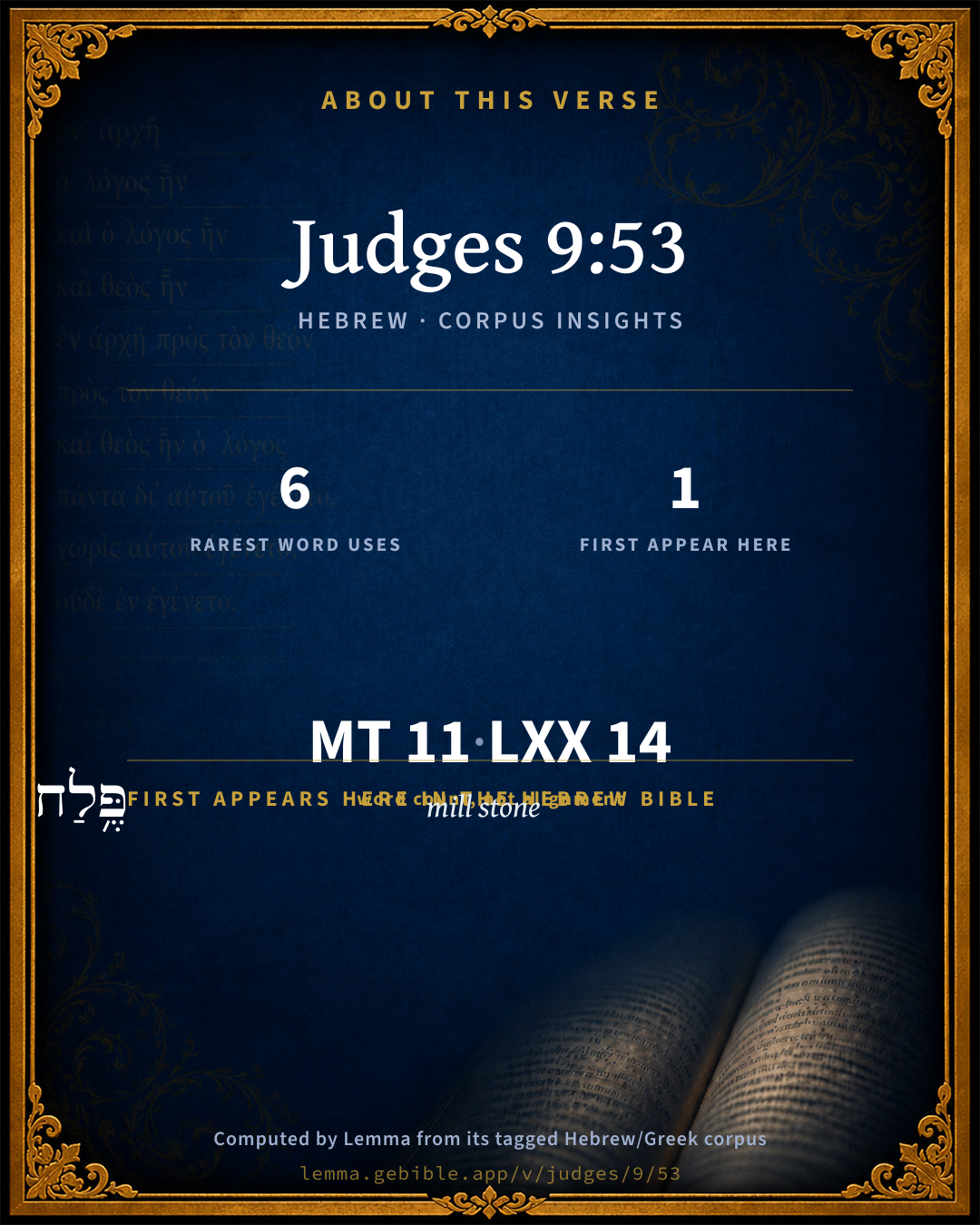
  • 1 first appearance in the Hebrew Bible
Full analysis ↓
Download a study sheet

One document with this verse’s original text, its word-by-word gloss line, the meaning frame, cross-references with their text, attributed commentary, and full source and license credits — printable, and it pastes into notes with its structure intact.

This verse Autodidact and up

Study sheet (.html) Plain text (.txt)

A passage Seminary Student

Up to 50 verses in one chapter. A passage sheet keeps up to 6 commentary sources and 12 cross-references per verse, in the order this page ranks them, and says so on the sheet whenever that leaves anything out. Ask for a single verse and you get the Autodidact verse sheet above.

Everything on this page stays free to read, with no account — the sheet is a download of what is already on screen, not access to it.

Want to remove ads? Support Godless Engineer
Compare translations 3

The same verse in 3 English versions, stacked beneath the original-language interlinear above. Click any original word for its lexicon entry.

Each is an independent rendering of the whole verse — the interlinear is not word-aligned to these translations.

Highlighted words mark where these versions differ — a whole-verse word diff, not a word-by-word alignment.

  • World English Bible Public Domain
    A certain woman cast an upper millstone on Abimelech's head, and broke his skull.
  • King James Version Public Domain
    And a certain woman cast a piece of a millstone upon Abimelech's head, and all to brake his skull.
  • unfoldingWord Literal Text CC BY-SA 4.0
    But one woman threw an upper millstone onto the head of Abimelech, and it crushed his skull.

unfoldingWord Literal Text — © unfoldingWord, licensed CC BY-SA 4.0. Word-aligned USFM3 via Door43 (git.door43.org/unfoldingWord/en_ult).

Versions to compare (up to 4)

3 of 4 selected

Show all 18 translations

Every available English version of this verse, each an independent rendering of the whole verse.

  • World English Bible Public Domain
    A certain woman cast an upper millstone on Abimelech's head, and broke his skull.
  • Berean Standard Bible Public Domain
    But a woman dropped an upper millstone on Abimelech’s head, crushing his skull.
  • Majority Standard Bible Public Domain
    But a woman dropped an upper millstone on Abimelech’s head, crushing his skull.
  • King James Version Public Domain
    And a certain woman cast a piece of a millstone upon Abimelech's head, and all to brake his skull.
  • American Standard Version (1901) Public Domain
    And a certain woman cast an upper millstone upon Abimelech's head, and brake his skull.
  • Revised Version (1885) Public Domain
    And a certain woman cast an upper millstone upon Abimelech’s head, and brake his skull.
  • Geneva Bible (1599) Public Domain
    But a certaine woman cast a piece of a milstone vpon Abimelechs head, and brake his braine pan.
  • Douay-Rheims (1899) Public Domain
    And behold a certain woman casting a piece of a millstone from above, dashed it against the head of Abimelech, and broke his skull.
  • Young's Literal Translation Public Domain
    and a certain woman doth cast a piece of a rider on the head of Abimelech, and breaketh his skull,
  • Literal Standard Version CC BY-SA 4.0
    and a certain woman casts a piece of a millstone on the head of Abimelech, and breaks his skull,
  • Unlocked Literal Bible CC BY-SA 4.0
    But a woman dropped an upper millstone on Abimelech's head and it cracked his skull.
  • unfoldingWord Literal Text CC BY-SA 4.0
    But one woman threw an upper millstone onto the head of Abimelech, and it crushed his skull.
  • Darby Bible Public Domain
    And a certain woman threw an upper millstone upon Abim'elech's head, and crushed his skull.
  • World Messianic Bible Public Domain
    A certain woman cast an upper millstone on Abimelech’s head, and broke his skull.
  • Webster's Bible Public Domain
    And a certain woman cast a piece of of a millstone upon Abimelech's head, and broke his skull.
  • Free Bible Version CC BY-SA 4.0
    a woman dropped a millstone down on Abimelech's head and cracked his skull open.
  • Bible in Basic English Public Domain
    But a certain woman sent a great stone, such as is used for crushing grain, on to the head of Abimelech, cracking the bone.
  • JPS Tanakh (1917) Public Domain
    And a certain woman cast an upper millstone upon Abimelech's head, and broke his skull.

Literal Standard Version (2020), Covenant Press — licensed CC BY-SA 4.0. Text via the HelloAO Bible API (eBible.org). Unlocked Literal Bible (unfoldingWord) — licensed CC BY-SA 4.0. Text via the HelloAO Bible API (eBible.org). unfoldingWord Literal Text — © unfoldingWord, licensed CC BY-SA 4.0. Word-aligned USFM3 via Door43 (git.door43.org/unfoldingWord/en_ult). Free Bible Version, Dr. Jonathan Gallagher — licensed CC BY-SA 4.0. Text via the HelloAO Bible API (eBible.org).

Word by word

More ways to search: Search by grammar → Find every occurrence → Compare this word →

Practice this passage: Drill this verse → Learn its vocabulary →

פֶּ֥לַח
pelach
H6400
“mill stone of”
Noun, Common, Feminine, Singular, Construct
Part of Speech
Noun
Type
Common
Gender
Feminine
Number
Singular
State
Construct
Full BDB Definition

Origin: from H6398

TWOT: 1773a

cleavage, mill-stone, cut, slice, part cut off - mill-stone - cleavage, slice
  1. וַתַּשְׁלֵ֞ךְ shâlak H7993 “and · to throw” Conjunction + Verb, Hiphil, Sequential Imperfect, 3rd Person, Feminine, Singular
  2. אִשָּׁ֥ה ʼishshâh H802 “woman” Noun, Common, Feminine, Singular, Absolute
  3. אַחַ֛ת ʼechâd H259 “one” Adjective, Cardinal number, Feminine, Singular, Absolute
  4. רֶ֖כֶב rekeb H7393 “chariot” Noun, Common, Masculine, Singular, Absolute
  5. עַל ʻal H5921 “upon” Preposition
  6. רֹ֣אשׁ rôʼsh H7218 “head of” Noun, Common, Masculine, Singular, Construct
  7. אֲבִימֶ֑לֶךְ ʼĂbîymelek H40 “Abimelech” Noun, Proper
  8. וַתָּ֖רִץ râtsats H7533 “and · to crush” Conjunction + Verb, Hiphil, Sequential Imperfect, 3rd Person, Feminine, Singular
  9. אֶת ʼêth H853 “-” Particle, Direct Object
  10. גֻּלְגָּלְתּֽוֹ gulgôleth H1538 “skull · his” Noun, Common, Feminine, Singular, Construct + Suffix, Personal, 3rd Person, Masculine, Singular

About this verse

These counts appear in no published source. They are computed here, from the morphology-tagged text and Lemma’s own curated glosses. What Lemma adds →

11
words
11
distinct lemmas
Historical
section

Notable vocabulary

The rarest word here is פֶּ֥לַח mill stone H6400 — appearing just 6 times in the whole Hebrew Bible.

First appearance in Scripture

This word makes its first canonical appearance in the Hebrew Bible here:

  • פֶּ֥לַח mill stone H6400

Shared distinctive vocabulary

פֶּ֥לַח mill stone H6400 occurs in 6 verses of the Hebrew Bible. Also found in:

Grammatical profile

  • 2 verbs
  • 6 nouns
  • 1 adjective
  • 1 preposition
  • 1 particle

Verb forms

  • וַתַּשְׁלֵ֞ךְ Hiphil · Sequential Imperfect
  • וַתָּ֖רִץ Hiphil · Sequential Imperfect

Hebrew & Septuagint length

In English translation the verse runs 14 words from the Hebrew and 18 from the Septuagint (LXX English) — closely comparable.

A rough comparison of the two English renderings, which tokenize alike — not a word-level alignment.

Word counts can differ between the Hebrew and the Greek without any difference in meaning — e.g. the Hebrew direct-object marker אֵת has no separate Greek word, and Greek often adds the article ὁ.

In the original languages it is 11 Hebrew tokens and 14 Greek tokens — but the two are counted differently (Hebrew bundles its prefixes and suffixes into one token; the Greek is in lemma form), so that isn’t a like-for-like length.

Cross-references

7

Topical passages linked to Judges 9:53 in the Treasury of Scripture Knowledge — connected by theme and wording, ordered by reader-vote popularity; previews shown in the World English Bible.

  • 2 Samuel 11:21 who struck Abimelech the son of Jerubbesheth? Didn't a woman cast an upper millstone on him from the wall, so that he died at Thebez? Why did you go so near the wall?' then shall you say, 'Your servant Uriah the Hittite is dead also.'"
  • Job 31:3 Is it not calamity to the unrighteous, And disaster to the workers of iniquity?
  • Judges 9:20 but if not, let fire come out from Abimelech, and devour the men of Shechem, and the house of Millo; and let fire come out from the men of Shechem, and from the house of Millo, and devour Abimelech.
  • Jeremiah 49:20 Therefore hear the counsel of Yahweh, that he has taken against Edom; and his purposes, that he has purposed against the inhabitants of Teman: Surely they shall drag them away, [even] the little ones of the flock; surely he shall make their habitation desolate over them.
  • Jeremiah 50:45 Therefore hear the counsel of Yahweh, that he has taken against Babylon; and his purposes, that he has purposed against the land of the Chaldeans: Surely they shall drag them away, [even] the little ones of the flock; surely he shall make their habitation desolate over them.
  • Judges 9:15 The bramble said to the trees, If in truth you anoint me king over you, then come and take refuge in my shade; and if not, let fire come out of the bramble, and devour the cedars of Lebanon.
  • 2 Samuel 20:21 The matter is not so: but a man of the hill-country of Ephraim, Sheba the son of Bichri by name, has lifted up his hand against the king, even against David; deliver him only, and I will depart from the city. The woman said to Joab, Behold, his head shall be thrown to you over the wall.

Cross-references courtesy of OpenBible.info (CC BY 4.0).

Hebrew and Greek witnesses Masoretic Hebrew ↔ Greek Septuagint

The same verse in the two great witnesses to the Old Testament, shown verse-for-verse.

These are two independent witnesses, not word-aligned to each other, and the Septuagint is shown in lemma (dictionary) form.

Hebrew Judges 9:53 Masoretic · Westminster Leningrad Codex

וַתַּשְׁלֵ֞ךְ אִשָּׁ֥ה אַחַ֛ת פֶּ֥לַח רֶ֖כֶב עַל רֹ֣אשׁ אֲבִימֶ֑לֶךְ וַתָּ֖רִץ אֶת גֻּלְגָּלְתּֽוֹ

A certain woman cast an upper millstone on Abimelech's head, and broke his skull.

World English Bible · Public Domain

Greek LXX Judges 9:53 Septuagint · lemma form

καί ῥίπτω γυνή εἷς κλάσμα ἐπιμυλίον ἐπί κεφαλή αβιμελεχ καί κλαίω ὁ κρανίον αὐτός

And a woman cast a piece of a millstone upon the head of Abimelech, and broke his skull.

LXX2012 (modern English Septuagint) · Public Domain

On this verse, Adam Clarke's Commentary discusses the Septuagint’s reading. Read the note in Commentary ↓

Hebrew: Westminster Leningrad Codex (CC BY 4.0). Greek: Septuagint (public domain); English from LXX2012 (modern English Septuagint) (Public Domain). How the Septuagint differs from the Hebrew →

Targum (Aramaic paraphrase)

1

The Targum is the ancient Jewish Aramaic paraphrase of the Hebrew Scriptures — an interpretive translation, not the Hebrew text itself. Onkelos (literal) and Pseudo-Jonathan (expansive) render the Torah, and Jonathan the Prophets. Coverage is partial: where no permissively-licensed English translation exists for a verse, only the Aramaic is shown. This is verse-level text, not a word-by-word alignment to the Hebrew.

  1. Targum Jonathan Prophets (Joshua–Malachi)
    וּרְמַת אִתְּתָא חֲדָא פַּלְגוּת רְכַב רְחַיָא עַל רֵישָׁא דַאֲבִימֶלֶךְ וְרַעַת יַת גוּלְגַלְתֵּיהּ:

    (no public-domain English translation for this verse)

    Targum Jonathan — Aramaic: “Mikraot Gedolot” (public domain). English: “Sefaria Community Translation” (CC0 1.0 (public-domain dedication)); “London "Chaldee Paraphrase," 1871” (public domain). Text via Sefaria.

Commentary

Notes on Judges 9:53 from classic Christian and Jewish commentators (each source and its license shown beneath its notes). The classic Christian expositions comment on the surrounding passage and are grouped to its opening verse, so a note may address several verses; the Jewish commentaries on the Tanakh (Rashi and others) are per-verse, so they appear only where the commentator wrote on this verse.

Lemma curates 59 commentaries, every one of them public domain or Creative Commons licensed, each selected and text-cleaned for this edition rather than reprinted as found. About our sources →

Trapp's Complete Commentary

John Trapp

Jdg 9:53 And a certain woman cast a piece of a millstone upon Abimelech’s head, and all to brake his skull.

Ver. 53. And a certain woman.] Women have sometimes done singular service against an enemy: as at the siege of Lamia, laid by M. Acilius, the Roman general: {a} of Coccinum, in the isle of Lemnus, by the Turks, where Marulla, a maiden, fought desperately in defence of her country: {b} of Buda, where the Hungarian women bestirred them lustily to save the town. {c} But what monstrous mothers were those Suevian women, who, assisting their husbands in fight against the Romans, under the conduct of Drusus, son-in-law to Augustus Caesar, threw their young children at them instead of darts. {d}

Cast a piece of a millstone.] So that ambitious King Pyrrhus was at last slain with a tile stone thrown upon his head by a woman. {e} And the like deadly blow light by a like hand, upon the head of Hermanius Earl of Lucelburg, whom Pope Hildebrand had set up in opposition to Henry the Emperor, whom he had excommunicated. {f} Simeon De Monteforti also, another of the Pope’s champions, fighting against those ancient Protestants the Waldenses, was brained with a stone at the siege of Tholouse. {g} That scholar that took his death by the falling of a letter of stone from the Earl of Northampton’s house at the funeral of Queen Anne, was to be pitied. But commentators observe it for a just hand of God upon Abimelech, that upon one stone he had slain his seventy brethren, and now a stone slayeth him: his head had stolen the crown of Israel, and now his head is smitten.

{a} Liv., lib. xxxvii.

{b} Turk. Hist., 413.

{c} Ibid., 741.

{d} Heyl., Geog.

{e} Plutarch.

{f} Val. Max. Christ.

{g} Arch. Ussher.

John Trapp, A Commentary or Exposition upon All the Books of the Old and New Testament (1647–1656) — public domain. Text from a community e-Sword module.

Joseph Benson's Commentary

Jdg 9:53-54. A woman cast a piece of a millstone — Such great stones, no doubt, they carried up with them, whereby they might defend themselves, or offend those who assaulted them. Here the justice of God is remarkable in suiting the punishment to his sin. He slew his brethren upon a stone, (Jdg 9:5,) and he loseth his own life by a stone. A woman slew him — Which was esteemed a matter of disgrace.

Joseph Benson's Commentary on the Old and New Testaments (1811–1818) — public domain. Text from a community e-Sword module.

Adam Clarke's Commentary

Verse 53. A piece of a millstone] פלח רכב pelach recheb, a piece of a chariot wheel; but the word is used in other places for upper millstones, and is so understood here by the Vulgate, Septuagint, Syriac, and Arabic.

And all to break his skull.] A most nonsensical version of ותרץ את גלגלתו vattarits eth gulgolto, which is literally, And she brake, or fractured, his skull. Plutarch, in his life of Pyrrhus, observes that this king was killed at the siege of Thebes, by a piece of a tile, which a woman threw upon his head.

Adam Clarke's Commentary on the Bible (1810–1826) — public domain. Text from a community e-Sword/MySword module.

Ellicott's Commentary for English Readers

(53) A piece of a millstone.—The word for millstone is receb, literally, runner, i.e., the upper millstone, or lapis vector, which is whirled round and round over the stationary lower one, sheceb (Deu_24:6).

And all to brake his skull.—This is a mere printer’s error for all-to or al-to, i.e., utterly, and it has led to the further misreading of “brake.” Others think that it should be printed “all to-brake,” where the to is intensive like the German ge—as in Chaucer’s “All is to-broken thilke regioun” (Knight’s Tale, 2,579). But in Latimer we find “they love, and all-to love him” (see Bible Word-book, § 5). The meaning of the verb is “smashed” or “shattered” (LXX., suneklase; Vulg., confregit; Luther, zerbrach). The death of Pyrrhus by a tile flung down by a woman as he rode into the town of Argos is an historic parallel (Pausan. 1:13). The ringleader of an attack on the Jews, who had taken refuge in York Castle in 1190, was similarly killed.

His armour.—Celîm, literally, implements. (Comp. Jdg_18:11; Gen_27:3.)

A Bible Commentary for English Readers, edited by Charles John Ellicott (1878–1897) — public domain. Text from a community e-Sword module.

The Cambridge Bible for Schools and Colleges

gen. ed. J. J. S. Perowne

53. upper millstone] lit. ‘millstone of riding’; i.e. the upper stone of a mill turned by a handle, the lower stone being stationary. In Palestine the grinding of corn for the household was, and still is, done by the women (Ecc_12:3, St Mat_24:41); this explains how a woman came to use such a weapon. Cf. Jdg_4:21.

The Cambridge Bible for Schools and Colleges (gen. ed. J. J. S. Perowne; Cambridge University Press, 1878–1918) — public domain. Text from a community e-Sword module.

John Gill's Exposition

Then he called hastily to the young man his armourbearer,.... Perceiving it was a mortal blow that was given him, and he should soon expire; and that the cast of the stone was by the hand of a woman, and therefore he was in haste to have the young man come to him:

and said unto him, draw thy sword and slay me, that men say not of me, a woman slew him; it being reckoned very ignominious and reproachful to die by the hand of a woman, and especially any great personage, as a king or general of an army (s); to avoid this, he chose rather to be guilty of suicide, or of what cannot well be excused from it, and so died by suicide; which, added to all his other sins, he seemed to have no sense of, or repentance for; and the method he took to conceal the shame of his death served the more to spread it; for this circumstance of his death could not be given without the reason of it, and which was remembered and related punctually near two hundred years afterwards, Sa2 11:21.

(s) "O turpe fatum! foemina Herculeae, necis Auctor feretur ----" Seneca Oetaeo.

John Gill's Exposition of the Whole Bible (1746–1763) — public domain (CC PDM 1.0). Text via the HelloAO Bible API.

Albert Barnes' Notes on the Bible

The phrase “all” to is now obsolete, and means “quite,” “entirely,” as in Chaucer, Spenser, and Milton.

Albert Barnes' Notes on the Bible (1834–1885) — public domain. Text from a community e-Sword/MySword module.

Haydock's Catholic Bible Commentary

Above, or "of the upper millstone," according to the Hebrew and Septuagint. Pyrrhus met with a similar fate at Argos. Plutarch observes, (in Scylla) that the Lacedemonians did not like to attack walls, because the bravest men are there often slain by the greatest cowards. (Calmet) --- Hence Joab puts this advice in the mouth of David, that it is imprudent to come too near the walls, 2 Kings xi. 21. --- Skull, (cerebrum) "brain." Yet the tyrant’s understanding was not perhaps so much impaired, as to excuse him for commanding his armour-bearer to kill him. (Menochius)

George Leo Haydock (1774–1849), Haydock's Catholic Family Bible and Commentary, 1859 edition — public domain. Excludes Psalms (Douay-Rheims chapter numbering differs from Protestant) and Deuterocanonical books (Catholic canon only).

Matthew Poole's English Annotations

Such great stones no doubt they carried up with them, whereby they might defend themselves, or offend those who assaulted them. Here the justice of God is remarkable in suiting the punishment to his sin. He slew his brethren upon a stone, Jdg 9:5, and he loseth his own life by a stone.

Matthew Poole's English Annotations on the Holy Bible (1683–1685) — public domain. Text from a community e-Sword/MySword module.

Whedon's Commentary on the Bible

Daniel D. Whedon

53. All-to brake his skull — Better, and she brake his skull. The phrase all-to was used by some of the old English authors in the sense of entirely, but is now obsolete.

Daniel D. Whedon (gen. ed.), Commentary on the Old and New Testaments (1874–1909) — public domain. Text from a community e-Sword module.

The Pulpit Commentary

A millstone. The word here used means the upper millstone, which rides as it were, or moves, over the fixed nether stone. All to brake his skull. This obsolete English phrase has been the subject of a recent controversy. In the older English of Chaucer and his immediate successors such compounds as to-break, to-burst, etc. were very common, and were frequently preceded by the adverb all. Hence, some English scholars would read the phrase here, and all to-brake his skull. It is, however, certain that before the time when the A.V was made the compounds to-break, to-burst, etc. had become entirely obsolete, and the compound all-to had come into use. The right way, therefore, in which to read the present phrase is, and all-to brake his skull, i.e. smashed it, dashed it in pieces. The prefix all-to gives intensity to the verb.

HOMILIES BY W.F. ADENEY Vers. 53, 54. Reputation.

In the moment of his death Abimelech is anxious to save his reputation, which he thinks would he dishonoured if it could be said that a woman slew him.

I REPUTATION AMONGST MEN IS SOMETIMES VALUED MORE HIGHLY THAN INNOCENCE IN THE SIGHT OF GOD. Abimelech is anxious about the opinion of the world, he cares nothing for the judgment of God. He is concerned with what will be said of him, he is not troubled about what he really is. He is dying after a most wicked life, yet he has no thought about his evil nature and his vile misdeeds, hut only anxiety about his fame. So we constantly see people much more occupied in securing a fair appearance than in living a true life. Yet how hollow is this pursuit I After our death it matters nothing to us what men may say, but everything turns on what God will do. A man"s future state will depend not on the splendour of the fame which he leaves behind in this world, but on the character of the revelation which will be made of his life in the other world. An epitaph is no passport to heaven.

II REPUTATION AMONGST MEN IS OFTEN DETERMINED BY A FALSE STANDARD OF CHARACTER. Abimelech knows that his misdeeds have been blazed through the country, yet he has no concern for the judgment of men on these, but very much concern for their opinion of the accident of his death. He sees no dishonour in cruelty and treachery, but great dishonour in death from a woman"s hand. The code of honour differs from the code of God"s law. Public opinion is too much formed on artificial points of merit and superficial appearances. Thus cowardice is commonly felt to be more disgraceful than cruelty; yet it is at least as bad not to be just and generous as not to he brave. Men commonly think more of masculine excellences than of saintly graces. Both are good, but the first obligation lies on the more Christian. Among the Christian duties which a consideration of merely worldly reputation leads men to neglect in comparison with lower obligations, are

(1) purity on the part of men,

(2) humility,

(3) forgiveness of injuries,

(4) charity.

III THE INFLUENCE OF REPUTATION SHOWS THE IMPORTANCE OF CULTIVATING A HEALTHY PUBLIC SENTIMENT. Whilst so many are governed by the opinion of the world, it is imperative that this should be purified as far as possible. There is something natural in respect for reputation. The bad man who has lost this proves himself to be utterly abandoned. Next to the fear of God, shame before men is the strongest safeguard for conscience. A healthy social atmosphere is an immense aid to goodness. The society of the Church is helpful for the preservation of the faithfulness of the Christian. A pure Christian home is a most valuable security for the character of its members. It is dangerous to stand alone; therefore, while regarding right and God"s will first, and rising above the fear of man which bringeth a snare, let us reverence Christian public sentiment, and seek to keep it pure. A.

The Pulpit Commentary (1880–1919), ed. H.D.M. Spence-Jones & Joseph S. Exell — public domain. Text from a community e-Sword module.

John Wesley's Explanatory Notes

Mill-stone - Such great stones no doubt they carried up with them, whereby they might defend themselves, or offend those who assaulted them. Here the justice of God is remarkable in suiting the punishment to his sin. He slew his brethren upon a stone, ver. 5, and he loseth his own life by a stone.

John Wesley, Explanatory Notes Upon the Whole Bible (1754–1765) — public domain. Text via the GEBible commentary corpus.

Rashi

Rabbi Shlomo Yitzchaki (Rashi)

A pestle shard. A fragment of upper grinding stone called "pestle" [lit. "rider. ].

And smashed. Crushed.

Rashi on the Tanakh — English translations: “The Judaica Press complete Tanach with Rashi, translated by A. J. Rosenberg” (CC BY 4.0); “Pentateuch with Rashi's commentary by M. Rosenbaum and A.M. Silbermann, 1929-1934” (public domain); “The Metsudah Tanach series, Lakewood, N.J” (CC BY 4.0); and “The Book of Joshua, Metsudah Publications, 1997” (CC BY 4.0). Text via Sefaria.

Lesson kit

Teaching starters — assembled from the data on this page, not authored interpretation. Every prompt links to the verse data it draws on. Edit before teaching.

Judges, in the Historical, opens this verse with 11 words (11 distinct Hebrew lemmas). Its most distinctive word is pelach (“mill stone”). A historical commentator’s framing appears above. Read the whole chapter for the surrounding context.

Discussion questions

  1. The word pelach carries the sense “mill stone.” How does it shape the verse?
  2. This is the first place “mill stone” appears in Scripture (first appears here). What does its debut here establish?
  3. How does 1 Samuel 30:12, which shares the word «mill stone», read alongside this verse?
  4. These translations render this verse differently; the difference is in the English rendering, not the original. What questions does that raise?
  5. «וַתַּשְׁלֵ֞ךְ» is a Hiphil Sequential Imperfect verb. How does that grammatical form shape the action described?
  6. Compare how Trapp's Complete Commentary and Joseph Benson's Commentary read this verse. Where do they agree or differ?

Things to notice

Reading settings

Reading text

Shown beneath each verse's original-language words.

Old Testament
Old Testament edition

Read the OT as the Masoretic Hebrew (MT) or the Greek Septuagint (LXX).

English shown for the Greek Septuagint (in the Hebrew ↔ Greek comparison).

Comparing translations? Open the Compare panel on any verse page to stack up to four side by side.