
Jeremiah 38:6

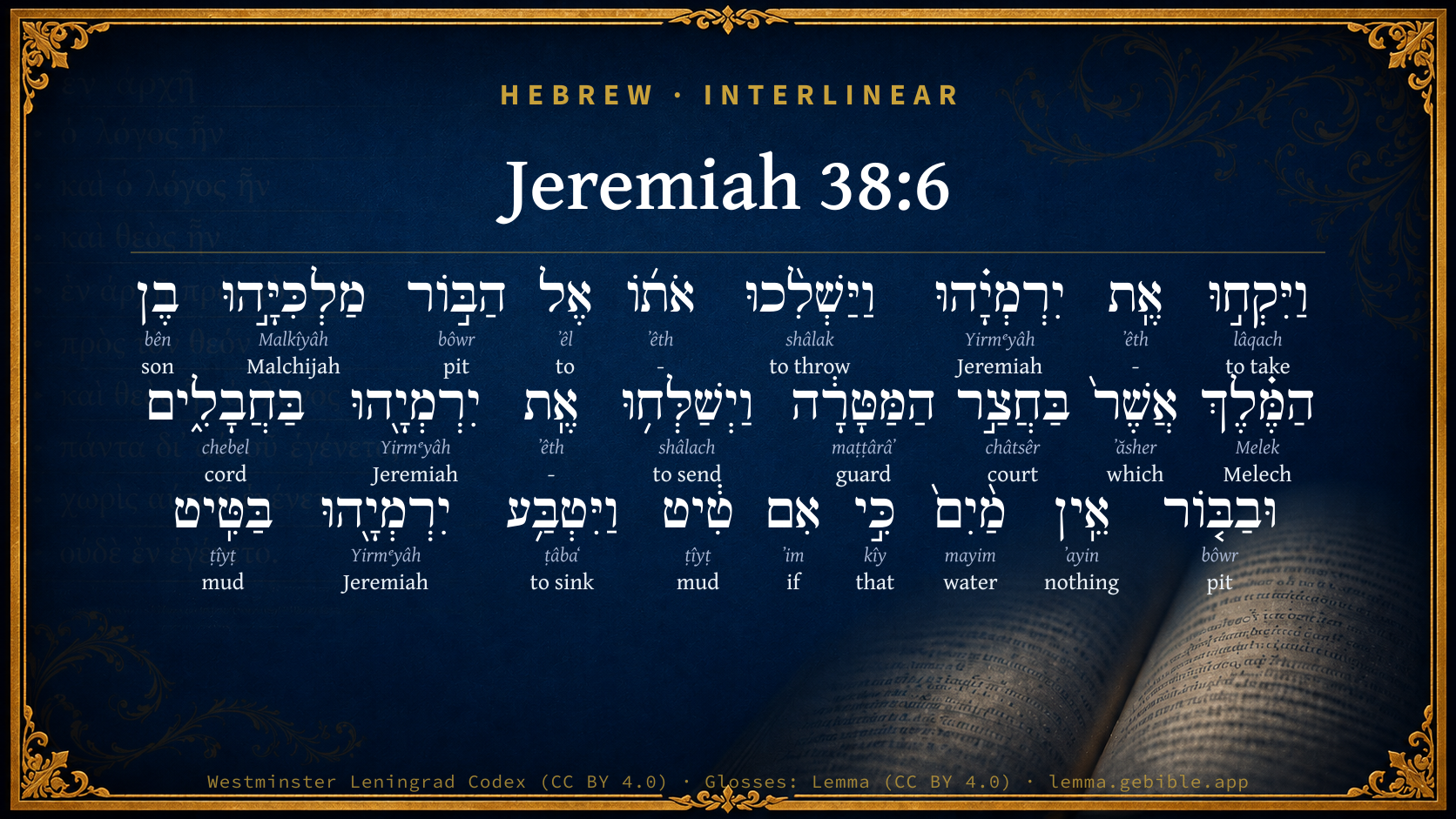
Hebrew (Westminster Leningrad Codex) Jeremiah 38:6 appears in the Hebrew Old Testament. The text above is from the Westminster Leningrad Codex. Each word links to its Strong’s number, a concise gloss, and parsing drawn from the Open Scriptures Hebrew Bible morphology. Click any word for its full Brown-Driver-Briggs (BDB) entry.
Download image
Cite this verse

Jeremiah 38:6 (World English Bible). Public Domain. Lemma interlinear Bible study tool, https://lemma.gebible.app/v/jeremiah/38/6.

Show BibTeX & RIS
BibTeX
RIS
English Translation
Then took they Jeremiah, and cast him into the dungeon of Malchijah the king's son, that was in the court of the guard: and they let down Jeremiah with cords. In the dungeon there was no water, but mire; and Jeremiah sank in the mire.
World English Bible · Public Domain
Download a study sheet

One document with this verse’s original text, its word-by-word gloss line, the meaning frame, cross-references with their text, attributed commentary, and full source and license credits — printable, and it pastes into notes with its structure intact.

This verse Autodidact and up

Study sheet (.html) Plain text (.txt)

A passage Seminary Student

Up to 50 verses in one chapter. A passage sheet keeps up to 6 commentary sources and 12 cross-references per verse, in the order this page ranks them, and says so on the sheet whenever that leaves anything out. Ask for a single verse and you get the Autodidact verse sheet above.

Everything on this page stays free to read, with no account — the sheet is a download of what is already on screen, not access to it.

Want to remove ads? Support Godless Engineer
Compare translations 3

The same verse in 3 English versions, stacked beneath the original-language interlinear above. Click any original word for its lexicon entry.

Each is an independent rendering of the whole verse — the interlinear is not word-aligned to these translations.

Highlighted words mark where these versions differ — a whole-verse word diff, not a word-by-word alignment.

  • World English Bible Public Domain
    Then took they Jeremiah, and cast him into the dungeon of Malchijah the king's son, that was in the court of the guard: and they let down Jeremiah with cords. In the dungeon there was no water, but mire; and Jeremiah sank in the mire.
  • King James Version Public Domain
    Then took they Jeremiah, and cast him into the dungeon of Malchiah the son of Hammelech, that was in the court of the prison: and they let down Jeremiah with cords. And in the dungeon there was no water, but mire: so Jeremiah sunk in the mire.
  • unfoldingWord Literal Text CC BY-SA 4.0
    Then they took Jeremiah and threw him into the cistern of Malkijah, son of the king. The cistern was in the courtyard of the guard. They lowered Jeremiah down on ropes. There was no water in the cistern, but it was muddy, and he sank down into the mud.

unfoldingWord Literal Text — © unfoldingWord, licensed CC BY-SA 4.0. Word-aligned USFM3 via Door43 (git.door43.org/unfoldingWord/en_ult).

Versions to compare (up to 4)

3 of 4 selected

Show all 18 translations

Every available English version of this verse, each an independent rendering of the whole verse.

  • World English Bible Public Domain
    Then took they Jeremiah, and cast him into the dungeon of Malchijah the king's son, that was in the court of the guard: and they let down Jeremiah with cords. In the dungeon there was no water, but mire; and Jeremiah sank in the mire.
  • Berean Standard Bible Public Domain
    So they took Jeremiah and dropped him into the cistern of Malchiah, the king’s son, which was in the courtyard of the guard. They lowered Jeremiah with ropes into the cistern, which had no water but only mud, and Jeremiah sank down into the mud.
  • Majority Standard Bible Public Domain
    So they took Jeremiah and dropped him into the cistern of Malchiah, the king’s son, which was in the courtyard of the guard. They lowered Jeremiah with ropes into the cistern, which had no water but only mud, and Jeremiah sank down into the mud.
  • King James Version Public Domain
    Then took they Jeremiah, and cast him into the dungeon of Malchiah the son of Hammelech, that was in the court of the prison: and they let down Jeremiah with cords. And in the dungeon there was no water, but mire: so Jeremiah sunk in the mire.
  • American Standard Version (1901) Public Domain
    Then took they Jeremiah, and cast him into the dungeon of Malchijah the king's son, that was in the court of the guard: and they let down Jeremiah with cords. And in the dungeon there was no water, but mire; and Jeremiah sank in the mire.
  • Revised Version (1885) Public Domain
    Then took they Jeremiah, and cast him into the dungeon of Malchijah the king’s son, that was in the court of the guard: and they let down Jeremiah with cords. And in the dungeon there was no water, but mire: and Jeremiah sank in the mire.
  • Geneva Bible (1599) Public Domain
    Then tooke they Ieremiah, and cast him into the dungeon of Malchiah the sonne of Hammelech, that was in the court of the prison: and they let downe Ieremiah with coards: and in the dungeon there was no water but myre: so Ieremiah stacke fast in the myre.
  • Douay-Rheims (1899) Public Domain
    Then they took Jeremias and cast him into the dungeon of Melchias the son of Amelech, which was in the entry of the prison: and they let down Jeremias by ropes into the dungeon, wherein there was no water, but mire. And Jeremias sunk into the mire.
  • Young's Literal Translation Public Domain
    And they take Jeremiah, and cast him into the pit of Malchiah son of the king, that `is' in the court of the prison, and they send down Jeremiah with cords; and in the pit there is no water, but mire, and Jeremiah sinketh in the mire.
  • Literal Standard Version CC BY-SA 4.0
    And they take Jeremiah, and cast him into the pit of Malchiah son of the king, that [is] in the court of the prison, and they send Jeremiah down with cords; and there is no water in the pit, but mire, and Jeremiah sinks in the mire.
  • Unlocked Literal Bible CC BY-SA 4.0
    Then they took Jeremiah and threw him into the cistern of Malkijah, son of the king. The cistern was in the courtyard of the guard. They lowered Jeremiah down on ropes. There was no water in the cistern, but it was muddy, and he sank down into the mud.
  • unfoldingWord Literal Text CC BY-SA 4.0
    Then they took Jeremiah and threw him into the cistern of Malkijah, son of the king. The cistern was in the courtyard of the guard. They lowered Jeremiah down on ropes. There was no water in the cistern, but it was muddy, and he sank down into the mud.
  • Darby Bible Public Domain
    Then they took Jeremiah, and cast him into the dungeon of Malchijah the son of Hammelech, which was in the court of the guard, and they let down Jeremiah with cords. And in the dungeon there was no water, but mire; and Jeremiah sank in the mire.
  • World Messianic Bible Public Domain
    Then they took Jeremiah and threw him into the dungeon of Malchijah the king’s son, that was in the court of the guard. They let down Jeremiah with cords. In the dungeon there was no water, but mire; and Jeremiah sank in the mire.
  • Webster's Bible Public Domain
    Then they took Jeremiah, and cast him into the dungeon of Malchiah the son of Hammelech, that was in the court of the prison: and they let down Jeremiah with cords. And in the dungeon there was no water, but mire: so Jeremiah sunk in the mire.
  • Free Bible Version CC BY-SA 4.0
    So they took Jeremiah and put him in the cistern belonging to Malchiah, the king's son, which was in the guard's courtyard. They lowered Jeremiah down with ropes into the cistern. It didn't have any water, only mud, and Jeremiah sank into the mud.
  • Bible in Basic English Public Domain
    So they took Jeremiah and put him into the water-hole of Malchiah, the king's son, in the place of the armed watchmen: and they let Jeremiah down with cords. And in the hole there was no water, but wet earth: and Jeremiah went down into the wet earth.
  • JPS Tanakh (1917) Public Domain
    Then took they Jeremiah, and cast him into the pit of Malchiah the king's son, that was in the court of the guard; and they let down Jeremiah with cords. And in the pit there was no water, but mire; and Jeremiah sank in the mire.

Literal Standard Version (2020), Covenant Press — licensed CC BY-SA 4.0. Text via the HelloAO Bible API (eBible.org). Unlocked Literal Bible (unfoldingWord) — licensed CC BY-SA 4.0. Text via the HelloAO Bible API (eBible.org). unfoldingWord Literal Text — © unfoldingWord, licensed CC BY-SA 4.0. Word-aligned USFM3 via Door43 (git.door43.org/unfoldingWord/en_ult). Free Bible Version, Dr. Jonathan Gallagher — licensed CC BY-SA 4.0. Text via the HelloAO Bible API (eBible.org).

Word by word

More ways to search: Search by grammar → Find every occurrence → Compare this word →

Practice this passage: Drill this verse → Learn its vocabulary →

הַמֶּ֗לֶךְ
Melek
H4429
“the · Melech”
Particle, Definite Article + Noun, Common, Masculine, Singular, Absolute
Part of Speech
Particle + Noun
Type
Common
Gender
Masculine
Number
Singular
State
Absolute
Full BDB Definition

Origin: the same as H4428

TWOT: None

Melech = "king" - a Benjamite, the 2nd son of Micah and grandson of Mephibosheth
  1. וַיִּקְח֣וּ lâqach H3947 “and · to take” Conjunction + Verb, Qal, Sequential Imperfect, 3rd Person, Masculine, Plural
  2. אֶֽת ʼêth H853 “-” Particle, Direct Object
  3. יִרְמְיָ֗הוּ Yirmᵉyâh H3414 “Jeremiah” Noun, Proper
  4. וַיַּשְׁלִ֨כוּ shâlak H7993 “and · to throw” Conjunction + Verb, Hiphil, Sequential Imperfect, 3rd Person, Masculine, Plural
  5. אֹת֜וֹ ʼêth H853 “- · him” Particle, Direct Object + Suffix, Personal, 3rd Person, Masculine, Singular
  6. אֶל ʼêl H413 “to” Preposition
  7. הַבּ֣וֹר bôwr H953 “the · pit” Particle, Definite Article + Noun, Common, Masculine, Singular, Absolute
  8. מַלְכִּיָּ֣הוּ Malkîyâh H4441 “Malchijah” Noun, Proper
  9. בֶן bên H1121 “son of” Noun, Common, Masculine, Singular, Construct
  10. אֲשֶׁר֙ ʼăsher H834 “which” Particle, Relative
  11. בַּחֲצַ֣ר châtsêr H2691 “in/at · court of” Preposition + Noun, Common, Both, Singular, Construct
  12. הַמַּטָּרָ֔ה maṭṭârâʼ H4307 “the · guard” Particle, Definite Article + Noun, Common, Feminine, Singular, Absolute
  13. וַיְשַׁלְּח֥וּ shâlach H7971 “and · to send” Conjunction + Verb, Piel, Sequential Imperfect, 3rd Person, Masculine, Plural
  14. אֶֽת ʼêth H853 “-” Particle, Direct Object
  15. יִרְמְיָ֖הוּ Yirmᵉyâh H3414 “Jeremiah” Noun, Proper
  16. בַּחֲבָלִ֑ים chebel H2256 “in/at · cords” Preposition + Noun, Common, Both, Plural, Absolute
  17. וּבַבּ֤וֹר bôwr H953 “and · in/at the · pit” Conjunction + Preposition, Determined + Noun, Common, Masculine, Singular, Absolute
  18. אֵֽין ʼayin H369 “nothing” Particle, Negative
  19. מַ֨יִם֙ mayim H4325 “water(s)” Noun, Common, Masculine, Plural, Absolute
  20. כִּ֣י kîy H3588 “that” Conjunction
  21. אִם ʼim H518 “if” Conjunction
  22. טִ֔יט ṭîyṭ H2916 “mud” Noun, Common, Masculine, Singular, Absolute
  23. וַיִּטְבַּ֥ע ṭâbaʻ H2883 “and · to sink” Conjunction + Verb, Qal, Sequential Imperfect, 3rd Person, Masculine, Singular
  24. יִרְמְיָ֖הוּ Yirmᵉyâh H3414 “Jeremiah” Noun, Proper
  25. בַּטִּֽיט ṭîyṭ H2916 “in/at the · mud” Preposition, Determined + Noun, Common, Masculine, Singular, Absolute

About this verse

These counts appear in no published source. They are computed here, from the morphology-tagged text and Lemma’s own curated glosses. What Lemma adds →

26
words
20
distinct lemmas
Prophets
section

Notable vocabulary

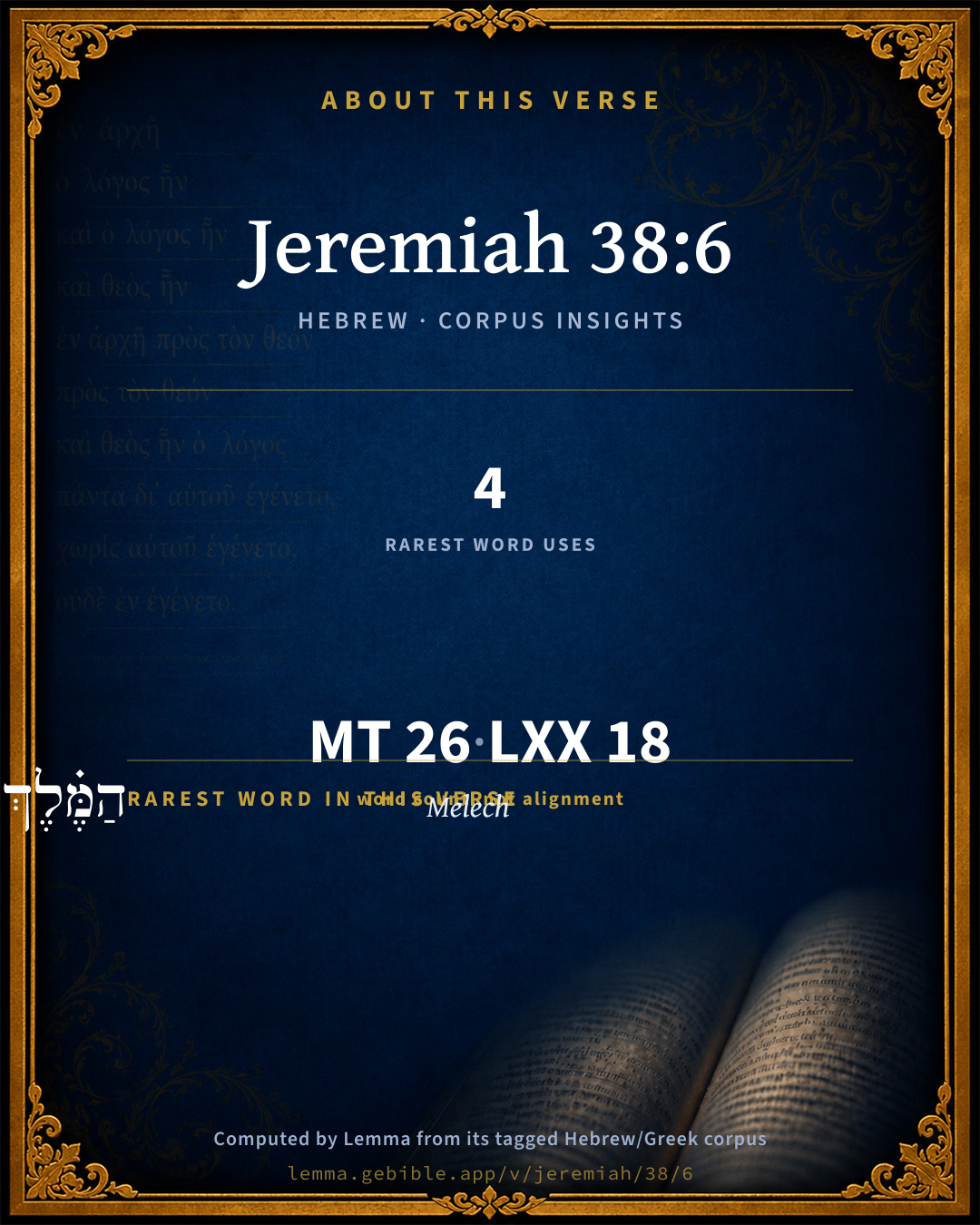
The rarest word here is הַמֶּ֗לֶךְ Melech H4429 — appearing just 4 times in the whole Hebrew Bible.

Shared distinctive vocabulary

הַמֶּ֗לֶךְ Melech H4429 occurs in 4 verses of the Hebrew Bible. Also found in:

Grammatical profile

  • 4 verbs
  • 14 nouns
  • 1 preposition
  • 2 conjunctions
  • 5 particles

Verb forms

  • וַיִּקְח֣וּ Qal · Sequential Imperfect
  • וַיַּשְׁלִ֨כוּ Hiphil · Sequential Imperfect
  • וַיְשַׁלְּח֥וּ Piel · Sequential Imperfect
  • וַיִּטְבַּ֥ע Qal · Sequential Imperfect

Repetition

Words recur within this verse — often emphatic in Hebrew:

  • יִרְמְיָ֗הוּ Jeremiah H3414 ×3
  • הַבּ֣וֹר pit H953 ×2
  • טִ֔יט mud H2916 ×2

Hebrew & Septuagint length

In the original languages it is 26 Hebrew tokens and 18 Greek tokens — but the two are counted differently (Hebrew bundles its prefixes and suffixes into one token; the Greek is in lemma form), so that isn’t a like-for-like length.

Cross-references

16

Topical passages linked to Jeremiah 38:6 in the Treasury of Scripture Knowledge — connected by theme and wording, ordered by reader-vote popularity; previews shown in the World English Bible.

  • Jeremiah 37:21 Then Zedekiah the king commanded, and they committed Jeremiah into the court of the guard; and they gave him daily a loaf of bread out of the bakers' street, until all the bread in the city was spent. Thus Jeremiah remained in the court of the guard.
  • Psalms 69:2 I sink in deep mire, where there is no foothold. I have come into deep waters, where the floods overflow me.
  • Psalms 69:14–15 Deliver me out of the mire, and don't let me sink. Let me be delivered from those who hate me, and out of the deep waters.
  • Jeremiah 37:16 When Jeremiah was come into the dungeon-house, and into the cells, and Jeremiah had remained there many days;
  • Jeremiah 38:22 behold, all the women who are left in the king of Judah's house shall be brought forth to the king of Babylon's princes, and those women shall say, Your familiar friends have set you on, and have prevailed over you: [now that] your feet are sunk in the mire, they are turned away back.
  • Genesis 37:24 and they took him, and threw him into the pit. The pit was empty. There was no water in it.
  • Psalms 40:2 He brought me up also out of a horrible pit, Out of the miry clay. He set my feet on a rock, And gave me a firm place to stand.
  • Psalms 109:5 They have rewarded me evil for good, And hatred for my love.
  • Lamentations 3:52–55 They have chased me sore like a bird, those who are my enemies without cause.
  • Zechariah 9:11 As for you also, Because of the blood of your covenant, I have set free your prisoners from the pit in which is no water.
  • Acts 16:24 who, having received such a charge, threw them into the inner prison, and secured their feet in the stocks.
  • Jeremiah 36:26 The king commanded Jerahmeel the king's son, and Seraiah the son of Azriel, and Shelemiah the son of Abdeel, to take Baruch the scribe and Jeremiah the prophet; but Yahweh hid them.
  • Jeremiah 38:11–12 So Ebedmelech took the men with him, and went into the house of the king under the treasury, and took there rags and worn-out garments, and let them down by cords into the dungeon to Jeremiah.
  • Luke 3:19–20 but Herod the tetrarch, being reproved by him for Herodias, his brother's wife, and for all the evil things which Herod had done,
  • 2 Corinthians 4:8–9 We are pressed on every side, yet not crushed; perplexed, yet not to despair;
  • Hebrews 10:36 For you need endurance so that, having done the will of God, you may receive the promise.

Cross-references courtesy of OpenBible.info (CC BY 4.0).

Hebrew and Greek witnesses Masoretic Hebrew ↔ Greek Septuagint

The same verse in the two great witnesses to the Old Testament, shown verse-for-verse.

These are two independent witnesses, not word-aligned to each other, and the Septuagint is shown in lemma (dictionary) form.

Hebrew Jeremiah 38:6 Masoretic · Westminster Leningrad Codex

וַיִּקְח֣וּ אֶֽת יִרְמְיָ֗הוּ וַיַּשְׁלִ֨כוּ אֹת֜וֹ אֶל הַבּ֣וֹר מַלְכִּיָּ֣הוּ בֶן הַמֶּ֗לֶךְ אֲשֶׁר֙ בַּחֲצַ֣ר הַמַּטָּרָ֔ה וַיְשַׁלְּח֥וּ אֶֽת יִרְמְיָ֖הוּ בַּחֲבָלִ֑ים וּבַבּ֤וֹר אֵֽין מַ֨יִם֙ כִּ֣י אִם טִ֔יט וַיִּטְבַּ֥ע יִרְמְיָ֖הוּ בַּטִּֽיט

Then took they Jeremiah, and cast him into the dungeon of Malchijah the king's son, that was in the court of the guard: and they let down Jeremiah with cords. In the dungeon there was no water, but mire; and Jeremiah sank in the mire.

World English Bible · Public Domain

Greek LXX Structure differs

In the Septuagint, Jeremiah is about an eighth shorter than the Hebrew and arranges its material differently — the Oracles Against the Nations (Hebrew chapters 46–51) appear in the middle of the Greek book, after 25:13. Because the chapter and verse boundaries do not line up, a verse-for-verse comparison with the Hebrew is not shown.

A verse-for-verse comparison isn’t shown here because the chapters and verses don’t line up. Switch to the LXX edition with the MT / LXX toggle above to read the Greek directly.

On this verse, Ellicott's Commentary for English Readers discusses the Septuagint’s reading. Read the note in Commentary ↓

Hebrew: Westminster Leningrad Codex (CC BY 4.0). Greek: Septuagint (public domain); English from a public-domain English Septuagint. How the Septuagint differs from the Hebrew →

Targum (Aramaic paraphrase)

1

The Targum is the ancient Jewish Aramaic paraphrase of the Hebrew Scriptures — an interpretive translation, not the Hebrew text itself. Onkelos (literal) and Pseudo-Jonathan (expansive) render the Torah, and Jonathan the Prophets. Coverage is partial: where no permissively-licensed English translation exists for a verse, only the Aramaic is shown. This is verse-level text, not a word-by-word alignment to the Hebrew.

  1. Targum Jonathan Prophets (Joshua–Malachi)
    וְדַבָּרוּ יַת יִרְמְיָה וּרְמוֹ יָתֵיהּ לְגוּבָא דְמַלְכִּיָה בַר מַלְכָּא דִבְדָרַת בֵּית אֲסִירַיָא וְשַׁרְבִּיבוּ יַת יִרְמְיָה בְּאַטוּנַיָא וּבְגוּבָא לֵית מַיָא אֱלָהֵן טִינָא וּטְבַע יִרְמְיָה בְּטִינָא:

    (no public-domain English translation for this verse)

    Targum Jonathan — Aramaic: “Mikraot Gedolot” (public domain). English: “Sefaria Community Translation” (CC0 1.0 (public-domain dedication)); “London "Chaldee Paraphrase," 1871” (public domain). Text via Sefaria.

Commentary

Notes on Jeremiah 38:6 from classic Christian and Jewish commentators (each source and its license shown beneath its notes). The classic Christian expositions comment on the surrounding passage and are grouped to its opening verse, so a note may address several verses; the Jewish commentaries on the Tanakh (Rashi and others) are per-verse, so they appear only where the commentator wrote on this verse.

Lemma curates 59 commentaries, every one of them public domain or Creative Commons licensed, each selected and text-cleaned for this edition rather than reprinted as found. About our sources →

Trapp's Complete Commentary

John Trapp

Jer 38:6 Then took they Jeremiah, and cast him into the dungeon of Malchiah the son of Hammelech, that [was] in the court of the prison: and they let down Jeremiah with cords. And in the dungeon [there was] no water, but mire: so Jeremiah sunk in the mire.

Ver. 6. Then took they Jeremiah.] Whom the king had now (against his conscience, as afterwards Pilate dealt by Jesus), either through fear or favour, betrayed unto his deadly enemies; and so he was in a pitiful plight, in a forlorn condition. But Jeremiah, de profundis, out of the deep called upon God (whom he found far more facile than these princes did Zedekiah), "Thou drewest near," saith he, "in the day when I called upon thee; thou saidst, Fear not." {Lam 3:57} I called upon thy name, O Lord, out of the low dungeon.

And they let down Jeremiah with cords.] With a murderous intent there to make an end of him privily, ut ibi praefocatus moreretur; ille vero usque ad collum mersus ibi manebat, said Josephus, that he might there pine and perish; but God graciously prevented it.

And in the dungeon there was no water but mire.] A typical hell it was, worse than Joseph’s pit, {Gen 37:24} or Heman’s lake, {Psa 88:6} or any prison that ever Brown the sect master ever came into, who used to boast that he had been committed to thirty-two prisons, and in some of them he could not see his hand at noonday. He died at length in Northampton jail, A.D. 1630, whereto he was sent for striking the constable requiring rudely the payment of a rate. {a}

So Jeremiah sunk in the mire.] Up to the neck, saith Josephus, and so became a type of Christ. {Psa 69:2}

{a} Fuller’s Church Hist., 168.

John Trapp, A Commentary or Exposition upon All the Books of the Old and New Testament (1647–1656) — public domain. Text from a community e-Sword module.

Joseph Benson's Commentary

Jer 38:6. Then they took Jeremiah and cast him into the dungeon of Malchiah — A place of much the same nature with that mentioned Jer 37:16, but in another prison. And they let down Jeremiah with cords — It seems there was no passage into this dungeon by stairs, and, as it was deep, they were obliged to let him down in this manner. So Jeremiah sunk in the mire — Which was in the bottom of this pit. Josephus asserts that he sunk up to his neck in it, and adds, that their intention in putting him into so foul a place was, that he might perish in it, Antiq, lib. 9. cap. 10. It has been thought by some, that during his abode in this loathsome place he composed the melancholy meditations contained in the third chapter of his Lamentations; but this seems highly improbable.

Joseph Benson's Commentary on the Old and New Testaments (1811–1818) — public domain. Text from a community e-Sword module.

Whedon's Commentary on the Bible

Daniel D. Whedon

JEREMIAH’S CLOSER CONFINEMENT AND RELEASE, Jer_38:6-13.

6. Dungeon — Literally, as above, cistern. As every house was supplied with these they easily served as ready-made prisons. In a cistern like to these, in the field or pasture, Joseph was placed by his brethren at Dothan. This explains the allusion in Zec_9:11, “prisoners out of the pit in which is no water.” Hence also the use of cords to let down Jeremiah into the prison.

Daniel D. Whedon (gen. ed.), Commentary on the Old and New Testaments (1874–1909) — public domain. Text from a community e-Sword module.

Tyndale Open Study Notes

Tyndale Open Resources

38:6 In the presence of everyone in the palace courtyard, Jeremiah was thrown into an empty cistern. At the bottom was a thick layer of mud that slowly enveloped Jeremiah’s body.

Tyndale Open Study Notes — © Tyndale Open Resources, licensed CC BY-SA 4.0. Text via the HelloAO Bible API.

Jamieson, Fausset & Brown

Robert Jamieson, A. R. Fausset & David Brown

dungeon--literally, the "cistern." It was not a subterranean prison as that in Jonathan's house (Jer 37:15), but a pit or cistern, which had been full of water, but was emptied of it during the siege, so that only "mire" remained. Such empty cisterns were often used as prisons (Zac 9:11); the depth forbade hope of escape.

Hammelech-- (Jer 36:26). His son followed in the father's steps, a ready tool for evil.

sunk in the mire--Jeremiah herein was a type of Messiah (Psa 69:2, Psa 69:14). "I sink in deep mire," &c.

Jamieson, Fausset & Brown — Commentary Critical and Explanatory on the Whole Bible (1871) — public domain (CC PDM 1.0). Text via the HelloAO Bible API.

Adam Clarke's Commentary

Verse 6. So Jeremiah sunk in the mire.] Their obvious design was, that he might be stifled in that place.

Adam Clarke's Commentary on the Bible (1810–1826) — public domain. Text from a community e-Sword/MySword module.

John Calvin's Commentaries

HERE is narrated the extreme presumption as well as cruelty of the princes; for they cast the holy Prophet into a pit, where he sank in the mire. It was a proof of hardened impiety not to spare so excellent a servant of God; and it was also a savage cruelty, when they had no cause of being so filled with rage, except that Jeremiah had obeyed God, and faithfully performed the office committed to him.

Let us at the same time learn from this example, whenever it pleases the Lord to try our patience, to bear with resignation what we see to have been borne by the holy Prophet. If, then, we shudder at any time at the horrors of the cross, so that it may seem hard to us to bear persecution, let us remember this example of the Prophet. In a word, there is here, on the one hand, shewn to us, as in a picture, the wickedness of the world; and on the other, the wonderful constancy and also the singular meekness of God’s servant shine forth gloriously.

Jeremiah then says, that he was taken by the princes and cast into a pit, which was in the court of the prison; and in that part, where one of the counselors dwelt, even Malchiah the son of Hamelech And at the same time he describes the state of the place, that it was a miry pit, so that he sank down in the mud. He does not mean that he was covered with mud, but that he was fixed in it, as the Hebrew word intimates; and we may thus rightly render the words, “He lay fixed in the mud.” It now follows —

John Calvin's Commentaries (1540-1563) — public domain. Text from the Calvin Translation Society English edition (1840s-50s) via the Christian Classics Ethereal Library (ccel.org). Calvin's coverage is partial (roughly two-thirds of the Bible); uncommented books and verses are honest gaps, never fabricated. The 19th-century editor's footnotes and remarks are omitted so the notes are faithfully Calvin's own voice.

Ellicott's Commentary for English Readers

(6) The dungeon of Malchiah the son of Hammelech.—Literally, the pit, or cistern. The LXX. agrees with the marginal reading in describing him as “a son of the king.” The same phrase is so translated in 1Ki_22:26; 2Ch_28:7, and would seem to have been an official or court title, applied to one of the royal house, as distinguished from. others. (See Note on Jerahmeel in Jer_36:26.) We have no data for judging whether this Malchiah is identical with the lather of Pashur in Jer_38:1; but it is not unlikely. In Lam_3:53-55 we have probably a reminiscence of these days of horrible suffering. The cistern had been partly dried up (possibly through the supply of water having been cut off during the protracted siege), but there remained a thick deposit, three or four feet deep, of black foetid mud,, and there, it is obvious from Jer_38:9 of this chapter, his enemies meant to leave him to die of hunger. They probably shrank from the odium of a public execution, or thought, with the strange superstition of the Eastern mind, that in this way they could escape the guilt of shedding the prophet’s blood. The death by starva-tion might easily be represented, even to themselves, as a death by disease.

A Bible Commentary for English Readers, edited by Charles John Ellicott (1878–1897) — public domain. Text from a community e-Sword module.

The Cambridge Bible for Schools and Colleges

gen. ed. J. J. S. Perowne

6. the dungeon of Malchijah] mg. pit; a cistern for storage of water; see on Jer_6:7. The depth and wretchedness of this place of confinement are shewn by the means employed to place Jeremiah in it.

the king’s son] better than mg. the son of Hammelech. See on Jer_36:26.

The Cambridge Bible for Schools and Colleges (gen. ed. J. J. S. Perowne; Cambridge University Press, 1878–1918) — public domain. Text from a community e-Sword module.

John Gill's Exposition

Then took they Jeremiah,.... Having the king's leave, or at least no prohibition from him; they went with proper attendants to the court of the prison, and took the prophet from thence:

and cast him into the dungeon of Malchiah the son of Hammelech, that was in the court of the prison; this was a dungeon that belonged to the prison which Malchiah had the care of, or which belonged to his house, which was contiguous to the court of the prison. The Targum renders it, Malchiah the son of the king; and so the Septuagint and Arabic versions; but it is not likely that Zedekiah should have a son that was set over his dungeon, or to whom one belonged, or should be called by his name: here the princes cast the prophet, in order that he should perish, either with famine or suffocation, or the noisomeness of the place; not caring with their own hands to take away the life of a prophet, and for fear of the people; and this being a more slow and private way of dispatching him, they chose it; for they designed no doubt nothing less than death:

and they let down Jeremiah with cords; there being no steps or stairs to go down into it; so that nobody could come to him when in it, or relieve him:

and in the dungeon there was no water, but mire; so Jeremiah sunk in the mire; up to the neck, as Josephus (q) says. Some think that it was at this time, and in this place, that Jeremiah put up the petitions to the Lord, and which he heard, recorded in Lam 3:55; and that that whole chapter was composed by him in this time of his distress.

(q) Antiqu. l. 10. c. 7. sect. 5.

John Gill's Exposition of the Whole Bible (1746–1763) — public domain (CC PDM 1.0). Text via the HelloAO Bible API.

Albert Barnes' Notes on the Bible

The dungeon - The cistern. Every house in Jerusalem was supplied with a subterranean cistern, so well constructed that the city never suffered in a siege from want of water. So large were they that when dry they seem to have been used for prisons Zec 9:11.

Hammelech - See Jer 36:26 note.

The prison - The guard. They threw Jeremiah into the nearest cistern, intending that he should die of starvation. Some have thought that Ps. 69 was composed by Jeremiah when in this cistern.

Albert Barnes' Notes on the Bible (1834–1885) — public domain. Text from a community e-Sword/MySword module.

Haydock's Catholic Bible Commentary

Mire, up to the neck; so that he would soon have been smothered. (Josephus, Antiquities x. 10.)

George Leo Haydock (1774–1849), Haydock's Catholic Family Bible and Commentary, 1859 edition — public domain. Excludes Psalms (Douay-Rheims chapter numbering differs from Protestant) and Deuterocanonical books (Catholic canon only).

Matthew Poole's English Annotations

Cast him into the dungeon of Malchiah the son of Hammelech, that was in the court of the prison; a place much of the same nature with that of which we read Jer 37:16, but in another prison. It should seem there was no passage into it by stairs, so as they were forced to let him down with cords. And in the bottom was nothing but mire, into which the prophet sank, in respect of which circumstances it was a much worse place than the dungeon in the prison in Jonathan’s house appeared to be, though Jeremiah feared that he should die there. It is probable these princes thrust him into this place, designing he should die in this hole a miserable death, but God otherwise provided for him.

Matthew Poole's English Annotations on the Holy Bible (1683–1685) — public domain. Text from a community e-Sword/MySword module.

The Pulpit Commentary

The dungeon; more literally, the cistern. "Every house in Jerusalem was supplied with a subterranean cistern, so well constructed that we never read of the city suffering in a siege from want of water" (Dr. Payne Smith). A grotto bearing the name of Jeremiah has been shown at Jerusalem since the fifteenth century. Under its floor are vast cisterns, the deepest of which professes to be the prison into which the prophet was thrown. The objection is that the sacred narrative proves that the prison was in the city, whereas "the present grotto was not included within the walls until the time of Herod Agrippa" (Thomson, "The Land and the Book," 1881, p. 555). The son of Hammelech; rather, a royal prince. (as Jer_36:26)

The apparent misanthropy of revelation.

The political aspect of these words is evident; let us now consider their moral bearings: The inspired prophet of God is taken for an enemy of his neighbours. The experience of Jeremiah is not without parallel, nor is it wanting in certain reasonable grounds of justification.

I THERE ARE THINGS IN REVELATION WHICH APPEAR TO INDICATE MISANTHROPY. When God utters his voice he does not always speak in dulcet notes. We may hear harsh, grating thunders of Sinai. The message is not always pleasant. It makes us feel uncomfortable, exposes our worst characteristics, and has no pity on our little contrivances for putting the best face on our conduct. It stays our hand in many a favorite occupation. It cries "vanity of vanities" to our pet schemes. It puts a veto on our proud ambition. It frowns at much of our pleasure. For the future it threatens judgment and hitter penalties. When we fancy we have found some neat plan of escape, it exposes the rottenness of our hope and plunges us for the moment into blank despair. Such is the work of certain parts of revelation, and being so, it is not unnaturally regarded by some as misanthropic. Bearing this fact in mind, we must not be surprised at the aversion that the irreligious feel to religion. Judging from this standpoint, they may regard their best friend as their enemy, and imagine that the angry voice of God indicates nothing but his settled wrath against them.

II THIS MISANTHROPY IS ONLY APPARENT. Jeremiah was the best friend of Jerusalem, and the fanatical leaders of resistance her most fatal foes. His advice was really wise and patriotic. The Bible, which to some is a gloomy Book, darkening the aspect of human life, contains the secret of its true blessedness. The religion of the Bible may be sombre in the eyes of some when compared with the sunny religion of Greece. But the Hellenic faith could not save its followers from utter moral corruption and ruin. Through the sterner faith of the Jew and the Christian we are led to that one satisfying brightness of life which comes from the rising upon us of the Sun of righteousness. We must judge of words by their aim, not by their sound. The Bible contains threats of terrible doom, hut as we discover the purpose of them we see that they are not curses but warnings. God often opposes us, stays our course, puts up the red signal, only to save us from rushing to some fatal calamity. Elijah, Jeremiah, John the Baptist, Savonarola, and John Knox were regarded by their contemporaries as misanthropic. Now we see that they were the salt of the earth, true saviours of society. Even Christ uttered words which might seem to indicate misanthropy, but all with the intention of leading men to escape from the evils he deplored and find salvation in his grace.

Vers. 6-13. "Cast down, but not forsaken.

As we look on the prophet as here portrayed, these words of St. Paul are brought to our mind. We have here, as there

I A SERVANT OF GOD CAST DOWN. See the prophet"s allusions to his sad condition in Lam_3:52-57; and Psalm 69. can hardly be other than descriptive of Jeremiah at this time. And such seasons of depression and distress seem to be the appointed lot of all God"s servants. Not one, from our Lord downwards, has been exempted. Manifold are the reasons for such appointment. In this particular case of Jeremiah

II THE CAUSES OF HIS DISTRESS were:

1. The cruelty of his treatment acting on a nature such as his.

2. Its coming upon him after he had been led to hope that now he was secure from all such treatment.

3. His knowledge that he desired to be, and was, his foes" best friend, and yet they dealt with him thus.

4. The hopelessness of his condition. Such were the immediate causes of his being cast down.

III WHEREFORE DOES GOD SUFFER HIS SERVANTS TO BE SUBJECTED TO SUCH DISTRESS? To deepen their hold upon God, as the storms cause the trees to take deeper root in the earth. To make them realize more than ever the help they have in God. To cultivate and foster those fruits of the Spirit, such as patience, humility, trust, etc., which will hardly grow in any other soil or by any other process. To make them mighty witnesses before men of the salvation of God and of the present help he is in trouble. To qualify them to sympathize with and succour others in their distress. How such thoughts are calculated to sustain the soul in distress! And they do, for

IV GOD"S SERVANTS ARE, THOUGH CAST DOWN, NOT FORSAKEN. Here was a stranger to the commonwealth of Israel and from the covenants of promise, one who least of all might have been expected to care for the prophet of God, and this stranger proves to be God"s good angel of mercy. God raised up this helper in the hour of his servant"s need. See what was done in connection with and by this noble-hearted Ethiopian.

1. God caused intelligence of the prophet"s sufferings to reach him (ver. 7).

2. He touched his heart with compassion (vers. 7, 9, 11).

3. He led him to resolve to attempt the prophet"s deliverance.

4. He gave him clearly to see the wickedness of the prophet"s enemies, and the truth of the prophet himself.

5. He filled his heart with courage. For courage was needed. He was alone. The consequences of his interference might have been fatal to himself. He had to reprove and condemn both the king and the king"s counsellors.

6. He gave him good success. The king at once yielded, went right over to his side (contrast ver. 5), took all precaution that the deliverance should not be hindered. And he did all this at once. Further, he took oath that Jeremiah should not be so dealt with in the future. Now, all this proves the blessed truth for God"s servants that, though they may be cast down, yet they shall not be forsaken.

V WHAT ARE WE TO LEARN FROM SUCH S RECORD? Much every way.

1. Concerning God. He is never at a loss for messengers of mercy and help to his servants.

2. Concerning his tried and troubled servants. Patiently wait. Trust at all times. Hope continually, till your eyes see his salvation, as they assuredly shall.

3. Concerning the enemies of the Lord. Their designs and purposes must fail, however certain of success they seem to be; for God is against them. C.

The Pulpit Commentary (1880–1919), ed. H.D.M. Spence-Jones & Joseph S. Exell — public domain. Text from a community e-Sword module.

Scofield Reference Notes

C. I. Scofield

then took they

(See Scofield "Jer 37:11").

The Scofield Reference Bible (1917 edition), notes by C. I. Scofield — public domain. Text from a community e-Sword module.

unfoldingWord translationNotes

Door43 World Missions Community

they ... threw him into the cistern

They literally "lowered Jeremiah down on ropes," but the word "threw" is an exaggeration to say that they treated him roughly. Your language may have another way of saying this. AT: "they ... roughly pushed him into the cistern" (See: Hyperbole and Generalization)

cistern

a deep hole in the ground where people collect and store rain water

the courtyard of the guard

This was an open area attached to the king's palace that was surrounded by buildings and in which they kept prisoners. See how you translated this in Jeremiah 32:2.

They lowered Jeremiah down on ropes

This tells how "they threw him into the cistern."

translationWords

court

unfoldingWord translationNotes — © Distant Shores Media and the Door43 World Missions Community, licensed CC BY-SA 4.0. Source: git.door43.org/Door43/en_tn.

Rashi

Rabbi Shlomo Yitzchaki (Rashi)

the pit of Malchiah lit. the pit Malchiah.

Rashi on the Tanakh — English translations: “The Judaica Press complete Tanach with Rashi, translated by A. J. Rosenberg” (CC BY 4.0); “Pentateuch with Rashi's commentary by M. Rosenbaum and A.M. Silbermann, 1929-1934” (public domain); “The Metsudah Tanach series, Lakewood, N.J” (CC BY 4.0); and “The Book of Joshua, Metsudah Publications, 1997” (CC BY 4.0). Text via Sefaria.

Lesson kit

Teaching starters — assembled from the data on this page, not authored interpretation. Every prompt links to the verse data it draws on. Edit before teaching.

Jeremiah, in the Prophets, opens this verse with 26 words (20 distinct Hebrew lemmas). Its most distinctive word is Melek (“Melech”). A historical commentator’s framing appears above. Read the whole chapter for the surrounding context.

Discussion questions

  1. The word Melek carries the sense “Melech.” How does it shape the verse?
  2. 1 Chronicles 8:35 shares the word «Melech» with this verse. How do the two illuminate each other?
  3. “Jeremiah” occurs 3× in this one verse. What is the effect of the repetition?
  4. These translations render this verse differently; the difference is in the English rendering, not the original. What questions does that raise?
  5. The verb «וַיִּקְח֣וּ» is Qal Sequential Imperfect. How does its form color the action?
  6. Reading how Trapp's Complete Commentary and Joseph Benson's Commentary read this verse, where do the two commentators agree and where do they part?

Things to notice

Reading settings

Reading text

Shown beneath each verse's original-language words.

Old Testament
Old Testament edition

Read the OT as the Masoretic Hebrew (MT) or the Greek Septuagint (LXX).

English shown for the Greek Septuagint (in the Hebrew ↔ Greek comparison).

Comparing translations? Open the Compare panel on any verse page to stack up to four side by side.