Isaiah 19:8

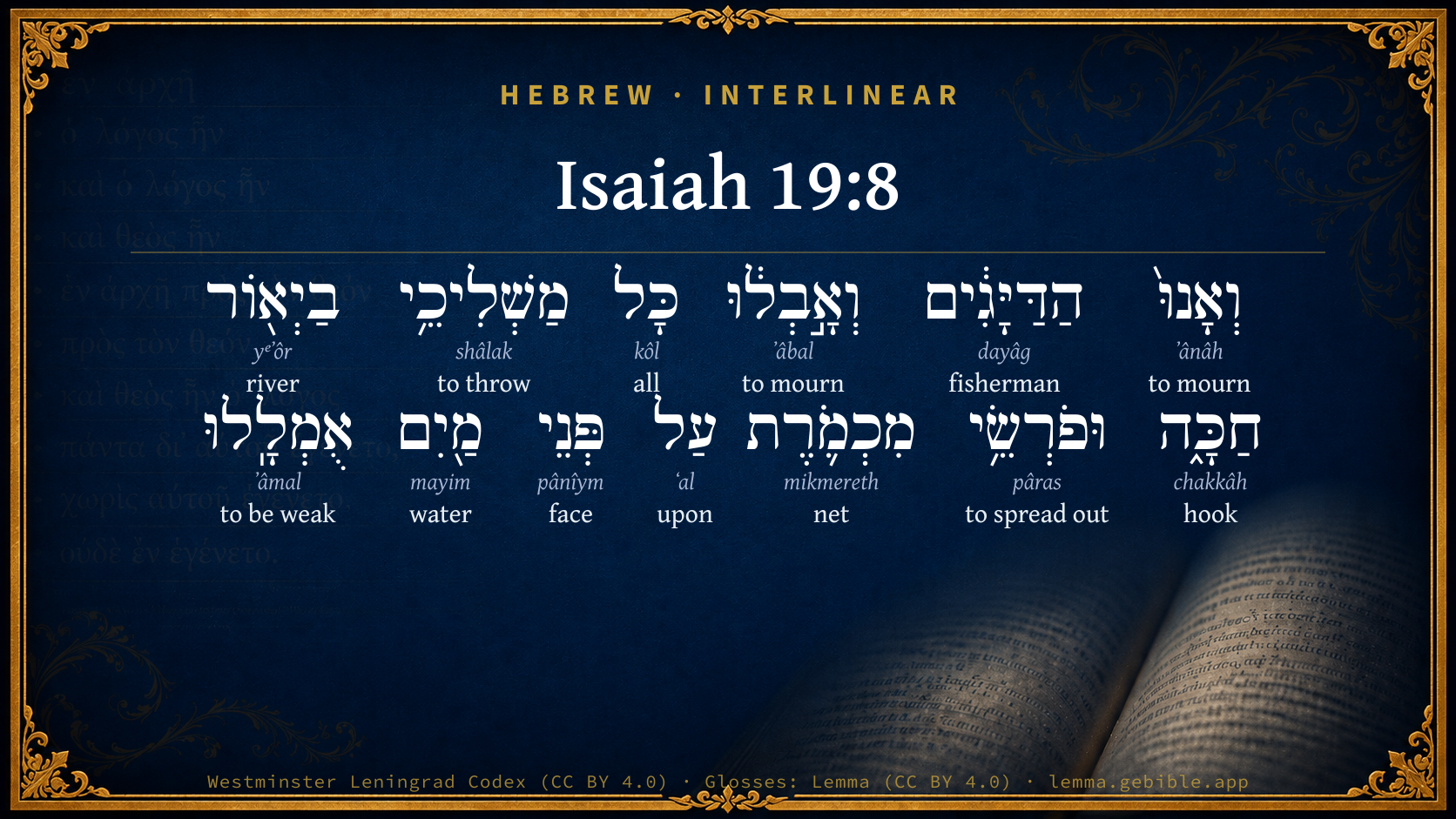
Hebrew (Westminster Leningrad Codex) Isaiah 19:8 appears in the Hebrew Old Testament. The text above is from the Westminster Leningrad Codex. Each word links to its Strong’s number, a concise gloss, and parsing drawn from the Open Scriptures Hebrew Bible morphology. Click any word for its full Brown-Driver-Briggs (BDB) entry.
Download image
Cite this verse

Isaiah 19:8 (World English Bible). Public Domain. Lemma interlinear Bible study tool, https://lemma.gebible.app/v/isaiah/19/8.

Show BibTeX & RIS
BibTeX
RIS
English Translation
The fishermen shall lament, and all those who cast angle into the Nile shall mourn, and those who spread nets on the waters shall languish.
World English Bible · Public Domain
Highlights
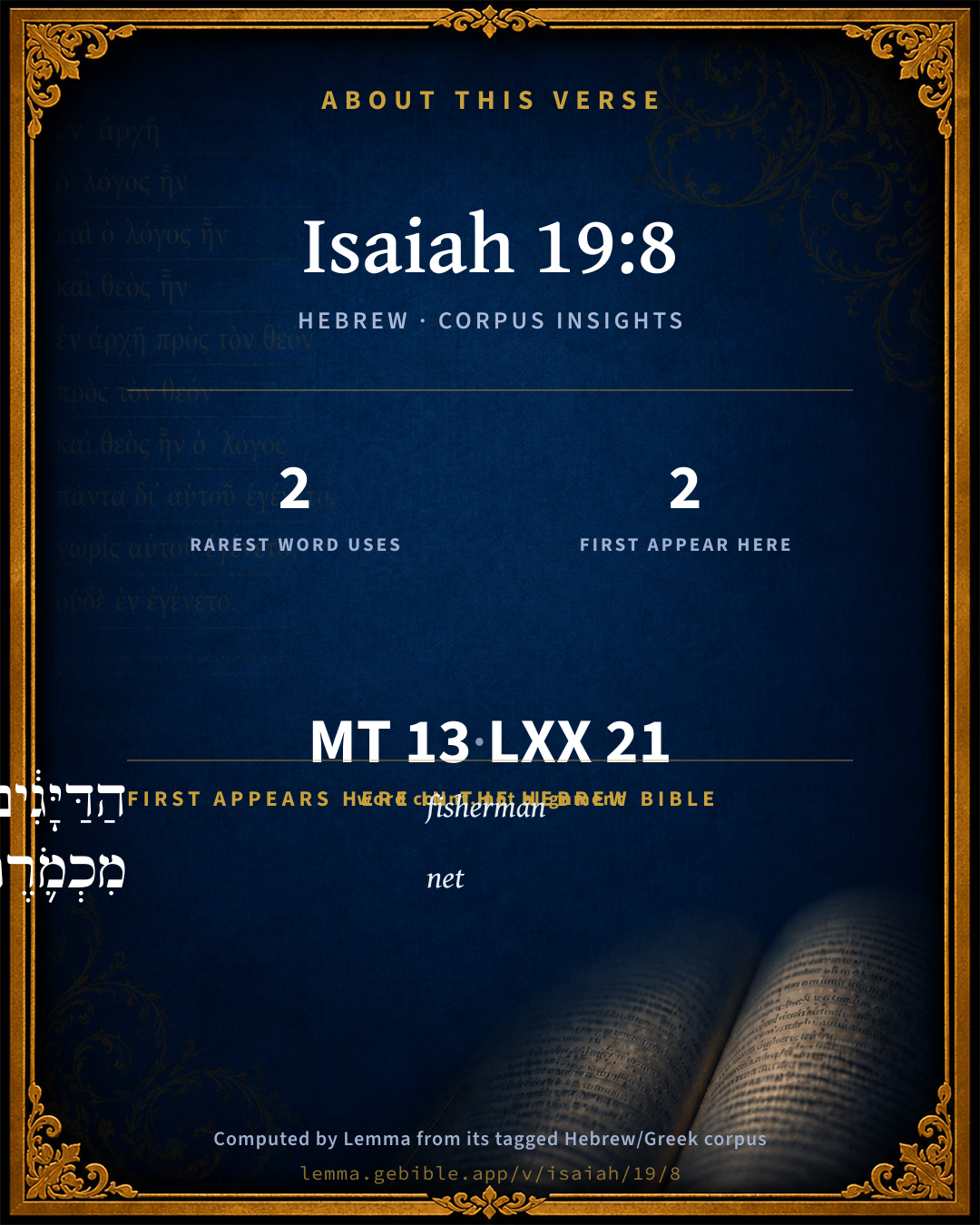
  • 2 first appearances in the Hebrew Bible
Full analysis ↓
Download a study sheet

One document with this verse’s original text, its word-by-word gloss line, the meaning frame, cross-references with their text, attributed commentary, and full source and license credits — printable, and it pastes into notes with its structure intact.

This verse Autodidact and up

Study sheet (.html) Plain text (.txt)

A passage Seminary Student

Up to 50 verses in one chapter. A passage sheet keeps up to 6 commentary sources and 12 cross-references per verse, in the order this page ranks them, and says so on the sheet whenever that leaves anything out. Ask for a single verse and you get the Autodidact verse sheet above.

Everything on this page stays free to read, with no account — the sheet is a download of what is already on screen, not access to it.

Want to remove ads? Support Godless Engineer
Compare translations 3

The same verse in 3 English versions, stacked beneath the original-language interlinear above. Click any original word for its lexicon entry.

Each is an independent rendering of the whole verse — the interlinear is not word-aligned to these translations.

Highlighted words mark where these versions differ — a whole-verse word diff, not a word-by-word alignment.

  • World English Bible Public Domain
    The fishermen shall lament, and all those who cast angle into the Nile shall mourn, and those who spread nets on the waters shall languish.
  • King James Version Public Domain
    The fishers also shall mourn, and all they that cast angle into the brooks shall lament, and they that spread nets upon the waters shall languish.
  • unfoldingWord Literal Text CC BY-SA 4.0
    And the fishermen will lament, and all of the ones casting a hook into the Nile will mourn, and the ones spreading a net upon the face of the waters will be enfeebled.

unfoldingWord Literal Text — © unfoldingWord, licensed CC BY-SA 4.0. Word-aligned USFM3 via Door43 (git.door43.org/unfoldingWord/en_ult).

Versions to compare (up to 4)

3 of 4 selected

Show all 18 translations

Every available English version of this verse, each an independent rendering of the whole verse.

  • World English Bible Public Domain
    The fishermen shall lament, and all those who cast angle into the Nile shall mourn, and those who spread nets on the waters shall languish.
  • Berean Standard Bible Public Domain
    Then the fishermen will mourn, all who cast a hook into the Nile will lament, and those who spread nets on the waters will pine away.
  • Majority Standard Bible Public Domain
    Then the fishermen will mourn, all who cast a hook into the Nile will lament, and those who spread nets on the waters will pine away.
  • King James Version Public Domain
    The fishers also shall mourn, and all they that cast angle into the brooks shall lament, and they that spread nets upon the waters shall languish.
  • American Standard Version (1901) Public Domain
    And the fishers shall lament, and all they that cast angle into the Nile shall mourn, and they that spread nets upon the waters shall languish.
  • Revised Version (1885) Public Domain
    The fishers also shall lament, and all they that cast angle into the Nile shall mourn, and they that spread nets upon the waters shall languish.
  • Geneva Bible (1599) Public Domain
    The fishers also shall mourne, and all they that cast angle into the riuer, shall lament, and they that spread their nette vpon the waters, shall be weakened.
  • Douay-Rheims (1899) Public Domain
    The fishers also shall mourn, and all that cast a hook into the river shall lament, and they that spread nets upon the waters shall languish away.
  • Young's Literal Translation Public Domain
    And lamented have the fishers, And mourned have all casting angle into a brook, And those spreading nets on the face of the waters have languished.
  • Literal Standard Version CC BY-SA 4.0
    And the fishers have lamented, || And all casting a hook into the brook have mourned, || And those spreading dragnets on the face of the waters have languished.
  • Unlocked Literal Bible CC BY-SA 4.0
    The fishermen will wail and mourn, and all who cast a hook into the Nile will mourn, and those who spread nets on the waters will grieve.
  • unfoldingWord Literal Text CC BY-SA 4.0
    And the fishermen will lament, and all of the ones casting a hook into the Nile will mourn, and the ones spreading a net upon the face of the waters will be enfeebled.
  • Darby Bible Public Domain
    And the fishers shall mourn, and all they that cast fish-hook into the Nile shall lament, and they that spread net upon the waters shall languish.
  • World Messianic Bible Public Domain
    The fishermen will lament, and all those who fish in the Nile will mourn, and those who spread nets on the waters will languish.
  • Webster's Bible Public Domain
    The fishers also shall mourn, and all they that cast angle into the brooks shall lament, and they that spread nets upon the waters shall languish.
  • Free Bible Version CC BY-SA 4.0
    Fishermen will mourn: all of them all who use hooks to fish in the Nile will weep and wail, along with those who fish by throwing nets into the water.
  • Bible in Basic English Public Domain
    The fishermen will be sad, and all those who put fishing-lines into the Nile will be full of grief, and those whose nets are stretched out on the waters will have sorrow in their hearts.
  • JPS Tanakh (1917) Public Domain
    The fishers also shall lament, and all they that cast angle into the Nile shall mourn, and they that spread nets upon the waters shall languish.

Literal Standard Version (2020), Covenant Press — licensed CC BY-SA 4.0. Text via the HelloAO Bible API (eBible.org). Unlocked Literal Bible (unfoldingWord) — licensed CC BY-SA 4.0. Text via the HelloAO Bible API (eBible.org). unfoldingWord Literal Text — © unfoldingWord, licensed CC BY-SA 4.0. Word-aligned USFM3 via Door43 (git.door43.org/unfoldingWord/en_ult). Free Bible Version, Dr. Jonathan Gallagher — licensed CC BY-SA 4.0. Text via the HelloAO Bible API (eBible.org).

Word by word

More ways to search: Search by grammar → Find every occurrence → Compare this word →

Practice this passage: Drill this verse → Learn its vocabulary →

וְאָנוּ֙
ʼânâh
H578
“and · to mourn”
Conjunction + Adverb
Part of Speech
Conjunction + Adverb
Full BDB Definition

Origin: a primitive root

TWOT: 124

(Qal) to mourn
  1. הַדַּיָּגִ֔ים dayâg H1771 “the · fishermen” Particle, Definite Article + Noun, Common, Masculine, Plural, Absolute
  2. וְאָ֣בְל֔וּ ʼâbal H56 “and · to mourn” Conjunction + Verb, Qal, Sequential Perfect, 3rd Person, Common, Plural
  3. כָּל kôl H3605 “all of” Noun, Common, Masculine, Singular, Construct
  4. מַשְׁלִיכֵ֥י shâlak H7993 “throwing” Verb, Hiphil, Participle Active, Masculine, Plural, Construct
  5. בַיְא֖וֹר yᵉʼôr H2975 “in/at the · river” Preposition, Determined + Noun, Proper
  6. חַכָּ֑ה chakkâh H2443 “hook” Noun, Common, Feminine, Singular, Absolute
  7. וּפֹרְשֵׂ֥י pâras H6566 “and · spreading out” Conjunction + Verb, Qal, Participle Active, Masculine, Plural, Construct
  8. מִכְמֹ֛רֶת mikmereth H4365 “net” Noun, Common, Feminine, Singular, Absolute
  9. עַל ʻal H5921 “upon” Preposition
  10. פְּנֵי pânîym H6440 “face(s) of” Noun, Common, Both, Plural, Construct
  11. מַ֖יִם mayim H4325 “water(s)” Noun, Common, Masculine, Plural, Absolute
  12. אֻמְלָֽלוּ ʼâmal H535 “to be weak” Verb, Pulal, Perfect, 3rd Person, Common, Plural

About this verse

These counts appear in no published source. They are computed here, from the morphology-tagged text and Lemma’s own curated glosses. What Lemma adds →

13
words
13
distinct lemmas
Prophets
section

Notable vocabulary

The rarest word here is וְאָנוּ֙ to mourn H578 — appearing just 2 times in the whole Hebrew Bible.

First appearance in Scripture

These words make their first canonical appearance in the Hebrew Bible here:

  • הַדַּיָּגִ֔ים fisherman H1771
  • מִכְמֹ֛רֶת net H4365

Shared distinctive vocabulary

וְאָנוּ֙ to mourn H578 occurs in 2 verses of the Hebrew Bible. Also found in:

Grammatical profile

  • 4 verbs
  • 7 nouns
  • 1 preposition
  • 1 adverb

Verb forms

  • וְאָ֣בְל֔וּ Qal · Sequential Perfect
  • מַשְׁלִיכֵ֥י Hiphil · Participle Active
  • וּפֹרְשֵׂ֥י Qal · Participle Active
  • אֻמְלָֽלוּ Pulal · Perfect

Hebrew & Septuagint length

In English translation the verse runs 25 words from the Hebrew and 26 from the Septuagint (LXX English) — closely comparable.

A rough comparison of the two English renderings, which tokenize alike — not a word-level alignment.

Word counts can differ between the Hebrew and the Greek without any difference in meaning — e.g. the Hebrew direct-object marker אֵת has no separate Greek word, and Greek often adds the article ὁ.

In the original languages it is 13 Hebrew tokens and 21 Greek tokens — but the two are counted differently (Hebrew bundles its prefixes and suffixes into one token; the Greek is in lemma form), so that isn’t a like-for-like length.

Cross-references

4

Topical passages linked to Isaiah 19:8 in the Treasury of Scripture Knowledge — connected by theme and wording, ordered by reader-vote popularity; previews shown in the World English Bible.

  • Ezekiel 47:10 It shall happen, that fishermen shall stand by it: from En Gedi even to En Eglaim shall be a place for the spreading of nets; their fish shall be after their kinds, as the fish of the great sea, exceeding many.
  • Habakkuk 1:15 He takes up all of them with the hook. He catches them in his net, and gathers them in his dragnet. Therefore he rejoices and is glad.
  • Numbers 11:5 We remember the fish, which we ate in Egypt for nothing; the cucumbers, and the melons, and the leeks, and the onions, and the garlic:
  • Exodus 7:21 The fish that were in the river died; and the river became foul, and the Egyptians couldn't drink water from the river; and the blood was throughout all the land of Egypt.

Cross-references courtesy of OpenBible.info (CC BY 4.0).

Hebrew and Greek witnesses Masoretic Hebrew ↔ Greek Septuagint

The same verse in the two great witnesses to the Old Testament, shown verse-for-verse.

These are two independent witnesses, not word-aligned to each other, and the Septuagint is shown in lemma (dictionary) form.

Hebrew Isaiah 19:8 Masoretic · Westminster Leningrad Codex

וְאָנוּ֙ הַדַּיָּגִ֔ים וְאָ֣בְל֔וּ כָּל מַשְׁלִיכֵ֥י בַיְא֖וֹר חַכָּ֑ה וּפֹרְשֵׂ֥י מִכְמֹ֛רֶת עַל פְּנֵי מַ֖יִם אֻמְלָֽלוּ

The fishermen shall lament, and all those who cast angle into the Nile shall mourn, and those who spread nets on the waters shall languish.

World English Bible · Public Domain

Greek LXX Isaiah 19:8 Septuagint · lemma form

καί στενάζω ὁ ἁλιεύς καί στενάζω πᾶς ὁ βάλλω ἄγκιστρον εἰς ὁ ποταμός καί ὁ βάλλω σαγήνη καί ὁ ἀμφιβολεύς πενθέω

And the fishermen shall groan, and all that cast a hook into the river shall groan; they also that cast nets, and the anglers shall mourn.

LXX2012 (modern English Septuagint) · Public Domain

Hebrew: Westminster Leningrad Codex (CC BY 4.0). Greek: Septuagint (public domain); English from LXX2012 (modern English Septuagint) (Public Domain). How the Septuagint differs from the Hebrew →

Targum (Aramaic paraphrase)

1

The Targum is the ancient Jewish Aramaic paraphrase of the Hebrew Scriptures — an interpretive translation, not the Hebrew text itself. Onkelos (literal) and Pseudo-Jonathan (expansive) render the Torah, and Jonathan the Prophets. Coverage is partial: where no permissively-licensed English translation exists for a verse, only the Aramaic is shown. This is verse-level text, not a word-by-word alignment to the Hebrew.

  1. Targum Jonathan Prophets (Joshua–Malachi)
    וְיִצְדוּן צַיְדֵי נוּנַיָא וְיִתְאַבְּלוּן כָּל דַהֲווֹ רָמָן בְּנַהֲרָא חַכְּתָא וּפַרְסֵי מַצְדָן עַל אַפֵּי מַיָא יִצְדוּן:

    The fishermen shall be laid desolate, and all they that cast angle into the brook, and they that spread nets upon the faces of the waters shall be destroyed.

    Targum Jonathan — Aramaic: “Mikraot Gedolot” (public domain). English: “Sefaria Community Translation” (CC0 1.0 (public-domain dedication)); “London "Chaldee Paraphrase," 1871” (public domain). Text via Sefaria.

Commentary

Notes on Isaiah 19:8 from classic Christian and Jewish commentators (each source and its license shown beneath its notes). The classic Christian expositions comment on the surrounding passage and are grouped to its opening verse, so a note may address several verses; the Jewish commentaries on the Tanakh (Rashi and others) are per-verse, so they appear only where the commentator wrote on this verse.

Lemma curates 59 commentaries, every one of them public domain or Creative Commons licensed, each selected and text-cleaned for this edition rather than reprinted as found. About our sources →

Trapp's Complete Commentary

John Trapp

Isa 19:8 The fishers also shall mourn, and all they that cast angle into the brooks shall lament, and they that spread nets upon the waters shall languish.

Ver. 8. The fishers also shall mourn.] Because their trade decayeth, or they take pains to no purpose. {Isa 19:10}

John Trapp, A Commentary or Exposition upon All the Books of the Old and New Testament (1647–1656) — public domain. Text from a community e-Sword module.

Geneva Bible (1599)

Geneva Bible translators

The Scriptures used to describe the destruction of a country by taking away of the commodities thereof, as by vines, flesh, fish, and such other things, whereby countries are enriched.

Geneva Bible (1599) marginal notes — public domain. Text via Bolls.life.

Jamieson, Fausset & Brown

Robert Jamieson, A. R. Fausset & David Brown

fishers--The Nile was famed for fish (Num 11:5); many would be thrown out of employment by the failure of fishes.

angle--a hook. Used in the "brooks" or canals, as the "net" was in "the waters" of the river itself.

Jamieson, Fausset & Brown — Commentary Critical and Explanatory on the Whole Bible (1871) — public domain (CC PDM 1.0). Text via the HelloAO Bible API.

Adam Clarke's Commentary

Verse 8. The fishers also - "And the fishers"] There was great plenty of fish in Egypt; see Nu 11:5. "The Nile," says Diodorus, lib. i., "abounds with incredible numbers of all sorts of fish." And much more the lakes. So Egmont, Pococke, &c.

Adam Clarke's Commentary on the Bible (1810–1826) — public domain. Text from a community e-Sword/MySword module.

Ellicott's Commentary for English Readers

(8) The fishers also shall mourn.—With the failure of the river, one at least of the industries of Egypt failed also. Fish had at all times formed part of the diet of the working-classes of Egypt (Herod. ii. 93; Num_11:5), and the pictures of Egyptian life continually represent the two modes of fishing, with the “angle” or hook, and with the net.

A Bible Commentary for English Readers, edited by Charles John Ellicott (1878–1897) — public domain. Text from a community e-Sword module.

The Cambridge Bible for Schools and Colleges

gen. ed. J. J. S. Perowne

8. Fishing, one of the staple industries of Egypt, is first mentioned, as that most immediately affected (cf. Exo_7:21). The two methods referred to, angling and net-fishing, are both depicted on the monuments.

that cast angle into the brooks] R.V. Nile.

The Cambridge Bible for Schools and Colleges (gen. ed. J. J. S. Perowne; Cambridge University Press, 1878–1918) — public domain. Text from a community e-Sword module.

John Gill's Exposition

The fishers also shall mourn,.... Because there will be no fish to catch, the waters of the river being dried up, and so will have none to sell, and nothing to support themselves and families with; and this must also affect the people in general, fish being the common food they lived upon, see Num 11:5, not only because of the great plenty there usually was, but because they killed and ate but very few living creatures, through a superstitious regard unto them; though Herodotus says (h) the Egyptian priests might not taste of fishes, yet the common people might; for, according to that historian (i), when the river Nile flowed out of the lake of Moeris, a talent of silver every day was brought into the king's treasury, arising from the profit of fish; and when it flowed in, twenty pounds; nay, he expressly says (k), that some of them live upon fish only, gutted, and dried with the sun:

and all they that cast angle, or hook,

into the brooks shall lament; which describes one sort of fishermen, and way of catching fishes, with the angle and hook, as the following clause describes another sort:

and they that spread nets upon the waters shall languish; be dispirited and enfeebled for want of trade and subsistence, and with grief and horror.

(h) Euterpe, sive l. 2. c. 37. (i) Ibid. c. 149. (k) Ibid. c. 92.

John Gill's Exposition of the Whole Bible (1746–1763) — public domain (CC PDM 1.0). Text via the HelloAO Bible API.

Albert Barnes' Notes on the Bible

The fishers also - In this verse, and the two following, the prophet describes the calamities that would come upon various classes of the inhabitants, as the consequence of the failing of the waters of the Nile. The first class which he mentions are the fishermen. Egypt is mentioned Num 11:5, as producing great quantities of fish. ‘We remember the fish which we did eat in Eypt freely.’ ‘The Nile,’ says Diodorus (i.), ‘abounds with incredible numbers of all sorts of fish.’ The same was true of the artificial canals, and lakes, and reservoirs of water Isa 19:10. Herodotus (ii. 93) says that large quantities of fish were produced in the Nile: ‘At the season of spawning,’ says he, ‘they move in vast multitudes toward the sea. As soon as that season is over they leave the sea, return up the river, and endeavor to regain their accustomed haunts.’ As a specimen of his “credulity,” however, and also of the attention which he bestowed on natural history, the reader may consult the passage here referred to in regard to the mode of their propagation.

He also says that it is observed of the fish that are taken in their passage to the sea, that they have ‘the left part of their heads depressed.’ Of those that are taken on their return, the “right” side of the head is found to be depressed. This he accounts for by observing, that ‘the cause of this is obvious: as they pass to the sea they rub themselves on the banks on the left side; as they return they keep closely to the same bank, and, in both instances, press against it, that they may not be obliged to deviate from their course by the current of the stream.’ Speaking of the Lake Moeris, Herodotus says, that ‘for six months the lake empties itself into the Nile, and the remaining six, the Nile supplies the lake. During the six months in which the waters ebb, the fishing which is here carried on furnishes the royal treasury with a talent of silver (about 180) every day’ (ii. 149). ‘The silver which the fishery of this lake produced, was appropriated to find the queen with clothes and perfumes.’ (Diod. i. 52.) The Lake Moeris is now farmed for 30 purses (about 193) annually.

Michaud says that the Lake Menzaleh now yields an annual revenue of 800 purses,’ about 5364. ‘The great abundance of fish produced in the Nile was an invaluable provision of nature, in a country which had neither extended pasture grounds, nor large herds of cattle, and where grain was the principal production. When the Nile inundated the country, and filled the lakes and canals with its overflowing waters, these precious gifts were extended to the most remote villages in the interior of the valley, and the plentiful supply of fish which they obtained was an additional benefit conferred upon them at this season of the year.’ (Wilkinson’s “Ancient Egyptians,” vol. iii. pp. 62, 63.) Hence, the greatness of the calamity here referred to by the prophet when the lakes and canals should be dried up. The whole country would feel it.

And all they that cast angle - Two kinds of fishermen are mentioned - those who used a hook, and those who used the net. The former would fish mainly in the “brooks” or canals that were cut from the Nile to water their lands. For the various methods of fishing, illustrated by drawings, the reader may consult Wilklnson’s “Ancient Egyptians,” vol. ii. p. 21; vol. iii. p. 53ff.

Albert Barnes' Notes on the Bible (1834–1885) — public domain. Text from a community e-Sword/MySword module.

Haydock's Catholic Bible Commentary

Fishers. The lake Mœris produced a talent every day for the revenue, and so great was the abundance of fish, that they could hardly be salted. The Nile was also well supplied with fish.

George Leo Haydock (1774–1849), Haydock's Catholic Family Bible and Commentary, 1859 edition — public domain. Excludes Psalms (Douay-Rheims chapter numbering differs from Protestant) and Deuterocanonical books (Catholic canon only).

Matthew Poole's English Annotations

Because they could catch few or no fish, by which trade they got their living; which also was a great plague to the people, whose common diet this was, because out of superstitious conceits they killed and eat but few living creatures, as appears both from sacred and profane writers.

Matthew Poole's English Annotations on the Holy Bible (1683–1685) — public domain. Text from a community e-Sword/MySword module.

Whedon's Commentary on the Bible

Daniel D. Whedon

8. Fishers… they that cast angle… spread nets — Arts and manufactures, and the fishery trade, all suffer. Fish and vegetables were the food of the people on account of their superstition respecting animal food. The lower classes were greatly affected by famines, cruel labours, and civil disturbances.

Spread nets — The net is not used at this day; anciently it was used, as proved by the fishnets found on the monuments.

Daniel D. Whedon (gen. ed.), Commentary on the Old and New Testaments (1874–1909) — public domain. Text from a community e-Sword module.

The Pulpit Commentary

The fishers also shall mourn. The fisherman"s trade was extensively practiced in ancient Egypt, and anything which interfered with it would necessarily be regarded as a great calamity. A large class supported itself by the capture and sale of fish fresh or salted. The Nile produced great abundance of fish, both in its main stream and in its canals and backwaters. Lake Moeris also provided an extensive supply (Herod., 2:149). All they that east angle into the brooks ; rather, into the river. Fishing with a hook was practiced in Egypt, though not very widely, except as an amusement by the rich. Actual hooks have been found, not very different from modern ones (Rawlinson, "History of Ancient Egypt," vol. 1. p. 506), and representations of angling occur in some of the tombs. Sometimes a line only is used, sometimes a rod and line (see Rawlinson, "Herodotus," vol. 2. pp. 101, 103, 2nd edit.). They that spread nets. Nets were very much more widely employed than lines and hooks. Ordinarily a dragnet was used; but sometimes small fry were taken in the shallows by means of a double-handled landing-net (ibid., p. 108, note 2).

The Pulpit Commentary (1880–1919), ed. H.D.M. Spence-Jones & Joseph S. Exell — public domain. Text from a community e-Sword module.

John Wesley's Explanatory Notes

Mourn - Because they could catch no fish; which was a great loss to the people, whose common diet this was.

John Wesley, Explanatory Notes Upon the Whole Bible (1754–1765) — public domain. Text via the GEBible commentary corpus.

J. A. Alexander on Isaiah

Joseph Addison Alexander

“And the fishermen shall mourn, and they shall lament, all the throwers of a hook into the river and the spreaders of a net upon the surface of the water languish.” Having described the effect of the drought on vegetation, he now describes its effect upon those classes of the people who were otherwise dependent on the river for subsistence. The multitude of fishes in the Nile, and of people engaged in catching them, is attested both by ancient and modern writers. The use of fish in ancient Egypt was promoted by the popular superstitions with respect to other animals. The net is said to be not now used in the fisheries of Egypt. It is remarkable, however, that the implement itself appears on some of the old monuments. This verse is not to be applied to an actual distress among the fishermen at any one time, but to be viewed as a characteristic trait in the prophetic picture. When he speaks of a winegrowing country, the Prophet renders vineyards and vinedressers prominent objects. So here, when he speaks of a country abounding in fisheries and fishermen, he describes their condition as an index or symbol of the state of the country. In like manner, a general distress in our southern states might be described as a distress among the sugar, cotton, or tobacco planters.

Joseph Addison Alexander, The Prophecies of Isaiah (1846–1847; New York: Scribner, 1870–1878) — public domain. Text from a community e-Sword module.

Rashi

Rabbi Shlomo Yitzchaki (Rashi)

And...shall lament Heb. וְאָנוּ, an expression of lamentation and mourning.

the fishermen They are the Egyptians who catch fish from the Nile, which spreads and goes up into many canals made on its banks over the surface of all the land of Egypt, unlike other rivers.

fishhooks ajjm in O.F.

Rashi on the Tanakh — English translations: “The Judaica Press complete Tanach with Rashi, translated by A. J. Rosenberg” (CC BY 4.0); “Pentateuch with Rashi's commentary by M. Rosenbaum and A.M. Silbermann, 1929-1934” (public domain); “The Metsudah Tanach series, Lakewood, N.J” (CC BY 4.0); and “The Book of Joshua, Metsudah Publications, 1997” (CC BY 4.0). Text via Sefaria.

Ibn Ezra

Rabbi Abraham ibn Ezra

ואנו And they shall mourn.

הדיגים The fishers. A noun analogous to גַּנָּבִים thieves (1:23).

חכה Angle. Comp. בחכה with an angle (Hab. 1:15), an instrument by which the fish are caught. Many derive the word from חֵךְ palate, but they are far from being right.

מכמרת Net.

Ibn Ezra on the Tanakh — English translations: “Sefaria Community Translation” (CC0 1.0 (public-domain dedication)); “Yalkut, Sifsei Chachomim Chumash, Metsudah Publications, 2009” (CC BY 4.0); and “Commentary of Ibn Ezra on Isaiah - trans. by M. Friedlander, 1873” (public domain). Text via Sefaria.

Lesson kit

Teaching starters — assembled from the data on this page, not authored interpretation. Every prompt links to the verse data it draws on. Edit before teaching.

Isaiah, in the Prophets, opens this verse with 13 words (13 distinct Hebrew lemmas). Its most distinctive word is ʼânâh (“to mourn”). A historical commentator’s framing appears above. Read the whole chapter for the surrounding context.

Discussion questions

  1. What does “to mourn” (ʼânâh) contribute to the verse as a whole?
  2. 2 words make their first appearance in Scripture here. What does this debut establish?
  3. How does Isaiah 3:26, which shares the word «to mourn», read alongside this verse?
  4. These translations render this verse differently; the difference is in the English rendering, not the original. What questions does that raise?
  5. «וְאָ֣בְל֔וּ» is a Qal Sequential Perfect verb. How does that grammatical form shape the action described?
  6. Compare how Trapp's Complete Commentary and Geneva Bible (1599) read this verse. Where do they agree or differ?

Things to notice

Reading settings

Reading text

Shown beneath each verse's original-language words.

Old Testament
Old Testament edition

Read the OT as the Masoretic Hebrew (MT) or the Greek Septuagint (LXX).

English shown for the Greek Septuagint (in the Hebrew ↔ Greek comparison).

Comparing translations? Open the Compare panel on any verse page to stack up to four side by side.