Joel 1:7

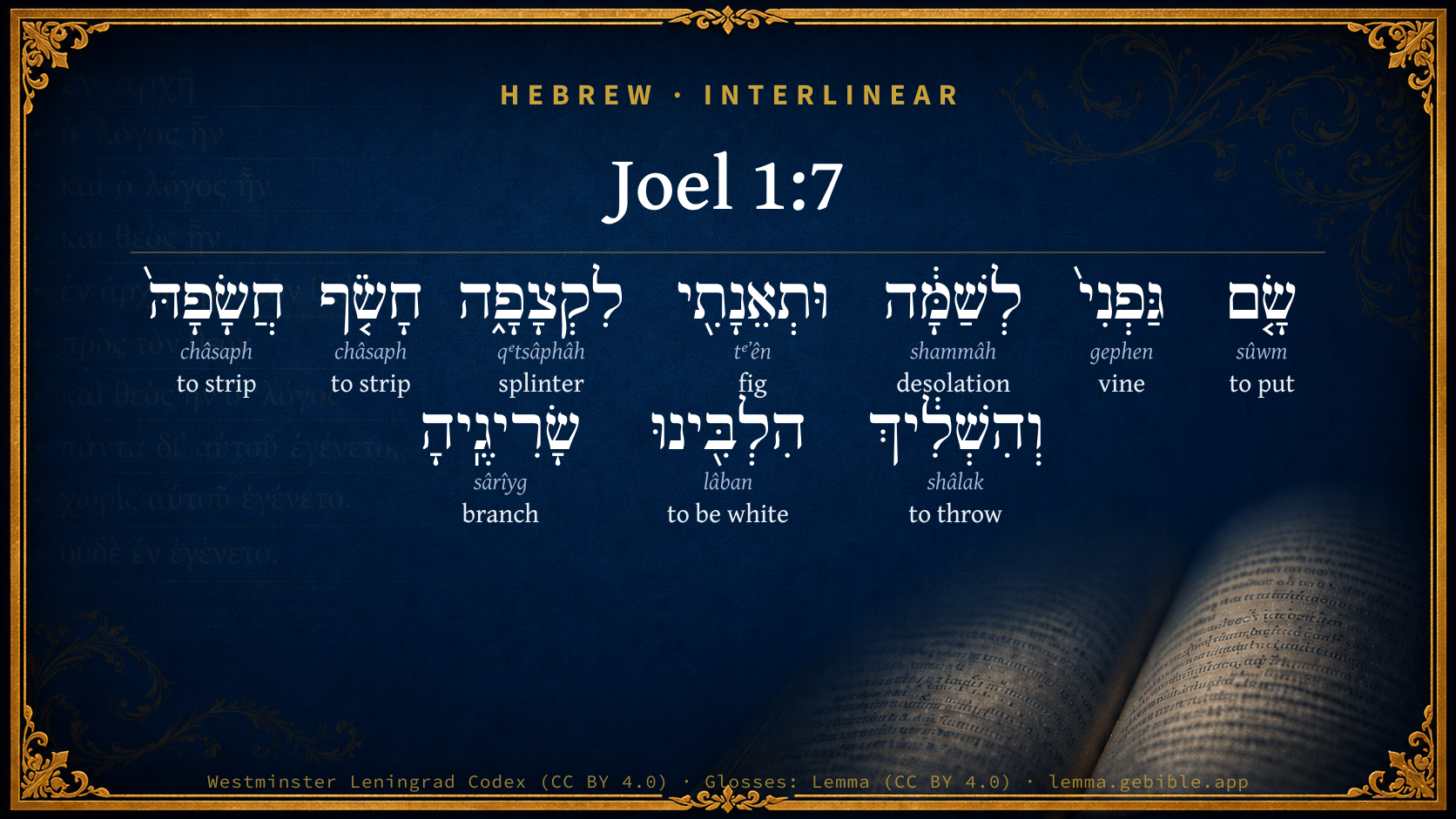
Hebrew (Westminster Leningrad Codex) Joel 1:7 appears in the Hebrew Old Testament. The text above is from the Westminster Leningrad Codex. Each word links to its Strong’s number, a concise gloss, and parsing drawn from the Open Scriptures Hebrew Bible morphology. Click any word for its full Brown-Driver-Briggs (BDB) entry.
Download image
Cite this verse

Joel 1:7 (World English Bible). Public Domain. Lemma interlinear Bible study tool, https://lemma.gebible.app/v/joel/1/7.

Show BibTeX & RIS
BibTeX
RIS
English Translation
He has laid my vine waste, And stripped my fig tree. He has stripped its bark, and thrown it away. Its branches are made white.
World English Bible · Public Domain
Highlights
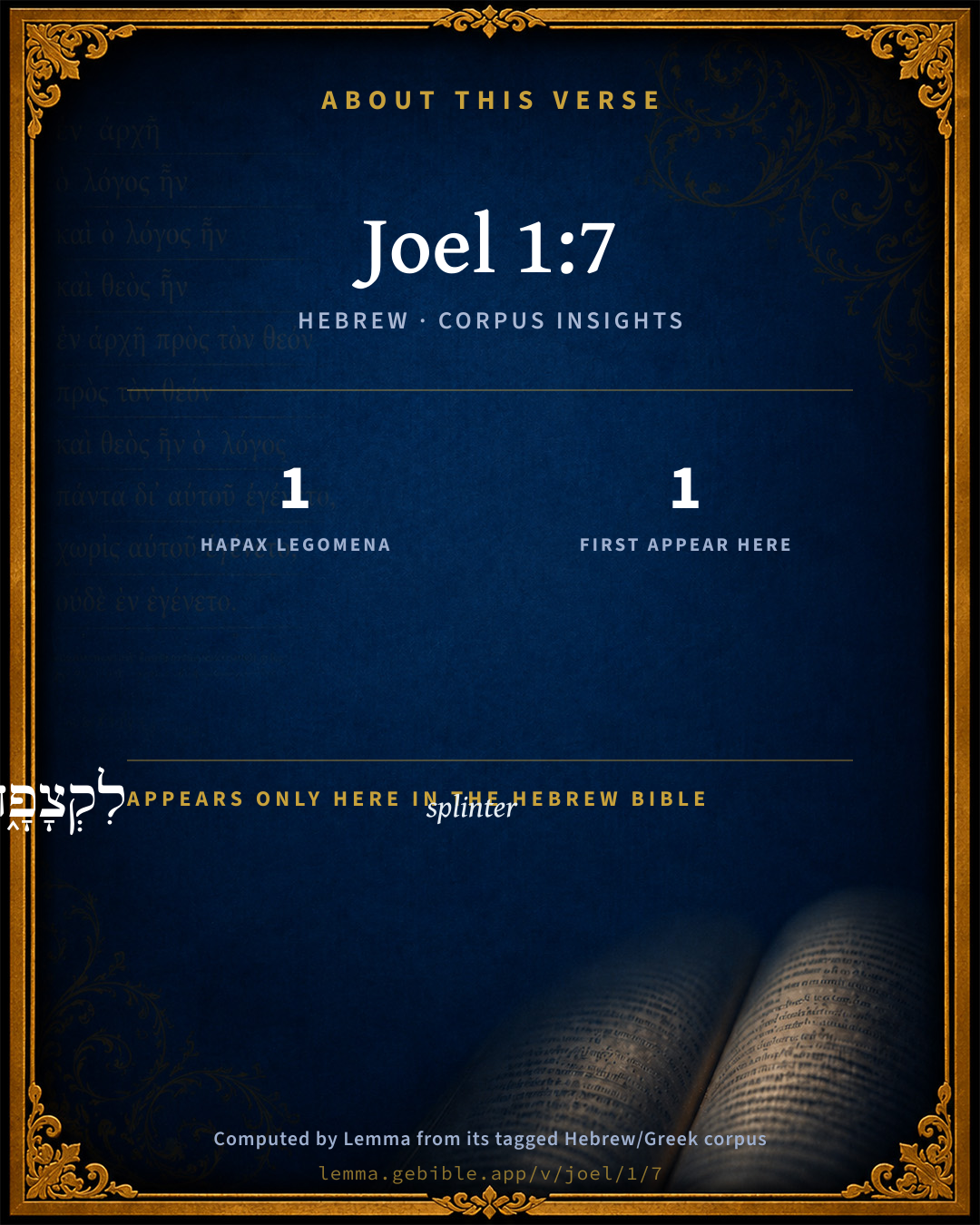
  • 1 hapax legomenon — only here in the Hebrew Bible
  • 1 first appearance in the Hebrew Bible
Full analysis ↓
Download a study sheet

One document with this verse’s original text, its word-by-word gloss line, the meaning frame, cross-references with their text, attributed commentary, and full source and license credits — printable, and it pastes into notes with its structure intact.

This verse Autodidact and up

Study sheet (.html) Plain text (.txt)

A passage Seminary Student

Up to 50 verses in one chapter. A passage sheet keeps up to 6 commentary sources and 12 cross-references per verse, in the order this page ranks them, and says so on the sheet whenever that leaves anything out. Ask for a single verse and you get the Autodidact verse sheet above.

Everything on this page stays free to read, with no account — the sheet is a download of what is already on screen, not access to it.

Want to remove ads? Support Godless Engineer
Compare translations 3

The same verse in 3 English versions, stacked beneath the original-language interlinear above. Click any original word for its lexicon entry.

Each is an independent rendering of the whole verse — the interlinear is not word-aligned to these translations.

Highlighted words mark where these versions differ — a whole-verse word diff, not a word-by-word alignment.

  • World English Bible Public Domain
    He has laid my vine waste, And stripped my fig tree. He has stripped its bark, and thrown it away. Its branches are made white.
  • King James Version Public Domain
    He hath laid my vine waste, and barked my fig tree: he hath made it clean bare, and cast it away; the branches thereof are made white.
  • unfoldingWord Literal Text CC BY-SA 4.0
    It has made my vine into a waste and my fig tree into splinters. Stripping, it has stripped it and thrown away; its branches have become white.

unfoldingWord Literal Text — © unfoldingWord, licensed CC BY-SA 4.0. Word-aligned USFM3 via Door43 (git.door43.org/unfoldingWord/en_ult).

Versions to compare (up to 4)

3 of 4 selected

Show all 18 translations

Every available English version of this verse, each an independent rendering of the whole verse.

  • World English Bible Public Domain
    He has laid my vine waste, And stripped my fig tree. He has stripped its bark, and thrown it away. Its branches are made white.
  • Berean Standard Bible Public Domain
    It has laid waste My grapevine and splintered My fig tree. It has stripped off the bark and thrown it away; the branches have turned white.
  • Majority Standard Bible Public Domain
    It has laid waste My grapevine and splintered My fig tree. It has stripped off the bark and thrown it away; the branches have turned white.
  • King James Version Public Domain
    He hath laid my vine waste, and barked my fig tree: he hath made it clean bare, and cast it away; the branches thereof are made white.
  • American Standard Version (1901) Public Domain
    He hath laid my vine waste, and barked my fig-tree: he hath made it clean bare, and cast it away; the branches thereof are made white.
  • Revised Version (1885) Public Domain
    He hath laid my vine waste, and barked my fig tree: he hath made it clean bare, and cast it away; the branches thereof are made white.
  • Geneva Bible (1599) Public Domain
    He maketh my vine waste, and pilleth off the barke of my figge tree: he maketh it bare, and casteth it downe: ye branches therof are made white.
  • Douay-Rheims (1899) Public Domain
    He hath laid my vineyard waste, and hath pilled off the bark of my fig tree: he hath stripped it bare, and cast it away; the branches thereof are made white.
  • Young's Literal Translation Public Domain
    It hath made my vine become a desolation, And my fig-tree become a chip, It hath made it thoroughly bare, and hath cast down, Made white have been its branches.
  • Literal Standard Version CC BY-SA 4.0
    It has made My vine become a desolation, || And My fig tree become a splinter, || It has made it thoroughly bare, and has cast down, || Its branches have been made white.
  • Unlocked Literal Bible CC BY-SA 4.0
    He has made my vineyard into a desolate place and has stripped my fig tree bare. He has stripped its bark and thrown it away; the branches are bare white.
  • unfoldingWord Literal Text CC BY-SA 4.0
    It has made my vine into a waste and my fig tree into splinters. Stripping, it has stripped it and thrown away; its branches have become white.
  • Darby Bible Public Domain
    He hath made my vine a desolation, and barked my fig-tree; he hath made it clean bare, and cast it away: its branches are made white.
  • World Messianic Bible Public Domain
    He has laid my vine waste, and stripped my fig tree. He has stripped its bark, and thrown it away. Its branches are made white.
  • Webster's Bible Public Domain
    He hath laid my vine waste, and barked my fig-tree: he hath made it clean bare, and cast it away; its branches are made white.
  • Free Bible Version CC BY-SA 4.0
    It has ruined my grapevines and destroyed my fig trees, stripping them completely and reducing them to stumps, white and bare.
  • Bible in Basic English Public Domain
    By him my vine is made waste and my fig-tree broken: he has taken all its fruit and sent it down to the earth; its branches are made white.
  • JPS Tanakh (1917) Public Domain
    He hath laid my vine waste, and blasted my fig-tree; he hath made it clean bare, and cast it down, the branches thereof are made white.

Literal Standard Version (2020), Covenant Press — licensed CC BY-SA 4.0. Text via the HelloAO Bible API (eBible.org). Unlocked Literal Bible (unfoldingWord) — licensed CC BY-SA 4.0. Text via the HelloAO Bible API (eBible.org). unfoldingWord Literal Text — © unfoldingWord, licensed CC BY-SA 4.0. Word-aligned USFM3 via Door43 (git.door43.org/unfoldingWord/en_ult). Free Bible Version, Dr. Jonathan Gallagher — licensed CC BY-SA 4.0. Text via the HelloAO Bible API (eBible.org).

Word by word

More ways to search: Search by grammar → Find every occurrence → Compare this word →

Practice this passage: Drill this verse → Learn its vocabulary →

לִקְצָפָ֑ה
qᵉtsâphâh
H7111
“to/for · splinter”
Preposition + Noun, Common, Feminine, Singular, Absolute
Part of Speech
Preposition + Noun
Type
Common
Gender
Feminine
Number
Singular
State
Absolute
Full BDB Definition

Origin: from H7107

TWOT: 2059a

snapping or splintering, something fragmented or splintered
  1. שָׂ֤ם sûwm H7760 “to put” Verb, Qal, Perfect, 3rd Person, Masculine, Singular
  2. גַּפְנִי֙ gephen H1612 “vine · my” Noun, Common, Both, Singular, Construct + Suffix, Personal, 1st Person, Common, Singular
  3. לְשַׁמָּ֔ה shammâh H8047 “to/for · desolation” Preposition + Noun, Common, Feminine, Singular, Absolute
  4. וּתְאֵנָתִ֖י tᵉʼên H8384 “and · fig · my” Conjunction + Noun, Common, Feminine, Singular, Construct + Suffix, Personal, 1st Person, Common, Singular
  5. חָשֹׂ֤ף châsaph H2834 “to strip” Verb, Qal, Infinitive Absolute
  6. חֲשָׂפָהּ֙ châsaph H2834 “to strip · her” Verb, Qal, Perfect, 3rd Person, Masculine, Singular + Suffix, Personal, 3rd Person, Feminine, Singular
  7. וְהִשְׁלִ֔יךְ shâlak H7993 “and · to throw” Conjunction + Verb, Hiphil, Perfect, 3rd Person, Masculine, Singular
  8. הִלְבִּ֖ינוּ lâban H3835 “to be white” Verb, Hiphil, Perfect, 3rd Person, Common, Plural
  9. שָׂרִיגֶֽיהָ sârîyg H8299 “branches · her” Noun, Common, Masculine, Plural, Construct + Suffix, Personal, 3rd Person, Feminine, Singular

About this verse

These counts appear in no published source. They are computed here, from the morphology-tagged text and Lemma’s own curated glosses. What Lemma adds →

10
words
9
distinct lemmas
Prophets
section

Notable vocabulary

1 hapax legomenon — a word that appears only here in the entire Hebrew Bible:

  • לִקְצָפָ֑ה splinter H7111

First appearance in Scripture

This word makes its first canonical appearance in the Hebrew Bible here:

  • לִקְצָפָ֑ה splinter H7111

Shared distinctive vocabulary

שָׂרִיגֶֽיהָ branch H8299 occurs in 3 verses of the Hebrew Bible. Also found in:

Grammatical profile

  • 5 verbs
  • 5 nouns

Verb forms

  • שָׂ֤ם Qal · Perfect
  • חָשֹׂ֤ף Qal · Infinitive Absolute
  • חֲשָׂפָהּ֙ Qal · Perfect
  • וְהִשְׁלִ֔יךְ Hiphil · Perfect
  • הִלְבִּ֖ינוּ Hiphil · Perfect

Repetition

A word recurs within this verse — often emphatic in Hebrew:

  • חָשֹׂ֤ף to strip H2834 ×2

Hebrew & Septuagint length

In English translation the verse runs 25 words from the Hebrew and 25 from the Septuagint (LXX English) — the same length.

A rough comparison of the two English renderings, which tokenize alike — not a word-level alignment.

Word counts can differ between the Hebrew and the Greek without any difference in meaning — e.g. the Hebrew direct-object marker אֵת has no separate Greek word, and Greek often adds the article ὁ.

Cross-references

9

Topical passages linked to Joel 1:7 in the Treasury of Scripture Knowledge — connected by theme and wording, ordered by reader-vote popularity; previews shown in the World English Bible.

  • Isaiah 5:6 I will lay it a wasteland. It won't be pruned nor hoed, But it will grow briers and thorns. I will also command the clouds that they rain no rain on it."
  • Amos 4:9 I struck you with blight and mildew many times in your gardens and your vineyards; And your fig trees and your olive trees have the swarming locust devoured: Yet you haven't returned to me," says Yahweh.
  • Joel 1:12 The vine has dried up, and the fig tree withered; the pomegranate tree, the palm tree also, and the apple tree, Even all of the trees of the field are withered; For joy has withered away from the sons of men.
  • Exodus 10:15 For they covered the surface of the whole earth, so that the land was darkened, and they ate every herb of the land, and all the fruit of the trees which the hail had left. There remained nothing green, either tree or herb of the field, through all the land of Egypt.
  • Psalms 105:33 He struck their vines and also their fig trees, And shattered the trees of their country.
  • Isaiah 24:7 The new wine mourns, the vine languishes, all the merry-hearted do sigh.
  • Jeremiah 8:13 I will utterly consume them, says Yahweh: there shall be no grapes on the vine, nor figs on the fig tree, and the leaf shall fade; and [the things that] I have given them shall pass away from them.
  • Hosea 2:12 I will lay waste her vines and her fig trees, About which she has said, 'These are my wages that my lovers have given me; And I will make them a forest,' And the animals of the field shall eat them.
  • Habakkuk 3:17 For though the fig tree doesn't flourish, Nor fruit be in the vines; The labor of the olive fails, The fields yield no food; The flocks are cut off from the fold, And there is no herd in the stalls:

Cross-references courtesy of OpenBible.info (CC BY 4.0).

Hebrew and Greek witnesses Masoretic Hebrew ↔ Greek Septuagint

The same verse in the two great witnesses to the Old Testament, shown verse-for-verse.

These are two independent witnesses, not word-aligned to each other, and the Septuagint is shown in lemma (dictionary) form.

Hebrew Joel 1:7 Masoretic · Westminster Leningrad Codex

שָׂ֤ם גַּפְנִי֙ לְשַׁמָּ֔ה וּתְאֵנָתִ֖י לִקְצָפָ֑ה חָשֹׂ֤ף חֲשָׂפָהּ֙ וְהִשְׁלִ֔יךְ הִלְבִּ֖ינוּ שָׂרִיגֶֽיהָ

He has laid my vine waste, And stripped my fig tree. He has stripped its bark, and thrown it away. Its branches are made white.

World English Bible · Public Domain

Greek LXX Joel 1:7 Septuagint · lemma form

τίθημι ὁ ἄμπελος ἐγώ εἰς ἀφανισμός καί ὁ συκῆ ἐγώ εἰς συγκλασμός ἐρευνάω ἐκἐρευνάω αὐτός καί ῥίπτω λευκαίνω κλῆμα αὐτός

He has ruined my vine, and utterly broken my fig-trees: he has utterly searched my vine, and cast it down; he has peeled its branches.

LXX2012 (modern English Septuagint) · Public Domain

On this verse, Jamieson, Fausset & Brown discusses the Septuagint’s reading. Read the note in Commentary ↓

Hebrew: Westminster Leningrad Codex (CC BY 4.0). Greek: Septuagint (public domain); English from LXX2012 (modern English Septuagint) (Public Domain). How the Septuagint differs from the Hebrew →

Targum (Aramaic paraphrase)

1

The Targum is the ancient Jewish Aramaic paraphrase of the Hebrew Scriptures — an interpretive translation, not the Hebrew text itself. Onkelos (literal) and Pseudo-Jonathan (expansive) render the Torah, and Jonathan the Prophets. Coverage is partial: where no permissively-licensed English translation exists for a verse, only the Aramaic is shown. This is verse-level text, not a word-by-word alignment to the Hebrew.

  1. Targum Jonathan Prophets (Joshua–Malachi)
    שַׁוֵי פֵּרֵי גוּפְנֵי עַמִי לְצָדוּ וְתֵינַתְהוֹן לְמִפְּחַת נְפָשׁ מִקְלַף קְלַף וּרְמָא חֲוָרוּ שִׁבְּשָׁהָא:

    (no public-domain English translation for this verse)

    Targum Jonathan — Aramaic: “Mikraot Gedolot” (public domain). English: “Sefaria Community Translation” (CC0 1.0 (public-domain dedication)); “London "Chaldee Paraphrase," 1871” (public domain). Text via Sefaria.

Commentary

Notes on Joel 1:7 from classic Christian and Jewish commentators (each source and its license shown beneath its notes). The classic Christian expositions comment on the surrounding passage and are grouped to its opening verse, so a note may address several verses; the Jewish commentaries on the Tanakh (Rashi and others) are per-verse, so they appear only where the commentator wrote on this verse.

Lemma curates 59 commentaries, every one of them public domain or Creative Commons licensed, each selected and text-cleaned for this edition rather than reprinted as found. About our sources →

Trapp's Complete Commentary

John Trapp

Joe 1:7 He hath laid my vine waste, and barked my fig tree: he hath made it clean bare, and cast [it] away; the branches thereof are made white.

Ver. 7. He hath laid my vine waste] The prophet proceeds in aggravating the calamity, that he might make the people the more sensible. There is nothing in the world more stupid and more stubborn than a drunkard. Of such it is that that saying of an ancient is often verified, Ablatus est a peccantibus timor, ne possit esse cautela, Fear is taken away from offenders, that there should be no caution against it. Here therefore let the words of the wise be as goads, and as nails fastened by the masters of the assemblies. Let them so preach with Peter, that their hearers may be pricked at heart, Act 2:37, may be galled and sawed, as it were, Act 7:54, may startle and tremble, as Act 24:25, may awaken out of that dead lethargy, whereinto Satan hath cast them, and recover out of his snare who are taken captive by him at his pleasure, 2Ti 2:26. True it is, we can hardly get men to believe that hell is so hot, or sin so heavy, or the devil so black or God so unmerciful as the preachers make him. The lion, say they, is not so terrible as he is painted; nor is our case so dangerous as is borne us in hand. Sed non pergamus exaggerare, saith Pareus here. Let God’s ministers lay load upon men’s sins, and set forth to the full the miseries that will fall upon them. The prophets did so for temporal (as here most graphically and to the life), shall not we much more for eternal punishments? "Oh" (saith one) "that I could get words to gore your very hearts with smarting pain; that this doctrine might be written in your flesh!"

And barked my fig tree] Take away the bark from the tree, and the sap can never find the way to the boughs. These vermin had barked the trees with their teeth, cast the bark out of their mouths upon the ground, and made the branches naked and all white as froth; so that the drunkards, deprived of their sweet draughts, were brought ad effiationem animae (as the Chaldee here expounded Chetsephah), to a yielding up of the ghost, yea, ad laqueum et restim, as the Latins, to the very halter.

John Trapp, A Commentary or Exposition upon All the Books of the Old and New Testament (1647–1656) — public domain. Text from a community e-Sword module.

Tyndale Open Study Notes

Tyndale Open Resources

1:7 The destructive power of locusts is well documented in both ancient and modern times. The insatiable insects consume annual crops such as grains and vegetables, and they destroy perennial fruit-bearing trees and vines, leaving the branches white and bare.

Tyndale Open Study Notes — © Tyndale Open Resources, licensed CC BY-SA 4.0. Text via the HelloAO Bible API.

Jamieson, Fausset & Brown

Robert Jamieson, A. R. Fausset & David Brown

barked--BOCHART, with the Septuagint and Syriac, translates, from an Arabic root, "hath broken," namely, the topmost shoots, which locusts most feed on. CALVIN supports English Version.

my vine . . . my fig tree--being in "My land," that is, Jehovah's (Joe 1:6). As to the vine-abounding nature of ancient Palestine, see Num 13:23-24.

cast it away--down to the ground.

branches . . . white--both from the bark being stripped off (Gen 30:37), and from the branches drying up through the trunk, both bark and wood being eaten up below by the locusts.

Jamieson, Fausset & Brown — Commentary Critical and Explanatory on the Whole Bible (1871) — public domain (CC PDM 1.0). Text via the HelloAO Bible API.

Adam Clarke's Commentary

Verse 7. He hath laid my vine waste] The locusts have eaten off both leaves and bark. חשף חשפה chasoph chasaphah, he hath made it clean bare; שדד שדה suddad sadeh, the field is laid waste, Joe 1:10; and כשד משדי kesod mishshaddai, a destruction from the Almighty, Joe 1:15; are all paronomasias in which this prophet seems to delight.

Adam Clarke's Commentary on the Bible (1810–1826) — public domain. Text from a community e-Sword/MySword module.

John Calvin's Commentaries

He afterwards adds, that his vine had been exposed to desolation and waste, his fig-tree to the stripping of the bark. God speaks not here of his own vine, as in some other places, in which he designates his Church by this term; but he calls everything on earth his own, as he calls the whole race of Abraham his children: and he thus reproaches the Jews for having reduced themselves to such wretchedness through their own fault; for they would have never been spoiled by their enemies, had not God, who was wont to defend then, previously rejected them; for there was nothing in their land which he did not claim as his own; as he had chosen the people, so he had consecrated the land to himself. Whatsoever, then, enlisted in Judea, was, as it were, sacred to God. Now when both the vines and the fig-trees were exposed to the depredations of the unbelieving, it was certain that God no longer ruled there. How so? Even because the Jews had expelled him. He afterwards enlarges on the same subject; for what follows, By denuding he has denuded it and cast it away, is not a mere narrative; the Prophet here declares not simply what had taken place; but as we have already said, adduces more proof, and tries to awaken the drowsy senses of the people, yea, to arouse them from that lethargy by which the minds of all had been seized; hence it is that he uses in his teaching so many expressions. This is the reason why he says that the vine and the fig-tree had been denuded, and also that the leaves had been taken away, that the branches had been made bare and white; so that there remained neither produce nor growth.

Many interpreters join these three verses with the former, as if the Prophet now expressed what he had said before of the palmer worm, the chafer, and the locust; for they think that he spake allegorically when he said that all the fruits of the land had been consumed by the locusts and the chafers. They therefore add, that these locusts, or chafers, or the palmer worms, were the Assyrians, as well as the Persian and the Greeks, that is, Alexander of Macedon and the Romans: but this is wholly a strained views so that there is no need of a long argument; for any one may easily perceive that the Prophet mentions another kind of punishments that he might in every way render the Jews inexcusable who were not roused by judgments so multiplied, but remained still obstinate in their vices. Let us now proceed.

John Calvin's Commentaries (1540-1563) — public domain. Text from the Calvin Translation Society English edition (1840s-50s) via the Christian Classics Ethereal Library (ccel.org). Calvin's coverage is partial (roughly two-thirds of the Bible); uncommented books and verses are honest gaps, never fabricated. The 19th-century editor's footnotes and remarks are omitted so the notes are faithfully Calvin's own voice.

Ellicott's Commentary for English Readers

(7) My vine.—This expression might well captivate the Jewish ear. God appropriates to Himself this land on which the trouble was, by His providence, to fall, and in wrath remembers mercy. It is “my vine,” “my fig-tree,” the people of God’s own choice, that were afflicted; and the affliction, however fully deserved, was, to speak as a man, painful to the Lord, “who doth not afflict willingly.” Yet the devastation was to be complete. God’s pleasant vine was doomed, and the fig-tree was to be cut down.

A Bible Commentary for English Readers, edited by Charles John Ellicott (1878–1897) — public domain. Text from a community e-Sword module.

The Cambridge Bible for Schools and Colleges

gen. ed. J. J. S. Perowne

7. He hath made my vine into a waste, and my fig-tree into splinters] The vine and the fig-tree are mentioned as the two principal and most representative fruit-trees of Palestine, the vine holding the first place (cf. Hos_2:12; 1Ki_4:25; 2Ki_18:31). For splinters (lit. something broken into pieces), comp. nearly the same word in Hos_10:7 (R.V. marg.). The words indicate the severity of the visitation. Locusts first attack plants and vegetables; when these have been all consumed, they attack trees, consuming first the leaves, then the bark. Comp. the quotation from Shaw’s Travels, below, p. 88. The effects of such ravages are felt sometimes for many years: “the wine of Algiers, before the locusts in 1723 wasted the vineyards, was in flavour not inferior to the best Hermitage. Since that time the wine has much degenerated, and has not yet [1732] recovered its usual qualities” (Shaw, p. 227).

made it clean bare] viz. by stripping off the bark, cf. Psa_29:9 (the same word).

cast it away] There is no pron. in the Hebrew; and the reference is, no doubt, partly to the fragments of bark and wood which have been bitten off by the locusts, but being uneatable by them have fallen to the ground, partly to the barked branches and trunks themselves, which (metaphorically) the insects have ‘cast away.’ “After they have passed, nothing remains but the large branches, and the roots, which, being under ground, have escaped their voracity.” “The bushes were eaten quite bare, though the animals could not have been long on the spot. They sat by hundreds on a bush gnawing the rind and the woody fibres” (Lichtenstein, Travels in S. Africa, p. 241, ap. Pusey).

its branches] Gen_40:10; Gen_40:12 only, also of the vine: properly, something intertwined.

shew whiteness] viz. through the bark being stripped off. “Ambedunt enim, ut Tacitus (Annal. xv. 5) loquitur, quicquid herbidum est et frondosum; ut nee culmus, nec granum ullum remaneat, et arbores frondibus et cortice tamquam vestibus nudatae instar truncorum alborum conspiciantur” (Ludolf, Hist. Aeth. p. 178 f., ap. Credner).

The Cambridge Bible for Schools and Colleges (gen. ed. J. J. S. Perowne; Cambridge University Press, 1878–1918) — public domain. Text from a community e-Sword module.

John Gill's Exposition

He hath laid my vine waste,.... That is, the locust, which spoiled the vines in Judea, the singular being put for the plural, by gnawing the branches, biting the tops of them, and devouring the leaves and the fruit; and so not only left them bare and barren, but destroyed them: this may emblematically represent the Assyrians or Babylonians wasting the land of Judea, the vine and vineyard of the Lord of hosts; see Isa 5:1;

and barked my fig tree; gnawed off the bark of them; locusts are not only harmful to vines, as is hinted by Theocritus (o), but to fig trees also: Pliny (p) speaks of fig trees in Boeotia gnawn by locusts, which budded again; and mentions it as something wonderful and miraculous that they should: and yet Sanctius observes, that these words cannot be understood properly of the locusts, since fig trees cannot be harmed by the bite or touch of them; which, besides their roughness, have an insipid bitter juice, which preserves them from being gnawn by such creatures; and the like is observed of the cypress by Vitruvius (q); but the passage out of Pliny shows the contrary. Some interpret it of a from or scum they left upon the fig tree when they gnawed it, such as Aben Ezra says is upon the face of the water; and something like this is left by caterpillars on the leaves of trees, which destroy them;

he hath made it clean bare; stripped it of its leaves and fruit, and bark also:

and cast it away; having got out all the juice they could:

the branches thereof are made white; the bark being gnawed off, and all the greenness and verdure of them dried up; so trees look, when this is their case: and thus the Jews were stripped by the Chaldeans of all their wealth and treasure, and were left bare and naked, and as the scum and offscouring of all things.

(o) Idyll. 5. (p) Nat. Hist. l. 17. c. 25. (q) De Architectura, l. 2. c. 9. p. 70.

John Gill's Exposition of the Whole Bible (1746–1763) — public domain (CC PDM 1.0). Text via the HelloAO Bible API.

Albert Barnes' Notes on the Bible

He hath laid my vine waste, and barked my fig tree - This describes an extremity of desolation. The locusts at first attack all which is green and succulent; when this has been consumed, then they attack the bark of trees. : “When they have devoured all other vegetables, they attack the trees, consuming first the leaves, then the bark.” : “A day or two after one of these bodies were in motion, others were already hatched to glean after them, gnawing off the young branches and the very bark of such trees as had escaped before with the loss only of their fruit and foliage.” : “They carried desolation wherever they passed. After having consumed herbage, fruit, leaves of trees, they attacked even their young shoots and their bark. Even the reeds, wherewith the huts were thatched, though quite dry, were not spared.” : “Everything in the country was devoured; the bark of figs, pomegranates, and oranges, bitter hard and corrosive, escaped not their voracity.” The effects of this wasting last on for many years .

He hath made it clean bare - o: “It is sufficient, if these terrible columns stop half an hour on a spot, for everything growing on it, vines, olive trees, and grain, to be entirely destroyed. After they have passed, nothing remains but the large branches, and the roots which, being under ground, have escaped their voracity.” : “After eating up the corn, they fell upon the vines, the pulse, the willows and even the hemp, notwithstanding its great bitterness.” : “They are particularly injurious to the palm trees; these they strip of every leaf and green particle, the trees remaining like skeletons with bare branches.” : “The bushes were eaten quite bare, though the animals could not have been long on the spot. They sat by hundreds on a bush gnawing the rind and the woody fibres.”

The branches thereof are made white - o: “The country did not seem to be burnt, but to be much covered with snow, through the whiteness of the trees and the dryness of the herbs. It pleased God that the fresh crops were already gathered in.”

The “vine” is the well-known symbol of God’s people Psa 80:8, Psa 80:14; Son 2:13, Son 2:15; Hos 10:1; Isa 5:1-7; Isa 27:2; the fig too, by reason of its sweetness, is an emblem of His Church and of each soul in her, bringing forth the fruit of grace Hos 9:10; Mat 21:19; Luk 13:6-7. When then God says, “he hath laid My vine waste,” He suggests to us, that He is not speaking chiefly of the visible tree, but of that which it represents. The locusts, accordingly, are not chiefly the insects, which bark the actual trees, but every enemy which wastes the heritage of God, which He calls by those names. His vineyard, the Jewish people, was outwardly and repeatedly desolated by the Chaldaens, Antiochus Epiphanes, and afterward by the Romans. The vineyard, which the Jews had, was, (as Jesus foretold,) let out to other farmers when they had killed Him; and, thenceforth, is the Christian Church, and, subordinately each soul in her. : “Pagan and heretical Emperors and heresiarchs wasted often the Church of Christ. antichrist shall waste it. They who have wasted her are countless. For the Psalmist says, “They who hate me without a cause are more than the hair’s of my head” Psa 69:4.

: “The nation which cometh up against the soul, are the princes of this world and of darkness and spiritual wickedness in high places, whose teeth are the teeth of a lion, of whom the Apostle Peter saith, “Our adversary the devil, as a roaring lion, walketh about seeking whom he may devour” 1Pe 5:8. If we give way to this nation, so that they should come up in us, immediately they will make our vineyard where we were accustomed to make “wine to gladden the heart of man” Psa 104:15, a desert, and bark or break our fig tree, that we should no more have in us those most sweet gifts of the Holy Spirit. Nor is it enough for that nation to destroy the vineyard and break the fig tree, unless it also destroy whatever there is of life in it, so that, its whole freshness being consumed. the switches remain white and dead, and that be fulfilled in us, “If they do these things in a green tree, what shall be done in the dry?” Luk 23:31. : “The Church, at least apart of it, is turned into a desert, deprived of spiritual goods, when the faithful are led, by consent to sin, to forsake God. “The fig tree is barked,” when the soul which once abounded with sweetest goods and fruits of the Holy Spirit, hath those goods lessened or cut off. Such are they who, having “begun in the Spirit” Gal 3:3, are perfected by the flesh.”

“ By spirits lying in wait, the vineyard of God is made a desert, when the soul, replenished with fruits, is wasted with longing for the praise of people. That “people barks” the “fig tree” of God, in that, carrying away the misguided soul to a thirst for applause, in proportion as it draws her on to ostentation, it strips her of the covering of humility. “Making it clean bare, it despoils it,” in that, so long as it lies hidden in its goodness, it is, as it were, clothed with a covering of its own, which protects it. But when the mind longs that which it has done should be seen by others, it is as though “the fig tree despoiled” had lost the bark that covered it. And so, as it follows, “The branches thereof are made white;” in that his works, displayed to the eyes of people, have a bright show; a name for sanctity is gotten, when good actions are published. But as, upon the bark being removed, the branches of the fig tree wither, so observe that the deeds of the arrogant, paraded before human eyes, wither through the very act of socking to please. Therefore the mind which is betrayed through boastfulness is rightly called a fig tree barked, in that it is at once fair to the eye, as being seen, and within a little of withering, as being bared of the covering of the bark. Within, then, must our deeds be laid up, if we look to a reward of our deeds from Him who seeth within.”

Albert Barnes' Notes on the Bible (1834–1885) — public domain. Text from a community e-Sword/MySword module.

Matthew Poole's English Annotations

He, that nation of locusts, Joe 1:6, both literally and mystically understood, hath laid my vine waste; made it a desolation, i.e. most desolate, which is more particularly declared in what followeth.

And barked my fig tree; peeled off the bark. which is certain destruction to the tree.

Made it clean bare; eat off all the rind and green bark, and left the body of both vine and fig tree bare and stripped.

And cast it away; as vermin cast out of their mouth the chewings of what they spoil, so here.

The branches thereof, all the branches of both vine and fig tree, are by these devouring vermin made white, all their green being eaten off; so miserably desolate will the enemy signified by these locusts make Judah, God’s vine.

Matthew Poole's English Annotations on the Holy Bible (1683–1685) — public domain. Text from a community e-Sword/MySword module.

The Pulpit Commentary

He hath laid my vine waste, and barked my fig tree (margin, laid my fig tree for a barking): he hath made it clean bare, and cast it away; the branches thereof are made white. We have here a detailed description of the destruction and devastation caused by this locust-army in its invasion of the land of Judah. The most valuable and most valued production of that land, the vine and fig tree, are ruined. The vine is laid waste, so that the vineyard becomes a wilderness:

(1) "he has barked the fig tree" (so Jerome, "Ficum meam decorticavit"); or rather,

(2) "he has broken the branches." The word jpxq denotes a fragment or something broken, branches broken off, and so the LXX, "hath utterly broken (eiv sugklasmon );" while

(3) Aben Ezra explains it, "Like foam on the face of the water, in which there is nothing;" i.e. a thing of nought. The locusts, by gnawing, had stripped off the bark, or by their excessive weight had broken off the branches. The next clause, which speaks of making it clean bare, is explained by the Chaldee of peeling off the bark, but that, according to the first rendering, has been already expressed. It is rather more than this it is stripping off the leaves and fruits or flowers; the barked or broken branches and twigs of vine and fig tree are then cast away or down to the ground. And all that is left are the whitened branches from which the bark has been stripped off. The casting away or down to the earth may refer to the bark; thus Kimchi: "He removes the bark; and so Jonathan explains, "He quite removes the bark and casts it away;" and the explanation is that he casts the bark to the earth when he eats the juicy parts between the bark and the wood; or the explanation may be that he eats the rind and casts the vine blossom to the earth, and, lo, it is bared." Some, again, understand it of what is uneatable, and others of the vine itself.

The Pulpit Commentary (1880–1919), ed. H.D.M. Spence-Jones & Joseph S. Exell — public domain. Text from a community e-Sword module.

Rashi

Rabbi Shlomo Yitzchaki (Rashi)

into a disappointment—Heb. לִקְצָפָה, into a disappointment.

he has peeled it and cast it off—He has peeled off the bark of the tree and cast it off until the branches of the vine have become white.

Rashi on the Tanakh — English translations: “The Judaica Press complete Tanach with Rashi, translated by A. J. Rosenberg” (CC BY 4.0); “Pentateuch with Rashi's commentary by M. Rosenbaum and A.M. Silbermann, 1929-1934” (public domain); “The Metsudah Tanach series, Lakewood, N.J” (CC BY 4.0); and “The Book of Joshua, Metsudah Publications, 1997” (CC BY 4.0). Text via Sefaria.

Lesson kit

Teaching starters — assembled from the data on this page, not authored interpretation. Every prompt links to the verse data it draws on. Edit before teaching.

Joel, in the Prophets, opens this verse with 10 words (9 distinct Hebrew lemmas). Its most distinctive word is qᵉtsâphâh (“splinter”). A historical commentator’s framing appears above. Read the whole chapter for the surrounding context.

Discussion questions

  1. What does “splinter” (qᵉtsâphâh) contribute to the verse as a whole?
  2. This verse holds 1 word here found nowhere else in the Hebrew Bible. What might the rare word draw attention to?
  3. The word “splinter” first appears here in Scripture. What is being introduced at this debut?
  4. Genesis 40:10 shares the word «branch» with this verse. How do the two illuminate each other?
  5. “to strip” occurs 2× in this one verse. What is the effect of the repetition?
  6. These translations render this verse differently; the difference is in the English rendering, not the original. What questions does that raise?
  7. The verb «שָׂ֤ם» is Qal Perfect. How does its form color the action?
  8. Reading how Trapp's Complete Commentary and Tyndale Open Study Notes read this verse, where do the two commentators agree and where do they part?

Things to notice

  • 1 word in this verse appears nowhere else in the Hebrew Bible.
  • 1 word makes its first canonical appearance in Scripture here.
  • These translations choose different wording for 15 words in this verse.
  • “to strip” occurs 2× in this single verse.
  • 9 distinct Hebrew lemmas span 10 words in this verse.

Reading settings

Reading text

Shown beneath each verse's original-language words.

Old Testament
Old Testament edition

Read the OT as the Masoretic Hebrew (MT) or the Greek Septuagint (LXX).

English shown for the Greek Septuagint (in the Hebrew ↔ Greek comparison).

Comparing translations? Open the Compare panel on any verse page to stack up to four side by side.