
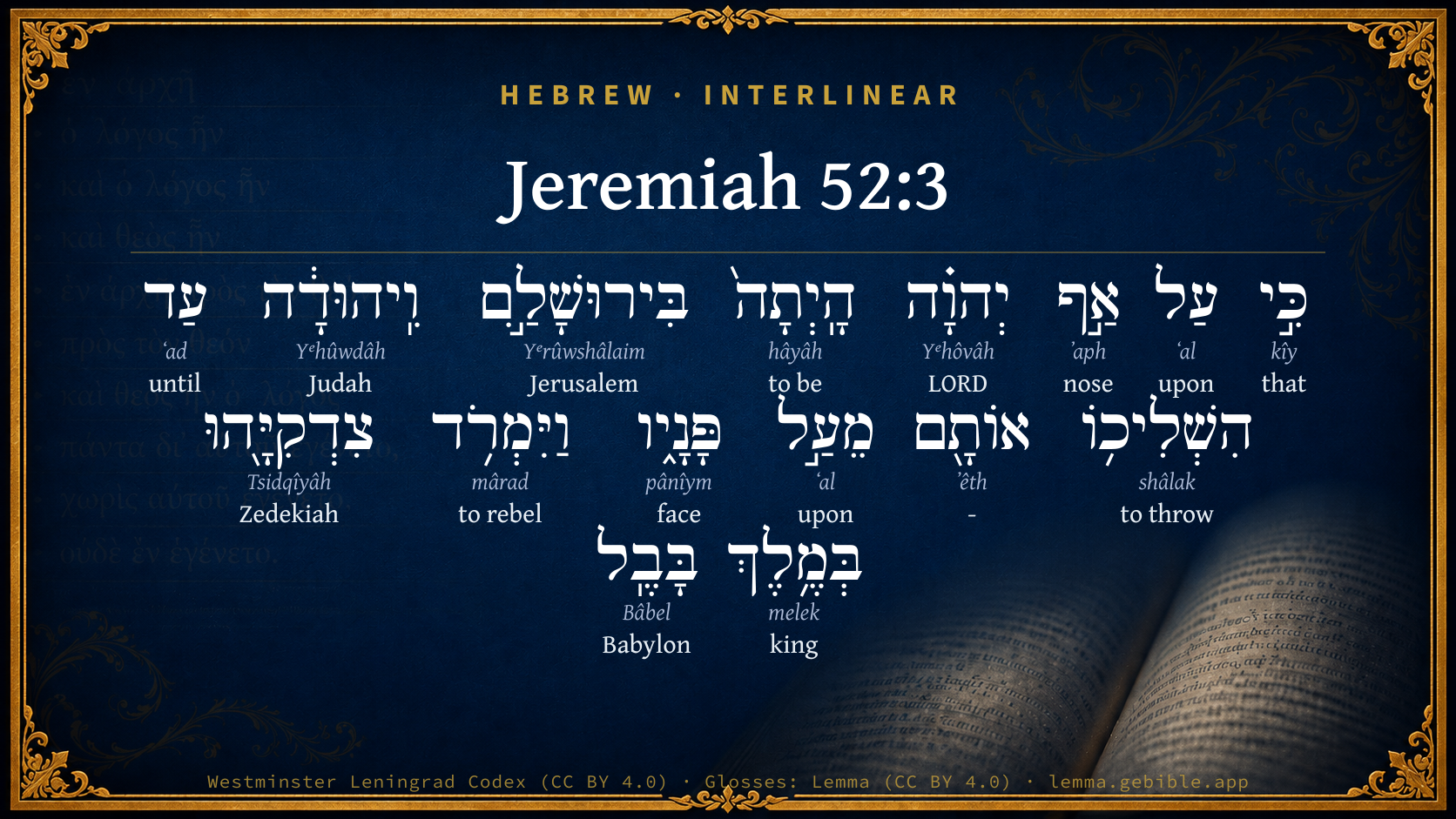
Jeremiah 52:3

Hebrew (Westminster Leningrad Codex) Jeremiah 52:3 appears in the Hebrew Old Testament. The text above is from the Westminster Leningrad Codex. Each word links to its Strong’s number, a concise gloss, and parsing drawn from the Open Scriptures Hebrew Bible morphology. Click any word for its full Brown-Driver-Briggs (BDB) entry.
Download image
Cite this verse

Jeremiah 52:3 (World English Bible). Public Domain. Lemma interlinear Bible study tool, https://lemma.gebible.app/v/jeremiah/52/3.

Show BibTeX & RIS
BibTeX
RIS
English Translation
For through the anger of Yahweh did it happen in Jerusalem and Judah, until he had cast them out from his presence. Zedekiah rebelled against the king of Babylon.
World English Bible · Public Domain
Download a study sheet

One document with this verse’s original text, its word-by-word gloss line, the meaning frame, cross-references with their text, attributed commentary, and full source and license credits — printable, and it pastes into notes with its structure intact.

This verse Autodidact and up

Study sheet (.html) Plain text (.txt)

A passage Seminary Student

Up to 50 verses in one chapter. A passage sheet keeps up to 6 commentary sources and 12 cross-references per verse, in the order this page ranks them, and says so on the sheet whenever that leaves anything out. Ask for a single verse and you get the Autodidact verse sheet above.

Everything on this page stays free to read, with no account — the sheet is a download of what is already on screen, not access to it.

Want to remove ads? Support Godless Engineer
Compare translations 3

The same verse in 3 English versions, stacked beneath the original-language interlinear above. Click any original word for its lexicon entry.

Each is an independent rendering of the whole verse — the interlinear is not word-aligned to these translations.

Highlighted words mark where these versions differ — a whole-verse word diff, not a word-by-word alignment.

  • World English Bible Public Domain
    For through the anger of Yahweh did it happen in Jerusalem and Judah, until he had cast them out from his presence. Zedekiah rebelled against the king of Babylon.
  • King James Version Public Domain
    For through the anger of the LORD it came to pass in Jerusalem and Judah, till he had cast them out from his presence, that Zedekiah rebelled against the king of Babylon.
  • unfoldingWord Literal Text CC BY-SA 4.0
    Through Yahweh’s anger, all these events happened in Jerusalem and Judah, until he drove them from before himself. Then Zedekiah rebelled against the king of Babylon.

unfoldingWord Literal Text — © unfoldingWord, licensed CC BY-SA 4.0. Word-aligned USFM3 via Door43 (git.door43.org/unfoldingWord/en_ult).

Versions to compare (up to 4)

3 of 4 selected

Show all 18 translations

Every available English version of this verse, each an independent rendering of the whole verse.

  • World English Bible Public Domain
    For through the anger of Yahweh did it happen in Jerusalem and Judah, until he had cast them out from his presence. Zedekiah rebelled against the king of Babylon.
  • Berean Standard Bible Public Domain
    For because of the anger of the LORD, all this happened in Jerusalem and Judah, until He finally banished them from His presence. And Zedekiah also rebelled against the king of Babylon.
  • Majority Standard Bible Public Domain
    For because of the anger of the LORD, all this happened in Jerusalem and Judah, until He finally banished them from His presence. And Zedekiah also rebelled against the king of Babylon.
  • King James Version Public Domain
    For through the anger of the LORD it came to pass in Jerusalem and Judah, till he had cast them out from his presence, that Zedekiah rebelled against the king of Babylon.
  • American Standard Version (1901) Public Domain
    For through the anger of Jehovah did it come to pass in Jerusalem and Judah, until he had cast them out from his presence. And Zedekiah rebelled against the king of Babylon.
  • Revised Version (1885) Public Domain
    For through the anger of the LORD did it come to pass in Jerusalem and Judah, until he had cast them out from his presence: and Zedekiah rebelled against the king of Babylon.
  • Geneva Bible (1599) Public Domain
    Doubtlesse because the wrath of the Lord was against Ierusalem and Iudah, till he had cast them out from his presence, therefore Zedekiah rebelled against the King of Babel.
  • Douay-Rheims (1899) Public Domain
    For the wrath of the Lord was against Jerusalem, and against Juda, till he cast t hem out from his presence: and Sedecias revolted from the king of Babylon.
  • Young's Literal Translation Public Domain
    for, because of the anger of Jehovah, it hath been in Jerusalem and Judah till He hath cast them from before His face, and Zedekiah doth rebel against the king of Babylon.
  • Literal Standard Version CC BY-SA 4.0
    for because of the anger of YHWH, it has been in Jerusalem and Judah until He has cast them from before His face, and Zedekiah rebels against the king of Babylon.
  • Unlocked Literal Bible CC BY-SA 4.0
    Through Yahweh's anger, all these events happened in Jerusalem and Judah, until he drove them from before himself. Then Zedekiah rebelled against the king of Babylon.
  • unfoldingWord Literal Text CC BY-SA 4.0
    Through Yahweh’s anger, all these events happened in Jerusalem and Judah, until he drove them from before himself. Then Zedekiah rebelled against the king of Babylon.
  • Darby Bible Public Domain
    For, because the anger of Jehovah was against Jerusalem and Judah, until he had cast them out from his presence, Zedekiah rebelled against the king of Babylon.
  • World Messianic Bible Public Domain
    For through the LORD’s anger this happened in Jerusalem and Judah, until he had cast them out from his presence. Zedekiah rebelled against the king of Babylon.
  • Webster's Bible Public Domain
    For through the anger of the LORD it came to pass in Jerusalem and Judah, till he had cast them out from his presence, that Zedekiah rebelled against the king of Babylon.
  • Free Bible Version CC BY-SA 4.0
    All this happened in Jerusalem and Judah, because of the Lord's anger, until he eventually banished them from his presence. Zedekiah rebelled against the king of Babylon.
  • Bible in Basic English Public Domain
    And because of the wrath of the Lord this came about in Jerusalem and Judah, till he had sent them away from before him: and Zedekiah took up arms against the king of Babylon.
  • JPS Tanakh (1917) Public Domain
    For through the anger of the LORD did it come to pass in Jerusalem and Judah, until He had cast them out from His presence. And Zedekiah rebelled against the king of Babylon.

Literal Standard Version (2020), Covenant Press — licensed CC BY-SA 4.0. Text via the HelloAO Bible API (eBible.org). Unlocked Literal Bible (unfoldingWord) — licensed CC BY-SA 4.0. Text via the HelloAO Bible API (eBible.org). unfoldingWord Literal Text — © unfoldingWord, licensed CC BY-SA 4.0. Word-aligned USFM3 via Door43 (git.door43.org/unfoldingWord/en_ult). Free Bible Version, Dr. Jonathan Gallagher — licensed CC BY-SA 4.0. Text via the HelloAO Bible API (eBible.org).

Word by word

More ways to search: Search by grammar → Find every occurrence → Compare this word →

Practice this passage: Drill this verse → Learn its vocabulary →

וַיִּמְרֹ֥ד
mârad
H4775
“and · to rebel”
Conjunction + Verb, Qal, Sequential Imperfect, 3rd Person, Masculine, Singular
Part of Speech
Conjunction + Verb
Stem
Qal
Form
Sequential Imperfect
Person
3rd Person
Gender
Masculine
Number
Singular
Full BDB Definition

Origin: a primitive root

TWOT: 1240

to rebel, revolt, be rebellious - (Qal) to rebel, revolt - against human king - against God - against light (poetic)
  1. כִּ֣י kîy H3588 “that” Conjunction
  2. עַל ʻal H5921 “upon” Preposition
  3. אַ֣ף ʼaph H639 “nose” Particle, Accusative
  4. יְהוָ֗ה Yᵉhôvâh H3068 “LORD” Noun, Proper
  5. הָֽיְתָה֙ hâyâh H1961 “to be” Verb, Qal, Perfect, 3rd Person, Feminine, Singular
  6. בִּירוּשָׁלִַ֣ם Yᵉrûwshâlaim H3389 “in/at · Jerusalem” Preposition + Noun, Proper
  7. וִֽיהוּדָ֔ה Yᵉhûwdâh H3063 “and · Judah” Conjunction + Noun, Proper
  8. עַד ʻad H5704 “until” Preposition
  9. הִשְׁלִיכ֥וֹ shâlak H7993 “to throw · him” Verb, Hiphil, Infinitive Construct + Suffix, Personal, 3rd Person, Masculine, Singular
  10. אוֹתָ֖ם ʼêth H853 “- · them” Particle, Direct Object + Suffix, Personal, 3rd Person, Masculine, Plural
  11. מֵעַ֣ל ʻal H5921 “from · upon” Preposition + Preposition
  12. פָּנָ֑יו pânîym H6440 “face(s) · his” Noun, Common, Both, Plural, Construct + Suffix, Personal, 3rd Person, Masculine, Singular
  13. צִדְקִיָּ֖הוּ Tsidqîyâh H6667 “Zedekiah” Noun, Proper
  14. בְּמֶ֥לֶךְ melek H4428 “in/at · king of” Preposition + Noun, Common, Masculine, Singular, Construct
  15. בָּבֶֽל Bâbel H894 “Babylon” Noun, Proper

About this verse

These counts appear in no published source. They are computed here, from the morphology-tagged text and Lemma’s own curated glosses. What Lemma adds →

16
words
15
distinct lemmas
Prophets
section

Notable vocabulary

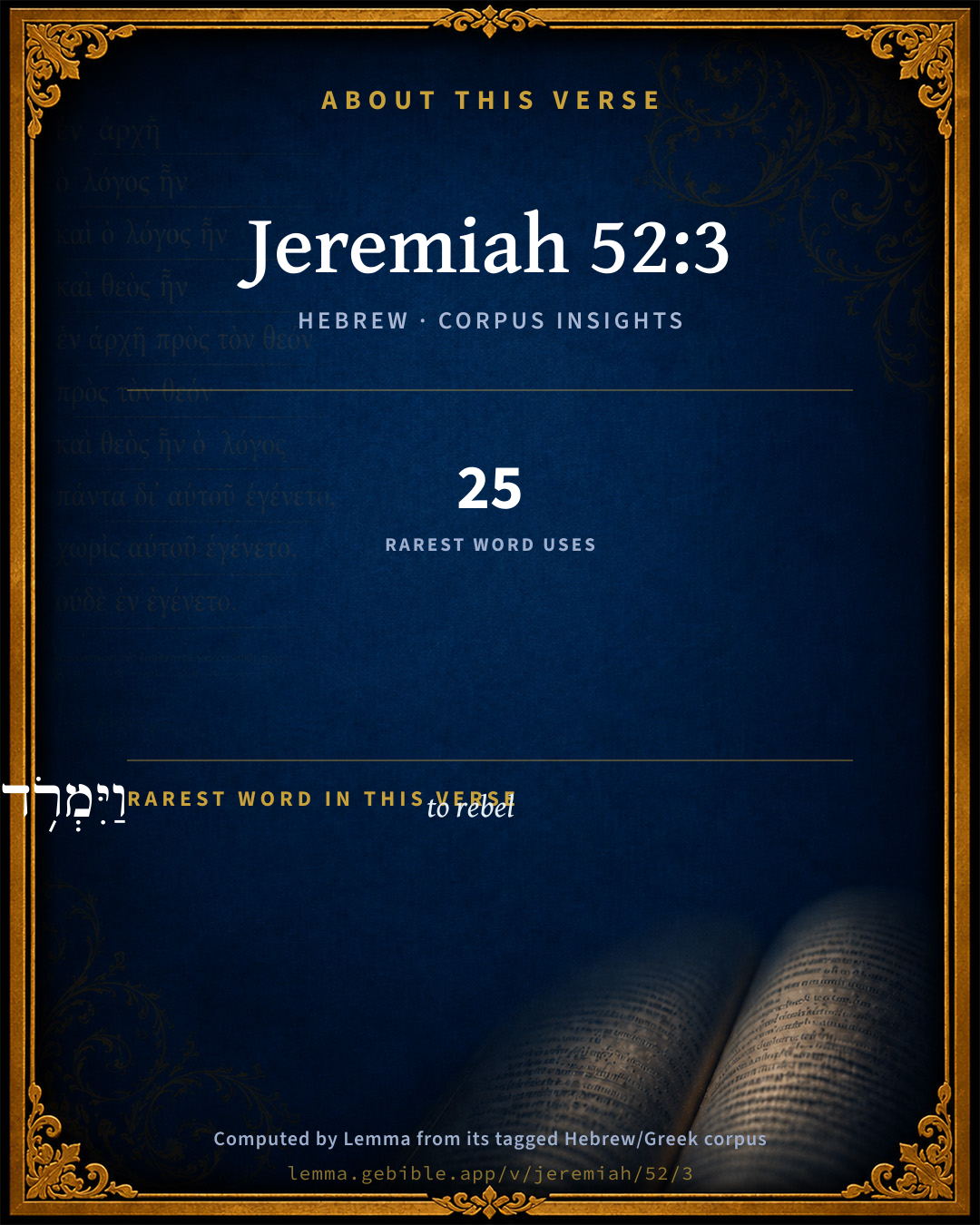
The rarest word here is וַיִּמְרֹ֥ד to rebel H4775 — appearing just 25 times in the whole Hebrew Bible.

Shared distinctive vocabulary

וַיִּמְרֹ֥ד to rebel H4775 occurs in 23 verses of the Hebrew Bible. Also found in:

Grammatical profile

  • 3 verbs
  • 7 nouns
  • 3 prepositions
  • 1 conjunction
  • 2 particles

Verb forms

  • הָֽיְתָה֙ Qal · Perfect
  • הִשְׁלִיכ֥וֹ Hiphil · Infinitive Construct
  • וַיִּמְרֹ֥ד Qal · Sequential Imperfect

Repetition

A word recurs within this verse — often emphatic in Hebrew:

Cross-references

9

Topical passages linked to Jeremiah 52:3 in the Treasury of Scripture Knowledge — connected by theme and wording, ordered by reader-vote popularity; previews shown in the World English Bible.

  • 2 Chronicles 36:13 He also rebelled against king Nebuchadnezzar, who had made him swear by God: but he stiffened his neck, and hardened his heart against turning to Yahweh, the God of Israel.
  • Isaiah 3:1 For, behold, the Lord, Yahweh of Hosts, takes away from Jerusalem and from Judah supply and support, The whole supply of bread, And the whole supply of water;
  • Isaiah 3:4–5 I will give boys to be their princes, And children shall rule over them.
  • 2 Samuel 24:1 Again the anger of Yahweh was kindled against Israel, and he moved David against them, saying, Go, number Israel and Judah.
  • 1 Kings 10:9 Blessed be Yahweh your God, who delighted in you, to set you on the throne of Israel: because Yahweh loved Israel forever, therefore made he you king, to do justice and righteousness.
  • Proverbs 28:2 In rebellion, a land has many rulers, But order is maintained by a man of understanding and knowledge.
  • Ecclesiastes 10:16 Woe to you, land, when your king is a child, And your princes eat in the morning!
  • Isaiah 19:4 I will give over the Egyptians into the hand of a cruel lord; and a fierce king shall rule over them, says the Lord, Yahweh of Hosts.
  • Ezekiel 17:12–21 Say now to the rebellious house, Don't you know what these things mean? tell them, Behold, the king of Babylon came to Jerusalem, and took the king of it, and the princes of it, and brought them to him to Babylon:

Cross-references courtesy of OpenBible.info (CC BY 4.0).

Hebrew and Greek witnesses Masoretic Hebrew ↔ Greek Septuagint

The same verse in the two great witnesses to the Old Testament, shown verse-for-verse.

These are two independent witnesses, not word-aligned to each other, and the Septuagint is shown in lemma (dictionary) form.

Hebrew Jeremiah 52:3 Masoretic · Westminster Leningrad Codex

כִּ֣י עַל אַ֣ף יְהוָ֗ה הָֽיְתָה֙ בִּירוּשָׁלִַ֣ם וִֽיהוּדָ֔ה עַד הִשְׁלִיכ֥וֹ אוֹתָ֖ם מֵעַ֣ל פָּנָ֑יו וַיִּמְרֹ֥ד צִדְקִיָּ֖הוּ בְּמֶ֥לֶךְ בָּבֶֽל

For through the anger of Yahweh did it happen in Jerusalem and Judah, until he had cast them out from his presence. Zedekiah rebelled against the king of Babylon.

World English Bible · Public Domain

Greek LXX Structure differs

In the Septuagint, Jeremiah is about an eighth shorter than the Hebrew and arranges its material differently — the Oracles Against the Nations (Hebrew chapters 46–51) appear in the middle of the Greek book, after 25:13. Because the chapter and verse boundaries do not line up, a verse-for-verse comparison with the Hebrew is not shown.

A verse-for-verse comparison isn’t shown here because the chapters and verses don’t line up. Switch to the LXX edition with the MT / LXX toggle above to read the Greek directly.

Hebrew: Westminster Leningrad Codex (CC BY 4.0). Greek: Septuagint (public domain); English from a public-domain English Septuagint. How the Septuagint differs from the Hebrew →

Targum (Aramaic paraphrase)

1

The Targum is the ancient Jewish Aramaic paraphrase of the Hebrew Scriptures — an interpretive translation, not the Hebrew text itself. Onkelos (literal) and Pseudo-Jonathan (expansive) render the Torah, and Jonathan the Prophets. Coverage is partial: where no permissively-licensed English translation exists for a verse, only the Aramaic is shown. This is verse-level text, not a word-by-word alignment to the Hebrew.

  1. Targum Jonathan Prophets (Joshua–Malachi)
    אֲרֵי עַל דְאַרְגִיזוּ קֳדָם יְיָ הֲוַת בִּירוּשְׁלֵם וּבִיהוּדָה עַד דְאַגְלֵי יַתְהוֹן מֵאַרְעָא בֵּית שְׁכִינְתֵּיהּ וּמְרִיד צִדְקִיָהוּ בְּמַלְכָּא דְבָבֶל:

    (no public-domain English translation for this verse)

    Targum Jonathan — Aramaic: “Mikraot Gedolot” (public domain). English: “Sefaria Community Translation” (CC0 1.0 (public-domain dedication)); “London "Chaldee Paraphrase," 1871” (public domain). Text via Sefaria.

Commentary

Notes on Jeremiah 52:3 from classic Christian and Jewish commentators (each source and its license shown beneath its notes). The classic Christian expositions comment on the surrounding passage and are grouped to its opening verse, so a note may address several verses; the Jewish commentaries on the Tanakh (Rashi and others) are per-verse, so they appear only where the commentator wrote on this verse.

Lemma curates 59 commentaries, every one of them public domain or Creative Commons licensed, each selected and text-cleaned for this edition rather than reprinted as found. About our sources →

Geneva Bible (1599)

Geneva Bible translators

So the Lord punished sin by sin, and gave him up to his rebellious heart, till he had brought the enemy upon him to lead him away and his people.

Geneva Bible (1599) marginal notes — public domain. Text via Bolls.life.

Adam Clarke's Commentary

Verse 3. Through the anger of the Lord] Here is a king given to a people in God's anger, and taken away in his displeasure.

Adam Clarke's Commentary on the Bible (1810–1826) — public domain. Text from a community e-Sword/MySword module.

John Gill's Exposition

For through the anger of the Lord it came to pass in Jerusalem and Judah,.... Or, "besides the anger of the Lord that was in", or "against Jerusalem and Judah" (n); for their many sins and transgressions committed against him:

till he had cast them out from his presence; out of the land of Judea; out of Jerusalem, and the temple, where were the symbols of his presence; so the Targum,

"till he removed them from the land of the house of his Shechinah;''

or majesty:

that Zedekiah rebelled against the king of Babylon: acted a very perfidious part, and broke a solemn covenant made with him by an oath, which was highly displeasing to God, and resented by him; the oath being made in his name, and by one that professed to worship him: this was an additional sin to those of the inhabitants of Judah and Jerusalem, which provoked the Lord to anger. According to our version the sense is, that because of the anger of the Lord for the sins of the Jews, God suffered Zedekiah to rebel against the king of Babylon, that so he might be provoked to come against them, and take vengeance on them; or for his former sins he suffered him to fall into this, to his own and his people's ruin.

(n) "nam praeter iram Jehovae, quae fuit contra Hierosolymam", Schmidt.

John Gill's Exposition of the Whole Bible (1746–1763) — public domain (CC PDM 1.0). Text via the HelloAO Bible API.

Albert Barnes' Notes on the Bible

It - i. e., Zedekiah’s evil doing.

Presence, that Zedekiah - Or, punctuate; “presence. And Zedekiah” etc.

Albert Barnes' Notes on the Bible (1834–1885) — public domain. Text from a community e-Sword/MySword module.

Haydock's Catholic Bible Commentary

Revolted, breaking his oath, which greatly offended God.

George Leo Haydock (1774–1849), Haydock's Catholic Family Bible and Commentary, 1859 edition — public domain. Excludes Psalms (Douay-Rheims chapter numbering differs from Protestant) and Deuterocanonical books (Catholic canon only).

Matthew Poole's English Annotations

It is generally thought that what we have in this chapter was not penned by the prophet Jeremiah, who it is not probable would have so largely repeated what he had related before, Jer 39, and could not historically relate what happened after his time, as some things did, which are mentioned towards the end of the chapter, from Jer 52:31 to the end. They therefore rather think it penned by some or other of those in Babylon, and put in here as a preface to the Book of Lamentations. What we have in the three first verses is entirely taken out of 2Ki 24:18-20. See the notes there.

Here the wicked actions of Zedekiah, and particularly his rebellion against the king of Babylon, who had made him king, as 2Ki 24:17, and to whom he had given an oath of fealty, is ascribed to the wrath of the Lord; God not putting any such wickedness into his heart, but suffering him so to miscarry, having a design to send Judah into captivity. Princes are often by God suffered to miscarry for the sins of their people, which should oblige us, when we think we have cause to complain of the errors of our rulers, to consider whether we have not by some sinful courses provoked God, which hath made him leave our rulers so to miscarry in order to our ruin and punishment.

Matthew Poole's English Annotations on the Holy Bible (1683–1685) — public domain. Text from a community e-Sword/MySword module.

The Pulpit Commentary

It came to pass. The implied subject of the verb is Zedekiah"s evil doing. That Zedekiah rebelled. There ought to be a full stop before these words, and "that" should rather be "And.

The Lord creating evil.

This is one of the passages of Scripture the meaning of which does not lie on the surface. It seems to represent God as instigating sin. For "through the anger of the Lord" it is said "that Zedekiah rebelled." But it was for that very rebellion he was so sorely punished, and yet it is said it was "through the Lord." Note

I THERE ARE OTHER PASSAGES LIKE THIS. Cf. "the Lord hardening Pharaoh"s heart." The history of Judas. "None of them is lost, but the son of perdition; that the Scripture might, be fulfilled". (Joh_17:12) Again," Is there evil in the city and I have not done it?". (Amos Isa_45:7) And St. Peter"s word to the Jews on the day of Pentecost. (Act_2:23) They wickedly did what nevertheless God had determined before to be done. And there are yet other Scriptures besides these.

II THEY GIVE ELSE TO GREAT DIFFICULTY. It is not difficult to understand that men should do wrong, or even the particular wrong which is charged against them and for which they are punished; but the difficulty is that the sin should be seemingly ascribed to God. And the Jews seem to have believed that God did prompt men to sin; cf. Joh_9:1, "Who did sin, this man or his parents in order that (ina ) he should be born blind?" The effect, the man"s blindness, they looked on as designed and intended by God, and hence the cause producing that effect must have been designed also. As we read over Scriptures like these, the question of Abram starts immediately to our lips, "Shall not the Judge of all the earth do right?". (cf. Rom_3:5-8) God "may and must transcend our understanding. He will by the very nature of the case dazzle and confound our imagination by the unsuspected riches and glory of his many mansions; but he must not trouble our sense of right if he would retain our homage and our love." But it is this sense of right that is troubled by what seems to be the teaching of Scriptures like these. They seem to teach that God prompts men to sin and then punishes them for it. Some who reasoned with St. Paul appear to have suggested (cf. Romans 3) that in such cases God was "unrighteous who took "vengeance." The apostle does not attempt to argue the matter, but treats the suggestion with a sort of "Get thee behind me, Satan," which is what his mh genoito really amounts to. And where the suggestion is made from mere captious motives, or with the intent only to support a foregone conclusion and determination to disregard God, then such a reply is the proper one to make. But it can never be other than right to endeavour to meet the honest difficulties which some of the utterances of God"s Word and some of the actings of his providence do unquestionably give rise to. If the suggestion were true that God made men to sin and then damned them for it, nothing could be more horrible, and no possible force could make men trust, love, or sincerely worship a God who would act so. But the suggestion is not true; for

III THE DIFFICULTY IS APPARENT, NOT REAL. God is never the author of sin. "The Lord is holy in all his ways, and righteous in all his works." "Let no man say when he is tempted," etc. (cf. Jam_1:13) But when sin has been Begotten in a man"s soul by his own evil desires, then the special form in which that sin shall manifest itself is very often ordered by God. This is how we understand all these passages. That very Babylon in connection with which this ver. 3 is written may supply an apt illustration. Isaiah calls Babylon "the desert of the sea," for when, by reason of the melting of the snows which fed the Euphrates and her many tributaries, the great river overflowed its hanks, the great plain on which Babylon stood became like a vast sea. But the great Assyrian lords cut their canals and constructed their massive dams and reservoirs so that the superabundant and otherwise destructive waters were directed into safe channels, and could do no further harm. Those monarchs were not the authors of the floods, but by their skill and wisdom they directed which way those floods should flow. On one of our great railways a little while ago, a signalman saw to his horror that an engine had somehow got away without its driver, and was rushing on with ever-increasing speed to its own destruction and that of the first unhappy passenger train and one was nearly due that it should meet. Quick as thought the signalman seized his levers and turned the runaway into a siding where it could harm no one but itself. In every large fire the firemen act in a similar way. And so God. When sin has broken out by no will of his, but altogether contrary to his will, he does not let it run riot, as it might, but he orders the way it shall take. Thence it came to pass "through the Lord" that "Zedekiah rebelled against the King of Babylon" (ver. 3).

IV THIS ORDERING OF SIN"S WAY ON THE PART OF GOD IS A THING MUCH TO BE REMEMBERED.

1. For our consolation and comfort. Mad and monstrous as sin is, it is yet under God"s control. Like as to the raging sea, he can say and does say to it, "Thus far shalt thou go, and no further," etc., and cf. Jer_5:22.

2. For the warning of the sinner. The flames of the eternal fire are lit within our own soul. Sin is ever twisting and knotting its own scourge. What a man soweth that shall he also reap. The seed of all our punishments was sown by our own hand, though we never intended the harvest. The way sin shall take is utterly out of our power. If it does somewhat that we did intend, it does for men that we never dreamt of nor desired.

3. For instruction to all thoughtful readers of God"s Word and beholders of his providence. God "does" the evil that is in the city, (Isa 45) but he does not originate it, and that which he does is but the ordering of its way. C.

Vers. 4-7. The siege and capture of Jerusalem.

I GENERAL LESSONS OF THE SIEGE.

1. God will perform his threats. The capture of Jerusalem had been long and frequently predicted. The accumulated prophecies were now fulfilled.

2. Delay of judgment is no reason for expecting it to be permanently withheld. The fate of Jerusalem seemed to be long postponed. But at length it came.

3. Previous immunity is no security for the future. The Jews fondly idolized Jerusalem as a charmed city. It seemed impossible that she should fall into the hands of her foes. We grow careless and confident through a series of fortunate escapes. But our confidence is irrational unless it has any deeper ground.

4. The favour of God is no protection against the punishment of sin. The Jews regarded themselves as Divine favourites. They had received many peculiar privileges. But these made the duty of fidelity only the more obligatory. For the most favoured people to be faithless was a great and terrible wickedness. Indeed, the favour of God, instead of mitigating punishment, makes a heavier penalty to be fitting for those who are so ungrateful as to sin against it.

II SPECIAL FEATURES OF THE SIEGE.

1. It was thorough. The great king Nebuchadnezzar came in person and "all" his army, and pitched a camp and built forts. Every effort was made to secure the city. The instruments of Divine vengeance are terrible, earnest, and vigorous.

2. It was protracted. It lasted for eighteen months How wearily those days and weeks and months must have dragged themselves along, every hour increasing the agony! But what is this period to the vast, dim reaches of the "punishment of the ages," which awaits lost souls?

3. It produced horrible sufferings. In the madness of famine, women devoured their own children. Thus God punished

a. "satiation and disgust towards his holy Word and soul food;

b. the terrible offering up of children to Moloch;

c. the loose discipline of children" (Cramer, quoted by Naegelsbach).

From a merely selfish position, who that knew and realized the frightful consequences of his sins would bring these upon his head for the sake of the poor pleasures of an hour?

4. It was successful. The siege ended in the capture of Jerusalem. The force of Nebuchadnezzar was great and terrible, but behind it was the judicial will of Heaven. To withstand this was certainly futile. All resistance to the decrees of Divine judgment must be vain. Our one hope is not in opposition, but in penitent cries for God"s mercy and unresisting submission to his will.

The Pulpit Commentary (1880–1919), ed. H.D.M. Spence-Jones & Joseph S. Exell — public domain. Text from a community e-Sword module.

Lesson kit

Teaching starters — assembled from the data on this page, not authored interpretation. Every prompt links to the verse data it draws on. Edit before teaching.

Jeremiah, in the Prophets, opens this verse with 16 words (15 distinct Hebrew lemmas). Its most distinctive word is mârad (“to rebel”). A historical commentator’s framing appears above. Read the whole chapter for the surrounding context.

Discussion questions

  1. What does “to rebel” (mârad) contribute to the verse as a whole?
  2. How does Genesis 14:4, which shares the word «to rebel», read alongside this verse?
  3. What does the repetition of “upon” (2× in this one verse) do in this verse?
  4. These translations render this verse differently. What is at stake in choosing one wording over another?
  5. «הָֽיְתָה֙» is a Qal Perfect verb. How does that grammatical form shape the action described?
  6. Compare how Geneva Bible (1599) and Adam Clarke's Commentary read this verse. Where do they agree or differ?

Things to notice

Reading settings

Reading text

Shown beneath each verse's original-language words.

Old Testament
Old Testament edition

Read the OT as the Masoretic Hebrew (MT) or the Greek Septuagint (LXX).

English shown for the Greek Septuagint (in the Hebrew ↔ Greek comparison).

Comparing translations? Open the Compare panel on any verse page to stack up to four side by side.