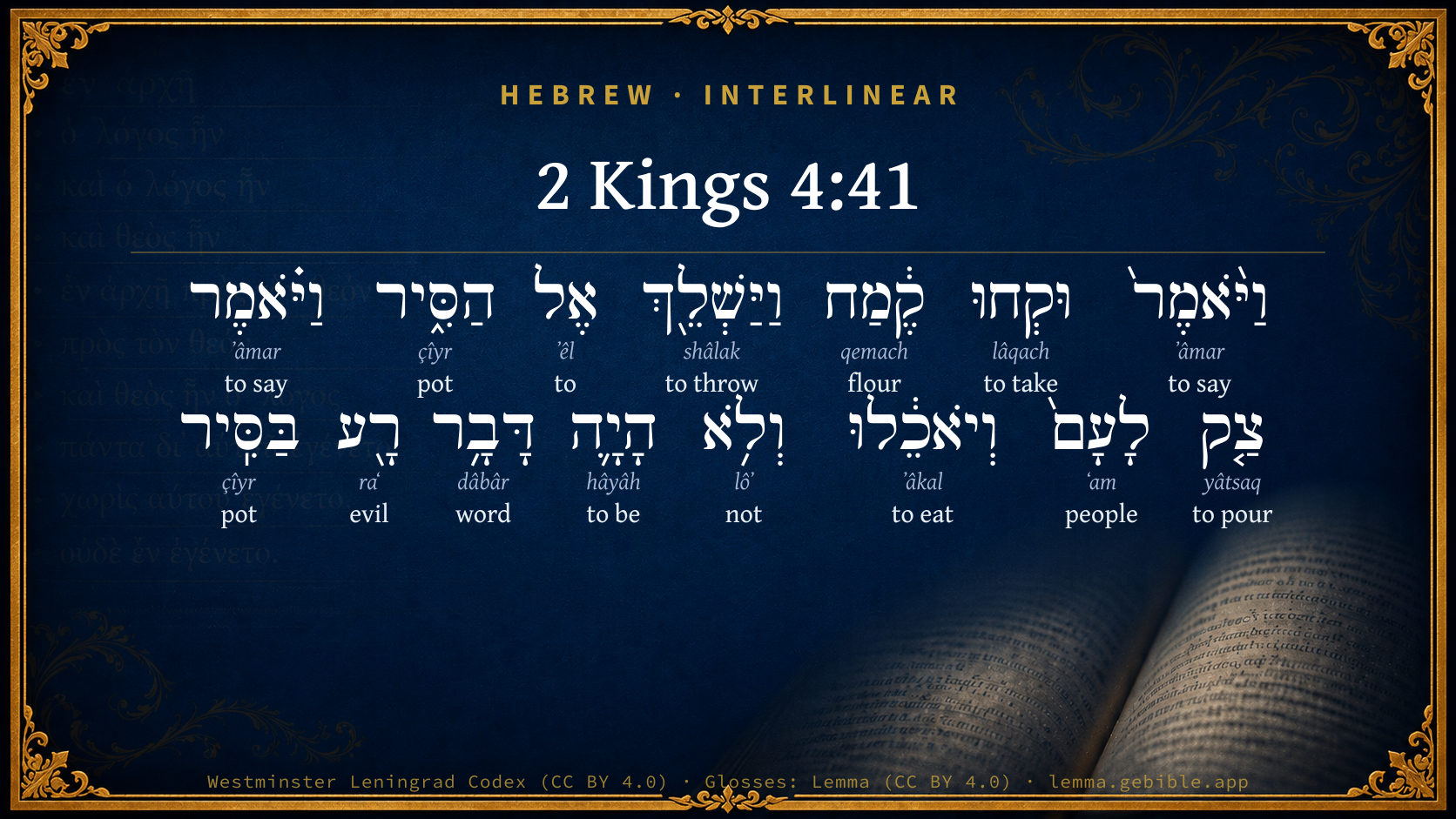
2 Kings 4:41

Hebrew (Westminster Leningrad Codex) 2 Kings 4:41 appears in the Hebrew Old Testament. The text above is from the Westminster Leningrad Codex. Each word links to its Strong’s number, a concise gloss, and parsing drawn from the Open Scriptures Hebrew Bible morphology. Click any word for its full Brown-Driver-Briggs (BDB) entry.
Download image
Cite this verse

2 Kings 4:41 (World English Bible). Public Domain. Lemma interlinear Bible study tool, https://lemma.gebible.app/v/2-kings/4/41.

Show BibTeX & RIS
BibTeX
RIS
English Translation
But he said, Then bring meal. He cast it into the pot; and he said, Pour out for the people, that they may eat. There was no harm in the pot.
World English Bible · Public Domain
Download a study sheet

One document with this verse’s original text, its word-by-word gloss line, the meaning frame, cross-references with their text, attributed commentary, and full source and license credits — printable, and it pastes into notes with its structure intact.

This verse Autodidact and up

Study sheet (.html) Plain text (.txt)

A passage Seminary Student

Up to 50 verses in one chapter. A passage sheet keeps up to 6 commentary sources and 12 cross-references per verse, in the order this page ranks them, and says so on the sheet whenever that leaves anything out. Ask for a single verse and you get the Autodidact verse sheet above.

Everything on this page stays free to read, with no account — the sheet is a download of what is already on screen, not access to it.

Want to remove ads? Support Godless Engineer
Compare translations 3

The same verse in 3 English versions, stacked beneath the original-language interlinear above. Click any original word for its lexicon entry.

Each is an independent rendering of the whole verse — the interlinear is not word-aligned to these translations.

Highlighted words mark where these versions differ — a whole-verse word diff, not a word-by-word alignment.

  • World English Bible Public Domain
    But he said, Then bring meal. He cast it into the pot; and he said, Pour out for the people, that they may eat. There was no harm in the pot.
  • King James Version Public Domain
    But he said, Then bring meal. And he cast it into the pot; and he said, Pour out for the people, that they may eat. And there was no harm in the pot.
  • unfoldingWord Literal Text CC BY-SA 4.0
    And he said, “Then bring flour.” And he threw into the pot, and he said, “Pour out for the people, that they may eat.” And a harmful thing was not in the pot.

unfoldingWord Literal Text — © unfoldingWord, licensed CC BY-SA 4.0. Word-aligned USFM3 via Door43 (git.door43.org/unfoldingWord/en_ult).

Versions to compare (up to 4)

3 of 4 selected

Show all 18 translations

Every available English version of this verse, each an independent rendering of the whole verse.

  • World English Bible Public Domain
    But he said, Then bring meal. He cast it into the pot; and he said, Pour out for the people, that they may eat. There was no harm in the pot.
  • Berean Standard Bible Public Domain
    Then Elisha said, “Get some flour.” He threw it into the pot and said, “Pour it out for the people to eat.” And there was nothing harmful in the pot.
  • Majority Standard Bible Public Domain
    Then Elisha said, “Get some flour.” He threw it into the pot and said, “Pour it out for the people to eat.” And there was nothing harmful in the pot.
  • King James Version Public Domain
    But he said, Then bring meal. And he cast it into the pot; and he said, Pour out for the people, that they may eat. And there was no harm in the pot.
  • American Standard Version (1901) Public Domain
    But he said, Then bring meal. And he cast it into the pot; and he said, Pour out for the people, that they may eat. And there was no harm in the pot.
  • Revised Version (1885) Public Domain
    But he said, Then bring meal. And he cast it into the pot; and he said, Pour out for the people, that they may eat. And there was no harm in the pot.
  • Geneva Bible (1599) Public Domain
    Then he said, Bring meale. And hee cast it into the potte, and sayd, Powre out for the people, that they may eate: and there was none euill in the pot.
  • Douay-Rheims (1899) Public Domain
    But he said: Bring some meal. And when they had brought it, he cast it into the pot, and said: Pour out for the people, that they may eat. And there was now no bitterness in the pot.
  • Young's Literal Translation Public Domain
    And he saith, `Then bring ye meal;' and he casteth into the pot, and saith, `Pour out for the people, and they eat;' and there was no evil thing in the pot.
  • Literal Standard Version CC BY-SA 4.0
    And he says, “Then bring a meal”; and he casts into the pot and says, “Pour out for the people, and they eat”; and there was no bad thing in the pot.
  • Unlocked Literal Bible CC BY-SA 4.0
    But Elisha said, “Bring some flour.” He threw it into the pot and said, “Pour it out for the people, so that they may eat.” Then there was no longer anything hurtful in the pot.
  • unfoldingWord Literal Text CC BY-SA 4.0
    And he said, “Then bring flour.” And he threw into the pot, and he said, “Pour out for the people, that they may eat.” And a harmful thing was not in the pot.
  • Darby Bible Public Domain
    And he said, Then bring meal. And he cast [it] into the pot, and said, Pour out for the people, that they may eat. And there was no harm in the pot.
  • World Messianic Bible Public Domain
    But he said, “Then bring meal.” He threw it into the pot; and he said, “Serve it to the people, that they may eat.” And there was nothing harmful in the pot.
  • Webster's Bible Public Domain
    But he said, Then bring meal. And he cast it into the pot; and he said, Pour out for the people, that they may eat. And there was no harm in the pot.
  • Free Bible Version CC BY-SA 4.0
    Elisha said, “Get some flour.” He threw it into the pot, and said, “Serve it to the people to eat.” There was nothing bad to eat in the pot.
  • Bible in Basic English Public Domain
    But he said, Get some meal. And he put it into the pot, and said, Now give it to the people so that they may have food. And there was nothing bad in the pot.
  • JPS Tanakh (1917) Public Domain
    But he said: 'Then bring meal.' And he cast it into the pot; and he said: 'Pour out for the people, that they may eat.' And there was no harm in the pot.

Literal Standard Version (2020), Covenant Press — licensed CC BY-SA 4.0. Text via the HelloAO Bible API (eBible.org). Unlocked Literal Bible (unfoldingWord) — licensed CC BY-SA 4.0. Text via the HelloAO Bible API (eBible.org). unfoldingWord Literal Text — © unfoldingWord, licensed CC BY-SA 4.0. Word-aligned USFM3 via Door43 (git.door43.org/unfoldingWord/en_ult). Free Bible Version, Dr. Jonathan Gallagher — licensed CC BY-SA 4.0. Text via the HelloAO Bible API (eBible.org).

Word by word

More ways to search: Search by grammar → Find every occurrence → Compare this word →

Practice this passage: Drill this verse → Learn its vocabulary →

קֶ֔מַח
qemach
H7058
“flour”
Noun, Common, Masculine, Singular, Absolute
Part of Speech
Noun
Type
Common
Gender
Masculine
Number
Singular
State
Absolute
Full BDB Definition

Origin: from an unused root probably meaning to grind

TWOT: 2033a

flour, meal, meal flour
  1. וַיֹּ֨אמֶר֙ ʼâmar H559 “and · to say” Conjunction + Verb, Qal, Sequential Imperfect, 3rd Person, Masculine, Singular
  2. וּקְחוּ lâqach H3947 “and · take” Conjunction + Verb, Qal, Imperative, 2nd Person, Masculine, Plural
  3. וַיַּשְׁלֵ֖ךְ shâlak H7993 “and · to throw” Conjunction + Verb, Hiphil, Sequential Imperfect, 3rd Person, Masculine, Singular
  4. אֶל ʼêl H413 “to” Preposition
  5. הַסִּ֑יר çîyr H5518 “the · pot” Particle, Definite Article + Noun, Common, Both, Singular, Absolute
  6. וַיֹּ֗אמֶר ʼâmar H559 “and · to say” Conjunction + Verb, Qal, Sequential Imperfect, 3rd Person, Masculine, Singular
  7. צַ֤ק yâtsaq H3332 “pour” Verb, Qal, Imperative, 2nd Person, Masculine, Singular
  8. לָעָם֙ ʻam H5971 “to/for the · people” Preposition, Determined + Noun, Common, Masculine, Singular, Absolute
  9. וְיֹאכֵ֔לוּ ʼâkal H398 “and · to eat” Conjunction + Verb, Qal, Imperfect, 3rd Person, Masculine, Plural
  10. וְלֹ֥א lôʼ H3808 “and · not” Conjunction + Particle, Negative
  11. הָיָ֛ה hâyâh H1961 “to be” Verb, Qal, Perfect, 3rd Person, Masculine, Singular
  12. דָּבָ֥ר dâbâr H1697 “word” Noun, Common, Masculine, Singular, Absolute
  13. רָ֖ע raʻ H7451 “evil” Adjective, Adjective, Masculine, Singular, Absolute
  14. בַּסִּֽיר çîyr H5518 “in/at the · pot” Preposition, Determined + Noun, Common, Both, Singular, Absolute

About this verse

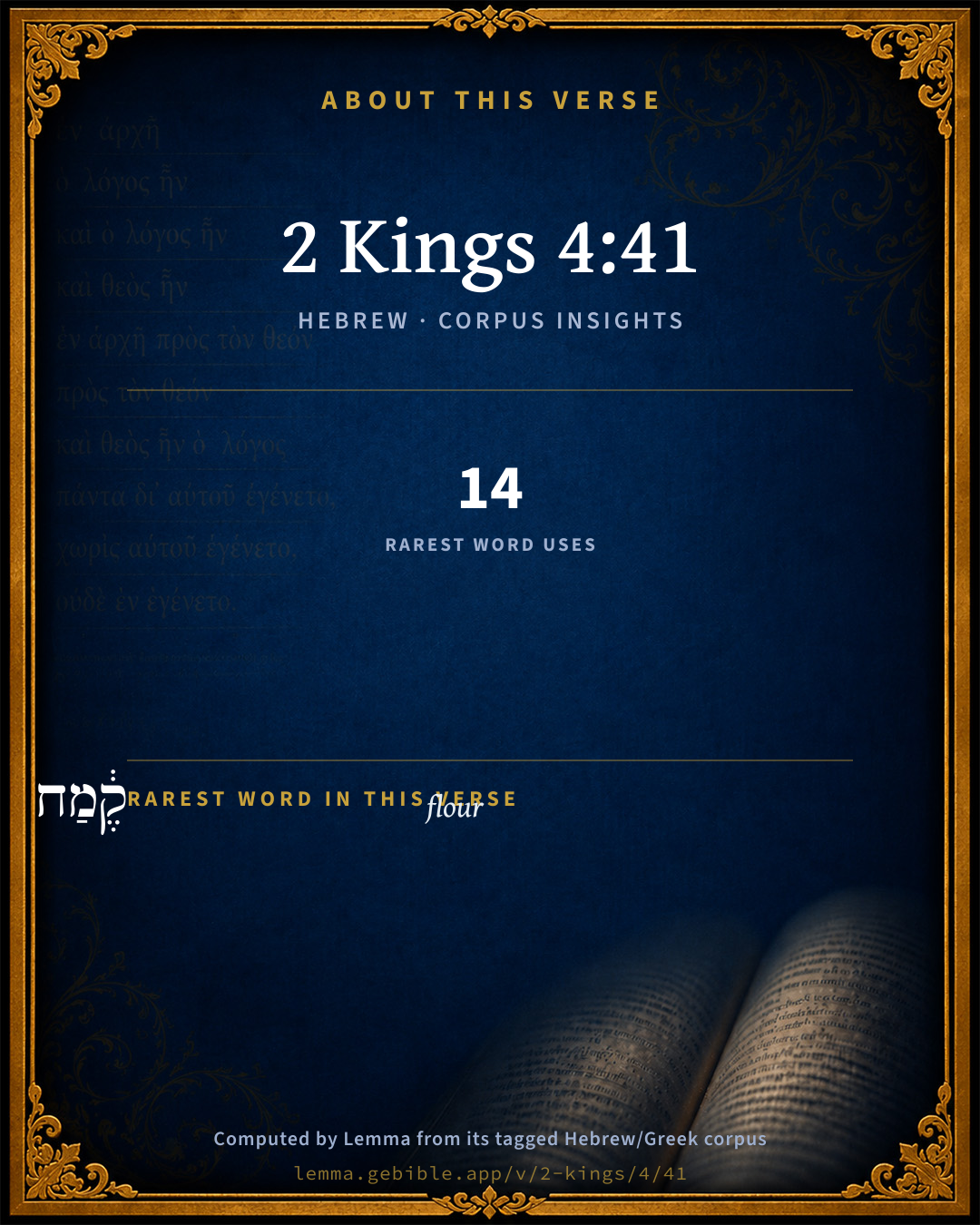
These counts appear in no published source. They are computed here, from the morphology-tagged text and Lemma’s own curated glosses. What Lemma adds →

15
words
13
distinct lemmas
Historical
section

Notable vocabulary

The rarest word here is קֶ֔מַח flour H7058 — appearing just 14 times in the whole Hebrew Bible.

Shared distinctive vocabulary

קֶ֔מַח flour H7058 occurs in 14 verses of the Hebrew Bible. Also found in:

Grammatical profile

  • 7 verbs
  • 5 nouns
  • 1 adjective
  • 1 preposition
  • 1 particle

Verb forms

  • וַיֹּ֨אמֶר֙ Qal · Sequential Imperfect
  • וּקְחוּ Qal · Imperative
  • וַיַּשְׁלֵ֖ךְ Hiphil · Sequential Imperfect
  • וַיֹּ֗אמֶר Qal · Sequential Imperfect
  • צַ֤ק Qal · Imperative
  • וְיֹאכֵ֔לוּ Qal · Imperfect
  • הָיָ֛ה Qal · Perfect

Repetition

Words recur within this verse — often emphatic in Hebrew:

  • וַיֹּ֨אמֶר֙ to say H559 ×2
  • הַסִּ֑יר pot H5518 ×2

Hebrew & Septuagint length

In English translation the verse runs 31 words from the Hebrew and 39 from the Septuagint (LXX English) — closely comparable.

A rough comparison of the two English renderings, which tokenize alike — not a word-level alignment.

Word counts can differ between the Hebrew and the Greek without any difference in meaning — e.g. the Hebrew direct-object marker אֵת has no separate Greek word, and Greek often adds the article ὁ.

Cross-references

7

Topical passages linked to 2 Kings 4:41 in the Treasury of Scripture Knowledge — connected by theme and wording, ordered by reader-vote popularity; previews shown in the World English Bible.

  • Exodus 15:25 Then he cried to Yahweh. Yahweh shown him a tree, and he threw it into the waters, and the waters were made sweet. There he made a statute and an ordinance for them, and there he tested them;
  • 2 Kings 2:21 He went forth to the spring of the waters, and cast salt therein, and said, Thus says Yahweh, I have healed these waters; there shall not be from there any more death or miscarrying.
  • 1 Corinthians 1:25 Because the foolishness of God is wiser than men, and the weakness of God is stronger than men.
  • 2 Kings 5:10 Elisha sent a messenger to him, saying, Go and wash in the Jordan seven times, and your flesh shall come again to you, and you shall be clean.
  • 2 Kings 6:6 The man of God said, Where fell it? He shown him the place. He cut down a stick, and cast it in there, and made the iron to swim.
  • John 9:6 When he had said this, he spat on the ground, made mud with the saliva, anointed the blind man's eyes with the mud,
  • Acts 28:5 However he shook off the creature into the fire, and wasn't harmed.

Cross-references courtesy of OpenBible.info (CC BY 4.0).

Hebrew and Greek witnesses Masoretic Hebrew ↔ Greek Septuagint

The same verse in the two great witnesses to the Old Testament, shown verse-for-verse.

These are two independent witnesses, not word-aligned to each other, and the Septuagint is shown in lemma (dictionary) form.

Hebrew 2 Kings 4:41 Masoretic · Westminster Leningrad Codex

וַיֹּ֨אמֶר֙ וּקְחוּ קֶ֔מַח וַיַּשְׁלֵ֖ךְ אֶל הַסִּ֑יר וַיֹּ֗אמֶר צַ֤ק לָעָם֙ וְיֹאכֵ֔לוּ וְלֹ֥א הָיָ֛ה דָּבָ֥ר רָ֖ע בַּסִּֽיר

But he said, Then bring meal. He cast it into the pot; and he said, Pour out for the people, that they may eat. There was no harm in the pot.

World English Bible · Public Domain

Greek LXX 2 Kings 4:41 Septuagint · lemma form

καί εἶπον λαμβάνω ἄλευρον καί ἐνβάλλω εἰς ὁ λέβης καί εἶπον ελισαιε πρός γιεζι ὁ παιδάριον ἐνχέω ὁ λαός καί ἐσθίω καί οὐ γίγνομαι ἔτι ἐκεῖ ῥῆμα πονηρός ἐν ὁ λέβης

And he said, Take meal, and cast it into the pot. And Elisaie said to his servant Giezi, Pour out for the people, and let them eat. And there was no longer there any hurtful thing in the pot.

LXX2012 (modern English Septuagint) · Public Domain

On this verse, Ellicott's Commentary for English Readers discusses the Septuagint’s reading. Read the note in Commentary ↓

Hebrew: Westminster Leningrad Codex (CC BY 4.0). Greek: Septuagint (public domain); English from LXX2012 (modern English Septuagint) (Public Domain). How the Septuagint differs from the Hebrew →

Targum (Aramaic paraphrase)

1

The Targum is the ancient Jewish Aramaic paraphrase of the Hebrew Scriptures — an interpretive translation, not the Hebrew text itself. Onkelos (literal) and Pseudo-Jonathan (expansive) render the Torah, and Jonathan the Prophets. Coverage is partial: where no permissively-licensed English translation exists for a verse, only the Aramaic is shown. This is verse-level text, not a word-by-word alignment to the Hebrew.

  1. Targum Jonathan Prophets (Joshua–Malachi)
    וַאֲמַר אַיְתוֹ קִמְחָא וּרְמוֹ לְדוּדָא וַאֲמַר אֲרֵיק לְעַמָא וְיֵיכְלוּן וְלָא הֲוָה מִדַעַם בִּישׁ בְּדוּדָא:

    (no public-domain English translation for this verse)

    Targum Jonathan — Aramaic: “Mikraot Gedolot” (public domain). English: “Sefaria Community Translation” (CC0 1.0 (public-domain dedication)); “London "Chaldee Paraphrase," 1871” (public domain). Text via Sefaria.

Commentary

Notes on 2 Kings 4:41 from classic Christian and Jewish commentators (each source and its license shown beneath its notes). The classic Christian expositions comment on the surrounding passage and are grouped to its opening verse, so a note may address several verses; the Jewish commentaries on the Tanakh (Rashi and others) are per-verse, so they appear only where the commentator wrote on this verse.

Lemma curates 59 commentaries, every one of them public domain or Creative Commons licensed, each selected and text-cleaned for this edition rather than reprinted as found. About our sources →

Trapp's Complete Commentary

John Trapp

2Ki 4:41 But he said, Then bring meal. And he cast [it] into the pot; and he said, Pour out for the people, that they may eat. And there was no harm in the pot.

Ver. 41. Then bring meal.] Which yet could not have made the pottage wholesome and savoury, but by a miracle.

John Trapp, A Commentary or Exposition upon All the Books of the Old and New Testament (1647–1656) — public domain. Text from a community e-Sword module.

Adam Clarke's Commentary

Verse 41. Bring meal.] Though this might, in some measure, correct the strong acrid and purgative quality; yet it was only a miracle which could make a lapful of this fruit shred into pottage salutary.

Adam Clarke's Commentary on the Bible (1810–1826) — public domain. Text from a community e-Sword/MySword module.

Ellicott's Commentary for English Readers

(41) Then bring meal.—Keil says, “the meal was only the material basis for the spiritual activity which went out from Elisha, and made the poisonous food wholesome.” Thenius, however, supposes that “the meal softened the bitterness, and obviated the drastic effect.” But Reuss appears to be right in saying, “by mistake a poisonous (not merely a bitter) plant had been put into the pot, and the prophet neutralises the poison by means of an antidote whose natural properties could never have had that effect.” The “meal” here, therefore, corresponds to the “salt” in 2Ki_2:21.

And he said, Pour out.—The LXX. adds, “to Gehazi, his servant;” probably a gloss.

A Bible Commentary for English Readers, edited by Charles John Ellicott (1878–1897) — public domain. Text from a community e-Sword module.

The Cambridge Bible for Schools and Colleges

gen. ed. J. J. S. Perowne

41. bring meal] He employs something which is wholesome and nourishing as a sign of the change that was to be wrought in the pottage. But we are not to attribute healing virtue to the meal that was used, any more than we should think that the salt (2Ki_2:21) was the means of healing the waters at Jericho.

The Cambridge Bible for Schools and Colleges (gen. ed. J. J. S. Perowne; Cambridge University Press, 1878–1918) — public domain. Text from a community e-Sword module.

John Gill's Exposition

But he said, then bring meal: and he cast it into the pot,.... And stirred it about in it:

and he said, pour out for the people, that they may eat; as they now might freely, and without any danger, as he intimated:

and there was no harm in the pot; or anything that could do any harm or mischief to the health of men: this was not owing to the natural virtue of meal, but to a miraculous power attending it, whereby the pottage was cured of its malignity, as the bad waters of Jericho were by salt, in a preceding miracle.

John Gill's Exposition of the Whole Bible (1746–1763) — public domain (CC PDM 1.0). Text via the HelloAO Bible API.

Albert Barnes' Notes on the Bible

Then bring meal - The natural properties of meal would but slightly diminish either the bitterness or the unwholesomeness of a drink containing colocynth. It is evident, therefore, that the conversion of the food from a pernicious and unsavory mess into palatable and wholesome nourishment was by miracle.

Albert Barnes' Notes on the Bible (1834–1885) — public domain. Text from a community e-Sword/MySword module.

Matthew Poole's English Annotations

He cast it into the pot, together with the pottage which they had taken out of it. There was no harm in the pot: the meal took away that hurtful quality, not by its natural power, which could do little in so short a time, but by the supernatural blessing of God upon it.

Matthew Poole's English Annotations on the Holy Bible (1683–1685) — public domain. Text from a community e-Sword/MySword module.

Whedon's Commentary on the Bible

Daniel D. Whedon

41. Then bring meal — What was there in the meal to counteract the bad properties of the gourds? Nothing, necessarily. The meal, like the salt cast into the foul waters of Jericho, (2Ki_2:21,) and the tree at Marah, (Exo_15:25,) was merely the suggestive symbol of the Divine powers of nourishment and healing which subsisted in Elisha’s God. It bore a similar relation to this miracle that Elisha’s stretching himself upon the body of the dead child did to the Divine power that raised the child to life.

It was the earthly medium through which the Spirit worked.

No harm in the pot — All the bad properties of the pottage were miraculously taken away. So, say some of the older divines, the healthsome meal of sound Christian doctrine, entering into the mind and heart of the Church, shall counteract and take away the poison of ill-born heresy.

Daniel D. Whedon (gen. ed.), Commentary on the Old and New Testaments (1874–1909) — public domain. Text from a community e-Sword module.

The Pulpit Commentary

But he said, Then bring meal. Elisha seems not to have hesitated for a moment. Prompt measures must be taken, if poisoning is even suspected. He has meal brought not that meal has any virtue in itself against colocynth, or against any other deleterious drug. But he acts, now as always, under Divine direction, and is instructed to use meal on this occasion, as he used salt in healing the waters of Jericho. The meal, as Keil observes, "might somewhat modify the bitterness and injurious qualities of the vegetable," whatever it was, but "could not possibly take them entirely away. The meal, the most wholesome food of man, was only the earthly substratum for the working of the Divine effluence which proceeded from Elisha, and made the noxious food perfectly wholesome." And he cast it into the pot; and he said, Pour out now for the peoplei.e. , the assembled company of sons of the prophetsthat they may eat. And there was no harm in the pot. Such as had faith in Elisha, and continued to eat of the pottage, found no ill result. What they ate did them no harm.

The Pulpit Commentary (1880–1919), ed. H.D.M. Spence-Jones & Joseph S. Exell — public domain. Text from a community e-Sword module.

John Wesley's Explanatory Notes

Into the pot - Together with the pottage which they had taken out of it.

John Wesley, Explanatory Notes Upon the Whole Bible (1754–1765) — public domain. Text via the GEBible commentary corpus.

Lesson kit

Teaching starters — assembled from the data on this page, not authored interpretation. Every prompt links to the verse data it draws on. Edit before teaching.

2 Kings, in the Historical, opens this verse with 15 words (13 distinct Hebrew lemmas). Its most distinctive word is qemach (“flour”). A historical commentator’s framing appears above. Read the whole chapter for the surrounding context.

Discussion questions

  1. How does “flour” (qemach) shape what this verse is saying?
  2. How does Genesis 18:6, which shares the word «flour», read alongside this verse?
  3. What does the repetition of “to say” (2× in this one verse) do in this verse?
  4. These translations render this verse differently; the difference is in the English rendering, not the original. What questions does that raise?
  5. «וַיֹּ֨אמֶר֙» is a Qal Sequential Imperfect verb. How does that grammatical form shape the action described?
  6. Compare how Trapp's Complete Commentary and Adam Clarke's Commentary read this verse. Where do they agree or differ?

Things to notice

Reading settings

Reading text

Shown beneath each verse's original-language words.

Old Testament
Old Testament edition

Read the OT as the Masoretic Hebrew (MT) or the Greek Septuagint (LXX).

English shown for the Greek Septuagint (in the Hebrew ↔ Greek comparison).

Comparing translations? Open the Compare panel on any verse page to stack up to four side by side.