
Psalms 2:3

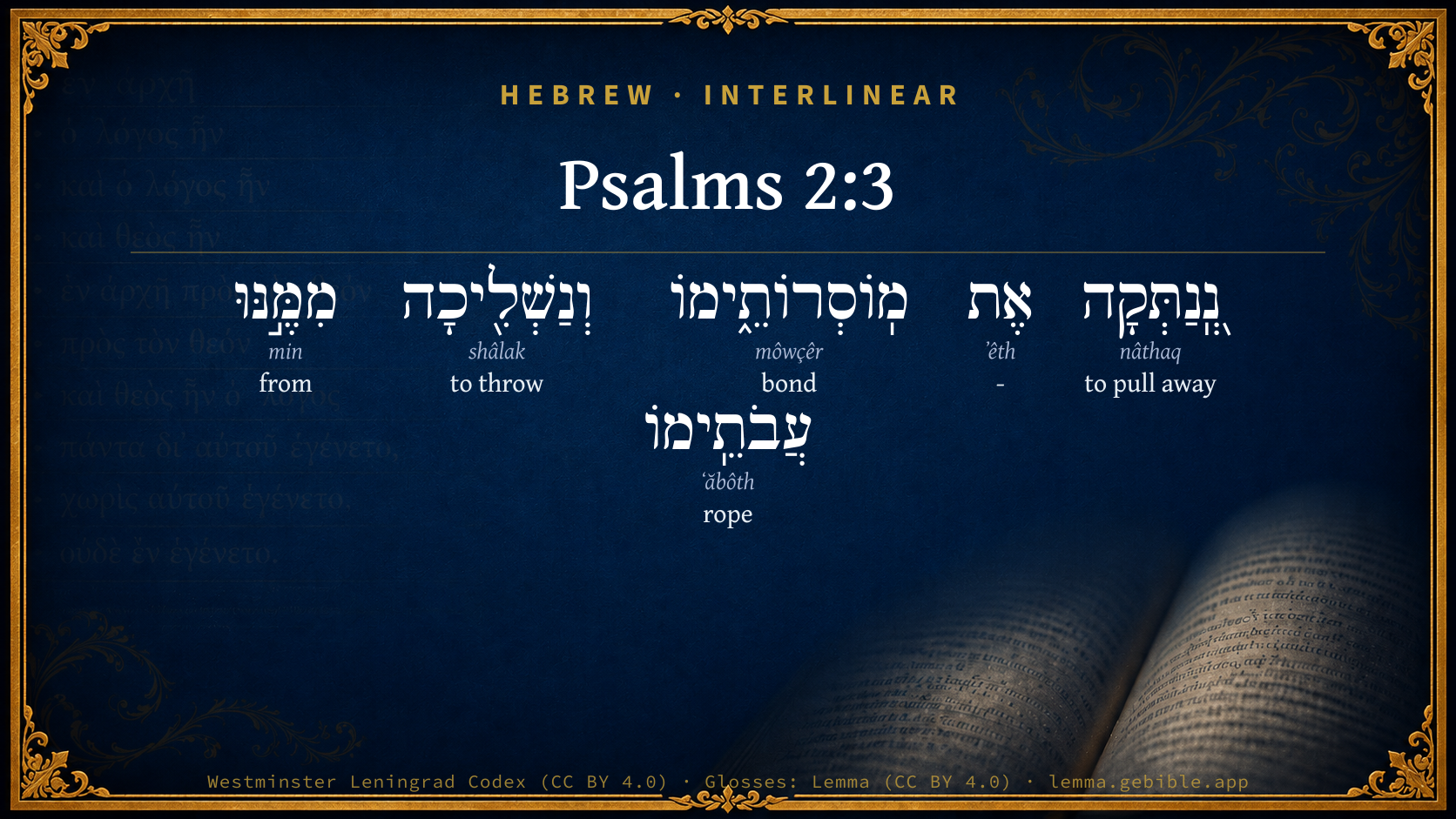
Hebrew (Westminster Leningrad Codex) Psalms 2:3 appears in the Hebrew Old Testament. The text above is from the Westminster Leningrad Codex. Each word links to its Strong’s number, a concise gloss, and parsing drawn from the Open Scriptures Hebrew Bible morphology. Click any word for its full Brown-Driver-Briggs (BDB) entry.
Download image
Cite this verse

Psalms 2:3 (World English Bible). Public Domain. Lemma interlinear Bible study tool, https://lemma.gebible.app/v/psalms/2/3.

Show BibTeX & RIS
BibTeX
RIS
English Translation
"Let's break their bonds apart, And cast away their cords from us."
World English Bible · Public Domain
Download a study sheet

One document with this verse’s original text, its word-by-word gloss line, the meaning frame, cross-references with their text, attributed commentary, and full source and license credits — printable, and it pastes into notes with its structure intact.

This verse Autodidact and up

Study sheet (.html) Plain text (.txt)

A passage Seminary Student

Up to 50 verses in one chapter. A passage sheet keeps up to 6 commentary sources and 12 cross-references per verse, in the order this page ranks them, and says so on the sheet whenever that leaves anything out. Ask for a single verse and you get the Autodidact verse sheet above.

Everything on this page stays free to read, with no account — the sheet is a download of what is already on screen, not access to it.

Want to remove ads? Support Godless Engineer
Compare translations 3

The same verse in 3 English versions, stacked beneath the original-language interlinear above. Click any original word for its lexicon entry.

Each is an independent rendering of the whole verse — the interlinear is not word-aligned to these translations.

Highlighted words mark where these versions differ — a whole-verse word diff, not a word-by-word alignment.

  • World English Bible Public Domain
    "Let's break their bonds apart, And cast away their cords from us."
  • King James Version Public Domain
    Let us break their bands asunder, and cast away their cords from us.
  • unfoldingWord Literal Text CC BY-SA 4.0
    “Let us tear apart their bonds and cast their cords away from us.” ts\*

unfoldingWord Literal Text — © unfoldingWord, licensed CC BY-SA 4.0. Word-aligned USFM3 via Door43 (git.door43.org/unfoldingWord/en_ult).

Versions to compare (up to 4)

3 of 4 selected

Show all 18 translations

Every available English version of this verse, each an independent rendering of the whole verse.

  • World English Bible Public Domain
    "Let's break their bonds apart, And cast away their cords from us."
  • Berean Standard Bible Public Domain
    “Let us break Their chains and cast away Their cords.”
  • Majority Standard Bible Public Domain
    “Let us break Their chains and cast away Their cords.”
  • King James Version Public Domain
    Let us break their bands asunder, and cast away their cords from us.
  • American Standard Version (1901) Public Domain
    Let us break their bonds asunder, And cast away their cords from us.
  • Revised Version (1885) Public Domain
    Let us break their bands asunder, and cast away their cords from us.
  • Geneva Bible (1599) Public Domain
    Let vs breake their bands, and cast their cordes from vs.
  • Douay-Rheims (1899) Public Domain
    Let us break their bonds asunder: and let us cast away their yoke from us.
  • Young's Literal Translation Public Domain
    `Let us draw off Their cords, And cast from us Their thick bands.'
  • Literal Standard Version CC BY-SA 4.0
    “Let us draw off Their cords, || And cast Their thick bands from us.”
  • Unlocked Literal Bible CC BY-SA 4.0
    “Let us tear off the shackles they put on us and throw off their chains.”
  • unfoldingWord Literal Text CC BY-SA 4.0
    “Let us tear apart their bonds and cast their cords away from us.” ts\*
  • Darby Bible Public Domain
    Let us break their bonds asunder, and cast away their cords from us!
  • World Messianic Bible Public Domain
    “Let’s break their bonds apart, and cast their cords from us.”
  • Webster's Bible Public Domain
    Let us break their bands asunder, and cast away their cords from us.
  • Free Bible Version CC BY-SA 4.0
    “Let's break the chains and throw away the cords that bind us.”
  • Bible in Basic English Public Domain
    Let their chains be broken, and their cords taken from off us.
  • JPS Tanakh (1917) Public Domain
    'Let us break their bands asunder, and cast away their cords from us.'

Literal Standard Version (2020), Covenant Press — licensed CC BY-SA 4.0. Text via the HelloAO Bible API (eBible.org). Unlocked Literal Bible (unfoldingWord) — licensed CC BY-SA 4.0. Text via the HelloAO Bible API (eBible.org). unfoldingWord Literal Text — © unfoldingWord, licensed CC BY-SA 4.0. Word-aligned USFM3 via Door43 (git.door43.org/unfoldingWord/en_ult). Free Bible Version, Dr. Jonathan Gallagher — licensed CC BY-SA 4.0. Text via the HelloAO Bible API (eBible.org).

Word by word

More ways to search: Search by grammar → Find every occurrence → Compare this word →

Practice this passage: Drill this verse → Learn its vocabulary →

About this verse

These counts appear in no published source. They are computed here, from the morphology-tagged text and Lemma’s own curated glosses. What Lemma adds →

6
words
6
distinct lemmas
Wisdom
section

Notable vocabulary

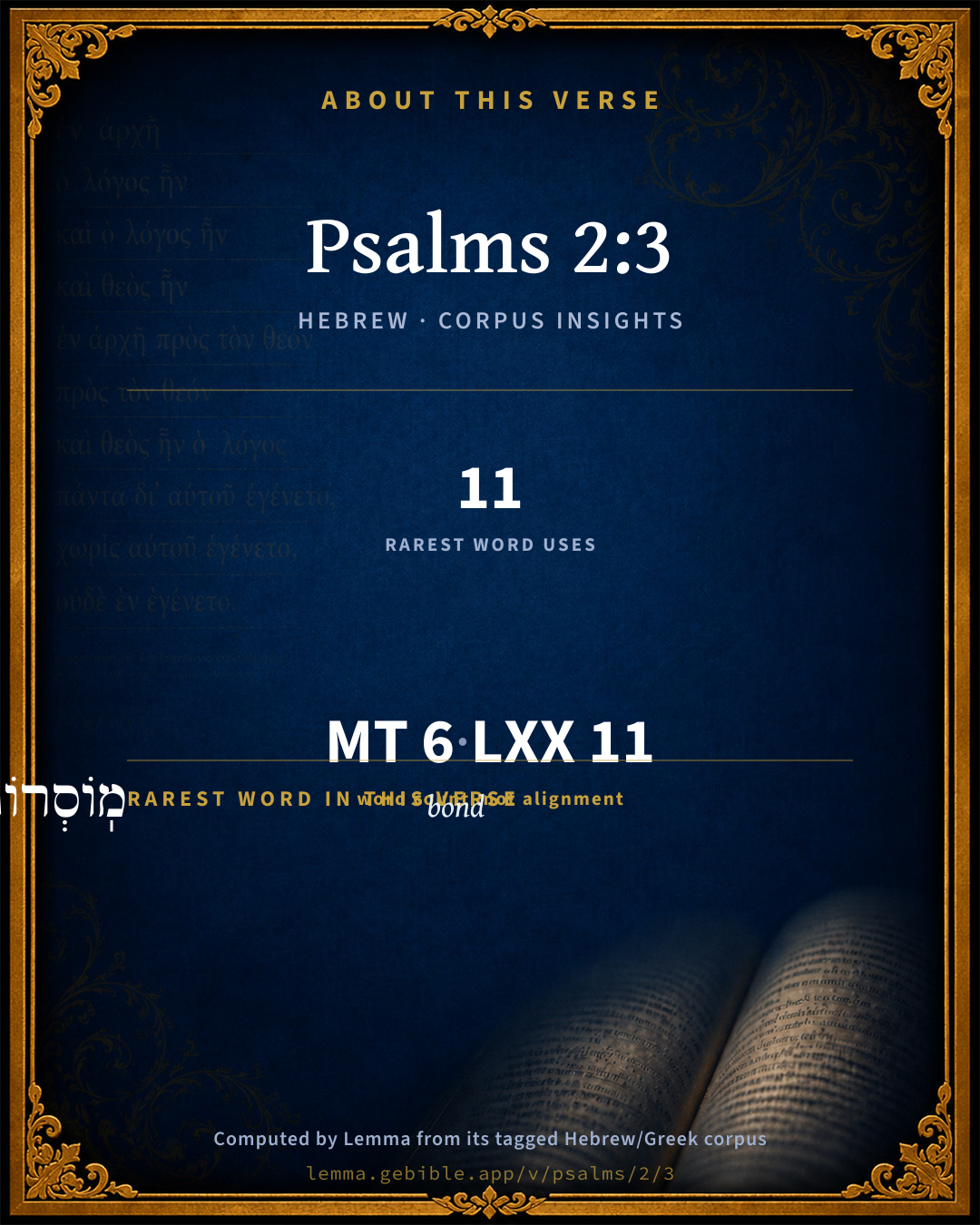
The rarest word here is מֽוֹסְרוֹתֵ֑ימוֹ bond H4147 — appearing just 11 times in the whole Hebrew Bible.

Shared distinctive vocabulary

מֽוֹסְרוֹתֵ֑ימוֹ bond H4147 occurs in 11 verses of the Hebrew Bible. Also found in:

Grammatical profile

  • 2 verbs
  • 2 nouns
  • 1 preposition
  • 1 particle

Verb forms

  • נְֽ֭נַתְּקָה Piel · Cohortative
  • וְנַשְׁלִ֖יכָה Hiphil · Cohortative

Hebrew & Septuagint length

In English translation the verse runs 12 words from the Hebrew and 14 from the Septuagint (LXX English) — closely comparable.

A rough comparison of the two English renderings, which tokenize alike — not a word-level alignment.

Word counts can differ between the Hebrew and the Greek without any difference in meaning — e.g. the Hebrew direct-object marker אֵת has no separate Greek word, and Greek often adds the article ὁ.

In the original languages it is 6 Hebrew tokens and 11 Greek tokens — but the two are counted differently (Hebrew bundles its prefixes and suffixes into one token; the Greek is in lemma form), so that isn’t a like-for-like length.

Cross-references

4

Topical passages linked to Psalms 2:3 in the Treasury of Scripture Knowledge — connected by theme and wording, ordered by reader-vote popularity; previews shown in the World English Bible.

  • Jeremiah 5:5 I will get me to the great men, and will speak to them; for they know the way of Yahweh, and the law of their God. But these with one accord have broken the yoke, and burst the bonds.
  • Luke 19:14 But his citizens hated him, and sent an envoy after him, saying, 'We don't want this man to reign over us.'
  • Luke 19:27 But bring those enemies of mine who didn't want me to reign over them here, and kill them before me.'"
  • 1 Peter 2:7–8 For you therefore who believe is the honor, but for such as are disobedient, "The stone which the builders rejected, Has become the chief cornerstone,"

Cross-references courtesy of OpenBible.info (CC BY 4.0).

Hebrew and Greek witnesses Masoretic Hebrew ↔ Greek Septuagint

The same verse in the two great witnesses to the Old Testament, shown verse-for-verse.

You’re reading Greek Psalm 2 (Hebrew Psalm 2). The Septuagint counts the superscription, so verse numbers can differ from the Hebrew — chapter-level alignment, not verse-by-verse. Numbering follows Rahlfs.

These are two independent witnesses, not word-aligned to each other, and the Septuagint is shown in lemma (dictionary) form.

Hebrew Psalms 2:3 Masoretic · Westminster Leningrad Codex

נְֽ֭נַתְּקָה אֶת מֽוֹסְרוֹתֵ֑ימוֹ וְנַשְׁלִ֖יכָה מִמֶּ֣נּוּ עֲבֹתֵֽימוֹ

"Let's break their bonds apart, And cast away their cords from us."

World English Bible · Public Domain

Greek LXX Greek Psalm 2:3 Septuagint · lemma form

διαῥήγνυμι ὁ δεσμός αὐτός καί ἀποῥίπτω ἀπό ἐγώ ὁ ζυγός αὐτός

saying, Let us break through their bonds, and cast away their yoke from us.

LXX2012 (modern English Septuagint) · Public Domain

On this verse, Ellicott's Commentary for English Readers discusses the Septuagint’s reading. Read the note in Commentary ↓

Hebrew: Westminster Leningrad Codex (CC BY 4.0). Greek: Septuagint (public domain); English from LXX2012 (modern English Septuagint) (Public Domain). How the Septuagint differs from the Hebrew →

Commentary

Notes on Psalms 2:3 from classic Christian and Jewish commentators (each source and its license shown beneath its notes). The classic Christian expositions comment on the surrounding passage and are grouped to its opening verse, so a note may address several verses; the Jewish commentaries on the Tanakh (Rashi and others) are per-verse, so they appear only where the commentator wrote on this verse.

Lemma curates 59 commentaries, every one of them public domain or Creative Commons licensed, each selected and text-cleaned for this edition rather than reprinted as found. About our sources →

Trapp's Complete Commentary

John Trapp

Psa 2:3 Let us break their bands asunder, and cast away their cords from us.

Ver. 3. Let us break their bands asunder, &c.] Here these rebels are brought in proclaiming their treasonable decrees against Christ, and his adherents, who seek to promote his kingdom. Resolved they were to run riot, as lawless and aweless, and therefore they slander the sweet laws of Christ’s kingdom, as bonds and thick cords (those signs of slavery, Jer 27:2; Jer 27:6-7), as burdens and grievances. So the Popish clergy of Collen told their good Archbishop Albert (who had made use of Bucer and Melancthon to bring things into better order), that they had rather live under the Turkish government than under such a reformation (Melch. Adam in Vit. Bucer). But what saith our Saviour? "My yoke is easy, and my burden light." No more burden it is to a regenerate person than the wings are to the bird. He delighteth in the law of God after the inward man, Rom 7:22 It is not to him now, as once, bands and cords, but as girdles and garters, which gird up his loins, and expedite his course the better. It confineth him to live in that element where he would live; as if one should be confined to paradise, where he would be, though there were no such law.

John Trapp, A Commentary or Exposition upon All the Books of the Old and New Testament (1647–1656) — public domain. Text from a community e-Sword module.

The Biblical Illustrator

Joseph S. Exell

Psa_2:3

Let us break their bands asunder, and cast away their cords from us.

Sinners vainly attempt to dissolve their obligations

I. The obligations sinners are under to God.

1. Natural obligations. Their nature, as dependent creatures, forms an intimate connection between them and their Maker. They cannot exist a moment without the immediate exertion of Divine power. Their dependence is absolute and universal. It respects all their natural powers and faculties, whether corporeal or mental. They are not sufficient to think, or speak, or act of themselves, independently of the presence and efficiency of God.

2. Moral obligations. God is a Being possessed of every natural and moral excellence. He will never do anything contrary to the perfect benevolence of His heart. Every sinner is capable of knowing that God is perfectly good, so he is under moral obligation to love Him for His goodness.

3. Legal obligation. Gods absolute supremacy gives Him an independent right to assume the character of a lawgiver. It properly belongs to Him to give law to all His intelligent creatures.

II. Sinners endeavour to free themselves from all the obligations which they are under to God. They wish and endeavour to break His bands, and cast away His cords.

1. This appears by their mode of speaking upon this subject.

2. By their mode of reasoning as well as speaking. They endeavour to reason away all their obligations to God.

3. It appears from their mode of acting, also, that they desire and endeavour to free themselves from all obligations to become reconciled and obedient to God.

III. All their endeavours to get loose from their obligations to God will be in vain.

1. They cannot destroy the existence of God.

2. Or their own existence. Improvement.

(1) We may see what is the great subject of controversy between them and their Creator.

(2) Though sinners are naturally disposed to free themselves from their obligations to God, yet they are not always sensible of it. They commonly think that they have no such disposition to complain of the bands and cords by which they are bound to God, and to desire and endeavour to break and cast them away.

(3) We see why sinners are the most opposed to the most essential and important doctrines of the gospel.

(4) If they endeavour to free themselves from their obligations, then they always endeavour to stifle convictions.

(5) If sinners are under such natural, moral, and legal obligations to God as have been mentioned, then He can awaken and convince them at any time He pleases.

(6) Sinners are extremely averse from prayer.

(7) All sinners, without exception, are bound to be religious or to fulfil their obligations to their Maker, who has made them rational, immortal, and accountable creatures.

(8) If sinners are bound to God by bands and cords which they cannot break nor cast away, then it is their immediate and imperious duty to cease from contending with their Maker, and to become cordially reconciled to the bands and cords by which He has bound them to Himself. (W. Emmons, D. D.)

Tendency of the young to infidelity

1. From their limited views. A little knowledge is a dangerous thing, as it too often encourages self-conceit and lays the foundation for many a hasty conclusion. A slight and imperfect view of the subject is taken as the whole. Judgment is rendered without even hearing the evidence. A few second-hand objections are suffered to cover the whole ground. Bacon says, It is true that a little philosophy inclineth mans mind to atheism, but depth in philosophy bringeth mens minds back to religion;--for while the mind of man looketh upon second causes scattered, it may sometimes rest in them, and go no further; but when it beholdeth the chain of them, confederate and linked together, it must needs fly to Providence and Deity.

2. From their defective training. In the religious education of youth the principal things have not always been made prominent. The youth perhaps knows no other Christianity than that which belongs to his own denomination, or some idle ceremony or some doubtful tenet has been inculcated with all the solemnity of religion and all the sanctions of eternity. The result is a narrow-minded, bitter bigotry. When the charm is broken, and its influence destroyed, the mind, left loose, too often swings at once to infidelity. The training is often defective in another way. That the mind may be free from unfounded prejudice and sectarian predilections, nothing is taught. To escape one evil they run into another and more fatal one. The native soft brings forth thorns and briars.

3. Another source of infidelity is the conduct of too many called Christians.

4. Another is an uneasiness of restraint. The spirit of wildness and wilfulness is manifest in the first dawn of intellect. The earliest period of childhood shows restlessness and hatred of restraint. Thousands are infidels because they dread the inspection of God and hate the restraints of religion. Their lives require such an opiate to their fears.

5. A love of distinction--an ambition to appear above the vulgar. Young men and boys affect infidelity for the same reason that they learn to swear or to chew tobacco. It gives an air of spirit and independence that spurns old traditions and vulgar prejudices.

6. Some are infidels in self-defence. They were once, perhaps, not far from the kingdom of God--it may be, deemed themselves citizens of that kingdom. But the world spread its charms before them. And they have found shelter from scorn and reproach in blank infidelity. Combine all these causes which are continually at work and is it wonderful that in the face of all the light of truth there should still be infidels? (D. Merrill.)

Bands that cannot be broken

The yoke that our Saviour would lay on this world is not a galling and exasperating code of laws, but a yoke in which humanity would be renewed, transformed, uplifted to the highest and eternal joy. It is of that yoke and burden that the worlds proud captains say, Let us break their bands asunder and cast away their cords from us. Bands and cords! It is an invidious description of the yoke that is easy and the burden that is light. What can be the issue of the effort to break the bands and cords of the Almighty? What can come of it? He that sitteth in the heavens shall laugh: the Lord shall have them in derision. The Psalmist is very bold: the laughter of God! the derision of the Most High! What a figure to use! It is a poets phrase, but it is a prophets truth. There is a spendthrift who is resenting the bands of economics and arithmetic; who says in regard to a plain and accurate cash statement, I will break these bands asunder, and in his foolishness he makes the attempt; but he cannot divert from their inflexible proportions the laws of parts and quantities, of plus and minus considerations. He may wish that ten amid ten should make twenty-five, but they will not. He that sitteth in the heavens! Great fixed proportions!--they wont bend to amuse a prodigal; they wont break to gratify a spendthrift. They claim their value and issue their writ, and the man who has lived and spent as though two and two made fifty is the object of the laughter of arithmetical law, and is by it had in derision. (F. W. Macdonald.)

The Biblical Illustrator, edited by Joseph S. Exell (c. 1880s–1900s) — public domain. Text from a community e-Sword module.

Joseph Benson's Commentary

Psa 2:3. Let us break their bands asunder — That is, the laws of the Lord and his Anointed; the bands or yokes which they design to put upon our necks, that they may bring us into subjection. The laws of God and Christ, though easy and pleasant in themselves, and to all good men, Mat 11:29-30; 1Jn 5:3; yet are very grievous and burdensome to corrupt nature, and carnal, wicked men. And cast away their cords from us — The same thing expressed with more emphasis. Let us not only break off their yoke, and the cords by which it is fastened upon us, but let us cast them far away. “These words, supposed to be spoken by the powers in arms against the Messiah, discover to us the true ground of opposition, namely, the unwillingness of rebellious nature to submit to the obligations of divine laws, which cross the interests, and lay a restraint upon the desires of men. Corrupt affections are the most inveterate enemies of Christ; and their language is, We will not have this man to reign over us. Doctrines would be readily believed if they involved in them no precepts; and the Church may be tolerated by the world, if she will only give up her discipline.” — Horne.

Joseph Benson's Commentary on the Old and New Testaments (1811–1818) — public domain. Text from a community e-Sword module.

Tyndale Open Study Notes

Tyndale Open Resources

2:3 break their chains: These kings believe that acknowledging the true God and his chosen ruler will result in their enslavement (Isa 28:22; 52:2; cp. Lam 3:7; Rom 1:1; 1 Cor 7:22; Titus 1:1).

Tyndale Open Study Notes — © Tyndale Open Resources, licensed CC BY-SA 4.0. Text via the HelloAO Bible API.

Geneva Bible (1599)

Geneva Bible translators

Thus the wicked say, that they will cast off the yoke of God, and of his Christ.

Geneva Bible (1599) marginal notes — public domain. Text via Bolls.life.

Jamieson, Fausset & Brown

Robert Jamieson, A. R. Fausset & David Brown

The rebellious purposes of men are more distinctly announced by this representation of their avowal in words, as well as actions.

bands . . . and . . . cords--denote the restraints of government.

Jamieson, Fausset & Brown — Commentary Critical and Explanatory on the Whole Bible (1871) — public domain (CC PDM 1.0). Text via the HelloAO Bible API.

Adam Clarke's Commentary

Verse 3. Let us break their bands] These are the words of the confederate heathen powers; and here, as Bishop Horne well remarks, "we may see the ground of opposition; namely, the unwillingness of rebellious nature to submit to the obligations of Divine laws, which cross the interests, and lay a restraint on the desires of men. Corrupt affections are the most inveterate enemies of Christ, and their language is, We will not have this man to reign over us. Doctrines would be readily believed if they involved in them no precepts; and the Church may be tolerated in the world if she will only give up her discipline."

Adam Clarke's Commentary on the Bible (1810–1826) — public domain. Text from a community e-Sword/MySword module.

John Calvin's Commentaries

3. Let us break, etc. This is a prosopopoeia, A rhetoric figure, in which persons or things are feigned or supposed to speak; a personification.

John Calvin's Commentaries (1540-1563) — public domain. Text from the Calvin Translation Society English edition (1840s-50s) via the Christian Classics Ethereal Library (ccel.org). Calvin's coverage is partial (roughly two-thirds of the Bible); uncommented books and verses are honest gaps, never fabricated. The 19th-century editor's footnotes and remarks are omitted so the notes are faithfully Calvin's own voice.

Ellicott's Commentary for English Readers

(3) Let us break.—The whispered purpose now breaks out into loud menace, and we hear their defiance pass along the ranks of the rebels.

Cords.—The LXX. and Vulg. have “yoke,” which is in keeping with the metaphor of a restive animal. (Comp. Isa_58:6; Isa_10:27.)

A Bible Commentary for English Readers, edited by Charles John Ellicott (1878–1897) — public domain. Text from a community e-Sword module.

The Cambridge Bible for Schools and Colleges

gen. ed. J. J. S. Perowne

3. The words of the kings and rulers exhorting one another to cast off the yoke of subjection. Bands are the fastenings by which the yoke was secured upon the neck (Jer_27:2; Jer_30:8; Nah_1:13; &c.): cords are perhaps merely synonymous with bands: but as the language of the previous clause is derived from the figure of an ox yoked for ploughing, cords may naturally be understood to mean the reins by which the animal was guided and kept under control. Cp. Job_39:10; Hos_11:4.

The Cambridge Bible for Schools and Colleges (gen. ed. J. J. S. Perowne; Cambridge University Press, 1878–1918) — public domain. Text from a community e-Sword module.

John Gill's Exposition

Let us break their bands asunder,.... These are not the words of the apostles, nor of the saints in Gospel times, encouraging one another, notwithstanding the rage and opposition of Jews and Gentiles against their Master and his interest, to break asunder the bands of wickedness, the idolatrous customs and practices of the Heathens, and to throw off the insupportable yoke of bondage, of Jewish traditions and ceremonies, see Isa 58:6; but of the Heathen, the people, and kings of the earth, and rulers who, with one voice, say this and what follows,

and cast away their cords from us; with relation to the Lord and his Anointed, whose laws, ordinances, and truths, they call "bands" and "cords"; so Arama interprets them of the law, and the commandments; or a "yoke", as the Vulgate Latin, Septuagint, Syriac, Arabic, and Ethiopic versions render the last word; and the phrases in general express their irreverence of God and the Messiah, their rejection Christ and his religion; their non-subjection to him, and their refusal to have him to rule over them; and their disesteem and contempt of his Gospel, and of the ordinances of it, and of the laws and rules of his government in his churches: and also they show the wrong notion that carnal men have of these things that whereas Christ's yoke is easy, and his burden light, Mat 11:30; his Gospel and the truths of it make men free from the slavery of sin and Satan, and from a spirit of bondage, Rom 8:15; and true Gospel liberty consists in an observance of his commands and ordinances; yet they look upon these things as bands and cords, as fetters and shackles, as so many restraints upon their liberty, which are not to be bore: when, on the other hand, they promise themselves liberty in a disengagement from them, and in the enjoyment of their own lusts and sinful pleasures; whereas thereby they are brought into bondage, and become the servants of corruption. Some render it "cast away from him" (c); either from Christ, or everyone from himself.

(c) "a nobis, sive ab illo", Nebiensis.

John Gill's Exposition of the Whole Bible (1746–1763) — public domain (CC PDM 1.0). Text via the HelloAO Bible API.

Albert Barnes' Notes on the Bible

Let us break their bands asunder - The bands of Yahweh and of his Anointed. They who are engaged in this combination or conspiracy regard Yahweh and his Anointed as one, and as having one object - to set up a dominion over the world. Hence, they take counsel against both; and, with the same purpose and design, endeavor to cast off the authority of each. The word “bands” here refers to the restraints imposed by their authority. The figure is probably taken from fastening a yoke on oxen, or the bands or cords which were used in plowing - the bands of the yoke being significant of their subjection to the authority or will of another. The same figure is used by the Saviour in Mat 11:29 : “Take my yoke upon you.” The idea here is, that it was the purpose of Yahweh and his Anointed to establish a dominion over men, and that it was equally the purpose of the kings and rulers here referred to that it should not be done.

And cast away their cords from us - The same idea under another form - the cords referring not to that which would bind them as prisoners, but to the ropes or thongs which bound oxen to the plow; and, hence, to that which would bind men to the service of God. The word translated “cords” is a stronger word than that which is rendered bands. It means properly what is twisted or interlaced, and refers to the usual manner in which ropes are made. Perhaps, also, in the words “let us cast away” there is the expression of an idea that it could be easily done: that they had only to will it, and it would be done. Together, the expressions refer to the purpose among men to cast off the government of God, and especially that part of his administration which refers to his purpose to establish a kingdom under the Messiah. It thus indicates a prevalent state of the human mind as being impatient of the restraints and authority of God, and especially of the dominion of his Son, anointed as King.

The passage Psa 2:1-3 proves:

(1) that the government of Yahweh, the true God, and the Messiah or Christ, is the same;

(2) that opposition to the Messiah, or to Christ, is in fact opposition to the purposes of the true God;

(3) that it may be expected that men will oppose that government, and there will be agitation and commotion in endeavoring to throw it off.

The passage, considered as referring to the Messiah, had an ample fulfillment

(a) in the purposes of the high priests, of Herod, and of Pilate, to put him to death, and in the general rejection of him by his own countrymen;

(b) in the general conduct of mankind - in their impatience of the restraints of the law of God, and especially of that law as promulgated by the Saviour, demanding submission and obedience to him; and

(c) in the conduct of individual sinners - in the opposition of the human heart to the authority of the Lord Jesus.

The passage before us is just as applicable to the world now as it was to the time when the Saviour personally appeared on the earth.

Albert Barnes' Notes on the Bible (1834–1885) — public domain. Text from a community e-Sword/MySword module.

Matthew Poole's English Annotations

Their, i.e. the Lord’s and his anointed’s,

bands, which they design to put upon our necks, that they may bring us into subjection. They mean the laws of God, which the king would oblige them to observe, which though easy and pleasant in themselves and to good men, Mat 11:29,30; 1Jo 5:3, yet are very grievous and burdensome to corrupt nature, and to men of wicked lives.

Cast away their cords from us; the same thing expressed with a little more emphasis. Let us not only break off their yoke, and the cords by which it is fastened upon us; but let us cast them far away, that they may never be recovered, and we may never be brought into bondage again.

Matthew Poole's English Annotations on the Holy Bible (1683–1685) — public domain. Text from a community e-Sword/MySword module.

The Treasury of David

Charles H. Spurgeon

Verse 3. "Let us break their bands asunder." "Let us be free to commit all manner of abominations. Let us be our own gods. Let us rid ourselves of all restraint." Gathering impudence by the traitorous proposition of rebellion, they add "let us cast away;" as if it were an easy matter "let us fling off 'their cords from us.'" What! O ye kings, do ye think yourselves Samsons? and are the bands of Omnipotence but as green withs before you? Do you dream that you shall snap to pieces and destroy the mandates of God the decrees of the Most High as if they were but tow? and do ye say, "Let us cast away their cords from us?" Yes! There are monarchs who have spoken thus, and there are still rebels upon thrones. However mad the resolution to revolt from God, it is one in which man has persevered ever since his creation, and he continues in it to this very day. The glorious reign of Jesus in the latter day will not be consummated, until a terrible struggle has convulsed the nations. His coming will be as a refiner's fire, and like fuller's soap, and the day thereof shall burn as an oven. Earth loves not her rightful monarch, but clings to the usurper's sway: the terrible conflicts of the last days will illustrate both the world's love of sin and Jehovah's power to give the kingdom to his only Begotten. To a graceless neck the yoke of Christ is intolerable, but to the saved sinner it is easy and light. We may judge ourselves by this, do we love that yoke, or do we wish to cast it from us?

Verses 1 - 4. Herod, the fox, plotted against Christ, to hinder the course of his ministry and mediatorship, but he could not perform his enterprise; 'tis so all along, therefore it is said, "Why do the heathen imagine a vain thing?" A vain thing, because a thing successless, their hands could not perform it. It was vain, not only because there was no true ground of reason why they should imagine or do such a thing, but vain also because they laboured in vain, they could not do it, and therefore it follows, "He that sitteth in the heavens shall laugh: the Lord shall have them in derision." The Lord sees what fools they are, and men (yea, themselves) shall see it. The prophet gives us a elegant description to this purpose. Isaiah 59:5, 6. "They weave the spider's web. . . . Their webs shall not become garments, neither shall they cover themselves with their works." As if he had said, they have been devising and setting things in a goodly frame to catch flies; they have been spinning a fine thread out of their brains, as the spider doth out of her bowels; such is their web, but when they have their web they cannot cut it out, or make it up into a garment. They shall go naked and cold, notwithstanding all their spinning and weaving, all their plotting and devising. The next broom that comes will sweep away all their webs and the spiders too, except they creep apace. God loves and delights to cross worldly proverbs and worldly craft.

Joseph Caryl, 1647.

Verse 3. Resolved they were to run riot, as lawless, and aweless, and therefore they slander the sweet laws of Christ's kingdom as bonds and thick cords, which are signs of slavery. Jeremiah 27: 2, 6, 7. But what saith our Saviour? "My yoke is easy, and my burden is light." It is no more burden to a regenerate man than wings to a bird. The law of Christ is no more as bands and cords, but as girdles and garters which gird up his loins and expedite his course.

John Trapp.

Verse 3. The true reason of the opposition of sinners to Christ's truth, viz.: their hatred of the restraints of godliness.

Charles H. Spurgeon's The Treasury of David (1869–1885) — public domain. Psalms only. Text from a community e-Sword/MySword module.

Whedon's Commentary on the Bible

Daniel D. Whedon

3. Their bands… their cords—The plural suffix their refers to Jehovah and his Messiah. The result of these hostile deliberations is the mutual exhortation to break asunder and cast away the bands of Messiah’s government. “Bands” and “cords “are the restraints and authority of law, and its moral rebuke of sin. The enemies will neither submit to law and obligation nor accept pardon through Christ. Their language implies that they already felt the restraining and reproving power of the Law and Gospel, and were partly under that power, but were bent on freedom in sin and hostility to God. This was the course of the Pharisees and rulers against Christ. See introductory note.

Daniel D. Whedon (gen. ed.), Commentary on the Old and New Testaments (1874–1909) — public domain. Text from a community e-Sword module.

The Pulpit Commentary

Let us break their bands asunder. Wicked men always feel God"s rule and his Law to be restraints. They chafe at them, fret against them, and, in the last resort so far as their will goes wholly throw them off. And cast away their cords from us. "Bands" and "cords" are the fetters that restrain prisoners. The rebels determine to burst them, and assert their absolute freedom.

The Pulpit Commentary (1880–1919), ed. H.D.M. Spence-Jones & Joseph S. Exell — public domain. Text from a community e-Sword module.

John Wesley's Explanatory Notes

And cast - The same thing expressed with more emphasis. Let us not only break off their yoke and the cords by which it is fastened upon us, but let us cast them far away.

John Wesley, Explanatory Notes Upon the Whole Bible (1754–1765) — public domain. Text via the GEBible commentary corpus.

J. A. Alexander on Psalms

Joseph Addison Alexander

3. Having described the conduct of the disaffected nations and their chiefs, he now introduces them as speaking. In the preceding verse they were seen, as it were, at a distance, taking counsel. Here they are brought so near to us, or we to them, that we can overhear their consultations. Let us break their bands, i.e. the bands of the Lord and his Anointed, the restraints imposed by their authority. The form of the Hebrew verb may be expressive either pf a proposition or of a fixed determination. We will break their bands, we are resolved to do it. This is, in fact, involved in the other version, where let its break must not be understood as a faint or dubious suggestion, but as a summons to the execution of a formed and settled purpose. The same idea is expressed, with a slight modification, in the other clause. And u·e will cast, or let us cast away from us their cords, twisted ropes, a stronger term than bands. The verb, too, while it really implies the act of breaking, suggests the additional idea of contemptuous facility, as if they had said, Let us fling away from us with scorn these feeble bands by which we have been hitherto confined. The application of this passage to the revolt of the Ammonites and other conquered nations against David, or to any similar rebellion against any of the later Jewish kings, as the principal subject of this grand description, makes it quite ridiculous, if not profane, and cannot therefore be consistent with the principles of sound interpretation. The utmost that can be conceded is that David borrowed the scenery of this dramatic exhibition from the wars and insurrections of his own eventful reign. The language of the rebels in the verse before us is a genuine expression of the feelings entertained, not only in the hearts of individual sinners, but by the masses of mankind, so far as they have been brought into collision with the sovereignty of God and Christ, not only at the time of his appearance upon earth, but in the ages both before and after that event, in which the prophecy, as we have seen, attained its height, but was not finally exhausted or fulfilled, since the same rash and hopeless opposition to the Lord and his anointed still continues, and is likely to continue until the kingdoms of this world are be• come the kingdoms of our Lord and of his Christ (Rev 11:15), an expression borrowed from this very passage.

Joseph Addison Alexander, The Psalms Translated and Explained (1850) — public domain. Text from a community e-Sword module.

Rashi

Rabbi Shlomo Yitzchaki (Rashi)

Let us break their bands Deronproms lor koyongles in Old French (as in Jer. 27:2). These are the bands with which the yoke is tied.

their cords Heb. עבתימו, lor kordes (leur cordes) in Old French.

Rashi on the Tanakh — English translations: “The Judaica Press complete Tanach with Rashi, translated by A. J. Rosenberg” (CC BY 4.0); “Pentateuch with Rashi's commentary by M. Rosenbaum and A.M. Silbermann, 1929-1934” (public domain); “The Metsudah Tanach series, Lakewood, N.J” (CC BY 4.0); and “The Book of Joshua, Metsudah Publications, 1997” (CC BY 4.0). Text via Sefaria.

Radak

Rabbi David Kimhi (Radak)

Let us break their bands asunder: – They were saying: “Let us break the bands of Israel and their league (lit. binding) in which they have bound themselves and agreed to make David king.” For there had elapsed seven years in which Israel as a whole had not agreed about him to make him king, and now when they had all agreed about him the Philistines said “let us break their bands asunder.”

And cast away their cords from us: – He repeats himself in different words, while the meaning is the same for such is the idiom of the language. And the “bands” and “cords” denote the strongest ropes, and are a figure for counsel and firm agreement.

Radak on the Tanakh — English translations: “Sefaria Community Translation” (CC0 1.0 (public-domain dedication)); “Eliyahu Munk, HaChut Hameshulash” (CC BY 4.0); “Rabbi Mike Feuer, Jerusalem Anthology” (CC BY 4.0); and “R. David Kimhi on the first book of Psalms, Translated by R.G. Finch, London, 1919” (public domain). Text via Sefaria.

Ibn Ezra

Rabbi Abraham ibn Ezra

Let us break their cords (nenattekah et mosroteimo): [The word mosroteimo - their cords/bonds] is from the root musar (מוּסָר - discipline, bond, instruction).

Also their ropes (גַּם עֲבֹתֵימוֹ - gam avoteimo): Means thick ropes (chavalim avotim). The meaning [of mosrot and avot] is one and the same, [expressed] with different words. For this is a manner of rhetorical elegance (derekh tzachut), like [in (Numbers 23:8)]: "How shall I curse (mah ekov)... and how shall I denounce (umah ez'om)." [Using synonyms in parallel clauses].

He who sits (יוֹשֵׁב - yoshev) [referring to yoshev ba-shamayim - "He who sits in the heavens" in v. 4]: Because Scripture mentioned [in v. 2] "kings of the earth take their stand" (yityatzvu malkhei eretz), it states, in contrast to them, "He who sits in the heavens," which are above man. The [Rav Saadia] Gaon said: That the meaning of He will laugh (יִשְׂחָק - yischak) [v. 4] is that He will make them into an object of laughter and derision (sechok u-la'ag). And the correct [view] is: That HaShem created substance/matter (ha-geshem), which is the essence, and the forms (ha-tzurot), which are accidents/attributes. [These philosophical terms contrast with] whatever man does or the images of living things he forms [in his mind]. His Name [i.e., God Himself] alone is too exalted to be [described] in terms of substance/essence, let alone accident/attribute. However, because the speaker [of Scripture] is human, and likewise the hearer, the Torah spoke in the language of human beings (dibrah Torah ki-leshon bnei adam) so that the hearer may understand. And similarly, they treated the earth as if it had human form, [as in verses like]: "And the earth opened its mouth" (Numbers 16:32), [and phrases like] "from the recesses/ends (mi-yarketei) of the earth" (e.g., Jeremiah 6:22). [Thus, "laughing" is anthropomorphic language used for human understanding].

And -lamo [in yil'ag lamo - "will mock them" in v. 4]: Is like lahem (לָהֶם - to/for them) [an archaic pronoun form].

And the word la'ag (לַעַג - scorn, derision): Is always [found] with the letter Lamed [as a prefix to the object being scorned], like (Psalm 22:8) "they mock me" (yal'igu li) [and (Psalm 80:7)] "therefore our enemies mock them" (ve-oyveinu yil'agu lamo). [This is] a manner of expression (derekh kinuy - perhaps meaning 'idiomatic usage' or 'reference'), as I will explain [elsewhere, or referring perhaps to the specific usage here].

Ibn Ezra on the Tanakh — English translations: “Sefaria Community Translation” (CC0 1.0 (public-domain dedication)); “Yalkut, Sifsei Chachomim Chumash, Metsudah Publications, 2009” (CC BY 4.0); and “Commentary of Ibn Ezra on Isaiah - trans. by M. Friedlander, 1873” (public domain). Text via Sefaria.

Lesson kit

Teaching starters — assembled from the data on this page, not authored interpretation. Every prompt links to the verse data it draws on. Edit before teaching.

Psalms, in the Wisdom, opens this verse with 6 words (6 distinct Hebrew lemmas). Its most distinctive word is môwçêr (“bond”). A historical commentator’s framing appears above. Read the whole chapter for the surrounding context.

Discussion questions

  1. How does “bond” (môwçêr) shape what this verse is saying?
  2. How does Job 39:5, which shares the word «bond», read alongside this verse?
  3. These translations render this verse differently. What is at stake in choosing one wording over another?
  4. «נְֽ֭נַתְּקָה» is a Piel Cohortative verb. How does that grammatical form shape the action described?
  5. Compare how Trapp's Complete Commentary and The Biblical Illustrator read this verse. Where do they agree or differ?

Things to notice

Reading settings

Reading text

Shown beneath each verse's original-language words.

Old Testament
Old Testament edition

Read the OT as the Masoretic Hebrew (MT) or the Greek Septuagint (LXX).

English shown for the Greek Septuagint (in the Hebrew ↔ Greek comparison).

Comparing translations? Open the Compare panel on any verse page to stack up to four side by side.