
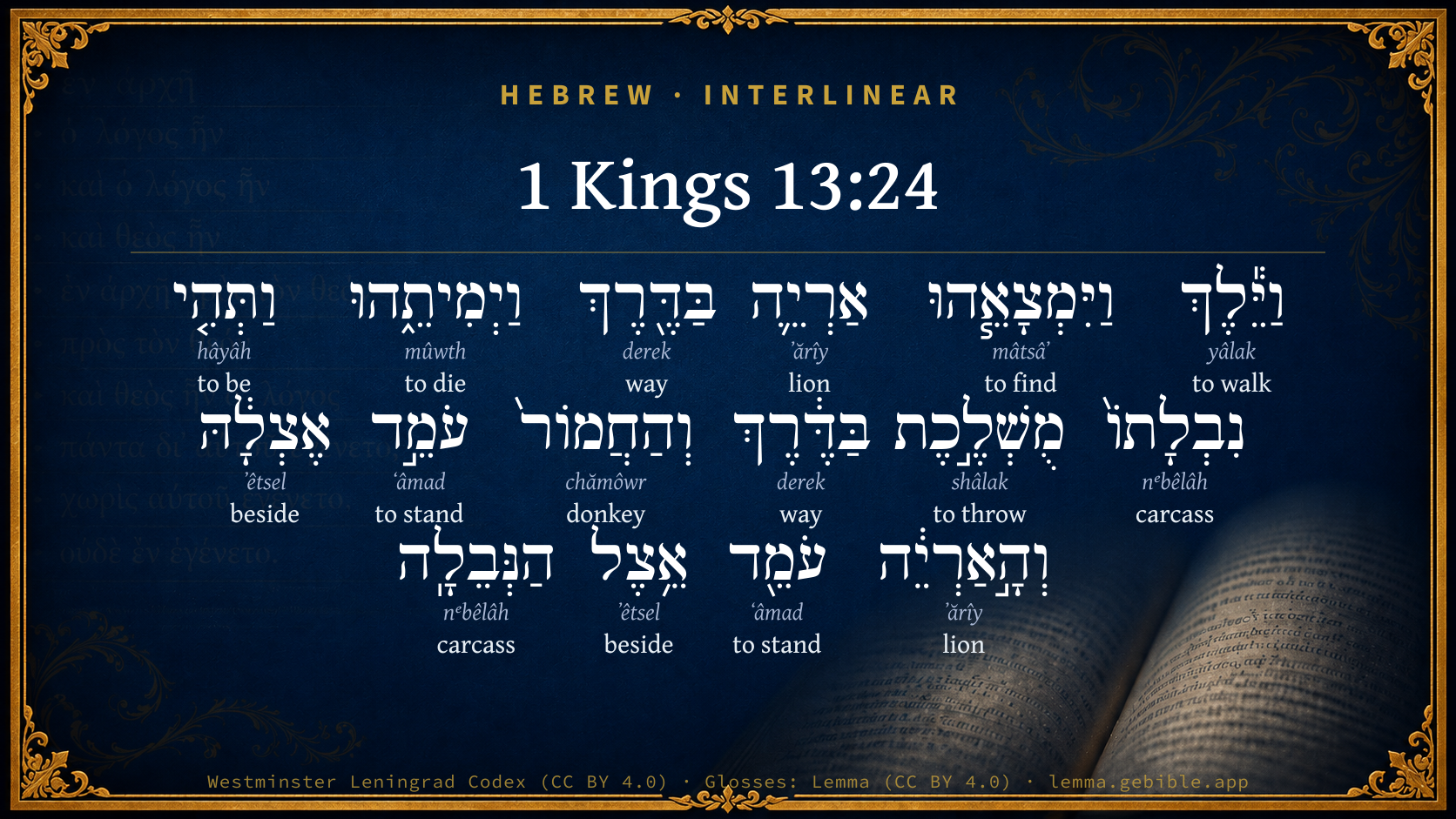
1 Kings 13:24

Hebrew (Westminster Leningrad Codex) 1 Kings 13:24 appears in the Hebrew Old Testament. The text above is from the Westminster Leningrad Codex. Each word links to its Strong’s number, a concise gloss, and parsing drawn from the Open Scriptures Hebrew Bible morphology. Click any word for its full Brown-Driver-Briggs (BDB) entry.
Download image
Cite this verse

1 Kings 13:24 (World English Bible). Public Domain. Lemma interlinear Bible study tool, https://lemma.gebible.app/v/1-kings/13/24.

Show BibTeX & RIS
BibTeX
RIS
English Translation
When he was gone, a lion met him by the way, and killed him: and his body was cast in the way, and the donkey stood by it; the lion also stood by the body.
World English Bible · Public Domain
Download a study sheet

One document with this verse’s original text, its word-by-word gloss line, the meaning frame, cross-references with their text, attributed commentary, and full source and license credits — printable, and it pastes into notes with its structure intact.

This verse Autodidact and up

Study sheet (.html) Plain text (.txt)

A passage Seminary Student

Up to 50 verses in one chapter. A passage sheet keeps up to 6 commentary sources and 12 cross-references per verse, in the order this page ranks them, and says so on the sheet whenever that leaves anything out. Ask for a single verse and you get the Autodidact verse sheet above.

Everything on this page stays free to read, with no account — the sheet is a download of what is already on screen, not access to it.

Want to remove ads? Support Godless Engineer
Compare translations 3

The same verse in 3 English versions, stacked beneath the original-language interlinear above. Click any original word for its lexicon entry.

Each is an independent rendering of the whole verse — the interlinear is not word-aligned to these translations.

Highlighted words mark where these versions differ — a whole-verse word diff, not a word-by-word alignment.

  • World English Bible Public Domain
    When he was gone, a lion met him by the way, and killed him: and his body was cast in the way, and the donkey stood by it; the lion also stood by the body.
  • King James Version Public Domain
    And when he was gone, a lion met him by the way, and slew him: and his carcass was cast in the way, and the ass stood by it, the lion also stood by the carcass.
  • unfoldingWord Literal Text CC BY-SA 4.0
    And he went, and a lion found him in the road, and it killed him. And his corpse was thrown on the road, and the donkey was standing beside it, and the lion was standing beside the corpse.

unfoldingWord Literal Text — © unfoldingWord, licensed CC BY-SA 4.0. Word-aligned USFM3 via Door43 (git.door43.org/unfoldingWord/en_ult).

Versions to compare (up to 4)

3 of 4 selected

Show all 18 translations

Every available English version of this verse, each an independent rendering of the whole verse.

  • World English Bible Public Domain
    When he was gone, a lion met him by the way, and killed him: and his body was cast in the way, and the donkey stood by it; the lion also stood by the body.
  • Berean Standard Bible Public Domain
    As he went on his way, a lion met him on the road and killed him, and his body was left lying in the road, with the donkey and the lion standing beside it.
  • Majority Standard Bible Public Domain
    As he went on his way, a lion met him on the road and killed him, and his body was left lying in the road, with the donkey and the lion standing beside it.
  • King James Version Public Domain
    And when he was gone, a lion met him by the way, and slew him: and his carcass was cast in the way, and the ass stood by it, the lion also stood by the carcass.
  • American Standard Version (1901) Public Domain
    And when he was gone, a lion met him by the way, and slew him: and his body was cast in the way, and the ass stood by it; the lion also stood by the body.
  • Revised Version (1885) Public Domain
    And when he was gone, a lion met him by the way, and slew him: and his carcase was cast in the way, and the ass stood by it; the lion also stood by the carcase.
  • Geneva Bible (1599) Public Domain
    And when hee was gone, a lion met him by the way, and slewe him, and his body was cast in the way, and the asse stoode thereby: the lion stood by the corps also.
  • Douay-Rheims (1899) Public Domain
    And when he was gone, a lion found him in the way, and killed him, and his body was cast in the way: and the ass stood by him, and the lion stood by the dead body.
  • Young's Literal Translation Public Domain
    and he goeth, and a lion findeth him in the way, and putteth him to death, and his carcase is cast in the way, and the ass is standing near it, and the lion is standing near the carcase.
  • Literal Standard Version CC BY-SA 4.0
    and he goes, and a lion finds him in the way, and puts him to death, and his carcass is cast in the way, and the donkey is standing near it, and the lion is standing near the carcass.
  • Unlocked Literal Bible CC BY-SA 4.0
    When the man of God was gone, a lion met him on the road and killed him, and his body was left on the road. Then the donkey stood by it, and the lion also stood by the body.
  • unfoldingWord Literal Text CC BY-SA 4.0
    And he went, and a lion found him in the road, and it killed him. And his corpse was thrown on the road, and the donkey was standing beside it, and the lion was standing beside the corpse.
  • Darby Bible Public Domain
    and he departed. And a lion met him by the way and slew him; and his corpse was cast in the way, and the ass stood by it; the lion also stood by the corpse.
  • World Messianic Bible Public Domain
    When he had gone, a lion met him by the way and killed him. His body was thrown on the path, and the donkey stood by it. The lion also stood by the body.
  • Webster's Bible Public Domain
    And when he had gone, a lion met him by the way, and slew him: and his carcass was cast in the way, and the ass stood by it, the lion also stood by the carcass.
  • Free Bible Version CC BY-SA 4.0
    But as he went on his way a lion came across him on the road and killed him. His body was left lying in the road, with both the donkey and the lion standing beside it.
  • Bible in Basic English Public Domain
    And he went on his way; but on the road a lion came rushing at him and put him to death; and his dead body was stretched in the road with the ass by its side, and the lion was there by the body.
  • JPS Tanakh (1917) Public Domain
    And when he was gone, a lion met him by the way, and slew him; and his carcass was cast in the way, and the ass stood by it; the lion also stood by the carcass.

Literal Standard Version (2020), Covenant Press — licensed CC BY-SA 4.0. Text via the HelloAO Bible API (eBible.org). Unlocked Literal Bible (unfoldingWord) — licensed CC BY-SA 4.0. Text via the HelloAO Bible API (eBible.org). unfoldingWord Literal Text — © unfoldingWord, licensed CC BY-SA 4.0. Word-aligned USFM3 via Door43 (git.door43.org/unfoldingWord/en_ult). Free Bible Version, Dr. Jonathan Gallagher — licensed CC BY-SA 4.0. Text via the HelloAO Bible API (eBible.org).

Word by word

More ways to search: Search by grammar → Find every occurrence → Compare this word →

Practice this passage: Drill this verse → Learn its vocabulary →

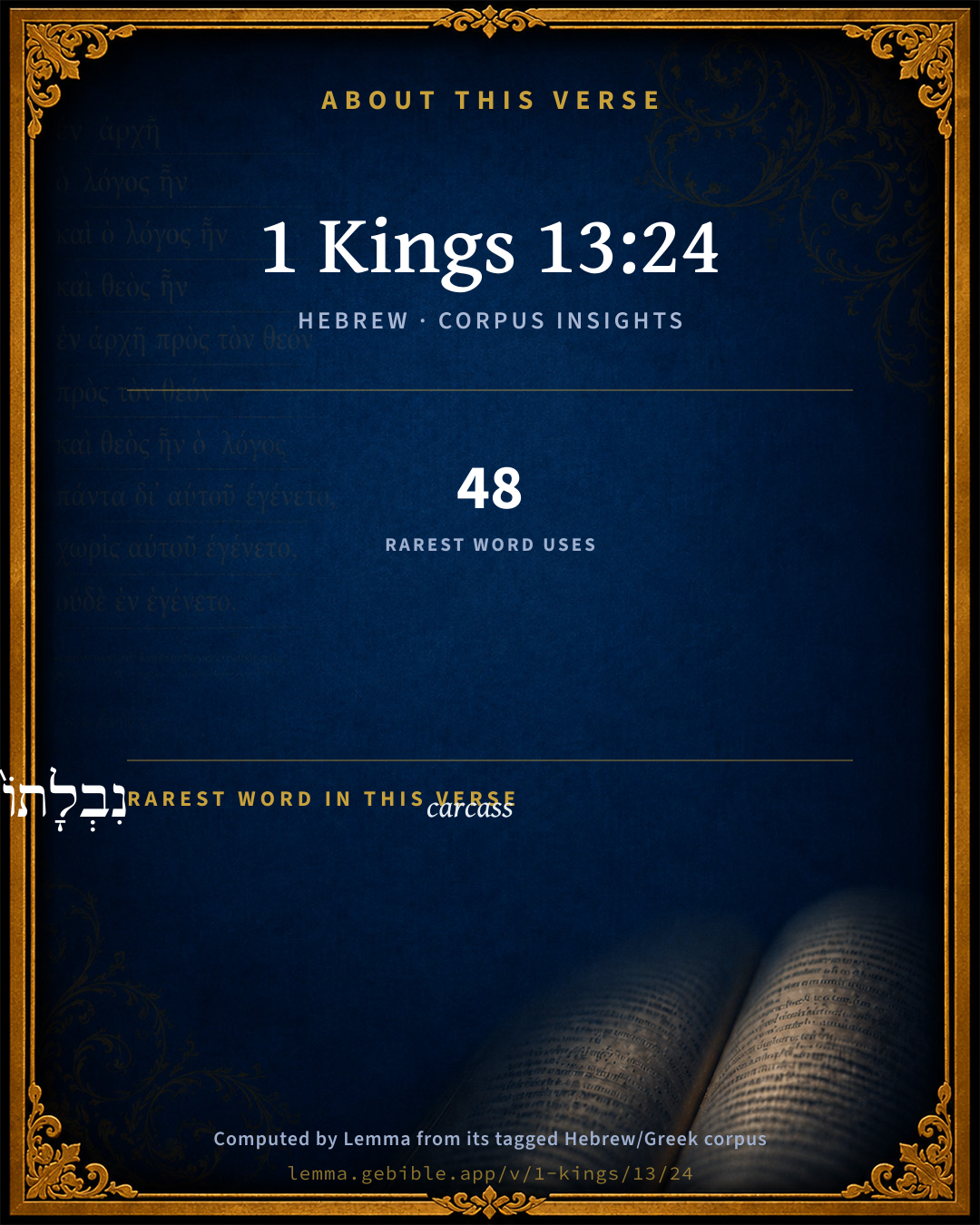
נִבְלָתוֹ֙
nᵉbêlâh
H5038
“carcass · his”
Noun, Common, Feminine, Singular, Construct + Suffix, Personal, 3rd Person, Masculine, Singular
Part of Speech
Noun
Type
Common
Gender
Feminine
Number
Singular
State
Construct
Full BDB Definition

Origin: from H5034

TWOT: 1286a

carcass, corpse - of humans, idols, animals
  1. וַיֵּ֕לֶךְ yâlak H3212 “and · to walk” Conjunction + Verb, Qal, Sequential Imperfect, 3rd Person, Masculine, Singular
  2. וַיִּמְצָאֵ֧הוּ mâtsâʼ H4672 “and · to find · him” Conjunction + Verb, Qal, Sequential Imperfect, 3rd Person, Masculine, Singular + Suffix, Personal, 3rd Person, Masculine, Singular
  3. אַרְיֵ֛ה ʼărîy H738 “lion” Noun, Common, Masculine, Singular, Absolute
  4. בַּדֶּ֖רֶךְ derek H1870 “in/at the · way” Preposition, Determined + Noun, Common, Both, Singular, Absolute
  5. וַיְמִיתֵ֑הוּ mûwth H4191 “and · to die · him” Conjunction + Verb, Hiphil, Sequential Imperfect, 3rd Person, Masculine, Singular + Suffix, Personal, 3rd Person, Masculine, Singular
  6. וַתְּהִ֤י hâyâh H1961 “and · to be” Conjunction + Verb, Qal, Sequential Imperfect, 3rd Person, Feminine, Singular
  7. מֻשְׁלֶ֣כֶת shâlak H7993 “thrown” Verb, Hophal, Participle Passive, Feminine, Singular, Absolute
  8. בַּדֶּ֔רֶךְ derek H1870 “in/at the · way” Preposition, Determined + Noun, Common, Both, Singular, Absolute
  9. וְהַחֲמוֹר֙ chămôwr H2543 “and · the · donkey” Conjunction + Particle, Definite Article + Noun, Common, Both, Singular, Absolute
  10. עֹמֵ֣ד ʻâmad H5975 “standing” Verb, Qal, Participle Active, Masculine, Singular, Absolute
  11. אֶצְלָ֔הּ ʼêtsel H681 “beside · her” Preposition + Suffix, Personal, 3rd Person, Feminine, Singular
  12. וְהָ֣אַרְיֵ֔ה ʼărîy H738 “and · the · lion” Conjunction + Particle, Definite Article + Noun, Common, Masculine, Singular, Absolute
  13. עֹמֵ֖ד ʻâmad H5975 “standing” Verb, Qal, Participle Active, Masculine, Singular, Absolute
  14. אֵ֥צֶל ʼêtsel H681 “beside” Preposition
  15. הַנְּבֵלָֽה nᵉbêlâh H5038 “the · carcass” Particle, Definite Article + Noun, Common, Feminine, Singular, Absolute

About this verse

These counts appear in no published source. They are computed here, from the morphology-tagged text and Lemma’s own curated glosses. What Lemma adds →

16
words
11
distinct lemmas
Historical
section

Shared distinctive vocabulary

נִבְלָתוֹ֙ carcass H5038 occurs in 41 verses of the Hebrew Bible. Also found in:

Grammatical profile

  • 7 verbs
  • 7 nouns
  • 2 prepositions

Verb forms

  • וַיֵּ֕לֶךְ Qal · Sequential Imperfect
  • וַיִּמְצָאֵ֧הוּ Qal · Sequential Imperfect
  • וַיְמִיתֵ֑הוּ Hiphil · Sequential Imperfect
  • וַתְּהִ֤י Qal · Sequential Imperfect
  • מֻשְׁלֶ֣כֶת Hophal · Participle Passive
  • עֹמֵ֣ד Qal · Participle Active
  • עֹמֵ֖ד Qal · Participle Active

Repetition

Words recur within this verse — often emphatic in Hebrew:

  • אַרְיֵ֛ה lion H738 ×2
  • בַּדֶּ֖רֶךְ way H1870 ×2
  • נִבְלָתוֹ֙ carcass H5038 ×2
  • עֹמֵ֣ד to stand H5975 ×2
  • אֶצְלָ֔הּ beside H681 ×2

Hebrew & Septuagint length

In English translation the verse runs 35 words from the Hebrew and 36 from the Septuagint (LXX English) — closely comparable.

A rough comparison of the two English renderings, which tokenize alike — not a word-level alignment.

Word counts can differ between the Hebrew and the Greek without any difference in meaning — e.g. the Hebrew direct-object marker אֵת has no separate Greek word, and Greek often adds the article ὁ.

Cross-references

7

Topical passages linked to 1 Kings 13:24 in the Treasury of Scripture Knowledge — connected by theme and wording, ordered by reader-vote popularity; previews shown in the World English Bible.

  • 1 Kings 20:36 Then said he to him, Because you have not obeyed the voice of Yahweh, behold, as soon as you are departed from me, a lion shall kill you. As soon as he was departed from him, a lion found him, and killed him.
  • 2 Kings 2:24 He looked behind him and saw them, and cursed them in the name of Yahweh. There came forth two she-bears out of the wood, and mauled forty-two lads of them.
  • Proverbs 22:13 The sluggard says, "There is a lion outside! I will be killed in the streets!"
  • Proverbs 26:13 The sluggard says, "There is a lion in the road! A fierce lion roams the streets!"
  • Amos 5:19 As if a man fled from a lion, And a bear met him; Or he went into the house and leaned his hand on the wall, And a snake bit him.
  • 1 Corinthians 11:31–32 For if we discerned ourselves, we wouldn't be judged.
  • 1 Peter 4:17–18 For the time has come for judgment to begin at the house of God. If it begins first with us, what will happen to those who don't obey the Gospel of God?

Cross-references courtesy of OpenBible.info (CC BY 4.0).

Hebrew and Greek witnesses Masoretic Hebrew ↔ Greek Septuagint

The same verse in the two great witnesses to the Old Testament, shown verse-for-verse.

These are two independent witnesses, not word-aligned to each other, and the Septuagint is shown in lemma (dictionary) form.

Hebrew 1 Kings 13:24 Masoretic · Westminster Leningrad Codex

וַיֵּ֕לֶךְ וַיִּמְצָאֵ֧הוּ אַרְיֵ֛ה בַּדֶּ֖רֶךְ וַיְמִיתֵ֑הוּ וַתְּהִ֤י נִבְלָתוֹ֙ מֻשְׁלֶ֣כֶת בַּדֶּ֔רֶךְ וְהַחֲמוֹר֙ עֹמֵ֣ד אֶצְלָ֔הּ וְהָ֣אַרְיֵ֔ה עֹמֵ֖ד אֵ֥צֶל הַנְּבֵלָֽה

When he was gone, a lion met him by the way, and killed him: and his body was cast in the way, and the donkey stood by it; the lion also stood by the body.

World English Bible · Public Domain

Greek LXX 1 Kings 13:24 Septuagint · lemma form

καί ἀποἔρχομαι καί εὑρίσκω αὐτός λέων ἐν ὁ ὁδός καί θανατόω αὐτός καί εἰμί ὁ σῶμα αὐτός ῥίπτω ἐν ὁ ὁδός καί ὁ ὄνος ἵστημι παρά αὐτός καί ὁ λέων ἵστημι παρά ὁ σῶμα

And a lion found him in the way, and killed him; and his body was cast out in the way, and the ass was standing by it, and the lion also was standing by the body.

LXX2012 (modern English Septuagint) · Public Domain

Hebrew: Westminster Leningrad Codex (CC BY 4.0). Greek: Septuagint (public domain); English from LXX2012 (modern English Septuagint) (Public Domain). How the Septuagint differs from the Hebrew →

Targum (Aramaic paraphrase)

1

The Targum is the ancient Jewish Aramaic paraphrase of the Hebrew Scriptures — an interpretive translation, not the Hebrew text itself. Onkelos (literal) and Pseudo-Jonathan (expansive) render the Torah, and Jonathan the Prophets. Coverage is partial: where no permissively-licensed English translation exists for a verse, only the Aramaic is shown. This is verse-level text, not a word-by-word alignment to the Hebrew.

  1. Targum Jonathan Prophets (Joshua–Malachi)
    וַאֲזַל וְאַשְׁכְּחֵיהּ אַרְיָא בְּאוֹרְחָא וְקַטְלֵיהּ וַהֲוַת נְבֵילְתֵּיהּ רַמְיָא בְאוֹרְחָא וַחֲמָרָא קָאִים לְקִבְלָא וְאַרְיָא קָאִים בִסְטַר נְבֵלְתָּא:

    (no public-domain English translation for this verse)

    Targum Jonathan — Aramaic: “Mikraot Gedolot” (public domain). English: “Sefaria Community Translation” (CC0 1.0 (public-domain dedication)); “London "Chaldee Paraphrase," 1871” (public domain). Text via Sefaria.

Commentary

Notes on 1 Kings 13:24 from classic Christian and Jewish commentators (each source and its license shown beneath its notes). The classic Christian expositions comment on the surrounding passage and are grouped to its opening verse, so a note may address several verses; the Jewish commentaries on the Tanakh (Rashi and others) are per-verse, so they appear only where the commentator wrote on this verse.

Lemma curates 59 commentaries, every one of them public domain or Creative Commons licensed, each selected and text-cleaned for this edition rather than reprinted as found. About our sources →

Trapp's Complete Commentary

John Trapp

1Ki 13:24 And when he was gone, a lion met him by the way, and slew him: and his carcase was cast in the way, and the ass stood by it, the lion also stood by the carcase.

Ver. 24. A lion met him by the way, and slew him.] Oh, the severity of God against sin in his very own! Neither can all their obedience bear out one disobedience, against a particular express command especially, as in our first parents, Moses, Jonas, &c., may be seen. Abhor therefore that which is evil, {Rom 12:9} and fear Almighty God - as those mongrels did {2Ki 17:33} - if but for his lions. The Bethelites might well see in this dreadful execution how much God abhorred them, and easily forsee what heavy judgments would be inflicted upon them for their abominable idolatries. See 1Pe 4:17 Eze 24:24.

And his carcass was cast in the way.] Not devoured by that ravenous beast, whose mouth was by God both opened to slay the prophet, and again shut, to show his power, dum praedae factus est praedae suae custos, while the lion becomes a guardian to the prophet whom he had slain, and a means to make the ass stay there in a readiness to bear his dead master to the burial. Who seeth not in all this an overruling command, and sweet providence of God, such as is still frequently seen in permitting and restraining the rage of unreasonable men?

The lion also stood by the carcass.] His not meddling with the carcass, as his nature inclined him, showed that God sent him. So when men can deny themselves in doing God service, &c.

John Trapp, A Commentary or Exposition upon All the Books of the Old and New Testament (1647–1656) — public domain. Text from a community e-Sword module.

The Biblical Illustrator

Joseph S. Exell

1Ki_13:24

And when he was gone, a lion met him by the way, and slew him.

A sharp punishment accords

But, surely, to be slain by a lion on the way home was a much too sharp punishment for taking ones supper with a prophet and an angel; uneasy conscience and all. But then, some sins, says that noble piece, the Westminster Larger Catechism, receive their aggravation from the persons offending; if they be of riper age, greater experience in grace, eminent for profession, gifts, place, office, and as such are guides to others, and whose example is likely to be followed by others. The very case, to the letter, of the man of God out of Judah. The sublimity of his public services that morning had henceforth set up a corresponding standard for his private life. And this is one of our best compensations for preaching the grace of God and the law of Christ. Our office quickens our conscience; it makes the law cut deeper and deeper into us every day; and it compels us to a public and private life we would otherwise have escaped. Preaching recoils with terrible strokes on the preacher. It curtails his liberty in a most tyrannous way; it tracks him through all his life in a most remorseless manner. Think it out well, and count the cost before you become minister, or an elder, or a Sabbath School teacher, or a young communicant. Yes, it was surely a little sin, if ever there was a little sin, to sup that Sabbath night at an old prophets table, and that, too, on the invitation of an angel (A. Whyte, D. D.)

The Biblical Illustrator, edited by Joseph S. Exell (c. 1880s–1900s) — public domain. Text from a community e-Sword module.

Geneva Bible (1599)

Geneva Bible translators

By this fearful example, God setteth forth how dangerous a thing it is for men to behave themselves coldly, or deceitfully in their charge whereunto God hath called them.

Geneva Bible (1599) marginal notes — public domain. Text via Bolls.life.

Jamieson, Fausset & Brown

Robert Jamieson, A. R. Fausset & David Brown

THE DISOBEDIENT PROPHET SLAIN BY A LION. (Kg1 13:23-32)

a lion met him by the way, and slew him--There was a wood near Beth-el infested with lions (Kg2 2:24). This sad catastrophe was a severe but necessary judgment of God, to attest the truth of the message with which the prophet had been charged. All the circumstances of this tragic occurrence (the undevoured carcass, the untouched ass, the passengers unmolested by the lion, though standing there) were calculated to produce an irresistible impression that the hand of God was in it.

Jamieson, Fausset & Brown — Commentary Critical and Explanatory on the Whole Bible (1871) — public domain (CC PDM 1.0). Text via the HelloAO Bible API.

Adam Clarke's Commentary

Verse 24. A lion met him - and slew him] By permitting himself to be seduced by the old prophet, when he should have acted only on the expressly declared counsel of God, he committed the sin unto death; that is, such a sin as God will punish with the death of the body, while he extends mercy to the soul. See my notes on 1Jo 5:16-17.

From the instance here related, we see, as in various other cases, that often judgment begins at the house of God. The true prophet, for receiving that as a revelation from God which was opposed to the revelation which himself had received, and which was confirmed by so many miracles, is slain by a lion, and his body deprived of the burial of his fathers; while the wicked king, and the old fallen prophet, are both permitted to live! If this was severity to the man of God, it was mercy to the others, neither of whom was prepared to meet his judge. Here we may well say, "If the righteous scarcely be saved, where shall the ungodly and the sinner appear?"

Adam Clarke's Commentary on the Bible (1810–1826) — public domain. Text from a community e-Sword/MySword module.

Ellicott's Commentary for English Readers

(24) A lion.—The lion is noticed in the Old Testament not unfrequently, especially in Southern Palestine: at Timnath (Jdg_14:5); near Bethlehem (1Sa_17:34); at Kabzeel, in Judah (2Sa_23:20); near Aphek (1Ki_20:36); in the thickets and forests of the Jordan valley (Jer_4:7; Jer_5:6), &c. The lion of Palestine is probably of the variety still constantly found in the neighbourhood of Babylon; and the prevalence of lions is shown by the occurrence of such names as Lebaoth, or Bethlebaoth, “the house of lions” (see Jos_15:32), and by the many names for the lion used in Scripture, as, for example, in Job_4:10-11. Now that the forests have disappeared from Palestine the lions have disappeared with them.

A Bible Commentary for English Readers, edited by Charles John Ellicott (1878–1897) — public domain. Text from a community e-Sword module.

The Cambridge Bible for Schools and Colleges

gen. ed. J. J. S. Perowne

24. a lion met him] That beasts of prey were common in the land at this time we may see from the history of the shepherd life of David, where he encountered both a lion and a bear (1Sa_17:34). The death of the prophet was caused by a stroke of the beast’s paw, but to shew that it was a visitation of the Lord, the natural instinct of the lion to devour what it has slain is checked, and instead of tearing the body, it stands by it as a guard.

The Cambridge Bible for Schools and Colleges (gen. ed. J. J. S. Perowne; Cambridge University Press, 1878–1918) — public domain. Text from a community e-Sword module.

John Gill's Exposition

And when the prophet that brought him back from the way heard thereof,.... The old prophet, that had deceived him, by telling him a lie:

he said, it is the man of God, who was disobedient unto the word of the Lord; but not a syllable does he say of his own sin in deceiving him; though one would think his own conscience must smite him for it:

therefore the Lord hath delivered him unto the lion, which hath torn him, and slain him, according to the word of the Lord, which he spake unto him; and that by himself, Kg1 13:21.

John Gill's Exposition of the Whole Bible (1746–1763) — public domain (CC PDM 1.0). Text via the HelloAO Bible API.

Haydock's Catholic Bible Commentary

Killed him. Thus the Lord often punishes his servants here, that he may spare them hereafter. For the generality of divines[theologians] are of opinion, that the sin of this prophet, considered with all its circumstances, was not mortal. (Challoner) --- He had received a positive order, and ought to have tried spirits, whether they were from God, 1 John iv. 1., and Galatians vi. 18. Every prophecy which contradicts the word of God, comes from an evil principle. (Calmet) --- The prophet might suppose, however, that some cause had intervened, which authorized him to eat with this his brother, (ver. 30.) whom he probably revered as a true prophet. Many of God’s commands are conditional. (Haydock) --- Serenus observes, that God often inflicts death for the smallest faults. (Cassian vii. 26.) (St. Gregory, Dial. iv. 24.) --- St. Augustine (cura, c. 7.) doubts not of the prophet’s salvation. --- Body, without even hurting the ass, ver. 28. (Haydock) --- God protected the relics of his servant, by stationing the lion for a guard. (Procopius) (Menochius) --- How impenetrable are the counsels of God! He suffers Jeroboam, and the prophet who had seduced his servant, to live; while he punishes the latter for a fault which he had committed undesignedly. But he thus purified him from guilt, (Calmet) while he reserved Jeroboam for more lasting torments in another world. (Haydock) --- Nothing could prove more forcibly the existence of future rewards and punishments. (Calmet) --- Not only the deceiver, but he also who is deceived, so as to transgress God’s orders, must be punished. (Worthington)

George Leo Haydock (1774–1849), Haydock's Catholic Family Bible and Commentary, 1859 edition — public domain. Excludes Psalms (Douay-Rheims chapter numbering differs from Protestant) and Deuterocanonical books (Catholic canon only).

Matthew Poole's English Annotations

A lion met him; for there were many lions in Judea, and this was brought hither by God’s special providence.

Why doth God punish a good man so severely for so small an offence?

Answ. First, His sin was not small, for it was a gross disobedience to a positive command.

Object. But he supposed, and was told by another prophet, that God had repealed his command, and so was deceived.

Answ. First, He had no sufficient discharge from the former command; for he neither was assured that the old man was a prophet, nor that the message he delivered was from God; but had reason to suspect the contrary, or at least to inquire the mind of God in this doubtful point, which he grossly neglected to do, and willingly believed the message, because it suited with his own inclination and necessity. Add to this, that he being a prophet was obliged to the greater exactness in obedience to all God’s precepts; and therefore this sin was much greater in him than in another, because hereby God was dishonoured, and the authority and success of his message blasted, and Jeroboam and the idolatrous Israelites hardened in their wicked courses, for the prevention whereof it was necessary that God should exercise severity towards him.

Answ. Secondly, As his sin was not so small, so his punishment was not so great, as may be imagined. For as to his outward man, his bodily death (which was a debt that he owed to God and nature) in this way was not so painful and terrible as many other kinds of death; and as to his soul, God, by giving him a gracious admonition both of his sin and danger, 1Ki 13:21,22, awakened him to true repentance, which doubtless he practised, and so was prepared for his death, and by this sudden death freed from all the miseries of an evil time and world, and speedily let into eternal glory.

Answ. Thirdly, As the world and all men in it were made for God’s glory, and all their lives and deaths ought to be laid out in his service; so it cannot seem strange nor harsh if God should bring his deserved death upon him in this manner, for the accomplishment of his own glorious designs, as to vindicate his own honour and justice from the imputation of partiality; to assure the truth of his predictions, and thereby provoke Jeroboam and his idolatrous followers to repentance; to justify himself in all his dreadful judgments which he intended to inflict upon Jeroboam’s house, and the whole kingdom of Israel, for their cursed apostacy; and to warn all succeeding sinners not rashly to venture upon small sins, and especially to take heed of greater sins, for which they might expect far sorer punishments.

His carcass was cast in the way; his life and soul being gone, his dead body falls to the ground, and lies there.

The lion also stood by the carcass: See Poole "1Ki 13:28".

Matthew Poole's English Annotations on the Holy Bible (1683–1685) — public domain. Text from a community e-Sword/MySword module.

The Pulpit Commentary

And when he was gone Heb. and he went, a lion (Lions were evidently numerous in Palestine in former days, though they are now extinct. This is proved by the names of places, such as Laish, Lebaoth, etc., and by the constant reference to them in Scripture. They had their lairs in the forests, one of which existed near Bethel, (2Ki_2:24) and especially in the thickets of the Jordan valley (Jer_49:19; Zec_11:3) met Heb. found. The primary meaning of axm is, no doubt, "found accidentally," "came upon" (eu=ren, invenit), but it is often used of finding after a search, (1Sa_9:4, etc.) and it should be remembered that this is the word used in vers. 14, 28 him by in, as below the way, and slew him: and his carcase was cast in the way road, highway, ver. 25, and the ass stood Heb. standing by it, the lion also stood standing by the carcase. These particulars are mentioned to show that his death was no accident, or chance, but a visitation of God. There are probably but few persons who have not felt that this summary punishment was marked by extreme severity; the more so, as the prophet was cruelly deceived, and that by a brother prophet, who claimed to have received a subsequent revelation, and whom, consequently, it appeared to be a duty to obey. And when it is observed that the really guilty person, the prophet of Bethel, so far as appears, escaped all punishment, and by his lie secured for himself respect for his remains, we seem to have a case of positive hardship and injustice. As I have discussed the question at some length elsewhere (Homil. Quart., vol. 4. pp. 214-221), it must suffice to say here that the difficulty is at once removed if we remember that although the Jewish dispensation was one of temporal recompenses, yet all the same there is a judgment hereafter. No doubt the man of God was punished for his disobedience, for inexcusable disobedience it was. It is quite true that he was solemnly assured that an angel had appeared to revoke his commission, but for this he had only the word of a stranger, of one, too, with whom he had been commanded "not even to eat." He had "the word of the Lord;" that is to say, the voice of God, borne in upon his soul, forbidding his return, and the word of an irreligious stranger, who gave no "sign the same day" in proof of his mission, authorizing it. There can be no doubt which he ought to have followed, the more so as the command he had himself received was so remarkably explicit and decisive (ver. 9); so decisive that we can hardly suppose he would have deviated from it, had not the pains of hunger and thirst pleaded powerfully in favour of the pretended revelation of the Bethelite prophet. Indeed, it is hardly too much to say that he eagerly welcomed this cause for returning. It is impossible, therefore, to acquit him of disobedience. Nor is it difficult to see that the consequences of this disobedience were serious. It was not as if he had disregarded a mere positive obligation, the only object of which was to test his obedience (Rawlinson); he had acted in a way calculated to destroy the moral effect of his mission. He had been employed not only to testify publicly against the calf worship, but also to lay the city and the new sanctuary of Jeroboam under an interdict, and by his return that interdict lost much of its force. His eating and drinking, small matters in themselves, were full of significance. Indeed, he did in one way precisely what Jeroboam and his people were doing in another he forsook the plain commands of God for the ordinances of men; he listened to the tempter and ate the forbidden fruit; and so it came to pass flint, instead of witnessing against disobedience, he himself set them the example of disobedience. It is the story of the Fall over again; and therefore death, the punishment of the Fall, befell him. But before we say that his punishment was too severe, let us remember what, by the mercy of God, that primal punishment has become. It has been turned into a blessing. It has given us the incarnation, redemption, eternal life. We forget that death is not necessarily an evil is in reality a blessing. One of the heathen has said that if we only knew what the future life was like, we should not be content to live. To this "man of God" it must surely have been gain to die. If the flesh was destroyed, it was that the spirit might be saved. (1Co_5:5) Only because we forget that death is the gate of life do we complain of the severity of his doom. And as to the lying prophet who wrought all this mischief escaping retribution which, by the way, he did not do, for assuredly he must have had a life-long remorse it is overlooked that the day of retribution has not yet arrived. There is for him a judgment to come. It may he said that the Jew did not know of this that the future life had not then been revealed. That is quite true, and for that very reason this visitation would make all the deeper impression on their minds. To this must be added that the man of God did not die merely or principally because of his sin, but "that the works of God might be made manifest in him." His death was necessary in order that his mission might not be altogether invalidated. His miserable end as it must have seemed to them would surely speak to the inhabitants of Bethel and to all Israel and Judah, for long years to come, as to the sure vengeance awaiting the disobedient, whether king, prophet, priest, or people. Though dead "he cried against the altar of Bethel." And the sacred narrative (vers. 26-32) affords us some ground for hoping that the "old prophet" became penitent for his sin. It is noteworthy that he joins his testimony to that of the man of God. Thus, this tragedy extorted even from him a warning against disobedience (ver. 26), and a confirmation of the prophecy against the altar of Bethel (ver. 32).

The Pulpit Commentary (1880–1919), ed. H.D.M. Spence-Jones & Joseph S. Exell — public domain. Text from a community e-Sword module.

John Wesley's Explanatory Notes

Slew him - "But why doth God punish a good man so severely for so small an offense?" His sin was not small, for it was a gross disobedience to a positive command. And it cannot seem strange if God should bring his deserved death upon him in this manner, for the accomplishment of his own glorious designs, to vindicate his own justice from the imputation of partiality; to assure the truth of his predictions, and thereby provoke Jeroboam and his idolatrous followers to repentance; and to justify himself in all his dreadful judgments which he intended to inflict upon Jeroboam's house, and the whole kingdom of Israel.

John Wesley, Explanatory Notes Upon the Whole Bible (1754–1765) — public domain. Text via the GEBible commentary corpus.

Lesson kit

Teaching starters — assembled from the data on this page, not authored interpretation. Every prompt links to the verse data it draws on. Edit before teaching.

1 Kings, in the Historical, opens this verse with 16 words (11 distinct Hebrew lemmas). Its most distinctive word is nᵉbêlâh (“carcass”). A historical commentator’s framing appears above. Read the whole chapter for the surrounding context.

Discussion questions

  1. The word nᵉbêlâh carries the sense “carcass.” How does it shape the verse?
  2. How does Leviticus 5:2, which shares the word «carcass», read alongside this verse?
  3. What does the repetition of “lion” (2× in this one verse) do in this verse?
  4. These translations render this verse differently. What is at stake in choosing one wording over another?
  5. «וַיֵּ֕לֶךְ» is a Qal Sequential Imperfect verb. How does that grammatical form shape the action described?
  6. Compare how Trapp's Complete Commentary and The Biblical Illustrator read this verse. Where do they agree or differ?

Things to notice

Reading settings

Reading text

Shown beneath each verse's original-language words.

Old Testament
Old Testament edition

Read the OT as the Masoretic Hebrew (MT) or the Greek Septuagint (LXX).

English shown for the Greek Septuagint (in the Hebrew ↔ Greek comparison).

Comparing translations? Open the Compare panel on any verse page to stack up to four side by side.