
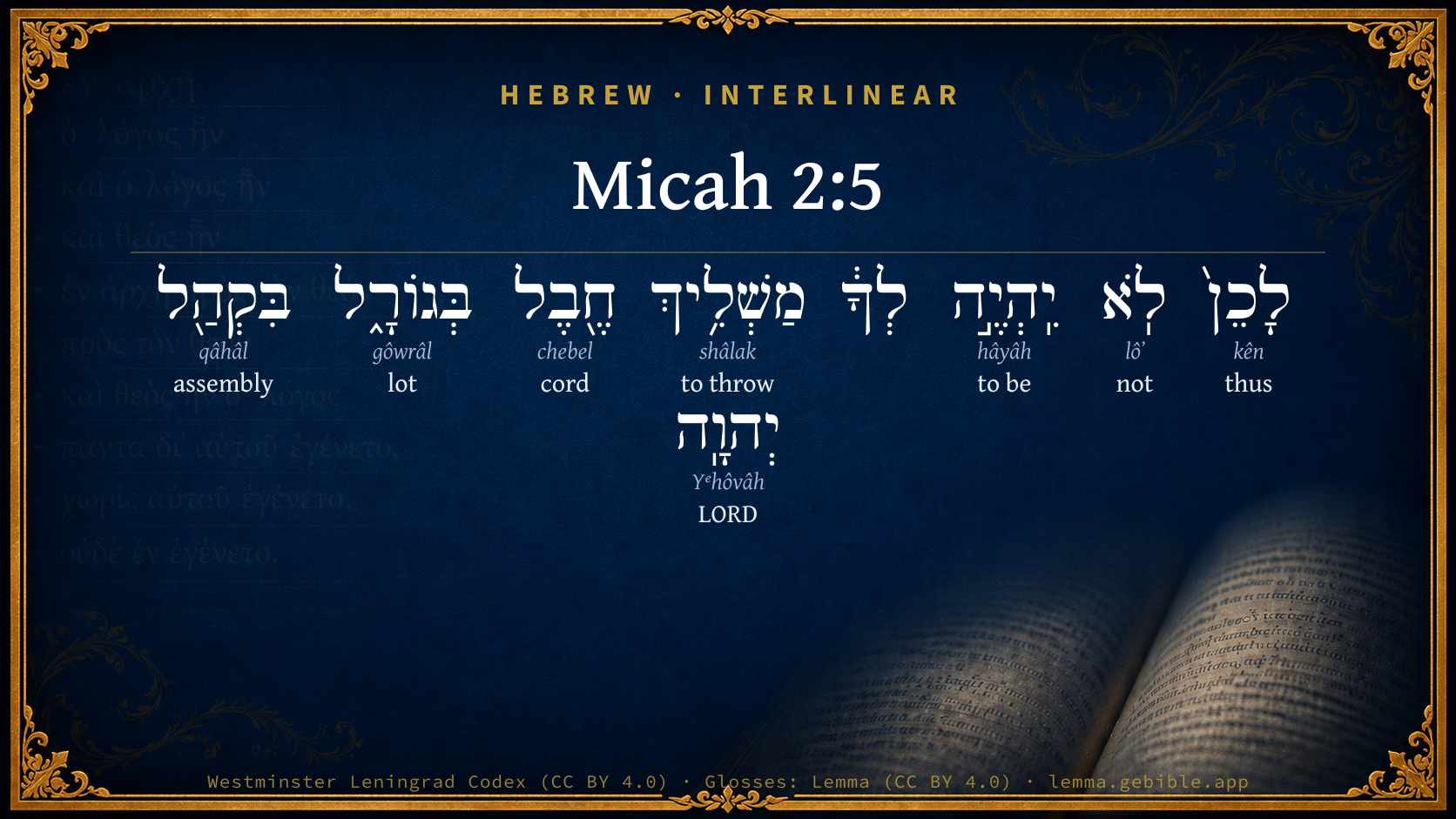
Micah 2:5

Hebrew (Westminster Leningrad Codex) Micah 2:5 appears in the Hebrew Old Testament. The text above is from the Westminster Leningrad Codex. Each word links to its Strong’s number, a concise gloss, and parsing drawn from the Open Scriptures Hebrew Bible morphology. Click any word for its full Brown-Driver-Briggs (BDB) entry.
Download image
Cite this verse

Micah 2:5 (World English Bible). Public Domain. Lemma interlinear Bible study tool, https://lemma.gebible.app/v/micah/2/5.

Show BibTeX & RIS
BibTeX
RIS
English Translation
Therefore you will have no one who divides the land by lot in the assembly of Yahweh.
World English Bible · Public Domain
Download a study sheet

One document with this verse’s original text, its word-by-word gloss line, the meaning frame, cross-references with their text, attributed commentary, and full source and license credits — printable, and it pastes into notes with its structure intact.

This verse Autodidact and up

Study sheet (.html) Plain text (.txt)

A passage Seminary Student

Up to 50 verses in one chapter. A passage sheet keeps up to 6 commentary sources and 12 cross-references per verse, in the order this page ranks them, and says so on the sheet whenever that leaves anything out. Ask for a single verse and you get the Autodidact verse sheet above.

Everything on this page stays free to read, with no account — the sheet is a download of what is already on screen, not access to it.

Want to remove ads? Support Godless Engineer
Compare translations 3

The same verse in 3 English versions, stacked beneath the original-language interlinear above. Click any original word for its lexicon entry.

Each is an independent rendering of the whole verse — the interlinear is not word-aligned to these translations.

Highlighted words mark where these versions differ — a whole-verse word diff, not a word-by-word alignment.

  • World English Bible Public Domain
    Therefore you will have no one who divides the land by lot in the assembly of Yahweh.
  • King James Version Public Domain
    Therefore thou shalt have none that shall cast a cord by lot in the congregation of the LORD.
  • unfoldingWord Literal Text CC BY-SA 4.0
    Therefore there will not be for you one casting a measuring line by lot in the assembly of Yahweh.

unfoldingWord Literal Text — © unfoldingWord, licensed CC BY-SA 4.0. Word-aligned USFM3 via Door43 (git.door43.org/unfoldingWord/en_ult).

Versions to compare (up to 4)

3 of 4 selected

Show all 18 translations

Every available English version of this verse, each an independent rendering of the whole verse.

  • World English Bible Public Domain
    Therefore you will have no one who divides the land by lot in the assembly of Yahweh.
  • Berean Standard Bible Public Domain
    Therefore, you will have no one in the assembly of the LORD to divide the land by lot.
  • Majority Standard Bible Public Domain
    Therefore, you will have no one in the assembly of the LORD to divide the land by lot.
  • King James Version Public Domain
    Therefore thou shalt have none that shall cast a cord by lot in the congregation of the LORD.
  • American Standard Version (1901) Public Domain
    Therefore thou shalt have none that shall cast the line by lot in the assembly of Jehovah.
  • Revised Version (1885) Public Domain
    Therefore thou shalt have none that shall cast the line by lot in the congregation of the LORD.
  • Geneva Bible (1599) Public Domain
    Therefore thou shalt haue none that shall cast a corde by lot in the Congregation of the Lord.
  • Douay-Rheims (1899) Public Domain
    Therefore thou shalt have none that shall cast the cord of a lot in the assembly of the Lord.
  • Young's Literal Translation Public Domain
    Therefore, thou hast no caster of a line by lot In the assembly of Jehovah.
  • Literal Standard Version CC BY-SA 4.0
    Therefore, you have no caster of a line by lot || In the assembly of YHWH.
  • Unlocked Literal Bible CC BY-SA 4.0
    Therefore, you rich people will have no descendants to divide up the territory by lot in the assembly of Yahweh.
  • unfoldingWord Literal Text CC BY-SA 4.0
    Therefore there will not be for you one casting a measuring line by lot in the assembly of Yahweh.
  • Darby Bible Public Domain
    Therefore thou shalt have none that shall cast the measuring line upon a lot, in the congregation of Jehovah.
  • World Messianic Bible Public Domain
    Therefore you will have no one who divides the land by lot in the LORD’s assembly.
  • Webster's Bible Public Domain
    Therefore thou shalt have none that shall cast a cord by lot in the congregation of the LORD.
  • Free Bible Version CC BY-SA 4.0
    Consequently at that time there will be none of you in the assembly of the Lord responsible for the division of the land.
  • Bible in Basic English Public Domain
    For this cause you will have no one to make the decision by the measuring line in the meeting of the Lord.
  • JPS Tanakh (1917) Public Domain
    Therefore thou shalt have none that shall cast the line by lot in the congregation of the LORD.

Literal Standard Version (2020), Covenant Press — licensed CC BY-SA 4.0. Text via the HelloAO Bible API (eBible.org). Unlocked Literal Bible (unfoldingWord) — licensed CC BY-SA 4.0. Text via the HelloAO Bible API (eBible.org). unfoldingWord Literal Text — © unfoldingWord, licensed CC BY-SA 4.0. Word-aligned USFM3 via Door43 (git.door43.org/unfoldingWord/en_ult). Free Bible Version, Dr. Jonathan Gallagher — licensed CC BY-SA 4.0. Text via the HelloAO Bible API (eBible.org).

Word by word

More ways to search: Search by grammar → Find every occurrence → Compare this word →

Practice this passage: Drill this verse → Learn its vocabulary →

About this verse

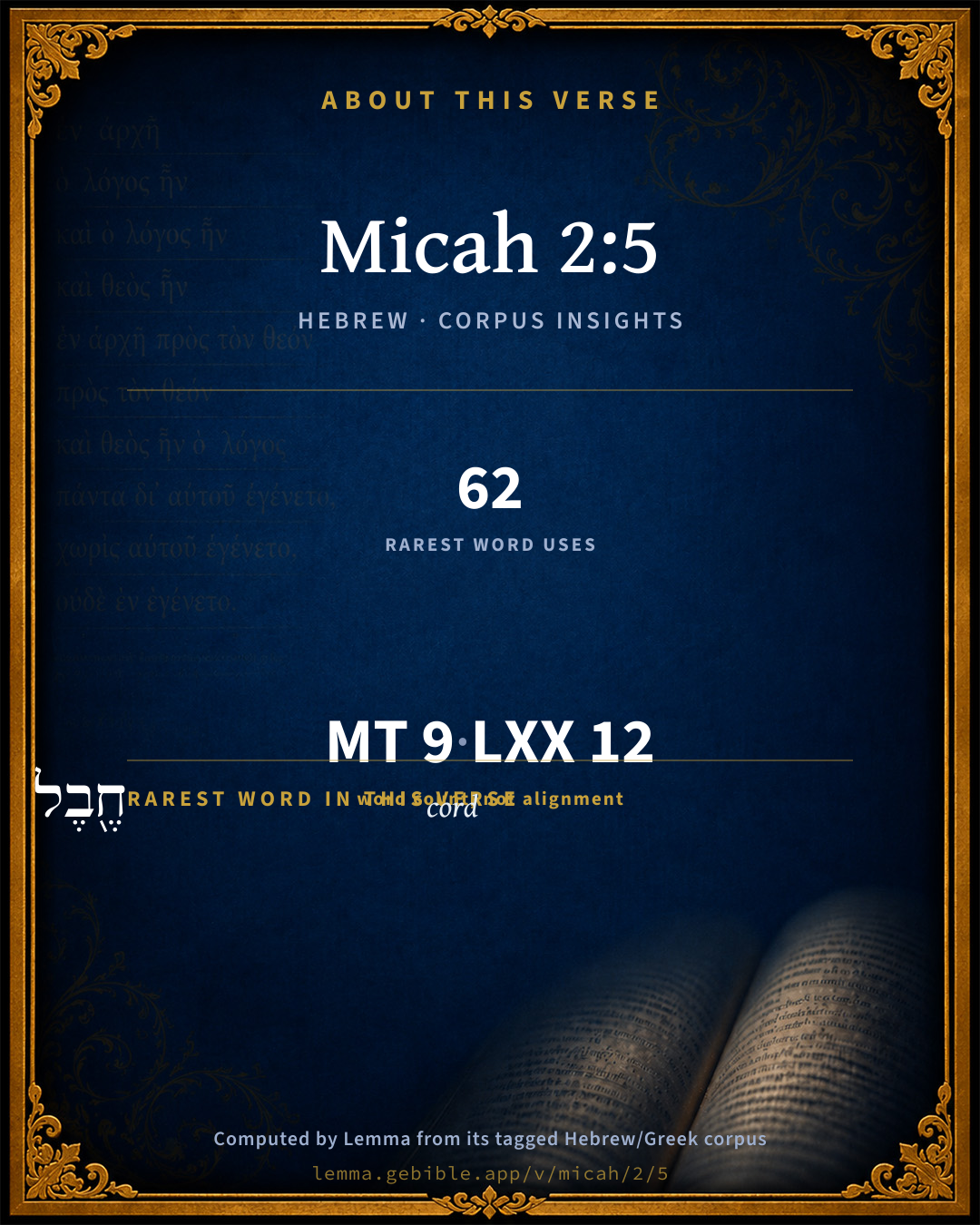
These counts appear in no published source. They are computed here, from the morphology-tagged text and Lemma’s own curated glosses. What Lemma adds →

9
words
8
distinct lemmas
Prophets
section

Grammatical profile

  • 2 verbs
  • 4 nouns
  • 1 preposition
  • 1 adverb
  • 1 particle

Verb forms

  • יִֽהְיֶ֣ה Qal · Imperfect
  • מַשְׁלִ֥יךְ Hiphil · Participle Active

Hebrew & Septuagint length

In English translation the verse runs 17 words from the Hebrew and 13 from the Septuagint (LXX English) — closely comparable.

A rough comparison of the two English renderings, which tokenize alike — not a word-level alignment.

Word counts can differ between the Hebrew and the Greek without any difference in meaning — e.g. the Hebrew direct-object marker אֵת has no separate Greek word, and Greek often adds the article ὁ.

In the original languages it is 9 Hebrew tokens and 12 Greek tokens — but the two are counted differently (Hebrew bundles its prefixes and suffixes into one token; the Greek is in lemma form), so that isn’t a like-for-like length.

Cross-references

8

Topical passages linked to Micah 2:5 in the Treasury of Scripture Knowledge — connected by theme and wording, ordered by reader-vote popularity; previews shown in the World English Bible.

  • Deuteronomy 32:8 When the Most High gave to the nations their inheritance, When he separated the children of men, He set the bounds of the peoples According to the number of the children of Israel.
  • Joshua 18:4 Appoint for you three men of each tribe: and I will send them, and they shall arise, and walk through the land, and describe it according to their inheritance; and they shall come to me.
  • Joshua 18:10 Joshua cast lots for them in Shiloh before Yahweh: and there Joshua divided the land to the children of Israel according to their divisions.
  • Deuteronomy 23:2 A bastard shall not enter into the assembly of Yahweh; even to the tenth generation shall none of his enter into the assembly of Yahweh.
  • Deuteronomy 23:8 The children of the third generation who are born to them shall enter into the assembly of Yahweh.
  • Nehemiah 7:61 These were those who went up from Tel-melah, Tel Harsha, Cherub, Addon, and Immer; but they could not show their fathers' houses, nor their seed, whether they were of Israel:
  • Psalms 16:6 The lines have fallen to me in pleasant places. Yes, I have a good inheritance.
  • Hosea 9:3 They won't dwell in Yahweh's land; But Ephraim will return to Egypt, And they will eat unclean food in Assyria.

Cross-references courtesy of OpenBible.info (CC BY 4.0).

Hebrew and Greek witnesses Masoretic Hebrew ↔ Greek Septuagint

The same verse in the two great witnesses to the Old Testament, shown verse-for-verse.

These are two independent witnesses, not word-aligned to each other, and the Septuagint is shown in lemma (dictionary) form.

Hebrew Micah 2:5 Masoretic · Westminster Leningrad Codex

לָכֵן֙ לֹֽא יִֽהְיֶ֣ה לְךָ֔ מַשְׁלִ֥יךְ חֶ֖בֶל בְּגוֹרָ֑ל בִּקְהַ֖ל יְהוָֽה

Therefore you will have no one who divides the land by lot in the assembly of Yahweh.

World English Bible · Public Domain

Greek LXX Micah 2:5 Septuagint · lemma form

διά οὗτος οὐ εἰμί σύ βάλλω σχοινίον ἐν κλῆρος ἐν ἐκκλησία κύριος

Therefore you shall have no one to cast a line for the lot.

LXX2012 (modern English Septuagint) · Public Domain

Hebrew: Westminster Leningrad Codex (CC BY 4.0). Greek: Septuagint (public domain); English from LXX2012 (modern English Septuagint) (Public Domain). How the Septuagint differs from the Hebrew →

Targum (Aramaic paraphrase)

1

The Targum is the ancient Jewish Aramaic paraphrase of the Hebrew Scriptures — an interpretive translation, not the Hebrew text itself. Onkelos (literal) and Pseudo-Jonathan (expansive) render the Torah, and Jonathan the Prophets. Coverage is partial: where no permissively-licensed English translation exists for a verse, only the Aramaic is shown. This is verse-level text, not a word-by-word alignment to the Hebrew.

  1. Targum Jonathan Prophets (Joshua–Malachi)
    בְּכֵן לָא יְהֵי לָךְ מְתַח חוּט מְשַׁח בְּעַדְבָא בִּקְהָלָא דַיָי:

    (no public-domain English translation for this verse)

    Targum Jonathan — Aramaic: “Mikraot Gedolot” (public domain). English: “Sefaria Community Translation” (CC0 1.0 (public-domain dedication)); “London "Chaldee Paraphrase," 1871” (public domain). Text via Sefaria.

Commentary

Notes on Micah 2:5 from classic Christian and Jewish commentators (each source and its license shown beneath its notes). The classic Christian expositions comment on the surrounding passage and are grouped to its opening verse, so a note may address several verses; the Jewish commentaries on the Tanakh (Rashi and others) are per-verse, so they appear only where the commentator wrote on this verse.

Lemma curates 59 commentaries, every one of them public domain or Creative Commons licensed, each selected and text-cleaned for this edition rather than reprinted as found. About our sources →

Trapp's Complete Commentary

John Trapp

Mic 2:5 Therefore thou shalt have none that shall cast a cord by lot in the congregation of the LORD.

Ver. 5. Therefore thou shalt have none that shall cast a cord by lot] Fields were divided with cords of old, and inheritances also. See Psa 16:5; Psa 105:11; Psa 78:55 2Sa 8:2. This hope is henceforth cut off from revolted Israel; the ten tribes never returned, the other two did, and some few of the ten among them. Whether upon their conversion to Christ they shall be restored to the promised land, Time, the mother of Truth, will make manifest.

In the congregation of the Lord] So you were once, but now nothing less. A congregation ye are still, but of malignants; a rabble of rebels conspiring against heaven. A name ye have to live, but ye are dead; ye cry out Templum Domini, The temple of the Lord are we; but in truth ye are no better than those Egyptian temples, beautiful without, but within nothing to be seen but a cat, rat, or some such despicable creature. Here they are called the congregation of the Lord by an irony, as the Cardinal of Ravenna is so called by way of derision.

John Trapp, A Commentary or Exposition upon All the Books of the Old and New Testament (1647–1656) — public domain. Text from a community e-Sword module.

Geneva Bible (1599)

Geneva Bible translators

Ye shall have no more lands to divide as you had in times past, and as you used to measure them in the Jubilee.

Geneva Bible (1599) marginal notes — public domain. Text via Bolls.life.

Jamieson, Fausset & Brown

Robert Jamieson, A. R. Fausset & David Brown

Therefore--resumed from Mic 2:3. On account of your crimes described in Mic 2:1-2.

thou--the ideal individual ("me," Mic 2:4), representing the guilty people in whose name he spoke.

none that . . . cast a cord by lot--none who shall have any possession measured out.

in the congregation of the Lord--among the people consecrated to Jehovah. By covetousness and violence (Mic 2:2) they had forfeited "the portion of Jehovah's people." This is God's implied answer to their complaint of injustice (Mic 2:4).

Jamieson, Fausset & Brown — Commentary Critical and Explanatory on the Whole Bible (1871) — public domain (CC PDM 1.0). Text via the HelloAO Bible API.

Adam Clarke's Commentary

Verse 5. None that shall cast a cord] You will no more have your inheritance divided to you by lot, as it was to your fathers; ye shall neither have fields nor possessions of any kind.

Adam Clarke's Commentary on the Bible (1810–1826) — public domain. Text from a community e-Sword/MySword module.

John Calvin's Commentaries

Here the Prophet concludes his discourse respecting God’s design to cleanse Judea from its perverse and wicked inhabitants, that it might no longer be the inheritance of one people. For the land, we know, had been given to the posterity of Abraham, on the condition, that it was to be held by them as an heritage: and we also know, that a line was determined by lot whenever the year of Jubilee returned, that every one might regain his own possession. The Prophet now testifies that this advantage would be taken away from the Jews, and that they would hereafter possess the land by no hereditary right; for God, who had given it, would now take it away.

There shall not then be one to cast a line by lot in the assembly of Jehovah. And he seems here to touch the Jews, by calling them the assembly of Jehovah. He indeed adopted them, they were the people of God: but he intimates that they were repudiated, because they had rendered themselves unworthy of his favor. He therefore, by calling them ironically the assembly of Jehovah, denies that they rightly retained this name, inasmuch as they had deprived themselves of this honor and dignity. It now follows —

John Calvin's Commentaries (1540-1563) — public domain. Text from the Calvin Translation Society English edition (1840s-50s) via the Christian Classics Ethereal Library (ccel.org). Calvin's coverage is partial (roughly two-thirds of the Bible); uncommented books and verses are honest gaps, never fabricated. The 19th-century editor's footnotes and remarks are omitted so the notes are faithfully Calvin's own voice.

Ellicott's Commentary for English Readers

(5) Thou shalt have none . . .—i.e., thou shalt have no part or inheritance in the congregation of the Lord—apparently referring to the ancient division of the land by lot.

A Bible Commentary for English Readers, edited by Charles John Ellicott (1878–1897) — public domain. Text from a community e-Sword module.

The Cambridge Bible for Schools and Colleges

gen. ed. J. J. S. Perowne

5. Therefore thou shall have none, &c.] Because the Israelites have violated the divinely sanctioned law of land-tenure, ‘therefore’ they shall have no future opportunity of redistributing the soil in accordance with equity. And this, because the ‘congregation of Jehovah,’ from which such a redistribution should proceed, is itself about to be dissolved.

that shall cast a cord by lot] Rather, that shall cast the measuring-line upon a lot (i.e. an allotment); alluding to the original distribution of Canaan by lot. Of course, the redistribution of the land in the year of Jubilee was governed, not by lot, but by regard for the old family-rights; still the primitive term ‘lot’ held its ground (so Psa_16:5; Psa_125:3).

The Cambridge Bible for Schools and Colleges (gen. ed. J. J. S. Perowne; Cambridge University Press, 1878–1918) — public domain. Text from a community e-Sword module.

John Gill's Exposition

Therefore thou shalt have none that shall cast a cord by lot,.... This confirms what was before delivered in a parabolical way, and as a lamentation; and is spoken either to the false prophet, as Kimchi; who should not be, nor have any posterity to inherit by lot the land of Israel; or to those oppressors that took away houses and fields from others, these should have no part nor lot in the land any more; or rather to the whole, people of Israel, who should no more inherit their land after their captivity, as they have not to this day. The allusion is to the distribution of the land by lot, and the dividing of it by a cord or line, as in Joshua's time; but now there should be no land in the possession of Israelites to be divided among them; nor any people to divide it to, being scattered up and down in the world, and so no need of any person to be employed in such service; nor any sanhedrim or court of judicature to apply unto for a just and equal division and distribution, who perhaps may be meant in the next clause:

in the congregation of the Lord; unless this is to be understood of the body of the people, who were formerly called the congregation of the Lord, Deu 23:1; though now they had forfeited this character, and are only called so ironically, as some think. Aben Ezra interprets it, when the Lord returns the captivity of his people; and so Kimchi, who applies it to the false prophet, as before observed, who at this time should have no part nor lot in the land.

John Gill's Exposition of the Whole Bible (1746–1763) — public domain (CC PDM 1.0). Text via the HelloAO Bible API.

Albert Barnes' Notes on the Bible

Therefore thou shalt have none that shall east a cord by lot in the congregation of the Lord - Thou, in the first instance, is the impenitent Jew of that day. God had promised by Hosea to restore Judah; shortly after, the prophet himself foretells it Mic 2:12. Now he forewarns these and such as these, that they would have no portion in it. They had “neither part nor lot in this matter” Act 8:21. They, the not-Israel then, were the images and ensamples of the not-Israel afterward, those who seem to be God’s people and are not; members of the body, not of the soul of the Church; who have a sort of faith, but have not love. Such was afterward the Israel after the flesh, which was broken off, while the true Israel was restored, passing out of themselves into Christ. Such, at the end, shall be those, who, being admitted by Christ into “their portion,” renounce the world in word not in deed. Such shall have “no portion forever “in the congregation of the Lord.” For “nothing defiled shall enter there, nor whatsoever worketh abomination or a lie, but they which are written in the Lamb’s book of life” Rev 21:27.

The ground of their condemnation is their resistance to light and known truth. These not only “entered not in” Luk 11:52, themselves, but, being hinderers of God’s word, them that were entering in, they hindered.

Albert Barnes' Notes on the Bible (1834–1885) — public domain. Text from a community e-Sword/MySword module.

Haydock's Catholic Bible Commentary

None. Thou shalt have no longer any lot or inheritance in the land of the people of the Lord. (Challoner) --- Strangers had taken possession. (Calmet) --- Virgil has the like affecting thoughts. (Eclogues i.) Impius hæc tam culta novalia miles habebit? (Haydock)

George Leo Haydock (1774–1849), Haydock's Catholic Family Bible and Commentary, 1859 edition — public domain. Excludes Psalms (Douay-Rheims chapter numbering differs from Protestant) and Deuterocanonical books (Catholic canon only).

Matthew Poole's English Annotations

Therefore; because your sins, so great, universal, and incorrigible, have provoked God to frame and design this desolation against you, and because he will punish you according to your ways.

Thou; either oppressor, spoken thus as to one, that it might comprehend every one of them, who are described Mic 2:2, or else this thou is the whole family, spoken of Mic 2:3; perhaps both these may best be meant here.

None that shall cast a cord by lot; none that shall ever return to this land, to claim an inheritance there, or to see it allotted by line, and given to them to possess it. The prophet here alludes to the manner of dividing fields and inheritance of old in use among them, as in Joshua’s time. So both the whole family in general, and the great ones, oppressors and extortioners, are more particularly menaced with an utter and perpetuated exclusion out of the land in which they sinned, and whence they are carried captives; whoever do, neither they, nor their posterity, shall possess inheritances in it.

In the congregation of the Lord; they should no more be the congregation of the Lord, nor should their children be so, or stand in the congregation of the Lord at any time hereafter, to claim their portion among God’s people. Thus they are rejected and disinherited, and this to this day is verified on the main body of this people.

Matthew Poole's English Annotations on the Holy Bible (1683–1685) — public domain. Text from a community e-Sword/MySword module.

The Pulpit Commentary

Therefore thou. BECAUSE thou, the tyrannical, oppressive grandee (vers. 1, 2), hast dealt with thy neighbour"s land unjustly, therefore thou shalt have none that shall cast a cord (the line) by lot ( for a lot); i.e. thou shalt have no more inheritance in Israel. The "line" is the measuring line used in dividing land, as Amo_7:17. The reference is to the original distribution of the land by lot in Joshua"s time. (see Jos_14:2, etc.) In the congregation of the Lord. The Lord"s own people, whose polity was now about to be dissolved. Hitzig, Reuss, and Orelli suppose that this verse contains a threat against Micah himself on the part of the ungodly Jews, intimating that they will punish him for presuming to prophesy against them, and that he shall die without leaving children. But this seems far fetched and inadmissible.

The Pulpit Commentary (1880–1919), ed. H.D.M. Spence-Jones & Joseph S. Exell — public domain. Text from a community e-Sword module.

John Wesley's Explanatory Notes

Thou shalt have - None that shall ever return to this land, to see it allotted by line and given them to possess it. In the congregation - They shall no more be the congregation of the Lord, nor their children after them.

John Wesley, Explanatory Notes Upon the Whole Bible (1754–1765) — public domain. Text via the GEBible commentary corpus.

Keil & Delitzsch

C. F. Keil & F. Delitzsch

"Therefore wilt thou have none to cast a measure for the lot in the congregation of Jehovah." With lâkhēn (therefore) the threat, commenced with lâkhēn in Mic 2:3, is resumed and applied to individual sinners. The whole nation is not addressed in לך, still less the prophet, as Hitzig supposes, but every individual among the tyrannical great men (Mic 2:1, Mic 2:2). The singular is used instead of the plural, to make the address more impressive, that no one may imagine that he is excepted from the threatened judgment. For a similar transition from the plural to the singular, see Mic 3:10. The expression, to cast the measure begōrâl, i.e., in the nature of a lot (equivalent to for a lot, or as a lot), may be explained on the ground that the land was divided to the Israelites by lot, and then the portion that fell to each tribe was divided among the different families by measure. The words are not to be taken, however, as referring purely to the future, as Caspari supposes, i.e., to the time when the promised land would be divided afresh among the people on their return. For even if the prophet does proclaim in Mic 2:12, Mic 2:13 the reassembling of Israel and its restoration to its hereditary land, this thought cannot be arbitrarily taken for granted here. We therefore regard the words as containing a general threat, that the ungodly will henceforth receive no further part in the inheritance of the Lord, but that they are to be separated from the congregation of Jehovah.

Keil & Delitzsch — Biblical Commentary on the Old Testament (1861–1891) — public domain (CC PDM 1.0). Text via the HelloAO Bible API. (Old Testament only.)

Rashi

Rabbi Shlomo Yitzchaki (Rashi)

who casts a line Divides a heritage. It is customary to divide a heritage with a measuring line.

Rashi on the Tanakh — English translations: “The Judaica Press complete Tanach with Rashi, translated by A. J. Rosenberg” (CC BY 4.0); “Pentateuch with Rashi's commentary by M. Rosenbaum and A.M. Silbermann, 1929-1934” (public domain); “The Metsudah Tanach series, Lakewood, N.J” (CC BY 4.0); and “The Book of Joshua, Metsudah Publications, 1997” (CC BY 4.0). Text via Sefaria.

Lesson kit

Teaching starters — assembled from the data on this page, not authored interpretation. Every prompt links to the verse data it draws on. Edit before teaching.

Micah, in the Prophets, opens this verse with 9 words (8 distinct Hebrew lemmas). Its most distinctive word is chebel (“cord”). A historical commentator’s framing appears above. Read the whole chapter for the surrounding context.

Discussion questions

  1. How does “cord” (chebel) shape what this verse is saying?
  2. How does Deuteronomy 32:8, which shares this passage’s theme, read alongside this verse?
  3. These translations render this verse differently; the difference is in the English rendering, not the original. What questions does that raise?
  4. «יִֽהְיֶ֣ה» is a Qal Imperfect verb. How does that grammatical form shape the action described?
  5. Compare how Trapp's Complete Commentary and Geneva Bible (1599) read this verse. Where do they agree or differ?

Things to notice

Reading settings

Reading text

Shown beneath each verse's original-language words.

Old Testament
Old Testament edition

Read the OT as the Masoretic Hebrew (MT) or the Greek Septuagint (LXX).

English shown for the Greek Septuagint (in the Hebrew ↔ Greek comparison).

Comparing translations? Open the Compare panel on any verse page to stack up to four side by side.