
2 Chronicles 25:12

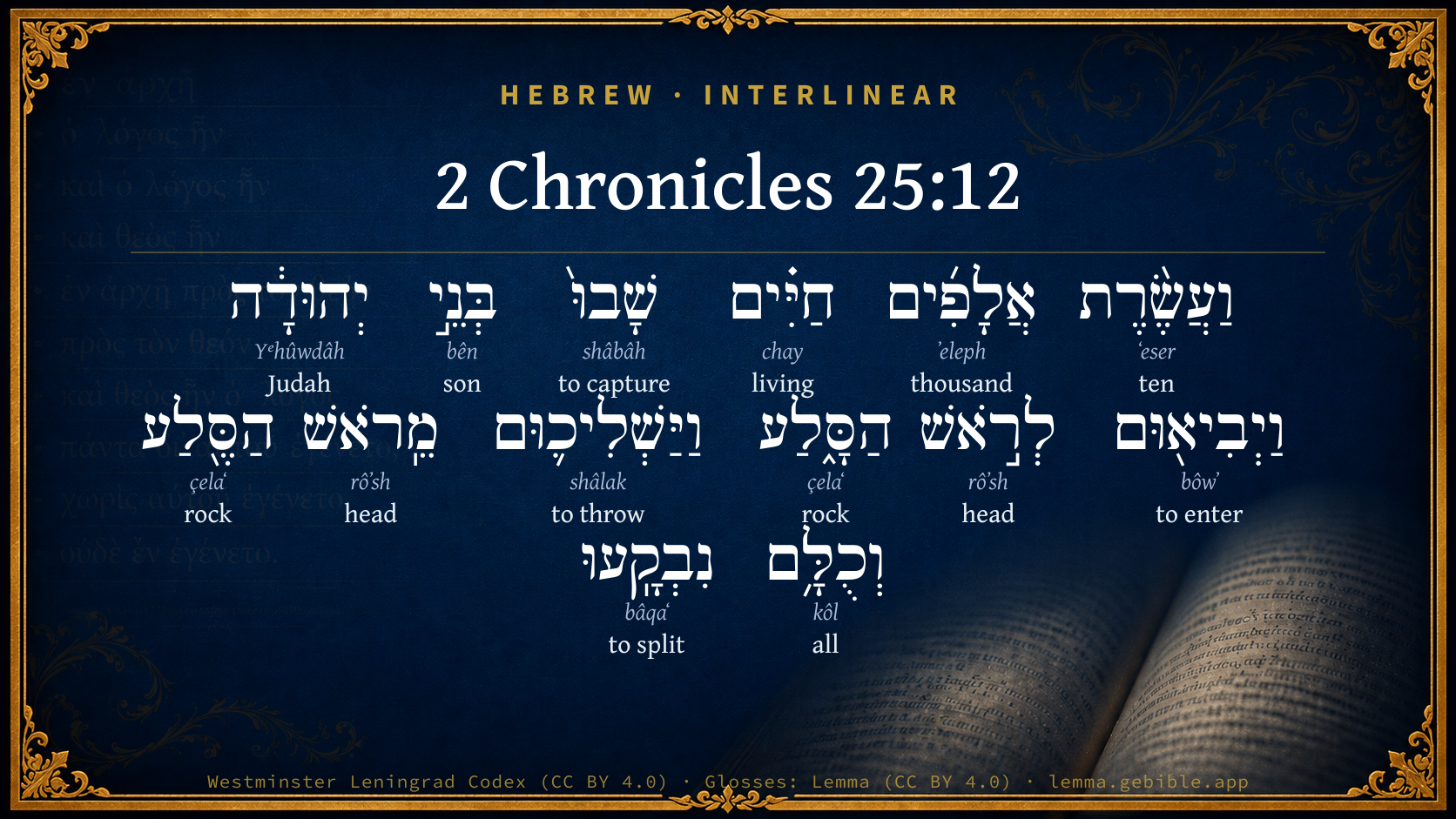
Hebrew (Westminster Leningrad Codex) 2 Chronicles 25:12 appears in the Hebrew Old Testament. The text above is from the Westminster Leningrad Codex. Each word links to its Strong’s number, a concise gloss, and parsing drawn from the Open Scriptures Hebrew Bible morphology. Click any word for its full Brown-Driver-Briggs (BDB) entry.
Download image
Cite this verse

2 Chronicles 25:12 (World English Bible). Public Domain. Lemma interlinear Bible study tool, https://lemma.gebible.app/v/2-chronicles/25/12.

Show BibTeX & RIS
BibTeX
RIS
English Translation
[other] ten thousand did the children of Judah carry away alive, and brought them to the top of the rock, and cast them down from the top of the rock, so that they all were broken in pieces.
World English Bible · Public Domain
Download a study sheet

One document with this verse’s original text, its word-by-word gloss line, the meaning frame, cross-references with their text, attributed commentary, and full source and license credits — printable, and it pastes into notes with its structure intact.

This verse Autodidact and up

Study sheet (.html) Plain text (.txt)

A passage Seminary Student

Up to 50 verses in one chapter. A passage sheet keeps up to 6 commentary sources and 12 cross-references per verse, in the order this page ranks them, and says so on the sheet whenever that leaves anything out. Ask for a single verse and you get the Autodidact verse sheet above.

Everything on this page stays free to read, with no account — the sheet is a download of what is already on screen, not access to it.

Want to remove ads? Support Godless Engineer
Compare translations 3

The same verse in 3 English versions, stacked beneath the original-language interlinear above. Click any original word for its lexicon entry.

Each is an independent rendering of the whole verse — the interlinear is not word-aligned to these translations.

Highlighted words mark where these versions differ — a whole-verse word diff, not a word-by-word alignment.

  • World English Bible Public Domain
    [other] ten thousand did the children of Judah carry away alive, and brought them to the top of the rock, and cast them down from the top of the rock, so that they all were broken in pieces.
  • King James Version Public Domain
    And other ten thousand left alive did the children of Judah carry away captive, and brought them unto the top of the rock, and cast them down from the top of the rock, that they all were broken in pieces.
  • unfoldingWord Literal Text CC BY-SA 4.0
    And 10,000 alive the sons of Judah took captive. And they brought them to the head of the cliff, and they threw them from the head of the cliff. And all of them were dashed to pieces.

unfoldingWord Literal Text — © unfoldingWord, licensed CC BY-SA 4.0. Word-aligned USFM3 via Door43 (git.door43.org/unfoldingWord/en_ult).

Versions to compare (up to 4)

3 of 4 selected

Show all 18 translations

Every available English version of this verse, each an independent rendering of the whole verse.

  • World English Bible Public Domain
    [other] ten thousand did the children of Judah carry away alive, and brought them to the top of the rock, and cast them down from the top of the rock, so that they all were broken in pieces.
  • Berean Standard Bible Public Domain
    and the army of Judah also captured 10,000 men alive. They took them to the top of a cliff and threw them down so that all were dashed to pieces.
  • Majority Standard Bible Public Domain
    and the army of Judah also captured 10,000 men alive. They took them to the top of a cliff and threw them down so that all were dashed to pieces.
  • King James Version Public Domain
    And other ten thousand left alive did the children of Judah carry away captive, and brought them unto the top of the rock, and cast them down from the top of the rock, that they all were broken in pieces.
  • American Standard Version (1901) Public Domain
    And `other' ten thousand did the children of Judah carry away alive, and brought them unto the top of the rock, and cast them down from the top of the rock, so that they all were broken in pieces.
  • Revised Version (1885) Public Domain
    And other ten thousand did the children of Judah carry away alive, and brought them unto the top of the rock, and cast them down from the top of the rock, that they all were broken in pieces.
  • Geneva Bible (1599) Public Domain
    And other ten thousand did the children of Iudah take aliue, and caryed them to the top of a rocke, and cast them downe from the top of the rocke, and they all burst to pieces.
  • Douay-Rheims (1899) Public Domain
    And other ten thousand men the sons of Juda took, and brought to the steep of a certain rock, and cast them down headlong from the top, and they all were broken to pieces.
  • Young's Literal Translation Public Domain
    And ten thousand alive have the sons of Judah taken captive, and they bring them to the top of the rock, and cast them from the top of the rock, and all of them have been broken.
  • Literal Standard Version CC BY-SA 4.0
    And the sons of Judah have taken captive ten thousand alive, and they bring them to the top of the rock, and cast them from the top of the rock, and all of them have been broken.
  • Unlocked Literal Bible CC BY-SA 4.0
    The army of Judah carried away alive another ten thousand. They took them to the top of the cliff and threw them down from there, so that they were all broken in pieces.
  • unfoldingWord Literal Text CC BY-SA 4.0
    And 10,000 alive the sons of Judah took captive. And they brought them to the head of the cliff, and they threw them from the head of the cliff. And all of them were dashed to pieces.
  • Darby Bible Public Domain
    And the children of Judah took ten thousand captive, alive, and brought them to the top of the cliff, and cast them down from the top of the cliff, so that they all were broken in pieces.
  • World Messianic Bible Public Domain
    The children of Judah carried away ten thousand alive, and brought them to the top of the rock, and threw them down from the top of the rock, so that they all were broken in pieces.
  • Webster's Bible Public Domain
    And other ten thousand left alive the children of Judah carried away captive, and brought them to the top of the rock, and cast them down from the top of the rock, that they were all broken in pieces.
  • Free Bible Version CC BY-SA 4.0
    The army of Judah also captured another ten thousand, took them to the top of a cliff and threw them off, killing them all.
  • Bible in Basic English Public Domain
    And ten thousand more the children of Israel took living, and made them go up to the top of the rock, pushing them down from the top of the rock so that their bodies were broken by the fall.
  • JPS Tanakh (1917) Public Domain
    And other ten thousand did the children of Judah carry away alive, and brought them unto the top of the Rock, and cast them down from the top of the Rock, that they all were broken in pieces.

Literal Standard Version (2020), Covenant Press — licensed CC BY-SA 4.0. Text via the HelloAO Bible API (eBible.org). Unlocked Literal Bible (unfoldingWord) — licensed CC BY-SA 4.0. Text via the HelloAO Bible API (eBible.org). unfoldingWord Literal Text — © unfoldingWord, licensed CC BY-SA 4.0. Word-aligned USFM3 via Door43 (git.door43.org/unfoldingWord/en_ult). Free Bible Version, Dr. Jonathan Gallagher — licensed CC BY-SA 4.0. Text via the HelloAO Bible API (eBible.org).

Word by word

More ways to search: Search by grammar → Find every occurrence → Compare this word →

Practice this passage: Drill this verse → Learn its vocabulary →

שָׁבוּ֙
shâbâh
H7617
“to capture”
Verb, Qal, Perfect, 3rd Person, Common, Plural
Part of Speech
Verb
Stem
Qal
Form
Perfect
Person
3rd Person
Gender
Common
Number
Plural
Full BDB Definition

Origin: a primitive root

TWOT: 2311

to take captive - (Qal) - to take captive - captive (participle) - to lead captive - (Niphal) to be taken captive
  1. וַעֲשֶׂ֨רֶת ʻeser H6235 “and · ten” Conjunction + Adjective, Cardinal number, Masculine, Singular, Construct
  2. אֲלָפִ֜ים ʼeleph H505 “thousand” Adjective, Cardinal number, Both, Plural, Absolute
  3. חַיִּ֗ים chay H2416 “living” Adjective, Adjective, Masculine, Plural, Absolute
  4. בְּנֵ֣י bên H1121 “sons of” Noun, Common, Masculine, Plural, Construct
  5. יְהוּדָ֔ה Yᵉhûwdâh H3063 “Judah” Noun, Proper
  6. וַיְבִיא֖וּם bôwʼ H935 “and · to enter · them” Conjunction + Verb, Hiphil, Sequential Imperfect, 3rd Person, Masculine, Plural + Suffix, Personal, 3rd Person, Masculine, Plural
  7. לְרֹ֣אשׁ rôʼsh H7218 “to/for · head of” Preposition + Noun, Common, Masculine, Singular, Construct
  8. הַסָּ֑לַע çelaʻ H5553 “the · rock” Particle, Definite Article + Noun, Common, Masculine, Singular, Absolute
  9. וַיַּשְׁלִיכ֛וּם shâlak H7993 “and · to throw · them” Conjunction + Verb, Hiphil, Sequential Imperfect, 3rd Person, Masculine, Plural + Suffix, Personal, 3rd Person, Masculine, Plural
  10. מֵֽרֹאשׁ rôʼsh H7218 “from · head of” Preposition + Noun, Common, Masculine, Singular, Construct
  11. הַסֶּ֖לַע çelaʻ H5553 “the · rock” Particle, Definite Article + Noun, Common, Masculine, Singular, Absolute
  12. וְכֻלָּ֥ם kôl H3605 “and · all · their” Conjunction + Noun, Common, Masculine, Singular, Construct + Suffix, Personal, 3rd Person, Masculine, Plural
  13. נִבְקָֽעוּ bâqaʻ H1234 “to split” Verb, Niphal, Perfect, 3rd Person, Common, Plural

About this verse

These counts appear in no published source. They are computed here, from the morphology-tagged text and Lemma’s own curated glosses. What Lemma adds →

14
words
12
distinct lemmas
Historical
section

Shared distinctive vocabulary

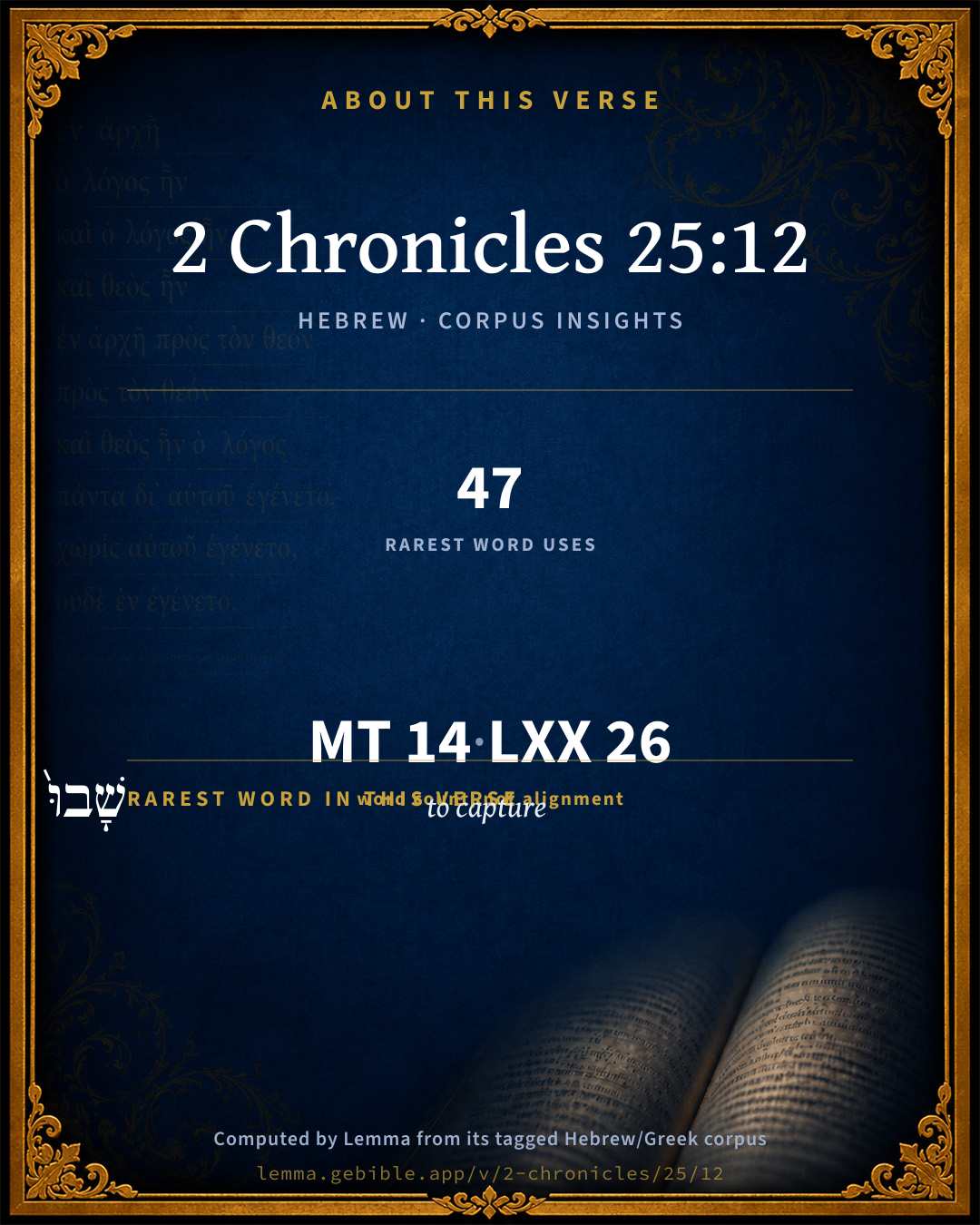
שָׁבוּ֙ to capture H7617 occurs in 42 verses of the Hebrew Bible. Also found in:

Grammatical profile

  • 4 verbs
  • 7 nouns
  • 3 adjectives

Verb forms

  • שָׁבוּ֙ Qal · Perfect
  • וַיְבִיא֖וּם Hiphil · Sequential Imperfect
  • וַיַּשְׁלִיכ֛וּם Hiphil · Sequential Imperfect
  • נִבְקָֽעוּ Niphal · Perfect

Repetition

Words recur within this verse — often emphatic in Hebrew:

  • לְרֹ֣אשׁ head H7218 ×2
  • הַסָּ֑לַע rock H5553 ×2

Hebrew & Septuagint length

In English translation the verse runs 38 words from the Hebrew and 36 from the Septuagint (LXX English) — closely comparable.

A rough comparison of the two English renderings, which tokenize alike — not a word-level alignment.

Word counts can differ between the Hebrew and the Greek without any difference in meaning — e.g. the Hebrew direct-object marker אֵת has no separate Greek word, and Greek often adds the article ὁ.

In the original languages it is 14 Hebrew tokens and 26 Greek tokens — but the two are counted differently (Hebrew bundles its prefixes and suffixes into one token; the Greek is in lemma form), so that isn’t a like-for-like length.

Cross-references

4

Topical passages linked to 2 Chronicles 25:12 in the Treasury of Scripture Knowledge — connected by theme and wording, ordered by reader-vote popularity; previews shown in the World English Bible.

  • 2 Chronicles 20:10 Now, behold, the children of Ammon and Moab and Mount Seir, whom you would not let Israel invade, when they came out of the land of Egypt, but they turned aside from them, and didn't destroy them;
  • 2 Samuel 12:31 He brought forth the people who were therein, and put them under saws, and under harrows of iron, and under axes of iron, and made them pass through the brick kiln: and thus did he to all the cities of the children of Ammon. David and all the people returned to Jerusalem.
  • 1 Chronicles 20:3 He brought forth the people who were therein, and cut [them] with saws, and with harrows of iron, and with axes. Thus did David to all the cities of the children of Ammon. David and all the people returned to Jerusalem.
  • 2 Chronicles 21:8–10 In his days Edom revolted from under the hand of Judah, and made a king over themselves.

Cross-references courtesy of OpenBible.info (CC BY 4.0).

Hebrew and Greek witnesses Masoretic Hebrew ↔ Greek Septuagint

The same verse in the two great witnesses to the Old Testament, shown verse-for-verse.

These are two independent witnesses, not word-aligned to each other, and the Septuagint is shown in lemma (dictionary) form.

Hebrew 2 Chronicles 25:12 Masoretic · Westminster Leningrad Codex

וַעֲשֶׂ֨רֶת אֲלָפִ֜ים חַיִּ֗ים שָׁבוּ֙ בְּנֵ֣י יְהוּדָ֔ה וַיְבִיא֖וּם לְרֹ֣אשׁ הַסָּ֑לַע וַיַּשְׁלִיכ֛וּם מֵֽרֹאשׁ הַסֶּ֖לַע וְכֻלָּ֥ם נִבְקָֽעוּ

[other] ten thousand did the children of Judah carry away alive, and brought them to the top of the rock, and cast them down from the top of the rock, so that they all were broken in pieces.

World English Bible · Public Domain

Greek LXX 2 Chronicles 25:12 Septuagint · lemma form

καί δέκα χιλίας ζωγρέω ὁ υἱός ἰουδά καί φέρω αὐτός ἐπί ὁ ἄκρος ὁ κρημνός καί κατακρημνίζω αὐτός ἀπό ὁ ἄκρος ὁ κρημνός καί πᾶς διαῥήγνυμι

And the children of Juda took ten thousand prisoners, and they carried them to the top of the precipice, and cast them headlong from the top of the precipice, and they were all dashed to pieces.

LXX2012 (modern English Septuagint) · Public Domain

On this verse, Ellicott's Commentary for English Readers discusses the Septuagint’s reading. Read the note in Commentary ↓

Hebrew: Westminster Leningrad Codex (CC BY 4.0). Greek: Septuagint (public domain); English from LXX2012 (modern English Septuagint) (Public Domain). How the Septuagint differs from the Hebrew →

Commentary

Notes on 2 Chronicles 25:12 from classic Christian and Jewish commentators (each source and its license shown beneath its notes). The classic Christian expositions comment on the surrounding passage and are grouped to its opening verse, so a note may address several verses; the Jewish commentaries on the Tanakh (Rashi and others) are per-verse, so they appear only where the commentator wrote on this verse.

Lemma curates 59 commentaries, every one of them public domain or Creative Commons licensed, each selected and text-cleaned for this edition rather than reprinted as found. About our sources →

Trapp's Complete Commentary

John Trapp

2Ch 25:12 And [other] ten thousand [left] alive did the children of Judah carry away captive, and brought them unto the top of the rock, and cast them down from the top of the rock, that they all were broken in pieces.

Ver. 12. And cast them down from the top.] See 2Ki 14:7.

John Trapp, A Commentary or Exposition upon All the Books of the Old and New Testament (1647–1656) — public domain. Text from a community e-Sword module.

Albert Barnes' Notes on the Bible

The top of the rock - Rather, “the height of Selah” (or, Petra), near which the battle was probably fought. On the cruel features of the Edomite wars, see 1Ki 11:15; Eze 25:12; Oba 1:14.

Albert Barnes' Notes on the Bible (1834–1885) — public domain. Text from a community e-Sword/MySword module.

The Pulpit Commentary

The top of the rock. The parallel uses the Hebrew word without translation, Selah (lS,h). There is little doubt that this is Petra (Conder"s "Handbook to the Bible," 305; Stanley"s "Sinai and Palestine," 87-92). The parallel tells us the interesting fact that Amaziah, perhaps under the influence of a spasmodic touch of devout-hess or gratitude, changed the name of Selah, or rather endeavoured to change it, to Joktheel, which Gesenius translates "subjugated of God." This name had already occurred in Jos_15:38. The new name, however, did notlast, as the Edomites recovered soon the country of (Amo_1:11; Isa_16:1, Isa_16:2) Arabia Petraea, of which Selah or Petra was the capital. Left alive. The Revised Version correctly renders, carry away alive. The cruelty of the Edomites receives many illustrations (see last references, and (Eze_25:12-14; Oba_1:1-15)

The Pulpit Commentary (1880–1919), ed. H.D.M. Spence-Jones & Joseph S. Exell — public domain. Text from a community e-Sword module.

Geneva Bible (1599)

Geneva Bible translators

In 2 Kings 14:7, this rock is called the city Sela.

Geneva Bible (1599) marginal notes — public domain. Text via Bolls.life.

Ellicott's Commentary for English Readers

(12) And other ten thousand left alive.—Rather, And ten thousand the sons of Judah took alive. The LXX. renders well: καὶ δέκα χιλιάδας ἐζώγρησαν οἱ υἱοὶ Ιουδα.

And brought them unto the top of the rock.—Or, of Sela. Sela, “the crag,” was the Edomite capital, known to after ages as Petra, “the rock.” The “Head of Sela” may be the name of a cliff overhanging the town. This savage massacre of prisoners is not mentioned in Kings; but it is quite credible, in view of the well-known atrocities of ancient warfare. (Comp. 1Ch_20:3; Psa_137:9; 2Ki_8:12; Amo_1:11; Amo_1:13; 1Ki_11:15-16 : Joab “cut off every male in Edom.”) It is, however, remarkable that the chronicler does not mention the capture of Sela itself. Thenius, therefore, supposes that the statement of this verse is really the result of an attempt to restore an illegible text of 2Ki_14:7.

A Bible Commentary for English Readers, edited by Charles John Ellicott (1878–1897) — public domain. Text from a community e-Sword module.

The Cambridge Bible for Schools and Colleges

gen. ed. J. J. S. Perowne

12. left alive did the children of Judah carry away captive] R.V. did the children of Judah carry away alive. The “left alive” of the A.V. is misleading, for it suggests that they were prisoners captured in the same battle in which the first ten thousand were slain; a comparison of Kings however suggests that they were the whole (or part) of the garrison of Sela, which fortress was captured by Amaziah after his victory in the valley of salt.

the rock] R.V. mg. Sela; cp. 2Ki_14:7 and Jer_49:16. Sela is usually identified with Petra (Bädeker, p. 146 ff.), but the identification is by no means certain.

The Cambridge Bible for Schools and Colleges (gen. ed. J. J. S. Perowne; Cambridge University Press, 1878–1918) — public domain. Text from a community e-Sword module.

John Gill's Exposition

But the soldiers of the army which Amaziah sent back, that they should not go with him to battle, The 100,000 men hired out of Israel, whom he dismissed before he went against Edom:

fell upon the cities of Judah, from Samaria even unto Bethhoron; which, though it formerly belonged to Ephraim, had been taken by the men of Judah; they did not fall on these as they returned home, for then it would have been said from Bethhoron to Samaria: but after they had returned home, they meditated this piece of revenge for the ill treatment of them, as they reckoned it:

and smote three thousand of them; of the inhabitants of the cities, who rose up and opposed them:

and took much spoil; out of them, and went their way with it.

John Gill's Exposition of the Whole Bible (1746–1763) — public domain (CC PDM 1.0). Text via the HelloAO Bible API.

Haydock's Catholic Bible Commentary

Rock, afterwards called Jecteel. Some take it to be Petra, 4 K. xiv. 7.

George Leo Haydock (1774–1849), Haydock's Catholic Family Bible and Commentary, 1859 edition — public domain. Excludes Psalms (Douay-Rheims chapter numbering differs from Protestant) and Deuterocanonical books (Catholic canon only).

Rashi

Rabbi Shlomo Yitzchaki (Rashi)

and they were all split open, etc...after [Amaziah] had come, etc. In Lam. Rabbah it says about him, “whether he is angry or he laughs” (Prov. 29:9).

Rashi on the Tanakh — English translations: “The Judaica Press complete Tanach with Rashi, translated by A. J. Rosenberg” (CC BY 4.0); “Pentateuch with Rashi's commentary by M. Rosenbaum and A.M. Silbermann, 1929-1934” (public domain); “The Metsudah Tanach series, Lakewood, N.J” (CC BY 4.0); and “The Book of Joshua, Metsudah Publications, 1997” (CC BY 4.0). Text via Sefaria.

Lesson kit

Teaching starters — assembled from the data on this page, not authored interpretation. Every prompt links to the verse data it draws on. Edit before teaching.

2 Chronicles, in the Historical, opens this verse with 14 words (12 distinct Hebrew lemmas). Its most distinctive word is shâbâh (“to capture”). A historical commentator’s framing appears above. Read the whole chapter for the surrounding context.

Discussion questions

  1. What does “to capture” (shâbâh) contribute to the verse as a whole?
  2. Genesis 14:14 shares the word «to capture» with this verse. How do the two illuminate each other?
  3. “head” occurs 2× in this one verse. What is the effect of the repetition?
  4. The translations on this page render this verse differently — a whole-verse word diff, not a word-by-word alignment. What might account for the different wordings?
  5. The verb «שָׁבוּ֙» is Qal Perfect. How does its form color the action?
  6. Reading how Trapp's Complete Commentary and Albert Barnes' Notes on the Bible read this verse, where do the two commentators agree and where do they part?

Things to notice

Reading settings

Reading text

Shown beneath each verse's original-language words.

Old Testament
Old Testament edition

Read the OT as the Masoretic Hebrew (MT) or the Greek Septuagint (LXX).

English shown for the Greek Septuagint (in the Hebrew ↔ Greek comparison).

Comparing translations? Open the Compare panel on any verse page to stack up to four side by side.