
Job 15:33

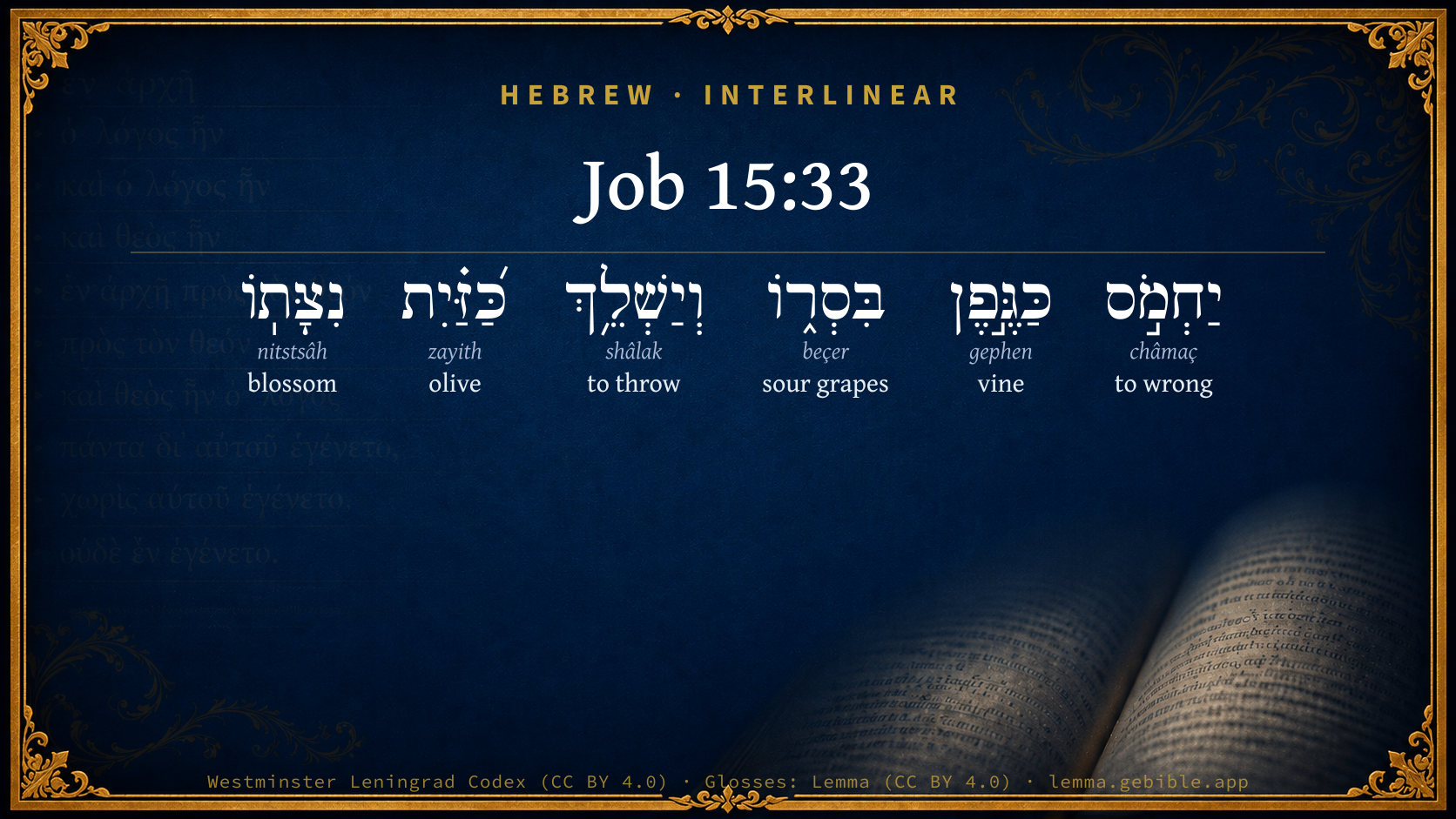
Hebrew (Westminster Leningrad Codex) Job 15:33 appears in the Hebrew Old Testament. The text above is from the Westminster Leningrad Codex. Each word links to its Strong’s number, a concise gloss, and parsing drawn from the Open Scriptures Hebrew Bible morphology. Click any word for its full Brown-Driver-Briggs (BDB) entry.
Download image
Cite this verse

Job 15:33 (World English Bible). Public Domain. Lemma interlinear Bible study tool, https://lemma.gebible.app/v/job/15/33.

Show BibTeX & RIS
BibTeX
RIS
English Translation
He shall shake off his unripe grape as the vine, And shall cast off his flower as the olive tree.
World English Bible · Public Domain
Highlights
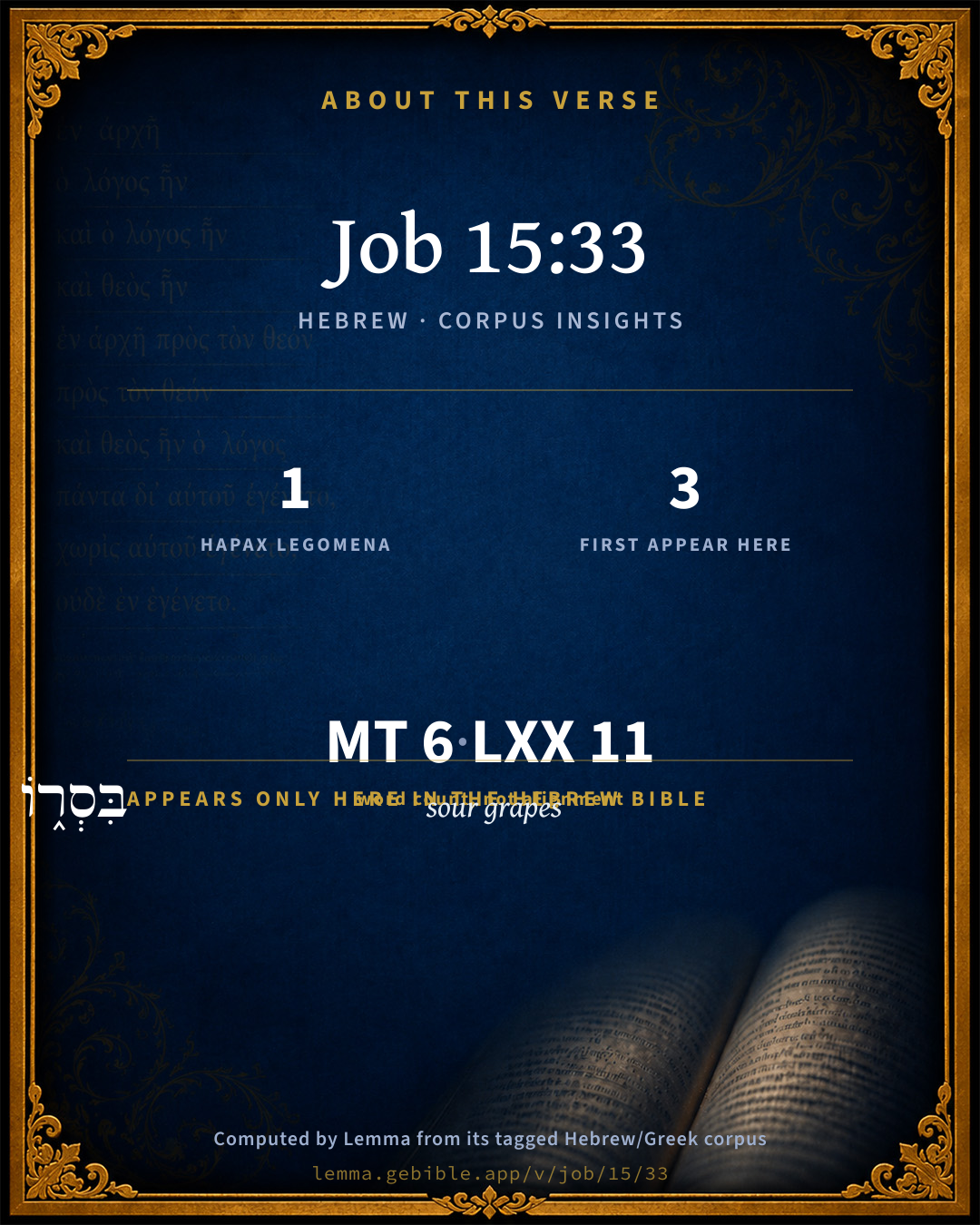
  • 1 hapax legomenon — only here in the Hebrew Bible
  • 3 first appearances in the Hebrew Bible
Full analysis ↓
Download a study sheet

One document with this verse’s original text, its word-by-word gloss line, the meaning frame, cross-references with their text, attributed commentary, and full source and license credits — printable, and it pastes into notes with its structure intact.

This verse Autodidact and up

Study sheet (.html) Plain text (.txt)

A passage Seminary Student

Up to 50 verses in one chapter. A passage sheet keeps up to 6 commentary sources and 12 cross-references per verse, in the order this page ranks them, and says so on the sheet whenever that leaves anything out. Ask for a single verse and you get the Autodidact verse sheet above.

Everything on this page stays free to read, with no account — the sheet is a download of what is already on screen, not access to it.

Want to remove ads? Support Godless Engineer
Compare translations 3

The same verse in 3 English versions, stacked beneath the original-language interlinear above. Click any original word for its lexicon entry.

Each is an independent rendering of the whole verse — the interlinear is not word-aligned to these translations.

Highlighted words mark where these versions differ — a whole-verse word diff, not a word-by-word alignment.

  • World English Bible Public Domain
    He shall shake off his unripe grape as the vine, And shall cast off his flower as the olive tree.
  • King James Version Public Domain
    He shall shake off his unripe grape as the vine, and shall cast off his flower as the olive.
  • unfoldingWord Literal Text CC BY-SA 4.0
    He will shake off his unripe grapes like a grapevine, and he will cast off his blossoms like an olive tree.

unfoldingWord Literal Text — © unfoldingWord, licensed CC BY-SA 4.0. Word-aligned USFM3 via Door43 (git.door43.org/unfoldingWord/en_ult).

Versions to compare (up to 4)

3 of 4 selected

Show all 18 translations

Every available English version of this verse, each an independent rendering of the whole verse.

  • World English Bible Public Domain
    He shall shake off his unripe grape as the vine, And shall cast off his flower as the olive tree.
  • Berean Standard Bible Public Domain
    He will be like a vine stripped of its unripe grapes, like an olive tree that sheds its blossoms.
  • Majority Standard Bible Public Domain
    He will be like a vine stripped of its unripe grapes, like an olive tree that sheds its blossoms.
  • King James Version Public Domain
    He shall shake off his unripe grape as the vine, and shall cast off his flower as the olive.
  • American Standard Version (1901) Public Domain
    He shall shake off his unripe grape as the vine, And shall cast off his flower as the olive-tree.
  • Revised Version (1885) Public Domain
    He shall shake off his unripe grape as the vine, and shall cast off his flower as the olive.
  • Geneva Bible (1599) Public Domain
    God shall destroy him as the vine her sower grape, and shall cast him off, as the oliue doeth her flowre.
  • Douay-Rheims (1899) Public Domain
    He shall be blasted as a vine when its grapes are in the first flower, and as an olive tree that casteth its flower.
  • Young's Literal Translation Public Domain
    He shaketh off as a vine his unripe fruit, And casteth off as an olive his blossom.
  • Literal Standard Version CC BY-SA 4.0
    He shakes off his unripe fruit as a vine, || And casts off his blossom as an olive.
  • Unlocked Literal Bible CC BY-SA 4.0
    He will drop his unripe grapes like a grapevine; he will cast off his flowers like the olive tree.
  • unfoldingWord Literal Text CC BY-SA 4.0
    He will shake off his unripe grapes like a grapevine, and he will cast off his blossoms like an olive tree.
  • Darby Bible Public Domain
    He shall shake off his unripe grapes as a vine, and shall cast his flower as an olive.
  • World Messianic Bible Public Domain
    He will shake off his unripe grape as the vine, and will cast off his flower as the olive tree.
  • Webster's Bible Public Domain
    He shall shake off his unripe grape as the vine, and shall cast off his flower as the olive.
  • Free Bible Version CC BY-SA 4.0
    like vines that lose their unripe grapes, or olive trees that lose their flowers.
  • Bible in Basic English Public Domain
    He is like a vine whose grapes do not come to full growth, or an olive-tree dropping its flowers.
  • JPS Tanakh (1917) Public Domain
    He shall shake off his unripe grape as the vine, and shall cast off his flower as the olive.

Literal Standard Version (2020), Covenant Press — licensed CC BY-SA 4.0. Text via the HelloAO Bible API (eBible.org). Unlocked Literal Bible (unfoldingWord) — licensed CC BY-SA 4.0. Text via the HelloAO Bible API (eBible.org). unfoldingWord Literal Text — © unfoldingWord, licensed CC BY-SA 4.0. Word-aligned USFM3 via Door43 (git.door43.org/unfoldingWord/en_ult). Free Bible Version, Dr. Jonathan Gallagher — licensed CC BY-SA 4.0. Text via the HelloAO Bible API (eBible.org).

Word by word

More ways to search: Search by grammar → Find every occurrence → Compare this word →

Practice this passage: Drill this verse → Learn its vocabulary →

About this verse

These counts appear in no published source. They are computed here, from the morphology-tagged text and Lemma’s own curated glosses. What Lemma adds →

6
words
6
distinct lemmas
Wisdom
section

Notable vocabulary

1 hapax legomenon — a word that appears only here in the entire Hebrew Bible:

  • בִּסְר֑וֹ sour grapes H1154

First appearance in Scripture

These words make their first canonical appearance in the Hebrew Bible here:

  • יַחְמֹ֣ס to wrong H2554
  • בִּסְר֑וֹ sour grapes H1154
  • נִצָּתֽוֹ blossom H5328

Shared distinctive vocabulary

נִצָּתֽוֹ blossom H5328 occurs in 2 verses of the Hebrew Bible. Also found in:

Grammatical profile

  • 2 verbs
  • 4 nouns

Verb forms

  • יַחְמֹ֣ס Qal · Imperfect
  • וְיַשְׁלֵ֥ךְ Hiphil · Imperfect

Hebrew & Septuagint length

In English translation the verse runs 20 words from the Hebrew and 22 from the Septuagint (LXX English) — closely comparable.

A rough comparison of the two English renderings, which tokenize alike — not a word-level alignment.

Word counts can differ between the Hebrew and the Greek without any difference in meaning — e.g. the Hebrew direct-object marker אֵת has no separate Greek word, and Greek often adds the article ὁ.

In the original languages it is 6 Hebrew tokens and 11 Greek tokens — but the two are counted differently (Hebrew bundles its prefixes and suffixes into one token; the Greek is in lemma form), so that isn’t a like-for-like length.

Cross-references

3

Topical passages linked to Job 15:33 in the Treasury of Scripture Knowledge — connected by theme and wording, ordered by reader-vote popularity; previews shown in the World English Bible.

  • Deuteronomy 28:39–40 You shall plant vineyards and dress them, but you shall neither drink of the wine, nor gather [the grapes]; for the worm shall eat them.
  • Isaiah 33:9 The land mourns and languishes; Lebanon is confounded and withers away; Sharon is like a desert; and Bashan and Carmel shake off [their leaves].
  • Revelation 6:13 The stars of the sky fell to the earth, like a fig tree dropping its unripe figs when it is shaken by a great wind.

Cross-references courtesy of OpenBible.info (CC BY 4.0).

Hebrew and Greek witnesses Masoretic Hebrew ↔ Greek Septuagint

The same verse in the two great witnesses to the Old Testament, shown verse-for-verse.

These are two independent witnesses, not word-aligned to each other, and the Septuagint is shown in lemma (dictionary) form.

Hebrew Job 15:33 Masoretic · Westminster Leningrad Codex

יַחְמֹ֣ס כַּגֶּ֣פֶן בִּסְר֑וֹ וְיַשְׁלֵ֥ךְ כַּ֝זַּ֗יִת נִצָּתֽוֹ

He shall shake off his unripe grape as the vine, And shall cast off his flower as the olive tree.

World English Bible · Public Domain

Greek LXX Job 15:33 Septuagint · lemma form

τρυγάω δέ ὥσπερ ὄμφαξ πρό ὥρα ἐκπίπτω δέ ὡς ἄνθος ἐλαία

And let him be gathered as the unripe grape before the time, and let him fall as the blossom of the olive.

LXX2012 (modern English Septuagint) · Public Domain

Hebrew: Westminster Leningrad Codex (CC BY 4.0). Greek: Septuagint (public domain); English from LXX2012 (modern English Septuagint) (Public Domain). How the Septuagint differs from the Hebrew →

Commentary

Notes on Job 15:33 from classic Christian and Jewish commentators (each source and its license shown beneath its notes). The classic Christian expositions comment on the surrounding passage and are grouped to its opening verse, so a note may address several verses; the Jewish commentaries on the Tanakh (Rashi and others) are per-verse, so they appear only where the commentator wrote on this verse.

Lemma curates 59 commentaries, every one of them public domain or Creative Commons licensed, each selected and text-cleaned for this edition rather than reprinted as found. About our sources →

Trapp's Complete Commentary

John Trapp

Job 15:33 He shall shake off his unripe grape as the vine, and shall cast off his flower as the olive.

Ver. 33. He shall shake off his unripe grapes as the vine] Filios intelligit per batra, et pueros per florem, saith Vatablus: i.e. By unripe grapes he meaneth the wicked man’s sons grown up; and by flowers of the olive, his little ones: and so it is the same with the former, only flourished over with two similitudes, He (that is, God) will snap off his sour grapes as the vines; so Broughton rendered it: Luctuosa foecunditas (such as was that of Laeta, in Jerome, Epist. 7, who buried many children) is a sore affliction. If the bud or flower decay, what hope can there be of fruit? Others understand it to be the untimely death, as before, or of the decay of his wealth and possessions.

John Trapp, A Commentary or Exposition upon All the Books of the Old and New Testament (1647–1656) — public domain. Text from a community e-Sword module.

Geneva Bible (1599)

Geneva Bible translators

As one that gathereth grapes before they be ripe.

Geneva Bible (1599) marginal notes — public domain. Text via Bolls.life.

Jamieson, Fausset & Brown

Robert Jamieson, A. R. Fausset & David Brown

Images of incompleteness. The loss of the unripe grapes is poetically made the vine tree's own act, in order to express more pointedly that the sinner's ruin is the fruit of his own conduct (Isa 3:11; Jer 6:19).

Jamieson, Fausset & Brown — Commentary Critical and Explanatory on the Whole Bible (1871) — public domain (CC PDM 1.0). Text via the HelloAO Bible API.

Adam Clarke's Commentary

Verse 33. He shall shake off his unripe grape]

10. Whatever children he may have, they shall never survive him, nor come to mature age. They shall be like wind-fall grapes and blasted olive blossoms. As the vine and olive, which are among the most useful trees, affording wine and oil, so necessary for the worship of God and the comfort of man, are mentioned here, they may be intended to refer to the hopeful progeny of the oppressor; but who fell, like the untimely grape or the blasted olive flower, without having the opportunity of realizing the public expectation.

Adam Clarke's Commentary on the Bible (1810–1826) — public domain. Text from a community e-Sword/MySword module.

The Cambridge Bible for Schools and Colleges

gen. ed. J. J. S. Perowne

33. It is doubtful if the A. V. expresses a meaning which is true to nature; the vine does not shake off its unripe grapes. The words must rather express the meaning that the grapes are not brought to maturity. The word “shake off” means to “wrong” Pro_8:36, and probably the idea is that the vine fails to nourish its grapes and leaves them to dry and wither. This carries out the conception of Job_15:32. The general idea of these verses is that the wicked man is “subject to vanity,” his branch prematurely withers (Job_15:32), he puts forth grapes but cannot ripen them, he flowers but he fails of fruit. His endeavours in all directions come short.

The Cambridge Bible for Schools and Colleges (gen. ed. J. J. S. Perowne; Cambridge University Press, 1878–1918) — public domain. Text from a community e-Sword module.

John Gill's Exposition

For the congregation of hypocrites shall be desolate,.... Hypocrites are such who seem to and would be thought to be, what they are not; they are outwardly righteous before men, but inwardly very wicked; have a form of godliness, but are destitute the power of it, Ti2 3:5; pretend to much religion, and to be worshippers of God, when it is only in outward appearances, and not in reality and sincerity: and such as these have been in the congregations of the righteous, in all ages; but here Eliphaz speaks of a congregation of them, a society, a family of them; and very probably has his eye upon Job's, and would represent hereby that he, the head of his family, and his children, when living, and his servants and associates, were all hypocrites, and now become desolate, reduced to want and poverty, and in distressed circumstances: or were "solitary" (i) and alone, as the word is rendered in Job 3:7; destitute of friends, and of the comforts of life; and perhaps reference may be had to the future state of such, when they shall aloud be bid to depart from God, have no society with angels and saints, but shall have their portion with those of the same character with them, hypocrites, in the highest degree of torment and misery, Mat 24:51;

and fire shall consume the tabernacles of bribery; either such tents, or houses, as were built with money taken as bribes; see Hab 2:12; or where such who received bribes dwelt; unjust judges, who took a gift that blinds the eyes, to pervert justice. Job is afterwards by Eliphaz represented as if he was an oppressor, a wicked magistrate, and guilty of such like crimes as here pointed at, Job 22:6; and the "fire" said to consume the dwelling places of such may be understood either of material fire, such as came down from heaven, and destroyed Job's sheep, Job 1:16; or figuratively, the wrath of God often compared to fire, which would appear in one way or another, to the utter ruin of such persons, their habitations, and those that dwelt in them.

"solitarium", Montanus; and to the same sense Vatablus, Beza, Tigurine version, Junius & Tremellius, Piscator, Drusius, Cocceius.

John Gill's Exposition of the Whole Bible (1746–1763) — public domain (CC PDM 1.0). Text via the HelloAO Bible API.

Albert Barnes' Notes on the Bible

He shall shake off his unripe grape as the vine - The idea here is, that the wicked man shall be like a vine that casts off its grapes while they are yet sour and green, and brings none to perfection; compare the notes at Isa 18:5. Scott renders this,

“As when the vine her half-grown berries showers,

Or poisoned olive her unfolding flowers.”

It would seem from this passage that the vine might be so blasted by a hot wind or other cause, as to cast its unripe grapes to the earth. The employment of a figure of this kind to illustrate an idea supposes that such a case was familiar to those who were addressed. It is well known that in the East the grape and the olive might be blasted while in blossom, or when the fruit was setting, as all fruit may be. The injury is usually done in the flower, or when the fruit is just forming. Yet our observations of the effects of the burning winds that pass over the deserts on fruit that is half formed, in blasting it and causing it to fall, are too limited to allow us to come to any definite conclusion in regard to such effects in general. Anyone, however, can see the beauty of this image. The plans and purposes of wicked people are immature. Nothing is carried to perfection. They are cut off, their plans are blasted, and all the results of their living are like the sour, hard, crabbed, and useless fruit that falls from the tree before it is ripe. The results of the life of the righteous, on the other hand, are like a tree loaded with ripe and mellow fruit - their plans are brought to maturity, and resemble the rich and heavy clusters of grapes, or the abundant fruits of the olive when ripe.

And shall cast off his flower as the olive - The olive is a well-known tree that abounds in the East. The fruit is chiefly valuable for the oil which it produces; compare the notes at Rom 11:17. The olive is liable to be blasted while the fruit is setting, or while the tree is in blossom. In Greece, a northeast wind often proves destructive to the olive, and the same may be true of other places. Dr. Chandler speaking of Greece, says, “The olive groves are now, as anciently, a principal source of the riches of Athens. The crops had failed five years successively when we arrived; the cause assigned was a northerly wind, called Greco-tramontane, which destroyed the flower. The fruit is set in about a fortnight, when the apprehension from this unpropitious quarter ceases. The bloom in the following year was unhurt, and we had the pleasure of leaving the Athenians happy in the prospect of a plentiful harvest.” A wicked man is here elegantly compared with such a tree that casts its flowers and produces no fruit.

Albert Barnes' Notes on the Bible (1834–1885) — public domain. Text from a community e-Sword/MySword module.

Haydock's Catholic Bible Commentary

First. Hebrew, "unripe." (Haydock) --- He shall derive no aid or comfort from his young family.

George Leo Haydock (1774–1849), Haydock's Catholic Family Bible and Commentary, 1859 edition — public domain. Excludes Psalms (Douay-Rheims chapter numbering differs from Protestant) and Deuterocanonical books (Catholic canon only).

Matthew Poole's English Annotations

He; either,

1. The wicked man, who by his sins is the author of his own ruin. Or,

2. God, who is easily understood, both from the matter and context.

Shall shake off, Heb. shall take away by violence.

His unripe grape, i. e. his fruit, his children, or other comforts, before their time.

As the vine, i.e. as the vine either itself droppeth, or rather loseth, its tender grapes, which are plucked off by a violent hand.

As the olive; which flourisheth much about the same time with the vine, and is commonly handled in the same manner.

Matthew Poole's English Annotations on the Holy Bible (1683–1685) — public domain. Text from a community e-Sword/MySword module.

Whedon's Commentary on the Bible

Daniel D. Whedon

33. Cast off his flower as the olive — “The olive is the most prodigal of all fruit-bearing trees in flowers. It literally bends under the load of them. But then not one in a hundred comes to maturity. The tree casts them off by millions, as if they were of no more value than flakes of snow, which they closely resemble. So it will be with those who trust in vanity.” — Land and Book, 1:72.

Daniel D. Whedon (gen. ed.), Commentary on the Old and New Testaments (1874–1909) — public domain. Text from a community e-Sword module.

The Pulpit Commentary

He shall shake off his unripe grape as the vine. Blight and untimely cold cause the vine to drop its grapes before they are mature. So the wicked man will be deprived, one by one, of his possessions. And shall cast off his flower as the olive. The olive often sheds its blossoms in vast numbers. "In spring," says Canon Tristram, "one may see the bloom, on the slightest breath of wind, shed like snowflakes, and perishing by millions" ("Natural History of the Bible," p. 375). According to some commentators, this happens regularly in alternate years.

The Pulpit Commentary (1880–1919), ed. H.D.M. Spence-Jones & Joseph S. Exell — public domain. Text from a community e-Sword module.

Lesson kit

Teaching starters — assembled from the data on this page, not authored interpretation. Every prompt links to the verse data it draws on. Edit before teaching.

Job, in the Wisdom, opens this verse with 6 words (6 distinct Hebrew lemmas). Its most distinctive word is beçer (“sour grapes”). A historical commentator’s framing appears above. Read the whole chapter for the surrounding context.

Discussion questions

  1. How does “sour grapes” (beçer) shape what this verse is saying?
  2. 1 word here appears nowhere else in the Hebrew Bible. Why might the author reach for such rare wording?
  3. 3 words make their first appearance in Scripture here. What does this debut establish?
  4. How does Isaiah 18:5, which shares the word «blossom», read alongside this verse?
  5. The translations on this page render this verse differently — a whole-verse word diff, not a word-by-word alignment. What might account for the different wordings?
  6. «יַחְמֹ֣ס» is a Qal Imperfect verb. How does that grammatical form shape the action described?
  7. Compare how Trapp's Complete Commentary and Geneva Bible (1599) read this verse. Where do they agree or differ?

Things to notice

Reading settings

Reading text

Shown beneath each verse's original-language words.

Old Testament
Old Testament edition

Read the OT as the Masoretic Hebrew (MT) or the Greek Septuagint (LXX).

English shown for the Greek Septuagint (in the Hebrew ↔ Greek comparison).

Comparing translations? Open the Compare panel on any verse page to stack up to four side by side.