
1 Kings 13:28

Hebrew (Westminster Leningrad Codex) 1 Kings 13:28 appears in the Hebrew Old Testament. The text above is from the Westminster Leningrad Codex. Each word links to its Strong’s number, a concise gloss, and parsing drawn from the Open Scriptures Hebrew Bible morphology. Click any word for its full Brown-Driver-Briggs (BDB) entry.
Download image
Cite this verse

1 Kings 13:28 (World English Bible). Public Domain. Lemma interlinear Bible study tool, https://lemma.gebible.app/v/1-kings/13/28.

Show BibTeX & RIS
BibTeX
RIS
English Translation
He went and found his body cast in the way, and the donkey and the lion standing by the body: the lion had not eaten the body, nor torn the donkey.
World English Bible · Public Domain
Download a study sheet

One document with this verse’s original text, its word-by-word gloss line, the meaning frame, cross-references with their text, attributed commentary, and full source and license credits — printable, and it pastes into notes with its structure intact.

This verse Autodidact and up

Study sheet (.html) Plain text (.txt)

A passage Seminary Student

Up to 50 verses in one chapter. A passage sheet keeps up to 6 commentary sources and 12 cross-references per verse, in the order this page ranks them, and says so on the sheet whenever that leaves anything out. Ask for a single verse and you get the Autodidact verse sheet above.

Everything on this page stays free to read, with no account — the sheet is a download of what is already on screen, not access to it.

Want to remove ads? Support Godless Engineer
Compare translations 3

The same verse in 3 English versions, stacked beneath the original-language interlinear above. Click any original word for its lexicon entry.

Each is an independent rendering of the whole verse — the interlinear is not word-aligned to these translations.

Highlighted words mark where these versions differ — a whole-verse word diff, not a word-by-word alignment.

  • World English Bible Public Domain
    He went and found his body cast in the way, and the donkey and the lion standing by the body: the lion had not eaten the body, nor torn the donkey.
  • King James Version Public Domain
    And he went and found his carcass cast in the way, and the ass and the lion standing by the carcass: the lion had not eaten the carcass, nor torn the ass.
  • unfoldingWord Literal Text CC BY-SA 4.0
    And he went, and he found the corpse thrown in the road and the donkey and the lion standing beside the corpse. The lion had not eaten the corpse, and it had not torn apart the donkey.

unfoldingWord Literal Text — © unfoldingWord, licensed CC BY-SA 4.0. Word-aligned USFM3 via Door43 (git.door43.org/unfoldingWord/en_ult).

Versions to compare (up to 4)

3 of 4 selected

Show all 18 translations

Every available English version of this verse, each an independent rendering of the whole verse.

  • World English Bible Public Domain
    He went and found his body cast in the way, and the donkey and the lion standing by the body: the lion had not eaten the body, nor torn the donkey.
  • Berean Standard Bible Public Domain
    and he went and found the body lying in the road, with the donkey and the lion standing beside it. The lion had not eaten the body or mauled the donkey.
  • Majority Standard Bible Public Domain
    and he went and found the body lying in the road, with the donkey and the lion standing beside it. The lion had not eaten the body or mauled the donkey.
  • King James Version Public Domain
    And he went and found his carcass cast in the way, and the ass and the lion standing by the carcass: the lion had not eaten the carcass, nor torn the ass.
  • American Standard Version (1901) Public Domain
    And he went and found his body cast in the way, and the ass and the lion standing by the body: the lion had not eaten the body, nor torn the ass.
  • Revised Version (1885) Public Domain
    And he went and found his carcase cast in the way, and the ass and the lion standing by the carcase: the lion had not eaten the carcase, nor torn the ass.
  • Geneva Bible (1599) Public Domain
    And he went and founde his body cast in the way, and the asse and the lion stoode by the corps: and the lion had not eaten the bodie, nor torne the asse.
  • Douay-Rheims (1899) Public Domain
    And he was gone, he found the dead body cast in the way, and the ass and the lion standing by the carcass: the lion had not eaten of the dead body, nor hurt the ass.
  • Young's Literal Translation Public Domain
    And he goeth and findeth his carcase cast in the way, and the ass and the lion are standing near the carcase -- the lion hath not eaten the carcase nor destroyed the ass.
  • Literal Standard Version CC BY-SA 4.0
    And he goes and finds his carcass cast in the way, and the donkey and the lion are standing near the carcass—the lion has not eaten the carcass nor destroyed the donkey.
  • Unlocked Literal Bible CC BY-SA 4.0
    He went and found the body left in the road, and the donkey and the lion standing by the body. The lion had not eaten the body, nor attacked the donkey.
  • unfoldingWord Literal Text CC BY-SA 4.0
    And he went, and he found the corpse thrown in the road and the donkey and the lion standing beside the corpse. The lion had not eaten the corpse, and it had not torn apart the donkey.
  • Darby Bible Public Domain
    And he went and found his corpse cast in the way, and the ass and the lion standing by the corpse: the lion had not eaten the corpse, nor torn the ass.
  • World Messianic Bible Public Domain
    He went and found his body thrown on the path, and the donkey and the lion standing by the body. The lion had not eaten the body nor mauled the donkey.
  • Webster's Bible Public Domain
    And he went and found his carcass cast in the way, and the ass and the lion standing by the carcass: the lion had not eaten the carcass, nor torn the ass.
  • Free Bible Version CC BY-SA 4.0
    and he went and found the body. It was still lying in the road, with the donkey and the lion standing beside it. The lion had not eaten the body or attacked the donkey.
  • Bible in Basic English Public Domain
    And he went and saw the dead body stretched out in the road with the ass and the lion by its side: the lion had not taken the body for its food or done any damage to the ass.
  • JPS Tanakh (1917) Public Domain
    And he went and found his carcass cast in the way, and the ass and the lion standing by the carcass; the lion had not eaten the carcass, nor torn the ass.

Literal Standard Version (2020), Covenant Press — licensed CC BY-SA 4.0. Text via the HelloAO Bible API (eBible.org). Unlocked Literal Bible (unfoldingWord) — licensed CC BY-SA 4.0. Text via the HelloAO Bible API (eBible.org). unfoldingWord Literal Text — © unfoldingWord, licensed CC BY-SA 4.0. Word-aligned USFM3 via Door43 (git.door43.org/unfoldingWord/en_ult). Free Bible Version, Dr. Jonathan Gallagher — licensed CC BY-SA 4.0. Text via the HelloAO Bible API (eBible.org).

Word by word

More ways to search: Search by grammar → Find every occurrence → Compare this word →

Practice this passage: Drill this verse → Learn its vocabulary →

נִבְלָתוֹ֙
nᵉbêlâh
H5038
“carcass · his”
Noun, Common, Feminine, Singular, Construct + Suffix, Personal, 3rd Person, Masculine, Singular
Part of Speech
Noun
Type
Common
Gender
Feminine
Number
Singular
State
Construct
Full BDB Definition

Origin: from H5034

TWOT: 1286a

carcass, corpse - of humans, idols, animals
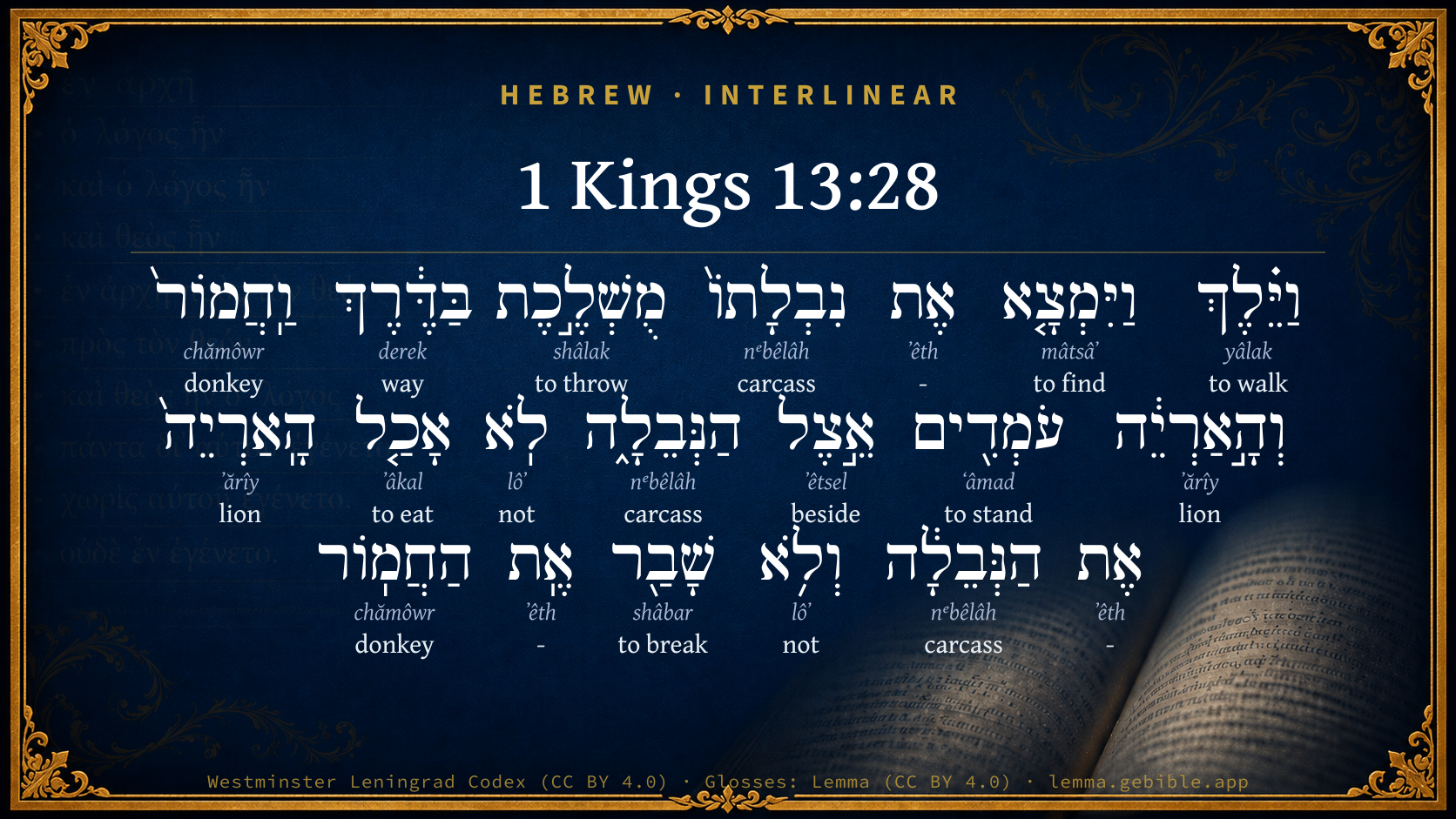
  1. וַיֵּ֗לֶךְ yâlak H3212 “and · to walk” Conjunction + Verb, Qal, Sequential Imperfect, 3rd Person, Masculine, Singular
  2. וַיִּמְצָ֤א mâtsâʼ H4672 “and · to find” Conjunction + Verb, Qal, Sequential Imperfect, 3rd Person, Masculine, Singular
  3. אֶת ʼêth H853 “-” Particle, Direct Object
  4. מֻשְׁלֶ֣כֶת shâlak H7993 “thrown” Verb, Hophal, Participle Passive, Feminine, Singular, Absolute
  5. בַּדֶּ֔רֶךְ derek H1870 “in/at the · way” Preposition, Determined + Noun, Common, Both, Singular, Absolute
  6. וַֽחֲמוֹר֙ chămôwr H2543 “and · donkey” Conjunction + Noun, Common, Both, Singular, Absolute
  7. וְהָ֣אַרְיֵ֔ה ʼărîy H738 “and · the · lion” Conjunction + Particle, Definite Article + Noun, Common, Masculine, Singular, Absolute
  8. עֹמְדִ֖ים ʻâmad H5975 “standing” Verb, Qal, Participle Active, Masculine, Plural, Absolute
  9. אֵ֣צֶל ʼêtsel H681 “beside” Preposition
  10. הַנְּבֵלָ֑ה nᵉbêlâh H5038 “the · carcass” Particle, Definite Article + Noun, Common, Feminine, Singular, Absolute
  11. לֹֽא lôʼ H3808 “not” Particle, Negative
  12. אָכַ֤ל ʼâkal H398 “to eat” Verb, Qal, Perfect, 3rd Person, Masculine, Singular
  13. הָֽאַרְיֵה֙ ʼărîy H738 “the · lion” Particle, Definite Article + Noun, Common, Masculine, Singular, Absolute
  14. אֶת ʼêth H853 “-” Particle, Direct Object
  15. הַנְּבֵלָ֔ה nᵉbêlâh H5038 “the · carcass” Particle, Definite Article + Noun, Common, Feminine, Singular, Absolute
  16. וְלֹ֥א lôʼ H3808 “and · not” Conjunction + Particle, Negative
  17. שָׁבַ֖ר shâbar H7665 “to break” Verb, Qal, Perfect, 3rd Person, Masculine, Singular
  18. אֶֽת ʼêth H853 “-” Particle, Direct Object
  19. הַחֲמֽוֹר chămôwr H2543 “the · donkey” Particle, Definite Article + Noun, Common, Both, Singular, Absolute

About this verse

These counts appear in no published source. They are computed here, from the morphology-tagged text and Lemma’s own curated glosses. What Lemma adds →

20
words
13
distinct lemmas
Historical
section

Shared distinctive vocabulary

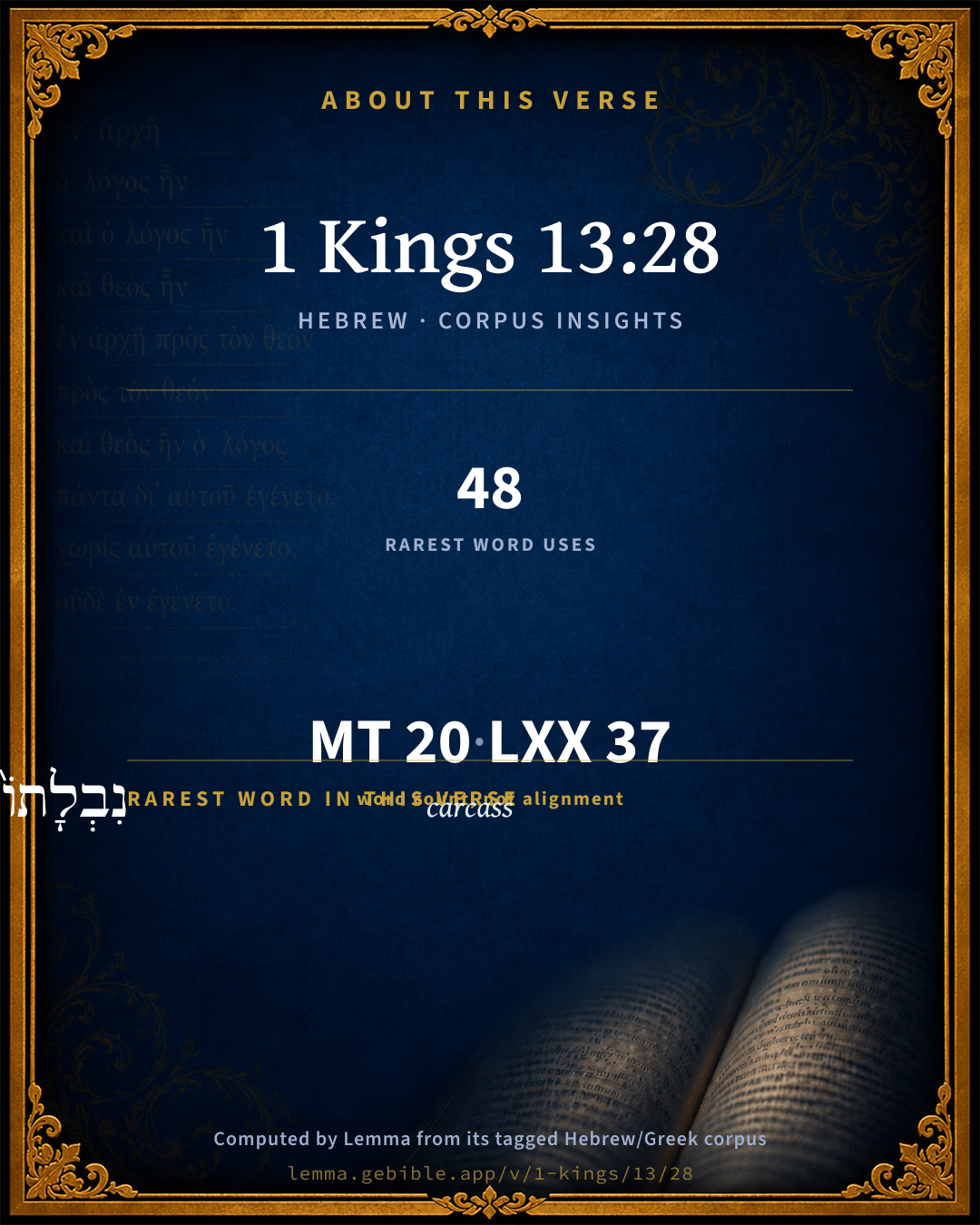
נִבְלָתוֹ֙ carcass H5038 occurs in 41 verses of the Hebrew Bible. Also found in:

Grammatical profile

  • 6 verbs
  • 8 nouns
  • 1 preposition
  • 5 particles

Verb forms

  • וַיֵּ֗לֶךְ Qal · Sequential Imperfect
  • וַיִּמְצָ֤א Qal · Sequential Imperfect
  • מֻשְׁלֶ֣כֶת Hophal · Participle Passive
  • עֹמְדִ֖ים Qal · Participle Active
  • אָכַ֤ל Qal · Perfect
  • שָׁבַ֖ר Qal · Perfect

Repetition

Words recur within this verse — often emphatic in Hebrew:

  • נִבְלָתוֹ֙ carcass H5038 ×3
  • וַֽחֲמוֹר֙ donkey H2543 ×2
  • וְהָ֣אַרְיֵ֔ה lion H738 ×2
  • לֹֽא not H3808 ×2

Hebrew & Septuagint length

In English translation the verse runs 31 words from the Hebrew and 41 from the Septuagint (LXX English) — closely comparable.

A rough comparison of the two English renderings, which tokenize alike — not a word-level alignment.

Word counts can differ between the Hebrew and the Greek without any difference in meaning — e.g. the Hebrew direct-object marker אֵת has no separate Greek word, and Greek often adds the article ὁ.

In the original languages it is 20 Hebrew tokens and 37 Greek tokens — but the two are counted differently (Hebrew bundles its prefixes and suffixes into one token; the Greek is in lemma form), so that isn’t a like-for-like length.

Cross-references

12

Topical passages linked to 1 Kings 13:28 in the Treasury of Scripture Knowledge — connected by theme and wording, ordered by reader-vote popularity; previews shown in the World English Bible.

  • 1 Kings 17:4 It shall be, that you shall drink of the brook; and I have commanded the ravens to feed you there.
  • 1 Kings 17:6 The ravens brought him bread and flesh in the morning, and bread and flesh in the evening; and he drank of the brook.
  • Job 38:11 And said, 'Here you may come, but no further; Here shall your proud waves be stayed?'
  • Psalms 148:7–8 Praise Yahweh from the earth, You great sea creatures, and all depths!
  • Jeremiah 5:22–23 Don't you fear me? says Yahweh: won't you tremble at my presence, who have placed the sand for the bound of the sea, by a perpetual decree, that it can't pass it? and though the waves of it toss themselves, yet they can't prevail; though they roar, yet they can't pass over it.
  • Daniel 3:22 Therefore because the king's commandment was urgent, and the furnace exceeding hot, the flame of the fire killed those men who took up Shadrach, Meshach, and Abednego.
  • Daniel 3:27–28 The satraps, the deputies, and the governors, and the king's counselors, being gathered together, saw these men, that the fire had no power on their bodies, nor was the hair of their head singed, neither were their pants changed, nor had the smell of fire passed on them.
  • Daniel 6:22–24 My God has sent his angel, and has shut the lions' mouths, and they have not hurt me; because as before him innocence was found in me; and also before you, O king, have I done no hurt.
  • Acts 16:26 Suddenly there was a great earthquake, so that the foundations of the prison were shaken; and immediately all the doors were opened, and everyone's bonds were loosened.
  • Hebrews 11:33–34 who, through faith subdued kingdoms, worked out righteousness, obtained promises, stopped the mouths of lions,
  • Leviticus 10:2 And fire came forth from before Yahweh, and devoured them, and they died before Yahweh.
  • Leviticus 10:5 So they drew near, and carried them in their coats out of the camp, as Moses had said.

Cross-references courtesy of OpenBible.info (CC BY 4.0).

Hebrew and Greek witnesses Masoretic Hebrew ↔ Greek Septuagint

The same verse in the two great witnesses to the Old Testament, shown verse-for-verse.

These are two independent witnesses, not word-aligned to each other, and the Septuagint is shown in lemma (dictionary) form.

Hebrew 1 Kings 13:28 Masoretic · Westminster Leningrad Codex

וַיֵּ֗לֶךְ וַיִּמְצָ֤א אֶת נִבְלָתוֹ֙ מֻשְׁלֶ֣כֶת בַּדֶּ֔רֶךְ וַֽחֲמוֹר֙ וְהָ֣אַרְיֵ֔ה עֹמְדִ֖ים אֵ֣צֶל הַנְּבֵלָ֑ה לֹֽא אָכַ֤ל הָֽאַרְיֵה֙ אֶת הַנְּבֵלָ֔ה וְלֹ֥א שָׁבַ֖ר אֶֽת הַחֲמֽוֹר

He went and found his body cast in the way, and the donkey and the lion standing by the body: the lion had not eaten the body, nor torn the donkey.

World English Bible · Public Domain

Greek LXX 1 Kings 13:28 Septuagint · lemma form

καί πορεύομαι καί εὑρίσκω ὁ σῶμα αὐτός ῥίπτω ἐν ὁ ὁδός καί ὁ ὄνος καί ὁ λέων ἵστημι παρά ὁ σῶμα καί οὐ ἐσθίω ὁ λέων ὁ σῶμα ὁ ἄνθρωπος ὁ θεός καί οὐ συντρίβω ὁ ὄνος

And he went and found the body cast in the way, and the ass and the lion were standing by the body: and the lion had not devoured the body of the man of God, and had not torn the ass.

LXX2012 (modern English Septuagint) · Public Domain

Hebrew: Westminster Leningrad Codex (CC BY 4.0). Greek: Septuagint (public domain); English from LXX2012 (modern English Septuagint) (Public Domain). How the Septuagint differs from the Hebrew →

Targum (Aramaic paraphrase)

1

The Targum is the ancient Jewish Aramaic paraphrase of the Hebrew Scriptures — an interpretive translation, not the Hebrew text itself. Onkelos (literal) and Pseudo-Jonathan (expansive) render the Torah, and Jonathan the Prophets. Coverage is partial: where no permissively-licensed English translation exists for a verse, only the Aramaic is shown. This is verse-level text, not a word-by-word alignment to the Hebrew.

  1. Targum Jonathan Prophets (Joshua–Malachi)
    וַאֲזַל וְאַשְׁכַּח יַת נְבֵלְתֵּיהּ רַמְיָא בְאוֹרְחָא וַחֲמָרָא וְאַרְיָא קַיְמִין בִּסְטַר נְבֵלְתָּא לָא אֲכַל אַרְיָא יַת נְבֵלְתָּא וְלָא תַבַּר יַת חֲמָרָא:

    (no public-domain English translation for this verse)

    Targum Jonathan — Aramaic: “Mikraot Gedolot” (public domain). English: “Sefaria Community Translation” (CC0 1.0 (public-domain dedication)); “London "Chaldee Paraphrase," 1871” (public domain). Text via Sefaria.

Commentary

Notes on 1 Kings 13:28 from classic Christian and Jewish commentators (each source and its license shown beneath its notes). The classic Christian expositions comment on the surrounding passage and are grouped to its opening verse, so a note may address several verses; the Jewish commentaries on the Tanakh (Rashi and others) are per-verse, so they appear only where the commentator wrote on this verse.

Lemma curates 59 commentaries, every one of them public domain or Creative Commons licensed, each selected and text-cleaned for this edition rather than reprinted as found. About our sources →

Trapp's Complete Commentary

John Trapp

1Ki 13:28 And he went and found his carcase cast in the way, and the ass and the lion standing by the carcase: the lion had not eaten the carcase, nor torn the ass.

Ver. 28. And found his carcass.] See on 1Ki 13:24.

Nor torn the ass.] Heb., Broken; though lions love to devour asses. All creatures are at God’s beck and call. The ass stands untouched, the man of God is torn, or broken.

John Trapp, A Commentary or Exposition upon All the Books of the Old and New Testament (1647–1656) — public domain. Text from a community e-Sword module.

Joseph Benson's Commentary

1Ki 13:28. He found, &c. — Here was a concurrence of miracles: that the ass did not run away from the lion, according to his nature, but boldly stood still, as waiting to carry the prophet to his burial; that the lion did not devour his prey, nor tear the ass, nor meddle with the travellers that passed by, nor hurt the old prophet, when he came to the spot, nor his ass; nor yet go away, when he had done his work, but stood still, as if, 1st, To preserve the carcass of the prophet, whom he had slain, from other wild beasts or fowls: 2d, As an evidence that the prophet’s death was not casual, nor the effect of a lion’s ravenous disposition, but of God’s singular and just judgment, who had directed the lion, by a supernatural power, how far to go, and where to stop; and, consequently, that the prophet’s prediction was divine, and would be infallibly accomplished in its proper time: and 3d, As a token of God’s favour to the deceased prophet, of whose very carcass he took such special care; thereby signifying, that, although for wise and just reasons he thought fit to take away his life, yet his remains were precious to him.

Joseph Benson's Commentary on the Old and New Testaments (1811–1818) — public domain. Text from a community e-Sword module.

Geneva Bible (1599)

Geneva Bible translators

To declare that this was only the judgment of God: for if the Lion had done it for hunger, he would also have devoured the body.

Geneva Bible (1599) marginal notes — public domain. Text via Bolls.life.

Adam Clarke's Commentary

Verse 28. The lion had not eaten the carcass, nor torn the ass.] All here was preternatural. The lion, though he had killed the man, does not devour him; the ass stands quietly by, not fearing the lion; and the lion does not attempt to tear the ass: both stand as guardians of the fallen prophet. How evident is the hand of God in all!

Adam Clarke's Commentary on the Bible (1810–1826) — public domain. Text from a community e-Sword/MySword module.

John Gill's Exposition

And it came to pass, after he had buried him, that he spoke to his sons, saying,.... He gave them the following charge:

when I am dead, then bury me in the sepulchre wherein the man of God is buried; as it was his own, it might be reasonably thought they would bury him in it without such a charge; but, lest they should not, he gives it:

lay my bones beside his bones; his view in this was, that when Josiah came to burn the bones of the priests, he would spare the bones of this man of God; and so his, lying by them, and mingled with them, would be spared also, and so it proved, Kg2 23:18.

John Gill's Exposition of the Whole Bible (1746–1763) — public domain (CC PDM 1.0). Text via the HelloAO Bible API.

Albert Barnes' Notes on the Bible

The lion had not eaten the carcase, nor torn the ass - These strange circumstances were of a nature to call men’s attention to the matter, and cause the whole story to be bruited abroad. By these means an incident, which Jeroboam would have wished hushed up, became no doubt the common talk of the whole people.

Albert Barnes' Notes on the Bible (1834–1885) — public domain. Text from a community e-Sword/MySword module.

Matthew Poole's English Annotations

Here was a concurrence of miracles: That the ass did not run away from the lion, according to his nature and custom, but boldly stood still, as reserving himself for the carrying of the prophet to his burial; that the lion did not devour its prey, as the manner is; nor yet go away when he had done his work which he was sent for, but stood still; partly, to preserve the carcass of the prophet from other wild beasts or fowls, which would quickly have eaten it; partly, as an evidence that the prophet’s death was not casual, nor the effect of a lion’s hungry and ravenous disposition, but of God’s singular and just judgment; and consequently, that this prediction was Divine, and should be infallibly accomplished in its proper time; and partly, as a token of God’s favour to the deceased prophet, of whose very carcas: he took such special care; thereby signifying, that although for wise and just reasons he thought fit to take away his life, yet his remains were precious to him, and his soul did live in his sight.

Matthew Poole's English Annotations on the Holy Bible (1683–1685) — public domain. Text from a community e-Sword/MySword module.

Whedon's Commentary on the Bible

Daniel D. Whedon

28. The lion had not eaten the carcass, nor torn the ass — Herein was signally manifest the punitive hand of God. The ass is choice food for a lion, and man he attacks not when he has other prey. He also is wont to tear and mangle his prey. But in this case the lion, seeming to know that he had a signal mission, acted contrary to the instincts of his nature, and stopped when his work was done. These facts, attested by sufficient witnesses, (compare 1Ki_13:25,) made the solemn lessons of the prophet’s disobedience and death all the more impressive.

Daniel D. Whedon (gen. ed.), Commentary on the Old and New Testaments (1874–1909) — public domain. Text from a community e-Sword module.

The Pulpit Commentary

And he went and found his carcase cast in the way, and the ass and the lion standing by the carcase: the lion had not eaten the carcase nor torn Heb. broken, as in ver. 26 the ass.

Vers. 28-29.

The Visitation of Judgment.

The man of God from Judah, deceived by the old prophet of Ephraim, ate and drank in that land of apostasy. This was a disobedience to the word of the Lord, and a complicity in the abominations he was sent to denounce. For this he heard the Divine voice of reproof, and went forth to suffer accordingly, as detailed in the text.

I THE SEQUEL VERIFIED A REMARKABLE PROPHECY.

1. Review the prophecy.

(1) Ver. 22. He was, therefore, doomed to die away from his home; and, presumably, by violence.

(2) With what solemn feelings would he see his ass saddled with the prospect of such a journey! Ought not our feelings also to be solemn to whom death is certain, though the moment and the manner be unknown?

2. Note the fulfilment.

(1) Vers. 29, 30. He was met and slain by a lion, and his corpse was cast in the way. There was a spectacle for all passengers! What an evil thing is sin!

(2) Thus suffered for disobedience a "man of God." The sanctity of his profession did not protect him from sin, neither can it protect him from punishment. So neither, the dignity of his office. So neither, the service he had rendered to God (see 1Co_9:27; 2Co_13:5, 2Co_13:6)

(3) Judgment begins at the house of God, but falls more terribly upon the wicked. (1Pe_4:17, 1Pe_4:18) They may well tremble before "Him that can destroy both soul and body in hell.

(4) The man of God came not to the sepulchre of his fathers, yet was mourned over by one who had been a snare to him, but to whom he had been made a blessing. There are strange reciprocities.

II THE FULFILMENT WAS ATTENDED BY REMARKABLE SIGNS.

1. Miracle controlled the instincts of animals.

(1) The lion was moved, not by thirst for prey, but by revenge. But this revenge was the Lord"s. The animal had suffered nothing from the hand of the man of God.

(2) Instinct was otherwise controlled. For here were the lion and the ass together watching the carcase. The ass did not fly from the face of the lion; neither did the lion molest the ass.

(3) Nor was this strange witnessing the accident of a momentary surprise. It was maintained while certain passengers, who first observed it, journeyed to the city and reported it; and until, in consequence, the old prophet, divining its import, came upon the scene.

2. Here let us admire the Divine resources.

(1) He that moved upon the instincts of the lion and the ass was the same who made the representatives of the animal creation defile before Adam to receive their names; who brought them into the ark of Noah; restrained the lions from injuring Daniel; the same who, in the days of His flesh, dwelt among the wild beasts in the wilderness, and who controlled the movements of fishes in the depths (Mar_1:13; Mat_17:27; Luk_5:4-7) This power over the instincts of the lion and ass is but a sample of corresponding dominion over every department of nature. And the resources of this power are the resources of justice and mercy.

3. But what is the mystical meaning of the signs?

(1) The death of the man of God was judgment for his complicity with the sin of Ephraim in eating and drinking in that polluted place. So it was the last of the series of warnings to Jeroboam before the abandonment of his house to destruction (see ver. 33).

(2) The lion that inflicted the penalty was the symbol of Judah, of its royalty, and especially of Shiloh, in whom that royalty culminated. Hence Messiah is described as the "Lion of the tribe of Judah" (see Gen_49:9, Gen_49:10; Rev_5:5) Of this glorious Lion, Josiah was to be a type. Messiah visits the sin of Ephraim in the apostasy of the son of Nebat, and the sin of Judah for complicity in its abominations. (see Hos_5:14) So in like manner will He strike down the forms of apostasy extant in these latter times.

(3) The ass was the symbol of Issachar; (Gen_49:14, Gen_49:15) but not of Judah; for it is difficult to justify the translation in verse 11, which is better rendered, "and him shall the peoples obey; binding up the shoots of the vine, and the branches of the choice vine.

(4) As the ass stood as a witness of this judgment of God upon the sin of Jeroboam, and then carried the carcase away to be buried, so "Baasha, the son of Ahijah, of the house of Issachar," destroyed and put out of sight the house of Jeroboam, fulfilling the prophecy of Ahijah the Shilonite (ch. 15:27-30). How manifold is the wisdom of God! How deep are His judgments! J.A.M.

The Pulpit Commentary (1880–1919), ed. H.D.M. Spence-Jones & Joseph S. Exell — public domain. Text from a community e-Sword module.

John Wesley's Explanatory Notes

He found, &c. - Here was a concurrence of miracles: that the ass did not run away from the lion, according to his nature, but boldly stood still, as reserving himself to carry the prophet to his burial; that the lion did not devour its prey, nor yet go away when he had done his work, but stood still, partly to preserve the carcase of the prophet from other wild beasts or fowls, partly, as an evidence that the prophet's death was not casual, nor the effect of a lion's ravenous disposition, but of God's singular and just judgment; and consequently, that his prediction was divine, and should be infallibly accomplished in its proper time; and partly, as a token of God's favour to the deceased prophet, of whose very carcase he took such special care: thereby signifying, that although for wise and just reasons he thought fit to take away his life, yet his remains was precious to him.

John Wesley, Explanatory Notes Upon the Whole Bible (1754–1765) — public domain. Text via the GEBible commentary corpus.

Lesson kit

Teaching starters — assembled from the data on this page, not authored interpretation. Every prompt links to the verse data it draws on. Edit before teaching.

1 Kings, in the Historical, opens this verse with 20 words (13 distinct Hebrew lemmas). Its most distinctive word is nᵉbêlâh (“carcass”). A historical commentator’s framing appears above. Read the whole chapter for the surrounding context.

Discussion questions

  1. What does “carcass” (nᵉbêlâh) contribute to the verse as a whole?
  2. How does Leviticus 5:2, which shares the word «carcass», read alongside this verse?
  3. What does the repetition of “carcass” (3× in this one verse) do in this verse?
  4. These translations render this verse differently. What is at stake in choosing one wording over another?
  5. «וַיֵּ֗לֶךְ» is a Qal Sequential Imperfect verb. How does that grammatical form shape the action described?
  6. Compare how Trapp's Complete Commentary and Joseph Benson's Commentary read this verse. Where do they agree or differ?

Things to notice

Reading settings

Reading text

Shown beneath each verse's original-language words.

Old Testament
Old Testament edition

Read the OT as the Masoretic Hebrew (MT) or the Greek Septuagint (LXX).

English shown for the Greek Septuagint (in the Hebrew ↔ Greek comparison).

Comparing translations? Open the Compare panel on any verse page to stack up to four side by side.