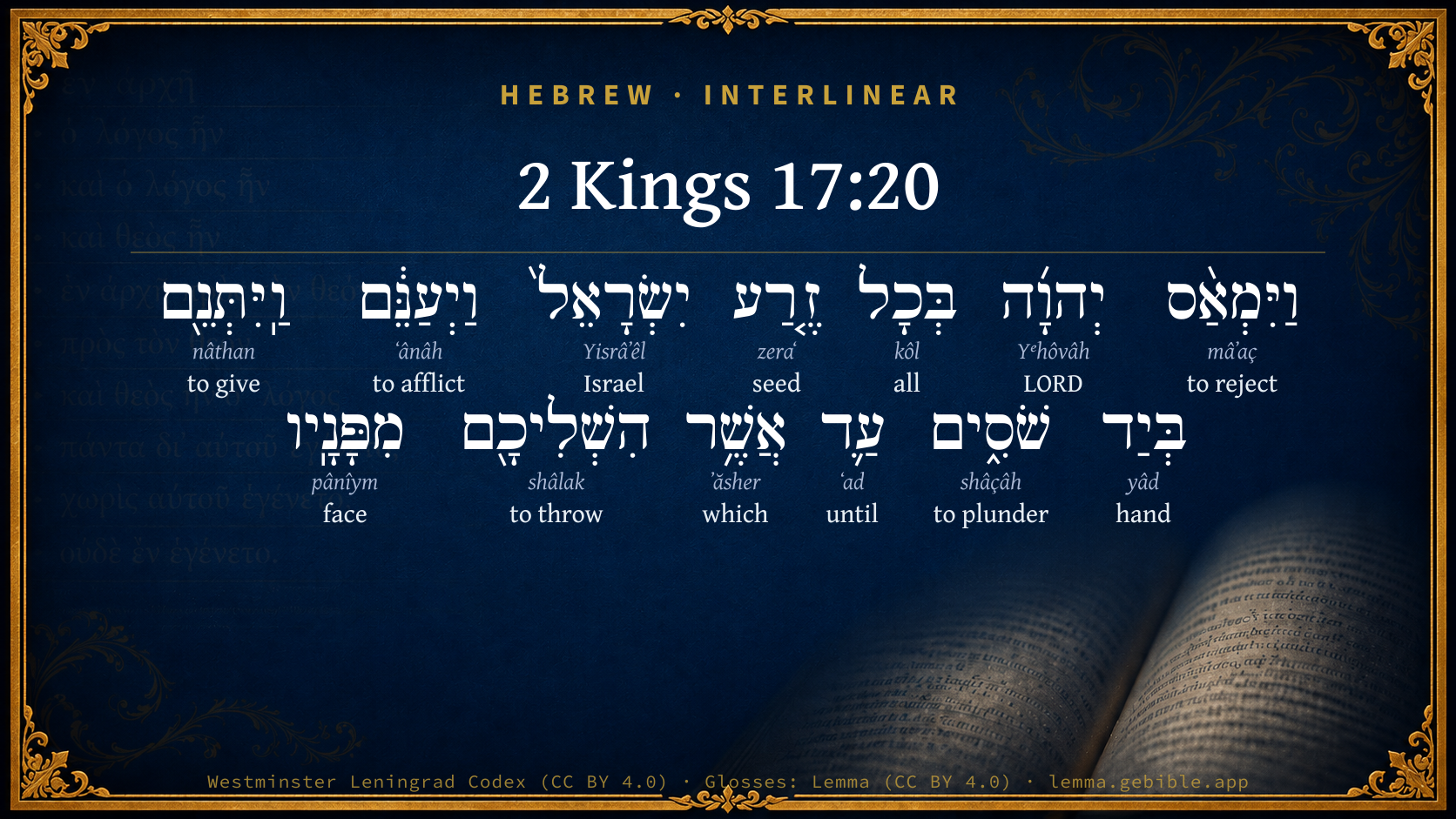
2 Kings 17:20

Hebrew (Westminster Leningrad Codex) 2 Kings 17:20 appears in the Hebrew Old Testament. The text above is from the Westminster Leningrad Codex. Each word links to its Strong’s number, a concise gloss, and parsing drawn from the Open Scriptures Hebrew Bible morphology. Click any word for its full Brown-Driver-Briggs (BDB) entry.
Download image
Cite this verse

2 Kings 17:20 (World English Bible). Public Domain. Lemma interlinear Bible study tool, https://lemma.gebible.app/v/2-kings/17/20.

Show BibTeX & RIS
BibTeX
RIS
English Translation
Yahweh rejected all the seed of Israel, and afflicted them, and delivered them into the hand of spoilers, until he had cast them out of his sight.
World English Bible · Public Domain
Download a study sheet

One document with this verse’s original text, its word-by-word gloss line, the meaning frame, cross-references with their text, attributed commentary, and full source and license credits — printable, and it pastes into notes with its structure intact.

This verse Autodidact and up

Study sheet (.html) Plain text (.txt)

A passage Seminary Student

Up to 50 verses in one chapter. A passage sheet keeps up to 6 commentary sources and 12 cross-references per verse, in the order this page ranks them, and says so on the sheet whenever that leaves anything out. Ask for a single verse and you get the Autodidact verse sheet above.

Everything on this page stays free to read, with no account — the sheet is a download of what is already on screen, not access to it.

Want to remove ads? Support Godless Engineer
Compare translations 3

The same verse in 3 English versions, stacked beneath the original-language interlinear above. Click any original word for its lexicon entry.

Each is an independent rendering of the whole verse — the interlinear is not word-aligned to these translations.

Highlighted words mark where these versions differ — a whole-verse word diff, not a word-by-word alignment.

  • World English Bible Public Domain
    Yahweh rejected all the seed of Israel, and afflicted them, and delivered them into the hand of spoilers, until he had cast them out of his sight.
  • King James Version Public Domain
    And the LORD rejected all the seed of Israel, and afflicted them, and delivered them into the hand of spoilers, until he had cast them out of his sight.
  • unfoldingWord Literal Text CC BY-SA 4.0
    And Yahweh rejected all of the seed of Israel, and he afflicted them, and he gave them into the hand of plunderers, until he cast them away from his face.

unfoldingWord Literal Text — © unfoldingWord, licensed CC BY-SA 4.0. Word-aligned USFM3 via Door43 (git.door43.org/unfoldingWord/en_ult).

Versions to compare (up to 4)

3 of 4 selected

Show all 18 translations

Every available English version of this verse, each an independent rendering of the whole verse.

  • World English Bible Public Domain
    Yahweh rejected all the seed of Israel, and afflicted them, and delivered them into the hand of spoilers, until he had cast them out of his sight.
  • Berean Standard Bible Public Domain
    So the LORD rejected all the descendants of Israel. He afflicted them and delivered them into the hands of plunderers, until He had banished them from His presence.
  • Majority Standard Bible Public Domain
    So the LORD rejected all the descendants of Israel. He afflicted them and delivered them into the hands of plunderers, until He had banished them from His presence.
  • King James Version Public Domain
    And the LORD rejected all the seed of Israel, and afflicted them, and delivered them into the hand of spoilers, until he had cast them out of his sight.
  • American Standard Version (1901) Public Domain
    And Jehovah rejected all the seed of Israel, and afflicted them, and delivered them into the hand of spoilers, until he had cast them out of his sight.
  • Revised Version (1885) Public Domain
    And the LORD rejected all the seed of Israel, and afflicted them, and delivered them into the hand of spoilers, until he had cast them out of his sight.
  • Geneva Bible (1599) Public Domain
    Therefore the Lord cast off all the seede of Israel, and afflicted them, and deliuered them into the handes of spoylers, vntill he had cast them out of his sight.
  • Douay-Rheims (1899) Public Domain
    And the Lord cast off all the seed of Israel, and afflicted them and delivered them into the hand of spoilers, till he cast them away from his face:
  • Young's Literal Translation Public Domain
    And Jehovah kicketh against all the seed of Israel, and afflicteth them, and giveth them into the hand of spoilers, till that He hath cast them out of His presence,
  • Literal Standard Version CC BY-SA 4.0
    And YHWH kicks against all the seed of Israel, and afflicts them, and gives them into the hand of spoilers, until He has cast them out of His presence,
  • Unlocked Literal Bible CC BY-SA 4.0
    So Yahweh rejected all the descendants of Israel; he afflicted them and gave them into the hand of those who would take the possession as spoil, until he had cast them out of his sight.
  • unfoldingWord Literal Text CC BY-SA 4.0
    And Yahweh rejected all of the seed of Israel, and he afflicted them, and he gave them into the hand of plunderers, until he cast them away from his face.
  • Darby Bible Public Domain
    And Jehovah rejected all the seed of Israel; and afflicted them, and delivered them into the hand of spoilers, until he had cast them out of his sight.
  • World Messianic Bible Public Domain
    The LORD rejected all the offspring of Israel, afflicted them, and delivered them into the hands of raiders, until he had cast them out of his sight.
  • Webster's Bible Public Domain
    And the LORD rejected all the seed of Israel, and afflicted them, and delivered them into the hand of spoilers, until he had cast them out of his sight.
  • Free Bible Version CC BY-SA 4.0
    The Lord gave up on all the descendants of Israel. He punished them and handed them over to their enemies, until he had banished them from his presence.
  • Bible in Basic English Public Domain
    So the Lord would have nothing to do with all the offspring of Israel, and sent trouble on them, and gave them up into the hands of their attackers, till he had sent them away from before his face.)
  • JPS Tanakh (1917) Public Domain
    And the LORD rejected all the seed of Israel, and afflicted them, and delivered them into the hand of spoilers, until He had cast them out of His sight.

Literal Standard Version (2020), Covenant Press — licensed CC BY-SA 4.0. Text via the HelloAO Bible API (eBible.org). Unlocked Literal Bible (unfoldingWord) — licensed CC BY-SA 4.0. Text via the HelloAO Bible API (eBible.org). unfoldingWord Literal Text — © unfoldingWord, licensed CC BY-SA 4.0. Word-aligned USFM3 via Door43 (git.door43.org/unfoldingWord/en_ult). Free Bible Version, Dr. Jonathan Gallagher — licensed CC BY-SA 4.0. Text via the HelloAO Bible API (eBible.org).

Word by word

More ways to search: Search by grammar → Find every occurrence → Compare this word →

Practice this passage: Drill this verse → Learn its vocabulary →

שֹׁסִ֑ים
shâçâh
H8154
“plundering”
Verb, Qal, Participle Active, Masculine, Plural, Absolute
Part of Speech
Verb
Stem
Qal
Form
Participle Active
Gender
Masculine
Number
Plural
State
Absolute
Full BDB Definition

Origin: a primitive root

TWOT: 2425

to spoil, plunder, take spoil - (Qal) - to plunder - plunderers (participle) - (Poel) to plunder
  1. וַיִּמְאַ֨ס mâʼaç H3988 “and · to reject” Conjunction + Verb, Qal, Sequential Imperfect, 3rd Person, Masculine, Singular
  2. יְהוָ֜ה Yᵉhôvâh H3068 “LORD” Noun, Proper
  3. בְּכָל kôl H3605 “in/at · all of” Preposition + Noun, Common, Masculine, Singular, Construct
  4. זֶ֤רַע zeraʻ H2233 “seed of” Noun, Common, Masculine, Singular, Construct
  5. יִשְׂרָאֵל֙ Yisrâʼêl H3478 “Israel” Noun, Proper
  6. וַיְעַנֵּ֔ם ʻânâh H6031 “and · to afflict · them” Conjunction + Verb, Piel, Sequential Imperfect, 3rd Person, Masculine, Singular + Suffix, Personal, 3rd Person, Masculine, Plural
  7. וַֽיִּתְּנֵ֖ם nâthan H5414 “and · to give · them” Conjunction + Verb, Qal, Sequential Imperfect, 3rd Person, Masculine, Singular + Suffix, Personal, 3rd Person, Masculine, Plural
  8. בְּיַד yâd H3027 “in/at · hand of” Preposition + Noun, Common, Both, Singular, Construct
  9. עַ֛ד ʻad H5704 “until” Preposition
  10. אֲשֶׁ֥ר ʼăsher H834 “which” Particle, Relative
  11. הִשְׁלִיכָ֖ם shâlak H7993 “to throw · them” Verb, Hiphil, Perfect, 3rd Person, Masculine, Singular + Suffix, Personal, 3rd Person, Masculine, Plural
  12. מִפָּנָֽיו pânîym H6440 “from · face(s) · his” Preposition + Noun, Common, Both, Plural, Construct + Suffix, Personal, 3rd Person, Masculine, Singular

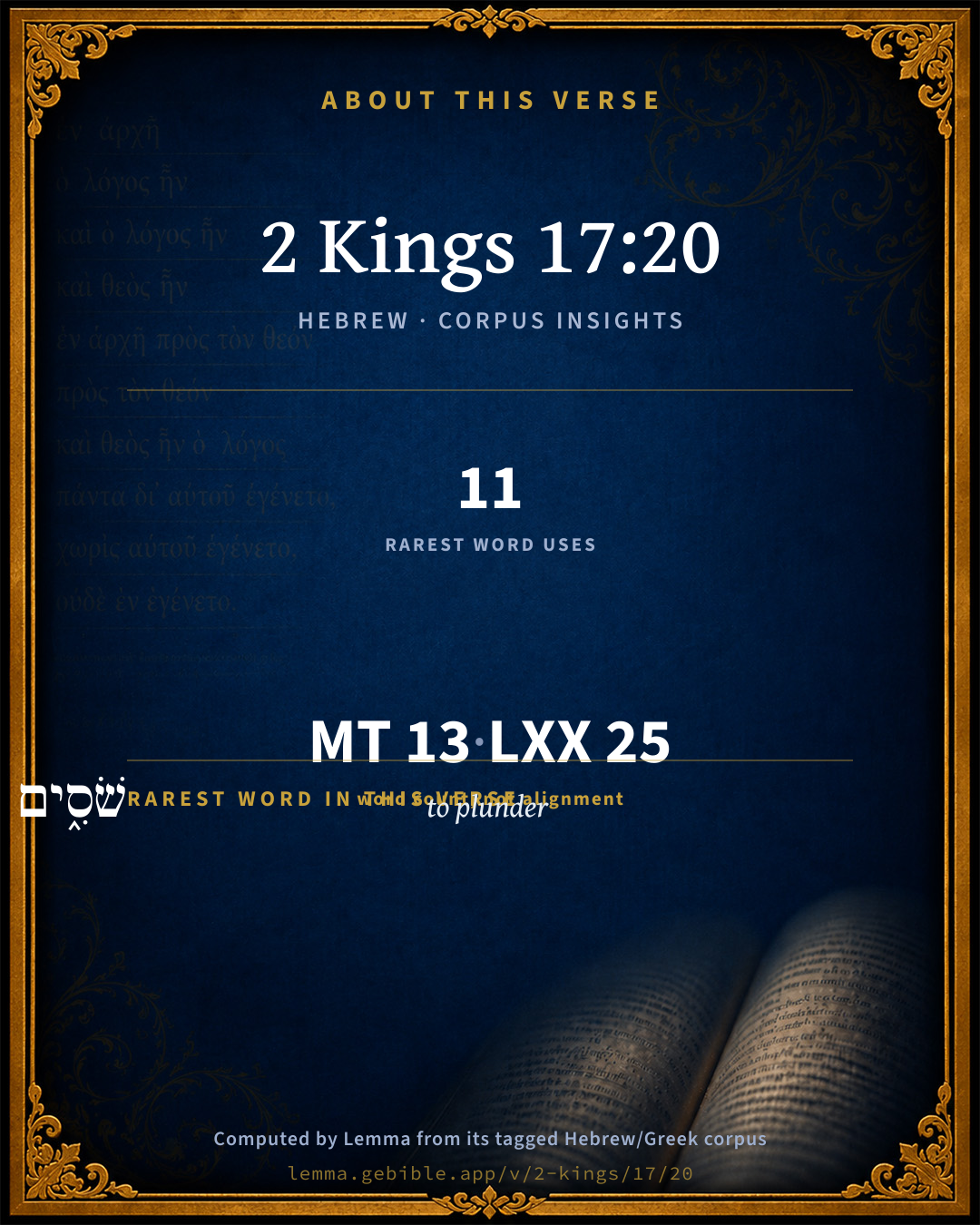
About this verse

These counts appear in no published source. They are computed here, from the morphology-tagged text and Lemma’s own curated glosses. What Lemma adds →

13
words
13
distinct lemmas
Historical
section

Notable vocabulary

The rarest word here is שֹׁסִ֑ים to plunder H8154 — appearing just 11 times in the whole Hebrew Bible.

Shared distinctive vocabulary

שֹׁסִ֑ים to plunder H8154 occurs in 11 verses of the Hebrew Bible. Also found in:

Grammatical profile

  • 5 verbs
  • 6 nouns
  • 1 preposition
  • 1 particle

Verb forms

  • וַיִּמְאַ֨ס Qal · Sequential Imperfect
  • וַיְעַנֵּ֔ם Piel · Sequential Imperfect
  • וַֽיִּתְּנֵ֖ם Qal · Sequential Imperfect
  • שֹׁסִ֑ים Qal · Participle Active
  • הִשְׁלִיכָ֖ם Hiphil · Perfect

Hebrew & Septuagint length

In English translation the verse runs 27 words from the Hebrew and 33 from the Septuagint (LXX English) — closely comparable.

A rough comparison of the two English renderings, which tokenize alike — not a word-level alignment.

Word counts can differ between the Hebrew and the Greek without any difference in meaning — e.g. the Hebrew direct-object marker אֵת has no separate Greek word, and Greek often adds the article ὁ.

In the original languages it is 13 Hebrew tokens and 25 Greek tokens — but the two are counted differently (Hebrew bundles its prefixes and suffixes into one token; the Greek is in lemma form), so that isn’t a like-for-like length.

Cross-references

25

Topical passages linked to 2 Kings 17:20 in the Treasury of Scripture Knowledge — connected by theme and wording, ordered by reader-vote popularity; previews shown in the World English Bible.

  • 2 Kings 15:29 In the days of Pekah king of Israel came Tiglath Pileser king of Assyria, and took Ijon, and Abel Beth Maacah, and Janoah, and Kedesh, and Hazor, and Gilead, and Galilee, all the land of Naphtali; and he carried them captive to Assyria.
  • 2 Kings 13:3 The anger of Yahweh was kindled against Israel, and he delivered them into the hand of Hazael king of Syria, and into the hand of Benhadad the son of Hazael, continually.
  • Jeremiah 6:30 Refuse silver shall men them, because Yahweh has rejected them.
  • Deuteronomy 11:12 a land which Yahweh your God cares for: the eyes of Yahweh your God are always on it, from the beginning of the year even to the end of the year.
  • 1 Samuel 15:23 For rebellion is as the sin of witchcraft, and stubbornness is as idolatry and teraphim. Because you have rejected the word of Yahweh, he has also rejected you from being king.
  • 1 Samuel 15:26 Samuel said to Saul, I will not return with you; for you have rejected the word of Yahweh, and Yahweh has rejected you from being king over Israel.
  • 1 Samuel 16:1 Yahweh said to Samuel, How long will you mourn for Saul, seeing I have rejected him from being king over Israel? fill your horn with oil, and go: I will send you to Jesse the Bethlehemite; for I have provided me a king among his sons.
  • 2 Kings 13:7 For he didn't leave to Jehoahaz of the people save fifty horsemen, and ten chariots, and ten thousand footmen; for the king of Syria destroyed them, and made them like the dust in threshing.
  • 2 Kings 15:18–20 He did that which was evil in the sight of Yahweh: he didn't depart all his days from the sins of Jeroboam the son of Nebat, with which he made Israel to sin.
  • 2 Kings 17:15 They rejected his statutes, and his covenant that he made with their fathers, and his testimonies which he testified to them; and they followed vanity, and became vain, and [went] after the nations that were round about them, concerning whom Yahweh had charged those who they should not do like them.
  • 2 Kings 17:18 Therefore Yahweh was very angry with Israel, and removed them out of his sight: there was none left but the tribe of Judah only.
  • 2 Kings 18:9 It happened in the fourth year of king Hezekiah, which was the seventh year of Hoshea son of Elah king of Israel, that Shalmaneser king of Assyria came up against Samaria, and besieged it.
  • 1 Chronicles 16:13 You seed of Israel his servant, You children of Jacob, his chosen ones.
  • 2 Chronicles 28:5–6 Therefore Yahweh his God delivered him into the hand of the king of Syria; and they struck him, and carried away of his a great multitude of captives, and brought them to Damascus. He was also delivered into the hand of the king of Israel, who struck him with a great slaughter.
  • Nehemiah 9:2 The seed of Israel separated themselves from all foreigners, and stood and confessed their sins, and the iniquities of their fathers.
  • Nehemiah 9:27–28 Therefore you delivered them into the hand of their adversaries, who distressed them: and in the time of their trouble, when they cried to you, you heard from heaven; and according to your manifold mercies you gave them saviors who saved them out of the hand of their adversaries.
  • Isaiah 45:25 In Yahweh shall all the seed of Israel be justified, and shall glory.
  • Jeremiah 31:36–37 If these ordinances depart from before me, says Yahweh, then the seed of Israel also shall cease from being a nation before me forever.
  • Jeremiah 33:24–26 Don't you consider what this people has spoken, saying, The two families which Yahweh did choose, he has cast them off? thus do they despise my people, that they should be no more a nation before them.
  • Jeremiah 46:28 Don't be afraid you, O Jacob my servant, says Yahweh; for I am with you: for I will make a full end of all the nations where I have driven you; but I will not make a full end of you, but I will correct you in measure, and will in no way leave you unpunished.
  • Jonah 1:3 But Jonah rose up to flee to Tarshish from the presence of Yahweh. He went down to Joppa, and found a ship going to Tarshish; so he paid its fare, and went down into it, to go with them to Tarshish from the presence of Yahweh.
  • Jonah 1:10 Then were the men exceedingly afraid, and said to him, "What is this that you have done?" For the men knew that he was fleeing from the presence of Yahweh, because he had told them.
  • Matthew 25:41 Then he will say also to those on the left hand, 'Depart from me, you cursed, into the eternal fire which is prepared for the devil and his angels;
  • Romans 11:1–2 I ask then, Did God reject his people? May it never be! For I also am an Israelite, a descendant of Abraham, of the tribe of Benjamin.
  • 2 Thessalonians 1:9 who will pay the penalty: eternal destruction from the face of the Lord and from the glory of his might,

Cross-references courtesy of OpenBible.info (CC BY 4.0).

Hebrew and Greek witnesses Masoretic Hebrew ↔ Greek Septuagint

The same verse in the two great witnesses to the Old Testament, shown verse-for-verse.

These are two independent witnesses, not word-aligned to each other, and the Septuagint is shown in lemma (dictionary) form.

Hebrew 2 Kings 17:20 Masoretic · Westminster Leningrad Codex

וַיִּמְאַ֨ס יְהוָ֜ה בְּכָל זֶ֤רַע יִשְׂרָאֵל֙ וַיְעַנֵּ֔ם וַֽיִּתְּנֵ֖ם בְּיַד שֹׁסִ֑ים עַ֛ד אֲשֶׁ֥ר הִשְׁלִיכָ֖ם מִפָּנָֽיו

Yahweh rejected all the seed of Israel, and afflicted them, and delivered them into the hand of spoilers, until he had cast them out of his sight.

World English Bible · Public Domain

Greek LXX 2 Kings 17:20 Septuagint · lemma form

καί ἀποὠθέω ὁ κύριος ἐν πᾶς σπέρμα ἰσραήλ καί σαλεύω αὐτός καί δίδωμι αὐτός ἐν χείρ διαἁρπάζω αὐτός ἕως ὅς ἀποῥίπτω αὐτός ἀπό πρόσωπον αὐτός

And the Lord was angry with the whole seed of Israel, and troubled them, and gave them into the hand of them that spoiled them, until he cast them out of his presence.

LXX2012 (modern English Septuagint) · Public Domain

On this verse, Ellicott's Commentary for English Readers discusses the Septuagint’s reading. Read the note in Commentary ↓

Hebrew: Westminster Leningrad Codex (CC BY 4.0). Greek: Septuagint (public domain); English from LXX2012 (modern English Septuagint) (Public Domain). How the Septuagint differs from the Hebrew →

Targum (Aramaic paraphrase)

1

The Targum is the ancient Jewish Aramaic paraphrase of the Hebrew Scriptures — an interpretive translation, not the Hebrew text itself. Onkelos (literal) and Pseudo-Jonathan (expansive) render the Torah, and Jonathan the Prophets. Coverage is partial: where no permissively-licensed English translation exists for a verse, only the Aramaic is shown. This is verse-level text, not a word-by-word alignment to the Hebrew.

  1. Targum Jonathan Prophets (Joshua–Malachi)
    וְקָץ יְיָ בְּכָל זַרְעָא דְיִשְׂרָאֵל וְעַנִינוּן וּמַסְרִינוּן בְּיַד בְּזוֹזִין עַד דְאַגְלִינוּן מֵאֲתַר בֵּית שְׁכִנְתֵּיהּ:

    (no public-domain English translation for this verse)

    Targum Jonathan — Aramaic: “Mikraot Gedolot” (public domain). English: “Sefaria Community Translation” (CC0 1.0 (public-domain dedication)); “London "Chaldee Paraphrase," 1871” (public domain). Text via Sefaria.

Commentary

Notes on 2 Kings 17:20 from classic Christian and Jewish commentators (each source and its license shown beneath its notes). The classic Christian expositions comment on the surrounding passage and are grouped to its opening verse, so a note may address several verses; the Jewish commentaries on the Tanakh (Rashi and others) are per-verse, so they appear only where the commentator wrote on this verse.

Lemma curates 59 commentaries, every one of them public domain or Creative Commons licensed, each selected and text-cleaned for this edition rather than reprinted as found. About our sources →

Trapp's Complete Commentary

John Trapp

2Ki 17:20 And the LORD rejected all the seed of Israel, and afflicted them, and delivered them into the hand of spoilers, until he had cast them out of his sight.

Ver. 20. And the Lord rejected.] Making them to become Loammi, and Loruhamah, according to Hos 1:6; Hos 1:9.

And delivered them into the hand of spoilers.] So that when to leave their dear country, they cried out to the mountains to cover them, and to the hills to fall upon them, according to Hos 10:8.

John Trapp, A Commentary or Exposition upon All the Books of the Old and New Testament (1647–1656) — public domain. Text from a community e-Sword module.

Joseph Benson's Commentary

2Ki 17:20. The Lord rejected all the seed of Israel — All the kingdom, or tribes of Israel, first one part of them, and now the rest: but this extends not to every individual person of these tribes, for many of them removed into the kingdom of Judah, and were associated with them: see 2Ch 11:16.

Joseph Benson's Commentary on the Old and New Testaments (1811–1818) — public domain. Text from a community e-Sword module.

Geneva Bible (1599)

Geneva Bible translators

Out of the land where he showed the greatest tokens of his presence and favor.

Geneva Bible (1599) marginal notes — public domain. Text via Bolls.life.

Ellicott's Commentary for English Readers

(20) And the Lord rejected all the seed of Israel.—Thenius prefers the reading of the LXX. “and rejected the Lord (as in the last clause of 2Ki_17:19), and the Lord, was angry with all the seed of Israel,” &c. It thus becomes plain that the writer goes back to 2Ki_17:18, after the parenthesis relating to Judah. “Israel” is used in the narrow sense in those verses.

Into the hand of spoilers—e.g., the Syrians (2Ki_10:32;) and the Assyrians (2Ki_15:19; 2Ki_15:29; 2Ki_17:3. The writer probably remembered Jdg_2:14.

A Bible Commentary for English Readers, edited by Charles John Ellicott (1878–1897) — public domain. Text from a community e-Sword module.

The Cambridge Bible for Schools and Colleges

gen. ed. J. J. S. Perowne

20. And the Lord rejected all the seed of Israel] The LXX. has ‘And they rejected the Lord, and the Lord was angry with all the seed of Israel’.

the hand of spoilers] The first of whom, mentioned below, is Jeroboam the son of Nebat, who led them astray, and the next is the king of Assyria, who carried them captive. There were many spoilers between, but Jeroboam’s act began the downward course, which ended in the captivity of Shalmaneser and Sargon.

The Cambridge Bible for Schools and Colleges (gen. ed. J. J. S. Perowne; Cambridge University Press, 1878–1918) — public domain. Text from a community e-Sword module.

John Gill's Exposition

And the Lord rejected all the seed of Israel,.... The ten tribes, with loathing and contempt, and wrote a "loammi" on them, rejected them from being his people, gave them a bill of divorce, and declared them no more under his care and patronage:

and afflicted them; as he did before he utterly cast them off, as by famine, drought, and pestilence, Amo 4:6.

and delivered them into the hands of spoilers; as, first, into the hands of Hazael and Benhadad, kings of Syria, and then of Tiglathpileser king of Assyria, Kg2 13:3,

until he had cast them out of his sight; by suffering them, as now, to be carried captive by Shalmaneser, Kg2 17:6.

John Gill's Exposition of the Whole Bible (1746–1763) — public domain (CC PDM 1.0). Text via the HelloAO Bible API.

Albert Barnes' Notes on the Bible

All the seed of lsrael - The Jews, i. e. as well as the Israelites. God’s dealings with both kingdoms were alike. “Spoilers” were sent against each, time after time, before the final ruin came on them - against Israel, Pul and Tiglath-pileser 2Ki 15:19, 2Ki 15:29; 1Ch 5:26; against Judah, Sennacherib 2Ki 18:13-16, Esar-haddon 2Ch 33:11, and Nebuchadnezzar thrice.

Albert Barnes' Notes on the Bible (1834–1885) — public domain. Text from a community e-Sword/MySword module.

Haydock's Catholic Bible Commentary

CHAPTER XVII.

George Leo Haydock (1774–1849), Haydock's Catholic Family Bible and Commentary, 1859 edition — public domain. Excludes Psalms (Douay-Rheims chapter numbering differs from Protestant) and Deuterocanonical books (Catholic canon only).

Matthew Poole's English Annotations

All the seed of Israel, i.e. all the kingdom or tribes of Israel; first one part of them, 2Ki 15:29, and now the rest. But this extends not to every individual person of these tribes; for many of them removed into the kingdom of Judah, and were associated with them, as appears from 2Ch 11:16, and many other places.

Matthew Poole's English Annotations on the Holy Bible (1683–1685) — public domain. Text from a community e-Sword/MySword module.

Whedon's Commentary on the Bible

Daniel D. Whedon

20. All the seed of Israel — That is, all Israel included in the ten tribes, for the kingdom of Judah had not yet fallen.

Spoilers — First the Syrians, (2Ki_10:32; 2Ki_13:3,) and lastly the Assyrians, (2Ki_15:19; 2Ki_15:29,) who utterly ruined them. 2Ki_17:3-6.

Daniel D. Whedon (gen. ed.), Commentary on the Old and New Testaments (1874–1909) — public domain. Text from a community e-Sword module.

The Pulpit Commentary

And the Lord rejected all the seed of Israel. God is no respecter of persons. As he had rejected the ten tribes on account of certain transgressions, which have been enumerated (vers. 8-17), so, when Judah committed the self-same sins, and transgressed equally, Judah had equally to be rejected. All the seed of Israel" is the entire nation Israel in the widest sense, made up of Judah and of Israel in the narrow sense. So Keil, rightly. And afflicted them by the hands of Sargon, and Sennacherib, and Esarhaddon, (2Ch_33:11) and Pharaoh-Nechoh, and othersand delivered them into the hands of spoilers. The "spoilers" intended are probably, first, the "bands of the Chaldees, and of the Syrians, and of the Moabites, and of the children of Ammon," who were let loose upon Judaea by Nebuchadnezzar when Jehoiakim rebelled against him, (2Ki_24:2) and secondly Nebuchadnezzar himself and Nebuzaradan, who completed the spoliation of the country, and plundered Jerusalem itself, to punish the revolts of Jehoiachid and Zedekiah, (2Ki_24:13-16 and 2Ki_25:8-21) when all the treasures of the temple were carried off. Until he had cast them out of his sight; i.e. until he had punished Judah as he had previously punished Israel (ver. 18), which was what justice required.

The Pulpit Commentary (1880–1919), ed. H.D.M. Spence-Jones & Joseph S. Exell — public domain. Text from a community e-Sword module.

John Wesley's Explanatory Notes

All Israel - All the tribes of Israel: first, one part of them, and now the rest. But this extends not to every individual person of these tribes; for many of them removed into the kingdom of Judah, and were associated with them.

John Wesley, Explanatory Notes Upon the Whole Bible (1754–1765) — public domain. Text via the GEBible commentary corpus.

Lesson kit

Teaching starters — assembled from the data on this page, not authored interpretation. Every prompt links to the verse data it draws on. Edit before teaching.

2 Kings, in the Historical, opens this verse with 13 words (13 distinct Hebrew lemmas). Its most distinctive word is shâçâh (“to plunder”). A historical commentator’s framing appears above. Read the whole chapter for the surrounding context.

Discussion questions

  1. What does “to plunder” (shâçâh) contribute to the verse as a whole?
  2. Judges 2:14 shares the word «to plunder» with this verse. How do the two illuminate each other?
  3. These translations render this verse differently; the difference is in the English rendering, not the original. What questions does that raise?
  4. The verb «וַיִּמְאַ֨ס» is Qal Sequential Imperfect. How does its form color the action?
  5. Reading how Trapp's Complete Commentary and Joseph Benson's Commentary read this verse, where do the two commentators agree and where do they part?

Things to notice

Reading settings

Reading text

Shown beneath each verse's original-language words.

Old Testament
Old Testament edition

Read the OT as the Masoretic Hebrew (MT) or the Greek Septuagint (LXX).

English shown for the Greek Septuagint (in the Hebrew ↔ Greek comparison).

Comparing translations? Open the Compare panel on any verse page to stack up to four side by side.