
2 Kings 24:20

Hebrew (Westminster Leningrad Codex) 2 Kings 24:20 appears in the Hebrew Old Testament. The text above is from the Westminster Leningrad Codex. Each word links to its Strong’s number, a concise gloss, and parsing drawn from the Open Scriptures Hebrew Bible morphology. Click any word for its full Brown-Driver-Briggs (BDB) entry.
Download image
Cite this verse

2 Kings 24:20 (World English Bible). Public Domain. Lemma interlinear Bible study tool, https://lemma.gebible.app/v/2-kings/24/20.

Show BibTeX & RIS
BibTeX
RIS
English Translation
For through the anger of Yahweh did it happen in Jerusalem and Judah, until he had cast them out from his presence. Zedekiah rebelled against the king of Babylon.
World English Bible · Public Domain
Download a study sheet

One document with this verse’s original text, its word-by-word gloss line, the meaning frame, cross-references with their text, attributed commentary, and full source and license credits — printable, and it pastes into notes with its structure intact.

This verse Autodidact and up

Study sheet (.html) Plain text (.txt)

A passage Seminary Student

Up to 50 verses in one chapter. A passage sheet keeps up to 6 commentary sources and 12 cross-references per verse, in the order this page ranks them, and says so on the sheet whenever that leaves anything out. Ask for a single verse and you get the Autodidact verse sheet above.

Everything on this page stays free to read, with no account — the sheet is a download of what is already on screen, not access to it.

Want to remove ads? Support Godless Engineer
Compare translations 3

The same verse in 3 English versions, stacked beneath the original-language interlinear above. Click any original word for its lexicon entry.

Each is an independent rendering of the whole verse — the interlinear is not word-aligned to these translations.

Highlighted words mark where these versions differ — a whole-verse word diff, not a word-by-word alignment.

  • World English Bible Public Domain
    For through the anger of Yahweh did it happen in Jerusalem and Judah, until he had cast them out from his presence. Zedekiah rebelled against the king of Babylon.
  • King James Version Public Domain
    For through the anger of the LORD it came to pass in Jerusalem and Judah, until he had cast them out from his presence, that Zedekiah rebelled against the king of Babylon.
  • unfoldingWord Literal Text CC BY-SA 4.0
    For because of the nose of Yahweh it was against Jerusalem and against Judah, until he cast them away from his face. And Zedekiah rebelled against the king of Babylon.

unfoldingWord Literal Text — © unfoldingWord, licensed CC BY-SA 4.0. Word-aligned USFM3 via Door43 (git.door43.org/unfoldingWord/en_ult).

Versions to compare (up to 4)

3 of 4 selected

Show all 18 translations

Every available English version of this verse, each an independent rendering of the whole verse.

  • World English Bible Public Domain
    For through the anger of Yahweh did it happen in Jerusalem and Judah, until he had cast them out from his presence. Zedekiah rebelled against the king of Babylon.
  • Berean Standard Bible Public Domain
    For because of the anger of the LORD, all this happened in Jerusalem and Judah, until He finally banished them from His presence. And Zedekiah also rebelled against the king of Babylon.
  • Majority Standard Bible Public Domain
    For because of the anger of the LORD, all this happened in Jerusalem and Judah, until He finally banished them from His presence. And Zedekiah also rebelled against the king of Babylon.
  • King James Version Public Domain
    For through the anger of the LORD it came to pass in Jerusalem and Judah, until he had cast them out from his presence, that Zedekiah rebelled against the king of Babylon.
  • American Standard Version (1901) Public Domain
    For through the anger of Jehovah did it come to pass in Jerusalem and Judah, until he had cast them out from his presence. And Zedekiah rebelled against the king of Babylon.
  • Revised Version (1885) Public Domain
    For through the anger of the LORD did it come to pass in Jerusalem and Judah, until he had cast them out from his presence: and Zedekiah rebelled against the king of Babylon.
  • Geneva Bible (1599) Public Domain
    Therefore certainly the wrath of the Lord was against Ierusalem and Iudah vntill he cast them out of his sight. And Zedekiah rebelled against the King of Babel.
  • Douay-Rheims (1899) Public Domain
    For the Lord was angry against Jerusalem and against Juda, till he cast them out from his face: and Sedecias revolted from the king of Babylon.
  • Young's Literal Translation Public Domain
    for, by the anger of Jehovah it hath been against Jerusalem and against Judah, till he cast them out from His presence, that Zedekiah rebelleth against the king of Babylon.
  • Literal Standard Version CC BY-SA 4.0
    for by the anger of YHWH it has been against Jerusalem and against Judah, until He [finally] cast them out from His presence. And Zedekiah rebels against the king of Babylon.
  • Unlocked Literal Bible CC BY-SA 4.0
    Through Yahweh's anger, all these events happened in Jerusalem and Judah, until he drove them out of his presence. Then Zedekiah rebelled against the king of Babylon.
  • unfoldingWord Literal Text CC BY-SA 4.0
    For because of the nose of Yahweh it was against Jerusalem and against Judah, until he cast them away from his face. And Zedekiah rebelled against the king of Babylon.
  • Darby Bible Public Domain
    For, because the anger of Jehovah was against Jerusalem and against Judah, until he had cast them out from his presence, Zedekiah rebelled against the king of Babylon.
  • World Messianic Bible Public Domain
    For through the anger of the LORD, this happened in Jerusalem and Judah, until he had cast them out from his presence. Then Zedekiah rebelled against the king of Babylon.
  • Webster's Bible Public Domain
    For through the anger of the LORD it came to pass in Jerusalem and Judah, until he had cast them out from his presence, that Zedekiah rebelled against the king of Babylon.
  • Free Bible Version CC BY-SA 4.0
    All this happened in Jerusalem and Judah, because of the Lord's anger, until he eventually banished them from his presence. Zedekiah rebelled against the king of Babylon.
  • Bible in Basic English Public Domain
    And because of the wrath of the Lord, this came about in Jerusalem and Judah, till he had sent them all away from before him: and Zedekiah took up arms against the king of Babylon.
  • JPS Tanakh (1917) Public Domain
    For through the anger of the LORD did it come to pass in Jerusalem and Judah, until He had cast them out from His presence. And Zedekiah rebelled against the king of Babylon.

Literal Standard Version (2020), Covenant Press — licensed CC BY-SA 4.0. Text via the HelloAO Bible API (eBible.org). Unlocked Literal Bible (unfoldingWord) — licensed CC BY-SA 4.0. Text via the HelloAO Bible API (eBible.org). unfoldingWord Literal Text — © unfoldingWord, licensed CC BY-SA 4.0. Word-aligned USFM3 via Door43 (git.door43.org/unfoldingWord/en_ult). Free Bible Version, Dr. Jonathan Gallagher — licensed CC BY-SA 4.0. Text via the HelloAO Bible API (eBible.org).

Word by word

More ways to search: Search by grammar → Find every occurrence → Compare this word →

Practice this passage: Drill this verse → Learn its vocabulary →

וַיִּמְרֹ֥ד
mârad
H4775
“and · to rebel”
Conjunction + Verb, Qal, Sequential Imperfect, 3rd Person, Masculine, Singular
Part of Speech
Conjunction + Verb
Stem
Qal
Form
Sequential Imperfect
Person
3rd Person
Gender
Masculine
Number
Singular
Full BDB Definition

Origin: a primitive root

TWOT: 1240

to rebel, revolt, be rebellious - (Qal) to rebel, revolt - against human king - against God - against light (poetic)
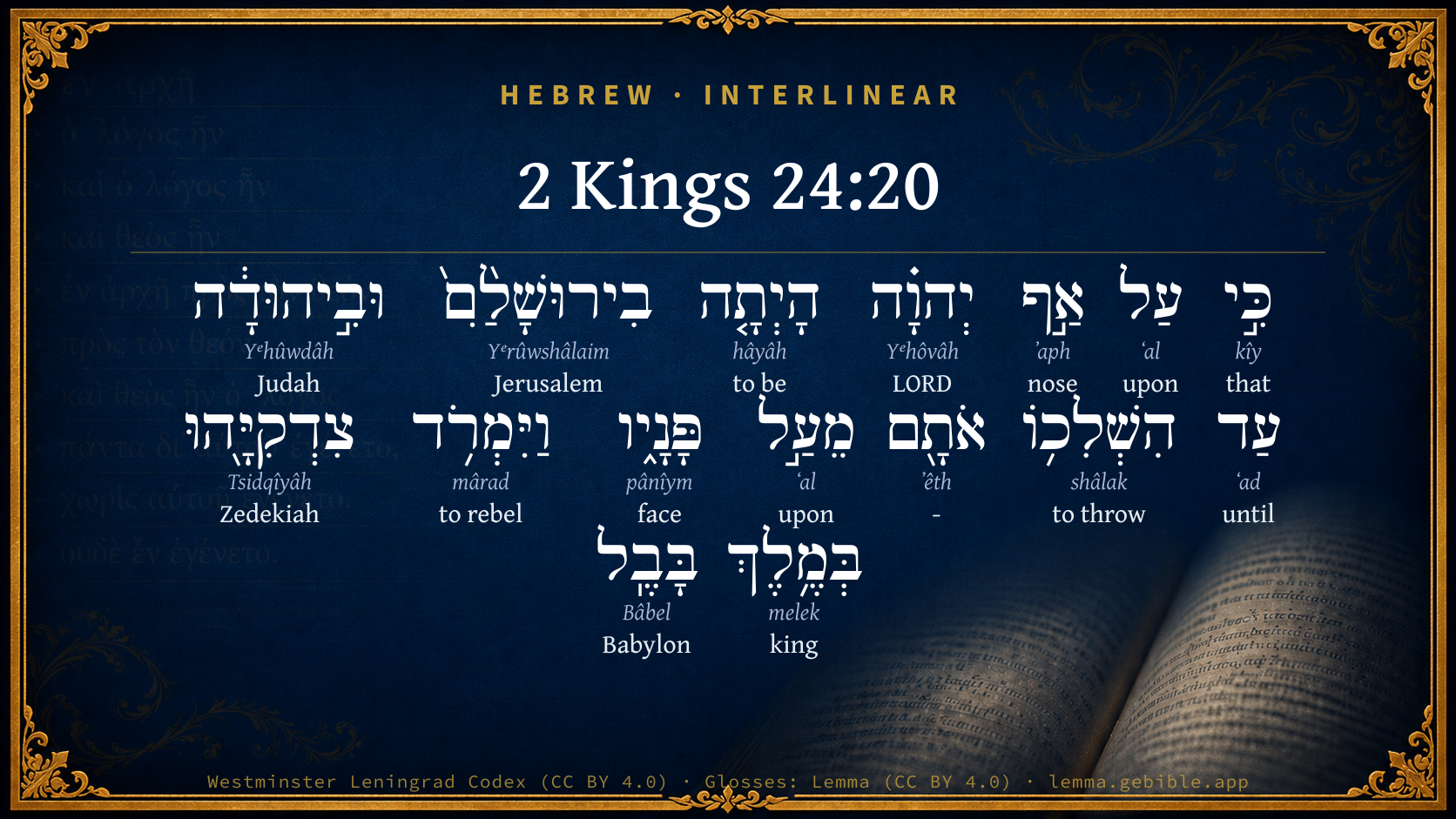
  1. כִּ֣י kîy H3588 “that” Conjunction
  2. עַל ʻal H5921 “upon” Preposition
  3. אַ֣ף ʼaph H639 “nose” Particle, Accusative
  4. יְהוָ֗ה Yᵉhôvâh H3068 “LORD” Noun, Proper
  5. הָיְתָ֤ה hâyâh H1961 “to be” Verb, Qal, Perfect, 3rd Person, Feminine, Singular
  6. בִירוּשָׁלִַ֨ם֙ Yᵉrûwshâlaim H3389 “in/at · Jerusalem” Preposition + Noun, Proper
  7. וּבִ֣יהוּדָ֔ה Yᵉhûwdâh H3063 “and · in/at · Judah” Conjunction + Preposition + Noun, Proper
  8. עַד ʻad H5704 “until” Preposition
  9. הִשְׁלִכ֥וֹ shâlak H7993 “to throw · him” Verb, Hiphil, Infinitive Construct + Suffix, Personal, 3rd Person, Masculine, Singular
  10. אֹתָ֖ם ʼêth H853 “- · them” Particle, Direct Object + Suffix, Personal, 3rd Person, Masculine, Plural
  11. מֵעַ֣ל ʻal H5921 “from · upon” Preposition + Preposition
  12. פָּנָ֑יו pânîym H6440 “face(s) · his” Noun, Common, Both, Plural, Construct + Suffix, Personal, 3rd Person, Masculine, Singular
  13. צִדְקִיָּ֖הוּ Tsidqîyâh H6667 “Zedekiah” Noun, Proper
  14. בְּמֶ֥לֶךְ melek H4428 “in/at · king of” Preposition + Noun, Common, Masculine, Singular, Construct
  15. בָּבֶֽל Bâbel H894 “Babylon” Noun, Proper

About this verse

These counts appear in no published source. They are computed here, from the morphology-tagged text and Lemma’s own curated glosses. What Lemma adds →

16
words
15
distinct lemmas
Historical
section

Notable vocabulary

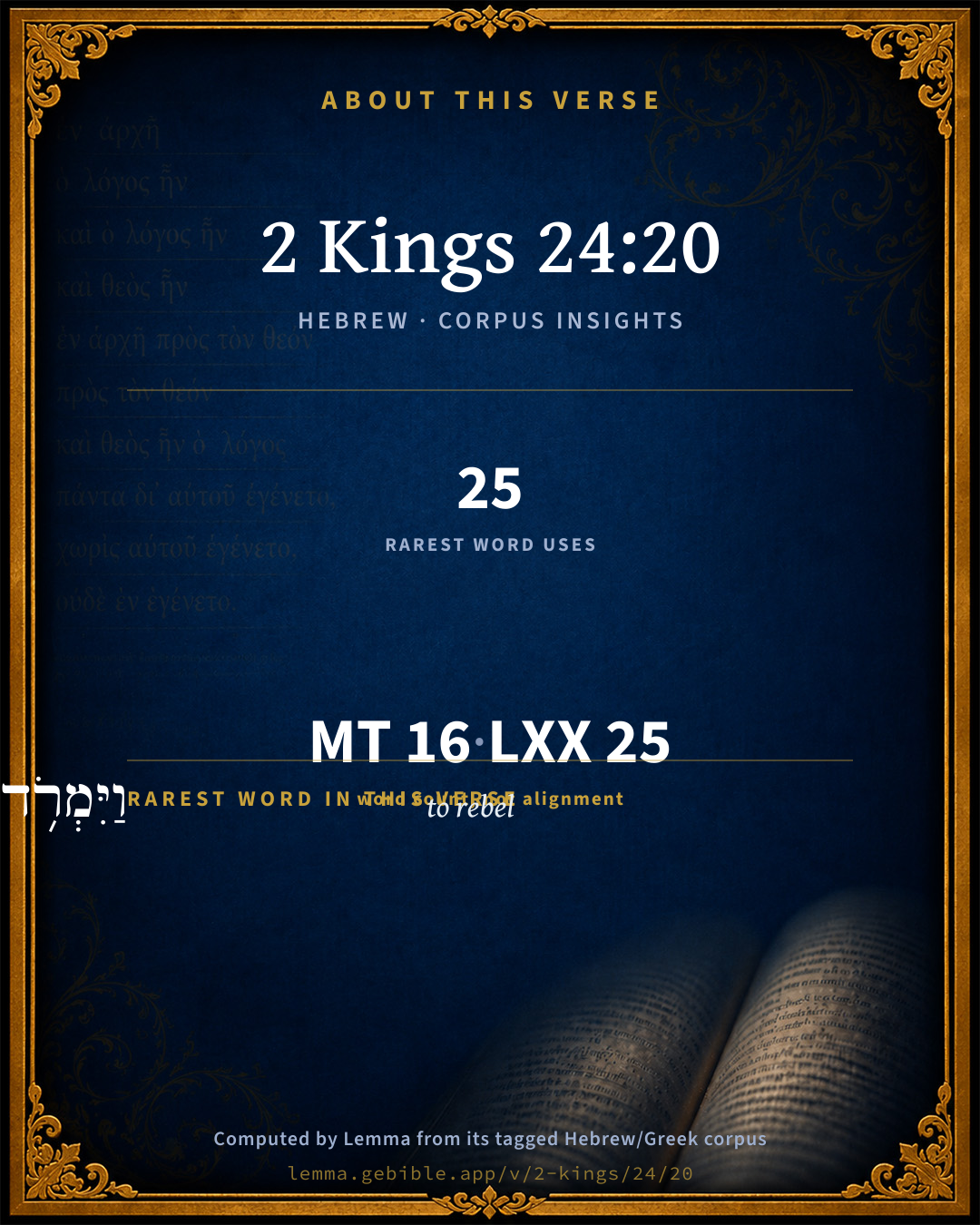
The rarest word here is וַיִּמְרֹ֥ד to rebel H4775 — appearing just 25 times in the whole Hebrew Bible.

Shared distinctive vocabulary

וַיִּמְרֹ֥ד to rebel H4775 occurs in 23 verses of the Hebrew Bible. Also found in:

Grammatical profile

  • 3 verbs
  • 7 nouns
  • 3 prepositions
  • 1 conjunction
  • 2 particles

Verb forms

  • הָיְתָ֤ה Qal · Perfect
  • הִשְׁלִכ֥וֹ Hiphil · Infinitive Construct
  • וַיִּמְרֹ֥ד Qal · Sequential Imperfect

Repetition

A word recurs within this verse — often emphatic in Hebrew:

Hebrew & Septuagint length

In English translation the verse runs 29 words from the Hebrew and 29 from the Septuagint (LXX English) — the same length.

A rough comparison of the two English renderings, which tokenize alike — not a word-level alignment.

Word counts can differ between the Hebrew and the Greek without any difference in meaning — e.g. the Hebrew direct-object marker אֵת has no separate Greek word, and Greek often adds the article ὁ.

In the original languages it is 16 Hebrew tokens and 25 Greek tokens — but the two are counted differently (Hebrew bundles its prefixes and suffixes into one token; the Greek is in lemma form), so that isn’t a like-for-like length.

Cross-references

11

Topical passages linked to 2 Kings 24:20 in the Treasury of Scripture Knowledge — connected by theme and wording, ordered by reader-vote popularity; previews shown in the World English Bible.

  • 2 Chronicles 36:13 He also rebelled against king Nebuchadnezzar, who had made him swear by God: but he stiffened his neck, and hardened his heart against turning to Yahweh, the God of Israel.
  • 2 Thessalonians 2:9–11 even he whose coming is according to the working of Satan with all power and signs and lying wonders,
  • Exodus 9:14–17 For this time I will send all my plagues against your heart, against your officials, and against your people; that you may know that there is none like me in all the earth.
  • Deuteronomy 2:30 But Sihon king of Heshbon would not let us pass by him; for Yahweh your God hardened his spirit, and made his heart obstinate, that he might deliver him into your hand, as at this day.
  • Deuteronomy 29:27 therefore the anger of Yahweh was kindled against this land, to bring on it all the curse that is written in this book;
  • 2 Kings 22:17 Because they have forsaken me, and have burned incense to other gods, that they might provoke me to anger with all the work of their hands, therefore my wrath shall be kindled against this place, and it shall not be quenched.
  • Isaiah 19:11–14 The princes of Zoan are utterly foolish; the counsel of the wisest counselors of Pharaoh is become brutish: how do you say to Pharaoh, I am the son of the wise, the son of ancient kings?
  • Jeremiah 27:12–15 I spoke to Zedekiah king of Judah according to all these words, saying, Bring your necks under the yoke of the king of Babylon, and serve him and his people, and live.
  • Jeremiah 38:17–21 Then said Jeremiah to Zedekiah, Thus says Yahweh, the God of hosts, the God of Israel: If you will go forth to the king of Babylon's princes, then your soul shall live, and this city shall not be burned with fire; and you shall live, and your house.
  • Ezekiel 17:15–20 But he rebelled against him in sending his ambassadors into Egypt, that they might give him horses and much people. Shall he prosper? shall he escape who does such things? shall he break the covenant, and yet escape?
  • 1 Corinthians 1:20 Where is the wise? Where is the scribe? Where is the lawyer of this world? Hasn't God made foolish the wisdom of this world?

Cross-references courtesy of OpenBible.info (CC BY 4.0).

Hebrew and Greek witnesses Masoretic Hebrew ↔ Greek Septuagint

The same verse in the two great witnesses to the Old Testament, shown verse-for-verse.

These are two independent witnesses, not word-aligned to each other, and the Septuagint is shown in lemma (dictionary) form.

Hebrew 2 Kings 24:20 Masoretic · Westminster Leningrad Codex

כִּ֣י עַל אַ֣ף יְהוָ֗ה הָיְתָ֤ה בִירוּשָׁלִַ֨ם֙ וּבִ֣יהוּדָ֔ה עַד הִשְׁלִכ֥וֹ אֹתָ֖ם מֵעַ֣ל פָּנָ֑יו וַיִּמְרֹ֥ד צִדְקִיָּ֖הוּ בְּמֶ֥לֶךְ בָּבֶֽל

For through the anger of Yahweh did it happen in Jerusalem and Judah, until he had cast them out from his presence. Zedekiah rebelled against the king of Babylon.

World English Bible · Public Domain

Greek LXX 2 Kings 24:20 Septuagint · lemma form

ὅτι ἐπί ὁ θυμός κύριος εἰμί ἐπί ἰερουσαλήμ καί ἐν ὁ ιουδα ἕως ἀποῥίπτω αὐτός ἀπό πρόσωπον αὐτός καί ἀθετέω σεδεκιας ἐν ὁ βασιλεύς βαβυλών

For it was according to the Lord's anger against Jerusalem and on Juda, until he cast them out of his presence, that Sedekias revolted against the king of Babylon.

LXX2012 (modern English Septuagint) · Public Domain

On this verse, Haydock's Catholic Bible Commentary discusses the Septuagint’s reading. Read the note in Commentary ↓

Hebrew: Westminster Leningrad Codex (CC BY 4.0). Greek: Septuagint (public domain); English from LXX2012 (modern English Septuagint) (Public Domain). How the Septuagint differs from the Hebrew →

Targum (Aramaic paraphrase)

1

The Targum is the ancient Jewish Aramaic paraphrase of the Hebrew Scriptures — an interpretive translation, not the Hebrew text itself. Onkelos (literal) and Pseudo-Jonathan (expansive) render the Torah, and Jonathan the Prophets. Coverage is partial: where no permissively-licensed English translation exists for a verse, only the Aramaic is shown. This is verse-level text, not a word-by-word alignment to the Hebrew.

  1. Targum Jonathan Prophets (Joshua–Malachi)
    אֲרֵי עַל דְאַרְגִיזוּ קֳדָם יְיָ הֲוַת בִּירוּשְׁלֵם וּבִיהוּדָה עַד דְאַגְלֵי יַתְהוֹן מֵאַרְעָא בֵּית שְׁכִינְתֵּיהּ וּמְרִיד צִדְקִיָהוּ בְּמַלְכָּא דְבָבֶל:

    (no public-domain English translation for this verse)

    Targum Jonathan — Aramaic: “Mikraot Gedolot” (public domain). English: “Sefaria Community Translation” (CC0 1.0 (public-domain dedication)); “London "Chaldee Paraphrase," 1871” (public domain). Text via Sefaria.

Commentary

Notes on 2 Kings 24:20 from classic Christian and Jewish commentators (each source and its license shown beneath its notes). The classic Christian expositions comment on the surrounding passage and are grouped to its opening verse, so a note may address several verses; the Jewish commentaries on the Tanakh (Rashi and others) are per-verse, so they appear only where the commentator wrote on this verse.

Lemma curates 59 commentaries, every one of them public domain or Creative Commons licensed, each selected and text-cleaned for this edition rather than reprinted as found. About our sources →

Trapp's Complete Commentary

John Trapp

2Ki 24:20 For through the anger of the LORD it came to pass in Jerusalem and Judah, until he had cast them out from his presence, that Zedekiah rebelled against the king of Babylon.

Ver. 20. For through the anger of the Lord.] Who hardened Zedekiah’s heart, that he "humbled not himself before Jeremiah," &c. {2Ch 36:12}

John Trapp, A Commentary or Exposition upon All the Books of the Old and New Testament (1647–1656) — public domain. Text from a community e-Sword module.

Joseph Benson's Commentary

2Ki 24:20. For through the anger of the Lord, &c. — God was so highly displeased with this wicked people, that he permitted Zedekiah to break his faith with Nebuchadnezzar, and to rebel against him, forgetting for what cause he changed his name. Unto this revolt, it is probable, he was persuaded by the ambassadors which the kings of Edom, Moab, Ammon, Tyre, and Zidon, sent unto him, to solicit him to throw off the yoke of the king of Babylon, Jer 27:2-4, &c.; which was the greater crime, because he had taken a solemn oath that he would be true to him, 2Ch 36:13. The king of Egypt also, it is likely, promised him help, Eze 17:15; and Hananiah, a false prophet, assured him God would, in two years time, break the yoke of the king of Babylon, and bring back all the vessels of the house of God, with Jehoiachin and all the captives: see Jer 28:1-4. Jeremiah indeed proved that he made them trust in a lie, by predicting his death that very year, which accordingly came to pass, 2Ki 24:15-17. But they still persisted in their vain hopes, there being other deceivers that prophesied falsely in God’s name, Jer 29:8-9 : and they most of all deceived themselves with proud conceits that they were the true seed of Abraham, who had a right to that land, Eze 33:24. The people’s sins, therefore, as Poole has justly observed, were the true cause why God gave them wicked kings, whom he suffered to act wickedly, that they might bring the long-deserved and threatened punishments upon themselves and their people.

Joseph Benson's Commentary on the Old and New Testaments (1811–1818) — public domain. Text from a community e-Sword module.

Geneva Bible (1599)

Geneva Bible translators

Out of Jerusalem and Judah into Babylon.

Geneva Bible (1599) marginal notes — public domain. Text via Bolls.life.

Jamieson, Fausset & Brown

Robert Jamieson, A. R. Fausset & David Brown

through the anger of the Lord . . . he cast them out from his presence--that is, in the course of God's righteous providence, his policy as king would prove ruinous to his country.

Zedekiah rebelled against the king of Babylon--instigated by ambassadors from the neighboring states who came to congratulate him on his ascension to the throne (compare Jer 17:3, with Jer 28:1), and at the same time get him to join them in a common league to throw off the Assyrian yoke. Though warned by Jeremiah against this step, the infatuated and perjured (Eze 17:13) Zedekiah persisted in his revolt.

Next: 2 Kings Chapter 25

Jamieson, Fausset & Brown — Commentary Critical and Explanatory on the Whole Bible (1871) — public domain (CC PDM 1.0). Text via the HelloAO Bible API.

Adam Clarke's Commentary

Verse 20. Zedekiah rebelled] This was in the eighth year of his reign: and he is strongly reproved for having violated the oath he took to the king of Babylon: see 2Ch 36:13. This was the filling up of the measure of iniquity; and now the wrath of God descends upon this devoted king, city, and people, to the uttermost. See the catastrophe in the next chapter.

Adam Clarke's Commentary on the Bible (1810–1826) — public domain. Text from a community e-Sword/MySword module.

Ellicott's Commentary for English Readers

(20) For through . . . in Jerusalem.—Literally, for upon the anger of Jehovah it befel Jerusalem. That which fell upon Jerusalem and Judah like a ruinous disaster was the evil doing of Zedekiah, mentioned in 2Ki_24:19. That such a prince as Zedekiah was raised to the throne was itself a token of Divine displeasure, for his character was such as to hasten the final catastrophe.

Until he had cast them out.—See Note on 2Ki_17:23.

That Zedekiah rebelled.—Rather, and Zedelciah rebelled. There should be a full stop after “presence.” Zedekiah expected help from Pharaoh Hophra (Apries), king of Egypt, to whom he sent ambassadors (Eze_17:15; comp. Jer_37:5; Jer_44:30.) Moreover the neighbouring peoples of Edom, Ammon, and Moab, as well as Tyre and Zidon, were eager to throw off the Babylonian yoke, and had proposed a general rising to Zedekiah (Jer_27:3 seq.) The high hopes which were inspired by the negotiations may be inferred from the prophecy of Hananiah (Jeremiah 28). Jeremiah opposed the project of revolt to the utmost of his power; and the event proved that he was right. In the early part of his reign Zedekiah had tried to procure the return of the exiles carried away in the last reign (Jer_29:3); and in his fourth year he visited Babylon himself, perhaps with the same object, and to satisfy Nebuchadnezzar of his fidelity (Jer_51:59). The date of his open revolt cannot be fixed.

A Bible Commentary for English Readers, edited by Charles John Ellicott (1878–1897) — public domain. Text from a community e-Sword module.

The Cambridge Bible for Schools and Colleges

gen. ed. J. J. S. Perowne

20. For through the anger of the Lord it came [did it come] to pass] Still the same language as in 2Ki_23:27 and in 2Ki_21:12-14, and all pointing to the evil practices of Manasseh and his times. The picture in 2Ch_36:14-16, sets before us the way in which the evil doings had corrupted all classes. ‘The chief of the priests and the people transgressed very much after all the abominations of the heathen and polluted the house of the Lord. And the Lord God of their fathers sent to them by His messengers, rising up betimes and sending, because He had compassion on His people and on His dwelling-place. But they mocked the messengers of God, and despised His words, and misused His prophets until the wrath of the Lord arose against His people, till there was no remedy’. God was deemed to be specially present in the temple at Jerusalem, hence the captivity was a removal from His sight.

that [R.V. and] Zedekiah rebelled] It is better to translate the conjunction as the mere copulative, putting a strong stop after ‘presence’. There were several stages in Zedekiah’s progress to complete revolt. The Chronicler (2Ch_36:12) says that Nebuchadnezzar had made the new king swear unto him by God, perhaps thinking such an oath would be more binding than if he sware by any other oath. We know (Jer_29:3) that Zedekiah sent an embassy to the king of Babylon, apparently with the desire of getting back the captives who had been taken away with Jeconiah. If this were really his wish it did not succeed, and thus the wish to revolt may have arisen. A little later Zedekiah went himself in the company of Seraiah (Jer_51:59) to Babylon. This was in the fourth year of his reign. Amid all these communications with the conqueror, we learn (Jer_27:3) that messengers came to Jerusalem from the kings of Edom, Moab, Ammon, Tyre and Sidon, who all seemed anxious to form a league against Babylon. Zedekiah listened to false prophets like Hananiah (Jer_28:1-4), who told him that the yoke of the king of Babylon was to be broken and the captives all to be brought back, and along with them the vessels of the house of the Lord. Disappointed of his petitions, and encouraged by the kings round about him, and by the smooth things he heard at home, Zedekiah revolted, probably refusing to pay the yearly tribute and sending (Eze_17:15) down to Egypt to obtain help in horses and chariots. Presently afterwards the Babylonian armies came once more against Jerusalem.

The Cambridge Bible for Schools and Colleges (gen. ed. J. J. S. Perowne; Cambridge University Press, 1878–1918) — public domain. Text from a community e-Sword module.

Albert Barnes' Notes on the Bible

It came to pass - Some prefer “came this to pass:” in the sense. “Through the anger of the Lord was it that another had king ruled in Jerusalem and in Judah:” concluding the chapter with the word “presence;” and beginning the next chapter with the words, “And Zedekiah rebelled against the king of Babylon.”

Rebelled - The Book of Jeremiah explains the causes of rebellion. In Zedekiah’s early years there was an impression, both at Jerusalem Jer 28:1-11 and at Babylon Jer. 29:5-28, that Nebuchadnezzar was inclined to relent. By embassy to Babylon Jer 29:3, and a personal visit Jer 51:59, Zedekiah strove hard to obtain the restoration of the captives and the holy vessels. But he found Nebuchadnezzar obdurate. Zedekiah returned to his own country greatly angered against his suzerain, and immediately proceeded to plot a rebellion. He sought the alliance of the kings of Tyre, Sidon, Moab, Ammon, and Edom Jer 27:3, and made overtures to Hophra, in Egypt, which were favorable received Eze 17:15, whereupon he openly revolted, apparently in his ninth year, 588 B.C. Tyre, it must be remembered, was all this time defying the power of Nebuchadnezzar, and thus setting an example of successful revolt very encouraging to the neighboring states. Nebuchadnezzar, while constantly maintaining an army in Syria, and continuing year after year his attempts to reduce Tyre (compare Eze 29:18) was, it would seem, too much occupied with other matters, such, probably, as the reduction of Susiana Jer 49:34-38, to devote more than a small share of his attention to his extreme western frontier. In that same year, however (588 B.C.), the new attitude taken by Egypt induced him to direct to that quarter the main force of the Empire, and to take the field in person.

Albert Barnes' Notes on the Bible (1834–1885) — public domain. Text from a community e-Sword/MySword module.

Haydock's Catholic Bible Commentary

Revolted. Literally, "departed;" (Haydock) "broke his covenant;" (Septuagint) acting contrary to his oath, (Paralipomenon) and to the dictates of prudence. God permitted this to take place, in the 8th year of Sedecias. (Calmet)

George Leo Haydock (1774–1849), Haydock's Catholic Family Bible and Commentary, 1859 edition — public domain. Excludes Psalms (Douay-Rheims chapter numbering differs from Protestant) and Deuterocanonical books (Catholic canon only).

Matthew Poole's English Annotations

Thus the people’s sins were the true cause why God gave them wicked kings, whom he suffered to do wickedly, that they might bring the long deserved and threatened punishments upon themselves and their people.

Matthew Poole's English Annotations on the Holy Bible (1683–1685) — public domain. Text from a community e-Sword/MySword module.

Whedon's Commentary on the Bible

Daniel D. Whedon

20. Zedekiah rebelled — In what year is not said, but probably in the eighth year of his reign. Chronicles says, that the king of Babylon “had made him swear by God” — that is, had bound him by the most solemn oath — (compare Eze_17:13,) to keep the peace by fidelity to the conqueror who had set him on the throne; and in Jer_29:3; Jer_51:59, mention is made of two embassies of Zedekiah to Babylon, with one of which Zedekiah went in person. In Jer_27:3, we find messengers from the kings of Edom, Moab, Ammon, Tyre, and Zidon, consulting with Zedekiah, perhaps concerting a plan to throw off the Babylonian yoke; and in Eze_17:15, Zedekiah is represented as “sending his ambassadors into Egypt, that they might give him horses and much people.” Thus he seems to have laid broad plans for his rebellion, and in all this he was encouraged by the false prophets of his time. Jeremiah 28.

Daniel D. Whedon (gen. ed.), Commentary on the Old and New Testaments (1874–1909) — public domain. Text from a community e-Sword module.

The Pulpit Commentary

For through the anger of the Lord it came to pus in Jerusalem and Judah. It was "through the auger of the Lord" at the persistent impenitence of the people, that that came to pass which actually came to pass the rejection of the nation by God and the casting of it out of his presence. In his anger he suffered the appointment of another perverse and faithless monarch, who made no attempt at a reformation of religion, and allowed him to run his evil course unchecked, and to embroil himself with his suzerain, and to bring destruction upon his nation. God"s anger, long provoked, (2Ki_21:10-15 2Ki_23:26, 27 24:3, 4) lay at the root of the whole series of events, not causing men"s sins, but allowing them to go on until the cup of their iniquities was full, and the time had arrived for vengeance. Until he had east them out from his presence. (2Ki_17:18, 20 23:27 24:3) To be "cast out of God"s presence" is to lose his protecting care, to be separated off from him, to be left defenseless against our enemies. When Israel was once finally cast off, its fate was sealed; there was no further hope for it; the end was come. That Zedekiah rebelled against the King of Babylon; rather, And Zedekiah rebelled, etc. The sentence is a detached one, and would, perhaps, better commence 2Ki 25. than terminate, as it does, 2Ki 24. Zedekiah, when he received his investiture at the hands ofNebuchadnezzar (ver. 17), took a solemn oath of allegiance and fidelity (2Ch_36:13; Eze_17:13) to him and to his successors; but almost immediately afterwards he began to intrigue with Egypt, sent a contingent of troops to help Psamatik II in his wars (Wiediemann, "Geschichte Aegyptens," p. 159), and thus sought to pave the way for an Egyptian alliance, on the strength of which he might venture upon a revolt. It was probably owing to the suspicions which these acts aroused that, in the fourth year of his reign, B.C. 594, he had to visit Babylon, (Jer_51:59) where, no doubt, he renewed his engagements and assured the Babylonian monarch of his fidelity. But these proceedings were nothing but a blind. On the accession of Hophra (Apries) to the throne of Egypt in B.C. 591, Zedekiah renewed his application to the Egyptian court, openly sending ambassadors, (Eze_17:15) with a request for infantry and cavalry. Thus was his rebellion complete, his "oath despised," and his "covenant broken". (Eze_17:15, Eze_17:16) The war with Babylon, and the siege of Jerusalem, were the natural consequences.

The Pulpit Commentary (1880–1919), ed. H.D.M. Spence-Jones & Joseph S. Exell — public domain. Text from a community e-Sword module.

John Wesley's Explanatory Notes

Came to pass - Thus the peoples sins were the true cause why God gave them wicked kings, whom he suffered to do wickedly, that they might bring the long-deserved, and threatened punishments upon themselves and their people.

John Wesley, Explanatory Notes Upon the Whole Bible (1754–1765) — public domain. Text via the GEBible commentary corpus.

Rashi

Rabbi Shlomo Yitzchaki (Rashi)

Indeed the wrath of Adonoy was, etc. Therefore, Tzidkiyohu rebelled against the king of Bavel. The Holy One, Blessed Is He, gave him the desire to rebel against him in order that he would be exiled.

Rashi on the Tanakh — English translations: “The Judaica Press complete Tanach with Rashi, translated by A. J. Rosenberg” (CC BY 4.0); “Pentateuch with Rashi's commentary by M. Rosenbaum and A.M. Silbermann, 1929-1934” (public domain); “The Metsudah Tanach series, Lakewood, N.J” (CC BY 4.0); and “The Book of Joshua, Metsudah Publications, 1997” (CC BY 4.0). Text via Sefaria.

Lesson kit

Teaching starters — assembled from the data on this page, not authored interpretation. Every prompt links to the verse data it draws on. Edit before teaching.

2 Kings, in the Historical, opens this verse with 16 words (15 distinct Hebrew lemmas). Its most distinctive word is mârad (“to rebel”). A historical commentator’s framing appears above. Read the whole chapter for the surrounding context.

Discussion questions

  1. How does “to rebel” (mârad) shape what this verse is saying?
  2. Genesis 14:4 shares the word «to rebel» with this verse. How do the two illuminate each other?
  3. “upon” occurs 2× in this one verse. What is the effect of the repetition?
  4. The translations on this page render this verse differently — a whole-verse word diff, not a word-by-word alignment. What might account for the different wordings?
  5. The verb «הָיְתָ֤ה» is Qal Perfect. How does its form color the action?
  6. Reading how Trapp's Complete Commentary and Joseph Benson's Commentary read this verse, where do the two commentators agree and where do they part?

Things to notice

Reading settings

Reading text

Shown beneath each verse's original-language words.

Old Testament
Old Testament edition

Read the OT as the Masoretic Hebrew (MT) or the Greek Septuagint (LXX).

English shown for the Greek Septuagint (in the Hebrew ↔ Greek comparison).

Comparing translations? Open the Compare panel on any verse page to stack up to four side by side.