Deuteronomy 9:17

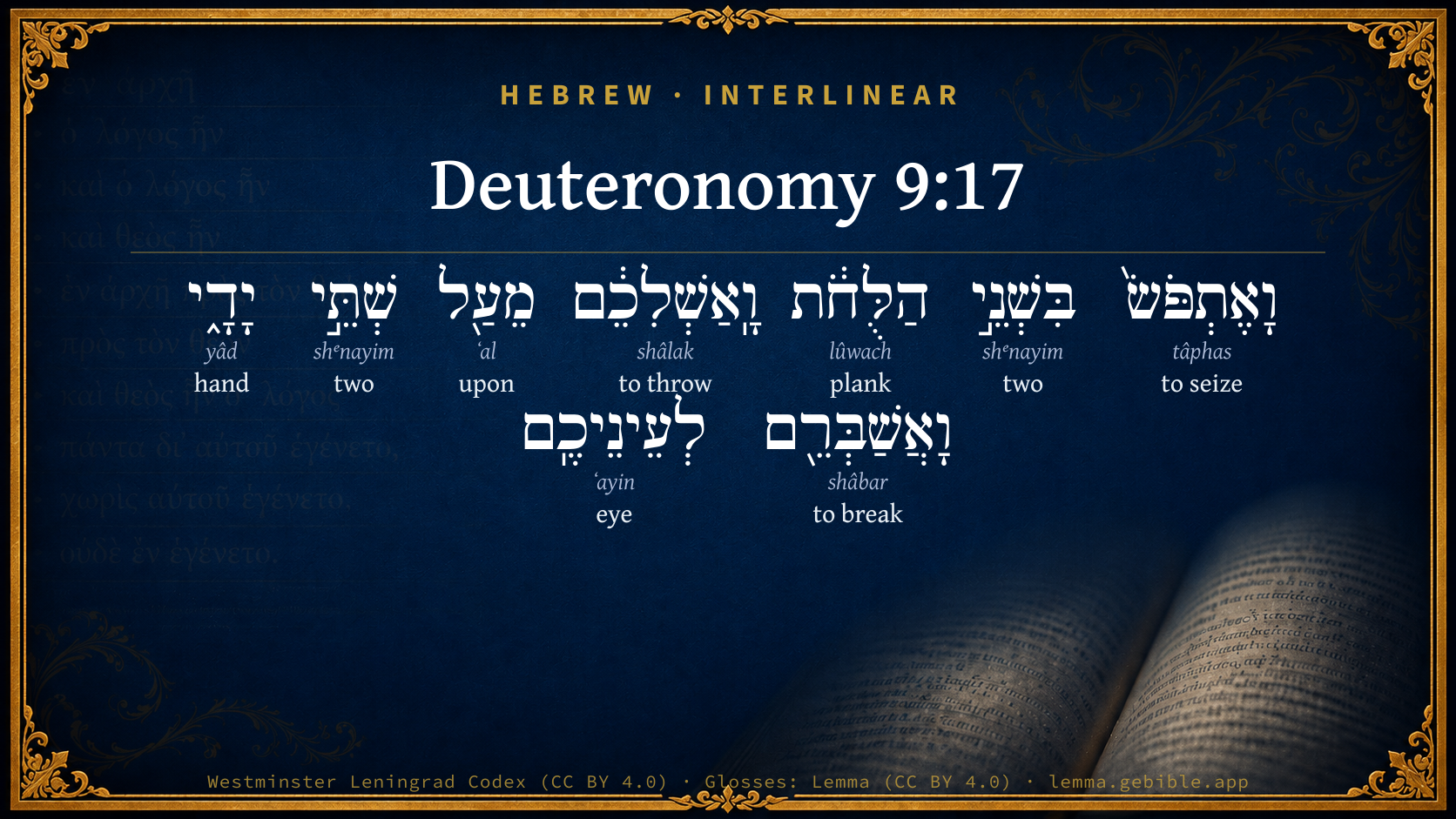
Hebrew (Westminster Leningrad Codex) Deuteronomy 9:17 appears in the Hebrew Old Testament. The text above is from the Westminster Leningrad Codex. Each word links to its Strong’s number, a concise gloss, and parsing drawn from the Open Scriptures Hebrew Bible morphology. Click any word for its full Brown-Driver-Briggs (BDB) entry.
Download image
Cite this verse

Deuteronomy 9:17 (World English Bible). Public Domain. Lemma interlinear Bible study tool, https://lemma.gebible.app/v/deuteronomy/9/17.

Show BibTeX & RIS
BibTeX
RIS
English Translation
I took hold of the two tables, and cast them out of my two hands, and broke them before your eyes.
World English Bible · Public Domain
Download a study sheet

One document with this verse’s original text, its word-by-word gloss line, the meaning frame, cross-references with their text, attributed commentary, and full source and license credits — printable, and it pastes into notes with its structure intact.

This verse Autodidact and up

Study sheet (.html) Plain text (.txt)

A passage Seminary Student

Up to 50 verses in one chapter. A passage sheet keeps up to 6 commentary sources and 12 cross-references per verse, in the order this page ranks them, and says so on the sheet whenever that leaves anything out. Ask for a single verse and you get the Autodidact verse sheet above.

Everything on this page stays free to read, with no account — the sheet is a download of what is already on screen, not access to it.

Want to remove ads? Support Godless Engineer
Compare translations 3

The same verse in 3 English versions, stacked beneath the original-language interlinear above. Click any original word for its lexicon entry.

Each is an independent rendering of the whole verse — the interlinear is not word-aligned to these translations.

Highlighted words mark where these versions differ — a whole-verse word diff, not a word-by-word alignment.

  • World English Bible Public Domain
    I took hold of the two tables, and cast them out of my two hands, and broke them before your eyes.
  • King James Version Public Domain
    And I took the two tables, and cast them out of my two hands, and brake them before your eyes.
  • unfoldingWord Literal Text CC BY-SA 4.0
    And I seized the two tablets and threw them out of my two hands. And I broke them before your eyes.

unfoldingWord Literal Text — © unfoldingWord, licensed CC BY-SA 4.0. Word-aligned USFM3 via Door43 (git.door43.org/unfoldingWord/en_ult).

Versions to compare (up to 4)

3 of 4 selected

Show all 18 translations

Every available English version of this verse, each an independent rendering of the whole verse.

  • World English Bible Public Domain
    I took hold of the two tables, and cast them out of my two hands, and broke them before your eyes.
  • Berean Standard Bible Public Domain
    So I took the two tablets and threw them out of my hands, shattering them before your eyes.
  • Majority Standard Bible Public Domain
    So I took the two tablets and threw them out of my hands, shattering them before your eyes.
  • King James Version Public Domain
    And I took the two tables, and cast them out of my two hands, and brake them before your eyes.
  • American Standard Version (1901) Public Domain
    And I took hold of the two tables, and cast them out of my two hands, and brake them before your eyes.
  • Revised Version (1885) Public Domain
    And I took hold of the two tables, and cast them out of my two hands, and brake them before your eyes.
  • Geneva Bible (1599) Public Domain
    Therefore I tooke the two Tables, and cast them out of my two handes, and brake them before your eyes.
  • Douay-Rheims (1899) Public Domain
    I cast the tables out of my hands, and broke them in your sight.
  • Young's Literal Translation Public Domain
    `And I lay hold on the two tables, and cast them out of my two hands, and break them before your eyes,
  • Literal Standard Version CC BY-SA 4.0
    And I lay hold on the two tablets, and cast them out of my two hands, and break them before your eyes,
  • Unlocked Literal Bible CC BY-SA 4.0
    I took the two tablets and threw them out of my hands. I broke them before your eyes.
  • unfoldingWord Literal Text CC BY-SA 4.0
    And I seized the two tablets and threw them out of my two hands. And I broke them before your eyes.
  • Darby Bible Public Domain
    And I seized the two tables, and cast them out of my two hands, and broke them before your eyes.
  • World Messianic Bible Public Domain
    I took hold of the two tablets, and threw them out of my two hands, and broke them before your eyes.
  • Webster's Bible Public Domain
    And I took the two tables, and cast them out of my two hands, and broke them before your eyes.
  • Free Bible Version CC BY-SA 4.0
    I threw the two tablets down, smashing them to pieces as you watched.
  • Bible in Basic English Public Domain
    And I let the stones go from my hands, and they were broken before your eyes.
  • JPS Tanakh (1917) Public Domain
    And I took hold of the two tables, and cast them out of my two hands, and broke them before your eyes.

Literal Standard Version (2020), Covenant Press — licensed CC BY-SA 4.0. Text via the HelloAO Bible API (eBible.org). Unlocked Literal Bible (unfoldingWord) — licensed CC BY-SA 4.0. Text via the HelloAO Bible API (eBible.org). unfoldingWord Literal Text — © unfoldingWord, licensed CC BY-SA 4.0. Word-aligned USFM3 via Door43 (git.door43.org/unfoldingWord/en_ult). Free Bible Version, Dr. Jonathan Gallagher — licensed CC BY-SA 4.0. Text via the HelloAO Bible API (eBible.org).

Word by word

More ways to search: Search by grammar → Find every occurrence → Compare this word →

Practice this passage: Drill this verse → Learn its vocabulary →

הַלֻּחֹ֔ת
lûwach
H3871
“the · planks”
Particle, Definite Article + Noun, Common, Masculine, Plural, Absolute
Part of Speech
Particle + Noun
Type
Common
Gender
Masculine
Number
Plural
State
Absolute
Full BDB Definition

Origin: from a primitive root

TWOT: 1091a

board, slab, tablet, plank - tablets (of stone) - boards (of wood) - plate (of metal)
  1. וָאֶתְפֹּשׂ֙ tâphas H8610 “and · to seize” Conjunction + Verb, Qal, Sequential Imperfect, 1st Person, Common, Singular
  2. בִּשְׁנֵ֣י shᵉnayim H8147 “in/at · two” Preposition + Adjective, Cardinal number, Masculine, Dual, Construct
  3. וָֽאַשְׁלִכֵ֔ם shâlak H7993 “and · to throw · them” Conjunction + Verb, Hiphil, Sequential Imperfect, 1st Person, Common, Singular + Suffix, Personal, 3rd Person, Masculine, Plural
  4. מֵעַ֖ל ʻal H5921 “from · upon” Preposition + Preposition
  5. שְׁתֵּ֣י shᵉnayim H8147 “two” Adjective, Cardinal number, Feminine, Dual, Construct
  6. יָדָ֑י yâd H3027 “hands · my” Noun, Common, Both, Dual, Construct + Suffix, Personal, 1st Person, Common, Singular
  7. וָאֲשַׁבְּרֵ֖ם shâbar H7665 “and · to break · them” Conjunction + Verb, Piel, Sequential Imperfect, 1st Person, Common, Singular + Suffix, Personal, 3rd Person, Masculine, Plural
  8. לְעֵינֵיכֶֽם ʻayin H5869 “to/for · eyes · your” Preposition + Noun, Common, Both, Dual, Construct + Suffix, Personal, 2nd Person, Masculine, Plural

About this verse

These counts appear in no published source. They are computed here, from the morphology-tagged text and Lemma’s own curated glosses. What Lemma adds →

9
words
8
distinct lemmas
Pentateuch
section

Shared distinctive vocabulary

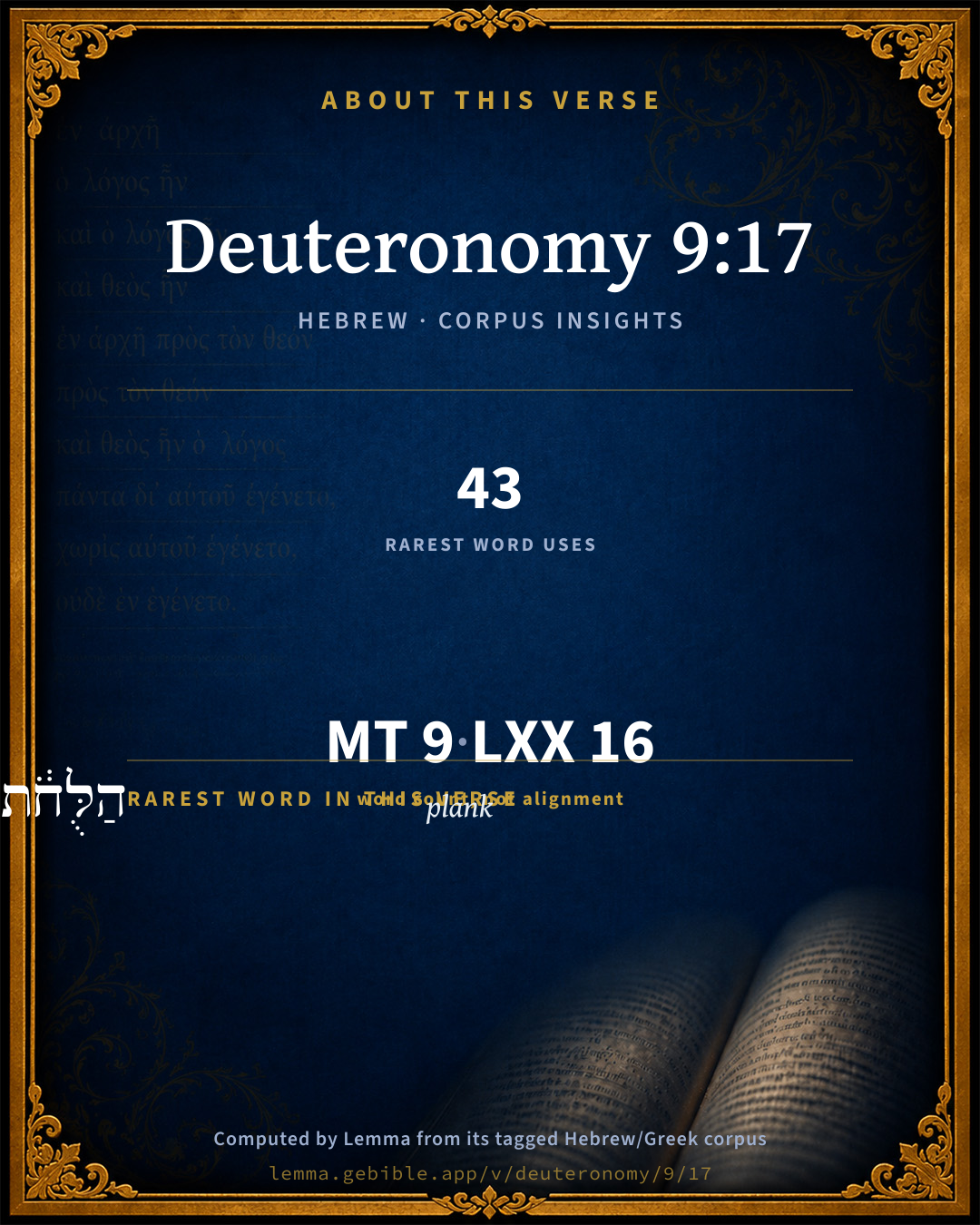
הַלֻּחֹ֔ת plank H3871 occurs in 33 verses of the Hebrew Bible. Also found in:

Grammatical profile

  • 3 verbs
  • 3 nouns
  • 2 adjectives
  • 1 preposition

Verb forms

  • וָאֶתְפֹּשׂ֙ Qal · Sequential Imperfect
  • וָֽאַשְׁלִכֵ֔ם Hiphil · Sequential Imperfect
  • וָאֲשַׁבְּרֵ֖ם Piel · Sequential Imperfect

Repetition

A word recurs within this verse — often emphatic in Hebrew:

  • בִּשְׁנֵ֣י two H8147 ×2

Hebrew & Septuagint length

In English translation the verse runs 21 words from the Hebrew and 21 from the Septuagint (LXX English) — the same length.

A rough comparison of the two English renderings, which tokenize alike — not a word-level alignment.

Word counts can differ between the Hebrew and the Greek without any difference in meaning — e.g. the Hebrew direct-object marker אֵת has no separate Greek word, and Greek often adds the article ὁ.

In the original languages it is 9 Hebrew tokens and 16 Greek tokens — but the two are counted differently (Hebrew bundles its prefixes and suffixes into one token; the Greek is in lemma form), so that isn’t a like-for-like length.

Hebrew and Greek witnesses Masoretic Hebrew ↔ Greek Septuagint

The same verse in the two great witnesses to the Old Testament, shown verse-for-verse.

These are two independent witnesses, not word-aligned to each other, and the Septuagint is shown in lemma (dictionary) form.

Hebrew Deuteronomy 9:17 Masoretic · Westminster Leningrad Codex

וָאֶתְפֹּשׂ֙ בִּשְׁנֵ֣י הַלֻּחֹ֔ת וָֽאַשְׁלִכֵ֔ם מֵעַ֖ל שְׁתֵּ֣י יָדָ֑י וָאֲשַׁבְּרֵ֖ם לְעֵינֵיכֶֽם

I took hold of the two tables, and cast them out of my two hands, and broke them before your eyes.

World English Bible · Public Domain

Greek LXX Deuteronomy 9:17 Septuagint · lemma form

καί ἐπιλαμβάνω ὁ δύο πλάξ ῥίπτω αὐτός ἀπό ὁ δύο χείρ ἐγώ καί συντρίβω ἐναντίον σύ

then I took hold of the two tables, and cast them out of my two hands, and broke them before you.

LXX2012 (modern English Septuagint) · Public Domain

Hebrew: Westminster Leningrad Codex (CC BY 4.0). Greek: Septuagint (public domain); English from LXX2012 (modern English Septuagint) (Public Domain). How the Septuagint differs from the Hebrew →

Targum (Aramaic paraphrase)

2

The Targum is the ancient Jewish Aramaic paraphrase of the Hebrew Scriptures — an interpretive translation, not the Hebrew text itself. Onkelos (literal) and Pseudo-Jonathan (expansive) render the Torah, and Jonathan the Prophets. Coverage is partial: where no permissively-licensed English translation exists for a verse, only the Aramaic is shown. This is verse-level text, not a word-by-word alignment to the Hebrew.

  1. Targum Onkelos Torah (Genesis–Deuteronomy)
    וַאֲחָדִית בִּתְרֵין לוּחַיָא וּרְמִיתִנוּן מֵעַל תַּרְתֵּין יְדָי וּתְבַרְתִּנוּן לְעֵינֵיכוֹן

    (no public-domain English translation for this verse)

    Targum Onkelos — Aramaic: “Onkelos Genesis” (public domain); “Onkelos Exodus” (public domain); “Onkelos Leviticus” (public domain); “Onkelos Numbers” (public domain); “Onkelos Deuteronomy” (public domain). English: “Sefaria Community Translation” (CC0 1.0 (public-domain dedication)); “J.W. Etheridge. The Targums of Onkelos and Jonathan Ben Uzziel on the Pentateuch. London: Longmans, Green, 1862” (public domain). Text via Sefaria.

  2. Targum Pseudo-Jonathan Torah (Genesis–Deuteronomy)
    וַאֲחָדַת בִּתְרֵין לוּחַיָא וּטְלַקְתִּינוּן מֵעִלַוֵי תַּרְתֵּין יְדָי וּתְבַרְתִּינוּן וְאַתּוּן חַמְיַין כַּד לוּחַיָא מִיתְבְּרִין וְאַתְוָותָא פָּרְחִין

    And taking the two tables, I cast them from my two hands and broke them; and you looked on while the tables were broken and the letters fled away.

    Targum Pseudo-Jonathan — Aramaic: “Targum Jonathan on Genesis” (public domain); “Targum Jonathan on Exodus” (public domain); “Targum Jonathan on Leviticus” (public domain); “Targum Jonathan on Numbers” (public domain); “Targum Jonathan on Deuteronomy” (public domain). English: “The Targum of Jonathan ben Uzziel, trans. J. W. Etheridge, London, 1862” (public domain). Text via Sefaria.

Commentary

Notes on Deuteronomy 9:17 from classic Christian and Jewish commentators (each source and its license shown beneath its notes). The classic Christian expositions comment on the surrounding passage and are grouped to its opening verse, so a note may address several verses; the Jewish commentaries on the Tanakh (Rashi and others) are per-verse, so they appear only where the commentator wrote on this verse.

Lemma curates 59 commentaries, every one of them public domain or Creative Commons licensed, each selected and text-cleaned for this edition rather than reprinted as found. About our sources →

Trapp's Complete Commentary

John Trapp

Deu 9:17 And I took the two tables, and cast them out of my two hands, and brake them before your eyes.

Ver. 17. And cast them.] {See Trapp on "Exo 32:19"}

John Trapp, A Commentary or Exposition upon All the Books of the Old and New Testament (1647–1656) — public domain. Text from a community e-Sword module.

Joseph Benson's Commentary

Deu 9:17. I brake them before your eyes — Not by an unbridled passion, but it zeal for God’s honour, and by the direction of God’s Spirit; to signify to the people that the covenant between God and them, contained in those tables, was broken, and that they were now cast out of God’s favour, and could expect nothing from him but fiery indignation.

Joseph Benson's Commentary on the Old and New Testaments (1811–1818) — public domain. Text from a community e-Sword module.

Jamieson, Fausset & Brown

Robert Jamieson, A. R. Fausset & David Brown

I took the two tables, . . . and broke them before your eyes--not in the heat of intemperate passion, but in righteous indignation, from zeal to vindicate the unsullied honor of God, and by the suggestion of His Spirit to intimate that the covenant had been broken, and the people excluded from the divine favor.

Jamieson, Fausset & Brown — Commentary Critical and Explanatory on the Whole Bible (1871) — public domain (CC PDM 1.0). Text via the HelloAO Bible API.

Ellicott's Commentary for English Readers

(17) I . . . brake them before your eyes.—This shows that the act was deliberate on Moses’ part. He did not simply drop the tables in his passion before they reached the camp; he deliberately broke the material covenant in the face of the people, who had broken the covenant itself. When we remember the effect of hastily touching not the tables of the Law themselves, but the mere chest that contained them, in after-times, we may well believe that the breaking of these two tables was an act necessary for the safety of Israel. In Exo_33:7, we read that Moses placed the temporary tabernacle outside the camp at the same time. The two actions seem to have had the same significance, and to have been done for the same reason.

A Bible Commentary for English Readers, edited by Charles John Ellicott (1878–1897) — public domain. Text from a community e-Sword module.

The Cambridge Bible for Schools and Colleges

gen. ed. J. J. S. Perowne

17. Vivid variation and expansion of Exo_32:19 b: and Moses’ anger waxed hot and he cast the tables out of his hands and brake them beneath the mount.

The Cambridge Bible for Schools and Colleges (gen. ed. J. J. S. Perowne; Cambridge University Press, 1878–1918) — public domain. Text from a community e-Sword module.

John Gill's Exposition

And I took the two tables, and cast them out of my two hands,.... In wrath and indignation at the sin they were guilty of:

and brake them before your eyes; as an emblem of their breach of them by transgressing them.

John Gill's Exposition of the Whole Bible (1746–1763) — public domain (CC PDM 1.0). Text via the HelloAO Bible API.

Matthew Poole's English Annotations

Not by an unbridled passion, but in zeal for God’s honour, and by the direction of God’s Spirit, to signify to the people, that the covenant between God and them contained in those tables was broken and made void, and they were now quite cast out of God’s favour, and could expect nothing from him but fiery indignation and severe justice. See Poole "Exo 32:19".

Matthew Poole's English Annotations on the Holy Bible (1683–1685) — public domain. Text from a community e-Sword/MySword module.

Whedon's Commentary on the Bible

Daniel D. Whedon

17. I took the two tables,… and brake them before your eyes — This was equivalent to declaring that the covenant which Jehovah had made with them was now broken by their apostasy. Comp. Exo_32:1-17.

Daniel D. Whedon (gen. ed.), Commentary on the Old and New Testaments (1874–1909) — public domain. Text from a community e-Sword module.

The Pulpit Commentary

Moses cast from him the two tables of stone on which God had inscribed the words of the Law, and broke them in pieces in the view of the people, when he came down from the mount and saw how they had turned aside from the right way, and were become idolaters. This was not the effect of a burst of indignation on his part; it was a solemn declaration that the covenant of God with his people had been nullified and broken by their sinful apostasy.

The Pulpit Commentary (1880–1919), ed. H.D.M. Spence-Jones & Joseph S. Exell — public domain. Text from a community e-Sword module.

John Wesley's Explanatory Notes

I brake them before your eyes - Not by an unbridled passion, but in zeal for God's honour, and by the direction of God's spirit, to signify to tine people, that the covenant between God and them contained in those tables was broken and they were now cast out of God's favour, and could expect nothing from him but fiery indignation.

John Wesley, Explanatory Notes Upon the Whole Bible (1754–1765) — public domain. Text via the GEBible commentary corpus.

unfoldingWord translationNotes

Door43 World Missions Community

General Information:

Moses continues reminding the people of Israel about what happened in the past.

I broke them before your eyes

Here "your eyes" is a synecdoche for the people of Israel. AT: "I broke them right in front of you" or "I broke them where you could see them" (See: Synecdoche)

lay facedown

"lay with my face on the ground." This is a way of showing that Yahweh was great and Moses was not.

forty days and forty nights

"40 days and 40 nights" (See: Numbers)

translationWords

bread

sin

evil

anger

unfoldingWord translationNotes — © Distant Shores Media and the Door43 World Missions Community, licensed CC BY-SA 4.0. Source: git.door43.org/Door43/en_tn.

Ramban (Nachmanides)

Rabbi Moshe ben Nachman (Ramban / Nachmanides)

AND I TOOK HOLD OF THE TWO TABLETS. This is also meant to be part of the chastisements. He is saying: “your sin was greater than could be borne, to the point that when I saw you being merry before the calf I could not restrain [my anger] and I broke the Tablets.” He had to mention this because he wanted them to realize the significance of the second Tablets, as he will explain [in the section that follows]. Possibly he is alluding further to the favor he did them when he endangered his own life by breaking the Tablets of G-d for their sake, as our Rabbis have said: “It is better that you [Israel] be judged like an [unchaste] unmarried woman and not like an [adulterous] wife.”

Ramban (Nachmanides) on the Tanakh — English translation: “Commentary on the Torah by Ramban (Nachmanides). Translated and annotated by Charles B. Chavel. New York, Shilo Pub. House, 1971-1976” (CC BY 4.0). Text via Sefaria.

Lesson kit

Teaching starters — assembled from the data on this page, not authored interpretation. Every prompt links to the verse data it draws on. Edit before teaching.

Deuteronomy, in the Pentateuch, opens this verse with 9 words (8 distinct Hebrew lemmas). Its most distinctive word is lûwach (“plank”). A historical commentator’s framing appears above. Read the whole chapter for the surrounding context.

Discussion questions

  1. The word lûwach carries the sense “plank.” How does it shape the verse?
  2. Exodus 24:12 shares the word «plank» with this verse. How do the two illuminate each other?
  3. “two” occurs 2× in this one verse. What is the effect of the repetition?
  4. These translations render this verse differently; the difference is in the English rendering, not the original. What questions does that raise?
  5. The verb «וָאֶתְפֹּשׂ֙» is Qal Sequential Imperfect. How does its form color the action?
  6. Reading how Trapp's Complete Commentary and Joseph Benson's Commentary read this verse, where do the two commentators agree and where do they part?

Things to notice

Reading settings

Reading text

Shown beneath each verse's original-language words.

Old Testament
Old Testament edition

Read the OT as the Masoretic Hebrew (MT) or the Greek Septuagint (LXX).

English shown for the Greek Septuagint (in the Hebrew ↔ Greek comparison).

Comparing translations? Open the Compare panel on any verse page to stack up to four side by side.