
Micah 2:4

Hebrew (Westminster Leningrad Codex) Micah 2:4 appears in the Hebrew Old Testament. The text above is from the Westminster Leningrad Codex. Each word links to its Strong’s number, a concise gloss, and parsing drawn from the Open Scriptures Hebrew Bible morphology. Click any word for its full Brown-Driver-Briggs (BDB) entry.
Download image
Cite this verse

Micah 2:4 (World English Bible). Public Domain. Lemma interlinear Bible study tool, https://lemma.gebible.app/v/micah/2/4.

Show BibTeX & RIS
BibTeX
RIS
English Translation
In that day they will take up a parable against you, And lament with a doleful lamentation, saying, 'We are utterly ruined! My people's possession is divided up. Indeed he takes it from me and assigns our fields to traitors!'"
World English Bible · Public Domain
Highlights
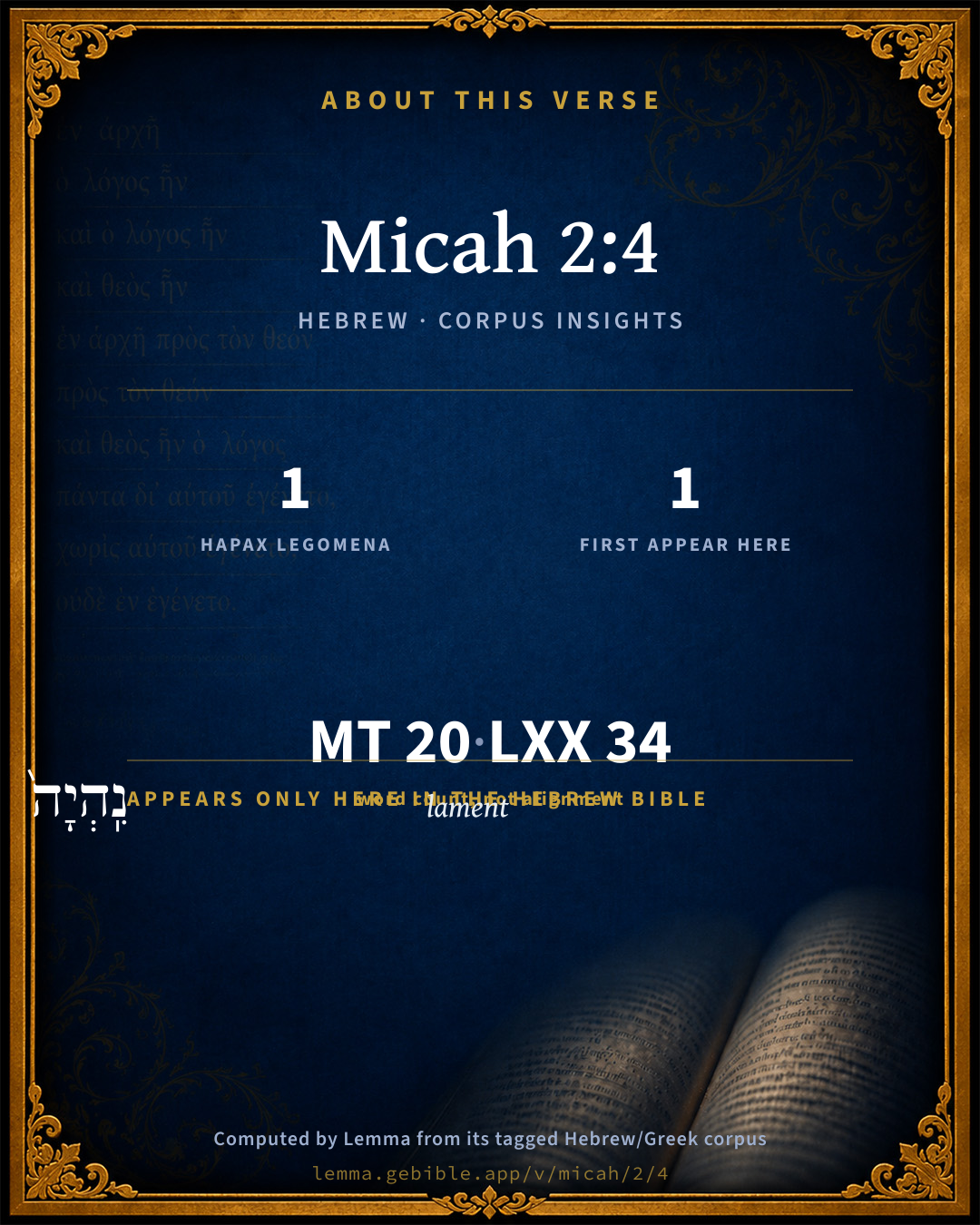
  • 1 hapax legomenon — only here in the Hebrew Bible
  • 1 first appearance in the Hebrew Bible
Full analysis ↓
Download a study sheet

One document with this verse’s original text, its word-by-word gloss line, the meaning frame, cross-references with their text, attributed commentary, and full source and license credits — printable, and it pastes into notes with its structure intact.

This verse Autodidact and up

Study sheet (.html) Plain text (.txt)

A passage Seminary Student

Up to 50 verses in one chapter. A passage sheet keeps up to 6 commentary sources and 12 cross-references per verse, in the order this page ranks them, and says so on the sheet whenever that leaves anything out. Ask for a single verse and you get the Autodidact verse sheet above.

Everything on this page stays free to read, with no account — the sheet is a download of what is already on screen, not access to it.

Want to remove ads? Support Godless Engineer
Compare translations 3

The same verse in 3 English versions, stacked beneath the original-language interlinear above. Click any original word for its lexicon entry.

Each is an independent rendering of the whole verse — the interlinear is not word-aligned to these translations.

Highlighted words mark where these versions differ — a whole-verse word diff, not a word-by-word alignment.

  • World English Bible Public Domain
    In that day they will take up a parable against you, And lament with a doleful lamentation, saying, 'We are utterly ruined! My people's possession is divided up. Indeed he takes it from me and assigns our fields to traitors!'"
  • King James Version Public Domain
    In that day shall one take up a parable against you, and lament with a doleful lamentation, and say, We be utterly spoiled: he hath changed the portion of my people: how hath he removed it from me! turning away he hath divided our fields.
  • unfoldingWord Literal Text CC BY-SA 4.0
    In that day will lift up against you a proverb, and lament a lamentation of a lamentation; He says, ‘Destroying, we are destroyed! The portion of my people he exchanges! How he removes from me! To a rebel he divides our fields!’”

unfoldingWord Literal Text — © unfoldingWord, licensed CC BY-SA 4.0. Word-aligned USFM3 via Door43 (git.door43.org/unfoldingWord/en_ult).

Versions to compare (up to 4)

3 of 4 selected

Show all 18 translations

Every available English version of this verse, each an independent rendering of the whole verse.

  • World English Bible Public Domain
    In that day they will take up a parable against you, And lament with a doleful lamentation, saying, 'We are utterly ruined! My people's possession is divided up. Indeed he takes it from me and assigns our fields to traitors!'"
  • Berean Standard Bible Public Domain
    In that day they will take up a proverb against you and taunt you with this bitter lamentation: ‘We are utterly ruined! He has changed the portion of my people. How He has removed it from me! He has allotted our fields to traitors.’”
  • Majority Standard Bible Public Domain
    In that day they will take up a proverb against you and taunt you with this bitter lamentation: ‘We are utterly ruined! He has changed the portion of my people. How He has removed it from me! He has allotted our fields to traitors.’”
  • King James Version Public Domain
    In that day shall one take up a parable against you, and lament with a doleful lamentation, and say, We be utterly spoiled: he hath changed the portion of my people: how hath he removed it from me! turning away he hath divided our fields.
  • American Standard Version (1901) Public Domain
    In that day shall they take up a parable against you, and lament with a doleful lamentation, `and' say, We are utterly ruined: he changeth the portion of my people: how doth he remove `it' from me! to the rebellious he divideth our fields.
  • Revised Version (1885) Public Domain
    In that day shall they take up a parable against you, and lament with a doleful lamentation, and say, We be utterly spoiled: he changeth the portion of my people: how doth he remove it from me! to the rebellious he divideth our fields.
  • Geneva Bible (1599) Public Domain
    In that daye shall they take vp a parable against you, and lament with a dolefull lamentation, and say, We be vtterly wasted: hee hath changed the portion of my people: how hath he taken it away to restore it vnto mee? he hath deuided our fieldes.
  • Douay-Rheims (1899) Public Domain
    In that day a parable shall be taken up upon you, and a song shall be sung with melody by them that say: We are laid waste and spoiled: the portion of my people is changed: how shall he depart from me, whereas he is returning that will divide our land?
  • Young's Literal Translation Public Domain
    In that day doth `one' take up for you a simile, And he hath wailed a wailing of wo, He hath said, We have been utterly spoiled, The portion of my people He doth change, How doth He move toward me! To the backslider our fields He apportioneth.
  • Literal Standard Version CC BY-SA 4.0
    In that day [one] takes up for you an allegory, || And he has wailed a wailing of woe, || He has said, We have been utterly spoiled, || The portion of my people He changes, || How He moves toward me! To the backslider our fields He apportions.
  • Unlocked Literal Bible CC BY-SA 4.0
    In that day men will sing a song about you, and lament with a wailing lamentation. They will sing, 'We Israelites are completely ruined; Yahweh changes the territory of my people. How can he remove it from me? He portions out our fields to traitors!'”
  • unfoldingWord Literal Text CC BY-SA 4.0
    In that day will lift up against you a proverb, and lament a lamentation of a lamentation; He says, ‘Destroying, we are destroyed! The portion of my people he exchanges! How he removes from me! To a rebel he divides our fields!’”
  • Darby Bible Public Domain
    In that day shall they take up a proverb concerning you, and lament with a doleful lamentation, [and] say, We are utterly spoiled: he hath changed the portion of my people: how hath he removed it from me! He hath distributed our fields to the rebellious.
  • World Messianic Bible Public Domain
    In that day they will take up a parable against you, and lament with a doleful lamentation, saying, ‘We are utterly ruined! My people’s possession is divided up. Indeed he takes it from me and assigns our fields to traitors!’”
  • Webster's Bible Public Domain
    In that day shall one take up a parable against you, and lament with a grievous lamentation, and say, We are utterly wasted: he hath changed the portion of my people: how hath he removed it from me! turning away he hath divided our fields.
  • Free Bible Version CC BY-SA 4.0
    On that day they will make up a saying to taunt you. With a mocking lament they will say, “We are totally ruined! Our possessions are being sold off. They've taken everything away, and given our fields to your conquerors.”
  • Bible in Basic English Public Domain
    In that day this saying will be said about you, and this song of grief will be made: The heritage of my people is measured out, and there is no one to give it back; those who have made us prisoners have taken our fields from us, and complete destruction has come to us.
  • JPS Tanakh (1917) Public Domain
    In that day shall they take up a parable against you, and lament with a doleful lamentation, and say: 'We are utterly ruined; he changeth the portion of my people; how doth he remove it from me! Instead of restoring our fields, he divideth them.'

Literal Standard Version (2020), Covenant Press — licensed CC BY-SA 4.0. Text via the HelloAO Bible API (eBible.org). Unlocked Literal Bible (unfoldingWord) — licensed CC BY-SA 4.0. Text via the HelloAO Bible API (eBible.org). unfoldingWord Literal Text — © unfoldingWord, licensed CC BY-SA 4.0. Word-aligned USFM3 via Door43 (git.door43.org/unfoldingWord/en_ult). Free Bible Version, Dr. Jonathan Gallagher — licensed CC BY-SA 4.0. Text via the HelloAO Bible API (eBible.org).

Word by word

More ways to search: Search by grammar → Find every occurrence → Compare this word →

Practice this passage: Drill this verse → Learn its vocabulary →

נִֽהְיָה֙
nihyâh
H5093
“lament”
Verb, Niphal, Perfect, 3rd Person, Masculine, Singular
Part of Speech
Verb
Stem
Niphal
Form
Perfect
Person
3rd Person
Gender
Masculine
Number
Singular
Full BDB Definition

Origin: from H5092

TWOT: 1311b

wailing, lament, lamentation, mourning song
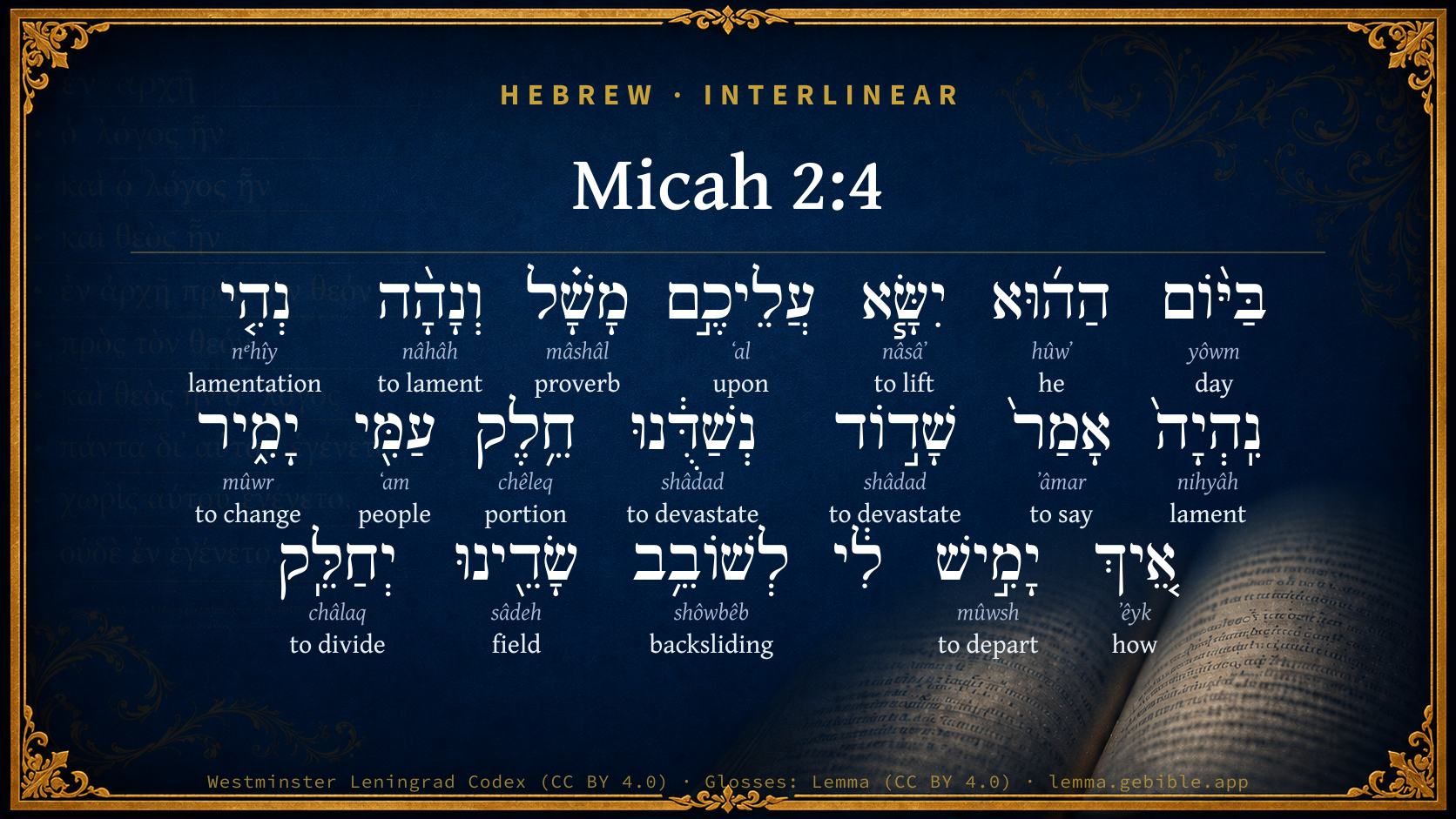
  1. בַּיּ֨וֹם yôwm H3117 “in/at the · day” Preposition, Determined + Noun, Common, Masculine, Singular, Absolute
  2. הַה֜וּא hûwʼ H1931 “the · he” Particle, Definite Article + Pronoun, Personal, 3rd Person, Masculine, Singular
  3. יִשָּׂ֧א nâsâʼ H5375 “to lift” Verb, Qal, Imperfect, 3rd Person, Masculine, Singular
  4. עֲלֵיכֶ֣ם ʻal H5921 “upon · you” Preposition + Suffix, Personal, 2nd Person, Masculine, Plural
  5. מָשָׁ֗ל mâshâl H4912 “proverb” Noun, Common, Masculine, Singular, Absolute
  6. וְנָהָ֨ה nâhâh H5091 “and · to lament” Conjunction + Verb, Qal, Sequential Perfect, 3rd Person, Masculine, Singular
  7. נְהִ֤י nᵉhîy H5092 “lamentation” Noun, Common, Masculine, Singular, Absolute
  8. אָמַר֙ ʼâmar H559 “to say” Verb, Qal, Perfect, 3rd Person, Masculine, Singular
  9. שָׁד֣וֹד shâdad H7703 “to devastate” Verb, Qal, Infinitive Absolute
  10. נְשַׁדֻּ֔נוּ shâdad H7703 “to devastate” Verb, Niphal, Perfect, 1st Person, Common, Plural
  11. חֵ֥לֶק chêleq H2506 “portion of” Noun, Common, Masculine, Singular, Construct
  12. עַמִּ֖י ʻam H5971 “people · my” Noun, Common, Masculine, Singular, Construct + Suffix, Personal, 1st Person, Common, Singular
  13. יָמִ֑יר mûwr H4171 “to change” Verb, Hiphil, Imperfect, 3rd Person, Masculine, Singular
  14. אֵ֚יךְ ʼêyk H349 “how” Particle, Interrogative
  15. יָמִ֣ישׁ mûwsh H4185 “to depart” Verb, Hiphil, Imperfect, 3rd Person, Masculine, Singular
  16. לְשׁוֹבֵ֥ב shôwbêb H7728 “to/for · backsliding” Preposition + Adjective, Adjective, Masculine, Singular, Absolute
  17. שָׂדֵ֖ינוּ sâdeh H7704 “fields · our” Noun, Common, Masculine, Plural, Construct + Suffix, Personal, 1st Person, Common, Plural
  18. יְחַלֵּֽק châlaq H2505 “to divide” Verb, Piel, Imperfect, 3rd Person, Masculine, Singular

About this verse

These counts appear in no published source. They are computed here, from the morphology-tagged text and Lemma’s own curated glosses. What Lemma adds →

20
words
18
distinct lemmas
Prophets
section

Notable vocabulary

1 hapax legomenon — a word that appears only here in the entire Hebrew Bible:

  • נִֽהְיָה֙ lament H5093

First appearance in Scripture

This word makes its first canonical appearance in the Hebrew Bible here:

  • נִֽהְיָה֙ lament H5093

Shared distinctive vocabulary

וְנָהָ֨ה to lament H5091 occurs in 3 verses of the Hebrew Bible. Also found in:

Grammatical profile

  • 9 verbs
  • 6 nouns
  • 1 adjective
  • 1 pronoun
  • 2 prepositions
  • 1 particle

Verb forms

  • יִשָּׂ֧א Qal · Imperfect
  • וְנָהָ֨ה Qal · Sequential Perfect
  • נִֽהְיָה֙ Niphal · Perfect
  • אָמַר֙ Qal · Perfect
  • שָׁד֣וֹד Qal · Infinitive Absolute
  • נְשַׁדֻּ֔נוּ Niphal · Perfect
  • יָמִ֑יר Hiphil · Imperfect
  • יָמִ֣ישׁ Hiphil · Imperfect
  • יְחַלֵּֽק Piel · Imperfect

Repetition

A word recurs within this verse — often emphatic in Hebrew:

  • שָׁד֣וֹד to devastate H7703 ×2

Hebrew & Septuagint length

In English translation the verse runs 40 words from the Hebrew and 53 from the Septuagint (LXX English) — closely comparable.

A rough comparison of the two English renderings, which tokenize alike — not a word-level alignment.

Word counts can differ between the Hebrew and the Greek without any difference in meaning — e.g. the Hebrew direct-object marker אֵת has no separate Greek word, and Greek often adds the article ὁ.

In the original languages it is 20 Hebrew tokens and 34 Greek tokens — but the two are counted differently (Hebrew bundles its prefixes and suffixes into one token; the Greek is in lemma form), so that isn’t a like-for-like length.

Cross-references

31

Topical passages linked to Micah 2:4 in the Treasury of Scripture Knowledge — connected by theme and wording, ordered by reader-vote popularity; previews shown in the World English Bible.

  • Habakkuk 2:6 Won't all these take up a parable against him, and a taunting proverb against him, and say, 'Woe to him who increases that which is not his, and who enriches himself by extortion! How long?'
  • Numbers 23:7 He took up his parable, and said, From Aram has Balak brought me, The king of Moab from the mountains of the East: Come, curse me Jacob, Come, defy Israel.
  • Deuteronomy 28:29 and you shall grope at noonday, as the blind gropes in darkness, and you shall not prosper in your ways: and you shall be only oppressed and robbed always, and there shall be none to save you.
  • Isaiah 6:11 Then I said, "Lord, how long?" He answered, "Until cities are waste without inhabitant, And houses without man, And the land becomes utterly waste,
  • Isaiah 24:3 The earth shall be utterly emptied, and utterly laid waste; for Yahweh has spoken this word.
  • Jeremiah 9:10 For the mountains will I take up a weeping and wailing, and for the pastures of the wilderness a lamentation, because they are burned up, so that none passes through; neither can men hear the voice of the cattle; both the birds of the sky and the animals are fled, they are gone.
  • Jeremiah 9:17–21 Thus says Yahweh of Hosts, Consider you, and call for the mourning women, that they may come; and send for the skillful women, that they may come:
  • Micah 1:15 I will yet bring to you, inhabitant of Mareshah, He who is the glory of Israel will come to Adullam.
  • Numbers 23:18 He took up his parable, and said, Rise up, Balak, and hear; Listen to me, you son of Zippor:
  • Numbers 24:3 He took up his parable, and said, Balaam the son of Beor says, The man whose eye was closed says;
  • Numbers 24:15 He took up his parable, and said, Balaam the son of Beor says, The man whose eye was closed says;
  • 2 Samuel 1:17 David lamented with this lamentation over Saul and over Jonathan his son
  • 2 Kings 17:23–24 until Yahweh removed Israel out of his sight, as he spoke by all his servants the prophets. So Israel was carried away out of their own land to Assyria to this day.
  • 2 Chronicles 35:25 Jeremiah lamented for Josiah: and all the singing men and singing women spoke of Josiah in their lamentations to this day; and they made them an ordinance in Israel: and, behold, they are written in the lamentations.
  • 2 Chronicles 36:20–21 Those who had escaped from the sword carried he away to Babylon; and they were servants to him and his sons until the reign of the kingdom of Persia:
  • Job 27:1 Job again took up his parable, and said,
  • Isaiah 14:4 that you shall take up this parable against the king of Babylon, and say, How has the oppressor ceased! the golden city ceased!
  • Isaiah 63:17–18 O Yahweh, why do you make us to err from your ways, and harden our heart from your fear? Return for your servants' sake, the tribes of your inheritance.
  • Jeremiah 4:13 Behold, he shall come up as clouds, and his chariots [shall be] as the whirlwind: his horses are swifter than eagles. Woe to us! for we are ruined.
  • Jeremiah 14:18 If I go forth into the field, then, behold, the slain with the sword! and if I enter into the city, then, behold, those who are sick with famine! for both the prophet and the priest go about in the land, and have no knowledge.
  • Jeremiah 25:9–11 behold, I will send and take all the families of the north, says Yahweh, and [I will send] to Nebuchadrezzar the king of Babylon, my servant, and will bring them against this land, and against the inhabitants of it, and against all these nations round about; and I will utterly destroy them, and make them an astonishment, and a hissing, and perpetual desolations.
  • Lamentations 1:1–5 How does the city sit solitary, that was full of people! She has become as a widow, who was great among the nations! She who was a princess among the provinces is become tributary!
  • Ezekiel 2:10 He spread it before me: and it was written within and without; and there were written therein lamentations, and mourning, and woe.
  • Ezekiel 16:44 Behold, everyone who uses proverbs shall use [this] proverb against you, saying, As is the mother, so is her daughter.
  • Joel 1:8 Mourn like a virgin dressed in sackcloth for the husband of her youth!
  • Joel 1:13 Put on sackcloth and mourn, you priests! Wail, you ministers of the altar. Come, lie all night in sackcloth, you ministers of my God, For the meal offering and the drink offering are withheld from your God's house.
  • Amos 5:1 Listen to this word which I take up for a lamentation over you, O house of Israel.
  • Amos 5:17 In all vineyards there will be wailing; For I will pass through the midst of you," says Yahweh.
  • Micah 2:10 Arise, and depart! For this is not your resting place, Because of uncleanness that destroys, Even with a grievous destruction.
  • Zephaniah 1:2 I will utterly sweep away everything off of the surface of the earth, says Yahweh.
  • Mark 12:12 They tried to seize him, but they feared the multitude; for they perceived that he spoke the parable against them. They left him, and went away.

Cross-references courtesy of OpenBible.info (CC BY 4.0).

Hebrew and Greek witnesses Masoretic Hebrew ↔ Greek Septuagint

The same verse in the two great witnesses to the Old Testament, shown verse-for-verse.

These are two independent witnesses, not word-aligned to each other, and the Septuagint is shown in lemma (dictionary) form.

Hebrew Micah 2:4 Masoretic · Westminster Leningrad Codex

בַּיּ֨וֹם הַה֜וּא יִשָּׂ֧א עֲלֵיכֶ֣ם מָשָׁ֗ל וְנָהָ֨ה נְהִ֤י נִֽהְיָה֙ אָמַר֙ שָׁד֣וֹד נְשַׁדֻּ֔נוּ חֵ֥לֶק עַמִּ֖י יָמִ֑יר אֵ֚יךְ יָמִ֣ישׁ לִ֔י לְשׁוֹבֵ֥ב שָׂדֵ֖ינוּ יְחַלֵּֽק

In that day they will take up a parable against you, And lament with a doleful lamentation, saying, 'We are utterly ruined! My people's possession is divided up. Indeed he takes it from me and assigns our fields to traitors!'"

World English Bible · Public Domain

Greek LXX Micah 2:4 Septuagint · lemma form

ἐν ὁ ἡμέρα ἐκεῖνος λαμβάνω ἐπί σύ παραβολή καί θρηνέω θρῆνος ἐν μέλος λέγω ταλαιπωρία ταλαιπωρέω μερίς λαός ἐγώ καταμετρέω ἐν σχοινίον καί οὐ εἰμί ὁ κωλύω αὐτός ὁ ἀποστρέφω ὁ ἀγρός ἐγώ διαμερίζω

In that day shall a parable be taken up against you, and a plaintive lamentation shall be uttered, saying, We are thoroughly miserable: the portion of my people has been measured out with a line, and there was none to hinder him so as to turn him back; your fields have been divided.

LXX2012 (modern English Septuagint) · Public Domain

On this verse, Haydock's Catholic Bible Commentary discusses the Septuagint’s reading. Read the note in Commentary ↓

Hebrew: Westminster Leningrad Codex (CC BY 4.0). Greek: Septuagint (public domain); English from LXX2012 (modern English Septuagint) (Public Domain). How the Septuagint differs from the Hebrew →

Targum (Aramaic paraphrase)

1

The Targum is the ancient Jewish Aramaic paraphrase of the Hebrew Scriptures — an interpretive translation, not the Hebrew text itself. Onkelos (literal) and Pseudo-Jonathan (expansive) render the Torah, and Jonathan the Prophets. Coverage is partial: where no permissively-licensed English translation exists for a verse, only the Aramaic is shown. This is verse-level text, not a word-by-word alignment to the Hebrew.

  1. Targum Jonathan Prophets (Joshua–Malachi)
    בְּעִדָנָא הַהִיא יִטוֹל עֲלֵיכוֹן מְתַל וְאִלְיָא וּבְעִינִיתֵיהּ יֵימַר אִתְבְּזָזָא אִתְבְּזַזְנָא מֵחוּלַקְהוֹן דְעַמִי מְעַדָן לְהוֹן מֵאַחְסַנְתְּהוֹן טָרְדִין לְהוֹן תְּאֵיבִין חוּלְקַתְהוֹן מְפַלְגִין:

    (no public-domain English translation for this verse)

    Targum Jonathan — Aramaic: “Mikraot Gedolot” (public domain). English: “Sefaria Community Translation” (CC0 1.0 (public-domain dedication)); “London "Chaldee Paraphrase," 1871” (public domain). Text via Sefaria.

Commentary

Notes on Micah 2:4 from classic Christian and Jewish commentators (each source and its license shown beneath its notes). The classic Christian expositions comment on the surrounding passage and are grouped to its opening verse, so a note may address several verses; the Jewish commentaries on the Tanakh (Rashi and others) are per-verse, so they appear only where the commentator wrote on this verse.

Lemma curates 59 commentaries, every one of them public domain or Creative Commons licensed, each selected and text-cleaned for this edition rather than reprinted as found. About our sources →

Trapp's Complete Commentary

John Trapp

Mic 2:4 In that day shall [one] take up a parable against you, and lament with a doleful lamentation, [and] say, We be utterly spoiled: he hath changed the portion of my people: how hath he removed [it] from me! turning away he hath divided our fields.

Ver. 4. In that day shall one take up a parable, &c.] In that day, that doleful and dismal day of their calamity.

Shall one] Any one that is moved at your misery, and would work you to a sense of your sin, the mother of your misery.

Shall take up a parable] Tristem et querulam, sad and sorrowful.

And lament with a doleful lamentation] Heb. with a lamentation of lamentations, or with heigh-ho upon heigh-ho, as the word seems to signify.

We be utterly spoiled] Plundered to the life, laid naked to the very foundation, Mic 1:6, put into such a condition as that there is neither hope of better nor place of worse.

He hath changed the portion of my people] That is, God, or the Assyrian, by God’s appointment, hath taken away our country, and given it to strangers. The Pope took upon him, in Henry VIII’s days, to give England, Primo occupaturo, to him that could first win it. This brutum fulmen briding of lighning came to nothing; but when God’s people changed their glory for that which profited not, Jer 2:11, he soon changed their portion; he caused that good land to spew them out, he turned their weal into woe, and brought wrath upon them to the utmost. Neither profited it them any more to have been called God’s people than it did Dives in flames, that Abraham called him son; or Judas, that Christ called him friend.

How hath he removed it from me!] This is lamentation-like indeed, see Lam 1:1; Lam 2:1; Lam 4:1, all beginning with the same word, How. The speech is concise and abrupt, meet for mourners. There is an elegance in the original not to be translated. How uncertain are all things here! God sits upon the circle of the earth, and shakes out the inhabitants at pleasure, as by a canvas, Isa 40:22. Persons and things are said to be in heaven, but on earth; on the outside of it only, where they have no firm footing. Dionysius was driven out of his kingdom; which yet he thought was tied to him with chains of adamant, saith the historian (Aelian. lib. 2).

Turning away (from us as a loathsome object, being so incorrigibly flagitioas) he hath divided our fields] sc. to the enemy for a reward, as he gave Egypt to Nebuchadnezzar for his pains at Tyre. Or thus. Instead of restoring (which now we are hopeless of) he hath divided our fields, our fertile and fat country, to those that will be sure to hold their own in it, as the Gauls and Goths did in Italy, after they had once tasted the sweetness of it. Vatablus rendereth the text thus: How hath he taken from me those fields of ours, which he seemed ready to restore! He hath even divided them, sc. to others.

John Trapp, A Commentary or Exposition upon All the Books of the Old and New Testament (1647–1656) — public domain. Text from a community e-Sword module.

Joseph Benson's Commentary

Mic 2:4-6. In that day shall one take up a parable — Shall use a figurative speech, against you — A parable signifies a speech out of the ordinary way, as the Greek word παροιμια imports, and illustrated with metaphors or rhetorical figures. So speaking in parables is opposed to speaking plainly, Joh 16:25; Joh 16:29. And lament, &c. — Your friends for you, and you for yourselves. He hath changed the portion of my people — Their wealth, plenty, freedom, joy, and honour, into poverty, famine, servitude, grief, and dishonour. How hath he removed it — How dreadfully hath God dealt with Israel; removing their persons into captivity, and transferring their possessions to their enemies! Turning away he hath divided our fields — Turning away from us in displeasure, God hath divided our fields among others. Thou shalt have none that shall cast a cord — None that shall ever return to this land, to see it allotted by line, and given them to possess it. In the congregation of the Lord — They shall no more be the congregation of the Lord, nor their children after them. They shall not prophesy — The people often said to the prophets, Prophesy ye not; and God here declares that he would, in his displeasure, grant their desire: and that the time should come, when the prophets should no longer prophesy unto them, that they might no longer bring contempt upon themselves, or be ignominiously treated by the people, as they had long been.

Joseph Benson's Commentary on the Old and New Testaments (1811–1818) — public domain. Text from a community e-Sword module.

Tyndale Open Study Notes

Tyndale Open Resources

2:4 The power brokers would be ruined financially as their enemies confiscated their property. The land that they had seized unjustly from fellow Israelites would be violently taken from them (2:5).

Tyndale Open Study Notes — © Tyndale Open Resources, licensed CC BY-SA 4.0. Text via the HelloAO Bible API.

Geneva Bible (1599)

Geneva Bible translators

Thus the Jews lament and say that there is no hope of restitution, seeing their possessions are divided among the enemies.

Geneva Bible (1599) marginal notes — public domain. Text via Bolls.life.

Jamieson, Fausset & Brown

Robert Jamieson, A. R. Fausset & David Brown

one take up a parable against you--that is, Some of your foes shall do so, taking in derision from your own mouth your "lamentation," namely, "We be spoiled," &c.

lament with a doleful lamentation--literally, "lament with a lamentation of lamentations." Hebrew, naha, nehi, nihyah, the repetition representing the continuous and monotonous wail.

he hath changed the portion of my people--a charge of injustice against Jehovah. He transfers to other nations the sacred territory assigned as the rightful portion of our people (Mic 1:15).

turning away he hath divided our fields--Turning away from us to the enemy, He hath divided among them our fields. CALVIN, as the Margin, explains, "Instead of restoring our territory, He hath divided our fields among our enemies, each of whom henceforward will have an interest in keeping what he hath gotten: so that we are utterly shut out from hope of restoration." MAURER translates as a noun, "He hath divided our fields to a rebel," that is, to the foe who is a rebel against the true God, and a worshipper of idols. So "backsliding," that is, backslider (Jer 49:4). English Version gives a good sense; and is quite tenable in the Hebrew.

Jamieson, Fausset & Brown — Commentary Critical and Explanatory on the Whole Bible (1871) — public domain (CC PDM 1.0). Text via the HelloAO Bible API.

Adam Clarke's Commentary

Verse 4. Take up a parable against you] Your wickedness and your punishment shall be subjects of common conversation; and a funeral dirge shall be composed and sung for you as for the dead. The lamentation is that which immediately follows: We be utterly spoiled; and ends, Are these his doings? Mic 2:7.

Adam Clarke's Commentary on the Bible (1810–1826) — public domain. Text from a community e-Sword/MySword module.

John Calvin's Commentaries

The verse is in broken sentences; and hence interpreters vary. But the meaning of the Prophet appears to me to be simply this, In that day they shall take up a proverb against you; that is, it will not be an ordinary calamity, but the report concerning it will go forth every where so that the Jews will become to all a common proverb. This is one thing. As to the word משל, meshil, it is taken, we know, for a weighty saying, and in the plural, weighty sayings, called by the Latins, sentences (sententias) or sayings, (dicta,) and by the Greeks, apophthegmata. αποφθεγματα, But these sayings were thus called weighty by the Hebrews, because he who elevated his style, made use especially of figurative expressions, to render his discourse nobler and more splendid. Hence many render this word, enigmas. It accords well with the Prophet’s meaning, to suppose, that proverbial sayings would spread every where respecting the Jews, especially as calamities were usually described in a plaintive song. They shall then mourn over you with lamentable mourning. But this ought to be referred to the fact, — that the calamity would be every where known. It yet seems that this sentence is applied afterwards to the Jews themselves, and not unsuitably. But it is an indefinite mode of speaking, since the Prophet speaks not of one or two men, but of the whole people.

They shall then mourn in this manner, Wasted, we have been wasted: the portion of my people has he changed — (it is the future instead of the past) — He has then changed the portion of my people This may be applied to God as well as to the Assyrians; for God was the principal author of this calamity; he it was who changed the portion of the people: for as by his blessing he had long cherished that people, so afterwards he changed their lot. But as the Assyrians were the ministers of God’s vengeance, the expression cannot be unsuitably applied to them. The Assyrian then has taken away the portion of my people And then he says, How has he made to depart, or has taken away, or removed from me, (literally, to me,) to restore, — though שבב, shibeb, may be from the root שוב, shub, it yet means the same, — How then has he taken away from us to restore our fields he divides, that is, which he has divided; for the relative אשר, asher, is understood and there is also a change of time. Now as the discourse, as I have said, is in broken sentences, there are various interpretations. I however think that the Prophet simply means this — How as to restoring has he taken away our fields, which he hath divided? that is, How far off are we from restitution? for every hope is far removed, since the Lord himself has divided among strangers our land and possession; or since the enemies have divided it among themselves; for it is usual after victory, for every one to seize on his own portion. Whether then this be understood of the Assyrians, or rather be referred to God, the meaning of the Prophet seems clearly to be this, — that the Jews were not only expelled from their country but that every hope of return was also taken away, since the enemies had parted among themselves their inheritance, so that they who had been driven out, now in vain thought of a restitution. But I read this in the present time; for the Prophet introduces here the Jews as uttering this lamentation, — “It is now all over with us, and there is no remedy for this evil; for not only are we stripped of all our property and ejected from our country, but what has been taken away by our enemies cannot be restored to us, inasmuch as they have already parted our possessions among themselves, and every one occupies his own portion and his own place, as though it were his own inheritance. We have therefore to do, not only with the Assyrians in general, but also with every individual; for what every one now occupies and possesses he will defend, as his rightful and hereditary possession.”

Some conjecture from this verse, that the discourse belongs rather to the Israelites, who were banished without any hope of return; but no necessity constrains us to explain this of the Israelites; for the Prophet does not declare here what God would do, but what would be the calamity when considered in itself. We have indeed said already in many places, that the Prophets, while threatening, speak only of calamities, desolations, deaths, and destructions, but that they afterwards add promises for consolation. But their teaching is discriminative: when the Prophets intend to terrify hypocrites and perverse men, they set forth the wrath of God only, and leave no hope; but when they would inspire with hope those who are by this means humbled, they draw forth comfort to them even from the goodness of God. What is here said then may fitly and really be applied to the Jews. It follows —

John Calvin's Commentaries (1540-1563) — public domain. Text from the Calvin Translation Society English edition (1840s-50s) via the Christian Classics Ethereal Library (ccel.org). Calvin's coverage is partial (roughly two-thirds of the Bible); uncommented books and verses are honest gaps, never fabricated. The 19th-century editor's footnotes and remarks are omitted so the notes are faithfully Calvin's own voice.

Ellicott's Commentary for English Readers

(4) Shall one take up a parable against you—i.e., the enemies shall repeat in mockery the doleful lamentations with which you bewail your pitiable state.

Turning away he hath divided.—Rather, to an apostate—i.e., an idolater—he hath divided our fields. The land they were taking from others God would give into the hands of an idolatrous king.

A Bible Commentary for English Readers, edited by Charles John Ellicott (1878–1897) — public domain. Text from a community e-Sword module.

The Cambridge Bible for Schools and Colleges

gen. ed. J. J. S. Perowne

4. shall one take up a parable] Or, a taunting song (as probably Isa_14:4, Hab_2:6). The Hebr. mâshâl means properly a saying characterized by parallelism—‘the parallelism may consist either in the moral application of emblems, or simply in the parallel disposition of the lines and the sense. From the fact that emblems were generally applied in a witty, satirical manner, mâshâl sometimes obtains the meaning of taunt-song.’ So, too, we may add, the participial noun môshçl acquires the sense of taunt-singer in Num_21:27, Eze_16:44. In the present instance, the prophet means (see next clause) that the same words from different speakers would be at once a lamentation and a taunt. When an Israelite should say plaintively, ‘It is all over,’ his enemy should take up his words in a tone of triumph or mockery.

and lament with a doleful lamentation, &c.] Rather, and lament with a lamentation:

‘It is done,’ they shall say,

‘We be utterly spoiled:

He changeth the portion of my people;

How doth he remove it from me!

Unto the rebellious he divideth our fields.’

The purport of the complaint is that Jehovah (for the Israelites recognize him as the sender of their trouble) has transferred the promised land to heathen men, who from their very birth have been rebels against Jehovah. The epithet ‘rebellious’ deserves notice. True, it is the Jews who use it, but the prophet would certainly have sanctioned its employment. We find him, in chap. Mic_5:15, announcing the punishment of the heathen for their disobedience, and his great contemporary Isaiah, in Isa_10:5-15 (comp. Isa_37:26), rebuking Sennacherib for ‘vaunting himself’ against Him who gave him his commission. Both prophets imply that the heathen had a certain natural light, which might have led them to the true God, or at least have preserved them from rejecting Him, when His claims were brought before them. Comp. St Paul’s words in Rom_1:20, ‘so that they are without excuse.’

The Cambridge Bible for Schools and Colleges (gen. ed. J. J. S. Perowne; Cambridge University Press, 1878–1918) — public domain. Text from a community e-Sword module.

John Gill's Exposition

In that day shall one take up a parable against you,.... Making use of your name, as a byword, a proverb, a taunt, and a jeer; mocking at your calamities and miseries: or, "concerning you" (c); take up and deliver out a narrative of your troubles, in figurative and parabolical expressions; which Kimchi thinks is to be understood of a false prophet, finding his prophecies and promises come to nothing; or rather a stranger, a bystander, a spectator of their miseries, an insulting enemy, mimicking and representing them; or one of themselves, in the name of the rest:

and lament with a doleful lamentation; or, "lament a lamentation of lamentation" (d): a very grievous one; or, "a lamentation that is", or "shall be", or "is done" (e); a real one, and which will continue:

and say, we be utterly spoiled; our persons, families, and friends; our estates, fields, and vineyards; our towns and cities, and even our whole land, all laid waste, spoiled, and plundered:

he hath changed the portion of my people; the land of Israel, which was the portion of the people of it, given unto them as their portion by the Lord; but now he, or the enemy the Assyrian, or God by him, had changed the possessors of it; had taken it away from Israel, and given it to others:

how hath he removed it from me! the land that was my portion, and the portion of my people; how comes it to pass that he hath taken away that which was my property, and given it to another! how strange is this! how suddenly was it done! and by what means!

turning away, he hath divided our fields; either God, turning away from his people, because of their sins, divided their fields among their enemies; "instead of restoring" (f), as some read it, he did so; or the enemy the Assyrian, turning away after he had conquered the land, and about to return to his own country, divided it among his soldiers: or, "to the perverse", or "rebellious one (g), he divideth our fields"; that is, the Lord divides them to the wicked, perverse, and blaspheming king of Assyria; so the word is used of one that goes on frowardly, and backslides, Isa 57:17.

(c) "super vos", Pagninus, Montanus; "de vobis", Junius & Tremellius, Piscator; "super vobis", Cocceius. (d) "et lamentabitur lamentum lamenti", Montanus. (e) "factum est", De Dieu; "ejulatu vero", Cocceius; "actum est", Burkius. (f) "pro reddendo", Castalio. (g) "aversus, refractarius", Drusius; "ingrato et rebelli", De Dieu.

John Gill's Exposition of the Whole Bible (1746–1763) — public domain (CC PDM 1.0). Text via the HelloAO Bible API.

Albert Barnes' Notes on the Bible

In that day shall one take up a parable against you - The mashal or likeness may, in itself, be any speech in which one thing is likened to another:

1) “figured speech,”

2) “proverb,” and, since such proverbs were often sharp sayings against others,

3) “taunting figurative speech.”

But of the person himself it is always said, he “is made, becomes a proverb” Deu 28:37; 1Ki 9:7; 2Ch 7:20; Psa 44:15; Psa 69:12; Jer 24:9; Eze 14:8. To take up or utter such a speech against one, is, elsewhere, followed by the speech itself; “Thou shalt take up this parable against the king of Babylon, and say, ...” Isa 14:4. “Shall not all these take up a parable against him, and say, ...” Hab 2:6. Although then the name of the Jews has passed into a proverb of reproach (Jerome, loc. cit.), this is not contained here. The parable here must be the same as the doleful lamentation, or dirge, which follows. No mockery is more cutting or fiendish, than to repeat in jest words by which one bemoans himself. The dirge which Israel should use of themselves in sorrow, the enemy shall take up in derision, as Satan does doubtless the self-condemnation of the damned. Ribera: “Men do any evil, undergo any peril, to avoid shame. God brings before us that deepest and eternal shame,” the shame and everlasting contempt, in presence of Himself and angels and devils and the good Psa 52:6-7; Isa 66:24, that we may avoid shame by avoiding evil.

And lament with a doleful lamentation - The words in Hebrew are varied inflections of a word imitating the sounds of woe. It is the voice of woe in all languages, because the voice of nature. Shall wail a wail of woe, It is the funeral dirge over the dead Jer 31:15, or of the living doomed to die Eze 32:18; it is sometimes the measured mourning of those employed to call forth sorrow Amo 5:16; Jer 9:17, Jer 9:19, or mourning generally 1Sa 7:2; Jer 9:18. Among such elegies, are still Zion-songs, (elegies over the ruin of Zion,) and mournings for the dead. The word woe is thrice repeated in Hebrew, in different forms, according to that solemn way, in which the extremest good or evil is spoken of; the threefold blessing, morning and evening, with the thrice-repeated name of God Num 6:24-26, impressing upon them the mystery which developed itself, as the divinity of the Messiah and the personal agency of the Holy Spirit were unfolded to them. The dirge which follows is purposely in abrupt brief words, as those in trouble speak, with scarce breath for utterance. First, in two words, with perhaps a softened inflection, they express the utterness of their desolation. Then, in a threefold sentence, each clause consisting of three short words, they say what God had done, but name Him not, because they are angry with Him. God’s chastisements irritate those whom they do not subdue .

The portion of my people He changeth;

How removeth He (it) as to me!

To a rebel our fields He divideth.

They act the patriot. They, the rich, mourn over “the portion of my people” (they say) which they had themselves despoiled: they speak, (as men do,) as if things were what they ought to be: they hold to the theory and ignore the facts. As if, because God had divided it to His people, therefore it so remained! as if, because the poor were in theory and by God’s law provided for, they were so in fact! Then they are enraged at God’s dealings. He removeth the portion as to me; and to whom giveth He our fields?

“To a rebel!” the Assyrian, or the Chaldee. They had deprived the poor of their portion of “the Lord’s land” . And now they marvel that God resumes the possession of His own, and requires from them, not the fourfold Exo 22:1; 2Sa 12:6; Luk 19:8 only of their spoil, but His whole heritage. Well might Assyrian or Chaldee, as they did, jeer at the word, renegade. They had not forsaken their gods; - but Israel, what was its whole history but a turning back? “Hath a nation changed their gods, which yet are no gods? But My people have changed their glory for that which doth not profit” Jer 2:11.

Such was the meaning in their lips. The word “divideth” had the more bitterness, because it was the reversal of that first “division” at the entrance into Canaan. Then, with the use of this same word Num 26:53, Num 26:55-56; Jos 13:7; Jos 14:5; Jos 18:2, Jos 18:5, Jos 18:10; Jos 19:51, the division of the land of the pagan was appointed to them. Ezekiel, in his great symbolic vision, afterward prophesied the restoration of Israel, with the use of this same term Eze 47:21. Joel spoke of the parting of their land, under this same term, as a sin of the pagan (Joel 4:2, (Joe 3:3 in English)). Now, they say, God “divideth our fields,” not to us, but to the pagan, whose lands He gave us. It was a change of act: in impenitence, they think it a change of purpose or will. But what lies in that, we be “utterly despoiled?” Despoiled of everything; of what they felt, temporal things; and of what they did not feel, spiritual things.

Despoiled of the land of promise, the good things of this life, but also of the Presence of God in His Temple, the grace of the Lord, the image of God and everlasting glory. “Their portion” was changed, as to themselves and with others. As to themselvcs, riches, honor, pleasure, their own land, were changed into want, disgrace, suffering, captivity; and yet more bitter was it to see others gain what they by their own fault had forfeited. As time went on, and their transgression deepened, the exchange of the portion of that former people of God became more complete. The casting-off of the Jews was the grafting-in of the Gentiles Act 13:46. Seeing ye judge yourselves unworthy of everlasting life, lo! we turn to the Gentiles. And so they who were “no people” Rom 10:19, became the people of God, and they who were His people, became, for the time, “not My people” Hos 1:9 : and “the adoption of sons, and the glory, and the covenants, and the lawgiving, and the service of God, and the promises” Rom 9:4-5, came to us Gentiles, since to us Christ Himself our God blessed forever came, and made us His.

How hath He removed - The words do not say what He removed. They thought of His gifts, the words include Himself. They say “How?” in amazement. The change is so great and bitter, it cannot be said. Time, yea eternity cannot utter it. “He hath divided our fields.” The land was but the outward symbol of the inward heritage. Unjust gain, kept back, is restored with usury Pro 1:19; it taketh away the life of the owners thereof. The vineyard whereof the Jews said, the inheritance shall be ours, was taken from them and given to others, even to Christians. So now is that awful change begun, when Christians, leaving God, their only unchanging Good, turn to earthly vanities, and, for the grace of God which He withdraws, have these only for their fleeting portion, until it shall be finally exchanged in the Day of Judgment Luk 16:25. Son, remember that thou in thy lifetime receivedst thy good things, and likewise Lazarus evil things; but now he is comforted and thou art tormented.

Israel defended himself in impenitence and self-righteousness. He was already the Pharisee. The doom of such was hopeless. The prophet breaks in with a renewed, “Therefore.” He had already prophesied that they should lose the lands which they had unjustly gotten, the land which they had profaned. He had described it in their own impenitent words. Now on the impenitence he pronounces the judgment which impenitence entails, that they should not be restored

Albert Barnes' Notes on the Bible (1834–1885) — public domain. Text from a community e-Sword/MySword module.

Haydock's Catholic Bible Commentary

Say. The Israelites sing this mournful canticle to ver. 7., which the prophet composes for them, to shew the certainty of the event. It is very difficult. (Calmet) --- The whole synagogue speaks. (Menochius) --- Depart. How do you pretend to say that the Assyrian is departing, when indeed he is coming to divide our lands amongst his subjects? (Challoner) --- The Cutheans were sent into the country, 4 Kings xvii. 24. (Calmet) --- Septuagint, "and there was none to hinder him from returning, our lands were divided." (Haydock)

George Leo Haydock (1774–1849), Haydock's Catholic Family Bible and Commentary, 1859 edition — public domain. Excludes Psalms (Douay-Rheims chapter numbering differs from Protestant) and Deuterocanonical books (Catholic canon only).

Matthew Poole's English Annotations

In that day; when God shall retaliate, as Mic 2:3, when he shall by the Assyrian captivity fulfil what hero is threatened by the prophet.

Shall one take up; there shall be taken up, or be in common ordinary use among those that know what is befallen you.

A parable; or taunting, scorning proverb; this tells them how their Assyrian conquerors should reflect reproach and shame upon captive Israel, much like that Psa 137:3, which the Babylonians used toward captive Judah.

Lament with a doleful lamentation; your friends for you, and you for yourselves, shall mourn most bitterly, as the import of the Hebraism is, lament with a lamentation of lamentations. So though all are not alike affected, yet every one shall carry it towards miserable Israel according as they are affected, condoling their sad state, or insulting over them.

We be utterly spoiled: this is the sum of their mournful lamentation over their own state; Our land wasted, our friends slain, our cities taken, plundered, and sacked, our houses and goods either taken away from us or burnt, and our persons no more our own, but captives, under the power and will of our enemy; thus spoiled, nothing is any longer ours.

He; the Assyrian, say some; God, say others; indeed God did it by the Assyrians. Hath changed the portion; the estate, wealth, plenty, freedom, safety, joy, and honour, into poverty, famine, servitude, danger, grief, and dishonour. The land of Canaan was the inheritance, and all the conveniencies it afforded were part of the portion of Israel; but, O doleful change! these all taken away from Israel, and given to others.

My people; it is either the prophet, who calls them his people, or rather, every one of Israel that useth this lamentation, Who saith

my people. How hath he removed it from me! how dreadfully hath God dealt with Israel! removing their persons into captivity, and transferring their right and possession to enemies!

Turning away he hath divided our fields; either, thus turning away from us in displeasure, God hath divided our fields among others, given them to the enemy, and he hath divided them to whom he pleaseth, to his own people and soldiers; or else this word turning away may be rendered returning, and be spoken of the enemy, when he returned he did divide our fields; or, as the margin of our Bibles, instead of restoring our fields, which we hoped, and our mistaken leaders promised, God hath given the enemy success and power to divide our fields, and to allot them to others.

Matthew Poole's English Annotations on the Holy Bible (1683–1685) — public domain. Text from a community e-Sword/MySword module.

The Pulpit Commentary

In that day. The evil time mentioned in ver. 3. A parable (mashal); probably here "a taunting song." The enemy shall use the words in which Israel laments her calamity as a taunt against her. (Hab_2:6) And lament with a doleful lamentation. The Hebrew gives a remarkable alliteration, Nahah nehi niheyah; Septuagint, Yrhnhyhsetai yrhnov en melei , "Lament a lamentation with melody;" Vulgate, Cantabitur canticum cum suavitate; " Wail a wail of woe." (Pusey). The Syriac coincides with the LXX By taking the three words as cognates, we get a very forcible sentence; but most modern commentators consider niheyah not a feminine formation, butniph. of the substantive verb hayah; hence the words would mean, "Lament with the lamentation;" "It is done," they shall say; "we are utterly spoiled." Thus Cheyne. The lamentation begins with "It is done," and continues to the end of the verse. The verbs are used impersonally shall take up," "one shall lament," "one shall say;" but it is plain that the last two refer to the Jews who shall utter the given dirge, which in turn shall be repeated as a taunt by the enemy. We are utterly spoiled. According to the second of the explanations of the preceding clause, these words expand and define the despairing cry, "It is done!" In the other case, they are the commencement of the lamentation. Septuagint, Talaipwria etalaipwrhsamen , "We are miserably miserable." The complaint is twofold. First, the once flourishing condition of Israel is changed to ruin and desolation. Secondly, He hath changed (changeth) the portion of my people. This is the second calamity: he, Jehovah, passes our inheritance over to the hands of others; the land of Canaan, pledged to us, is transferred to our enemies. Septuagint ktemetrhyh en scoiniw , "hath been measured with a line." How hath he removed it the portion from me! This is better than the alternative rendering, "How doth he depart from me?" Turning away he hath divided our fields; rather, to an apostate he divideth our fields. The apostate is the King of Assyria or Chaldea; and he is so named as being a rebel against Jehovah, whom he might have known by the light of natural religion. (Mic_5:15 Rom_1:20) This was fulfilled later by the colonization of Samaria by a mixed population.

The Pulpit Commentary (1880–1919), ed. H.D.M. Spence-Jones & Joseph S. Exell — public domain. Text from a community e-Sword module.

John Wesley's Explanatory Notes

A parable - A taunting proverb. And lament - Your friends for you, and you for yourselves. He - God. Portion - Their wealth, plenty, freedom, joy and honour, into poverty, famine, servitude, grief and dishonour. How - How dreadfully hath God dealt with Israel; removing their persons into captivity, and transferring their possession to their enemies? Turning away - Turning away from us in displeasure. God hath divided our fields among others.

John Wesley, Explanatory Notes Upon the Whole Bible (1754–1765) — public domain. Text via the GEBible commentary corpus.

Rashi

Rabbi Shlomo Yitzchaki (Rashi)

and he shall lament, “A lamentation has come about…” Heb. וְנָהָה נְהִי נִהְיָה. וְנָהָה is a future tense, like וְעָשָה, and he shall make, and וּפָנָה, and he shall turn. The lamenting one shall lament and say, “A lamentation has come about in the world. Now what is the lamentation that has come about?...” They have robbed us! Heb. שָׁדוֹד נְשַׁדֻּנוּ. Our enemies have robbed us, The prophet uses the expression נְשַׁדֻּנוּ, in which there is a “nun” in the beginning, and does not use שַׁדוּנוּ, because נְשַׁדֻּנוּ serves in two voices, the passive voice and the active voice. Had the prophet written נְשַדֹנוּ, in the passive voice, the expression would refer to the robbed and not to the robbers. Had he written שַדוּנוּ, in the active voice, the expression would refer to the robbers and not to the robbed. This way, it refers to both: we were given into the hand of those who robbed us. In Old French, there is the expression somes degatert nous, we were ravaged. Another explanation: נְשַׁדֻּנוּ means we brought upon ourselves that they robbed us.

He changes the portion of my people—The inheritance of the portion of my people has been exchanged to the enemy.

How will He turn to me to return our fields, which he divides—How will He turn again to me, to return our fields to us, which this enemy divides for himself? How is it possible to return them to me anymore? All these are the words of the lamenting one who takes up the parable. How will He turn to me—Kome se destornera amois? As in (Jud. 4:18) “Turn to me.... And he turned to her.”

Rashi on the Tanakh — English translations: “The Judaica Press complete Tanach with Rashi, translated by A. J. Rosenberg” (CC BY 4.0); “Pentateuch with Rashi's commentary by M. Rosenbaum and A.M. Silbermann, 1929-1934” (public domain); “The Metsudah Tanach series, Lakewood, N.J” (CC BY 4.0); and “The Book of Joshua, Metsudah Publications, 1997” (CC BY 4.0). Text via Sefaria.

Lesson kit

Teaching starters — assembled from the data on this page, not authored interpretation. Every prompt links to the verse data it draws on. Edit before teaching.

Micah, in the Prophets, opens this verse with 20 words (18 distinct Hebrew lemmas). Its most distinctive word is nihyâh (“lament”). A historical commentator’s framing appears above. Read the whole chapter for the surrounding context.

Discussion questions

  1. How does “lament” (nihyâh) shape what this verse is saying?
  2. This verse holds 1 word here found nowhere else in the Hebrew Bible. What might the rare word draw attention to?
  3. The word “lament” first appears here in Scripture. What is being introduced at this debut?
  4. 1 Samuel 7:2 shares the word «to lament» with this verse. How do the two illuminate each other?
  5. “to devastate” occurs 2× in this one verse. What is the effect of the repetition?
  6. These translations render this verse differently. What is at stake in choosing one wording over another?
  7. The verb «יִשָּׂ֧א» is Qal Imperfect. How does its form color the action?
  8. Reading how Trapp's Complete Commentary and Joseph Benson's Commentary read this verse, where do the two commentators agree and where do they part?

Things to notice

  • 1 word in this verse appears nowhere else in the Hebrew Bible.
  • 1 word makes its first canonical appearance in Scripture here.
  • This verse counts 20 Hebrew ↔ 34 Greek words.
  • These translations choose different wording for 34 words in this verse.
  • “to devastate” occurs 2× in this single verse.

Reading settings

Reading text

Shown beneath each verse's original-language words.

Old Testament
Old Testament edition

Read the OT as the Masoretic Hebrew (MT) or the Greek Septuagint (LXX).

English shown for the Greek Septuagint (in the Hebrew ↔ Greek comparison).

Comparing translations? Open the Compare panel on any verse page to stack up to four side by side.