
Jeremiah 8:10

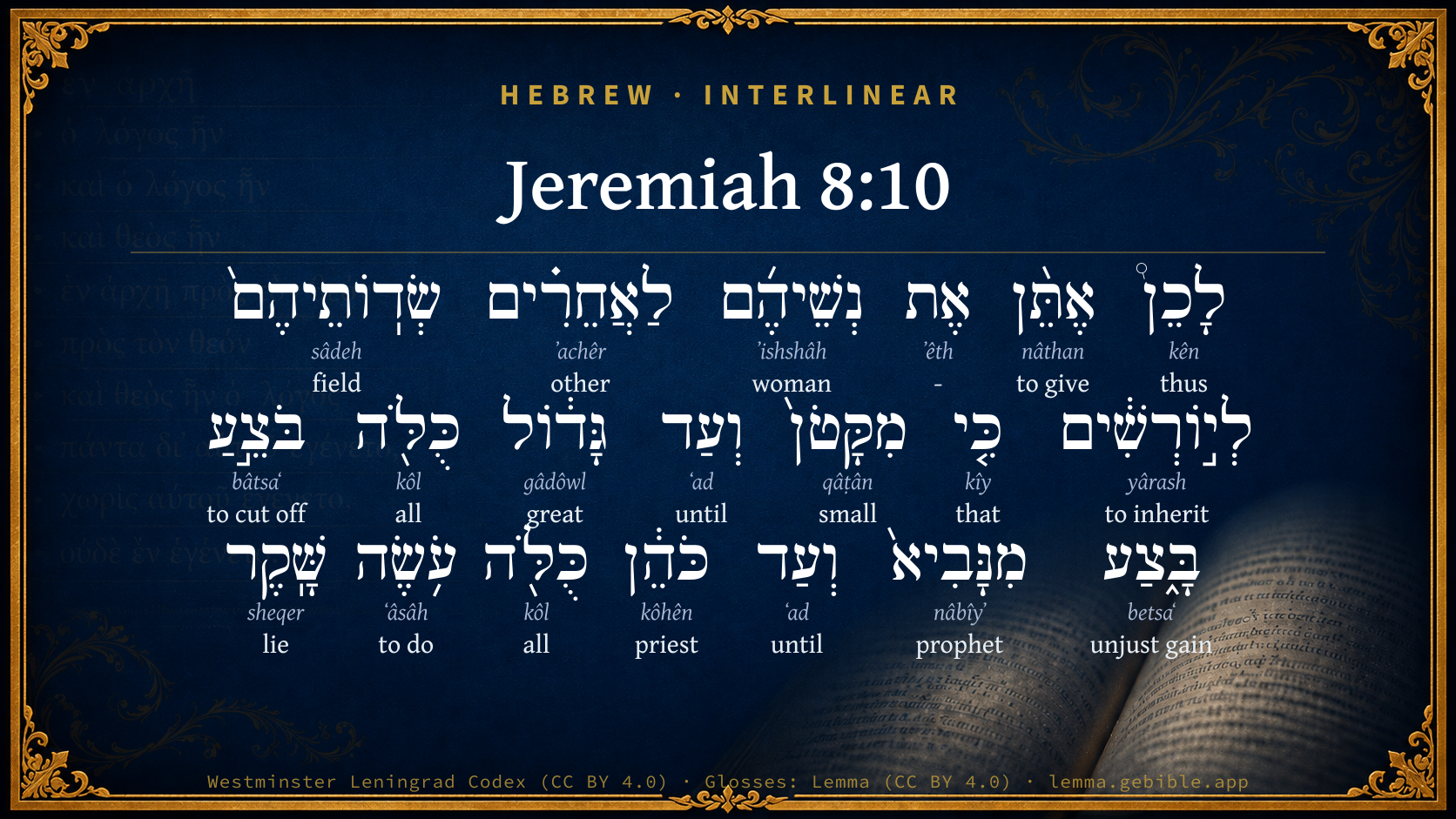
Hebrew (Westminster Leningrad Codex) Jeremiah 8:10 appears in the Hebrew Old Testament. The text above is from the Westminster Leningrad Codex. Each word links to its Strong’s number, a concise gloss, and parsing drawn from the Open Scriptures Hebrew Bible morphology. Click any word for its full Brown-Driver-Briggs (BDB) entry.
Download image
Cite this verse

Jeremiah 8:10 (World English Bible). Public Domain. Lemma interlinear Bible study tool, https://lemma.gebible.app/v/jeremiah/8/10.

Show BibTeX & RIS
BibTeX
RIS
English Translation
Therefore will I give their wives to others, and their fields to those who shall possess them: for everyone from the least even to the greatest is given to covetousness; from the prophet even to the priest every one deals falsely.
World English Bible · Public Domain
Download a study sheet

One document with this verse’s original text, its word-by-word gloss line, the meaning frame, cross-references with their text, attributed commentary, and full source and license credits — printable, and it pastes into notes with its structure intact.

This verse Autodidact and up

Study sheet (.html) Plain text (.txt)

A passage Seminary Student

Up to 50 verses in one chapter. A passage sheet keeps up to 6 commentary sources and 12 cross-references per verse, in the order this page ranks them, and says so on the sheet whenever that leaves anything out. Ask for a single verse and you get the Autodidact verse sheet above.

Everything on this page stays free to read, with no account — the sheet is a download of what is already on screen, not access to it.

Want to remove ads? Support Godless Engineer
Compare translations 3

The same verse in 3 English versions, stacked beneath the original-language interlinear above. Click any original word for its lexicon entry.

Each is an independent rendering of the whole verse — the interlinear is not word-aligned to these translations.

Highlighted words mark where these versions differ — a whole-verse word diff, not a word-by-word alignment.

  • World English Bible Public Domain
    Therefore will I give their wives to others, and their fields to those who shall possess them: for everyone from the least even to the greatest is given to covetousness; from the prophet even to the priest every one deals falsely.
  • King James Version Public Domain
    Therefore will I give their wives unto others, and their fields to them that shall inherit them: for every one from the least even unto the greatest is given to covetousness, from the prophet even unto the priest every one dealeth falsely.
  • unfoldingWord Literal Text CC BY-SA 4.0
    Therefore I will give their wives to others, their fields to those possessing them, because from the least to the greatest everyone is greedy for dishonest gain. From the prophet to the priest, everyone deals deceitfully.

unfoldingWord Literal Text — © unfoldingWord, licensed CC BY-SA 4.0. Word-aligned USFM3 via Door43 (git.door43.org/unfoldingWord/en_ult).

Versions to compare (up to 4)

3 of 4 selected

Show all 18 translations

Every available English version of this verse, each an independent rendering of the whole verse.

  • World English Bible Public Domain
    Therefore will I give their wives to others, and their fields to those who shall possess them: for everyone from the least even to the greatest is given to covetousness; from the prophet even to the priest every one deals falsely.
  • Berean Standard Bible Public Domain
    Therefore I will give their wives to other men and their fields to new owners. For from the least of them to the greatest, all are greedy for gain; from prophet to priest, all practice deceit.
  • Majority Standard Bible Public Domain
    Therefore I will give their wives to other men and their fields to new owners. For from the least of them to the greatest, all are greedy for gain; from prophet to priest, all practice deceit.
  • King James Version Public Domain
    Therefore will I give their wives unto others, and their fields to them that shall inherit them: for every one from the least even unto the greatest is given to covetousness, from the prophet even unto the priest every one dealeth falsely.
  • American Standard Version (1901) Public Domain
    Therefore will I give their wives unto others, and their fields to them that shall possess them: for every one from the least even unto the greatest is given to covetousness; from the prophet even unto the priest every one dealeth falsely.
  • Revised Version (1885) Public Domain
    Therefore will I give their wives unto others, and their fields to them that shall possess them: for every one from the least even unto the greatest is given to covetousness, from the prophet even unto the priest every one dealeth falsely.
  • Geneva Bible (1599) Public Domain
    Therefore will I giue their wiues vnto others, and their fieldes to them that shall possesse them: for euery one from the least euen vnto the greatest is giuen to couetousnesse, and from the Prophet euen vnto the Priest, euery one dealeth falsely.
  • Douay-Rheims (1899) Public Domain
    Therefore I will give their women to strangers, their fields to others for an inheritance: because from the least even to the greatest all follow covetousness: from the prophet even to the priest, all deal deceitfully.
  • Young's Literal Translation Public Domain
    Therefore, I give their wives to others, Their fields to dispossessors, For from the least even unto the greatest, Every one is gaining dishonest gain, From prophet even unto priest, every one is dealing falsely.
  • Literal Standard Version CC BY-SA 4.0
    Therefore, I give their wives to others, || Their fields to dispossessors, || For from the least even to the greatest, || Everyone is gaining dishonest gain, || From prophet even to priest, everyone is dealing falsely.
  • Unlocked Literal Bible CC BY-SA 4.0
    So I will give their wives to others, and their fields to those who will possess them, because from the least to the greatest, all of them are greedy for dishonest gain! From the prophet to the priest, all of them practice deceit.
  • unfoldingWord Literal Text CC BY-SA 4.0
    Therefore I will give their wives to others, their fields to those possessing them, because from the least to the greatest everyone is greedy for dishonest gain. From the prophet to the priest, everyone deals deceitfully.
  • Darby Bible Public Domain
    Therefore will I give their wives unto others, their fields to those that shall possess [them]; for every one, from the least even unto the greatest, is given to covetousness; from the prophet even unto the priest, every one dealeth falsely.
  • World Messianic Bible Public Domain
    Therefore I will give their wives to others and their fields to those who will possess them. For everyone from the least even to the greatest is given to covetousness; from the prophet even to the priest everyone deals falsely.
  • Webster's Bible Public Domain
    Therefore will I give their wives to others, and their fields to them that shall inherit them: for every one from the least even to the greatest is given to covetousness, from the prophet even to the priest every one dealeth falsely.
  • Free Bible Version CC BY-SA 4.0
    I'm going to give their wives to others, and their fields to different owners, since everyone cheats because they're greedy, poor and rich alike. Even prophets and priests—they are all dishonest liars!
  • Bible in Basic English Public Domain
    So I will give their wives to others, and their fields to those who will take them for themselves: for everyone, from the least to the greatest, is given up to getting money; from the priest even to the prophet, everyone is false.
  • JPS Tanakh (1917) Public Domain
    Therefore will I give their wives unto others, and their fields to them that shall possess them; for from the least even unto the greatest every one is greedy for gain, from the prophet even unto the priest every one dealeth falsely.

Literal Standard Version (2020), Covenant Press — licensed CC BY-SA 4.0. Text via the HelloAO Bible API (eBible.org). Unlocked Literal Bible (unfoldingWord) — licensed CC BY-SA 4.0. Text via the HelloAO Bible API (eBible.org). unfoldingWord Literal Text — © unfoldingWord, licensed CC BY-SA 4.0. Word-aligned USFM3 via Door43 (git.door43.org/unfoldingWord/en_ult). Free Bible Version, Dr. Jonathan Gallagher — licensed CC BY-SA 4.0. Text via the HelloAO Bible API (eBible.org).

Word by word

More ways to search: Search by grammar → Find every occurrence → Compare this word →

Practice this passage: Drill this verse → Learn its vocabulary →

בֹּצֵ֣עַ
bâtsaʻ
H1214
“cutting off”
Verb, Qal, Participle Active, Masculine, Singular, Absolute
Part of Speech
Verb
Stem
Qal
Form
Participle Active
Gender
Masculine
Number
Singular
State
Absolute
Full BDB Definition

Origin: a primitive root

TWOT: 267

to cut off, break off, gain by unrighteous violence, get, finish, be covetous, be greedy - (Qal) - to cut off - to stop - to gain wrongfully or by violence - (Piel) - to cut off, sever - to finish, complete, accomplish - to violently make gain of
  1. לָכֵן֩ kên H3651 “to/for · thus” Preposition + Adverb
  2. אֶתֵּ֨ן nâthan H5414 “to give” Verb, Qal, Imperfect, 1st Person, Common, Singular
  3. אֶת ʼêth H853 “-” Particle, Direct Object
  4. נְשֵׁיהֶ֜ם ʼishshâh H802 “women · their” Noun, Common, Feminine, Plural, Construct + Suffix, Personal, 3rd Person, Masculine, Plural
  5. לַאֲחֵרִ֗ים ʼachêr H312 “to/for · other” Preposition + Adjective, Adjective, Masculine, Plural, Absolute
  6. שְׂדֽוֹתֵיהֶם֙ sâdeh H7704 “fields · their” Noun, Common, Masculine, Plural, Construct + Suffix, Personal, 3rd Person, Masculine, Plural
  7. לְי֣וֹרְשִׁ֔ים yârash H3423 “to/for · inheriting” Preposition + Verb, Qal, Participle Active, Masculine, Plural, Absolute
  8. כִּ֤י kîy H3588 “that” Conjunction
  9. מִקָּטֹן֙ qâṭân H6996 “from · small” Preposition + Adjective, Adjective, Masculine, Singular, Absolute
  10. וְעַד ʻad H5704 “and · until” Conjunction + Preposition
  11. גָּד֔וֹל gâdôwl H1419 “great” Adjective, Adjective, Masculine, Singular, Absolute
  12. כֻּלֹּ֖ה kôl H3605 “all · her” Noun, Common, Masculine, Singular, Construct + Suffix, Personal, 3rd Person, Feminine, Singular
  13. בָּ֑צַע betsaʻ H1215 “unjust gain” Noun, Common, Masculine, Singular, Absolute
  14. מִנָּבִיא֙ nâbîyʼ H5030 “from · prophet” Preposition + Noun, Common, Masculine, Singular, Absolute
  15. וְעַד ʻad H5704 “and · until” Conjunction + Preposition
  16. כֹּהֵ֔ן kôhên H3548 “priest” Noun, Common, Masculine, Singular, Absolute
  17. כֻּלֹּ֖ה kôl H3605 “all · her” Noun, Common, Masculine, Singular, Construct + Suffix, Personal, 3rd Person, Feminine, Singular
  18. עֹ֥שֶׂה ʻâsâh H6213 “doing” Verb, Qal, Participle Active, Masculine, Singular, Absolute
  19. שָּֽׁקֶר sheqer H8267 “lie” Noun, Common, Masculine, Singular, Absolute

About this verse

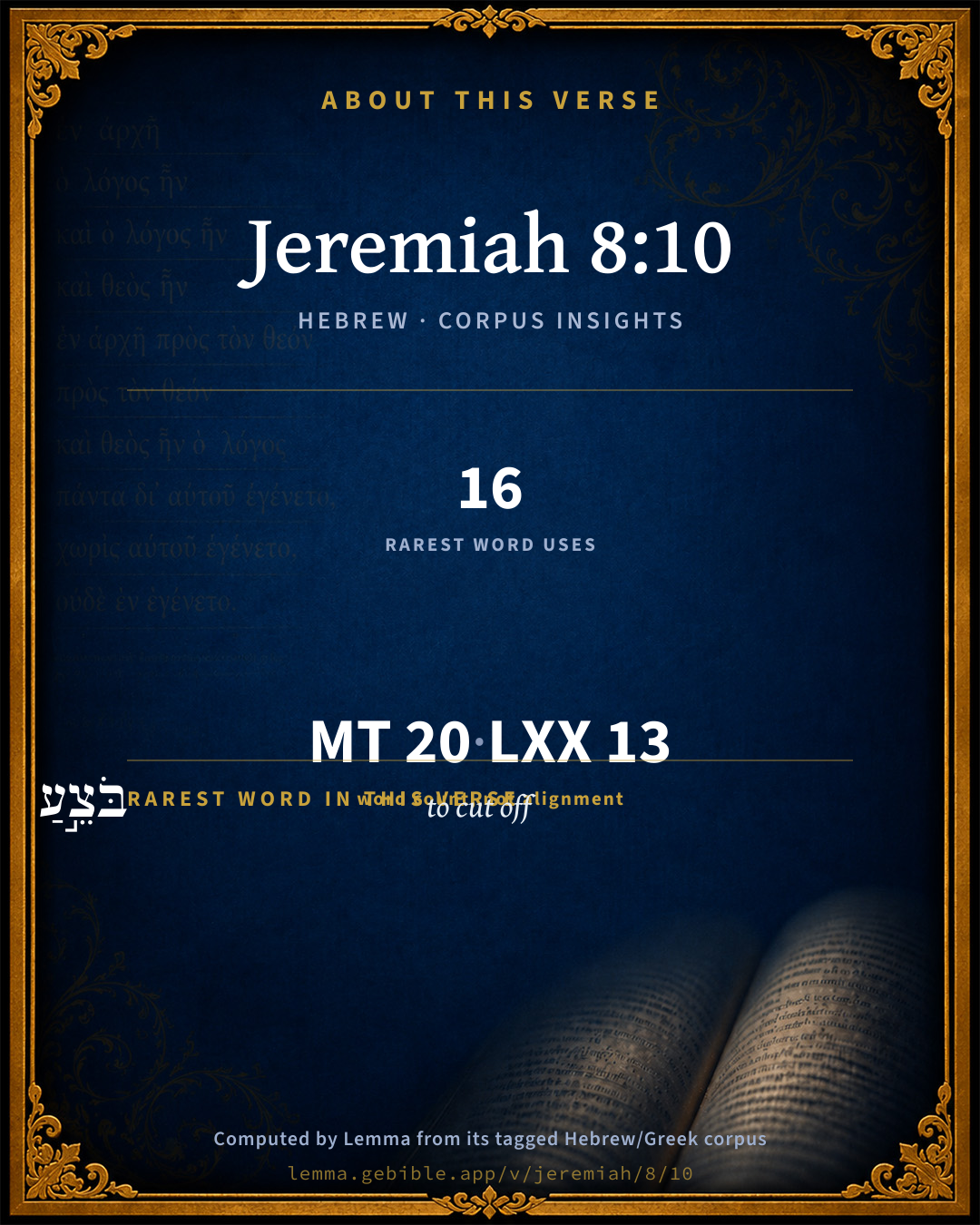
These counts appear in no published source. They are computed here, from the morphology-tagged text and Lemma’s own curated glosses. What Lemma adds →

20
words
18
distinct lemmas
Prophets
section

Notable vocabulary

The rarest word here is בֹּצֵ֣עַ to cut off H1214 — appearing just 16 times in the whole Hebrew Bible.

Shared distinctive vocabulary

בֹּצֵ֣עַ to cut off H1214 occurs in 16 verses of the Hebrew Bible. Also found in:

Grammatical profile

  • 4 verbs
  • 8 nouns
  • 3 adjectives
  • 2 prepositions
  • 1 conjunction
  • 1 adverb
  • 1 particle

Verb forms

  • אֶתֵּ֨ן Qal · Imperfect
  • לְי֣וֹרְשִׁ֔ים Qal · Participle Active
  • בֹּצֵ֣עַ Qal · Participle Active
  • עֹ֥שֶׂה Qal · Participle Active

Repetition

Words recur within this verse — often emphatic in Hebrew:

  • וְעַד until H5704 ×2
  • כֻּלֹּ֖ה all H3605 ×2

Hebrew & Septuagint length

In the original languages it is 20 Hebrew tokens and 13 Greek tokens — but the two are counted differently (Hebrew bundles its prefixes and suffixes into one token; the Greek is in lemma form), so that isn’t a like-for-like length.

Cross-references

18

Topical passages linked to Jeremiah 8:10 in the Treasury of Scripture Knowledge — connected by theme and wording, ordered by reader-vote popularity; previews shown in the World English Bible.

  • Jeremiah 6:12–13 Their houses shall be turned to others, their fields and their wives together; for I will stretch out my hand on the inhabitants of the land, says Yahweh.
  • Ezekiel 33:31 They come to you as the people comes, and they sit before you as my people, and they hear your words, but don't do them; for with their mouth they show much love, but their heart goes after their gain.
  • Deuteronomy 28:30–32 You shall betroth a wife, and another man shall lie with her: you shall build a house, and you shall not dwell therein: you shall plant a vineyard, and shall not use the fruit of it.
  • Isaiah 28:7 Even these reel with wine, and stagger with strong drink; the priest and the prophet reel with strong drink, they are swallowed up of wine, they stagger with strong drink; they err in vision, they stumble in judgment.
  • Isaiah 56:10–12 His watchmen are blind, they are all without knowledge; they are all mute dogs, they can't bark; dreaming, lying down, loving to slumber.
  • Jeremiah 23:11–17 for both prophet and priest are profane; yes, in my house have I found their wickedness, says Yahweh.
  • Ezekiel 22:27–28 Her princes in the midst of it are like wolves ravening the prey, to shed blood, [and] to destroy souls, that they may get dishonest gain.
  • Amos 5:11 Forasmuch therefore as you trample on the poor, And take taxes from him of wheat: You have built houses of hewn stone, But you will not dwell in them. You have planted pleasant vineyards, But you shall not drink their wine.
  • Zephaniah 1:13 Their wealth will become a spoil, and their houses a desolation. Yes, they will build houses, but won't inhabit them. They will plant vineyards, but won't drink their wine.
  • Titus 1:11 whose mouths must be stopped; men who overthrow whole houses, teaching things which they ought not, for dishonest gain's sake.
  • Jeremiah 5:31 the prophets prophesy falsely, and the priests bear rule by their means; and my people love to have it so: and what will you do in the end of it?
  • Jeremiah 23:25–26 I have heard what the prophets have said, who prophesy lies in my name, saying, I have dreamed, I have dreamed.
  • Jeremiah 32:32 because of all the evil of the children of Israel and of the children of Judah, which they have done to provoke me to anger, they, their kings, their princes, their priests, and their prophets, and the men of Judah, and the inhabitants of Jerusalem.
  • Lamentations 4:13 [It is] because of the sins of her prophets, [and] the iniquities of her priests, That have shed the blood of the just in the midst of her.
  • Micah 3:5 Thus says Yahweh concerning the prophets who lead my people astray; for those who feed their teeth, they proclaim, "Peace!" and whoever doesn't provide for their mouths, they prepare war against him:
  • Micah 3:11 Her leaders judge for bribes, And her priests teach for a price, And her prophets of it tell forturnes for money: Yet they lean on Yahweh, and say, Isn't Yahweh in the midst of us? No disaster will come on us.
  • Titus 1:7 For the overseer must be blameless, as God's steward; not self-pleasing, not easily angered, not given to wine, not violent, not greedy for dishonest gain;
  • 2 Peter 2:1–3 But there also arose false prophets among the people, as among you also there will be false teachers, who will secretly bring in destructive heresies, denying even the Master who bought them, bringing on themselves swift destruction.

Cross-references courtesy of OpenBible.info (CC BY 4.0).

Hebrew and Greek witnesses Masoretic Hebrew ↔ Greek Septuagint

The same verse in the two great witnesses to the Old Testament, shown verse-for-verse.

These are two independent witnesses, not word-aligned to each other, and the Septuagint is shown in lemma (dictionary) form.

Hebrew Jeremiah 8:10 Masoretic · Westminster Leningrad Codex

לָכֵן֩ אֶתֵּ֨ן אֶת נְשֵׁיהֶ֜ם לַאֲחֵרִ֗ים שְׂדֽוֹתֵיהֶם֙ לְי֣וֹרְשִׁ֔ים כִּ֤י מִקָּטֹן֙ וְעַד גָּד֔וֹל כֻּלֹּ֖ה בֹּצֵ֣עַ בָּ֑צַע מִנָּבִיא֙ וְעַד כֹּהֵ֔ן כֻּלֹּ֖ה עֹ֥שֶׂה שָּֽׁקֶר

Therefore will I give their wives to others, and their fields to those who shall possess them: for everyone from the least even to the greatest is given to covetousness; from the prophet even to the priest every one deals falsely.

World English Bible · Public Domain

Greek LXX Structure differs

In the Septuagint, Jeremiah is about an eighth shorter than the Hebrew and arranges its material differently — the Oracles Against the Nations (Hebrew chapters 46–51) appear in the middle of the Greek book, after 25:13. Because the chapter and verse boundaries do not line up, a verse-for-verse comparison with the Hebrew is not shown.

A verse-for-verse comparison isn’t shown here because the chapters and verses don’t line up. Switch to the LXX edition with the MT / LXX toggle above to read the Greek directly.

On this verse, The Cambridge Bible for Schools and Colleges discusses the Septuagint’s reading. Read the note in Commentary ↓

Hebrew: Westminster Leningrad Codex (CC BY 4.0). Greek: Septuagint (public domain); English from a public-domain English Septuagint. How the Septuagint differs from the Hebrew →

Targum (Aramaic paraphrase)

1

The Targum is the ancient Jewish Aramaic paraphrase of the Hebrew Scriptures — an interpretive translation, not the Hebrew text itself. Onkelos (literal) and Pseudo-Jonathan (expansive) render the Torah, and Jonathan the Prophets. Coverage is partial: where no permissively-licensed English translation exists for a verse, only the Aramaic is shown. This is verse-level text, not a word-by-word alignment to the Hebrew.

  1. Targum Jonathan Prophets (Joshua–Malachi)
    בְּכֵן אֶתֵּן יַת נְשֵׁיהוֹן לְאוֹחֲרָנִין חַקְלַתְהוֹן לִירוּתִין אֲרֵי מִן זְעֵירָא וְעַד רַבָּא כּוּלְהוֹן אַנְסֵי מָמוֹן מִסָפֵר וְעַד כָּהֵן כּוּלְהוֹן עָבְדֵי שְׁקָר:

    (no public-domain English translation for this verse)

    Targum Jonathan — Aramaic: “Mikraot Gedolot” (public domain). English: “Sefaria Community Translation” (CC0 1.0 (public-domain dedication)); “London "Chaldee Paraphrase," 1871” (public domain). Text via Sefaria.

Commentary

Notes on Jeremiah 8:10 from classic Christian and Jewish commentators (each source and its license shown beneath its notes). The classic Christian expositions comment on the surrounding passage and are grouped to its opening verse, so a note may address several verses; the Jewish commentaries on the Tanakh (Rashi and others) are per-verse, so they appear only where the commentator wrote on this verse.

Lemma curates 59 commentaries, every one of them public domain or Creative Commons licensed, each selected and text-cleaned for this edition rather than reprinted as found. About our sources →

Trapp's Complete Commentary

John Trapp

Jer 8:10 Therefore will I give their wives unto others, [and] their fields to them that shall inherit [them]: for every one from the least even unto the greatest is given to covetousness, from the prophet even unto the priest every one dealeth falsely.

Ver. 10. Therefore will I give their wives.] For a punishment of their rejecting my Word, which ought to be received with all reverence and good affection. {a} The Turks do so highly respect the Koran (which is their Bible), that if a Christian do but sit upon it, though unwittingly, they presently put him to death.

For every one, &c.] See Jer 6:13.

{a} Dilher. Elect., lib. i. cap. 2.

John Trapp, A Commentary or Exposition upon All the Books of the Old and New Testament (1647–1656) — public domain. Text from a community e-Sword module.

Albert Barnes' Notes on the Bible

These verses are almost identical with Jer 6:12-15.

Jer 8:10

To them that shall inherit them - Rather, “to those that shall take possession of them, i. e., “to conquerors who shall take them by force.

Albert Barnes' Notes on the Bible (1834–1885) — public domain. Text from a community e-Sword/MySword module.

Joseph Benson's Commentary

Jer 8:10-12. Therefore will I give their wives unto others — See on Jer 6:12; and their fields to them, that shall inherit, or possess, them — For the word inherit is sometimes taken for any sort of possession. See Psa 32:8. So Israel is called the Lord’s inheritance, chap. Jer 10:16, and elsewhere. The expression, however, implies that their fields should not only be taken possession of by the victorious Chaldeans, should be ravaged and stripped of their crops and cattle, but that these their enemies should possess their fields as their own, and acquire a property in them which they should transmit to their posterity. For every one is given to covetousness, &c. — For the elucidation of this and the two following verses, see notes on Jer 6:13-15.

Joseph Benson's Commentary on the Old and New Testaments (1811–1818) — public domain. Text from a community e-Sword module.

Tyndale Open Study Notes

Tyndale Open Resources

8:10-12 These verses repeat 6:13-15.

Tyndale Open Study Notes — © Tyndale Open Resources, licensed CC BY-SA 4.0. Text via the HelloAO Bible API.

Jamieson, Fausset & Brown

Robert Jamieson, A. R. Fausset & David Brown

Repeated from Jer 6:12-15. See a similar repetition, Jer 8:15; Jer 14:19.

inherit--succeed to the possession of them.

Jamieson, Fausset & Brown — Commentary Critical and Explanatory on the Whole Bible (1871) — public domain (CC PDM 1.0). Text via the HelloAO Bible API.

Adam Clarke's Commentary

Verse 10. Therefore will I give their wives] From this to the end of Jer 8:15 is repeated from Jer 6:13-15.

Adam Clarke's Commentary on the Bible (1810–1826) — public domain. Text from a community e-Sword/MySword module.

John Calvin's Commentaries

GOD here threatens punishment, because he found that he effected nothing, and that he had to do with an obstinate people, having before tried whether they were reclaimable. Having seen that exhortations were of no avail, he now comes to extreme severity, I will give, he says, their wives to strangers. He sets forth, by a particular instance, the evils which usually accompany wars: and nothing is more distressing than when the wife is snatched away from her husband; for if husbands had their option, they would prefer instant death than to bear such a disgrace. Jeremiah then shews that the most atrocious thing that happens to conquered nations was nigh the Jews, — that their men would be deprived of their wives. He afterwards says the same thing of their fields; God declares that he would give the fields to their possessors. By this mode of speaking he intimates, that they would be deprived of their fields, not for a short time, but perpetually.

There is, indeed, a contrast here implied: for it sometimes happens, that enemies prevail and plunder everything; but yet they take no long possession of the fields, for a change succeeds: but when he calls enemies possessors, he means that there would be such a calamity, that the Jews would for a long time, even for their life, be banished from their country, and would lose their possessions. They thought that the land was so given to them, that it could never be taken from them: and doubtless the Lord would have never expelled them, had they not defiled it with their pollutions; but as they had polluted it by their sins, they deserved to be banished from it. So the Prophet shews that their confidence was absurd, in thinking that they would be the perpetual inheritors of that land: “Succeed you, “he says, “shall others, who shall possess it as it were by an hereditary right.” We now perceive the Prophet’s meaning.

He afterwards mentions the reason why God had resolved to deal so severely with them, For they are, he says, from the least to the greatest given up to avarice He means that no equity prevailed among the people; for under one kind of sin he includes all frauds and plunders, and every kind of injustice. He then says, that every one was addicted to his own gain, so that they practiced mutual wrongs without any regard to what was right and just.

He then enlarges on the subject and says, that all, from the prophet to the priest, acted deceitfully There is here also a part mentioned for the whole. But Jeremiah in various ways sets forth the wrongs by which men harassed one another. Nor does he exclude violence when he speaks of fraud; but it is the same as though he said, that they, being forgetful of what was right, practiced fraud of every kind. It was, indeed, a dreadful thing, that there remained no rectitude or justice in the prophets and the priests, who ought to have carried light for others, and to have shewn to them the right way, as God had constituted them to be the leaders of the people. Since, then, even these acted deceitfully, there must have been among the common people the most disgraceful injustice. Hence the Prophet shews by these words, that God could not be charged with too much rigor, as though he treated the people cruelly; for there was such a mass of wickedness, that it could no longer be borne. It follows —

John Calvin's Commentaries (1540-1563) — public domain. Text from the Calvin Translation Society English edition (1840s-50s) via the Christian Classics Ethereal Library (ccel.org). Calvin's coverage is partial (roughly two-thirds of the Bible); uncommented books and verses are honest gaps, never fabricated. The 19th-century editor's footnotes and remarks are omitted so the notes are faithfully Calvin's own voice.

Ellicott's Commentary for English Readers

(10-12) Every one from the least . . .—The prophet reproduces, though not verbally, what he had already said in Jer_6:12-15. (Comp. Notes there.) It is as though that emphatic condemnation of the sins of the false teachers were burnt into his soul, and could not but find utterance whenever he addressed the people.

A Bible Commentary for English Readers, edited by Charles John Ellicott (1878–1897) — public domain. Text from a community e-Sword module.

The Cambridge Bible for Schools and Colleges

gen. ed. J. J. S. Perowne

10–12. See summary at commencement of section. These verses are omitted by LXX and are almost identical with ch. Jer_6:12-15 above. See notes there.

The Cambridge Bible for Schools and Colleges (gen. ed. J. J. S. Perowne; Cambridge University Press, 1878–1918) — public domain. Text from a community e-Sword module.

John Gill's Exposition

Therefore will I give their wives unto others,.... To strangers, to the Gentiles; than which nothing could be more disagreeable to them, or a sorer punishment, of a temporal one:

and their fields to them that shall inherit them; or,

to the heirs (i); other and new ones; and who should possess them as if they were the true and rightful heirs of them.

For everyone from the least even to the greatest is given to covetousness; from the prophet even to the priest everyone dealeth falsely; covetousness and false dealing, which prevailed in all ranks and orders of men among them, were the cause of their ruin: covetousness is the root of all evil; and to deal falsely, or make a lie, as the words may be rendered, is diabolical and abominable in the sight of God, and especially in men of such characters, who were to preach truth to others; See Gill on Jer 6:13.

(i) "haeredibus", V. L. Pagninus, Montanus.

John Gill's Exposition of the Whole Bible (1746–1763) — public domain (CC PDM 1.0). Text via the HelloAO Bible API.

Haydock's Catholic Bible Commentary

Others. Idumeans, &c. Yet most part of the land remained uncultivated. (Calmet) --- The rest, to ver. 13., "they will collect their fruits, says," &c., is supplied by Grabe. (Haydock)

George Leo Haydock (1774–1849), Haydock's Catholic Family Bible and Commentary, 1859 edition — public domain. Excludes Psalms (Douay-Rheims chapter numbering differs from Protestant) and Deuterocanonical books (Catholic canon only).

Matthew Poole's English Annotations

Therefore will I give their wives unto others, and their fields to them that shall inherit them; a paraphrastical description of the miseries of war: God doth here insinuate that their misery shall not be for a short time, but so long, as that strangers, viz. the Chaldeans, shall enjoy their land by inheritances, so far should they be from possessing their land for ever.

Every one is given to covetousness; so greedy after their own private gain, that they took no care of equity or justice, in which word is comprised all their fraudulent dealings one among another. Of this and the two next verses, see on Jer 6:13-15.

Matthew Poole's English Annotations on the Holy Bible (1683–1685) — public domain. Text from a community e-Sword/MySword module.

Whedon's Commentary on the Bible

Daniel D. Whedon

10-12. Were they ashamed — Identical with Jer_6:12-15, but with such differences as to vindicate the passage from the charge of being interpolated here. It is an instance of Jeremiah’s tendency to repeat himself. For a list of these repetitions, see Introduction, p. 286.

Daniel D. Whedon (gen. ed.), Commentary on the Old and New Testaments (1874–1909) — public domain. Text from a community e-Sword module.

The Pulpit Commentary

Vers. 10-12. These verses are almost the same as Jer_6:12-15; the differences are in Ver. 10. They are omitted in the Septuagint, and Hitzig regards them as an interpolation, at any rate from the point where the present passage coincides verbally with its parallel. His grounds are:

(1) that Ver. 13 follows more naturally on Ver. 10 ("... them that shall inherit them") than on Ver. 12;

(2) that Ver. 10 is deficient in symmetry; and

(3) that the deviations from Jer_6:13-15 sometimes loosen theconnection of the clauses, sometimes sink into the colloquial style. The arguments seem to be inconclusive. Jeremiah is apt to repeat himself (Graf refers to Ver. 14 = Jer_4:5; Ver. 51-Jer_14:19 Jer_5:9 = Jer_5:29, Jer_9:8 Jer_7:16 = Jer_11:14 Jer_50:41-43 = Jer_6:22-24 = Jer_49:19-21) and the element which is common to this paragraph and to Jer_6:12-15 seems equally appropriate in both connections. It should be added, however, that the cautious and reverent block has come to the same conclusion as Hitzig. To them that shall inherit them; rather, to them that shall take possession of them, i.e. by violence.

The Pulpit Commentary (1880–1919), ed. H.D.M. Spence-Jones & Joseph S. Exell — public domain. Text from a community e-Sword module.

Lesson kit

Teaching starters — assembled from the data on this page, not authored interpretation. Every prompt links to the verse data it draws on. Edit before teaching.

Jeremiah, in the Prophets, opens this verse with 20 words (18 distinct Hebrew lemmas). Its most distinctive word is bâtsaʻ (“to cut off”). A historical commentator’s framing appears above. Read the whole chapter for the surrounding context.

Discussion questions

  1. How does “to cut off” (bâtsaʻ) shape what this verse is saying?
  2. Job 6:9 shares the word «to cut off» with this verse. How do the two illuminate each other?
  3. “until” occurs 2× in this one verse. What is the effect of the repetition?
  4. The translations on this page render this verse differently — a whole-verse word diff, not a word-by-word alignment. What might account for the different wordings?
  5. The verb «אֶתֵּ֨ן» is Qal Imperfect. How does its form color the action?
  6. Reading how Trapp's Complete Commentary and Albert Barnes' Notes on the Bible read this verse, where do the two commentators agree and where do they part?

Things to notice

Reading settings

Reading text

Shown beneath each verse's original-language words.

Old Testament
Old Testament edition

Read the OT as the Masoretic Hebrew (MT) or the Greek Septuagint (LXX).

English shown for the Greek Septuagint (in the Hebrew ↔ Greek comparison).

Comparing translations? Open the Compare panel on any verse page to stack up to four side by side.