
Jeremiah 32:7

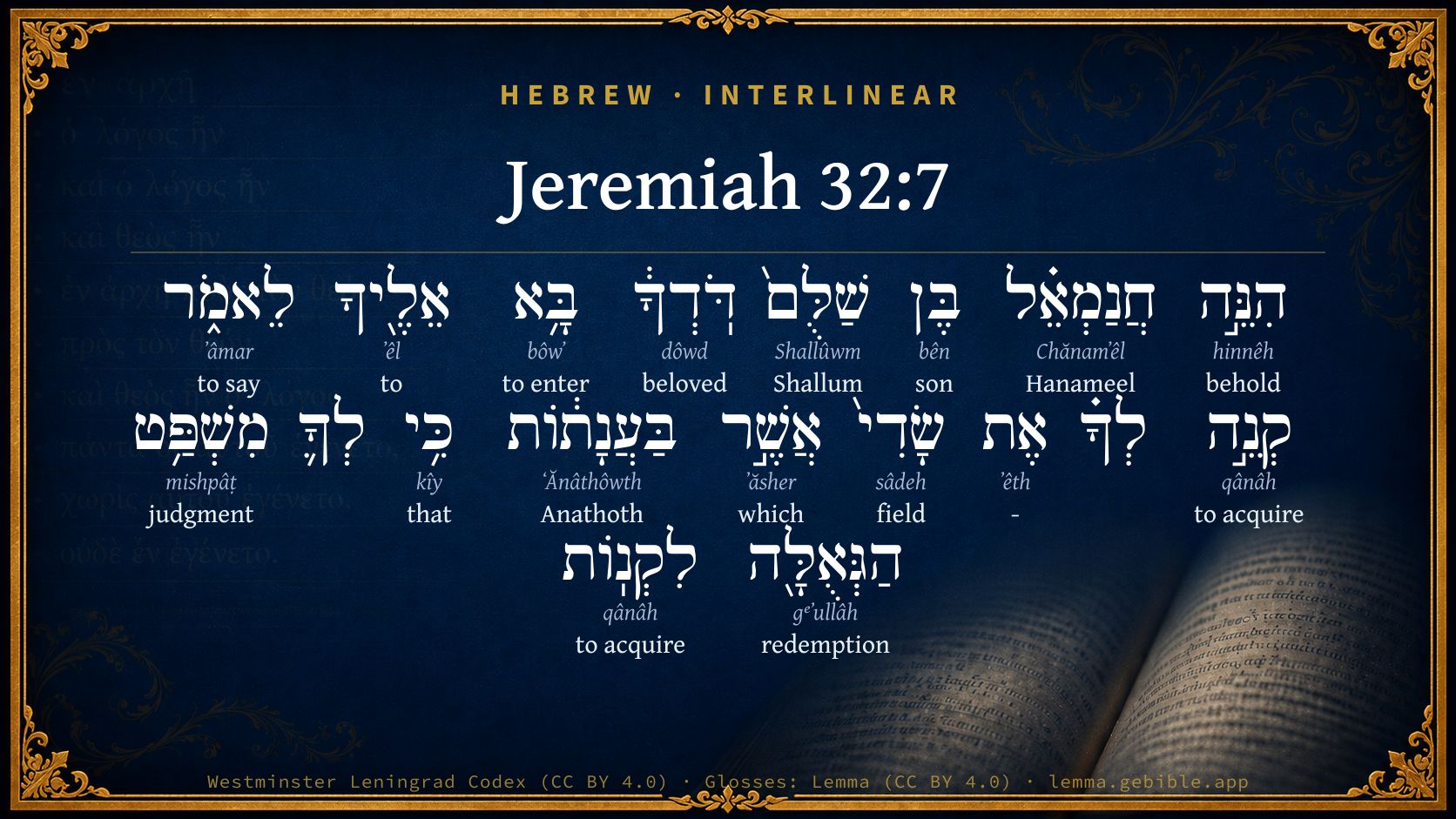
Hebrew (Westminster Leningrad Codex) Jeremiah 32:7 appears in the Hebrew Old Testament. The text above is from the Westminster Leningrad Codex. Each word links to its Strong’s number, a concise gloss, and parsing drawn from the Open Scriptures Hebrew Bible morphology. Click any word for its full Brown-Driver-Briggs (BDB) entry.
Download image
Cite this verse

Jeremiah 32:7 (World English Bible). Public Domain. Lemma interlinear Bible study tool, https://lemma.gebible.app/v/jeremiah/32/7.

Show BibTeX & RIS
BibTeX
RIS
English Translation
Behold, Hanamel the son of Shallum your uncle shall come to you, saying, Buy you my field that is in Anathoth; for the right of redemption is yours to buy it.
World English Bible · Public Domain
Highlights
  • 1 first appearance in the Hebrew Bible
Full analysis ↓
Download a study sheet

One document with this verse’s original text, its word-by-word gloss line, the meaning frame, cross-references with their text, attributed commentary, and full source and license credits — printable, and it pastes into notes with its structure intact.

This verse Autodidact and up

Study sheet (.html) Plain text (.txt)

A passage Seminary Student

Up to 50 verses in one chapter. A passage sheet keeps up to 6 commentary sources and 12 cross-references per verse, in the order this page ranks them, and says so on the sheet whenever that leaves anything out. Ask for a single verse and you get the Autodidact verse sheet above.

Everything on this page stays free to read, with no account — the sheet is a download of what is already on screen, not access to it.

Want to remove ads? Support Godless Engineer
Compare translations 3

The same verse in 3 English versions, stacked beneath the original-language interlinear above. Click any original word for its lexicon entry.

Each is an independent rendering of the whole verse — the interlinear is not word-aligned to these translations.

Highlighted words mark where these versions differ — a whole-verse word diff, not a word-by-word alignment.

  • World English Bible Public Domain
    Behold, Hanamel the son of Shallum your uncle shall come to you, saying, Buy you my field that is in Anathoth; for the right of redemption is yours to buy it.
  • King James Version Public Domain
    Behold, Hanameel the son of Shallum thine uncle shall come unto thee saying, Buy thee my field that is in Anathoth: for the right of redemption is thine to buy it.
  • unfoldingWord Literal Text CC BY-SA 4.0
    ‘Look, Hanamel son of Shallum your uncle is coming to you and will say, “Buy my field that is in Anathoth for yourself, for the right to buy it belongs to you.”’”

unfoldingWord Literal Text — © unfoldingWord, licensed CC BY-SA 4.0. Word-aligned USFM3 via Door43 (git.door43.org/unfoldingWord/en_ult).

Versions to compare (up to 4)

3 of 4 selected

Show all 18 translations

Every available English version of this verse, each an independent rendering of the whole verse.

  • World English Bible Public Domain
    Behold, Hanamel the son of Shallum your uncle shall come to you, saying, Buy you my field that is in Anathoth; for the right of redemption is yours to buy it.
  • Berean Standard Bible Public Domain
    Behold! Hanamel, the son of your uncle Shallum, is coming to you to say, ‘Buy for yourself my field in Anathoth, for you have the right of redemption to buy it.’
  • Majority Standard Bible Public Domain
    Behold! Hanamel, the son of your uncle Shallum, is coming to you to say, ‘Buy for yourself my field in Anathoth, for you have the right of redemption to buy it.’
  • King James Version Public Domain
    Behold, Hanameel the son of Shallum thine uncle shall come unto thee saying, Buy thee my field that is in Anathoth: for the right of redemption is thine to buy it.
  • American Standard Version (1901) Public Domain
    Behold, Hanamel the son of Shallum thine uncle shall come unto thee, saying, Buy thee my field that is in Anathoth; for the right of redemption is thine to buy it.
  • Revised Version (1885) Public Domain
    Behold, Hanamel the son of Shallum thine uncle shall come unto thee, saying, Buy thee my field that is in Anathoth: for the right of redemption is thine to buy it.
  • Geneva Bible (1599) Public Domain
    Beholde, Hanameel, the sonne of Shallum thine vncle, shall come vnto thee and say, Bye vnto thee my fielde, that is in Anathoth: for the title by kindred appertaineth vnto thee to bye it.
  • Douay-Rheims (1899) Public Domain
    Behold, Hanameel the son of Sellum thy cousin shall come to thee, saying: Buy thee my field, which is in Anathoth, for it is thy right to buy it, being akin.
  • Young's Literal Translation Public Domain
    Lo, Hanameel son of Shallum, thine uncle, is coming unto thee, saying, Buy for thee my field that `is' in Anathoth, for thine `is' the right of redemption -- to buy.
  • Literal Standard Version CC BY-SA 4.0
    Behold, Hanameel son of Shallum, your uncle, is coming to you, saying, Buy my field that [is] in Anathoth for yourself, for the right of redemption [is] yours to buy.”
  • Unlocked Literal Bible CC BY-SA 4.0
    'Look, Hanamel son of Shallum your uncle is coming to you and will say, “Buy my field that is in Anathoth for yourself, for the right to buy it belongs to you.”'”
  • unfoldingWord Literal Text CC BY-SA 4.0
    ‘Look, Hanamel son of Shallum your uncle is coming to you and will say, “Buy my field that is in Anathoth for yourself, for the right to buy it belongs to you.”’”
  • Darby Bible Public Domain
    Behold, Hanameel, the son of Shallum thine uncle, shall come unto thee, saying, Buy for thyself my field which is in Anathoth; for thine is the right of redemption, to buy [it].
  • World Messianic Bible Public Domain
    ‘Behold, Hanamel the son of Shallum your uncle will come to you, saying, “Buy my field that is in Anathoth; for the right of redemption is yours to buy it.”’”
  • Webster's Bible Public Domain
    Behold, Hanameel the son of Shallum thy uncle shall come to thee, saying, Buy for thee my field that is in Anathoth: for the right of redemption is thine to buy it.
  • Free Bible Version CC BY-SA 4.0
    Your cousin Hanamel, son of Shallum, is coming to tell you, ‘Why don't you buy my field in Anathoth because you have the right to redeem it and buy it?’
  • Bible in Basic English Public Domain
    See, Hanamel, the son of Shallum, your father's brother, will come to you and say, Give the price and get for yourself my property in Anathoth: for you have the right of the nearest relation.
  • JPS Tanakh (1917) Public Domain
    Behold, Hanamel, the son of Shallum thine uncle, shall come unto thee, saying: Buy thee my field that is in Anathoth; for the right of redemption is thine to buy it.'

Literal Standard Version (2020), Covenant Press — licensed CC BY-SA 4.0. Text via the HelloAO Bible API (eBible.org). Unlocked Literal Bible (unfoldingWord) — licensed CC BY-SA 4.0. Text via the HelloAO Bible API (eBible.org). unfoldingWord Literal Text — © unfoldingWord, licensed CC BY-SA 4.0. Word-aligned USFM3 via Door43 (git.door43.org/unfoldingWord/en_ult). Free Bible Version, Dr. Jonathan Gallagher — licensed CC BY-SA 4.0. Text via the HelloAO Bible API (eBible.org).

Word by word

More ways to search: Search by grammar → Find every occurrence → Compare this word →

Practice this passage: Drill this verse → Learn its vocabulary →

חֲנַמְאֵ֗ל
Chănamʼêl
H2601
“Hanameel”
Noun, Proper
Part of Speech
Noun
Type
Proper
Full BDB Definition

Origin: probably by orthographical variation for H2606

TWOT: None

Hanameel = "God is gracious" - son of Shallum and cousin of Jeremiah
  1. הִנֵּ֣ה hinnêh H2009 “behold” Particle, Demonstrative
  2. בֶּן bên H1121 “son of” Noun, Common, Masculine, Singular, Construct
  3. שַׁלֻּם֙ Shallûwm H7967 “Shallum” Noun, Proper
  4. דֹּֽדְךָ֔ dôwd H1730 “beloved · your” Noun, Common, Masculine, Singular, Construct + Suffix, Personal, 2nd Person, Masculine, Singular
  5. בָּ֥א bôwʼ H935 “entering” Verb, Qal, Participle Active, Masculine, Singular, Absolute
  6. אֵלֶ֖יךָ ʼêl H413 “to · you” Preposition + Suffix, Personal, 2nd Person, Masculine, Singular
  7. לֵאמֹ֑ר ʼâmar H559 “to say” Preposition + Verb, Qal, Infinitive Construct
  8. קְנֵ֣ה qânâh H7069 “acquire” Verb, Qal, Imperative, 2nd Person, Masculine, Singular
  9. אֶת ʼêth H853 “-” Particle, Direct Object
  10. שָׂדִי֙ sâdeh H7704 “field · my” Noun, Common, Masculine, Singular, Construct + Suffix, Personal, 1st Person, Common, Singular
  11. אֲשֶׁ֣ר ʼăsher H834 “which” Particle, Relative
  12. בַּעֲנָת֔וֹת ʻĂnâthôwth H6068 “in/at · Anathoth” Preposition + Noun, Proper
  13. כִּ֥י kîy H3588 “that” Conjunction
  14. מִשְׁפַּ֥ט mishpâṭ H4941 “judgment of” Noun, Common, Masculine, Singular, Construct
  15. הַגְּאֻלָּ֖ה gᵉʼullâh H1353 “the · redemption” Particle, Definite Article + Noun, Common, Feminine, Singular, Absolute
  16. לִקְנֽוֹת qânâh H7069 “to acquire” Preposition + Verb, Qal, Infinitive Construct

About this verse

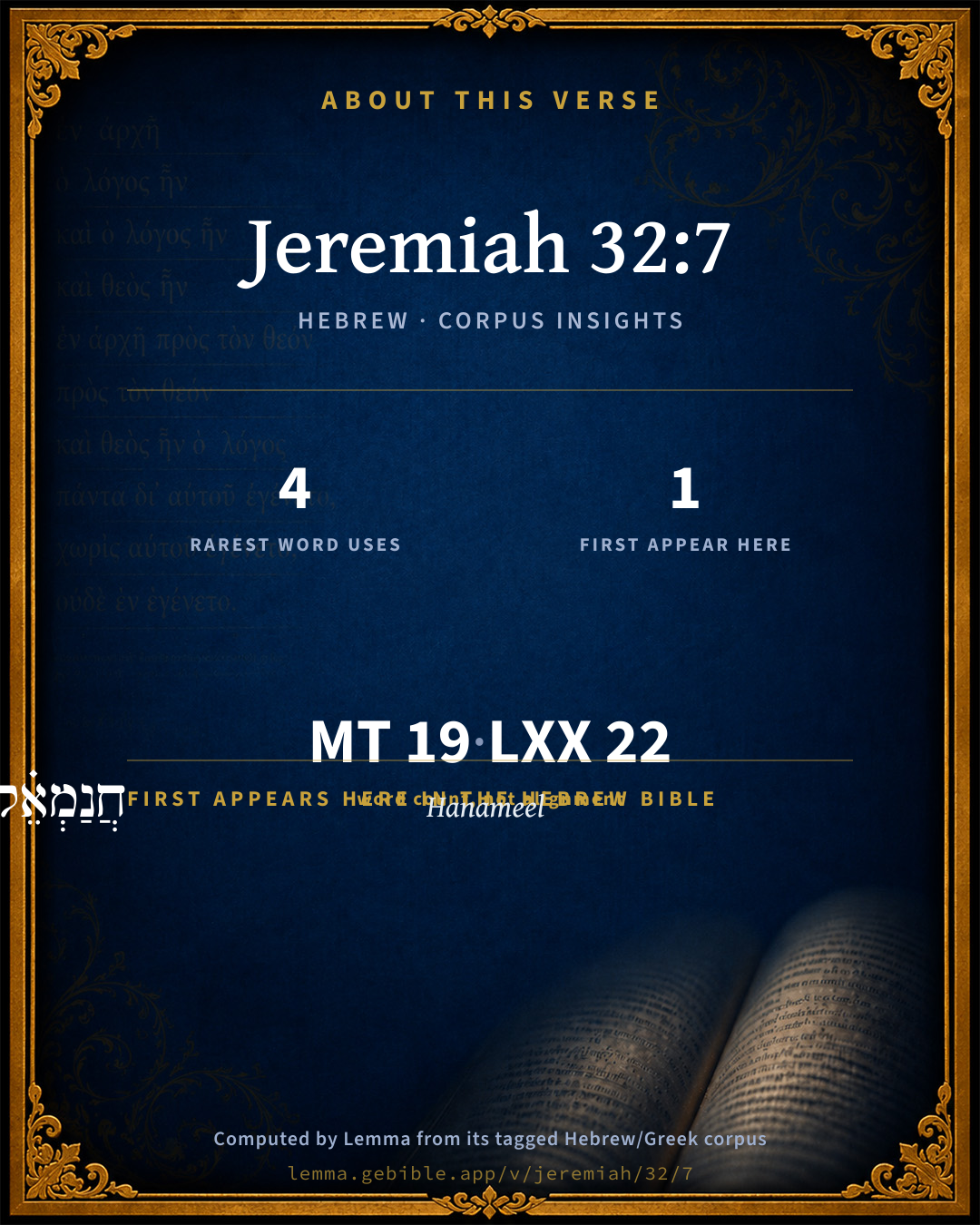
These counts appear in no published source. They are computed here, from the morphology-tagged text and Lemma’s own curated glosses. What Lemma adds →

19
words
16
distinct lemmas
Prophets
section

Notable vocabulary

The rarest word here is חֲנַמְאֵ֗ל Hanameel H2601 — appearing just 4 times in the whole Hebrew Bible.

First appearance in Scripture

This word makes its first canonical appearance in the Hebrew Bible here:

  • חֲנַמְאֵ֗ל Hanameel H2601

Shared distinctive vocabulary

חֲנַמְאֵ֗ל Hanameel H2601 occurs in 4 verses of the Hebrew Bible. Also found in:

Grammatical profile

  • 4 verbs
  • 8 nouns
  • 3 prepositions
  • 1 conjunction
  • 3 particles

Verb forms

  • בָּ֥א Qal · Participle Active
  • לֵאמֹ֑ר Qal · Infinitive Construct
  • קְנֵ֣ה Qal · Imperative
  • לִקְנֽוֹת Qal · Infinitive Construct

Repetition

A word recurs within this verse — often emphatic in Hebrew:

  • קְנֵ֣ה to acquire H7069 ×2

Hebrew & Septuagint length

In the original languages it is 19 Hebrew tokens and 22 Greek tokens — but the two are counted differently (Hebrew bundles its prefixes and suffixes into one token; the Greek is in lemma form), so that isn’t a like-for-like length.

Cross-references

12

Topical passages linked to Jeremiah 32:7 in the Treasury of Scripture Knowledge — connected by theme and wording, ordered by reader-vote popularity; previews shown in the World English Bible.

  • Jeremiah 1:1 The words of Jeremiah the son of Hilkiah, of the priests who were in Anathoth in the land of Benjamin:
  • Leviticus 25:25 "'If your brother becomes poor, and sells some of his possessions, then his kinsman who is next to him shall come, and redeem that which his brother has sold.
  • Jeremiah 11:21 Therefore thus says Yahweh concerning the men of Anathoth, who seek your life, saying, You shall not prophesy in the name of Yahweh, that you not die by our hand;
  • Leviticus 25:23 "'The land shall not be sold in perpetuity, for the land is mine; for you are strangers and live as foreigners with me.
  • Leviticus 25:34 But the field of the suburbs of their cities may not be sold; for it is their perpetual possession.
  • Leviticus 25:49 or his uncle, or his uncle's son, may redeem him, or any who is a close relative to him of his family may redeem him; or if he has grown rich, he may redeem himself.
  • Numbers 35:2 Command the children of Israel that they give to the Levites of the inheritance of their possession cities to dwell in; and suburbs for the cities round about them shall you give to the Levites.
  • Ruth 4:3–9 He said to the near kinsman, Naomi, who has come back out of the country of Moab, is selling the parcel of land, which was our brother Elimelech's:
  • 1 Kings 14:5 Yahweh said to Ahijah, Behold, the wife of Jeroboam comes to inquire of you concerning her son; for he is sick: thus and thus shall you tell her; for it will be, when she comes in, that she will feign herself to be another woman.
  • Mark 11:2–6 and said to them, "Go your way into the village that is opposite you. Immediately as you enter into it, you will find a young donkey tied, on which no one has sat. Untie him, and bring him.
  • Mark 14:13–16 He sent two of his disciples, and said to them, "Go into the city, and there you will meet a man carrying a pitcher of water. Follow him,
  • Joshua 21:18–19 Anathoth with its suburbs, and Almon with its suburbs; four cities.

Cross-references courtesy of OpenBible.info (CC BY 4.0).

Hebrew and Greek witnesses Masoretic Hebrew ↔ Greek Septuagint

The same verse in the two great witnesses to the Old Testament, shown verse-for-verse.

These are two independent witnesses, not word-aligned to each other, and the Septuagint is shown in lemma (dictionary) form.

Hebrew Jeremiah 32:7 Masoretic · Westminster Leningrad Codex

הִנֵּ֣ה חֲנַמְאֵ֗ל בֶּן שַׁלֻּם֙ דֹּֽדְךָ֔ בָּ֥א אֵלֶ֖יךָ לֵאמֹ֑ר קְנֵ֣ה לְךָ֗ אֶת שָׂדִי֙ אֲשֶׁ֣ר בַּעֲנָת֔וֹת כִּ֥י לְךָ֛ מִשְׁפַּ֥ט הַגְּאֻלָּ֖ה לִקְנֽוֹת

Behold, Hanamel the son of Shallum your uncle shall come to you, saying, Buy you my field that is in Anathoth; for the right of redemption is yours to buy it.

World English Bible · Public Domain

Greek LXX Structure differs

In the Septuagint, Jeremiah is about an eighth shorter than the Hebrew and arranges its material differently — the Oracles Against the Nations (Hebrew chapters 46–51) appear in the middle of the Greek book, after 25:13. Because the chapter and verse boundaries do not line up, a verse-for-verse comparison with the Hebrew is not shown.

A verse-for-verse comparison isn’t shown here because the chapters and verses don’t line up. Switch to the LXX edition with the MT / LXX toggle above to read the Greek directly.

On this verse, The Pulpit Commentary discusses the Septuagint’s reading. Read the note in Commentary ↓

Hebrew: Westminster Leningrad Codex (CC BY 4.0). Greek: Septuagint (public domain); English from a public-domain English Septuagint. How the Septuagint differs from the Hebrew →

Targum (Aramaic paraphrase)

1

The Targum is the ancient Jewish Aramaic paraphrase of the Hebrew Scriptures — an interpretive translation, not the Hebrew text itself. Onkelos (literal) and Pseudo-Jonathan (expansive) render the Torah, and Jonathan the Prophets. Coverage is partial: where no permissively-licensed English translation exists for a verse, only the Aramaic is shown. This is verse-level text, not a word-by-word alignment to the Hebrew.

  1. Targum Jonathan Prophets (Joshua–Malachi)
    הָא חֲנַמְאֵל בַּר שַׁלֻם אַחֲבוּךְ אָתֵי לְוָתָךְ לְמֵימָר זְבוּן לָךְ יַת חַקְלִי דְבַעֲנָתוֹת אֲרֵי לָךְ חַזְיָא אַחְסַנְתָּא לְמִזְבַּן:

    (no public-domain English translation for this verse)

    Targum Jonathan — Aramaic: “Mikraot Gedolot” (public domain). English: “Sefaria Community Translation” (CC0 1.0 (public-domain dedication)); “London "Chaldee Paraphrase," 1871” (public domain). Text via Sefaria.

Commentary

Notes on Jeremiah 32:7 from classic Christian and Jewish commentators (each source and its license shown beneath its notes). The classic Christian expositions comment on the surrounding passage and are grouped to its opening verse, so a note may address several verses; the Jewish commentaries on the Tanakh (Rashi and others) are per-verse, so they appear only where the commentator wrote on this verse.

Lemma curates 59 commentaries, every one of them public domain or Creative Commons licensed, each selected and text-cleaned for this edition rather than reprinted as found. About our sources →

Trapp's Complete Commentary

John Trapp

Jer 32:7 Behold, Hanameel the son of Shallum thine uncle shall come unto thee, saying, Buy thee my field that [is] in Anathoth: for the right of redemption [is] thine to buy [it].

Ver. 7. Behold, Hanameel the son of Shallum.] This Shallum and Hilkiah the father of Jeremiah were brethren. And it was no less an honour to Hanameel to have such a kinsman as Jeremiah, than afterwards it was to Mark to be Barnabas’s sister’s son.

Buy thee my field that is in Anathoth.] The priests, though they had no grain fields, yet they had meadows for their cattle, gardens and orchards in the suburbs of their cities, which in some cases they might sell one to another, till the year of jubilee howsoever. Some say that if such a field were so sold to a kinsman as here, it remained to him for ever. But the possession of the Levites might at any time be redeemed. {Lev 25:32}

For the right of redemption is thine.] See Lev 25:25; Lev 25:32 Rth 3:12; Rth 4:3-4.

John Trapp, A Commentary or Exposition upon All the Books of the Old and New Testament (1647–1656) — public domain. Text from a community e-Sword module.

Geneva Bible (1599)

Geneva Bible translators

Or, right to redeem it.

Because he was next of the kindred, as Ruth 4:4.

Whereby was meant that the people should return again out of captivity and enjoy their possessions and vineyards, as verses 15 and 44.

Geneva Bible (1599) marginal notes — public domain. Text via Bolls.life.

Jamieson, Fausset & Brown

Robert Jamieson, A. R. Fausset & David Brown

son of Shallum thine uncle--therefore, Jeremiah's first cousin.

field . . . in Anathoth--a sacerdotal city: and so having one thousand cubits of suburban fields outside the wall attached to it (Num 35:4-5). The prohibition to sell these suburban fields (Lev 25:34) applied merely to their alienating them from Levites to another tribe; so that this chapter does not contravene that prohibition. Besides, what is here meant is only the purchase of the use of the field till the year of jubilee. On the failure of the owner, the next of kin had the right of redeeming it (Lev 25:25, &c.; Rut 4:3-6).

Jamieson, Fausset & Brown — Commentary Critical and Explanatory on the Whole Bible (1871) — public domain (CC PDM 1.0). Text via the HelloAO Bible API.

Adam Clarke's Commentary

Verse 7. The right of redemption is thine] The law had established that the estates of a family should never be alienated. If, therefore, a man through poverty was obliged to sell his patrimony, the nearest relative had a right to purchase it before all others, and even to redeem it, if it had been sold to another. This is what is called the right of goel, or kinsman, Le 25:25. And in the year of jubilee the whole reverted to its ancient master Le 25:13.

Adam Clarke's Commentary on the Bible (1810–1826) — public domain. Text from a community e-Sword/MySword module.

John Calvin's Commentaries

But in the first place, let us see whether this was, as they say, a naked vision, or a real transaction. Some think that it was exhibited to Jeremiah by the prophetic Spirit; but it may be easily gathered from the context that the field was actually bought. It is first said, that the word came to Jeremiah; but shortly after it is added, that after his uncle’s son came, Jeremiah was informed that the whole business was directed by God. God then foretold the Prophet what was to be, Behold, Hanameel the son of Shallum, thine uncle, shall come to thee, and shall offer to sell his field to thee. This is what God said to the Prophet; and thus far we may say, that Jeremiah was informed of what was to be either by a dream or a vision; but when he afterwards adds, that Hanameel himself came, and that Jeremiah testifies that he now knew that it was from the Lord, there is no doubt but that it is a real narrative. God then inducedHanameel to come to Jeremiah and to offer him the field on sale, and to ask him to buy it, because he was the next heir, and therefore had the right of redemption. We then perceive that it was a communication from above, but then the reality was connected with it, for Hanameel came and sold the field before witnesses; and all this was necessary, not so much on account of Jeremiah as of the whole people, and especially of the faithful, for whom this prophecy was particularly designed; for God did not intend this to be a common treasure, but laid it up for his chosen people, as we may gather from the conclusion.

Before Hanameel then came, the Prophet was instructed that nothing was done unadvisedly, but that God had arranged and ordered the whole. He was then commanded to buy the field, and as it were to cast away his money; for who would not have said that it was the same thing as to throw it away? And then we are to notice a circumstance as to the time; for the Prophet was then in danger of his life, to what purpose then was the field to him? We have also said that he could not have a free access to it, had he not been shut up in prison; for he could not have ventured to go out of the city. It was then a most strange and ridiculous purchase according to the judgment of the flesh; for Jeremiah squandered away his money, and the possession of the field was only imaginary. But yet as God would have him to buy it, he spared not his money, but purchased the field from his uncle’s son.

John Calvin's Commentaries (1540-1563) — public domain. Text from the Calvin Translation Society English edition (1840s-50s) via the Christian Classics Ethereal Library (ccel.org). Calvin's coverage is partial (roughly two-thirds of the Bible); uncommented books and verses are honest gaps, never fabricated. The 19th-century editor's footnotes and remarks are omitted so the notes are faithfully Calvin's own voice.

Ellicott's Commentary for English Readers

(7) Behold, Hanameel the son of Shallum . . .—The teaching of the narrative that follows lies almost on the surface, and is brought out distinctly in Jer_32:44. “With all the certainty of desolation, misery, exile in the immediate future, the prophet was to give a practical proof that he was as certain of the ultimate restoration. It was worth while to buy a field even for what might seem the contingency of that remote reversion. Roman history records a parallel act of patriotic faith in the purchase of land at Rome at its full market value, at the very time when the armies of Hannibal were marching to the gate of the city (Livy, xxvi. 11). Nothing more is known of the Hanameel who is here mentioned than that he was the first cousin of the prophet (Jer_32:8-9). The word “uncle” in this verse therefore applies strictly to Shallum. As the lands belonging to the priests and Levites as such could not be alienated (Lev_25:34), we must assume either that the land in question had come into the family by marriage and was private property, or that the law had been so far relaxed as to allow of the transfer of land within the limits of the family, and up to the date of the next year of jubilee. In such a case, as in Rth_3:12; Rth_4:4, the option of purchase was offered in the first instance to the next of kin (the Goël, or “redeemer,” of the family), so that it might still be kept in the line of succession (Lev_25:24; Lev_25:32). The prophet naturally lays stress on the fact that he was warned beforehand of the visit of Hanameel and of its object. The coincidence was to him what the arrival of the messenger of Cornelius was to Peter (Act_10:19-21).

A Bible Commentary for English Readers, edited by Charles John Ellicott (1878–1897) — public domain. Text from a community e-Sword module.

The Cambridge Bible for Schools and Colleges

gen. ed. J. J. S. Perowne

7. Hanamel the son of Shallum thine uncle] The distinct statement in Jer_32:8-9 however that Hanamel was Jeremiah’s first cousin makes it necessary to refer the word uncle of this v. to Shallum, and to consider the word for son in Jer_32:12 to have been accidentally omitted by a Heb. copyist.

Anathoth] See Intr. p. x.

the right of redemption is thine to buy it] According to the law, as formulated in Lev_25:24 f.; Rth_4:6, if land was, or was about to be, sold, the nearest of kin, in this case Jeremiah, had a right to purchase or re-purchase it as the case might be, so that it should not pass from one family to another. For the system of land tenure (although it is doubtful whether the laws regulating it were ever reduced to practice) see HDB. IV. 325 a.

The Cambridge Bible for Schools and Colleges (gen. ed. J. J. S. Perowne; Cambridge University Press, 1878–1918) — public domain. Text from a community e-Sword module.

John Gill's Exposition

So Hanameel mine uncle's son came unto me,.... Freely and voluntarily, of his own accord; though it was determined he should, as it was predicted he would; for God's decrees do not infringe the liberty of the will: this man came from Anathoth, very probably, to Jerusalem, to the place where the prophet was:

in the court of the prison, according to the word of the Lord; which had been made known before to Jeremiah:

and said unto me, buy my field, I pray thee, that is in Anathoth,

which is in the country of Benjamin; it belonged to that tribe:

for the right of inheritance is thine; the reversion of this field; it would come to him after the death of his cousin, as being next heir:

and the redemption is thine; buy it for thyself; since, if it was sold to another, he, according to law, was obliged to redeem it; and therefore it was much better to buy it at once for himself:

then I knew that this was the word of the Lord; that it was the word of the Lord which came to him before, and that it was the will of the Lord that he should make this purchase; since there was such an exact agreement between the prophecy and the event.

John Gill's Exposition of the Whole Bible (1746–1763) — public domain (CC PDM 1.0). Text via the HelloAO Bible API.

Albert Barnes' Notes on the Bible

Hanameel was strictly the first-cousin of Jeremiah. In Hebrew all the terms of relationship are used in a more loose way than with us.

Albert Barnes' Notes on the Bible (1834–1885) — public domain. Text from a community e-Sword/MySword module.

Haydock's Catholic Bible Commentary

Next. Priests could sell only to their fellow priests, Leviticus xxv. 34. (St. Jerome) --- Others might dispose of their landed property to any, until the year of jubilee. The nearest relation had the first offer, but he was not obliged to purchase. Jeremias now consented, to shew that the people should return to possess the land, though it was now in the enemy’s hands. (Calmet) --- Thus a Roman purchased the land on which Hannibal was encamped, despising his power and threats. (V. Max. iii. 8.; Livy xxvi.) (Haydock)

George Leo Haydock (1774–1849), Haydock's Catholic Family Bible and Commentary, 1859 edition — public domain. Excludes Psalms (Douay-Rheims chapter numbering differs from Protestant) and Deuterocanonical books (Catholic canon only).

Matthew Poole's English Annotations

From hence may be concluded the certainty of future contingency in God’s eye; the coming of

Hanameel was a future contingency, yet certainly known to God, so as he could tell the prophet he would come. Anathoth (as appears from Jos 21:18) was one of the cities of the Levites; hence ariseth a question, how it could be sold to Jeremiah, who by the law might not possess it, Num 18:20, being a Levite.

1. Some excuse it from the command of God, who might dispense with his own law; but this seemeth not enough, because it is said afterward, the right of redemption is thine.

2. Others therefore say the Levites might have some small possessions, though no ploughed land; they might have houses, and orchards, and gardens, in cities and suburbs. But that these might be sold seemeth contrary to the law, Lev 25:34. It is therefore rather thought to be meant of some small estate left to Hanameel from his ancestors.

The right of redemption belonged to the next of kin, Lev 25:25; Rth 4:4.

Matthew Poole's English Annotations on the Holy Bible (1683–1685) — public domain. Text from a community e-Sword/MySword module.

Whedon's Commentary on the Bible

Daniel D. Whedon

JEREMIAH BUYS THE FIELD IN ANATHOTH, Jer_32:6-15.

7. Thine uncle — This, as we learn from the following verse, refers to Shallum, and not Hanameel, to which name, according to the laws of Hebrew construction, it is also applicable. The original word for “uncle” is very general in its import, being sometimes rendered “beloved,” as for instance in Isa_5:1, which is literally, “I will sing to my well beloved a song of my uncle (beloved) touching his vineyard.”

The right of redemption — See Lev_25:25. He who had the right of redemption had also the right of pre-emption, both having the same object, namely, to preserve the possession for the family.

Daniel D. Whedon (gen. ed.), Commentary on the Old and New Testaments (1874–1909) — public domain. Text from a community e-Sword module.

The Pulpit Commentary

Hanameel. Another form of Hananeel; comp. Gesam , in the Septuagint = Goshen, Madiam = Midian. In Jer_31:38 the Authorized Version has Hananeel, and the Septuagint Anamehl (of course, the persons referred to are different). The son of Shallum thine uncle. It is strange that Hanameel should be called at once Jeremiah"s uncle"s son and his uncle; and yet this is the case the former in vers. 8, 9, the latter in ver. 12. There is, therefore, no reason why we should deviate (as most commentators do) from the ordinary Hebrew usage, and suppose "thine uncle" in this verse to refer to Shallum, and not rather to Hanameel. But how are we to explain this singular variation in phraseology? Either from the fact that the Hebrew for "uncle" is simply a word expressive of affection, (it means "beloved," see e.g. Isa_5:1) and might, therefore, just as well be applied to a cousin as to an uncle: or else. upon the supposition that the word for "son (of)" has fallen out of the text before "mine uncle," both in this verse and in ver. 12.

The Pulpit Commentary (1880–1919), ed. H.D.M. Spence-Jones & Joseph S. Exell — public domain. Text from a community e-Sword module.

Rashi

Rabbi Shlomo Yitzchaki (Rashi)

is coming By Divine command.

Rashi on the Tanakh — English translations: “The Judaica Press complete Tanach with Rashi, translated by A. J. Rosenberg” (CC BY 4.0); “Pentateuch with Rashi's commentary by M. Rosenbaum and A.M. Silbermann, 1929-1934” (public domain); “The Metsudah Tanach series, Lakewood, N.J” (CC BY 4.0); and “The Book of Joshua, Metsudah Publications, 1997” (CC BY 4.0). Text via Sefaria.

Lesson kit

Teaching starters — assembled from the data on this page, not authored interpretation. Every prompt links to the verse data it draws on. Edit before teaching.

Jeremiah, in the Prophets, opens this verse with 19 words (16 distinct Hebrew lemmas). Its most distinctive word is Chănamʼêl (“Hanameel”). A historical commentator’s framing appears above. Read the whole chapter for the surrounding context.

Discussion questions

  1. The word Chănamʼêl carries the sense “Hanameel.” How does it shape the verse?
  2. This is the first place “Hanameel” appears in Scripture (first appears here). What does its debut here establish?
  3. How does Jeremiah 32:8, which shares the word «Hanameel», read alongside this verse?
  4. What does the repetition of “to acquire” (2× in this one verse) do in this verse?
  5. These translations render this verse differently; the difference is in the English rendering, not the original. What questions does that raise?
  6. «בָּ֥א» is a Qal Participle Active verb. How does that grammatical form shape the action described?
  7. Compare how Trapp's Complete Commentary and Geneva Bible (1599) read this verse. Where do they agree or differ?

Things to notice

Reading settings

Reading text

Shown beneath each verse's original-language words.

Old Testament
Old Testament edition

Read the OT as the Masoretic Hebrew (MT) or the Greek Septuagint (LXX).

English shown for the Greek Septuagint (in the Hebrew ↔ Greek comparison).

Comparing translations? Open the Compare panel on any verse page to stack up to four side by side.