
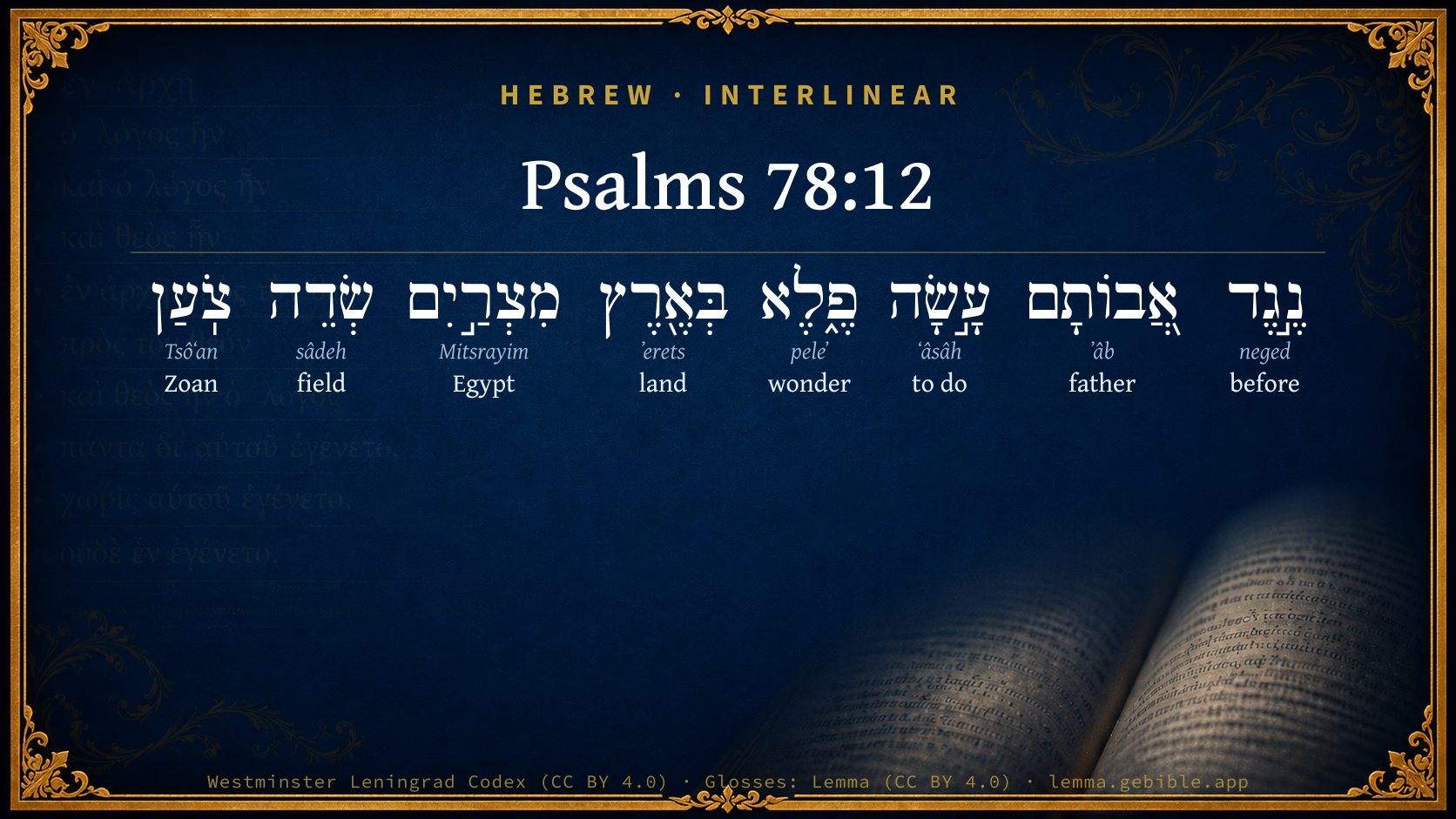
Psalms 78:12

Hebrew (Westminster Leningrad Codex) Psalms 78:12 appears in the Hebrew Old Testament. The text above is from the Westminster Leningrad Codex. Each word links to its Strong’s number, a concise gloss, and parsing drawn from the Open Scriptures Hebrew Bible morphology. Click any word for its full Brown-Driver-Briggs (BDB) entry.
Download image
Cite this verse

Psalms 78:12 (World English Bible). Public Domain. Lemma interlinear Bible study tool, https://lemma.gebible.app/v/psalms/78/12.

Show BibTeX & RIS
BibTeX
RIS
English Translation
He did marvelous things in the sight of their fathers, In the land of Egypt, in the field of Zoan.
World English Bible · Public Domain
Download a study sheet

One document with this verse’s original text, its word-by-word gloss line, the meaning frame, cross-references with their text, attributed commentary, and full source and license credits — printable, and it pastes into notes with its structure intact.

This verse Autodidact and up

Study sheet (.html) Plain text (.txt)

A passage Seminary Student

Up to 50 verses in one chapter. A passage sheet keeps up to 6 commentary sources and 12 cross-references per verse, in the order this page ranks them, and says so on the sheet whenever that leaves anything out. Ask for a single verse and you get the Autodidact verse sheet above.

Everything on this page stays free to read, with no account — the sheet is a download of what is already on screen, not access to it.

Want to remove ads? Support Godless Engineer
Compare translations 3

The same verse in 3 English versions, stacked beneath the original-language interlinear above. Click any original word for its lexicon entry.

Each is an independent rendering of the whole verse — the interlinear is not word-aligned to these translations.

Highlighted words mark where these versions differ — a whole-verse word diff, not a word-by-word alignment.

  • World English Bible Public Domain
    He did marvelous things in the sight of their fathers, In the land of Egypt, in the field of Zoan.
  • King James Version Public Domain
    Marvellous things did he in the sight of their fathers, in the land of Egypt, in the field of Zoan.
  • unfoldingWord Literal Text CC BY-SA 4.0
    He did wonders before their fathers in the land of Egypt, in the territory of Zoan.

unfoldingWord Literal Text — © unfoldingWord, licensed CC BY-SA 4.0. Word-aligned USFM3 via Door43 (git.door43.org/unfoldingWord/en_ult).

Versions to compare (up to 4)

3 of 4 selected

Show all 18 translations

Every available English version of this verse, each an independent rendering of the whole verse.

  • World English Bible Public Domain
    He did marvelous things in the sight of their fathers, In the land of Egypt, in the field of Zoan.
  • Berean Standard Bible Public Domain
    He worked wonders before their fathers in the land of Egypt, in the region of Zoan.
  • Majority Standard Bible Public Domain
    He worked wonders before their fathers in the land of Egypt, in the region of Zoan.
  • King James Version Public Domain
    Marvellous things did he in the sight of their fathers, in the land of Egypt, in the field of Zoan.
  • American Standard Version (1901) Public Domain
    Marvellous things did he in the sight of their fathers, In the land of Egypt, in the field of Zoan.
  • Revised Version (1885) Public Domain
    Marvelous things did he in the sight of their fathers, in the land of Egypt, in the field of Zoan.
  • Geneva Bible (1599) Public Domain
    Hee did marueilous thinges in the sight of their fathers in the lande of Egypt: euen in the fielde of Zoan.
  • Douay-Rheims (1899) Public Domain
    Wonderful things did he do in the sight of their fathers, in the land of Egypt, in the field of Tanis.
  • Young's Literal Translation Public Domain
    Before their fathers He hath done wonders, In the land of Egypt -- the field of Zoan.
  • Literal Standard Version CC BY-SA 4.0
    He has done wonders before their fathers, || In the land of Egypt—the field of Zoan.
  • Unlocked Literal Bible CC BY-SA 4.0
    They forgot the marvelous things he did in the sight of their ancestors in the land of Egypt, in the land of Zoan.
  • unfoldingWord Literal Text CC BY-SA 4.0
    He did wonders before their fathers in the land of Egypt, in the territory of Zoan.
  • Darby Bible Public Domain
    In the sight of their fathers had he done wonders, in the land of Egypt, the field of Zoan.
  • World Messianic Bible Public Domain
    He did marvelous things in the sight of their fathers, in the land of Egypt, in the field of Zoan.
  • Webster's Bible Public Domain
    Marvelous things did he in the sight of their fathers, in the land of Egypt, in the field of Zoan.
  • Free Bible Version CC BY-SA 4.0
    the miracles he had performed for their forefathers near Zoan in Egypt.
  • Bible in Basic English Public Domain
    He did great works before the eyes of their fathers, in the land of Egypt, in the fields of Zoan.
  • JPS Tanakh (1917) Public Domain
    Marvellous things did He in the sight of their fathers, in the land of Egypt, in the field of Zoan.

Literal Standard Version (2020), Covenant Press — licensed CC BY-SA 4.0. Text via the HelloAO Bible API (eBible.org). Unlocked Literal Bible (unfoldingWord) — licensed CC BY-SA 4.0. Text via the HelloAO Bible API (eBible.org). unfoldingWord Literal Text — © unfoldingWord, licensed CC BY-SA 4.0. Word-aligned USFM3 via Door43 (git.door43.org/unfoldingWord/en_ult). Free Bible Version, Dr. Jonathan Gallagher — licensed CC BY-SA 4.0. Text via the HelloAO Bible API (eBible.org).

Word by word

More ways to search: Search by grammar → Find every occurrence → Compare this word →

Practice this passage: Drill this verse → Learn its vocabulary →

About this verse

These counts appear in no published source. They are computed here, from the morphology-tagged text and Lemma’s own curated glosses. What Lemma adds →

8
words
8
distinct lemmas
Wisdom
section

Notable vocabulary

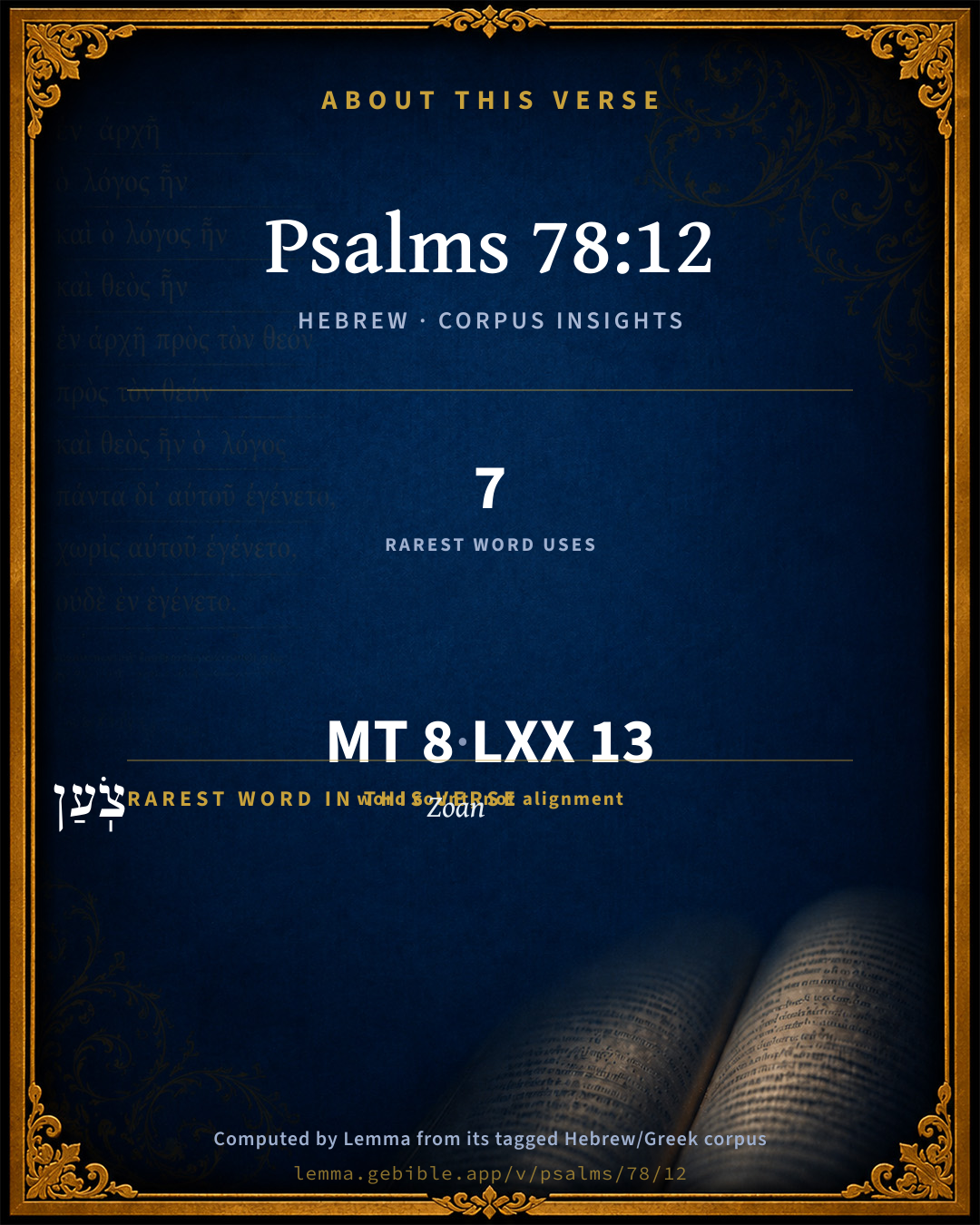
The rarest word here is צֹֽעַן Zoan H6814 — appearing just 7 times in the whole Hebrew Bible.

Shared distinctive vocabulary

צֹֽעַן Zoan H6814 occurs in 7 verses of the Hebrew Bible. Also found in:

Grammatical profile

  • 1 verb
  • 6 nouns
  • 1 preposition

Verb forms

  • עָ֣שָׂה Qal · Perfect

Hebrew & Septuagint length

In English translation the verse runs 20 words from the Hebrew and 18 from the Septuagint (LXX English) — closely comparable.

A rough comparison of the two English renderings, which tokenize alike — not a word-level alignment.

Word counts can differ between the Hebrew and the Greek without any difference in meaning — e.g. the Hebrew direct-object marker אֵת has no separate Greek word, and Greek often adds the article ὁ.

In the original languages it is 8 Hebrew tokens and 13 Greek tokens — but the two are counted differently (Hebrew bundles its prefixes and suffixes into one token; the Greek is in lemma form), so that isn’t a like-for-like length.

Cross-references

13

Topical passages linked to Psalms 78:12 in the Treasury of Scripture Knowledge — connected by theme and wording, ordered by reader-vote popularity; previews shown in the World English Bible.

  • Numbers 13:22 They went up by the South, and came to Hebron; and Ahiman, Sheshai, and Talmai, the children of Anak, were there. (Now Hebron was built seven years before Zoan in Egypt.)
  • Isaiah 19:11 The princes of Zoan are utterly foolish; the counsel of the wisest counselors of Pharaoh is become brutish: how do you say to Pharaoh, I am the son of the wise, the son of ancient kings?
  • Ezekiel 30:14 I will make Pathros desolate, and will set a fire in Zoan, and will execute judgments on No.
  • Exodus 7:1–12:51 Yahweh said to Moses, "Behold, I have made you as God to Pharaoh; and Aaron your brother shall be your prophet.
  • Psalms 135:9 Who sent signs and wonders into the midst of you, Egypt, On Pharaoh, and on all his servants;
  • Isaiah 19:13 The princes of Zoan are become fools, the princes of Memphis are deceived; they have caused Egypt to go astray, who are the corner-stone of her tribes.
  • Genesis 32:3 Jacob sent messengers in front of him to Esau, his brother, to the land of Seir, the field of Edom.
  • Deuteronomy 4:34 Or has God tried to go and take him a nation from the midst of [another] nation, by trials, by signs, and by wonders, and by war, and by a mighty hand, and by an outstretched arm, and by great terrors, according to all that Yahweh your God did for you in Egypt before your eyes?
  • Deuteronomy 6:22 and Yahweh shown signs and wonders, great and sore, on Egypt, on Pharaoh, and on all his house, before our eyes;
  • Nehemiah 9:10 and shown signs and wonders on Pharaoh, and on all his servants, and on all the people of his land; for you knew that they dealt proudly against them, and did get you a name, as it is this day.
  • Psalms 78:42–50 They didn't remember his hand, Nor the day when he redeemed them from the adversary;
  • Psalms 105:27–38 They performed miracles among them, And wonders in the land of Ham.
  • Psalms 106:22 Wondrous works in the land of Ham, And awesome things by the Red Sea.

Cross-references courtesy of OpenBible.info (CC BY 4.0).

Hebrew and Greek witnesses Masoretic Hebrew ↔ Greek Septuagint

The same verse in the two great witnesses to the Old Testament, shown verse-for-verse.

You’re reading Greek Psalm 77 (Hebrew Psalm 78). The Septuagint counts the superscription, so verse numbers can differ from the Hebrew — chapter-level alignment, not verse-by-verse. Numbering follows Rahlfs.

These are two independent witnesses, not word-aligned to each other, and the Septuagint is shown in lemma (dictionary) form.

Hebrew Psalms 78:12 Masoretic · Westminster Leningrad Codex

נֶ֣גֶד אֲ֭בוֹתָם עָ֣שָׂה פֶ֑לֶא בְּאֶ֖רֶץ מִצְרַ֣יִם שְׂדֵה צֹֽעַן

He did marvelous things in the sight of their fathers, In the land of Egypt, in the field of Zoan.

World English Bible · Public Domain

Greek LXX Greek Psalm 77:12 Septuagint · lemma form

ἐναντίον ὁ πατήρ αὐτός ὅς ποιέω θαυμάσιος ἐν γῆ αἴγυπτος ἐν πεδίον τάνις

the miracles which he wrought before their fathers, in the land of Egypt, in the plain of Tanes.

LXX2012 (modern English Septuagint) · Public Domain

On this verse, Ellicott's Commentary for English Readers discusses the Septuagint’s reading. Read the note in Commentary ↓

Hebrew: Westminster Leningrad Codex (CC BY 4.0). Greek: Septuagint (public domain); English from LXX2012 (modern English Septuagint) (Public Domain). How the Septuagint differs from the Hebrew →

Commentary

Notes on Psalms 78:12 from classic Christian and Jewish commentators (each source and its license shown beneath its notes). The classic Christian expositions comment on the surrounding passage and are grouped to its opening verse, so a note may address several verses; the Jewish commentaries on the Tanakh (Rashi and others) are per-verse, so they appear only where the commentator wrote on this verse.

Lemma curates 59 commentaries, every one of them public domain or Creative Commons licensed, each selected and text-cleaned for this edition rather than reprinted as found. About our sources →

Trapp's Complete Commentary

John Trapp

Psa 78:12 Marvellous things did he in the sight of their fathers, in the land of Egypt, [in] the field of Zoan.

Ver. 12. Marvellous things did he, &c.] Whereof they were eye-witnesses, and therefore could not plead ignorance or excuse. The Hebrew hath it, a marvel, or a miracle, collective.

In the field of Zoan] Corruptly called afterward Tan and Tanis; a populous and principal city of Egypt even in Isaiah’s time, Isa 19:11-13; about 23 miles from Memphis, saith Josephus: there Moses wrought his miracles (Ptolemy. Strabo).

John Trapp, A Commentary or Exposition upon All the Books of the Old and New Testament (1647–1656) — public domain. Text from a community e-Sword module.

The Treasury of David

Charles H. Spurgeon

Ver. 12. Egypt, here called the field of Zoan, was the scene of marvellous things which were done in open day in the sight of Israel. These were extraordinary, upon a vast scale, astounding, indisputable, and such as ought to have rendered it impossible for an Israelite to be disloyal to Jehovah, Israel's God.

Ver. 12. Zoan. The name of a city in Egypt (Nu 13:22), though it be not set down in the story in Exodus, is twice specified by the writer of this psalm, here, and Ps 78:43, as the scene wherein the wondrous works were wrought on Pharaoh by Moses; either because really the first and principal of the miracles were shewed Pharaoh there, this city being the seat of the king, and a most ancient city, as appears by the expression used of Hebron, in Nu 13:22, where to set out the antiquity of that city, where Abraham, the tenth from Noah dwelt, it is said, that "it was built seven years before Zoan in Egypt; "or perhaps only in poetical style, as "the field" or country of Zoan, is all one with the "land of Egypt" foregoing. Thus, in other prophetic writings, when judgments are threatened, instead of "Egypt" sometimes we find "Zoan" alone, Isa 19:11, where the "princes of Zoan" are all one with the counsellors of Pharaoh; sometimes "the princes of Zoan, "with the addition of some other city, as Isa 19:13, "the princes of Zoan, the princes of Noph, "i.e., again, the counsellors of that kingdom, which as it follows, "have seduced Egypt, "--brought the whole nation to ruin. So Isa 30:4, where they sent to Egypt for relief, it is said, their "princes were at Zoan, their ambassadors at Hanes." Henry Hammond.

Ver. 12. In the field of Zoan. We see in this passage that it was not without reason that God most powerfully displayed his wondrous works, his virtue and his glory in the more famous cities: not that he despised the humbler and obscure, but that he might more conveniently in this way scatter abroad the knowledge and renown of his name. For this cause he desired Moses to perform his miracles in the royal city, and in its field; for the same reason he afterwards fixed his dwelling place in the most famous city of Canaan, in which he decreed also that Christ his Son should be crucified and the foundation of his heavenly kingdom laid. Musculus.

Ver. 12-16. God revealed in his deeds. The wonder working God --Ps 78:12-16. The avenging God--Ps 78:12. The interposing God--Ps 78:13. The guiding God--Ps 78:14. The Father God--Ps 78:14-16. C. D.

Ver. 12-17. Obstinacy of unbelief. It makes head against God's majesty--Ps 78:17; his gracious providence--Ps 78:14-16; his interposing care--Ps 78:13; his avenging justice-- Ps 78:12; his distinguishing grace--Ps 78:12-16. C. D.

Ver. 12-17. Prodigies cannot convert the soul. Lu 16:31. C. D.

Psalms 78:13*

Ver. 12-17. Prodigies cannot convert the soul. Lu 16:31. C. D.

Psalms 78:14*

Ver. 12-17. Prodigies cannot convert the soul. Lu 16:31. C. D.

Ver. 12-16. God revealed in his deeds. The wonder working God --Ps 78:12-16. The avenging God--Ps 78:12. The interposing God--Ps 78:13. The guiding God--Ps 78:14. The Father God --Ps 78:14-16. C. D.

Ver. 12-17. Obstinacy of unbelief. It makes head against God's majesty--Ps 78:17; his gracious providence--Ps 78:14-16; his interposing care--Ps 78:13; his avenging justice-- Ps 78:12; his distinguishing grace--Ps 78:12-16. C. D.

Ver. 12-17. Prodigies cannot convert the soul. Lu 16:31. C. D.

Ver. 12-17. Obstinacy of unbelief. It makes head against God's majesty--Ps 78:17; his gracious providence--Ps 78:14-16; his interposing care--Ps 78:13; his avenging justice-- Ps 78:12; his distinguishing grace--Ps 78:12-16. C. D.

Ver. 12-17. Prodigies cannot convert the soul. Lu 16:31. C. D.

Charles H. Spurgeon's The Treasury of David (1869–1885) — public domain. Psalms only. Text from a community e-Sword/MySword module.

Joseph Benson's Commentary

Psa 78:12-15. Marvellous things did he in the field — That is, in the territory or jurisdiction, not excluding the city itself; of Zoan — An ancient and eminent city of Egypt. In the day-time he led them with a cloud — Which afforded them much comfort, both as a shadow from the scorching heat of the climate and season, and as a companion and director in their journey. He clave the rocks — He uses the plural number, because it was twice done, once in Rephidim, Exo 17:6, and again in Kadesh, Num 20:1; Num 20:11. And gave them drink as out of the great depths —

In great abundance.

Joseph Benson's Commentary on the Old and New Testaments (1811–1818) — public domain. Text from a community e-Sword module.

Whedon's Commentary on the Bible

Daniel D. Whedon

12. As in Psa_78:10-11, the psalmist had charged the defection of Ephraim to their forgetting God’s works and wonders of old, so now (Psa_78:12) he takes up the nation’s history to show that, from first to last, God alone had been their deliverer and protector.

Zoan—The Greek Tanis, situated on the Tanitic branch of the Nile, about forty miles from the eastern frontier of the kingdom, on the beautiful low lands, as its name signifies. For its antiquity see Num_13:22. At the time of the Exodus it was the capital of Lower Egypt, and here Moses communed with Pharaoh. It figures largely in the prophets, but is now a heap of ruins. The field of Zoan denotes the Nome, or province of the city, or its suburban lands. Anciently a rich plain extended eastward from the city as far as Pelusium, nearly thirty miles.

Daniel D. Whedon (gen. ed.), Commentary on the Old and New Testaments (1874–1909) — public domain. Text from a community e-Sword module.

J. A. Alexander on Psalms

Joseph Addison Alexander

12. (Psa 78:12) Before their fathers he did a wonder, in the land of Egypt, in the field of Zoan. Wonder has here the same collective sense as in Psa 77:11; Psa 77:14. Zoan, called by the Greeks Tanis, was the an cient capital of Lower Egypt. See Num 13:22. The field of Zoan was the country immediately adjacent to it.

Joseph Addison Alexander, The Psalms Translated and Explained (1850) — public domain. Text from a community e-Sword module.

Tyndale Open Study Notes

Tyndale Open Resources

78:12-16 The focus shifts from Ephraim (78:9-11) to Israel as a whole as the psalmist reflects on God’s power in Egypt (see 81:4-7) and in the wilderness.

78:12 The miracles are the ten plagues against Egypt that God performed during Israel’s captivity (Exod 7–12).

Tyndale Open Study Notes — © Tyndale Open Resources, licensed CC BY-SA 4.0. Text via the HelloAO Bible API.

Geneva Bible (1599)

Geneva Bible translators

He proveth that not only the posterity but also their forefathers were wicked and rebellious to God.

Geneva Bible (1599) marginal notes — public domain. Text via Bolls.life.

Adam Clarke's Commentary

Verse 12. The field of Zoan.] "In campo Taneos," Vulgate. Tanis was the capital of Pharaoh, where Moses wrought so many miracles. It was situated in the Delta, on one of the most easterly branches of the Nile. It was afterwards called Thanis; and from it the district was called the Thanitic Canton. See Calmet. Dr. Shaw thinks Zoan was intended to signify Egypt in general.

Adam Clarke's Commentary on the Bible (1810–1826) — public domain. Text from a community e-Sword/MySword module.

John Calvin's Commentaries

12. He wrought marvellously in the sight of their fathers. The Psalmist is still to be regarded as condemning the posterity of the Israelites for their guilt; but he very properly, at the same time, begins to speak of the first ancestors of the nation, intimating, that the whole race of them, even from their first original, were of a perverse and rebellious disposition. But having remarked that the children of Ephraim had fallen into apostasy, because they had forgotten the wonderful works of God, he continues to prosecute the same subject. Meanwhile, as I have said, he makes a very happy transition to speak of the fathers, whom it was his object to include in the same condemnation. In the first place, he adverts to the miracles which were wrought in the midst of the land of Egypt, previous to the departure of the people from it. To recall these the more vividly to the mind, he names a place which was highly celebrated — the field of Zoan. He next comes to speak of the passage through the sea, where he repeats what was brought under our notice in the previous psalm, that the order of nature was reversed when the waters stopped in their course, and were even raised up into solid heaps like mountains. In the third place, he declares, that after the people had passed through the Red Sea, God still continued to be their guide in their journey; and that this might not be a mere temporary deliverance, he graciously continued to stretch forth his hand to bestow upon them new testimonies of his goodness. It being a difficult and wearisome thing for them to pursue their journey through dry and sandy regions, it was no ordinary blessing to be protected from the heat of the sun by the intervention of a cloud. This, however, was to them a pledge of more distinguished grace. God hereby testified, that this people were under his protection, until they should reach the heavenly inheritance. Accordingly, Paul teaches in 1 Corinthians 10:2, that there was a kind of baptism administered to the people in that cloud, as also in their passing through the sea; the fruit of which is not limited to this frail and transitory life, but extends even to everlasting salvation.

John Calvin's Commentaries (1540-1563) — public domain. Text from the Calvin Translation Society English edition (1840s-50s) via the Christian Classics Ethereal Library (ccel.org). Calvin's coverage is partial (roughly two-thirds of the Bible); uncommented books and verses are honest gaps, never fabricated. The 19th-century editor's footnotes and remarks are omitted so the notes are faithfully Calvin's own voice.

Ellicott's Commentary for English Readers

(12) Field of Zoan.—See Num_13:22. It is the classical “Tanis,” merely a corruption of Tsoan, i.e., low country (LXX. and Vulgate). Tanis is situated on the east bank of what was formerly called the Tanitic branch of the Nile. Between it and Pelusium, about thirty miles to the east, stretched a rich plain known as “the marshes,” or “the pastures,” or “the field” of Zoan.

The psalm now turns to the adventures in the wilderness, postponing the marvels in Egypt till Psa_78:43.

A Bible Commentary for English Readers, edited by Charles John Ellicott (1878–1897) — public domain. Text from a community e-Sword module.

The Cambridge Bible for Schools and Colleges

gen. ed. J. J. S. Perowne

12. In the sight of their fathers he did wonders. Cp. Psa_77:14.

in the field of Zoan] Zoan, known to the Greeks as Tanis, was situated on the E. bank of the Tanitic branch of the Nile. It was famous as the capital of the Hyksos dynasty, and was refounded by Ramses II, the Pharaoh of the oppression. It is described by Mr Petrie, who excavated it in 1883–4, as “a city which was only inferior to the other capitals—Thebes and Memphis—in the splendour of its sculptures.” The phrase “field of Zoan” for the district in which it was situated has been found in an Egyptian inscription.

After this brief allusion to the plagues, of which he intends to speak in detail afterwards (43ff.), the Psalmist passes on at once to the Exodus and the journey through the wilderness.

The Cambridge Bible for Schools and Colleges (gen. ed. J. J. S. Perowne; Cambridge University Press, 1878–1918) — public domain. Text from a community e-Sword module.

John Gill's Exposition

He divided the sea,.... The Targum adds,

"by the rod of Moses their master;''

which he was ordered to lift up, and to stretch out his hand over the sea; which he did, and at the same time a strong east wind was raised, which caused the sea to go back, and divided the waters of it; see Exo 14:16.

and caused them to pass through; that is, he caused the Israelites to pass through the sea; this they did in faith, Heb 11:29, in the faith of the power and promise of God, and of future grace and blessings, which this was an emblem of; for it was a representation of baptism, and is so called, Co1 10:1 and of the sea of Christ's blood, or of his sufferings and death; whereby all enemies are overcome and destroyed, as sin and Satan, signified by the Egyptians, and salvation is wrought, and every blessing of grace procured; and of the passage of God's people through the sea of this world, and afflictions in it, safe to glory:

and he made the waters to stand as an heap; and were as a wall on the right hand and on the left hand so they continued until the Israelites had passed through; and then they returned, and covered the Egyptians, and drowned them, Exo 14:22.

John Gill's Exposition of the Whole Bible (1746–1763) — public domain (CC PDM 1.0). Text via the HelloAO Bible API.

Albert Barnes' Notes on the Bible

Marvellous things did he in the sight of their fathers - Things suited to excite wonder and astonishment. Such were all the miracles that he performed, in effecting the deliverance of his people.

In the land of Egypt - In delivering them from Pharaoh.

In the field of Zoan - The Septuagint renders this ἐν πεδίῳ Τάνεως en pediō Taneōs” in the plain of Tanis.” So the Latin Vulgate. Zoan or Tanis was an ancient city of Lower Egypt, situated on the eastern side of the Tanitie arm of the Nile. The name given to it in the Egyptian language signified “low region.” See the notes at Isa 19:11. The Hebrews seem to have been located in this region, and it was in this part of Egypt - that is, in the country lying round about Zoan - that the wonders of God were principally manifested in behalf of his people.

Albert Barnes' Notes on the Bible (1834–1885) — public domain. Text from a community e-Sword/MySword module.

Matthew Poole's English Annotations

In the field, i.e. in the territory or jurisdiction, not excluding the city itself. In the like sense we read of the field of Edom, and of Moab, Gen 32:3; 36:35; Num 21:20.

Zoan; an ancient, and eminent, and the royal city of Egypt. See Num 13:22; Isa 19:11; 30:4.

Matthew Poole's English Annotations on the Holy Bible (1683–1685) — public domain. Text from a community e-Sword/MySword module.

The Pulpit Commentary

Marvellous things did he in the sight of their fathers, in the land of Egypt, in the field of Zoan. The miracles of Egypt are, perhaps, the most striking series in Jewish history. A more particular account of them is given below (vers. 44-53). They were wrought "in the field of Zoan," i.e. in the rich flat tract east and south of the city of Zoan, the Greek Tanis, now San. (On this place, see Mr. Reginald Peele"s "Cities of Egypt," pp. 64-88) This fact could not have been gathered from Exodus, but must have come to the writer from the tradition of which he speaks in ver. 3.

Vers. 12, 31. God"s marvellous doings.

The marvel of God"s doings is always this He is ever rescuing, delivering, restoring, redeeming, saving, or, as we may say, putting things straight. The type of all God"s doings was, to the Jew, the rescue of the race from Egyptian bondage. The Divine attributes are not best seen in punishments or scenes of terror; throughout the history of the world they have been most fully revealed in God"s savings, deliverings, and redeemings. Moses composed a song when the Hebrews had safely reached the further shores of the Red Sea. To him that rescue was a most impressive demonstration of the Divine righteousness; so the song runs thus: "Who is like unto thee, O Lord, among the gods? Who is like thee, glorious in holiness, fearful in praises, doing wonders?" When God would declare the great foundation laws, he revealed himself as the nation"s Deliverer and Saviour: "I am the Lord thy God, that brought thee out of the land of Egypt, out of the house of bondage." When Joshua pleaded so earnestly, "What wilt thou do unto thy great Name?" the thing distressing him was that God seemed to have ceased to be a Deliverer and Redeemer of his people. David gains right impressions of the Divine righteousness by meditating on the Divine mercy. Started on this line, we may consider as "marvellous doings

I THE DIVINE DELIVERANCES. Reading sacred history for illustrations, we find:

1. Noah delivered from peril of flood.

2. Abraham delivered from Chaldean polytheistic associations.

3. Hebrews delivered from bondage, and from position of peril at the Red Sea.

4. Local deliverances, as in the times of the Judges, early history of David,reigns of Asa and Jehoshaphat.

5. National rescue from captivity.

6. Deliverance from sin, by Christ Jesus. Every case is a marvel of Divine wisdom, power, and grace. And God is best known in his redeemings. "He delivereth and rescueth.

II THE DIVINE PROVIDENCES. Which efficiently provide, and mysteriously guide. By providences we mean the ordinary arrangements of life, as distinct from times of trouble and peril. There is a marvel of the Divine ordering of Israel"s way, and of ours. Heaven-sent manna, and streams from smitten rocks, tell of an ever-wonder-working providence. To devout minds, no marvel is greater than God"s making "all things work together for good.

III THE DIVINE FORBEARANCES. Many of these are called to mind in this psalm. God"s long suffering towards stiff-necked Israel must always seem a marvel of grace; and his people in every age have exclaimed, "It is of the Lord"s mercies that we are not consumed.

IV THE DIVINE JUDGMENTS. (See ver. 31) These must be included, but they are put last, because "judgment is his strange work." The marvel of God"s judgments is the absence of vindictiveness in them, and the power that makes them work towards ends of moral blessing. R.T.

The Pulpit Commentary (1880–1919), ed. H.D.M. Spence-Jones & Joseph S. Exell — public domain. Text from a community e-Sword module.

John Wesley's Explanatory Notes

Field - In the territory. Zoan - An ancient and eminent city of Egypt.

John Wesley, Explanatory Notes Upon the Whole Bible (1754–1765) — public domain. Text via the GEBible commentary corpus.

Keil & Delitzsch

C. F. Keil & F. Delitzsch

It is now related how wonderfully God led the fathers of these Ephraimites, who behaved themselves so badly as the leading tribe of Israel, in the desert; how they again and again ever indulged sinful murmuring, and still He continued to give proofs of His power and of His loving-kindness. The (according to Num 13:22) very ancient Zoan (Tanis), ancient Egyptian Zane, Coptic G'ane, on the east bank of the Tanitic arm of the Nile, so called therefrom - according to the researches to which the Turin Papyrus No. 112 has led, identical with Avaris (vid., on Isa 19:11)

(Note: The identity of Avaris and Tanis is in the meanwhile again become doubtful. Tanis was the Hyksos city, but Pelusium = Avaris the Hyksos fortress; vid., Petermann's Mittheilungen, 1866, S. 296-298.)

- was the seat of the Hyksos dynasties that ruled in the eastern Delta, where after their overthrow Rameses II, the Pharaoh of the bondage, in order to propitiate the enraged mass of the Semitic population of Lower Egypt, embraced the worship of Baal instituted by King Apophis. The colossal sitting figure of Rameses II in the pillared court of the Royal Museum in Berlin, says Brugsch (Aus dem Orient ii. 45), is the figure which Rameses himself dedicated to the temple of Baal in Tanis and set up before its entrance. This mighty colossus is a contemporary of Moses, who certainly once looked upon this monument, when, as Ps 78 says, he "wrought wonders in the land of Egypt, in the field of Zoan." The psalmist, moreover, keeps very close to the Tra in his reproduction of the history of the Exodus, and in fact so close that he must have had it before him in the entirety of its several parts, the Deuteronomic, Elohimistic, and Jehovistic. Concerning the rule by which it is appointed ‛ā'sa phéle, vid., on Psa 52:5. The primary passage to Psa 78:13 (cf. נוזלים Psa 78:16) is Exo 15:8. נד is a pile, i.e., a piled up heap or mass, as in Psa 33:7. And Psa 78:14 is the abbreviation of Exo 13:21. In Psa 78:15. the writer condenses into one the two instances of the giving of water from the rock, in the first year of the Exodus (Ex. 17) and in the fortieth year (Num. 20). The Piel יבקּע and the plural צרים correspond to this compression. רבּה is not an adjective (after the analogy of תּהום רבּה), but an adverb as in Psa 62:3; for the giving to drink needs a qualificative, but תהמות does not need any enhancement. ויּוצא has ı̂ instead of ē as in Psa 105:43.

The fact that the subject is continued in Psa 78:17 with ויּוסיפוּ without mention having been made of any sinning on the part of the generation of the desert, is explicable from the consideration that the remembrance of that murmuring is closely connected with the giving of water from the rock to which the names Massah u-Merı̂bah and Merı̂bath-Kadesh (cf. Num 20:13 with Num 27:14; Deu 32:51) point back: they went on (עוד) winning against Him, in spite of the miracles they experienced. למרות is syncopated from להמרות as in Isa 3:8. The poet in Psa 78:18 condenses the account of the manifestations of discontent which preceded the giving of the quails and manna (Ex. 16), and the second giving of quails (Num. 11), as he has done the two cases of the giving of water from the rock in Psa 78:15. They tempted God by unbelievingly and defiantly demanding (לשׁאל, postulando, Ew. 280, d) instead of trustfully hoping and praying. בּלבבם points to the evil fountain of the heart, and לנפשׁם describes their longing as a sensual eagerness, a lusting after it. Instead of allowing the miracles hitherto wrought to work faith in them, they made the miracles themselves the starting-point of fresh doubts. The poet here clothes what we read in Exo 16:3; Num 11:4., Psa 21:5, in a poetic dress. In לעמּו the unbelief reaches it climax, it sounds like self-irony. On the co-ordinating construction "therefore Jahve heard it and was wroth," cf. Isa 5:4; Isa 12:1; Isa 50:2; Rom 6:17. The allusion is to the wrath-burning at Taberah (Tab'eera), Num 11:1-3, which preceded the giving of the quails in the second year of the Exodus. For it is obvious that Psa 78:21 and Num 11:1 coincide, ויתעבר ואשׁ here being suggested by the ותבער־בם אשׁ eht yb d of that passage, and אף עלה being the opposite of ותשׁקע האשׁ in Psa 78:2. A conflagration broke out at that time in the camp, at the same time, however, with the breaking out of God's anger. The nexus between the anger and the fire is here an outward one, whereas in Num 11:1 it is an internal one. The ground upon which the wrathful decree is based, which is only hinted at there, is here more minutely given in Psa 78:22 : they believed not in Elohim (vid., Num 14:11), i.e., did not rest with believing confidence in Him, and trusted not in His salvation, viz., that which they had experienced in the redemption out of Egypt (Exo 14:13; Exo 15:2), and which was thereby guaranteed for time to come. Now, however, when Taberah is here followed first by the giving of the manna, Psa 78:23-25, then by the giving of the quails, Psa 78:26-29, the course of the events is deranged, since the giving of the manna had preceded that burning, and it was only the giving of the quails that followed it. This putting together of the two givings out of order was rendered necessary by the preceding condensation (in Psa 78:18-20) of the clamorous desire for a more abundant supply of food before each of these events. Notwithstanding Israel's unbelief, He still remained faithful: He caused manna to rain down out of the opened gates of heaven (cf. "the windows of heaven," Gen 7:11; Kg2 7:2; Mal 3:10), that is to say, in richest abundance. The manna is called corn (as in Psa 105:40, after Exo 16:4, it is called bread) of heaven, because it descended in the form of grains of corn, and supplied the place of bread-corn during the forty years. לחם אבּירים the lxx correctly renders ἄρτον ἀγγέλων (אבּירים = גּבּרי כח, Psa 103:20). The manna is called "bread of angels" (Wisd. 16:20) as being bread from heaven (Psa 78:24, Psa 105:40), the dwelling-place of angels, as being mann es-semâ, heaven's gift, its Arabic name, - a name which also belongs to the vegetable manna which flows out of the Tamarix mannifera in consequence of the puncture of the Coccus manniparus, and is even at the present day invaluable to the inhabitants of the desert of Sinai. אישׁ is the antithesis to אבירים; for if it signified "every one," אכלוּ would have been said (Hitzig). צידהּ as in Exo 12:39; לשׂבע as in Exo 16:3, cf. Psa 78:8.

Keil & Delitzsch — Biblical Commentary on the Old Testament (1861–1891) — public domain (CC PDM 1.0). Text via the HelloAO Bible API. (Old Testament only.)

Kretzmann's Popular Commentary

Paul E. Kretzmann

The Narrative of God’s Deeds

v. 12. Marvelous things did He in the sight of their fathers, before the exodus, in the land of Egypt, in the field of Zoan, this being the residence of the Pharaohs at the time of the deliverance from Egypt, Num 14:22. The miracles performed by Moses were probably all done in or near this capital, and it is mentioned also at a later date because it was located in the most easterly portion of Egypt, in the part nearest to the land of Canaan.

v. 13. He divided the sea and caused them to pass through, Exo 14:21; and He made the waters to stand as an heap, Exo 15:8.

v. 14. In the daytime also He led them with a cloud and all the night with a light of fire, this pillar of fire being mentioned frequently in the account of the wilderness journey, Exo 13:21-22.

v. 15. He clave the rocks in the wilderness, on two different occasions, Exo 17:5; Num 20:11, and gave them drink as out of the great depths.

v. 16. He brought streams also out of the rock, in performing the miracles just referred to, and caused waters to run down like rivers.

v. 17. And they sinned yet more against Him by provoking the Most High in the wilderness, with their continual rebellious murmurings.

v. 18. And they tempted God in their heart, Mat 15:19, by asking meat for their lust, when they declared that their soul loathed the very sight of the manna, Num 11:4-6.

v. 19. Yea, they spake against God; they said, Can God furnish a table in the wilderness?

v. 20. Behold, He smote the rock that the waters gushed out and the streams overflowed, giving them water in rich abundance; can He give bread also? Can He provide flesh for His people? It was a blasphemous murmuring in the face of the great miracles performed for their benefit.

v. 21. Therefore the Lord heard this and was wroth, Numbers 11; so a fire was kindled against Jacob, and anger also came up against Israel,

v. 22. because they believed not in God, had no faith in the covenant God, and trusted not in His salvation, the deliverance which He had promised them;

v. 23. though He had commanded the clouds from above and opened the doors of heaven,

v. 24. and had rained down manna upon them to eat and had given them of the corn of heaven, miraculous food, Joh 6:31.

v. 25. Man did eat angels’ food, so called because it came down from heaven, Psa 105:40; He sent them meat to the full, all they needed to sustain their lives by the way.

v. 26. He caused an east wind to blow in the heaven, and by His power He brought in the south wind, the exact direction of the wind therefore being southeast, Num 11:31.

v. 27. He rained flesh also upon them as dust, in great abundance, and feathered fowls like as the sand of the sea, a day’s journey wide around their camp and two cubits high;

v. 28. and He let it fall in the midst of their camp, round about their habitations.

v. 29. So they did eat and were well filled, falling upon the quails with the greatest greed; for He gave them their own desire.

v. 30. They were not estranged from their lust, they were still indulging their desire to the full; but while their meat was yet in their mouths,

v. 31. the wrath of God came upon them and slew the fattest of them, those physically in the best condition, and smote down the chosen men of Israel, those in the fullness of their strength, Num 11:33.

v. 32. For all this they sinned still, refusing to let the punishments of the Lord lead them to repentance, and believed not for His wondrous works, even His miracles did not succeed in bringing about a lasting change of heart in them.

v. 33. Therefore their days did He consume in vanity, literally, "He caused their days to vanish in a breath," and their years in trouble, with abrupt speed, for by His decision all the members of the nation which were forty years of age at the time of the exodus died in the wilderness.

v. 34. When He slew them, then they sought Him, making a show at outward reformation, more from fear than from conviction; and they returned and enquired early after God, Num 21:7.

v. 35. And they remembered, with a repentance of fear, that God was their Rock, Deu 32:15-37, and the high God their Redeemer, from whom alone they might expect deliverance of body and soul.

v. 36. Nevertheless, they did flatter Him with their mouth, trying to appease Him with a feigned change of heart, and they lied unto Him with their tongues.

v. 37. For their heart was not right with Him, they were not sincere in their repentance, it was not a lasting sorrow which they felt, neither were they steadfast in His covenant, they did not prove themselves faithful.

v. 38. But He, being full of compassion, of merciful patience, forgave their iniquity and destroyed them not, especially since Moses interceded for them time and again; yea, many a time turned He His anger away and did not stir up all His wrath. Cf Num 14:20.

v. 39. For He remembered that they were but flesh, weak and sinful mortals; a wind that passeth away and cometh not again, altogether evanescent.

v. 40. How oft did they provoke Him in the wilderness, with rebellion upon rebellion, and grieve Him in the desert, troubling His loving fatherly heart with their unruly behavior.

v. 41. Yea, they turned back and tempted God, testing out His kindness in a total of ten temptations, Num 14:22, and limited the Holy One of Israel, worrying, troubling, vexing Him with their rebellious conduct.

v. 42. They remembered not His hand, outstretched as it had been for their deliverance, nor the day when He delivered them from the enemy, from the oppression of the Egyptians,

v. 43. how He had wrought His signs in Egypt and His wonders in the field of Zoan,

v. 12. the psalmist now turning to a recital of the plagues which God sent upon Pharaoh and the Egyptians in order to compel them to give Israel permission to leave,

v. 44. and had turned their rivers into blood, in the first general plague, Exo 7:17, and their floods, that they could not drink.

v. 45. He sent divers sorts of flies among them, the insect pests of the fourth plague, Exo 8:21-29, which devoured them, and frogs, in the second plague, Exo 8:2, which destroyed them.

v. 46. He gave also their increase unto the caterpillar, literally, "the eater," the cricket, and their labor unto the locust, in the eighth plague, Exo 10:13-15.

v. 47. He destroyed their vines, the growth of which was a very important industry in ancient Egypt, with hail, in the seventh plague, Exo 9:23-25, and their sycomore-trees, the sycomore fig-trees of the Orient, with frost, great hailstones.

v. 48. He gave up their cattle also to the hail, Exo 9:23, and their flocks to hot thunderbolts, for the play of lightning accompanying the hail was unparalled, Exo 9:22-24.

v. 49. He cast upon them the fierceness of His anger, wrath, and indignation, and trouble, by sending evil angels among them, that is, angels bringing all these misfortunes, destroying messengers of Jehovah.

v. 50. He made a way to His anger, giving it free rein; He spared not their soul from death, but gave their life over to the pestilence, in the plague of murrain, Exo 9:6;

v. 51. and smote all the first-born in Egypt, in the final plague, Exo 12:29; the chief of their strength in the tabernacles of Ham, in the habitations where the Egyptians, the descendants of Ham, dwelled;

v. 52. but made His own people to go forth like sheep, under His protecting leadership, and guided them in the wilderness like a flock, Psa 77:20.

v. 53. And He led them on safely, so that they feared not, there was no reason for worry or fear; but the sea overwhelmed their enemies, covering them, wiping them out.

v. 54. And He brought them to the border of His Sanctuary, literally, "to the boundary of His holiness," the region or land in which His holiness was to rule, even to this mountain, which His right hand had purchased, the Holy Land itself.

v. 55. He cast out the heathen also before them, under the leadership of Joshua, and divided them an inheritance by line, Jos 13:7, and made the tribes of Israel to dwell in their tents, every family in its own home, according to the allotment.

v. 56. Yet they tempted and provoked the most high God, even after they were in possession of the Promised Land with all its blessings, Jdg 2:11, and kept not His testimonies, all the regulations intended for the guidance of their conduct,

v. 57. but turned back, aside from the prescribed path, and dealt unfaithfully like their fathers, they apostatized from their promised loyalty to Jehovah; they were turned aside like a deceitful bow, one which turns back and thus fails to shoot the arrow placed upon it.

v. 58. For they provoked Him to anger with their high places, the altars on the hills devoted to idolatry, and moved Him to jealousy with their graven images, with the idols to which they turned in preference to Him.

v. 59. When God heard this, He was wroth, filled with indignation, and greatly abhorred Israel, although not to the point of total rejection,

v. 60. so that He forsook the Tabernacle of Shiloh, where it had first been erected after the conquest of the country, Jos 18:1; the tent which He placed among men, where He had promised to dwell and to reveal Himself to His people, for the Tabernacle was later erected near Gibeon, apparently on the hill between this town and Nob;

v. 61. and delivered His strength, namely, the Ark of the Covenant, into captivity, by letting the Philistines capture it, 1 Samuel 4, and His glory into the enemy’s hand, 1Sa 4:21-22.

v. 62. He gave His people over also unto the sword, 1Sa 4:10; and was wroth with His inheritance, with the people which belonged to Him by virtue of their deliverance.

v. 63. The fire, namely, that of wars, consumed their young men; and their maidens were not given to marriage, no marriage anthems were intoned in their honor, for they were killed or dragged into exile during the troublous times of the judges.

v. 64. Their priests fell by the sword, Hophni and Phinehas being examples, 1Sa 4:11; and their widows made no lamentation, being kept from the customary rites of mourning by the terrors of war. But then came the change of Israel’s fortunes.

v. 65. Then the Lord awaked as one out of sleep, for it had seemed to Israel that He had slumbered while the heathen were enslaving His people, and like a mighty man that shouteth by reason of wine, filled with heroic courage by its proper enjoyment.

v. 66. And He smote His enemies in the hinder parts, His blows raining down upon the backs, principally of the Philistines, who at that time were the chief enemies of Israel; he put them to a perpetual reproach, the disgrace recorded 1Sa 5:6.

v. 67. Moreover, He refused the Tabernacle of Joseph, taking it away from Shiloh, in the midst of the tribe of Ephraim, and chose not the tribe of Ephraim,

v. 68. but chose the tribe of Judah, the bearer of the Messianic promise, the Mount Zion which He loved, selecting Jerusalem as the city of His central Sanctuary.

v. 69. And He built his Sanctuary like high palaces, firm as the heights of heaven, most excellent and glorious, like the earth which He hath established forever, founded most solidly.

v. 70. He chose David also His servant, the ancestor of the Messiah, and took him from the sheepfolds, 1Sa 16:11;

v. 71. from following the ewes great with young He brought him to feed Jacob, His people, and Israel, His inheritance, the children of Israel being a type of the spiritual Israel, and David a type of the great Shepherd, the Messiah Himself, Isa 40:11.

v. 72. So he fed them, as their ruler, with all care and kindness, according to the integrity of his heart, striving after ever greater understanding of their needs, and guided them by the skillfulness of his hands, with the proper appreciation of all that was best for them. Herein also David prefigured the great King of the Church, whose understanding of our needs and wants resulted in our eternal redemption.

Paul E. Kretzmann, Popular Commentary of the Bible (1921–1924) — public domain. Text from a community e-Sword module.

unfoldingWord translationNotes

Door43 World Missions Community

land of Zoan

This refers to the area around the city of Zoan, which was in Egypt. (See: How to Translate Names)

translationWords

amazed

Egypt

water

light

fire

unfoldingWord translationNotes — © Distant Shores Media and the Door43 World Missions Community, licensed CC BY-SA 4.0. Source: git.door43.org/Door43/en_tn.

Rashi

Rabbi Shlomo Yitzchaki (Rashi)

Before their forefathers He wrought wonders (Nevertheless—Shem Ephraim) Afterwards, when the end arrived, they too “continued to sin against Him,” as he further concludes. (Another explanation—Shem Ephraim)

Before their forefathers Abraham, Isaac, and Jacob came beside the sea, and the Holy One, blessed be He, showed them how He was redeeming their children.

Rashi on the Tanakh — English translations: “The Judaica Press complete Tanach with Rashi, translated by A. J. Rosenberg” (CC BY 4.0); “Pentateuch with Rashi's commentary by M. Rosenbaum and A.M. Silbermann, 1929-1934” (public domain); “The Metsudah Tanach series, Lakewood, N.J” (CC BY 4.0); and “The Book of Joshua, Metsudah Publications, 1997” (CC BY 4.0). Text via Sefaria.

Lesson kit

Teaching starters — assembled from the data on this page, not authored interpretation. Every prompt links to the verse data it draws on. Edit before teaching.

Psalms, in the Wisdom, opens this verse with 8 words (8 distinct Hebrew lemmas). Its most distinctive word is Tsôʻan (“Zoan”). A historical commentator’s framing appears above. Read the whole chapter for the surrounding context.

Discussion questions

  1. The word Tsôʻan carries the sense “Zoan.” How does it shape the verse?
  2. Numbers 13:22 shares the word «Zoan» with this verse. How do the two illuminate each other?
  3. These translations render this verse differently; the difference is in the English rendering, not the original. What questions does that raise?
  4. The verb «עָ֣שָׂה» is Qal Perfect. How does its form color the action?
  5. Reading how Trapp's Complete Commentary and The Treasury of David read this verse, where do the two commentators agree and where do they part?

Things to notice

Reading settings

Reading text

Shown beneath each verse's original-language words.

Old Testament
Old Testament edition

Read the OT as the Masoretic Hebrew (MT) or the Greek Septuagint (LXX).

English shown for the Greek Septuagint (in the Hebrew ↔ Greek comparison).

Comparing translations? Open the Compare panel on any verse page to stack up to four side by side.