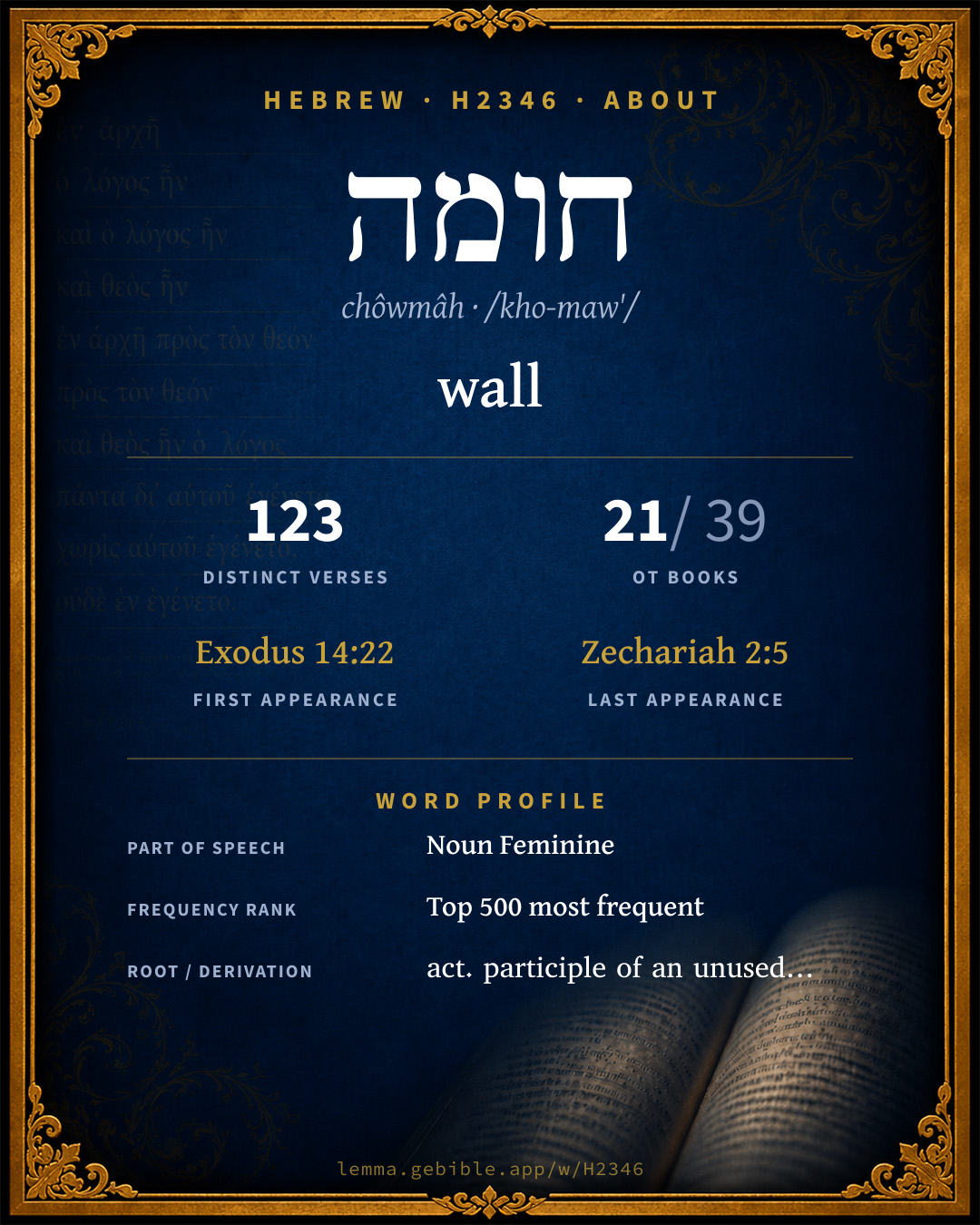
חוֹמָה
wall
Full lexicon entry — Brown-Driver-Briggs (BDB)
From Brown-Driver-Briggs (BDB)
Where this word appears
See every Absolute-state word in the Hebrew Bible →
Grammar key — what these labels mean
Part of speech
- Noun
- A naming word — a person, place, thing, or idea.
Noun type
- Common
- A common noun — a general class of person, place, or thing (“king,” “city,” “water”), not a specific name.
State
- Absolute
- The independent form of a noun, not bound to a following word.
- Construct
- A noun bound to a following noun in a possessive / “of” relationship (the construct chain).
Gender
- Feminine
- Grammatically feminine.
Number
- Singular
- One.
- Plural
- More than one (in Hebrew, generally three or more).
- Dual
- Exactly two — for natural pairs and some measures of time.
Grammatical forms
- Noun, Common, Feminine, Singular, Absolute 69 times (52%)
- Noun, Common, Feminine, Singular, Construct 31 times (23%)
- Noun, Common, Feminine, Plural, Construct 26 times (20%)
- Noun, Common, Feminine, Dual, Absolute 4 times (3%)
- Noun, Common, Feminine, Plural, Absolute 3 times (2%)
Parsed forms decoded from the imported morphology (morphhb / Westminster Leningrad Codex — WLC text public domain, morphhb tagging CC BY 4.0), counted across 133 parsed occurrences — not distinct verses.
Every verse where H2346 appears — 123 distinct verses across 21 books. Click any verse to open its interlinear word-by-word view. Verse text shown in the World English Bible for context — . Each verse’s Hebrew form is shown with its reference; the English is not keyword-highlighted, since the data carries no word-level English alignment. Use “Compare translations” on any verse to read it across multiple English versions. This concordance covers the Hebrew Bible; Septuagint (Greek Old Testament) occurrences are not indexed here.
Exodus 2 verses
- Exodus 14:22 חֹמָ֔ה n c fs The children of Israel went into the midst of the sea on the dry ground, and the waters were a wall to them on their right hand, and on their left.
- Exodus 14:29 חֹמָ֔ה n c fs But the children of Israel walked on dry land in the midst of the sea, and the waters were a wall to them on their right hand, and on their left.
Leviticus 3 verses
- Leviticus 25:29 חוֹמָ֔ה n c fs "'If a man sells a dwelling house in a walled city, then he may redeem it within a whole year after it has been sold. For a full year he shall have the right of redemption.
- Leviticus 25:30 חֹמָ֗ה n c fs If it isn't redeemed within the space of a full year, then the house that is in the walled city shall be made sure in perpetuity to him who bought it, throughout his generations. It shall not be released in the Jubilee.
- Leviticus 25:31 חֹמָה֙ n c fs But the houses of the villages which have no wall round about them shall be reckoned with the fields of the country: they may be redeemed, and they shall be released in the Jubilee.
Deuteronomy 2 verses
- Deuteronomy 3:5 חוֹמָ֥ה n c fs All these were cities fortified with high walls, gates, and bars; besides the unwalled towns a great many.
- Deuteronomy 28:52 חֹמֹתֶ֨י/ךָ֙ n c fp cs + sfx pers 2ms They shall besiege you in all your gates, until your high and fortified walls come down, in which you trusted, throughout all your land; and they shall besiege you in all your gates throughout all your land, which Yahweh your God has given you.
Joshua 3 verses
- Joshua 2:15 הַֽ/חוֹמָ֔ה וּ/בַֽ/חוֹמָ֖ה ptcl def.art + n c fs conj + prep det + n c fs Then she let them down by a cord through the window: for her house was on the side of the wall, and she lived on the wall.
- Joshua 6:5 חוֹמַ֤ת n c fs cs It shall be that when they make a long blast with the ram's horn, and when you hear the sound of the trumpet, all the people shall shout with a great shout; and the wall of the city shall fall down flat, and the people shall go up every man straight before him.
- Joshua 6:20 הַֽ/חוֹמָ֜ה ptcl def.art + n c fs So the people shouted, and [the priests] blew the trumpets; and it happened, when the people heard the sound of the trumpet, that the people shouted with a great shout, and the wall fell down flat, so that the people went up into the city, every man straight before him, and they took the city.
1 Samuel 3 verses
- 1 Samuel 25:16 חוֹמָה֙ n c fs they were a wall to us both by night and by day, all the while we were with them keeping the sheep.
- 1 Samuel 31:10 בְּ/חוֹמַ֖ת prep + n c fs cs They put his armor in the house of the Ashtaroth; and they fastened his body to the wall of Beth-shan.
- 1 Samuel 31:12 מֵ/חוֹמַ֖ת prep + n c fs cs all the valiant men arose, and went all night, and took the body of Saul and the bodies of his sons from the wall of Beth-shan; and they came to Jabesh, and burnt them there.
2 Samuel 6 verses
- 2 Samuel 11:20 הַ/חוֹמָֽה ptcl def.art + n c fs it shall be that, if the king's wrath arise, and he tells you, 'Why did you go so near to the city to fight? Didn't you know that they would shoot from the wall?
- 2 Samuel 11:21 הַֽ/חוֹמָה֙ הַֽ/חוֹמָ֑ה ptcl def.art + n c fs ptcl def.art + n c fs who struck Abimelech the son of Jerubbesheth? Didn't a woman cast an upper millstone on him from the wall, so that he died at Thebez? Why did you go so near the wall?' then shall you say, 'Your servant Uriah the Hittite is dead also.'"
- 2 Samuel 11:24 הַ/חוֹמָ֔ה ptcl def.art + n c fs The shooters shot at your servants from off the wall; and some of the king's servants are dead, and your servant Uriah the Hittite is dead also.
- 2 Samuel 18:24 הַ֣/חוֹמָ֔ה ptcl def.art + n c fs Now David was sitting between the two gates: and the watchman went up to the roof of the gate to the wall, and lifted up his eyes, and looked, and, behold, a man running alone.
- 2 Samuel 20:15 הַ/חוֹמָֽה ptcl def.art + n c fs They came and besieged him in Abel of Beth Maacah, and they cast up a mound against the city, and it stood against the rampart; and all the people who were with Joab battered the wall, to throw it down.
- 2 Samuel 20:21 הַ/חוֹמָֽה ptcl def.art + n c fs The matter is not so: but a man of the hill-country of Ephraim, Sheba the son of Bichri by name, has lifted up his hand against the king, even against David; deliver him only, and I will depart from the city. The woman said to Joab, Behold, his head shall be thrown to you over the wall.
1 Kings 4 verses
- 1 Kings 3:1 חוֹמַ֥ת n c fs cs Solomon made affinity with Pharaoh king of Egypt, and took Pharaoh's daughter, and brought her into the city of David, until he had made an end of building his own house, and the house of Yahweh, and the wall of Jerusalem round about.
- 1 Kings 4:13 חוֹמָ֖ה n c fs Ben Geber, in Ramoth-gilead (to him [pertained] the towns of Jair the son of Manasseh, which are in Gilead; [even] to him [pertained] the region of Argob, which is in Bashan, sixty great cities with walls and brazen bars);
- 1 Kings 9:15 חוֹמַ֣ת n c fs cs This is the reason of the levy which king Solomon raised, to build the house of Yahweh, and his own house, and Millo, and the wall of Jerusalem, and Hazor, and Megiddo, and Gezer.
- 1 Kings 20:30 הַ/חוֹמָ֔ה ptcl def.art + n c fs But the rest fled to Aphek, into the city; and the wall fell on twenty-seven thousand men who were left. Ben Hadad fled, and came into the city, into an inner chamber.
2 Kings 8 verses
- 2 Kings 3:27 הַ֣/חֹמָ֔ה ptcl def.art + n c fs Then he took his eldest son who would have reigned in his place, and offered him for a burnt offering on the wall. There was great wrath against Israel: and they departed from him, and returned to their own land.
- 2 Kings 6:26 הַ/חֹמָ֑ה ptcl def.art + n c fs As the king of Israel was passing by on the wall, there cried a woman to him, saying, Help, my lord, O king.
- 2 Kings 6:30 הַ/חֹמָ֑ה ptcl def.art + n c fs It happened, when the king heard the words of the woman, that he tore his clothes (now he was passing by on the wall); and the people looked, and, behold, he had sackcloth within on his flesh.
- 2 Kings 14:13 בְּ/חוֹמַ֨ת prep + n c fs cs Jehoash king of Israel took Amaziah king of Judah, the son of Jehoash the son of Ahaziah, at Beth-shemesh, and came to Jerusalem, and broke down the wall of Jerusalem from the gate of Ephraim to the corner gate, four hundred cubits.
- 2 Kings 18:26 הַ/חֹמָֽה ptcl def.art + n c fs Then said Eliakim the son of Hilkiah, and Shebnah, and Joah, to Rabshakeh, Please speak to your servants in the Syrian language; for we understand it: and don't speak with us in the Jews' language, in the ears of the people who are on the wall.
- 2 Kings 18:27 הַ֣/חֹמָ֔ה ptcl def.art + n c fs But Rabshakeh said to them, Has my master sent me to your master, and to you, to speak these words? Hasn't he sent me to the men who sit on the wall, to eat their own dung, and to drink their own water with you?
- 2 Kings 25:4 הַ/חֹמֹתַ֗יִם ptcl def.art + n c fd Then a breach was made in the city, and all the men of war [fled] by night by the way of the gate between the two walls, which was by the king's garden (now the Chaldeans were against the city round about); and [the king] went by the way of the Arabah.
- 2 Kings 25:10 חוֹמֹ֥ת n c fp cs All the army of the Chaldeans, who were [with] the captain of the guard, broke down the walls of Jerusalem round about.
2 Chronicles 9 verses
- 2 Chronicles 8:5 חוֹמ֖וֹת n c fp Also he built Beth Horon the upper, and Beth Horon the lower, fortified cities, with walls, gates, and bars;
- 2 Chronicles 14:7 חוֹמָ֣ה n c fs For he said to Judah, Let us build these cities, and make about them walls, and towers, gates, and bars; the land is yet before us, because we have sought Yahweh our God; we have sought him, and he has given us rest on every side. So they built and prospered.
- 2 Chronicles 25:23 בְּ/חוֹמַ֣ת prep + n c fs cs Joash king of Israel took Amaziah king of Judah, the son of Joash the son of Jehoahaz, at Beth-shemesh, and brought him to Jerusalem, and broke down the wall of Jerusalem from the gate of Ephraim to the corner gate, four hundred cubits.
- 2 Chronicles 26:6 ח֣וֹמַת חוֹמַ֣ת חוֹמַ֣ת n c fs cs n c fs cs n c fs cs He went forth and warred against the Philistines, and broke down the wall of Gath, and the wall of Jabneh, and the wall of Ashdod; and he built cities in [the country of] Ashdod, and among the Philistines.
- 2 Chronicles 27:3 וּ/בְ/חוֹמַ֥ת conj + prep + n c fs cs He built the upper gate of the house of Yahweh, and on the wall of Ophel he built much.
- 2 Chronicles 32:5 הַ/חוֹמָ֨ה הַ/חוֹמָ֣ה ptcl def.art + n c fs ptcl def.art + n c fs He took courage, and built up all the wall that was broken down, and raised [it] up to the towers, and the other wall outside, and strengthened Millo [in] the city of David, and made weapons and shields in abundance.
- 2 Chronicles 32:18 הַֽ/חוֹמָ֔ה ptcl def.art + n c fs They cried with a loud voice in the Jews' language to the people of Jerusalem who were on the wall, to frighten them, and to trouble them; that they might take the city.
- 2 Chronicles 33:14 חוֹמָ֣ה n c fs Now after this he built an outer wall to the city of David, on the west side of Gihon, in the valley, even to the entrance at the fish gate; and he compassed Ophel about [with it], and raised it up to a very great height: and he put valiant captains in all the fortified cities of Judah.
- 2 Chronicles 36:19 חוֹמַ֣ת n c fs cs They burnt the house of God, and broke down the wall of Jerusalem, and burnt all the palaces of it with fire, and destroyed all the goodly vessels of it.
Nehemiah 29 verses
- Nehemiah 1:3 וְ/חוֹמַ֤ת conj + n c fs cs They said to me, The remnant who are left of the captivity there in the province are in great affliction and reproach: the wall of Jerusalem also is broken down, and the gates of it are burned with fire.
- Nehemiah 2:8 וּ/לְ/חוֹמַ֣ת conj + prep + n c fs cs and a letter to Asaph the keeper of the king's forest, that he may give me timber to make beams for the gates of the castle which appertains to the house, and for the wall of the city, and for the house that I shall enter into. The king granted me, according to the good hand of my God on me.
- Nehemiah 2:13 בְּ/חוֹמֹ֤ת prep + n c fp cs I went out by night by the valley gate, even toward the jackal's well, and to the dung gate, and viewed the walls of Jerusalem, which were broken down, and the gates of it were consumed with fire.
- Nehemiah 2:15 בַּ/חוֹמָ֑ה prep det + n c fs Then went I up in the night by the brook, and viewed the wall; and I turned back, and entered by the valley gate, and so returned.
- Nehemiah 2:17 חוֹמַ֣ת n c fs cs Then said I to them, You see the evil case that we are in, how Jerusalem lies waste, and the gates of it are burned with fire: come, and let us build up the wall of Jerusalem, that we be no more a reproach.
- Nehemiah 3:8 הַ/חוֹמָ֥ה ptcl def.art + n c fs Next to him repaired Uzziel the son of Harhaiah, goldsmiths. Next to him repaired Hananiah one of the perfumers, and they fortified Jerusalem even to the broad wall.
- Nehemiah 3:13 בַּ/חוֹמָ֔ה prep det + n c fs The valley gate repaired Hanun, and the inhabitants of Zanoah; they built it, and set up the doors of it, the bolts of it, and the bars of it, and one thousand cubits of the wall to the dung gate.
- Nehemiah 3:15 חוֹמַ֞ת n c fs cs The spring gate repaired Shallun the son of Colhozeh, the ruler of the district of Mizpah; he built it, and covered it, and set up the doors of it, the bolts of it, and the bars of it, and the wall of the pool of Shelah by the king's garden, even to the stairs that go down from the city of David.
- Nehemiah 3:27 חוֹמַ֥ת n c fs cs After him the Tekoites repaired another portion, over against the great tower that stands out, and to the wall of Ophel.
- Nehemiah 4:1 הַ֣/חוֹמָ֔ה ptcl def.art + n c fs But it happened that when Sanballat heard that we were building the wall, he was angry, and took great indignation, and mocked the Jews.
- Nehemiah 4:3 חוֹמַ֥ת n c fs cs Now Tobiah the Ammonite was by him, and he said, Even that which they are building, if a fox go up, he shall break down their stone wall.
- Nehemiah 4:6 הַ֣/חוֹמָ֔ה הַ/חוֹמָ֖ה ptcl def.art + n c fs ptcl def.art + n c fs So we built the wall; and all the wall was joined together to half [the height] of it: for the people had a mind to work.
- Nehemiah 4:7 לְ/חֹמ֣וֹת prep + n c fp cs But it happened that when Sanballat, Tobiah, the Arabians, the Ammonites, and the Ashdodites heard that the repairing of the walls of Jerusalem went forward, [and] that the breaches began to be stopped, then they were very angry;
- Nehemiah 4:10 בַּ/חוֹמָֽה prep det + n c fs Judah said, The strength of the bearers of burdens is decayed, and there is much rubbish; so that we are not able to build the wall.
- Nehemiah 4:13 לַ/חוֹמָ֖ה prep det + n c fs Therefore set I in the lowest parts of the space behind the wall, in the open places, I set [there] the people after their families with their swords, their spears, and their bows.
- Nehemiah 4:15 הַ֣/חוֹמָ֔ה ptcl def.art + n c fs It happened, when our enemies heard that it was known to us, and God had brought their counsel to nothing, that we returned all of us to the wall, everyone to his work.
- Nehemiah 4:17 בַּ/חוֹמָ֛ה prep det + n c fs They all built the wall and those who bore burdens loaded themselves; everyone with one of his hands worked in the work, and with the other held his weapon;
- Nehemiah 4:19 הַ֣/חוֹמָ֔ה ptcl def.art + n c fs I said to the nobles, and to the rulers and to the rest of the people, The work is great and large, and we are separated on the wall, one far from another:
- Nehemiah 5:16 הַ/חוֹמָ֤ה ptcl def.art + n c fs Yes, also I continued in the work of this wall, neither bought we any land: and all my servants were gathered there to the work.
- Nehemiah 6:1 הַ֣/חוֹמָ֔ה ptcl def.art + n c fs Now it happened, when it was reported to Sanballat and Tobiah, and to Geshem the Arabian, and to the rest of our enemies, that I had built the wall, and that there was no breach left therein; (though even to that time I had not set up the doors in the gates;)
- Nehemiah 6:6 הַ/חוֹמָ֑ה ptcl def.art + n c fs in which was written, It is reported among the nations, and Gashmu says it, that you and the Jews think to rebel; for which cause you are building the wall: and you would be their king, according to these words.
- Nehemiah 6:15 הַֽ/חוֹמָ֔ה ptcl def.art + n c fs So the wall was finished in the twenty-fifth [day] of [the month] Elul, in fifty-two days.
- Nehemiah 7:1 הַ/חוֹמָ֔ה ptcl def.art + n c fs Now it happened, when the wall was built, and I had set up the doors, and the porters and the singers and the Levites were appointed,
- Nehemiah 12:27 חוֹמַ֣ת n c fs cs At the dedication of the wall of Jerusalem they sought the Levites out of all their places, to bring them to Jerusalem, to keep the dedication with gladness, both with giving thanks, and with singing, with cymbals, psalteries, and with harps.
- Nehemiah 12:30 הַ/חוֹמָֽה ptcl def.art + n c fs The priests and the Levites purified themselves; and they purified the people, and the gates, and the wall.
- Nehemiah 12:31 לַ/חוֹמָ֑ה לַ/חוֹמָ֔ה prep det + n c fs prep det + n c fs Then I brought up the princes of Judah on the wall, and appointed two great companies who gave thanks and went in procession. [One went] on the right hand on the wall toward the dung gate;
- Nehemiah 12:37 לַ/חוֹמָ֑ה prep det + n c fs By the spring gate, and straight before them, they went up by the stairs of the city of David, at the ascent of the wall, above the house of David, even to the water gate eastward.
- Nehemiah 12:38 לְ/הַ/חוֹמָ֗ה הַ/חוֹמָ֥ה prep + ptcl def.art + n c fs ptcl def.art + n c fs The other company of those who gave thanks went to meet them, and I after them, with the half of the people, on the wall, above the tower of the furnaces, even to the broad wall,
- Nehemiah 13:21 הַ/חוֹמָ֔ה ptcl def.art + n c fs Then I testified against them, and said to them, Why lodge you about the wall? if you do so again, I will lay hands on you. From that time forth came they no more on the Sabbath.
Psalms 2 verses
Proverbs 2 verses
Song of Solomon 3 verses
- Song of Solomon 5:7 הַ/חֹמֽוֹת ptcl def.art + n c fp The watchmen who go about the city found me. They beat me. They bruised me. The keepers of the walls took my cloak away from me.
- Song of Solomon 8:9 חוֹמָ֣ה n c fs If she is a wall, We will build on her a turret of silver. If she is a door, We will enclose her with boards of cedar. Beloved
- Song of Solomon 8:10 חוֹמָ֔ה n c fs I am a wall, and my breasts like towers, Then I was in his eyes like one who found peace.
Isaiah 13 verses
- Isaiah 2:15 חוֹמָ֥ה n c fs For every lofty tower, For every fortified wall,
- Isaiah 22:10 הַ/חוֹמָֽה ptcl def.art + n c fs and you numbered the houses of Jerusalem, and you broke down the houses to fortify the wall;
- Isaiah 22:11 הַ/חֹ֣מֹתַ֔יִם ptcl def.art + n c fd you made also a reservoir between the two walls for the water of the old pool. But you didn't look to him who had done this, neither did you have respect for him who purposed it long ago.
- Isaiah 25:12 חוֹמֹתֶ֗י/ךָ n c fp cs + sfx pers 2ms The high fortress of your walls has he brought down, laid low, and brought to the ground, even to the dust.
- Isaiah 26:1 חוֹמ֥וֹת n c fp In that day shall this song be sung in the land of Judah: we have a strong city; salvation will he appoint for walls and bulwarks.
- Isaiah 30:13 בְּ/חוֹמָ֣ה prep + n c fs therefore this iniquity shall be to you as a breach ready to fall, swelling out in a high wall, whose breaking comes suddenly in an instant.
- Isaiah 36:11 הַ/חוֹמָֽה ptcl def.art + n c fs Then said Eliakim and Shebna and Joah to Rabshakeh, Please speak, to your servants in the Syrian language; for we understand it: and don't speak to us in the Jews' language, in the ears of the people who are on the wall.
- Isaiah 36:12 הַ֣/חוֹמָ֔ה ptcl def.art + n c fs But Rabshakeh said, Has my master sent me to your master, and to you, to speak these words? [has he] not [sent me] to the men who sit on the wall, to eat their own dung, and to drink their own water with you?
- Isaiah 49:16 חוֹמֹתַ֥יִ/ךְ n c fp cs + sfx pers 2fs Behold, I have engraved you on the palms of my hands; your walls are continually before me.
- Isaiah 56:5 וּ/בְ/חֽוֹמֹתַ/י֙ conj + prep + n c fp cs + sfx pers 1cs To them will I give in my house and within my walls a memorial and a name better than of sons and of daughters; I will give them an everlasting name, that shall not be cut off.
- Isaiah 60:10 חֹמֹתַ֔יִ/ךְ n c fp cs + sfx pers 2fs Foreigners shall build up your walls, and their kings shall minister to you: for in my wrath I struck you, but in my favor have I had mercy on you.
- Isaiah 60:18 חוֹמֹתַ֔יִ/ךְ n c fp cs + sfx pers 2fs Violence shall no more be heard in your land, desolation nor destruction within your borders; but you shall call your walls Salvation, and your gates Praise.
- Isaiah 62:6 חוֹמֹתַ֣יִ/ךְ n c fp cs + sfx pers 2fs I have set watchmen on your walls, Jerusalem; they shall never hold their peace day nor night: you who call on Yahweh, take no rest,
Jeremiah 13 verses
- Jeremiah 1:15 חוֹמֹתֶ֨י/הָ֙ n c fp cs + sfx pers 3fs For, behold, I will call all the families of the kingdoms of the north, says Yahweh; and they shall come, and they shall set everyone his throne at the entrance of the gates of Jerusalem, and against all the walls of it round about, and against all the cities of Judah.
- Jeremiah 1:18 וּ/לְ/חֹמ֥וֹת conj + prep + n c fp cs For, behold, I have made you this day a fortified city, and an iron pillar, and brazen walls, against the whole land, against the kings of Judah, against the princes of it, against the priests of it, and against the people of the land.
- Jeremiah 15:20 לְ/חוֹמַ֤ת prep + n c fs cs I will make you to this people a fortified brazen wall; and they shall fight against you, but they shall not prevail against you; for I am with you to save you and to deliver you, says Yahweh.
- Jeremiah 21:4 לַֽ/חוֹמָ֑ה prep det + n c fs Thus says Yahweh, the God of Israel, Behold, I will turn back the weapons of war that are in your hands, with which you fight against the king of Babylon, and against the Chaldeans who besiege you, without the walls; and I will gather them into the midst of this city.
- Jeremiah 39:4 הַ/חֹמֹתָ֑יִם ptcl def.art + n c fd It happened that, when Zedekiah the king of Judah and all the men of war saw them, then they fled, and went forth out of the city by night, by the way of the king's garden, through the gate between the two walls; and he went out toward the Arabah.
- Jeremiah 39:8 חֹמ֥וֹת n c fp cs The Chaldeans burned the king's house, and the houses of the people, with fire, and broke down the walls of Jerusalem.
- Jeremiah 49:27 בְּ/חוֹמַ֣ת prep + n c fs cs I will kindle a fire in the wall of Damascus, and it shall devour the palaces of Ben Hadad.
- Jeremiah 50:15 חֽוֹמוֹתֶ֑י/הָ n c fp cs + sfx pers 3fs Shout against her round about: she has submitted herself; her bulwarks are fallen, her walls are thrown down; for it is the vengeance of Yahweh: take vengeance on her; as she has done, do to her.
- Jeremiah 51:12 חוֹמֹ֨ת n c fp cs Set up a standard against the walls of Babylon, make the watch strong, set the watchmen, prepare the ambushes; for Yahweh has both purposed and done that which he spoke concerning the inhabitants of Babylon.
- Jeremiah 51:44 חוֹמַ֥ת n c fs cs I will execute judgment on Bel in Babylon, and I will bring forth out of his mouth that which he has swallowed up; and the nations shall not flow any more to him: yes, the wall of Babylon shall fall.
- Jeremiah 51:58 חֹ֠מוֹת n c fp cs Thus says Yahweh of hosts: The broad walls of Babylon shall be utterly overthrown, and her high gates shall be burned with fire; and the peoples shall labor for vanity, and the nations for the fire; and they shall be weary.
- Jeremiah 52:7 הַ/חֹמֹתַ֨יִם֙ ptcl def.art + n c fd Then a breach was made in the city, and all the men of war fled, and went forth out of the city by night by the way of the gate between the two walls, which was by the king's garden; (now the Chaldeans were against the city round about;) and they went toward the Arabah.
- Jeremiah 52:14 חֹמ֥וֹת n c fp cs All the army of the Chaldeans, who were with the captain of the guard, broke down all the walls of Jerusalem round about.
Lamentations 3 verses
- Lamentations 2:7 חוֹמֹ֖ת n c fp cs The Lord has cast off his altar, he has abhorred his sanctuary; He has given up into the hand of the enemy the walls of her palaces: They have made a noise in the house of Yahweh, as in the day of a solemn assembly.
- Lamentations 2:8 חוֹמַ֣ת וְ/חוֹמָ֖ה n c fs cs conj + n c fs Yahweh has purposed to destroy the wall of the daughter of Zion; He has stretched out the line, he has not withdrawn his hand from destroying; He has made the rampart and wall to lament; they languish together.
- Lamentations 2:18 חוֹמַ֣ת n c fs cs Their heart cried to the Lord: wall of the daughter of Zion, let tears run down like a river day and night; Give yourself no respite; don't let the apple of your eye cease.
Ezekiel 9 verses
- Ezekiel 26:4 חֹמ֣וֹת n c fp cs They shall destroy the walls of Tyre, and break down her towers: I will also scrape her dust from her, and make her a bare rock.
- Ezekiel 26:9 בְּ/חֹֽמוֹתָ֑יִ/ךְ prep + n c fp cs + sfx pers 2fs He shall set his battering engines against your walls, and with his axes he shall break down your towers.
- Ezekiel 26:10 חֽוֹמוֹתַ֔יִ/ךְ n c fp cs + sfx pers 2fs By reason of the abundance of his horses their dust shall cover you: your walls shall shake at the noise of the horsemen, and of the wagons, and of the chariots, when he shall enter into your gates, as men enter into a city in which is made a breach.
- Ezekiel 26:12 חוֹמוֹתַ֔יִ/ךְ n c fp cs + sfx pers 2fs They shall make a spoil of your riches, and make a prey of your merchandise; and they shall break down your walls, and destroy your pleasant houses; and they shall lay your stones and your timber and your dust in the midst of the waters.
- Ezekiel 27:11 חוֹמוֹתַ֨יִ/ךְ֙ חוֹמוֹתַ֨יִ/ךְ֙ n c fp cs + sfx pers 2fs n c fp cs + sfx pers 2fs The men of Arvad with your army were on your walls round about, and valorous men were in your towers; they hanged their shields on your walls round about; they have perfected your beauty.
- Ezekiel 38:11 חוֹמָ֔ה n c fs and you shall say, I will go up to the land of unwalled villages; I will go to those who are at rest, who dwell securely, all of them dwelling without walls, and having neither bars nor gates;
- Ezekiel 38:20 חוֹמָ֖ה n c fs so that the fish of the sea, and the birds of the sky, and the animals of the field, and all creeping things who creep on the earth, and all the men who are on the surface of the earth, shall shake at my presence, and the mountains shall be thrown down, and the steep places shall fall, and every wall shall fall to the ground.
- Ezekiel 40:5 חוֹמָ֛ה n c fs Behold, a wall on the outside of the house round about, and in the man's hand a measuring reed six cubits long, of a cubit and a handbreadth each: so he measured the thickness of the building, one reed; and the height, one reed.
- Ezekiel 42:20 ח֤וֹמָה n c fs He measured it on the four sides: it had a wall round about, the length five hundred, and the breadth five hundred, to make a separation between that which was holy and that which was common.
Joel 2 verses
- Joel 2:7 חוֹמָ֑ה n c fs They run like mighty men. They climb the wall like warriors. They each march in his line, and they don't swerve off course.
- Joel 2:9 בַּֽ/חוֹמָה֙ prep det + n c fs They rush on the city. They run on the wall. They climb up into the houses. They enter in at the windows like thieves.
Amos 4 verses
- Amos 1:7 בְּ/חוֹמַ֣ת prep + n c fs cs But I will send a fire on the wall of Gaza, And it will devour its palaces.
- Amos 1:10 בְּ/ח֣וֹמַת prep + n c fs cs But I will send a fire on the wall of Tyre, And it will devour its palaces."
- Amos 1:14 בְּ/חוֹמַ֣ת prep + n c fs cs But I will kindle a fire in the wall of Rabbah, And it will devour its palaces, With shouting in the day of battle, With a tempest in the day of the whirlwind;
- Amos 7:7 חוֹמַ֣ת n c fs cs Thus he showed me and, behold, the Lord stood beside a wall made by a plumb line, with a plumb line in his hand.
Nahum 2 verses
- Nahum 2:5 חֽוֹמָתָ֔/הּ n c fs cs + sfx pers 3fs He summons his picked troops. They stumble on their way. They dash to its wall, and the protective shield is put in place.
- Nahum 3:8 חוֹמָתָֽ/הּ n c fs cs + sfx pers 3fs Are you better than No-Amon, who was situated among the rivers, who had the waters around her; whose rampart was the sea, and her wall was of the sea?
Zechariah 1 verse
About this entry
At a glance — auto-summarized from this page’s data, not written by a person. Every figure links to its source below. This summary describes the numbers; it doesn’t interpret them.
“wall” is the headline sense of the Hebrew noun חומה (chôwmâh). Its earliest occurrence is Exodus 14:22. It turns up in 123 verses across 21 books, a common footprint. It clusters with חם, חמאה and חמת under a shared root. The sections below give every sense, occurrence, and version rendering.
Gloss history
Strong's 1890 vs modern scholarship
About this word
Strong's H2346 catalogs a Hebrew word from the Hebrew Old Testament.
These counts are not copied from any lexicon or concordance. They are computed here, from the morphology-tagged Hebrew Old Testament. What Lemma adds →
- 123
- distinct verses
- The word appears in 123 distinct verses.
- 21 / 39
- OT books
- The word appears in 21 of 39 Old Testament books.
- #339
- by frequency
- Top 500 most frequent Hebrew words (rank 339 of 8,640 Hebrew words by occurrence).
View all 123 occurrences in the concordance →
By section of the Old Testament
By traditional corpus
Conventional, traditional groupings — biblical authorship is debated, so this is a traditional corpus grouping, not an authorship claim. Each share is this word’s portion of its verses in that division of the Hebrew canon. Each figure is a share of the word’s 123 distinct verses.
- Prophets (Nevi'im) 68 verses · 55%
- Writings (Ketuvim) 48 verses · 39%
- Torah (Pentateuch) 7 verses · 6%
How translations render this word
Counts come from each version’s own published word-to-Strong’s tagging or interlinear alignment — an approximate guide to how each version renders this word, not a word-level alignment the data otherwise carries. Because each total is that version’s own tagged count, the per-version totals vary from one another and need not match the appearance or distinct-verse counts above. These counts may also differ from a printed concordance because Lemma counts each distinctly tagged rendering and does not collapse phrase taggings into a single head-word total. This is a fixed set of word-tagged versions (KJV, ASV, BSB, ULT) and does not change with the reading translation you choose elsewhere. Each version’s license is shown beside its name below (and on Sources).
BDB lists this Strong’s number as 2 distinct words (homographs). Each count above pools all of them and is not split by sense — see the Senses section below. A low-frequency rendering may belong to a different one of those words, not the primary meaning.
- King James Version†: Wall 71×, Walls 26×, All the wall 2×
- American Standard Version†: Wall 70×, Walls 22×, Between the two walls 3×
- Berean Standard Bible†: Wall 72×, Walls 42×, Two walls 3×
- unfoldingWord Literal Text†: Wall 67×, Wall of 20×, Walls 20×
King James Version Public Domain
Renders H2346 across 133† tagged occurrences — most commonly:
Plus 26 renderings that appear only once — usually multi-word phrases or single function words the recovered tagging swept in, not distinct renderings.
American Standard Version Public Domain
Renders H2346 across 133† tagged occurrences — most commonly:
Plus 32 renderings that appear only once — usually multi-word phrases or single function words the recovered tagging swept in, not distinct renderings.
Berean Standard Bible Public Domain
Renders H2346 across 128† tagged occurrences — most commonly:
Plus 9 renderings that appear only once — usually multi-word phrases or single function words the recovered tagging swept in, not distinct renderings. Not rendered by a distinct English word in 5 further occurrences.
unfoldingWord Literal Text CC BY-SA 4.0
Renders H2346 across 137† tagged occurrences — most commonly:
Plus 13 renderings that appear only once — usually multi-word phrases or single function words the recovered tagging swept in, not distinct renderings.
Senses in the full BDB
What do BDB’s symbols mean?
BDB uses these scholarly abbreviations:
| Symbol | Meaning |
|---|---|
| 𝔊 | the Septuagint (the ancient Greek translation, LXX) |
| 𝔙 | the Vulgate (the Latin translation) |
| 𝔖 | the Syriac version (the Peshitta) |
| 𝔗 | the Targum (the Aramaic translation) |
| ψ | the Psalms |
| √ | root (the underlying root or stem) |
| ‖ | parallel passage (a synonymous or contrasted parallel) |
| † | the dagger: every passage where the word occurs is cited |
The 5 senses and sub-senses the full Brown-Driver-Briggs lexicon distinguishes for this word, in lexicon order (not ranked by frequency), with BDB’s own verbatim wording and sub-sense lettering. Shown in Hebrew script with BDB’s own scholarly abbreviations. The condensed entry is in the Lexicon Entry tab. See also the Forms in the corpus table below.
- 1. usually term for wall of city Dt 28:52; Jos 2:15; 6:5, 20 (all JE), 1 S 31:10, 12; 2 S 11:20, 21(×2) 2 K 18:26, 27 = Is 36:11, 12, Am 1:7, 10, 14; Is 2:15; 22:10, 11; 25:12; Na 2:6; 3:8; Ez 26:9 +, Je 1:15 +, Jo 2:7, 9; בֵּין הַחֹמֹתַיִם (of Jerus.) i.e. between the two walls of the Ophel and the SW. hill respectively, of a reservoir Is 22:11, a gate 2 K 25:4 = Je 34:4 = 52:7; symbol of Isr.; Am 7:7; 2 Ch 8:5; 14:6; 25:23; 26:6(×3) ψ 51:20; Ne 1:3 + 31 times in Ne; חוֹמַת אֲנָךְ Am 7:7 (lit. wall of a plummet) is of doubtful meaning: a wall built plumb, or by means of a plumb-line? We thinks unintelligible; עִיר חוֹמָה = walled city, Lv 25:29, עִיר אשׁר לֹא ה׳ v 30 (לֹא = לוֹ), opp. הַחֲצֵרִים אשׁר אין להם ח׳ v 31 (all H); more elaborately עָרִים בְּצֻרֹת ח׳ גְבֹהָה דְּלָתַיִם וּבְרִ֑יחַ Dt 3:5, cf. 2 Ch 8:5; ע׳ גְּדֹלוֹת חוֹמָה וּבְרִיחַ נְחֹשֶׁת 1 K 4:13; ח׳ בְצוּרָה Is 2:15; ח׳ sg. of wall of Jerus. 1 K 3:1 + often; contempt. חוֹמַת אַבְנֵיהֶם Ne 3:35; less often pl. Ne 2:13 +; of specific portions of wall ח׳ הָעֹפֶל 2 Ch 27:3; Ne 3:27; ח׳ בְּרֵכַת הַשֶּׁלַה Ne 3:15; הַח׳ הָֽרְחָבָה 3:8; 12:38; also (generally) of Babylon Je 51:58.—Men build, בנה, the ח׳ 1 K 9:15 +, especially (of rebuilding), Ne 2:17 +; fortify it בִּצֵּר Is 22:10; it is joined together קשׁר Ne 3:38; is repaired עָֽלְתָה אֲרוּכָה לְח׳ Ne 4:1; it falls נפל Jos 6:5, 20; 1 K 20:30; Ez 38:20; the enemy makes it fall הִפִּיל 2 S 20:15 (preceded by מַשְׁחִית si vera l., v. Dr); destroys it הִשְׁחִית La 2:8; שִׁחֵת Ez 26:4; makes a breach in it פָּרַץ בּ׳ 2 K 14:13 = 2 Ch 25:23, cf. פרץ c. acc. 2 Ch 26:6; Ne 3:35, and וַיִּבֶן אֶת־בל־הח׳ הַפְּרוּצָה 2 Ch 32:5; also (in sim.) עִיר פְּרוּצָה ואין ח׳ Pr 25:28; and Pu. pt. מְפֹרָ֑צֶת Ne 1:3; one breaks it down נָתַץ 2 K 25:10; 2 Ch 36:19; Je 39:8; 52:14; tears it down הָרַס Ez 26:12, cf. pass. Je 50:15; Amos predicts that י׳ will send fire into wall (of Gaza, etc.): וְשִׁלַּחְתִּי אֵשׁ בְּח׳ Am 1:7, 10; or kindle fire in וְהִצַּתִּי אֵשׁ בְּח׳ v 14, so Je 49:27. e.g. Deuteronomy 28:52
- 2. wall of a building:
- a. citadel, fortress ח׳ ארמנותיה La 2:7. e.g. Lamentations 2:7
- b. surrounding new temple Ez 40:5; 42:20. e.g. Ezekiel 40:5
- 3. fig. of waters of Red Sea Ex 14:22, 29 (P), cf. Na 3:8; of David’s men as protectors of Nabal’s shepherds 1 S 25:16; of prophet as object of assault חוֹמַת נְחשֶׁת Je 1:18; ח׳ נחשׁת בְּצוּרָה Je 15:20; of strong, virtuous woman Ct 8:9, 10; of salvation, יְשׁוּעָה, as defence Is 26:1 (‖ חֵל); of י׳ himself ח׳ אֵשׁ Zc 2:9; a dangerous polit. scheme is called breach in ח׳ נִשְׂגָּבָה Is 30:13; ח׳ נִשְׂגָּבָה in sim. of wealth Pr 18:11 (‖ קִרְיַת עֻזּוֹ); a reckless man is עִיר פְּרוּצָה אֵין ח׳ Pr 25:28. e.g. Exodus 14:22
Senses from the full Brown-Driver-Briggs lexicon (Brown, Driver, Briggs; Oxford 1906 — public domain), digitized via Sefaria, supplemented by the OpenScriptures HebrewLexicon (CC BY 4.0). Full attribution on Sources.
Word origin
n.f. wall (as protection; cstr. חמת MI21.21)—abs. ח׳ Lv 25:29 + 59 times (incl. לְהַחוֹמָה Ne 12:38); חֹמָה Ex 14:29 + 8 times; cstr. חוֹמַת Jos 6:5 + 28 times; sf. חוֹמָתָהּ Na 2:6; 3:8; pl. abs. חוֹמוֹת 2 Ch 8:5; Is 26:1; חֹמוֹת Ct 5:7; cstr. חוֹמוֹת ψ 51:20; חוֹמֹת 2 K 25:10 + 9 times; sf. חוֹמֹתַי Is 56:5; חֹמֹתֶיךָ Dt 28:52; Is 25:12; חוֹמוֹתַיִךְ Ez 26:10, 12; 27:11(×2); חוֹמֹתַיִךְ Is 49:16 + 2 times; חֹמֹתַיִךְ Is 60:10; חֹמוֹתָ֑יִךְ Ez 26:9; חוֹמוֹתֶיהָ Je 50:15; חוֹמֹתֶיהָ ψ 55:11; Je 1:15; du. חוֹמֹתַיִם Is 22:11; חֹמֹתַיִם 2 K 25:4 = Je 52:7; חֹמֹתָ֑ים Je 39:4 (v. Ol§ 113 a Ges§ 87 s);—
— Brown-Driver-Briggs (Oxford 1906, public domain), digitized via Sefaria, supplemented by the OpenScriptures HebrewLexicon (CC BY 4.0). See Sources.
Origin: act. participle of an unused root apparently meaning to join
Jastrow Dictionary
A second Hebrew/Aramaic lexicon for comparison, covering Aramaic and post-biblical (Talmudic, Targumic, Midrashic) usage that the biblical-Hebrew BDB does not. Matched by lemma rather than by Strong’s number, so a lemma may carry more than one Jastrow headword (shown separately below), and the entries cover usage well beyond the Bible.
חוֹמָה
- חָמָה to surround, protect, v. Ges. H. Dict. s. v. חמה) wall, esp. fortification Yeb. 62ᵇ (ref. to Jer. XXXI, 21) בלא ח׳ lives without (moral) protection. Meg. 5ᵇ שימה חוֹמָתָהּ whose lake is her fortification. Ib. I, 1 מוקפין ח׳ fortified all around; a. fr.—Pl. חוֹמוֹת. Cant. R. to V, 7 חוֹמוֹתֶיהָ של וכ׳ the walls of; a. e. e.g. Jeremiah 31:21
A Dictionary of the Targumim, the Talmud Babli and Yerushalmi, and the Midrashic Literature (Marcus Jastrow; London, Luzac, 1903) — Public Domain. Digitized via Sefaria. Digitized via Sefaria. Full attribution on Sources.
Forms in the corpus
The 88 distinct written forms H2346 takes in the Hebrew Bible, most frequent first — each parse links to that state’s occurrences in the concordance. Hebrew forms include their vowel points and cantillation, so a single lemma takes many written forms.
The 60 most common forms are shown; 28 rarer forms follow in the full concordance.
Same root — word family
Other BDB entries built from the same root as H2346, grouped by Strong’s listed origin. These share a root / origin per the lexicon — not necessarily a shared meaning. Each links to that word’s own entry.
Derived from this word
Proper names from this root
People and places named from this root — a name, not an additional meaning of the word.
Compare all same-root words → Showing 4 of 5 — not the complete family. 1 of the same-root words is a proper name (a person or place). They share a root, not necessarily a meaning.
Septuagint verse parallels
This word appears in 87 verses that also exist in the Greek Old Testament (Septuagint), out of the 123 Hebrew verses it occurs in. You can read those verses in Greek by switching the Old Testament edition to the Septuagint.
Read these verses in the Septuagint
- Exodus 14:22
- Leviticus 25:29
- Deuteronomy 3:5
- Joshua 2:15
- 1 Samuel 25:16
- 2 Samuel 11:20
- 1 Kings 4:13
- 2 Kings 3:27
- 2 Chronicles 8:5
- Psalms 55:10
- Proverbs 18:11
- Song of Solomon 5:7
This is a verse-level parallel only — the same verses exist in both the Hebrew and Greek Old Testaments. No word-level Hebrew↔Greek correspondence is claimed: the data carries no such alignment, so no Greek word is shown as this Hebrew word’s translation. Coverage is not total — the Septuagint omits the deuterocanon and renumbers the Psalms, so some Hebrew verses have no direct Greek parallel.