
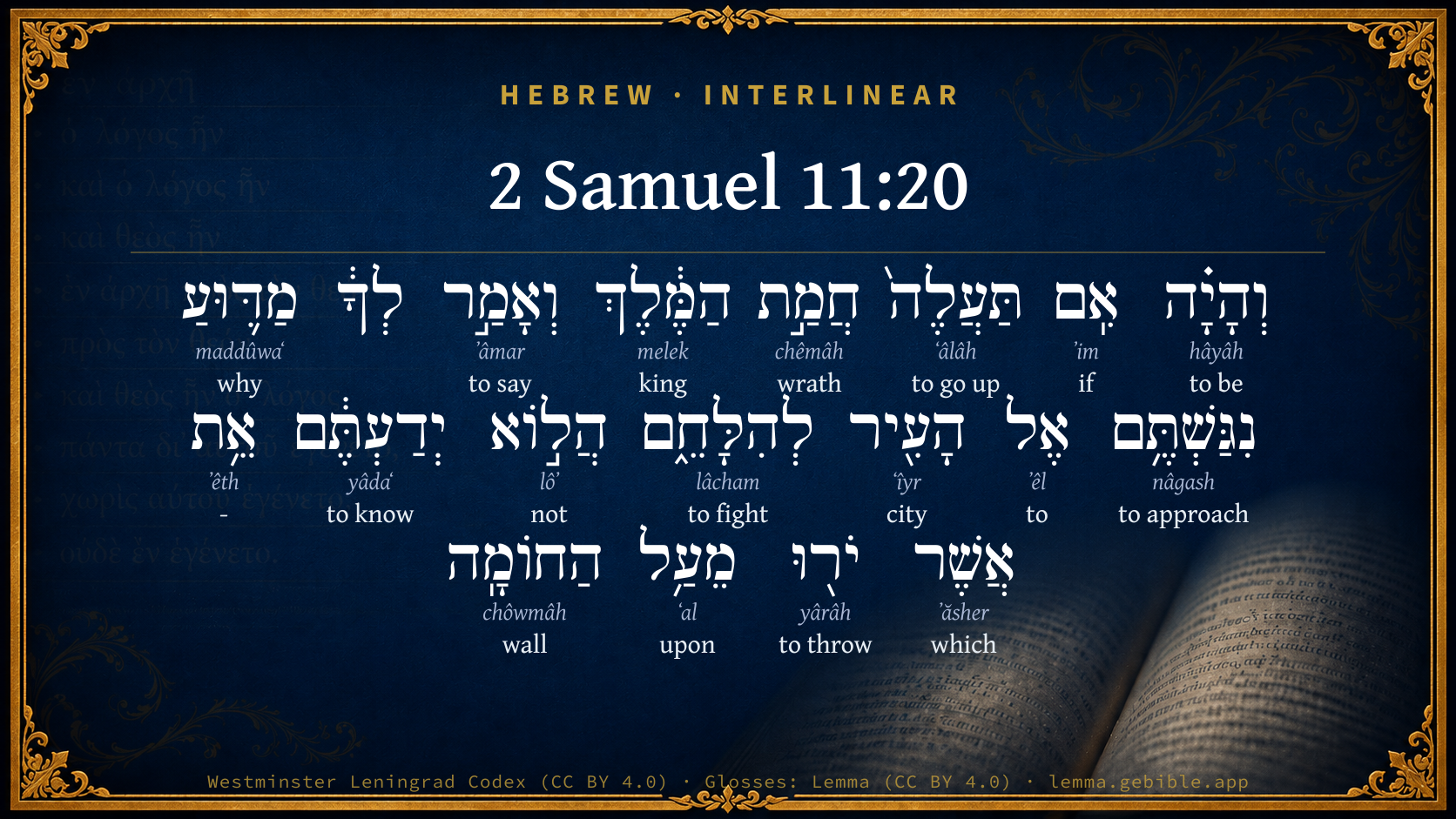
2 Samuel 11:20

Hebrew (Westminster Leningrad Codex) 2 Samuel 11:20 appears in the Hebrew Old Testament. The text above is from the Westminster Leningrad Codex. Each word links to its Strong’s number, a concise gloss, and parsing drawn from the Open Scriptures Hebrew Bible morphology. Click any word for its full Brown-Driver-Briggs (BDB) entry.
Download image
Cite this verse

2 Samuel 11:20 (World English Bible). Public Domain. Lemma interlinear Bible study tool, https://lemma.gebible.app/v/2-samuel/11/20.

Show BibTeX & RIS
BibTeX
RIS
English Translation
it shall be that, if the king's wrath arise, and he tells you, 'Why did you go so near to the city to fight? Didn't you know that they would shoot from the wall?
World English Bible · Public Domain
Download a study sheet

One document with this verse’s original text, its word-by-word gloss line, the meaning frame, cross-references with their text, attributed commentary, and full source and license credits — printable, and it pastes into notes with its structure intact.

This verse Autodidact and up

Study sheet (.html) Plain text (.txt)

A passage Seminary Student

Up to 50 verses in one chapter. A passage sheet keeps up to 6 commentary sources and 12 cross-references per verse, in the order this page ranks them, and says so on the sheet whenever that leaves anything out. Ask for a single verse and you get the Autodidact verse sheet above.

Everything on this page stays free to read, with no account — the sheet is a download of what is already on screen, not access to it.

Want to remove ads? Support Godless Engineer
Compare translations 3

The same verse in 3 English versions, stacked beneath the original-language interlinear above. Click any original word for its lexicon entry.

Each is an independent rendering of the whole verse — the interlinear is not word-aligned to these translations.

Highlighted words mark where these versions differ — a whole-verse word diff, not a word-by-word alignment.

  • World English Bible Public Domain
    it shall be that, if the king's wrath arise, and he tells you, 'Why did you go so near to the city to fight? Didn't you know that they would shoot from the wall?
  • King James Version Public Domain
    And if so be that the king's wrath arise, and he say unto thee, Wherefore approached ye so nigh unto the city when ye did fight? knew ye not that they would shoot from the wall?
  • unfoldingWord Literal Text CC BY-SA 4.0
    it will be, if the heat of the king rises and he says to you, ‘Why did you draw near to the city to fight? Did you not know that they would shoot from the wall?

unfoldingWord Literal Text — © unfoldingWord, licensed CC BY-SA 4.0. Word-aligned USFM3 via Door43 (git.door43.org/unfoldingWord/en_ult).

Versions to compare (up to 4)

3 of 4 selected

Show all 18 translations

Every available English version of this verse, each an independent rendering of the whole verse.

  • World English Bible Public Domain
    it shall be that, if the king's wrath arise, and he tells you, 'Why did you go so near to the city to fight? Didn't you know that they would shoot from the wall?
  • Berean Standard Bible Public Domain
    if the king’s anger flares, he may ask you, ‘Why did you get so close to the city to fight? Did you not realize they would shoot from atop the wall?
  • Majority Standard Bible Public Domain
    if the king’s anger flares, he may ask you, ‘Why did you get so close to the city to fight? Did you not realize they would shoot from atop the wall?
  • King James Version Public Domain
    And if so be that the king's wrath arise, and he say unto thee, Wherefore approached ye so nigh unto the city when ye did fight? knew ye not that they would shoot from the wall?
  • American Standard Version (1901) Public Domain
    it shall be that, if the king's wrath arise, and he say unto thee, Wherefore went ye so nigh unto the city to fight? knew ye not that they would shoot from the wall?
  • Revised Version (1885) Public Domain
    it shall be that, if the king’s wrath arise, and he say unto thee, Wherefore went ye so nigh unto the city to fight? knew ye not that they would shoot from the wall?
  • Geneva Bible (1599) Public Domain
    And if the kings anger arise, so that he say vnto thee, Wherefore approched ye vnto the citie to fight? knewe ye not that they would hurle from the wall?
  • Douay-Rheims (1899) Public Domain
    If thou see him to be angry, and he shall say: Why did you approach so near to the wall to fight? knew you not that many darts are thrown from above off the wall?
  • Young's Literal Translation Public Domain
    then, it hath been, if the king's fury ascend, and he hath said to thee, Wherefore did ye draw nigh unto the city to fight? did ye not know that they shoot from off the wall?
  • Literal Standard Version CC BY-SA 4.0
    then, it has been, if the king’s fury ascends, and he has said to you, Why did you draw near to the city to fight? Did you not know that they shoot from off the wall?
  • Unlocked Literal Bible CC BY-SA 4.0
    it may happen that the king will become angry, and he will say to you, 'Why did you go so near to the city to fight? Did you not know that they would shoot from the wall?
  • unfoldingWord Literal Text CC BY-SA 4.0
    it will be, if the heat of the king rises and he says to you, ‘Why did you draw near to the city to fight? Did you not know that they would shoot from the wall?
  • Darby Bible Public Domain
    and if so be that the king's wrath arise, and he say to thee, Why did ye go so near to the city to fight? did ye not know that they would shoot from the wall?
  • World Messianic Bible Public Domain
    it shall be that, if the king’s wrath arise, and he asks you, ‘Why did you go so near to the city to fight? Didn’t you know that they would shoot from the wall?
  • Webster's Bible Public Domain
    And if the king's wrath shall rise, and he shall say to thee, Why approached ye so nigh to the city for the fight? knew ye not that they would shoot from the wall?
  • Free Bible Version CC BY-SA 4.0
    if the king gets angry and asks you, ‘Why did you get so near to the town in the attack? Didn't you know they would shoot arrows from the wall?
  • Bible in Basic English Public Domain
    If the king is angry and says, Why did you go so near the town for the fight? was it not certain that their archers would be on the wall?
  • JPS Tanakh (1917) Public Domain
    it shall be that, if the king's wrath arise, and he say unto thee: Wherefore went ye so nigh unto the city to fight? knew ye not that they would shoot from the wall?

Literal Standard Version (2020), Covenant Press — licensed CC BY-SA 4.0. Text via the HelloAO Bible API (eBible.org). Unlocked Literal Bible (unfoldingWord) — licensed CC BY-SA 4.0. Text via the HelloAO Bible API (eBible.org). unfoldingWord Literal Text — © unfoldingWord, licensed CC BY-SA 4.0. Word-aligned USFM3 via Door43 (git.door43.org/unfoldingWord/en_ult). Free Bible Version, Dr. Jonathan Gallagher — licensed CC BY-SA 4.0. Text via the HelloAO Bible API (eBible.org).

Word by word

More ways to search: Search by grammar → Find every occurrence → Compare this word →

Practice this passage: Drill this verse → Learn its vocabulary →

מַדּ֛וּעַ
maddûwaʻ
H4069
“why”
Particle, Interrogative
Part of Speech
Particle
Type
Interrogative
Full BDB Definition

Origin: from H4100 and the pass. participle of H3045

TWOT: 848h

why?, on what account?, wherefore?
  1. וְהָיָ֗ה hâyâh H1961 “and · to be” Conjunction + Verb, Qal, Sequential Perfect, 3rd Person, Masculine, Singular
  2. אִֽם ʼim H518 “if” Conjunction
  3. תַּעֲלֶה֙ ʻâlâh H5927 “to go up” Verb, Qal, Imperfect, 3rd Person, Feminine, Singular
  4. חֲמַ֣ת chêmâh H2534 “wrath of” Noun, Common, Feminine, Singular, Construct
  5. הַמֶּ֔לֶךְ melek H4428 “the · king” Particle, Definite Article + Noun, Common, Masculine, Singular, Absolute
  6. וְאָמַ֣ר ʼâmar H559 “and · to say” Conjunction + Verb, Qal, Sequential Perfect, 3rd Person, Masculine, Singular
  7. נִגַּשְׁתֶּ֥ם nâgash H5066 “to approach” Verb, Niphal, Perfect, 2nd Person, Masculine, Plural
  8. אֶל ʼêl H413 “to” Preposition
  9. הָעִ֖יר ʻîyr H5892 “the · city” Particle, Definite Article + Noun, Common, Feminine, Singular, Absolute
  10. לְהִלָּחֵ֑ם lâcham H3898 “to fight” Preposition + Verb, Niphal, Infinitive Construct
  11. הֲל֣וֹא lôʼ H3808 “not” Particle, Interrogative + Particle, Negative
  12. יְדַעְתֶּ֔ם yâdaʻ H3045 “to know” Verb, Qal, Perfect, 2nd Person, Masculine, Plural
  13. אֵ֥ת ʼêth H853 “-” Particle, Direct Object
  14. אֲשֶׁר ʼăsher H834 “which” Particle, Relative
  15. יֹר֖וּ yârâh H3384 “to throw” Verb, Hiphil, Imperfect, 3rd Person, Masculine, Plural
  16. מֵעַ֥ל ʻal H5921 “from · upon” Preposition + Preposition
  17. הַחוֹמָֽה chôwmâh H2346 “the · wall” Particle, Definite Article + Noun, Common, Feminine, Singular, Absolute

About this verse

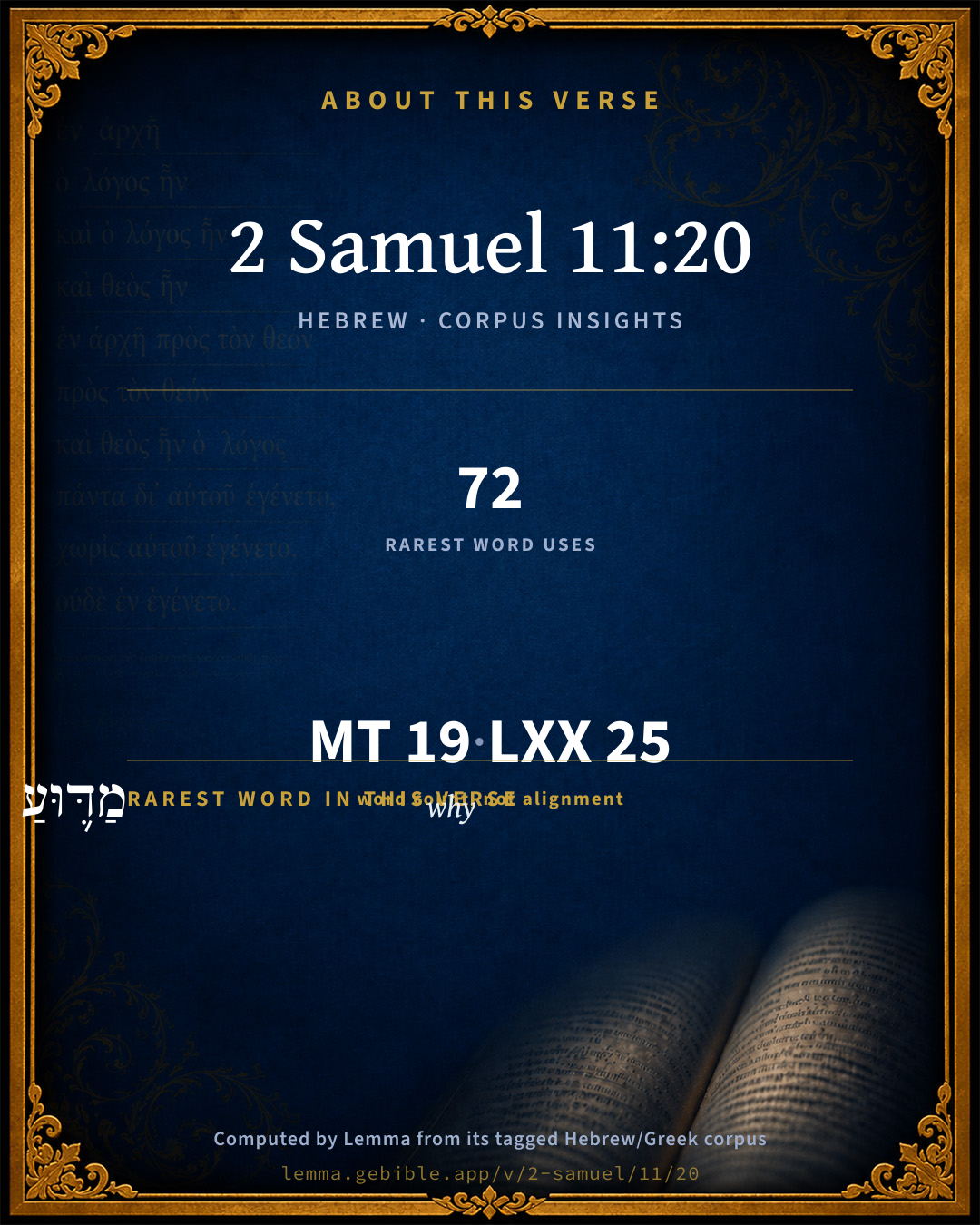
These counts appear in no published source. They are computed here, from the morphology-tagged text and Lemma’s own curated glosses. What Lemma adds →

19
words
18
distinct lemmas
Historical
section

Grammatical profile

  • 7 verbs
  • 4 nouns
  • 3 prepositions
  • 1 conjunction
  • 4 particles

Verb forms

  • וְהָיָ֗ה Qal · Sequential Perfect
  • תַּעֲלֶה֙ Qal · Imperfect
  • וְאָמַ֣ר Qal · Sequential Perfect
  • נִגַּשְׁתֶּ֥ם Niphal · Perfect
  • לְהִלָּחֵ֑ם Niphal · Infinitive Construct
  • יְדַעְתֶּ֔ם Qal · Perfect
  • יֹר֖וּ Hiphil · Imperfect

Hebrew & Septuagint length

In English translation the verse runs 34 words from the Hebrew and 41 from the Septuagint (LXX English) — closely comparable.

A rough comparison of the two English renderings, which tokenize alike — not a word-level alignment.

Word counts can differ between the Hebrew and the Greek without any difference in meaning — e.g. the Hebrew direct-object marker אֵת has no separate Greek word, and Greek often adds the article ὁ.

In the original languages it is 19 Hebrew tokens and 25 Greek tokens — but the two are counted differently (Hebrew bundles its prefixes and suffixes into one token; the Greek is in lemma form), so that isn’t a like-for-like length.

Hebrew and Greek witnesses Masoretic Hebrew ↔ Greek Septuagint

The same verse in the two great witnesses to the Old Testament, shown verse-for-verse.

These are two independent witnesses, not word-aligned to each other, and the Septuagint is shown in lemma (dictionary) form.

Hebrew 2 Samuel 11:20 Masoretic · Westminster Leningrad Codex

וְהָיָ֗ה אִֽם תַּעֲלֶה֙ חֲמַ֣ת הַמֶּ֔לֶךְ וְאָמַ֣ר לְךָ֔ מַדּ֛וּעַ נִגַּשְׁתֶּ֥ם אֶל הָעִ֖יר לְהִלָּחֵ֑ם הֲל֣וֹא יְדַעְתֶּ֔ם אֵ֥ת אֲשֶׁר יֹר֖וּ מֵעַ֥ל הַחוֹמָֽה

it shall be that, if the king's wrath arise, and he tells you, 'Why did you go so near to the city to fight? Didn't you know that they would shoot from the wall?

World English Bible · Public Domain

Greek LXX 2 Samuel 11:20 Septuagint · lemma form

καί εἰμί ἐάν ἀναβαίνω ὁ θυμός ὁ βασιλεύς καί εἶπον σύ τίς ὅτι ἐγγίζω πρός ὁ πόλις πολεμέω οὐ οἶδα ὅτι τοξεύω ἀπάνωθεν ὁ τεῖχος

then it shall come to pass if the anger of the king shall arise, and he shall say to you, Why did you⌃ draw near to the city to fight? knew you⌃ not that they would shoot from off the wall?

LXX2012 (modern English Septuagint) · Public Domain

Hebrew: Westminster Leningrad Codex (CC BY 4.0). Greek: Septuagint (public domain); English from LXX2012 (modern English Septuagint) (Public Domain). How the Septuagint differs from the Hebrew →

Targum (Aramaic paraphrase)

1

The Targum is the ancient Jewish Aramaic paraphrase of the Hebrew Scriptures — an interpretive translation, not the Hebrew text itself. Onkelos (literal) and Pseudo-Jonathan (expansive) render the Torah, and Jonathan the Prophets. Coverage is partial: where no permissively-licensed English translation exists for a verse, only the Aramaic is shown. This is verse-level text, not a word-by-word alignment to the Hebrew.

  1. Targum Jonathan Prophets (Joshua–Malachi)
    וִיהֵי אִם יִדְלַק רוּגְזָא דְמַלְכָּא וְיֵימַר לָךְ מָא דֵין אִתְקַרֵבְתּוּן לְקַרְתָּא לְאַגָחָא הֲלָא יְדַעְתּוּן יַת דְיִרְמוֹן עֲלֵיכוֹן מִן שׁוּרָא:

    (no public-domain English translation for this verse)

    Targum Jonathan — Aramaic: “Mikraot Gedolot” (public domain). English: “Sefaria Community Translation” (CC0 1.0 (public-domain dedication)); “London "Chaldee Paraphrase," 1871” (public domain). Text via Sefaria.

Commentary

Notes on 2 Samuel 11:20 from classic Christian and Jewish commentators (each source and its license shown beneath its notes). The classic Christian expositions comment on the surrounding passage and are grouped to its opening verse, so a note may address several verses; the Jewish commentaries on the Tanakh (Rashi and others) are per-verse, so they appear only where the commentator wrote on this verse.

Lemma curates 59 commentaries, every one of them public domain or Creative Commons licensed, each selected and text-cleaned for this edition rather than reprinted as found. About our sources →

Trapp's Complete Commentary

John Trapp

2Sa 11:20 And if so be that the king’s wrath arise, and he say unto thee, Wherefore approached ye so nigh unto the city when ye did fight? knew ye not that they would shoot from the wall?

Ver. 20. And if so be that the king’s wrath arise.] As that is the best reward oft times that is given to generals and other officers, though never so well deserving, unless they prove prosperous, that they are discountenanced and discarded; as were Bellisarius, Trajan general to Valens, Hunuiades otherwhiles, qui pro tantorum laborum praemio vix veniam impetravere. {a}

{a} Ut de Aria, Mont. Thuan.

John Trapp, A Commentary or Exposition upon All the Books of the Old and New Testament (1647–1656) — public domain. Text from a community e-Sword module.

Geneva Bible (1599)

Geneva Bible translators

Or, thou shalt do this, if.

Geneva Bible (1599) marginal notes — public domain. Text via Bolls.life.

Adam Clarke's Commentary

Verse 20. If - the king's wrath arise] It is likely that Joab had by some indiscretion suffered loss about this time; and he contrived to get rid of the odium by connecting the transaction with the death of Uriah, which he knew would be so pleasing to the king.

Adam Clarke's Commentary on the Bible (1810–1826) — public domain. Text from a community e-Sword/MySword module.

The Cambridge Bible for Schools and Colleges

gen. ed. J. J. S. Perowne

20. if so be that the king’s wrath arise] Joab assumes that David would find fault with him for bad generalship, until he knew that his commission was executed by Uriah’s death.

The Cambridge Bible for Schools and Colleges (gen. ed. J. J. S. Perowne; Cambridge University Press, 1878–1918) — public domain. Text from a community e-Sword module.

John Gill's Exposition

And if so be that the king's wrath arise,.... Which might be seen in his countenance, or expressed in his words:

and he say, wherefore approached ye so nigh unto the city when ye did fight? as to expose the king's troops to the enemy on the wall, who by stones or darts greatly annoyed them, or sallied out on them, and killed many of them:

knew ye not that they would shoot from the wall? they must have known that, and therefore should have kept out of the reach of their shot.

John Gill's Exposition of the Whole Bible (1746–1763) — public domain (CC PDM 1.0). Text via the HelloAO Bible API.

Whedon's Commentary on the Bible

Daniel D. Whedon

20. If… the king’s wrath arise — Joab had apprehensions that the king might regard the loss as greater than necessary.

Daniel D. Whedon (gen. ed.), Commentary on the Old and New Testaments (1874–1909) — public domain. Text from a community e-Sword module.

Lesson kit

Teaching starters — assembled from the data on this page, not authored interpretation. Every prompt links to the verse data it draws on. Edit before teaching.

2 Samuel, in the Historical, opens this verse with 19 words (18 distinct Hebrew lemmas). Its most distinctive word is maddûwaʻ (“why”). A historical commentator’s framing appears above. Read the whole chapter for the surrounding context.

Discussion questions

  1. The word maddûwaʻ carries the sense “why.” How does it shape the verse?
  2. These translations render this verse differently. What is at stake in choosing one wording over another?
  3. «וְהָיָ֗ה» is a Qal Sequential Perfect verb. How does that grammatical form shape the action described?
  4. Compare how Trapp's Complete Commentary and Geneva Bible (1599) read this verse. Where do they agree or differ?

Things to notice

Reading settings

Reading text

Shown beneath each verse's original-language words.

Old Testament
Old Testament edition

Read the OT as the Masoretic Hebrew (MT) or the Greek Septuagint (LXX).

English shown for the Greek Septuagint (in the Hebrew ↔ Greek comparison).

Comparing translations? Open the Compare panel on any verse page to stack up to four side by side.