
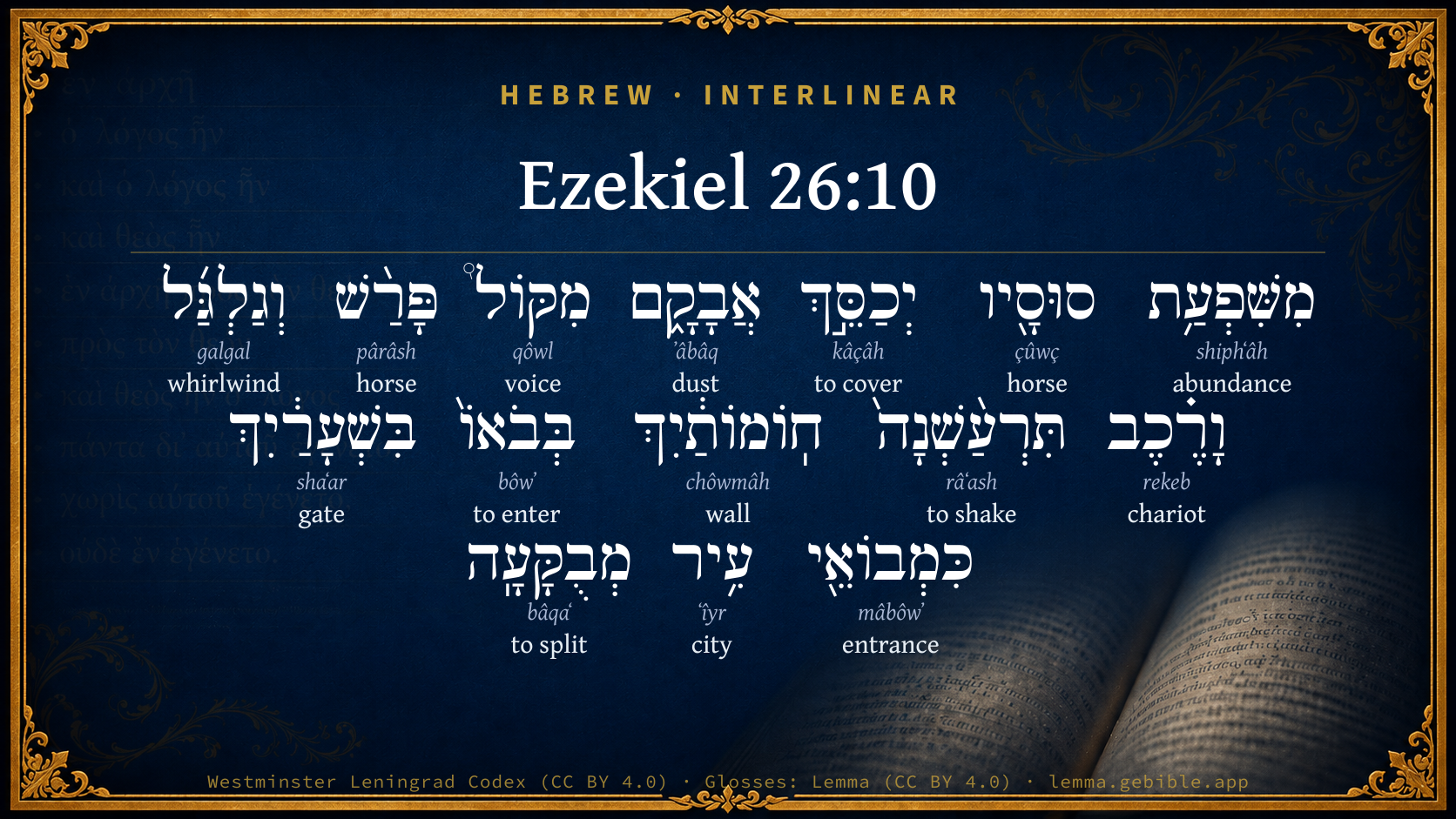
Ezekiel 26:10

Hebrew (Westminster Leningrad Codex) Ezekiel 26:10 appears in the Hebrew Old Testament. The text above is from the Westminster Leningrad Codex. Each word links to its Strong’s number, a concise gloss, and parsing drawn from the Open Scriptures Hebrew Bible morphology. Click any word for its full Brown-Driver-Briggs (BDB) entry.
Download image
Cite this verse

Ezekiel 26:10 (World English Bible). Public Domain. Lemma interlinear Bible study tool, https://lemma.gebible.app/v/ezekiel/26/10.

Show BibTeX & RIS
BibTeX
RIS
English Translation
By reason of the abundance of his horses their dust shall cover you: your walls shall shake at the noise of the horsemen, and of the wagons, and of the chariots, when he shall enter into your gates, as men enter into a city in which is made a breach.
World English Bible · Public Domain
Download a study sheet

One document with this verse’s original text, its word-by-word gloss line, the meaning frame, cross-references with their text, attributed commentary, and full source and license credits — printable, and it pastes into notes with its structure intact.

This verse Autodidact and up

Study sheet (.html) Plain text (.txt)

A passage Seminary Student

Up to 50 verses in one chapter. A passage sheet keeps up to 6 commentary sources and 12 cross-references per verse, in the order this page ranks them, and says so on the sheet whenever that leaves anything out. Ask for a single verse and you get the Autodidact verse sheet above.

Everything on this page stays free to read, with no account — the sheet is a download of what is already on screen, not access to it.

Want to remove ads? Support Godless Engineer
Compare translations 3

The same verse in 3 English versions, stacked beneath the original-language interlinear above. Click any original word for its lexicon entry.

Each is an independent rendering of the whole verse — the interlinear is not word-aligned to these translations.

Highlighted words mark where these versions differ — a whole-verse word diff, not a word-by-word alignment.

  • World English Bible Public Domain
    By reason of the abundance of his horses their dust shall cover you: your walls shall shake at the noise of the horsemen, and of the wagons, and of the chariots, when he shall enter into your gates, as men enter into a city in which is made a breach.
  • King James Version Public Domain
    By reason of the abundance of his horses their dust shall cover thee: thy walls shall shake at the noise of the horsemen, and of the wheels, and of the chariots, when he shall enter into thy gates, as men enter into a city wherein is made a breach.
  • unfoldingWord Literal Text CC BY-SA 4.0
    His horses will be so many that their dust will cover you. Your walls will shake with the sound of horsemen, wagons, and chariots. When he enters your gates, he will enter as men come into a city whose walls have been broken down.

unfoldingWord Literal Text — © unfoldingWord, licensed CC BY-SA 4.0. Word-aligned USFM3 via Door43 (git.door43.org/unfoldingWord/en_ult).

Versions to compare (up to 4)

3 of 4 selected

Show all 18 translations

Every available English version of this verse, each an independent rendering of the whole verse.

  • World English Bible Public Domain
    By reason of the abundance of his horses their dust shall cover you: your walls shall shake at the noise of the horsemen, and of the wagons, and of the chariots, when he shall enter into your gates, as men enter into a city in which is made a breach.
  • Berean Standard Bible Public Domain
    His multitude of horses will cover you in their dust. When he enters your gates as an army entering a breached city, your walls will shake from the noise of cavalry, wagons, and chariots.
  • Majority Standard Bible Public Domain
    His multitude of horses will cover you in their dust. When he enters your gates as an army entering a breached city, your walls will shake from the noise of cavalry, wagons, and chariots.
  • King James Version Public Domain
    By reason of the abundance of his horses their dust shall cover thee: thy walls shall shake at the noise of the horsemen, and of the wheels, and of the chariots, when he shall enter into thy gates, as men enter into a city wherein is made a breach.
  • American Standard Version (1901) Public Domain
    By reason of the abundance of his horses their dust shall cover thee: thy walls shall shake at the noise of the horsemen, and of the wagons, and of the chariots, when he shall enter into thy gates, as men enter into a city wherein is made a breach.
  • Revised Version (1885) Public Domain
    By reason of the abundance of his horses their dust shall cover thee: thy walls shall shake at the noise of the horsemen, and of the wagons, and of the chariots, when he shall enter into thy gates, as men enter into a city wherein is made a breach.
  • Geneva Bible (1599) Public Domain
    The dust of his horses shall couer thee, for their multitude: thy walles shall shake at the noise of the horsemen, and of the wheeles, and of the charets, when he shall enter into thy gates as into the entrie of a citie that is broken downe.
  • Douay-Rheims (1899) Public Domain
    By reason of the multitude of his horses, their dust shall cover thee: thy walls shall shake at the noise of the horsemen, and wheels, and chariots, when they shall go in at thy gates, as by the entrance of a city that is destroyed.
  • Young's Literal Translation Public Domain
    From the abundance of his horses cover thee doth their dust, From the noise of horseman, and wheel, and rider, Shake do thy walls, in his coming in to thy gates, As the coming into a city broken-up.
  • Literal Standard Version CC BY-SA 4.0
    From the abundance of his horses their dust cover you, || From the noise of horseman, and wheel, and rider, || Your walls shake, in his coming into your gates, || As the coming into a city that has been broken-up.
  • Unlocked Literal Bible CC BY-SA 4.0
    His horses will be so many that their dust will cover you. Your walls will shake with the sound of horsemen, wagons, and chariots. When he enters your gates, he will enter as men come into a city whose walls have been broken down.
  • unfoldingWord Literal Text CC BY-SA 4.0
    His horses will be so many that their dust will cover you. Your walls will shake with the sound of horsemen, wagons, and chariots. When he enters your gates, he will enter as men come into a city whose walls have been broken down.
  • Darby Bible Public Domain
    By reason of the abundance of his horses their dust shall cover thee; thy walls shall shake at the noise of the horsemen, and of the wheels, and of the chariots, when he shall enter through thy gates, as a city is entered into, wherein is made a breach.
  • World Messianic Bible Public Domain
    By reason of the abundance of his horses, their dust will cover you. Your walls will shake at the noise of the horsemen, of the wagons, and of the chariots, when he enters into your gates, as men enter into a city which is broken open.
  • Webster's Bible Public Domain
    By reason of the abundance of his horses their dust shall cover thee: thy walls shall shake at the noise of the horsemen, and of the wheels, and of the chariots, when he shall enter into thy gates, as men enter into a city in which is made a breach.
  • Free Bible Version CC BY-SA 4.0
    He will have so many horses you will be covered by the dust they throw up. When he comes in through your gates it will sound like an army charging into a defeated city. Your walls will shake from all the noise made by the cavalry, wagons, and chariots.
  • Bible in Basic English Public Domain
    Because of the number of his horses you will be covered with their dust: your walls will be shaking at the noise of the horsemen and of the wheels and of the war-carriages, when he comes through your doorways, as into a town which has been broken open.
  • JPS Tanakh (1917) Public Domain
    By reason of the abundance of his horses their dust shall cover thee; at the noise of the horsemen, and of the wheels, and of the chariots, thy walls shall shake, when he shall enter into thy gates, as men enter into a city wherein is made a breach.

Literal Standard Version (2020), Covenant Press — licensed CC BY-SA 4.0. Text via the HelloAO Bible API (eBible.org). Unlocked Literal Bible (unfoldingWord) — licensed CC BY-SA 4.0. Text via the HelloAO Bible API (eBible.org). unfoldingWord Literal Text — © unfoldingWord, licensed CC BY-SA 4.0. Word-aligned USFM3 via Door43 (git.door43.org/unfoldingWord/en_ult). Free Bible Version, Dr. Jonathan Gallagher — licensed CC BY-SA 4.0. Text via the HelloAO Bible API (eBible.org).

Word by word

More ways to search: Search by grammar → Find every occurrence → Compare this word →

Practice this passage: Drill this verse → Learn its vocabulary →

מִשִּׁפְעַ֥ת
shiphʻâh
H8229
“from · abundance of”
Preposition + Noun, Common, Feminine, Singular, Construct
Part of Speech
Preposition + Noun
Type
Common
Gender
Feminine
Number
Singular
State
Construct
Full BDB Definition

Origin: from H8228

TWOT: 2447b

abundance, quantity, multitude
  1. סוּסָ֖יו çûwç H5483 “horses · his” Noun, Common, Masculine, Plural, Construct + Suffix, Personal, 3rd Person, Masculine, Singular
  2. יְכַסֵּ֣ךְ kâçâh H3680 “to cover · you” Verb, Piel, Imperfect, 3rd Person, Masculine, Singular + Suffix, Personal, 2nd Person, Feminine, Singular
  3. אֲבָקָ֑ם ʼâbâq H80 “dust · their” Noun, Common, Masculine, Singular, Construct + Suffix, Personal, 3rd Person, Masculine, Plural
  4. מִקּוֹל֩ qôwl H6963 “from · voice of” Preposition + Noun, Common, Masculine, Singular, Construct
  5. פָּרַ֨שׁ pârâsh H6571 “horse” Noun, Common, Masculine, Singular, Absolute
  6. וְגַלְגַּ֜ל galgal H1534 “and · whirlwind” Conjunction + Noun, Common, Masculine, Singular, Absolute
  7. וָרֶ֗כֶב rekeb H7393 “and · chariot” Conjunction + Noun, Common, Masculine, Singular, Absolute
  8. תִּרְעַ֨שְׁנָה֙ râʻash H7493 “to shake” Verb, Qal, Imperfect, 3rd Person, Feminine, Plural
  9. חֽוֹמוֹתַ֔יִךְ chôwmâh H2346 “walls · your” Noun, Common, Feminine, Plural, Construct + Suffix, Personal, 2nd Person, Feminine, Singular
  10. בְּבֹאוֹ֙ bôwʼ H935 “in/at · to enter · him” Preposition + Verb, Qal, Infinitive Construct + Suffix, Personal, 3rd Person, Masculine, Singular
  11. בִּשְׁעָרַ֔יִךְ shaʻar H8179 “in/at · gates · your” Preposition + Noun, Common, Masculine, Plural, Construct + Suffix, Personal, 2nd Person, Feminine, Singular
  12. כִּמְבוֹאֵ֖י mâbôwʼ H3996 “like/as · entrances of” Preposition + Noun, Common, Masculine, Plural, Construct
  13. עִ֥יר ʻîyr H5892 “city” Noun, Common, Feminine, Singular, Absolute
  14. מְבֻקָּעָֽה bâqaʻ H1234 “split” Verb, Pual, Participle Passive, Feminine, Singular, Absolute

About this verse

These counts appear in no published source. They are computed here, from the morphology-tagged text and Lemma’s own curated glosses. What Lemma adds →

15
words
15
distinct lemmas
Prophets
section

Notable vocabulary

The rarest word here is מִשִּׁפְעַ֥ת abundance H8229 — appearing just 6 times in the whole Hebrew Bible.

Shared distinctive vocabulary

מִשִּׁפְעַ֥ת abundance H8229 occurs in 5 verses of the Hebrew Bible. Also found in:

Grammatical profile

  • 4 verbs
  • 11 nouns

Verb forms

  • יְכַסֵּ֣ךְ Piel · Imperfect
  • תִּרְעַ֨שְׁנָה֙ Qal · Imperfect
  • בְּבֹאוֹ֙ Qal · Infinitive Construct
  • מְבֻקָּעָֽה Pual · Participle Passive

Hebrew & Septuagint length

In English translation the verse runs 50 words from the Hebrew and 48 from the Septuagint (LXX English) — closely comparable.

A rough comparison of the two English renderings, which tokenize alike — not a word-level alignment.

Word counts can differ between the Hebrew and the Greek without any difference in meaning — e.g. the Hebrew direct-object marker אֵת has no separate Greek word, and Greek often adds the article ὁ.

Cross-references

8

Topical passages linked to Ezekiel 26:10 in the Treasury of Scripture Knowledge — connected by theme and wording, ordered by reader-vote popularity; previews shown in the World English Bible.

  • Jeremiah 47:3 At the noise of the stamping of the hoofs of his strong ones, at the rushing of his chariots, at the rumbling of his wheels, the fathers don't look back to their children for feebleness of hands;
  • Ezekiel 26:15 Thus says the Lord Yahweh to Tyre: shall not the isles shake at the sound of your fall, when the wounded groan, when the slaughter is made in the midst of you?
  • Ezekiel 27:28 At the sound of the cry of your pilots the suburbs shall shake.
  • Joshua 6:5 It shall be that when they make a long blast with the ram's horn, and when you hear the sound of the trumpet, all the people shall shout with a great shout; and the wall of the city shall fall down flat, and the people shall go up every man straight before him.
  • Joshua 6:20 So the people shouted, and [the priests] blew the trumpets; and it happened, when the people heard the sound of the trumpet, that the people shouted with a great shout, and the wall fell down flat, so that the people went up into the city, every man straight before him, and they took the city.
  • Jeremiah 4:13 Behold, he shall come up as clouds, and his chariots [shall be] as the whirlwind: his horses are swifter than eagles. Woe to us! for we are ruined.
  • Ezekiel 26:7 For thus says the Lord Yahweh: Behold, I will bring on Tyre Nebuchadrezzar king of Babylon, king of kings, from the north, with horses, and with chariots, and with horsemen, and a company, and much people.
  • Nahum 2:3–4 The shield of his mighty men is made red. The valiant men are in scarlet. The chariots flash with steel in the day of his preparation, and the pine spears are brandished.

Cross-references courtesy of OpenBible.info (CC BY 4.0).

Hebrew and Greek witnesses Masoretic Hebrew ↔ Greek Septuagint

The same verse in the two great witnesses to the Old Testament, shown verse-for-verse.

These are two independent witnesses, not word-aligned to each other, and the Septuagint is shown in lemma (dictionary) form.

Hebrew Ezekiel 26:10 Masoretic · Westminster Leningrad Codex

מִשִּׁפְעַ֥ת סוּסָ֖יו יְכַסֵּ֣ךְ אֲבָקָ֑ם מִקּוֹל֩ פָּרַ֨שׁ וְגַלְגַּ֜ל וָרֶ֗כֶב תִּרְעַ֨שְׁנָה֙ חֽוֹמוֹתַ֔יִךְ בְּבֹאוֹ֙ בִּשְׁעָרַ֔יִךְ כִּמְבוֹאֵ֖י עִ֥יר מְבֻקָּעָֽה

By reason of the abundance of his horses their dust shall cover you: your walls shall shake at the noise of the horsemen, and of the wagons, and of the chariots, when he shall enter into your gates, as men enter into a city in which is made a breach.

World English Bible · Public Domain

Greek LXX Ezekiel 26:10 Septuagint · lemma form

ἀπό ὁ πλῆθος ὁ ἵππος αὐτός κατακαλύπτω σύ ὁ κονιορτός αὐτός καί ἀπό ὁ φωνή ὁ ἱππεύς αὐτός καί ὁ τροχός ὁ ἅρμα αὐτός σείω ὁ τεῖχος σύ εἰςπορεύομαι αὐτός ὁ πύλη σύ ὡς εἰςπορεύομαι εἰς πόλις ἐκ πεδίον

By reason of your multitude of his horses their dust shall cover you, and by reason of the sound of his horsemen and the wheels of his chariots the walls shall be shaken, when he enters into your gates, as one entering into a city from the plain.

LXX2012 (modern English Septuagint) · Public Domain

Hebrew: Westminster Leningrad Codex (CC BY 4.0). Greek: Septuagint (public domain); English from LXX2012 (modern English Septuagint) (Public Domain). How the Septuagint differs from the Hebrew →

Targum (Aramaic paraphrase)

1

The Targum is the ancient Jewish Aramaic paraphrase of the Hebrew Scriptures — an interpretive translation, not the Hebrew text itself. Onkelos (literal) and Pseudo-Jonathan (expansive) render the Torah, and Jonathan the Prophets. Coverage is partial: where no permissively-licensed English translation exists for a verse, only the Aramaic is shown. This is verse-level text, not a word-by-word alignment to the Hebrew.

  1. Targum Jonathan Prophets (Joshua–Malachi)
    מֵרִפְסַת סוּסְוָתֵיהּ יַחֲפִינָךְ אַבְקֵיהוֹן מִקַל פָּרָשִׁין וְגַלְגְלִין וּרְתִיכִין יְזוּעוּן שׁוּרָךְ בְּמֵיעֲלוֹהִי בְּתַרְעָךְ כְּמָא דְעָלִין בְּקַרְתָּא דִמְתַּרְעָא מִשׁוּר:

    (no public-domain English translation for this verse)

    Targum Jonathan — Aramaic: “Mikraot Gedolot” (public domain). English: “Sefaria Community Translation” (CC0 1.0 (public-domain dedication)); “London "Chaldee Paraphrase," 1871” (public domain). Text via Sefaria.

Commentary

Notes on Ezekiel 26:10 from classic Christian and Jewish commentators (each source and its license shown beneath its notes). The classic Christian expositions comment on the surrounding passage and are grouped to its opening verse, so a note may address several verses; the Jewish commentaries on the Tanakh (Rashi and others) are per-verse, so they appear only where the commentator wrote on this verse.

Lemma curates 59 commentaries, every one of them public domain or Creative Commons licensed, each selected and text-cleaned for this edition rather than reprinted as found. About our sources →

Trapp's Complete Commentary

John Trapp

Eze 26:10 By reason of the abundance of his horses their dust shall cover thee: thy walls shall shake at the noise of the horsemen, and of the wheels, and of the chariots, when he shall enter into thy gates, as men enter into a city wherein is made a breach.

Ver. 10. Thy walls shall shake.] With the noise of one chariot, walls and windows seem to shake; what, then, with the rattle of so many? Methought I heard the noise and fright that shall be at the last day, said one, {a} that was at the taking of a town in the low countries. The fragor and terror was so great, say the Turkish histories (speaking of a bloody battle between Amurath III and Lazarus, despot of Sernia), that the angels in heaven, so they are pleased to hyperbolise, amazed with that hideous noise, for that time forgot the heavenly hymns wherewith they always glorify God. {b}

When he shall enter into thy gates.] As our Henry VIII did into Tournay, a city of France, which was ever counted so impregnable, that this sentence was engraven over one of the gates, Iannes ton me a perdu ton pucellage, i.e., Thou hast never lost thy maidenhead.

{a} A Lapide.

{b} Turkish History.

John Trapp, A Commentary or Exposition upon All the Books of the Old and New Testament (1647–1656) — public domain. Text from a community e-Sword module.

Jamieson, Fausset & Brown

Robert Jamieson, A. R. Fausset & David Brown

dust--So thick shall be the "dust" stirred up by the immense numbers of "horses," that it shall "cover" the whole city as a cloud.

horses . . . chariots--As in Eze 26:3-5, New Tyre on the insular rock in the sea (compare Isa 23:2, Isa 23:4, Isa 23:6) is referred to; so here, in Eze 26:9-11, Old Tyre on the mainland. Both are included in the prophecies under one name.

wheels--FAIRBAIRN thinks that here, and in Eze 23:24, as "the wheels" are distinct from the "chariots," some wheelwork for riding on, or for the operations of the siege, are meant.

Jamieson, Fausset & Brown — Commentary Critical and Explanatory on the Whole Bible (1871) — public domain (CC PDM 1.0). Text via the HelloAO Bible API.

Ellicott's Commentary for English Readers

(10) Shall enter into thy gates.—The whole description of this verse again implies that Nebuchadnezzar had contrived some way by which his armies, with horsemen and chariots, could march into the city, and the prophet gives a glowing poetic description of the effect of their entrance.

A Bible Commentary for English Readers, edited by Charles John Ellicott (1878–1897) — public domain. Text from a community e-Sword module.

John Gill's Exposition

By reason of the abundance of his horses their dust shall cover thee,.... The dust raised by the feet of the horses so numerous, should rise in such quantities, and to such a height, as to be like a cloud, which should cover the city; an hyperbolical way of speaking, as Kimchi observes; as is also the following clause:

thy walls shall shake at the noise of the horsemen, and of the wheels, and of the chariots; at the shouts of the horsemen upon every attack, and the rattling of the chariot wheels running to and fro, in carrying on their designs:

when ye shall enter into thy gates; that is, then particularly shall such a shout be made by the horsemen, and such rattling of the chariots, as will even make the walls of the city to shake; an excess of expression, signifying the prodigious noise made at their entrance into it: as men enter into a city wherein is made a breach; or, "according to the entrance of a city broken up" (i); when its walls are broken down, and a gap is made; at which men rush in in great numbers, and with great force and clamour.

(i) "tanquam introitus civitatis diruptae", Montanus; "dissipatae", Pagninus; "quemadmodum ingrediuntur urbem disruptam", Piscator; "quemadmodum intratur urbs praerupta", Cocceius.

John Gill's Exposition of the Whole Bible (1746–1763) — public domain (CC PDM 1.0). Text via the HelloAO Bible API.

Haydock's Catholic Bible Commentary

Destroyed. Old Tyre was taken by storm. It is doubtful whether it was pillaged, chap. xxix. 18. (Calmet)

George Leo Haydock (1774–1849), Haydock's Catholic Family Bible and Commentary, 1859 edition — public domain. Excludes Psalms (Douay-Rheims chapter numbering differs from Protestant) and Deuterocanonical books (Catholic canon only).

Matthew Poole's English Annotations

Their dust; the dust they raise in marching, or in their exercising, in riding to and fro; but whether while on the land, or when they entered the city, may be doubted.

Shall cover thee; as a cloud it shall cover the city.

Shall shake, as buildings do with great noise, motion. or beating on the ground.

The wheels, of their engines, or wagons, or chariots.

He shall enter into thy gates; Nebuchadnezzar, without fear, shall enter and possess his conquest, which Tyre at last yielded to him after thirteen years’ hard siege.

Wherein is made a breach; whose walls battered and leveled, there is nothing left to defend the citizens, who therefore yield, or defend the besieger, who therefore fearless entereth.

Matthew Poole's English Annotations on the Holy Bible (1683–1685) — public domain. Text from a community e-Sword/MySword module.

Rashi

Rabbi Shlomo Yitzchaki (Rashi)

From the abundance of his horses When there are many horses, they raise dust with their feet, which ascends and becomes like a cloud, darkening the earth. This is called שִּׁפְּעַת, an abundance. Similarly, (Job 22:11): “or an abundance of (וְשִּׁפְּעַת) water covers you,” de la foison in French, of abundance.

as men enter a breached city as they enter a city that has been breached of its wall(Targum), that its wall has been breached.

Rashi on the Tanakh — English translations: “The Judaica Press complete Tanach with Rashi, translated by A. J. Rosenberg” (CC BY 4.0); “Pentateuch with Rashi's commentary by M. Rosenbaum and A.M. Silbermann, 1929-1934” (public domain); “The Metsudah Tanach series, Lakewood, N.J” (CC BY 4.0); and “The Book of Joshua, Metsudah Publications, 1997” (CC BY 4.0). Text via Sefaria.

Lesson kit

Teaching starters — assembled from the data on this page, not authored interpretation. Every prompt links to the verse data it draws on. Edit before teaching.

Ezekiel, in the Prophets, opens this verse with 15 words (15 distinct Hebrew lemmas). Its most distinctive word is shiphʻâh (“abundance”). A historical commentator’s framing appears above. Read the whole chapter for the surrounding context.

Discussion questions

  1. How does “abundance” (shiphʻâh) shape what this verse is saying?
  2. 2 Kings 9:17 shares the word «abundance» with this verse. How do the two illuminate each other?
  3. The translations on this page render this verse differently — a whole-verse word diff, not a word-by-word alignment. What might account for the different wordings?
  4. The verb «יְכַסֵּ֣ךְ» is Piel Imperfect. How does its form color the action?
  5. Reading how Trapp's Complete Commentary and Jamieson, Fausset & Brown read this verse, where do the two commentators agree and where do they part?

Things to notice

Reading settings

Reading text

Shown beneath each verse's original-language words.

Old Testament
Old Testament edition

Read the OT as the Masoretic Hebrew (MT) or the Greek Septuagint (LXX).

English shown for the Greek Septuagint (in the Hebrew ↔ Greek comparison).

Comparing translations? Open the Compare panel on any verse page to stack up to four side by side.