
Amos 1:10

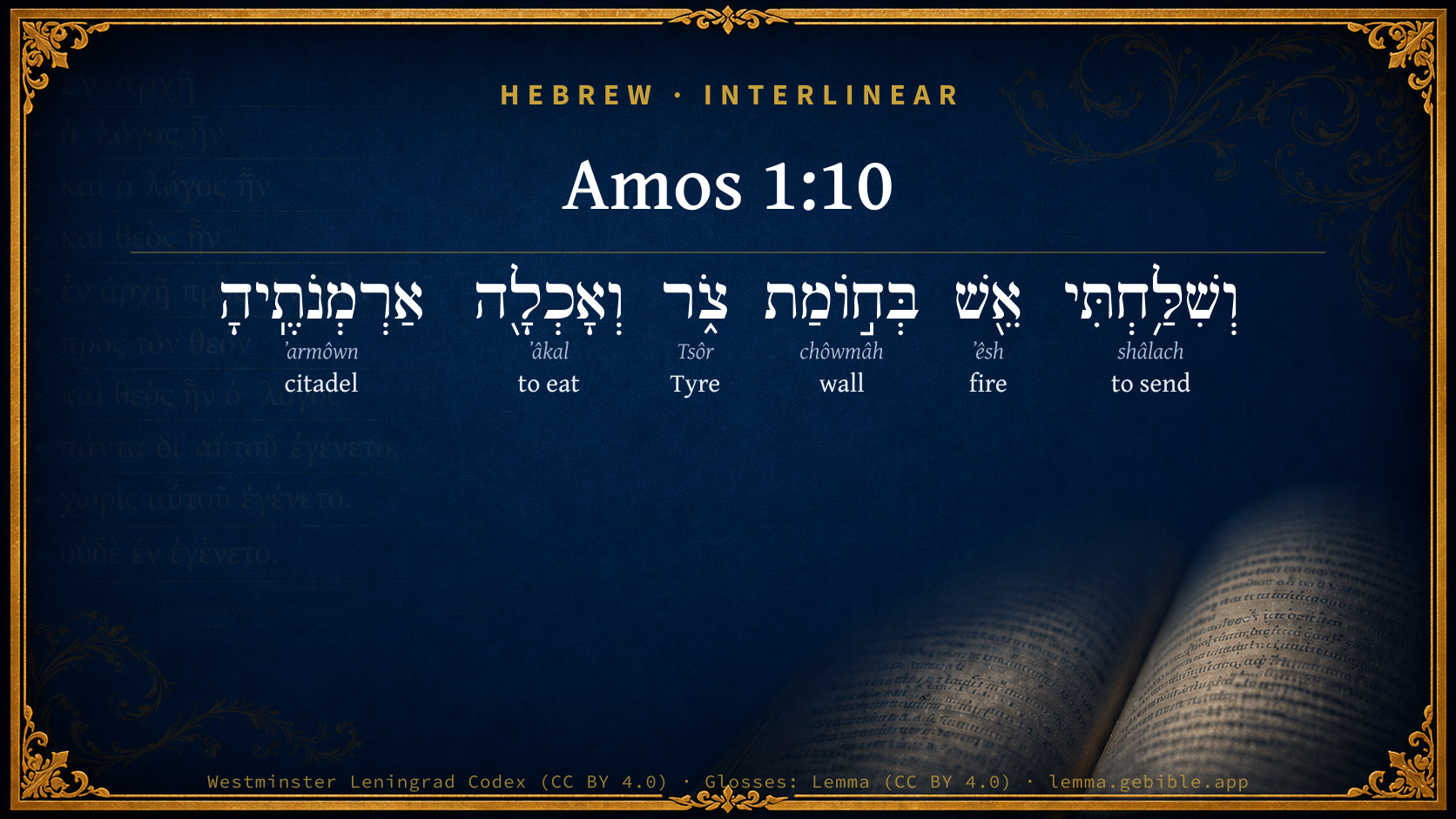
Hebrew (Westminster Leningrad Codex) Amos 1:10 appears in the Hebrew Old Testament. The text above is from the Westminster Leningrad Codex. Each word links to its Strong’s number, a concise gloss, and parsing drawn from the Open Scriptures Hebrew Bible morphology. Click any word for its full Brown-Driver-Briggs (BDB) entry.
Download image
Cite this verse

Amos 1:10 (World English Bible). Public Domain. Lemma interlinear Bible study tool, https://lemma.gebible.app/v/amos/1/10.

Show BibTeX & RIS
BibTeX
RIS
English Translation
But I will send a fire on the wall of Tyre, And it will devour its palaces."
World English Bible · Public Domain
Download a study sheet

One document with this verse’s original text, its word-by-word gloss line, the meaning frame, cross-references with their text, attributed commentary, and full source and license credits — printable, and it pastes into notes with its structure intact.

This verse Autodidact and up

Study sheet (.html) Plain text (.txt)

A passage Seminary Student

Up to 50 verses in one chapter. A passage sheet keeps up to 6 commentary sources and 12 cross-references per verse, in the order this page ranks them, and says so on the sheet whenever that leaves anything out. Ask for a single verse and you get the Autodidact verse sheet above.

Everything on this page stays free to read, with no account — the sheet is a download of what is already on screen, not access to it.

Want to remove ads? Support Godless Engineer
Compare translations 3

The same verse in 3 English versions, stacked beneath the original-language interlinear above. Click any original word for its lexicon entry.

Each is an independent rendering of the whole verse — the interlinear is not word-aligned to these translations.

Highlighted words mark where these versions differ — a whole-verse word diff, not a word-by-word alignment.

  • World English Bible Public Domain
    But I will send a fire on the wall of Tyre, And it will devour its palaces."
  • King James Version Public Domain
    But I will send a fire on the wall of Tyrus, which shall devour the palaces thereof.
  • unfoldingWord Literal Text CC BY-SA 4.0
    I will send fire on the walls of Tyre, and it will devour her fortresses.”

unfoldingWord Literal Text — © unfoldingWord, licensed CC BY-SA 4.0. Word-aligned USFM3 via Door43 (git.door43.org/unfoldingWord/en_ult).

Versions to compare (up to 4)

3 of 4 selected

Show all 18 translations

Every available English version of this verse, each an independent rendering of the whole verse.

  • World English Bible Public Domain
    But I will send a fire on the wall of Tyre, And it will devour its palaces."
  • Berean Standard Bible Public Domain
    So I will send fire upon the walls of Tyre to consume its citadels.”
  • Majority Standard Bible Public Domain
    So I will send fire upon the walls of Tyre to consume its citadels.”
  • King James Version Public Domain
    But I will send a fire on the wall of Tyrus, which shall devour the palaces thereof.
  • American Standard Version (1901) Public Domain
    but I will send a fire on the wall of Tyre, and it shall devour the palaces thereof.
  • Revised Version (1885) Public Domain
    but I will send a fire on the wall of Tyre, and it shall devour the palaces thereof.
  • Geneva Bible (1599) Public Domain
    Therefore wil I send a fire vpon ye walles of Tyrus, and it shall deuoure the palaces thereof.
  • Douay-Rheims (1899) Public Domain
    And I will send a fire upon the wall of Tyre, and it shall devour the houses thereof.
  • Young's Literal Translation Public Domain
    And I have sent a fire against the wall of Tyre, And it hath consumed her palaces.
  • Literal Standard Version CC BY-SA 4.0
    And I have sent a fire against the wall of Tyre, || And it has consumed her palaces.”
  • Unlocked Literal Bible CC BY-SA 4.0
    I will send fire on the walls of Tyre, and it will devour her fortresses.”
  • unfoldingWord Literal Text CC BY-SA 4.0
    I will send fire on the walls of Tyre, and it will devour her fortresses.”
  • Darby Bible Public Domain
    And I will send a fire on the wall of Tyre, and it shall devour the palaces thereof.
  • World Messianic Bible Public Domain
    but I will send a fire on the wall of Tyre, and it will devour its palaces.”
  • Webster's Bible Public Domain
    But I will send a fire on the wall of Tyre, which shall devour its palaces:
  • Free Bible Version CC BY-SA 4.0
    So I will send down fire on the walls of Tyre and burn up its fortresses.
  • Bible in Basic English Public Domain
    And I will send a fire on the wall of Tyre, burning up its great houses.
  • JPS Tanakh (1917) Public Domain
    So will I send a fire on the wall of Tyre, and it shall devour the palaces thereof.

Literal Standard Version (2020), Covenant Press — licensed CC BY-SA 4.0. Text via the HelloAO Bible API (eBible.org). Unlocked Literal Bible (unfoldingWord) — licensed CC BY-SA 4.0. Text via the HelloAO Bible API (eBible.org). unfoldingWord Literal Text — © unfoldingWord, licensed CC BY-SA 4.0. Word-aligned USFM3 via Door43 (git.door43.org/unfoldingWord/en_ult). Free Bible Version, Dr. Jonathan Gallagher — licensed CC BY-SA 4.0. Text via the HelloAO Bible API (eBible.org).

Word by word

More ways to search: Search by grammar → Find every occurrence → Compare this word →

Practice this passage: Drill this verse → Learn its vocabulary →

About this verse

These counts appear in no published source. They are computed here, from the morphology-tagged text and Lemma’s own curated glosses. What Lemma adds →

6
words
6
distinct lemmas
Prophets
section

Shared distinctive vocabulary

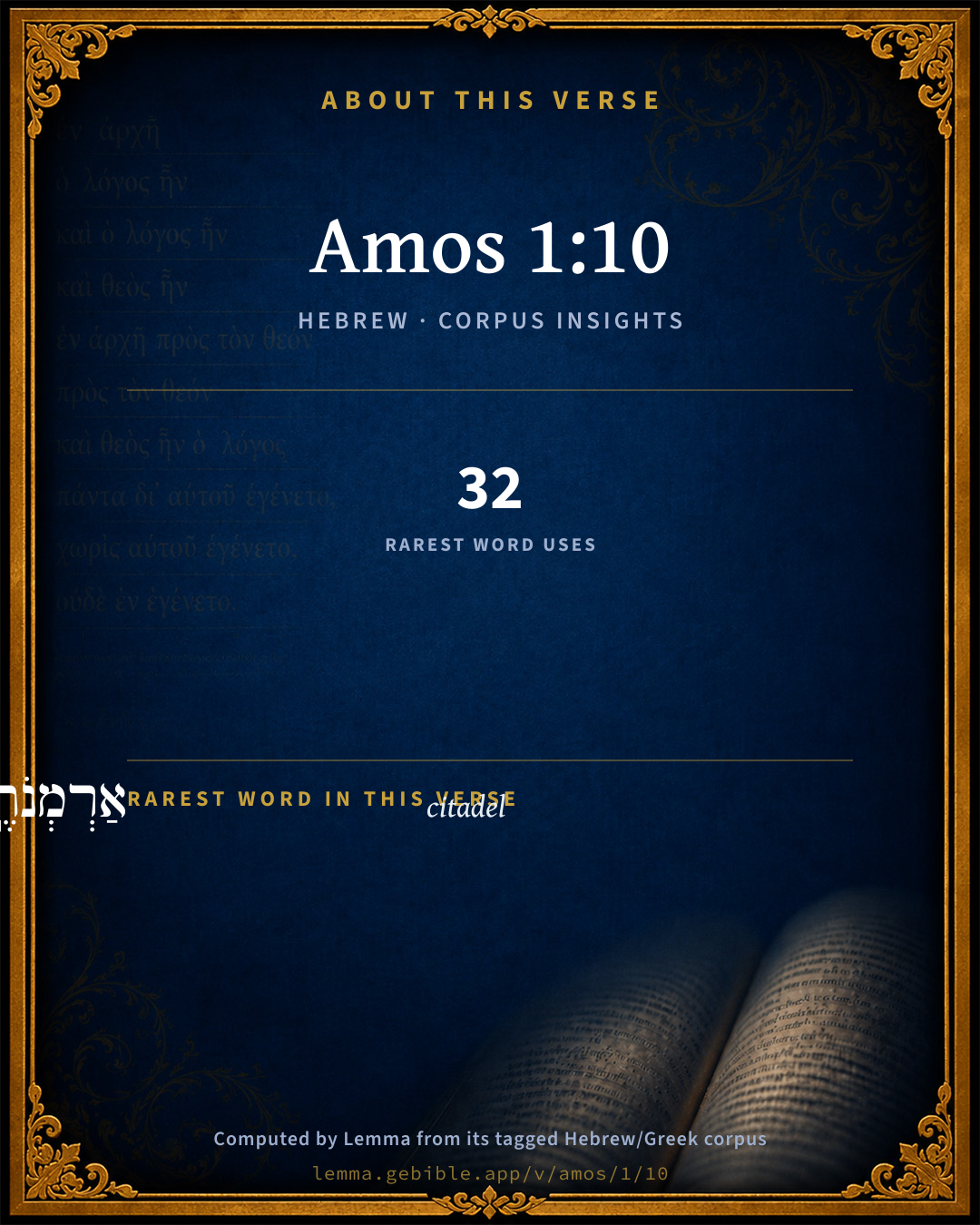
אַרְמְנֹתֶֽיהָ citadel H759 occurs in 31 verses of the Hebrew Bible. Also found in:

Grammatical profile

  • 2 verbs
  • 4 nouns

Verb forms

  • וְשִׁלַּ֥חְתִּי Piel · Sequential Perfect
  • וְאָכְלָ֖ה Qal · Sequential Perfect

Hebrew & Septuagint length

In English translation the verse runs 17 words from the Hebrew and 20 from the Septuagint (LXX English) — closely comparable.

A rough comparison of the two English renderings, which tokenize alike — not a word-level alignment.

Word counts can differ between the Hebrew and the Greek without any difference in meaning — e.g. the Hebrew direct-object marker אֵת has no separate Greek word, and Greek often adds the article ὁ.

Cross-references

4

Topical passages linked to Amos 1:10 in the Treasury of Scripture Knowledge — connected by theme and wording, ordered by reader-vote popularity; previews shown in the World English Bible.

  • Zechariah 9:4 Behold, the Lord will dispossess her, And he will strike her power in the sea; And she will be devoured with fire.
  • Amos 1:7 But I will send a fire on the wall of Gaza, And it will devour its palaces.
  • Ezekiel 26:12 They shall make a spoil of your riches, and make a prey of your merchandise; and they shall break down your walls, and destroy your pleasant houses; and they shall lay your stones and your timber and your dust in the midst of the waters.
  • Amos 1:4 But I will send a fire into the house of Hazael, And it will devour the palaces of Ben Hadad.

Cross-references courtesy of OpenBible.info (CC BY 4.0).

Hebrew and Greek witnesses Masoretic Hebrew ↔ Greek Septuagint

The same verse in the two great witnesses to the Old Testament, shown verse-for-verse.

These are two independent witnesses, not word-aligned to each other, and the Septuagint is shown in lemma (dictionary) form.

Hebrew Amos 1:10 Masoretic · Westminster Leningrad Codex

וְשִׁלַּ֥חְתִּי אֵ֖שׁ בְּח֣וֹמַת צֹ֑ר וְאָכְלָ֖ה אַרְמְנֹתֶֽיהָ

But I will send a fire on the wall of Tyre, And it will devour its palaces."

World English Bible · Public Domain

Greek LXX Amos 1:10 Septuagint · lemma form

καί ἐκ ἀποστέλλω πῦρ ἐπί ὁ τεῖχος τύρος καί καταἐσθίω θεμέλιον αὐτός

And I will send forth a fire on the walls of Tyre, and it shall devour the foundations of it.

LXX2012 (modern English Septuagint) · Public Domain

Hebrew: Westminster Leningrad Codex (CC BY 4.0). Greek: Septuagint (public domain); English from LXX2012 (modern English Septuagint) (Public Domain). How the Septuagint differs from the Hebrew →

Targum (Aramaic paraphrase)

1

The Targum is the ancient Jewish Aramaic paraphrase of the Hebrew Scriptures — an interpretive translation, not the Hebrew text itself. Onkelos (literal) and Pseudo-Jonathan (expansive) render the Torah, and Jonathan the Prophets. Coverage is partial: where no permissively-licensed English translation exists for a verse, only the Aramaic is shown. This is verse-level text, not a word-by-word alignment to the Hebrew.

  1. Targum Jonathan Prophets (Joshua–Malachi)
    וְאֶשְׁלַח אֶשְׁתָּא בְשׁוּרֵי צוֹר וּתְשֵׁיצֵי בִּרְנְיָתָהָא:

    (no public-domain English translation for this verse)

    Targum Jonathan — Aramaic: “Mikraot Gedolot” (public domain). English: “Sefaria Community Translation” (CC0 1.0 (public-domain dedication)); “London "Chaldee Paraphrase," 1871” (public domain). Text via Sefaria.

Commentary

Notes on Amos 1:10 from classic Christian and Jewish commentators (each source and its license shown beneath its notes). The classic Christian expositions comment on the surrounding passage and are grouped to its opening verse, so a note may address several verses; the Jewish commentaries on the Tanakh (Rashi and others) are per-verse, so they appear only where the commentator wrote on this verse.

Lemma curates 59 commentaries, every one of them public domain or Creative Commons licensed, each selected and text-cleaned for this edition rather than reprinted as found. About our sources →

Trapp's Complete Commentary

John Trapp

Amo 1:10 But I will send a fire on the wall of Tyrus, which shall devour the palaces thereof.

Ver. 10. Therefore I will send a fire upon the walls of Tyrus] This was fulfilled shortly after in the war that Shalmaneser waged against the Tyrians, whereof see Joseph. lib. ix. chap. 14. Or in Nebuchadnezzar’s war with them, whereof read Eze 29:18 Jer 27:3; Jer 47:4. Joseph. cont. Apion, lib. 2. Or Alexander’s, Curt. lib. 4; Justin. lib. 11. It is good for men to tremble at God’s judgments while they hang in the threatenings, as Josiah did; and not to tempt the Spirit of the Lord, as Ananias and Sapphira did, Act 5:9, by putting it to the proof, whether he will be dicti sui Dominus, as good as his word.

John Trapp, A Commentary or Exposition upon All the Books of the Old and New Testament (1647–1656) — public domain. Text from a community e-Sword module.

Tyndale Open Study Notes

Tyndale Open Resources

1:10 fire on the walls: The main part of Tyre was built on an island, making it almost impossible to capture (see Ezek 26:1–28:19).

Tyndale Open Study Notes — © Tyndale Open Resources, licensed CC BY-SA 4.0. Text via the HelloAO Bible API.

Jamieson, Fausset & Brown

Robert Jamieson, A. R. Fausset & David Brown

fire--(Compare Amo 1:4, Amo 1:7; Isa. 23:1-18; Eze. 26:1-28:26). Many parts of Tyre were burnt by fiery missiles of the Chaldeans under Nebuchadnezzar. Alexander of Macedon subsequently overthrew it.

Jamieson, Fausset & Brown — Commentary Critical and Explanatory on the Whole Bible (1871) — public domain (CC PDM 1.0). Text via the HelloAO Bible API.

Adam Clarke's Commentary

Verse 10. I will send a fire on the wall of Tyrus] The destructive fire or siege by Nebuchadnezzar, which lasted thirteen years, and ended in the destruction of this ancient city; see on Ezekiel, Eze 26:7-14, as above. It was finally ruined by Alexander, and is now only a place for a few poor fishermen to spread their nets upon.

Adam Clarke's Commentary on the Bible (1810–1826) — public domain. Text from a community e-Sword/MySword module.

John Calvin's Commentaries

But he adds, that God would send a fire on the wall of Tyrus to consume its palaces. When this happened, cannot with certainty be known: for though Tyrus was demolished by Alexander, as Gaza also was, these cities, I doubt not, suffered this calamity long before the coming of Alexander of Macedon; and it is probable, as I have already reminded you, that the Assyrians laid waste these countries, and also took possession of Tyrus, though they did not demolish that city; for in Alexander’s time there was no king there, it had been changed into a republic; the people were free, and had the chief authority. There must then have been there no small changes, for the state of the city and its government were wholly different from what they had been. We may then conclude that Tyrus was laid waste by the Assyrians, but afterwards recovered strength, and was a free city in the time of Alexander the Great. Let us now proceed: for I dwell not on every word, as we see that the same expressions are repeated by the Prophet.

John Calvin's Commentaries (1540-1563) — public domain. Text from the Calvin Translation Society English edition (1840s-50s) via the Christian Classics Ethereal Library (ccel.org). Calvin's coverage is partial (roughly two-thirds of the Bible); uncommented books and verses are honest gaps, never fabricated. The 19th-century editor's footnotes and remarks are omitted so the notes are faithfully Calvin's own voice.

John Gill's Exposition

But I will send a fire on the wall of Tyrus,.... An enemy to destroy the walls of it: this was done either by Shalmaneser king of the Assyrians, in the times of Eulaeus king of the Tyrians, of whose expedition against it Josephus (s) makes mention: or by Nebuchadnezzar, who took it after thirteen years' siege of it, in the time of Ithobalus (t): or by Alexander, by whom it was taken, as Curtius (u) relates, after it had been besieged seven months:

which shall devour the palaces thereof; of the governor, the great men and merchants in it. Alexander ordered all to be slain but those that fled to the temples, and fire to be put to the houses; which made it a most desolate place, as the above historian has recorded.

(s) Antiqu. l. 9. c. 14. sect. 2. (t) Hist. Phoenic. apud Joseph. contr. Apion. l. 1. c. 21. (u) Hist. l. 4. c. 4.

John Gill's Exposition of the Whole Bible (1746–1763) — public domain (CC PDM 1.0). Text via the HelloAO Bible API.

Albert Barnes' Notes on the Bible

I will send a fire upon the wall of Tyre - Tyre had long ere this become tributary to Assyria. Asshur-ban-ipal (about 930 b.c.,) records his “taking tribute from the kings of all the chief Phoenician cities as Tyre, Sidon, Biblus and Aradus” . His son Shalmanubar records his taking tribute from them in his 21st year about 880, b.c.), as did Ivalush III , and after this time Tiglath-pileser II , the same who took Damascus and carried off its people, as also the east and north of Israel. The Phoenicians had aided Benhadad, in his unsuccessful war or rebellion against Shalmanubar , but their city had received no hurt. There was nothing, in the time of Amos, to indicate any change of policy in the Assyrian conquerors.

They had been content hitherto with tribute from their distant dependencies; they had spared them, even when in arms against them. Yet Amos says absolutely in the name of God, “I will send a fire upon the wall of Tyre,” and the fire did fall, first from Shalamaneser or Sargon his successor, and then from Nebuchadnezzar. The Tyrians (as is men’s custom) inserted in their annals their successes, or the successful resistance which they made for a time. They relate that , “Elulaeus, king of Tyre, reduced the Kittiaeans (Cypriotes) who had revolted. The king of Assyria invaded all Phoenicia, and returned, having made peace with all. Sidon and Ace and old Tyre, and many other cities revolted from the Tyrians, and surrendered to the king of Assyria. Tyre then not obeying, the king returned against them, the Phoenicians manning 60 ships for him.” These, he says, were dispersed, 500 prisoners taken; the honor of Tyre intensified. “The king of Assyria, removing, set guards at the river and aqueducts, to hinder the Tyrians from drawing water. This they endured for 5 years, drinking from the wells sunk.”

The Tyrian annalist does not relate the sequel. He does not venture to say that the Assyrian King gave up the siege, but, having made the most of their resistance, breaks off the account. The Assyrian inscriptions say, that Sargon took Tyre , and received tribute from Cyprus, where a monument has been found, bearing the name of Sargon . It is not probable that a monarch who took Samaria and Ashdod, received tribute from Egypt, the “Chief of Saba,” and “Queen of the Arabs,” overran Hamath, Tubal, Cilicia, Armenia, reduced Media, should have returned baffled, because Tyre stood out a blockade for 5 years. Since Sargon wrested from Tyre its newly-recovered Cyprus, its insular situation would not have protected itself. Nebuchadnezzar took it after a 13 years’ siege (Eze 26:7-12, see the notes at Isa. 23).

Albert Barnes' Notes on the Bible (1834–1885) — public domain. Text from a community e-Sword/MySword module.

Haydock's Catholic Bible Commentary

Thereof. Salmanasar besieged it five years (Menander) and Nabuchodonosor thirteen, when he destroyed Tyre, Ezechiel xxvi.

George Leo Haydock (1774–1849), Haydock's Catholic Family Bible and Commentary, 1859 edition — public domain. Excludes Psalms (Douay-Rheims chapter numbering differs from Protestant) and Deuterocanonical books (Catholic canon only).

The Pulpit Commentary

A fire, as ver. 7: see Ezekiel"s prophecy against Tyre (26). She had long been tributary to Assyria, but, revolting, was punished by Sargon, and later was attacked by Nebuchadnezzar, who besieged it for thirteen years, with what success is not known. The Assyrian monuments afford no account of its capture by this monarch. (comp. Isa 23; Jer_47:4; Arrian., 2:16-24) (For its capture and destruction by Alexander the Great, see notes on Zec_9:2, Zec_9:4)

The Pulpit Commentary (1880–1919), ed. H.D.M. Spence-Jones & Joseph S. Exell — public domain. Text from a community e-Sword module.

Lesson kit

Teaching starters — assembled from the data on this page, not authored interpretation. Every prompt links to the verse data it draws on. Edit before teaching.

Amos, in the Prophets, opens this verse with 6 words (6 distinct Hebrew lemmas). Its most distinctive word is ʼarmôwn (“citadel”). A historical commentator’s framing appears above. Read the whole chapter for the surrounding context.

Discussion questions

  1. The word ʼarmôwn carries the sense “citadel.” How does it shape the verse?
  2. 1 Kings 16:18 shares the word «citadel» with this verse. How do the two illuminate each other?
  3. These translations render this verse differently; the difference is in the English rendering, not the original. What questions does that raise?
  4. The verb «וְשִׁלַּ֥חְתִּי» is Piel Sequential Perfect. How does its form color the action?
  5. Reading how Trapp's Complete Commentary and Tyndale Open Study Notes read this verse, where do the two commentators agree and where do they part?

Things to notice

Reading settings

Reading text

Shown beneath each verse's original-language words.

Old Testament
Old Testament edition

Read the OT as the Masoretic Hebrew (MT) or the Greek Septuagint (LXX).

English shown for the Greek Septuagint (in the Hebrew ↔ Greek comparison).

Comparing translations? Open the Compare panel on any verse page to stack up to four side by side.