
Jeremiah 51:58

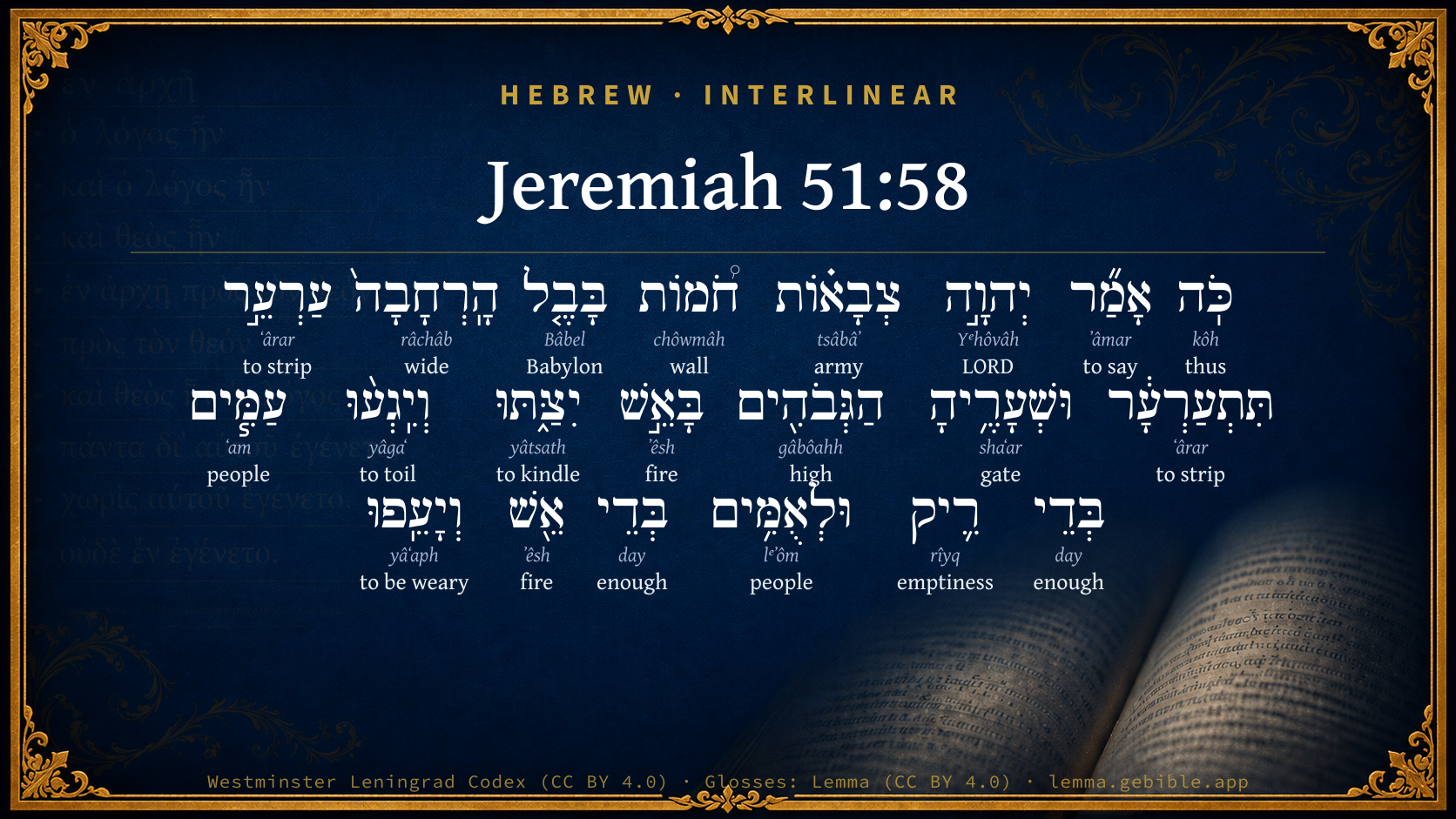
Hebrew (Westminster Leningrad Codex) Jeremiah 51:58 appears in the Hebrew Old Testament. The text above is from the Westminster Leningrad Codex. Each word links to its Strong’s number, a concise gloss, and parsing drawn from the Open Scriptures Hebrew Bible morphology. Click any word for its full Brown-Driver-Briggs (BDB) entry.
Download image
Cite this verse

Jeremiah 51:58 (World English Bible). Public Domain. Lemma interlinear Bible study tool, https://lemma.gebible.app/v/jeremiah/51/58.

Show BibTeX & RIS
BibTeX
RIS
English Translation
Thus says Yahweh of hosts: The broad walls of Babylon shall be utterly overthrown, and her high gates shall be burned with fire; and the peoples shall labor for vanity, and the nations for the fire; and they shall be weary.
World English Bible · Public Domain
Download a study sheet

One document with this verse’s original text, its word-by-word gloss line, the meaning frame, cross-references with their text, attributed commentary, and full source and license credits — printable, and it pastes into notes with its structure intact.

This verse Autodidact and up

Study sheet (.html) Plain text (.txt)

A passage Seminary Student

Up to 50 verses in one chapter. A passage sheet keeps up to 6 commentary sources and 12 cross-references per verse, in the order this page ranks them, and says so on the sheet whenever that leaves anything out. Ask for a single verse and you get the Autodidact verse sheet above.

Everything on this page stays free to read, with no account — the sheet is a download of what is already on screen, not access to it.

Want to remove ads? Support Godless Engineer
Compare translations 3

The same verse in 3 English versions, stacked beneath the original-language interlinear above. Click any original word for its lexicon entry.

Each is an independent rendering of the whole verse — the interlinear is not word-aligned to these translations.

Highlighted words mark where these versions differ — a whole-verse word diff, not a word-by-word alignment.

  • World English Bible Public Domain
    Thus says Yahweh of hosts: The broad walls of Babylon shall be utterly overthrown, and her high gates shall be burned with fire; and the peoples shall labor for vanity, and the nations for the fire; and they shall be weary.
  • King James Version Public Domain
    Thus saith the LORD of hosts; The broad walls of Babylon shall be utterly broken, and her high gates shall be burned with fire; and the people shall labour in vain, and the folk in the fire, and they shall be weary.
  • unfoldingWord Literal Text CC BY-SA 4.0
    Yahweh of hosts says this: The thick walls of Babylon will be completely demolished, and her high gates will be burned. Then the peoples coming to her aid will labor uselessly; everything that the nations try to do for her will be burned up.”

unfoldingWord Literal Text — © unfoldingWord, licensed CC BY-SA 4.0. Word-aligned USFM3 via Door43 (git.door43.org/unfoldingWord/en_ult).

Versions to compare (up to 4)

3 of 4 selected

Show all 18 translations

Every available English version of this verse, each an independent rendering of the whole verse.

  • World English Bible Public Domain
    Thus says Yahweh of hosts: The broad walls of Babylon shall be utterly overthrown, and her high gates shall be burned with fire; and the peoples shall labor for vanity, and the nations for the fire; and they shall be weary.
  • Berean Standard Bible Public Domain
    This is what the LORD of Hosts says: “Babylon’s thick walls will be leveled, and her high gates consumed by fire. So the labor of the people will be for nothing; the nations will exhaust themselves to fuel the flames.”
  • Majority Standard Bible Public Domain
    This is what the LORD of Hosts says: “Babylon’s thick walls will be leveled, and her high gates consumed by fire. So the labor of the people will be for nothing; the nations will exhaust themselves to fuel the flames.”
  • King James Version Public Domain
    Thus saith the LORD of hosts; The broad walls of Babylon shall be utterly broken, and her high gates shall be burned with fire; and the people shall labour in vain, and the folk in the fire, and they shall be weary.
  • American Standard Version (1901) Public Domain
    Thus saith Jehovah of hosts: The broad walls of Babylon shall be utterly overthrown, and her high gates shall be burned with fire; and the peoples shall labor for vanity, and the nations for the fire; and they shall be weary.
  • Revised Version (1885) Public Domain
    Thus saith the LORD of hosts: The broad walls of Babylon shall be utterly overthrown, and her high gates shall be burned with fire; and the peoples shall labour for vanity, and the nations for the fire; and they shall be weary.
  • Geneva Bible (1599) Public Domain
    Thus saith the Lord of hostes, The thicke wall of Babel shalbe broken, and her hie gates shall be burnt with fire, and the people shall labour in vaine, and the folke in ye fire, for they shalbe weary.
  • Douay-Rheims (1899) Public Domain
    Thus saith the Lord of hosts: That broad wall of Babylon shall be utterly broken down, and her high gates shall be burnt with fire, and the labours of the people shall come to nothing, and of the nations shall go to the fire, and shall perish.
  • Young's Literal Translation Public Domain
    Thus said Jehovah of Hosts, the wall of Babylon -- The broad one -- is utterly made bare, And her high gates with fire are burnt, And peoples labour in vain, And nations in fire, and have been weary!
  • Literal Standard Version CC BY-SA 4.0
    Thus said YHWH of Hosts: The wall of Babylon—The broad one—is made utterly bare, || And her high gates are burned with fire, || And peoples labor in vain, || And nations in fire, and have been weary!”
  • Unlocked Literal Bible CC BY-SA 4.0
    Yahweh of hosts says this: The thick walls of Babylon will be completely demolished, and her high gates will be burned. Then the peoples coming to her aid will labor uselessly; everything that the nations try to do for her will be burned up.”
  • unfoldingWord Literal Text CC BY-SA 4.0
    Yahweh of hosts says this: The thick walls of Babylon will be completely demolished, and her high gates will be burned. Then the peoples coming to her aid will labor uselessly; everything that the nations try to do for her will be burned up.”
  • Darby Bible Public Domain
    Thus saith Jehovah of hosts: The broad walls of Babylon shall be utterly laid bare, and her high gates shall be burned with fire; so that the peoples will have laboured in vain, and the nations for the fire: and they shall be weary.
  • World Messianic Bible Public Domain
    The LORD of Hosts says: “The wide walls of Babylon will be utterly overthrown. Her high gates will be burned with fire. The peoples will labor for vanity, and the nations for the fire; and they will be weary.”
  • Webster's Bible Public Domain
    Thus saith the LORD of hosts; The broad walls of Babylon shall be utterly broken, and her high gates shall be burned with fire; and the people shall labor in vain, and the people in the fire, and they shall be weary.
  • Free Bible Version CC BY-SA 4.0
    This is what the Lord Almighty says: Babylon's massive walls will be knocked down to the ground and her high gates burned. All that the people worked for will be for nothing; other nations who came to help will wear themselves out, only to see what they've done go up in flames.
  • Bible in Basic English Public Domain
    The Lord of armies has said: The wide walls of Babylon will be completely uncovered and her high doorways will be burned with fire; so peoples keep on working for nothing, and the weariness of nations comes to an end in the smoke.
  • JPS Tanakh (1917) Public Domain
    Thus saith the LORD of hosts: The broad walls of Babylon shall be utterly overthrown, and her high gates shall be burned with fire; and the peoples shall labour for vanity, and the nations for the fire; and they shall be weary.

Literal Standard Version (2020), Covenant Press — licensed CC BY-SA 4.0. Text via the HelloAO Bible API (eBible.org). Unlocked Literal Bible (unfoldingWord) — licensed CC BY-SA 4.0. Text via the HelloAO Bible API (eBible.org). unfoldingWord Literal Text — © unfoldingWord, licensed CC BY-SA 4.0. Word-aligned USFM3 via Door43 (git.door43.org/unfoldingWord/en_ult). Free Bible Version, Dr. Jonathan Gallagher — licensed CC BY-SA 4.0. Text via the HelloAO Bible API (eBible.org).

Word by word

More ways to search: Search by grammar → Find every occurrence → Compare this word →

Practice this passage: Drill this verse → Learn its vocabulary →

עַרְעֵ֣ר
ʻârar
H6209
“to strip”
Verb, Pilpel, Infinitive Absolute
Part of Speech
Verb
Stem
Pilpel
Form
Infinitive Absolute
Full BDB Definition

Origin: a primitive root

TWOT: 1705

to strip, make bare, strip oneself - (Qal) to strip, strip oneself - (Poel) to lay bare - (Hithpalpel) to be utterly stripped, be utterly laid bare - (Pilpel) break
  1. כֹּֽה kôh H3541 “thus” Adverb
  2. אָמַ֞ר ʼâmar H559 “to say” Verb, Qal, Perfect, 3rd Person, Masculine, Singular
  3. יְהוָ֣ה Yᵉhôvâh H3068 “LORD” Noun, Proper
  4. צְבָא֗וֹת tsâbâʼ H6635 “armies” Noun, Common, Both, Plural, Absolute
  5. חֹ֠מוֹת chôwmâh H2346 “walls of” Noun, Common, Feminine, Plural, Construct
  6. בָּבֶ֤ל Bâbel H894 “Babylon” Noun, Proper
  7. הָֽרְחָבָה֙ râchâb H7342 “the · wide” Particle, Definite Article + Adjective, Adjective, Feminine, Singular, Absolute
  8. תִּתְעַרְעָ֔ר ʻârar H6209 “to strip” Verb, Hithpalpel, Imperfect, 3rd Person, Feminine, Singular
  9. וּשְׁעָרֶ֥יהָ shaʻar H8179 “and · gates · her” Conjunction + Noun, Common, Masculine, Plural, Construct + Suffix, Personal, 3rd Person, Feminine, Singular
  10. הַגְּבֹהִ֖ים gâbôahh H1364 “the · high” Particle, Definite Article + Adjective, Adjective, Masculine, Plural, Absolute
  11. בָּאֵ֣שׁ ʼêsh H784 “in/at the · fire” Preposition, Determined + Noun, Common, Both, Singular, Absolute
  12. יִצַּ֑תּוּ yâtsath H3341 “to kindle” Verb, Qal, Imperfect, 3rd Person, Masculine, Plural
  13. וְיִֽגְע֨וּ yâgaʻ H3021 “and · to toil” Conjunction + Verb, Qal, Imperfect, 3rd Person, Masculine, Plural
  14. עַמִּ֧ים ʻam H5971 “peoples” Noun, Common, Masculine, Plural, Absolute
  15. בְּדֵי day H1767 “in/at · enough of” Preposition + Noun, Common, Masculine, Singular, Construct
  16. רִ֛יק rîyq H7385 “emptiness” Noun, Common, Masculine, Singular, Absolute
  17. וּלְאֻמִּ֥ים lᵉʼôm H3816 “and · peoples” Conjunction + Noun, Common, Masculine, Plural, Absolute
  18. בְּדֵי day H1767 “in/at · enough of” Preposition + Noun, Common, Masculine, Singular, Construct
  19. אֵ֖שׁ ʼêsh H784 “fire” Noun, Common, Both, Singular, Absolute
  20. וְיָעֵֽפוּ yâʻaph H3286 “and · to be weary” Conjunction + Verb, Qal, Sequential Perfect, 3rd Person, Common, Plural

About this verse

These counts appear in no published source. They are computed here, from the morphology-tagged text and Lemma’s own curated glosses. What Lemma adds →

21
words
18
distinct lemmas
Prophets
section

Notable vocabulary

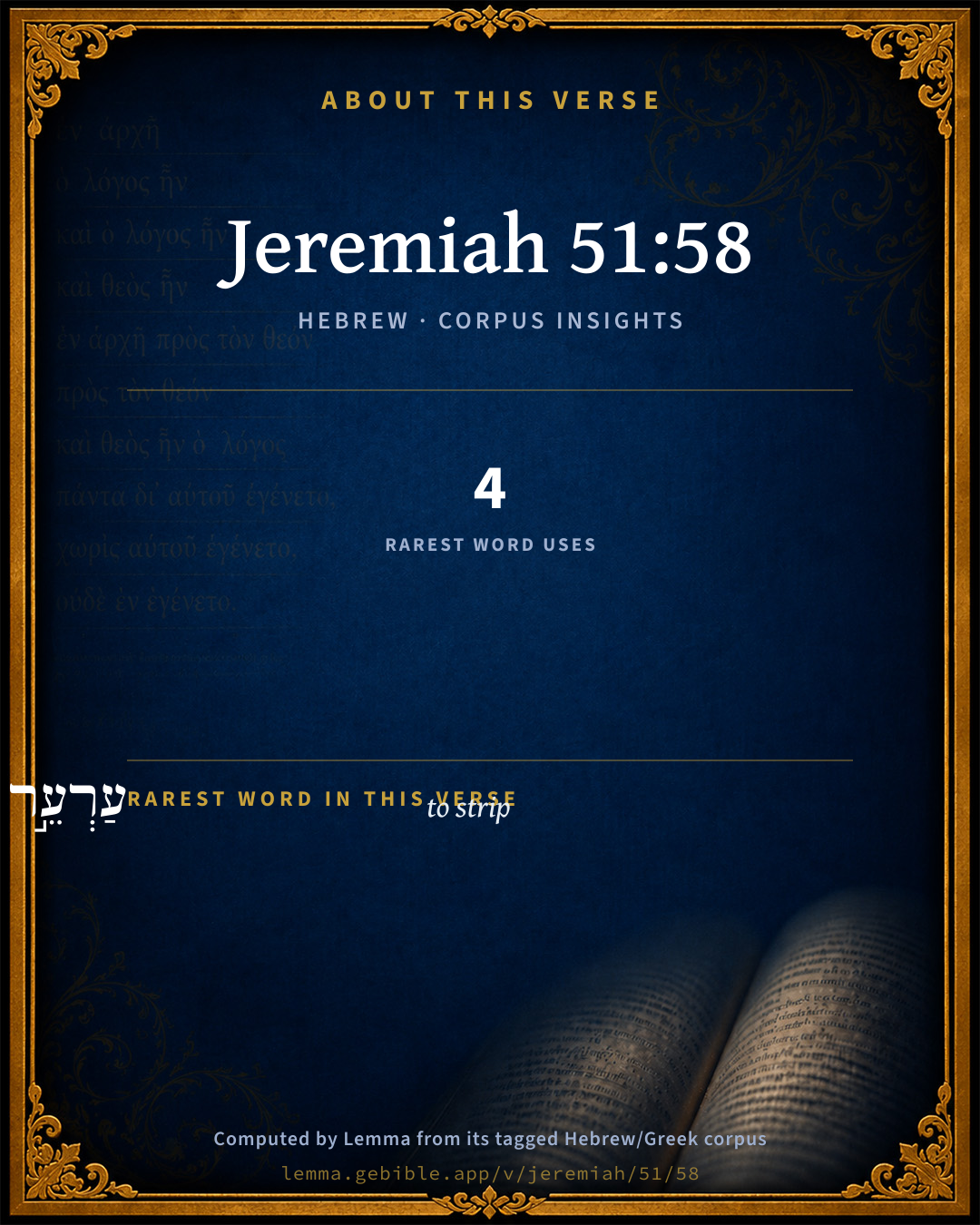
The rarest word here is עַרְעֵ֣ר to strip H6209 — appearing just 4 times in the whole Hebrew Bible.

Shared distinctive vocabulary

עַרְעֵ֣ר to strip H6209 occurs in 3 verses of the Hebrew Bible. Also found in:

Grammatical profile

  • 6 verbs
  • 12 nouns
  • 2 adjectives
  • 1 adverb

Verb forms

  • אָמַ֞ר Qal · Perfect
  • עַרְעֵ֣ר Pilpel · Infinitive Absolute
  • תִּתְעַרְעָ֔ר Hithpalpel · Imperfect
  • יִצַּ֑תּוּ Qal · Imperfect
  • וְיִֽגְע֨וּ Qal · Imperfect
  • וְיָעֵֽפוּ Qal · Sequential Perfect

Repetition

Words recur within this verse — often emphatic in Hebrew:

  • עַרְעֵ֣ר to strip H6209 ×2
  • בָּאֵ֣שׁ fire H784 ×2
  • בְּדֵי enough H1767 ×2

Cross-references

9

Topical passages linked to Jeremiah 51:58 in the Treasury of Scripture Knowledge — connected by theme and wording, ordered by reader-vote popularity; previews shown in the World English Bible.

  • Habakkuk 2:13 Behold, isn't it of Yahweh of Hosts that the peoples labor for the fire, and the nations weary themselves for vanity?
  • Jeremiah 50:15 Shout against her round about: she has submitted herself; her bulwarks are fallen, her walls are thrown down; for it is the vengeance of Yahweh: take vengeance on her; as she has done, do to her.
  • Jeremiah 51:44 I will execute judgment on Bel in Babylon, and I will bring forth out of his mouth that which he has swallowed up; and the nations shall not flow any more to him: yes, the wall of Babylon shall fall.
  • Jeremiah 51:64 and you shall say, Thus shall Babylon sink, and shall not rise again because of the evil that I will bring on her; and they shall be weary. Thus far are the words of Jeremiah.
  • Isaiah 45:1–2 Thus says Yahweh to his anointed, to Cyrus, whose right hand I have held, to subdue nations before him, and I will loose the loins of kings; to open the doors before him, and the gates shall not be shut:
  • Psalms 127:1 Unless Yahweh builds the house, They labor in vain who build it. Unless Yahweh watches over the city, The watchman guards it in vain.
  • Isaiah 65:23 They shall not labor in vain, nor bring forth for calamity; for they are the seed of the blessed of Yahweh, and their offspring with them.
  • Jeremiah 51:9 We would have healed Babylon, but she is not healed: forsake her, and let us go everyone into his own country; for her judgment reaches to heaven, and is lifted up even to the skies.
  • Jeremiah 51:30 The mighty men of Babylon have forborne to fight, they remain in their strongholds; their might has failed; they are become as women: her dwelling-places are set on fire; her bars are broken.

Cross-references courtesy of OpenBible.info (CC BY 4.0).

Hebrew and Greek witnesses Masoretic Hebrew ↔ Greek Septuagint

The same verse in the two great witnesses to the Old Testament, shown verse-for-verse.

These are two independent witnesses, not word-aligned to each other, and the Septuagint is shown in lemma (dictionary) form.

Hebrew Jeremiah 51:58 Masoretic · Westminster Leningrad Codex

כֹּֽה אָמַ֞ר יְהוָ֣ה צְבָא֗וֹת חֹ֠מוֹת בָּבֶ֤ל הָֽרְחָבָה֙ עַרְעֵ֣ר תִּתְעַרְעָ֔ר וּשְׁעָרֶ֥יהָ הַגְּבֹהִ֖ים בָּאֵ֣שׁ יִצַּ֑תּוּ וְיִֽגְע֨וּ עַמִּ֧ים בְּדֵי רִ֛יק וּלְאֻמִּ֥ים בְּדֵי אֵ֖שׁ וְיָעֵֽפוּ

Thus says Yahweh of hosts: The broad walls of Babylon shall be utterly overthrown, and her high gates shall be burned with fire; and the peoples shall labor for vanity, and the nations for the fire; and they shall be weary.

World English Bible · Public Domain

Greek LXX Structure differs

In the Septuagint, Jeremiah is about an eighth shorter than the Hebrew and arranges its material differently — the Oracles Against the Nations (Hebrew chapters 46–51) appear in the middle of the Greek book, after 25:13. Because the chapter and verse boundaries do not line up, a verse-for-verse comparison with the Hebrew is not shown.

A verse-for-verse comparison isn’t shown here because the chapters and verses don’t line up. Switch to the LXX edition with the MT / LXX toggle above to read the Greek directly.

On this verse, The Cambridge Bible for Schools and Colleges discusses the Septuagint’s reading. Read the note in Commentary ↓

Hebrew: Westminster Leningrad Codex (CC BY 4.0). Greek: Septuagint (public domain); English from a public-domain English Septuagint. How the Septuagint differs from the Hebrew →

Targum (Aramaic paraphrase)

1

The Targum is the ancient Jewish Aramaic paraphrase of the Hebrew Scriptures — an interpretive translation, not the Hebrew text itself. Onkelos (literal) and Pseudo-Jonathan (expansive) render the Torah, and Jonathan the Prophets. Coverage is partial: where no permissively-licensed English translation exists for a verse, only the Aramaic is shown. This is verse-level text, not a word-by-word alignment to the Hebrew.

  1. Targum Jonathan Prophets (Joshua–Malachi)
    כִּדְנַן אֲמַר יְיָ צְבָאוֹת שׁוּרֵי בָּבֶל פָּתַיָא אִתְחַמָרָא יִתְחַמְרוּן וְתַרְעָהָא רָמַיָא בְּנוּרָא יִתּוֹקְדוּן וְיֶהְלוּן עַמְמַיָא דְבָבֶל לְרֵיקָנוּ וּמַלְכְּוָתָא תְסוּף אֶשְׁתָּא וְיִשְׁתַּלְהוּן:

    (no public-domain English translation for this verse)

    Targum Jonathan — Aramaic: “Mikraot Gedolot” (public domain). English: “Sefaria Community Translation” (CC0 1.0 (public-domain dedication)); “London "Chaldee Paraphrase," 1871” (public domain). Text via Sefaria.

Commentary

Notes on Jeremiah 51:58 from classic Christian and Jewish commentators (each source and its license shown beneath its notes). The classic Christian expositions comment on the surrounding passage and are grouped to its opening verse, so a note may address several verses; the Jewish commentaries on the Tanakh (Rashi and others) are per-verse, so they appear only where the commentator wrote on this verse.

Lemma curates 59 commentaries, every one of them public domain or Creative Commons licensed, each selected and text-cleaned for this edition rather than reprinted as found. About our sources →

Trapp's Complete Commentary

John Trapp

Jer 51:58 Thus saith the LORD of hosts; The broad walls of Babylon shall be utterly broken, and her high gates shall be burned with fire; and the people shall labour in vain, and the folk in the fire, and they shall be weary.

Ver. 58. The broad walls of Babylon.] See on Jer 51:44. Or, The walls of broad Babylon, that greatest of all cities, saith Strabo; {a} the compass whereof within the walls was near upon seventy miles, saith Pliny. {b}

{a} Lib. xvi.

{b} Lib. vi. cap. 26.

John Trapp, A Commentary or Exposition upon All the Books of the Old and New Testament (1647–1656) — public domain. Text from a community e-Sword module.

Joseph Benson's Commentary

Jer 51:58. The broad walls of Babylon shall be utterly broken, &c. — That the walls of Babylon were of a prodigious height and thickness, Herodotus tells, who says, they were 200 cubits high, and 50 cubits in breadth, lib. 1. cap. 178. “We are astonished,” says Bishop Lowth, in his note on Isa 13:19, “at the accounts which ancient historians of the best credit give, of the immense extent, height, and thickness of the walls of Nineveh and Babylon; nor are we less astonished, when we are assured by the concurrent testimony of modern travellers, that no remains, not the least traces, of these prodigious works, are to be found. Our wonder will, I think, be moderated in both respects, if we consider the fabric of these celebrated walls, and the nature of the materials of which they consisted. Buildings in the East have always been, and are to this day, made of earth or clay mixed, or beat up with straw, to make the parts cohere, and dried only in the sun. This is their method of making bricks. The walls of the city were built of the earth, digged out of the spot, and dried upon the place; by which means both the ditch and the wall were at once formed; the former furnishing materials for the latter. That the walls of Babylon were of this kind is well known; and Berosus expressly says, (apud Joseph. Antiq. Jer 10:11,) that Nebuchadnezzar added three new walls, both to the old and new city, partly of brick and bitumen, and partly of brick alone. A wall of this sort must have a great thickness in proportion to its height, otherwise it cannot stand. The thickness of the walls of Babylon is said to have been one-fourth of their height; which seems to have been no more than was absolutely necessary.” Her high gates shall be burned, and the people shall labour in vain, &c. — If the Chaldeans take never so much pains to quench the fire, it shall be to no purpose; and all their efforts to preserve their empire and city shall be as insignificant as if men wrought in the fire, which immediately destroys all the fruits of their labours. The words may be better translated, “And the people have laboured for a thing of naught, and the folks have wearied themselves for that which shall be fuel for the fire;” that is, the works which have been erected with such incredible labour and expense, shall be a prey to the flames.

Joseph Benson's Commentary on the Old and New Testaments (1811–1818) — public domain. Text from a community e-Sword module.

Keil & Delitzsch

C. F. Keil & F. Delitzsch

And not only are the defenders of the city to fall, but the strong ramparts also, the broad walls and the lofty towers, are to be destroyed. The adjective הרחבה is joined in the singular with the plural חמות, because the complex notion of the walls of Babylon, denoted by the latter word, is viewed as a unity; cf. Ewald, 318. ערר, in Hithpael, means "to be made bare," i.e., to be destroyed down to the ground; the inf. abs. Pilel is added to intensify the expression. Regarding the height and breadth and the extent of the walls of Babylon, cf. the collection of notices by the old writers in Duncker's Gesch. des Alt. i. S. 856ff. According to Herodotus (i. 178f.), they were fifty ells "royal cubits," or nearly 85 feet thick, and 200 ells 337 1/2 feet high; Ctesias assigns them a height of 300 feet, Strabo that of 50 ells cubits, or 75 feet, and a breadth of 32 feet. On this Duncker remarks: "The height and breadth which Herodotus gives to the walls are no doubt exaggerated. Since the wall of Media, the first line of defence for the country, had a height of 100 feet and a breadth of 20 feet, and since Xenophon saw in Nineveh walls 150 feet in height, we shall be able with some degree of certainty to assume, in accordance with the statement of Pliny (vi. 26), that the wall of Babylon must have had a height of 200 feet above the ditch, and a proportionate breadth of from 30 to 40 feet. This breadth would be sufficient to permit of teams of four being driven along the rampart, between the battlements, as Herodotus and Strabo inform us, without touching, just as the rampart on the walls of Nineveh is said to have afforded room for three chariots."

(Note: For details as to the number of the walls, and statistics regarding them, see Duncker, S. 858, Anm. 3, who is inclined to understand the notice of Berosus regarding a triple wall as meaning that the walls of the river are counted as the second, and those round the royal fortress as the third line of circumvallation. J. Oppert, Expd. en Msop. i. p. 220ff., has given a thorough discussion of this question. By carefully comparing the accounts of the ancient writers regarding the walls of Babylon, and those given in the inscriptions, lately discovered and deciphered, found on the buildings of Sennacherib and Nebuchadnezzar, with the vast extent of the long mounds of rubbish on the places where the ruins are met with, he has obtained this result, - that the city was surrounded by a strong double wall with deep ditches, an outer and an inner enceinte, and that the outer or large wall enclosed a space of 513 square kilometres, i.e., a piece of ground as large as the department of the Seine, fifteen times the extent of the city of Paris in the year 1859, seven times that of the same city in 1860, while the second or inner wall enclosed an area of 290 square kilometres, much larger than the space occupied by London.)

The gates leading into the city were, according to Herodotus, l.c., provided with beautifully ornamented gateways; the posts, the two leaves of the gates, and the thresholds, were of bronze. The prophecy concludes, Jer 51:58, with some words from Hab 2:13, which are to be verified by the destruction of Babylon, viz., that the nations which have built Babylon, and made it great, have laboured in vain, and only wearied themselves. Habakkuk probably does not give this truth as a quotation from an older prophet, but rather declares it as an ordinance of God, that those who build cities with blood, and strongholds with unrighteousness, make nations toil to supply food for fire. Jeremiah has made use of the passage as a suitable conclusion to his prophecy, but made some unimportant alterations; for he has transposed the words בּדי אשׁ and בּדי ריק, and changed יעפוּ into ויעפוּ, that he may conclude his address with greater emphasis. For, according to the arrangement here, וּלאמּים בּדי־אשׁ still depends on ויגעוּ, and ויעפוּ indicates the result of this toil for the enslaved nations, - they only weary themselves thereby. The genuineness of this reading is put beyond a doubt by the repetition of ויעפוּ at the close of the epilogue in Jer 51:64. What Habakkuk said generally of the undertakings of the Chaldeans, Jeremiah applied specially to the fall of the city of Babylon, because it was to exhibit its fulfilment most plainly in that event.

Keil & Delitzsch — Biblical Commentary on the Old Testament (1861–1891) — public domain (CC PDM 1.0). Text via the HelloAO Bible API. (Old Testament only.)

Geneva Bible (1599)

Geneva Bible translators

The thickness of the wall was fifty foot thick.

Geneva Bible (1599) marginal notes — public domain. Text via Bolls.life.

Jamieson, Fausset & Brown

Robert Jamieson, A. R. Fausset & David Brown

broad walls--eighty-seven feet broad [ROSENMULLER]; fifty cubits [GROTIUS]. A chariot of four horses abreast could meet another on it without collision. The walls were two hundred cubits high, and four hundred and eighty-five stadia, or sixty miles in extent.

gates--one hundred in number, of brass; twenty-five on each of the four sides, the city being square; between the gates were two hundred and fifty towers. BEROSUS says triple walls encompassed the outer, and the same number the inner city. Cyrus caused the outer walls to be demolished. Taking the extent of the walls to be three hundred and sixty-five stadia, as DIODORUS states, it is said two hundred thousand men completed a stadium each day, so that the whole was completed in one year.

labour . . . in the fire--The event will show that the builders of the walls have "labored" only for the "fire" in which they shall be consumed, "In the fire" answers to the parallel, "burned with fire." Translate, "shall have labored in vain," &c. Compare Job 3:14, "built desolate places for themselves," that is, grand places, soon about to be desolate ruins. Jeremiah has in view here Hab 2:13.

Jamieson, Fausset & Brown — Commentary Critical and Explanatory on the Whole Bible (1871) — public domain (CC PDM 1.0). Text via the HelloAO Bible API.

Adam Clarke's Commentary

Verse 58. The broad walls of Babylon] Herodotus, who saw these walls, says, "The city was a regular square, each side of which was one hundred and twenty stadia, the circumference four hundred and eighty stadia. It was surrounded by a wall fifty cubits broad, and two hundred cubits high; and each side had twenty-five brazen gates." - Herod. lib. i. c. 178. Had not Cyrus resorted to stratagem, humanly speaking, he could not have taken this city. For the destruction of this wall and its very vestiges, See Clarke on Isa 13:19.

Adam Clarke's Commentary on the Bible (1810–1826) — public domain. Text from a community e-Sword/MySword module.

John Calvin's Commentaries

The Prophet again introduces God as the speaker, that what he said might obtain more attention from the Jews; and for this reason he subjoined a eulogy to the last verse, and said that the king spoke, whose name is Jehovah of hosts We have stated elsewhere what is the design of such expressions, even that men may rise above everything seen in the world when God’s power is mentioned, that they may not try to contain it in their own small measure. Then the Prophet now again repeats the name of God, that the Jews might receive with becoming reverence what he announced.

And what he says is, The wall of Babylon, however wide it may be, shall yet be surely demolished. We have said that the walls were fifty feet wide, and the feet were indeed long, though Herodotus, as I have said, mentions cubits and not feet. The width, indeed, was such that four horses abreast meeting, could pass, there being space enough for them. It hence, then, appears, that their thickness was so great, that the Babylonians confidently disregarded whatever had been predicted by the Prophet; for no engines of war could have ever beaten down walls so thick, especially as they were made of bricks and cemented by bitumen. As, then, the material, beside the thickness, was so firm and strong, this prophecy was incredible. It did not indeed reach the Babylonians, but the Jews themselves regarded as a fable all that they had heard from the mouth of the Prophet. Yet God did not in vain refer to width of the wall, in order that the faithful might feel assured that the walls of Babylon could not possibly resist him, however firm they might be in their materials and thickness. The wall, he says, shall surely be demolished.

He afterwards mentions the gates, which Herodotus says were of brass when Darius took them away. He, indeed, means the doors, but the Prophet includes the framework as well as the brazen doors. He then says, they shall be consumed with fire The Babylonians might have laughed at this threatening of Jeremiah, for brass could not have been consumed with fire, even if enemies had been permitted to set fire to them — for brass could not have been so soon melted. But as the Prophet had predicted this by God’s command, so at length his prophecy was verified when he was dead, because it was proved by the event that this proceeded from God; for when the doors were removed, the gates themselves were demolished; and it may have been that Darius put fire to them, that he might the sooner destroy the gates and the towers, which were very high, as well as the walls.

He afterwards adds, Labor shall the people in vain, and the nations in the fire; they shall be wearied So this passage is commonly explained, as though the Prophet had said, that when the walls of Babylon had begun to burn, and the gates to be consumed with fire, there would be no remedy, though the Babylonians might greatly weary themselves and fatigue themselves in attempting to quench the fire. But this exposition seems to be forced and unnatural. I therefore take the words, though future, in the past tense. And as the walls of Babylon had not been erected without great labor, and a vast number of men had been hired, some to bring bitumen, others to heap up the earth, and others to make the bricks, the Prophet in this place intimates that all this labor would be in vain, even because it was spent for the fire, — that whatever they did who had been either hired for wages or forced by authority to erect the walls, was labor for the fire; that is, they labored that their work might eventually be consumed by fire. This seems to me to be the real meaning of the Prophet. He then says that the people had labored in vain, or for nothing, and why? because they labored for the fire. The second clause is in my view an explanation of the former. It now follows, —

John Calvin's Commentaries (1540-1563) — public domain. Text from the Calvin Translation Society English edition (1840s-50s) via the Christian Classics Ethereal Library (ccel.org). Calvin's coverage is partial (roughly two-thirds of the Bible); uncommented books and verses are honest gaps, never fabricated. The 19th-century editor's footnotes and remarks are omitted so the notes are faithfully Calvin's own voice.

Ellicott's Commentary for English Readers

(58) Her high gates shall be burned with fire.—These were part of the works on which Nebuchadnezzar prided himself as the restorer of the city. The inscription already quoted refers to these as well as to the walls: “Babylon is the refuge of the god Merodach. I have finished Imgur Bel, his great enclosure. In the threshold of the great gates I have adjusted folding-doors in brass.” (Oppert, ut supra; Comp. also Records of the Past, v. pp. 125, 127).

The people shall labour in vain.—The words are all but verbally identical, in some MSS. absolutely so, with those of Hab_2:13. In both the thought is that the stately edifices which had been raised with so much toil by the slave-labour of Nebuchadnezzar’s subjects and captives should all be fruitless. The walls of Babylon are described by Herod. (1, 173), possibly with some exaggeration, as 50 cubits (= 75 feet) thick and 200 high.

A Bible Commentary for English Readers, edited by Charles John Ellicott (1878–1897) — public domain. Text from a community e-Sword module.

The Cambridge Bible for Schools and Colleges

gen. ed. J. J. S. Perowne

58. The broad walls of Babylon] better than mg. The walls of broad Babylon, We should, with LXX, read wall. According to Herodotus, the outer wall of Babylon was 200 royal cubits (about 373 English feet) high, while it was fifty cubits wide. This, however, both from the nature of the case, and from the conflicting testimony of other writers, seems exaggerated. Probably the height was about 60 or 70 English feet, and the walls perhaps 30 or 40 feet wide, as they allowed of a team of four horses being driven along them. See Herod. I. 178, and Rawlinson’s notes there.

utterly overthrown] lit. (as mg.) made bare, destroyed, so that the very foundations shall be uncovered.

high gates] “In the circuit of the wall are a hundred gates, all of brass, with brazen lintels and side-posts.” Herod. I. 179.

the peoples shall labour, etc.] almost identical with Hab_2:13 (referred to in mg.), transposing, however, the words for “vanity” and for “the fire.” It appears in both places to be a quotation from an older source, and to express a general truth. We should therefore render (with a slight change of text) by present tenses, the peoples labour for vanity, and the nations weary themselves for the fire.

The Cambridge Bible for Schools and Colleges (gen. ed. J. J. S. Perowne; Cambridge University Press, 1878–1918) — public domain. Text from a community e-Sword module.

John Gill's Exposition

So Jeremiah wrote in a book all the evil that should come upon Babylon,.... The evil of punishment predicted and threatened: this he delivered, not by word of mouth to Seraiah to relate when he came to Babylon; but he wrote it in a book for him reread; and he wrote it himself; Baruch, his amanuensis, not being now with him:

even all these words that are written against Babylon; in this and the preceding chapter: this book written by Jeremiah was a copy of them.

John Gill's Exposition of the Whole Bible (1746–1763) — public domain (CC PDM 1.0). Text via the HelloAO Bible API.

Albert Barnes' Notes on the Bible

The broad walls - Herodotus makes the breadth of the walls 85 English feet.

Broken - See the margin. i. e., the ground beneath them shall be laid bare by their demolition.

The people - Or, peoples. Jeremiah concludes his prophecy with a quotation from Habakkuk; applying the words to the stupendous works intended to make Babylon an eternal city, but which were to end in such early and utter disappointment.

Albert Barnes' Notes on the Bible (1834–1885) — public domain. Text from a community e-Sword/MySword module.

Haydock's Catholic Bible Commentary

Broad wall. The pagan historians agree not in the dimensions, but allow it was excessively broad and lofty. (Calmet) --- Six chariots might go abreast. It was 360 stadia long, (Ctesias); or 480 (Herodotus i. 178.) that is above 23 leagues, allowing 2,500 paces for each. This author says the breadth was fifty cubits of the king, three inches larger than the common one, or about twenty-one inches. Pliny ([Natural History?] vi. 26.) improperly applies this to Roman feet, and says the walls were two hundred feet high; while Herodotus assigns so many cubits. (Calmet) --- There were three different walls. (Curtius v.) --- Cyrus demolished the outer one. (Berosus) --- What remained, (Calmet) with the hundred brazen gates, Darius treated in like manner. (Herodotus i. 179., and iii. 159.) --- Thus was the prediction fulfilled, and the works of so many captive nations brought to nothing. It is asserted that 200,000 (Calmet) daily finished a stadium, (Curtius v.) or 125 paces. (Calmet)

George Leo Haydock (1774–1849), Haydock's Catholic Family Bible and Commentary, 1859 edition — public domain. Excludes Psalms (Douay-Rheims chapter numbering differs from Protestant) and Deuterocanonical books (Catholic canon only).

Matthew Poole's English Annotations

Incredible things are told us by historians of this great city. They say the compass of it was threescore miles about; that her walls were in height two hundred feet, her breadth such as two chariots might drive abreast upon the top of them; that it had a hundred great gates, many of then of brass. God threatens the breaking down of these walls and the burning of these high gates and towers; and that though the people should labour to quench this fire, or to rebuild this city, yet it would be all lost labour, and they should give over their enterprise, as being weary.

Matthew Poole's English Annotations on the Holy Bible (1683–1685) — public domain. Text from a community e-Sword/MySword module.

Whedon's Commentary on the Bible

Daniel D. Whedon

58. Broad walls… high gates — See the descriptions of Babylon by Strabo and others. According to Herodotus the walls were eighty-five feet thick and three hundred and thirty-seven and a half feet high. Ctesias makes them three hundred feet high. Strabo, seventy-five feet high and thirty-two feet thick. Xenophon saw in Babylon walls a hundred and fifty feet in height. Duncker concludes that these walls must have had a height of two hundred feet above the ditch, and a proportionate breadth of from thirty to forty feet. This breadth would be sufficient to permit of teams being drawn along the rampart between the battlements, as Herodotus and Strabo inform us, without touching. The rampart on the walls of Nineveh is said to have afforded room for the driving abreast of three chariots. As to the “gates,” Herodotus represents them as most elaborately constructed and ornamented; the posts, the folding doors, and the thresholds being of bronze. Oppert quotes an inscription in which Nebuchadrezzar says, “In the thresholds of the great gates, I inserted folding doors of brass, with very strong palings and gratings.” There were one hundred of these gates, twenty-five in each of the four sides of the wall. (The remainder of the verse is quoted from Habakkuk.)

Daniel D. Whedon (gen. ed.), Commentary on the Old and New Testaments (1874–1909) — public domain. Text from a community e-Sword module.

The Pulpit Commentary

The broad walls of Babylon... and her high gates. See Herod., 1:179, 181, and the parallel accounts from other authors, cited by Duncker ("Hist. of Antiquity," 3:373, etc.), who taxes Herodotus with exaggeration, but admits as probable that the walls were not less than forty feet broad. Utterly broken; rather, destroyed even to the ground (literally, made bare). The people; rather, peoples.

The broad walls.

I THE EMPIRE OF SIN HAS SUCH WALLS. Those referred to here may be taken as a type of them. They were:

1. To separate. Have we not proof of this in the wide distance, the invincible barriers, Which keep the ungodly from sympathizing, associating, or in any way uniting, with the people of God? The kingdom of evil remains shut up from the kingdom of God. Mansoul cannot be entered by way of the gates; the messengers of the King seek admission, but cannot obtain it. And hereafter the Reparation will continue (cf. Luke 16, "Between us and you there is a great gulf fixed"). Separation, which is voluntary now, becomes involuntary then.

2. For security. A terrible security it is. In vain do the ambassadors of God endeavour to penetrate within those walls. In vain do his soldiers seek to scale them and his weapons of war to destroy them. The strong man armed keepeth his goods in peace. What minister of Christ has not again and again retired baffled from before these broad walls, so high, so strong, so impregnable?

3. For enjoyment. The broad walls of cities such as Babylon were places for pleasant walking for recreation and enjoyment. So does the sinner"s fancied security lull his soul to rest, make him cry, "Peace, peace!" when there is no peace. But

II THE KINGDOM OF GOD HAS ITS BROAD WALLS. (cf. Neh_3:8, where we read of the broad walls of Jerusalem.) Let us see to it that we maintain and preserve those walls.

1. For separation. Let us not seek to come close to the world, in its habits, maxims, spirit, behaviour. Keep the wall broad, strong: high. We cannot serve God and mammon. Let there be no attempt at compromise. And these walls are also.

2. For security. If we do not maintain them we run great risk for ourselves. Tampering with sin is perilous work. And let us not think that we are more likely to win the world by such breaking down of the broad walls. The result is all the other way. See how broad a wall Christ maintained between himself and the world. God has built these walls. His power, his wisdom, his love, his promise, are all portions of these walls by which his Church is guarded and against which the gates of hell shall not prevail.

3. For enjoyment. What comfort there is in the thought of them, of the sure defence, the wall of fire, which God will be to his people! And on these walls, as we "walk about Zion, and go round her, and tell the towers thereof," what rest, what communion one with another, and what bright prospects are ours! The broad walls of Babylon shall be "broken down;" but these are eternal. Are we within them? C.

The Pulpit Commentary (1880–1919), ed. H.D.M. Spence-Jones & Joseph S. Exell — public domain. Text from a community e-Sword module.

John Wesley's Explanatory Notes

Weary - Though the people should labour to quench this fire, or to rebuild this city, yet it would be all lost labour.

John Wesley, Explanatory Notes Upon the Whole Bible (1754–1765) — public domain. Text via the GEBible commentary corpus.

Rashi

Rabbi Shlomo Yitzchaki (Rashi)

shall be overthrown Heb. תתערער, an expression of digging. An expression like “Dig under it, dig under it (עָרוּ), until its foundation” (Psalms 137:7).

for much futility For much futility which it will bring upon them.

Rashi on the Tanakh — English translations: “The Judaica Press complete Tanach with Rashi, translated by A. J. Rosenberg” (CC BY 4.0); “Pentateuch with Rashi's commentary by M. Rosenbaum and A.M. Silbermann, 1929-1934” (public domain); “The Metsudah Tanach series, Lakewood, N.J” (CC BY 4.0); and “The Book of Joshua, Metsudah Publications, 1997” (CC BY 4.0). Text via Sefaria.

Lesson kit

Teaching starters — assembled from the data on this page, not authored interpretation. Every prompt links to the verse data it draws on. Edit before teaching.

Jeremiah, in the Prophets, opens this verse with 21 words (18 distinct Hebrew lemmas). Its most distinctive word is ʻârar (“to strip”). A historical commentator’s framing appears above. Read the whole chapter for the surrounding context.

Discussion questions

  1. What does “to strip” (ʻârar) contribute to the verse as a whole?
  2. Isaiah 23:13 shares the word «to strip» with this verse. How do the two illuminate each other?
  3. “to strip” occurs 2× in this one verse. What is the effect of the repetition?
  4. These translations render this verse differently; the difference is in the English rendering, not the original. What questions does that raise?
  5. The verb «אָמַ֞ר» is Qal Perfect. How does its form color the action?
  6. Reading how Trapp's Complete Commentary and Joseph Benson's Commentary read this verse, where do the two commentators agree and where do they part?

Things to notice

Reading settings

Reading text

Shown beneath each verse's original-language words.

Old Testament
Old Testament edition

Read the OT as the Masoretic Hebrew (MT) or the Greek Septuagint (LXX).

English shown for the Greek Septuagint (in the Hebrew ↔ Greek comparison).

Comparing translations? Open the Compare panel on any verse page to stack up to four side by side.