
Nehemiah 6:15

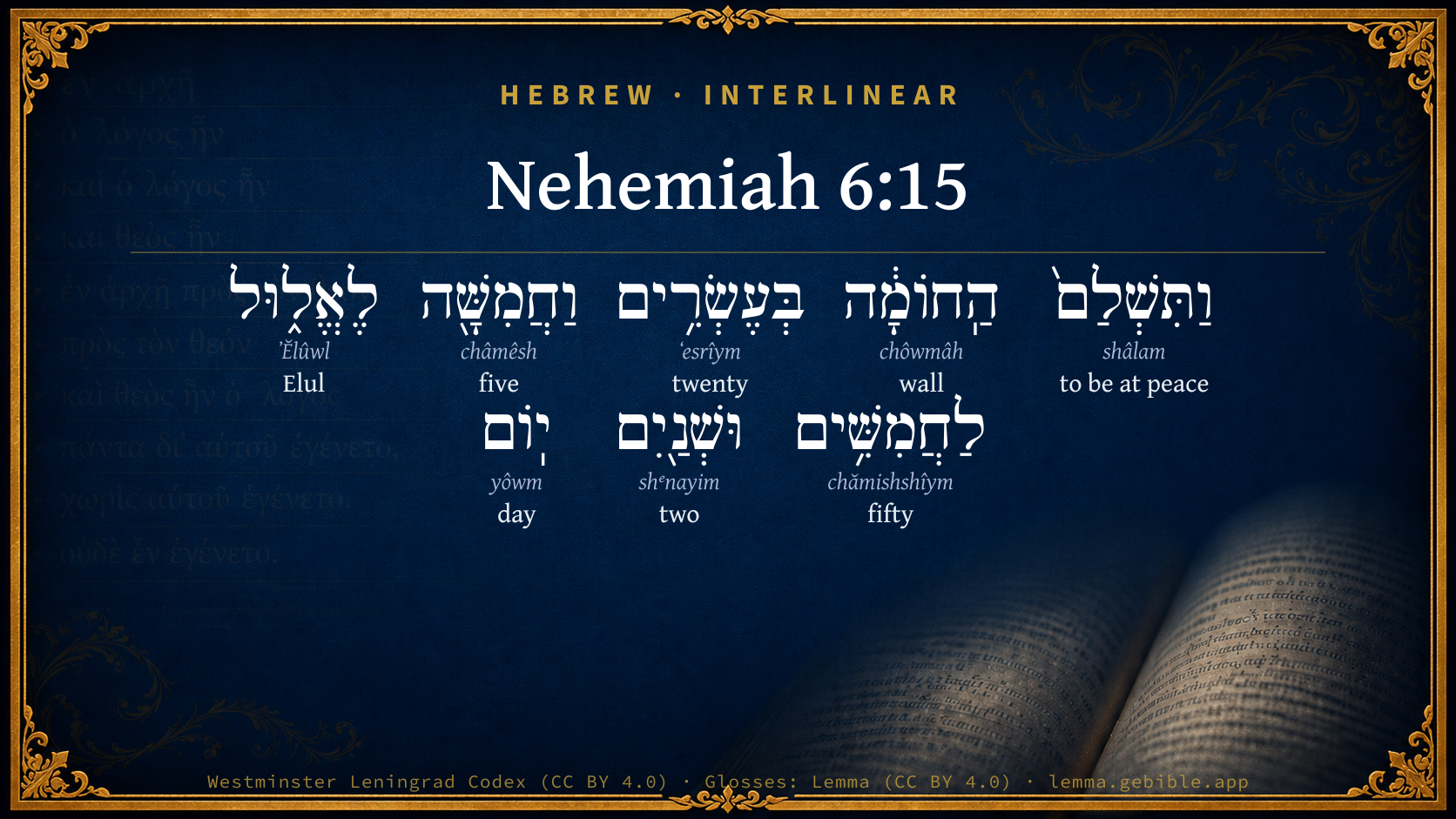
Hebrew (Westminster Leningrad Codex) Nehemiah 6:15 appears in the Hebrew Old Testament. The text above is from the Westminster Leningrad Codex. Each word links to its Strong’s number, a concise gloss, and parsing drawn from the Open Scriptures Hebrew Bible morphology. Click any word for its full Brown-Driver-Briggs (BDB) entry.
Download image
Cite this verse

Nehemiah 6:15 (World English Bible). Public Domain. Lemma interlinear Bible study tool, https://lemma.gebible.app/v/nehemiah/6/15.

Show BibTeX & RIS
BibTeX
RIS
English Translation
So the wall was finished in the twenty-fifth [day] of [the month] Elul, in fifty-two days.
World English Bible · Public Domain
Highlights
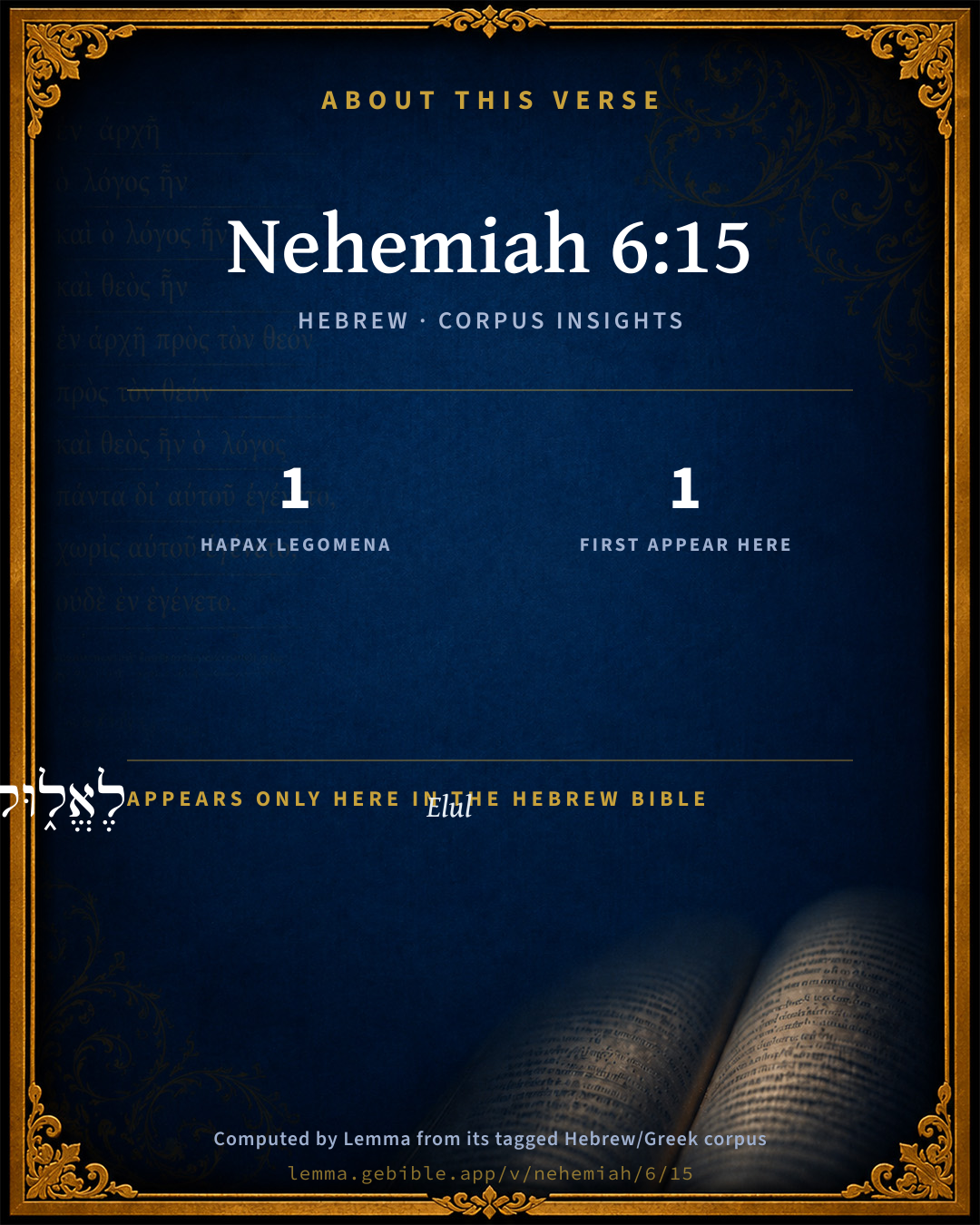
  • 1 hapax legomenon — only here in the Hebrew Bible
  • 1 first appearance in the Hebrew Bible
Full analysis ↓
Download a study sheet

One document with this verse’s original text, its word-by-word gloss line, the meaning frame, cross-references with their text, attributed commentary, and full source and license credits — printable, and it pastes into notes with its structure intact.

This verse Autodidact and up

Study sheet (.html) Plain text (.txt)

A passage Seminary Student

Up to 50 verses in one chapter. A passage sheet keeps up to 6 commentary sources and 12 cross-references per verse, in the order this page ranks them, and says so on the sheet whenever that leaves anything out. Ask for a single verse and you get the Autodidact verse sheet above.

Everything on this page stays free to read, with no account — the sheet is a download of what is already on screen, not access to it.

Want to remove ads? Support Godless Engineer
Compare translations 3

The same verse in 3 English versions, stacked beneath the original-language interlinear above. Click any original word for its lexicon entry.

Each is an independent rendering of the whole verse — the interlinear is not word-aligned to these translations.

Highlighted words mark where these versions differ — a whole-verse word diff, not a word-by-word alignment.

  • World English Bible Public Domain
    So the wall was finished in the twenty-fifth [day] of [the month] Elul, in fifty-two days.
  • King James Version Public Domain
    So the wall was finished in the twenty and fifth day of the month Elul, in fifty and two days.
  • unfoldingWord Literal Text CC BY-SA 4.0
    And the wall was finished on 25 of Elul, on day 52.

unfoldingWord Literal Text — © unfoldingWord, licensed CC BY-SA 4.0. Word-aligned USFM3 via Door43 (git.door43.org/unfoldingWord/en_ult).

Versions to compare (up to 4)

3 of 4 selected

Show all 18 translations

Every available English version of this verse, each an independent rendering of the whole verse.

  • World English Bible Public Domain
    So the wall was finished in the twenty-fifth [day] of [the month] Elul, in fifty-two days.
  • Berean Standard Bible Public Domain
    So the wall was completed in fifty-two days, on the twenty-fifth of Elul.
  • Majority Standard Bible Public Domain
    So the wall was completed in fifty-two days, on the twenty-fifth of Elul.
  • King James Version Public Domain
    So the wall was finished in the twenty and fifth day of the month Elul, in fifty and two days.
  • American Standard Version (1901) Public Domain
    So the wall was finished in the twenty and fifth `day' of `the month' Elul, in fifty and two days.
  • Revised Version (1885) Public Domain
    So the wall was finished in the twenty and fifth day of the month Elul, in fifty and two days.
  • Geneva Bible (1599) Public Domain
    Notwithstanding the wall was finished on the fiue and twentieth day of Elul, in two and fiftie dayes.
  • Douay-Rheims (1899) Public Domain
    But the wall was finished the five and twentieth day of the month of Elul, in two and fifty days.
  • Young's Literal Translation Public Domain
    And the wall is completed in the twenty and fifth of Elul, on the fifty and second day;
  • Literal Standard Version CC BY-SA 4.0
    And the wall is completed in the twenty-fifth of Elul, on the fifty-second day;
  • Unlocked Literal Bible CC BY-SA 4.0
    So the wall was finished on the twenty-fifth day of the month of Elul, after fifty-two days.
  • unfoldingWord Literal Text CC BY-SA 4.0
    And the wall was finished on 25 of Elul, on day 52.
  • Darby Bible Public Domain
    So the wall was finished on the twenty-fifth of Elul, in fifty-two days.
  • World Messianic Bible Public Domain
    So the wall was finished in the twenty-fifth day of Elul, in fifty-two days.
  • Webster's Bible Public Domain
    So the wall was finished in the twenty and fifth day of the month Elul, in fifty and two days.
  • Free Bible Version CC BY-SA 4.0
    The wall was finished on the twenty-fifth day of the month Elul. It took fifty-two days.
  • Bible in Basic English Public Domain
    So the wall was complete on the twenty-fifth day of the month Elul, in fifty-two days.
  • JPS Tanakh (1917) Public Domain
    So the wall was finished in the twenty and fifth day of the month Elul, in fifty and two days.

Literal Standard Version (2020), Covenant Press — licensed CC BY-SA 4.0. Text via the HelloAO Bible API (eBible.org). Unlocked Literal Bible (unfoldingWord) — licensed CC BY-SA 4.0. Text via the HelloAO Bible API (eBible.org). unfoldingWord Literal Text — © unfoldingWord, licensed CC BY-SA 4.0. Word-aligned USFM3 via Door43 (git.door43.org/unfoldingWord/en_ult). Free Bible Version, Dr. Jonathan Gallagher — licensed CC BY-SA 4.0. Text via the HelloAO Bible API (eBible.org).

Word by word

More ways to search: Search by grammar → Find every occurrence → Compare this word →

Practice this passage: Drill this verse → Learn its vocabulary →

About this verse

These counts appear in no published source. They are computed here, from the morphology-tagged text and Lemma’s own curated glosses. What Lemma adds →

8
words
8
distinct lemmas
Historical
section

Notable vocabulary

1 hapax legomenon — a word that appears only here in the entire Hebrew Bible:

  • לֶאֱל֑וּל Elul H435

First appearance in Scripture

This word makes its first canonical appearance in the Hebrew Bible here:

  • לֶאֱל֑וּל Elul H435

Grammatical profile

  • 1 verb
  • 3 nouns
  • 4 adjectives

Verb forms

  • וַתִּשְׁלַם֙ Qal · Sequential Imperfect

Cross-references

4

Topical passages linked to Nehemiah 6:15 in the Treasury of Scripture Knowledge — connected by theme and wording, ordered by reader-vote popularity; previews shown in the World English Bible.

  • Nehemiah 4:1–2 But it happened that when Sanballat heard that we were building the wall, he was angry, and took great indignation, and mocked the Jews.
  • Psalms 1:3 He will be like a tree planted by the streams of water, That brings forth its fruit in its season, Whose leaf also does not wither. Whatever he does shall prosper.
  • Ezra 6:15 This house was finished on the third day of the month Adar, which was in the sixth year of the reign of Darius the king.
  • Daniel 9:25 Know therefore and discern, that from the going forth of the commandment to restore and to build Jerusalem to the Anointed One, the prince, shall be seven weeks, and sixty-two weeks: it shall be built again, with street and moat, even in troubled times.

Cross-references courtesy of OpenBible.info (CC BY 4.0).

Hebrew and Greek witnesses Masoretic Hebrew ↔ Greek Septuagint

The same verse in the two great witnesses to the Old Testament, shown verse-for-verse.

These are two independent witnesses, not word-aligned to each other, and the Septuagint is shown in lemma (dictionary) form.

Hebrew Nehemiah 6:15 Masoretic · Westminster Leningrad Codex

וַתִּשְׁלַם֙ הַֽחוֹמָ֔ה בְּעֶשְׂרִ֥ים וַחֲמִשָּׁ֖ה לֶאֱל֑וּל לַחֲמִשִּׁ֥ים וּשְׁנַ֖יִם יֽוֹם

So the wall was finished in the twenty-fifth [day] of [the month] Elul, in fifty-two days.

World English Bible · Public Domain

Greek LXX Structure differs

The Septuagint has no separate book of Nehemiah. Its Greek text is the second half of Esdras B (2 Esdras), chapters 11–23; Ezra is the first half (1–10).

A verse-for-verse comparison isn’t shown here because the chapters and verses don’t line up. Switch to the LXX edition with the MT / LXX toggle above to read the Greek directly.

On this verse, The Cambridge Bible for Schools and Colleges discusses the Septuagint’s reading. Read the note in Commentary ↓

Hebrew: Westminster Leningrad Codex (CC BY 4.0). Greek: Septuagint (public domain); English from a public-domain English Septuagint. How the Septuagint differs from the Hebrew →

Commentary

Notes on Nehemiah 6:15 from classic Christian and Jewish commentators (each source and its license shown beneath its notes). The classic Christian expositions comment on the surrounding passage and are grouped to its opening verse, so a note may address several verses; the Jewish commentaries on the Tanakh (Rashi and others) are per-verse, so they appear only where the commentator wrote on this verse.

Lemma curates 59 commentaries, every one of them public domain or Creative Commons licensed, each selected and text-cleaned for this edition rather than reprinted as found. About our sources →

Matthew Henry's Commentary

Nehemiah is here finishing the wall of Jerusalem, and yet still has trouble created him by his enemies.

I. Tobiah, and the other adversaries of the Jews, had the mortification to see the wall built up, notwithstanding all their attempts to hinder it. The wall was begun and finished in fifty-two days, and yet we have reason to believe they rested on the sabbaths, Neh 6:15. Many were employed, and there was room for them; what they did they did cheerfully, and minded their business because they loved it. The threats of their enemies, which were intended to weaken them, it is likely, quickened them to go on with their work the more vigorously, that they might get it done before the enemy came. Thus out of the eater came forth meat. See what a great deal of work may be done in a little time if we would set about it in earnest and keep close to it. When the enemies heard that the wall was finished before they thought it was well begun, and, when they doubted not but to put a stop to it, they were much cast down in their own eyes, Neh 6:16. 1. They were ashamed of their own confidence that they should cause the work to cease; they were crest-fallen upon the disappointment. 2. They envied the prosperity and success of the Jews, grieved to see the walls of Jerusalem built, while, it may be, the kings of Persia had not permitted them thus to fortify the cities of Samaria. When Cain envied his brother his countenance fell, Gen 4:5. 3. They despaired of ever doing them the mischief they designed them, of bringing them down and making a prey of them; and well they might, for they perceived, by the wonderful success, that the work was wrought of God. Even these heathens had so much sense as, [1.] To see a special providence of God conversant about the affairs of the church when they did remarkably prosper. They said among the heathen, The Lord has done great things for them; it is his doing, Psa 126:2. God fighteth for Israel and worketh with them. [2.] To believe that God's work would be perfect. When the perceived that the work was of God they expected no other than that it would go on and prosper. [3.] To conclude that, if it were of God, it was to no purpose to think of opposing it; it would certainly prevail and be victorious.

II. Nehemiah had the vexation, notwithstanding this, to see some of his own people treacherously corresponding with Tobiah and serving his interest; and a great grief and discouragement, no doubt, it was to him. 1. Even of the nobles of Judah there were those who had so little sense of honour and their country's good as to communicate with Tobiah by letter, Neh 6:17. They wrote with all the freedom and familiarity of friends to him, and welcomed his letters to them. Could nobles do a thing so mean? Nobles of Judah so wicked a thing? It seems great men are not always wise, not always honest. 2. Many in Judah were in a strict but secret confederacy with him to advance the interest of his country, though it would certainly be the ruin of their own. They were sworn unto him, not as their prince, but as their friend and ally, because both he and his son had married daughters of Israel, Neh 6:18. See the mischief of marrying with strangers; for one heathen that was converted by it ten Jews were perverted. When once they became akin to Tobiah they soon became sworn to him. A sinful love leads to a sinful league. 3. They had the impudence to court Nehemiah himself into a friendship with him: "They reported his good deeds before me, represented him as an intelligent gentleman and well worthy my acquaintance, an honest gentleman and one that I might confide in." We are indeed required to speak ill of no man, but never to speak well of bad men. Those that forsake the law praise the wicked, Pro 28:4. 4. They were so false as to betray Nehemiah's counsels to him; they uttered Nehemiah's words to him, perverting them, no doubt, and putting false constructions upon them, which furnished Tobiah with matter for letters to put him in fear and so drive him from his work and discourage him in it. Thus were all their thoughts against him for evil, yet God thought upon him for good.

Matthew Henry's Commentary on the Whole Bible (1708–1710) — public domain (CC PDM 1.0). Text via the HelloAO Bible API.

The Cambridge Bible for Schools and Colleges

gen. ed. J. J. S. Perowne

15–19. The Completion of the Wall (Neh_6:15); and the impression produced (Neh_6:16): treasonable correspondence (Neh_6:17-19)

15. Elul] This month, which is the same as the Assyrian U-lu-lu, corresponds to the end of August and beginning of September. It is mentioned in 1Ma_14:27. The 25th of Elul would be September 444. Elul, the 6th of the sacred year, was the last month of the civil year.

in fifty and two days] Nehemiah is evidently calling attention to the remarkable rapidity with which the wall was built. But though a remarkable performance, there is nothing incredible in it; and the suggestion to append to the text ‘and two years’ (so Ewald) would give a period of time strangely at variance with the description of haste and urgency in chap. 5. It is true this would nearly agree with Josephus’ statement that the wall took two years and four months building; but Josephus’s chronology is not to be preferred to our text, when the LXX. and the Vulgate show no variation. We do not know the grounds which Josephus had for giving ‘two years and four months;’ but even this circumstantial statement disagrees with the proposed reading.

In order to account for the speed with which the wall was built, we must bear in mind, (a) that large numbers of people were employed upon the work, and a thorough system of distribution facilitated its execution; (b) the walls in many parts probably only required repairing, while the materials for the most part lay all ready to hand: (c) Nehemiah and his companions constantly stimulated the people to persevere in the work: (d) according to a very reasonable computation, the 40 lots into which the wall (cf. ch. 3) was distributed averaged about 80 yards apiece, and many lots were omitted in the list.

For another instance of the rapid erection of walls under patriotic stimulus, compare the action of Themistocles and the Athenians (see Grote’s Hist. of Greece, vol. IV. p. 333 f.).

The Cambridge Bible for Schools and Colleges (gen. ed. J. J. S. Perowne; Cambridge University Press, 1878–1918) — public domain. Text from a community e-Sword module.

Trapp's Complete Commentary

John Trapp

Neh 6:15 So the wall was finished in the twenty and fifth [day] of [the month] Elul, in fifty and two days.

Ver. 15. So the wall was finished] Though with much ado, and maugre the malice of all foreign and internal enemies. So shall the work of grace in men’s hearts: it is perfected there by opposition, and grows gradually, but constantly and infallibly.

In the twenty and fifth day of the month Elul] Which was their sixth month, answering, mostly, to our August. This (saith Beda) answered both unto the six days of God’s working to make the world, after which a rest followed, and to the everlasting rest in heaven after six ages of the world, spent in toil and labour!

In fifty and two days] A very short time for the despatch of so great a work. But nescit tarda molimina Spiritus Sancti gratia. God was much seen herein; and the enemies’ courage much quailed. But what meant Josephus to say, that the wall was in building two years and three months? It appeareth hereby, and by many other passages in his Jewish Antiquities, that he had not much read, or at least minded, the Holy Scriptures. Of this short time spent in building the wall, Daniel seemeth to prophesy, saith an interpreter, when he saith, that it should be built again in angustiis temporum, in the straits of time, Dan 9:25; neither hold we so much strange at it, since the hands at it were many and those were motitantes, nimble and cheerful, and the princes were present to prick them on, and they repaired only and built upon the old foundation; and lastly the very enemies were convinced that the work was wrought of God, Neh 6:16; what marvel, therefore, that it went so on end?

John Trapp, A Commentary or Exposition upon All the Books of the Old and New Testament (1647–1656) — public domain. Text from a community e-Sword module.

The Biblical Illustrator

Joseph S. Exell

Neh_6:15

So the wall was finished in the twenty and fifth day . . . in fifty and two days.

Fifty-two days work

Let us make a parable of the story and use the text as a motto of a deeper theme. Fifty-two Sundays and their work.

I. How quickly they pass.

II. What opportunities they furnish.

1. Of rest.

2. Of spiritual friendship.

3. Of Divine instruction.

4. Of moral renewal.

III. What results they leave.

1. In memory.

2. In life.

3. For judgment.

Application:

1. Thank God for the day of days.

2. Use each day as it comes.

3. Determine upon a rounded result for each cycle of fifty-two. (Homiletic Commentary.)

Finished work

1. The work of human redemption. Yes, the work was done. The atoning sacrifice was offered and accepted, as was demonstrated when Jesus rose again from the dead.

2. And is there ground for hope that the great and blessed work of renewal, begun in the believers heart, will be perfected?

3. The progress of the Church at large is also assured. (T. Rowson.)

Success

There was great exultation when Lesseps completed the Suez Canal, by which the communication between Europe and the East has been materially expedited. There was great exultation when the favourite project of Count Cavour for a tunnel through Mont Cents was brought to a successful termination, by which Paris and Turin have been approximated within a few hours of each other. There was great exultation and loyal thankfulness when, in 1873, the Prince of Wales put the top stone to the Portland Breakwater. The foundation-stone of this work had been laid twenty-three years before, by his august father; and it was an interesting moment when the Prince completed the magnificent undertaking by adding to the words by which he formally announced the fact, These are imperial works, and worthy kings; and echoing shouts of joy went up, from two hundred thousand spectators. Similarly, it was a great day for Jerusalem when her walls and bulwarks were commended to the blessing of the Almighty. (J. M. Randall.)

The Biblical Illustrator, edited by Joseph S. Exell (c. 1880s–1900s) — public domain. Text from a community e-Sword module.

Joseph Benson's Commentary

Neh 6:15. The wall was finished in the twenty and fifth day of the month Elul — Answering part to our August and part to September. In fifty and two days — To be computed either from the time of Sanballat’s sending this letter to him, or, as most judge, from the beginning of the work, which, though a great thing, yet it is not at all incredible, considering, 1st, That the walls and gates were not wholly pulled down by the Chaldeans: for to what purpose should they make that waste of time and labour? 2d, That where the walls were thrown down, yet the materials remained, which they now used. 3d, That, in building the walls, they regarded not ornament, but only strength and safety. 4th, The great numbers of the builders, and the prudent distribution of the work among them, and their admirable zeal and diligence therein. 5th, That there want not parallel instances, even in heathen authors; for both Quintus Curtius and Arrian relate that Alexander the Great built the walls of new Alexandria, which were seven miles in compass, within twenty days’ space. 6th, That the hand of God was manifest in carrying on this work, which their very enemies here acknowledge.

Joseph Benson's Commentary on the Old and New Testaments (1811–1818) — public domain. Text from a community e-Sword module.

Keil & Delitzsch

C. F. Keil & F. Delitzsch

The wall completed, and the impression made by this work upon the enemies of the Jews. - Neh 6:15 The wall was finished on the twenty-fifth day of the month Elul, i.e., of the sixth month, in fifty-two days. According to this statement, it must have been begun on the third day of the fifth month (Ab). The year is not mentioned, the before-named (Neh 2:1) twentieth year of Artaxerxes being intended. This agrees with the other chronological statements of this book. For, according to Neh 2:1, it was in Nisan (the first month) of this year that Nehemiah entreated permission of the king to go to Jerusalem; and we learn from Neh 5:14 and Neh 13:6 that he was governor in Jerusalem from the twentieth year onwards, and must therefore have set out for that place immediately after receiving the royal permission. In this case, he might well arrive in Jerusalem before the expiration of the fourth month. He then surveyed the wall, and called a public assembly for the purpose of urging the whole community to enter heartily upon the work of restoration (Neh 2:11-17). All this might take place in the course of the fourth month, so that the work could be actually taken in hand in the fifth. Nor is there any reasonable ground, as Bertheau has already shown, for doubting the correctness of the statement, that the building was completed in fifty-two days, and (with Ewald) altering the fifty-two days into two years and four months.

(Note: Ewald, Gesch. iv. p. 178, thinks that traces of the correct reading of this verse are found in the statement of Josephus, Ant. xi. 5. 7f., that the wall of Jerusalem was finished in two years and four months, and that the word וּשׁנתים may have been omitted from Neh 6:15 by an ancient clerical error, though he is obliged to admit that Josephus in other instances gives no trustworthy dates concerning Nehemiah, whom he makes arrive at Jerusalem in the twenty-fifth, and complete the wall in the twenty-eight year of Xerxes. On the other hand, Bertheau has already remarked, that even if שׁנתים is supplied, no agreement with the statement of Josephus is obtained, since the question still remains how four months can be made out of fifty-two days, or vice versa, fifty-two days of four months. In fact, it is vain to seek for any common ground on which these two different statements can be harmonized; and hence the two years and four months of Josephus can scarcely be regarded as furnishing traces of another reading of the text.)

For we must in this case consider, 1st, the necessity for hastening the work repeatedly pointed out by Nehemiah; 2nd, the zeal and relatively very large number of builders - the whole community, both the inhabitants of Jerusalem and the men of Jericho, Tekoa, Gibeon, Mizpah, etc. having combined their efforts; 3rd, that the kind of exertion demanded by such laborious work and unintermitted watchfulness as are described Neh 4, though it might be continued for fifty-two days, could scarcely endure during a longer period; and lastly, the amount of the work itself, which must not be regarded as the rebuilding of the whole wall, but only as the restoration of those portions that had been destroyed, the repair of the breaches (Neh 1:3; Neh 2:13; Neh 6:1), and of the ruined gates, - a large portion of wall and at least one gate having remained uninjured.). To this must be added that the material, so far as stone was concerned, was close at hand, stone needing for the most part to be merely brought out of the ruins; besides which, materials of all kind might have been collected and prepared beforehand. It is, moreover, incorrect to compute the extent of this fortified wall by the extent of the wall of modern Jerusalem.

Neh 6:16

The news that the wall was finished spread fear among the enemies, viz., among the nations in the neighbourhood of Jerusalem (comp. Neh 4:1; Neh 5:9); they were much cast down, and perceived "that this work was effected with the help of our God." The expression בעניהם יפּלוּ occurs only here, and must be explained according to פּניו יפּלוּ, his countenance fell (Gen 4:5), and לב יפּל, the heart fails (i.e., the courage) (Sa1 17:32): they sank in their own eyes, i.e., they felt themselves cast down, discouraged.

Keil & Delitzsch — Biblical Commentary on the Old Testament (1861–1891) — public domain (CC PDM 1.0). Text via the HelloAO Bible API. (Old Testament only.)

Tyndale Open Study Notes

Tyndale Open Resources

6:15-16 just fifty-two days: Everyone realized that the help of our God was what made such success possible (see also 1:11; 2:8, 18, 20; 4:15, 20).

Tyndale Open Study Notes — © Tyndale Open Resources, licensed CC BY-SA 4.0. Text via the HelloAO Bible API.

Geneva Bible (1599)

Geneva Bible translators

After that I had sent Sanballat his answer.

Which was the sixth month and contained part of August, and part of September.

Geneva Bible (1599) marginal notes — public domain. Text via Bolls.life.

Adam Clarke's Commentary

Verse 15. The twenty and fifth - of - Elul] This Jewish month answers to a part of our August and September.

Fifty and two days.] I see no difficulty in supposing that several thousand workmen, each of whom was working as for God, should be able to complete this wall in fifty-two days. There is little doubt that several parts of the old wall were entire; in many places the foundations still remained; there were all the materials of the old wall still at hand; and though they had to clear and carry away much rubbish, yet they do not appear to have had any stones to quarry. The work mentioned here was little when compared to what Caesar did in Gaul and other places; and to what Titus did at Jerusalem, who built a wall round Jerusalem of five thousand paces in three days, besides, thirteen towers of ten stadia in circuit. And Quintus Curtius and Arrian inform us that Alexander the Great built the walls of Alexandria, on the Tanais, which were nearly eight miles in compass, in the space of between twenty and thirty days. Nehemiah therefore had time sufficient in fifty-two days to repair and restore the walls of Jerusalem. See Calmet on this place.

Adam Clarke's Commentary on the Bible (1810–1826) — public domain. Text from a community e-Sword/MySword module.

Ellicott's Commentary for English Readers

(15) In fifty and two days.—The twenty-fifth day of Elul answers to about our September 15th; and, dating back, the wall began in the latter part of July, soon after Nehemiah’s arrival. If we bear in mind that the wall was only partially overthrown, that the materials for restoration were at hand, and that the utmost skill had been shown in organising the bands of workmen, the time will not appear too short. There is no need to adopt the suggestion of Josephus, that the rebuilding occupied two years and four months.

They perceived that this work was wrought of our God.—Not miraculously, but under the Divine sanction and help. By this expression Nehemiah at once triumphs over his foes, and gives the glory where it was due. His own heroic part in the work is utterly forgotten.

(15, 16) The finishing of the wall is recorded in the implest manner: first, with a formal specification of the date and time; then in its effect upon the enemies, and as redounding to the glory of God.

A Bible Commentary for English Readers, edited by Charles John Ellicott (1878–1897) — public domain. Text from a community e-Sword module.

John Gill's Exposition

So the wall was finished in the twenty fifth day of the month Elul,.... The sixth month, answering to part of August and part of September:

in fifty and two days; which Aben Ezra reckons from the time that Sanballat sent his letter to Nehemiah, when no more were wanting than to set the doors upon the gates, Neh 6:1, but rather these, with Jarchi, must be reckoned from the time the building was begun; which, reckoning back from the twenty fifth of Elul, it will appear it was begun the third day of the fifth month Ab; nor need this be thought incredible, considering the number of workmen, their ardour and diligence in building, and that the walls were not wholly built all around, only repaired, and breaches made up, and much of the old materials were made use of, which were at hand, and stone unhewed, and especially being attended with the blessing of God, which succeeded the undertaking: nor are there wanting examples similar to this; and as it is observed by many from Curtius (x), the walls of new Alexandria, which were sixty furlongs in length, or more than seven miles, were finished in seventeen days; if Nicephorus (y) is to be credited, the high walls which surrounded Constantinople, and were twenty miles in circumference, were finished in two months time. Josephus is not to be regarded, who, contrary to the Scriptures says (z), this wall of Jerusalem was two years and four months in building.

(x) Hist. l. 7. c. 6. Justin e Trogo, l. 12. c. 5. (y) Hist. l. 14. c. 1. (z) Antiqu. l. 11. c. 5. sect. 8.

John Gill's Exposition of the Whole Bible (1746–1763) — public domain (CC PDM 1.0). Text via the HelloAO Bible API.

Albert Barnes' Notes on the Bible

Elul - The sixth month, corresponding to the latter part of August and the beginning of September.

In fifty and two days - Josephus states that the repairs of the wall occupied two years and four months. But Nehemiah’s narrative is thoroughly consistent with itself, and contains in it nothing that is improbable. The walls everywhere existed at the time that he commenced his task, and only needed repairs. The work was partitioned among at least 37 working parties, who labored simultaneously, with material ready at hand; and, notwithstanding all menaces, uninterruptedly.

Albert Barnes' Notes on the Bible (1834–1885) — public domain. Text from a community e-Sword/MySword module.

Haydock's Catholic Bible Commentary

Elul, the last of the civil year, corresponding with our August and September, when the walls were dedicated, chap. xii. 27. --- Days. Josephus ([Antiquities?] xi. 5.) says, "two years and three (Greek four) months" (Haydock) had been spent in perfecting the work. (Cajetan) --- Others date from the reception of the letter, ver. 5. (Vatable) --- But the work only lasted the time here specified, as the materials were at hand, and some of the walls were standing, while the rocks defended other parts; and the city was not then so large as it was afterwards. (Calmet) --- The whole people wrought almost day and night, and Nehemias encouraged them with all his power. (Tirinus) --- Thus Alexander the Great built the walls of New Alexandria, on the Tanais, 60 stadia, or near 6000 paces (Calmet) long, in less than twenty days; (Tirinus) and Cæsar perfected other works, before Alise, &c., with equal expedition. (Bel. Gal. i., and vii.) --- The Romans, at the last siege of Jerusalem, surrounded the city with a wall 5000 paces long, and with thirteen towers, in three days. (Josephus, Jewish Wars vi. 13.) (Calmet)

George Leo Haydock (1774–1849), Haydock's Catholic Family Bible and Commentary, 1859 edition — public domain. Excludes Psalms (Douay-Rheims chapter numbering differs from Protestant) and Deuterocanonical books (Catholic canon only).

Matthew Poole's English Annotations

The month Elul; answering part to our August and part to September.

In fifty and two days; to be computed, either,

1. From the time of Sanballat’s sending this letter to him; or,

2. As most judge, from the beginning of the work; which though a great thing, yet it is not at all incredible, considering,

1. That the walls and gates were not wholly pulled down by the Chaldeans; for to what purpose should they make that waste of time and labour?

2. That where the walls were thrown down, yet the materials remained, which they now used.

3. That in the building of the walls they minded not curiosity, but only strength and safety.

4. The great numbers of the builders, and the prudent distribution of the work among them, and their admirable zeal and diligence in the work.

5. That there want not parallel instances even in heathen authors; for both Curtius and Arrian report, that Alexander the Great built the walls of new Alexandria, which contained above seven miles in length, within twenty days’ space.

6. That there was an eminent hand of God in carrying on this work, which their very enemies here acknowledge.

Matthew Poole's English Annotations on the Holy Bible (1683–1685) — public domain. Text from a community e-Sword/MySword module.

Whedon's Commentary on the Bible

Daniel D. Whedon

15. Elul — The sixth month of the Jewish ecclesiastical year, corresponding nearly to our September. Fifty and two days back from the twenty-fifth of Elul would bring us to the third of the preceding month, Ab. The building of the wall was accordingly finished in the remarkably short time of less than two months. That this was possible, notwithstanding all the opposition of enemies, may be seen from the following considerations:

“There is little doubt that several parts of the old wall were entire; in many places the foundations still remained; there were all the materials of the old wall still at hand; and though they had to clear off and carry away much rubbish, yet they do not appear to have had any stones to quarry. The work mentioned here was little when compared to what Cesar did in Gaul and other places; and to what Titus did at Jerusalem, when he built a wall round that city of five thousand paces in three days, besides thirteen towers of ten stadia in circuit. And Quintus Curtius and Arrian inform us that Alexander the Great built the walls of Alexandria, which were nearly eight miles in compass, in the space of between twenty and thirty days.” — Clarke.

Daniel D. Whedon (gen. ed.), Commentary on the Old and New Testaments (1874–1909) — public domain. Text from a community e-Sword module.

The Pulpit Commentary

So the wall was finished in the twenty and fifth day of the month Elul, in fifty and two days. According to Josephus, ("Ant. Jud:," 11:5, the work of restoration occupied two years and four months, or 840 days, instead of fifty-two. And this period has been thought so much more probable than the smaller one, that moderns generally have accepted it, while some have even proposed to alter our present text of Nehemiah by the insertion of u-shnathayim, "and two years," at the end of this verse (Ewald). But the authority of Josephus on matters of remote history is so small, and the whole account of Nehemiah is so harmonious and consistent with itself, that alteration seems quite unnecessary. Nehemiah leaves Susa in Nisan, probably towards the middle or close of the month, for his preparations must have taken him some time. He would be likely to be nearly three months on his journey, and would thus reach Jerusalem about the middle of July say July 15. He then rested three days, surveyed the wall, laid his plan before the nobles, arranged the working parties, and set to work. It was his object to hasten matters as much as possible; and he may well have commenced the rebuilding within ten days of his arrival. Fifty-two days from July 25 would bring him to Sept. 15, which corresponds, as nearly as may be, to the 25th of Elul. There is no difficulty in supposing that the wall could have been repaired in this space. The materials were ready at hand; the working parties were numerous; the workmen full of zeal. If we estimate the circumference of the wall at four miles, which is probably beyond the truth, and the working parties at forty-two (Ewald), it will follow that each party had, on the average, to repair 168 yards, or at the rate of between three and four yards a day. There was probably no work done on the sabbaths, and there may have been one or two days of interruption, when attack seemed imminent; (Neh_4:13-15) but otherwise the work was carried on without pause from early dawn to dark (ibid. ver. 21). The wall attained to half its height in a very short time (ibid. ver. 6), there was then a brief interruption, after which came the main work of completing the entire circuit to its full height. It is possible that the fifty-two days are counted from the "return to work (ibid. ver. 15).

HOMILIES BY R.A. REDFORD Vers. 15-19. The good work finished in spite of man by the power of God.

I A great MANIFESTATION OF DIVINE POWER is a great casting down of God"s enemies.

1. There is real weakness in all sin. "In their own eyes" defeat meant shame and confusion; but the true heart never doubts that its cause is right, even when success is delayed.

2. The world will perceive God"s hand. When the finished work is before them they will not dare to deny who has accomplished it. Therefore we should hasten it on, and be more eager to bring it to completion.

3. The great facts of Divine grace spread their message not only among the enemies of the Church, but among the heathen, who have been sitting in darkness. A revived zeal and energy in God"s people will have a mighty effect in casting down the imaginations which exalt themselves against the name of Christ.

II The best preparation of the true Church against discouragements, both from without and from within, is to know that ITS WALLS ARE BUILT UP, AND ITS GATES IS THEIR PLACES.

1. That will put a stop to the corrupting intercourse between the Church and the world.

2. It will help the people of God to know their true leaders. The nobles were traitors; but henceforth men after the example of Nehemiah will be the defenders of Judah.

3. In the sight of the finished work the hearts of God"s people are strong. In the best sense success makes success. "Tobiah"s letters" will do no harm, for there are the walls speaking in the name of God, "epistles written by the Spirit of God, known and read of all men." Let the world trust as it may in its devices, we rejoice in "the walls of Jerusalem," which are "salvation," and "her gates" "praise. R.

The Pulpit Commentary (1880–1919), ed. H.D.M. Spence-Jones & Joseph S. Exell — public domain. Text from a community e-Sword module.

John Wesley's Explanatory Notes

Elul - Answering part to our August, and part to September.

John Wesley, Explanatory Notes Upon the Whole Bible (1754–1765) — public domain. Text via the GEBible commentary corpus.

Scofield Reference Notes

C. I. Scofield

Elul

sixth month i.e. September.

The Scofield Reference Bible (1917 edition), notes by C. I. Scofield — public domain. Text from a community e-Sword module.

Kretzmann's Popular Commentary

Paul E. Kretzmann

The Wall Completed

v. 15. So the wall was finished in the twenty and fifth day of the month Elul, corresponding roughly to the latter part of August and the greater part of September, in fifty and two days, showing that the builders were inspired with great love and zeal for the work.

v. 16. And it came to pass that, when all our enemies heard thereof and all the heathen that were about us saw these things, they were much cast down in their own eyes; for they perceived that this work was wrought of our God, since it had been brought to a successful conclusion in spite of all the enmity from without and the dissension within, as it had been brought about by the bribes. The divine cooperation was evident throughout.

v. 17. Moreover, in those days the nobles of Judah sent many letters unto Tobiah, literally, "multiplied their letters going to Tobiah," thus becoming traitors to their own cause, and the letters of Tobiah came unto them.

v. 18. For there were many in Judah sworn unto him, because he was the son-in-law of Shechaniah, the son of Arah; and his son Johanan had taken the daughter of Meshullam, the son of Berechiah, the evil of mixed marriages with the enemies of the Lord appearing here once more.

v. 19. Also they reported his good deeds before me, in trying to influence Nehemiah in his favor, and uttered my words to him, informing the enemy of all the matters undertaken by. Nehemiah, so that Tobiah was able to plan new schemes to hinder the work. And Tobiah, with all this information at his command, sent letters to put me in fear. As Nehemiah and the faithful Jews continued in the task set before them in spite of all attempts of the enemies to discourage them, so all true Christians will work for the Lord consistently, letting neither threats nor enticements keep them from performing the labor entrusted to them.

Paul E. Kretzmann, Popular Commentary of the Bible (1921–1924) — public domain. Text from a community e-Sword module.

unfoldingWord translationNotes

Door43 World Missions Community

So the wall was finished

This can be stated in active form. AT: "We finished the wall" (See: Active or Passive)

the twenty-fifth day of the month of Elul

"day 25 of the month of Elul." Elul is the sixth month of the Hebrew calendar. (See: Hebrew Months and Ordinal Numbers)

fifty-two days

"52 days" (See: Numbers)

they fell greatly in their own eyes

"they thought much less of themselves" or "they lost confidence in themselves"

the work was done with the help of our God

This can be stated in active form. AT: "it was our God who helped us complete this work" (See: Active or Passive)

translationWords

day

adversary

nation

fear

works

God

unfoldingWord translationNotes — © Distant Shores Media and the Door43 World Missions Community, licensed CC BY-SA 4.0. Source: git.door43.org/Door43/en_tn.

Rashi

Rabbi Shlomo Yitzchaki (Rashi)

on the twenty-fifth day of the month of Ellul, in the twentieth year of King Darius, for in the twentieth year of Darius, Nehemiah went up from Babylon, and in that year he built the ruins of Jerusalem.

after fifty-two days The construction of the wall was completed fifty-two days after they had started building it.

Rashi on the Tanakh — English translations: “The Judaica Press complete Tanach with Rashi, translated by A. J. Rosenberg” (CC BY 4.0); “Pentateuch with Rashi's commentary by M. Rosenbaum and A.M. Silbermann, 1929-1934” (public domain); “The Metsudah Tanach series, Lakewood, N.J” (CC BY 4.0); and “The Book of Joshua, Metsudah Publications, 1997” (CC BY 4.0). Text via Sefaria.

Lesson kit

Teaching starters — assembled from the data on this page, not authored interpretation. Every prompt links to the verse data it draws on. Edit before teaching.

Nehemiah, in the Historical, opens this verse with 8 words (8 distinct Hebrew lemmas). Its most distinctive word is ʼĔlûwl (“Elul”). A historical commentator’s framing appears above. Read the whole chapter for the surrounding context.

Discussion questions

  1. How does “Elul” (ʼĔlûwl) shape what this verse is saying?
  2. 1 word here appears nowhere else in the Hebrew Bible. Why might the author reach for such rare wording?
  3. This is the first place “Elul” appears in Scripture (first appears here). What does its debut here establish?
  4. How does Nehemiah 4:1–2, which shares this passage’s theme, read alongside this verse?
  5. The translations on this page render this verse differently — a whole-verse word diff, not a word-by-word alignment. What might account for the different wordings?
  6. «וַתִּשְׁלַם֙» is a Qal Sequential Imperfect verb. How does that grammatical form shape the action described?
  7. Compare how Matthew Henry's Commentary and The Cambridge Bible for Schools and Colleges read this verse. Where do they agree or differ?

Things to notice

  • 1 word in this verse appears nowhere else in the Hebrew Bible.
  • 1 word makes its first canonical appearance in Scripture here.
  • These translations choose different wording for 10 words in this verse.
  • 8 distinct Hebrew lemmas span 8 words in this verse.

Reading settings

Reading text

Shown beneath each verse's original-language words.

Old Testament
Old Testament edition

Read the OT as the Masoretic Hebrew (MT) or the Greek Septuagint (LXX).

English shown for the Greek Septuagint (in the Hebrew ↔ Greek comparison).

Comparing translations? Open the Compare panel on any verse page to stack up to four side by side.