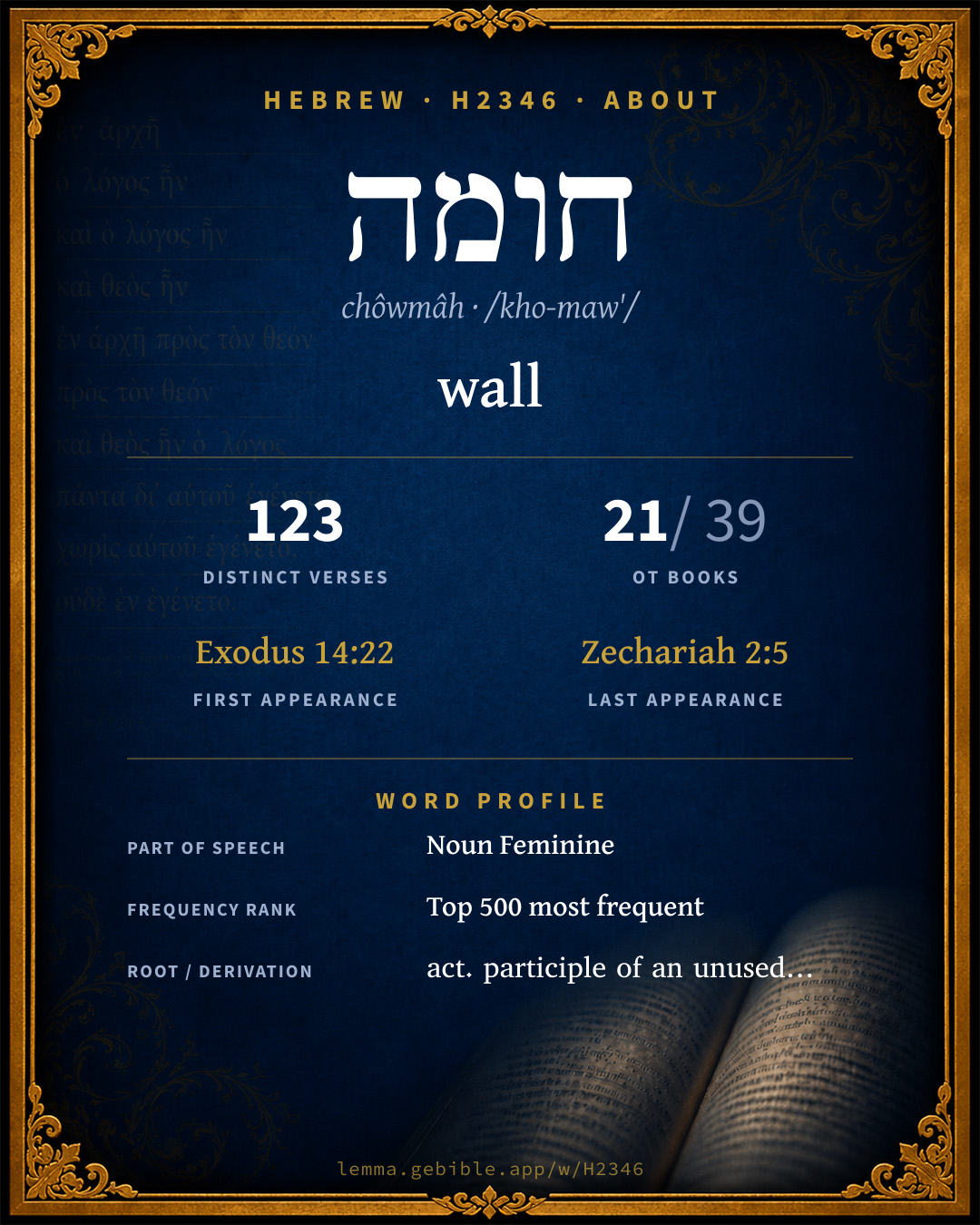
חוֹמָה
wall
Full lexicon entry — Brown-Driver-Briggs (BDB)
From Brown-Driver-Briggs (BDB)
Where this word appears
Grammar key — what these labels mean
Part of speech
- Noun
- A naming word — a person, place, thing, or idea.
Noun type
- Common
- A common noun — a general class of person, place, or thing (“king,” “city,” “water”), not a specific name.
State
- Absolute
- The independent form of a noun, not bound to a following word.
- Construct
- A noun bound to a following noun in a possessive / “of” relationship (the construct chain).
Gender
- Feminine
- Grammatically feminine.
Number
- Singular
- One.
- Plural
- More than one (in Hebrew, generally three or more).
- Dual
- Exactly two — for natural pairs and some measures of time.
Every verse where H2346 appears in the Book of Joel — 2 distinct verses. Click any verse to open its interlinear word-by-word view. Verse text shown in the World English Bible for context — . Each verse’s Hebrew form is shown with its reference; the English is not keyword-highlighted, since the data carries no word-level English alignment. Use “Compare translations” on any verse to read it across multiple English versions. This concordance covers the Hebrew Bible; Septuagint (Greek Old Testament) occurrences are not indexed here.
Joel
- Joel 2:7 חוֹמָ֑ה n c fs They run like mighty men. They climb the wall like warriors. They each march in his line, and they don't swerve off course.
- Joel 2:9 בַּֽ/חוֹמָה֙ prep det + n c fs They rush on the city. They run on the wall. They climb up into the houses. They enter in at the windows like thieves.
About this entry
At a glance — auto-summarized from this page’s data, not written by a person. Every figure links to its source below. This summary describes the numbers; it doesn’t interpret them.
“wall” is the headline sense of the Hebrew noun חומה (chôwmâh). Its earliest occurrence is Exodus 14:22. It turns up in 123 verses across 21 books, a common footprint. It clusters with חם, חמאה and חמת under a shared root. The sections below give every sense, occurrence, and version rendering.
Gloss history
Strong's 1890 vs modern scholarship
About this word
Strong's H2346 catalogs a Hebrew word from the Hebrew Old Testament.
These counts are not copied from any lexicon or concordance. They are computed here, from the morphology-tagged Hebrew Old Testament. What Lemma adds →
- 123
- distinct verses
- The word appears in 123 distinct verses.
- 21 / 39
- OT books
- The word appears in 21 of 39 Old Testament books.
- #339
- by frequency
- Top 500 most frequent Hebrew words (rank 339 of 8,640 Hebrew words by occurrence).
View all 123 occurrences in the concordance →
By section of the Old Testament
By traditional corpus
Conventional, traditional groupings — biblical authorship is debated, so this is a traditional corpus grouping, not an authorship claim. Each share is this word’s portion of its verses in that division of the Hebrew canon. Each figure is a share of the word’s 123 distinct verses.
- Prophets (Nevi'im) 68 verses · 55%
- Writings (Ketuvim) 48 verses · 39%
- Torah (Pentateuch) 7 verses · 6%
How translations render this word
Counts come from each version’s own published word-to-Strong’s tagging or interlinear alignment — an approximate guide to how each version renders this word, not a word-level alignment the data otherwise carries. Because each total is that version’s own tagged count, the per-version totals vary from one another and need not match the appearance or distinct-verse counts above. These counts may also differ from a printed concordance because Lemma counts each distinctly tagged rendering and does not collapse phrase taggings into a single head-word total. This is a fixed set of word-tagged versions (KJV, ASV, BSB, ULT) and does not change with the reading translation you choose elsewhere. Each version’s license is shown beside its name below (and on Sources).
BDB lists this Strong’s number as 2 distinct words (homographs). Each count above pools all of them and is not split by sense — see the Senses section below. A low-frequency rendering may belong to a different one of those words, not the primary meaning.
- King James Version†: Wall 71×, Walls 26×, All the wall 2×
- American Standard Version†: Wall 70×, Walls 22×, Between the two walls 3×
- Berean Standard Bible†: Wall 72×, Walls 42×, Two walls 3×
- unfoldingWord Literal Text†: Wall 67×, Wall of 20×, Walls 20×
King James Version Public Domain
Renders H2346 across 133† tagged occurrences — most commonly:
Plus 26 renderings that appear only once — usually multi-word phrases or single function words the recovered tagging swept in, not distinct renderings.
American Standard Version Public Domain
Renders H2346 across 133† tagged occurrences — most commonly:
Plus 32 renderings that appear only once — usually multi-word phrases or single function words the recovered tagging swept in, not distinct renderings.
Berean Standard Bible Public Domain
Renders H2346 across 128† tagged occurrences — most commonly:
Plus 9 renderings that appear only once — usually multi-word phrases or single function words the recovered tagging swept in, not distinct renderings. Not rendered by a distinct English word in 5 further occurrences.
unfoldingWord Literal Text CC BY-SA 4.0
Renders H2346 across 137† tagged occurrences — most commonly:
Plus 13 renderings that appear only once — usually multi-word phrases or single function words the recovered tagging swept in, not distinct renderings.
Senses in the full BDB
What do BDB’s symbols mean?
BDB uses these scholarly abbreviations:
| Symbol | Meaning |
|---|---|
| 𝔊 | the Septuagint (the ancient Greek translation, LXX) |
| 𝔙 | the Vulgate (the Latin translation) |
| 𝔖 | the Syriac version (the Peshitta) |
| 𝔗 | the Targum (the Aramaic translation) |
| ψ | the Psalms |
| √ | root (the underlying root or stem) |
| ‖ | parallel passage (a synonymous or contrasted parallel) |
| † | the dagger: every passage where the word occurs is cited |
The 5 senses and sub-senses the full Brown-Driver-Briggs lexicon distinguishes for this word, in lexicon order (not ranked by frequency), with BDB’s own verbatim wording and sub-sense lettering. Shown in Hebrew script with BDB’s own scholarly abbreviations. The condensed entry is in the Lexicon Entry tab. See also the Forms in the corpus table below.
- 1. usually term for wall of city Dt 28:52; Jos 2:15; 6:5, 20 (all JE), 1 S 31:10, 12; 2 S 11:20, 21(×2) 2 K 18:26, 27 = Is 36:11, 12, Am 1:7, 10, 14; Is 2:15; 22:10, 11; 25:12; Na 2:6; 3:8; Ez 26:9 +, Je 1:15 +, Jo 2:7, 9; בֵּין הַחֹמֹתַיִם (of Jerus.) i.e. between the two walls of the Ophel and the SW. hill respectively, of a reservoir Is 22:11, a gate 2 K 25:4 = Je 34:4 = 52:7; symbol of Isr.; Am 7:7; 2 Ch 8:5; 14:6; 25:23; 26:6(×3) ψ 51:20; Ne 1:3 + 31 times in Ne; חוֹמַת אֲנָךְ Am 7:7 (lit. wall of a plummet) is of doubtful meaning: a wall built plumb, or by means of a plumb-line? We thinks unintelligible; עִיר חוֹמָה = walled city, Lv 25:29, עִיר אשׁר לֹא ה׳ v 30 (לֹא = לוֹ), opp. הַחֲצֵרִים אשׁר אין להם ח׳ v 31 (all H); more elaborately עָרִים בְּצֻרֹת ח׳ גְבֹהָה דְּלָתַיִם וּבְרִ֑יחַ Dt 3:5, cf. 2 Ch 8:5; ע׳ גְּדֹלוֹת חוֹמָה וּבְרִיחַ נְחֹשֶׁת 1 K 4:13; ח׳ בְצוּרָה Is 2:15; ח׳ sg. of wall of Jerus. 1 K 3:1 + often; contempt. חוֹמַת אַבְנֵיהֶם Ne 3:35; less often pl. Ne 2:13 +; of specific portions of wall ח׳ הָעֹפֶל 2 Ch 27:3; Ne 3:27; ח׳ בְּרֵכַת הַשֶּׁלַה Ne 3:15; הַח׳ הָֽרְחָבָה 3:8; 12:38; also (generally) of Babylon Je 51:58.—Men build, בנה, the ח׳ 1 K 9:15 +, especially (of rebuilding), Ne 2:17 +; fortify it בִּצֵּר Is 22:10; it is joined together קשׁר Ne 3:38; is repaired עָֽלְתָה אֲרוּכָה לְח׳ Ne 4:1; it falls נפל Jos 6:5, 20; 1 K 20:30; Ez 38:20; the enemy makes it fall הִפִּיל 2 S 20:15 (preceded by מַשְׁחִית si vera l., v. Dr); destroys it הִשְׁחִית La 2:8; שִׁחֵת Ez 26:4; makes a breach in it פָּרַץ בּ׳ 2 K 14:13 = 2 Ch 25:23, cf. פרץ c. acc. 2 Ch 26:6; Ne 3:35, and וַיִּבֶן אֶת־בל־הח׳ הַפְּרוּצָה 2 Ch 32:5; also (in sim.) עִיר פְּרוּצָה ואין ח׳ Pr 25:28; and Pu. pt. מְפֹרָ֑צֶת Ne 1:3; one breaks it down נָתַץ 2 K 25:10; 2 Ch 36:19; Je 39:8; 52:14; tears it down הָרַס Ez 26:12, cf. pass. Je 50:15; Amos predicts that י׳ will send fire into wall (of Gaza, etc.): וְשִׁלַּחְתִּי אֵשׁ בְּח׳ Am 1:7, 10; or kindle fire in וְהִצַּתִּי אֵשׁ בְּח׳ v 14, so Je 49:27. e.g. Deuteronomy 28:52
- 2. wall of a building:
- a. citadel, fortress ח׳ ארמנותיה La 2:7. e.g. Lamentations 2:7
- b. surrounding new temple Ez 40:5; 42:20. e.g. Ezekiel 40:5
- 3. fig. of waters of Red Sea Ex 14:22, 29 (P), cf. Na 3:8; of David’s men as protectors of Nabal’s shepherds 1 S 25:16; of prophet as object of assault חוֹמַת נְחשֶׁת Je 1:18; ח׳ נחשׁת בְּצוּרָה Je 15:20; of strong, virtuous woman Ct 8:9, 10; of salvation, יְשׁוּעָה, as defence Is 26:1 (‖ חֵל); of י׳ himself ח׳ אֵשׁ Zc 2:9; a dangerous polit. scheme is called breach in ח׳ נִשְׂגָּבָה Is 30:13; ח׳ נִשְׂגָּבָה in sim. of wealth Pr 18:11 (‖ קִרְיַת עֻזּוֹ); a reckless man is עִיר פְּרוּצָה אֵין ח׳ Pr 25:28. e.g. Exodus 14:22
Senses from the full Brown-Driver-Briggs lexicon (Brown, Driver, Briggs; Oxford 1906 — public domain), digitized via Sefaria, supplemented by the OpenScriptures HebrewLexicon (CC BY 4.0). Full attribution on Sources.
Word origin
n.f. wall (as protection; cstr. חמת MI21.21)—abs. ח׳ Lv 25:29 + 59 times (incl. לְהַחוֹמָה Ne 12:38); חֹמָה Ex 14:29 + 8 times; cstr. חוֹמַת Jos 6:5 + 28 times; sf. חוֹמָתָהּ Na 2:6; 3:8; pl. abs. חוֹמוֹת 2 Ch 8:5; Is 26:1; חֹמוֹת Ct 5:7; cstr. חוֹמוֹת ψ 51:20; חוֹמֹת 2 K 25:10 + 9 times; sf. חוֹמֹתַי Is 56:5; חֹמֹתֶיךָ Dt 28:52; Is 25:12; חוֹמוֹתַיִךְ Ez 26:10, 12; 27:11(×2); חוֹמֹתַיִךְ Is 49:16 + 2 times; חֹמֹתַיִךְ Is 60:10; חֹמוֹתָ֑יִךְ Ez 26:9; חוֹמוֹתֶיהָ Je 50:15; חוֹמֹתֶיהָ ψ 55:11; Je 1:15; du. חוֹמֹתַיִם Is 22:11; חֹמֹתַיִם 2 K 25:4 = Je 52:7; חֹמֹתָ֑ים Je 39:4 (v. Ol§ 113 a Ges§ 87 s);—
— Brown-Driver-Briggs (Oxford 1906, public domain), digitized via Sefaria, supplemented by the OpenScriptures HebrewLexicon (CC BY 4.0). See Sources.
Origin: act. participle of an unused root apparently meaning to join
Jastrow Dictionary
A second Hebrew/Aramaic lexicon for comparison, covering Aramaic and post-biblical (Talmudic, Targumic, Midrashic) usage that the biblical-Hebrew BDB does not. Matched by lemma rather than by Strong’s number, so a lemma may carry more than one Jastrow headword (shown separately below), and the entries cover usage well beyond the Bible.
חוֹמָה
- חָמָה to surround, protect, v. Ges. H. Dict. s. v. חמה) wall, esp. fortification Yeb. 62ᵇ (ref. to Jer. XXXI, 21) בלא ח׳ lives without (moral) protection. Meg. 5ᵇ שימה חוֹמָתָהּ whose lake is her fortification. Ib. I, 1 מוקפין ח׳ fortified all around; a. fr.—Pl. חוֹמוֹת. Cant. R. to V, 7 חוֹמוֹתֶיהָ של וכ׳ the walls of; a. e. e.g. Jeremiah 31:21
A Dictionary of the Targumim, the Talmud Babli and Yerushalmi, and the Midrashic Literature (Marcus Jastrow; London, Luzac, 1903) — Public Domain. Digitized via Sefaria. Digitized via Sefaria. Full attribution on Sources.
Forms in the corpus
The 88 distinct written forms H2346 takes in the Hebrew Bible, most frequent first — each parse links to that state’s occurrences in the concordance. Hebrew forms include their vowel points and cantillation, so a single lemma takes many written forms.
The 60 most common forms are shown; 28 rarer forms follow in the full concordance.
Same root — word family
Other BDB entries built from the same root as H2346, grouped by Strong’s listed origin. These share a root / origin per the lexicon — not necessarily a shared meaning. Each links to that word’s own entry.
Derived from this word
Proper names from this root
People and places named from this root — a name, not an additional meaning of the word.
Compare all same-root words → Showing 4 of 5 — not the complete family. 1 of the same-root words is a proper name (a person or place). They share a root, not necessarily a meaning.
Septuagint verse parallels
This word appears in 87 verses that also exist in the Greek Old Testament (Septuagint), out of the 123 Hebrew verses it occurs in. You can read those verses in Greek by switching the Old Testament edition to the Septuagint.
Read these verses in the Septuagint
- Exodus 14:22
- Leviticus 25:29
- Deuteronomy 3:5
- Joshua 2:15
- 1 Samuel 25:16
- 2 Samuel 11:20
- 1 Kings 4:13
- 2 Kings 3:27
- 2 Chronicles 8:5
- Psalms 55:10
- Proverbs 18:11
- Song of Solomon 5:7
This is a verse-level parallel only — the same verses exist in both the Hebrew and Greek Old Testaments. No word-level Hebrew↔Greek correspondence is claimed: the data carries no such alignment, so no Greek word is shown as this Hebrew word’s translation. Coverage is not total — the Septuagint omits the deuterocanon and renumbers the Psalms, so some Hebrew verses have no direct Greek parallel.