Song of Solomon 8:9

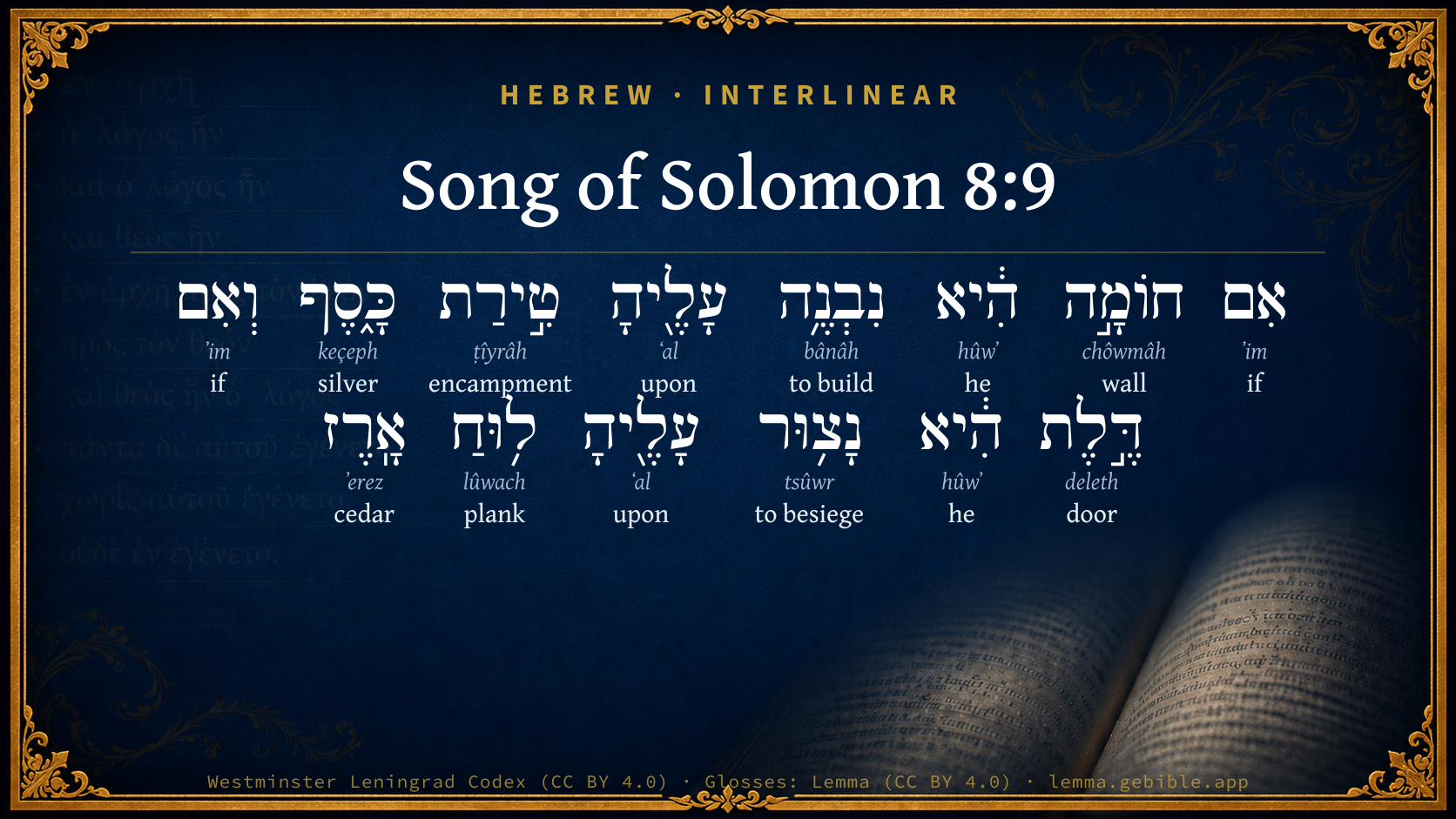
Hebrew (Westminster Leningrad Codex) Song of Solomon 8:9 appears in the Hebrew Old Testament. The text above is from the Westminster Leningrad Codex. Each word links to its Strong’s number, a concise gloss, and parsing drawn from the Open Scriptures Hebrew Bible morphology. Click any word for its full Brown-Driver-Briggs (BDB) entry.
Download image
Cite this verse

Song of Solomon 8:9 (World English Bible). Public Domain. Lemma interlinear Bible study tool, https://lemma.gebible.app/v/song-of-solomon/8/9.

Show BibTeX & RIS
BibTeX
RIS
English Translation
If she is a wall, We will build on her a turret of silver. If she is a door, We will enclose her with boards of cedar. Beloved
World English Bible · Public Domain
Download a study sheet

One document with this verse’s original text, its word-by-word gloss line, the meaning frame, cross-references with their text, attributed commentary, and full source and license credits — printable, and it pastes into notes with its structure intact.

This verse Autodidact and up

Study sheet (.html) Plain text (.txt)

A passage Seminary Student

Up to 50 verses in one chapter. A passage sheet keeps up to 6 commentary sources and 12 cross-references per verse, in the order this page ranks them, and says so on the sheet whenever that leaves anything out. Ask for a single verse and you get the Autodidact verse sheet above.

Everything on this page stays free to read, with no account — the sheet is a download of what is already on screen, not access to it.

Want to remove ads? Support Godless Engineer
Compare translations 3

The same verse in 3 English versions, stacked beneath the original-language interlinear above. Click any original word for its lexicon entry.

Each is an independent rendering of the whole verse — the interlinear is not word-aligned to these translations.

Highlighted words mark where these versions differ — a whole-verse word diff, not a word-by-word alignment.

  • World English Bible Public Domain
    If she is a wall, We will build on her a turret of silver. If she is a door, We will enclose her with boards of cedar. Beloved
  • King James Version Public Domain
    If she be a wall, we will build upon her a palace of silver: and if she be a door, we will inclose her with boards of cedar.
  • unfoldingWord Literal Text CC BY-SA 4.0
    If she a wall, we will build on her a battlement of silver. And if she a door, we will enclose over her boards of cedar.

unfoldingWord Literal Text — © unfoldingWord, licensed CC BY-SA 4.0. Word-aligned USFM3 via Door43 (git.door43.org/unfoldingWord/en_ult).

Versions to compare (up to 4)

3 of 4 selected

Show all 18 translations

Every available English version of this verse, each an independent rendering of the whole verse.

  • World English Bible Public Domain
    If she is a wall, We will build on her a turret of silver. If she is a door, We will enclose her with boards of cedar. Beloved
  • Berean Standard Bible Public Domain
    If she is a wall, we will build a tower of silver upon her. If she is a door, we will enclose her with panels of cedar.
  • Majority Standard Bible Public Domain
    If she is a wall, we will build a tower of silver upon her. If she is a door, we will enclose her with panels of cedar.
  • King James Version Public Domain
    If she be a wall, we will build upon her a palace of silver: and if she be a door, we will inclose her with boards of cedar.
  • American Standard Version (1901) Public Domain
    If she be a wall, We will build upon her a turret of silver: And if she be a door, We will inclose her with boards of cedar.
  • Revised Version (1885) Public Domain
    If she be a wall, we will build upon her a turret of silver: and if she be a door, we will enclose her with boards of cedar.
  • Geneva Bible (1599) Public Domain
    If shee be a wall, we will builde vpon her a siluer palace: and if she be a doore, we wil keepe her in with bordes of cedar.
  • Douay-Rheims (1899) Public Domain
    If she be a wall: let us build upon it bulwarks of silver: if she be a door, let us join it together with boards or cedar.
  • Young's Literal Translation Public Domain
    If she is a wall, we build by her a palace of silver. And if she is a door, We fashion by her board-work of cedar.
  • Literal Standard Version CC BY-SA 4.0
    If she is a wall, we build by her a palace of silver. And if she is a door, || We fashion by her board-work of cedar.
  • Unlocked Literal Bible CC BY-SA 4.0
    If she is a wall, we will build on her a tower of silver. If she is a door, we will adorn her with boards of cedar. The woman speaking to herself
  • unfoldingWord Literal Text CC BY-SA 4.0
    If she a wall, we will build on her a battlement of silver. And if she a door, we will enclose over her boards of cedar.
  • Darby Bible Public Domain
    If she be a wall, We will build upon her a turret of silver; And if she be a door, We will enclose her with boards of cedar.
  • World Messianic Bible Public Domain
    If she is a wall, we will build on her a turret of silver. If she is a door, we will enclose her with boards of cedar.
  • Webster's Bible Public Domain
    If she is a wall, we will build upon her a palace of silver: and if she is a door, we will inclose her with boards of cedar.
  • Free Bible Version CC BY-SA 4.0
    If she is a wall, we will build a silver tower on it. But if she is a door, we will bar the way with cedar planks.
  • Bible in Basic English Public Domain
    If she is a wall, we will make on her a strong base of silver; and if she is a door, we will let her be shut up with cedar-wood.
  • JPS Tanakh (1917) Public Domain
    If she be a wall, we will build upon her a turret of silver; and if she be a door, we will enclose her with boards of cedar.

Literal Standard Version (2020), Covenant Press — licensed CC BY-SA 4.0. Text via the HelloAO Bible API (eBible.org). Unlocked Literal Bible (unfoldingWord) — licensed CC BY-SA 4.0. Text via the HelloAO Bible API (eBible.org). unfoldingWord Literal Text — © unfoldingWord, licensed CC BY-SA 4.0. Word-aligned USFM3 via Door43 (git.door43.org/unfoldingWord/en_ult). Free Bible Version, Dr. Jonathan Gallagher — licensed CC BY-SA 4.0. Text via the HelloAO Bible API (eBible.org).

Word by word

More ways to search: Search by grammar → Find every occurrence → Compare this word →

Practice this passage: Drill this verse → Learn its vocabulary →

טִ֣ירַת
ṭîyrâh
H2918
“encampment of”
Noun, Common, Feminine, Singular, Construct
Part of Speech
Noun
Type
Common
Gender
Feminine
Number
Singular
State
Construct
Full BDB Definition

Origin: from (an equivalent to) H2905

TWOT: 798b

encampment, battlement - encampment, tent camp - walled dwelling places, battlement (metaphorically) - row (of stones)
  1. אִם ʼim H518 “if” Conjunction
  2. חוֹמָ֣ה chôwmâh H2346 “wall” Noun, Common, Feminine, Singular, Absolute
  3. הִ֔יא hûwʼ H1931 “he” Pronoun, Personal, 3rd Person, Feminine, Singular
  4. נִבְנֶ֥ה bânâh H1129 “to build” Verb, Qal, Imperfect, 1st Person, Common, Plural
  5. עָלֶ֖יהָ ʻal H5921 “upon · her” Preposition + Suffix, Personal, 3rd Person, Feminine, Singular
  6. כָּ֑סֶף keçeph H3701 “silver” Noun, Common, Masculine, Singular, Absolute
  7. וְאִם ʼim H518 “and · if” Conjunction + Conjunction
  8. דֶּ֣לֶת deleth H1817 “door” Noun, Common, Feminine, Singular, Absolute
  9. הִ֔יא hûwʼ H1931 “he” Pronoun, Personal, 3rd Person, Feminine, Singular
  10. נָצ֥וּר tsûwr H6696 “to besiege” Verb, Qal, Imperfect, 1st Person, Common, Plural
  11. עָלֶ֖יהָ ʻal H5921 “upon · her” Preposition + Suffix, Personal, 3rd Person, Feminine, Singular
  12. ל֥וּחַ lûwach H3871 “plank of” Noun, Common, Masculine, Singular, Construct
  13. אָֽרֶז ʼerez H730 “cedar” Noun, Common, Masculine, Singular, Absolute

About this verse

These counts appear in no published source. They are computed here, from the morphology-tagged text and Lemma’s own curated glosses. What Lemma adds →

14
words
11
distinct lemmas
Wisdom
section

Notable vocabulary

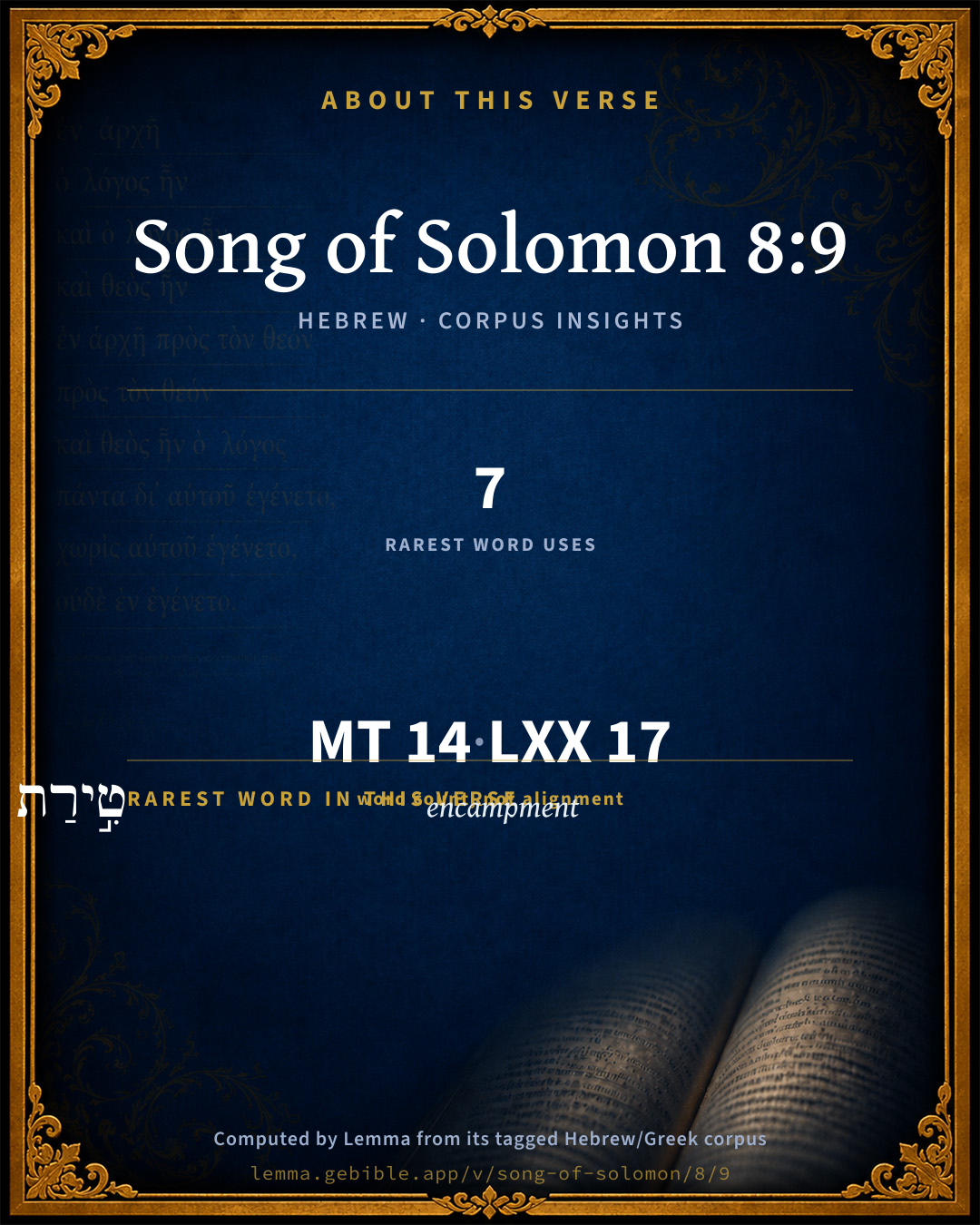
The rarest word here is טִ֣ירַת encampment H2918 — appearing just 7 times in the whole Hebrew Bible.

Shared distinctive vocabulary

טִ֣ירַת encampment H2918 occurs in 7 verses of the Hebrew Bible. Also found in:

Grammatical profile

  • 2 verbs
  • 6 nouns
  • 2 pronouns
  • 2 prepositions
  • 2 conjunctions

Verb forms

  • נִבְנֶ֥ה Qal · Imperfect
  • נָצ֥וּר Qal · Imperfect

Repetition

Words recur within this verse — often emphatic in Hebrew:

  • עָלֶ֖יהָ upon H5921 ×2
  • אִם if H518 ×2
  • הִ֔יא he H1931 ×2

Hebrew & Septuagint length

In English translation the verse runs 28 words from the Hebrew and 25 from the Septuagint (LXX English) — closely comparable.

A rough comparison of the two English renderings, which tokenize alike — not a word-level alignment.

Word counts can differ between the Hebrew and the Greek without any difference in meaning — e.g. the Hebrew direct-object marker אֵת has no separate Greek word, and Greek often adds the article ὁ.

In the original languages it is 14 Hebrew tokens and 17 Greek tokens — but the two are counted differently (Hebrew bundles its prefixes and suffixes into one token; the Greek is in lemma form), so that isn’t a like-for-like length.

Cross-references

12

Topical passages linked to Song of Solomon 8:9 in the Treasury of Scripture Knowledge — connected by theme and wording, ordered by reader-vote popularity; previews shown in the World English Bible.

  • 1 Kings 6:15 He built the walls of the house within with boards of cedar: from the floor of the house to the walls of the ceiling, he covered them on the inside with wood; and he covered the floor of the house with boards of fir.
  • Song of Solomon 2:9 My beloved is like a roe or a young hart. Behold, he stands behind our wall! He looks in at the windows. He glances through the lattice.
  • Isaiah 58:12 Those who shall be of you shall build the old waste places; you shall raise up the foundations of many generations; and you shall be called The repairer of the breach, The restorer of paths to dwell in.
  • Isaiah 60:17 For brass I will bring gold, and for iron I will bring silver, and for wood brass, and for stones iron. I will also make your officers peace, and righteousness your ruler.
  • Isaiah 61:4 They shall build the old wastes, they shall raise up the former desolations, and they shall repair the waste cities, the desolations of many generations.
  • Zechariah 6:12–15 and speak to him, saying, 'Thus says Yahweh of Hosts, "Behold, the man whose name is the Branch: and he shall grow up out of his place; and he shall build the temple of Yahweh;
  • Matthew 16:18 I also tell you that you are Peter, and on this rock I will build my assembly, and the gates of Hades will not prevail against it.
  • Acts 14:27 When they had arrived, and had gathered the assembly together, they reported all the things that God had done with them, and that he had opened a door of faith to the Gentiles.
  • Acts 15:16 'After these things I will return. I will again build the tent of David, which has fallen. I will again build its ruins. I will set it up,
  • 1 Corinthians 3:10–12 According to the grace of God which was given to me, as a wise master builder I laid a foundation, and another builds on it. But let each man be careful how he builds on it.
  • Ephesians 2:20–22 being built on the foundation of the apostles and prophets, Christ Jesus himself being the chief cornerstone;
  • Revelation 21:12–19 having a great and high wall; having twelve gates, and at the gates twelve angels; and names written on them, which are the names of the twelve tribes of the children of Israel.

Cross-references courtesy of OpenBible.info (CC BY 4.0).

Hebrew and Greek witnesses Masoretic Hebrew ↔ Greek Septuagint

The same verse in the two great witnesses to the Old Testament, shown verse-for-verse.

These are two independent witnesses, not word-aligned to each other, and the Septuagint is shown in lemma (dictionary) form.

Hebrew Song of Solomon 8:9 Masoretic · Westminster Leningrad Codex

אִם חוֹמָ֣ה הִ֔יא נִבְנֶ֥ה עָלֶ֖יהָ טִ֣ירַת כָּ֑סֶף וְאִם דֶּ֣לֶת הִ֔יא נָצ֥וּר עָלֶ֖יהָ ל֥וּחַ אָֽרֶז

If she is a wall, We will build on her a turret of silver. If she is a door, We will enclose her with boards of cedar. Beloved

World English Bible · Public Domain

Greek LXX Song of Solomon 8:9 Septuagint · lemma form

εἰ τεῖχος εἰμί οἰκοδομέω ἐπί αὐτός ἔπαλξις ἀργυροῦς καί εἰ θύρα εἰμί διαγράφω ἐπί αὐτός σανίδος κέδρινος

If she is a wall, let us build upon her silver bulwarks; and if she is a door, let us carve for her cedar panels.

LXX2012 (modern English Septuagint) · Public Domain

Hebrew: Westminster Leningrad Codex (CC BY 4.0). Greek: Septuagint (public domain); English from LXX2012 (modern English Septuagint) (Public Domain). How the Septuagint differs from the Hebrew →

Commentary

Notes on Song of Solomon 8:9 from classic Christian and Jewish commentators (each source and its license shown beneath its notes). The classic Christian expositions comment on the surrounding passage and are grouped to its opening verse, so a note may address several verses; the Jewish commentaries on the Tanakh (Rashi and others) are per-verse, so they appear only where the commentator wrote on this verse.

Lemma curates 59 commentaries, every one of them public domain or Creative Commons licensed, each selected and text-cleaned for this edition rather than reprinted as found. About our sources →

Trapp's Complete Commentary

John Trapp

Son 8:9 If she [be] a wall, we will build upon her a palace of silver: and if she [be] a door, we will inclose her with boards of cedar.

Ver. 9. If she be a wall, we will build upon her, &c.] Christ answers, If she be, as she ought to be, strong and well grounded in the faith, able to bear a good weight laid upon her, as a wall, pillar, and ground of truth, not sinking or fainting under the heaviest burden of these light afflictions, which are but for a moment, but patient and perseverant in the faith unto the death, then will I do all for her that may be done, to make her happy. This speech is somewhat like that of Solomon concerning Adonijah, "If he show himself a worthy man," &c. {1Ki 1:52}

We will build upon her a palace of silver.] The whole blessed Trinity will have a hand in building the Church of the Gentiles upon the foundation of the apostles and prophets, Jesus Christ himself being the chief corner stone. {Eph 2:20} God "plants the heavens, and lays the foundation of the earth, that he may say to Zion, Thou art my people." {Isa 51:16} None can come to Christ except God the Father draw him. {Joh 6:44} Christ the second person is both "author and finisher of our faith." {Heb 12:2} The Holy Ghost is "the same Spirit of faith" in David and Paul, {2Co 4:13} and is received by "the hearing of faith." {Gal 3:2} He is "the God of all grace," {2Pe 1:19} antecedent, concomitant, subsequent. We have nothing of which any of us can say, Mihi soli debeo., I am not bound to God for it.

And if she be a door, &c.] As she is "the house of God, and gate of heaven." {Gen 28:17} If she will open the "everlasting doors to the King of glory," {Psa 24:7} and open "a great door and effectual" to his faithful ministers, {1Co 16:9} who come to "build her for a habitation of God through the Spirit." {Eph 2:22} If she open the gates, "that the righteous nation, which keepeth the truth, may enter in," {Isa 26:2} then will the Lord Christ "enclose her," board her, and beautify her with fair, sweet, and strong cedars, as with curious and costly wainscot, which shall be monimentum, munimentum, ornamentum, &c. But all this is promised upon the condition that she be a wall and a door, that is, that she receive and retain Christ with her; for otherwise she can claim nothing. He may desert her without breach of covenant, as he did the old Church, and many particular Churches of the New Testament now under the Turk, for their perfidy and apostacy. The Church of Rome, though utterly revolted, yet lays strong claim to Christ still; and concludes, "I sit as a queen, and shall see no sorrow. Therefore shall her plagues come in one day. For, strong is the Lord God who judgeth her." {Rev 18:7-8} {See Trapp on "Rev 18:7"} {See Trapp on "Rev 18:8"} About the year of grace 1414, Theodoricus Urias, an Augustine friar in Germany, said that the Church of Rome was, even so long since, become ex aurea argenteam, ex argentea ferream, ex ferrea terream, superesse ut in stercus abiret, {a} of gold silver, of silver brass, of brass iron, of iron clay. There remains nothing now, but that of clay she become dung, to be swept out of doors with the besom of destruction.

{a} Jac. Revius, De Vit. Pontif., p. 229.

John Trapp, A Commentary or Exposition upon All the Books of the Old and New Testament (1647–1656) — public domain. Text from a community e-Sword module.

Joseph Benson's Commentary

Son 8:9. If she be a wall, &c. — This and the following verse are certainly very obscure, and it is, perhaps, impossible to ascertain the precise signification of each of the terms or clauses used in them. The general meaning, however, of this verse is thought to be, that Christ engages himself to provide for her, in a way which should best suit with her condition. If the Gentiles, when they are converted, shall be like a wall, strong and firm in faith; we — my Father and I, as the principal builders, and my ministers, as workers with and under us, will build upon her a palace of silver — Will add more strength and beauty to her, will enlarge and adorn her; and if she be as a door — Which is weaker than a wall; if she be weak in faith, yet we will not therefore reject her, but we will enclose, or (as many others render the word) strengthen, or fortify her with boards of cedar — Which are not only beautiful, but also strong and durable. In other words, “We will take care of her, in proportion as she is capable of receiving or profiting by our bounty, like as men are wont to build on good foundations.” The eastern people delight thus to express themselves by parables, or comparisons. The bride’s answer in the next verse is thought to show that the bridegroom alludes to the sister’s degree of growth.

Joseph Benson's Commentary on the Old and New Testaments (1811–1818) — public domain. Text from a community e-Sword module.

Tyndale Open Study Notes

Tyndale Open Resources

8:9 wall: There appear to be two metaphorical meanings for this term: (1) The prepubescent girl’s chest is like a wall (see 8:10); and (2) until she is married, she should be abstinent, impenetrable like a wall. • protect her with a silver tower: Towers were used as lookouts for protecting the city; a silver one would be more prominent and impregnable. If the woman is already a wall, having kept her virginity, they will honor and reinforce her resolve. • On the other hand, a swinging door indicates promiscuity. The brothers will force her to restrain herself.

Tyndale Open Study Notes — © Tyndale Open Resources, licensed CC BY-SA 4.0. Text via the HelloAO Bible API.

Geneva Bible (1599)

Geneva Bible translators

If she be sure and fast, she is meet for the husband to dwell in.

Geneva Bible (1599) marginal notes — public domain. Text via Bolls.life.

Adam Clarke's Commentary

Verse 9. If she be a wall] All these expressions, says Calmet, show that it was necessary to provide a husband for this young sister. For a woman without a husband is like a wall without towers, and without defense; is like a gate or door without bar or lock; and like a city without walls. They must therefore provide for their sister a rich, powerful, and illustrious man; qualities here figured by towers or palaces of silver, and doors of cedar. As it is customary to build towers upon a wall, and to put bolts and bars upon a door in order to secure it, so the expressions may point out the defense, protection, and guardianship which they imagined this young woman to require.

Adam Clarke's Commentary on the Bible (1810–1826) — public domain. Text from a community e-Sword/MySword module.

Ellicott's Commentary for English Readers

(9) If she be a wall.—The wall and door are emblems of chastity and its opposite. The palace of silver some commentators explain by reference to the custom (among the Druses) of wearing an ornament like a horn on the head. But this is unlikely. The metaphors of the wall and door are naturally expanded. If the maiden grows up virtuous and inaccessible to seduction we will build upon her a palace of silver, i.e., we will so provide for her in marriage that from her may spring an illustrious house; but if otherwise, we will enclose her with boards of cedar, i.e., the strongest precautions shall be taken to guard her honour. This passage is one of the strongest arguments for the theory that chaste wedded love is the theme of this book, the poet going on in Son_8:10 to put into the heroine’s mouth a protestation of purity; and by which virtuous disposition, even more than by her beauty, she had won her husband’s love: “I have grown up to virtuous womanhood, and I have found favour in his eyes.”

A Bible Commentary for English Readers, edited by Charles John Ellicott (1878–1897) — public domain. Text from a community e-Sword module.

The Cambridge Bible for Schools and Colleges

gen. ed. J. J. S. Perowne

9. If she be a wall] i.e. if she resist attacks and preserve her innocence, they will reward her by building upon her a battlement or turret of silver, i.e. they will adorn her, perhaps for her marriage, as the bride in ancient times wore a crown.

and if she be a door] i.e. if she be ready to permit an enemy to pass her defences, then they will fasten her up with a plank of cedar. The meaning is, that as men prevent a door from opening by fastening a plank across so that it cannot move, so they will take measures to prevent her from yielding to her weakness. The Heb. deleth means always strictly a door, never a doorway, which is pethach.

cedar] The plank is to be of cedar, because the wood of that tree is specially tough and indestructible, not at all like the soft red American cedar.

The Cambridge Bible for Schools and Colleges (gen. ed. J. J. S. Perowne; Cambridge University Press, 1878–1918) — public domain. Text from a community e-Sword module.

Haydock's Catholic Bible Commentary

Cedar. Procuring for her a rich and steady husband to protect her. These are the words of the bridegroom. The Christian Church seemed weak at first. But her pastors and martyrs caused her to triumph over all the powers of hell. (Calmet) --- Those who correspond with the first grace, are furnished with others. (Menochius)

George Leo Haydock (1774–1849), Haydock's Catholic Family Bible and Commentary, 1859 edition — public domain. Excludes Psalms (Douay-Rheims chapter numbering differs from Protestant) and Deuterocanonical books (Catholic canon only).

Matthew Poole's English Annotations

This seems to be Christ’s answer to the foregoing question of the Jewish church concerning their sister church of the Gentiles, for which they were very solicitous. Christ therefore engageth himself to take care of her, and to provide for her, as the matter doth require, and as suits best with her condition. If the Gentiles, when they are converted, shall be like a

wall, strong and firm in faith, stedfast against all assaults and temptations, for a wall in Scripture use signifies strength, Isa 26:1; Jer 15:20, and elsewhere,

we, my Father, and I, and the Holy Ghost, as the principal builders, and my ministers as workers with and under us,

will build upon her a palace of silver; will add more strength and beauty to her, will enlarge and adorn her, make her more amiable in mine eyes, and more visible and glorious in the eyes of the world.

And if she be as a door, which is weaker than a wall, and where the enemy doth or may break in upon her; if she be weak in faith, and sometimes overcome by the tempter, yet we will not therefore reject and forsake her, but

we will enclose, or (as many others render the word) strengthen, or fortify, her with boards of cedar, which are not only beautiful, but also strong and durable. If she be sincere, and open the door of her heart to me, though she be weak, I will come in to her, and make her stronger.

Matthew Poole's English Annotations on the Holy Bible (1683–1685) — public domain. Text from a community e-Sword/MySword module.

Whedon's Commentary on the Bible

Daniel D. Whedon

9. If she be a wall — This implies stability and fidelity of character.

A palace of silver — Better, a turret of silver. Among the Druses of Mount Lebanon an unmarried girl wears upon the crown of her head a silver horn, often studded with jewels. Possibly a beautiful gift of this sort is contemplated as a reward for her maintenance of the honour of their family.

And if she be a door — That is, “swinging to and fro,” “fickle.” Cedar is a strong wood, and the idea of enclosing her in boards of cedar is that of close, strict custody. If she show herself accessible to seductive arts, she shall be guarded with the greater vigilance.

Daniel D. Whedon (gen. ed.), Commentary on the Old and New Testaments (1874–1909) — public domain. Text from a community e-Sword module.

The Pulpit Commentary

If she be a wall, we will build upon her a turret of silver: and if she be a door, we will enclose her with boards of cedar. The interpretation which Delitzsch suggests of these words is that the "wall" represents firmness of character, and the "door" weakness and insecurity. If she firmly and successfully withstands all immoral approaches, then we will bestow high honour upon her, as a tribute to her maidenly virtue and constancy. The turret or castle of silver would mean rewarding her with increase. Silver is the emblem of holiness, gold of nobility. The meaning may, however, merely be, "We will endow her with plenty." The boards of cedar are supposed to be special protections, as cedar is noted for its hardness and durability. But is not the meaning much simpler and more natural? It would be rather a far fetched use of the figure of a door that it should suggest seduction, and would be rather unsuitable in the lips of the bridegroom when speaking of the little sister of his own bride. May not the meaning be no more than this? She may become one of the most substantial parts of the building, like a wall; in that ease all that she can be she shall be; we will put the highest honour upon her. She may be a door, that is, though not so great and substantial as the wall, still in the very front of the building and before the eyes of all. In that case we will beautify her with costly and fragrant adornment. The gate shall be enclosed in cedar wood. "The wall and the door," says Zockler, "are mostly understood of the steadfast and faithful keeping of the Word of God and of its zealous proclamation to the Gentiles; (1Co_16:9, etc.) but some also explain them of the valiant in faith and the weak in faith, or of the learned and simple, or of faithful Christians and such as are recreant and easily accessible to the arts of seduction. And then, according to these various interpretations, the "silver bulwarks" are now the miracles of the first witnesses of Jesus, now the distinguished teachers of the Church, now pious Christian rulers, now the testimonies of Holy Scripture by which faith is strengthened. And, again, by the "cedar boards" are sometimes understood the ten commandments or the Law, sometimes Christian teachers, sometimes the examples of the saints, sometimes the salutary discipline of the cross and sufferings for Christ"s sake," etc. All such attempts at detailed interpretation fail to give satisfaction. Their effect is to repel many from the study of the book altogether, just as the follies and. extravagances of the interpreters of prophecy have greatly hindered the study of the prophetic Scriptures. The wall and the door need not be taken as opposed to one another, as they are not in our conceptions of a city.

They fulfil different functions. The wall is for defence; the door is for admission. In the one case we think of strength, and in the other case of beauty. The application of the symbols is very easy if the general meaning alone is regarded. There is a variety of capacity and function in the Church of Christ. There are differences in the forms of Christianity among different nations. But the Lord will receive and bless all. Some are not fitted to be built upon as strong wails, but they may still be beautiful examples of Christian graces in the eyes of the world, through whom many gladly enter into the truth and into the fellowship of Christ.

The Pulpit Commentary (1880–1919), ed. H.D.M. Spence-Jones & Joseph S. Exell — public domain. Text from a community e-Sword module.

John Wesley's Explanatory Notes

If - This seems to be Christ's answer to the foregoing question of the Jewish church. Christ engages himself to provide for her, as suits best with her condition. If the Gentiles when they are converted shall be like a wall, strong and firm in faith; We, my Father, and I, and the Holy Ghost, as the principal builders, and my ministers as workers with, and under us, will build upon her a palace of silver, will add more strength and beauty to her, will enlarge and adorn her; and if she be as a door, which is weaker than a wall; if she be weak in faith, yet we will not therefore reject her, but we will inclose or (as many others render the word) strengthen or fortify her with boards of cedar, which are not only beautiful, but also strong and durable.

John Wesley, Explanatory Notes Upon the Whole Bible (1754–1765) — public domain. Text via the GEBible commentary corpus.

unfoldingWord translationNotes

Door43 World Missions Community

General Information:

The young woman's brothers continue to speak among themselves.

If she is a wall ... If she is a door

The little sister (Song of Songs 8:8) has very small breasts that either have not grown or are very small. (See: Metaphor)

we will build on her a tower of silver ... we will adorn her with boards of cedar

The brothers decide to decorate the little sister with silver and cedar, symbols of riches, so that she will be more likely to attract a good husband. (See: Metaphor)

will adorn her

"will decorate her"

translationWords

watchtower

silver

cedar

unfoldingWord translationNotes — © Distant Shores Media and the Door43 World Missions Community, licensed CC BY-SA 4.0. Source: git.door43.org/Door43/en_tn.

Rashi

Rabbi Shlomo Yitzchaki (Rashi)

If she be a wall If she is strong in her faith and in her fear [of God], to be against them like a copper wall, that they should not enter her midst, meaning that she will not intermarry with them, and they will not come into her, and she will not be seduced by them.

we will build upon her a silver turret We will be to her as a fortified city and for a crown and for beauty, and we will build for her the Holy City and the chosen Temple.

and if she be a door which turns on its hinges, and when one knocks on it, it opens. She, too, if she opens for them so that they enter her and she [enters] them.

we will enclose her with cedar boards We will put into her door wooden boards which rot and which the worm gnaws and eats. Thereupon, the congregation of Israel will say:

Rashi on the Tanakh — English translations: “The Judaica Press complete Tanach with Rashi, translated by A. J. Rosenberg” (CC BY 4.0); “Pentateuch with Rashi's commentary by M. Rosenbaum and A.M. Silbermann, 1929-1934” (public domain); “The Metsudah Tanach series, Lakewood, N.J” (CC BY 4.0); and “The Book of Joshua, Metsudah Publications, 1997” (CC BY 4.0). Text via Sefaria.

Lesson kit

Teaching starters — assembled from the data on this page, not authored interpretation. Every prompt links to the verse data it draws on. Edit before teaching.

Song of Solomon, in the Wisdom, opens this verse with 14 words (11 distinct Hebrew lemmas). Its most distinctive word is ṭîyrâh (“encampment”). A historical commentator’s framing appears above. Read the whole chapter for the surrounding context.

Discussion questions

  1. How does “encampment” (ṭîyrâh) shape what this verse is saying?
  2. Genesis 25:16 shares the word «encampment» with this verse. How do the two illuminate each other?
  3. “upon” occurs 2× in this one verse. What is the effect of the repetition?
  4. These translations render this verse differently; the difference is in the English rendering, not the original. What questions does that raise?
  5. The verb «נִבְנֶ֥ה» is Qal Imperfect. How does its form color the action?
  6. Reading how Trapp's Complete Commentary and Joseph Benson's Commentary read this verse, where do the two commentators agree and where do they part?

Things to notice

Reading settings

Reading text

Shown beneath each verse's original-language words.

Old Testament
Old Testament edition

Read the OT as the Masoretic Hebrew (MT) or the Greek Septuagint (LXX).

English shown for the Greek Septuagint (in the Hebrew ↔ Greek comparison).

Comparing translations? Open the Compare panel on any verse page to stack up to four side by side.