
Amos 1:7

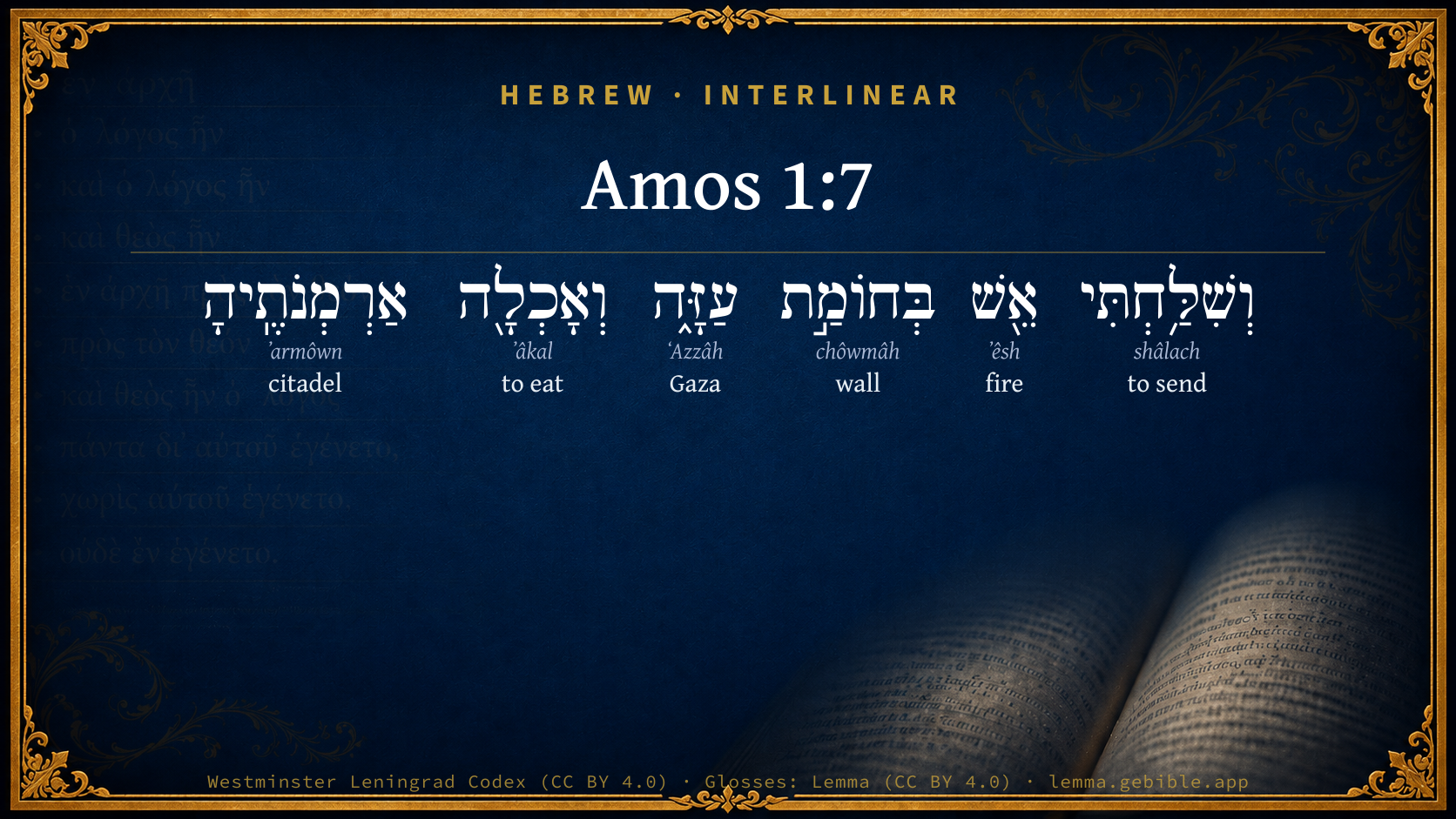
Hebrew (Westminster Leningrad Codex) Amos 1:7 appears in the Hebrew Old Testament. The text above is from the Westminster Leningrad Codex. Each word links to its Strong’s number, a concise gloss, and parsing drawn from the Open Scriptures Hebrew Bible morphology. Click any word for its full Brown-Driver-Briggs (BDB) entry.
Download image
Cite this verse

Amos 1:7 (World English Bible). Public Domain. Lemma interlinear Bible study tool, https://lemma.gebible.app/v/amos/1/7.

Show BibTeX & RIS
BibTeX
RIS
English Translation
But I will send a fire on the wall of Gaza, And it will devour its palaces.
World English Bible · Public Domain
Download a study sheet

One document with this verse’s original text, its word-by-word gloss line, the meaning frame, cross-references with their text, attributed commentary, and full source and license credits — printable, and it pastes into notes with its structure intact.

This verse Autodidact and up

Study sheet (.html) Plain text (.txt)

A passage Seminary Student

Up to 50 verses in one chapter. A passage sheet keeps up to 6 commentary sources and 12 cross-references per verse, in the order this page ranks them, and says so on the sheet whenever that leaves anything out. Ask for a single verse and you get the Autodidact verse sheet above.

Everything on this page stays free to read, with no account — the sheet is a download of what is already on screen, not access to it.

Want to remove ads? Support Godless Engineer
Compare translations 3

The same verse in 3 English versions, stacked beneath the original-language interlinear above. Click any original word for its lexicon entry.

Each is an independent rendering of the whole verse — the interlinear is not word-aligned to these translations.

Highlighted words mark where these versions differ — a whole-verse word diff, not a word-by-word alignment.

  • World English Bible Public Domain
    But I will send a fire on the wall of Gaza, And it will devour its palaces.
  • King James Version Public Domain
    But I will send a fire on the wall of Gaza, which shall devour the palaces thereof:
  • unfoldingWord Literal Text CC BY-SA 4.0
    I will send fire on the walls of Gaza, and it will devour her fortresses.

unfoldingWord Literal Text — © unfoldingWord, licensed CC BY-SA 4.0. Word-aligned USFM3 via Door43 (git.door43.org/unfoldingWord/en_ult).

Versions to compare (up to 4)

3 of 4 selected

Show all 18 translations

Every available English version of this verse, each an independent rendering of the whole verse.

  • World English Bible Public Domain
    But I will send a fire on the wall of Gaza, And it will devour its palaces.
  • Berean Standard Bible Public Domain
    So I will send fire upon the walls of Gaza, to consume its citadels.
  • Majority Standard Bible Public Domain
    So I will send fire upon the walls of Gaza, to consume its citadels.
  • King James Version Public Domain
    But I will send a fire on the wall of Gaza, which shall devour the palaces thereof:
  • American Standard Version (1901) Public Domain
    but I will send a fire on the wall of Gaza, and it shall devour the palaces thereof.
  • Revised Version (1885) Public Domain
    But I will send a fire on the wall of Gaza, and it shall devour the palaces thereof:
  • Geneva Bible (1599) Public Domain
    Therefore will I sende a fire vpon the walles of Azzah, and it shall deuoure the palaces thereof.
  • Douay-Rheims (1899) Public Domain
    And I will send a fire on the wall of Gaza, and it shall devour the houses thereof.
  • Young's Literal Translation Public Domain
    And I have sent a fire against the wall of Gaza, And it hath consumed her palaces;
  • Literal Standard Version CC BY-SA 4.0
    And I have sent a fire against the wall of Gaza, || And it has consumed her palaces;
  • Unlocked Literal Bible CC BY-SA 4.0
    I will send fire on the walls of Gaza, and it will devour her fortresses.
  • unfoldingWord Literal Text CC BY-SA 4.0
    I will send fire on the walls of Gaza, and it will devour her fortresses.
  • Darby Bible Public Domain
    And I will send a fire on the wall of Gazah, and it shall devour the palaces thereof.
  • World Messianic Bible Public Domain
    but I will send a fire on the wall of Gaza, and it will devour its palaces.
  • Webster's Bible Public Domain
    But I will send a fire on the wall of Gaza, which shall devour its palaces:
  • Free Bible Version CC BY-SA 4.0
    So I will send down fire on the walls of Gaza and burn up its fortresses.
  • Bible in Basic English Public Domain
    And I will send a fire on the wall of Gaza, burning up its great houses:
  • JPS Tanakh (1917) Public Domain
    So will I send a fire on the wall of Gaza, and it shall devour the palaces thereof;

Literal Standard Version (2020), Covenant Press — licensed CC BY-SA 4.0. Text via the HelloAO Bible API (eBible.org). Unlocked Literal Bible (unfoldingWord) — licensed CC BY-SA 4.0. Text via the HelloAO Bible API (eBible.org). unfoldingWord Literal Text — © unfoldingWord, licensed CC BY-SA 4.0. Word-aligned USFM3 via Door43 (git.door43.org/unfoldingWord/en_ult). Free Bible Version, Dr. Jonathan Gallagher — licensed CC BY-SA 4.0. Text via the HelloAO Bible API (eBible.org).

Word by word

More ways to search: Search by grammar → Find every occurrence → Compare this word →

Practice this passage: Drill this verse → Learn its vocabulary →

About this verse

These counts appear in no published source. They are computed here, from the morphology-tagged text and Lemma’s own curated glosses. What Lemma adds →

6
words
6
distinct lemmas
Prophets
section

Notable vocabulary

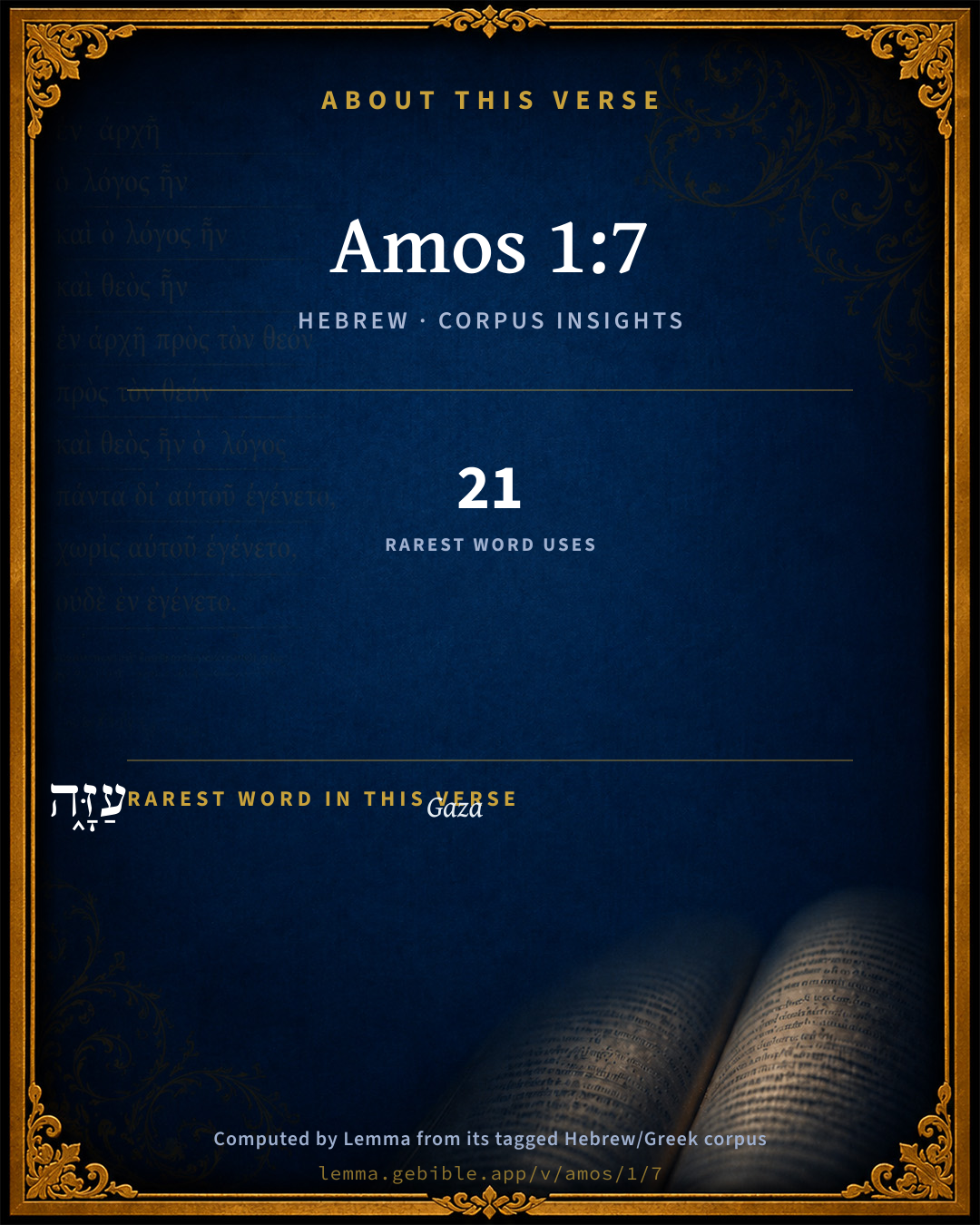
The rarest word here is עַזָּ֑ה Gaza H5804 — appearing just 21 times in the whole Hebrew Bible.

Shared distinctive vocabulary

עַזָּ֑ה Gaza H5804 occurs in 20 verses of the Hebrew Bible. Also found in:

Grammatical profile

  • 2 verbs
  • 4 nouns

Verb forms

  • וְשִׁלַּ֥חְתִּי Piel · Sequential Perfect
  • וְאָכְלָ֖ה Qal · Sequential Perfect

Hebrew & Septuagint length

In English translation the verse runs 17 words from the Hebrew and 18 from the Septuagint (LXX English) — closely comparable.

A rough comparison of the two English renderings, which tokenize alike — not a word-level alignment.

Word counts can differ between the Hebrew and the Greek without any difference in meaning — e.g. the Hebrew direct-object marker אֵת has no separate Greek word, and Greek often adds the article ὁ.

Cross-references

12

Topical passages linked to Amos 1:7 in the Treasury of Scripture Knowledge — connected by theme and wording, ordered by reader-vote popularity; previews shown in the World English Bible.

  • Zephaniah 2:4 For Gaza will be forsaken, and Ashkelon a desolation. They will drive out Ashdod at noonday, and Ekron will be rooted up.
  • 2 Kings 18:8 He struck the Philistines to Gaza and the borders of it, from the tower of the watchmen to the fortified city.
  • Jeremiah 47:1 The word of Yahweh that came to Jeremiah the prophet concerning the Philistines, before that Pharaoh struck Gaza.
  • Deuteronomy 32:35 Vengeance is mine, and recompense, At the time when their foot shall slide: For the day of their calamity is at hand, The things that are to come on them shall make haste.
  • Deuteronomy 32:41–43 If I whet my glittering sword, My hand take hold on judgment; I will render vengeance to my adversaries, Will recompense those who hate me.
  • 2 Chronicles 26:6 He went forth and warred against the Philistines, and broke down the wall of Gath, and the wall of Jabneh, and the wall of Ashdod; and he built cities in [the country of] Ashdod, and among the Philistines.
  • Psalms 75:7–8 But God is the judge. He puts down one, and lifts up another.
  • Psalms 94:1–5 Yahweh, you God to whom vengeance belongs, You God to whom vengeance belongs, shine forth.
  • Jeremiah 25:18–20 [to wit], Jerusalem, and the cities of Judah, and the kings of it, and the princes of it, to make them a desolation, an astonishment, a hissing, and a curse, as it is this day;
  • Amos 1:4 But I will send a fire into the house of Hazael, And it will devour the palaces of Ben Hadad.
  • Zechariah 9:5–7 Ashkelon will see it, and fear; Gaza also, and will writhe in agony; As will Ekron, for her expectation will be disappointed; And the king will perish from Gaza, And Ashkelon will not be inhabited.
  • Romans 12:19 Don't seek revenge yourselves, beloved, but give place to God's wrath. For it is written, "Vengeance belongs to me; I will repay, says the Lord."

Cross-references courtesy of OpenBible.info (CC BY 4.0).

Hebrew and Greek witnesses Masoretic Hebrew ↔ Greek Septuagint

The same verse in the two great witnesses to the Old Testament, shown verse-for-verse.

These are two independent witnesses, not word-aligned to each other, and the Septuagint is shown in lemma (dictionary) form.

Hebrew Amos 1:7 Masoretic · Westminster Leningrad Codex

וְשִׁלַּ֥חְתִּי אֵ֖שׁ בְּחוֹמַ֣ת עַזָּ֑ה וְאָכְלָ֖ה אַרְמְנֹתֶֽיהָ

But I will send a fire on the wall of Gaza, And it will devour its palaces.

World English Bible · Public Domain

Greek LXX Amos 1:7 Septuagint · lemma form

καί ἐκ ἀποστέλλω πῦρ ἐπί ὁ τεῖχος γάζα καί καταἐσθίω θεμέλιον αὐτός

And I will send forth a fire on the walls of Gaza, and it shall devour its foundations.

LXX2012 (modern English Septuagint) · Public Domain

Hebrew: Westminster Leningrad Codex (CC BY 4.0). Greek: Septuagint (public domain); English from LXX2012 (modern English Septuagint) (Public Domain). How the Septuagint differs from the Hebrew →

Targum (Aramaic paraphrase)

1

The Targum is the ancient Jewish Aramaic paraphrase of the Hebrew Scriptures — an interpretive translation, not the Hebrew text itself. Onkelos (literal) and Pseudo-Jonathan (expansive) render the Torah, and Jonathan the Prophets. Coverage is partial: where no permissively-licensed English translation exists for a verse, only the Aramaic is shown. This is verse-level text, not a word-by-word alignment to the Hebrew.

  1. Targum Jonathan Prophets (Joshua–Malachi)
    וְאֶשְׁלַח אֶשְׁתָּא בְּשׁוּרֵי עַזָה וּתְשֵׁיצֵי בִּרְנְיָתָהָא:

    (no public-domain English translation for this verse)

    Targum Jonathan — Aramaic: “Mikraot Gedolot” (public domain). English: “Sefaria Community Translation” (CC0 1.0 (public-domain dedication)); “London "Chaldee Paraphrase," 1871” (public domain). Text via Sefaria.

Commentary

Notes on Amos 1:7 from classic Christian and Jewish commentators (each source and its license shown beneath its notes). The classic Christian expositions comment on the surrounding passage and are grouped to its opening verse, so a note may address several verses; the Jewish commentaries on the Tanakh (Rashi and others) are per-verse, so they appear only where the commentator wrote on this verse.

Lemma curates 59 commentaries, every one of them public domain or Creative Commons licensed, each selected and text-cleaned for this edition rather than reprinted as found. About our sources →

Trapp's Complete Commentary

John Trapp

Amo 1:7 But I will send a fire on the wall of Gaza, which shall devour the palaces thereof:

Ver. 7. But I will send a fire] i.e. an enemy, saith Drusius, which, as a fire, shall consume all. This was fulfilled by Uzziah, 2Ch 26:6, whence it was afterward called "Gaza, which is desert," Act 8:26.

Which shall devour the palaces thereof] Built likely in the blood of the poor afflicted, and having sin at the bottom, which blew up all at length, as the voice from heaven said to Phocas, who likewise laid his foundation in blood. {See Trapp on "Amo 1:4"}

John Trapp, A Commentary or Exposition upon All the Books of the Old and New Testament (1647–1656) — public domain. Text from a community e-Sword module.

Tyndale Open Study Notes

Tyndale Open Resources

1:7 I will send down fire: Uzziah conquered Philistia (2 Chr 26:6); in 701 BC, the Assyrian invasion all but ended the distinct identity of the Philistines.

Tyndale Open Study Notes — © Tyndale Open Resources, licensed CC BY-SA 4.0. Text via the HelloAO Bible API.

Jamieson, Fausset & Brown

Robert Jamieson, A. R. Fausset & David Brown

fire--that is, the flame of war (Num 21:28; Isa 26:11). Hezekiah fulfilled the prophecy, smiting the Philistines unto Gaza (Kg2 18:8). Foretold also by Isa 14:29, Isa 14:31.

Jamieson, Fausset & Brown — Commentary Critical and Explanatory on the Whole Bible (1871) — public domain (CC PDM 1.0). Text via the HelloAO Bible API.

John Calvin's Commentaries

Now follows a denunciation of punishment, — that God would send a fire on the wall of Gaza, to devour its palaces. And it hence appears that Gaza was a splendid town, and sumptuously built; and for this reason the Prophet speaks of its palaces. He shows, at the same time, that neither strength nor wealth would prevent God from executing the punishment which the Gazites deserved. He names also other cities of Palestine, even Ascalon and Azdod, or Azotus, and Ecron. These cities the Philistine then possessed. The Prophet then intimates, that wheresoever they might flee, there would be no safe place for them; for the Lord would expose as a prey to enemies, not only Gaza, but also all the other cities. We may conclude that Ascalon was the first city; for there was the royal residence, though Gaza was the capital of the whole nation; it might yet be that the pleasantness of its situation, and other attractions, might have induced the king to reside there, though it was not the metropolis; Him then who holds the scepter I will cut off from Ascalon. He at last concludes, that all the remnants of Palestine would be destroyed. Now, whenever God denounces destruction on the Jews, he ever gives some hope, and says that the remnant would be saved: but here the Prophet declares that whatever remained of that nation would be destroyed; for God purposed to destroy them altogether, and also their very name.

John Calvin's Commentaries (1540-1563) — public domain. Text from the Calvin Translation Society English edition (1840s-50s) via the Christian Classics Ethereal Library (ccel.org). Calvin's coverage is partial (roughly two-thirds of the Bible); uncommented books and verses are honest gaps, never fabricated. The 19th-century editor's footnotes and remarks are omitted so the notes are faithfully Calvin's own voice.

The Cambridge Bible for Schools and Colleges

gen. ed. J. J. S. Perowne

7. But I will send a fire &c.] The verse is framed exactly as Amo_1:4. Wall, with allusion to Gaza’s being a stronghold.

The Cambridge Bible for Schools and Colleges (gen. ed. J. J. S. Perowne; Cambridge University Press, 1878–1918) — public domain. Text from a community e-Sword module.

John Gill's Exposition

But I will send a fire on the wall of Gaza,.... An enemy that shall pull down and destroy the walls of it: this was fulfilled in the times of Uzziah, under whom Amos prophesied; and very likely in a very short time after this prophecy, who went out and warred against the Philistines, and broke down the wall of Gaza, Ch2 26:6; or else in the times of Hezekiah, who smote the Philistines unto Gaza, and the borders thereof, Kg2 18:8; or however in the times of Nebuchadnezzar, according to the prophecy of Jeremiah, Jer 25:20; as also in the times of Alexander the great, who, after he had taken Tyre, besieged Gaza, and after two months' siege took it, as Diodorus Siculus relates (p); the wall being undermined and thrown down, he entered in at the ruins of it, as Curtius (q) says; in the times of the Maccabees the suburbs of it were burnt by Jonathan, and the place taken:

"61 From whence he went to Gaza, but they of Gaza shut him out; wherefore he laid siege unto it, and burned the suburbs thereof with fire, and spoiled them. 62 Afterward, when they of Gaza made supplication unto Jonathan, he made peace with them, and took the sons of their chief men for hostages, and sent them to Jerusalem, and passed through the country unto Damascus.'' (1 Maccabees 11)

which shall devour the palaces thereof; the palaces of the governor, and of other great men in it; (the governor of it, when Alexander took it, was Batis;) and the stately towers of it, of which there were many. This city was about fifteen miles south of Askelon, and about four or five north of the river Bezor, and at a small distance from the Mediterranean. It was situated on an eminence, surrounded with the most beautiful and fertile valleys, watered by the above mentioned river, and a number of other springs; and at a further distance encompassed on the inland side with hills, all planted with variety of fine fruit trees. The city itself was strong, both by its situation, and by the stout "walls" and stately "bowers" that surrounded it, and built after the Philistine manner (r) Arrian also says (s), it was a great city built on high ground, and encompassed with a strong wall, and was distant from the sea at least two and a half miles; See Gill on Act 8:26.

(p) Bibliothec. tom. 2. l. 17. p. 526. (q) Hist. l. 4. c. 5, 6. (r) Universal History, vol. 2. p. 490. (s) De Expeditione Alex. l. 2. p. 150.

John Gill's Exposition of the Whole Bible (1746–1763) — public domain (CC PDM 1.0). Text via the HelloAO Bible API.

Albert Barnes' Notes on the Bible

But - Literally, “and.” Thus had Gaza done, and thus would God do; “I will send a fire upon Gaza.” The sentence on Gaza stands out, probably in that it was first in power and in sin. It was the merchant-city of the five; the caravans parted from it or passed through it; and so this sale of the Jewish captives was ultimately effected through them. First in sin, first in punishment. Gaza was strong by nature and by art. “The access to it also,” Arrian notices , “lay through deep sand.” We do not hear of its being taken, except in the first times of Israel under the special protection of God Jdg 1:1-2, Jdg 1:18, or by great conquerors. All Philistia, probably, submitted to David; we hear of no special conquest of its towns 2Sa 8:1. Its siege cost Alexander 2 months , with all the aid of the engines with which he had taken Tyre, and the experience which he had there gained. The Egyptian accounts state, that when besieged by Tothmosis III it capitulated . Thenceforth, it had submitted neither to Egypt nor Assyria. Yet Amos declared absolutely, that Gaza should be destroyed by fire, and it was so. Sennacherib first, then, after Jeremiah had foretold anew the destruction of Gaza, Ashkelon, and the Philistines, Pharaoh Necho “smote Gaza” Jer 47:1. Yet who, with human foresight only, would undertake to pronounce the destruction of a city so strong?

Albert Barnes' Notes on the Bible (1834–1885) — public domain. Text from a community e-Sword/MySword module.

Haydock's Catholic Bible Commentary

Gaza. Ozias, Ezechias, and Psammetichus, ravaged the country, 2 Paralipomenon xxvi. 6., 4 Kings xviii. 8., and Isaias xiv. 29. The Philistines recovered strength; but Nabuchodonosor, Alexander, and the Machabees conquered them again.

George Leo Haydock (1774–1849), Haydock's Catholic Family Bible and Commentary, 1859 edition — public domain. Excludes Psalms (Douay-Rheims chapter numbering differs from Protestant) and Deuterocanonical books (Catholic canon only).

Matthew Poole's English Annotations

I will send a fire; see Amo 1:4; desolating judgments, expressed here by fire.

On the wall; which was strong, and a mighty defence to the city; this only mentioned, but all the power and strength of Gaza, and of whole Palestina, is here included, and the judgment denounced is here intended against all the munitions of that people: Gaza: see Amo 1:6.

Devour: see Amo 1:4.

The palaces thereof: see Amo 1:4. What is here foretold was fulfilled partly by Uzziah, 2Ch 26:6-8, and partly by Hezekiah, 2Ki 18:8, and partly by Sennacherib, Isa 20:1.

Matthew Poole's English Annotations on the Holy Bible (1683–1685) — public domain. Text from a community e-Sword/MySword module.

The Pulpit Commentary

A fire. Each guilty city is to have its own special punishment, though probably the calamity of each is common to all. Gaza was conquered by Sennacherib when he invaded Judea in the time of Hezekiah, by Pharaoh-Necho, (Jer_47:1) and by Alexander the Great, who spent more than two months in its siege. (Josephus, "Ant.," 11:8, 4; Arrian., 2:27; see note on Zep_2:4)

The Pulpit Commentary (1880–1919), ed. H.D.M. Spence-Jones & Joseph S. Exell — public domain. Text from a community e-Sword module.

John Wesley's Explanatory Notes

A fire - Desolating judgments. Gaza - All the power and strength of Palestine is here included.

John Wesley, Explanatory Notes Upon the Whole Bible (1754–1765) — public domain. Text via the GEBible commentary corpus.

Lesson kit

Teaching starters — assembled from the data on this page, not authored interpretation. Every prompt links to the verse data it draws on. Edit before teaching.

Amos, in the Prophets, opens this verse with 6 words (6 distinct Hebrew lemmas). Its most distinctive word is ʻAzzâh (“Gaza”). A historical commentator’s framing appears above. Read the whole chapter for the surrounding context.

Discussion questions

  1. How does “Gaza” (ʻAzzâh) shape what this verse is saying?
  2. Genesis 10:19 shares the word «Gaza» with this verse. How do the two illuminate each other?
  3. These translations render this verse differently. What is at stake in choosing one wording over another?
  4. The verb «וְשִׁלַּ֥חְתִּי» is Piel Sequential Perfect. How does its form color the action?
  5. Reading how Trapp's Complete Commentary and Tyndale Open Study Notes read this verse, where do the two commentators agree and where do they part?

Things to notice

Reading settings

Reading text

Shown beneath each verse's original-language words.

Old Testament
Old Testament edition

Read the OT as the Masoretic Hebrew (MT) or the Greek Septuagint (LXX).

English shown for the Greek Septuagint (in the Hebrew ↔ Greek comparison).

Comparing translations? Open the Compare panel on any verse page to stack up to four side by side.