Isaiah 60:10

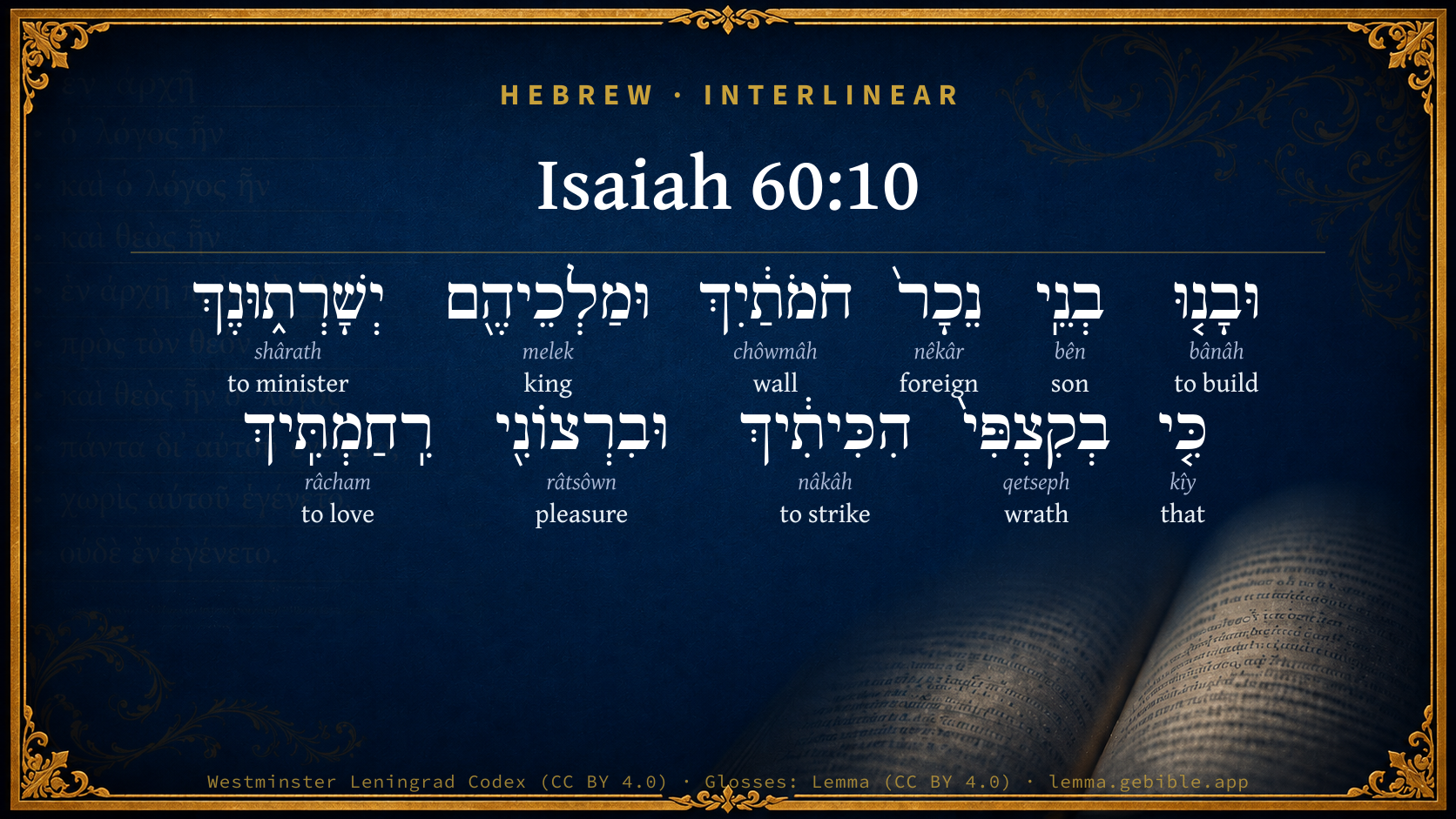
Hebrew (Westminster Leningrad Codex) Isaiah 60:10 appears in the Hebrew Old Testament. The text above is from the Westminster Leningrad Codex. Each word links to its Strong’s number, a concise gloss, and parsing drawn from the Open Scriptures Hebrew Bible morphology. Click any word for its full Brown-Driver-Briggs (BDB) entry.
Download image
Cite this verse

Isaiah 60:10 (World English Bible). Public Domain. Lemma interlinear Bible study tool, https://lemma.gebible.app/v/isaiah/60/10.

Show BibTeX & RIS
BibTeX
RIS
English Translation
Foreigners shall build up your walls, and their kings shall minister to you: for in my wrath I struck you, but in my favor have I had mercy on you.
World English Bible · Public Domain
Download a study sheet

One document with this verse’s original text, its word-by-word gloss line, the meaning frame, cross-references with their text, attributed commentary, and full source and license credits — printable, and it pastes into notes with its structure intact.

This verse Autodidact and up

Study sheet (.html) Plain text (.txt)

A passage Seminary Student

Up to 50 verses in one chapter. A passage sheet keeps up to 6 commentary sources and 12 cross-references per verse, in the order this page ranks them, and says so on the sheet whenever that leaves anything out. Ask for a single verse and you get the Autodidact verse sheet above.

Everything on this page stays free to read, with no account — the sheet is a download of what is already on screen, not access to it.

Want to remove ads? Support Godless Engineer
Compare translations 3

The same verse in 3 English versions, stacked beneath the original-language interlinear above. Click any original word for its lexicon entry.

Each is an independent rendering of the whole verse — the interlinear is not word-aligned to these translations.

Highlighted words mark where these versions differ — a whole-verse word diff, not a word-by-word alignment.

  • World English Bible Public Domain
    Foreigners shall build up your walls, and their kings shall minister to you: for in my wrath I struck you, but in my favor have I had mercy on you.
  • King James Version Public Domain
    And the sons of strangers shall build up thy walls, and their kings shall minister unto thee: for in my wrath I smote thee, but in my favour have I had mercy on thee.
  • unfoldingWord Literal Text CC BY-SA 4.0
    And sons of foreignness will build your walls, and their kings will serve you; for in my wrath I struck you, but in my favor I will have compassion on you.

unfoldingWord Literal Text — © unfoldingWord, licensed CC BY-SA 4.0. Word-aligned USFM3 via Door43 (git.door43.org/unfoldingWord/en_ult).

Versions to compare (up to 4)

3 of 4 selected

Show all 18 translations

Every available English version of this verse, each an independent rendering of the whole verse.

  • World English Bible Public Domain
    Foreigners shall build up your walls, and their kings shall minister to you: for in my wrath I struck you, but in my favor have I had mercy on you.
  • Berean Standard Bible Public Domain
    Foreigners will rebuild your walls, and their kings will serve you. Although I struck you in anger, yet in favor I will show you mercy.
  • Majority Standard Bible Public Domain
    Foreigners will rebuild your walls, and their kings will serve you. Although I struck you in anger, yet in favor I will show you mercy.
  • King James Version Public Domain
    And the sons of strangers shall build up thy walls, and their kings shall minister unto thee: for in my wrath I smote thee, but in my favour have I had mercy on thee.
  • American Standard Version (1901) Public Domain
    And foreigners shall build up thy walls, and their kings shall minister unto thee: for in my wrath I smote thee, but in my favor have I had mercy on thee.
  • Revised Version (1885) Public Domain
    And strangers shall build up thy walls, and their kings shall minister unto thee: for in my wrath I smote thee, but in my favour have I had mercy on thee.
  • Geneva Bible (1599) Public Domain
    And the sonnes of strangers shall builde vp thy walles, and their Kings shall minister vnto thee: for in my wrath I smote thee, but in my mercie I had compassion on thee.
  • Douay-Rheims (1899) Public Domain
    And the children of strangers shall build up thy walls, and their kings shall minister to thee: for in my wrath have I struck thee, and in my reconciliation have I had mercy upon thee.
  • Young's Literal Translation Public Domain
    And sons of a stranger have built thy walls, And their kings do serve thee, For in My wrath I have smitten thee, And in My good pleasure I have pitied thee.
  • Literal Standard Version CC BY-SA 4.0
    And sons of a stranger have built your walls, || And their kings serve you, || For in My wrath I have struck you, || And in My good pleasure I have pitied you.
  • Unlocked Literal Bible CC BY-SA 4.0
    Sons of foreigners will rebuild your walls, and their kings will serve you; though in my wrath I punished you, yet in my favor I will have compassion on you.
  • unfoldingWord Literal Text CC BY-SA 4.0
    And sons of foreignness will build your walls, and their kings will serve you; for in my wrath I struck you, but in my favor I will have compassion on you.
  • Darby Bible Public Domain
    And the sons of the alien shall build up thy walls, and their kings shall minister unto thee. For in my wrath I smote thee, but in my favour have I had mercy on thee.
  • World Messianic Bible Public Domain
    “Foreigners will build up your walls, and their kings will serve you; for in my wrath I struck you, but in my favor I have had mercy on you.
  • Webster's Bible Public Domain
    And the sons of strangers shall build up thy walls, and their kings shall minister to thee: for in my wrath I smote thee, but in my favor have I had mercy on thee.
  • Free Bible Version CC BY-SA 4.0
    Foreigners will rebuild your walls, and their kings will work for you. Even though I did hit you when I was angry with you, now I will be kind and merciful to you.
  • Bible in Basic English Public Domain
    And men from strange countries will be building up your walls, and their kings will be your servants: for in my wrath I sent punishment on you, but in my grace I have had mercy on you.
  • JPS Tanakh (1917) Public Domain
    And aliens shall build up thy walls, and their kings shall minister unto thee; for in My wrath I smote thee, but in My favour have I had compassion on thee.

Literal Standard Version (2020), Covenant Press — licensed CC BY-SA 4.0. Text via the HelloAO Bible API (eBible.org). Unlocked Literal Bible (unfoldingWord) — licensed CC BY-SA 4.0. Text via the HelloAO Bible API (eBible.org). unfoldingWord Literal Text — © unfoldingWord, licensed CC BY-SA 4.0. Word-aligned USFM3 via Door43 (git.door43.org/unfoldingWord/en_ult). Free Bible Version, Dr. Jonathan Gallagher — licensed CC BY-SA 4.0. Text via the HelloAO Bible API (eBible.org).

Word by word

More ways to search: Search by grammar → Find every occurrence → Compare this word →

Practice this passage: Drill this verse → Learn its vocabulary →

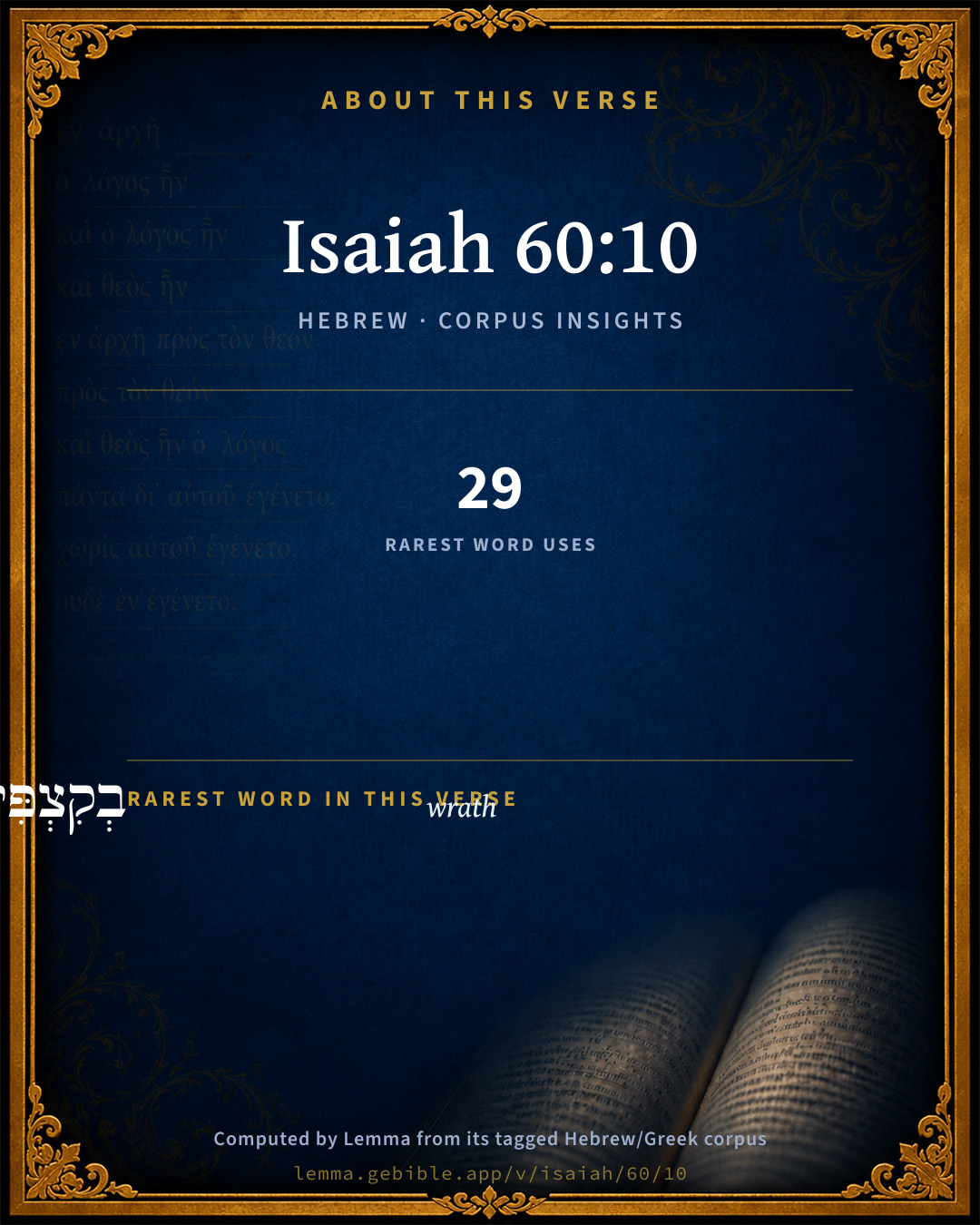
בְקִצְפִּי֙
qetseph
H7110
“in/at · wrath · my”
Preposition + Noun, Common, Masculine, Singular, Construct + Suffix, Personal, 1st Person, Common, Singular
Part of Speech
Preposition + Noun
Type
Common
Gender
Masculine
Number
Singular
State
Construct
Full BDB Definition

Origin: from H7107

TWOT: 2058a , 2059b

wrath, anger - of God - of man - splinter, twig, broken twig - meaning dubious
  1. וּבָנ֤וּ bânâh H1129 “and · to build” Conjunction + Verb, Qal, Sequential Perfect, 3rd Person, Common, Plural
  2. בְנֵֽי bên H1121 “sons of” Noun, Common, Masculine, Plural, Construct
  3. נֵכָר֙ nêkâr H5236 “foreign” Noun, Common, Masculine, Singular, Absolute
  4. חֹמֹתַ֔יִךְ chôwmâh H2346 “walls · your” Noun, Common, Feminine, Plural, Construct + Suffix, Personal, 2nd Person, Feminine, Singular
  5. וּמַלְכֵיהֶ֖ם melek H4428 “and · kings · their” Conjunction + Noun, Common, Masculine, Plural, Construct + Suffix, Personal, 3rd Person, Masculine, Plural
  6. יְשָׁרְת֑וּנֶךְ shârath H8334 “to minister · you” Verb, Piel, Imperfect, 3rd Person, Masculine, Plural + Suffix, Personal, 2nd Person, Feminine, Singular
  7. כִּ֤י kîy H3588 “that” Conjunction
  8. הִכִּיתִ֔יךְ nâkâh H5221 “to strike · you” Verb, Hiphil, Perfect, 1st Person, Common, Singular + Suffix, Personal, 2nd Person, Feminine, Singular
  9. וּבִרְצוֹנִ֖י râtsôwn H7522 “and · in/at · pleasure · my” Conjunction + Preposition + Noun, Common, Masculine, Singular, Construct + Suffix, Personal, 1st Person, Common, Singular
  10. רִֽחַמְתִּֽיךְ râcham H7355 “to love · you” Verb, Piel, Perfect, 1st Person, Common, Singular + Suffix, Personal, 2nd Person, Feminine, Singular

About this verse

These counts appear in no published source. They are computed here, from the morphology-tagged text and Lemma’s own curated glosses. What Lemma adds →

11
words
11
distinct lemmas
Prophets
section

Shared distinctive vocabulary

בְקִצְפִּי֙ wrath H7110 occurs in 29 verses of the Hebrew Bible. Also found in:

Grammatical profile

  • 4 verbs
  • 6 nouns
  • 1 conjunction

Verb forms

  • וּבָנ֤וּ Qal · Sequential Perfect
  • יְשָׁרְת֑וּנֶךְ Piel · Imperfect
  • הִכִּיתִ֔יךְ Hiphil · Perfect
  • רִֽחַמְתִּֽיךְ Piel · Perfect

Hebrew & Septuagint length

In English translation the verse runs 30 words from the Hebrew and 30 from the Septuagint (LXX English) — the same length.

A rough comparison of the two English renderings, which tokenize alike — not a word-level alignment.

Word counts can differ between the Hebrew and the Greek without any difference in meaning — e.g. the Hebrew direct-object marker אֵת has no separate Greek word, and Greek often adds the article ὁ.

Cross-references

15

Topical passages linked to Isaiah 60:10 in the Treasury of Scripture Knowledge — connected by theme and wording, ordered by reader-vote popularity; previews shown in the World English Bible.

  • Isaiah 61:5 Strangers shall stand and feed your flocks, and foreigners shall be your plowmen and your vine-dressers.
  • Isaiah 49:23 Kings shall be your nursing fathers, and their queens your nursing mothers: they shall bow down to you with their faces to the earth, and lick the dust of your feet; and you shall know that I am Yahweh; and those who wait for me shall not be disappointed.
  • Revelation 21:26 and they shall bring the glory and the honor of the nations into it so that they may enter.
  • Isaiah 14:1–2 For Yahweh will have compassion on Jacob, and will yet choose Israel, and set them in their own land: and the foreigner shall join himself with them, and they shall cleave to the house of Jacob.
  • Isaiah 60:3 Nations shall come to your light, and kings to the brightness of your rising.
  • Zechariah 6:15 Those who are far off shall come and build in the temple of Yahweh; and you shall know that Yahweh of hosts has sent me to you. This will happen, if you will diligently obey the voice of Yahweh your God."'"
  • Revelation 21:24 The nations will walk in its light. The kings of the earth bring the glory and honor of the nations into it.
  • Psalms 30:5 For his anger is but for a moment; His favor is for a lifetime. Weeping may stay for the night, But joy comes in the morning.
  • Isaiah 12:1 In that day you will say, "I will give thanks to you, Yahweh; for though you were angry with me, your anger has turned away and you comfort me.
  • Isaiah 54:7–8 For a small moment have I forsaken you; but with great mercies will I gather you.
  • Isaiah 57:17–18 For the iniquity of his covetousness was I angry, and struck him; I hid [my face] and was angry; and he went on backsliding in the way of his heart.
  • Ezra 6:3–12 In the first year of Cyrus the king, Cyrus the king made a decree: Concerning the house of God at Jerusalem, let the house be built, the place where they offer sacrifices, and let the foundations of it be strongly laid; the height of it sixty cubits, and the breadth of it sixty cubits;
  • Ezra 7:12–28 Artaxerxes, king of kings, to Ezra the priest, the scribe of the law of the God of heaven, perfect and so forth.
  • Nehemiah 2:7–9 Moreover I said to the king, If it please the king, let letters be given me to the governors beyond the River, that they may let me pass through until I come to Judah;
  • Isaiah 66:21 Of them also will I take for priests [and] for Levites, says Yahweh.

Cross-references courtesy of OpenBible.info (CC BY 4.0).

Hebrew and Greek witnesses Masoretic Hebrew ↔ Greek Septuagint

The same verse in the two great witnesses to the Old Testament, shown verse-for-verse.

These are two independent witnesses, not word-aligned to each other, and the Septuagint is shown in lemma (dictionary) form.

Hebrew Isaiah 60:10 Masoretic · Westminster Leningrad Codex

וּבָנ֤וּ בְנֵֽי נֵכָר֙ חֹמֹתַ֔יִךְ וּמַלְכֵיהֶ֖ם יְשָׁרְת֑וּנֶךְ כִּ֤י בְקִצְפִּי֙ הִכִּיתִ֔יךְ וּבִרְצוֹנִ֖י רִֽחַמְתִּֽיךְ

Foreigners shall build up your walls, and their kings shall minister to you: for in my wrath I struck you, but in my favor have I had mercy on you.

World English Bible · Public Domain

Greek LXX Isaiah 60:10 Septuagint · lemma form

καί οἰκοδομέω ἀλλογενής ὁ τεῖχος σύ καί ὁ βασιλεύς αὐτός παραἵστημι σύ διά γάρ ὀργή ἐγώ πατάσσω σύ καί διά ἔλεος ἀγαπάω σύ

And strangers shall build your walls, and their kings shall wait upon you: for by reason of my wrath I struck you, and by reason of mercy I loved you.

LXX2012 (modern English Septuagint) · Public Domain

On this verse, Keil & Delitzsch discusses the Septuagint’s reading. Read the note in Commentary ↓

Hebrew: Westminster Leningrad Codex (CC BY 4.0). Greek: Septuagint (public domain); English from LXX2012 (modern English Septuagint) (Public Domain). How the Septuagint differs from the Hebrew →

Targum (Aramaic paraphrase)

1

The Targum is the ancient Jewish Aramaic paraphrase of the Hebrew Scriptures — an interpretive translation, not the Hebrew text itself. Onkelos (literal) and Pseudo-Jonathan (expansive) render the Torah, and Jonathan the Prophets. Coverage is partial: where no permissively-licensed English translation exists for a verse, only the Aramaic is shown. This is verse-level text, not a word-by-word alignment to the Hebrew.

  1. Targum Jonathan Prophets (Joshua–Malachi)
    וְיִבְנוֹן בְּנֵי עַמְמַיָא שׁוּרָךְ וּמַלְכֵיהוֹן יְשַׁמְשׁוּנִיךְ אֲרֵי בְרוּגְזִי אַלְקֵיתִיךְ וּבִרְעוּתִי אֲרַחֵם עֲלָךְ:

    And the sons of the nations shall build up thy walls, and their kings shall minister unto thee: for in my wrath I smote thee, but in my favour have I had mercy on thee.

    Targum Jonathan — Aramaic: “Mikraot Gedolot” (public domain). English: “Sefaria Community Translation” (CC0 1.0 (public-domain dedication)); “London "Chaldee Paraphrase," 1871” (public domain). Text via Sefaria.

Commentary

Notes on Isaiah 60:10 from classic Christian and Jewish commentators (each source and its license shown beneath its notes). The classic Christian expositions comment on the surrounding passage and are grouped to its opening verse, so a note may address several verses; the Jewish commentaries on the Tanakh (Rashi and others) are per-verse, so they appear only where the commentator wrote on this verse.

Lemma curates 59 commentaries, every one of them public domain or Creative Commons licensed, each selected and text-cleaned for this edition rather than reprinted as found. About our sources →

Trapp's Complete Commentary

John Trapp

Isa 60:10 And the sons of strangers shall build up thy walls, and their kings shall minister unto thee: for in my wrath I smote thee, but in my favour have I had mercy on thee.

Ver. 10. And the sons of strangers shall build up thy walls.] By preaching and writing for the truth, as did many famous Greek and Latin doctors; and since them, not a few of all nations.

And their kings shall minister unto thee.] As did Cyrus and Darius; but especially Constantine the Great (who cared not what he bestowed upon the Church, and was therefore, in a jeer, by the heathens called Pupillus, as if he needed a guardian to order his expenses), Valentinian, Theodosius, Honorius, Justinian. Our Edward VI, {a} besides the much good he did at home, sent at one time five thousand pounds to relieve Protestants beyond seas. Queen Elizabeth sent both men and means in abundance to the relief of the French and Hollanders.

{a} His Life, by Sir John Heywood, p. 115.

John Trapp, A Commentary or Exposition upon All the Books of the Old and New Testament (1647–1656) — public domain. Text from a community e-Sword module.

Joseph Benson's Commentary

Isa 60:10-12. And the sons of the stranger — Namely, such as were not Israelites born, but of Gentile race; and he puts sons of strangers, by a usual Hebraism, for strangers; shall build up thy walls — As Gentile proselytes to the Jewish religion assisted the Jews in repairing the walls of Jerusalem upon their return from captivity, so Gentile converts to Christianity assisted the apostles, evangelists, and other ministers of Christ, who were of Jewish extraction, in building and adorning the Christian Church: and for many ages its builders have been almost wholly of Gentile race. And their kings shall minister unto thee — Ecclesiastical history affords us many instances of kings and princes that were great benefactors to her, among whom Constantine greatly excelled. For in my wrath I smote thee, &c. — As I afflicted thee in mine anger, so out of my compassions I will abundantly bless thee. “The discourse here,” says Vitringa, “rises, and will continue to rise till the end of the section, that the blindest may discern spiritual things involved in these corporeal figures and emblems. It is not sufficient that the nations only, with their wealth and possessions, shall be added to the church, and perform all requisite offices toward it, but kings and princes also shall come: nor shall they come alone; a great retinue shall attend them: nor shall instances of their approach be few and rare, but common and frequent; insomuch that the gates of the city shall be always left open to receive this continual accession of kings and people.” The nation, &c., that will not serve thee — Do offices of kindness to thee, as the word ועבדוis used Isa 19:23, or, that will not submit to Christ’s sceptre; shall perish — Shall not only be subdued to thee, but shall be destroyed by the sword, or famine, or pestilence, or some other of the divine judgments. Yea, those nations shall be utterly wasted — Shall, by the peculiar interposition of a righteous providence, be brought to desolation. “This,” says Lowth, “must relate to the latter days, as the Scripture calls them, when the church shall become a great mountain, and break in pieces all the kingdoms of the earth, according to Daniel’s prophecy, Dan 2:35; Dan 2:44.”

Joseph Benson's Commentary on the Old and New Testaments (1811–1818) — public domain. Text from a community e-Sword module.

Keil & Delitzsch

C. F. Keil & F. Delitzsch

The first turn (Isa 60:1-3) described the glorification of Zion through the rising of the glory of Jehovah; the second (Isa 60:4-9) her glorification through the recovery of her scattered children, and the gifts of the Gentiles who bring them home; and now the third depicts her glorification through the service of the nations, especially of her former persecutors, and generally through the service of all that is great and glorious in the world of nature and the world of men. Not only do the converted heathen offer their possessions to the church on Zion, but they offer up themselves and their kings to pay her homage and render service to her. "And sons of strangers build thy walls, and their kings serve thee: for in my wrath I have smitten thee, and in my favour I have had mercy upon thee. And thy gates remain open continually day and night, they shall not be shut, to bring in to thee the possessions of the nations and their kings in triumph. For the nation and the kingdom which will not serve thee will perish, and the nations be certainly laid waste." The walls of Zion (חמתיך doubly defective) rise up from their ruins through the willing co-operation of converted foreigners (Isa 56:6-7), and foreign kings place themselves at the service of Zion (Isa 49:23); the help rendered by the edicts of Cyrus, Darius, and Artaxerxes Longimanus being only a prelude to events stretching on to the end of time, though indeed, in the view of the prophet himself, the period immediately succeeding the captivity really would be the end of time. Of the two perfects in Isa 60:10, הכּיתיך points to the more remote past; רחמתּיך to the nearer past, stretching forward into the present (cf., Isa 54:8). On pittēăch, patescere, hiscere, see Isa 48:8, where it is applied to the ear, as in Sol 7:13 to a bud. The first clause of Isa 60:11 closes with ולילה; tiphchah divides more strongly than tebir, which is subordinate to it. At the same time, "day and night" may be connected with "shall not be shut," as in Rev 21:25-26. The gates of Zion may always be left open, for there is no more fear of a hostile attack; and they must be left open ad importandum, that men may bring in the possession of the heathen through them (a thing which goes on uninterruptedly), נהוּגים וּמלכיהם. The last words are rendered by Knobel, "and their kings are leaders (of the procession);" but nâhūg would be a strange substantive, having nothing to support it but the obscure יקוּש from יקושׁ, for אחוּז in Sol 3:8 does not mean a support, but amplexus (Ewald, 149, d). The rendering "and their kings escorted," i.e., attended by an escort, commends itself more than this; but in the passage quoted in support of this use of nâhag, viz., Nah 2:8, it is used as a synonym of hâgâh, signifying gemere. It is better to follow the lxx and Jerome, and render it, "and their kings brought," viz., according to Isa 20:4; Sa1 30:2, as prisoners (Targ. zeqı̄qı̄n, i.e., beziqqı̄m, in fetters) - brought, however, not by their several nations who are tired of their government and deliver them up (as Hitzig supposes), but by the church, by which they have been irresistibly bound in fetters, i.e., inwardly conquered (compare Isa 45:14 with Psa 149:8), and thus suffer themselves to be brought in a triumphal procession to the holy city as the captives of the church and her God. Isa 60:12 is connected with this nehūgı̄m; for the state of every nation and kingdom is henceforth to be determined by its subjection to the church of the God of sacred history (עבד, δουλεύειν, in distinction from shērēth, διακονεῖν, θεραπεύειν), and by its entrance into this church - the very same thought which Zechariah carries out in Isa 14:16. Instead of כי־הגוי, כי is more properly pointed according to certain MSS with munach (without makkeph); the article before haggōyim is remonstrative, and the inf. intens. chârōbh makes the thing threatened unquestionable.

Keil & Delitzsch — Biblical Commentary on the Old Testament (1861–1891) — public domain (CC PDM 1.0). Text via the HelloAO Bible API. (Old Testament only.)

Tyndale Open Study Notes

Tyndale Open Resources

60:10-16 Those who previously oppressed the people of God will one day participate in restoring the holy city (see 2:2-4; 19:18-25; Neh 2:8; Amos 9:12).

60:10 their kings will serve you: God’s people who were previously humiliated (2:11) will be exalted.

Tyndale Open Study Notes — © Tyndale Open Resources, licensed CC BY-SA 4.0. Text via the HelloAO Bible API.

Geneva Bible (1599)

Geneva Bible translators

Meaning, Cyrus and his successors, but chiefly this is accomplished in them that serve Christ, being converted by his Gospel.

Geneva Bible (1599) marginal notes — public domain. Text via Bolls.life.

Jamieson, Fausset & Brown

Robert Jamieson, A. R. Fausset & David Brown

kings . . . minister unto thee--(See on Isa 60:7; Isa 49:23).

in my wrath I smote thee-- (Isa 54:7-8; Isa 57:17).

Jamieson, Fausset & Brown — Commentary Critical and Explanatory on the Whole Bible (1871) — public domain (CC PDM 1.0). Text via the HelloAO Bible API.

Ellicott's Commentary for English Readers

(10) The sons of strangers shall build . . .—Either as willing proselytes or as being brought into subjection. (Comp. Zec_6:15.) To build the temples or palaces of conquerors was, as in the case of the Egyptian and Babylonian bondage, the almost inevitable lot of the conquered.

A Bible Commentary for English Readers, edited by Charles John Ellicott (1878–1897) — public domain. Text from a community e-Sword module.

The Cambridge Bible for Schools and Colleges

gen. ed. J. J. S. Perowne

10. the sons of strangers] strangers (R.V.), as in ch. Isa_56:3; although the reference here is not to individual proselytes, but to foreigners in general. It is not even certain that the verse implies a willing cooperation of heathen converted to the religion of Israel, although this is to be presumed. In either case the rebuilding of the walls by the heathen who had destroyed them is the sign of the complete removal of the divine anger against Israel.

for in my wrath &c.] Cf. ch. Isa_54:7-8.

The Cambridge Bible for Schools and Colleges (gen. ed. J. J. S. Perowne; Cambridge University Press, 1878–1918) — public domain. Text from a community e-Sword module.

John Gill's Exposition

And the sons of strangers shall build up thy walls,.... The sons of the people; or Gentiles, as the Targum; who were strangers from the covenants of promise, and aliens from the commonwealth of Israel; strangers to God and Christ, and the Spirit of Christ, and to the Gospel, and all that is good; yet the sons of these, being in great numbers converted everywhere, will be useful in building up the church of God, in strengthening, protecting, and defending it; these are the same with those afar off, that shall come and build in the temple of the Lord, Zac 6:15, such there have been among the Gentiles in all ages, more or less, since the times of the apostles, who have been instruments of the edification of the church, and of the defence of its doctrines and ordinances; and more there will be in the latter day:

and their kings shall minister unto thee; that is, the kings of the Gentiles, as Constantine, and some other truly Christian kings and emperors, have done, though their numbers have been very small as yet; but, when this prophecy is fulfilled, it will be a general case; kings everywhere will be nursing fathers, and queens nursing mothers to the church, will serve the interest of it, and promote it to the uttermost of their power; see Isa 49:23,

for in my wrath I smote thee, but in my favour have I had mercy on thee; for the Jews' rejection of the Messiah, for their contempt of his Gospel, and persecution of his apostles and ministers, wrath came upon them to the uttermost, upon their city, temple, and nation, to the destruction of them, and which is still upon them; and though blindness is happened unto them, and they are shut up in unbelief, yet there is a time when the Lord will have mercy on them, call and convert them, and return their captivity; see Rom 11:25.

John Gill's Exposition of the Whole Bible (1746–1763) — public domain (CC PDM 1.0). Text via the HelloAO Bible API.

Albert Barnes' Notes on the Bible

And the sons of strangers - They who have been devoted to a foreign and a false religion shall become devoted to the true religion, and engage in the service of the true God.

Shall build up thy walls - Jerusalem is represented as a ruined city. Her walls had been thrown down, and were lying prostrate. In restoring her to her former magnificence, strangers and foreigners would lend their cheerful aid. The idea is, that they would become tributary to the church, and esteem it a privilege to be engaged in any service, however laborious, that would promote its best interests.

And their kings - (See the notes at Isa 49:23).

For in my wrath I smote thee - Referring to the calamities which he had, from time to time, brought on Jerusalem (see Isa 57:17).

But in my favor - (See the notes at Isa 54:8).

Albert Barnes' Notes on the Bible (1834–1885) — public domain. Text from a community e-Sword/MySword module.

Haydock's Catholic Bible Commentary

To thee. The Persians monarchs (Calmet) were mostly favourable to the Jews. (Haydock) --- The Gentiles help to form the Church, which rejects no one, ver. 11.

George Leo Haydock (1774–1849), Haydock's Catholic Family Bible and Commentary, 1859 edition — public domain. Excludes Psalms (Douay-Rheims chapter numbering differs from Protestant) and Deuterocanonical books (Catholic canon only).

Matthew Poole's English Annotations

The sons of strangers, viz. such as were not Israelites; and he puts sons of strangers by a usual Hebraism for strangers, properly termed alienigenae: see Isa 56:3. This was literally fulfilled in repairing the walls of Jerusalem; he spake before of the temple, now of the city; and spiritually in the ministers of the gospel, who are the walls and bulwarks of the church by preaching and writing for her; and ecclesiastical history affords us many instances of kings and princes that were great benefactors to her, among whom Constantine did greatly excel, not caring what he bestowed on her, Valentinian and Theodosius, &c.

Shall minister; shall administer all necessaries to thee: as they had been demolished by the Babylonians, so they were repaired by the favour of Cyrus, Darius Hystaspes, Artsxerxes, &c., all strangers, Ezr 6:7, &c, or strangers becoming proselytes: see Isa 56:6.

In my wrath I smote thee, but in my favour have I had mercy on thee; as I afflicted thee in my anger, so out of my compassions I will abundantly bless thee.

Matthew Poole's English Annotations on the Holy Bible (1683–1685) — public domain. Text from a community e-Sword/MySword module.

Whedon's Commentary on the Bible

Daniel D. Whedon

10. Strangers — Foreigners of false religions converted to the true religion. In…

wrath I smote thee — This refers to the morale of wasted Jerusalem, and their captivity at Babylon.

Their kings — Perhaps including Cyrus, Darius, etc., of Persia; likewise the later Christian kings.

Daniel D. Whedon (gen. ed.), Commentary on the Old and New Testaments (1874–1909) — public domain. Text from a community e-Sword module.

The Pulpit Commentary

Vers. 10-14. The third stanza. Zion"s reconstruction.

The sons of strangers shall build up thy walls. Cyrus aided in the supply of timber for the construction of the second temple. (Ezr_3:7) Artaxerxes Longimanus sanctioned the rebuilding of the wall of Jerusalem. (Neh_1:3 Neh_2:5-8) The passage has, however, a meaning beyond the literal one. "Strangers" of all kinds, Greeks, and Romans, and Syrians, and Africans, and Cauls, and Spaniards, and others, assisted in building and enlarging the walls of the Church as it spread over the world, set up its bulwarks in the Creeds, and fenced it round about with various decrees and canons. Their kings shall minister unto thee (see the comment on ver. 3). Among ministrant kings may be mentioned Cyrus, Darius the son of Hystaspes, Artaxerxes Longimanus, Alexander the Great, Constantine, Theodosius, Charlemagne, St. Louis, etc. I had mercy on thee. A preterit of prophetic certitude. Mr. Cheyne translates, "I will have compassion upon thee."

The Pulpit Commentary (1880–1919), ed. H.D.M. Spence-Jones & Joseph S. Exell — public domain. Text from a community e-Sword module.

John Wesley's Explanatory Notes

Minister - Shall administer all necessaries to thee. I had mercy - As I afflicted thee in my anger, so out of my compassion I will abundantly bless thee.

John Wesley, Explanatory Notes Upon the Whole Bible (1754–1765) — public domain. Text via the GEBible commentary corpus.

J. A. Alexander on Isaiah

Joseph Addison Alexander

“And strangers shall build thy walls, and their kings shall serve thee; for in my wrath I smote thee, and in my favor I have had mercy on thee.” For the true sense of the phrase translated ‘strangers’, see above on Isa 56:3; and with the last clause compare Isa 54:7-8. The ‘for’ relates to the whole of that clause taken together; not to the first member by itself. It was not because God had been angry, but because He had been angry and relented, that they were to be thus favored. (See above, on Isa 12:1). The Prophet here foretells the agency of strangers or new converts in promoting the safety and prosperity of Israel, under figures borrowed from the old economy, and implying a vicissitude or alternation of distress and joy, such as Isaiah frequently exhibits. The building of the walls here mentioned is the same as that in Psa 51:18, and Psa 147:2, where it is no more to be literally understood than the captivity of Zion in Psa 14:7, or that of Job in Job 42:10.

Joseph Addison Alexander, The Prophecies of Isaiah (1846–1847; New York: Scribner, 1870–1878) — public domain. Text from a community e-Sword module.

unfoldingWord translationNotes

Door43 World Missions Community

General Information:

Yahweh continues speaking to the people of Israel.

they will not be shut day or night

Here "day" and "night" together mean "all the time." This can be stated in active form. AT: "no one will ever shut them" (See: Active or Passive and Merism)

so that the wealth of the nations may be brought, with their kings being led

This can be stated in active form. AT: "so that the people of the nations may bring their wealth, along with their kings" (See: Active or Passive)

translationWords

son

alien

king

servant

wrath

punish

favor

compassion

gate

unfoldingWord translationNotes — © Distant Shores Media and the Door43 World Missions Community, licensed CC BY-SA 4.0. Source: git.door43.org/Door43/en_tn.

Rashi

Rabbi Shlomo Yitzchaki (Rashi)

and in my grace Because I favored you; in old French, en mon apayemant.

Rashi on the Tanakh — English translations: “The Judaica Press complete Tanach with Rashi, translated by A. J. Rosenberg” (CC BY 4.0); “Pentateuch with Rashi's commentary by M. Rosenbaum and A.M. Silbermann, 1929-1934” (public domain); “The Metsudah Tanach series, Lakewood, N.J” (CC BY 4.0); and “The Book of Joshua, Metsudah Publications, 1997” (CC BY 4.0). Text via Sefaria.

Ibn Ezra

Rabbi Abraham ibn Ezra

And the sons of strangers shall build, etc. The Israelites will not build the walls of Jerusalem, as they did not build even the temple; other nations will do it.

Ibn Ezra on the Tanakh — English translations: “Sefaria Community Translation” (CC0 1.0 (public-domain dedication)); “Yalkut, Sifsei Chachomim Chumash, Metsudah Publications, 2009” (CC BY 4.0); and “Commentary of Ibn Ezra on Isaiah - trans. by M. Friedlander, 1873” (public domain). Text via Sefaria.

Lesson kit

Teaching starters — assembled from the data on this page, not authored interpretation. Every prompt links to the verse data it draws on. Edit before teaching.

Isaiah, in the Prophets, opens this verse with 11 words (11 distinct Hebrew lemmas). Its most distinctive word is qetseph (“wrath”). A historical commentator’s framing appears above. Read the whole chapter for the surrounding context.

Discussion questions

  1. How does “wrath” (qetseph) shape what this verse is saying?
  2. Numbers 1:53 shares the word «wrath» with this verse. How do the two illuminate each other?
  3. These translations render this verse differently. What is at stake in choosing one wording over another?
  4. The verb «וּבָנ֤וּ» is Qal Sequential Perfect. How does its form color the action?
  5. Reading how Trapp's Complete Commentary and Joseph Benson's Commentary read this verse, where do the two commentators agree and where do they part?

Things to notice

Reading settings

Reading text

Shown beneath each verse's original-language words.

Old Testament
Old Testament edition

Read the OT as the Masoretic Hebrew (MT) or the Greek Septuagint (LXX).

English shown for the Greek Septuagint (in the Hebrew ↔ Greek comparison).

Comparing translations? Open the Compare panel on any verse page to stack up to four side by side.